winter tires AUDI Q3 2015 Owners Manual
[x] Cancel search | Manufacturer: AUDI, Model Year: 2015, Model line: Q3, Model: AUDI Q3 2015Pages: 258, PDF Size: 64.9 MB
Page 75 of 258
M N
M N
0 ::i co ,...., \!) ..,.,
,...., ..,., ,....,
vehicle to skid or the rear end to break away -risk ing an accident.
Speed warning system
Overview
T he speed warning system helps you to keep
your driving speed below a set speed limit.
The speed warning system warns if the driver
exceeds a prev iously stored maximum speed .
A warning tone will sound as soon as the vehi
cle speed exceeds the set speed by about
3 mph (3 km/h). At the same time , an indica
tor lamp
(mj (USA models) / ISJ (Canada mod
e ls) will light up in the instrument cluster dis
p lay and the driver message
Spe ed limit
wa rning exceeded.
wi ll appear. The indicator
l amp
1mj / i•j will go out when the speed
drops below the set speed lim it aga in.
Setting a thresho ld is recommended if you
wou ld like to be reminded when you reach a
certain maximum speed . Situations where yo u
may want to do so include driving in a country
with a general speed limit or if the re is a
specified max imum speed for winter tires .
(D Tips
Even though your vehicle is equipped with
a speed warning system, you should st ill
watch the speedometer to make sure you are not driving faster than the speed lim it.
Setting speed limit
You can set , change and delete the threshold
in the MMI.
.,. Se lect :
I CAR I funct ion button > S ystem s or
Car System s control button > Vehicle set
tings > Speed warning .
You can set any thresho ld between 20 mph
(30 km/h) and 150 mph (240 km/h). Settings
can each be adjusted in increments of 6 mph
(10 km/h) .
On the ro ad 73
Cruise control
Description
The cruise cont ro l system makes it poss ible to
drive at a constant speed start ing at 15 mph
(20 km/h).
The speed is kept constant by modifying en
gine powe r or th rough an active brake inte r
vention.
A WARNING
- Always pay attention to the traffic
around you when the cruise control is in
operation. You are always responsible for
your speed and the distance between
your vehicle and other vehicles.
- For reasons of safety, cr uise control
should not be used in the city, in stop
and-go traffic, on winding roads and
when road cond it ions are poor (such as
ice, fog, gravel, heavy rain and hydro
plan ing) -you could have an accident .
- Sw itch the cruise control off temporar ily
when dr iv ing in turning lanes, h ighway
exits or in constr uction zones.
- Please note that unconsc iously "resting"
your foot on the accelerator pedal pre
vents the cruise control from braking .
This is due to the control system be ing
overridden by the dr iver's acceleration .
- If a b rake system malfunction s uc h as
overheating occurs when the cruise con
trol system is swi tched on, the braking
function in the system may be switched off . The other cruise control functions re
main active as long as the indicator light
II (US models) !l'I (Canada mode ls) is
on .
(D Tips
-The cruise control system is ideal for
stretches w ith speed limits. The driver is
responsib le for adhering to the correct
speed.
- The cru ise control remains act ive when
shift ing gears .
Page 160 of 258
158 Intellig ent technolog y
brake discs and pa ds with a few caref ul
brake a pplicat ions.
- If you damage the front s poiler, or if you
insta ll a different spoiler, be su re the air
flow to the front brakes is not obstruct ed. Otherwise the brake system could
ov erhe at r educi ng the eff ect iveness of
t h e enti re brak e system.
- Failure of one brake ci rcuit will impair
the braking capability resulting in an in creased stopp ing distance. Avoid driv ing
the vehicle and have it towed to the near
est author ized Audi dealer or qualif ied
wor kshop.
- Never let the vehicle rol l to a stop w ith
the engine shu t off.
- If the brake booster is not working, the
brake pedal must be pressed conside ra
bly harder to make up for the lac k of
booster assistance.
Electromechanical
steering
The electromechanical steering supports the
driver 's steering movements .
Power steering adapts electronically based on
the vehicle speed.
Ind icator light s and messages
• Steering fault! Do not drive vehicle !
If this indicator light tu rns on and stays on
and this message appears, t he power steering
may have fa iled.
Stop the vehicle in a safe locat ion as soon as
possib le . Do
not continue driving . See your
author ized Audi dealer or other qua lified re
pa ir facility for assistance .
If the indicator light turns on, the steer ing
may be more d ifficu lt to move or more sensi
tive than usual. The steer ing may also be at an
angle when dr iving st raight . Drive slowly to you
r authorized Audi dea ler or
qualified workshop to have the ma lf u nction
corrected.
l ;:!" ij Steering lock : S ys tem fault! Please con
tact de aler.
The re is an elect ron ic steering column lo ck
malfunction .
Drive to an author ized Audi dealer or qualified
r epair fac il ity immediate ly to have the mal
funct ion corrected.
(D Tips
If the . or ,To n ind icator light only stays
on for a short t ime, yo u may continue dr iv
i ng.
Driving with your
quattro
Applies to veh icles: w ith all-w hee l d ri ve
With all-wheel drive, all four wheels are driv
en.
General information
Wi th a ll-w heel d rive, power is dis trib ute d to
all four wheels . This happens automatically
depending on your driving style and the road
conditions at the time . See a lso
¢ page 153.
The all -whee l dr ive concept is des igned for
high eng ine power. Your veh icle is except ion
ally powerfu l and has excellent d riving charac
terist ics both under normal driving conditions
and on snow and ice. Always read and follow
safety precaut ions¢ .&..
Winter tires
When driving in the winter, yo ur vehicle with
all-wheel drive has an advantage, eve n wit h
regular tires. In winter road conditions it may
be advisable to mount winter tires (or all-sea
son tires) for improved driveability and brak
ing: these tires must be mounted on
all four
wheel s.
See also ¢ page 210, Winter tires.
Tire chains
Where tire chains are mandatory on certain
roads, this norma lly also app lies to ve hicles
Page 198 of 258
196 Tire s and wheel s
-Never mount used tires on yo ur vehicle if
yo u are not sure of their "previous histo
ry." Old used tires may have been dam
aged even though the damage cannot be
seen that can lead to sudden t ire failure
and loss of vehicle control.
- If you notice unusual vibration or if the
vehicle pulls to one side when driving, al
ways stop as soon as it is safe to do so
and check the wheels and tires for dam
age.
(D Note
- Please note that summer and winter
tires are designed for the cond itions that
a re typ ica l in those seasons. Aud i recom-
Glossary of tire and loading terminology
Accessory weight
means t he comb ined we ight (in excess of
those sta ndard items wh ich may be rep lace d)
of automa tic transmission, power s teering ,
power brakes, power wi ndows, power seats,
radio, and heater, to the extent that thes e
items are availab le as factory-installed equip
ment (whether ins talled or not) .
Aspect ratio
means the ratio o f the height to the width of
the tire in percent. Numbers of 55 or lower in
d icate a low sidewall for improved steer ing re
sponse and better overall handling on dry
pavement.
Bead
means t he pa rt of the tire that is made of
steel wires, wrapped or reinforced by ply cords
and that is shaped to fit the rim .
Bead separat ion
means a b reakdown of the bond between
components in the bead.
Cord
means the strands forming the plies in the
tire. mends using winter tires during the w
in
ter months. Low temperatures signifi
cantly decrease the elastic ity o f summe r
tires, which affects traction and braking ability . If summer tires are used in very
co ld temperatures, cracks ca n form o n
the tread bars, resu lting in permanent
tire damage that can cause lo ud driving
noise and unbalanced tires. Aud i is no t
responsib le for this type of d amage .
- Burn ished , polished or chromed rims
must not be used in winter road condi
tions. The s urface of the rims does not
have s uff ic ient corrosion protection for
this and could be permanently damaged
by road sa lt o r similar substances .
Cold tire inflation pressure
means the t ire p ress ure recommended by the
vehicle m anufacture r fo r a tire o f a des ign ated
s ize that has not been d riven for more than a
coup le of miles (ki lometers) at low speeds in
the three hour period before the tire p ress ure
is measured or adjusted .
Curb weight
means the we ight of a motor ve hicl e w ith
standard equipment including the maximum
capac ity of fuel, oi l, and coolant, air condi
tion ing and additional weig ht o f optiona l
equipment.
E x tra load tire
means a t ire design to operate at higher loads
and at higher inflation pressures than the cor
responding standa rd tire . Extra load tires may
be identified as "XL", "x l" , "E X TRA LOAD", or
"RF" on the sidewall.
Gross Axle Weight Rating ("GAWR ")
means the load-carrying capa city of a s ingle
axle system, measured at the tire-ground in-
terfaces.
liJJ>
Page 200 of 258
198 Tires and wheels
Speed rating (letter code)
means the speed at wh ic h a tir e is des igned to
be d riven for extended per io d s o f time. The
ratings range from 93 mph (150 km/h) to
186 mph (298 km/h) ¢ page 207 . You may
not find this in format ion on all tires because
it is not required by law.
The speed rating letter code, w here a pplica
b le, is molded on the tire s idewa ll and indi
cates the maxim um permissible road speeds
¢ &. in Winter tires on page 211.
Tire pressure monitoring system*
means a system tha t d etects when one or
mo re of a vehicle's t ires are under inflated and
i llum ina tes a low t ire p ress ure warn ing te ll
tale .
Tread
means t hat port ion of a tire tha t comes into
con tact w it h t he road.
Tread separation
means pull ing away of the t read from the t ire
car cass .
Treadwear indicators (TWI)
means t he projections withi n the pr inc ipal
g rooves designed to give a v isua l ind ication of
the deg rees of wea r of the tre ad . See
¢ pag e 205, Tread W ear Indicator (TWI) for
mo re inf ormat io n on measu ring tire we ar.
Uniform Tire Quality Grading
is a tire i nfo rmation system developed by the
United States Nat io nal Highway Traffic Safety
Admin istration (N HTSA) that is designed to
h e lp buye rs make re lative compa risons among
tires. The UT QG i s no t a safety r ating an d no t a
g uar antee that a t ire will las t fo r a presc ribed
n umber of m iles (kilome ters) or pe rform in a
certain way. It s imply gives ti re bu ye rs addi
tional informat ion to combine with other con -s
iderations, such as p rice , brand loya lty and
dealer recommendations. Un der UTQ G, tires
are grade d by the t ire manufacturers in three
areas : treadwea r, traction, and temperature
resistance. The UTQG informat ion on the tires,
molded into the sidewalls .
U.S. DOT Tire Identification Number (TIN )
This is the tire's "se ria l numbe r" . It be gins
with the letters "DOT" and ind icates that the
t ir e meets all federa l standards . The next two
numbers or letters ind icate the plant where it
was ma nufactu red, and the last four numbe rs
r eprese nt the week and year of ma nufact ure.
Fo r exampl e,
DOT ... 2214 ...
means that the tire was produced in t he 22nd
wee k of 2014. The ot her numbers are market
ing codes that may or may not be used by the
t ire manufacturer . This information is used to
contact consumers i f a tire defect requires a
r ecall .
Vehicle capacity weight
means the rated cargo and luggage load p lus
150 lbs. (68 k ilograms) times the vehicle's to
ta l seating capacity as listed on the label lo
cated on the driver's side B-pilla r.
Vehicle maximum lo ad on the tire
means that load on an individua l tire that is
determined by distrib uting to eac h axle its
share of the maxim um loaded vehicle weight
and divid ing by two .
Vehicle normal load on the tire
means that load on an individua l t ir e that is
determined by distrib uting to eac h ax le its
share of the curb weight, accessory weight,
and normal occ upant weig ht (d istr ibuted in
accorda nce wit h tab le below¢ page 199)
and divid ing by two .
Page 209 of 258
M N
M N
0 ::i co ,...., \!) 1.1'1 ,...., 1.1'1 ,....,
contribution to good road holding and safe
handling when in good condition and properly
inflated
¢ .&. .
We recommend that all work on t ires and
wheels be performed by an authorized A udi
dealer. They are familiar with recommended
procedures and have the necessary spec ial
too ls and spare parts as we ll as the proper fa
cilities for dispos ing of the old tires .
Authorized Audi dealers have the necessary information about techn ica l requ irements for
installing or changing tires and r ims.
R eplacing t ires and wheel s
Tires shou ld be rep laced at least in pairs and
not individua lly (for example both front tires
or both rear tires together).
Be s ure to read and heed the information to
the tire pressure monitoring system*
¢ page 213.
Always buy rep lacement radial tires that have
the same specifications as the t ires approved
for your ve hicle by Audi. Replacement tires
must always have the same load rating speci
fication as the original equipment or approved
optional tires listed in the table
¢ page 199.
Audi-approved specification tires are specially
matched to your vehicle and its load limits ,
and can contribute to the important road hold
ing, driving character istics, and safety of the
veh icle. The table
( ¢ page 199) lists spec ifica
tions of the t ires approved for the Audi mod
e ls covered by your Owner 's Literature .
T he tire pressure labe l located on dr iver 's side
B-pillar (¢
page 199, fig. 153) lists the speci
fications o f the orig inal equipment tires in
stalled on your veh icle at the time it was man
ufactured .
Federal law requires t ire manufacturers to
p lace s tanda rd ized information on the s ide
wall of all tires¢
fig. 156 . This information
i dent ifies and desc ribes the fundamental
characterist ics , the quality grade of the tire
and a lso provides a tire ide ntificat io n number
Tire s an d wheel s 207
for sa fety standard certification and in case of
a reca ll.
Tire specifications
Knowledge of tire specifications makes it eas
ier to choose the co rrec t tires . Radial ti res
have the tire specifications marked on the
sidewa ll, for examp le:
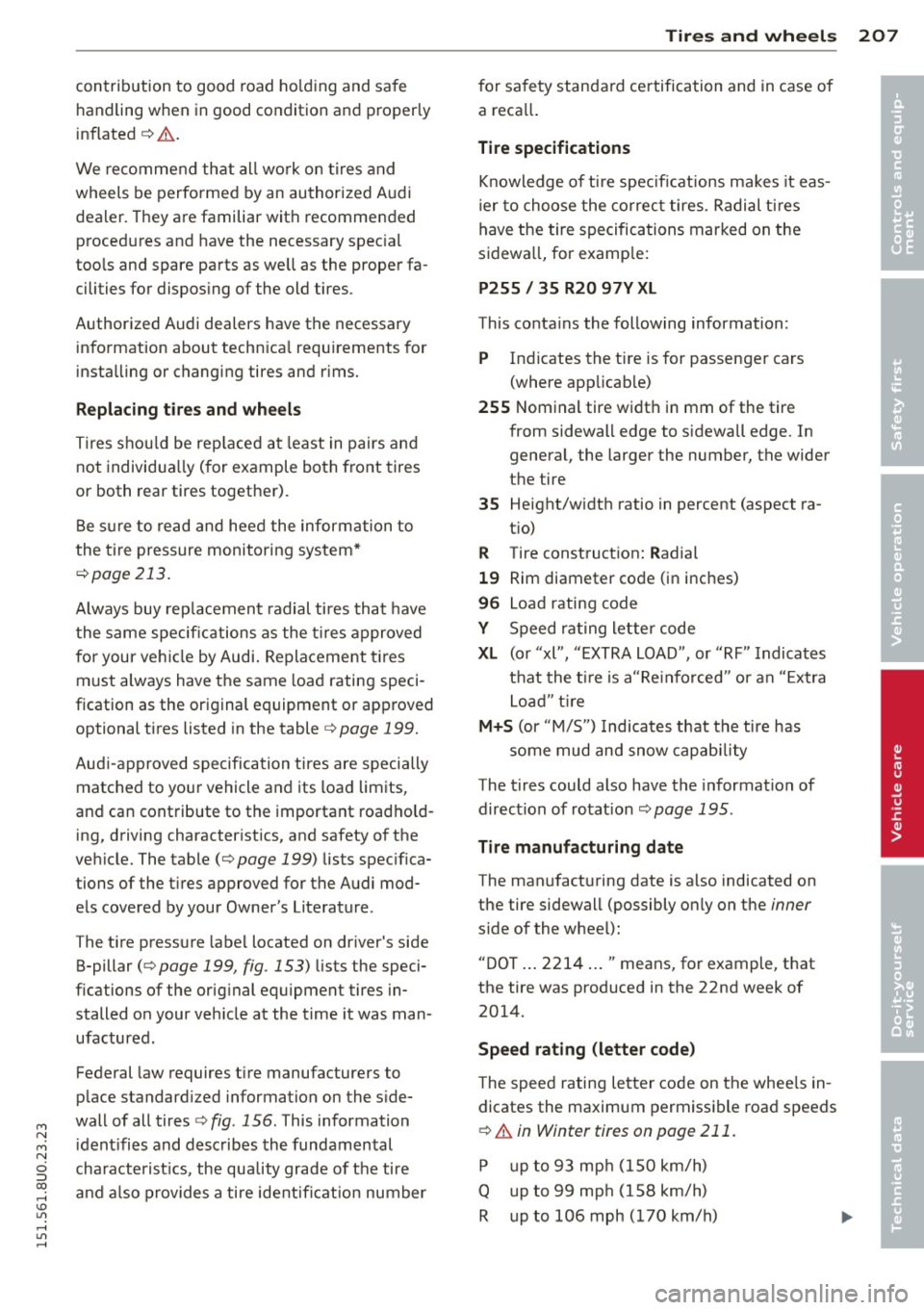
P255 / 35 R20 97Y XL
This co nta ins the following information :
P Indicates the tire is for passenger cars
(where app licab le)
255 Nom inal tire width i n mm of the tire
from sidewall edge to sidewall edge. In
general, the larger the number, the wider
the ti re
35 Height/w idth ratio in percent (aspect ra -
t io)
R Tire construct ion: Radial
1 9 Rim diameter code (i n inches)
96 Load rating code
Y Speed ra ting letter code
XL (or "xl", "EXTRA LOAD", or "RF" Indicates
t h at the t ire is a"Re info rced" or an " Extra
Load " tir e
M+S (or "M/S") Indicates that the ti re has
some mud and snow capab ility
The tires could also have the informat ion of
direction of rotation ¢
page 195 .
Tire manufacturing d ate
The manufact uring date is also indicated on
the tire sidewall (possibly only on the
inner
s ide of the wheel):
"DOT ... 2214 ... "means, for example, that
the tire was produced in the 22nd week of 2014.
Speed rating (letter cod e)
The speed rating letter code on the whee ls in
dicates the maximum permissible road speeds
¢ .&. in Winter tires on page 211.
P up to 93 mp h (150 km/h)
Q up to 99 mp h (1 58 km/h)
R up to 106 mph ( 170 km/h)
•
•
Page 211 of 258
M N
M N
0 ::i co ,...., \!) 1.1'1 ,...., 1.1'1 ,....,
-All four wheels must be fitted with radia l
t ires of the same type, size (roll ing cir
cumference) and the same tread pattern .
Driv ing with different tires reduces veh i
cle handling and can lead to a loss of
control.
- If the spare tire is not the same as the
t ir es that are mounted on the veh icle -
for example with winte r tires -o nl y use
the spare tire for a short period of time and dr ive wi th extra care. Refit the nor
ma l road whee l as soon as safely possi
ble.
- Never drive faster than the maxim um
speed for which the tires on your vehicle
are rated because tires that are driven
faster than their rated speed can fail
sudden ly.
- Overloading tires cause heat build- up,
sudden tire failure, including a blowout
and sudden deflation and loss of control.
- Temperature grades app ly to tires that
are properly inflated and not over or un
der inflated .
- For technical reasons it is not a lways
poss ible to use wheels from other
vehicles -in some cases not even wheels
from the same vehicle model.
- If you install wheel tr im discs on the ve
hicle wheels, make sure that the air flow
to the brakes is not blocked. Reduced air
flow to the brakes can them to overheat,
increasing stopping distances and ca us
ing a collision.
- Run flat t ires may on ly be used on
vehicles that we re equ ipped w ith them
at the facto ry. The vehicle must have a
chassis des igned for run flat t ires and a
facto ry-installed tire p ress ure monito r
ing system* that indicates a loss of tire
pressure. Incorrect use of run flat tires
can lead to vehicle damage or accidents.
Check with an authorized Audi dea ler or
t ire spec ia list to see if your vehicle can be
equipped with run flat tires .
If run flat
t ir es a re used, they must be insta lled on
all four wheels. M ixing tire types is not
permitted.
Tire s an d wheel s 209
@ Note
-For technical reasons, it is not generally
possible to use the wheel rims from oth
er veh icles. Th is can hold tr ue for wheels
of the same vehicle type.
- If the spare tire is d ifferent from the
tires that you have mounted on your ve
hicle (for example winter tires or wide
profi le tires), then use the spare tire for a
short per iod of time only and drive w ith
extra care. Replace the flat tire w ith the
tire matching the othe rs on your vehicle
as soon as possib le.
- Never d rive without the valve stem cap .
T he va lves co uld get d amaged.
(® For the sake of the environment
D ispose of o ld tires in accordance with the
l ocal requirements.
Uniform tire quality grading
- Tread wea r
- Traction AA A B C
- Temperature ABC
Quality grades can be found where applicable
o n the t ire s ide wall between tread shoulder
and maximum section width
c:> page 206,
fig. 156 .
For e xample : Tread wear 200 , Traction AA,
Temperature A.
All passenger car t ires must conform to Feder
al Safety Requirements in addition to these
grades .
Tread w ear
T he tread wear grade is a comparative rating
based on the wear rate of the tire when tested
under contro lled conditions on a specified
government test course.
For example, a tire graded 1S0 wo uld wear
one and one ha lf (1 1/2) times as well on the
government course as a tire graded 100.
1JJ>
•
•
Page 212 of 258
210 Tire s and wheel s
The relat ive performance of tires depends
upon the actua l conditions of their use, how
ever, and may depart sign ificantly from the
norm due to va riat ions in dr iving habits, serv
ice practices and differences in road character
istics and climate.
Tr action
The traction grades , from highest to lowest,
are AA, A, Band
C. Those g rades represent the
tire's ability to stop on wet pavement as measured under controlled cond itions on
specified government test surfaces of asphalt
and concrete . A tire marked C may have poor
traction performance ¢.&, .
Temperature
The tempera ture grades are A (the h ighest),
B, and
C, represen ting the tire's resistance to
the generat ion of heat and its abi lity to dissi
pate heat when tested under controlled cond i
tions on a specified indoor laboratory test
wheel.
Sustained high temperature can cause the
material of the tire to degenerate and reduce
tire life, and excessive temperature can lead
to sudden ti re fa il ur e~ .&, .
The grade
C corresponds to a level of perform
ance which all passenger ca r tires must meet
u nder the Federa l Motor Veh icle Safety Stand
a rd No.
1 09. Grades Band A represent higher
l eve ls of performance on the laboratory test
wheel than the minimum required by law .
A WARNING
The traction grade assigned to this tire is
based on straight-ahead braking traction
tests, and does not include acceleration,
cornering , hydroplan ing or peak traction
character istics.
A WARNING
The temperature grade for this t ire is es
tablished for a t ire that is properly inflated
and not overloaded . Excessive speed, un
derinflation, or excessive loading, eithe r
-
separately or in combination, can ca use
heat bui ldup and possib le tire failure .
Winter tires
Winter tires can improve vehicle handling on
snow and ice. At temperatures below 45 °F ( 7 °C) we recommend changing to winter
tires.
In some heavy snow areas , local governments
may require true winter or "snow" tires, those
with very deeply cut tread . These tires should
only be used in pairs and be installed on all
four wheels . Make sure you purchase snow
tires that are the same s ize and construction
type as the othe r tires on your vehicle .
Your vehicle is equipped with all wheel drive,
th is will improve traction during winter driv
i ng, even with the standa rd t ires. However, we
strong ly recommend that you always equip all
four wheels on you r vehicle wi th cor rectly fit
ted win ter tires o r all -season tires, when win
te r road cond itions are expected . This also im
proves the vehicle's braking performance and
reduces stopping distances.
Summe r tires provide less grip on i ce and
snow.
Winter tires (snow tires) must always be fitted on all four whee ls .
Ask your author ized Audi dealer or qualified
workshop for permitted
winter tir e siz es. Use
on ly rad ial winter t ires .
Winter tires lose their effectiveness when the
tread is worn down to a depth of
O .15 7 inch
(4 mm).
Only drive w ith w inter t ires under winter con
ditions. Summer t ires handle better when
there is no snow or ice on the roads and the
temperature is above 45 °F (7 °() .
If you have a flat ti re, see notes on spare
whee l¢
page 206 .
Please always remember that winter tires may
have a lower speed rating than the tires origi-
nally installed on your vehicle at the time it .,.
Page 213 of 258
M N
M N
0 ::i co ,...., \!) ..,.,
,...., ..,., ,....,
was manufactured. Please see ¢ page 207,
Speed rating (letter code) for a listing of the
speed rat ing letter codes and the maximum
speed at which the tires can be driven .
The speed rating letter code(¢
page 198) is
on the side wall of the tire
c::> page 206.
A WARNING
Winter tires have maximum speed limits
that may be lower than your vehicle's max
imum speed. Always know the maximum
speed before driving off . Never drive faster
than the speed permitted for your specific
w inte r tires . This will cause damage to the
tires leading to an ac cident and serious
pe rsonal inj ury to you and yo ur passen
gers .
A WARNING
Driving faster than the maximum speed
for which the winter tires on your vehicle
were designed can ca use tire fai lure in
cluding a blowout and sudden deflat ion,
loss of control, crashes and serious per
sonal injuries . Have worn or damaged tires
rep laced immed iate ly.
- Winter tires have maximum speed rat ing
that may be lower than your veh icle's
maximum speed .
- Never drive faster than the speed for
w hich the winter or other tires installed
on your veh icle are rated .
A WARNING
Always adjust your d rivi ng to the road and
traffic conditions. Neve r let the good ac
c eleration of the w inte r ti res and all whee l
drive temp t you in to taking extra r is k s . A l
ways remember:
- When bra king, an a ll whee l dr ive vehicle
hand les in the s ame way as a front drive
vehicle.
- Drive carefu lly and reduce your speed on
icy and slippery roads, even winter tires
cannot he lp under blac k ice conditions.
Tire s an d wheel s 211
'
@) For the sake of the environment
Use summer tires when weather condi
tions permit. They are qu ieter, do not wear
as quickly and reduce fuel consumpt ion.
Snow chains
Snow cha ins may be fitted only to the front
wheels, and o nly to certain tire sizes . Ask your
autho rized Aud i deale r on which tire sizes
snow cha ins can be used .
The snow chains must have low-prof ile links
and must not be th icker than 0.53 inch
(13.5 mm) , includ ing the lock .
Remove wheel center covers and trim discs
before putt ing snow cha ins on your vehicle
c::> Q) . For safety reasons cover caps must then
be fitted over the wheel bolts. These are ava il
able from autho rized Aud i dealers.
A WARNING
Using the wrong snow chai ns for your vehi
cle o r insta lling them incorrect ly can in
crease the risk of loss of cont ro l leading to
serious personal injury.
- Snow chains are available in different
sizes. A lways make sure to follow the in
structions p rov ided by the snow chain
manufacturer.
- When driving with snow chains never
drive faster than the speed permitted for
your specif ic snow chains.
- Always observe local regulations .
(D Note
-Remove snow chains before dr iv ing o n
roads not covered with snow to avoid
damaging tires and wea ring the snow
chains down unnecessarily.
- Snow chains, which come into direct con
tact with the whee l rim , can scratch or
damage it . Therefore, make sure that the
snow chains are suitably covered. Check
the pos ition of the snow chains after
•
•
Page 215 of 258
M N
M N
0 ::i co ,...., \!) 1.1'1 ,...., 1.1'1 ,....,
In o rder to minimize the occurrence o f imp act
damage to the tires of y our vehicle, we recom
mend that you observe the following precau
tions :
- Always maintain recommended inflation
pressures. Check your tire pressure every
2,000 miles (3,000 km) and add a ir if neces
sary.
- Drive carefu lly on roads with potholes, deep
gullies or ridges. The impact from driving
through or over such obstacles can damage
your tires. Impact with a curb may also cause damage to your tires .
- After any impact, immediately inspect your
tires or have them inspected by the nearest
authorized Aud i deale r. Replace a damaged
t ire as soon as poss ible .
- In spect your t ires every 2,000 miles (3,000
km) for damage and wear . Damage is not al
ways easy to see. Damage can lead to loss of
air and unde rinflation, wh ic h could eventu
ally cause ti re fa il ur e.
If yo u be lieve that a
t ir e may have been damaged , replace the
tire as soon as possible.
- These tires may wea r more q uick ly than oth
ers.
- Please a lso remembe r that, whi le these t ires
deliver respons ive handling, they may ride
l ess comfortably and make more noise than
other c hoices.
Reduced p erformance in winter /cold
s ea son condit ion s
All ti res are designed for certain purposes .
The low aspect ratio, ultra hig h pe rformance
tires orig inally installed on your veh icle are in
tended for max imum dry and wet road per
formance and handling . They are not suitable
for cold, snowy or icy weather cond it ions . If
you dr ive under those circumstances, you
should equip your vehicle with all-season or
winter tires, whi ch offe r better trac tion under
t hose cond itions . We suggest yo u use the rec
ommended snow or all -season tires specified
for your ve hicle, or their equiva lent .
Refe r to
~ page 210 for mo re deta iled info r
mat io n regarding w in ter t ires.
Tire s an d wheel s 213
Tire pressure
monitoring system
ill General notes
App lies to vehicles : wi th tire p ress ure mo nito rin g system
Each tire, incl uding the spa re (if provided),
sho uld be checked monthly when co ld and in
flated to the inflation pressure recommended
by the veh icle manufacturer on the veh icle
placard or tire inflation pressure label. (If your
vehicle has tires of a d ifferent size than the
s iz e indicated on the vehicle placa rd o r tire in
flat io n pressu re labe l, you s hou ld dete rm ine
the p roper t ire inflation p ress ure fo r those
ti r es).
As an added safety featu re, your veh icle has
been equipped with a tire p ressure monitoring
system ( TPMS) tha t illum inates a low ti re
pressure te lltale whe n one or more o f you r
ti res is significant ly under -inflated . Acco rding
ly, when the low tire pressure te lltale i llumi
nates, yo u shou ld stop and check you r tires as
soon as possib le, and inf late them to the
proper pressure. Driving on a sign ificantly un
der- inflated t ire causes the tire to overheat
and can lead to tire fa ilure . Under-inflation al
so reduces fuel eff ic iency and tire tread life,
and may affe ct the vehicle 's hand ling and
stopp ing abil ity.
Please note that the TPMS is not a subst itute
fo r proper tire ma intenanc e, and it is the d riv
er's respo nsibility to maintain co rrect tire
pressure, even if under -inflation has not
reached the leve l to tr igger illum inat ion o f the
T PMS low ti re p ressu re tellta le .
You r vehicle has also been equipped with a
T PMS ma lf u nction indicator to ind icate w hen
t he sys tem is not oper ating prope rly . T he
T PMS ma lfunction indicator is combined w ith
the low tire pressure te lltale. When the sys
tem detects a malfunction, the telltale wi ll
flash for approximate ly one min ute and then
rema in con tinuously i llum inated . T hi s se
quence will continue upon subsequent vehicle
start-ups as long as the malfunct ion exists . ..,.
•
•
Page 217 of 258
M N
M N
0 ::i co ,...., \!) 1.1'1 ,...., 1.1'1 ,....,
-The driver is responsible for maintaining
the correct tire pressures. You must
check the tire pressures regularly.
- Under certain conditions (such as a spor
ty driving style, winter conditions or un
paved roads), the pressure monitor indi
cator may be delayed.
- Ask your authorized dealer if run-flat
tires may be used on your vehicle. Your
vehicle registration becomes invalid if
you use these tires when not permitted .
Damage to your vehicle or accidents
could also result.
- The tire pressure monitoring system may
stop working when there is an ESC mal
function.
- Using snow chains may result in a system
malfunction.
- The tire pressure monitoring system on
your Audi was developed using tires with
the "AO" or "RO" identification on the
tire sidewall
¢page 206. We recom
mend using these tires.
Reset tire pressure monitoring system
Applies to vehicles: with tire pressure monit oring sys te m
If the tire pressure is adjusted, wheels are ro
tated or changed, the TPMS must be reset.
"'Before storing the new tire pressures, check
that the current pressures on all four tires correspond to the specified values and
adapt the pressures to the current load
¢ page 199.
"'Sw itch on the ignition.
"' Select: the
I CAR I function button > Car* sys
tems
contro l button > Servicing & checks >
Tire pressure monitoring > Store tire pres
sures > Yes, store now .
(D Tips
Do not store the tire pressure if there are
snow chains on the tire. Otherwise, a sys
tem malfunction may occur.
Tires and wheels 215
•
•