brake light AUDI Q3 2015 Owner's Manual
[x] Cancel search | Manufacturer: AUDI, Model Year: 2015, Model line: Q3, Model: AUDI Q3 2015Pages: 258, PDF Size: 64.9 MB
Page 160 of 258
158 Intellig ent technolog y
brake discs and pa ds with a few caref ul
brake a pplicat ions.
- If you damage the front s poiler, or if you
insta ll a different spoiler, be su re the air
flow to the front brakes is not obstruct ed. Otherwise the brake system could
ov erhe at r educi ng the eff ect iveness of
t h e enti re brak e system.
- Failure of one brake ci rcuit will impair
the braking capability resulting in an in creased stopp ing distance. Avoid driv ing
the vehicle and have it towed to the near
est author ized Audi dealer or qualif ied
wor kshop.
- Never let the vehicle rol l to a stop w ith
the engine shu t off.
- If the brake booster is not working, the
brake pedal must be pressed conside ra
bly harder to make up for the lac k of
booster assistance.
Electromechanical
steering
The electromechanical steering supports the
driver 's steering movements .
Power steering adapts electronically based on
the vehicle speed.
Ind icator light s and messages
• Steering fault! Do not drive vehicle !
If this indicator light tu rns on and stays on
and this message appears, t he power steering
may have fa iled.
Stop the vehicle in a safe locat ion as soon as
possib le . Do
not continue driving . See your
author ized Audi dealer or other qua lified re
pa ir facility for assistance .
If the indicator light turns on, the steer ing
may be more d ifficu lt to move or more sensi
tive than usual. The steer ing may also be at an
angle when dr iving st raight . Drive slowly to you
r authorized Audi dea ler or
qualified workshop to have the ma lf u nction
corrected.
l ;:!" ij Steering lock : S ys tem fault! Please con
tact de aler.
The re is an elect ron ic steering column lo ck
malfunction .
Drive to an author ized Audi dealer or qualified
r epair fac il ity immediate ly to have the mal
funct ion corrected.
(D Tips
If the . or ,To n ind icator light only stays
on for a short t ime, yo u may continue dr iv
i ng.
Driving with your
quattro
Applies to veh icles: w ith all-w hee l d ri ve
With all-wheel drive, all four wheels are driv
en.
General information
Wi th a ll-w heel d rive, power is dis trib ute d to
all four wheels . This happens automatically
depending on your driving style and the road
conditions at the time . See a lso
¢ page 153.
The all -whee l dr ive concept is des igned for
high eng ine power. Your veh icle is except ion
ally powerfu l and has excellent d riving charac
terist ics both under normal driving conditions
and on snow and ice. Always read and follow
safety precaut ions¢ .&..
Winter tires
When driving in the winter, yo ur vehicle with
all-wheel drive has an advantage, eve n wit h
regular tires. In winter road conditions it may
be advisable to mount winter tires (or all-sea
son tires) for improved driveability and brak
ing: these tires must be mounted on
all four
wheel s.
See also ¢ page 210, Winter tires.
Tire chains
Where tire chains are mandatory on certain
roads, this norma lly also app lies to ve hicles
Page 165 of 258
M N
M N
0 ::i co ,...., \!) 1.1'1 ,...., 1.1'1 ,....,
If you anticipate what you need to do next and
drive economically, you can easily cut your
fuel consumption by 10-15 percent. This sec
tion will give you some tips on how you can help the environmen t and your pocketbook.
The consumption estimates as published by ENVIRONMENTAL PROTECTION AGENCY
(EPA) and Transport Canada may not corre
spond to your actual consumption on the
road, wh ich will vary depend ing upon vehi
cle load and speed, road and weather con
ditions, tr ip length, etc.
Drive smoothly and keep a lookout
ahead
Vehicles use the most fuel when they are ac
celerating.
.,. Avoid unnecessa ry accelerating and braking.
Vehicles use the most fuel when they are ac
celerating . If you anticipate what is go ing to
happen next, you will need to brake less and,
thus , accelerate less. Let the vehicle coas t
whenever poss ible -for example when you see
that the next traffic light is red.
Avoid full throttle
Driving at moderate speeds saves fuel and
improves your mileage.
.,. Try and keep well be low your car's max imum
speed.
Accelerating gently reduces fuel consump
tion, engine wear, and does not disturb the
environment. Fue l consumption, exhaust emissions and en
g ine no ise increase d isproportionately at high
speeds . If you dr ive at approximately three
qua rters of top speed, fue l consumption will
be red uced by one half. Never dr ive faste r
than the posted speed limi t and wea ther con
ditions permit.
Dri vin g and en vironm ent 163
Reducing unnecessary idling
Even when your car is just idling it burns up
fuel .
.,. Shut the engine off when you are not driving
the vehicle .
.,. Do not warm up the vehicle by lett ing the
eng ine run at idle .
It makes sense to shut off the engine in traffic
jams, when wa it ing for tra ins to pass at rail
road crossings, or at t raff ic lights that have
l ong waits on red . T u rning the eng ine off for
just 30-40 seconds saves mo re fuel tha n is
bur ned star ting the engine again.
It takes a long t ime for the engine to warm up
fully when it is runn ing at id le. However, wear
and noxious emissions are especia lly hig h
when the eng ine is wa rm ing up. So yo u shou ld
drive away as soon as yo u start the engine and
avoid r unning at high rpms whi le the engine is
still warming up.
(D Note
D o not leave engine idling unattended af
ter starting. If warning lights sho uld come
on to indicate improper operation, they
would go unheeded. Extended idling also produces heat, w hich could res ult in over
heating or other damage to the veh icle or
other p roperty .
Regular maintenance
A badly tuned engine unnecessarily wastes a
lot of fuel .
.,. Have you r veh icle serviced at regu lar inter-
vals.
By having your ve hicle reg ularly serviced by an
a uthorized Audi dea le r helps to ensure that it
runs properly and econom ica lly. The cond ition
of your veh icle not only affects its safety and
ability to ho ld its va lue, it a lso affects
fuel
con sumption .
Chec k your o il each t ime you fill your tank.
Ill-
•
•
Page 166 of 258
164 Driving and en vironm ent
The amount of oil used is related to eng ine
load and speed.
I t is normal for the oil consumption of a new
engine to reach its lowest val ue after a certain
mileage has been driven.
You must drive your vehicle about 3 ,000 miles
(5,000 kilometers) before you can properly
assess o il cons umption .
This a lso applies to fuel consumption and en
g ine output .
0 Note
-Have your vehicle maintained properly
and in accordance with the service rec
ommendations in your War ranty
& Main
tenance booklet. Lack of proper mainte
nance as well as imp roper use of the ve
hicle will impair the function of the
emission control system and could lead
to damage.
- Do not a lter or remove any component of
the Emi ssion Contro l System unless ap
proved
by the manufacturer.
- Do not a lter or remove any device, such
as heat shields, switches, ignition wires,
va lves, which are designed to protect
your vehicle's Emiss ion Control System
and other important veh icle compo
nents .
Fewer short trips
Fuel consumption will always be relatively
high on short trips .
• Try to avo id driving sho rt distances with a
cold eng ine.
The engine and catalytic converter have to reach their optimal
ope rating tempe ratu re to
reduce fuel con sumption and noxious emis
sions effect ively.
Just after starting, a cold engine in a mid-size car on ly achieves a fuel economy of 6-8 miles
per gallon (30-40 l/100 km) . After about a
half a m ile, fuel economy climbs to 12 mpg
(20 l/100 km) . After about
2. 5 miles (4 km), the engine is at its proper operating tempera
ture and fuel economy has reached a normal
l evel. So you can see that you should avo id
short trips whenever possible.
T he
out sid e tempe rature is also critical in this
regard . Your car consumes more fue l in the
winter than in the s ummer.
Driving offroad
General information
When driving off road, the functions fo r the
electron ic stabiliza tion control ( ESC) are ex
panded . The ESC-Offroad-Mode can be activat
ed in driving situations in which a wheel lock
or a differential lock function is needed
c> page 155.
Your Audi i s howev er, n ot an offroad vehicle.
Ne ver dri ve the vehicle in te rrain wh ich i s n ot
suitable for the vehicle , o r w hich ex ceeds
y ou r driv ing skill s. Ne ver tak e an y u nneces
s ar y risk s!
Aft er d riving offroad
-After driving offroad, remove branches and
other debris from the radiator gri lle, under
body, and wheels. Look especially for objects
(stones) that have been caught in the tire
tread.
- Clean the body and the vehicle underbody
and inspect the vehicle for possible damag
es.
- Clean off the dirty windows, headlights, tail
lights and the license plate .
- Pe rform a brake test (especially after driving
through water).
A WARNING
- Be especially aware and attent ive when
driving under difficult condit ions . Dam
ages to the vehicle and injur ies may oc
cur when driv ing at an excessively high
speed or with incor rect driving maneu
vers.
- Always adjust you r speed and hand ling
to the roads, terrain, t raff ic and weather
~
Page 168 of 258
166 Trailer towing
Trailer towing Driving with a trailer
General information
Your Audi was designed primarily for passen
ger transportation .
If you plan to tow a trai ler, p lease remember
that the additional load will affect durability,
economy and performance .
Trailer towing not on ly places more stress on
the vehicle, it also calls for more concentra
tion from the driver.
For this reason, always fo llow the operating
and driving instructions provided and use
common sense.
Technical requirements
Tr aile r hitch
Use a weight-carrying hitch conforming to the
gross trailer weight. The hitch must be suita
ble for your vehicle and trailer and mu st be
mounted securely on the veh icle's chassis at a
technically sound location. Use only a trailer
h itch with a removab le ball mount. A lways
check with the trai ler h itch manufact urer to
make sure that you are using the correct
hitch.
Do not use a bumper hi tch .
The hitch must be installed in such a way that
it does not interfere with the impact-absorb
ing bumper system . No modifications should
be made to the vehicle exhaust and brake sys
tems . From t ime to time, check that all hitch
mounting bo lts remain securely fastened.
When you are not towing a trailer, remove the
trailer h itch ball mount. This prevents the
h itch from causing damage should your veh i
cle be struck from behind
¢ A .
Traile r brak es
If your tra iler is equipped w ith a braking sys
tem, check to be sure that it conforms to a ll
regulat ions . The trailer hydraulic brake system must not be
direct ly connected to the vehicle's hydraulic
brake system
~ A .
Saf ety ch ain s
Always use safety chains between your veh icle
and the trai le r.
Trail er light s
Trailer lights must meet all regulations. Be
sure to check w ith your authorized Audi dealer
for correct wi ring, switches, and relays.
Mirrors
If you are unable to see the traffic behind you
us ing the regular outside mirrors, then you
must install extended mirrors .
It is important
that you always have clea r vis io n to the rear.
,8. WARNING
- I f a trai ler has electrical brakes p lease
note that these brakes are not activated
by the factory -fitted control unit -risk of
accident!
- Afte r removing the trailer hitch, do not
store it in your vehicle. In case of sudden
braking, the hitch could fly forward and
injure you or your passengers.
- Never install a "weight distributing" or
"load equalizing" trailer hitch on your ve
h icle. The vehicle was not designed for
these kinds of trailer h itches. The h itch
attachment can fail, caus ing the trailer
to tear loose from the veh icle.
- The Gross Vehicle Weight Rating for your
veh icle, found on the safety compliance
label on the driver's s ide B-pillar, must
never be exceeded under any c ircumstan
ces. Exceeding the Gross Vehicle Weight
Rating of yo ur vehicle is likely to damage
your vehicle, and such damage will not
be covered by yo ur Limited New Ve hicle
Warranty . Exceeding the Gross Vehicle
Weight Rating will a lso change the per
formance and handling characteristics of
your veh icle, wh ich could cause a crash
resulting in serious injury or death.
-
Page 169 of 258
M N
M N
0 ::i co ,...., \!) ..,.,
,...., ..,., ,....,
Operating instructions
6"
~ ~
I 1,2 ..
-{ }
l::_
-
2
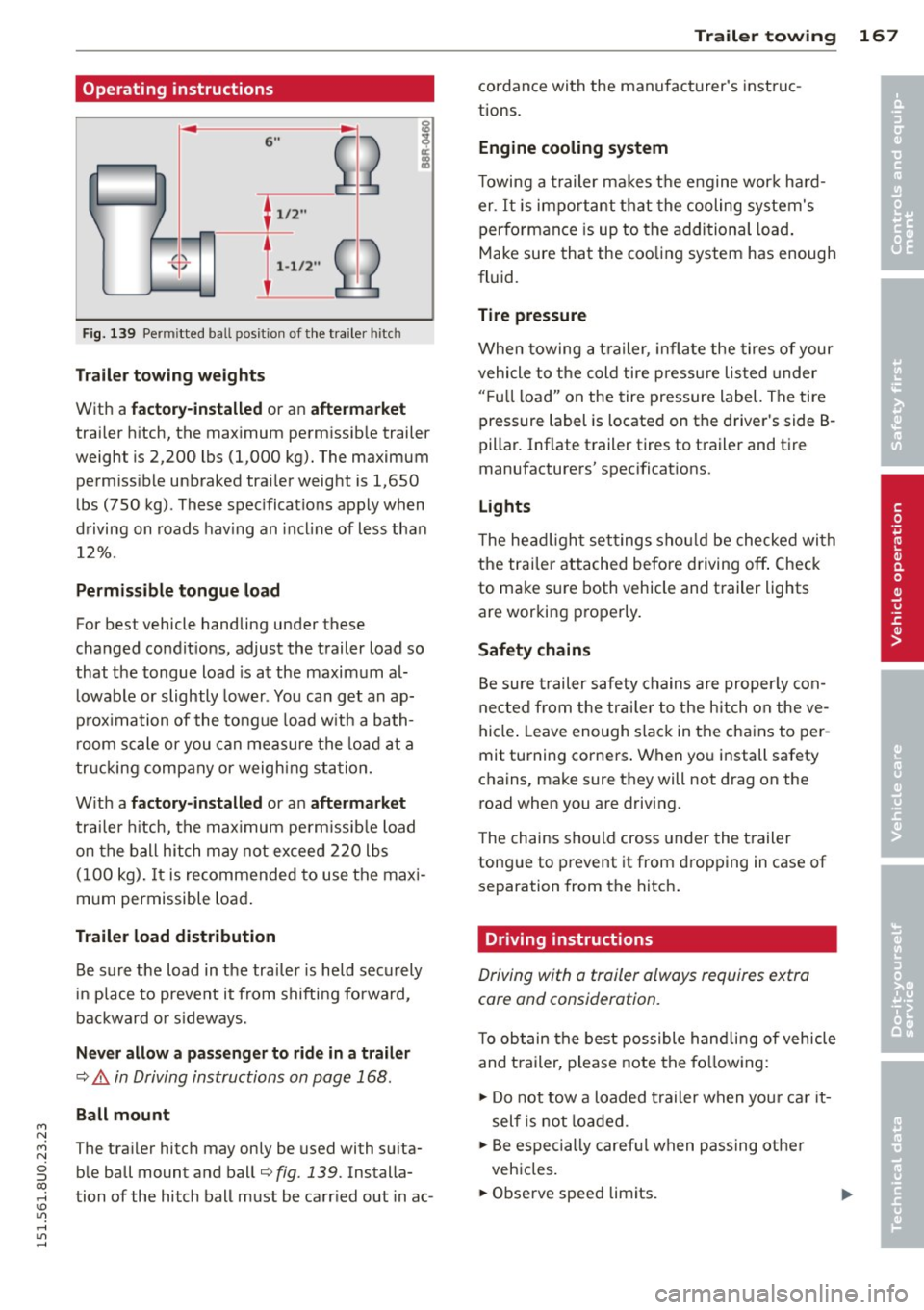
Fig. 139 Permit ted ball position of the trailer hitch
Trailer towing weights
With a factory-installed or an aftermarket
trailer hitch, the maximum permissible trailer
weight is 2,200 lbs (1,000 kg). The maximum permissible unbraked trailer weight is 1,650
lbs (750 kg) . These specifications apply when
driving on roads having an incline of less than
12%.
Permissible tongue load
For best vehicle handling under these
changed conditions, adjust the trailer load so
that the tongue load is at the maximum al
lowable or slightly lower . You can get an ap
proximation of the tongue load with a bath
room scale or you can measure the load at a
trucking company or weighing station.
With a
factory-installed or an aftermarket
trailer hitch, the maximum permissible load
on the ball hitch may not exceed 220 lbs
(100 kg).
It is recommended to use the maxi
mum permissible load.
Trailer load distribution
Be sure the load in the trailer is held securely
in place to prevent it from shifting forward,
backward or sideways.
Never allow a passenger to ride in a trailer
¢.&. in Driving instructions on page 168.
Ball mount
The trailer hitch may only be used with suita
ble ball mount and ball¢
fig. 139. Installa
tion of the hitch ball must be carried out in ac-
Trailer towing 167
cordance with the manufacturer's instruc
tions.
Engine cooling system
Towing a trailer makes the engine work hard
er .
It is important that the cooling system's
performance is up to the additional load.
Make sure that the cooling system has enough
fluid.
Tire pressure
When towing a trailer, inflate the tires of your
vehicle to the cold tire pressure listed under
"Full load" on the tire pressure label. The tire
pressure label is located on the driver's side B
pillar. Inflate trailer tires to trailer and tire
manufacturers' specifications .
Lights
The headlight settings should be checked with
the trailer attached before driving off. Check
to make sure both vehicle and trailer lights
are working properly.
Safety chains
Be sure trailer safety chains are properly con
nected from the trailer to the hitch on the ve
hicle. Leave enough slack in the chains to per
mit turning corners. When you install safety
chains, make sure they will not drag on the
road when you are driving.
The chains should cross under the trailer
tongue to prevent it from dropping in case of
separation from the hitch.
Driving instructions
Driving with a trailer always requires extra
core and consideration.
To obtain the best possible handling of vehicle
and trailer, please note the following :
.,. Do not tow a loaded trailer when your car it
self is not loaded.
.,. Be especially careful when passing other
vehicles.
.,. Observe speed limits.
•
•
Page 170 of 258
168 Trailer towing
• Do not drive at the maximum permissible
speed.
• Always apply brakes early.
• Monitor the temperature gauge.
Weight distribution
Towing a loaded trailer with an empty car re
sults in a highly unstable distribution of
weight. If this cannot be avoided, drive at very low speeds only to avoid the risk of losing
steering control.
A "balanced" rig is easier to operate and con
trol. This means that the tow vehicle should
be loaded to the extent possible and permissi
ble, while keeping the trailer as light as possi
ble under the circumstances. Whenever possi
ble, transfer some cargo to the luggage com
partment of the tow vehicle while observing
tongue load requirements and vehicle loading
considerations .
Speed
The higher the speed, the more difficult it be
comes for the driver to control the rig . Do not
drive at the maximum permissible speed. Re
duce your speed even more if load, weather or
wind conditions are unfavorable -particularly
when going downhill.
Reduce vehicle speed
immediately if the trail
er shows the slightest sign of swaying.
Do not
try to stop the swaying by accelerating.
Observe speed limits . In some areas, speeds
for vehicles towing trailers are lower than for
regular vehicles.
Always apply brakes early. When driving
downhill, shift into a lower gear to use the en
gine braking effect to slow the vehicle. Use of
the brakes alone can cause them to overheat
and fail.
Coolant temperature
The coolant temperature gauge c:> page 10
must be observed carefully . If the needle
moves close to the upper end of the scale, re
duce speed immediately and/or turn off the
air conditioner. If the coolant temperature warning light in
the instrument cluster starts flashing., pull
off the road, stop and let the engine
idle for
about two minutes to prevent heat build-up.
A WARNING
Anyone not properly restrained in a mov
ing vehicle is at a much greater risk in an
accident . Never let anyone ride in your car
who is not properly wearing the restraints
provided by Audi.
Trailer towing tips
Important to know
Your vehicle handles differently when towing
-
a trailer because of the additional weight and
different weight distribution. Safety, perform
ance and economy will greatly depend on how carefully you load your trailer and operate
your rig.
Before you actually tow your trailer, practice
turning, stopping and backing up in an area
away from traffic. Keep practicing until you
have become completely familiar with the way
your vehicle-trailer combination behaves and
responds.
Backing up is difficult and requires practice.
Backing up with a trailer generally requires
steering action opposite to that when backing
up your vehicle without a trailer.
Maintain a greater distance between your ve
hicle and the one in front of you. You will need
more room to stop. To compensate for the
trailer, you will need a larger than normal
turning radius.
When passing, remember that you cannot ac
celerate as fast as you normally would be
cause of the added load. Make sure you have
enough room to pass. After passing, allow
plenty of room for your trailer before chang
ing lanes again.
Avoid jerky starts, sharp turns or rapid lane
changes.
Page 173 of 258
M N
M N
0 ::i co ,...., \!) 1.1'1 ,...., 1.1'1 ,....,
Vehicle care and cleaning 171
Rinse the vehicle thoroughly again and let it
air dry. Remove any water residue using a
shammy .
A WARNING
- Only wash the vehicle when the ignition
is off and follow the instructions from
the car wash operator to reduce the risk
of accidents .
- To reduce the r isk of cuts, protect your
self from sharp metal components when
wash ing the underbody or the inside of
the wheel housings.
- After washing the vehicle, the braking ef
fect may be de layed due to moisture on
the brake rotors or ice in the winter. The
brakes must be dried first with a few
careful brake applications.
([) Note
-If you wash the vehicle in an automatic
car wash, you must fold the exterior m ir
rors in to reduce the ris k of damage to
the mirrors. Power folding exterior mir
rors* must only be folded in and out us
ing the power folding function. -
To prevent paint damage, do not wash
the vehicle in direct sunlight.
- To reduce the risk of damage to the sur
face, do not use insect removing spong
es, kitchen sponges or similar items.
- Matte finish painted vehicle compo
nents:
- To reduce the risk of damage to the
surface, do not use polishing agents or
hard wax.
- Never use car wash cycles that apply
protective wax.
It can destroy the
matte finish effect .
- Do not place any stickers or magnet ic
signs on vehicle parts painted w ith
matte fin ish paint. The paint could be
damaged when the stickers or magnets
are removed.
@ For the sake of the environment
Only wash the vehicle in facilities spec ially
designed for that purpose . This will red uce
the r isk of dirty water contam inated with
oil from entering the sewer system.
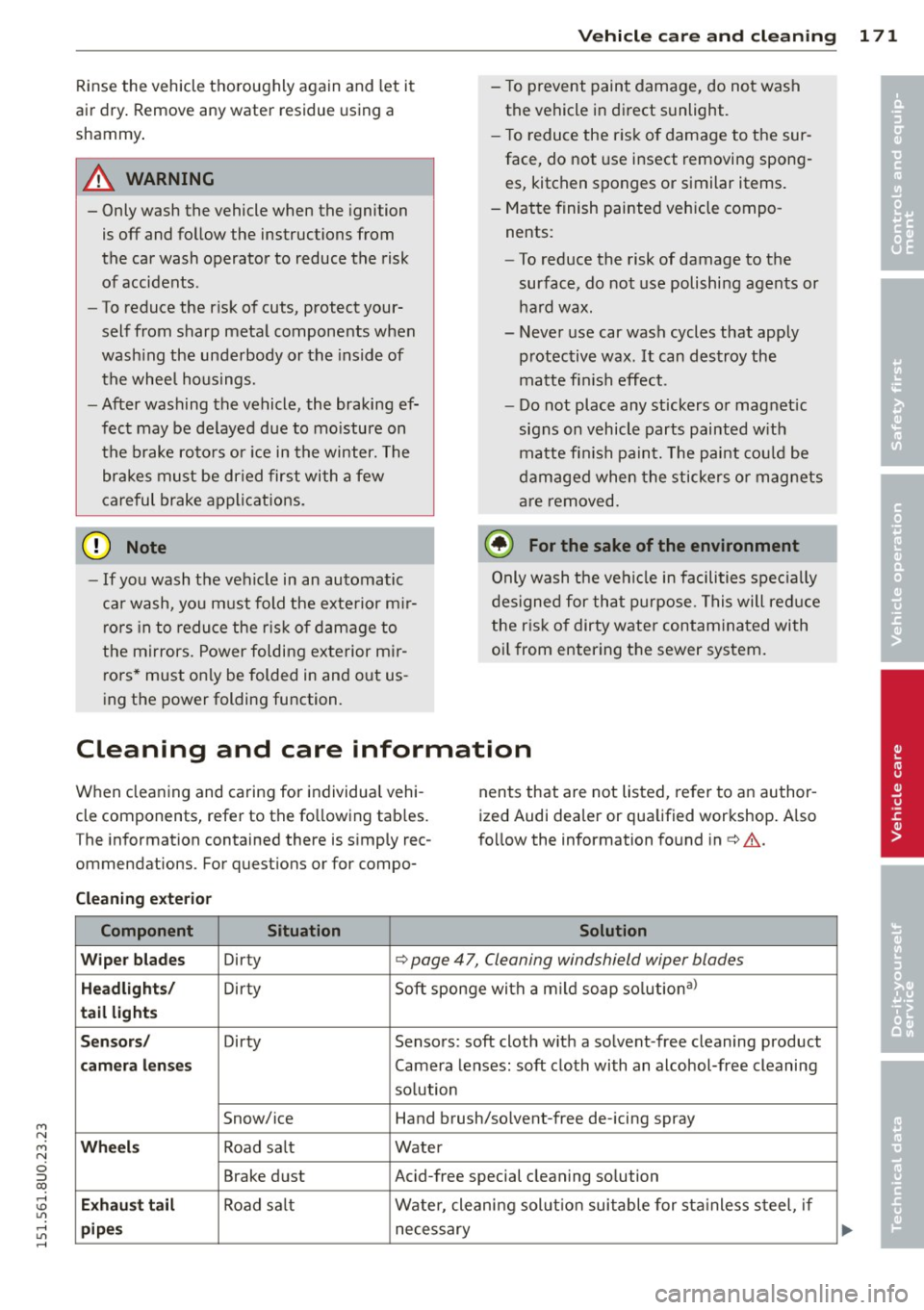
Cleaning and care information
When cleaning and caring for individual vehi
cle components, refer to the following tab les .
The information contained there is simply rec
ommendations . For questions or for compo- nents that are not listed,
refer to an author
ized Audi dealer or qualified workshop. A lso
follow the information found in ¢ ,& .
Cleaning exterior
Component Situation Solution
Wiper blades
Dirty Q page 4 7, Cleaning windshield wiper blades
Headlights/ Dirty Soft sponge with
a m ild soap solutiona>
tail lights
Sensors/
Dirty Sensors: soft cloth with a solvent -free cleaning product
camera lenses Camera lenses: soft cloth with an alcohol-free cleaning
solution
Snow/ice Hand brush/solvent-free de-icing spray
Wheels Road sa lt Water
Brake dust Acid-free special cleaning solution
Exhaust tail Road salt Water, cleaning solut ion suitable for stainless steel, if
pipes necessary
•
•
Page 181 of 258
M N M N
0 ::i co
rl I.O
"' rl
"' rl
Checking and filling Engine hood
Releasing and opening the engine hood
The engine hood is released from inside the
vehicle .
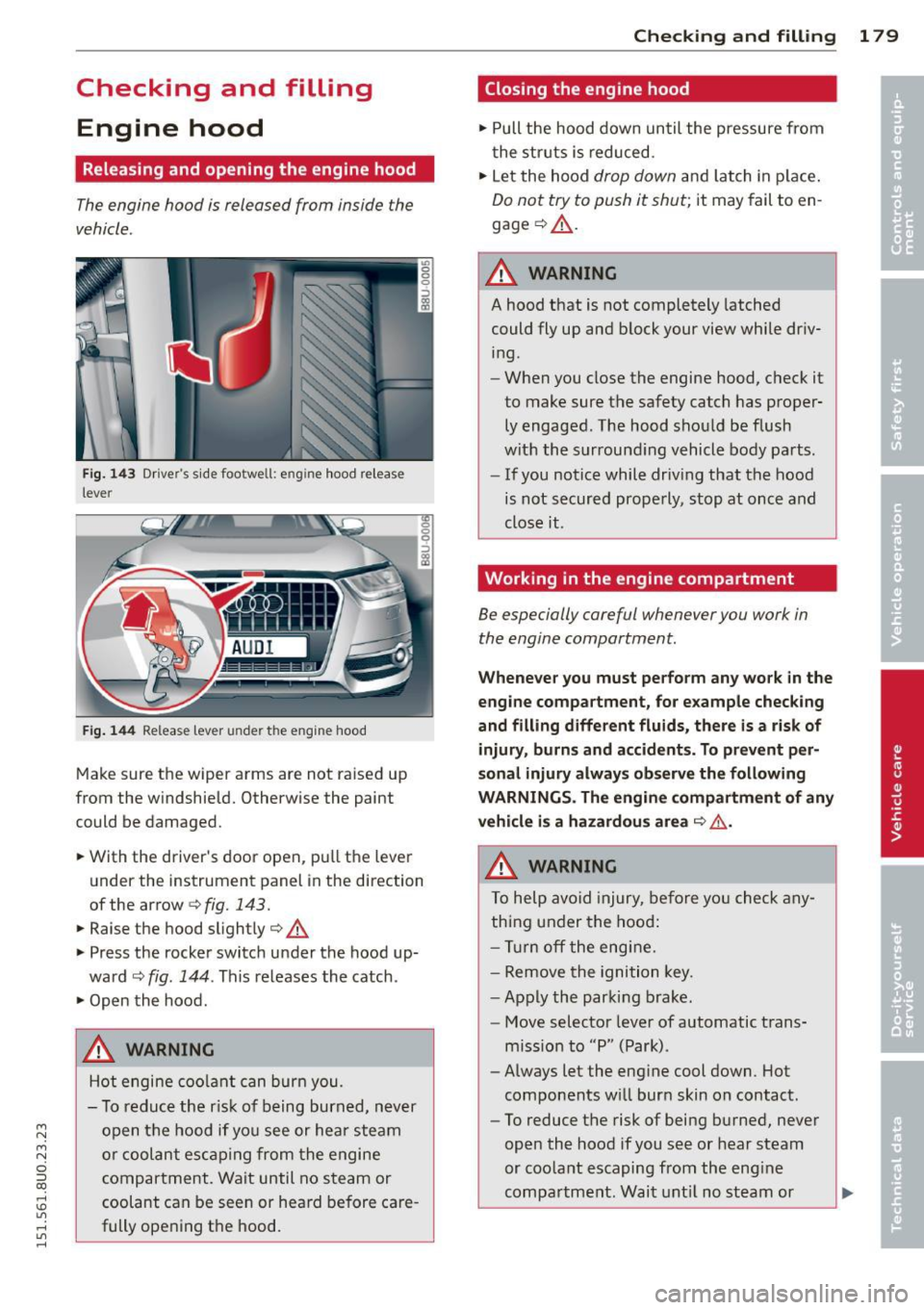
Fig. 1 43 Dr iver's side footwell: eng ine hood release
lever
F ig . 144 Re lease lever un der the engine hood
Make sure the wiper arms are not raised up
from the w indshield. Otherw ise the paint
could be damaged .
.. With the driver's door open, pu ll the lever
under the instrument panel in the direction
of the arrow
c> fig. 143.
.. Raise the hood slightly c> .&,
.. Press the rocker switch under the hood up
ward
c> fig. 144 . This releases the catch .
.. Open the hood.
A WARNING
Hot engine coo lant can burn you.
- T o reduce the r is k of being burned, never
open the hood if you see or hear steam
or coolan t escaping from the engine
compartment. Wait until no steam or
coolant can be seen or heard be fore care
fully opening t he hood.
Checkin g and fillin g 179
Closing the engine hood
.. Pull the hood down un til the pressure from
t he stru ts is reduced.
.. Let the hood
drop down and latch in p lace .
Do not try to push it shut; it may fail to en
gage¢ .&,.
A WARNING
-
A hood that is not completely latched
could fly up and b lock your view while dr iv
ing.
- When you close the engine hood , check it
to make sure the safety catch has proper
ly engaged. The hood shou ld be flush
with the surround ing vehicle body parts.
- If you notice while dr iving that the hood
is not secured properly, stop at once and
close it.
Working in the engine compartment
Be especially careful whenever you work in
the engine compartment.
Whene ve r you must pe rform an y wo rk in the
eng ine compa rtment , for e xample check ing
and filling different fluids, there is a risk of
injury , burns and accidents. To prevent per
so nal injury alway s observe th e foll owing
WARNINGS . Th e engin e compartm ent of an y
v e hicle i s a ha zardou s area
c> .&, .
A WARNING
To help avoid injury, be fore yo u check any
thing under the hood:
- Tu rn off the engi ne .
- Remove the ignition key.
- Apply the parking brake .
- Move selector leve r of automatic trans-
miss ion to "P" (Park) .
- Always let the engine cool down. Hot
components w ill bur n skin on contact.
- To reduce the risk of being burned, never
open the hood if you see or hear steam
or coo la nt escaping from the eng ine
compa rtment. Wait unt il no steam or
Page 191 of 258
M N M N
0 ::i co
rl I.O
"' rl
"' rl
Brake fluid
Checking brake fluid level
The brake fluid level can be checked with a
quick glance.
N
N
;:;;
" 03
"'
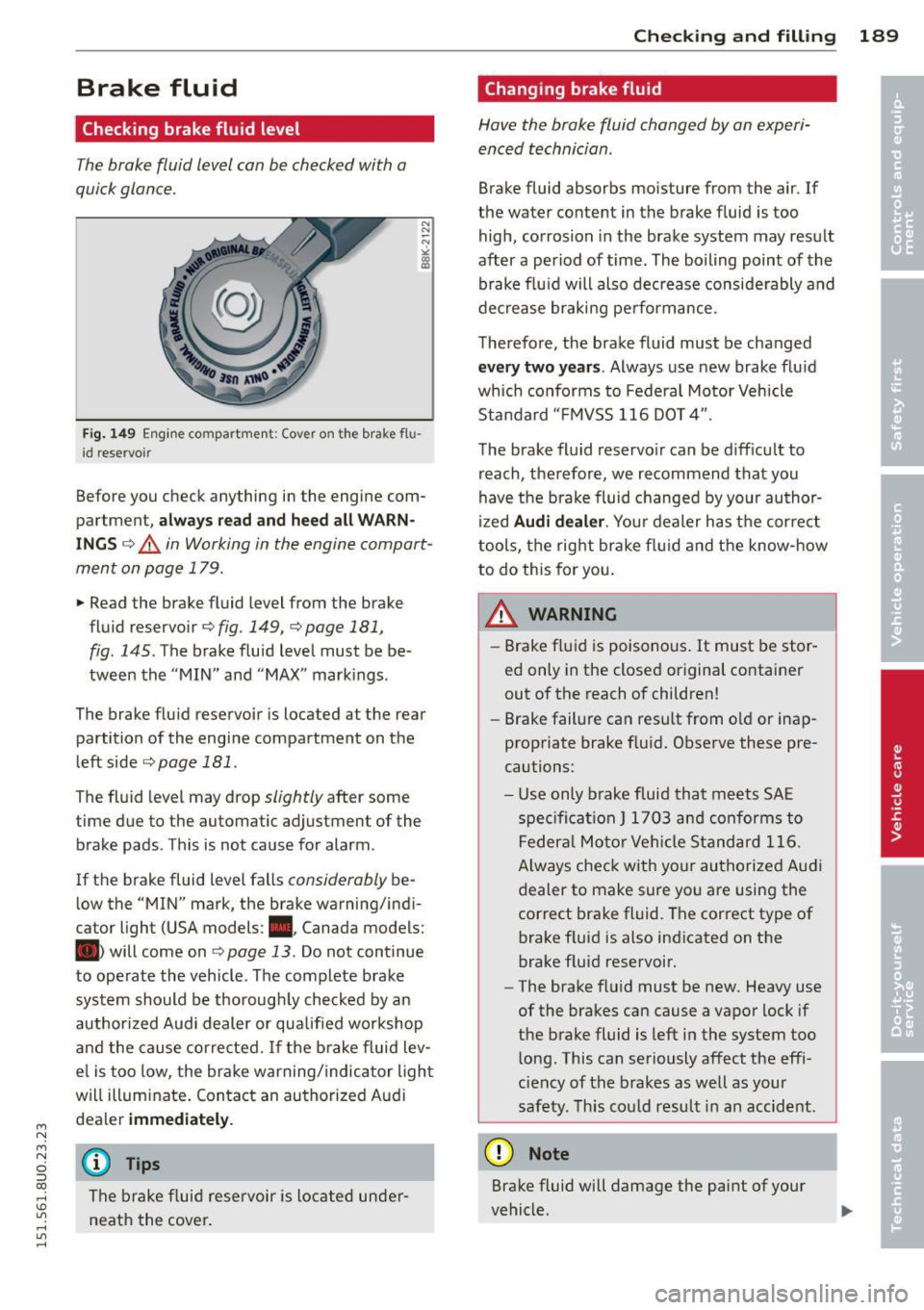
Fi g. 149 Eng ine compartment: Cover on the brake flu
id reservoir
Before you check anything in the engine com
partment,
a lwa ys read and heed all WARN
ING S c:> .&.. in Working in the engine compart
ment on page 179 .
~ Read the brake fluid level from the brake
fluid reservoir
c:> fig. 149, <=> page 181,
fig . 145.
The brake flu id level must be be
tween the "MIN" and "MAX" markings.
The brake fluid reservoir is located at the rear
partition of the engine compartment on the
left side <::;>
page 181 .
The fluid level may drop slightly after some
time due to the automatic adjustment of the
brake pads . This is not cause for alarm .
If the brake fluid level falls
considerably be
low the "MIN" mark, the brake warning/indi
cator light (USA models: ., Canada models:
• will come on
<::;> page 13. Do not continue
to operate the vehicle . The complete brake
system should be thorough ly checked by an
author ized Audi dealer or qua lified workshop
and the cause corrected.
If the brake fluid lev
e l is too low, the brake warning/indicator ligh t
will illuminate . Contact an authorized A ud i
dealer
immediately.
@ Tips
The brake f luid reservoir is located under
neath the cover .
Checking and fillin g 189
Changing brake fluid
Have the brake fluid changed by on experi
enced technician.
Brake fluid absorbs moisture from the air. If
the water content in the brake fluid is too
high, corrosion in the brake system may result
after a period of time . The boiling point of the
brake flu id will also dec rease considerably and
decrease braking pe rformance.
Therefore, the brake fluid must be changed
ev ery two years. Always use new brake flu id
which conforms to Federal Motor Vehicle
Standard "F MVSS 116 DOT 4".
The brake fluid reservo ir can be d iff icult to
reach, the refore, we recommend that you
have the brake fluid changed by your author
i zed
Audi d ealer. Your dealer has t he correct
tools, the right brake fl uid and t he know-how
to do this for you .
A WARNING -.
-Brake fluid is poisonous . It must be stor
ed only in the closed original container
out of the reach of children!
- Brake failure can resu lt from o ld or inap
propriate brake f luid. Observe these pre
cautions:
- Use only brake fluid that meets SAE
spe cificat ion
J 1 7 03 and conforms to
Federa l Moto r Ve hicl e Standard 116.
Always check with yo ur authorized Audi
dealer to make sure yo u are using the
correct bra ke fluid. The correct type of
brake f luid is also indicated on the
brake f luid reservoir.
- The brake fluid must be new. Heavy use
of the brakes can cause a vapor lock if
the brake fluid is left in the system too
l ong . This can seriously affect the effi
c iency of the brakes as well as your
safety. This cou ld resu lt in an accident.
(D Note
Brake fluid will damage the paint of your
vehicle .
Page 192 of 258
190 Checking and filling
@ For the sake of the environment
Because of the problem of proper disposa l
of brake flu id as we ll as the special tools
req uired and the necessary expert ise, we
recommend that you have the b rake fluid
changed by your author ized Audi dealer.
Battery
General information
Unde r normal operating conditions, the bat
tery in your A udi does not need any mainte
nance. With
high outside temperatures or
long daily dr ives we recommend that you have
the elect ro lyte level checked by an authorized
Aud i dea ler o r qualified workshop . The elec
trolyte leve l sho uld a lso be c hecked each t ime
the battery is c harged
c::> page 192.
H ave the battery checked when you take your
ve hicle in for service . Yo u are well adv ised to
replace a bat tery that is older tha n 5 yea rs .
W ith certa in types of a irbag deployment, t he
battery is d isconnected from the vehicle elec
tr ica l system fo r safety reasons
c::> & in Re
pair, core and disposal of the airbags on
page 126.
Disconnecting the battery terminals
Some veh icle functions (power w indow regu
lato rs, for example) are lost if the battery ter
m inals a re discon nected. These functions have
to be re lea rned after the batte ry terminals a re
c onnec ted agai n. T o prevent this, the battery
should o nly be di sconnec ted from the vehicle
e lec trica l syste m when absolu tely necess ary
for repairs.
Vehicles not driven for long periods
I f yo u do not dr ive you r vehicle over a pe riod
of severa l days or weeks, elec trical co m po
n en ts are gr adually cu t back o r swi tched off .
T his reduces energy cons ump tion and main
tains sta rting capab ility over a lon ger perio d
c::> page 159 .
Some o f the conven ien ce f unct ions m ay no t
ope rate, su ch as the in ter ior lights o r the power seat adjus
tment . The convenience
funct ions wi ll be available again when yo u
tu rn on the ign ition and sta rt t he engine .
Winter operation
During the w inte r mon th s, batt ery c apac ity
tends to dec rease as tempera tures drop . This
is beca use more power is a lso consumed w hile
starting, and the headlights, rear win dow de
f ogger, etc., are used more often.
Avoid unnecessa ry powe r consumpt ion, pa r
ticu lar ly in ci ty traffic o r when traveling only
sho rt distances . Let yo ur autho rized A udi
dealer check the capacity of the vehicle bat
tery before w inter sets in
<=:> page 192. A well
charged battery will not on ly prevent starting
problems when the weather is cold, but w ill
also last longer .
@ Tips
If your vehicle is left standing for seve ral
w eeks at extremely low temperatures, the
vehicle battery s hou ld be removed and
s tored w her e it w ill not freeze. This will
preve nt i t fr om be ing d amaged and having
t o be repla ced .
Working on the battery
Be especially careful when working on or near
the battery.
T he battery is loc ated in the luggage compar t
ment under the floo r. B efo re you che ck any
t hi ng in the luggage co mpartmen t,
read and
heed all WARNINGS
c::> .&_ .
Always heed t he safety warnings , when work
i ng on the veh icle ba tte ry or the vehicle e le c
t ric al sys tem to p reven t inju ry.
The following WARNINGS are very
important when working on the battery:
Always heed the following WARNING SYM ·
BOLS and safety precautions when working
on the battery .
®
Always wear eye protection .