instrument cluster AUDI Q3 2015 Owner's Manual
[x] Cancel search | Manufacturer: AUDI, Model Year: 2015, Model line: Q3, Model: AUDI Q3 2015Pages: 258, PDF Size: 64.9 MB
Page 170 of 258
168 Trailer towing
• Do not drive at the maximum permissible
speed.
• Always apply brakes early.
• Monitor the temperature gauge.
Weight distribution
Towing a loaded trailer with an empty car re
sults in a highly unstable distribution of
weight. If this cannot be avoided, drive at very low speeds only to avoid the risk of losing
steering control.
A "balanced" rig is easier to operate and con
trol. This means that the tow vehicle should
be loaded to the extent possible and permissi
ble, while keeping the trailer as light as possi
ble under the circumstances. Whenever possi
ble, transfer some cargo to the luggage com
partment of the tow vehicle while observing
tongue load requirements and vehicle loading
considerations .
Speed
The higher the speed, the more difficult it be
comes for the driver to control the rig . Do not
drive at the maximum permissible speed. Re
duce your speed even more if load, weather or
wind conditions are unfavorable -particularly
when going downhill.
Reduce vehicle speed
immediately if the trail
er shows the slightest sign of swaying.
Do not
try to stop the swaying by accelerating.
Observe speed limits . In some areas, speeds
for vehicles towing trailers are lower than for
regular vehicles.
Always apply brakes early. When driving
downhill, shift into a lower gear to use the en
gine braking effect to slow the vehicle. Use of
the brakes alone can cause them to overheat
and fail.
Coolant temperature
The coolant temperature gauge c:> page 10
must be observed carefully . If the needle
moves close to the upper end of the scale, re
duce speed immediately and/or turn off the
air conditioner. If the coolant temperature warning light in
the instrument cluster starts flashing., pull
off the road, stop and let the engine
idle for
about two minutes to prevent heat build-up.
A WARNING
Anyone not properly restrained in a mov
ing vehicle is at a much greater risk in an
accident . Never let anyone ride in your car
who is not properly wearing the restraints
provided by Audi.
Trailer towing tips
Important to know
Your vehicle handles differently when towing
-
a trailer because of the additional weight and
different weight distribution. Safety, perform
ance and economy will greatly depend on how carefully you load your trailer and operate
your rig.
Before you actually tow your trailer, practice
turning, stopping and backing up in an area
away from traffic. Keep practicing until you
have become completely familiar with the way
your vehicle-trailer combination behaves and
responds.
Backing up is difficult and requires practice.
Backing up with a trailer generally requires
steering action opposite to that when backing
up your vehicle without a trailer.
Maintain a greater distance between your ve
hicle and the one in front of you. You will need
more room to stop. To compensate for the
trailer, you will need a larger than normal
turning radius.
When passing, remember that you cannot ac
celerate as fast as you normally would be
cause of the added load. Make sure you have
enough room to pass. After passing, allow
plenty of room for your trailer before chang
ing lanes again.
Avoid jerky starts, sharp turns or rapid lane
changes.
Page 204 of 258
202 Tire s and whee ls
your veh icle and in this manua l and the kind
of driving you p lan to do .
Neve r e xcee d the m ax imum inflati on pres
s u re list e d on th e tir e s ide wall f or a ny r ea
s on.
Remember that the vehicle manufacturer, not
the tire manufacturer , determ ines the co rrect
tire pressure for the t ires on your veh icle .
It is important to check the tire pressure when
the tires a re cold .
- Read the required t ire pres sure from the tire
pressure label. The ti re pressure label is lo
cated on the driver's side 8-p illar . The t ire
pressure label lists the recommended cold
t ire inflat ion p ressu res for the veh icle at its
maximum capacity we ight and the tires that
were on you r vehicle at the time it was man
ufactured . For recommended tire pressures
for normal load condit ions, please see chap
ter
9 page 199.
-Turn the valve stem cap counter-clockwise
to remove it from the tire valve.
- Place the a ir pressure gauge on the valve.
- T he tire pressures should on ly be checked
and adjusted when the tires are cold. The
s li ghtly raised pressures of warm tires must
not be reduced.
- Adjust the tire pressure to the load you are
carrying .
- Reinsta ll the va lve stem cap on the valve.
When should I check the tire pressur e?
The correct tire pressure is especially impor
tant at high speeds. The pressure should
therefore be checked at least once a month
and always befo re starting a journey. Do not
forget to check the tire pressure for the spare wheel.
When should I ad ju st th e tire p re ss ures?
Adj ust the tire p ressure to the load you are
carry ing . After chang ing a wheel
or replacing
wheels you have to adjust the tire pressures
on all wheels . In addition, you must then in iti
alize the new tire pressures in th e tire pres
sure monito ring system*
c> page 213.
A WARNING
Incorrect tire pressures and/or underinfla
tion can lead sudden tire fa ilure, loss of
control, collision, serious personal injury
or even death.
- When the
Rt] warning symbol appears in
the instrument cluster, stop and inspect
the t ires.
- Incorrect tire pressure and/or underinfla
tion can cause increased tire wear and
can affect the hand ling of the vehicle and
stopping abi lity.
- I nco rrect tire pressures and/or underin
f lation can also lead to sudden t ire fail
ure, including a blowout and sudden de
flation, ca using loss of vehicle contro l.
- The driver is responsible for the co rrect
tire pressures for all tires on the veh icle.
The applicable pressure values are locat
ed on a sticker on the driver's side B -pil
lar.
- Only when all tires on the vehicle are fil
led to the correct pressure, the tire pres
sure monitoring system * can work cor
rectly.
- The use of incorrect tire pressure va lues
can lead to acc idents or other damage.
Therefore it is essential that the driver
observe the spec ified t ire pressure values
for the tires and the correct pressures for
the function of the t i re pressure monitor
ing system*.
- Always inflate t ires to the recommended
and correct t ire p ressure before dr iving
off.
- Driving with underinf lated tires bend
mo re, letting them get too hot resulting
in tread sepa ration, s udden tire failure
and loss of cont ro l.
- E xcessive speed and/overloadi ng can
cause heat b uild- up, sudden tire failure
and loss of cont ro l.
- I f the tire pressure is too low or too high,
the t ires will wear prema turely and the
vehicle wi ll not handle well. ..,
Page 216 of 258
214 Tire s and wheel s
When the malfunction indicator is illuminat
ed, the system may not be able to det ect or
signal low t ire pressure as intended . TPMS
malfunct ions m ay occur for a variety of re a
sons, including the installa tion of replace
ment or a lternate tires or wheels on the vehi
cle that prevent the TPMS from funct ioning
properly . Always check the TPMS malfunct ion
tellta le afte r replacing one or more t ires or
wheels on your veh icle to ensure that the re
p lacement or a lternate tires and wheels allow
the TPMS to continue to function properly.
Tire pressure indicator appears
Applies to vehicles: with tire pressure monito ring system
The tire pressure indicator in the instrument
cluster informs you if the tire pressure is too
low or if there is a system malfunction.
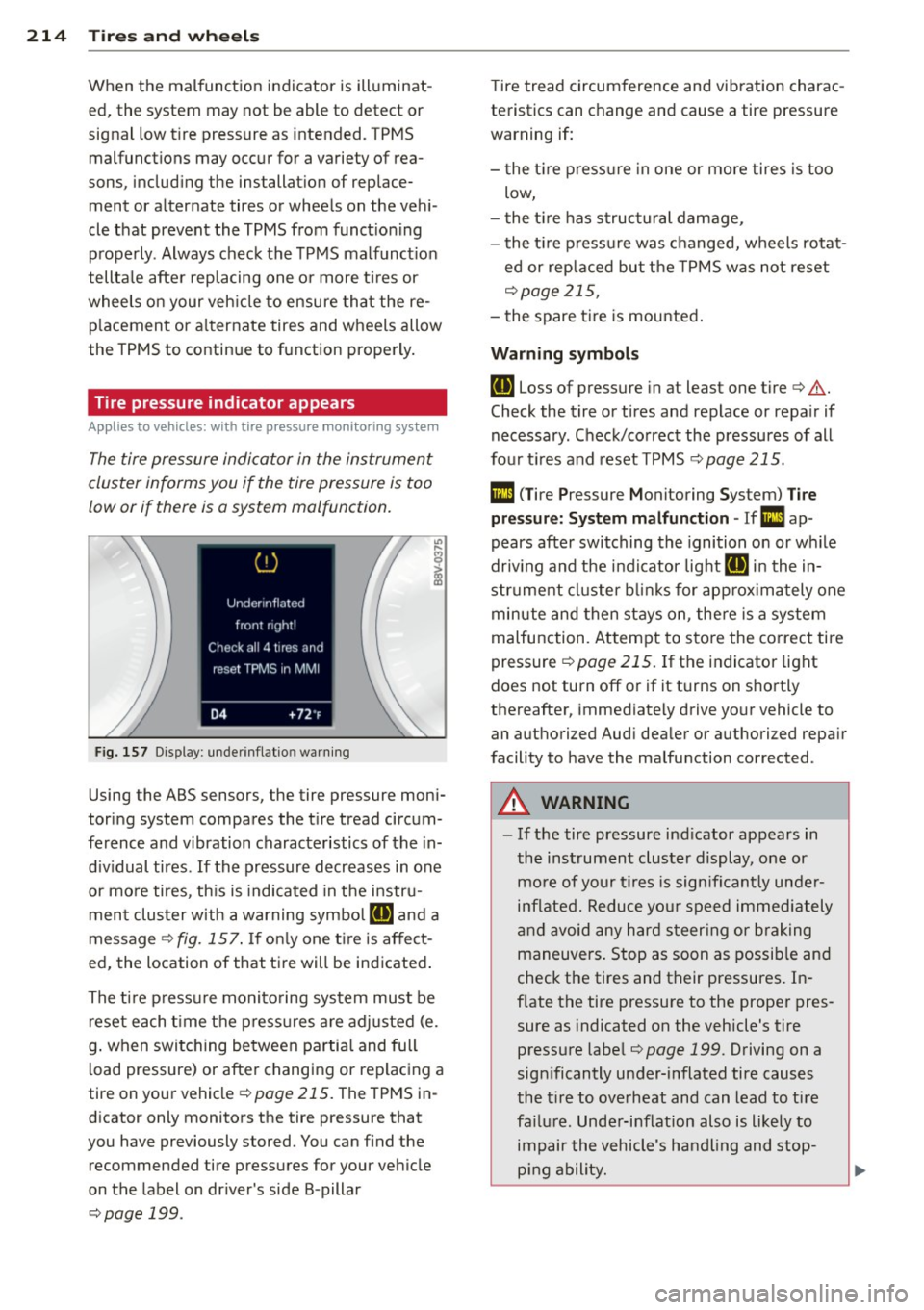
F ig. 157 Display : under inflatio n warning
Using the ABS sensors, the tire pressure moni
toring system compares the t ire tread circum
ference and vibration characteristics of the in
d iv idual tires . If the pressure decreases in one
or more tires, th is is indicated in the instru
ment cluster w ith a warning symbo l
RE and a
message¢
fig. 157 . If on ly one ti re is affect
ed, the location of that tire will be indicated .
The t ire p ressu re monito ring system must be
reset each t ime the press ures a re adjusted (e.
g . when switching between partia l and full
l oad pressure) or after changing or replacing a
tire on your vehicle ¢
page 215. The TPMS in
dicator only monitors the tire p ressu re that
you have previously s tored. You can find the
recommended tire pressures for your vehicle
on the label on dr iver 's side B -pillar
¢ page 199.
Tire tread circumference and vibration charac
teristics can change and cause a tire pressure
warning if:
- t he t ire press ure in one or more tires is too
low,
- t he t ire has s tructural damage ,
- the t ire p ressure was changed, wheels rotat -
ed or replaced but the TPMS was not reset
¢ page 215,
-the spare t ire is mou nted.
Warning symbo ls
RE Loss of pressure in at least one tire¢.& .
Check the tire or tires and replace or repa ir if
necessary . Check/correct the pressures of all
four t i res and reset TPMS
¢ page 215 .
Ill (T ire Pressure Monitoring Sys tem) T ire
pr ess ure: S y ste m m alfun ction -If l!I ap
pears after switching the ignition on or wh ile
driv ing and the indicator light
RE in the in
strument cluster b links for app rox imately one
minute and then stays on , the re is a system
malfunction . Attempt to sto re the correct tire
pressure
¢ page 215 . If the indicator light
does not turn off or if it turns on shortly
thereafter, immediately drive yo ur vehicle to
an authori zed Aud i dea ler or authori zed repa ir
facility to have the malfunction corrected .
A WARNING
--- If the tire pressure indicator appears in
the instrument cluster display, one or mo re of your t ires is sign ifi cantly unde r
i n flated. Reduce yo ur speed immedi ately
and avoid any hard steer ing or b raking
maneuve rs. Stop as soon as possib le and
check the tires and their pressures. In
f late the tire pressure to the proper pres
sure as indicated on the vehicle's tire
pressure labe l
¢page 199. Driving on a
significantly under-i nflated tire causes
the t ire to overheat and can lead to ti re
fa ilu re. Unde r-inflation also is likely to
impair the vehicle's handling and stop
p ing ability.