service AUDI Q3 2015 Owner's Manual
[x] Cancel search | Manufacturer: AUDI, Model Year: 2015, Model line: Q3, Model: AUDI Q3 2015Pages: 258, PDF Size: 64.9 MB
Page 187 of 258
and adve rsely affect you r New Vehicle
Wa rrant y.
@) For the sake of the environment
-Un der no ci rc u mstances can the o il come
in contact with the sewage network or
the soil.
- Observe and follow lega l regu lations
when disposing of empty oil containers .
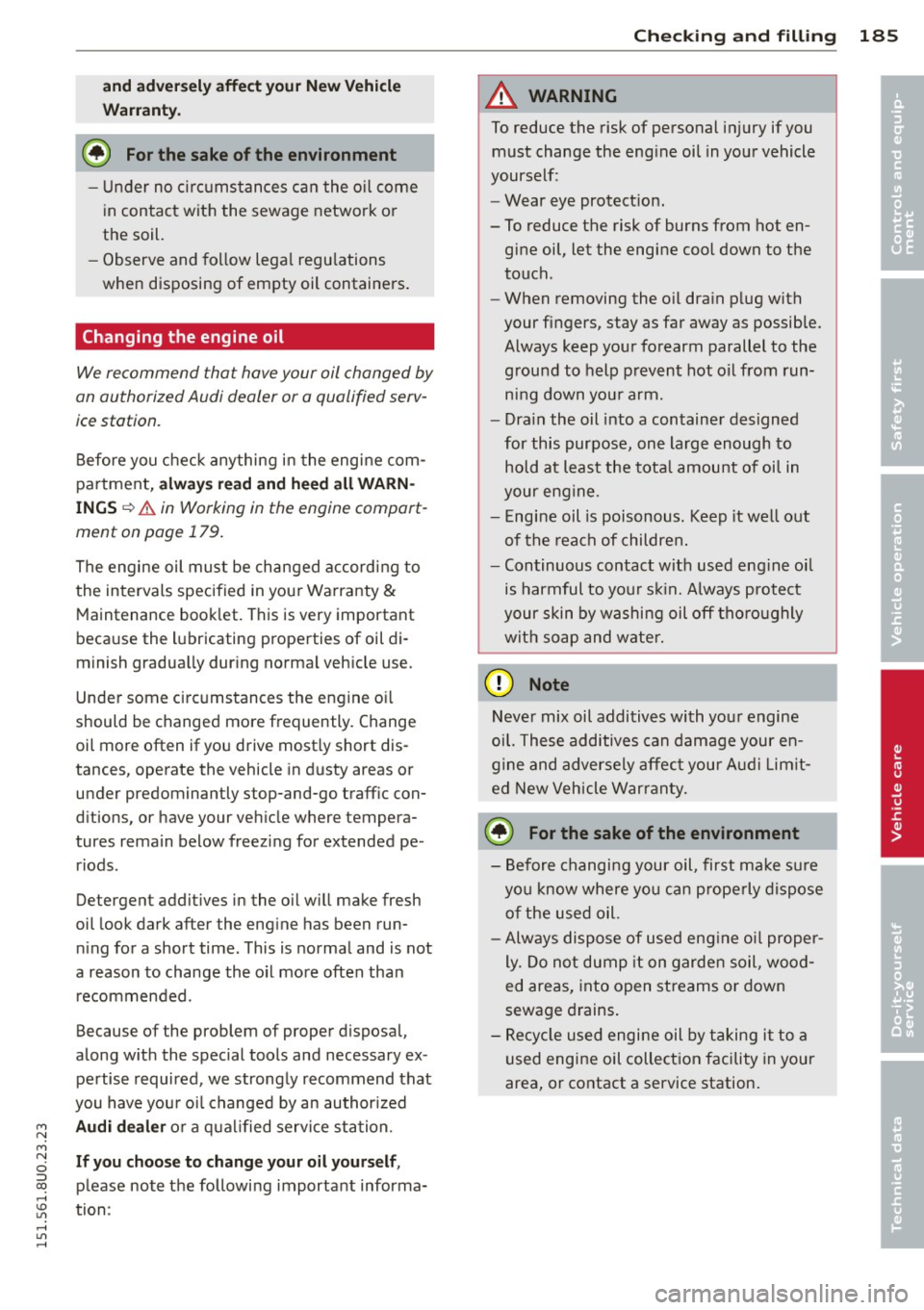
Changing the engine oil
We recommend that have your oil changed by
an authorized Audi dealer or a qualified serv
ice station.
Before you check anything in the engine com
par tment,
a lways rea d and he ed all WARN
INGS ~&. in Working in the engine compart
ment on page 179.
The engine oil must be changed according to
the intervals specified in your Warranty
&
Maintenance book let. This is very important
because the lubricating properties of oil di
minish gradua lly during normal vehicle use.
Under some circumstances the engine oi l
should be changed more frequently. Change
oil more often if you drive most ly short dis
tances, operate the vehicle in dusty areas or under predominantly stop-and-go traff ic con
d itions, or have your veh icle where tempera
tures remain below freezing for extended pe
riods.
Detergent additives in the o il w ill make fresh
oil look dark after the engine has been run n ing for a short time. This is normal and is not
a reason to change the oil more often than recommended.
Because of the problem of proper disposa l,
along w ith the special tools and necessary ex
pertise required, we strongly recommend that
you have you r oi l changed by an authorized
~ Au di de ale r o r a qual ified servi ce station.
M N
0 ::i co ,...., \!) 1.1'1 ,...., 1.1'1 ,....,
If you choo se t o c ha ng e y our o il your self ,
please note the followi ng important informa
tion :
Checkin g and fillin g 185
A WARNING
To reduce the risk of personal injury if you
must change the eng ine oil in your vehicle
yourself:
- Wear eye protect ion.
- To reduce the risk of burns from hot en- gine oil, let the engine cool down to the
touch.
- When removing the o il dra in p lug with
your fingers, stay as far away as possible. Always keep your forearm parallel to the
ground to help p revent hot oil from run
ning down you r arm.
- Dra in the oil into a container designed
for this purpose, one la rge enough to
hold at least the tota l amount of oi l in
your eng ine .
- Engine oil is poisonous. Keep it well out
of the reach of children.
- Continuous contact wit h used eng ine o il
is harmful to your s kin. A lways protect
your skin by washing oil off tho ro ughly
with soap and water.
@ Note
Neve r mix oil additives with your engine
oil. These additives can damage your en
g ine and adversely affec t you r Au di L imit
ed New Vehicle Warranty.
@ For the sake of the environment
- Before changing your oil, first make su re
you know where you c an properly dispose
o f the used oil.
- Always dispose of used eng ine oi l proper
ly. Do not dump it on garden soil, wood
ed areas, into open streams or down
sewage drains .
- Recycle used engine oil by taking it to a
used engine oil collect ion facility in your
area, or contact a service station.
•
•
Page 192 of 258
190 Checking and filling
@ For the sake of the environment
Because of the problem of proper disposa l
of brake flu id as we ll as the special tools
req uired and the necessary expert ise, we
recommend that you have the b rake fluid
changed by your author ized Audi dealer.
Battery
General information
Unde r normal operating conditions, the bat
tery in your A udi does not need any mainte
nance. With
high outside temperatures or
long daily dr ives we recommend that you have
the elect ro lyte level checked by an authorized
Aud i dea ler o r qualified workshop . The elec
trolyte leve l sho uld a lso be c hecked each t ime
the battery is c harged
c::> page 192.
H ave the battery checked when you take your
ve hicle in for service . Yo u are well adv ised to
replace a bat tery that is older tha n 5 yea rs .
W ith certa in types of a irbag deployment, t he
battery is d isconnected from the vehicle elec
tr ica l system fo r safety reasons
c::> & in Re
pair, core and disposal of the airbags on
page 126.
Disconnecting the battery terminals
Some veh icle functions (power w indow regu
lato rs, for example) are lost if the battery ter
m inals a re discon nected. These functions have
to be re lea rned after the batte ry terminals a re
c onnec ted agai n. T o prevent this, the battery
should o nly be di sconnec ted from the vehicle
e lec trica l syste m when absolu tely necess ary
for repairs.
Vehicles not driven for long periods
I f yo u do not dr ive you r vehicle over a pe riod
of severa l days or weeks, elec trical co m po
n en ts are gr adually cu t back o r swi tched off .
T his reduces energy cons ump tion and main
tains sta rting capab ility over a lon ger perio d
c::> page 159 .
Some o f the conven ien ce f unct ions m ay no t
ope rate, su ch as the in ter ior lights o r the power seat adjus
tment . The convenience
funct ions wi ll be available again when yo u
tu rn on the ign ition and sta rt t he engine .
Winter operation
During the w inte r mon th s, batt ery c apac ity
tends to dec rease as tempera tures drop . This
is beca use more power is a lso consumed w hile
starting, and the headlights, rear win dow de
f ogger, etc., are used more often.
Avoid unnecessa ry powe r consumpt ion, pa r
ticu lar ly in ci ty traffic o r when traveling only
sho rt distances . Let yo ur autho rized A udi
dealer check the capacity of the vehicle bat
tery before w inter sets in
<=:> page 192. A well
charged battery will not on ly prevent starting
problems when the weather is cold, but w ill
also last longer .
@ Tips
If your vehicle is left standing for seve ral
w eeks at extremely low temperatures, the
vehicle battery s hou ld be removed and
s tored w her e it w ill not freeze. This will
preve nt i t fr om be ing d amaged and having
t o be repla ced .
Working on the battery
Be especially careful when working on or near
the battery.
T he battery is loc ated in the luggage compar t
ment under the floo r. B efo re you che ck any
t hi ng in the luggage co mpartmen t,
read and
heed all WARNINGS
c::> .&_ .
Always heed t he safety warnings , when work
i ng on the veh icle ba tte ry or the vehicle e le c
t ric al sys tem to p reven t inju ry.
The following WARNINGS are very
important when working on the battery:
Always heed the following WARNING SYM ·
BOLS and safety precautions when working
on the battery .
®
Always wear eye protection .
Page 205 of 258
M N
M N
0 ::i co ,...., \!) ..,.,
,...., ..,., ,....,
-If the ti re is not flat and y ou do not have
to change a wheel immed iate ly, drive at
reduced speed to the nearest service sta
t ion to check the tire pressure and add
air as required.
(D Note
Dr iving without va lve stem caps can cause
damage to the t ire va lves . To prevent this,
always make sure that factory installed
valve stem caps on all wheels are secu re ly
mounted on the va lve .
@) For the sake of the environment
Underinflated tires will a lso increase the
fue l consumption.
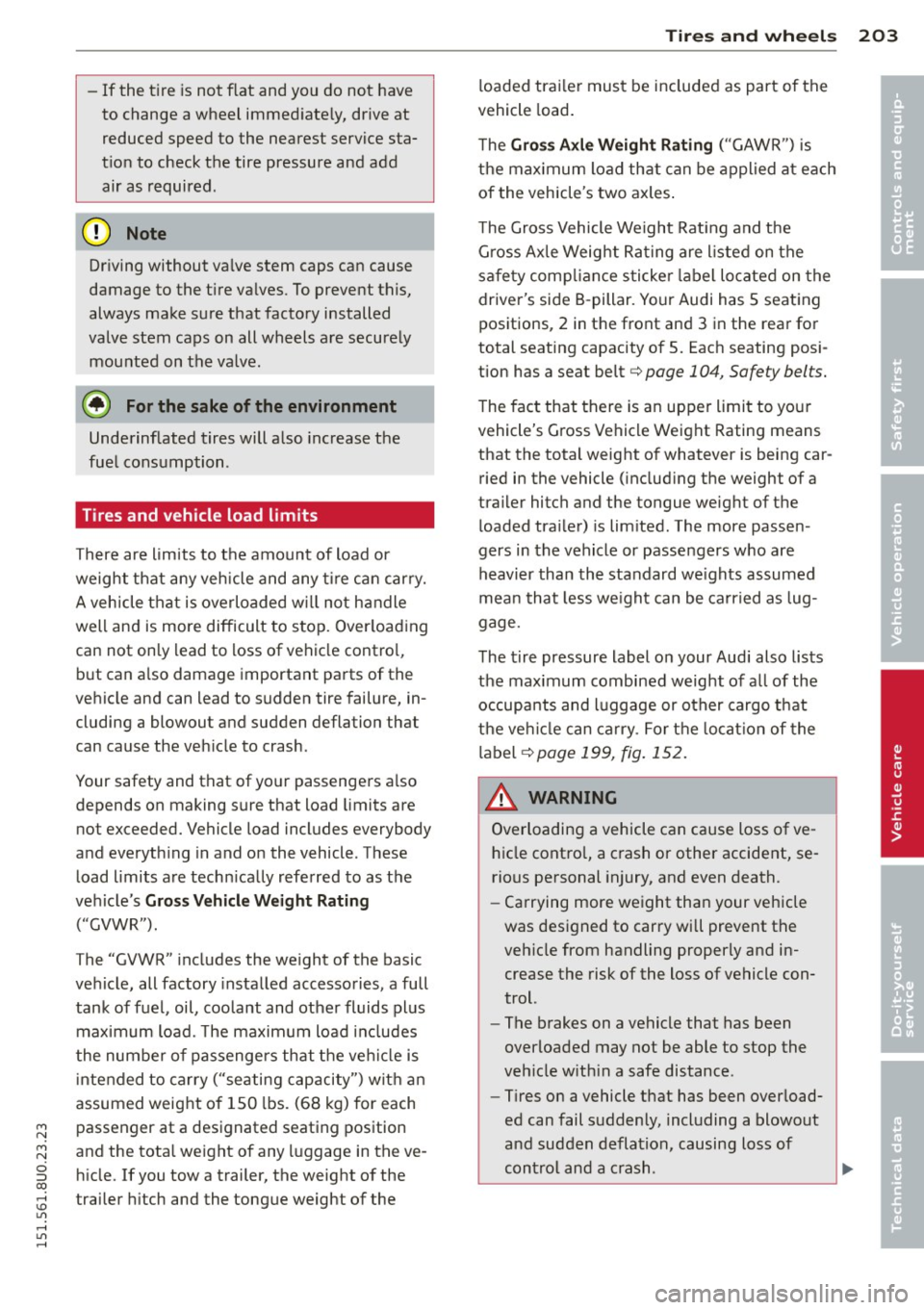
Tires and vehicle load limits
There are limits to the amount of load or
weight t hat any veh icle and any t ire ca n car ry.
A vehicle that is overloaded w ill not handle
well and is more difficult to stop. Overload ing
can not on ly lead to loss of vehicle contro l,
but can a lso damage important parts of the
vehicle and can lead to sudden tire failure, in
cluding a blowout and sudden deflation that
can cause the ve hicle to crash.
Your safety and that of yo ur passenge rs a lso
depends on making sure th at load limits are
no t exceeded. Vehicle load includes everybody
and everyth ing in and on the vehicle. These
load limits a re tech nica lly referred to as the
ve hicle's
Gross Veh icle Weight Rating
("GVWR").
The "GVWR" includes the we ight of the basic
ve hicle, all factory installed accessories, a full
tank of f uel, oil, coo lant and othe r fluids plus
max imum load. The maximum load includes
the number o f passenger s that the ve hicl e is
intended to carry ("se ating capacity") w it h an
assumed weig ht o f 150 lbs. (68 kg) for each
passenger at a designated seating position
and the tota l weight of any luggage in the ve
h icle. If you tow a trailer, the weight of the
trailer hitch and the tong ue weight of the
Tire s an d wheel s 203
loaded tra ile r must be included as part of the
vehicle load .
T he
Gro ss Ax le Weight Rating (" GAWR") is
the max imum load th at can be applied at each
of the vehicle's two axles .
T he Gross Vehicle Weight Rat ing and t he
G ross Ax le Weig ht Ra ting are l iste d on the
s af ety comp liance s tic ke r la bel lo cated on the
driver's side 8 -pillar . Yo ur Audi has 5 seating
positions, 2 in the front and 3 in the rear fo r
total seating capacity of 5. Eac h seating posi
tion has a seat be lt
c::> page 104, Safety bel ts.
T he fac t that there is an upper limit to yo ur
vehicle's G ross Vehicle Weight Rating means
that the total weight of whatever is being car
ried in the vehicle ( includ ing the weight of a
trai ler hitch and the tongue weight of the
l oaded tra ile r) is lim ited . The more passen
gers in the vehicle or passe ngers w ho are
heavi er than the standard we ights assumed
mea n that less we ight can be ca rried as lug
gage.
T he t ire pressure label o n your Aud i also lis ts
the max imum combined weight of a ll of the
occupants and l uggage or o ther cargo t hat
the ve hicl e can carry . Fo r th e lo cat ion of the
l abel
c::> page 199, fig . 152.
A WARNING
-=
Overloading a vehicle can cause loss of ve -
h icle cont ro l, a c rash or other accide nt, se
rious pe rsonal injury, and even death.
- Ca rrying more we ight than your vehicle
was des igned to carry wi ll prevent the
veh icle from handling pr oper ly and in
crease the risk of the loss of vehicle con
trol.
- The brakes on a vehicle that has been
overloaded may not be able to stop the
ve hicle w it hi n a safe distance.
- Tires o n a vehicle that has been over load
ed can fail s uddenly, incl uding a blowout
a nd sudden defla tion, causing loss of
con trol an d a crash . ..,.
•
•
Page 207 of 258
M N M N
0 ::i co
rl I.O
"' rl
"' rl
Tire service life
The service life of tires depends on a lot of
different things including proper installation
and balancing, correct tire pressure and driv
ing style.
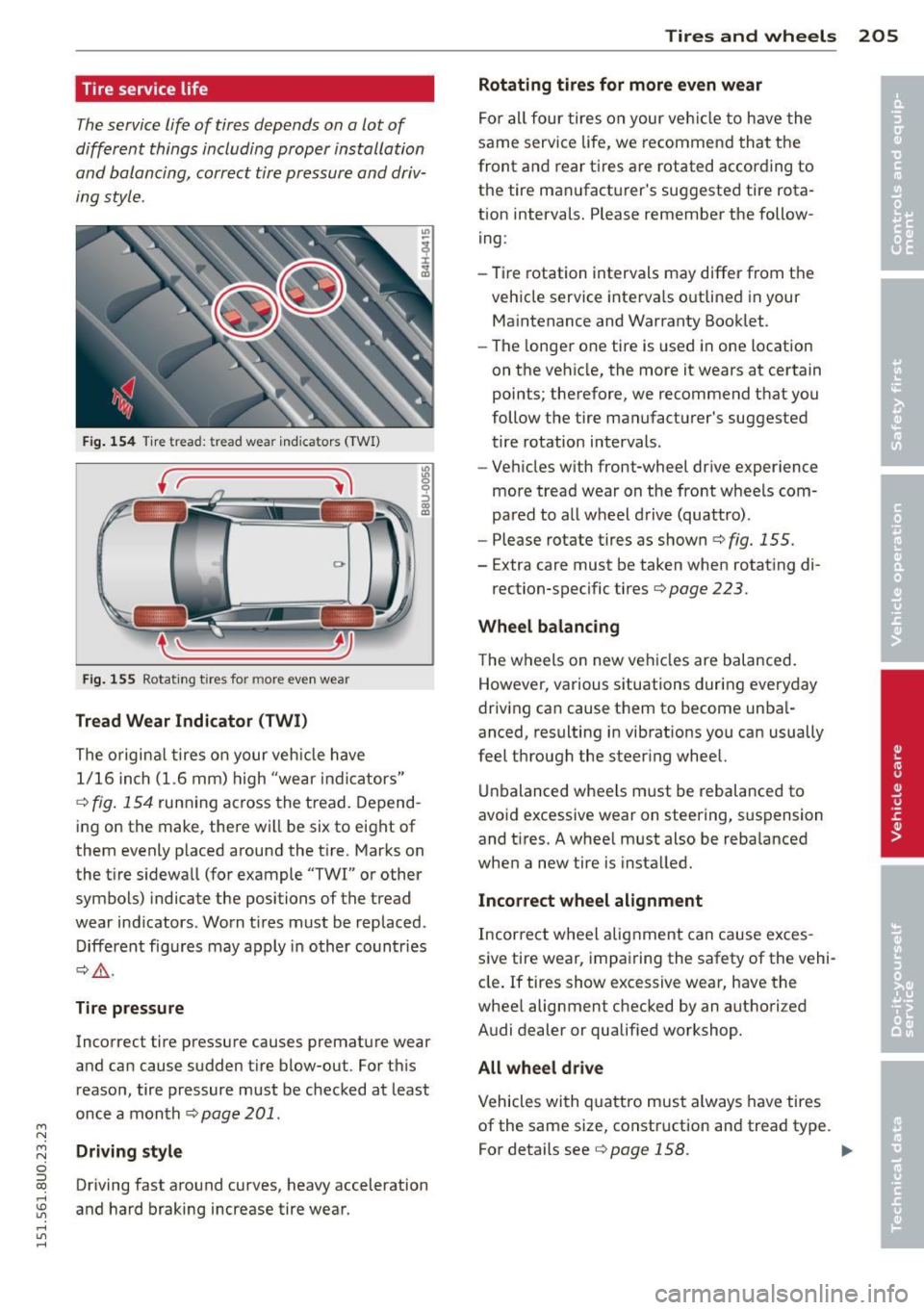
Fig. 154 Tire tread: tread wea r in dica tors (TWI)
Fig. 155 Rotating t ires for more even wea r
Tread Wear Indicator (TWI)
The original tires on your veh icle have
1/16 inch (1.6 mm) high "wear indicators"
r::!;> fig. 154 run ning across the tread. Depend
ing on the make, there will be six to eight of
them evenly p laced around the tire . Marks on
the t ire s idewall (for example "TWI" or other
symbols) indicate the positions of the tread
wear ind icators . Worn t ires must be replaced.
Different figures may apply in other countries
r::!) &.
Tire pressure
Incorrect tire pressure causes premature wear
and can cause sudden tir e blow-out . For this
reason, tire pressure must be checked at least
once a month
r::!;> page 201.
Driving style
Driving fast around curves , heavy acceleration
and hard braking increase tire wear.
Tires and wheels 205
Rotating tires for more even wear
For all four tires on your vehicle to have the
same service life, we recommend that the
front and rear tires are rotated according to
the tire manufacturer 's suggested tire rota
tion inte rvals. Please remember the follow
ing :
- Tire rotation intervals may differ from the
vehicle service interva ls o utlined in your
Ma intenance and Warranty Booklet.
- The longer one tire is used in one location
on the vehicle, the more it wears at certain
points ; therefore, we recommend that you
follow the tire manufactu rer 's suggested
tire rotation intervals .
- Vehicles w ith front-wheel dr ive exper ience
more tread wear on the front wheels com
pared to all w heel drive (quattro) .
- Please rotate tires as shown
r::!;> fig. 155.
-Extra care must be taken when rotating di-
rection-specific tires
r::!;> page 223 .
Wheel balancing
The wheels on new veh icles are balanced .
However, various situations during everyday
driving can cause them to become unba l
anced, resulting in vibrations you can usually
feel through the steer ing wheel.
Unbalanced wheels must be rebalanced to
avoid excessive wear on steering, s uspension
and t ires. A whee l must also be reba lanced
when a new tire is insta lled.
Incorrect wheel alignment
Incorrect wheel alignment can cause exces
sive tire wear, impairing the safety of the vehi
cle . If tires show excessive wear, have the
whee l alignment checked by an authori zed
Audi dealer or qualified workshop.
All wheel drive
Vehicles wi th quattro must always have tires
of the same size, construction and tread type.
For details
see r::!) page 158. 111>
Page 231 of 258
M N M N
0 :::i co
rl I.O
"' rl
"' rl
@ Tips
- The discharged battery must be properly
connected to the vehicle's electrical sys
tem. When jump start ing or charging the
battery, never connect the negative
ground cable to the battery negative post because the battery manager sys
tem must be able to detect the battery's
state of cha rge . A lways connect the neg
ative g round cab le to the negative
gro und post o f the battery manage r con
trol uni t.
Use of jumper cables
Make sure to connect the jumper cobl e
clomps in exactly the order describ ed b elow!
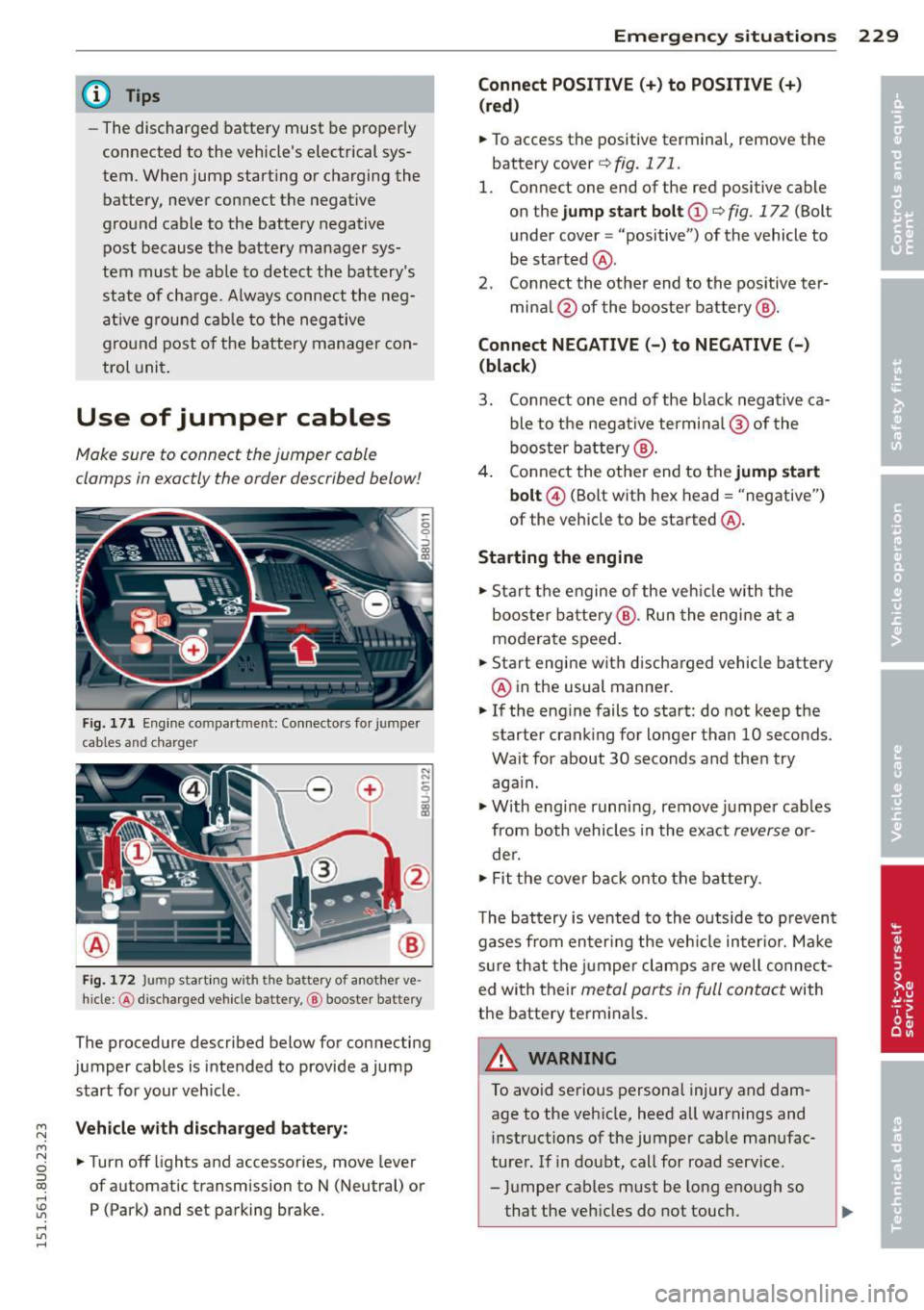
F ig. 171 Engine co mpartmen t: Con ne ctors fo r jum per
c ables a nd char ger
Fi g. 172 Jump s tart in g w ith t he ba ttery of a not her ve
hi cle :@ disch arged vehicle battery ,@ booster bat tery
The procedure described below for connecting
jumper cables is intended to provide a jump
start for your veh icle .
V ehicle with discharged batter y:
.. Tu rn off lights and accessories, move lever
of automatic transmission to N (Neutral) or P (Park) and set parking brake .
Emergency situ ation s 229
Connect POSITIVE(+ ) to POSITIVE (+ )
(red )
.. To access the positive terminal, remove the
battery cover
c::> fig. 1 71.
1. Connect one end of the red positive cable
on the
jump sta rt bolt (D c::> fig . 172 (Bolt
under cover = "positive") of the vehicle to
be started @.
2 . Connect th e other end to the pos itive ter-
mina l@ of the booster battery @.
Connect NEGATIVE( -) to NEGATIVE(-)
( black )
3. Connect one end of the black negative ca ble to the negat ive termina l@ of the
booster battery @.
4 . Connect the othe r end to the
jump start
bolt @
(Bolt with hex head = "negative")
of the vehicle to be started @.
Starting the engine .,. Sta rt the engine of the veh icle w ith the
booste r ba tte ry @ . Ru n the engine at a
moderate speed .
.. Start engine w it h discharged vehicle battery
@ in the usual manner .
.. If the eng ine fails to start: do not keep the
starter c ranking for longer than 10 seconds.
Wait for about 30 seconds and the n try
aga in .
.. With eng ine runni ng, remove jumpe r cab les
from both vehicles in the exact
reverse o r
de r .
.,. Fit the cover b ack o nto the battery.
T he battery is vented to th e outside to p revent
gases from enter ing the veh icle inter io r. Ma ke
s u re that the j umper clamps are well connec t
ed with their
metal parts in full contact with
the battery term inals.
,8. WARNING
To avoid serious personal injury and dam
age to the veh icle, heed all warnings and
instructions of the jumper cable man ufac
turer. If in doubt, call for road service .
- J umper cables m ust be long enough so
that the veh icles do not touch.
-
Page 239 of 258
M N
M N
0 ::i co ,...., \!) 1.1"1 ,...., 1.1"1 ,....,
Consumer Information
Warranty coverages
Your Audi is covered by the following war
ranties :
- New Vehicle Limited Warranty
- Limited Warranty Against Corrosion Perfo-
ration
- Emissions Control System Warranty
- Emissions Performance Warranty
- California Emissions Con trol Warranty (USA
vehicles only)
- California Emissions Performance Warranty
(USA vehicles only)
Detailed information regarding your warran
ties can be found in your
Warranty & Mainte
nance booklet .
Operating your vehicle
outside the U.S.A. or
Canada
Government regulations in the United States
and Canada require that automobiles meet
specific emission regulations and safety
standards. Therefore, veh icles built for the
U.S.A. and Canada differ from vehicles sold in
other countries .
If you p lan to take your vehicle outside the
continental limits of the United States or Can
ada, there is the possibility that:
- unleaded fuels for vehicles with cata lytic
converter may not be available;
- fuel may have a considerably lower octane
rating . Improper fuel may cause engine
damage ;
- service may be inadequate due to lack of
proper service facilities, tools or testing
equipment;
- replacement parts may not be readily availa
ble.
- Navigation systems for vehicles built for the
U.S.A. and Canada will not necessari ly work
in Europe, and may not work in other coun
tries outside of North America.
Consumer Information 237
@ Note
Audi cannot be responsible for mechanical
damage that could result from inadequate
fuel, service or parts availab ility.
Audi Service Repair
Manuals and Literature
Audi Offic ial Factory Service Manuals and Lit
erature are published as soon as possible after
model introduction. Service Manuals and liter
atu re are availabl e to order from the Audi
T echnical Literature Ordering Center at:
www.audi.techliterature.com
Maintenance
' General
Your vehicle has been designed to help keep
maintenance requirements to a minimum.
However, a certain amount of regular mainte
nance is still necessary to assure your vehicle's
safety, economy and reliability . For detailed
vehicle maintenance consult your Warranty
&
Maintenance booklet.
Under difficult operating conditions , for ex
ample at extremely low outside temperatures ,
in very dusty regions, when towing a tra iler
very frequently, etc., some serv ice work
shou ld be pe rformed between the intervals
specified. This applies particularly to:
- oil changes, and
- cleaning or replacing the air filter .
® For the sake of the environment
By regularly maintaining your vehicle, you
help make sure that emission standards
are maintained, thus min imizi ng adverse
effects on the environment .
Important considerations for you and
your vehicle
The increasing use of electronics , sophisticat
ed fuel injection and emission contro l sys-
tems, and the genera lly increasing technica l ..,_
•
•
Page 244 of 258
242 Index .:..:..:..::....::..
...:..._ ___________________________ _
A
A/C (automatic climate control) .. .... .. 64
Accessories .. ... ... ... .... .. .. .. .. . 239
Adaptive cruise control Cleaning the sensor ....... .. .. .... . 171
Adapt ive light ............. .. .. .. .. .. 40
Adapt ive Light (defective) ....... .. .. .. 18
Adding Engine coolant ............. .. .... . 187
Engine oil .... ........... .. .. .... . 184
W indshield washer fluid ... .... .. .. . 193
Additional accessories
Addit ives 239
E ng ine oil .... ........... .. .. .... . 184
Adjustable steering column .... .. .... .. 66
Adjusting Air distribution (automatic climate con-
trol) ... .. .. .............. ... .. .. .. 65
Front seats . . . . . . . . . . . . . . . . . . . . . . . . 50
Instrument illumination ... .. .. .. .. . .
44
Steering column ...... .... .. .. .. .. .. 66
Temperature (automat ic climate control) 65
Airbag
Warning/indicator lights ....... .... .. 16
A irba g system . . . . . . . . . . . . . . . . . 112, 128
Advanced Airbag System ........... . 116
Advanced Airbag System components . 119
Care ... .... ................ ..... . 126
Children .................. .. .... . 134
Child restraints ........... .. .. .... . 135
Components (front airbags) . . . . . . . . . 119
Danger of fitting a child safety seat on
the front passenger seat . . . . . . . . . . . . 114
Disposal . .. ... .......... .. .. .. .. . 126
Front airbags . . . . . . . . . . . . . . . . 116, 117
H ow do the front airbags work? . .. .. . 121
How many airbags does my vehicle
have? .................... .. .... . 119
How the Advanced Airbag System com-
ponen ts work together ...... .. .... . 120
Important things to know .... .. .... . 112
Indicator light .............. ... .. . 123
Monitoring ................. ... ... 123
PASSENGER AIR BAG OFF l ight .. .. .. . 123
Repairs .. .. ... .......... .. .. .. .. . 126
Safety instructions ........ .. .. .... . 125
Side airbags ................ ..... . 127 Side
curtain airbags ............... .
Weight-sensing mat .............. .
When must the system be inspected?
Alcantara Cleaning .. .... .. ............. ... .
All -wheel drive .. .. ..... ........... .
Selective wheel torque control
All wheel drive 130
134
123
173
158
153
Winter tires ... .. ............. .. .. 210
Alternator
refer to Generator ................ .. 15
Anti-freeze
refer to E ng ine coolant system . .. .. . .
Anti-lock brake system ............. . .
Anti- lock braking system 186
153
Warning/indicator lights ............. 16
Anti-slip regulation ... .......... .. .. 153
Warning/indicator lights .......... .. . 16
Anti-theft alarm warning system ... .. .. . 28
Anti-theft systems Electronic immobilizer ............... 33
Ashtray .... .... .. ............. .... . 53
Asterisk What does it mean when something is marked with an asterisk? . . . . . . . . . . . . . . 6
Audi drive select
refer to Drive select . . . . . . . . . . . . . . . . . 79
Audi Service Repair Manuals and Litera-
ture 237
AUTO Automat ic climate control . . . . . . . . . . . . 64
Automat ic headl ights ............ .. . 40
Auto Lock . . . . . . . . . . . . . . . . . . . . . . . . . . 28
Automatic be lt retractor ............. 107
Automat ic climate control
Air out lets . . . . . . . . . . . . . . . . . . . . . . . . 65
Changing temperature units ..... .. .. . 65
Operation . . . . . . . . . . . . . . . . . . . . . . . . . 64
Synchronisation . . . . . . . . . . . . . . . . . . . . 65
Automat ic Shift Lock (ASL) ........ ... . 82
Automatic transmiss ion .......... .... . 81
Automatic Shift Lock (ASL) ...... .... . 82
Driving ... .. ... ... ... .. ..... ... .. . 82
Emergency mode . . . . . . . . . . . . . . . . . . . 85
Kick-down . . . . . . . . . . . . . . . . . . . . . . . . . 85
Manual shift program .......... .. .. . 84
Removal lock (ignit ion key) ........ .. . 66
Page 253 of 258
M N
M N
0 ::i co ,...., \!) 1.1'1 ,...., 1.1'1 ,....,
Warning light ..... .... ... .. .. .. .... 16
WhyYOU MUSTwearthem ... .. .. .. . 104
Worn properly . . . . . . . . . . . . . . . . . . . . 106
Safety compliance st icker ... .. .. .. .. . 234
Safety equipment . . . . . . . . . . . . . . . . . . . . 94
Safety features for occupant restra int and
protection ... .... .. .... ... .. .. .. .... 94
Safety guide lines
Seat adjustment . . . . . . . . . . . . . . . . . . . . SO
Safety instructions Eng ine compartment .. .... .. .. .. .. . 179
for side curtain a irbags .. ..... .... .. 132
for us ing ch ild safety seats . .. .. .. .. . 136
for using safety be lts ...... .. .. .. .. . 107
Mon itoring the Advanced Airbag Sys-
tem ..... .. .. .... .. .... ... .. .. ... 125
Seat Number of seats ......... .. .. .. .. . 104
Seat adjustment ........... .. .. .. .... 51
Driver 's seat . . . . . . . . . . . . . . . . . . . . . . . SO
F ront passenger's seat . . . . . . . . . . . . . . . 51
Front seats . . . . . . . . . . . . . . . . . . . . . . . . SO
H ead restraints .......... .. .. .. .. .. 97
Seat belts
refer to Safety belts . . . . . . . . . . . . . . . . 104
Seat covers Cleaning ... .... ...... ... .. .. .. ... 173
Seat heating . . . . . . . . . . . . . . . . . . . . . . . . 65
Sea ting capacity . . . . . . . . . . . . . . . . . . . . 104
Seating posi tion
Driver ..... ... .. .. ..... ... .. .. .... 95
Front passenger .......... .. .. .. .. .. 96
How to adjust the front seats . . . . . . . . . 96
Incorrect seat position . . . . . . . . . . . . . . . 98
Occupants ................ ... ... ... 95
Rear passengers . . . . . . . . . . . . . . . . . . . . 97
Seats Fo lding .. .. ............. .... .. .... 60
Selec tive unlock fea ture ..... .. .. .. .. .. 32
Select ive wheel torque control (all -wheel
d rive) . .. .. .. .. ........ ... .. ... ... . 153
Selector lever ............. .... .. .. .. 81
Selecto r lever (automatic tr ansmission)
E me rgency operation . . . . . . . . . . . . . . . . 86
Service and disposal Safety belt pretens ioner . ......... .. 111
Service interval disp lay . . . . . . . . . . . . . . . . 25
Inde x 251
Serv ice position
refer to Replacing wiper blades . ... .. . 47
S ET button . . . . . . . . . . . . . . . . . . . . . . . . . 23
S hi ft paddles .. .. .. ................. . 84
Sh utting down vehicle . ... .... ... .. .. 162
S ide a irbags
Desc ription .. .. .... ... ....... ..... 127
How they wor k ... ................. 128
Side assist Activati ng and deactivating ........... 77
Adjusting the brightness . . . . . . . . . . . . . 77
Cleaning the senso rs . . . . . . . . . . . . . . . 171
Des cription .. .. .. .. . .............. . 75
Senso r range . . . . . . . . . . . . . . . . . . . . . . 76
Side curta in airbags .. .............. . 130
Desc ription .. .. .. .. . .. .... .... .. .. 130
How they work ... .. ............... 131
Safe ty i nstr uctions ................. 132
Side marker lights . ............. .... . 40
Ski sack . ... .. .. .... . ... ...... ... .. . 61
Slid ing/tilt ing sunroof
Convenience opening/clos ing .. .. .. .. . 37
Snow cha ins .. .. .. ................. 211
Socket ... .. .. .. .. .. . .. ... .... ... .. . 5 4
Sources of information abo ut child re-
stra ints and their use . ............... 151
Spare tire ... .. .. .. ................. 217
Spare whee l .. .. .. ............... .. 217
Speed rat ing letter code ............. . 207
Speed warning system . . . . . . . . . . . . . . . . 73
START ENG INE ST O P button (conven ience
k ey) ..... .. .. .. .... ... .......... .. . 69
START ENGINE STOP button (Co nvenience
key) .......... ... .. ..... ........... 68
Starting Hill ho ld . . . . . . . . . . . . . . . . . . . . . . . . . . 72
Star ting from res t .. ............. .. .. . 71
Start ing off w ith a trailer ............ .. 72
Starting the engine . . . . . . . . . . . . . . 66, 68
Stee ring
El ectromechanica l steer ing . . . . . . . 158, 0
L ocking the steering . . . . . . . . . . . . . . . . 66
L ocking (convenience key) . . . . . . . . . . . . 69
Locking (ignition lock) .. ..... ... .. .. . 67
also refer to Electromechan ica l steer-
ing ......... .. .. ................. 158
•
•
Page 254 of 258
252 Index
Steering wheel
Adjusting steering co lumn ... ... ... ..
66
Indicator light . ........... ... .... .. 16
Multifunction steering wheel . .. ...... 21
Steer ing whee l w ith tiptronic . .. .. .... .. 84
Steps for determining correct load limit .
204
Stopping the engine . . . . . . . . . . . . . . 67, 69
Storage . .. .... ... .... .... .. .. .. .. .. 54
Cup holder door pockets . . . . . . . . . . . . . . 56
Glove compartment . . . . . . . . . . . . . . . . . 55
Sto rage compartments . . . . . . . . . . . . . . . 56
Sunroof
refer to Panorama sunroof . . . . . . . . . . . 38
Sun shades
Emergency closing (roof) ........... ..
39
Sun visors . . . . . . . . . . . . . . . . . . . . . . . . . . 46
Symbols
refer to Warning/indicato r lights .... .. 11
T
Tachomet er . . . . . . . . . . . . . . . . . . . . . . . . . 11
Tail lights
C leaning . .. .. . .. ..... ..... .. .. .. .
171
Technical Data ................ ... ... 234
Technical modifications ....... .... .. . 240
Tether anchors . ...... ... .. .. .. .. .. . 149
Tether strap ... ...... ..... .. .. .. .. . 149
Textiles
Cleaning ................. ... .... .
173
The first 1,000 miles (1,500 km) and after-
wards . .. .. .... ...... ....... .. .. .. .
161
Tie-down rings ... ..... ...... .. .. .. . 101
Tie-downs . . . . . . . . . . . . . . . . . . . . . . . . . . 60
tiptronic .............. ........ ... .. 81
tiptronic (automatic t ransmission) ...... 84
Tire pressure ....... ... .... .. .. .. .. .
201
Tire pressure monitoring system ....... 213
Loss of air pressure ........ .... .... 214
Malfunction .............. ... .. ... 2 14
Resetting tire p ressures .... .. .. .. .. . 215
Tires .. .. .. .. .... .. ... .. .. .... .. ... 195
Low aspect ratio ti res . . . . . . . . . . . . . . . 212
Service life ...... ........... ... .. . 205
Speed rating letter code ......... ... 207
Tire manufacturing date . .. .. .. .. .. . 207
Tire pressure monitor ing system .. ... 213
r ·f· t · ire spec, 1ca ions ............. .... 207
Tread depth ..... ................. 205
Uniform tire quality grading ......... 209
Winter tires . .. .. ....... ..... .... .
T ires and wheels
Checking tire pressure ............. .
Co ld tire inflation pressure ...... .. . .
o· . 1mens 1ons .... .. ................ .
General notes .. .. ... ... .... ... .. . .
Glossa ry of tire and lo ading terminolo-
gy .......... ... ................ .
210
201
199
206
195
1 96
New tir es and wheels ..... ...... .. .. 206
Replac ing . ...... ................ . 207
Snow chains . .. .. ...... ....... .... 211
T ires and vehicle load limits . .. .. .. .. 203
Wheel bolts ... .. ................. 212
W inter tires ..... ................. 210
Tire service life .. .. ................ . 205
Tool kit .... .. .. .. ...... ....... .... 216
T orn or frayed safety belts
Towing Front eyelet ... .. ....... ...... .. . .
Rear eyelet .. .. .. .. ........ .... .. .
T ow t ruck procedures ............. . .
TPMS 107
231
231
230
Tire pressure monitoring system 2 13, 214
T rai ler towing ..... ................. 166
Ope rating inst ructions .......... .... 1 67
Parking systems .. ... .. .... .... .. .. . 93
Technical requiremen ts . . . . . . . . 166, 167
Tongue load . .. ....... ........... . 16 7
Trailer towing tips ................ . 168
Trailer turn signal assembly
Warning/ indi cator lights . ....... .... .
19
Transmission .. .. .. ... .. .... .... .... . 81
Transmission malfunction (indicator light) 85
Transport Canada .. ................ . 102
Tread Wear Indicator (TWI) ... .... .. .. 205
Trip computer
Fuel consumption . . . . . . . . . . . . . . . . . .
22
Mileage ......... .......... ...... .. 22
Trip odom ete r ... .. ................ .. 23
Trunk
refer to Luggage compartment ... .. .. . 59
Trunk lid
refer to Rear lid . . . . . . . . . . . . . . . . . . . . 34