wheel AUDI Q3 2015 Service Manual
[x] Cancel search | Manufacturer: AUDI, Model Year: 2015, Model line: Q3, Model: AUDI Q3 2015Pages: 258, PDF Size: 64.9 MB
Page 173 of 258
M N
M N
0 ::i co ,...., \!) 1.1'1 ,...., 1.1'1 ,....,
Vehicle care and cleaning 171
Rinse the vehicle thoroughly again and let it
air dry. Remove any water residue using a
shammy .
A WARNING
- Only wash the vehicle when the ignition
is off and follow the instructions from
the car wash operator to reduce the risk
of accidents .
- To reduce the r isk of cuts, protect your
self from sharp metal components when
wash ing the underbody or the inside of
the wheel housings.
- After washing the vehicle, the braking ef
fect may be de layed due to moisture on
the brake rotors or ice in the winter. The
brakes must be dried first with a few
careful brake applications.
([) Note
-If you wash the vehicle in an automatic
car wash, you must fold the exterior m ir
rors in to reduce the ris k of damage to
the mirrors. Power folding exterior mir
rors* must only be folded in and out us
ing the power folding function. -
To prevent paint damage, do not wash
the vehicle in direct sunlight.
- To reduce the risk of damage to the sur
face, do not use insect removing spong
es, kitchen sponges or similar items.
- Matte finish painted vehicle compo
nents:
- To reduce the risk of damage to the
surface, do not use polishing agents or
hard wax.
- Never use car wash cycles that apply
protective wax.
It can destroy the
matte finish effect .
- Do not place any stickers or magnet ic
signs on vehicle parts painted w ith
matte fin ish paint. The paint could be
damaged when the stickers or magnets
are removed.
@ For the sake of the environment
Only wash the vehicle in facilities spec ially
designed for that purpose . This will red uce
the r isk of dirty water contam inated with
oil from entering the sewer system.
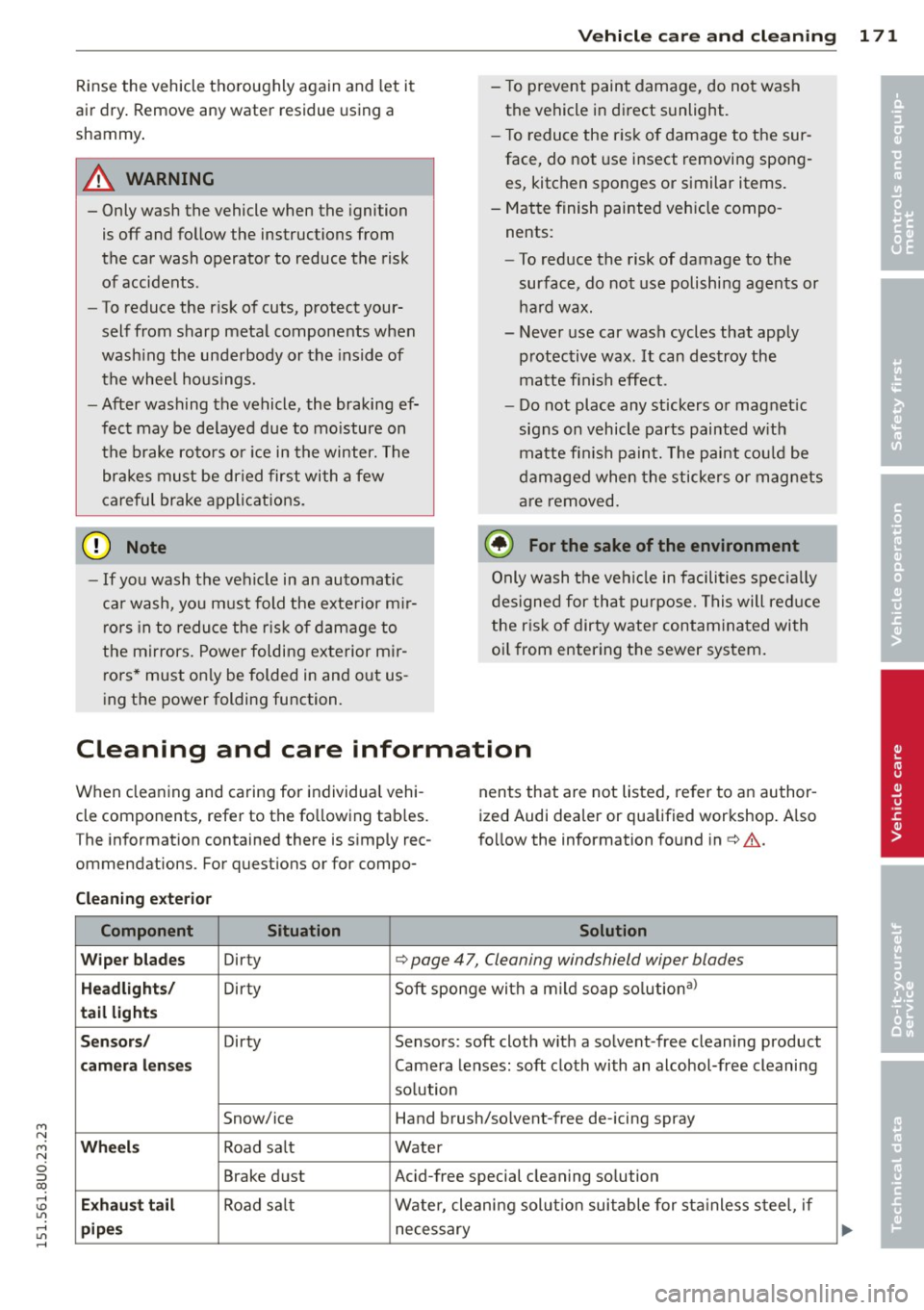
Cleaning and care information
When cleaning and caring for individual vehi
cle components, refer to the following tab les .
The information contained there is simply rec
ommendations . For questions or for compo- nents that are not listed,
refer to an author
ized Audi dealer or qualified workshop. A lso
follow the information found in ¢ ,& .
Cleaning exterior
Component Situation Solution
Wiper blades
Dirty Q page 4 7, Cleaning windshield wiper blades
Headlights/ Dirty Soft sponge with
a m ild soap solutiona>
tail lights
Sensors/
Dirty Sensors: soft cloth with a solvent -free cleaning product
camera lenses Camera lenses: soft cloth with an alcohol-free cleaning
solution
Snow/ice Hand brush/solvent-free de-icing spray
Wheels Road sa lt Water
Brake dust Acid-free special cleaning solution
Exhaust tail Road salt Water, cleaning solut ion suitable for stainless steel, if
pipes necessary
•
•
Page 175 of 258
M N
M N
0 ::i co ,...., \!) 1.1'1 ,...., 1.1'1 ,....,
Vehicle care and cleaning 173
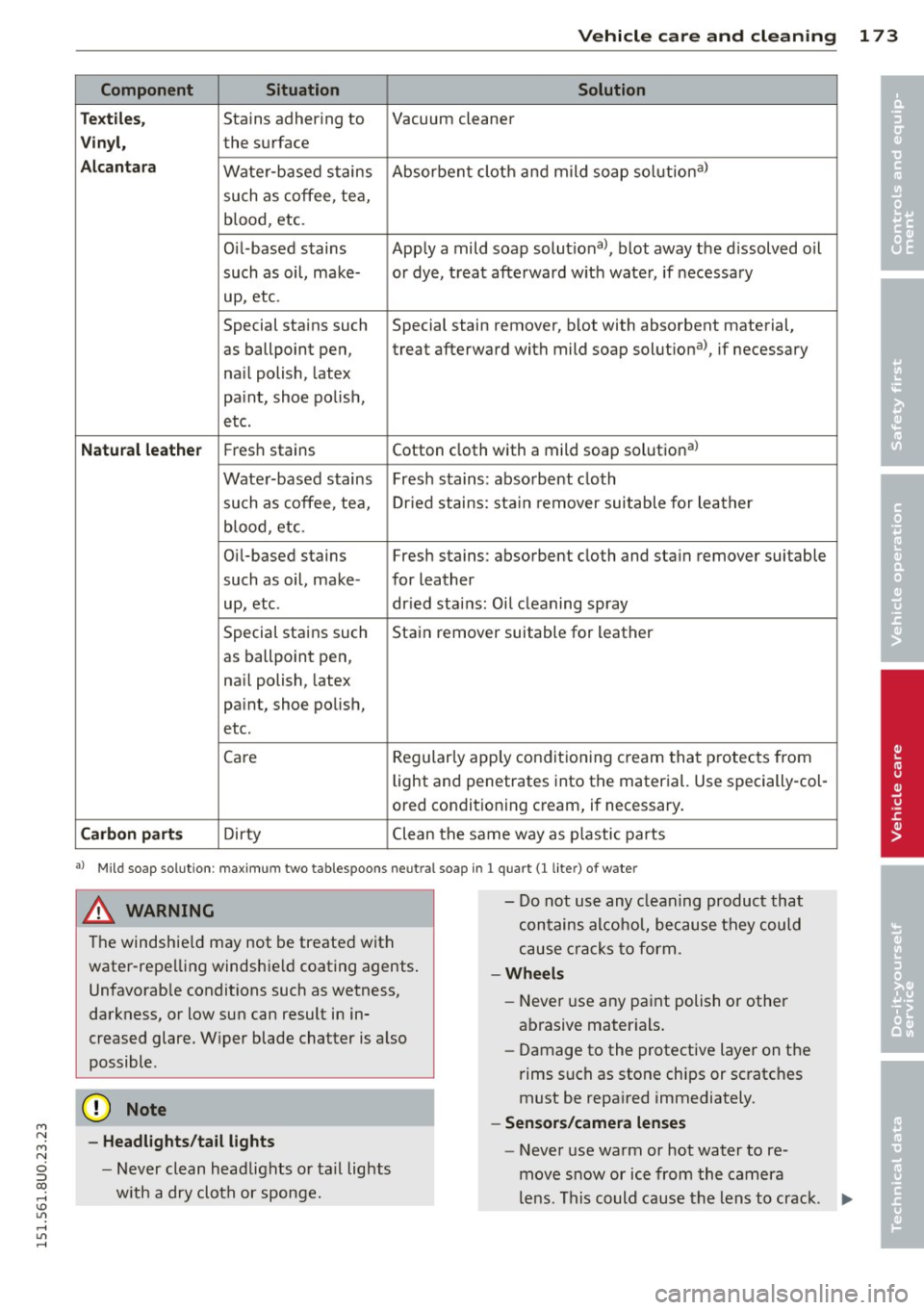
Component Situation Solution
Te xtile s,
Stains adhering to Vacuum cleaner
Vinyl, the surface
Alcantara Water-based stains Absorbent cloth and mild soap solutiona>
such as coffee, tea, blood, etc.
Oil-based stains Apply a mild soap solutiona>, blot away the d issolved oil
such as oil, make- or dye, treat afterward w ith water, if necessary
up, etc.
Special stains such Special stain remover, blot with absorbent material,
as ballpoint pen, treat afterward with mild soap solutiona>, if necessary
na il polish, latex
pa int, shoe polish,
etc.
Natural leather Fr es h stains Cotton cloth with a mild soap solutiona)
Water-based stains Fresh sta ins: absorbent cloth
such as coffee, tea, Dr ied stains: sta in remover suitable for leather
blood, etc.
Oil-based stains Fresh sta ins: absorbent cloth and stain remover suitable
such as oil, make- for leather
up, etc . dried sta ins: Oil cleaning spray
Special stains such Stain remover suitable for leather
as ballpo int pen,
na il polish, latex
pa int, shoe polish,
etc .
Care Regularly
apply conditioning cream that protects from
light and penetrates into the material. Use specially-col-
ored conditioning cream, if necessary.
Carbon parts Dirty Clean the same way as plastic parts
al Mild soap solution: maximum two tablespoons neut ral soap in 1 quart (I liter) of water
& WARNING
The windshie ld may not be treated with
water-repelling windshie ld coating agents .
Unfavorab le conditions such as wetness,
darkness, or low sun can result in in
creased glare. W iper blade chatter is also
possible.
- Headlights/tail lights
- Never clean headlights or tail lights
w ith a dry cloth or sponge. -
Do not use any cleaning product that
contains alcohol, because they could
cause cracks to form .
-Wheels
-Never use any paint polish or other
abrasive mater ials.
- Damage to the protective layer on the
rims such as stone chips or scratches
must be repaired immediately.
- Sensors/camera lenses
- Never use warm or hot water to re-
move snow or ice from the camera
len s. This could cause the lens to crack .
IJII>
•
•
Page 197 of 258
M N
M N
0 ::i co ,...., \!) 1.1'1 ,...., 1.1'1 ,....,
Tires and wheels
Tires
General notes
Tires may be the least appreciated and most
abused parts of a motor vehicle .
Tires may be the least appreciated and most
abused parts of a motor vehicle . Tires are,
however, one of the most important parts of a
vehicle, particularly considering the compara
tively small patch of rubber on eac h tire that
assures that a ll- important contact between
you, you r vehicle and the road.
Ma intaining the correct tire pressure, mak ing
sure that your vehicle and its tires do not have
to carry mo re weight than they can safely han
d le, avoiding damage from road hazards and
r eg ularly inspec ting t ires for damage i nclud
ing cuts, slashes irreg ular wear and ove ra ll
condition are the most important things that
you can do to he lp avoid sudden tire failure in
cluding tread separat ion and blowouts.
Avoiding damage If you have to d rive over a curb or similar ob
stacle, drive very slow ly and as close as possi
b le at a right angle to the curb.
A lways keep chemicals includ ing grease, o il ,
gasoline and brake fluid off the t ires .
I nspect the t ires regularly for damage (cuts,
cracks or b listers, etc.). Remove any fo reign
bod ies embedde d in the treads.
Storing tires Mark tires when you remove them to indicate
the direction of rotation . T his ensures you to
be ab le to mount them correctly when you re
i nstall them .
When removed, the whee ls or t ires should be
sto red in a cool, d ry and preferably dark place .
Store tires in a vertical pos ition if they are not
mounted on rims, in a horizontal pos it ion if
they are mounted on rims .
Tires an d wheel s 195
New tires
New tires h ave to be broken in ¢ & .
The tread depth of new t ires may vary, accord
ing to the type a nd make of t ire and the tread
pa tte rn.
Hidden damage
Damage to tires and rims is ofte n not readily
visible . If you notice unusual v ib rat io n or the
vehicle p ulls to one s ide, th is may ind icate
that one of the t ires has been damaged . T he
ti res m ust be chec ked immed iate ly by an au
t horized Audi dea le r or q ua lified wor kshop .
Unidirectional tires
A un idirectional tire can be identified by ar
rows on the sidewa ll, that po int in the direc
tion the t ire is designed to rotate. You mus t
f ol low the specified d irection o f rotation . T his
is necessary so that these tires can develop
their optimum characteristics regarding grip, road noise, wear and hydrop laning resistance.
For more information
¢page 223.
A WARNING
New tires or t ires that are o ld, worn or
damaged cannot provide maximum con
trol and braking ability .
-
-New tires tend to be slippery and must
also be b roken-in. To reduce the risk of
losing control , a collision and serious
pe rsonal injuries, drive w it h special care
for the first 350 miles (560 km).
- Driving with worn or damaged tires can
lead to loss of control, sudden tire fail
ure, including a blowout and sudden de
fl ation, c ras hes and se riou s personal in
juries . Have wo rn or damaged t ires re
placed immediate ly.
- Ti res age even if they are no t being used
an d can fai l sudden ly, especially at hig h
spee ds. Tires that are more than 6 years
old can only be used in an emergency
and then w ith special care and at low
speed.
•
•
Page 198 of 258
196 Tire s and wheel s
-Never mount used tires on yo ur vehicle if
yo u are not sure of their "previous histo
ry." Old used tires may have been dam
aged even though the damage cannot be
seen that can lead to sudden t ire failure
and loss of vehicle control.
- If you notice unusual vibration or if the
vehicle pulls to one side when driving, al
ways stop as soon as it is safe to do so
and check the wheels and tires for dam
age.
(D Note
- Please note that summer and winter
tires are designed for the cond itions that
a re typ ica l in those seasons. Aud i recom-
Glossary of tire and loading terminology
Accessory weight
means t he comb ined we ight (in excess of
those sta ndard items wh ich may be rep lace d)
of automa tic transmission, power s teering ,
power brakes, power wi ndows, power seats,
radio, and heater, to the extent that thes e
items are availab le as factory-installed equip
ment (whether ins talled or not) .
Aspect ratio
means the ratio o f the height to the width of
the tire in percent. Numbers of 55 or lower in
d icate a low sidewall for improved steer ing re
sponse and better overall handling on dry
pavement.
Bead
means t he pa rt of the tire that is made of
steel wires, wrapped or reinforced by ply cords
and that is shaped to fit the rim .
Bead separat ion
means a b reakdown of the bond between
components in the bead.
Cord
means the strands forming the plies in the
tire. mends using winter tires during the w
in
ter months. Low temperatures signifi
cantly decrease the elastic ity o f summe r
tires, which affects traction and braking ability . If summer tires are used in very
co ld temperatures, cracks ca n form o n
the tread bars, resu lting in permanent
tire damage that can cause lo ud driving
noise and unbalanced tires. Aud i is no t
responsib le for this type of d amage .
- Burn ished , polished or chromed rims
must not be used in winter road condi
tions. The s urface of the rims does not
have s uff ic ient corrosion protection for
this and could be permanently damaged
by road sa lt o r similar substances .
Cold tire inflation pressure
means the t ire p ress ure recommended by the
vehicle m anufacture r fo r a tire o f a des ign ated
s ize that has not been d riven for more than a
coup le of miles (ki lometers) at low speeds in
the three hour period before the tire p ress ure
is measured or adjusted .
Curb weight
means the we ight of a motor ve hicl e w ith
standard equipment including the maximum
capac ity of fuel, oi l, and coolant, air condi
tion ing and additional weig ht o f optiona l
equipment.
E x tra load tire
means a t ire design to operate at higher loads
and at higher inflation pressures than the cor
responding standa rd tire . Extra load tires may
be identified as "XL", "x l" , "E X TRA LOAD", or
"RF" on the sidewall.
Gross Axle Weight Rating ("GAWR ")
means the load-carrying capa city of a s ingle
axle system, measured at the tire-ground in-
terfaces.
liJJ>
Page 199 of 258
M N
M N
0 ::i co ,...., \!) 1.1"1 ,...., 1.1"1 ,....,
Tires and wheels 197
Gross Vehicle Weight Rating ("GVWR") Ply
means the maximum total loaded weight of
the vehicle .
Groove
means the space between two adjacent tread
ri bs.
Load rating (code)
means the maximum load that a tire is rated
to carry for a given inflat ion pressure . You
may not find this informat ion on all tires be
cause it is not requ ired by law.
Maximum load rating
means the load rating for a t ire at the max i
mum permissible inflation pressure for that
tire .
Maximum loaded vehicle weight
means the sum of:
(a) Curb weight
(b) Accesso ry weight
(c) Vehicle capacity weight, and
(d) Production opt ions we ight
Maximum (permissible) inflation pressure
means the maximum co ld inf lation pressure
to which a tire may be inflated . Also called
"maximum inflation pressure."
Normal occupant weight
means 150 lbs . (68 kilograms) times the
number of occupants seated in the vehicle up
to the tota l seating capacity of your vehicle.
Occupant distribution
means distribution of occupants in a veh icle.
Outer diameter
means the overall diameter of an inflated new
tire .
Overall width
means the linear distance between the exteri
ors of the sidewalls of an inflated tire, includ
ing e levations due to labeling, decorations, or
protective bands or ribs. means a layer of
rubber-coated parallel cords.
Production options weight
means the combined weight of those installed
regular production opt ions we ighing over 5
lbs. (2.3 kg) in excess of those standa rd items
which they replace, not previously considered
in curb weight or accessory weight, including
heavy duty brakes, ride levelers, roof rack,
heavy duty battery, and spec ial trim.
Radial ply tire
means a pneumatic tire in which the ply cords
that extend to the beads are laid at substan
tially 90 degrees to the centerline of the
tread.
Recommended inflation pressure
see r::!;> page 196, Cold tire inflation pressure .
Reinforced tire
means a tire design to operate at higher loads
and at higher inflation pressures than the cor
responding standard tire. Reinforced tires
may be identified as "XL", "xl", "EXTRA LOAD",
or "RF" on the sidewal l.
Rim
means a metal support for a tire or a t ire and
tube assembly upo n which the tire beads are
seated .
Rim diamete r
means nominal diameter of the bead seat. If
you change your wheel s ize, you wi ll have to
purchase new tires to match the new r im di
ameter .
Rim size designation
means rim diameter and width.
Rim width
means nominal distance between rim flanges.
Sidewall
means that portion of a t ire between the
tread and bead .
•
•
Page 200 of 258
198 Tires and wheels
Speed rating (letter code)
means the speed at wh ic h a tir e is des igned to
be d riven for extended per io d s o f time. The
ratings range from 93 mph (150 km/h) to
186 mph (298 km/h) ¢ page 207 . You may
not find this in format ion on all tires because
it is not required by law.
The speed rating letter code, w here a pplica
b le, is molded on the tire s idewa ll and indi
cates the maxim um permissible road speeds
¢ &. in Winter tires on page 211.
Tire pressure monitoring system*
means a system tha t d etects when one or
mo re of a vehicle's t ires are under inflated and
i llum ina tes a low t ire p ress ure warn ing te ll
tale .
Tread
means t hat port ion of a tire tha t comes into
con tact w it h t he road.
Tread separation
means pull ing away of the t read from the t ire
car cass .
Treadwear indicators (TWI)
means t he projections withi n the pr inc ipal
g rooves designed to give a v isua l ind ication of
the deg rees of wea r of the tre ad . See
¢ pag e 205, Tread W ear Indicator (TWI) for
mo re inf ormat io n on measu ring tire we ar.
Uniform Tire Quality Grading
is a tire i nfo rmation system developed by the
United States Nat io nal Highway Traffic Safety
Admin istration (N HTSA) that is designed to
h e lp buye rs make re lative compa risons among
tires. The UT QG i s no t a safety r ating an d no t a
g uar antee that a t ire will las t fo r a presc ribed
n umber of m iles (kilome ters) or pe rform in a
certain way. It s imply gives ti re bu ye rs addi
tional informat ion to combine with other con -s
iderations, such as p rice , brand loya lty and
dealer recommendations. Un der UTQ G, tires
are grade d by the t ire manufacturers in three
areas : treadwea r, traction, and temperature
resistance. The UTQG informat ion on the tires,
molded into the sidewalls .
U.S. DOT Tire Identification Number (TIN )
This is the tire's "se ria l numbe r" . It be gins
with the letters "DOT" and ind icates that the
t ir e meets all federa l standards . The next two
numbers or letters ind icate the plant where it
was ma nufactu red, and the last four numbe rs
r eprese nt the week and year of ma nufact ure.
Fo r exampl e,
DOT ... 2214 ...
means that the tire was produced in t he 22nd
wee k of 2014. The ot her numbers are market
ing codes that may or may not be used by the
t ire manufacturer . This information is used to
contact consumers i f a tire defect requires a
r ecall .
Vehicle capacity weight
means the rated cargo and luggage load p lus
150 lbs. (68 k ilograms) times the vehicle's to
ta l seating capacity as listed on the label lo
cated on the driver's side B-pilla r.
Vehicle maximum lo ad on the tire
means that load on an individua l tire that is
determined by distrib uting to eac h axle its
share of the maxim um loaded vehicle weight
and divid ing by two .
Vehicle normal load on the tire
means that load on an individua l t ir e that is
determined by distrib uting to eac h ax le its
share of the curb weight, accessory weight,
and normal occ upant weig ht (d istr ibuted in
accorda nce wit h tab le below¢ page 199)
and divid ing by two .
Page 201 of 258
M N M N
0 ::i co
rl I.O
"' rl
"' rl
Tires and wheels 199
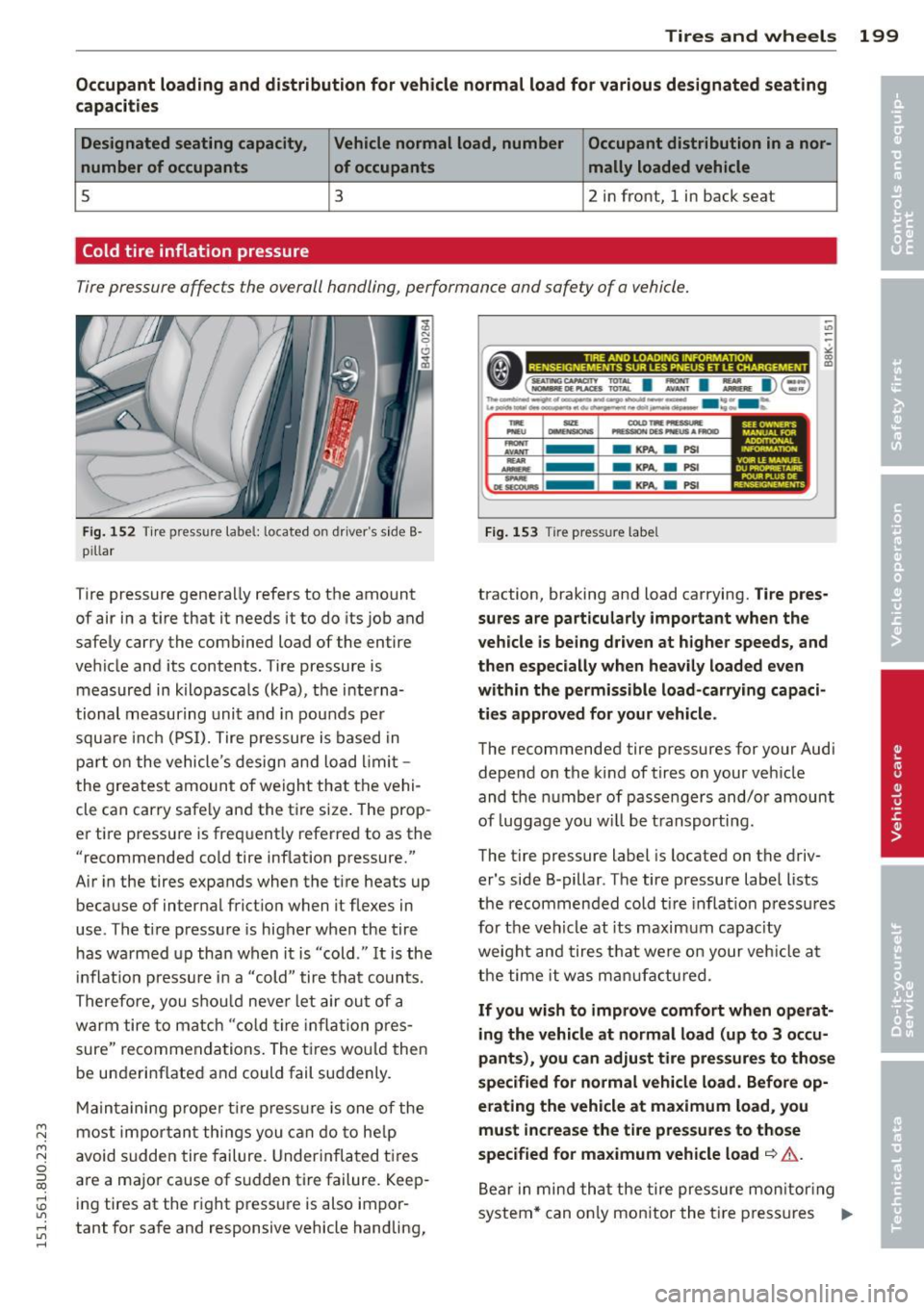
Occupant loading and distribution for vehicle normal load for various designated seating
capacities
Designated seating capacity, Vehicle normal load, number Occupant distribution in a nor-
number of occupants of occupants mally loaded vehicle
5 3 2 in front, 1 in back seat
Cold tire inflation pressure
Tire pressure affects the overall handling, performance and safety of a vehicle.
Fig. 152 Tire press ure label: located on driver 's s ide B·
p ill ar
Tire pressure generally refers to the amount
of air in a tire that it needs it to do its job and
safely carry the combined load of the entire
vehicle and its contents . Tire pressure is
measured in kilopasca ls (kPa), the interna
tional measuring unit and in pounds pe r
square inch (PSI). Tire pressure is based in
part on the vehicle 's design and load limit -
the greatest amount of weight that the vehi
cle can carry safe ly and the t ire size . The prop
er tire pressure is frequent ly referred to as the
"recommended cold tire inflation pressure."
Air in the tires expands when the tire heats up
because of internal friction when it flexes in
use . The tire pressu re is higher when the tire
has warmed up than when it is "cold ."
It is the
in flat ion pressure i n a "cold " tire that counts.
Therefo re, you shou ld neve r let air out of a
warm tire to ma tch "cold tire inflat ion pres
sure" recommendations. The tires would then
be underinflated and could fail suddenly .
Maintaining proper tir e pressure is one of the
most impor tant things you can do to help
avoid sudden tire failure. Underinflated tires
are a ma jor cause of s udden tire failure . Keep·
ing tires at the right pressure is also impor
tant for safe and responsive vehicle handling,
-tD
-
---------------------.. ,;
•(==.: I :::; I :,,. I)@ gi n. ............ .,_____, .... -.ito._.. ____ .... _ ...
&..p0idit,101111-~--.,...,....-- ..... ~ .... ..
-··-.....
-
-Dlst<:OURS
- KPA.. a PSI
- KPA..
a PS I
- KPA.. a PSI
Fig. 153 Tire pressu re labe l
traction, braking and load carrying. Tire pres
sures are particularly important when the
vehicle is being driven at higher speeds, and
then especially when heavily loaded even
within the permissible load-carrying capaci
ties approved for your vehicle.
The recommended tire pressures for your Audi
depend on the kind of tires on your ve hicle
and the number of passengers and/o r amount
of luggage you w ill be transporti ng.
The tire pressure label is located on the driv
er's side B -pillar . The tire pressure labe l lists
the recommended cold tire inflat io n pressures
for the vehicle at its maximum capacity
weight and tires that were on your veh icle at
t he time it was manufactured.
If you wish to improve comfort when operat
ing the vehicle at normal load (up to 3 occu
pants), you can adjust tire pressures to those
specified for normal vehicle load. Before op
erating the vehicle at maximum load, you
must increase the tire pressures to those
specified for maximum vehicle load
¢ &.
Bear in mind that the tire pressure monitoring
system * can only monitor the tire pressures
II>
Page 202 of 258
200 Tires and wheels
you have stored. The system does not recog
nize the load condition of your vehicle.
The effectiveness of the tire pressure monito r
ing system* will be impaired if you store nor
mal load pressures but then operate the vehi
cle at its maximum load¢.&. .
See the illustration¢
fig. 152 for the location
of the label on driver's side 8-pillar (color of
the actua l label and exact location on the ve
hicle wi ll vary slightly).
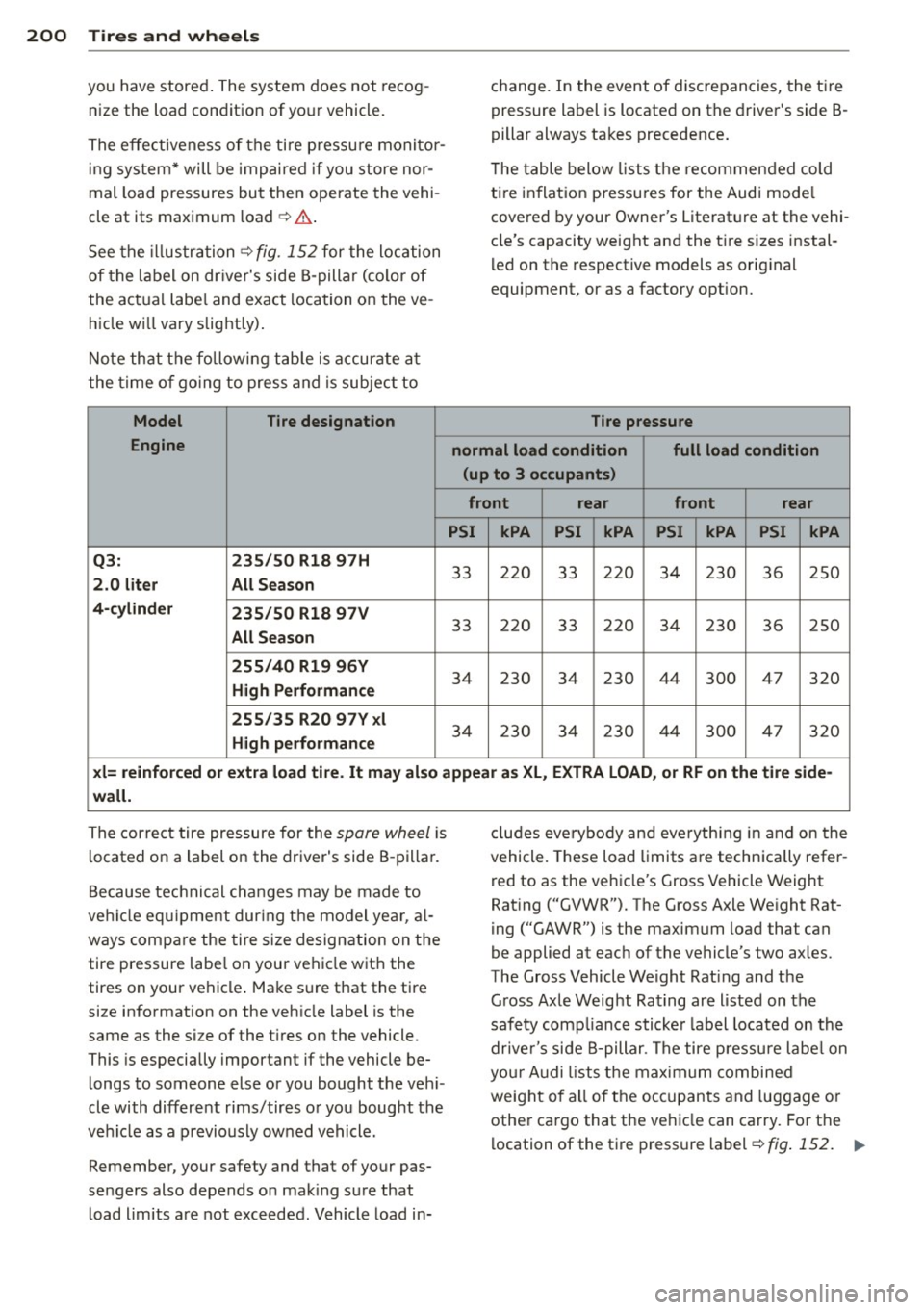
Note that the following table is accurate at
the time of going to press and is subject to
Model Tire designation
Engine
Q3: 235/50
Rl8 97H
2.0 liter All Season
4 -cylinder
235/50 Rl8 97V
All Season
255/40 Rl9 96Y
High Performan ce
255/35 R20 97Y xl
High performance
change. In the event of discrepancies, the tir e
pressure label is located on the driver's side 8-
pillar always takes precedence.
T he table below lists the recommended cold
ti re inflation pressures for the Audi mode l
covered by your Owner's Literature at the vehi
cle's capacity weight and the t ire sizes instal
l ed on the respective models as original
equipment, or as a factory option.
Tire pressure
normal load condition full load condition (up to 3 occupants)
front rear front rear
PSI kPA PSI kPA PSI kPA PSI kPA
33 220 33 220 34 230 36 250
33 220 33 220 34 230 36 250
34 230 34
230 44
300 47
320
34 230 34 230 44 300 47 320
xl= reinforced or extra load tire. It may also appear as XL, EXTRA LOAD, or RF on the tire side-
wall.
The correct tire pressure for the spare wheel is
located on a label on the driver's side 8 -pillar.
Because technical changes may be made to
vehi cle equipment dur ing the model year, al
ways compare the tire size designation on the
tire pressure labe l on your vehicle with the
tires on your vehicle . Make sure that the tire
size information on the veh icle label is the
same as the size of the t ires on the vehicle.
This is especially important if the vehicle be
longs to someone else or you bought the vehi
cle with different rims/tires or you bought the
vehicle as a previously owned vehicle.
Remember, your safety and that of your pas
sengers also depends on mak ing sure that
load limits are not exceeded . Vehicle load in- eludes
everybody and everything in and on the
vehicle. These load limits are technically refer
red to as the vehicle's Gross Vehicle Weight
Rat ing ("GVWR"). The Gross Axle We ight Rat
ing ("GAWR") is the maximum load that can
be applied at each of the vehicle's two axles.
The Gross Vehicle Weight Rating and the
Gross Axle Weight Rating are listed on the
safety compliance sticker label located on the
dr ive r's side 8-pillar. The tire pressure labe l on
you r Audi lists the max imum combined
weight of all of the occupants and luggage or
other cargo that the ve hicle can carry. For the
location of the tire pressure label
~fig . 152. .,..
Page 203 of 258
M N
M N
0 ::i co ,...., \!) ..,.,
,...., ..,., ,....,
A WARNING ,~
Overloading a vehicle can cause loss of ve
hicle control, a crash or other accident, se
rious personal injury, and even death.
- Carrying more weight than your vehicle
was designed to carry will prevent the
vehicle from handling properly and in crease the risk of a loss of vehicle con
trol.
- The brakes on a vehicle that has been
overloaded may not be able to stop the
vehicle within a safe distance.
- Tires on a vehicle that has been overload
ed can fail suddenly causing loss of con
trol and a crash.
- Always make sure that the total load be
ing transported -including the weight of
a trailer hitch and the tongue weight of a
loaded trailer -does not make the vehi
cle heavier than the vehicle's Gross Vehi
cle Weight Rating.
A WARNING
- Incorrect tire pressures and/or underin
flation can lead to a serious or fatal acci
dent .
- Incorrect tire pressures and/or underin flation cause increased tire wear and can
affect the handling of the vehicle.
- Incorrect tire pressures and/or underin
flation can also lead to sudden tire fail
ure, including a blowout and sudden de
flation, causing loss of vehicle control.
Checking tire pressure
-
The correct tire pressure for the tires original
ly installed on your vehicle is listed on the tire
pressure label located on driver's side 8-pil lar .
The recommended tire pressures are on the
tire pressure label and in the table
c::;, page 199, Cold tire inflation pressure . This
means that the pressure must be checked and
adjusted when the tire has not been driven for more than a couple of miles (kilometers) at
low speeds during the previous three hours.
Tires and wheels 201
Air in the tires expands when the tire heats up
as a result of internal friction as it flexes in
use. The tire pressure is higher when the tire
has warmed up than when it is "cold."
It is the inflation pressure in a "cold" tire that
counts. Therefore, you should never let air out
of a warm tire to match "Cold tire inflation
pressure" recommendations
c::;, page 199 . The
tires would then be underinflated and could
fail suddenly .
The tire pressure label on your Audi lists the recommended cold tire inflation pressures at
maximum capacity for the new, original
equipment tires that were on your vehicle at
the time it was manufactured . For the loca
tion of the label
¢page 199, fig . 152 .
Most tires lose air naturally over time . They
can also lose some air if you drive over a pot
hole or hit a curb while parking.
It is usually
not possible to see whether the radial tires
used today are underinflated just by looking
at them.
Therefore, be sure to check tire pressures at
least once a month and always before going
on a long trip. Make sure to take the number
of people and the amount of luggage into ac
count when adjusting tire pressure for a trip -
even one that you would not consider to be "long." See
c::;, page 203, Tires and vehicle
load limits
for more important information .
Always use an accurate tire pressure gauge
when checking and adjusting inflation pres
sures. Check all of the tires and be sure not to
forget the spare tire. If the pressure in any tire is too high when the tire is "cold", let air out
of the tire slowly with the edge of the tire gauge and keep checking the pressure until
you reach the pressure that is correct for the load (passengers and luggage) and kind of
driving you plan to do.
If the pressure in any tire is too low, note the
difference between the pressure in the cold
tire and the pressure you need and add the air
that you need to reach the correct pressure for
the vehicle load (passengers and luggage) for
the tires on your vehicle as listed on the on .,.. •
•
Page 204 of 258
202 Tire s and whee ls
your veh icle and in this manua l and the kind
of driving you p lan to do .
Neve r e xcee d the m ax imum inflati on pres
s u re list e d on th e tir e s ide wall f or a ny r ea
s on.
Remember that the vehicle manufacturer, not
the tire manufacturer , determ ines the co rrect
tire pressure for the t ires on your veh icle .
It is important to check the tire pressure when
the tires a re cold .
- Read the required t ire pres sure from the tire
pressure label. The ti re pressure label is lo
cated on the driver's side 8-p illar . The t ire
pressure label lists the recommended cold
t ire inflat ion p ressu res for the veh icle at its
maximum capacity we ight and the tires that
were on you r vehicle at the time it was man
ufactured . For recommended tire pressures
for normal load condit ions, please see chap
ter
9 page 199.
-Turn the valve stem cap counter-clockwise
to remove it from the tire valve.
- Place the a ir pressure gauge on the valve.
- T he tire pressures should on ly be checked
and adjusted when the tires are cold. The
s li ghtly raised pressures of warm tires must
not be reduced.
- Adjust the tire pressure to the load you are
carrying .
- Reinsta ll the va lve stem cap on the valve.
When should I check the tire pressur e?
The correct tire pressure is especially impor
tant at high speeds. The pressure should
therefore be checked at least once a month
and always befo re starting a journey. Do not
forget to check the tire pressure for the spare wheel.
When should I ad ju st th e tire p re ss ures?
Adj ust the tire p ressure to the load you are
carry ing . After chang ing a wheel
or replacing
wheels you have to adjust the tire pressures
on all wheels . In addition, you must then in iti
alize the new tire pressures in th e tire pres
sure monito ring system*
c> page 213.
A WARNING
Incorrect tire pressures and/or underinfla
tion can lead sudden tire fa ilure, loss of
control, collision, serious personal injury
or even death.
- When the
Rt] warning symbol appears in
the instrument cluster, stop and inspect
the t ires.
- Incorrect tire pressure and/or underinfla
tion can cause increased tire wear and
can affect the hand ling of the vehicle and
stopping abi lity.
- I nco rrect tire pressures and/or underin
f lation can also lead to sudden t ire fail
ure, including a blowout and sudden de
flation, ca using loss of vehicle contro l.
- The driver is responsible for the co rrect
tire pressures for all tires on the veh icle.
The applicable pressure values are locat
ed on a sticker on the driver's side B -pil
lar.
- Only when all tires on the vehicle are fil
led to the correct pressure, the tire pres
sure monitoring system * can work cor
rectly.
- The use of incorrect tire pressure va lues
can lead to acc idents or other damage.
Therefore it is essential that the driver
observe the spec ified t ire pressure values
for the tires and the correct pressures for
the function of the t i re pressure monitor
ing system*.
- Always inflate t ires to the recommended
and correct t ire p ressure before dr iving
off.
- Driving with underinf lated tires bend
mo re, letting them get too hot resulting
in tread sepa ration, s udden tire failure
and loss of cont ro l.
- E xcessive speed and/overloadi ng can
cause heat b uild- up, sudden tire failure
and loss of cont ro l.
- I f the tire pressure is too low or too high,
the t ires will wear prema turely and the
vehicle wi ll not handle well. ..,