wheel AUDI Q3 2015 Repair Manual
[x] Cancel search | Manufacturer: AUDI, Model Year: 2015, Model line: Q3, Model: AUDI Q3 2015Pages: 258, PDF Size: 64.9 MB
Page 215 of 258
M N
M N
0 ::i co ,...., \!) 1.1'1 ,...., 1.1'1 ,....,
In o rder to minimize the occurrence o f imp act
damage to the tires of y our vehicle, we recom
mend that you observe the following precau
tions :
- Always maintain recommended inflation
pressures. Check your tire pressure every
2,000 miles (3,000 km) and add a ir if neces
sary.
- Drive carefu lly on roads with potholes, deep
gullies or ridges. The impact from driving
through or over such obstacles can damage
your tires. Impact with a curb may also cause damage to your tires .
- After any impact, immediately inspect your
tires or have them inspected by the nearest
authorized Aud i deale r. Replace a damaged
t ire as soon as poss ible .
- In spect your t ires every 2,000 miles (3,000
km) for damage and wear . Damage is not al
ways easy to see. Damage can lead to loss of
air and unde rinflation, wh ic h could eventu
ally cause ti re fa il ur e.
If yo u be lieve that a
t ir e may have been damaged , replace the
tire as soon as possible.
- These tires may wea r more q uick ly than oth
ers.
- Please a lso remembe r that, whi le these t ires
deliver respons ive handling, they may ride
l ess comfortably and make more noise than
other c hoices.
Reduced p erformance in winter /cold
s ea son condit ion s
All ti res are designed for certain purposes .
The low aspect ratio, ultra hig h pe rformance
tires orig inally installed on your veh icle are in
tended for max imum dry and wet road per
formance and handling . They are not suitable
for cold, snowy or icy weather cond it ions . If
you dr ive under those circumstances, you
should equip your vehicle with all-season or
winter tires, whi ch offe r better trac tion under
t hose cond itions . We suggest yo u use the rec
ommended snow or all -season tires specified
for your ve hicle, or their equiva lent .
Refe r to
~ page 210 for mo re deta iled info r
mat io n regarding w in ter t ires.
Tire s an d wheel s 213
Tire pressure
monitoring system
ill General notes
App lies to vehicles : wi th tire p ress ure mo nito rin g system
Each tire, incl uding the spa re (if provided),
sho uld be checked monthly when co ld and in
flated to the inflation pressure recommended
by the veh icle manufacturer on the veh icle
placard or tire inflation pressure label. (If your
vehicle has tires of a d ifferent size than the
s iz e indicated on the vehicle placa rd o r tire in
flat io n pressu re labe l, you s hou ld dete rm ine
the p roper t ire inflation p ress ure fo r those
ti r es).
As an added safety featu re, your veh icle has
been equipped with a tire p ressure monitoring
system ( TPMS) tha t illum inates a low ti re
pressure te lltale whe n one or more o f you r
ti res is significant ly under -inflated . Acco rding
ly, when the low tire pressure te lltale i llumi
nates, yo u shou ld stop and check you r tires as
soon as possib le, and inf late them to the
proper pressure. Driving on a sign ificantly un
der- inflated t ire causes the tire to overheat
and can lead to tire fa ilure . Under-inflation al
so reduces fuel eff ic iency and tire tread life,
and may affe ct the vehicle 's hand ling and
stopp ing abil ity.
Please note that the TPMS is not a subst itute
fo r proper tire ma intenanc e, and it is the d riv
er's respo nsibility to maintain co rrect tire
pressure, even if under -inflation has not
reached the leve l to tr igger illum inat ion o f the
T PMS low ti re p ressu re tellta le .
You r vehicle has also been equipped with a
T PMS ma lf u nction indicator to ind icate w hen
t he sys tem is not oper ating prope rly . T he
T PMS ma lfunction indicator is combined w ith
the low tire pressure te lltale. When the sys
tem detects a malfunction, the telltale wi ll
flash for approximate ly one min ute and then
rema in con tinuously i llum inated . T hi s se
quence will continue upon subsequent vehicle
start-ups as long as the malfunct ion exists . ..,.
•
•
Page 216 of 258
214 Tire s and wheel s
When the malfunction indicator is illuminat
ed, the system may not be able to det ect or
signal low t ire pressure as intended . TPMS
malfunct ions m ay occur for a variety of re a
sons, including the installa tion of replace
ment or a lternate tires or wheels on the vehi
cle that prevent the TPMS from funct ioning
properly . Always check the TPMS malfunct ion
tellta le afte r replacing one or more t ires or
wheels on your veh icle to ensure that the re
p lacement or a lternate tires and wheels allow
the TPMS to continue to function properly.
Tire pressure indicator appears
Applies to vehicles: with tire pressure monito ring system
The tire pressure indicator in the instrument
cluster informs you if the tire pressure is too
low or if there is a system malfunction.
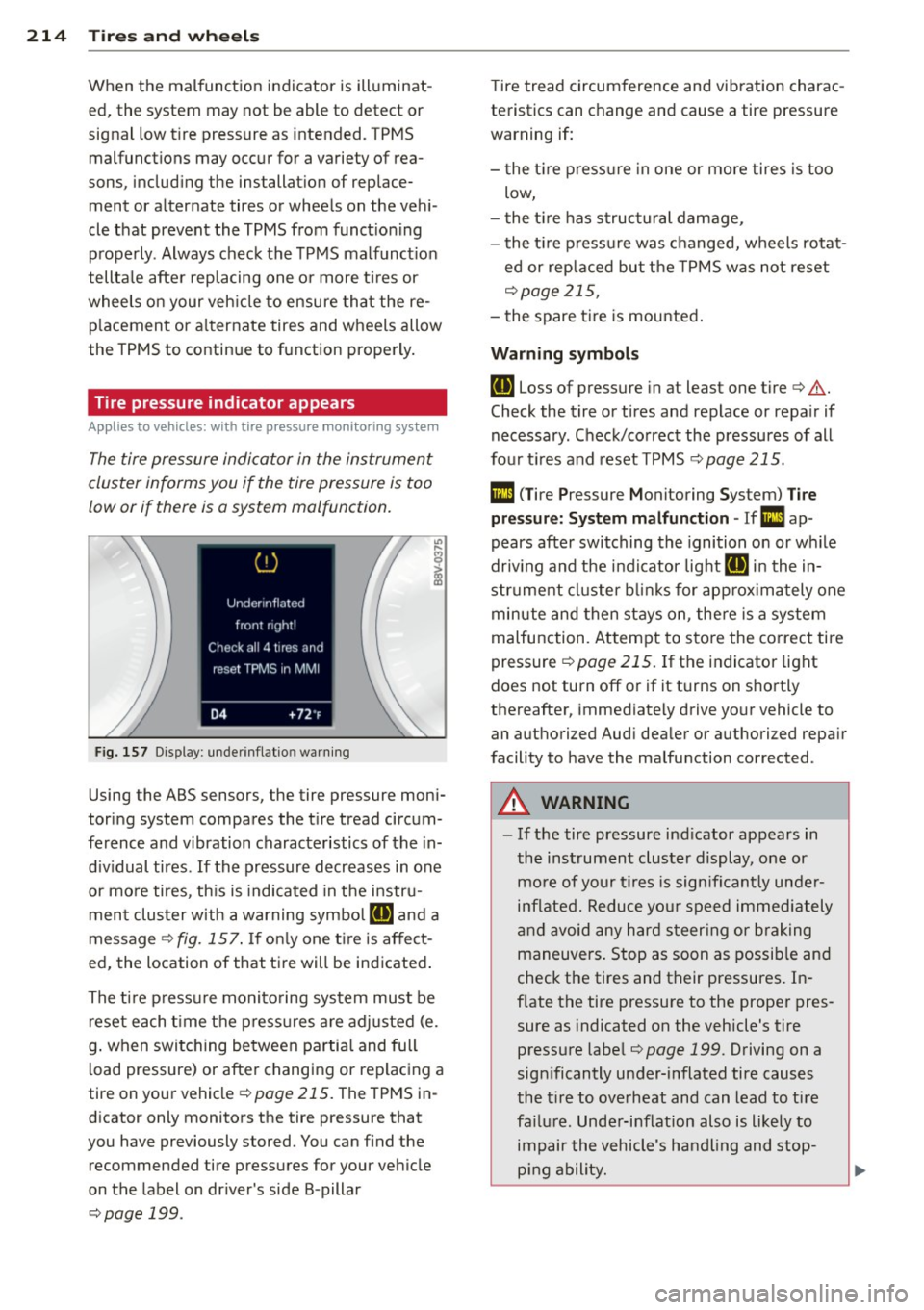
F ig. 157 Display : under inflatio n warning
Using the ABS sensors, the tire pressure moni
toring system compares the t ire tread circum
ference and vibration characteristics of the in
d iv idual tires . If the pressure decreases in one
or more tires, th is is indicated in the instru
ment cluster w ith a warning symbo l
RE and a
message¢
fig. 157 . If on ly one ti re is affect
ed, the location of that tire will be indicated .
The t ire p ressu re monito ring system must be
reset each t ime the press ures a re adjusted (e.
g . when switching between partia l and full
l oad pressure) or after changing or replacing a
tire on your vehicle ¢
page 215. The TPMS in
dicator only monitors the tire p ressu re that
you have previously s tored. You can find the
recommended tire pressures for your vehicle
on the label on dr iver 's side B -pillar
¢ page 199.
Tire tread circumference and vibration charac
teristics can change and cause a tire pressure
warning if:
- t he t ire press ure in one or more tires is too
low,
- t he t ire has s tructural damage ,
- the t ire p ressure was changed, wheels rotat -
ed or replaced but the TPMS was not reset
¢ page 215,
-the spare t ire is mou nted.
Warning symbo ls
RE Loss of pressure in at least one tire¢.& .
Check the tire or tires and replace or repa ir if
necessary . Check/correct the pressures of all
four t i res and reset TPMS
¢ page 215 .
Ill (T ire Pressure Monitoring Sys tem) T ire
pr ess ure: S y ste m m alfun ction -If l!I ap
pears after switching the ignition on or wh ile
driv ing and the indicator light
RE in the in
strument cluster b links for app rox imately one
minute and then stays on , the re is a system
malfunction . Attempt to sto re the correct tire
pressure
¢ page 215 . If the indicator light
does not turn off or if it turns on shortly
thereafter, immediately drive yo ur vehicle to
an authori zed Aud i dea ler or authori zed repa ir
facility to have the malfunction corrected .
A WARNING
--- If the tire pressure indicator appears in
the instrument cluster display, one or mo re of your t ires is sign ifi cantly unde r
i n flated. Reduce yo ur speed immedi ately
and avoid any hard steer ing or b raking
maneuve rs. Stop as soon as possib le and
check the tires and their pressures. In
f late the tire pressure to the proper pres
sure as indicated on the vehicle's tire
pressure labe l
¢page 199. Driving on a
significantly under-i nflated tire causes
the t ire to overheat and can lead to ti re
fa ilu re. Unde r-inflation also is likely to
impair the vehicle's handling and stop
p ing ability.
Page 217 of 258
M N
M N
0 ::i co ,...., \!) 1.1'1 ,...., 1.1'1 ,....,
-The driver is responsible for maintaining
the correct tire pressures. You must
check the tire pressures regularly.
- Under certain conditions (such as a spor
ty driving style, winter conditions or un
paved roads), the pressure monitor indi
cator may be delayed.
- Ask your authorized dealer if run-flat
tires may be used on your vehicle. Your
vehicle registration becomes invalid if
you use these tires when not permitted .
Damage to your vehicle or accidents
could also result.
- The tire pressure monitoring system may
stop working when there is an ESC mal
function.
- Using snow chains may result in a system
malfunction.
- The tire pressure monitoring system on
your Audi was developed using tires with
the "AO" or "RO" identification on the
tire sidewall
¢page 206. We recom
mend using these tires.
Reset tire pressure monitoring system
Applies to vehicles: with tire pressure monit oring sys te m
If the tire pressure is adjusted, wheels are ro
tated or changed, the TPMS must be reset.
"'Before storing the new tire pressures, check
that the current pressures on all four tires correspond to the specified values and
adapt the pressures to the current load
¢ page 199.
"'Sw itch on the ignition.
"' Select: the
I CAR I function button > Car* sys
tems
contro l button > Servicing & checks >
Tire pressure monitoring > Store tire pres
sures > Yes, store now .
(D Tips
Do not store the tire pressure if there are
snow chains on the tire. Otherwise, a sys
tem malfunction may occur.
Tires and wheels 215
•
•
Page 218 of 258
216 What do I do now?
What do I do now?
General information
.. Park the vehicle as far as possible from mov
ing traffic in the event of a flat tire. In the
event of a flat tire, park the vehicle on a lev
el surface . It you are on a steep incline, be
especially careful.
.. Set the parking brake .
.. Switch the emergency flashers on .
.. Put on a reflective vest, if ava ilable .
.. Set up the warning triang le, if available .
.. Have the passengers exit the vehicle. They
should move to a safe place, for example
behind a guard rai l.
A WARNING
Pay attention to the steps above. They are
for your protection and the for the safety
of other drivers.
A WARNING
Improper use of the vehicle jack can cause
serious personal injuries.
- Never use the screw driver hex head to
tighten wheel bolts, since the bolts can
not attain the necessary tightening tor
que if you use the hex head, potentially
causing an accident.
- The factory-suppl ied jack is intended on
ly for your vehicle model. Under no cir
cumstances should it be used to lift
heavy vehicles or other loads; you risk in
jur ing yourself.
- Never start the engine when the vehicle
is raised, which could cause an accident.
- Support the vehicle securely with appro
priate stands if work is to be performed
underneath the vehicle; otherwise, there
is a potential risk for injury.
- Never use the jack supplied with your
Audi on another vehicle, particularly on a
heavier one . The jack is only suitable for
use on the vehicle it came with .
Vehicle tool kit with
lifting jack
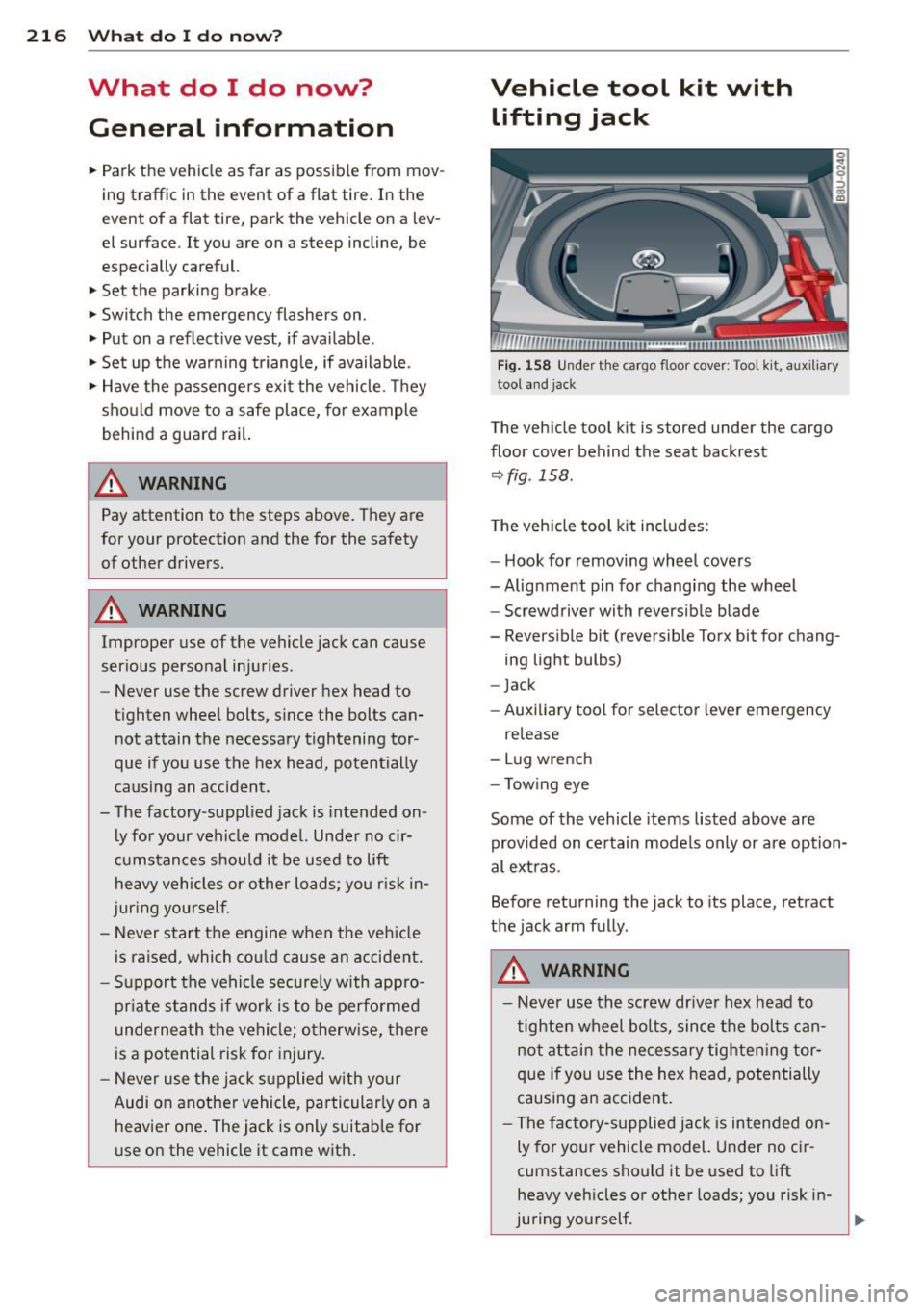
Fig. 158 Under the cargo floo r cover : Too l kit , auxiliary
too l and jack
The veh icle tool kit is stored under the cargo
floor cover behind the seat backrest
Q fig . 158 .
The vehicle tool kit includes :
- Hook for removing wheel covers
- Alig nment pin for changing the wheel
- Screwdriver with reversible blade
- Reversible bit (reversible Torx bit for chang-
ing light bulbs)
- Jack
- Auxil iary tool for selector lever emergency
release
- Lug wrench
-Towing eye
Some of the vehicle items listed above are
provided on certain models only or are option
al extras.
Before returning the jack to its place , retract
the jack arm fully .
A WARNING
-Never use the screw driver hex head to
tighten wheel bolts, since the bolts can
not attain the necessary tighten ing tor
que if you use the hex head, potentially
causing an accident.
- The factory-supplied jack is intended on
ly for your vehicle model. Under no cir
cumstances should it be used to lift
heavy veh icles or other loads; you risk in-
-
juring yourself. ~
Page 219 of 258
M N M N
0 ::i co
rl I.O
"' rl
"' rl
-Never start the engine when the veh icle
is raised, which cou ld cause an accident.
- Support the vehicle secure ly with appro
priate stands if work is to be performed
underneath the vehicle; otherwise, there
is a potential risk for injury.
Folding chocks
Applies to vehicles: with fold ing chocks
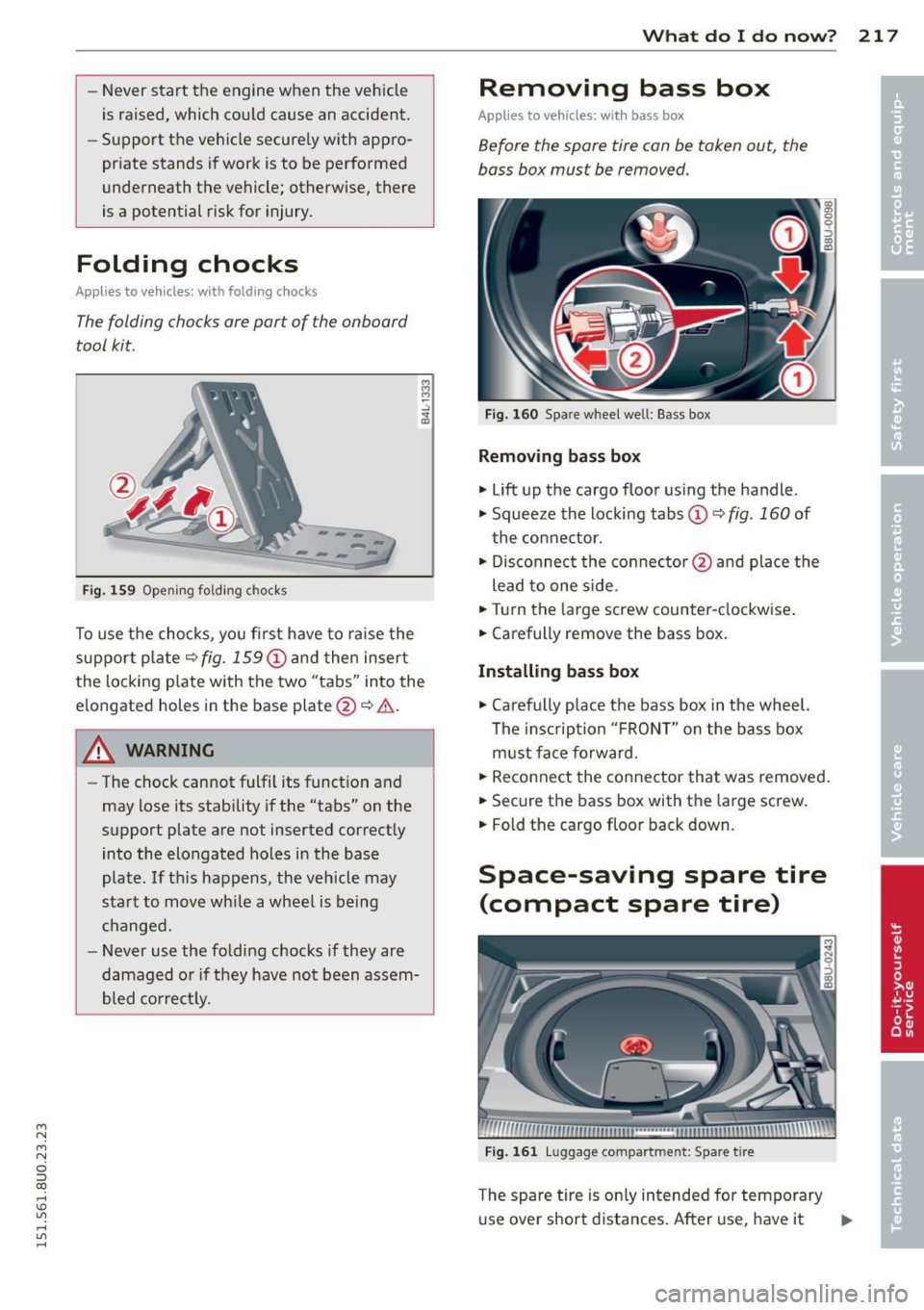
The folding chocks are part of the on board
tool kit.
------ - --
Fi g. 159 Opening foldi ng chocks
To use the chocks, you fi rst have to ra ise the
suppor t plate~
fig . 159 CD and then insert
the locking p late with the two "tabs" into the
e longated holes in the base plate@~&. .
&_ WARNING
-The chock cannot fulfil its function and
may lose its stability if the "tabs" on the
support plate are not inserted correctly into the elongated holes in the base
plate. If t his happens , the veh icle may
sta rt to move whi le a wheel is being
changed.
- Never use the folding chocks if they are
damaged or if they have not been assem
bled correct ly.
What do I d o now ? 217
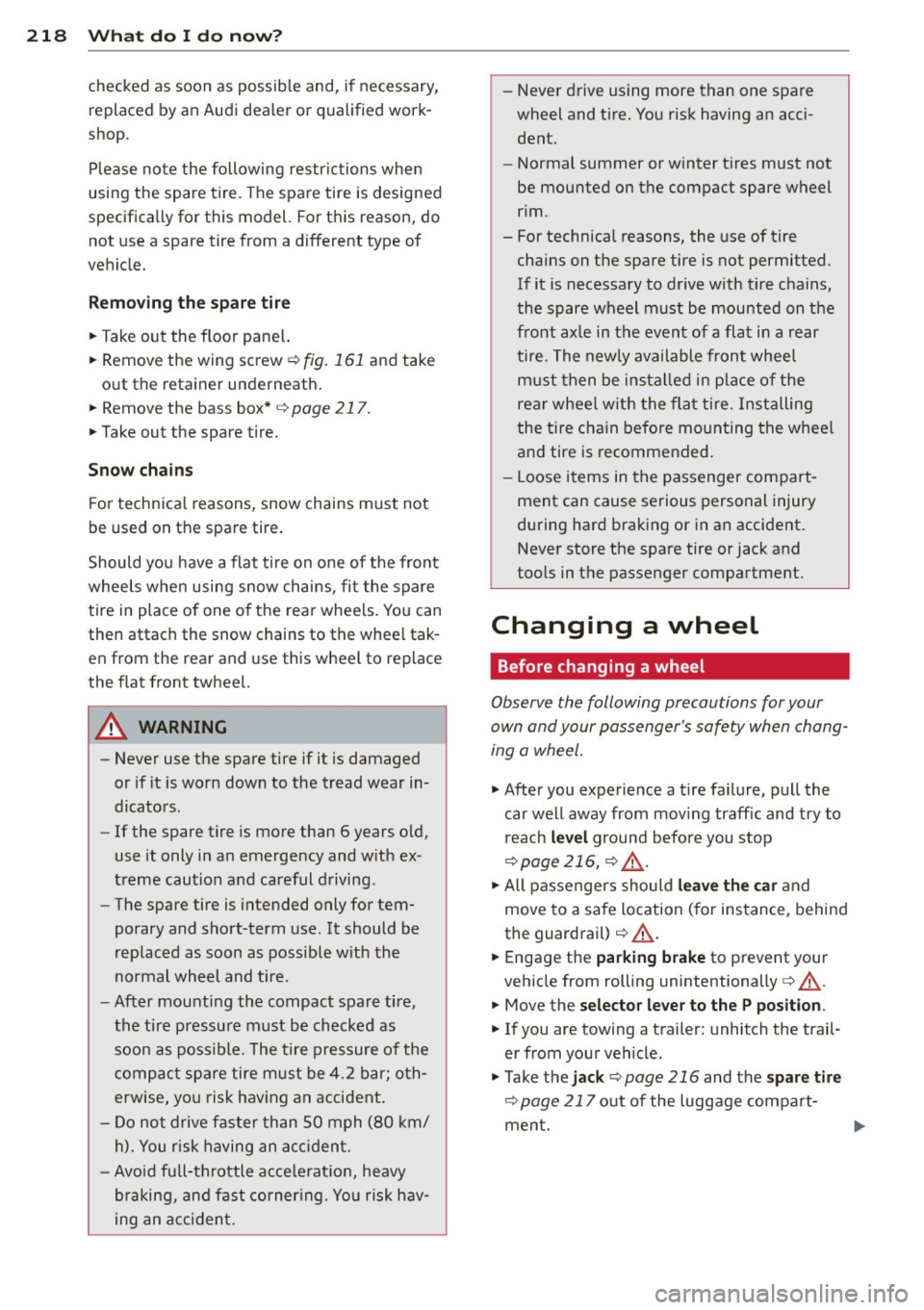
Removing bass box
App lies to vehicles: wit h bass box
Before the spare tire can be taken out, the
bass box must be removed.
Fi g. 160 Spa re whee l well: Bass box
Removing bass box
.,. Lift up the cargo floor us ing the handle .
.,. Squeeze the locking tabs
CD ~ fig. 160 of
the connector .
.,. Disconnec t the conne ctor @and place the
le ad to one side .
.. Tur n the large screw counter-clockwise .
.. Carefully remove the bass box.
Installing bass box
.,. Carefully place the bass box in the wh eel.
The ins cription "FRO NT' ' on the bas s box
m ust face forward .
.. Reco nnect the connector that was removed .
.. Secure the bass box with the large screw.
.. Fold the cargo floor back down.
Space-saving spare tire
(compact spare tire)
.'II If Ill llf 1111 11
Fig . 16 1 Lu ggage compartme nt: Spa re tire
T he spare tire is on ly in tended for tempo rary
u se over short distances. After use, have it ...,
Page 220 of 258
218 What do I do no w?
checked as soon as possible and, if necessary,
replaced by an Audi dea ler or qualified work
shop.
P lease no te the following restr ictions when
using the spare tire . The spa re tire is designed
specifica lly for this model. For t his reason, do
not use a spare tire from a different type of
vehicle.
Re moving the spare tire
.. Take out the floor pane l.
.. Remove the wing screw ¢
fig. 161 and take
out the retainer underneath .
.. Remove the bass box* ¢
page 217.
.. Take out the spare tire.
Snow cha in s
For technica l reasons, snow chains must not
be used on the spare tire .
Should you have a flat tire on one of the front
wheels when using snow chains, fit the spare
tire in place of one o f the rear whee ls. You can
then attach the snow chains to the whee l tak
en from the rear and use this wheel to replace
the flat front twheel.
A WARNING
- Never use the spare tire if it is damaged
or if it is worn down to the tread wear in
dicato rs .
- If the spare tire is more than 6 years o ld,
use it only in an emergency and w ith ex
t reme caution and careful d riving .
- The spare tire is intended only for tem
porary and short-term use. It should be
replaced as soon as possib le w ith the
normal wheel and t ire.
- After mounting the compact spare tire,
the tire pressu re must be checke d as
soon as poss ible. The tire pressure of the
c om pac t spa re tire must be 4.2 bar; oth
erwise, you risk hav ing an accident .
- Do not drive faster than 50 mph (8 0 km/
h). You risk having an acc iden t.
- Avoid full-throttle acce le rat ion, heavy
braking, and fast corner ing . Yo u r isk hav
ing an ac ciden t. -
Never drive using more than one spare
wheel and tire. You r isk having an acci
dent.
- Normal summer or winter t ires must not
be mounted on the compact spare wheel
rim.
- For technical reasons, the use of tire
chains on the spare tire is not permitted.
If it is necessary to drive with tire chains,
the spare wheel must be mounted on the
front ax le in the event of a flat in a rear
tire. The new ly available front wheel
m ust then be installed in place of the
rea r whee l w ith the flat tire. Installing
the tire chain be fore mounting the whee l
and tire is recommended.
- Loose items in the passenger compart
ment can cause se rious personal injury
during hard braking or in an accident. Never store the spare tire or jack and
too ls in t he passenger compartment.
Changing a wheel
Before changing a wheel
Observe the following precautions for your
own and your passenger's safety when chang
ing a wheel.
.. After you experie nce a t ire failure, pull the
car well away from mov ing traffic and try to
reach
level ground before you stop
¢ page 216, ¢,& .
.. All passengers should leave th e car and
move to a safe location ( for ins tance, behind
the guardrail) ¢&, .
.. Engage the
pa rking brake to prevent your
veh icle from rolling unintentionally
c> &, .
.. Move the
selector lever to the P posit ion .
.. If you are towing a trailer : unhitch the trail
er from your vehicle.
.. Take the
jack ¢ page 216 and the spare tir e
¢page 217 out of the luggage compart-
ment. .,.
Page 221 of 258
M N
M N
0 ::i co ,...., \!) ..,.,
,...., ..,., ,....,
A WARNING 1=
You or your passengers could be injured
while changing a wheel if you do not fol
low these safety precautions:
- If you have a flat tire, move a safe dis
tance off the road. Turn off the engine,
turn the emergency flashers on and use
other warning devices to alert other mo
torists.
- Make sure that passengers wait in a safe
place away from the vehicle and well
away from the road and traffic.
- To help prevent the vehicle from moving
suddenly and possibly slipping off the
jack, always fully set the parking brake
and block the wheel diagonally opposite
the wheel being changed with the fold
ing chocks or other objects. When one
front wheel is lifted off the ground, plac ing the Automatic Transmission in "P"
(Park) will
not prevent the vehicle from
moving .
- Before you change a wheel, be sure the
ground is level and firm. If necessary,
use a sturdy board under the jack.
- Always store the vehicle tool kit, the jack
and the replaced tire in the luggage com
partment
¢ page 100.
(D Note
If you are changing the wheel on a steep
incline, use the folding chock¢
page 217
to block the opposite wheel to prevent the
vehicle from moving.
(!) Tips
Obey all laws.
Changing a wheel
When you change a wheel, follow the se
quence described below step-by-step and in
exactly that order .
-
1. Remove the decorative wheel cover* or
the
wheel bolt caps*. For more details see
also
¢ page 220.
2. Loosen the wheel bolts<=:> page 220 .
What do I do now? 219
3.
4.
5.
6.
7.
8.
Locate the proper mounting point for the
jack and align the jack below that point
¢ page 221.
Lift the car with the jack ¢ page 221.
Remove the wheel with the flat tire and
then install the
spare tire <=:>page 222.
Tighten all wheel bolts lightly.
Lower the vehicle with the jack .
Use the wheel bolt wrench and
firmly
tighten all wheel bolts in a crisscross pat
tern ¢
page 220.
9. Replace the decorative wheel cover* or
the
wheel bolt caps*.
A WARNING
Always read and follow all WARNINGS and information<=:>
A in Raising the vehicle on
page 221
and <=:> page 223.
After changing a wheel
A wheel change is not complete without the
doing the following.
.,. Always store the vehicle tool kit, the jack4
and the replaced tire in the luggage com
partment
¢ page 100.
.,. Check the tire pressure of the spare tire as
soon as possible .
.,. As soon as possible, have the
tightening
torques
on all wheel bolts checked with a
torque wrench. The correct tightening tor
que is 105 ft lbs. (140 Nm).
.,. Have the flat tire
replaced as soon as possi
ble.
(D Tips
- If you notice that the wheel bolts are
corroded and difficult to turn while
changing a tire, they should be replaced
before you check the tightening torque.
- Drive at reduced speed until you have the
tightening torques checked.
•
•
Page 222 of 258
220 What do I do now?
Removing the wheel covers/bolt caps
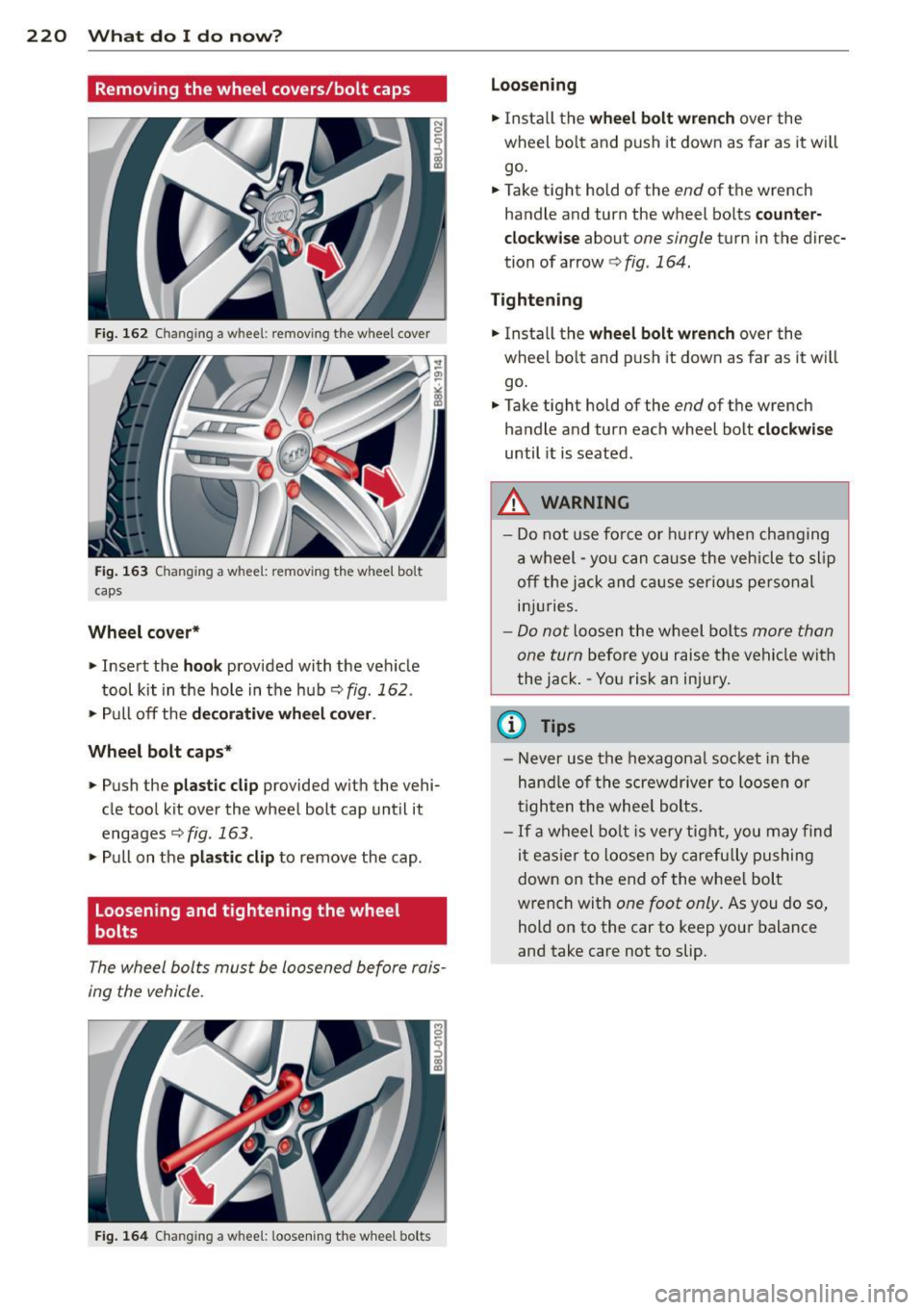
Fig. 162 Cha ng in g a w hee l: re mov ing the w heel cover
Fig. 163 Chan gin g a w hee l: re mov ing the w heel bo lt
c aps
Wheel cover*
• Insert the hook provided with the vehicle
tool kit in the hole in the hub
¢ fig. 162 .
• Pull off the decorative wheel cover .
Wheel bolt caps*
• Push the plastic clip provided with the vehi
cle tool kit over the wheel bolt cap until it
engages
¢ fig. 163 .
• Pull on the plastic clip to remove the cap.
Loosening and tightening the wheel
bolts
The wheel bolts must be loosened before rais
ing the vehicle.
Fig. 164 Chan ging a whee l: loosening th e wh eel b olts
Loosening
• Install the wheel bolt wrench over the
wheel bolt and push it down as far as it will
go .
.. Take tight hold of the
end of the wrench
handle and turn the wheel bolts
counter
clockwise
about one single turn in the direc
tion of arrow
¢ fig . 164.
Tightening
• Install the wheel bolt wrench over the
wh eel bolt and push it down as far as it will
go.
• Take tight hold of the
end of the wrench
handle and turn each wheel bolt
clockwise
until it is seated .
.&_ WARNING
=
-Do not use force or hurry when changing
a wheel - you can cause the vehicle to slip
off the jack and cause serious personal
injuries.
- Do not loosen the wheel bolts more than
one turn
before you raise the vehicle with
the jack. -You risk an injury.
(D Tips
- Never use the hexagonal socket in the
handle of the screwdriver to loosen or
tighten the wheel bolts.
-If a wheel bolt is very tight, you may find
it easier to loosen by carefully pushing
down on the end of the wheel bolt
wrench with
one foot only. As you do so,
hold on to the car to keep your balance
and take care not to slip.
Page 223 of 258
M N M N
0 ::i co
rl I.O
"' rl
"' rl
Raising the vehicle
The vehicle must be li~ed with the jack first
before the wheel can be removed .
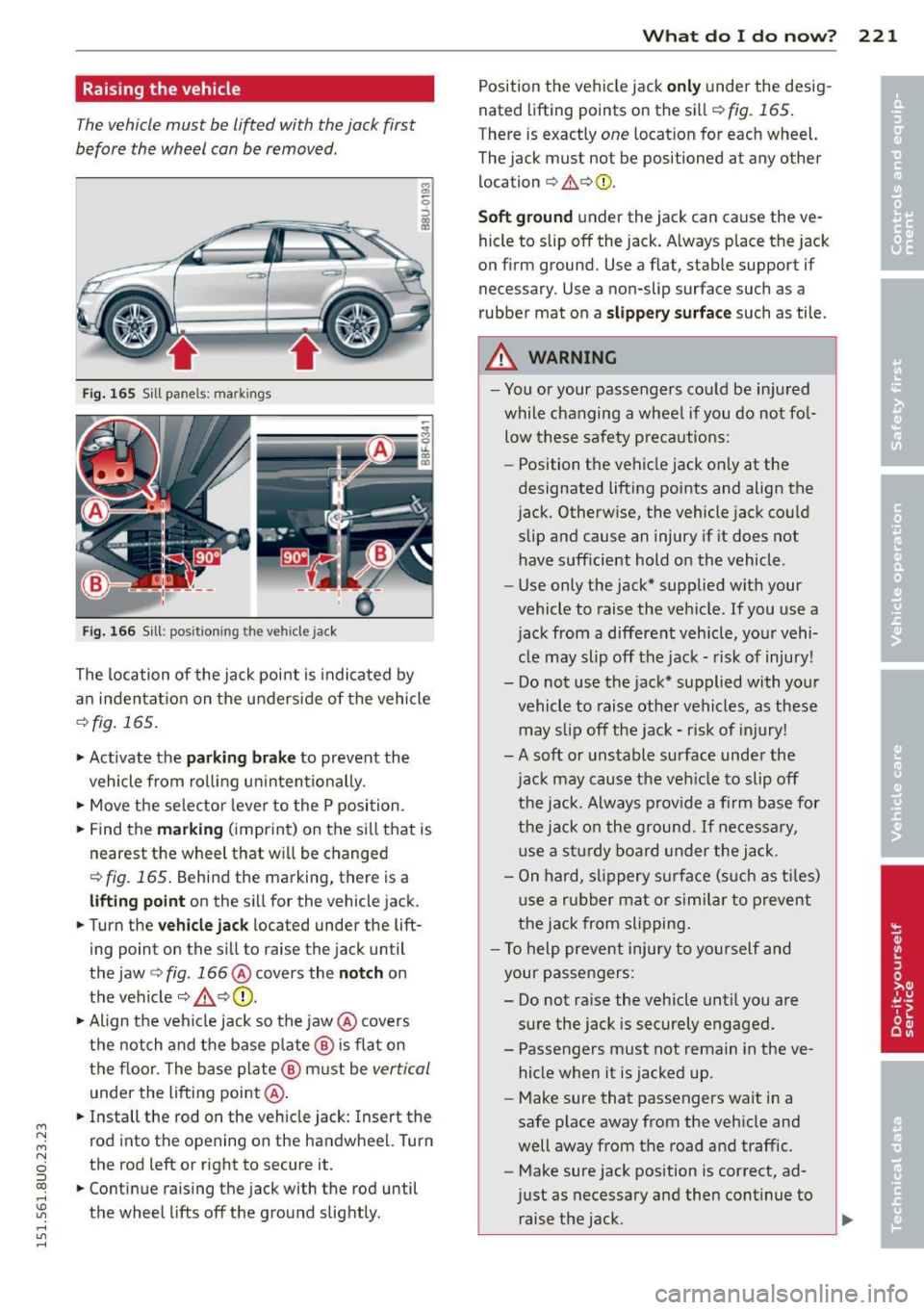
Fig. 165 S ill pane ls: markings
Fi g. 166 Sill: posit ion ing th e vehicle jack
The location of the jack point is indicated by
a n in den ta ti on on the underside of the vehicle
c::> fig . 165.
"'Activate the parking b rak e to prevent the
vehicle from ro lling u ninten tionally.
"' Move the selector lever to the P position .
"' Find the
markin g (imprint) on the si ll that is
nearest the wheel that w ill be changed
c::>fig. 165 . Behind the marking, there is a
lifting po int on the sill for the vehicle jack .
"' Turn the
vehicle jack located under the lift
ing point on the sill to raise the jack until
the jaw
c::> fig . 166 @ covers the notch on
the vehicle
c::> .&_ c::>0 .
"'Align the vehi cle jack so the jaw @covers
the notch and the base p late @ is flat on
t h e f loor. The base p late @ must be
vertical
under the lifting point @.
"' Install the rod on the vehicle jack : Insert the
rod into the opening on the handwheel. Turn
the rod left or right to secure it.
"' Continue raising the jack with the rod until
the wheel lifts off the ground slightly .
What do I do now ? 221
Position the vehicle jack only under the desig
nated lifting po ints on the si ll
c::>fig. 165 .
There is exactly one locat ion for each wheel.
The jack must not be positioned at any other
location
c::> .&. c::> (D .
Soft g round under the jack can cause the ve
hicle to slip off the jack. A lways p lace the jack
on firm ground. Use a f lat, stable support if
necessary. Use a non-slip surface such as a
rubber mat o n a
slippery surface such as tile.
A WARNING
- You or your passengers co uld be inju red
while changing a wheel if you do not fo l
low these safety p re ca utions:
- Position the vehicle jack on ly at the
designated lifting points and align the
j ack. Otherw ise, the vehicle jack could
slip and cause an injury if it does not
have sufficient hold on the vehicle.
- Use only the jack* supplied with your
vehicle to raise the veh icle . If you use a
j ac k from a different veh icle, you r vehi
cle may slip off the jac k -ris k of injury !
- Do not use the jack* supplied with yo ur
vehicle to raise other vehicles, as these
may s lip off the jack -risk of injury!
- A soft o r unstable surface unde r the
j ac k m ay cause the veh icle to slip off
the jack . Always prov ide a fi rm base for
the jack o n the ground.
If necess ary,
u se a st urdy board under the jack.
- On hard, sl ippery su rface (such as t iles)
u se a r ubber mat or s imi lar to prevent
the jack from slipping .
- To help prevent injury to yo urself and
your p asse ngers:
- Do not ra ise the vehicle until you are
sure the jack is securely engaged.
- Passengers must not remain in the ve
hicle when it is jacked up.
- Make sure that passengers wait in a
safe place away from the veh icle and
well away from the road and traffic .
- Make sure jack position is correct, ad
j ust as necessary and then cont inue to
raise the jack .
Page 224 of 258
222 What do I do now?
-If work has to be done under the vehi
cle , ensure that it is safely supported
on suitable stands -risk of injury!
- Never start the engine when the vehi
cle is on the jack -risk of accident!
CD Note
Do not lift the vehicle by the si ll. Position
the vehicle jack only at the designated lift
ing points on the sill. Otherwise, your vehi
cle will be damaged.
Taking the wheel off/installing the spare
tire
Follow these instructions step-by-step for
changing the wheel.
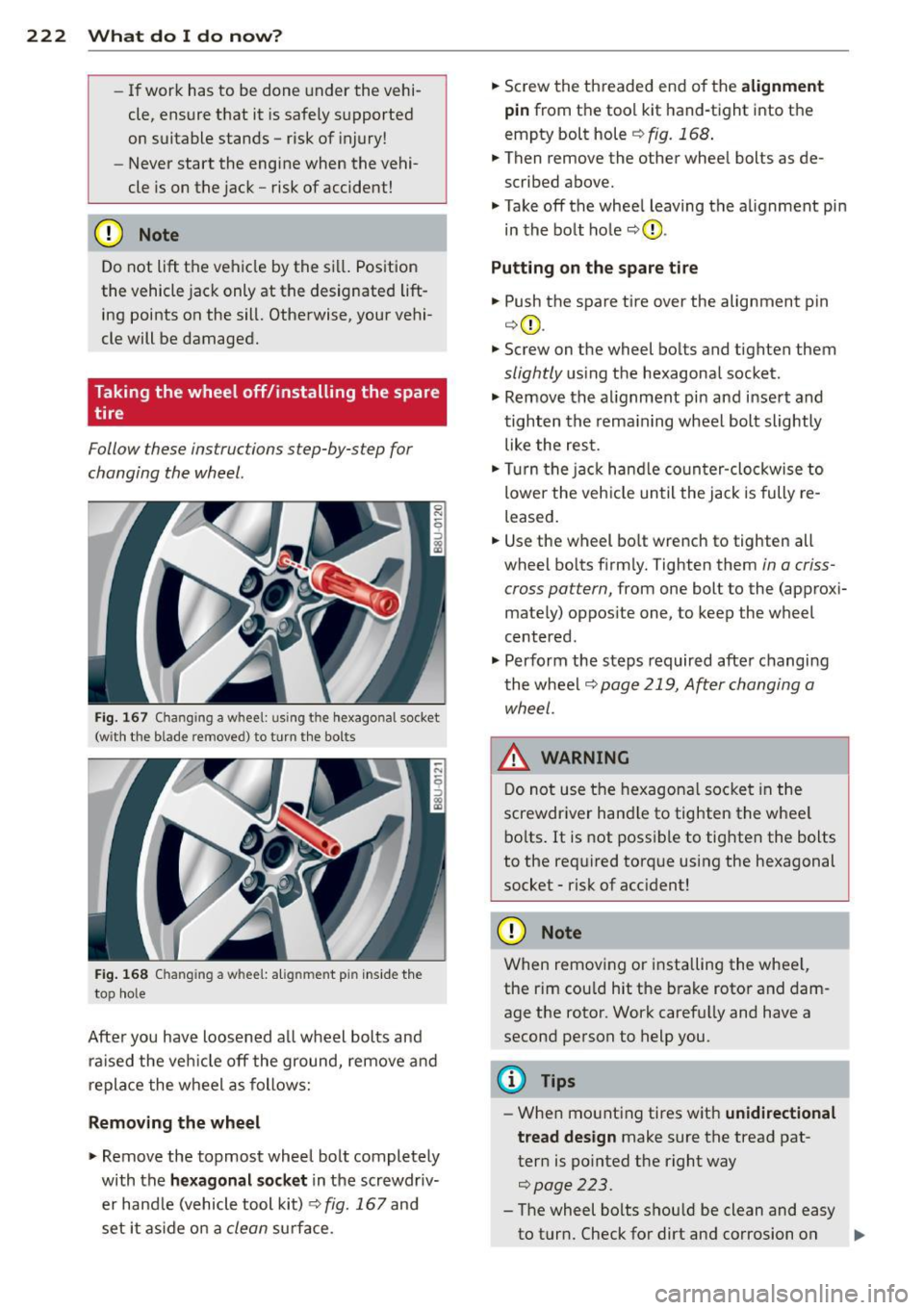
Fig. 167 Changing a whee l: u sing the hexago nal socket
(w ith the blade removed) to turn the bolts
Fig. 168 Changing a w hee l: a lignm en t pi n inside the
top hole
After you have loosened a ll wheel bolts and
ra ised the veh icle off the ground, remove and
replace the wheel as follows:
Removing the wheel
> Remove the topmost wheel bolt completely
with the
hexagonal socket in the screwdriv
er handle (vehicle tool kit)
r=;; fig. 167 and
set it as ide on a
clean su rface. >
Screw the threaded end of the
alignment
pin
from the tool kit hand-tight into the
empty bolt hole
¢ fig. 168 .
... Then remove the other whee l bolts as de
scribed above.
> Takeoff the whee l leaving the alignment pin
in the bolt hole
r=;; (D.
Putting on the spare tire
... Push the spare tire over the alignment pin
¢ CD.
... Screw on the wheel bolts and tighten them
slightly using the hexagonal socket .
> Remove the alignment pin and insert and
tighten the remaining wheel bolt slightly
like the rest.
... Turn the jack handle counter -clockwise to
lower the veh icle until the jack is fully re
leased .
... Use the wheel bolt wrench to tighten all
wheel bo lts firm ly. Tighten them
in a criss
cross pattern,
from one bolt to the (approx i
mately) oppos ite one, to keep the wheel
centered.
> Perform the steps required after changing
the wheel
¢ page 219, After changing a
wheel.
A WARNING
-
Do not use the hexagonal socket in the
screwdriver hand le to tighten the whee l
bolts. It is not possible to tighten the bolts
to the required torque using the hexagonal
socket - risk of accident!
CD Note
When removing or installing the whee l,
the rim cou ld hit the brake rotor and dam
age the rotor. Work carefu lly and have a
second person to help you.
(D Tips
-When mount ing tires with unidirectional
tread design
make sure the tread pat
tern is po inted the right way
r=;;page223.
- The wheel bolts shou ld be clean and easy
to turn. Check for dirt and corrosion on