brake pads AUDI Q3 2015 Owners Manual
[x] Cancel search | Manufacturer: AUDI, Model Year: 2015, Model line: Q3, Model: AUDI Q3 2015Pages: 258, PDF Size: 64.9 MB
Page 14 of 258
12 Instruments and warning/indicator lights
compartment, stop the engine and let it
cool down. Always exercise extreme cau
tion when work ing under the hood
c::> page 179.
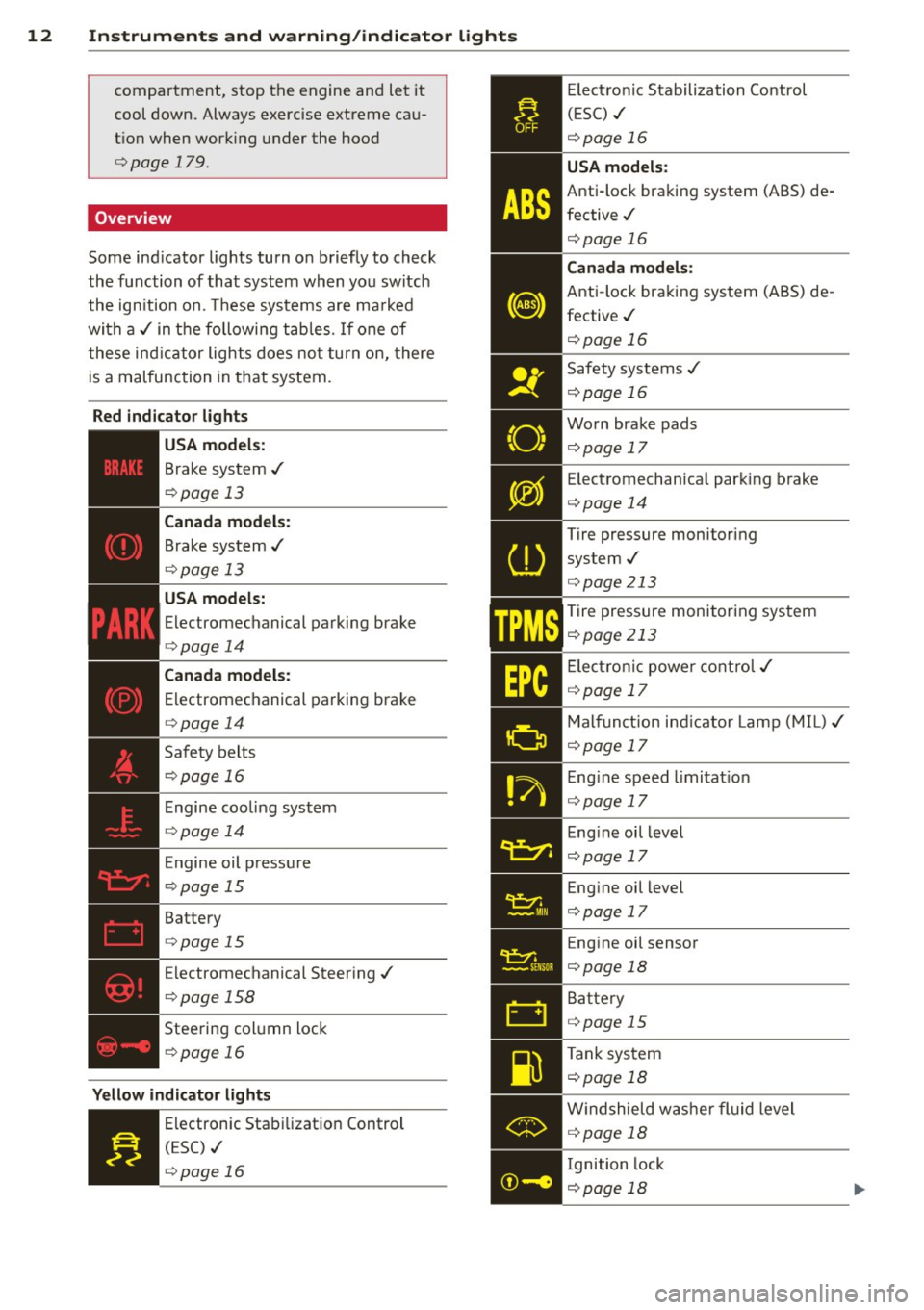
Overview
Some ind icator lights turn on briefly to check
the function of that system when you switch
the ign ition on. These systems are ma rked
with a ../ in the following tables. If one of
these indicator lights does not turn on, there
is a malfunction in that system.
Red indicator lights
USA models:
Brake system ../
c::>page 13
Canada models:
Brake system ../
c::>page 13
USA models:
Electromechanical parking brake
c::>page 14
Canada models:
Electromechanical parking brake
c::>page 14
Safety belts
c::>page 16
Engine cooling system
c::>page 14
Engine oil pressure
c::>page 15
Battery
c::>page 15
Electromechanical Steering../
¢ page 158
Steering column lock
¢page 16
Yellow indicator lights
Electronic Stabilization Control
(ESC) ../
¢page 16
TPMS
Electronic Stabilization Control
(ESC) ../
¢page 16
USA models:
Anti-lock braking system (ABS) de
fective../
¢page 16
Canada models:
Anti-lock braking system (ABS) de
fective../
c::> page 16
Safety systems ../
c::> page 16
Worn brake pads
c::> page 17
Electromechanical park ing brake
¢ page 14
Tire pressure monitoring
system../
¢page 213
Tire pressure monitoring system
¢page 213
Elect ronic power control../
c::> page 17
• M
alfunct ion ind icator Lamp (MIL)../ ¢page 17
Engine speed limitat ion
c::> page 17
- Engine oil level
- c::>pagel7
• ·
-. Engine oil level _
1 c::> page 17
• Engine oil sensor c::> page 18
Battery
c::> page 15
-
Tank system
... c::> page 18
• Windshield
washer fluid level c::> page 18
- Ignition lock
IYiiil c::> page 18
Page 16 of 258
![AUDI Q3 2015 Owners Manual 14 Instrum ent s and w arn ing /indic ato r light s
(USA models): If the warning light . and the
warning light
ll] appear together, immedi
ately contact your authorized Audi deale](/img/6/57629/w960_57629-15.png "AUDI Q3 2015 Owners Manual 14 Instrum ent s and w arn ing /indic ato r light s
(USA models): If the warning light . and the
warning light
ll] appear together, immedi
ately contact your authorized Audi deale")
14 Instrum ent s and w arn ing /indic ato r light s
(USA models): If the warning light . and the
warning light
ll] appear together, immedi
ately contact your authorized Audi dealer or
qua lified workshop to have all brake pads in
spected
¢ page 17.
When the light comes on, an audib le warning
signal is also given .
.&_ WARNING
- Always observe the warnings in
¢ page 179, before opening the hood
and checking the brake fluid.
- Driv ing with low brake fluid is a safety
hazard. Stop the car and get professional
assistance.
- If the . (USA models) . (Canada
models) brake system indicator light
turns on together with the ABS and ESC
indicator lights, the ABS/ESC regu lating
function may have failed. Functions that
stabilize the vehicle are no longer availa
ble. Th is could cause the vehicle to
swerve and increase the risk of sliding .
Drive carefully to the nearest a uthorized
Audi dealer or other qualified workshop
and have the malfunction corrected.
- If the brake warning/indicator light does
not go out after a few seconds and the
park ing brake is released, or lights up
wh ile you are driving, the fluid level in
the brake fluid reservoir is too low .
If you
believe that it is safe to do so, proceed
immediately at low speed to the nearest
authori zed Audi dealer o r qualified wo rk
shop and have the bra ke system inspect
ed.
- Always keep in m ind that after several
brake applicat ions, yo u will need greater
pressure on the brake peda l to stop your
vehicle. Do not re ly on strained brakes to
respond with maxim um stopping power
in critical situations. You must allow for
increased brak ing distances. The extra
distance used up by fad ing brakes could
lead to an acc ident.
PARK !<®> Electromechanical parking brake
The warning/indicator light monitors the
electromechanical parking brake .
If the indicator light. (USA models) •
(Canada models) turns on, the parking brake
was set.
• (USA model s)/. (Canada models ) Press
brake pedal to release parking b ra ke.
To re lease the park ing brake, press the brake
peda l and press the button(®) at the same
t ime or start driving with starting assist
¢ page 71, Starting from rest.
Ill Pa rking br ake : S ys tem f ault! See owne r's
manual.
If the I.II ind ic a tor light tu rns o n and this
message appears, there is a parking b rake
malfunction. Drive to your authorized A udi
dealer or qualified workshop immediately to
have the malfunct ion corrected.
@ Tips
More informat ion on the parking brake
¢page 70 .
-L Engine cooling system
A malfunction in the engine cooling system
must be repaired as soon as possible.
• Turn off engine and ch eck coolant level
T he coolant level is too low .
Do not continue dr iving and turn
off the en
gine. Check the coo lant level
¢ page 186.
-If the coo lant level is too low, add coo lant
¢ page 186. Only continue driving if the in
dicator light turns off.
- If the coo lant level is correct, then the ma l
function may be ca used by fa ilure of the
coolant fan. Do not continue driving. See
your authorized Audi dealer or qualified re pa ir fac ility .
• Coolant temperature! Let engine run
w ith vehicle stationar y.
Page 19 of 258
Instrument s and warnin g/indic ator ligh ts 17
M N
M N
0 ::i co ,...., \!) ..,.,
not illuminate when you switch the ignition
on, this also means there is a malfunction .
A WARNING
If you have a malfunction in the safety sys
tems, contact your author ized Audi dealer
immediately. Otherw ise the safety sys
tems may not work properly in an acci
dent .
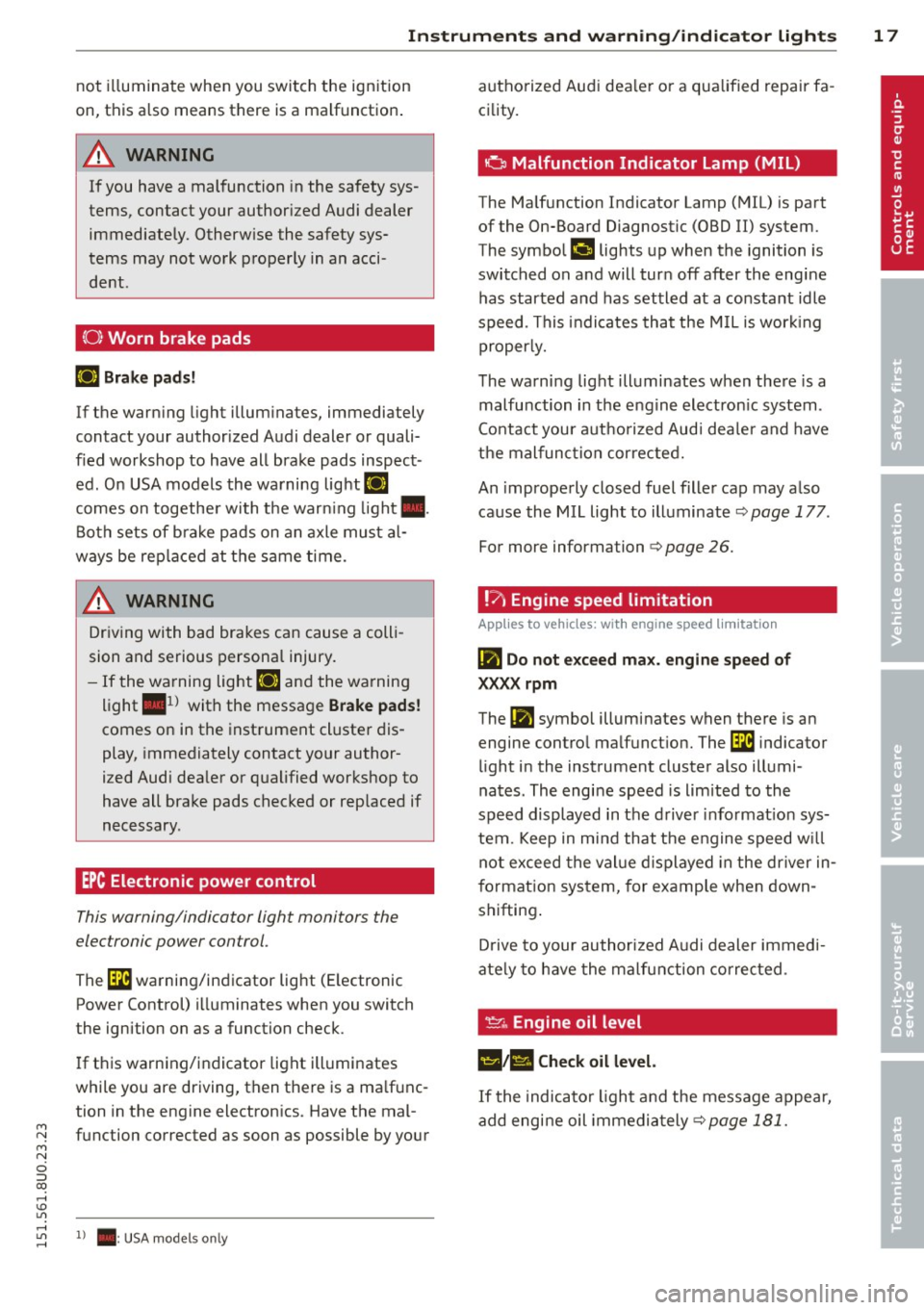
(0 ) Worn brake pads
Ill Brake pad s!
If the warn ing light illum inates, immediately
contact your authorized Audi dealer or quali
fied workshop to have all brake pads inspect
ed. On USA models the warning light
Ill
comes on together with the warn ing light •.
Both sets of b rake pads on an axle must al
ways be rep laced at the same time.
A WARNING
Dr iv ing with bad brakes can cause a coll i
sion and serious personal injury.
- If the wa rning light Ill and the warning
light
. ll with the message Brake pad s!
comes on in the instrument cluste r dis
play, immediately contact your author
i z ed Audi dealer or qualified workshop to
have all brake pads checked or replaced if
necessary .
EPC Electronic power control
This warning/indicator light monitors the
elec tronic power control .
The [31 warning/indicator light (E lectronic
Power Control) i lluminates when you switch
the ignition on as a function check .
-
If t his warning/indicator light ill uminates
while you are driving, then there is a ma lfunc
tion in the engine electron ics. Have the mal
function corrected as soon as possible by your
,....,
~ 1 ) . : USA models only
authorized Aud i dea le r or a qualified repair fa
cility.
· o Malfunction Indicator Lamp (MIL)
The Ma lfunction Indicator Lamp (MIL) is part
of the On-Board Diagnostic (OBD II) system.
The symbol
('4 lights up when the ignition is
switched on and will turn off after the eng ine
has started and has settled at a constant idle
speed . This i ndicates that the M IL is work ing
properly.
The warning light illuminates when there is a
malfu nction in the e ngine electron ic system .
Co ntact you r aut ho rized Aud i dea le r and have
t h e malfunc tion corrected.
An improperly closed fuel fille r cap may a lso
cause the MIL light to illuminate
q page 177 .
For more information q page 26.
!?; Engine speed limitation
App lies to vehicles: wi th engine speed limi tati on
(fl Do not e xce ed ma x. engin e speed of
XX.XX rpm
The Ill symbol illuminate s when there is an
engine contro l ma lf unct ion. The
(31 indicator
light in the instrument cluster also illumi
nates . The engi ne speed is limited to the
speed displayed in the d river info rmat ion sys
tem. Keep in mind that the engine speed w ill
not exceed the val ue d isplayed in the dr iver in
f ormat ion system, for example when down
shifting .
D rive to your authori zed A udi dealer immed i
ate ly to have the ma lfunction corrected .
!:( .. Engine oil level
1!1;111 Check oil level.
If the indicator light and the message appear,
add engi ne oil immediately
<=> page 181.
Page 158 of 258
156 Intellig ent technol ogy
Hill descent assist brakes a ll four wheels auto
matica lly in order to limit speed when driving
e ither forward or reverse on hills with a grade
up to approximately 50%.
When the hi ll descent assist is on, the current
driving speed, when your vehicle entered the incline is maintained . It is only possib le to
switch on the assist when driving slower than
37 mph (60 km/h). The assist works between
approximately 2 and 19 mph (4 and 30 km/ h) . T he driver can increase or decrease the ve
h icle speed w ith in these lim its by depressing
the accelerato r o r brake pedal In addition, ve
h icle steerability is increased d ue to the brak
ing d istribution when driving in reverse .
There must be however sufficient ground ad hes io n. The hill descent assis t can
no t do its
job if the incl ine is icy or if the incline ground
is loose¢ &..
The system does not work at speeds between 19 and 37 mph (30 and 60 km/h) . T he system
i s then in the ready-mode . The diode in the
button will come on. The system automatical
ly switched off when you drive faster than 37
mph (60 km/h). The diode will go out in this
case.
The flashing indicator lamp
-0-in the instru
ment cluster indicates whenever the driving
speed is being actively controlled to a certain
speed up to approximate ly 19 mph (30 km/h) .
The indicator lamp lights up continuously
when the system goes into standby mode.
Hill descent assist is automatically activated
under the fo llow ing cond itions:
- the d iode in the button illuminates,
- vehicle speed is be low approximately
19 mph (30 km/h)
- the in cl in e is 10%.
_&, WARNING
- Always adapt your speed to the weather,
road and traffic conditions . Do not let
the increased safety provided tempt you
into taking risks. -
The hill descent assist system cannot
overcome the laws of physics. Your dr iv
ing style must always be adapted to the
current road and traffic cond itions .
- The hill descent ass ist may not be ab le to
hold your vehicle at a constant speed un
de r all conditions while driv ing on an in
cline (for example if ground under the
veh icle is loose).
Braking
What affects braking efficiency?
New br ake p ad s
During the first 250 miles (400 km), new
brake pads do not possess the ir full brak ing
effect, they have to be "broken in" first ¢&. .
You can compensate for this slightly reduced
braking power by pushing harder on the brake
pedal. Avoid heavy b ra ki ng loads dur ing the
break-in pe riod.
Operating conditions and driving h abits
The brakes on today 's automobiles are still
subjec t to wear, depending largely on operat
i ng condit ions and driving hab its
~ &. -On
vehicles that are either dr iven mos tly in stop
and -go city t ra ffi c or are dr iven hard, the
brake pads should be chec ked by your author
ized Audi dea ler mo re often than specified in
the
Warranty & M aintenan ce booklet. Failure
to have your brake pads inspected can result in reduced brake performance.
On steep slopes, you sho uld use the braking
effect of the eng ine. This way, you prevent un
necessary wear on the brake system. If you
must use your brakes, do not hold the brakes
down cont inuous ly . Pump the brakes at inter
vals .
Oper ating n ois e
Noises may occur when braking depending on
the speed, braking force and outside condi-
tions such as temperature and humidity. .,,.
Page 159 of 258
M N
M N
0 ::i co ,...., \!) 1.1'1 ,...., 1.1'1 ,....,
Effect of w ate r and ro ad salt
In certain situa tions, for example after driving
through water, in heavy rain, after overnight
condensation or after washing your car, the braking effect can be reduced by moisture or
ice on the brake rotors and brake pads. The
brakes must be dried first with a few careful
brake applications.
At higher speeds and with the windshield wip
ers turned on, the brake pads press against
the brake rotors for a short amount of time.
This occurs at regular intervals w ithout the
driver noticing and provides for better brake response time under wet condit ions.
The effectiveness of the brakes can be reduced
when the vehicle is dr iven o n a salt-covered
road and the brakes are not used . Likewise,
you clean
off accumulated sa lt coating from
brake discs and pads with a few caut ious ap
p lications of the brake¢.&. -
Cor ro sion
There may be a tendency for dirt to build up
on the b rake pads and corrosion to form on
the discs if the car is not dr iven regular ly or
only for short t rips with little use of the
brakes.
If the brakes are not used frequently, or if cor rosion has formed on the discs, it is advisable
to clean
off the pads and discs by b rak ing
fi rm ly a few times from a modera tely high
speed¢ .&..
Faults in the brake system
If you should notice a sudden increase in
brake pedal travel, then one of the two brake
circu its may have failed¢&. -
Low brake fluid le vel
Malfunct ions can occur in the brake system if
the brake fluid level is too low. T he brake fluid
level is monitored electronically .
Brake boo ster
The brake booster increases the pressure that
you generate with the brake pedal. It works
only when the engine is running .¢ .&.
Int ellig ent technolog y 157
Brak e lining we ar status
B rake lining wear may be checked by visual in
spection o f the condition of the brake pads
thro ugh the openings in the wheel. If neces
sary, the wheel may be removed for this in
spection
¢ page 218, Changing a wheel.
A WARNING
-New brake pads don't have the best stop
ping power and must be "broken-in" dur
ing the initial 100 to 150 miles (150 to
200 kilometers) of normal c ity dr iving .
You can compensate for this by pressing
the brake pedal more firmly. This also
applies la ter when new pads are instal
led.
- You should perform braking maneuvers
for the purpose of cleaning the brake
system only if road conditions permit .
Other road users must not be put at risk -
you may cause an accident!
- Before descending a steep grade, reduce
speed and shift transmission into a lower
gea r or lower dr iving range. Do not ride
the brakes or hold the pedal down too
long or too often. This could cause the
brakes to get hot and diminish braking
efficiency.
- Do not "ride the brakes" by rest ing your
foot on the pedal when you do not intend
to brake. This may cause the brakes to overheat, p remature wear and increased
s topping distance.
- Unde r ce rtain cl imati c and ope rat ing
conditions such as passing thro ugh wa
ter, dr iv ing in heavy rain o r after washing
the vehicle, the effectiveness of the
brakes can be reduced. In winte r, ice can
accumu late on the brake pads, lin ings,
discs and drums. Carefully app ly brakes
for a test. Brakes w ill dry and ice coat
ings w ill be cleaned
off after a few care
ful brake applicat ions.
- Driving for an extended period of time on
salt-covered roads without using your brakes can a lso affect braking efficiency.
Clean
off accum ulated salt coating from
•
•
Page 167 of 258
M N
M N
0 ::i co ,...., \!) ..,.,
,...., ..,., ,....,
conditions. Drive especially slow if
offroad with low visibility.
- Please note that the wheels can spin and
the vehicle can break away when the ESC
Offroad Mode is switched off, especially
when the road is slippery.
- Driv ing stability is reduced in the ESC
Offroad mode.
@ For the sake of the envi ronment
Avoid harming the environment and take
nature into consideration .
(D Tips
On ly drive where it is allowed and always
stay on the provided roads and paths .
Driver messages
There is only one right way to drive in difficult
conditions: slowly and with caution!
When driv ing offroad, observe the following:
• Never dr ive the veh icle in terra in which is
not suitable for the veh icle, or wh ich ex
ceeds your driving skills. Never take any un
necessary risks!
• Drive slowly and cautiously!
• Pay attention to the
gro und cl earance of
your vehicle! This may vary depending on
the load and composition of the ground and
the environment. The driver is therefore re
spons ible for deciding whether a vehicle can
handle a specific situation .
• Activate the
ESC-Offr oad-Mode Q page 155
as needed.
• Use the
hill desce nt ass is t Q page 155 when
driv ing down steep sections on hi lls.
Difficult terr ain
Never drive in areas that are not familiar to
you and dr ive slowly when offroad and be pre
pared and expect the unexpected (e.g . pot
holes, bou lders, tree stumps, etc.)
To prevent the vehicle from bottoming and
avoid damage to the underbody , you should
drive straight across severe bumps in the
Dri vin g and en vironm ent 165
ground with only one side o f the veh icle so
that only two of your whee ls cross the bumps.
Drive quickly through sandy or marshy offroad
sections and do not stop, if at all possible .
Driving throu gh w ater on road s
Note the following to avoid veh icle damage
when driving through water, for examp le on
flooded roads:
- The water must not be any higher than the
bottom of the vehicle body.
- Do not drive faster than walking speed .
A WARNING
--After driving through water, mud, slush,
etc., the brakes may be slow to take effect because of wet brake rotors and pads. D ry
the bra kes first by braking carefully to re
store the fu ll braking effect.
(D Note
Vehicle components such as the eng ine,
transmission, suspension or electrical sys
tem can be severe ly damaged by dr iv ing
th rough water.
(D Tips
- Check the depth of the water before d riv
ing through it.
- Do not stop the vehicle, drive in reverse
or switch the engine off when driving
thro ugh water.
- Keep i n mind that oncoming veh icles
may create waves that raise the water
level and make it too deep for your vehi
cle to drive through sa fely.
- Avo id d riving through salt wate r because
i t can cause corros ion.
•
•
Page 191 of 258
M N M N
0 ::i co
rl I.O
"' rl
"' rl
Brake fluid
Checking brake fluid level
The brake fluid level can be checked with a
quick glance.
N
N
;:;;
" 03
"'
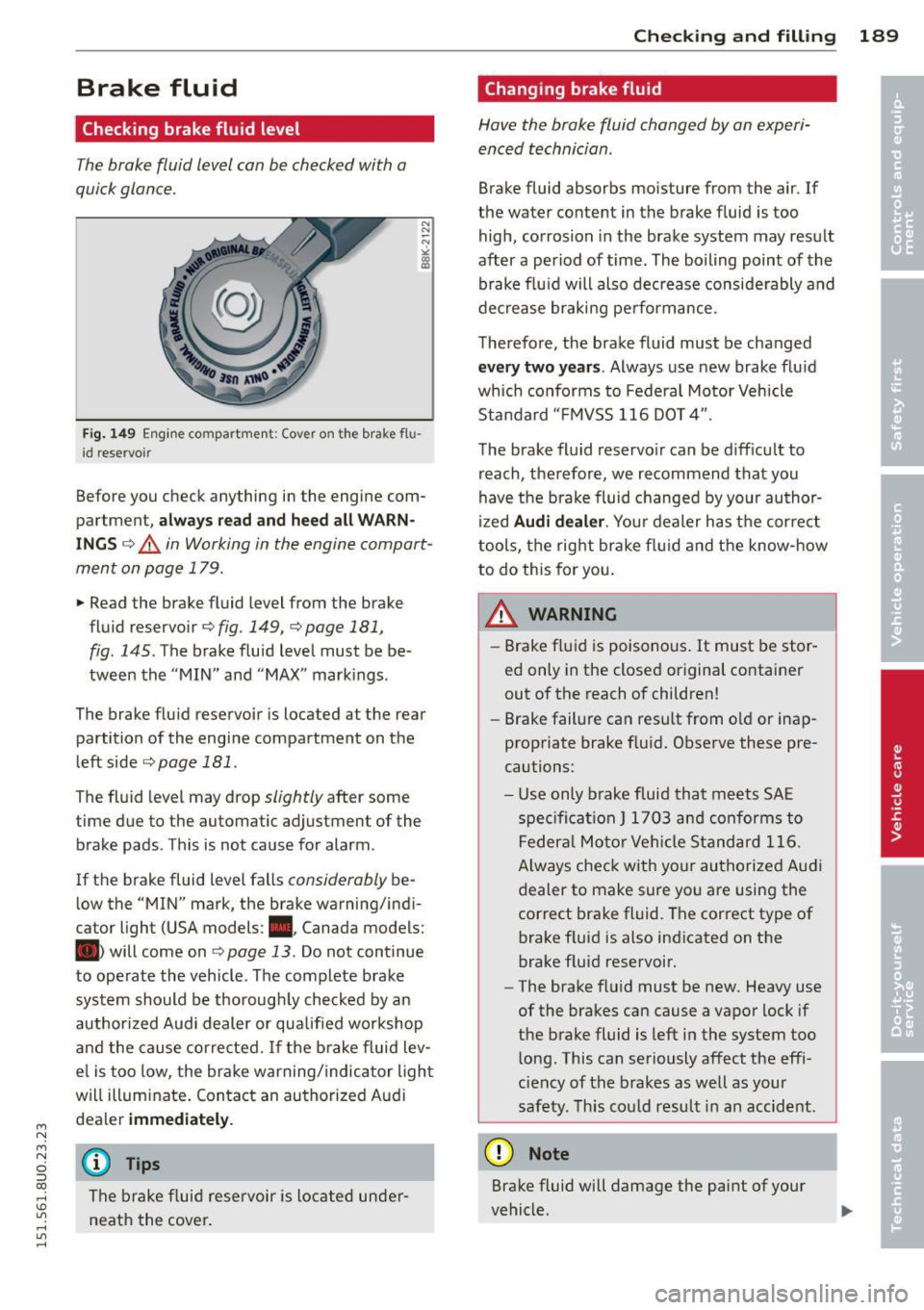
Fi g. 149 Eng ine compartment: Cover on the brake flu
id reservoir
Before you check anything in the engine com
partment,
a lwa ys read and heed all WARN
ING S c:> .&.. in Working in the engine compart
ment on page 179 .
~ Read the brake fluid level from the brake
fluid reservoir
c:> fig. 149, <=> page 181,
fig . 145.
The brake flu id level must be be
tween the "MIN" and "MAX" markings.
The brake fluid reservoir is located at the rear
partition of the engine compartment on the
left side <::;>
page 181 .
The fluid level may drop slightly after some
time due to the automatic adjustment of the
brake pads . This is not cause for alarm .
If the brake fluid level falls
considerably be
low the "MIN" mark, the brake warning/indi
cator light (USA models: ., Canada models:
• will come on
<::;> page 13. Do not continue
to operate the vehicle . The complete brake
system should be thorough ly checked by an
author ized Audi dealer or qua lified workshop
and the cause corrected.
If the brake fluid lev
e l is too low, the brake warning/indicator ligh t
will illuminate . Contact an authorized A ud i
dealer
immediately.
@ Tips
The brake f luid reservoir is located under
neath the cover .
Checking and fillin g 189
Changing brake fluid
Have the brake fluid changed by on experi
enced technician.
Brake fluid absorbs moisture from the air. If
the water content in the brake fluid is too
high, corrosion in the brake system may result
after a period of time . The boiling point of the
brake flu id will also dec rease considerably and
decrease braking pe rformance.
Therefore, the brake fluid must be changed
ev ery two years. Always use new brake flu id
which conforms to Federal Motor Vehicle
Standard "F MVSS 116 DOT 4".
The brake fluid reservo ir can be d iff icult to
reach, the refore, we recommend that you
have the brake fluid changed by your author
i zed
Audi d ealer. Your dealer has t he correct
tools, the right brake fl uid and t he know-how
to do this for you .
A WARNING -.
-Brake fluid is poisonous . It must be stor
ed only in the closed original container
out of the reach of children!
- Brake failure can resu lt from o ld or inap
propriate brake f luid. Observe these pre
cautions:
- Use only brake fluid that meets SAE
spe cificat ion
J 1 7 03 and conforms to
Federa l Moto r Ve hicl e Standard 116.
Always check with yo ur authorized Audi
dealer to make sure yo u are using the
correct bra ke fluid. The correct type of
brake f luid is also indicated on the
brake f luid reservoir.
- The brake fluid must be new. Heavy use
of the brakes can cause a vapor lock if
the brake fluid is left in the system too
l ong . This can seriously affect the effi
c iency of the brakes as well as your
safety. This cou ld resu lt in an accident.
(D Note
Brake fluid will damage the paint of your
vehicle .
Page 245 of 258
M N
M N
0 ::i co ,...., \!) ..,.,
,...., ..,., ,....,
Selector lever ...................... 81
Selector lever emergency release . . . . . . 86
Automatic wipers .......... .... .. .... 46
Auto Safety Hotline ........ .. .. .. .. . 101
Average speed . . . . . . . . . . . . . . . . . . . . . . . 22
Avoid damaging the vehicle ...... ... .. 161
B
Bass box .. .. ............. .... .. .. . 217
Battery . . . . . . . . . . . . . . . . . . . . . . . 15, 190
Battery location inside the luggage com-
partment .. .. ........... .. .. .. ... 190
Charging . .. ............. .... .. ... 192
Important warnings when working on
the battery . ................ ... ... 190
Jump starting .... .. ...... .. .. .. .. . 228
Low ... .. .. .. ... .. ..... ... .. .. .. . 159
Replacing the battery ..... .. .. .. .. . 193
State of charge . . . . . . . . . . . . . . . . . . . . 159
Winter operation ............ ... .. . 190
Working on the battery ....... ... .. . 190
Before driving . . . . . . . . . . . . . . . . . . . . . . . 94
Blended gasoline .......... .... .. .. . 17 5
Blower (automatic climate control) . . . . . . 65
Booster seats ................ ... ... 141
Brake fluid Changing the brake fluid ... .. .. .. .. . 189
Checking the brake fluid level . .. .. .. . 189
Reservoir .. ... ... .... ... .. .. .. .. . 189
What is the correct brake fluid level? .. 189
What should I do if the brake fluid warn-
ing light comes on? ....... .. .. .. .. . 189
Brake system . . . . . . . . . . . . . . . . . . . . . . . 189
Brake assist system . . . . . . . . . . . . . . . . 153
Brake fluid ........... ...... .... .. 189
Brake fluid specifications for refill and re-
placement . ............. .... .. .. . 189
Brake light defective ...... .. .. .. .. .. 18
Brake power assist unit ...... .. .. .. . 156
Brakes ..... .. ................ .... 156
Electromechanical parking brake .. .. .. 70
General information ......... ... .. . 156
Warning/indicator lights ..... .. .. .. .. 13
Worn brake pads symbol . . . . . . . . . . . . . 17
Braking Emergency braking function . . . . . . . . . . 72
Starting on inclines . . . . . . . . . . . . . . . . . 72
Index 243
Break-in period . ..... ............... 161
Tires 161
Bul bs ........ .. .. ................. 226
C
California Proposition 65 Warning ... .. 180
Battery specific .................. . 191
Capacities .. .. .. .. ............... .. 235
Caps for wheel bolts, removing ...... .. 220
Carbon parts Cleaning . . . . . . . . . . . . . . . . . . . . 172, 173
Care ....... .. .. .. ................. 170
Cargo area
refer to Loading the luggage compart-
ment ....... .. .... ............... 100
Catalytic converter ................. . 161
Center armrest Adjusting . .. .. .. .. ............... . 51
Storage compartment . ...... ..... .. . 51
Central locking . ..... ................ 28
Central locking switch ............... 32
Convenience key . . . . . . . . . . . . . . . . . . . . 31
Remote control key . . . . . . . . . . . . . . . . . 30
Certification . . . . . . . . . . . . . . . . . . . . . . . 240
Changing a flat tire ... . .. .. .. .... .... 218
Changing a wheel ...... ............. 218
Changing engine oil .. ........... .... 185
Checking Engine coolant level ............... . 186
Checking tire pressure .............. . 201
Child restraints
Danger of using child restraints in the
front seat . . . . . . . . . . . . . . . . . . . . . . . . 114
System anchors .. .. .............. . 146
Where can I get additional information
about child restraints and their use? .. 151
Child safety ... .. ...... ........... .. 133
Convertible locking retractor ........ . 143
Important safety instructions for using
child safety seats ... .............. . 136
Important things to know when driving
with children .. .. ............... .. 133
Installing a child restraint using the
LATCH system . . . . . . . . . . . . . . . . . . . . . 148
Mounting and releasing the anchorage
hook ... .. .. .. .. .. . ....... ..... .. 148
•
•