tires AUDI Q3 2015 Owners Manual
[x] Cancel search | Manufacturer: AUDI, Model Year: 2015, Model line: Q3, Model: AUDI Q3 2015Pages: 258, PDF Size: 64.9 MB
Page 5 of 258
M N
M N
0 ::i co ,...., \!) 1.1'1 ,...., 1.1'1 ,....,
Airbag system ............ ... .. 112
Important things to know . . . . . . . . . . 112
Front airbags .................... 116
Monitoring the Advanced Airbag
System . . . . . . . . . . . . . . . . . . . . . . . . . 123
Side airbags . . . . . . . . . . . . . . . . . . . . . 127
Side curtain a irbags . . . . . . . . . . . . . . . 130
Child Safety . . . . . . . . . . . . . . . . . . . 133
Important things to know . . . . . . . . . . 133
Child safety seats . . . . . . . . . . . . . . . . . 139
Installing a child safety seat . . . . . . . . 143
LATCH Lower anchorages and tethers
for child ren . . . . . . . . . . . . . . . . . . . . . . 146
Additional Information
lSl
Vehicle operation . . . . . . . . . . . . . 1S2
Intelligent technology . . . . . . . . 152
Notice about data recorded by the
Event Data Recorder and vehicle
control modules . . . . . . . . . . . . . . . . . . 152
Electronic Stabili zation Control (ESC) . 153
Braking . . . . . . . . . . . . . . . . . . . . . . . . . 156
Electromechanical steering . . . . . . . . . 158
Driving with your quattro . . . . . . . . . . 158
Energy management . . . . . . . . . . . . . . 159
Driving and environment . . . . . 161
The first 1,000 miles (1,500 km) and
afterwards . . . . . . . . . . . . . . . . . . . . . . 161
Avoid damaging the vehicle. . . . . . . . . 161
Catalytic converter . . . . . . . . . . . . . . . . 161
Shutting down vehicle . . . . . . . . . . . . . 162
Operate your vehicle economically and minimize pollution. . . . . . . . . . . . . . . . 162
Driving offroad . . . . . . . . . . . . . . . . . . . 164
Trailer towing . . . . . . . . . . . . . . . . . 166
Driving with a trailer . . . . . . . . . . . . . . 166
Trailer towing tips . . . . . . . . . . . . . . . . 168
Vehicle care . . . . . . . . . . . . . . . . . . . 170
Vehicle care and cleaning . . . . . 170
General information . . . . . . . . . . . . . . 170
Car washes . . . . . . . . . . . . . . . . . . . . . . 170
Cleaning and care information . . . . . . 171
Table of contents 3
Fuel supply and filling your
fuel tank ..... .... ..............
175
Gasoline .. .. .. .. .. .. .. .. .. .. .. .. 175
Fuel tank. . . . . . . . . . . . . . . . . . . . . . . . 176
Checking and filling . . . . . . . . . . . 179
Engine hood . . . . . . . . . . . . . . . . . . . . . 179
Engine compartment ............. .
Engine oil . .. .. .... ... .. ..... ... .
Engine cooling system .......... .. .
Brake fluid ....... .............. .
Battery ........................ .
Windshield washer container
Tires and wheels ... ..... ... .. .
181
181
186
189
190
193
195
Tires . . . . . . . . . . . . . . . . . . . . . . . . . . . 195
Tire pressure monitoring system 213
Do-it-yourself service . . . . . . . . . 216
What do I do now? ............ 216
General information . . . . . . . . . . . . . . 216
Vehicle tool kit with lifting jack . . . . . . 216
Folding chocks . . . . . . . . . . . . . . . . . . . 217
Removing bass box . . . . . . . . . . . . . . . 217
Space-saving spare tire (compact
spare tire) . . . . . . . . . . . . . . . . . . . . . . . 217
Changing a wheel . . . . . . . . . . . . . . . . . 218
Fuses and bulbs . . . . . . . . . . . . . . . 224
Fuses. ....... ... .. .............. 224
Bulbs. . . . . . . . . . . . . . . . . . . . . . . . . . . 226
Emergency situations . . . . . . . . . 228
General . . . . . . . . . . . . . . . . . . . . . . . . . 228
Starting by pushing or towing . . . . . . . 228
Starting with jumper cables . . . . . . . . 228
Use of jumper cables . . . . . . . . . . . . . . 229
Emergency towing with commercial
tow truck . . . . . . . . . . . . . . . . . . . . . . . 230
Lifting vehicle . . . . . . . . . . . . . . . . . . . . 232
Technical data . . . . . . . . . . . . . . . . . 234
Technical Data . . . . . . . . . . . . . . . . . 234
Vehicle identification . . . . . . . . . . . . . . 234
Weights . . . . . . . . . . . . . . . . . . . . . . . . 234
Dimensions . . . . . . . . . . . . . . . . . . . . . . 235
•
•
Page 29 of 258
M N
M N
0 ::i co ,...., \!) ..,.,
,...., ..,., ,....,
Electronic speed
limiter
Your vehicle may be factory equipped with tires that are rated for a maximum speed of
130 mph (210 km/h) . Th is is less than the
maximum speed of your vehicle. To reduce the
r isk of sudden tire failure and loss of control if
the veh icle is operated at excessive speeds,
your veh icle also has an elect ronic speed limit
er. The electronic speed limiter prevents yo ur
vehicle from going faster than the tire speed
rating. For more information~
page 206.
If the engine control unit receives fau lty vehi
cle road speed signals, the Malfunction Indi
cator Lamp (MIL)¢• will illuminate . If this
occ urs, contact the nearest authorized Audi
dealer for assistance.
A WARNING
-
Always observe the posted speed limits and adjust your speed to suit prevailing
road, t raff ic and weather conditions. Never
drive your vehicle faster than the maxi
mum speed rating of the tires insta lled.
Dri ver information di spla y 2 7
Page 75 of 258
M N
M N
0 ::i co ,...., \!) ..,.,
,...., ..,., ,....,
vehicle to skid or the rear end to break away -risk ing an accident.
Speed warning system
Overview
T he speed warning system helps you to keep
your driving speed below a set speed limit.
The speed warning system warns if the driver
exceeds a prev iously stored maximum speed .
A warning tone will sound as soon as the vehi
cle speed exceeds the set speed by about
3 mph (3 km/h). At the same time , an indica
tor lamp
(mj (USA models) / ISJ (Canada mod
e ls) will light up in the instrument cluster dis
p lay and the driver message
Spe ed limit
wa rning exceeded.
wi ll appear. The indicator
l amp
1mj / i•j will go out when the speed
drops below the set speed lim it aga in.
Setting a thresho ld is recommended if you
wou ld like to be reminded when you reach a
certain maximum speed . Situations where yo u
may want to do so include driving in a country
with a general speed limit or if the re is a
specified max imum speed for winter tires .
(D Tips
Even though your vehicle is equipped with
a speed warning system, you should st ill
watch the speedometer to make sure you are not driving faster than the speed lim it.
Setting speed limit
You can set , change and delete the threshold
in the MMI.
.,. Se lect :
I CAR I funct ion button > S ystem s or
Car System s control button > Vehicle set
tings > Speed warning .
You can set any thresho ld between 20 mph
(30 km/h) and 150 mph (240 km/h). Settings
can each be adjusted in increments of 6 mph
(10 km/h) .
On the ro ad 73
Cruise control
Description
The cruise cont ro l system makes it poss ible to
drive at a constant speed start ing at 15 mph
(20 km/h).
The speed is kept constant by modifying en
gine powe r or th rough an active brake inte r
vention.
A WARNING
- Always pay attention to the traffic
around you when the cruise control is in
operation. You are always responsible for
your speed and the distance between
your vehicle and other vehicles.
- For reasons of safety, cr uise control
should not be used in the city, in stop
and-go traffic, on winding roads and
when road cond it ions are poor (such as
ice, fog, gravel, heavy rain and hydro
plan ing) -you could have an accident .
- Sw itch the cruise control off temporar ily
when dr iv ing in turning lanes, h ighway
exits or in constr uction zones.
- Please note that unconsc iously "resting"
your foot on the accelerator pedal pre
vents the cruise control from braking .
This is due to the control system be ing
overridden by the dr iver's acceleration .
- If a b rake system malfunction s uc h as
overheating occurs when the cruise con
trol system is swi tched on, the braking
function in the system may be switched off . The other cruise control functions re
main active as long as the indicator light
II (US models) !l'I (Canada mode ls) is
on .
(D Tips
-The cruise control system is ideal for
stretches w ith speed limits. The driver is
responsib le for adhering to the correct
speed.
- The cru ise control remains act ive when
shift ing gears .
Page 103 of 258
M N
M N
0 ::i co ,...., \!) 1.1"1 ,...., 1.1"1 ,....,
to reduce the risk of injury when the vehi
cle is not be ing used.
- After closing the rear lid, always make
sure that it is properly closed and locked.
- Never leave your vehicle unattended es
pecially with the rear lid left open . A
child could crawl into the vehicle through
the luggage compartment and close the
rear lid becoming trapped and unable to
get out. Be ing trapped in a vehicle can
lead to serious persona l injury.
- Never let children play in or around the vehicle .
- Never let passe ngers r ide in the luggage
compartment . Ve hicle occupants must
always be properly restrained in one of
the vehicle's seating positions.
(D Tips
- Air c irculation helps to reduce window
fogging. Sta le air escapes to the outside
th rough vents in the trim pane l. Be su re
to keep these slots free and open.
- The t ire pressure must correspond to the
load. The t ire pressur e is shown o n the
tire p ress ure label. The tire pressure la
bel is loc ated on the d river's s ide B-pi ll a r.
The t ire pressure label lists the recom
mended cold ti re inflat ion pressu res for
the vehicle at its maximum capacity
weig ht and the tires that were on you r
vehicle at the time it was manufactured.
For recommended t ire pressures fo r nor
mal load conditions, please see chap ter
c:>page 199.
Tie-downs
The luggage compartment is equipped with
four tie-downs to secure luggage and other
items .
Use the tie-downs to secure your cargo prop
erly
c:> page 100, Loading the luggage com
partment.
In a coll is ion, the laws of phys ics mean that
even smalle r items that are loose in the vehi
cle will become heavy missiles that can cause
Dr iving S afel y 101
serious injury. Items in the ve hicle possess en
ergy which vary with vehicle speed and the
weight o f the item . Vehicle speed is the most
s ignificant factor.
Fo r example, in a fronta l collision at a speed
of 30 mph (48 km/h), the forces acting on a
10 -lb (5 kg) object a re about 20 times the
no rmal weight of the item. This means that
the weight of the item would sudden ly be
about 200 lbs. (90 kg) . You can imag ine the
i njur ies that a 200 lbs . (90 kg) item flying
fr eely th ro ugh the passenger compar tme nt
c ould cause in a co lli sion like this.
A WARNING
We ak, dam aged or improper str aps used
to secure items to tie -downs can fail dur
ing hard braking or in a collision and cause
serious personal injury .
-Always use s uita ble mount ing stra ps and
properly secu re items to the tie-downs in
the l uggage compa rtme nt to he lp pre
vent items from shift ing or f ly ing fo r
ward as dangerous missiles .
-When the rea r seat backrest is folded
down, a lways use suitable mounting
straps and properly secure items to the
tie-downs in the luggage compartment
to hel p prevent items from fly ing for
ward as dangerous missiles into the pas
s enger compartment.
- Never attach a chi ld safety seat te th er
strap to a t ie- down .
Reporting Safety
Defects
Applicable to U.S.A.
If you b elieve that your v ehi cle
has a d efe ct whi ch could cause
a crash or could cause injury or
d eath, you should imm ediately
inform the National Highway
Tr affic Safet y Admini stration ..,.
•
•
Page 156 of 258
154 Intellig ent technolog y
Anti-slip r egulation (ASR )
ASR reduces engine power when the drive
wheels begin to spin and adapts the force to
the road conditions. This makes it easier to
start, accelerate and drive up hills.
Electronic diffe rential lock (EDL )
The ED L brakes wheels that are spinn ing and
transfers the drive power to the o ther d rive
wheel or whee ls if the vehicle is equipped with
all-wheel drive* . This function is available up
to about 60 mph (100 km/h).
I n extreme cases , ED L automat ica lly switches
off to help keep the brake on the braked whee l
from overheating . EDL wi ll switch on again au
tomatically when conditions have returned to normal.
El ectron ic inte ra xle diff ere ntial lock */
se lec tive wheel t orque contr ol*
The electronic interaxle differential lock (front
wheel drive) or the select ive wheel torque
control (all-wheel drive) operates when driv
ing through curves. The front wheel on the in·
side of the curve or both wheels on the inside
of the curve are braked select ively as needed .
This minimizes s lid ing in the front wheels a nd
allows for more p rec ise driving through
curves. The app licab le system may not acti
vate when driving in wet or snowy conditions .
A WARNING
-ESC, ABS, ASR, EDL, the electronic inter
axle differentia l lock* /selective whee l
torque control* and the hill descent as
sist cannot overcome the laws of physics.
Th is is especially important on slippery
o r wet roads . If the systems begin acting to stabilize your vehicle, you should im
mediately change your speed to match
the road and traffic conditions. Do not let the increased safety provided by
these systems tempt you to take r isks .
Doing so will increase the risk of a loss of
veh icle cont ro l, collision and ser ious per
sonal injur ies.
- Always adapt your speed to road, traffic
and weather conditions. The risk of los
ing control of the vehicle increases when
driving too fast , espec ially through
curves and on slippery or wet roads, and
when driving too close to vehicles up
ahead. ESC, ABS, the brake ass ist sys
tem, ASR, EDL and the electronic inter
axle d ifferential lock*/selective wheel
torque control* cannot prevent colli
sions .
- Always accelerate with special care on
even, smooth surfaces such as those that
are wet or covered with ice and snow .
The drive wheels can spin even w ith
these assistance systems t hat cannot al
ways he lp to reduce the risk of loss of ve
hicle control.
(D Tips
- ABS and ASR only wo rk correct ly when
all four wheels are equipped with identi
cal tires. D ifferent tire sizes can lead to a
reduction in engine power.
- You may hear noises when the systems
described are working .
-If the ind icator light DJ or Ell (USA
mode ls)/ lCO)J
page 16.
Page 160 of 258
158 Intellig ent technolog y
brake discs and pa ds with a few caref ul
brake a pplicat ions.
- If you damage the front s poiler, or if you
insta ll a different spoiler, be su re the air
flow to the front brakes is not obstruct ed. Otherwise the brake system could
ov erhe at r educi ng the eff ect iveness of
t h e enti re brak e system.
- Failure of one brake ci rcuit will impair
the braking capability resulting in an in creased stopp ing distance. Avoid driv ing
the vehicle and have it towed to the near
est author ized Audi dealer or qualif ied
wor kshop.
- Never let the vehicle rol l to a stop w ith
the engine shu t off.
- If the brake booster is not working, the
brake pedal must be pressed conside ra
bly harder to make up for the lac k of
booster assistance.
Electromechanical
steering
The electromechanical steering supports the
driver 's steering movements .
Power steering adapts electronically based on
the vehicle speed.
Ind icator light s and messages
• Steering fault! Do not drive vehicle !
If this indicator light tu rns on and stays on
and this message appears, t he power steering
may have fa iled.
Stop the vehicle in a safe locat ion as soon as
possib le . Do
not continue driving . See your
author ized Audi dealer or other qua lified re
pa ir facility for assistance .
If the indicator light turns on, the steer ing
may be more d ifficu lt to move or more sensi
tive than usual. The steer ing may also be at an
angle when dr iving st raight . Drive slowly to you
r authorized Audi dea ler or
qualified workshop to have the ma lf u nction
corrected.
l ;:!" ij Steering lock : S ys tem fault! Please con
tact de aler.
The re is an elect ron ic steering column lo ck
malfunction .
Drive to an author ized Audi dealer or qualified
r epair fac il ity immediate ly to have the mal
funct ion corrected.
(D Tips
If the . or ,To n ind icator light only stays
on for a short t ime, yo u may continue dr iv
i ng.
Driving with your
quattro
Applies to veh icles: w ith all-w hee l d ri ve
With all-wheel drive, all four wheels are driv
en.
General information
Wi th a ll-w heel d rive, power is dis trib ute d to
all four wheels . This happens automatically
depending on your driving style and the road
conditions at the time . See a lso
¢ page 153.
The all -whee l dr ive concept is des igned for
high eng ine power. Your veh icle is except ion
ally powerfu l and has excellent d riving charac
terist ics both under normal driving conditions
and on snow and ice. Always read and follow
safety precaut ions¢ .&..
Winter tires
When driving in the winter, yo ur vehicle with
all-wheel drive has an advantage, eve n wit h
regular tires. In winter road conditions it may
be advisable to mount winter tires (or all-sea
son tires) for improved driveability and brak
ing: these tires must be mounted on
all four
wheel s.
See also ¢ page 210, Winter tires.
Tire chains
Where tire chains are mandatory on certain
roads, this norma lly also app lies to ve hicles
Page 161 of 258
with all-wheel drive¢ page 211, Snow
chains .
Replacing wheels /tire s
Vehicles w ith all-wheel drive mus t always
h ave tires o f the same size. Also avoid t ires
with different tread depths. For details see
page
c::> page 206, New tires and replacing
tires and wheels.
A WARNING
Always adjust your driving to road and traf
fic condit ions. Do not let the extra safety
afforded by all-wheel drive tempt you into
taking extra risks.
- Although the all-wheel dr ive is very ef
fective, always remember that braking capacity is limited by t ire traction . You
should therefore not dr ive at excess ive
speeds on icy or slippery road surfaces.
- On wet road surfaces, be careful not to
dr ive too fast because the front wheels
c ou ld beg in to s lide on top of the water
(aquaplaning). If this sho uld oc cur, you
will have no warning from a sudden in crease in engine speed as with a front
wheel drive vehicle. A lways drive at
speeds which are suited to the road con
ditions -risk of crash.
Energy management
Starting ability is optimized
Energy management controls the distribution
of electrical energy and thus optimizes the
availability of electrical energy for starting
the engine .
If a vehicle with a conventional energy system
is not driven for a long period of time , the bat
tery is discharged by idling cu rrent consumers
(e.g. immobilizer). In ce rtain c ircumstances it
can result in there being insufficient energy
M avai lab le to start the engine . N
M N
0 ::i co ,...., \!) 1.1'1 ,...., 1.1'1 ,....,
Intelligent energy management in your veh i
cle handles the d istribution of elec trical ener
gy . Starting abi lity is markedly improved and
the life of the battery is extended .
Intellig ent technolog y 159
Basica lly, energy management consists of
b att ery diag nosis , id lin g cur rent man age
ment
and dyn amic en ergy m anag ement.
Batte ry diagnosis
Battery diagnosis continuously determines
the state of the battery . Sensors determine
battery voltage, battery current and battery
temperature . This determines the current
state of charge and the power of the batte ry .
Idlin g current manag ement
Id ling current management reduces energy
consumption while the vehicle is standing.
With the ig nition switched off, it controls the
energy supply to the various electrical compo nents. Data from battery diagnosis is cons id
ered.
Depending on the battery's state of charge ,
individual consumers are gradually turned off
to prevent excessive discharge of the batte ry
and thus maintain starting capability .
Dynamic energy manag ement
While the vehicle is being driven, dynamic en
ergy management distributes the energy gen
erated according to the needs of the individ u
al components . It regulates consumption, so
that more electrical energy is not being used
than is being generated and ensures an opti
mal state of charge for the battery .
(D Tips
-But even energy management cannot
negate the limits of physics. Consider
that the power and life of a battery are
limited.
- If start ing ability is threatened, the indi
cator light (•) ;ippears
c::> page 15.
What you should know
The highest priority is given to maintaining
starting capability .
The battery is severe ly taxed in short-distance
driving , in ci ty traff ic and during the cold time
of year . Abundant electrical energy is .,.
•
•
Page 163 of 258
M N
M N
0 ::i co ,...., \!) 1.1'1 ,...., 1.1'1 ,....,
Driving and
environment
The first 1
1000
miles
(11500 km) and
afterwards
New engine
The engine needs to be run-in during the first
1,000 miles (1 ,500 km) .
For the first 600 mile s (1,000
kilometers ):
.,. Do not use full throttle.
.,. Do not drive at engine speeds that are more
than
2/3 of the max imum permitted RPM .
From 600 to 1 ,000 miles (1,000 to
1,500 kilometers ):
.. Speeds can gradually be increased to the
maximum perm iss ible road or eng ine speed .
During and after br eak-in period
.. Do not rev the eng ine up to h igh speeds
when it is cold. Th is applies whether the
transmission is in N (Neutral) or in gear.
Afte r the break- in peri od
.. Do not exceed max imum eng ine speed un
der any circumstances .
.. Upshift into the next higher gear
before
reaching the red area at the end of the tach
ometer scale
c.> page 10.
During the first few hours of driving, the en
g ine's interna l friction is higher than later
when all the moving parts have been broken in . How well this break -in process is done de
pends to a considerable extent on the way the
ve hicl e is driven du ring the first 1,000 miles
(1,500 k ilome ters).
(D Note
Extremely h igh engine speeds are auto
mat ica lly reduc ed. However , th ese rpm
lim its are programmed for a n engine well
r u n- in, not a new engine.
Driving and environment 161
@) For the sake of the environment
Do not drive with unnecessarily high en
g ine speeds - upshifting ear ly saves f uel,
reduces noise and protects the environ
ment.
New tires
If your vehicle is running on new tires, drive
very carefully for the first 350 miles (500 ki lo
meters) after fitting.
.&, WARNING
N ew tires tend to be sl ippery and mus t al
so be "b roken -in" . Be sure to remember
this dur ing the f irst 350 m iles (500 kilo
meters) . Brake gently . Avoid fo llowing
closely behind other vehicles or other sit
uations that m ight require sudden, hard
b raking .
Avoid damaging the
vehicle
When you are d rivi ng on poo r roads, or over
cu rbs, steep ramps, etc., make certa in that
low- ly in g parts s uch as spo ile rs and ex ha ust
system parts do not bottom o ut and get dam
aged.
Th is is espec ially true for veh icles with low
s lung chassis (spo rts chas sis)* and fully load
ed vehicles.
Catalytic converter
It is very important that your emission con trol system (catalytic converter) is function
ing properly to ensure that your vehicle is run
ning in an environmentally sound manner.
.. Always use lead -free gasoline c'.> page 175,
Fuel supply .
.. Never r un the tank down all the way to emp
ty.
.. Never put too much motor o il in your engine
c.> page 184, 'l::1: Adding engine oil .
.. Never try to push -or tow-sta rt you r vehicle . I),
•
•
Page 164 of 258

162 Driving and en vironm ent
The cata lytic converter is an efficient "clean
up" device built into the exhaust system of
the veh icle. The catalytic converter burns
many of the pollutants in the exhaust gas be
fore they are released into the atmosphere.
The exclusive use of unleaded fuel is critically
important for the life of the catalytic convert
er and proper functioning of the engine.
A WARNING
-The temperature of the exhaust system
is high, both when driv ing and after stop
ping the engine.
- Never touch the exhaust tail p ipes once
they have become hot. This could result
in burns .
- Do not park or operate the veh icle in
areas where the hot exhaust system may
come in contact with dry grass, brush,
fuel spill or other material which can
c ause a fi re.
- Do not apply additional undercoating or
rustproofing on o r near the exhaust
man ifold, exhaus t pipes, catalytic con
verte r o r heat shie lds. D uring driving, the
substance used for undercoating cou ld
overheat and cause a fire.
(D Note
- Be aware th at just one tank fi lling with
leaded fue l will already seriously de
grade the performance of the catalytic
conve rter .
- Do not exceed the correc t engine oil leve l
~page 184.
-Do not drive un til the fue l tank becomes
completely empty . The engine could mis
fire. Unburned f uel could a lso get into
the exhaust system and this could cause
the catalyt ic converter to overheat.
- Do not turn off the ignit ion while the ve
hicle is moving.
- Do not continue to operate yo ur vehicle
u nder these conditions , as otherw ise fuel
can reac h the catalytic converter. This
could result in overheat ing of the con
verter, requ iring its replacement. -
To assu re efficient operation of the Emis
sion Control System :
- Have your vehicle maintained properly and in accordance w ith the service rec
ommendat ions in your Warranty &
M ain tenance book let.
- L ack of prope r maintenance as we ll as
i mproper use of t he vehicle wi ll impair
the function of the em ission cont ro l
sys tem an d could lea d to damage.
~ For the sake of the environment
Eve n when the Emiss io n Control System is
ope rat ing proper ly, the exha ust gas c an
have a sul fur- like ex haust gas smell under
some ope rat ing states . This depends on
the sulfur content of the fuel being used. Using a different brand of fue l may help,
or f illing the tank with lead-free super
grade gasoline.
Shutting down vehicle
If you would like your vehicle to remain inop
erative for a longer per iod of time, contact an
Audi or other specialized dealer. They can ad
vise you on necessary precautions e .g . corro
s ion p revention, maintenance and sto rage .
Pay attent ion to additional info rmat io n con
ce rn in g the battery. Refe r to~
page 190.
Operate your vehicle
economically and
minimize pollution
Gene ral
Your personal style of driving will determine
the economy of your vehicle, as well as ex
haust and noise levels .
Fuel economy, e nvir onme nta l impact, and
we ar on your eng ine, b rakes and tires la rgely
depend on three fac to rs:
- your personal driving style
- operati ng conditions
- technical limitations
Page 169 of 258
M N
M N
0 ::i co ,...., \!) ..,.,
,...., ..,., ,....,
Operating instructions
6"
~ ~
I 1,2 ..
-{ }
l::_
-
2
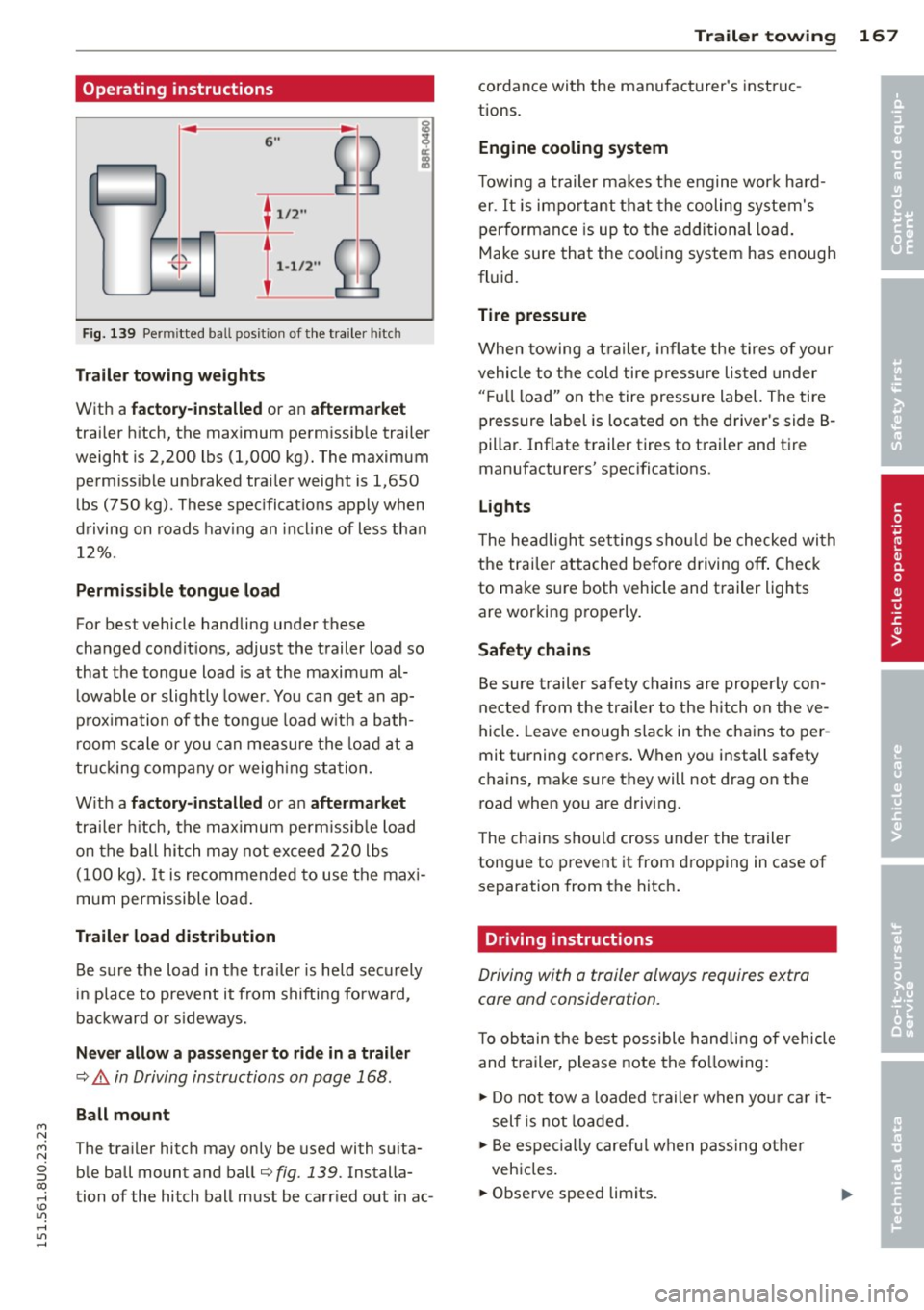
Fig. 139 Permit ted ball position of the trailer hitch
Trailer towing weights
With a factory-installed or an aftermarket
trailer hitch, the maximum permissible trailer
weight is 2,200 lbs (1,000 kg). The maximum permissible unbraked trailer weight is 1,650
lbs (750 kg) . These specifications apply when
driving on roads having an incline of less than
12%.
Permissible tongue load
For best vehicle handling under these
changed conditions, adjust the trailer load so
that the tongue load is at the maximum al
lowable or slightly lower . You can get an ap
proximation of the tongue load with a bath
room scale or you can measure the load at a
trucking company or weighing station.
With a
factory-installed or an aftermarket
trailer hitch, the maximum permissible load
on the ball hitch may not exceed 220 lbs
(100 kg).
It is recommended to use the maxi
mum permissible load.
Trailer load distribution
Be sure the load in the trailer is held securely
in place to prevent it from shifting forward,
backward or sideways.
Never allow a passenger to ride in a trailer
¢.&. in Driving instructions on page 168.
Ball mount
The trailer hitch may only be used with suita
ble ball mount and ball¢
fig. 139. Installa
tion of the hitch ball must be carried out in ac-
Trailer towing 167
cordance with the manufacturer's instruc
tions.
Engine cooling system
Towing a trailer makes the engine work hard
er .
It is important that the cooling system's
performance is up to the additional load.
Make sure that the cooling system has enough
fluid.
Tire pressure
When towing a trailer, inflate the tires of your
vehicle to the cold tire pressure listed under
"Full load" on the tire pressure label. The tire
pressure label is located on the driver's side B
pillar. Inflate trailer tires to trailer and tire
manufacturers' specifications .
Lights
The headlight settings should be checked with
the trailer attached before driving off. Check
to make sure both vehicle and trailer lights
are working properly.
Safety chains
Be sure trailer safety chains are properly con
nected from the trailer to the hitch on the ve
hicle. Leave enough slack in the chains to per
mit turning corners. When you install safety
chains, make sure they will not drag on the
road when you are driving.
The chains should cross under the trailer
tongue to prevent it from dropping in case of
separation from the hitch.
Driving instructions
Driving with a trailer always requires extra
core and consideration.
To obtain the best possible handling of vehicle
and trailer, please note the following :
.,. Do not tow a loaded trailer when your car it
self is not loaded.
.,. Be especially careful when passing other
vehicles.
.,. Observe speed limits.
•
•