wheel size AUDI Q3 2015 Owners Manual
[x] Cancel search | Manufacturer: AUDI, Model Year: 2015, Model line: Q3, Model: AUDI Q3 2015Pages: 258, PDF Size: 64.9 MB
Page 119 of 258
M N
M N
0 ::i co ,...., \!) 1.1"1 ,...., 1.1"1 ,....,
-Therefore, always wear your safety belts
and make sure that everybody in your ve
hicle is properly restrained.
A WARNING
A person on the front passenger seat, es
pecially infants and small children, will re
ceive serious injur ies and can even be kil
led by being too close to the airbag when
it inflates.
- Although the Advanced Airbag System in
your vehicle is designed to turn off the
front passenger a irbag if an infant or a
small ch ild is on the front passenge r
seat, nobody can absolutely guarantee
that deployment under these special
conditions is impossible in all conceiva
ble s ituations that may happen during
the useful life of your vehicle.
- The Advanced A irbag System can deploy
in accordance with the "low risk" opt ion
under the U.S. Federa l Standard if a c hild
that is heavier than the typical one-year
old child is o n the front passenger seat
and the other cond itions for airbag de
ployment are met .
- Acc ident statist ics have shown that chil
dre n are generally safe r in the rea r seat
area than in the front seating posit io n.
- For their own safety, all children, espe
cially 1 2 yea rs and younger, sho uld al
ways ride in the b ack properly restrained
for their age and size .
Advanced front airbag system
-
Your vehicle is equipped w it h a front Advanced
Airbag System in comp liance with United
States Federal Motor Vehicle Safety Standard
208 as applicable at the time your vehicle was
manufactured.
The front Advanced Airbag System supp le
ments the safety belts to provide additiona l
protection for the driver's and front passeng
er's heads and upper bodies in frontal crashes.
The airbags inflate only in frontal impacts
when the vehicle decelerat io n is high enough .
Airbag system 117
The front Advanced Airbag System for the
front seat occupants is not a substitute for
your safety be lts . Rather, it is part of the over
all occupant restra int system in your vehicle.
Always remember that the airbag system can
only he lp to protect you, if you are sitting up
rig ht, wearing your safety belt and wear ing it
proper ly. This is why you and your passe ngers
mus t always be prope rly restrained, not jus t
because the law req uires you to be.
T he Advanced A irbag System in your vehicle
has been ce rtified to meet the "low risk" re
quirements for 3 and 6 yea r-old ch ildren o n
the passenger side and very small ad ults o n
the driver side . The low risk deployment crite
ria are intended to help reduce the risk o f in
jury through interaction with the front airbag that can occur, for example, by being too
close to the steering wheel and instrument
panel when the airbag inflates.
In addition, the system has been certified to
comply with the "s uppression" requirements
of the Safety Standard, to turn off the front
airbag for infants
12 months old and younger
who are restrained on the front passenger
seat in child rest raints that are listed in the
Standard ¢
page 135, Child restraints and
Advanced Airbags.
"Suppress ion" requires the front a irbag on the
passenger side to be turned off if:
- a child up to about one year of age is re
strained on the front passenger seat in one
of the rear -fac ing or forward-facing infant
restrai nts listed in Federal Motor Vehicle
Safety Standard 208 with which the Ad
vanced Ai rbag System in your ve hicl e was
cert ified . For a listing of t he chi ld res traints
tha t were used to certify you r vehicle's com
pliance with the US Safety Standard
¢ page 135,
-weight less than a thresho ld level stored in
the control unit is detected on the front pas
senger seat .
When a person is detected on the front pas senger seat, weighing more than the total
weight of a chi ld that is about 1 year old •
•
Page 136 of 258
134 Child Safety
-Always install rear-facing child safety
seats on the rear seat.
- If you must install a rearward facing
child safety seat on the front passenger
seat in exceptional circumstances and
the
PASSENGER AIR BAG OFF light does
not come on and stay on, immediately
install the rear-facing child safety seat in
a rear seating position and have the air
bag system inspected immediately by
your Audi dealer.
_& WARNING
If, in exceptional circumstances, you must
install a forward-facing child restraint on
the front passenger's seat:
- Always make sure the forward-facing
seat has been designed and certified by
its manufacturer for use on a front seat
with a passenger front and side airbag.
- Always follow the manufacturer's in
structions provided with the child safety
seat or carrier.
- Always move the passenger seat into its
rearmost position in the seat's fore and
aft adjustment range, as far away from
the airbag as possible before installing
the child restraint. The backrest must be
adjusted to an upright position .
- Always make sure that the
PASSENGER
AIR BAG OFF
light comes on and stays
on all the time whenever the ignition is
switched on.
(D Tips
Always replace child restraints that were
installed in a vehicle during a crash. Dam
age to a child restraint that is not visible
could cause it to fail in another collision
situation.
Advanced front airbag system and children
Your vehicle is equipped with a front "Ad
vanced Airbag System" in compliance with United States Federal Motor Vehicle Safety Standard (FMVSS) 208 as applicable at the
time your vehicle was manufactured.
The Advanced Airbag system in your vehicle
has been certified to meet the "low-risk" re
quirements for 3- and 6-year old children on
the passenger side and small adults on th e
driver side. The low ris k deployment criteria
are intended to reduce the risk of injury
through interact ion with the airbag t hat can
occur, for example, by being too close to the
steering wheel and instrument panel when
the airbag inflates . In addition, the system
has been certified to comply with the "sup
pression" requirements of the Safety Stand
ard, to turn off the front airbag for infants up
to 12 months who are restrained on the front
passenger seat in child restraints that are list
ed in the Standard.
Even though your vehicle is equipped with an
Advanced Airbag system , all children, espe
cially those 12 years and younger, should al
ways ride in the back seat properly restrained
for their age and size. The airbag on the pas
senger side makes the front seat a potentially
dangerous place for a child to ride . The front
seat is not the safest place for a child in a for
ward-facing child safety seat. It can be a very
dangerous place for an infant or a larger child
in a rearward-facing seat .
Advanced Airbags and the weight
sensing mat in the front seat
The Advanced Airbag System in your vehicle
detects the presence of an infant or child in a
child restraint on the front passenger seat us
ing the weight-sensing mat in the seat cush
ion and the sensor below the safety belt latch
on the front passenger seat that measures the
tension on the safety belt.
The weight -sensing mat measures total
weight of the child and the child safety seat
and a child blanket on the front passenger
seat. The weight on the front passenger seat
is related to the design of the child restraint
and its "footprint", the size and shape of the
bottom of the child restraint as it sits on the .,..
Page 156 of 258
154 Intellig ent technolog y
Anti-slip r egulation (ASR )
ASR reduces engine power when the drive
wheels begin to spin and adapts the force to
the road conditions. This makes it easier to
start, accelerate and drive up hills.
Electronic diffe rential lock (EDL )
The ED L brakes wheels that are spinn ing and
transfers the drive power to the o ther d rive
wheel or whee ls if the vehicle is equipped with
all-wheel drive* . This function is available up
to about 60 mph (100 km/h).
I n extreme cases , ED L automat ica lly switches
off to help keep the brake on the braked whee l
from overheating . EDL wi ll switch on again au
tomatically when conditions have returned to normal.
El ectron ic inte ra xle diff ere ntial lock */
se lec tive wheel t orque contr ol*
The electronic interaxle differential lock (front
wheel drive) or the select ive wheel torque
control (all-wheel drive) operates when driv
ing through curves. The front wheel on the in·
side of the curve or both wheels on the inside
of the curve are braked select ively as needed .
This minimizes s lid ing in the front wheels a nd
allows for more p rec ise driving through
curves. The app licab le system may not acti
vate when driving in wet or snowy conditions .
A WARNING
-ESC, ABS, ASR, EDL, the electronic inter
axle differentia l lock* /selective whee l
torque control* and the hill descent as
sist cannot overcome the laws of physics.
Th is is especially important on slippery
o r wet roads . If the systems begin acting to stabilize your vehicle, you should im
mediately change your speed to match
the road and traffic conditions. Do not let the increased safety provided by
these systems tempt you to take r isks .
Doing so will increase the risk of a loss of
veh icle cont ro l, collision and ser ious per
sonal injur ies.
- Always adapt your speed to road, traffic
and weather conditions. The risk of los
ing control of the vehicle increases when
driving too fast , espec ially through
curves and on slippery or wet roads, and
when driving too close to vehicles up
ahead. ESC, ABS, the brake ass ist sys
tem, ASR, EDL and the electronic inter
axle d ifferential lock*/selective wheel
torque control* cannot prevent colli
sions .
- Always accelerate with special care on
even, smooth surfaces such as those that
are wet or covered with ice and snow .
The drive wheels can spin even w ith
these assistance systems t hat cannot al
ways he lp to reduce the risk of loss of ve
hicle control.
(D Tips
- ABS and ASR only wo rk correct ly when
all four wheels are equipped with identi
cal tires. D ifferent tire sizes can lead to a
reduction in engine power.
- You may hear noises when the systems
described are working .
-If the ind icator light DJ or Ell (USA
mode ls)/ lCO)J
page 16.
Page 161 of 258
with all-wheel drive¢ page 211, Snow
chains .
Replacing wheels /tire s
Vehicles w ith all-wheel drive mus t always
h ave tires o f the same size. Also avoid t ires
with different tread depths. For details see
page
c::> page 206, New tires and replacing
tires and wheels.
A WARNING
Always adjust your driving to road and traf
fic condit ions. Do not let the extra safety
afforded by all-wheel drive tempt you into
taking extra risks.
- Although the all-wheel dr ive is very ef
fective, always remember that braking capacity is limited by t ire traction . You
should therefore not dr ive at excess ive
speeds on icy or slippery road surfaces.
- On wet road surfaces, be careful not to
dr ive too fast because the front wheels
c ou ld beg in to s lide on top of the water
(aquaplaning). If this sho uld oc cur, you
will have no warning from a sudden in crease in engine speed as with a front
wheel drive vehicle. A lways drive at
speeds which are suited to the road con
ditions -risk of crash.
Energy management
Starting ability is optimized
Energy management controls the distribution
of electrical energy and thus optimizes the
availability of electrical energy for starting
the engine .
If a vehicle with a conventional energy system
is not driven for a long period of time , the bat
tery is discharged by idling cu rrent consumers
(e.g. immobilizer). In ce rtain c ircumstances it
can result in there being insufficient energy
M avai lab le to start the engine . N
M N
0 ::i co ,...., \!) 1.1'1 ,...., 1.1'1 ,....,
Intelligent energy management in your veh i
cle handles the d istribution of elec trical ener
gy . Starting abi lity is markedly improved and
the life of the battery is extended .
Intellig ent technolog y 159
Basica lly, energy management consists of
b att ery diag nosis , id lin g cur rent man age
ment
and dyn amic en ergy m anag ement.
Batte ry diagnosis
Battery diagnosis continuously determines
the state of the battery . Sensors determine
battery voltage, battery current and battery
temperature . This determines the current
state of charge and the power of the batte ry .
Idlin g current manag ement
Id ling current management reduces energy
consumption while the vehicle is standing.
With the ig nition switched off, it controls the
energy supply to the various electrical compo nents. Data from battery diagnosis is cons id
ered.
Depending on the battery's state of charge ,
individual consumers are gradually turned off
to prevent excessive discharge of the batte ry
and thus maintain starting capability .
Dynamic energy manag ement
While the vehicle is being driven, dynamic en
ergy management distributes the energy gen
erated according to the needs of the individ u
al components . It regulates consumption, so
that more electrical energy is not being used
than is being generated and ensures an opti
mal state of charge for the battery .
(D Tips
-But even energy management cannot
negate the limits of physics. Consider
that the power and life of a battery are
limited.
- If start ing ability is threatened, the indi
cator light (•) ;ippears
c::> page 15.
What you should know
The highest priority is given to maintaining
starting capability .
The battery is severe ly taxed in short-distance
driving , in ci ty traff ic and during the cold time
of year . Abundant electrical energy is .,.
•
•
Page 166 of 258
164 Driving and en vironm ent
The amount of oil used is related to eng ine
load and speed.
I t is normal for the oil consumption of a new
engine to reach its lowest val ue after a certain
mileage has been driven.
You must drive your vehicle about 3 ,000 miles
(5,000 kilometers) before you can properly
assess o il cons umption .
This a lso applies to fuel consumption and en
g ine output .
0 Note
-Have your vehicle maintained properly
and in accordance with the service rec
ommendations in your War ranty
& Main
tenance booklet. Lack of proper mainte
nance as well as imp roper use of the ve
hicle will impair the function of the
emission control system and could lead
to damage.
- Do not a lter or remove any component of
the Emi ssion Contro l System unless ap
proved
by the manufacturer.
- Do not a lter or remove any device, such
as heat shields, switches, ignition wires,
va lves, which are designed to protect
your vehicle's Emiss ion Control System
and other important veh icle compo
nents .
Fewer short trips
Fuel consumption will always be relatively
high on short trips .
• Try to avo id driving sho rt distances with a
cold eng ine.
The engine and catalytic converter have to reach their optimal
ope rating tempe ratu re to
reduce fuel con sumption and noxious emis
sions effect ively.
Just after starting, a cold engine in a mid-size car on ly achieves a fuel economy of 6-8 miles
per gallon (30-40 l/100 km) . After about a
half a m ile, fuel economy climbs to 12 mpg
(20 l/100 km) . After about
2. 5 miles (4 km), the engine is at its proper operating tempera
ture and fuel economy has reached a normal
l evel. So you can see that you should avo id
short trips whenever possible.
T he
out sid e tempe rature is also critical in this
regard . Your car consumes more fue l in the
winter than in the s ummer.
Driving offroad
General information
When driving off road, the functions fo r the
electron ic stabiliza tion control ( ESC) are ex
panded . The ESC-Offroad-Mode can be activat
ed in driving situations in which a wheel lock
or a differential lock function is needed
c> page 155.
Your Audi i s howev er, n ot an offroad vehicle.
Ne ver dri ve the vehicle in te rrain wh ich i s n ot
suitable for the vehicle , o r w hich ex ceeds
y ou r driv ing skill s. Ne ver tak e an y u nneces
s ar y risk s!
Aft er d riving offroad
-After driving offroad, remove branches and
other debris from the radiator gri lle, under
body, and wheels. Look especially for objects
(stones) that have been caught in the tire
tread.
- Clean the body and the vehicle underbody
and inspect the vehicle for possible damag
es.
- Clean off the dirty windows, headlights, tail
lights and the license plate .
- Pe rform a brake test (especially after driving
through water).
A WARNING
- Be especially aware and attent ive when
driving under difficult condit ions . Dam
ages to the vehicle and injur ies may oc
cur when driv ing at an excessively high
speed or with incor rect driving maneu
vers.
- Always adjust you r speed and hand ling
to the roads, terrain, t raff ic and weather
~
Page 199 of 258
M N
M N
0 ::i co ,...., \!) 1.1"1 ,...., 1.1"1 ,....,
Tires and wheels 197
Gross Vehicle Weight Rating ("GVWR") Ply
means the maximum total loaded weight of
the vehicle .
Groove
means the space between two adjacent tread
ri bs.
Load rating (code)
means the maximum load that a tire is rated
to carry for a given inflat ion pressure . You
may not find this informat ion on all tires be
cause it is not requ ired by law.
Maximum load rating
means the load rating for a t ire at the max i
mum permissible inflation pressure for that
tire .
Maximum loaded vehicle weight
means the sum of:
(a) Curb weight
(b) Accesso ry weight
(c) Vehicle capacity weight, and
(d) Production opt ions we ight
Maximum (permissible) inflation pressure
means the maximum co ld inf lation pressure
to which a tire may be inflated . Also called
"maximum inflation pressure."
Normal occupant weight
means 150 lbs . (68 kilograms) times the
number of occupants seated in the vehicle up
to the tota l seating capacity of your vehicle.
Occupant distribution
means distribution of occupants in a veh icle.
Outer diameter
means the overall diameter of an inflated new
tire .
Overall width
means the linear distance between the exteri
ors of the sidewalls of an inflated tire, includ
ing e levations due to labeling, decorations, or
protective bands or ribs. means a layer of
rubber-coated parallel cords.
Production options weight
means the combined weight of those installed
regular production opt ions we ighing over 5
lbs. (2.3 kg) in excess of those standa rd items
which they replace, not previously considered
in curb weight or accessory weight, including
heavy duty brakes, ride levelers, roof rack,
heavy duty battery, and spec ial trim.
Radial ply tire
means a pneumatic tire in which the ply cords
that extend to the beads are laid at substan
tially 90 degrees to the centerline of the
tread.
Recommended inflation pressure
see r::!;> page 196, Cold tire inflation pressure .
Reinforced tire
means a tire design to operate at higher loads
and at higher inflation pressures than the cor
responding standard tire. Reinforced tires
may be identified as "XL", "xl", "EXTRA LOAD",
or "RF" on the sidewal l.
Rim
means a metal support for a tire or a t ire and
tube assembly upo n which the tire beads are
seated .
Rim diamete r
means nominal diameter of the bead seat. If
you change your wheel s ize, you wi ll have to
purchase new tires to match the new r im di
ameter .
Rim size designation
means rim diameter and width.
Rim width
means nominal distance between rim flanges.
Sidewall
means that portion of a t ire between the
tread and bead .
•
•
Page 201 of 258
M N M N
0 ::i co
rl I.O
"' rl
"' rl
Tires and wheels 199
Occupant loading and distribution for vehicle normal load for various designated seating
capacities
Designated seating capacity, Vehicle normal load, number Occupant distribution in a nor-
number of occupants of occupants mally loaded vehicle
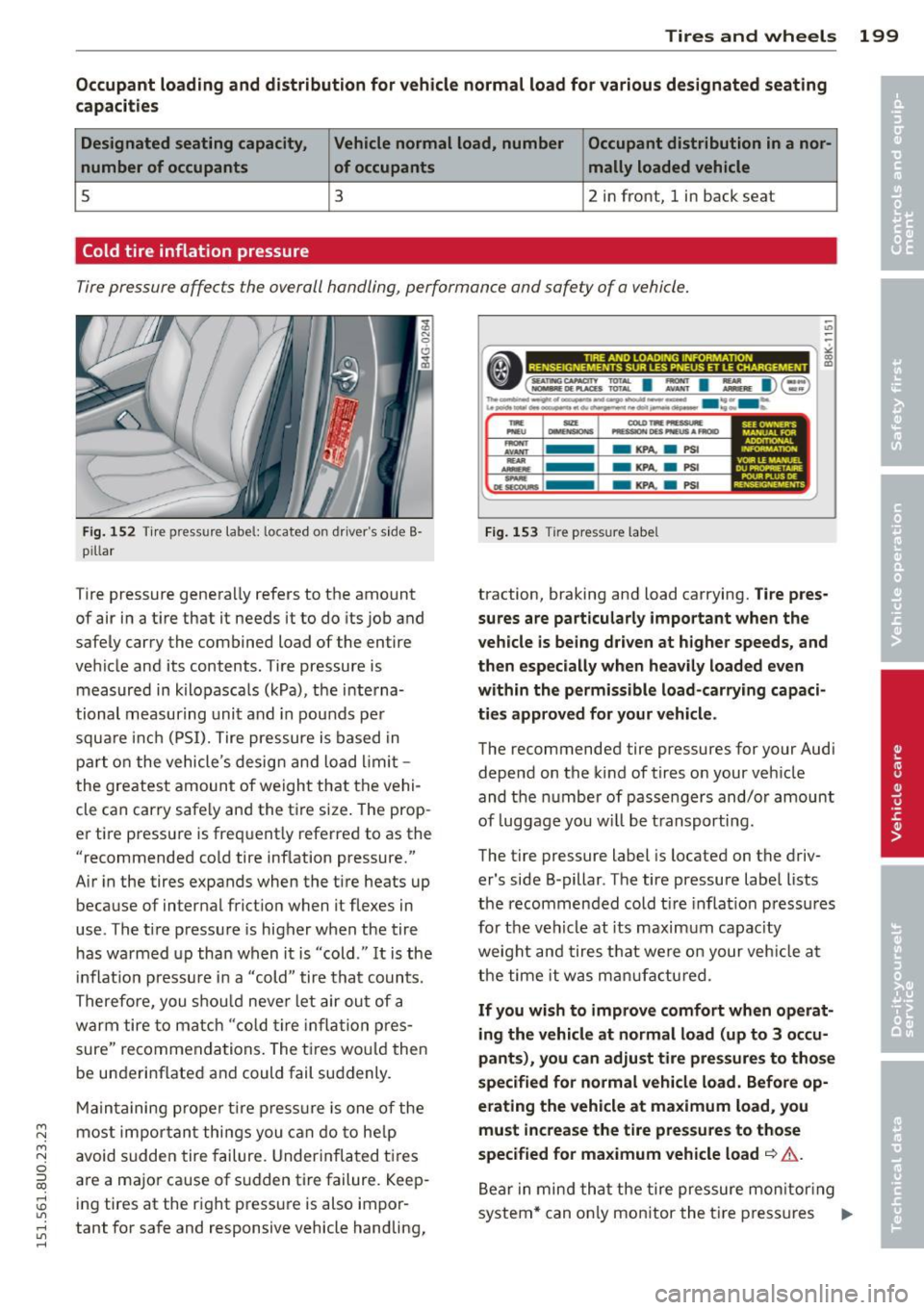
5 3 2 in front, 1 in back seat
Cold tire inflation pressure
Tire pressure affects the overall handling, performance and safety of a vehicle.
Fig. 152 Tire press ure label: located on driver 's s ide B·
p ill ar
Tire pressure generally refers to the amount
of air in a tire that it needs it to do its job and
safely carry the combined load of the entire
vehicle and its contents . Tire pressure is
measured in kilopasca ls (kPa), the interna
tional measuring unit and in pounds pe r
square inch (PSI). Tire pressure is based in
part on the vehicle 's design and load limit -
the greatest amount of weight that the vehi
cle can carry safe ly and the t ire size . The prop
er tire pressure is frequent ly referred to as the
"recommended cold tire inflation pressure."
Air in the tires expands when the tire heats up
because of internal friction when it flexes in
use . The tire pressu re is higher when the tire
has warmed up than when it is "cold ."
It is the
in flat ion pressure i n a "cold " tire that counts.
Therefo re, you shou ld neve r let air out of a
warm tire to ma tch "cold tire inflat ion pres
sure" recommendations. The tires would then
be underinflated and could fail suddenly .
Maintaining proper tir e pressure is one of the
most impor tant things you can do to help
avoid sudden tire failure. Underinflated tires
are a ma jor cause of s udden tire failure . Keep·
ing tires at the right pressure is also impor
tant for safe and responsive vehicle handling,
-tD
-
---------------------.. ,;
•(==.: I :::; I :,,. I)@ gi n. ............ .,_____, .... -.ito._.. ____ .... _ ...
&..p0idit,101111-~--.,...,....-- ..... ~ .... ..
-··-.....
-
-Dlst<:OURS
- KPA.. a PSI
- KPA..
a PS I
- KPA.. a PSI
Fig. 153 Tire pressu re labe l
traction, braking and load carrying. Tire pres
sures are particularly important when the
vehicle is being driven at higher speeds, and
then especially when heavily loaded even
within the permissible load-carrying capaci
ties approved for your vehicle.
The recommended tire pressures for your Audi
depend on the kind of tires on your ve hicle
and the number of passengers and/o r amount
of luggage you w ill be transporti ng.
The tire pressure label is located on the driv
er's side B -pillar . The tire pressure labe l lists
the recommended cold tire inflat io n pressures
for the vehicle at its maximum capacity
weight and tires that were on your veh icle at
t he time it was manufactured.
If you wish to improve comfort when operat
ing the vehicle at normal load (up to 3 occu
pants), you can adjust tire pressures to those
specified for normal vehicle load. Before op
erating the vehicle at maximum load, you
must increase the tire pressures to those
specified for maximum vehicle load
¢ &.
Bear in mind that the tire pressure monitoring
system * can only monitor the tire pressures
II>
Page 202 of 258
200 Tires and wheels
you have stored. The system does not recog
nize the load condition of your vehicle.
The effectiveness of the tire pressure monito r
ing system* will be impaired if you store nor
mal load pressures but then operate the vehi
cle at its maximum load¢.&. .
See the illustration¢
fig. 152 for the location
of the label on driver's side 8-pillar (color of
the actua l label and exact location on the ve
hicle wi ll vary slightly).
Note that the following table is accurate at
the time of going to press and is subject to
Model Tire designation
Engine
Q3: 235/50
Rl8 97H
2.0 liter All Season
4 -cylinder
235/50 Rl8 97V
All Season
255/40 Rl9 96Y
High Performan ce
255/35 R20 97Y xl
High performance
change. In the event of discrepancies, the tir e
pressure label is located on the driver's side 8-
pillar always takes precedence.
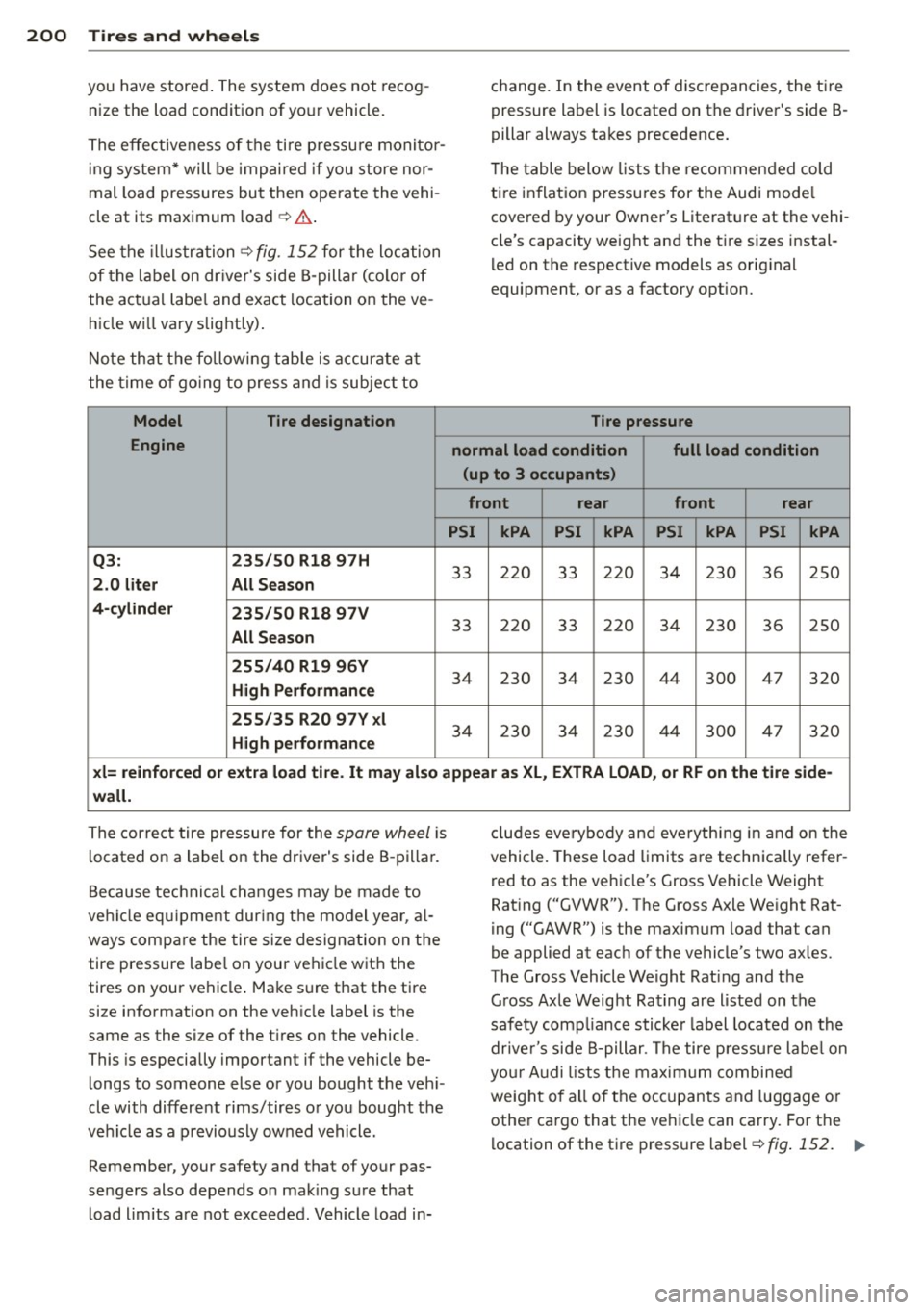
T he table below lists the recommended cold
ti re inflation pressures for the Audi mode l
covered by your Owner's Literature at the vehi
cle's capacity weight and the t ire sizes instal
l ed on the respective models as original
equipment, or as a factory option.
Tire pressure
normal load condition full load condition (up to 3 occupants)
front rear front rear
PSI kPA PSI kPA PSI kPA PSI kPA
33 220 33 220 34 230 36 250
33 220 33 220 34 230 36 250
34 230 34
230 44
300 47
320
34 230 34 230 44 300 47 320
xl= reinforced or extra load tire. It may also appear as XL, EXTRA LOAD, or RF on the tire side-
wall.
The correct tire pressure for the spare wheel is
located on a label on the driver's side 8 -pillar.
Because technical changes may be made to
vehi cle equipment dur ing the model year, al
ways compare the tire size designation on the
tire pressure labe l on your vehicle with the
tires on your vehicle . Make sure that the tire
size information on the veh icle label is the
same as the size of the t ires on the vehicle.
This is especially important if the vehicle be
longs to someone else or you bought the vehi
cle with different rims/tires or you bought the
vehicle as a previously owned vehicle.
Remember, your safety and that of your pas
sengers also depends on mak ing sure that
load limits are not exceeded . Vehicle load in- eludes
everybody and everything in and on the
vehicle. These load limits are technically refer
red to as the vehicle's Gross Vehicle Weight
Rat ing ("GVWR"). The Gross Axle We ight Rat
ing ("GAWR") is the maximum load that can
be applied at each of the vehicle's two axles.
The Gross Vehicle Weight Rating and the
Gross Axle Weight Rating are listed on the
safety compliance sticker label located on the
dr ive r's side 8-pillar. The tire pressure labe l on
you r Audi lists the max imum combined
weight of all of the occupants and luggage or
other cargo that the ve hicle can carry. For the
location of the tire pressure label
~fig . 152. .,..
Page 207 of 258
M N M N
0 ::i co
rl I.O
"' rl
"' rl
Tire service life
The service life of tires depends on a lot of
different things including proper installation
and balancing, correct tire pressure and driv
ing style.
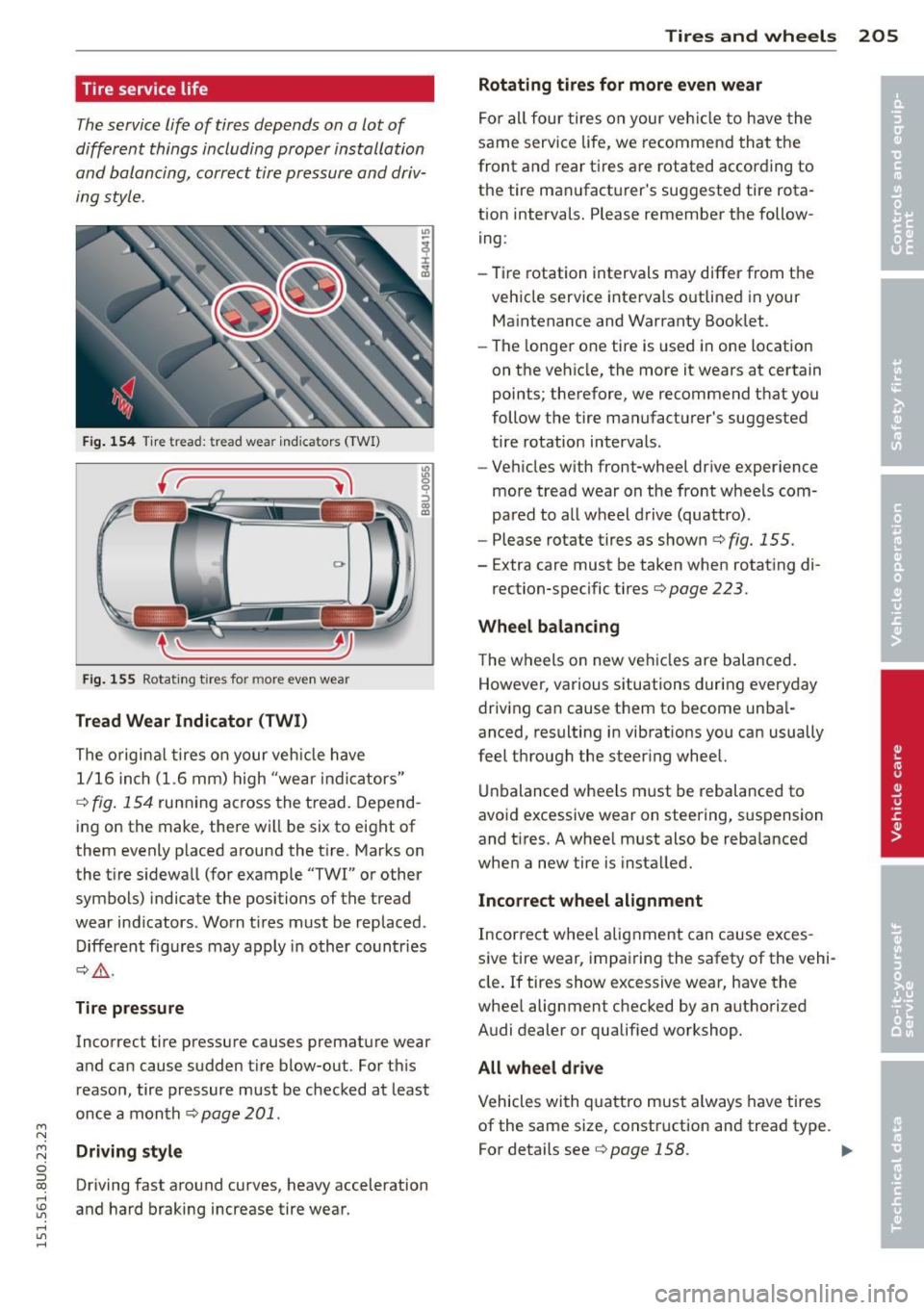
Fig. 154 Tire tread: tread wea r in dica tors (TWI)
Fig. 155 Rotating t ires for more even wea r
Tread Wear Indicator (TWI)
The original tires on your veh icle have
1/16 inch (1.6 mm) high "wear indicators"
r::!;> fig. 154 run ning across the tread. Depend
ing on the make, there will be six to eight of
them evenly p laced around the tire . Marks on
the t ire s idewall (for example "TWI" or other
symbols) indicate the positions of the tread
wear ind icators . Worn t ires must be replaced.
Different figures may apply in other countries
r::!) &.
Tire pressure
Incorrect tire pressure causes premature wear
and can cause sudden tir e blow-out . For this
reason, tire pressure must be checked at least
once a month
r::!;> page 201.
Driving style
Driving fast around curves , heavy acceleration
and hard braking increase tire wear.
Tires and wheels 205
Rotating tires for more even wear
For all four tires on your vehicle to have the
same service life, we recommend that the
front and rear tires are rotated according to
the tire manufacturer 's suggested tire rota
tion inte rvals. Please remember the follow
ing :
- Tire rotation intervals may differ from the
vehicle service interva ls o utlined in your
Ma intenance and Warranty Booklet.
- The longer one tire is used in one location
on the vehicle, the more it wears at certain
points ; therefore, we recommend that you
follow the tire manufactu rer 's suggested
tire rotation intervals .
- Vehicles w ith front-wheel dr ive exper ience
more tread wear on the front wheels com
pared to all w heel drive (quattro) .
- Please rotate tires as shown
r::!;> fig. 155.
-Extra care must be taken when rotating di-
rection-specific tires
r::!;> page 223 .
Wheel balancing
The wheels on new veh icles are balanced .
However, various situations during everyday
driving can cause them to become unba l
anced, resulting in vibrations you can usually
feel through the steer ing wheel.
Unbalanced wheels must be rebalanced to
avoid excessive wear on steering, s uspension
and t ires. A whee l must also be reba lanced
when a new tire is insta lled.
Incorrect wheel alignment
Incorrect wheel alignment can cause exces
sive tire wear, impairing the safety of the vehi
cle . If tires show excessive wear, have the
whee l alignment checked by an authori zed
Audi dealer or qualified workshop.
All wheel drive
Vehicles wi th quattro must always have tires
of the same size, construction and tread type.
For details
see r::!) page 158. 111>
Page 211 of 258
M N
M N
0 ::i co ,...., \!) 1.1'1 ,...., 1.1'1 ,....,
-All four wheels must be fitted with radia l
t ires of the same type, size (roll ing cir
cumference) and the same tread pattern .
Driv ing with different tires reduces veh i
cle handling and can lead to a loss of
control.
- If the spare tire is not the same as the
t ir es that are mounted on the veh icle -
for example with winte r tires -o nl y use
the spare tire for a short period of time and dr ive wi th extra care. Refit the nor
ma l road whee l as soon as safely possi
ble.
- Never drive faster than the maxim um
speed for which the tires on your vehicle
are rated because tires that are driven
faster than their rated speed can fail
sudden ly.
- Overloading tires cause heat build- up,
sudden tire failure, including a blowout
and sudden deflation and loss of control.
- Temperature grades app ly to tires that
are properly inflated and not over or un
der inflated .
- For technical reasons it is not a lways
poss ible to use wheels from other
vehicles -in some cases not even wheels
from the same vehicle model.
- If you install wheel tr im discs on the ve
hicle wheels, make sure that the air flow
to the brakes is not blocked. Reduced air
flow to the brakes can them to overheat,
increasing stopping distances and ca us
ing a collision.
- Run flat t ires may on ly be used on
vehicles that we re equ ipped w ith them
at the facto ry. The vehicle must have a
chassis des igned for run flat t ires and a
facto ry-installed tire p ress ure monito r
ing system* that indicates a loss of tire
pressure. Incorrect use of run flat tires
can lead to vehicle damage or accidents.
Check with an authorized Audi dea ler or
t ire spec ia list to see if your vehicle can be
equipped with run flat tires .
If run flat
t ir es a re used, they must be insta lled on
all four wheels. M ixing tire types is not
permitted.
Tire s an d wheel s 209
@ Note
-For technical reasons, it is not generally
possible to use the wheel rims from oth
er veh icles. Th is can hold tr ue for wheels
of the same vehicle type.
- If the spare tire is d ifferent from the
tires that you have mounted on your ve
hicle (for example winter tires or wide
profi le tires), then use the spare tire for a
short per iod of time only and drive w ith
extra care. Replace the flat tire w ith the
tire matching the othe rs on your vehicle
as soon as possib le.
- Never d rive without the valve stem cap .
T he va lves co uld get d amaged.
(® For the sake of the environment
D ispose of o ld tires in accordance with the
l ocal requirements.
Uniform tire quality grading
- Tread wea r
- Traction AA A B C
- Temperature ABC
Quality grades can be found where applicable
o n the t ire s ide wall between tread shoulder
and maximum section width
c:> page 206,
fig. 156 .
For e xample : Tread wear 200 , Traction AA,
Temperature A.
All passenger car t ires must conform to Feder
al Safety Requirements in addition to these
grades .
Tread w ear
T he tread wear grade is a comparative rating
based on the wear rate of the tire when tested
under contro lled conditions on a specified
government test course.
For example, a tire graded 1S0 wo uld wear
one and one ha lf (1 1/2) times as well on the
government course as a tire graded 100.
1JJ>
•
•