light AUDI Q3 2016 Owners Manual
[x] Cancel search | Manufacturer: AUDI, Model Year: 2016, Model line: Q3, Model: AUDI Q3 2016Pages: 252, PDF Size: 62.81 MB
Page 168 of 252
Trailer mod e
Weight d istribution
Towing a loaded trailer with an empty car res ults
in a high ly unstable distribution of weight . If this
cannot be avoided, drive at very low speeds on ly
to avoid the risk of losing steering control.
A "balanced" rig is easie r to operate and con trol.
This means that the tow vehicle should be loaded
to the extent possible and permissible, while
keeping the trai le r as light as possib le under the
circumstances. Whenever possible, transfer
some cargo to the luggage compartment of the
tow vehicle while observ ing tongue load requ ire
ments and vehicle loading considerat ions.
Spee d
The higher the speed, the more difficult it be
comes for the driver to contro l the rig. Do not
drive at the maximum permiss ible speed. Reduce
your speed even more if load, weather or w ind
conditions are unfavorable - part icularly when
goi ng downhill.
Reduce veh icle speed
immediatel y if the tra iler
shows the slightest sign of swaying .
Do not try
to stop the sway ing by acc ele rating .
Observe speed lim its. In some areas, speeds for
veh icles towing trailers are lower than for regular
ve hicles.
A lways app ly brakes early. When driving down
h ill, shift into a lower gear to use the engine
braking effect to slow the veh icle. Use of the
brakes alone can cause them to overheat and fail.
Coolant temp era ture
The coolant temperature gauge¢ page 10 must
be observed carefully. If the needle moves close
to the upper end of the scale, reduce speed im mediately and/or turn off the air conditioner.
If the coo lant temperature warning light in the
instr ument cluster starts flashing., pull off
the road, stop and let the engine
idle for about
two minutes to prevent heat bu ild-up.
A WARNING
Anyone not proper ly restrained in a moving
vehicle is at a much greater risk in an acci-
166
-
dent . Never let anyone ride in your car who is
not properly wear ing the restraints provided
by Audi.
Trailer mode notes
Important to know
You r vehicle handles differently when towing a
trailer because o f th e additiona l weight and dif
ferent weight distribution. Safety, performance
and economy will g reatly depend on how carefu l
l y you load your trai ler and operate your rig.
Before yo u actually tow your trailer, pract ice
turning, stopping and backing up in an area away
from traffic . Keep practicing unti l you have be
come complete ly familiar w ith the way your vehi
cle-tra iler combination behaves and responds.
Backing up is difficult and requires practice .
Backing up with a trailer genera lly requires steer
ing action opposite to that when backing up your
vehicle without a trailer.
Maintain a greater distance between your vehicle
and the one in fro nt of you . You will need more
room to stop. To compensate for the trailer, you
will need a larger than normal turning radius.
When passing, remember that you cannot accel erate as fast as you normally wo uld beca use of
the added load. Make sure you have enough room
to pass. After passing, allow p lenty of room for
your trailer before changing lanes again.
Avoid jerky starts, sharp turns or rapid lane
changes.
@ Tips
- Do not tow a trailer du ring the break-in peri
od of your vehicle.
- If you tow a trai le r, your Au di may requi re
more frequent maintenance due to the ex
t ra load ¢
page 232.
Page 170 of 252
Care and cleaning
Care and cleaning
General information
Regular, prope r care helps to maintain your vehi
cle's value.
It can a lso be a requirement when
submitting war ranty claims for cor rosion damage
and pa int defects on the body.
The necessary care prod ucts can be obtained
from your authorized Audi dealer o r authorized
Aud i Service Facility. Read and follow the instruc
tions for use on the packaging.
A WARNING
- Using cleaning and care products incorrectly
can be dangero us to your hea lth .
- Always store clean ing and care products out
of reach of children to reduce the r isk of po i
so ning .
@ For the sake of the environment
- Preferab ly use environmentally-friendly
products when buying cleaning agents.
- Do not dispose of leftove r clean ing and care
products wit h household t rash.
Car washes
The longer that deposits remain on the veh icle,
the more the surface may be damaged. High
temperatures such as those caused by sunlight
increase the damaging effect.
Before washing, rinse
off heavy deposits with
p lenty of water.
Stubborn deposits s uch as bird droppings or tree
sap are best removed with plenty of water and a mic rofibe r cloth.
A lso, wash the underside of yo ur vehicle once
road sa lt stops being used for the season .
Pressure washers
When washing your veh icles with a pressure
washer, always follow t he ope ra ti ng inst ructions
p rovided w ith the pressure washer. This is espe
cially important in regard to the pressure and
spraying distance . Do not a im the spray directly
at seals on side windows, doors, the hood, the
168
rear lid or the sunroo f* or at tires rubber hoses I I
insulating material, sensors* or camera lenses* .
Keep a distance of at least 16 inches (40 cm) .
Do no t remove snow and ice with a pressure
washe r.
Neve r use rota ry no zzles or high pressure noz
z les.
The water temperatu re must not be above 140 °F
(60 °().
Automatic car washes
Spray
off the vehicle before washing.
Make su re that the windows and roof * are closed
and t he windshie ld wipers are
off . Follow instruc
tions from the car wash operato r, especially if
there are accessories attached to your vehicle.
If possible, use car washes that do not have
brushes.
Washing
by hand
Clean the vehicl e starting from the top and work
in g down using a soft sponge or cleaning br ush .
Use solvent-free cleaning products.
Washing vehicles with matte finish paint
by
hand
To avo id damaging the paint w hen washing, fi rst
remove dust and large pa rt icl es from your vehi
cle. Insects, grease spots and fingerprints are
best removed with a special cleane r for matte
finish paint .
Apply the p rodu ct using a microfiber cloth. To
avoid damaging the paint surface, do not use too
much pressure.
Rinse the vehicle thorough ly w ith wate r. Then
clean using a neutra l shampoo and a soft m icr o
fiber cloth .
R inse the ve hicle thorough ly again a nd let it air
dry. Remove any water residue using a leather
cloth.
A WARNING
- Only wash the vehicle when the ignition is
off and follow the instr uctions from the car
-
Page 171 of 252
wash operator to reduce the risk of acc idents.
- To reduce the risk of cuts, protect yourself
from sharp metal components when wash
ing the underbody or the inside of the wheel
housings .
- After washing the vehicle, the brak ing effect
may be delayed due to mo isture on the
brake rotors or ice in the w inter . The brakes
must be dried first w ith a few careful brake
applica tions .
- If you wash the vehicle in an automatic car
wash, yo u m ust fold the exterior m irrors i n
to reduce the risk of damage to the mirrors.
Power folding exte rior m irrors* must on ly
be fo lded in a nd out using the power folding
funct ion.
- To p revent paint damage, do not wash the
vehicle i n direct sunlight.
Ca re and cleaning
- To re duce the risk of damage to the surface,
do not use insect removing sponges, kitchen
sponges or s imilar items .
- Matte finish painted veh icle components:
- To reduce the risk of damage to the sur-
face, do not use po lishing agents or hard
wax.
- Never use protective wax. It can destroy
the matte finish effect .
- Do not place any stickers or magnetic
signs on vehicle parts painted with matte
finish paint. The paint cou ld be damaged
when the stickers or magnets are re
moved .
@ For the sake of the environment
Only wash the vehicle in facili ties s pec ia lly de
s igned for that pu rpose. This will reduce the
r isk of dir ty wate r contam ina ted with o il from
en te ring the sewe r sys tem.
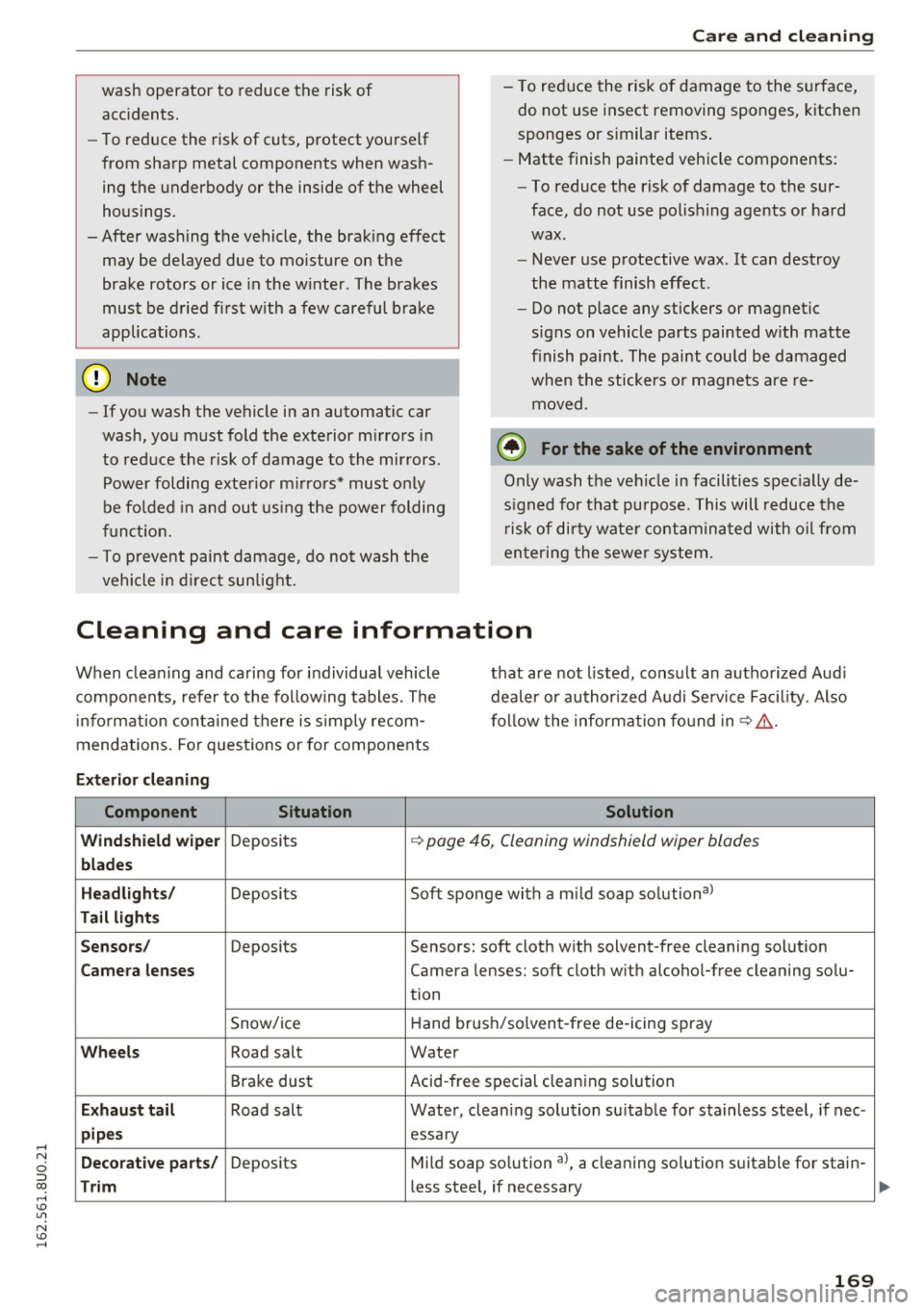
Cleaning and care information
W hen clea ning and ca ring for individua l vehicle
components, refer to the following tables. The
in fo rmation co ntai ned there is s imp ly recom
mend ations. For quest ions or for components that are
not listed, cons ult an autho rized Aud i
dealer or author ized A udi Se rvice Fac il ity. Also
f o llow the information fo und in ~ .&. -
Ext erior cleaning
Component Situation Solution
Windshield wiper
Deposits ~ page 46, Cleaning windshield wiper blades
blades
H eadlights /
Deposits Soft sponge with a mild soap solutiona >
Tail light s
Sensors /
Deposits Sensors: soft cloth with solvent-free cleaning solution
Camera lenses Camera lenses: soft cloth w ith alcoho l-free cleaning solu-
tion
Snow/i ce H
and brus h/solven t-free de-icing spray
Whe els Road salt Water
Brake dust Acid
-free special clean ing solution
Exhaust tail Road salt Water, clean ing solution su itab le for stainless stee l, if nee -
pipes essary
Decorative parts/ Deposits M
ild soap so lution al, a cleaning so lution s uitable for stain-
Trim less stee l, if necessary
169
...
Page 173 of 252
Care and cleaning
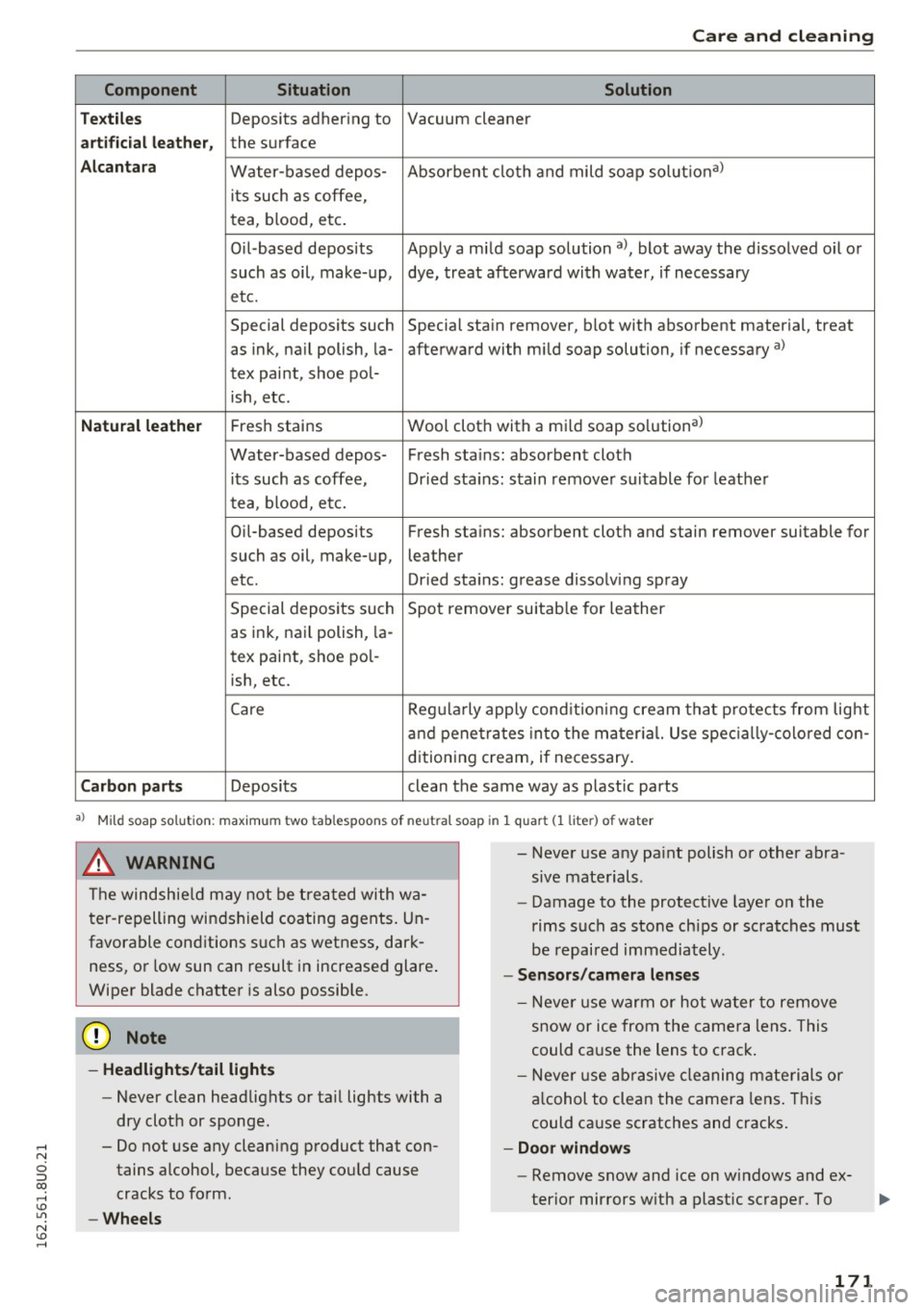
Component Situation Solution
T ex til es
Deposits adhering to Vacuum cleaner
art ifici al leat her, the surface
A lcan tara Water-based depos- Absorbent cloth and mild soap
solutional
its such as coffee,
tea, blood, etc.
Oil-based deposits Apply a mild soap solution al, blot away the dissolved oil or
such as oil, make-up, dye, treat afterward with water, if necessary
etc.
Special deposits such Special stain remover, b lot with absorbent material, treat
as ink, nail polish, la-afterward with mild soap solution, if necessary al
tex paint, shoe pol-
ish, etc.
Natu ral le ath er Fresh stains Wool cloth with a mild soap solution al
Water-based depos-Fresh stains: absorbent cloth
its such as coffee, Dried sta ins: stain remover su itable for leathe r
tea, blood, etc.
Oil-based deposits Fresh stains: absorbent cloth and stain remover suitable for
such as oil, make-up, leather
etc . Dried stains : grease dissolving spray
Special deposits such Spot remover suitable for leather
as ink, nail polish, la-
tex paint, shoe pol-
ish, etc.
Ca re Regularrly apply cond itioning cream that p rotects from light
and penetrates into the ma ter ial. Use spec ially-colored con-
ditionirng cream, if necessary.
Carbon p art s Deposits clean the same way as plastic parts
a) Mild soap solution: maximum two tablespoons of neutral soap in 1 q uart (1 liter) of water
.8, WARNING
The windshield may not be trea ted with wa
ter-repelling windshield coating agents. Un
favorable cond itions such as wetness, dark
ness, or low sun can result in increased glare.
Wiper blade chatter is also possible.
@ Note
- Headlight s/tail li ghts
- Never clean headlights or tail lights with a
dry cloth or sponge.
- Do not use any cleaning product that con
tains alcohol, because they could cause
cracks to form.
- Whe els
-
- Never use a ny pa int polish or other abra
sive materials .
- Damage to the protect ive layer on the
rims such as sto ne ch ips or scratches must
be repaired immediately .
-Sen sor s/camera lenses
-Neve r use warm or hot water to remove
snow or ice from the camera lens . This
could ca use the lens to crack .
- Neve r use ab rasive cleaning materials or
a lcohol to clean the camera lens . This
could cause scratches and cracks .
-Door window s
-Remove snow and ice on windows and ex-
terior mirrors w ith a plast ic scraper. To
171
Page 174 of 252
Care and cleaning
avoid scratches, move the scraper on ly in
one direction and not back and forth.
- Never remove snow or ice from door win
dows and mirrors using warm or hot water
because this could cause cracks to form .
- To avoid damage to the rear w indow de
fogger, do not apply any stickers on the
heating wires on the inside of the window .
- Decorati ve parts /trim
- Never use chrome care or cleaning prod-
ucts.
- Paint
- To red uce the risk of scratches, the vehicle
must be free of dirt and dust before pol
ishing or waxing .
- T o prevent pa int damage, do not polish or
wax the veh icle in direct sunlight.
- To red uce the risk of pa int damage, do not
polish away rust spots.
- Remove cosmetics and sunscreen immedi
ately -these could damage the paint.
- Di spla ys
- To avoid scratches, do not use dry cleaning
methods on displays .
-Controls
- Make sure that no fluids enter the con-
trols, because this could cause damage.
- Safety belts
- Do not remove the safety belts to clean
them.
- Never clean safety belts o r th eir compo
nents chemically or with cor rosive fl uids
or so lvents and neve r al low sha rp objects
t o come into con ta ct w ith the safe ty belts.
T his could cause damage to the belt web
bing .
-If there is damage to the webbing, the
connections, the retractors or the buckles,
have them replaced by an author ized Audi
dealer or authorized Audi Service Facility.
- Textiles /art ificial leather/ Alcantara
- Never treat artificia l leather/ Alcantara
w ith leather care products, so lvents, floor
polish, shoe polish, spot remove or similar
prod uct s.
- Have a specialist remove st ubborn stains
to prevent damage.
172
- Never use steam cleaners, brushes, hard
sponges, etc . when cleaning .
- D o not turn on the seat heating* to dry the
seat.
- Objects w ith sharp edges s uch as zippe rs,
rivets on clothing or be lts can cause dam
age to the surface .
- Open hook and loop fasteners, fo r exam
p le on clothing, can damage seat covers.
Make sure hook and loop fastene rs are
closed.
- Natu ral leathe r
- Never treat leather with solvents, floor
polish, shoe polish, spot remover or sim i
lar p roducts .
- Objects w ith sharp edges such as zippe rs,
rivets on clothing or belts can cause dam
age to the surface.
- Never use steam cleaners, brushes, hard
sponges, etc. when cleaning.
- Do not turn on the seat heating * to dry the
seat.
- To he lp prevent the leather from fad ing,
do not leave the vehicle in d irect sunlight
for long periods of time . If leav ing the ve
h icl e parked fo r long pe riods of time, you
should cove r the leathe r to pro te ct it from
d irec t sunlight.
{D Tips
- Insects are easier to remove from paint that
has been freshly waxed.
- Regular waxing can prevent rust spots from
forming.
Page 175 of 252
Fuel and Refueling
Gasoline
Fuel supply
Using the right fuel helps keep the environment
clean and prevents engine damage .
Fuel recommendation
The fuel recommended for your vehicle is unlead
ed premium
grade gasoline. Audi recommends
using TOP TIER Detergent Gasoline with a mini
mum octane rating of 91 AKI (95 RON). For more
in formation on TOP TIER Detergent Gasoline,
p lease go to the offic ial website
(www.toptiergas.com).
The recommended gasoline octane rating for
your engine can also be found on a label located
on the inside of the fuel filler flap. This rating
may be specified as AKI or RON.
Your vehicle may also be operated using unlead
ed regular gasoline with a minimum octane rat
ing of 87 AKI/91 RON. However, using 87 AKI/91
RON octane fuel w ill slightly reduce engine pe r
formance.
Use unleaded gasoline only. Unleaded gasoline
is available throughout the USA, Canada, and in
most European countries . We recommend that
you do not take your vehicle to areas or countries
where un leaded gasoline may not be available.
For more information on refueling your vehicle,
see
r=;, page 17 4.
Octane rating
Octane rating indicates a gasoline's ability to re
sist engine damaging "knock" caused by prema
ture ignit ion and detonation . Therefore, buy ing
the correct grade of gasoline is very important to
help prevent poss ible engine damage and a loss
of eng ine performance.
Gasoline most commonly used in the United
States and Canada has the following octane rat
ings that can usually be found on the filler pump:
- Premium Grade: 91 - 96 AKI
- Regular Grade: 87 - 90 AKI
Fuel and Refueling
Explanation of the abbreviations :
AKI=
Ant i Knock Index= (R+M)/2 = (RON +MON)/
2
RON = Re search Octane Number
MON= Motor Octane Number.
(D Note
- Do not use any fuel with octane ratings low
er than 87 AKI or 91 RON otherwise expen
sive engine damage w ill occur.
- Do
not use leaded gasoline. The use of lead
ed gasoline will severely damage your vehi
cle's catalytic converter and its ability to
control exhaust emissions.
Blended gasoline
Use of gasoline containing alcohol or MTBE
(methyl tertiary butyl ether)
You may use unleaded gasoline b lended with al
cohol or MTBE (commonly referred to as oxygen
ates) if the blended mixt ure meets the follo wing
criteria:
Blend of gasoline methanol (wood alcohol or
methyl alcohol)
- Anti-knock index must be 87 AKI or higher.
- Blend must contain no more than 3% metha-
nol.
- Blend must contain more than 2% co-solvents.
Blend of gasoline and ethanol (grain alcohol or
ethyl alcohol)
- Anti-knock index must be 87 AKI or higher.
- Blend must not conta in more than 15% etha-
nol.
Blend of gasoline and MTBE
- Anti-knock index must be 87 AKI or higher.
- Blend must contain not more than 15% MTBE.
Seasonally adjusted gasoline
Many gasoline grades are blended to perform es
pecially well for winter or summer dr iving . Dur
ing seasonal change-ove r, we suggest that you
fill up at busy gas stations where the seasonal
adjustment is more likely to be made in time. ..,.
173
Page 179 of 252
.... N
c:i ::J CX)
.... I.Cl U"I
N I.Cl ......
Checking and Filling Hood
Opening the hood
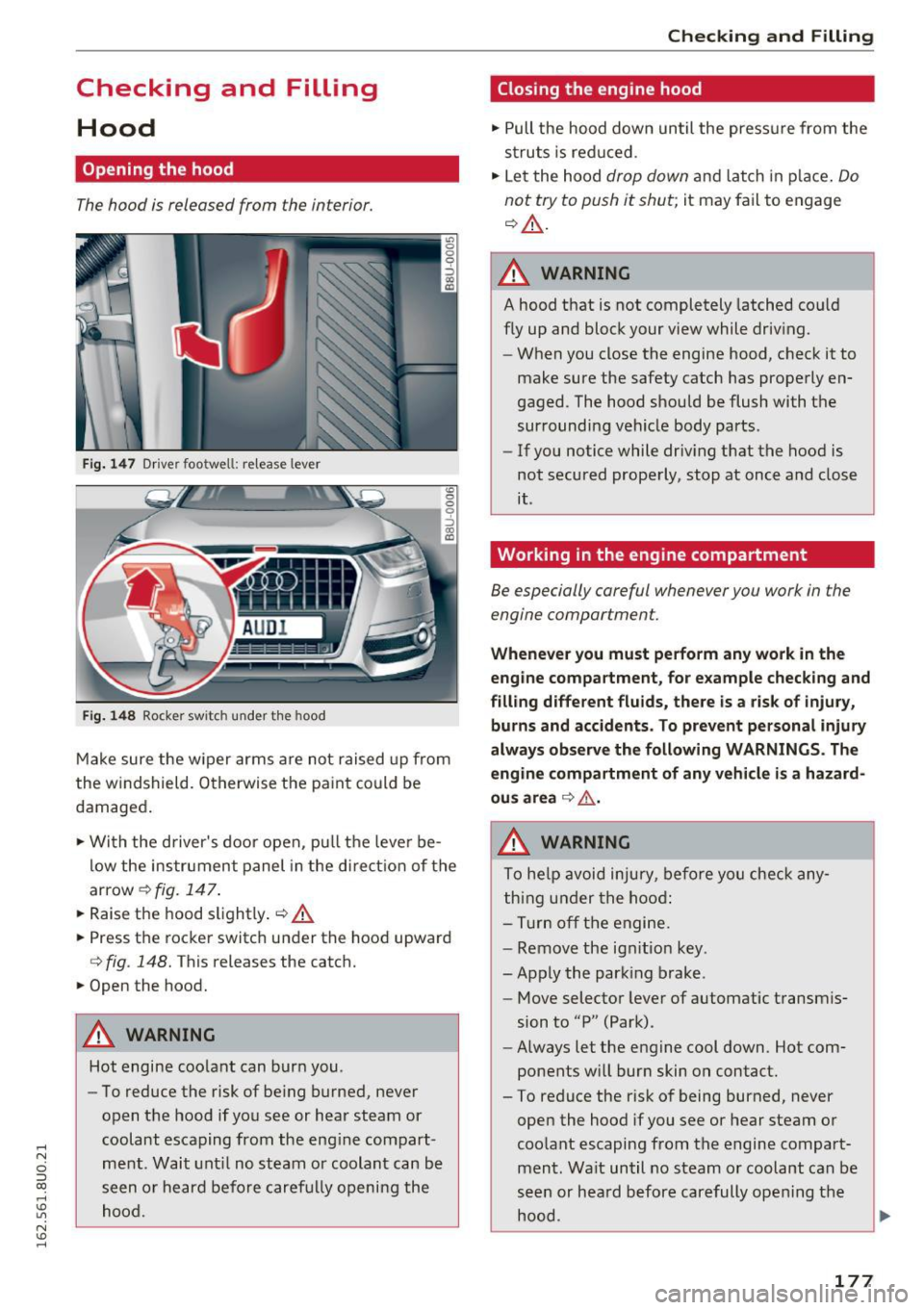
The hood is released from the interior.
Fig. 147 Driver footwell: release lever
Fig. 14 8 Rocke r switch under t he hood
<0 0 0
0
::,
"' CD
Make sure the w iper arms are not raised up from
the w indshield. O therwise the paint coul d be
damaged .
.,. Wi th the d river's doo r open, p ull th e leve r be
l ow the ins trument panel in the direct io n of the
arrow¢
fig. 1 47.
.,. Raise the hood s lightly . q &.
.,. Press t he roc ker switc h under the hood upward
Q fig. 148. This releases the catch.
.,. Open the hood.
A WARNING
Hot engine coolant can burn you.
- To reduce the risk of be ing burned, never
open t he hood if you see or hear steam or
coolant escaping from the eng ine compart
me nt. Wait unt il no steam or coolant can be
seen o r he ard before caref ully opening the
hood.
Checking and Filling
Closing the engine hood
., Pull the hood down until the press ure from the
s tr uts is red uced .
.,. Le t the hood
drop down and lat ch in p lace . Do
not try to push it shut;
it may fail to engage
q &_ .
A WARNING
A hood that is not completely latched co uld
fly up and block your view while driv ing.
- When you close the engine hood, check it to
make sure the safety catch has prope rly en
gaged. The hood should be flush with th e
sur rounding veh icle body parts.
- If you notice while driv ing that the hood is
not secured prope rly, stop at once and close
it .
Working in the engine compartment
Be especially careful whenever you work in the
engine compartment.
-
Whenever you must pe rform any work in the
eng ine compartment , for e xample check ing and
filling diff erent fluids, there is a ris k of injury,
burns and accidents. To prevent personal injury
always ob serv e the following WARNINGS . Th e
engine compartment of any veh icle is a hazard
ou s area
q .&. .
A WARNING
To he lp avoid injury, before yo u check any
t hing under the hoo d:
- Turn off the engi ne .
- Remove the ign ition key.
- Apply the park ing brake .
- Move selector lever of automatic transmis-
sion to "P" (Park).
- Always let the engine cool down. Hot com
ponents w ill bur n skin on contact.
-
-To reduce the risk of being burned, never
open the hood if you see or hear steam or
coo lant escaping from the engine compart
ment. Wa it until no steam o r coolant can be
seen or hea rd before carefully opening the
hood.
177
Page 182 of 252
Check ing and F illing
Audi oil quality standard
Gas olin e
VW 502 00 or
engi ne vw 50400
Using the proper engine oil is important for the
functionality and service life of the engine. Your
engine was factory-filled with a high-quality oil
which can usually be used throughout the entire
year .
Q) Note
Your Limited New Vehicle Warranty does not
cover damage or malfunctions due to failure
to follow recommended maintenance and use
requirements as set fo rth in the Audi Owner's
Manual and Wa rranty
& Maintenance booklet.
- Use only a high qua lity eng ine oi l th at ex-
pressly complies with the Audi oil qua lity
stan dard specified for your vehi cle's engine.
Using any o ther oil can cause serious engine
damage .
- Do not mix any lubricants o r other addit ives
i nto the engine oil. Doing so can cause en
gine damage.
(D Tips
I f you nee d to add oi l and there is none availa
ble that meets the Audi o il qu ality st andard
your engine requires, you may ad d a total of
no more than 0 .5 quart/liter of a high-quality
"synthet ic"oil that meets the following speci
fications.
- ACEA A3 o r API SM with a viscosity g rade of
SAE OW-30, SAE 5W-30 or SAE 5W-40.
- For more information about engine oi l that
has been approved for your vehicle, please
contact either your authorized Audi dea ler
or Audi Custome r Relat ions at
1 (800) 822-2834 or visit our web site at
www.audiusa.com or www .aud icanada .ca.
Engine oil consumption
The engine in your vehicle depends on an ade
quate amount of oil to lubricate and cool all of
its moving parts .
In order to provide effective lubrication and cool
ing of internal engine components, all internal
180
combust ion engines consume a certa in amo unt
of oil. Oil consumption varies from engine to en
gine and may change significantly over the life of
the engine. Typically, engines w ith a specified
break-in period (see
c:::;, page 159) consume more
o il dur ing the break-in per iod than they consume
af ter o il consumption has stab ilized .
Under normal conditions, the rate of oil con
sumption depends on the quality and viscos ity of
the oil, the RPM (revo lutions per m inute) at
wh ich the engine is operated, the amb ient tem
perature and road condit ions. Further factors a re
the amount of o il di lution from wate r co ndensa
tion or fue l resid ue an d the oxidation level of the
o il. As any engine is sub ject to wear as mileage
builds up, the oi l cons umption may increase over
time unt il replacement of worn components may
become necessary.
With a ll these variab les coming into p lay, no
standard rate of oil consumption can be estab
li shed or specified. The re is no alternative to reg
u lar and frequent checking of the oi l level, see
Note.
If the yellow engine oil level warning symbo l Ell
in the instrument cluster lights up, you sho uld
check the oil level as soon as possible
c:::;, page 181. Top off the oil at your earliest con
venience
c:::;,page 181.
A WARNING
Before you check anyth ing in the e ng ine com
partment, always read and heed all WARN
I NGS
c:::;, .&. in Working in the engin e compart
ment on page 177.
(D Note
Driving w ith an insuffic ient oil level is likely to
cause severe damage to the eng ine.
(D Tips
- The oil pressure warn ing d isplay. is not
an indicator of the oil level. Do not rely on
it. Instead, check the oil level in your en
g ine at regular int ervals , pr eferably each
time you refuel, and alway s before going
on a long trip .
Page 185 of 252
Cooling system
Coolant
The engine coolant performs two functions: it
keeps the engine from overheating and it pro
tects the engine from freezing in the winter .
The cooling system is sealed and generally re
quires little attention.
T he cooling system has been filled at the factory
with a permanent coolant which does not need to
be changed . The coolant consists of a mixture of
specially condit ioned water and the manufactur
er's glycol-basedcoolant add itive G 13 antifreeze
with anticorrosion additives (SO% for USA mod
e ls; 60% for Canada models) . This mixt ure bot h
assures the necessary frost protec tion and pro
tects meta l components in the engine's cooling
system from corrosion and scaling . It also raises
the boiling point of the coolant.
D o not red uce the concent ration of the coolant in
the summer by add ing p la in water.
The propor
tion of coolant addit ive mu st be at least 50 %
but not more than 60 %
to mainta in antifreeze
protection and cooling efficiency. If the coolant
frost protection is too low, the coolant could
freeze and damage the vehicle heating and en
g ine cooling system .
For year-round driving, antifree ze is added at the
factory for temperatures down to :
- -31° F(- 3S°C)USA
- -4 0 ° F ( - 40 °C) Can ada.
If you must add coolant, use a m ixture of water
and coolant addit ive. M ixing the coolant additive
with d istilled water is recommended .
_& WARNING
Before you check anythi ng i n t he engine com
partment, a lways read and heed a ll WARN
INGS
¢ .&. in Working in the engine compart
ment on page 177 .
(D Note
-Befo re winter se ts in, have the coo lant
checked to see if the coolant additive in you r
vehicle is sufficient to meet the cl imate con -
Check ing and Filling
ditions. This is especially important if you
live in a region where the winter is extreme
ly cold. If necessary, increase the proportion
of coolant additive to 60%.
- When adding coolant additive to your cool
ing system, remember :
- We recommend us ing only coolant add i
tive G12+ + or G13 fo r yo ur vehicle. This
coolant addit ive is avai lab le a t aut horized
A udi dealers . O ther types of antifree ze can
significantly reduce corrosion pro tect ion .
The resulting corrosion can cause a loss of
coolant and serious engine damage.
- Do not add any type of radiator leak sealant
to your vehicle's engine coolant. Adding ra
diator repair fluid may adversely affect the
function and performance of your cooling system and cou ld resu lt in damage not cov
ered by your New Veh icle Limited Warra nty .
Checking the engine coolant level
The engine coolant level can be checked with a
quick glance.
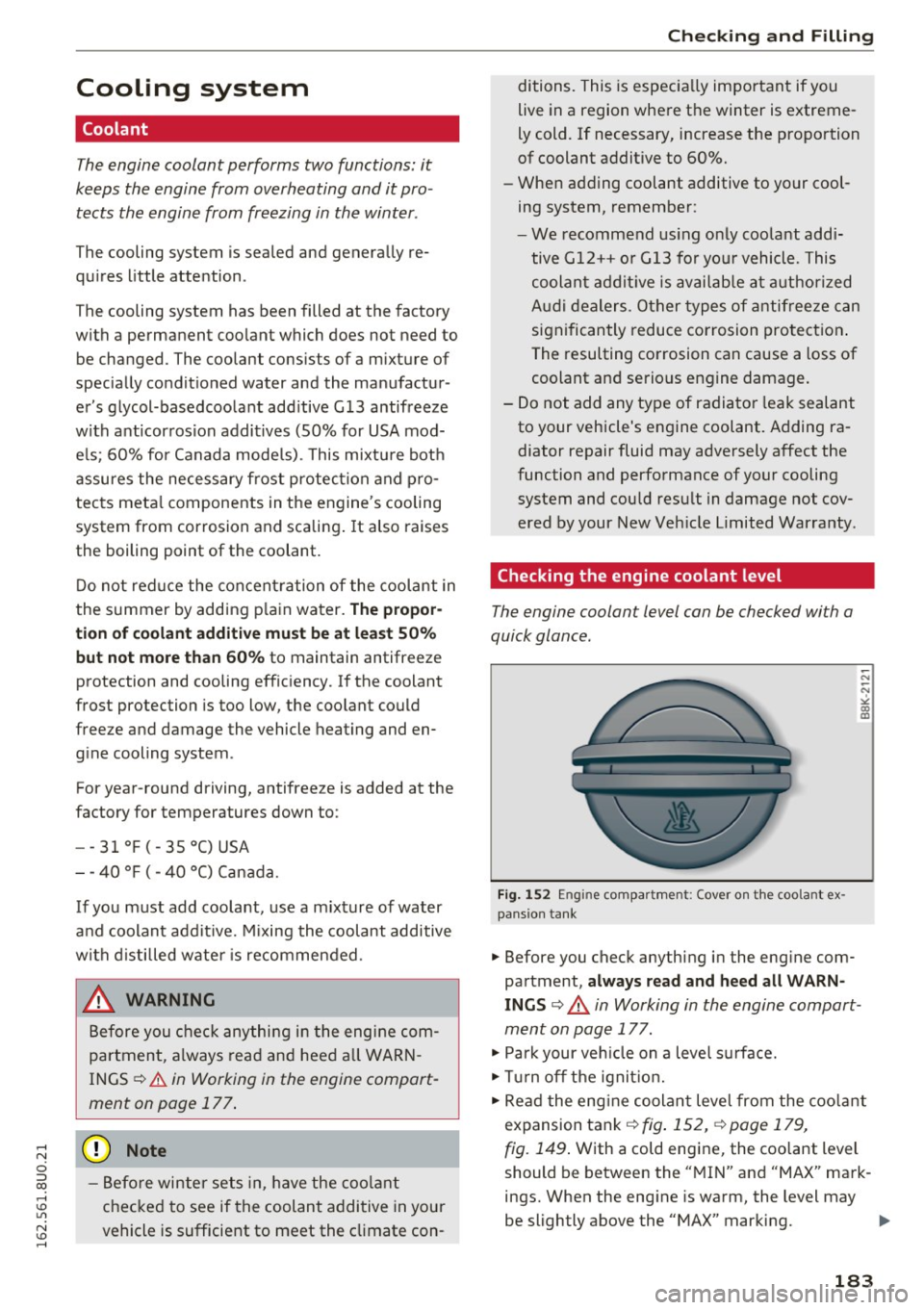
Fi g. 1 52 Engin e compar tmen t: Cover o n the coo la n t ex
pans ion tank
.. Before you check anything in the eng ine com
partment,
always r ead and h eed all WARN
INGS ¢ ,A in Working in the engine compart
ment on page 177 .
.. Par k your veh icle on a leve l sur face.
.. Tur n off t he ignit io n .
.. Read the eng ine coolan t leve l from the coo lant
expansion tank
¢ fig . 15 2, ¢ page 179,
fig. 149 .
With a cold engine, the coo lant level
should be b etween the "MIN" and "MAX" mark
ings. When the eng ine is warm, the level may
be slightly above the "MAX" marking. .,..
183
Page 186 of 252
Check ing and F illing
The location of the coolant expansion tank can be
seen in the engine compartment illustration
c::> page 179.
To obtain an accura te reading, the eng ine must
be switched off .
The expans io n tank in your vehicle is equipped
with a n elec tric coolant level sensor.
When the coolant level is too low, the war ning
lig ht in the Auto-Check System
c::> page 14 will
blin k until you add coo la nt and the level has bee n
restored to normal. Even t hou gh the re is an e lec
tr ic coolant level sensor, we still re commend you
check the coo lant level from time to time .
Coolant loss
Coolant loss may indicate a leak in the cooling
system. I n the event of coolant loss, the cooling
system should be inspected immediately by your
author ized Audi dealer. It is not enough me rely
to add coolant.
I n a
se aled system, losses can occur only if the
boi ling point of the coo lant is ex ceeded as a re
sul t of over heat ing.
A WARNING
T he cooling system is unde r pressure and can
get very hot . Red uce the risk of scalding from
hot coolant by following these steps.
- Turn off the eng ine and a llow it to cool
down .
- Protect your face, hands and arms from es
caping fluid and steam by cove ring the ca p
with a la rge, thick rag.
- Turn the cap s lowly and very ca refu lly in a
counter-clockwise direction w hile ap ply ing
light, downwa rd pressure o n the top of the
cap.
- To avo id being burned, do not sp ill anti
freeze or coolant on the exha ust system or
hot eng ine parts. Under certain conditions,
the ethy lene g lycol in e ngine coolant can
catch fire.
(D Note
Do not add any type of radiato r leak sealant
to your veh icle's engine coolant. Adding radia-
184
tor repair fluid may a dverse ly affect the func
tion and performance of your coo ling system
and could result in damage not covered by
your New Vehicle Limited Warranty.
Adding coolant
Be very careful when adding engine coolant.
Befo re yo u check any thing in the engine compart
ment,
always read and heed all WARNINGS
c::>
A in Working in the engine compartment on
page 177.
Requireme nt: The re mus t be a res idual amo unt
of coolant in the expans ion tank
c::> (D .
""Tur n off t he engine .
"" Let the eng ine cool down.
"" Pla ce a thick rag over the coolan t ex pan sio n
tank
c::> page 183, fig. 152 and carefull y turn
the cap counter-clockwise
c::> ,&. .
""Add coolant m ixed in the cor rect rat io
c::>page 183, Coolant up to the MAX ma rking.
"" Make sure that the fluid level remains stab le.
Add more coolant if necessa ry .
"" Twis t the cap o n aga in
tightly.
Replacement eng ine coolant must conform to ex
act specifications
c::> page 183, Coolant.
We recommend using only coo lant ad ditive G 12+
+ , G13 or in an emergency G12+. Do
not use a
different additive. In an emergency use plain wa
te r unt il you can get the cor rect addit ive and ca n
r esto re the cor rect rat io. Thi s should be done as
soon as possib le.
If you have lost a considerable amount of coo l
an t, then you s hou ld add co ld a ntifreeze and cold
water only whe n the engine is co ld.
A lways use
new engine coo lant when ref illing.
Do no t fill c oolant above the "MAX" mark . Excess
coolant will be forced out th rough the pressure
r elief valve in the cap when the engine becomes
hot.
~