light AUDI Q3 2016 Workshop Manual
[x] Cancel search | Manufacturer: AUDI, Model Year: 2016, Model line: Q3, Model: AUDI Q3 2016Pages: 252, PDF Size: 62.81 MB
Page 90 of 252
Parking systems
Parking systems
General information
Applies to vehicles: with rear parking system/parking system
p lus/rear v iew camera
Depending on your vehicle 's equipment , various
parking aids will help you when parking and ma
neuvering.
The
rear park ing system is an audible parking aid
that warns you of obstacles
behind the vehicle
~ page 88.
The parking system plus assists you when park
ing by audibly and visually indicating objects de
tected
in front of and behind the vehicle
~ page 89.
The rear view camera shows the area behind the
vehicle in the Infotainment display . This display
assists you when you are cross or parallel parking
~ page 90. In addition, you are assisted by the
functions from the park ing system plus
~ page 89.
& WARNING
-Always look for traffic and check the area
around your vehicle by looking at it directly
as well. The parking system cannot replace
the driver's attention. The driver is always
responsible for safety during parking and
for all other maneuvers.
- Please note that some surfaces , such as
clothing, are not detected by the system .
- Sensors and cameras have blind spots in
which people and objects cannot be detect
ed . Be especially cautious of children and
animals.
- The sensors can be displaced by impacts or
damage to the radiator gr ille, bumper,
wheel housing and the underbody . The park
ing systems may become impa ired as a re
sult . Have your authorized Audi dealer or
qualified workshop check their function.
- Make sure the sensors are not covered by
stickers, deposits o r any other obstructions
as
it may impair the sensor function . For in
formation on cleaning, refer to
~ page 168.
88
(D Note
-Some objects are not detected by the sys
tem under certain circumstances:
-Objects such as barrier chains, trailer draw
bars, vertical poles or fences
- Objects above the sensors such as wall ex
tensions
- Objects with specific surfaces or struc
tures such as chain link fences or powder
snow.
- If you continue driving closer to a low-lying
object, it may disappear from the sensor
range. Note that you will no longer be
warned about this obstacle.
(D Tips
-The system may provide a warning even
though there are no obstacles in the cover
age area in some situations, such as:
- certain road surfaces or for long grass.
- external ultrasonic sources e.g. from cleaning vehicles .
- heavy rain, snow or thick vehicle exhaust .
- We recommend that you practice parking in
a traffic-free location or parking lot to be
come familiar with the system . When doing
this, there should be good light and weath
er conditions.
- You can change the volume and pitch of the
signals as well as the display
~ page 93.
- Please refer to the instructions for towing a
trailer ~
page 94 .
-What appears in the infotainment display is
somewhat time-delayed.
Rear parking system
Description
Applies to veh icles : with rear parking system
The rear parking syst em is an audible parking
aid .
There is a sensor in the rear bumpe r cover. If
these detect an obstacle, audible signals warn
you.
Make sure the sensors are not covered by stick -
ers , deposits or any other obstructions as it may ""'
Page 97 of 252
.... N
ci ::, co
Driving safety
Basics
Safe driving habits
Please remember -safety first!
This chapter contains important information,
tips, instructions and warnings that you need to
read and observe for your own safety, the safety
of your passengers and others . We have summar
ized here what you need to know about safety
belts, airbags, child restraints as well as child
safety. Your safety is for us
priority number 1. Al
ways observe the information and warnings in
this section - for your own safety as well as that
of your passengers.
The information in this section applies to all
model versions of your vehicle. Some of the fea
tures descr ibed in this sections may be standard
equipment on some models, or may be optional
equipment on others. If you are not sure, ask
your authorized Audi dealer.
A WARNING
-
- Always make sure that you follow the in
structions and heed the WARNINGS in this
Manual. It is in your interest and in the in
terest of your passengers .
- Always keep the complete Owner's Litera
ture in your Audi when you lend or sell your
vehicle so that this important information
will always be available to the driver and
passengers.
- Always keep the Owner's literature handy so
that you can find it easily if you have ques
tions.
Safety equipment
The safety features are part of the occupant re
straint system and work together to help reduce
the risk of injury in a wide variety of accident sit
uations.
Your safety and the safety of your passengers
should not be left to chance. Advances in tech-
~ nology have made a var iety of features available
~ to help reduce the risk of injury in an accident . ....
Driving safety
The following is a list of just a few of the safety
features in your Audi:
- sophisticated safety belts for driver and all pas-
senger seat ing pos itions,
- be lt force limiters for the front seats,
- belt pretensioners for the seats,
- belt height adjustment for the front seats,
- head restraints for each seating position,
- front airbags,
- side airbags in the front seats,
- side curtain airbags with ejection mitigation
features,
- special LATCH anchorages for child restraints,
- adjustab le steering column.
These individual safety features, can work to gether as a system to help protect you and your
passengers in a wide range of accidents . These
features cannot work as a system if they are not
always correctly adjusted and correctly used.
Safety is everybody's responsibility!
Important things to do before driving
Safety is everybody 's job! Vehicle and occupant
safety always depends on the informed and care
ful driver .
For your safety and the safety of your passen
gers,
before driving always:
.,. Make sure that all lights and signals are operat
ing correctly.
.,. Make sure that the tire pressure is correct .
.,. Make sure that all windows are clean and afford
good visibility to the outside .
.,. Secure all luggage and other items carefully
~page 100, ~page 54 .
.,. Make sure that nothing can interfere with the
pedals.
.,. Adjust front seat, head restraint and mirrors
correctly for your height.
.,. Instruct passengers to adjust the head re
straints according to their height.
.,. Make sure to use the right child restraint cor
rectly to protect children
c:> page 132, Child
safety. ..,.
95
Page 98 of 252
Driving safety
• Sit properly in your seat and make sure that
your passengers do the same
c:> page 50, Front
seats .
• Fasten your safety belt and wear it properly . Al
so instruct your passengers to fasten their safe
ty belts properly
c:>page 104.
What impairs driving safety?
Safe driving is directly related to the condition of
the vehicle, the driver as well as the driver 's abili
ty to concentrate on the road without being dis
tracted .
The driver is responsible for the safety of the ve
hicle and all of its occupants. If your ability to
drive is impaired, safety risks for everybody in the
vehicle increase and you also become a hazard to
everyone else on the road
c:> Li').. Therefore :
• Do not let yourself be distracted by passengers
or by using a cellular telephone .
• NEVER drive when your driving ability is im
paired (by medications, alcohol, drugs , etc.).
• Observe all traffic laws, rules of the road and
speed limits and plain common sense.
• ALWAYS adjust your speed to road, traffic and
weather conditions.
• Take frequent breaks on long trips. Do not drive
for more than two hours at a stretch.
• Do NOT drive when you are tired, under pres
sure or when you are stressed.
A WARNING
Impaired driving safety increases the risk of
ser ious personal injury and death whenever a
vehicle is being used.
96
Correct passenger
seating positions
Proper seating position for the driver
The proper driver seating position is important
for safe, relaxed driving.
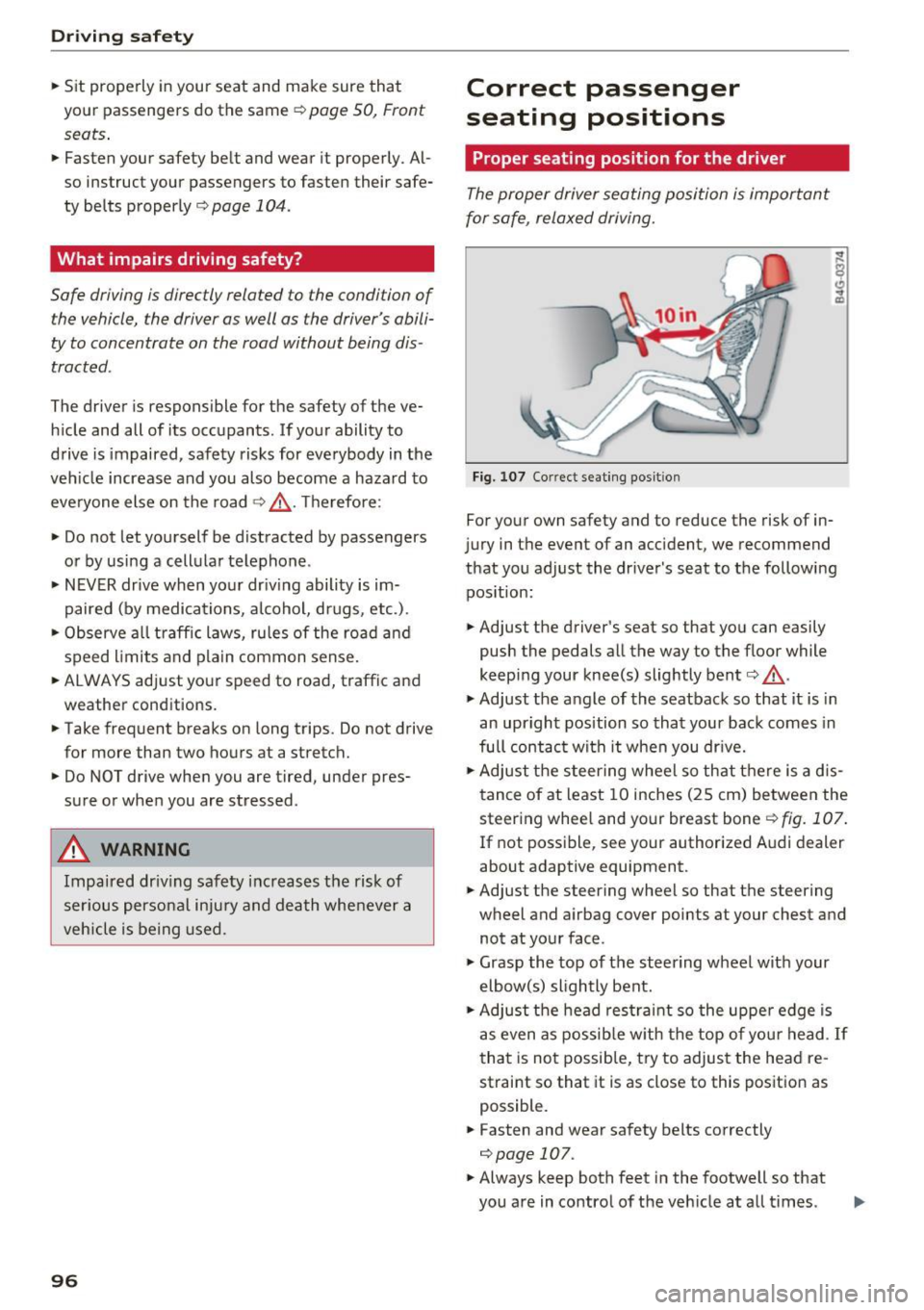
Fig. 107 Correct seating posit ion
For your own safety and to reduce the risk of in
jury in the event of an accident, we recommend
that you adjust the driver's seat to the following position:
• Adjust the driver's seat so that you can easily
push the pedals all the way to the floor while
keeping your knee(s) slightly bent
c:> .&, .
• Adjust the angle of the seatback so that it is in
an upright position so that your back comes in
full contact with it when you drive.
• Adjust the steering wheel so that there is a dis
tance of at least 10 inches (25 cm) between the
steering wheel and your breast boner::!)
fig. 107.
If not possible, see your authorized Audi dealer
about adaptive equipment.
• Adjust the steering wheel so that the steering
wheel and airbag cover points at your chest and
not at your face.
• Grasp the top of the steering wheel with your
elbow(s) slightly bent.
• Adjust the head restraint so the upper edge is
as even as possible with the top of your head .
If
that is not possible, try to adjust the head re
straint so that it is as close to this position as
possible.
• Fasten and wear safety belts correctly
c:>page 107.
• Always keep both feet in the footwell so that
you are in control of the veh icle at all times .
Page 106 of 252
Safety belt s
Safety belts
General information
Always wear safety belts!
Wearing safe ty belts correctly saves lives!
This chapte r explains why safety be lts a re neces
sary, how they work and how to adjust and wear
them correct ly.
.. Read all the information that follows and heed
all of the instructions and WARNINGS.
&_ WARNING
Not wea ring safety belts or wearing them im
properly increases the risk of ser ious personal
injury and dea th .
- Safety belts are the s ingle most effective
mea ns ava ilab le to reduce the risk of serious
injury and dea th in automob ile accidents .
For yo ur protect ion and that of your passe n
gers, alw ays co rre ctly wea r sa fety be lt s
when the veh icle is moving .
- Pregnant wom en, in ju re d, o r physically i m
paired persons mus t also use s afety be lts.
L ik e all vehi cle o ccu pants, they are mo re
li kely to be serio usly injure d if th ey do no t
wea r safety be lts. The best way to protect a
fetus is to protect the mothe r -th roughout
the ent ire pregnancy .
Number of seats
Your Audi has a total of five seating positions:
two in the front and three in the rear. Each seat
i n g position has a safety belt.
&_ WARNING
N ot wea ring safety bel ts or weari ng them im
properly increases th e r isk of ser ious personal
inju ry and dea th.
- N ever st rap more tha n one perso n, includ
ing small ch ildren, into a ny be lt .
It is espe
ci ally dan gerous to pla ce a sa fety bel t over a
c hild s itting on you r lap.
- N ever le t mo re people ride in t he vehicle
t h an t he re are saf ety bel ts availab le.
104
-Be sure everyone riding in the vehicle is
properly restrained with a separate safety
be lt or ch ild restraint.
Safety belt warning light
Your vehicle has a warning system for the driver
and front seat passenger to remind you about the importance of buckling-up.
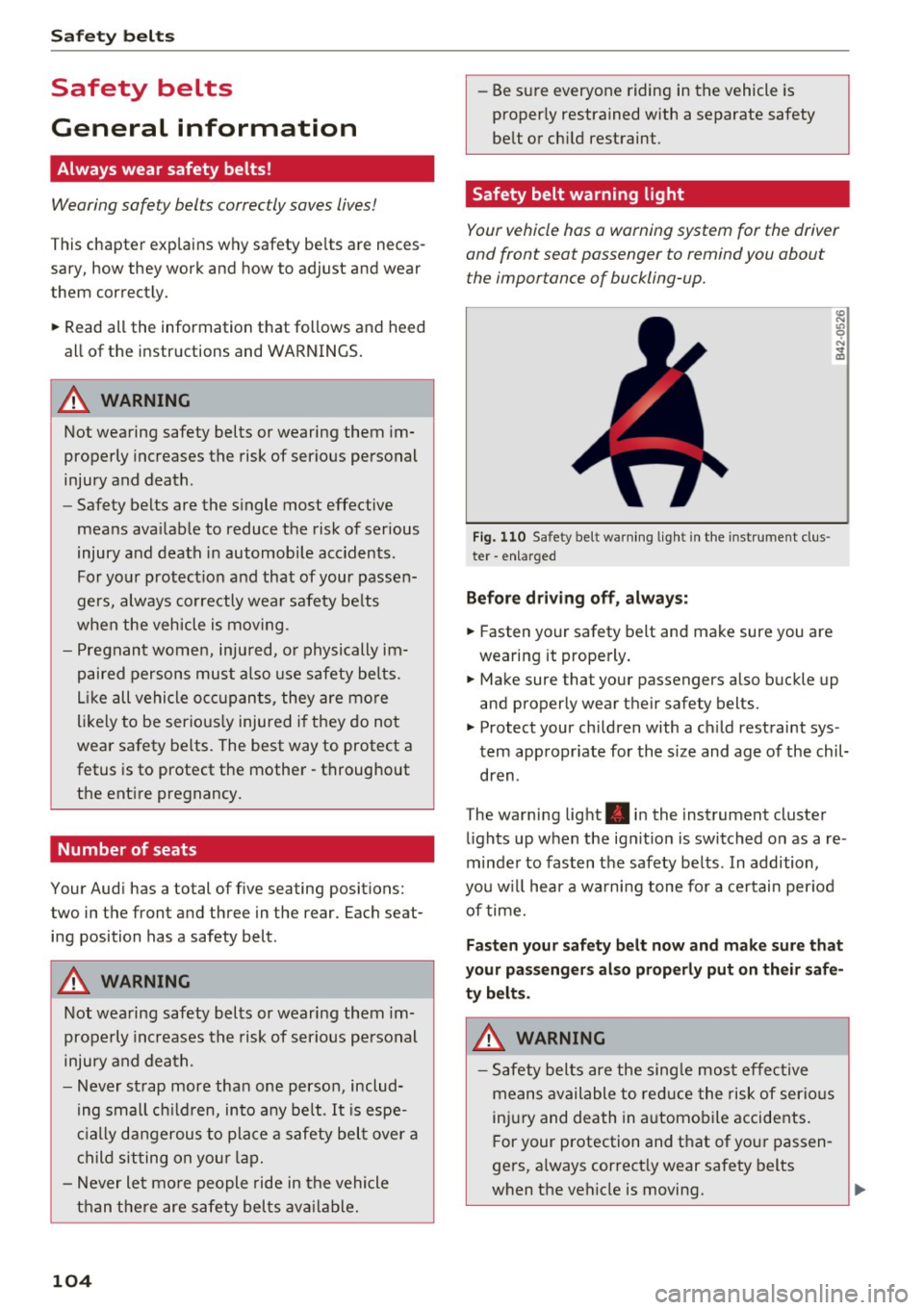
Fig . 11 0 Safety belt wa rning lig ht in th e in st ru ment clu s·
ter · enl arged
Before driving off , always:
.. Fasten yo ur safety belt and make sure you are
wearing it properly.
.. Ma ke sure that your passengers also b uck le up
and properly wear t heir safety belts.
.. Protect your chi ldren with a ch ild restraint sys
tem app ropr iate for the size and age of the chil
dren .
The wa rning lig ht . in the inst rument cluste r
li ghts up w hen the ig nition is switched on as a re
minde r to fas ten the safety be lts . In addition,
you w ill hear a wa rn in g tone for a ce rtain per iod
of time .
Fasten your safety belt now and make sure that
your passenger s also properly put on their safe
ty belt s.
&_ WARNING -
- Safety bel ts are the sing le mos t eff ec tive
means available to re du ce the risk of serio us
in jur y and dea th in a utomobile accidents.
F or your protection and t hat of yo ur passen
ge rs, a lways cor rect ly wear safety belts
when the vehicle is movin g.
Page 107 of 252
.... N
c:i ::J CX)
.... I.Cl U"I
N I.Cl ......
-Failure to pay attention to the warn ing light
that come on, could lead to persona l injury.
Why use safety belts?
Frontal collisions and the law of physics
Frontal crashes create very strong forces for peo
ple riding in vehicles .
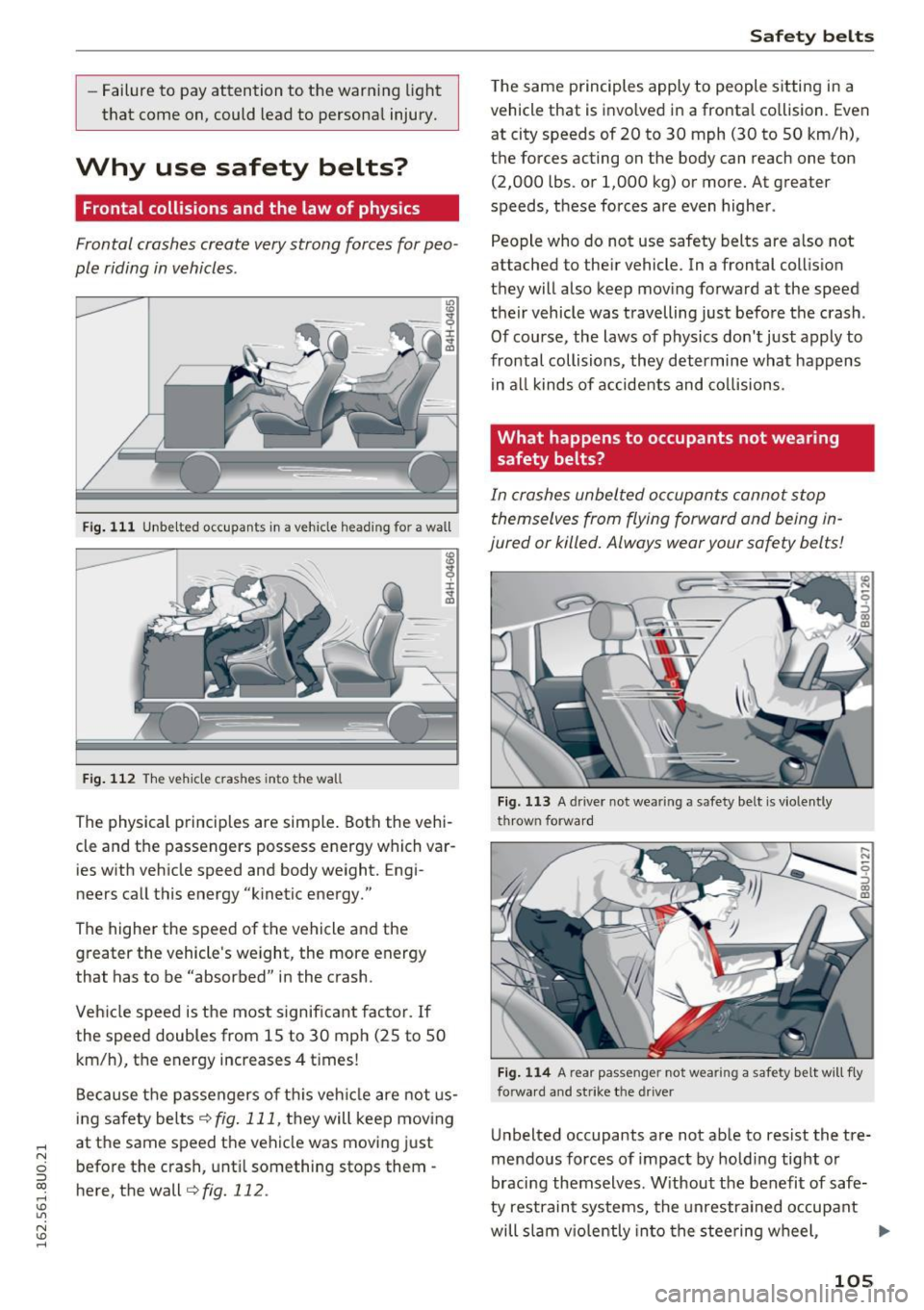
Fig. 111 Unbelted occupants in a vehicle heading for a wall
Fig. 112 The vehicle crashes into the wall
The physical principles are simple. Both the vehi
cle and the passengers possess energy which var ies with vehicle speed and body weight. Engi
neers call this energy "kinetic energy."
The higher the speed of the vehicle and the greater the vehicle's we ight, the more energy
that has to be "absorbed" in the crash.
Veh icle speed is the most significant factor. If
the speed doubles from 15 to 30 mph (25 to 50
km/h), the energy increases 4 t imes!
Because the passengers of this vehicle are not us
ing safety belts
¢fig. 111, they will keep moving
at the same speed the vehicle was moving just
before the crash, until something stops them -
here, the wall¢
fig. 112 .
Safety belts
The same p rinciples apply to people sitting in a
vehicle that is invo lved in a fronta l co llision. Even
at city speeds of 20 to 30 mph (30 to 50 km/h),
the forces acting on the body can reach one ton
(2,000 lbs. or 1,000 kg) or more. At greater
speeds, these forces are even higher.
People who do not use safety belts are a lso not
attached to the ir vehicle. In a frontal collis ion
they will also keep moving forward at the speed
their vehicle was travelling just before the crash .
Of course, the laws of physics don't just apply to
frontal collisions, they determine what happens in all kinds of accidents and collisions .
What happens to occupants not wea ring
safety belts?
In crashes unbelted occupants cannot stop
themselves from flying forward and being in
jured or killed. Always wear your safety belts!
Fig. 113 A driver not wearing a safety belt is violently
th row n forwar d
Fig. 114 A rear passe nger not wearing a safety belt will fly
forward a nd strike the driver
Unbelted occupants are not able to resist the tre
mendous forces of impact by holding tight or
bracing themselves . Without the benefit of safe
ty restraint systems, the unrestrained occupant
will slam viol ently into th e steering wheel, .,.
105
Page 110 of 252
Safe ty belts
Autom ati c s afet y belt retr actors
Every safety belt is equ ipped with an automa tic
be lt retractor on the shoulder belt. This feature
locks the belt when the belt is pulled out fast,
during hard braking and in a n accident. The belt
may a lso lock when you drive up or down a steep
hill or through a sharp curve. Dur ing normal driv
ing the belt lets you
move freely.
Safety belt p ret en sion ers
The safety belts are equipped with a belt preten
sioner that helps to t ighten the safety belt and
remove slack when the pretensioner is activated.
The function of the pretensioner is mon itored by
a warning light
r:::') page 16.
Convertib le loc king retracto r
Every safety be lt except the one on the driver
seat is equipped with a convertible locking retrac
tor that
mus t be used when the safety belt is
used to attach a child safety seat. Be sure to read
the impo rtant information about this feature
c:;,page 141.
.&_ WARNING
Imprope rly pos itioned safety be lts can cause
ser ious injury in an accident
¢page 108,
Safety belt position.
- Safety belts offer optimum protection only
when the seatback is upright and belts are
properly positioned on the body.
- Always make sure that the rear seat back
rest to which the center rea r safety belt is
attached is secure ly latched whenever the
rear center safety belt is being used. If the
backrest is not securely latched, the passen
ger will move forward with the backrest dur
ing sudden braking, in a sudden maneuver
and especially in a crash.
- Never attach the safety belt to the buckle for another seat. Attaching the belt to the
wrong buckle will reduce safety belt effec
tiveness and can cause serious persona l in
jury.
- A passenger who is not properly restrained can be seriously in jured by the safety be lt it
self when it moves from the stronger parts
108
of the body into critical areas like the abdo men.
- Always lock the convertible locking retractor
when you are securing a child safety seat in
the vehicle
¢page 143.
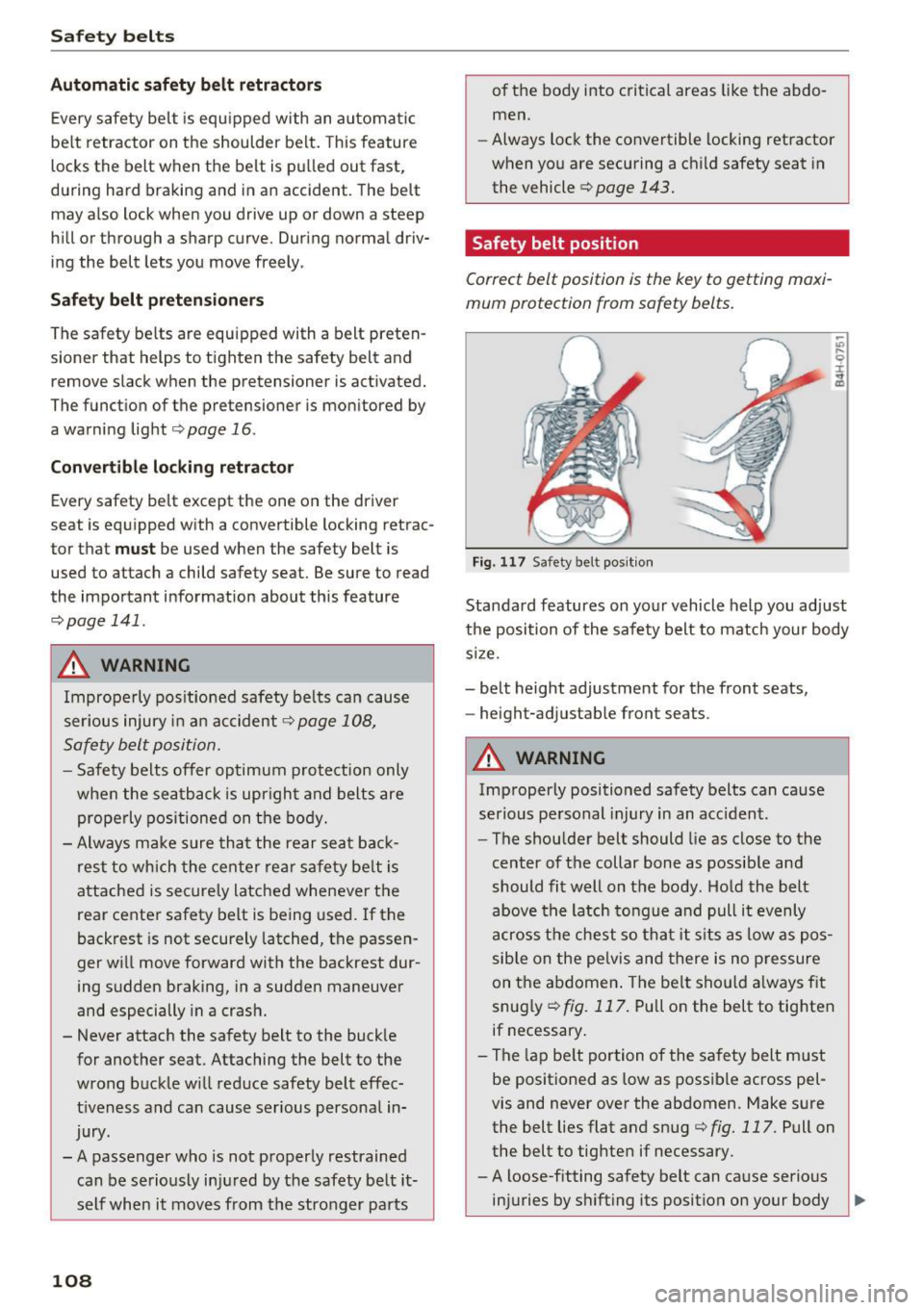
Safety belt position
Correct belt position is the key to getting maxi
mum protection from safety belts .
Fig. 117 Safety belt posit ion
-"' .... 9 I ... a,
Standard features on your vehicle help you adjust
the position of the safety belt to match your body
s ize.
- belt height adjustment for the front seats,
- height-adjustab le front seats.
.&_ WARNING
Improperly positioned safety belts can cause
serious pe rsonal injury in an acc ident .
- The shou lder belt should lie as close to the
center of the collar bone as possib le and
should fit well on the body. Hold the belt
above the latch tongue and pull it evenly
across t he chest so that it s its as low as pos
sib le on the pe lvis and there is no p re ssure
on the a bdomen . The belt sho uld a lways f it
snug ly
c:;, fig. 117. Pull on the belt to tig hten
if necessary .
- The lap be lt portion of the safety belt must
be positioned as low as possible across pel
vis and never
over the abdomen. Make sure
the belt lies flat and snug
c:;, fig. 117. Pull on
the belt to tighten if necessary.
- A loose-fitting safety belt can ca use serious
injuries by sh ifting its position on your body ..,_
Page 116 of 252
Airbag system
about children and Advanced Airbags
c:>page 132.
Even though your vehicle is equipped with an Ad
vanced Airbag System, make certain that all chil
dren, especially those 12 years and younger, al
ways ride in the back seat proper ly restrained for
their age and size. The airbag on the passenger
side makes the front seat a potentially dangerous place for a child to ride. The front seat is not the
safest place for a child in a forward-facing child
safety seat . It can be a very dangerous place for
an infant or a child in a rearward-fac ing seat.
The Advanced Airbag System in your veh icle has
been cert ified to comply with the requirements
of United States Federal Motor Vehicle Safety
Standard (FMVSS) 208, as well as Canada Motor
Veh icle Safety Standard (CMVSS) 208 as applica
b le at the time your vehicle was manufactured.
According to requirements, the front Advanced
Airbag System on the passenger side has been
certified for "suppression" for infants of about
12 month old and younger and for "low risk de
ployment" for children aged 3 to 6 years o ld (as
defined in the standard) .
The
PASSENGER AIR BAG OFF light in the instru
ment panel tells you when the front Advanced
Airbag on the passenger side has been turned off by the electronic control unit.
Each time you switch on the ignition, the
PAS
SENGER AIR BAG OFF
light will come on for a
few seconds and:
- will stay on if the front passenger seat is not
occupied,
-will stay on if there is a small chi ld or child re
straint on the front passenger seat,
- will go off if the front passenger seat is occu
pied by an adult as registered by the weight
sensing mat
c:> page 122, Monitoring the Ad
vanced Airbag System.
The PASSENGER AIR BAG OFF light comes on
when the control unit detects a tota l we ight on
the front passenger seat that requires the front
airbag to be turned off.
If the total weight on the front passenger seat is
more than that of a typical 1 year-old child but
114
less than the weight of a sma ll adult, the front
airbag on the passenger side can dep loy (the
PASSENGER AIR BAG OFF light does not come
on). If the
PASSENGER AIR BAG OFF light does
not come on, the front airbag on the passenger
s ide has not been turned off by the electron ic
control unit and can deploy if the control unit
senses an impact that meets the conditions stor
ed in its memory.
For example, the airbag may deploy if:
-a small ch ild that is heav ier than a typica l 1
year-old child is on the front passenger seat (regardless of whether the child is in one of the
child safety seats listed
c:> page 134), o r
- a child who has outgrown ch ild restraints is on
the front passenger seat.
If the front passenger airbag is turned off, the
PASSENGER AIR BAG OFF light comes on in the
i nstrument cluster and stays on.
The front airbag on the passenger side may
not
deploy (the PASSENGER AIR BAG OFF light does
not illuminate and stay lit) even if a small adult
or teenager, or a passenger who is not sitting up
right with their back against a non-reclined back
rest with the ir feet on the vehicle floor in front of
the seat is on the front passenger seat
c:> page 96, Proper seating position for the driver.
If the front passenger a irbag deploys, the Feder
al Standard requires the airbag to meet the "low
risk" deployment criteria to reduce the r isk of in
jury through interact ion w ith the airbag. "Low
risk" deployment occurs in those crashes that
take place a t lower decelerations as defined in
the e lectronic control unit
c:> page 122, PASSEN
GER AIR BAG OFF light.
Always remember, a child safety seat or infant
carrier installed on the front seat may be struck
and knocked out of position by the rapidly inflat
i ng passenger's airbag in a frontal collision . The
airbag could greatly reduce the effectiveness of
the child restraint and even seriously injure the
ch ild during inflation.
For this reason, and because the back seat is the
safest place for children -when proper ly restrain
ed according to their age and size -we strongly
Ill>
Page 117 of 252
recommend that children a lway s sit in t he b ack
seat ~
page 132, Child safety .
A WARNING
A child in a rearward-facing chi ld safety seat
installed on the front passen ger seat w ill be
seriously injured and can be killed if the front airbag inflates -even w it h an Advanced A irbag
System .
- The inflating a irbag w ill hit the child safety
seat or infant carrier with great force and
will smash the ch ild safety seat and chi ld
against t he backrest, center armrest, door
o r roof.
- Always install rear-facing child safety seats
on the rear seat.
- If you must i nstall a rearward fac ing ch ild
safety seat on t he front passenger seat be
cause of exceptiona l circumstances and the
PASSENGER AIR BAG OFF light does not
come on and stay on, immed iate ly install
the rear-fac ing ch ild safety seat in a rear
seating posit ion and have the airbag system
inspected by your a uthorized Audi dea ler.
- Forward-fac ing ch ild safety seats installed
on the front passenger's seat may interfere
with the deployment of the airbag and cause serious personal in jury to the child.
A WARNING
If, in except ional circumstances, you must in
stall a forward-facing chi ld restraint on the
front passenger's seat:
- Always make sure the forward-fac ing seat
has been designed and ce rtified by its man
ufacturer fo r use on a fron t seat with a pas
senger front and s ide a irbag.
- Never put the forward-facing child restraint
up against or ve ry near the instrument pan
el.
- Always move the passenger seat into its
rea rmost position in t he seat's fore and aft
adjus tme nt range, as f ar away from the ai r
bag as possib le befo re instal ling the for
wa rd -f acing child restra int . T he backrest
must be adjusted to an upright position .
Airbag sys tem
-Make sure that the PASSENGER AIR BAG
OFF
li ght comes on and stays on a ll the time
whenever the ignit ion is switched on.
A WARNING
To reduce the risk of serious injury, make sure
that the
PASSENGER AIR BAG OFF li ght will
be d isplayed whenever a child rest raint is in
stalled on the front passenger seat and the i gnition is switched on.
- If the PASSENGER AIR BAG OFF light does
not stay on, pe rform t he checks desc ribed
c> page 122, Monitoring the Advan ced Air
bag System.
- T ake the child restra int off t he front passen
ge r seat and install it prope rly at one of the
rear sea t positions i f the
PASSENGER AIR
BAG OFF
light does no t stay on .
- Have the ai rbag system inspec ted by your
author ized Audi dealer immed iate ly .
- Always carefully f ollow ins truc tions from
chi ld restrain t manufacturers when instal
ling child restra ints .
A WARNING ~ -If, in exceptional ci rcumstances, you must in -
stall a forward or rearward-facing child re
stra int on the front passenger's seat:
- Imp roper installation of child restrai nts can
reduce the ir effectiveness or even prevent
them from providing any protection.
- An imprope rly installed child restra int can
inter fere with the airbag as it deploys and
serio usly injure or even kill the chi ld -even
with an Advanced A irbag System.
- Always care fully follow the manufacturer's
instr uctions provided with the child safety
seat or carr ier.
- Never p lace add itiona l items on the seat
that can increase t he total weight registered
by the weight-sensi ng mat and can cause in
jury in a crash.
115
Page 119 of 252
Advanced front airbag system
Your vehicle is equipped with a front Advanced
Airbag System in compliance with Un ited States
F edera l Motor Vehicle Safety Standard 208, as
well as Canada Motor Vehicle Safety Standard
(CMVSS) 208 as applicable at the time your vehi
cle was manufactured .
The front Advanced Airbag System supp lements
the safety belts to provide additional protection
for the driver's and front passenger's heads and upper bodies in frontal crashes . The airbags in
f late only in frontal impacts when the veh icle de
celeration is high enough.
The front Advanced Airbag System for the front
seat occupants is not a substitute for your safety be lts . Rather, it is part of the overall occupant re
stra int system in your vehicle. Always remember
that the airbag system can on ly help to protect
you, if you are sitting upr ight, wear ing your safe
ty belt and wear ing it prope rly. This is why you
and your passengers must always be prope rly re
stra ined, not just beca use the law req uires yo u to
be .
The Advanced Airbag System in your veh icle has
been ce rtified to meet the "low r is k" requi re
ments fo r 3 and 6 ye ar-old children o n the pas
senger side and very sma ll adults on the drive r
side . The low risk dep loyment criteria are intend
ed to help reduce the risk of injury through inter
action with the front a irbag that can occur, for
examp le, by being too close to the steering wheel
and instrument panel when the airbag inflates .
In addition, the system has been certified to
comp ly with the "suppression" requirements of
the Safety Standard, to turn off the front a irbag
for i nfants 12 months old and younger who are
restrained on the front passenger seat in child re
stra ints that are listed in the Standa rd
¢ page 134, Child restraints and Advanced Air
bags.
"Suppress ion" requ ires the front a irbag on the
passenger side to be turned off if:
- a ch ild up to about one year of age is restra ined
on the front passenger seat in one of the rear
facing or forward-fac ing infant restra ints listed
Airb ag sys tem
in Federal Motor Veh icle Safety Standard 208
with which the Advanced Airbag System in your
veh icle was certif ied. For a List ing of the child
restraints that were used to certify your vehi
cle's compliance with the US Safety Standard
¢page 134,
-weight less than a threshold level stored in the
control un it is detected on the front passenger
seat .
When a person is detected on the front passen ger seat, weighing more than the total weight of
a chi ld that is about
1 year old restra ined in one
of the rear-facing or forward-fac ing infant re
straints (listed in Federal Motor Veh icle Safety
Standard 208 with w hich the Advanced A irbag
System in your veh icle was certified), the front
airbag on the passenge r side may o r may not de
ploy .
T he
PAS SENGER AIR BAG OFF lig ht comes o n
whe n the elect ronic control uni t detects a tota l
weight on the fron t passenger sea t th at req uires
the front airbag to be turned off . If the
PASSEN
GER AIR BAG OFF
light does not come on, the
front airbag on the passenger side has not been
turned off by the control unit and can dep loy if
the control unit senses an impact that meets the
condit ions stored in its memory .
If the total weight on the front passenger seat is
more than that of a typica l 1 year-old, but less
than the weight of a small adult, the front airbag
o n the passenger s ide may deploy (the
PAS SEN
GER AIR BAG OFF
light does not come on) .
For example , the ai rb ag may deploy if :
- a small chi ld that is heav ier than a typ ica l 1
yea r-o ld child is on the front passenger seat
(regard less of whether the child is in one of the
child safety seats listed
¢ page 134),
- a child who has outgrown c hild restraints is on
the front passenger seat.
If the front passenge r a irbag is t urned off, the
PASSENGER AIR BAG OFF light in the center of
the instrument pane l wi ll come on and stay on .
T he front airbag on the passenger side m ay
not
deploy (the PASSENGER AIR BAG OFF light does
not illuminate and stay lit) if: ..,.
117
Page 120 of 252
Airbag syste m
-a small adu lt or teenager is on the front pas
senger seat
- a passenger who is not sitting upright with
their back against a non -reclined backrest with
their feet on the vehicle floor in front of the
seat is on the front passenger seat.
I f the front passenger airbag dep loys, the Feder
al Standard requires the airbag to meet the "low
risk" deployment criteria to help reduce the risk
of injury through interaction with the airbag.
"Low risk" deployment occurs in those crashes
that take place at lower decelerations as def ined
in the electronic control unit.¢
page 122
Alway s remember: Even though your vehicle is
equ ipped w ith Advanced Airbags, the safest place
for children is properly restrained on the back
seat . Please be sure to read the important infor
mat ion in the sections that follow and be sure to
heed a ll of the WARN INGS.
A WARNING
To red uce the risk of inj ury when an ai rbag in
fla tes, a lways wear safety bel ts p roperly.
- If you are unrestrained, leaning fo rwa rd, s it
t ing s ideways or o ut of pos ition in any way,
yo ur risk of in jury is much h igher .
- Yo u will also re ceive serious injur ies and
could even be killed if you are up aga inst the
airbag or too close to it when it inflates -
even with an Advanced Airbag
¢page 112.
A WARNING
A child in a rearward-facing chi ld safety seat
installed on the front passenger seat wi ll be
ser iously injured and can be killed if the front
airbag inflates - even w ith an Advanced Airbag
System.
- Although the Advanced A irbag System in
your vehicle is designed to turn off the front
airbag when a rearward-facing child re
straint has been installed on the front pas
senger seat, nobody can absolutely g uaran
tee that deployment is impossible in all con
ceivable s ituations that may happen during
the useful life of your vehicle .
- The inflating a irbag w il l hit the child safety
seat or infant c arrier with great force and
118
w ill smash the child safety seat and child
aga inst the back rest, center armrest, door,
or roof.
- Always install rearward-facing child re
straints in the back seat.
- If you must install a rearward facing child
safety seat on the front passenger seat be
cause of exceptional circumstances and the
PASSENGER AIR BAG OFF light does not
come on and stay on, immediately install
the rea r-facing child safety seat in a rear
seating posi tion and have the ai rbag system
inspected by your au thori zed Au di dealer.
A WARNING
If, in exceptional ci rcums tances, you must in
stall a forward-facing child res traint on the
front passenger's seat:
- Always make sure the forward-fa cing sea t
has been des igned and certified by its man
ufacturer for use on a front seat with a pas
senger front and side airbag.
- Never put the fo rward -facing child restraint
up against or very nea r the instrument pan ·
el.
-Always move the passenge r seat into its
rearmost position in the seat's fo re and aft
ad justment range, as far away from the a ir
bag as poss ible, before install ing the for
ward-facing chi ld restraint. The backrest
m ust be adjusted to an upr ight position.
- Make sure that the
PASSENGER AIR BAG
OFF
li ght comes on and stays on all t he time
wheneve r the ign it ion is switched on.
Advanced Airbag System components
The fro nt passenge r seat i n your veh icle has a lot
of ve ry important parts of the Advanced A irbag
System i n it. These parts incl ude t he weight
sens ing mat, senso rs, wir ing, bracke ts, and
more . The f unction o f the system in the front
passenger seat is checked by the electro nic con
tro l unit when the ignition is on . The control unit
monitors the Advanced Airbag System and turns
the airbag ind icator light on when a malfunction
i n the system components is detected. The func-
tion of the a irbag ind icator light is described in .,_