warning AUDI Q3 2016 Owners Manual
[x] Cancel search | Manufacturer: AUDI, Model Year: 2016, Model line: Q3, Model: AUDI Q3 2016Pages: 252, PDF Size: 62.81 MB
Page 126 of 252
Airbag syste m
-the adu lt on the front passenger seat is proper
ly seated on the center of the seat cushion with
his or her back up against the backrest and the
backrest is not reclined
c> page 96, Correct pas
senger seating positions,
- the adult is not taking weight off the seat by
holding on to the passenger assist handle
above the front passenger door or supporting
their we ight on the armrest,
- the safety belt is being properly worn and that
there is not a lot of slack in the safety belt web
bing,
- accessory seat covers or cushions or other
th ings that may cause an incorrect read ing or
impression on the weight-sensing mat under
the upho lstery of the seat have been removed
from the front passenge r seat,
- a safety be lt extender has not been left in the
safety belt latch for the front passenge r seat.
In addition to the
PA SSE NGER AIR BA G OFF
lig ht in the center of the instrument panel, the
message
PASSENGER AIR BAG OFF or PASSEN
GER AIR BAG ON
w ill briefly appear in the inst ru
ment cluster display . T his is to inform the driver
of the current front passenger airbag status.
Important safety instructions on
monitoring the Advanced Airbag System
A WARNING
An airbag system that is not funct ion ing prop
er ly cannot p rovide supplemental p rotection
in a frontal crash.
- If the airbag indicato r light
c>page 16
comes when the vehicle is be ing used, h ave
the system inspected immediate ly by yo ur
authorized Audi dealer. It is possible that
the airbag will inflate when it is not s up
posed to, or will not inflate when it should.
A WARNING
If the front airbag inflates, a child without a
child restraint, in a rearward-facing child safe
ty seat or in a forward-facing child restra int
that has not been properly installed w ill be
ser iously injured and can be killed .
124
-Even tho ugh your vehicle is equipped with
an Advanced A irbag System, make certain
that a ll children, espec ia lly 12 years and
younger, always ride on the back seat prop
erly restrained for their age and s ize.
- Always install forward or rear-facing child
safety seats on the rear seat - even with an
Advanced A irbag System.
- If you must install a rearward-facing child
safety seat on the front passenger seat be
cause of exceptional circumstances and the
PASSENGER AIR BAG OFF light does not
appear and s tay on, immedi ately ins tall the
rear-facing child safety seat in a re ar seat ing
position and have the a irbag system in
spected by your authorized Audi dea ler.
- A t ight tether or other s trap on a rearward
facing chi ld restraint attached to the front
passenger seat can put too much pressure
on the weight-sensing mat in the seat and
register more weight than is actually on the
seat. The heavier weight registered can
make the system work as thoug h an adu lt
were on the seat and deploy the Advanced
Airbag when it must be suppressed causing
serious or even f atal injury to the child.
- If, in exceptional circumstances, you must
install a forward-facing child res traint on
the front p assenge r seat, always move the
seat into i ts rearmost position in the sea t's
fore and aft ad justment range, as far away
from the ai rbag as possible . The backrest
must be adjusted to an upr ight position.
Make sure that the
PASSENGER AIR BAG
OFF
li ght comes on and stays on all the time
wheneve r the ignit ion is switched on.
A WARNING
- If the PASSENG ER AIR BAG OFF light does
not go out when an adult is sitting on the
front passenger seat afte r taking the steps
described above, make s ure the adult is
p roper ly sea ted and restra ined at one o f the
rear sea ting posit ions .
- Have the ai rbag system inspected by your
author ized Audi dealer befo re t ransporting
anyone on the front passenger seat.
Page 127 of 252
(D Tips
If the weight-sensing mat in the front passen
ger seat detects an empty seat, the front air
bag on the passenger side will be turned off,
and
P ASS ENGER AIR B AG OFF will stay on.
Repair , care and disposal of the airbags
Parts of the a irbag system are installed at many
d ifferent p laces on your Aud i. Installing, remov
ing, servicing o r repa iring a part in an area of the
vehicle can damage a pa rt of an airbag system
and prevent that system from working properly in a co llision.
There are some importa nt things you have to
know to make sure that the effectiveness of the
system w ill not be impaired and that discarded
components do not cause injury or pollute the
environment.
A WARNING
Improper care, serv icing and repair proce
dures can increase the r isk of personal injury
and death by preventing an airbag from de
ploying when needed or deploying an airbag
unexpectedly :
-
-Never cover, obstruct, or change the steer
ing wheel horn pad or a irbag cover or the in
strument panel or mod ify them in any way .
- Never attach any objects such as cupholders
or telephone mountings to the surfaces cov
er ing the airbag units .
- For cleaning the horn pad or instrument panel, use only a soft, dry cloth or one mois
tened with plain water. Solvents or cleaners
cou ld damage the a irbag cover or change
the stiffness or strength of the mater ial so
that the airbag cannot dep loy and protect
properly.
- Never repair, adjust, or change any parts of
the airbag system.
- All work on the stee ring wheel, instr ument
pane l, front seats or electrical system (in
cluding the installation of audio equipment,
cellu lar telephones and CB radios, etc .)
must be performed by a qualified technician
Airb ag sys tem
who has the training and special equ ipment
necessary.
- For any wo rk on the airbag system, we
strong ly recommend that you see your au
thorized Audi dealer or qualified workshop .
- Never modify the front bumper or parts of
the vehicle body.
- Always make sure that the side a irbag can
inflate without interference:
- Never install seat covers or replacement
upholstery ove r the front seatbacks that
have not been specifica lly approved by
Audi .
- Never use addi tional seat cushions that
cove r the areas where the side airbags in
flate.
- Damage to the orig inal seat cove rs or to
the seam in the area of the s ide airbag
module must a lways be repaired immedi
ate ly by an authorized Aud i dealer.
- The airbag system can be activated only
once . A fter an airbag has inflated, it must
be replaced by an authorized Audi dealer or
qualified technic ian who has the technical
information, training and spec ial equ ipment
necessary.
- The airbag system can be deployed only
once . After an airbag has been deployed, it
must be replaced with new rep lacement
parts des igned and approved especially for
your Aud i model version. Replacement of
comp lete airbag systems or airbag compo
nents must be performed by qualified work
shops only. Ma ke sure that any airbag serv
ice act ion is en tered in your Aud i Wa rranty
& Maintenance booklet under AIRBAG RE
PLACEMENT RECORD.
@ For the sake of the environment
Un deployed airbag modules and p retension-
ers might be classif ied as Perchlorate Materi -
al -special handling may apply, see
www.dtsc .ca.gov/hazardouswaste/perchlo-
rate . When the vehicle or parts of the re-
straint system including airbag modu les safe-
ty belts with pretensioners are scrapped, all
applicable laws and regu lations must be ob
se rved. Your authorized Audi dealer is familiar .,.
125
Page 128 of 252
Airbag syste m
with these requirements and we recommend
that you have your dealer perform this service
for you.
Other things that can affect Advanced
Airbag performance
Changing the vehicle's suspension system can
change the way that the Advanced Airbag System
performs in a crash. For examp le, using t ire-r im
comb inat ions not approved by Audi, lower ing the
veh icle, changing the stiffness of the suspens ion,
including the springs, suspension struts, shock
absorbers etc . can change the forces that are
measured by the airbag sensors and sent to the
electronic control unit. Some suspension changes
can, for example, increase the force levels meas
ured by the sensors and make the airbag system
deploy in crashes in wh ich it would not deploy if
the changes had not been made. Other kinds of
changes may reduce the force levels meas ured by
the sensors and prevent the airbag from deploy ing when it should.
A WARNING
Changing the vehicle's suspension including
use of unapproved tire-rim combinations can
change Advanced Airbag performance and in
crease the risk of serious personal injury in a
crash.
- Never install suspension components that
do not have the same performance charac
teristics as the components originally instal
led o n your veh icle .
- Never use tire-rim comb inations that have
not been approved by Audi.
A WARNING
Items stored between the safety belt buckle
and the center console can cause the senso rs
in the buckle to send the wrong info rmation
to the electronic control module and prevent
t he Advanced Airbag System from wor king
properly.
- Always make sure tha t noth ing can interfere
with the safety be lt buck les and that they
are not obstructed.
126
Side airbags
Description of side airbags
The airbag system can provide supplemental
protection to properly restrained occupants .
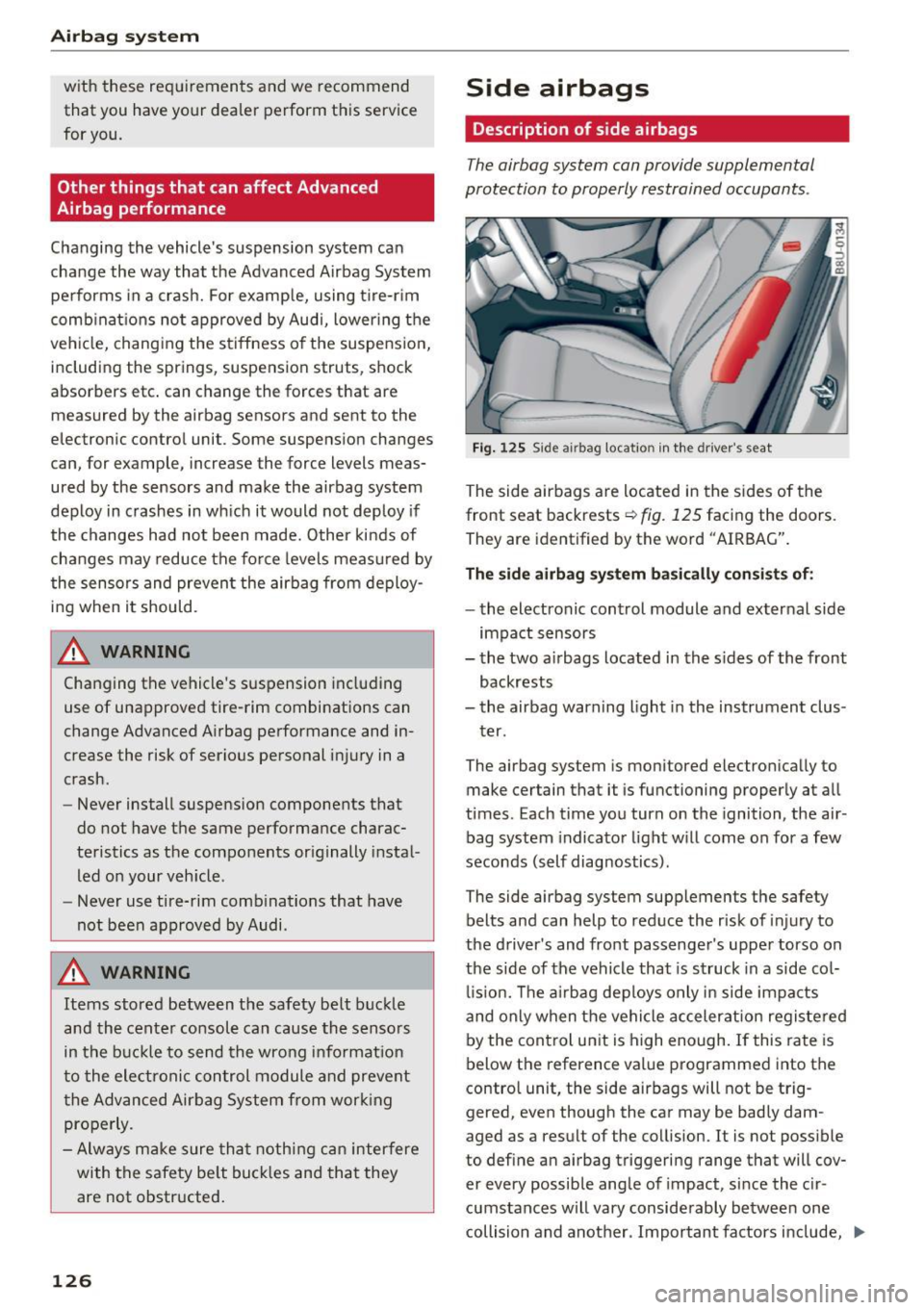
Fig. 125 S ide a irbag locat io n in the driver's seat
The side airbags are located in the sides of the
front seat backrests ¢
fig. 125 facing the doors.
They are identified by the word "AIRBAG".
The sid e airbag system ba sically con sis t s o f:
- the electronic control module and external side
impact sensors
- the two a irbags located in the s ides of the front
backrests
- the airbag warning light in the instrument clus -
ter.
The airbag system is monitored electronica lly to
make certain that it is functioning properly at a ll
t imes. Each time you turn on the ignition, the air
bag system indicator light w ill come on for a few
seconds (self diagnostics) .
The side airbag system supplements the safety belts and can help to reduce the risk of injury to
the driver's and front passenger's upper torso on
the side of the vehicle that is struck in a side co l
li sion. The a irbag deploys only in side impacts
and only when the vehicle acceleration registered by the control unit is high enough. If this rate is
below the reference val ue programmed into the
contro l unit, the side airbags will not be trig-
gered, even though the car may be badly dam-
aged as a result of the collision. It is not possible
to define an airbag triggering range that will cov er every possible angle of impact, si nce the c ir
cumstances w ill vary conside rably between one
collision and another . Important factors include, .,,.
Page 129 of 252
.... N
c:i ::J CX)
.... I.Cl U"I
N I.Cl ......
for example, the nature (hard or soft) of the im
pacting object, the angle of impact, vehicle
speed, etc.
¢ page 128, Important safety in
structions on the side airbag system.
Aside from their normal safety function, safety
be lts work to he lp keep the driver or front pas
senger in posit ion in the event of a side collision
so that the side airbags can provide protection.
The airbag system is
not a substitute for your
safety belt. Rather, it is part of the overall occu
pant restraint system in your veh icle. Always re
member that the side airbag system can only
help to protect you if you are wearing your safety
belt and wearing it properly . This is another rea
son why you should always wear your safety be lts, not just because the law requires you to do
so
¢ page 104, General information.
It is important to remember that while the sup
p lem ental side airbag system is designed to re
duce the likelihood of serious injur ies, other inju
ries , fo r example, swell ing, bruising, and minor
abrasions can also be associated with deployed
side airbags. Remember too, side airbags wi ll de
ploy only once and only in certain kinds of acci
dents· your safety belts are always there to offer
protection.
Vehicle damage, repair costs or even the lack of
ve hicl e damage are not necessarily an indication
of over-sensitive or failed airbag activation. In
some col lisions, both front and side a irbags may
inflate. Remember too, that airbags will deploy
only once and only in certain kinds of coll isions -
your safety belts are always there to offer protec ·
tion in those acc idents in which a irbags are not
supposed to deploy or when they have already
deployed.
The side airbag system will not deploy:
-when the ign ition is turned off
- in side collisions when the acceleration meas-
ured by the sensor is too low
- in front-end collisions
- in rear-end collisions
- in rollovers.
Airbag system
In some types of accidents the front airbags, side
curtain airbags and side airbags may be triggered
together.
A WARNING
=
- Safety belts and the airbag system will only
provide protection when occupants are in
the proper seat ing pos ition¢
page 128.
- If the airbag ind icator light Q page 16
comes when the veh icle is being used, have
the system inspected immediately by your
author ized Audi dealer. It is possible that
the airbag will inflate when it is not sup
posed to, or will not inflate when it should.
How supplemental side airbags work
Side airbags deploy instantly and can help re·
duce the risk of upper torso injuries for occu
pants who are properly restrained.
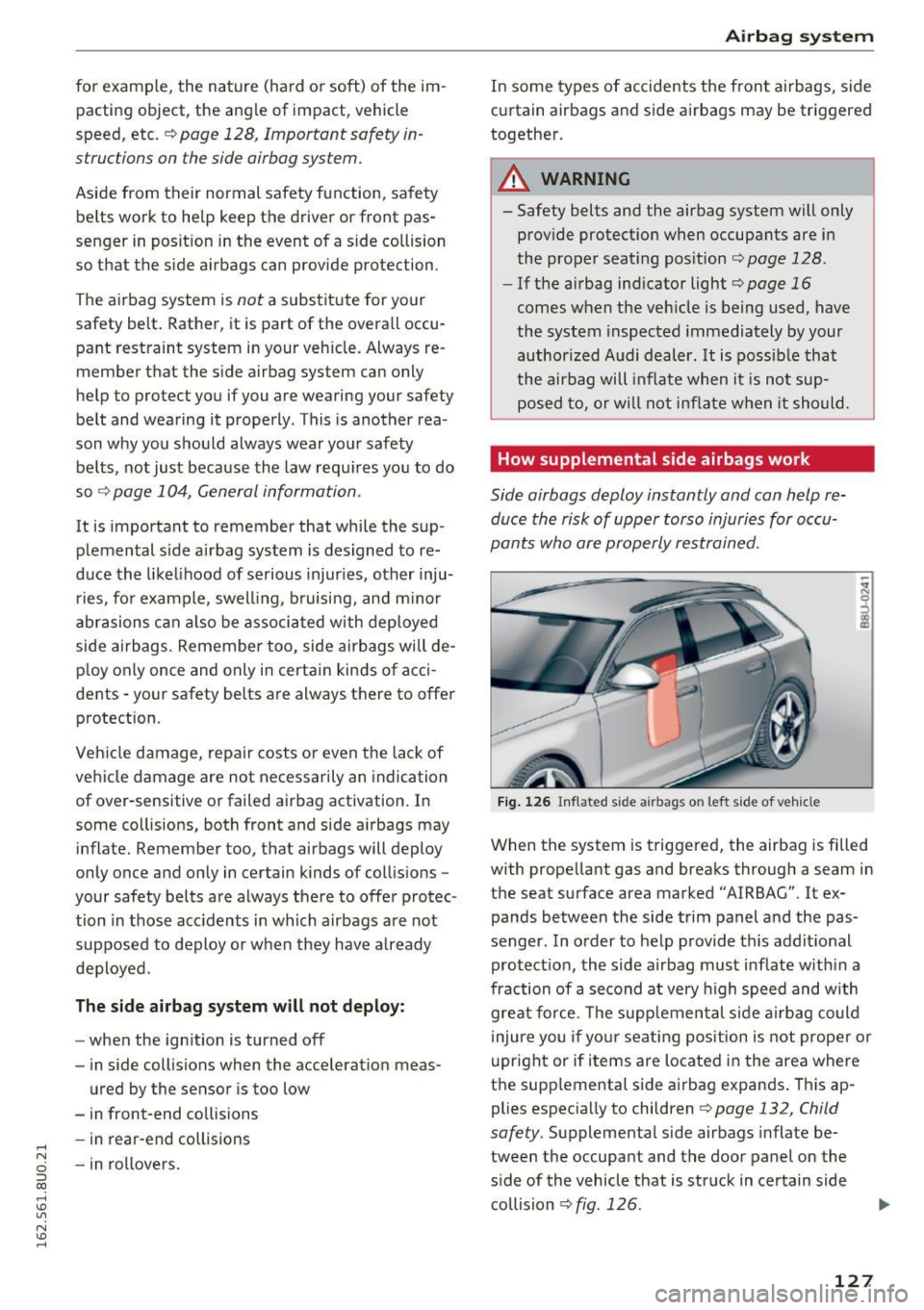
Fig. 126 Inflated side a irbags on left side of vehicle
When the system is triggered, the airbag is filled
with propellant gas and breaks through a seam in
the seat surface area marked "AIRB AG". It ex
pands between the side trim panel and the pas·
senger . In order to help provide this addit ional
protect ion, the side airbag must inflate w ith in a
fraction of a second at very high speed and with
great force. Th e supplemental side airbag could
injure you if you r seating position is not proper or
upright or if items are located in the area where
the supp lemental side a irbag expands. This ap
plies especially to children¢
page 132, Child
safety.
Supplemental side airbags inflate be
tween the occupant and the door panel on the
s ide of the vehicle that is struck in certain side
collision ¢
fig. 126. .,.
127
Page 130 of 252
Airbag syste m
Although they are not a soft pillow, they can
"cushion" the impact and in this way they can
he lp to reduce the risk of injury to the upper part
of the body.
A fine dust may develop when the airbag deploys.
This is normal and does not mean there is a fire in the vehicle.
Important safety instructions on the side
airbag system
Airbags are only supplemental restraints. Always
properly wear safety belts and ride in a proper
seating position.
There is a lot that you and your passengers must
know and act accordingly to help the safety belts
and a irbags do the ir job to provide supplemental
protection .
A WARNING
An inflating side airbag can cause ser ious or
fatal injury. Improperly wea ring safety belts
and improper seating positions increase the
r is k of serious personal injury and death
whenever a vehicle is being used.
- In order to red uce the risk of injury when
the supplemental side airbag inflates :
- Always sit in an upright position and never
lean aga inst the area where the supple-
mental side airbag is located.
- Never let a chi ld or anyone else rest the ir
head against the side trim panel in the
area where the supplemental s ide a irbag
inflates.
- Always make sure that safety belts are
worn correctly,
- Do not let anyone sitting in the front seat
put their hand or any other parts of t he ir
body out of the window.
- Always make sure that the side airbag can
inflate without interference.
- Never install seat covers o r rep lacemen t
upho lstery over the front seatbacks that
have not been specifically approved by
Aud i.
128
- Never use additional seat c ushions that
cover the areas where the side airbags de
ploy.
- Damage to the orig inal seat covers or to
the seam in the area of the s ide airbag
module must a lways be repaired immedi
ate ly by an autho rized Aud i dealer .
- Objects between you and the airbag can in
crease the r isk of injury in an acc ident by in
terfering with the way the airbag unfolds or
by being pushed into you as the airbag in
flates.
- Never place or attach accessor ies or other
ob jects (s uch as c upholders, telephone
brackets, or even large, b ulky objects) on
the doors, over or near the area marked "AIRBAG" on the seat backrests.
- Such objects and accessories can become
dangero us projecti les and cause injury
when the supplemental side airbag de ploys.
- Never carry any objects or pets in the de
ployment space between them and the
airbags or allow children or other passe n
gers to trave l in this position .
- Always use the b uilt-in coat hooks only fo r
lightweight clo thing. Never leave any heavy
or sharp-edged objec ts in the po ckets that
may i nterfere wi th s ide airb ag deployment
and can cause persona l injury in an accident.
- Always prevent the side ai rbags from being
damaged by heavy objec ts knocking against
or hit ting the sides of the seatbacks.
- The a irb ag sys tem can only be triggere d
once. If the airbag has been triggered, the
system must be replaced by an authorized
Audi dea lership .
- Damage (cracks, deep scratches etc.) to the
original seat covers or to the seam in the
area of the side airbag module must always
be repaired immediately by an authorized
Aud i dea ler .
- If ch ildren are seated improperly, their risk
of injury increases in the case of an accident
c::;, page 132, Child safety.
- Never attempt to mod ify any components of
the airbag system in any way.
Page 132 of 252
Airbag system
The side curtain airbag system basically
consists of:
- The electronic control module and external side
impact sensors
- The side curta in airbags above the front and
rear side windows with ejection mitigation fea
tures
- The airbag indicator light in the instrument
panel
The airbag system is monitored electronically to
make certain it is functioning properly at all
times. Each time you turn on the ignition, the air
bag system indicator light will come on for a few
seconds (self diagnostics).
The side curtain airbag is not activated:
-if the ignition is turned off,
-in side collisions when the acceleration meas-
ured by the sensor is too low,
- in rear-end collisions.
,&. WARNING
-Safety belts and the airbag system will only
provide protection when occupants are in
the proper seating position
¢ page 50,
Front seats.
-If the airbag indicator light ¢page 16
comes when the vehicle is being used, have
the system inspected immediately by your
authorized Audi dealer . It is possible that
the airbag will inflate when it is not sup
posed to, or will not inflate when it should.
130
How side curtain airbags work
Side curtain airbags can work together with side
airbags to help reduce the risk of head and upper
torso injuries for occupants who are properly re
strained.
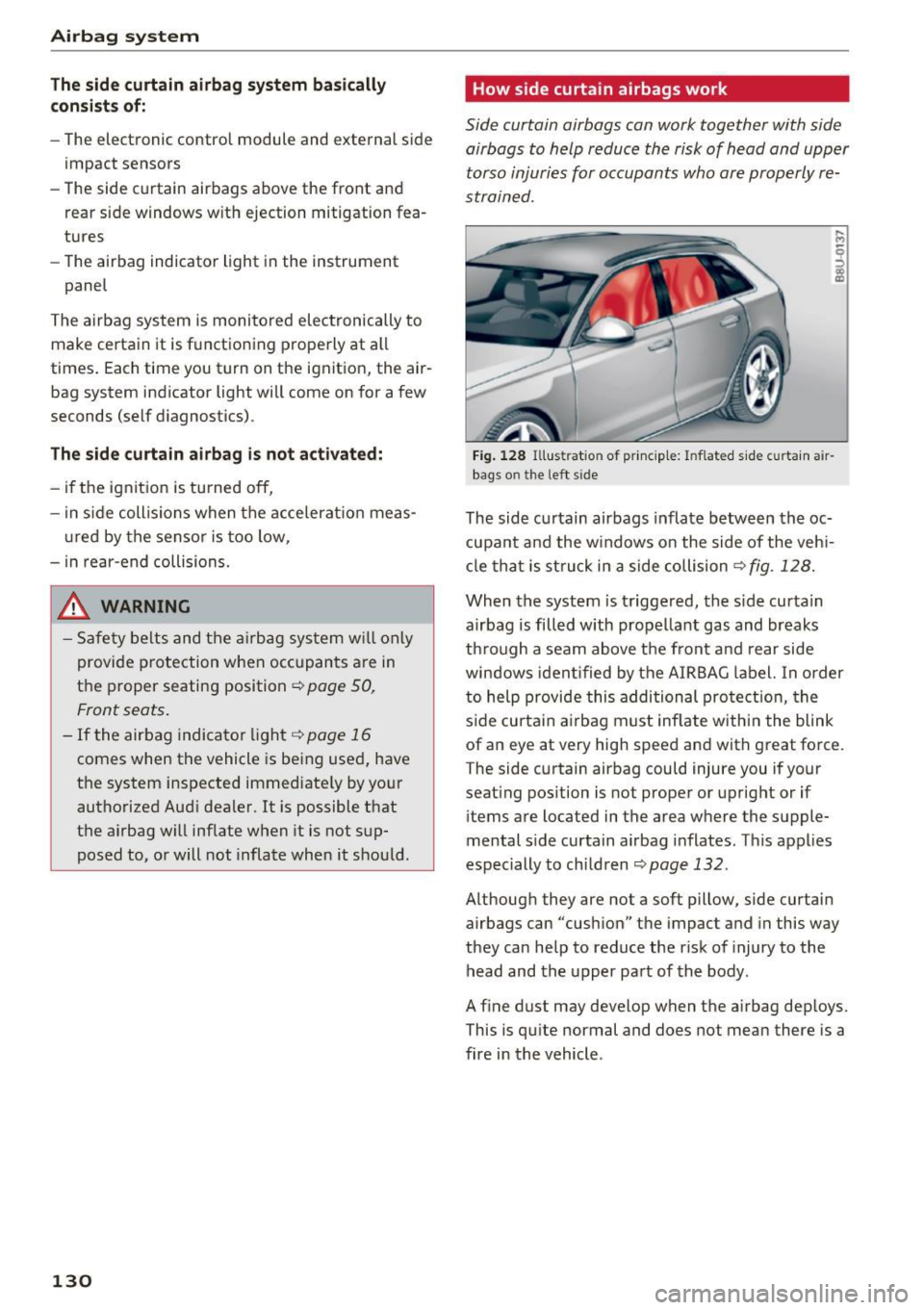
Fig. 128 Illus tratio n of principle: I nflated side curtain a ir
bag s on t he left s ide
The side curtain airbags inflate between the oc
cupant and the windows on the side of the vehi
cle that is struck in a side collision
~ fig. 128.
When the system is triggered, the side curtain
airbag is filled with propellant gas and breaks
through a seam above the front and rear side
windows identified by the AIRBAG label. In order
to help provide this additional protection, the
side curtain airbag must inflate within the blink
of an eye at very high speed and with great force.
The side curtain airbag could injure you if your
seating position is not proper or upright or if
items are located in the area where the supple
mental side curtain airbag inflates. This applies
especially to children~
page 132.
Although they are not a soft pillow, side curtain
airbags can "cushion" the impact and in this way
they can help to reduce the risk of injury to the
head and the upper part of the body.
A fine dust may develop when the airbag deploys .
This is quite normal and does not mean there is a
fire in the vehicle .
Page 133 of 252
Important safety instructions on the side
curtain airbag system
Airbags are only supplemental restraints. Always
properly wear safety belts and ride in a proper
seating position.
There is a lot that you and your passengers must
know and do to help the safety belts and airbags
do their job to provide supplemental protection.
_& WARNING
-
Improperly wearing safety belts and improper
seating positions increase the risk of serious
personal injury and death whenever a vehicle
is being used.
- Never let occupants place any parts of their
bodies in the area from which the side cur
tain airbags inflate.
- Always make sure that the side curtain air
bags can inflate without interference. Un
suitable accessories fitted inside the expan
sion range of a head airbag can dangerously
interfere with its function. A deploying head
airbag develops enough force to catapult
any piece of add-on component out of its
path of inflation and into the passenger
compartment. An occupant hit by such a
projectile can suffer serious injury or death
¢ page 234, Technical Modifications.
- Do not swivel the sun visors to the side if
you have any objects clipped onto them (for
example pens). If the airbag should deploy,
you could be injured by these objects.
- Use the built-in coat hooks only for light
weight clothing. Never leave any heavy or
sharp-edged objects in the pockets that may
interfere with airbag deployment and can
cause personal injury in an accident.
- Never use hangers to hang clothing from the hooks.
- Only use factory-installed sun shades or, in
the case of shades installed after the vehicle
leaves the factory, only Audi roll-up
sunscreens may be used
¢ page 234, Addi
tional accessories and parts replacement.
- Always sit in proper seating position and
wear safety belts while traveling so that the
Airbag system
side curtain airbags can help provide protec
tion.
- The airbag system can only be triggered
once. If the airbag has been triggered, the
system must be replaced by an authorized
Audi dealer or qualified workshop.
-Always have work involving the side curtain
airbag system, removal and installation of
the airbag components, or other repairs performed by an authorized Audi dealer or
qualified workshop. Otherwise the airbag
system may not work correctly.
- Never attempt to modify any components of
the airbag system in any way.
131
Page 134 of 252
Child safety
Child safety
Important information
Introduction
The rear seat is generally the safest place in a
collision .
The physical principles of what happens when
your vehicle is in a crash apply also to children
¢ page 105, What happens to occupants not
wearing safety belts? .
But unlike adults and
teenagers, their muscles and bones are not fully
developed. In many respects children are at
g reater r isk of serious injury in crashes than
adults .
Because children's bodies are not fully devel
oped, they require restraint systems especially
des igned for their size, weight, and body struc
ture. Many countries and all states of the United
States and provinces of Canada have laws requir
ing the use of approved child restraint systems
for infants and small children .
I n a frontal crash at a speed of 20-35 mph
(30-56 km/h) the forces acting on a 13 -pound
(6 kg) infant will be more than 20 times the
weight of the child. This means the weight of the child would suddenly be more than 260 pounds (120 kg) . Under these conditions, only an appro
priate child restraint properly used can reduce
the risk of serious injury . Child restra ints, like
adu lt safety belts, must be used properly to be
effect ive. Used improperly, they can increase the
risk of serious injury in an acc ident.
Consult the child safety seat manufacturer's in
structions in order to be sure the seat is right for
your child's size¢
page 135, Important safety
instructions for using child safety seats .
Please
be sure to read and heed all of the impo rtant in
formation and WARNINGS about child safety,
Advanced Airbags, and the installation of child
restraints in this chapter.
There is a lot you need to know about the Ad
vanced Airbags in your vehicle and how they work
when infants and children in child restraints are
on the front passenger seat . Because of the large
amount of important information, we cannot re-
132
peat it all here. We urge you to read the detailed
information in this owner's manual about airbags
and the Advanced Airbag System in your vehicle and the very important information about trans
porting children on the front passenger seat.
Please be sure to heed the WARNINGS - they are
extremely importa nt for your safety and the safe
ty of your passengers, especia lly infants and
small chi ldren.
.&_ WARNING
- Accident statistics have shown that children
are generally safer in the rear seat area than
in the front seating position. Always restrain
any child age 12 and under in the rear.
- All vehicle occupants and especially children
must be restrained properly whenever riding
in a vehicle. An unrestrained or improperly
restrained child cou ld be injured by striking
the inter ior or by being ejected from the ve
hicle during a sudden maneuver or impact.
An unrestrained or improperly restrained
child is a lso at greater r isk of injury or death
through contact w ith an inf lating airbag.
- A suitable ch ild restraint properly installed
and used at one of the rear seating positions
provides the highest degree of pro tect ion
for infants and small children in most acci
dent sit uations.
.&_ WARNING
Children on the front seat of any car even with
Advanced Airbags can be seriously injured or
even killed when an airbag inflates. A child in
a rearward-facing chi ld safety seat installed
on the front passenger seat will be seriously injured and can be killed if the front airbag in
flates.
- The inflating airbag will hit the child safety
seat or infant carr ier with great force and
w ill smash the child safety seat and child
aga inst the backrest , center armrest, or
door.
- Always install rear-facing child safety seats
on the rear seat.
- If you must install a rearward facing child
safety seat on the front passenger seat in
Page 135 of 252
exceptional circumstances and the
PASS ENGER AIR BAG OFF light does not
come on and stay on, immed iately install
the rear-fac ing ch ild safety seat in a rear
seating pos it ion and have the airbag system
inspected immediately by your Audi dealer .
A WARNING
If, in exceptio nal circumstances, you must in
stall a forward-facing chi ld restraint on the
front passenger's seat:
- Always make sure the forward-fac ing seat
has been designed and ce rtified by its man
ufact urer fo r use on a front seat with a pas
senger front and side airbag .
- Always follow the manufact urer's instruc
tions prov ided with the ch ild safety seat or
carrier.
- Always move the passenger seat into its
rearmost position in the seat's fore and aft
adjustment range, as far away from the air
bag as possib le before installing the child
restraint. The backrest must be adjusted to
an upr ight position.
- Always make sure that the
PA SSENGER AIR
BAG OFF
light comes on and stays on all the
t ime whenever the ignition is switched on.
{D) Tips
Always replace chi ld restraints that were in
stalled in a vehicle dur ing a crash . Damage to
a child restraint that is not visible could cause
it to fail in another collision situation.
Advanced front airbag system and children
Your veh icle is equipped with a front "Advanced
Airbag System " in compliance w ith United States
F edera l Moto r Vehicle Safety Standard (FMVSS)
208, as well as Canada Motor Ve hicle Safe ty
Stand ard (CMVSS) 208 as appli cable at the t ime
your vehicle was manufactured .
The Advanced Airbag system in your ve hicle has
been ce rtified to meet the "low-risk " requ ire
ments for 3 -and 6-year old children on the pas
senger side and small adults on the driver side .
The low risk deployment criteria are intended to
Ch ild safety
reduce the risk of injury through interaction with
the airbag that can occur, for example, by being
too close to the steering wheel and instr ument
panel when the airbag inflates. In addition, the
system has been cert ified to comply with the
"suppression" requirements of the Safety Stand
ard, to turn off the front airbag for infants up to
12 months who are restrained on the front pas
senger seat in ch ild rest raints that are lis ted in
the S tanda rd .
Even thoug h your veh icle is equipped with an Ad
vanced Airbag system, all ch ildren, especially
those 12 yea rs and younger, sho uld a lways ride
i n the back seat properly restra ined for their age
and size . The airbag on the passenger side makes
the front seat a potentia lly dangerous p lace for a
child to ride. The front seat is not the safest place
for a ch ild in a forward-fac ing ch ild safety seat. It
can be a very dangerous place for an infant or a
larger ch ild in a rearward-facing seat .
Advanced Airbags and the weight -sensing
mat in the front seat
T he Advanced A irbag System in you r vehicle de
tects the presence of a n in fan t or child in a ch ild
restra int on the front passenger seat using the
weight-sensing mat in the seat cushion and the sensor below the safety belt latch on the front
passenger seat that measures the tension on the
safety belt.
The weight-sensing mat measures total weight
of the child and the chi ld safety seat and a child
blanket on the front passenger seat. The weight
on the front passenger seat is related to the de
s ign of the child restra int and its "footprint" , the
s ize and shape of the bottom of the c hild re
straint as it s its on the seat. The weight of a chi ld
r estra int and its "footprint " va ry for different
k inds of child restra ints and for the different
models of the same kind of ch ild rest raint of
fered by child restraint manufacturers.
T he weight ranges for the individ ual types,
makes and mode ls of chi ld restrain ts that the
N HT SA has spec ified in the Safety Standard to
gether with the weight ranges o f typical infants
and typical 1 year-old chi ld have been stored in .,.
133
Page 136 of 252
Child safet y
the control unit of the Advanced Ai rbag System.
When a chi ld restraint is being used on the front
passenger seat with a typical 1 year-old child, the
Advanced Airbag System compares the we ight
measured by the weight sensing mat with the in
formation stored in the electronic control unit.
The electronic cont rol un it also registers the ten
sion on the front passenger safety belt. The ten
sion on the safety belt for the front passenger
seat will be d ifferent fo r an adult who is properly
using the safety belt as compared to the tension
on the belt when it is used to attach a ch ild re
stra int to the seat. The senso r below the la tch fo r
the safety belt for the fro nt sea t passe nger
meas ures the tens io n on the belt. The inp ut from
this sensor is then used with the weight to "de
cide", whether there is a child restraint with a
typical 1 year-old child on the front passenger
seat and whethe r or not the a irbag must be
turned off.
Child restraints and Advanced Airbags
Regardless of the child restra int tha t you use,
make sure that it has been cert ified to meet Safe
ty Standa rds and has been certified by its manu
facturer for u se wi th an a irb ag. Always be sure
t ha t th e chi ld res tra in t i s properly insta lled at
one o f th e rear seating posit ions . If i n excep tion
a l ci rcumstances yo u must use it on the front
passenger seat, carefully read all of the informa
tion on child safety and Advanced Airbags and heed a ll of the app licab le WARNINGS. Make cer
tain that the child restra int is correctly recog
n ized by the we ight-sens ing mat inside the front
passenger seat, that t he fron t passenger a irbag
is tu rned off and tha t the airbag status is a lways
cor rect ly signa led by the
PASSENGER AIR BAG
OFF ligh t.
M any types and models of c hild rest rai nts have
been available ove r th e yea rs, new models are in
t roduced regularly incorporat ing new and im
p roved designs and o lder mode ls are taken o ut o f
p roduction . Chi ld restraints a re not standardized .
Ch ild rest raints of the same type typica lly have
d ifferent weights and s izes and d ifferent 'foot
prints, ' the size and shape of the bottom of the
chi ld restraint that s its on the seat, when they
134 are ins
talled on a vehicle seat . These d ifferences
make it virtua lly impossib le to certify compliance
with the requirements for advanced a irbags w ith
each and every child restra int that has eve r been
sold in the past or will be so ld over the course of
the usefu l life of your vehicle.
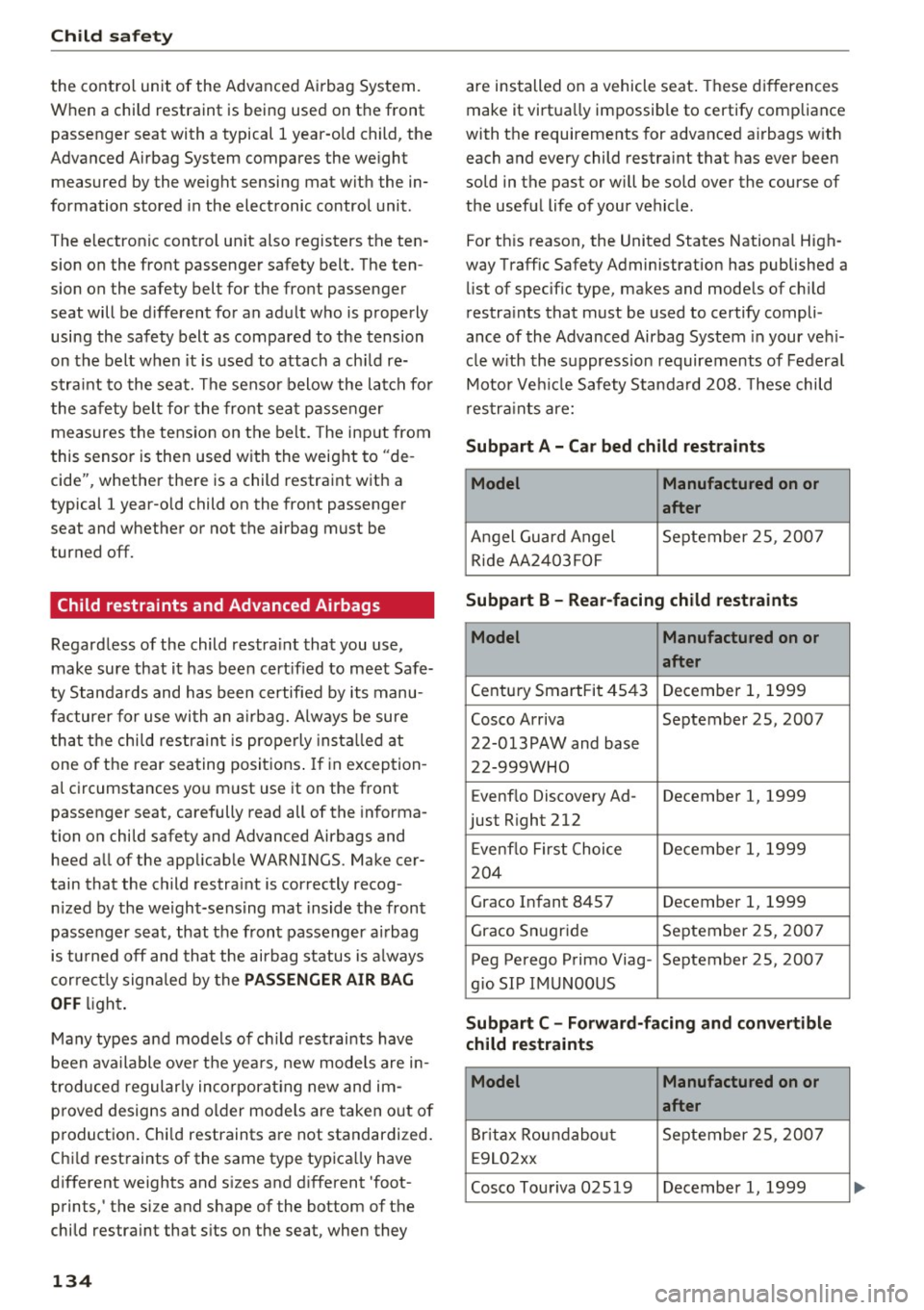
Fo r thi s reason, the United States Nationa l H igh
way Traffic Safety Administration has published a li st of specific type, makes and mode ls of ch ild
r estra ints that must be used to certify compli
ance of the Advanced Airbag System in your ve hi
cle w ith the s uppress ion requirements of Federa l
Motor Ve hicl e Safety Standa rd 208. These child
r es trai nts are:
Subpart A - Car bed child restraints
Model Manufactured on or
after
Angel Guard Angel Septe mber 25, 2 007
R ide AA2 403FO F
Subpart B - Rear-facing child restraints
Model Manufactured on or
after
Cent ury SmartFi t 454 3 Decembe r 1, 1999
Cosco Arriva September 25, 2007
22-013PAW and base
22- 999WHO
Evenf lo Discove ry Ad -December 1, 1999
just R ight 212
E venflo First Choi ce Decembe r 1, 1999
2 04
Graco I nfant 8457 December 1, 1999
Graco Snugr ide September 25, 20 07
Peg Perego Primo Viag- September 25, 2007
g io SIP I MUNOOUS
Subpart C -Forward-facing and convertible
child restraints
Model Manufactured on or
after
B rit a x Roun dabo ut September 25, 200 7
E 9 L02xx
Cosco Touriva 02519 December 1, 1999