warning AUDI Q3 2016 Workshop Manual
[x] Cancel search | Manufacturer: AUDI, Model Year: 2016, Model line: Q3, Model: AUDI Q3 2016Pages: 252, PDF Size: 62.81 MB
Page 74 of 252
Driving
When start ing from a stop
- T he in tegr al hi ll sta rt as sis t helps y ou when
driving by automatically releasing the park ing
brake¢
page 72, Starting from a stop.
- When starting on incl ines, the hill start assist
prevents the vehicle from unintentionally roll
ing back . The braking force
of the parking brake
is only released if sufficient drive power has
been built up at the wheels.
Em erg enc y bra ke f unction
An emergency braking functions ens ures that the
vehicle can be s lowed down even if the
normal
brakes fail¢ page 73, Emergency braking
function.
,&. WARNING
- Do not press the accelerator pedal inadver
tently when the veh icle is stationary and the
engine is running and a gear is selected.
Otherwise t he vehicle w ill start to move im
med iate ly and could result in a c rash.
- If the power supply fa ils, the released park
ing bra ke can no longe r engage. In th is
case, pa rk the veh icle on leve l ground and
sec ure it by placing the selector lever in the
P position. See an author ized Audi dealer or
authorized Aud i Service Faci lity for assis
tance .
(D Tips
-If the parking b rake is set while the ignition
i s sw itched off, the. indicator light in the
b utton and -(USA models) /. (Cana
da models) will turn off after a certain
amount of time.
- Occasiona l noises when the parking brake is
set and re leased are normal and are not a
cause for concern.
- When the vehicle is parked, the parking
brake goes thro ugh a self-test cycle at reg u
l ar intervals. Any no ises assoc iated with this
are normal.
- If there is a power fa ilure, the parking brake
will not set if it is re leased, and it will not
release if it is set¢,&. See an authorized
72
-
Audi dealer or author ized Audi Service Fa
cility for assistance.
Parking
.. Press the brake pedal to stop the veh icle.
.. To set the park ing brake, pull on the© switch.
.. Select the P position .
.. Turn the engine off¢,& .
.. Turn the steering wheel when par king on in
cl ines so that the wheels w ill roll into the cu rb
if the vehicle starts moving.
,&. WARNING
- Always take the veh icle key with yo u when
leaving the vehicle, even for a short period
of time. This applies part icularly when chil
dren remain in the vehicle. Otherwise chil
dren could start the engine, release the
parking brake or operate electrical equip
ment such as power w indows, which in
creases the risk of an accident.
-
- No one should remain in the veh icle w hen it
is locked, especially ch ild ren. Locked doors
make it more difficult for emergency work
ers to get into the veh icle, wh ich puts lives
at risk.
Starting from a stop
The start assist function ensures that the park
ing broke is released automatically upon start
ing.
Stopping and setting the parking brake
.. To set the park ing brake, pull on the(®) switch.
Starting and automat ically r elea sing the
parking brake
.. When you press the acce lerator pedal, the
parking brake is automat ica lly re leased and
your vehicle beg ins to move .
When stopping at a traffic signa l or stopping in
c ity traff ic, the parking brake can be applied . The
vehicle does not have to be held with the brake pedal. The park ing brake elim inates the tendency
to c reep when a se lector lever position is engag-
ed. As soon as yo u press t he accelerator pedal,
1J1>
Page 75 of 252
the parking brake releases automatically and the
vehicle starts to move.
Starting on hills
When start ing on inclines, the hill start ass ist
prevents the vehicle from unintentionally roll ing
back. The braking force of the parking brake is
only released if sufficient drive power has been
bui lt up at the whee ls.
(D Tips
For safety reasons, the parking brake is re
leased automatically only when the driver's
safety belt is fastened and the driver's door is
locked.
Starting to drive with a trailer
To prevent rolling back unintentionally on an in
cline, do the following:
.. Keep pulling the<®> switch and press the acce l
erator pedal. The parking brake stays applied
and prevents the vehicle from ro lling backward.
.. You can re lease the<®> switch once you are sure
that you are transferring enough dr iving force
to the whee ls by pressing the accelerator pedal.
Depending on the weight of the rig (vehicle and
trailer) and the severity of the incline, you may
roll backwards as you start.
Hill hold
A ppl ies to vehicles: with H ill Hol d
Hill hold makes it easier to start on hills .
Requirement: The driver's door must be closed,
the seat belt must be buckled and the engine
must be running.
The system is activated when the brake pedal is
p ressed
for a few seconds.
To prevent the vehicle from roll ing back when
starting, the brake power is held for a brief mo
ment after releasing the brake pedal. During this
~ time, you can easi ly begin to move you r vehicle .
ci ::, co ,....,
A WARNING
- The intelligent technology of Hill Hold can
not overcome the limitat ions imposed by
natural physical laws. The increased comfort
offered by Hill Hold should not cause you to
take safety risks.
- Hill Hold cannot hold the vehicle in all hill
start situations (for example, if the g round
is slippery or icy).
- If you do not beg in moving immediately af
ter releasing the brake peda l, the vehicle
could begin to roll backward under certain
circumstances . Press the brake pedal or set
the parking brake immediately.
-If the engine "stalls", press the brake pedal
or set the parking bra ke immediate ly.
- To prevent the vehicle from roll ing back un
intentionally when starting in s top-and-go
traffic, keep the brake pedal pressed for a
few seconds before driving off .
(D Tips
You can find out if your vehicle is eq uipped
wi th Hill Hold by checking at an authorized
Audi dealer or authorized Audi Service Facili
ty.
Emergency braking function
This is used if the conventional brake system
fails or locks up.
.,. To brake your veh icle using the parking brake in
an emergency, pu ll the(®) switch and keep it
pulled.
.. The braking stops as soon as you release the<®>
switch or acce lerate .
If you pu ll the(®) switch and hold it above a
speed of about 5 mph (8 km/h) , the emergency
braking function is activated. The vehicle brakes
at all four whee ls by activating the braking hy
draulics. The brake performance is similar to
heavy brak ing .
c::> .&.
In order not to activate the emergency brake
function by mistake, a warning tone (buzzer)
sounds when the(®) switch is pulled. As soon as .,.
73
Page 76 of 252
Driving
the<®> switch is released, or the accelerator pedal is depressed, emergency braking stops.
A WARNING
Emergency braking should only be used in an
emergency, when the normal brake pedal has
failed or the brake pedal is obstructed. During
emergency braking, your vehicle will brake
similar to heavy braking . ESC and the associ·
ated components (ABS, ASR, EDL) cannot
overcome the laws of physics. In corners and
when road or weather conditions are bad, a
full brake application can cause the vehicle to
skid or the rear end to break away, which in
creases the risk of an accident.
Speed warning system
Introduction
Applies to vehicles: with speed warning system
The speed warning sy stem helps you to stay un
der a specified maximum speed.
The speed warning system warns you if you are
exceeding the maximum speed that you have set .
You will hear a warning tone when your speed ex
ceeds the stored value by approximately 3 mph
(3 km/h) . The indicator light
101 (USA models)/
llll (Canada models) and the Speed limit warn
ing exceeded.
message appear in the instrument
cluster display at the same time . T hP
(Cl / t•j in
dicator light turns off when the speed decreases
below the stored maximum speed.
Setting a threshold is recommended if you would
like to be reminded when you reach a certain
maximum speed. Situations where you may want
to do so include driving in a country with a gener
al speed limit or if there is a specified maximum
speed fo r winter tires.
@ Tips
Regardless of the speed warning system, you
should always monitor your speed using the
speedometer and make sure you are following
the legal speed limit.
74
Setting the threshold
Applies to vehicles: with speed warn ing system
You can set, change and delete the warning
threshold in the Infotainment system .
.. Select: !CAR ! function button> (Car) systems*
control but ton > Driver assist> Speed warning .
You can set any threshold between 20 mph
(30 km/h) and 150 mph (240 km/h). Settings
can each be adjusted in increments of S mph (10 km/h) .
Cruise control system
Switching on
Applies to vehicles: with cruise control system
The cruise control system makes it possible to
drive at a constant speed starting at 20 mph
(30kmlh).
0
f
~
0
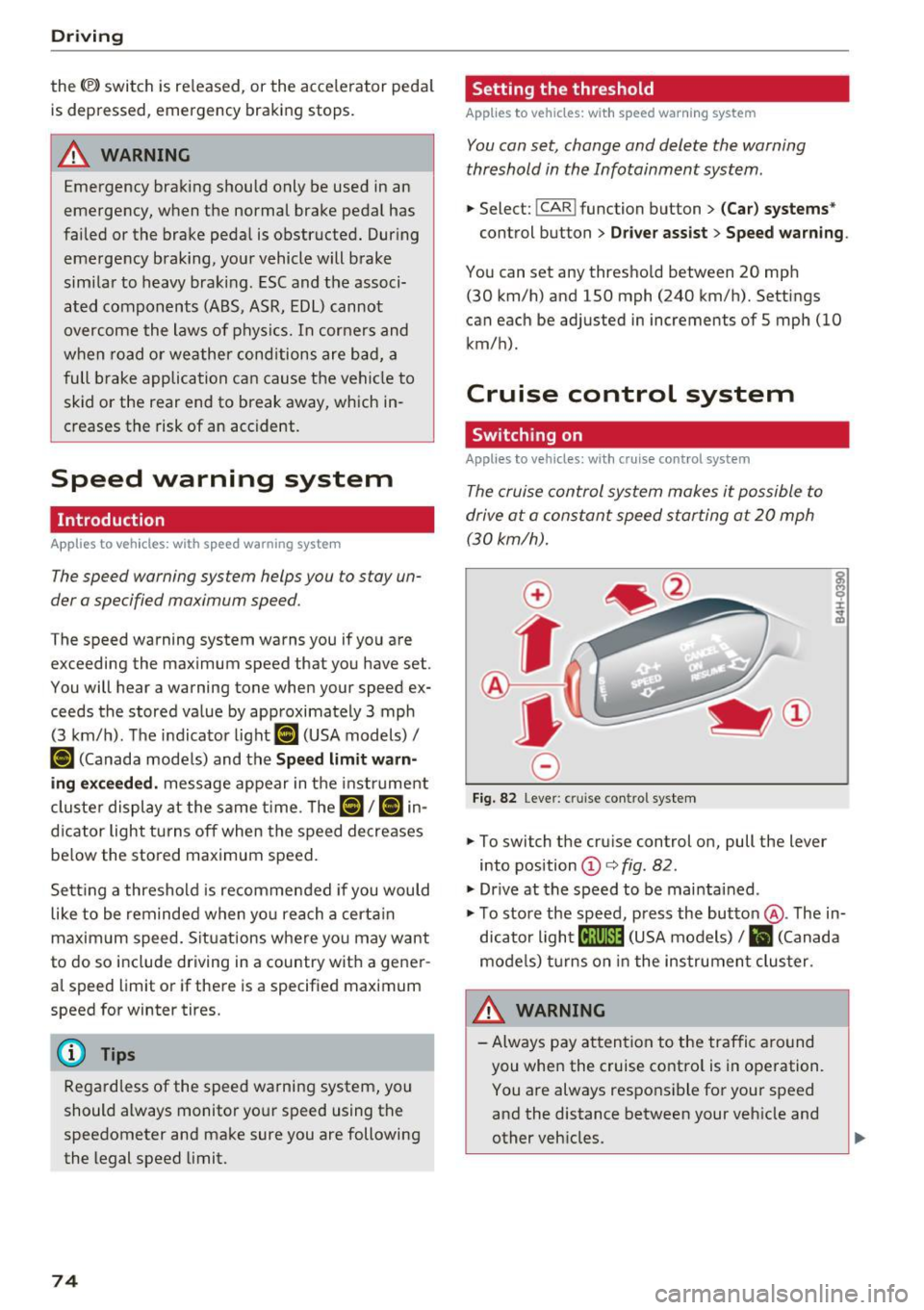
Fig. 82 Lever: cruise con trol system
.. To switch the cruise control on, pull the lever
into position
© c:> fig . 82 .
"'Drive at the speed to be maintained .
"' To store the speed, press the button @. The in
dicator light
[ij;(tj~i~ (USA models) / Bl (Canada
models) turns on in the instrument cluster .
&_ WARNING
-Always pay attention to the traffic around
you when the cruise control is in operation. You are always responsible for your speed
and the distance between your vehicle and
other vehicles .
.
Page 77 of 252
-For reasons of safety, cruise control should
not be used in the city, in stop-and-go traf
fic, on winding roads and when road condi
t ions are poor (such as ice, fog, gravel,
heavy ra in and hydroplaning) -you could
have an acc ident.
- Switch the cruise control off temporar ily
when driving in turning lanes, h ighway exits
o r in construction zones.
(D Tips
-The cruise control system is ideal for
stretches w ith speed limits. The driver is re
spons ible for adhering to the correct speed.
- The cruise control remains active when
sh ifting gears.
Changing speed
A ppl ies to vehicles: with c ruise control system
.. To inc rease o r decrease the speed in incre
ments, push the lever towa rd
0 10 <=> page 74,
fig. 82.
.. To increase or decrease the speed quickly, hold
the lever in the
010 direction until the de
sired speed is displayed .
You can also press the accelerator pedal down to
increase your speed, for example i f you want to
pass someone. The speed you saved earlier will
resume as soon as you re lease the accelerator
pedal.
However, if you exceed your saved speed by 5
mph (10 km/h) for longer than 5 minutes, the
cruise control system turns off temporari ly. The
tij ;(i)~i~ (USA models)/ . (Canada models) ind ica
tor light in the instrument cluster turns off and
the stored speed is retained.
Preselecting the speed
Appl ies to veh icles: with c ruise control system
You can preselect your desired speed when the
vehicle is stationary.
.... "' .. Switch the ignition on. ci ~ .. Pull the lever into position (D <=> page 74,
~ fig. 82. Lil
N v:, ....
Driving
.. To increase or decrease the speed, push the lev-
er toward
0 10 .
.. To store the speed displayed, release the lever.
T his function makes it possible, fo r example, to
save the desired speed before driving on the
highway. Once on the highway, activate the
cruise control by pulling the lever toward @.
Switching off
App lies to vehicles : with cruise co nt ro l sys te m
Temporary deactivation
.. Press the brake pedal, or
.. Press the lever into position @ (not clicked into
place)
<=> page 74, fig. 82 .
Switching off completely
.. Press the lever into position @(clicked into
place), or
.. Switch the ignit ion off .
T he speed you stored will be retained if the cruise
contro l has been switched off temporari ly. To re
sume the stored speed, release the brake pedal
and pull the lever into position@.
Switching the ignition off wi ll erase the stored
speed.
A WARNING
You should only resume the stored speed if it
i s not too high for existing traff ic conditions.
Otherw ise you risk an accident.
75
Page 78 of 252
Audi side assist
Audi side assist
Side assist
Description
Applies to vehicles: with Aud i side ass ist
F ig. 83 Se nsor detec tion ran ge
Fig . 84 Display o n th e exter io r mirr or
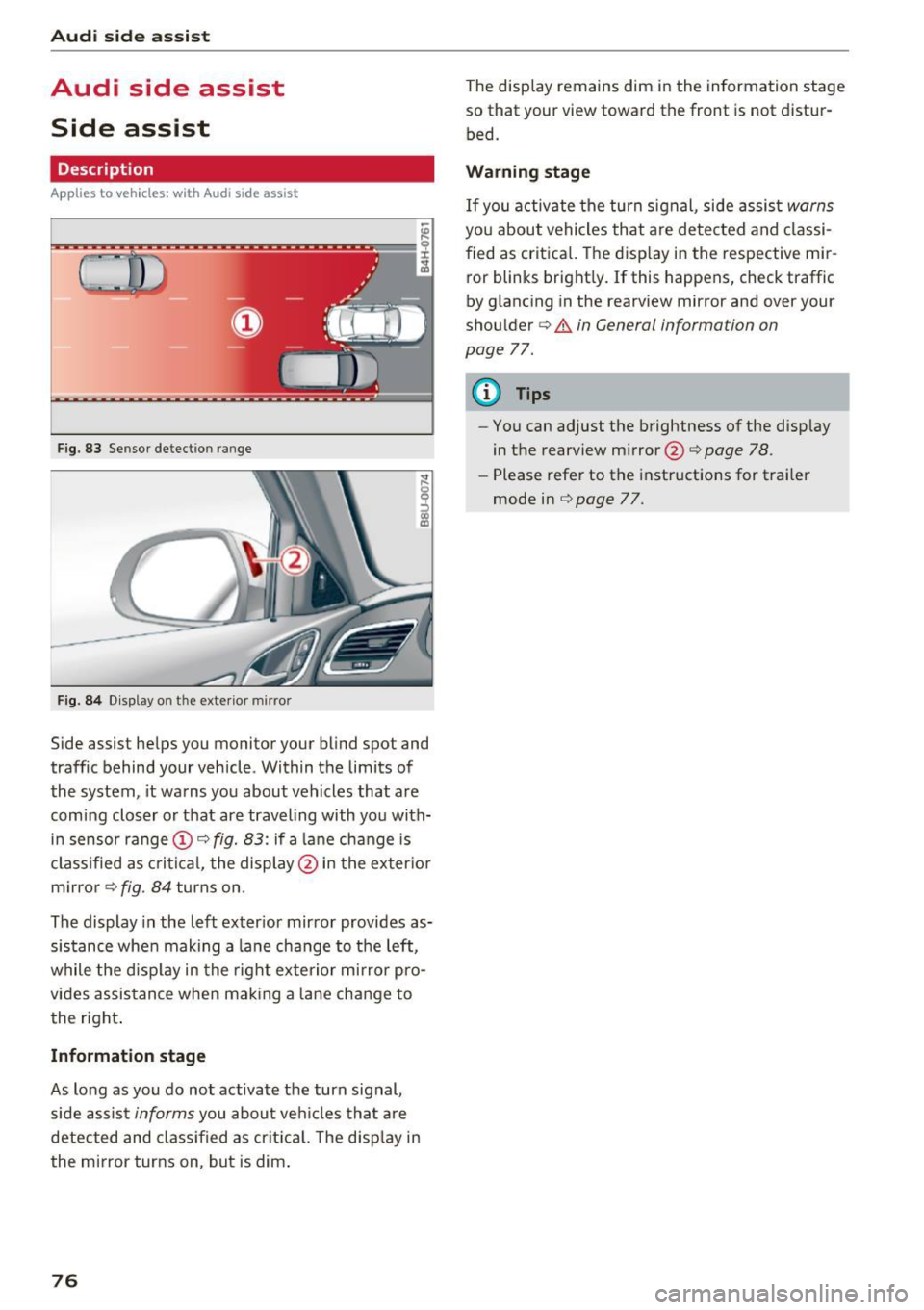
Side assist he lps you monitor your bl ind spot and
traffic behind your vehicle . Within the limits of
the system , it warns you about vehicles that are
comi ng closer o r that are traveling with you with
i n sensor range
(D c:> fig. 83: if a lane change is
classified as cr itic al, the displ ay @ in the exter io r
m irro r
i=>fig . 84 turns on .
The display in the left exter ior mir ror provides as
sis tance whe n making a la ne change to the left,
while the disp lay in the rig ht exte rio r mi rror pro
vides assis tance when mak ing a lane chan ge to
the right .
Information stage
As long as you do no t activate the turn signal,
side assis t
informs you about ve hicles tha t are
detected and class if ied as crit ic al. T he disp lay in
the mirror turns on, but is dim .
76
The display remains dim in the information stage
so that your view toward the fron t is not distur
bed.
Warning stage
If you activate the turn signal, side assis t warns
you about vehicles tha t are detected and classi
fied as crit ica l. T he disp lay in the respective mir
ror blinks bright ly. If this happens, check traffic
by glancing in the rearview mi rror and ove r you r
shou lder c:>
.&. in General information on
page
77.
{!) Tips
- You can adjust the b rightness of the disp lay
in the rearview mirror @c:>
page 78 .
-Please refe r to the instructions for trai ler
mode in c:>
page 77.
Page 79 of 252
.... N
c:i :::J CX)
.... I.Cl U"I
N I.Cl ......
General information
Appl ies to vehicles: with Audi side assist
®
®
©
Fig. 85 Driving si tuat ions
Fig. 86 Rear of the veh icle: pos ition of the sensors
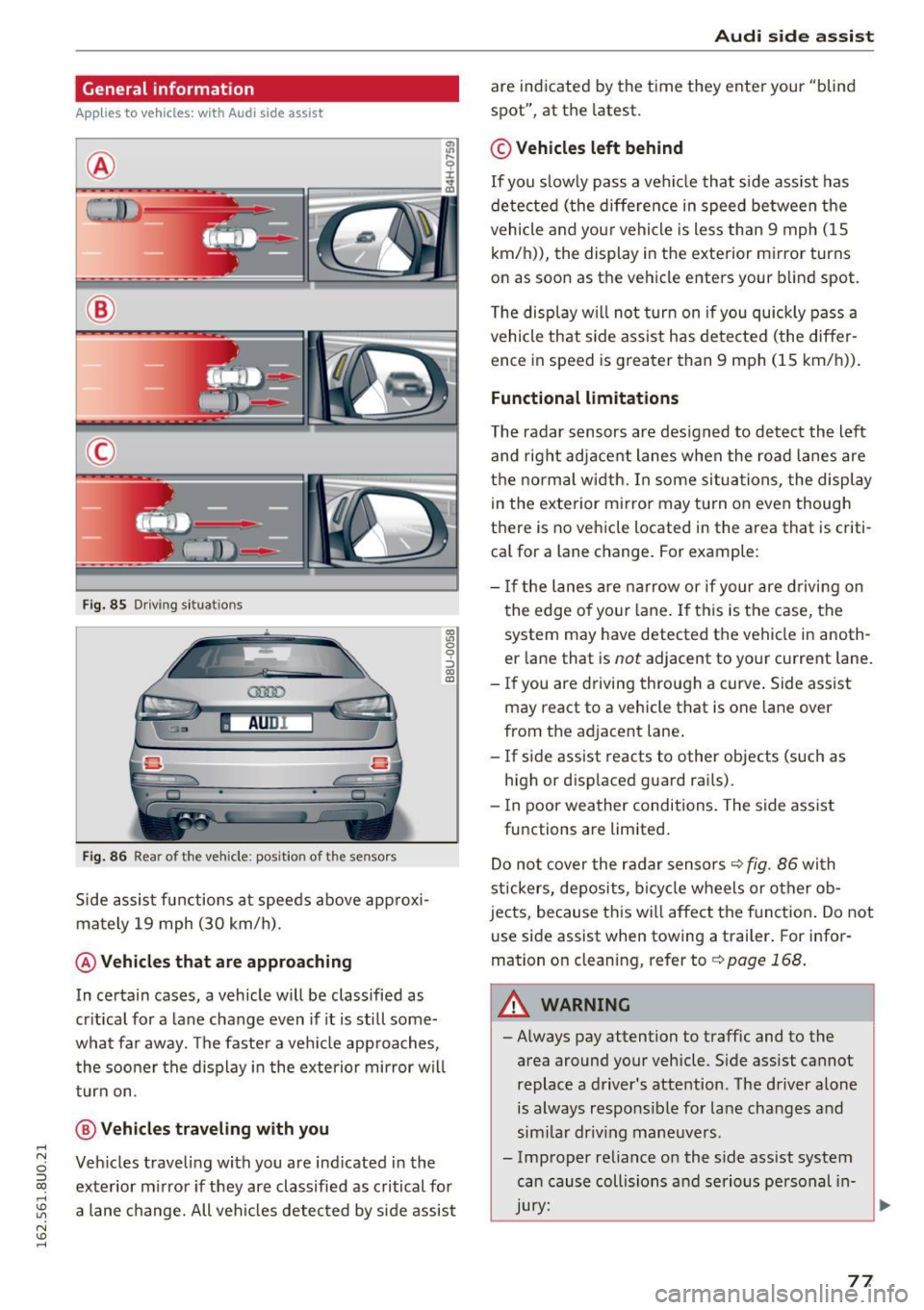
Side assist functions at speeds above approxi
mately
19 mph (30 km/h).
@ Vehicles that are approaching
:'ll 0
0
::':,
"' m
In certain cases, a vehicle will be classified as
critical for a lane change even if it is still some
what far away. The faster a vehicle approaches,
the sooner the display in the exterior mirror will
turn on.
@ Vehicles traveling with you
Vehicles traveling with you are indicated in the
exterior mirror if they are classified as critical for
a lane change. All vehicles detected by side assist
Audi side assist
are indicated by the time they enter your "blind
spot", at the latest.
© Vehicles left behind
If you slowly pass a vehicle that side assist has
detected (the difference in speed between the
vehicle and your vehicle is less than 9 mph (15
km/h)), the display in the exterior mirror turns
on as soon as the vehicle enters your blind spot.
The display will not turn on if you quickly pass a
vehicle that side assist has detected (the differ
ence in speed is greater than 9 mph (15 km/h)).
Functional limitations
The radar sensors are designed to detect the left
and right adjacent lanes when the road lanes are
the normal width. In some situations, the display
in the exterior mirror may turn on even though
there is no vehicle located in the area that is criti
cal for a lane change. For example:
- If the lanes are narrow or if your are driving on
the edge of your lane. If this is the case, the
system may have detected the vehicle in anoth
er lane that is
not adjacent to your current lane.
- If you are driving through a curve. Side assist
may react to a vehicle that is one lane over
from the adjacent lane.
- If side assist reacts to other objects (such as
high or displaced guard rails).
- In poor weather conditions. The side assist
functions are limited.
Do not cover the radar sensors
~ fig. 86 with
stickers, deposits, bicycle wheels or other ob
jects, because this will affect the function. Do not
use side assist when towing a trailer. For infor
mation on cleaning, refer to ¢
page 168.
A WARNING
=
-Always pay attention to traffic and to the
area around your vehicle . Side assist cannot
replace a driver's attention. The driver alone is always responsible for lane changes and
similar driving maneuvers .
- Improper reliance on the side assist system can cause collisions and serious personal in-
-
Jury: ~
77
Page 80 of 252
Audi side assist
-Never rely only on side assist when chang
ing lanes.
- Always check rear view mirrors to make
sure that it is safe to change lanes.
- Side assist cannot detect a ll vehicles under
all conditions- danger of acc ident!
- Please note that side assist indicates there
are approaching vehicles, or vehicles in your blind spot, only after your vehicle has
reached a driving speed of at least 19 mph
(30 km/h).
- In certain situations, the system may not function or its funct ion may be limited. For
example:
- if veh icles are approaching or being left
behind very quickly. The display may not
turn on in time.
- in poor weather conditions such as heavy
rain, snow or heavy mist.
- on very w ide lan es, in tight curves or if
there is a rise in the road su rface. Vehicles
in the adjacent lane may not be detected
because they are outside of the sensor
range.
(D Note
The sensors can be displaced by impacts or
damage to the bumper, wheel housing and
underbody. This can affect the system. Have
your authorized Audi dealer or authorized
Audi Serv ice Facility check their function.
(D} Tips
- If the window glass in the driver 's door or
front passenger's door has been tinted, the
display in the exterior mirror may be misin
terpreted.
- For Declaration of Comp liance to United
States FCC and Industry Canada regu lations
c;, page235.
78
Switching on and off
App lies to vehicles: wit h Audi side assist
Fig. 87 D river's door: s ide assist button
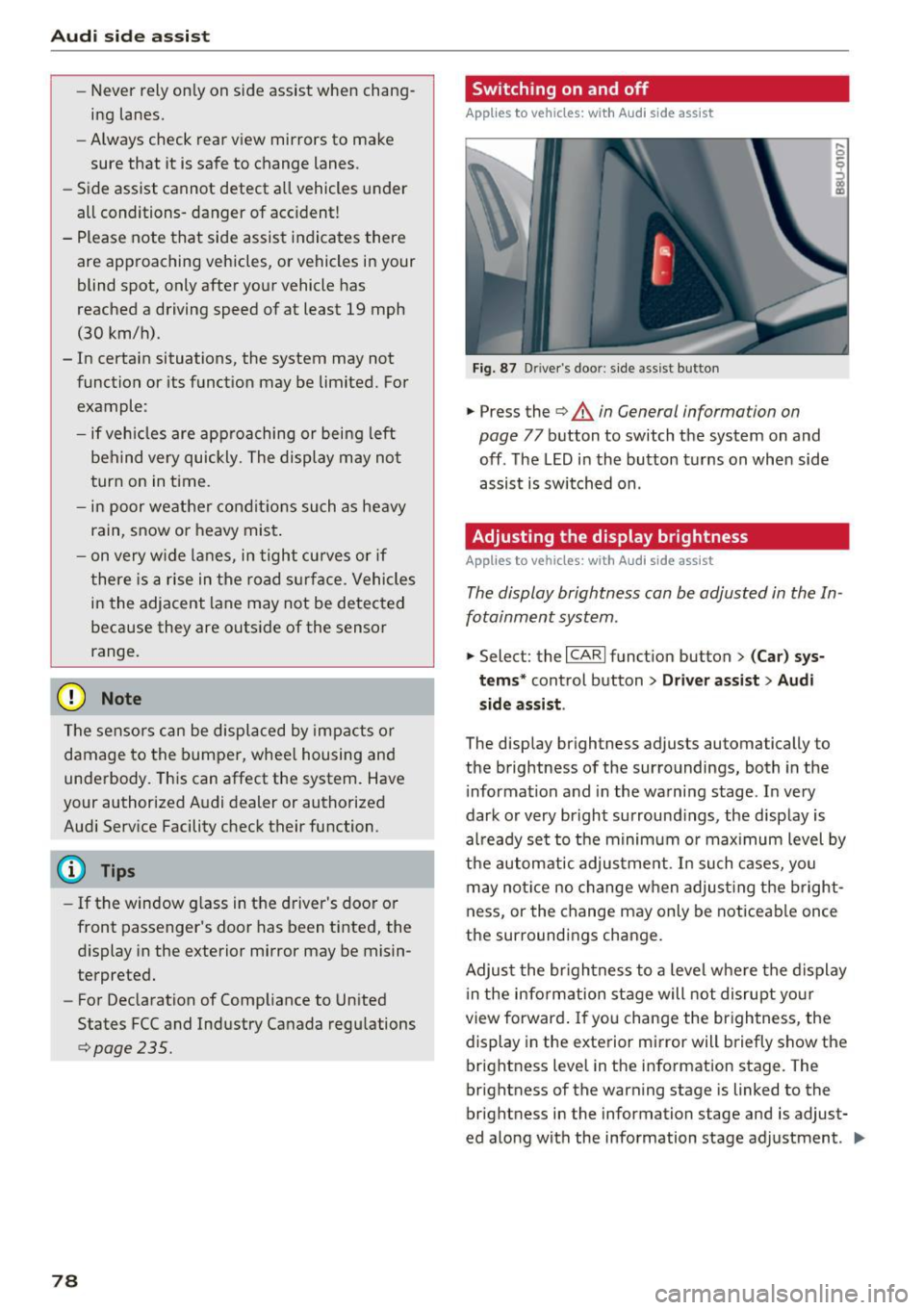
.,. Press the c;, &. in General information on
page
77 button to switch the system on and
off . The LED in the button turns on when side
assist is switched on .
Adjusting the display brightness
Applies to vehicles: wit h Aud i side ass ist
! a,
The display brightness can be adjusted in the In
fotainment system .
.,. Select: the I CARI function button > (Car) sys
tems *
control button > Driver assist > Audi
side assis t.
The display brightness adjusts automatically to
the brightness of the surroundings, both in the
i nformation and in the warning stage . In very
dark or very bright surround ings, the display is
al ready set to the minimum or max imum level by
the automatic adjustment. In such cases, you
may notice no change when adjust ing the bright
ness, or the change may only be noticeable once
the surroundings change.
Adjust the br ightness to a level where the display
i n the information stage will not disrupt your
view forward. If you change the brightness, the
display in the exterior mirror will briefly show the
brightness level in the information stage. The
brightness of the warning stage is linked to the
brightness in the information stage and is adjust
ed along with the information stage adjustment . .,,.
Page 83 of 252
Dynamic -gives the driver a sporty driving feel
and is suited to a sporty driving style .
A WARNING
Pay attention to traffic when operating the
drive se lect to reduce the risk of an accident.
Audi drive select
81
Page 85 of 252
.... N
c:i ::J CX)
.... I.Cl U"I
N I.Cl ......
,&_ WARNING
Read and follow all WARNINGS¢ A in Driv
ing tips on page 84.
(D Note
Coasting downhill w ith the transm ission in N
and the engine not running will result in dam
age to the automatic transmission and possi
bly the catalytic converter.
@ Tips
- If you accidentally select N while driving,
take your foot off the accelerator pedal and
wait for the engine to slow down to idle be
fore selecting Dor S.
- If there is a power failure, the selector lever
will not move out of the P position. The
emergency release can be used if this hap
pens
¢ page 86.
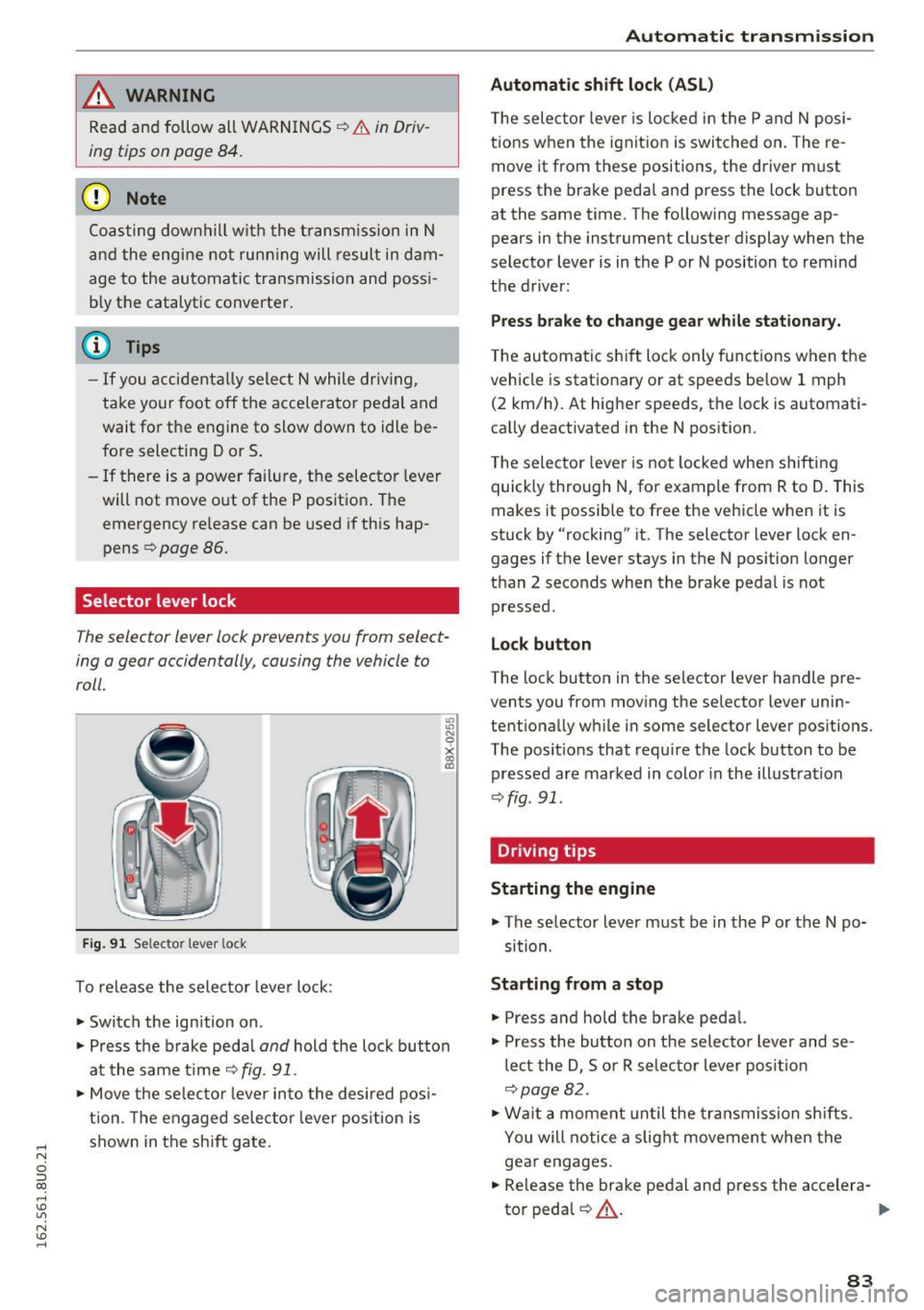
Selector lever lock
The selector lever lock prevents you from select
ing o gear occidentally, causing the vehicle to
roll.
Fig. 91 Selecto r lever loc k
To release the selector lever lock:
• Switch the ign ition on .
• Press the b rake peda l
and hold the lock button
at the same time ¢
fig. 91.
• Move the selector lever into the desired posi
tion. The engaged selecto r lever position is
shown in the shift gate .
-
Automatic transmission
Automatic shift lock (ASL)
The selec tor lever is locked in the P and N posi
tions when the ignit ion is switched on. The re
move it from these positions , the driver m ust
press the brake pedal and press the lock button
at the same time. The following message ap
pears in the instrument cluster display when the
selector lever is in the P or N position to remind
the driver:
Press brake to change gear while stationary.
The automatic shift lock only funct ions when the
vehicle is stat ionary o r at speeds be low 1 mph
(2 km/h). At higher speeds, the lock is automati
cally deactivated in the N position.
The selector lever is not locked when shifting
quick ly through N, for example from R to D. This
makes it possible to free the vehicle when it is
stuck by "rocking" it. The selector lever lock en
gages if the lever stays in the N position longer
than 2 seco nds when the brake pedal is not
pressed.
Lock button
The lock button in the selector lever handle pre
vents you from moving the selector lever unin
tentionally while in some selector lever positions.
The positions that require the lock button to be
pressed are marked in color in the illustration
¢fig . 91.
Driving tips
Starting the engine
• The se lector lever must be in the P or the N po
sit ion.
Starting from a stop
• Press and hold the brake pedal.
• Press the button on the selector lever and se
lect the D , Sor R selector lever posit ion
¢page 82.
• Wait a moment until the transmission shifts.
You will notice a slight movement when the
gear engages.
• Release the brake pedal and press the accelera-
tor pedal
QA - .,..
83
Page 86 of 252
Automatic transmissio n
Stopp ing temporarily
.,. Press the b rake peda l to stop the vehicle, fo r
example at a traffic light. Do not press the ac
ce lerator peda l when doing this.
... To prevent the vehicle from rolling when you
start driving, set the parking brake when stop
ping on steep inclines ¢
,&..
.,. The park ing brake w il l release automatically
and the vehicle will start moving once you press
the accelerator pedal.
Stopp ing /park ing
If the selector lever is not in the P posit ion when
you open the driver's door, the vehicle could roll.
The message
S hift to P and turn off ign it ion ,
otherwi se vehicle can roll awa y
appears.
.,. Press and hold the brake pedal
c> ,&. .
.,. Set the parking brake.
.,. To engage the P selector lever posit ion, press
the button on the selector lever and sh ift into
the P position
i:> page 82.
Stopp ing on an incline
.,. Always press the brake peda l to hold the vehi
cle in place and prevent it from "rolling back"
c> ,&. . Do not try to prevent the vehicle from
"ro lling back" when a gear is engaged by in
c reasing the eng ine speed
i:> 0.
Starting on a hill
.,. Set the parking brake.
.,. Se lect the D posit ion .
.,. Press t he accelerator pedal carefully . If you r
safety belt is fastened, the pa rking brake is au
tomat ica lly released a nd your ve hicle beg ins to
move .
Unde r ce rtain c ircumstances, such as driv ing in
the mountains, it may be usef ul to sw itch tempo
rarily to the manua l shift program in o rde r to ad
just the gea rs to the d riving conditions by hand
i:>page 85 .
On inclines, act ivate the park ing brake first and
then move the se lector lever to the P pos it ion
c>page 72. This prevents the lo cking mechanism
from being loaded too heav ily and w ill make i t
easier to move the se lec tor lever out of the P po
sition.
84
A WARNING
- The vehicle can also ro ll when the eng ine is
stopped.
- Unintended vehicle movement can cause se
rious injury.
- Never leave your veh icle with the engine
running while in gear. If you must leave
your veh icle w hen the engine is r unning, ac
tivate t he pa rking brake a nd move the selec
tor lever to P .
- Power is still transmitted to the wheels
when the engine is running at idle . To p re
vent the vehicle from "creeping", yo u m ust
keep your foo t on t he b rake when the en
g in e is ru nning and the selector lever is in D/
Sor R or "tiptronic" mode is se lected .
- Do not press the a cce le ra to r peda l when
changing the se lec to r l ever posi tion while
the vehicle is s ta tionary and the engine is
r u nning .
- Never sh ift into R or P whi le driving.
- Before d riving down a s teep sl ope, redu ce
your spee d and sh ift into a lower gea r w ith
"t i ptronic" .
- Do not ride the brakes or press the bra ke
pedal too of ten o r too long when dr iv ing
down a hi ll. Constant braking ca uses the
brakes to ove rheat and substantially re
duces brak ing performance, increases b rak
ing d istance or causes comp lete failure of
the brake system.
- To prevent the veh icle from rol ling back
when stopp ing on inclines, always hold it in
place with the brake peda l or park ing brake .
- Never hold the vehicle on an incline with a
slipping clutch. The clutch opens automati
cally when it becomes too hot from the
overload. An ind icator lam p. illumina tes
and a dr iver message appears¢
page 86
w hen t he clu tch is overloade d.
- If the e ngine must rema in running, never
have a ny driving posi tion engaged when
checking unde r th e hood. Make s ure these
lec to r l ever has secu rely eng aged an d is
loc ked in P with the parking b rake set