battery AUDI Q3 2016 User Guide
[x] Cancel search | Manufacturer: AUDI, Model Year: 2016, Model line: Q3, Model: AUDI Q3 2016Pages: 252, PDF Size: 62.81 MB
Page 72 of 252
Driving
@ Tips
-Some noise after starting the engine is nor
mal and is no cause for concern.
- If you leave the vehicle with t he ignit ion
switched on, the ignition will switc h off af
ter a certain amount of time . Make sure that
electr ica l equipment suc h as the exterior
lights are switched off.
Stopping the engine
Appl ies to veh icles: w ith conve nien ce key
• Bring the vehicle to a full stop.
• Select the P or N selector lever position .
• Press the
I S TAR T ENGIN E STO PI button
¢ page 69, fig. 79.
Engaging the steering lock
The steering locks when you turn the engine off
using the
I START ENGINE STOP! button a nd
open the driver's door . The locked steering helps
p revent vehicle theft.
Emergency off function
If it is absolutely necessary, the engine can also
be turned off while driving at speeds lower than
6 mph (10 km/h) . To switch the engine off, press
the
I START ENGINE STOPI button twice in a row
briefly o r press and hold for longer than two sec
onds.
_& WARNING
- Never turn off the engine before the veh icle
has come to a comp lete stop . The full func
tion of the brake booster and the power
steering is not guaranteed. You must use more force to turn or brake if necessary. Be
cause you cannot steer and brake as you
usually would, this could lead to crashes
and serious injuries.
- For safety reasons, you should always park
yo ur vehicle with the selecto r lever in P .
Otherwise, the vehicle could inadvertently
roll away .
- The radiator fan can continue to r un for up
to 10 minutes even after you have turned
off the engine and removed the ignit ion key.
70
The radiator fan can also turn on again if the
engine coolant heats up because of intense
sunlight or heat build-up in the engine com
partment .
- Always take the key with you whenever you
leave your vehicle . Otherwise, the engine
could be started or electrical equipment
such as the power windows could be operat
ed. This can lead to serious injury.
(D Note
If the engine has been under heavy load for
an extended period of time, heat builds up in
the eng ine compartment after the engine is
switched off -there is a risk of damaging the
engine. For this reason, let the engine r un at
idle for approxi mately two minutes before
shutting it off.
Starting the engine when there is a
malfunction
App lies to vehicles: wit h co nvenience key
Other circumstances can cause the engine not to
start, such as the battery in the remote control
key has drained , there is interference with the
key or there is a system malfunction .
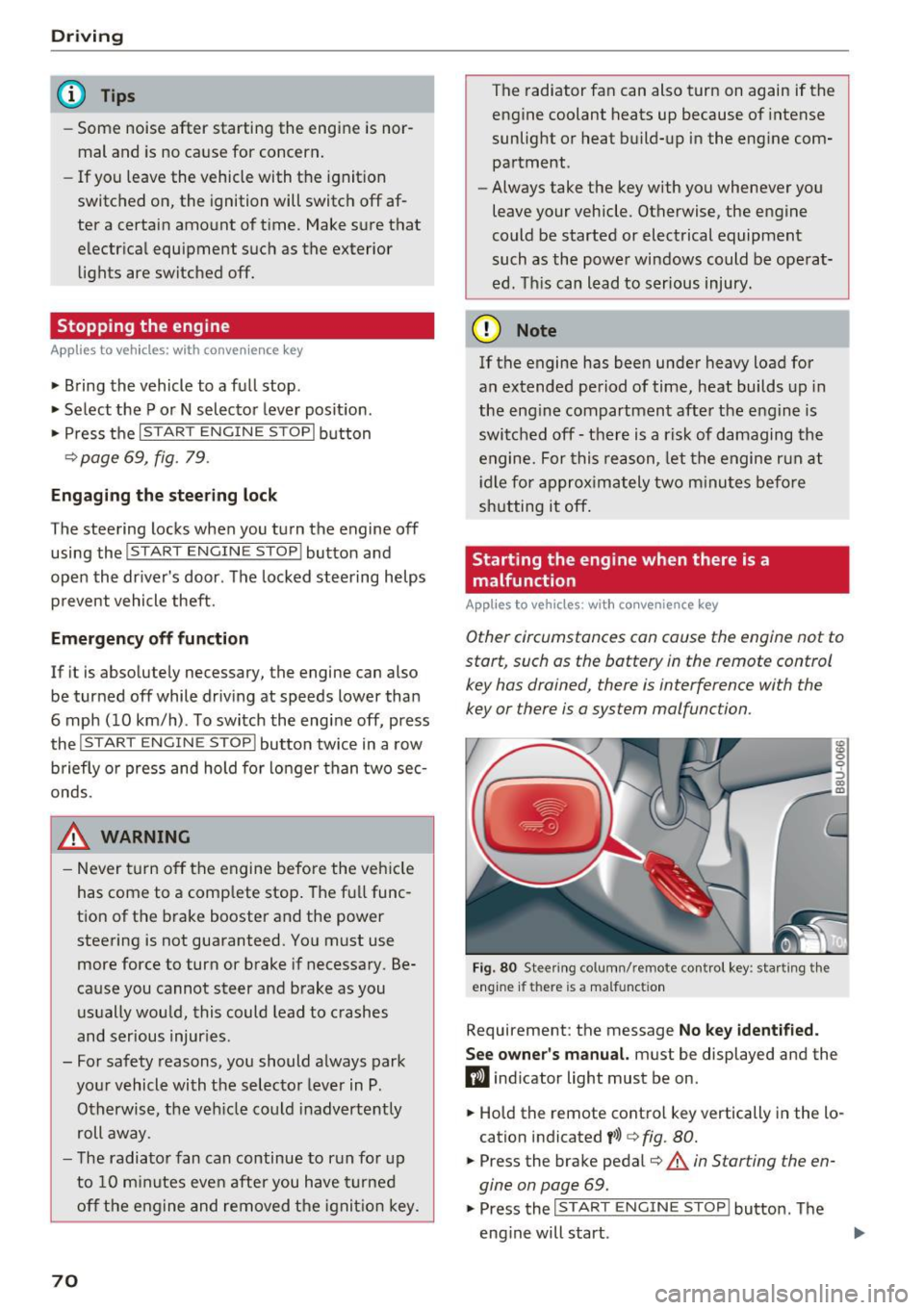
Fig. 80 Stee ring co lumn/ remo te cont rol key : sta rting t he
engine if th ere is a malfunct ion
Requirement: the message No key identified.
See owner's
manual. must be displayed and the
fl ind icator light must be on .
• Hold the remote control key vertically in the lo
cation indicated
t>>) ¢ fig. 80.
• Press the brake pedal¢.&. in Starting the en
gine on page
69.
• Press the ~IS_T_A_R_T_ E_N_ G_ I_ N_ E ~ s=T ~O ~ P~ I button. The
eng ine will start .
Page 73 of 252
.... N
c:i ::J CX)
.... I.Cl U"I
N I.Cl ......
.. Drive to an authorized A udi dealer or author
ized Audi Service Facility immediately to have
the malfunction corrected.
@ Tips
You can view the message again by pressi ng
the
I START E NGINE STOP! button.
Driver messages
Turn off ignit ion. Battery di scharging
This message appears and a war ning tone sounds
if you open the driver's doo r whe n the ignition is
sw itched on.
Pr ess brake pedal to start engine
This message appears if you do not step on the
brake pedal to start the eng ine on a vehicle with
a n automatic transm ission .
Please engage Nor P.
This message appears when starting or stopping
the eng ine and Nor Pis not engaged. The engine
will not start/stop.
Ill Is key in the vehicle ?
The indicator light turns on and this message ap
pea rs if the conven ience key* was removed from
the veh icle when the eng ine was runn ing. If t he
conven ience key is no longer in the vehicle, you
cannot switch the ignition on or start the engine
once yo u stop it. Yo u also ca nnot lock the vehicle
from the outside.
Shift to P , vehicle can roll away . Doors can only
be locked in P.
This message appea rs fo r safe ty re asons a long
with a warn ing sound if the se lector lever is not
e ng aged in P a fter swi tching the ignition off.
Move the selector lever to the P positio n. Other
wise the vehicle is not protected from rolling and
it cannot be loc ked.
DJ No key identified . See owner's manual.
This message appears if the re is no convenience
key * in side the veh icle or if the system does not
r ecognize the key. The conve nience key may not
be re cognized, for examp le, i f it is cove red by an
D rivi ng
obje ct that disrupts the signa l (such as a br ie f
case), or if the key battery is wea k. E lectronic de
vices such as cell phones can a lso inte rfere with
the signal.
T o still be able to start or stop the engine, re fer
to
¢ page 70.
Electromechanical
parking brake
Operating
The electromechanical parking brake replaces
the hand brake.
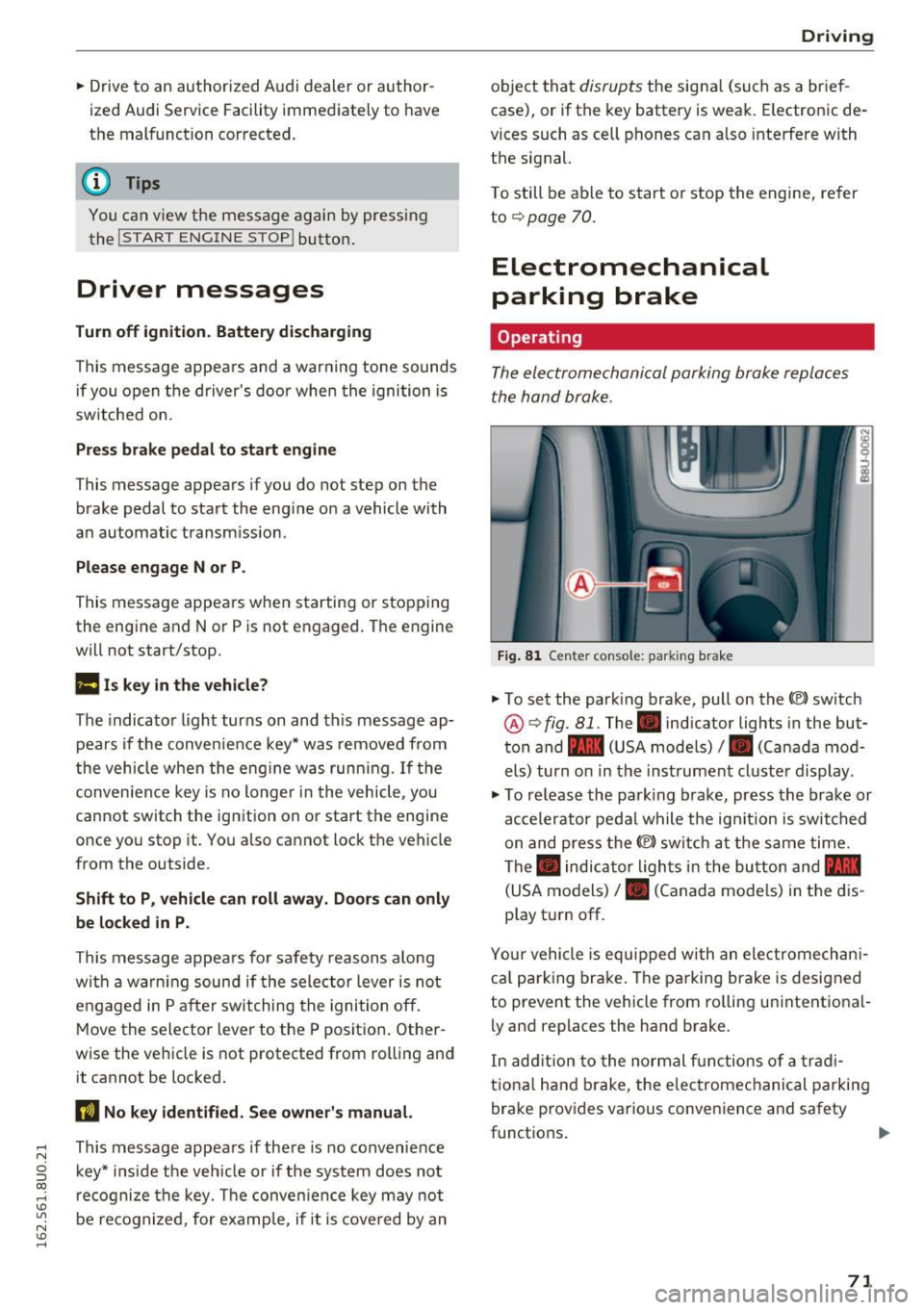
Fi g. 81 Center console: parking brake
.. To set the park ing brake, pull on the(®) switch
@¢ fig. 81. The . indicator lights in the but
ton and - (USA models)/ . (Canada mod
els) turn o n in the ins trument cluste r display.
.,. To re lease the park ing brake, press the brake or
ac celerator pedal w hile the ign it ion is switched
on and press the(®) switch at the s ame time.
The . indicator ligh ts in t he bu tton and -
(USA models)/ . (Canada mode ls) in the dis
play t urn off.
Yo ur vehicle is equipped with an elect romechan i
ca l p a rk ing brake . The pa rking brake is designed
to prevent the vehicle from ro lling un intent ional
ly and replaces the hand brake.
In add ition to the normal f unctions of a tra d i
t iona l h and b rake, t he elec tromec hanical parking
bra ke prov ides various conven ience and safety
functions .
71
Page 81 of 252
@ Tips
-Side assist is not active whi le you are ma k
i ng the ad justment .
- Your settings are automatically stored and
ass igned to the remote control key being
u sed.
Driver messages
App lies to vehicles: with Audi side assist
If side ass ist switches off by itself, the LED in the
button turns off and a message will appear in the
i nstr ument cluster d is pl ay :
Audi side assist: Unavailable. Sensor view
The radar senso rs ' vision is affected. Do not cover
the area in front of the sensors with b ike wheels,
sticke rs, dirt or other ob jects . Clean the area in
front of the senso rs, if necessary
c:> page 77,
fig . 86 .
Aud i side assist: Unavailable
Side assist cannot be switched o n tempo rar ily be
cause there is a malfunction (for exam ple, the
battery charge level may be too low).
Audi side assist: Syst em fault!
The system cannot guarantee that it will detect
ve hicles co rrectly and it is switched off. The sen
sors have been d isp laced or are fa ulty. Have the
system checked by an authorized Audi dealer or
author ized Audi Service Facility soon.
Audi side as sist: Unavailable when towing
Side assist sw itches off automatically when a fac
tory-installed trailer hitch is connected to the
e lectrical connector on the trailer. T he re is no
gua rantee the system will sw itch off when using
a retrofi tted tra ile r hitch . Do not use s ide ass ist
when towing a trailer.
Aud i side assist
79
Page 159 of 252
conditions regar dless of your speed to
reduce the risk of an accident.
Energy management
The starting ability is optimized
The energy management system manages the
electrical energy distribution and optimizes the
availability of electrical energy for starting the
engine.
When a vehicle w ith a conventional energy sys
tem is not dr iven for a long time, the battery is
d rained by equ ipme nt (for example the immobi l
iz er) . In certain circumstances, there could may
not be eno ugh energy to start the engi ne.
Your veh icle is equipped with an inte lligent ene r
gy managemen t system for d istr ibut ing electrici
ty . This significant ly imp roves the starting ab ility
and inc reases t he battery life.
The energy management system Is made up of
batt ery diagno sis, idling curr ent management
and dynami c en ergy managemen t.
B attery diagnosis
The battery diagnosis determines the battery
charge level. The senso rs determ ine the battery
voltage, t he battery cur rent, and the battery
temperature. The cu rrent charge level a nd the
pe rformance of the bat tery are dete rm ined based
on this .
Idling current management
The idling cu rrent management dec reases the
energy used wh ile parked . With the eng ine
sw itched off, it manages the energy dist ribution
t o the different elect rical componen ts. Date from
battery d iagnosis is taken into account for this.
D epending on the battery cha rge level, e lectr ica l
equ ipment is swi tched off one item after the oth
e r, to p revent the ba tte ry from d raining and to
r etain the s tarting ab ility.
Dynamic energy management
Wh ile driving, dynamic energy management dis
tr ib utes the approp riate amount of energy to the
e lectr ica l equipment. It controls the battery
Intellig ent Technology
charge level so that more energy is not used then
is being generated in order to maintain an opti
mal battery charge level.
(D Tips
- Energy management cannot overcome the
laws of physics . Note that the charge level
and length o f the battery life are limited.
- When the sta rting ability is endangered, the
(•) indicator lig ht turns on
¢page 15.
What you should know
Maintaining the starting ability is the highest
priority.
A lo t of st ress is p laced on t he b attery when dr iv
ing shor t distances, in traff ic, and at cold t imes
of the year . A lot of energy is used but litt le is
generated. It is also critical when the engine is
not running but e lectr ica l equipment is sw itched
on. In th is case, energy is used but none is gener
ated.
In situations like this, energy management wi ll
active ly regulated the distr ibut ion of energy.
Long periods without us e
If you do not drive your vehicle for sever al days o r
weeks, electrical equ ipment is gradua lly scale d
back or sw itched off . This reduces energy use and
ensures the vehicle will be ab le to start after long
per iods of time . Some conven ience functions,
such as interior lig hting or power seat ad just
ment, may not be ava ilable under certain circum
stances. These conven ience functions wi ll be
available again once you sw itch t he ignition on
and sta rt the eng ine.
With the engine switched off
The battery w ill dra in if you use Infotainment
funct ions such as listening to the radio while the
engi ne is switched off .
The vehicle's ab ility to start may be impa ired by
the energy use, a message will appear in the In
fota inment system display .
The message indicates that the system wi ll
switch off automatically soon. If you would like
lill'
157
Page 160 of 252
Intelligent Technology
to continue using the funct ions, you must start
the engine .
With the engine running
Although elect rical energy is genera ted whi le
d riving, the ba tte ry can d rain. Thi s can happe n
when little energy is gene rated, and much is used
and the charge leve l of the battery is not op tima l.
T o restore the balance of energy, components
that re q ui re la rge amou nts of energy a re tempo
rar ily sca led bac k or swi tched off . Heating sys
tems in particu lar require a grea t deal of energy.
If you notice, for examp le, that the seat heating*
or rear window defroster is not wo rking, then it
has been tempo rarily reduced or switched off.
These systems are available again as soon as the
energy supp ly has been restored.
In addition, you may notice that the idle speed
has slightly increased. That is norma l and no
cause for concern. Due to the increased idling
speed, the add itiona l req uir ed energy wi ll be
generated and the battery will be cha rged.
158
Page 162 of 252
Driving and th e en vironm ent
A WARNING
-The temperature of the exhaust system is
high, both when driving and after stopping
the engine.
- Never touch the exha ust tail pipes once they
have become hot . This could result in burns.
- Do no t park or operate the vehi cle in areas
where the hot exha ust system may come in
contact with dry grass, br ush, fue l spill or
other mater ial which can cause a fire.
- Do not apply additional undercoating or
rustproofing on or near the exhaust mani
fold, exhaust p ipes, catalytic converter or
heat sh ields. During dr iv ing, the substance
used for undercoating could ove rheat and
ca use a fire .
(D Note
-Be aware that just one tank filling with
leaded fuel will a lready ser iously degrade
the performance of the catalytic converter .
- Do not exceed the correct eng ine oi l level
¢ page 181.
-Do not drive until the fuel tank becomes
complete ly empty. The engine cou ld mis
fire. Unburned fuel could also get into the
exhaust system and this could cause t he
catalytic converte r to overheat.
- Do not turn off the ignition whi le the vehicle
i s mov ing.
- Do not continue to operate your veh icle un
der these cond itions, as otherwise fue l can
r each the catalytic converte r. This cou ld re
su lt in ove rheating of t he converte r, req uir
i ng its re placement.
- T o assure efficient operation of the Emis
s ion Control System:
- Have your ve hicle maintained properly and
in accordance with the se rvice recommen
dations in your Wa rranty
& Maintenance
book let .
- Lack of proper maintenance as well as im
proper use of the vehicle will impair the
function of the em ission cont rol system
and co uld lead to damage.
160
-
® For the sake of the environment
Even when the Emiss ion Control System is op
e rating properly, the exhaust gas can have a
su lfu r-li ke exhaust gas sme ll under some op
erating states. T his depends on the sulfur
content of the fuel being used. Us ing a d iffer
ent brand of fuel may help, or fi lling the tank
with lead-free super g rade gasoline.
Shutting down vehicle
If you would like your vehicle to remain inopera
tive for a longer pe riod of time, contact an Audi
o r othe r spec ia liz ed dealer. They ca n adv ise you
o n necessa ry p recautions e.g. corros io n preven
tion, m aintenance and storage . Pay attention to
additional in formation concer ning the battery .
Refer to¢
page 187 .
Economical and environ
mentally-friendly driving
General
Your personal style of driving will determine the
economy of your vehicle, a s well as exhau st and
noise levels .
Fu el economy, env ironmenta l impact, and wear
o n your e ngine, brakes and tires large ly depend
o n t hree fa ctors:
- your personal d riving style
- operat ing cond itions
- technical limitat ions
If you anticipate what you need to do next and
drive economically, you can easily cut your f uel
consumption by 10-lS percent. Th is sect ion wi ll
give you some tips on how you can help the envi
ronment and your pocketbook .
{l) Tips
The consumption estimates as published by
ENVIRONMENTAL PROTECTIO N AGENCY
(EPA) and T ransport Canada may not corre
spond to your actual consump tion on the
r oad, which wi ll vary depending upon vehicle
l oad and speed, road a nd wea ther conditions,
tri p l engt h, etc.
Page 180 of 252
Checking and Filling
-Keep children away from the engine com
partment.
- Never spill fluids on hot engine compo
nents. They can cause a fire.
- Never touch the radiator fan. The auxiliary
electric fan is temperature controlled and
can switch on suddenly.
- Never open the coolant reservoir cap when
the engine is still warm. The coolant system
is pressurized and hot coolant could spray
out.
- Protect your face, hands and arm from steam or hot engine coolant by placing a
thick rag over the cap when you open the
coolant reservoir .
- Do not remove the engine cover under any
circumstances. This increases the risk of
burns .
- If work on the fuel system or the electrical
system is necessary:
-Always disconnect the battery.
- Never smoke or work near heaters or open
flames. Fluids in the engine compartment
could start a fire.
- Keep an approved fire extinguisher imme
diately available.
- To avoid electrical shock and personal injury
while the engine is running or being started,
never touch:
- Ignition cables
- Other components of the high voltage
electronic ignition system.
- If you must perform a check or repair with
the engine running:
- First, fully apply the parking brake, move
selector lever of automatic transmission
to "P" (Park).
- Always use extreme caution to prevent
clothing, jewelry, or long hair from get-
178
ting caught in the radiator fan, V-belts or
other moving parts, or from contacting
hot parts. Tie back hair before starting,
and do not wear clothing that will hang or
droop into the engine.
- Minimize exposure to emission and chemi
cal hazards
c::> & .
A WARNING
California Proposition 65 Warning:
- Engine exhaust, some of its constituents,
and certain vehicle components contain or
emit chemicals known to the State of Cali
fornia to cause cancer and birth defects and
reproductive harm. In addition, certain flu
ids contained in vehicles and certain prod
ucts of component wear contain or emit
chemicals known to the State of California
to cause cancer and birth defects or other
reproductive harm .
- Battery posts, terminals and related acces
sories contain lead and lead compounds,
chemicals known to the State of California
to cause cancer and reproductive harms.
Wash hands after handling.
([) Note
When adding fluids, always make sure that
they are poured into the proper container or
filler opening, otherwise serious damage to
vehicle systems will occur.
@ For the sake of the environment
To detect leaks in time, inspect the vehicle
floor pan from underneath regularly. If you
see spots from oil or other vehicle fluids, have
your vehicle inspected by an authorized Audi dealer .
Page 189 of 252
@ For the sake of the environment
Because of the problem of proper disposal of
brake fluid as we ll as the special toots re
quired and the necessary expertise, we rec
ommend that you have the brake fluid
changed by your authorized Audi dealer .
Battery
General information
Under normal operating conditions, the battery
in your Audi does not need any maintenance.
With
high outside temperatures or long daily
drives we recommend that you have the electro
lyte level checked by an authorized Audi dealer or
qualified workshop. The electrolyte level should
also be checked each time the battery is charged
c> page 189.
Have the battery checked when you take your ve
hicle in for serv ice. You are well advised to re
place a battery t hat is older than 5 years.
With certain types of airbag deployment, the battery is disconnected from the vehicle electri
cal system for safety reasons
c> & in Repair, care
and disposal of the airbags on page 125 .
Disconnecting the battery terminals
Some vehicle functions (power window regula
tors, for example) are lost if the battery termi nals are disconnected. These functions have to be
relearned after the battery terminals are con
nected again. To prevent th is, the battery should
only be disconnected from the vehicle e lectr ica l
system when abso lutely necessary for repairs.
Vehicles not driven for long periods
If you do not drive your vehicle over a period of
several days or weeks, electrical components are
gradually cut back or sw itched off. This reduces
energy consumption and maintains starting ca
pability over a longer pe riod
c> page 157.
Some of the conven ience functions may not oper
ate, such as the interior lights or the power seat
adjustment. The convenience functions will be
available again when you turn on the ignition and
start the engine.
Checking and Filling
Winter operation
During the winter months, battery capacity tends
to decrease as temperatures drop . This is be
cause more power is also consumed while start
ing, and the headlights, rear window defogger,
etc., are used more often.
Avo id unnecessary power consumption, particu
larly in city traffic or when traveling only short
distances . Let your authorized Audi dealer check
the capacity of the vehicle battery before winter
sets in
c> page 189. A well charged battery will
not only prevent starting problems when the
weather is cold, but will also last longer .
(D Tips
If your vehicle is left standing for several
weeks at extremely low temperatures, the ve
hicle battery should be removed and stored
where it w ill not freeze. This will prevent it
from be ing damaged and having to be re
placed.
Working on the battery
Be especially careful when working on or near
the battery.
The battery is located in the engine compart
ment . Before you check anything in the engine
compartment ,
read and heed all WARNINGS
c>,& ,
Always heed the safety warnings, when working
on the vehicle battery or the veh icle electrical
system to prevent injury.
The following WARNINGS are very important
when working on the battery:
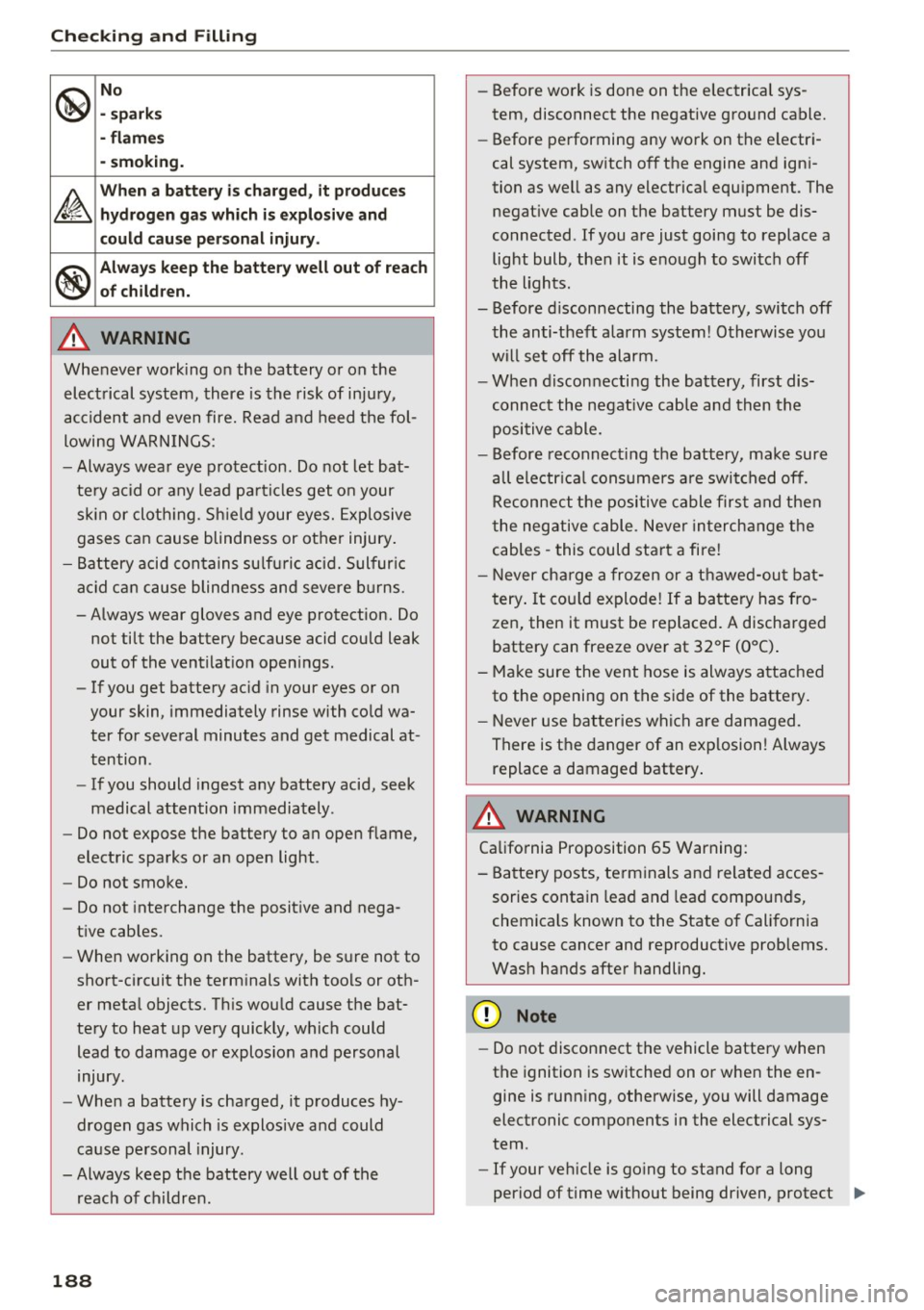
Always heed the following WARNING SYM·
BOLS and safety precautions when working on
the battery.
®
Always wear eye protection.
A
Battery acid contains sulfuric acid. Al-
ways wear gloves and eye protection .
187
Page 190 of 252
Check ing and F illing
@
No
- sp ark s
- flam es
- smoking.
£
When a bat tery is charg ed, it produc es
hydr og en gas which i s ex plo sive and
could c aus e pe rs onal injury .
®
Alwa ys keep the b atter y well out of reach
of chil dren.
A WARNING
Whenever work ing on the battery or on the
elect rical system, there is the risk of injury,
accident and
even fire. Read and heed the fol
lowing WARN INGS :
- Always wea r eye protection. Do not let bat
te ry acid or any lead pa rticles get on your
sk in or cloth ing . Sh ield your eyes. Explosive
gases can cause blindness or other injury .
- Battery acid con tains su lfu ric acid. Sulfur ic
acid c an cause blindness and
severe bu rns.
- Always wear gloves and eye protection. Do
no t tilt the battery because acid could leak
out of the ventilat ion open ings .
- If you get battery ac id in your eyes or on
your skin, immediately rinse with cold wa
ter for several minutes and get medical at tention .
- If you should ingest any battery acid, seek
medical attention immediately .
- Do not expose the battery to an open flame,
electric sparks or an open light .
- Do not smoke.
- Do not interchange the positive and nega-
t ive cables.
- When working on the battery, be sure not to
short-circuit the term inals with tools or oth
er metal objects. Th is wou ld cause the bat
tery to heat up very quickly, which could
lead to damage or explosion and personal
injury .
- When a battery is charged, it produces hy
drogen gas which is explosive and could
ca use personal injury.
- Always keep the battery well out of the reach of ch ildre n.
188
-
-Before wo rk is done on the electrical sys
tem, disconnect the negative gro und cable.
- Before performing any work on the e lectri
cal system, switch off the engine and ign i
tion as well as any electrical equ ipment . The
negat ive cab le on the battery must be dis
connected . If you are just going to replace a
light bulb, then it is enough to switch off
the lights.
- Before d isconnecting the battery, switch off
the an ti-theft alarm system! Otherwise you
will set off the alarm.
- When disconnecting the battery, first dis
connect the negative cab le and then the
positive cable.
- Before reconnect ing the battery, make sure
all electr ica l consume rs a re switched off .
Reconnect the positive cable firs t and then
the negative cable . Never in terch ange t he
cables -this could sta rt a fire!
- Never cha rge a frozen or a thawed-ou t bat
tery . It cou ld explode ! If a ba ttery has fro
zen, then it must be replaced. A discharged
battery can freeze over at 32°F (0°C) .
- Make sure the
vent hose is always attached
to the opening on the side of the battery .
- Never use bat ter ies which are damaged.
There is the danger of an exp losion! Always
replace a damaged battery .
A WARNING
Califo rnia Proposition 65 Warning :
- Ba tte ry posts, te rm inals and related acces
sories contain lead and lead compounds,
chemicals known to the State o f Cali fornia
to cause cancer and reproductive problems.
Wash hands after handling.
(D Note
- Do not disconnect the vehicle battery when
the ignition is switched on or when the en
gine is running, otherwise, you will damage
electronic components in the electrical sys
tem .
- If your veh icle is go ing to stand for a long
period of time w ithout being driven, protect ..,.
Page 191 of 252
.... N
c:i ::J CX)
.... I.Cl U"I
N I.Cl ......
the battery from "freez ing", otherwise it
will be damaged a nd will then have to be re
placed .
Battery charging
Starting the engine requires a well charged bat
tery.
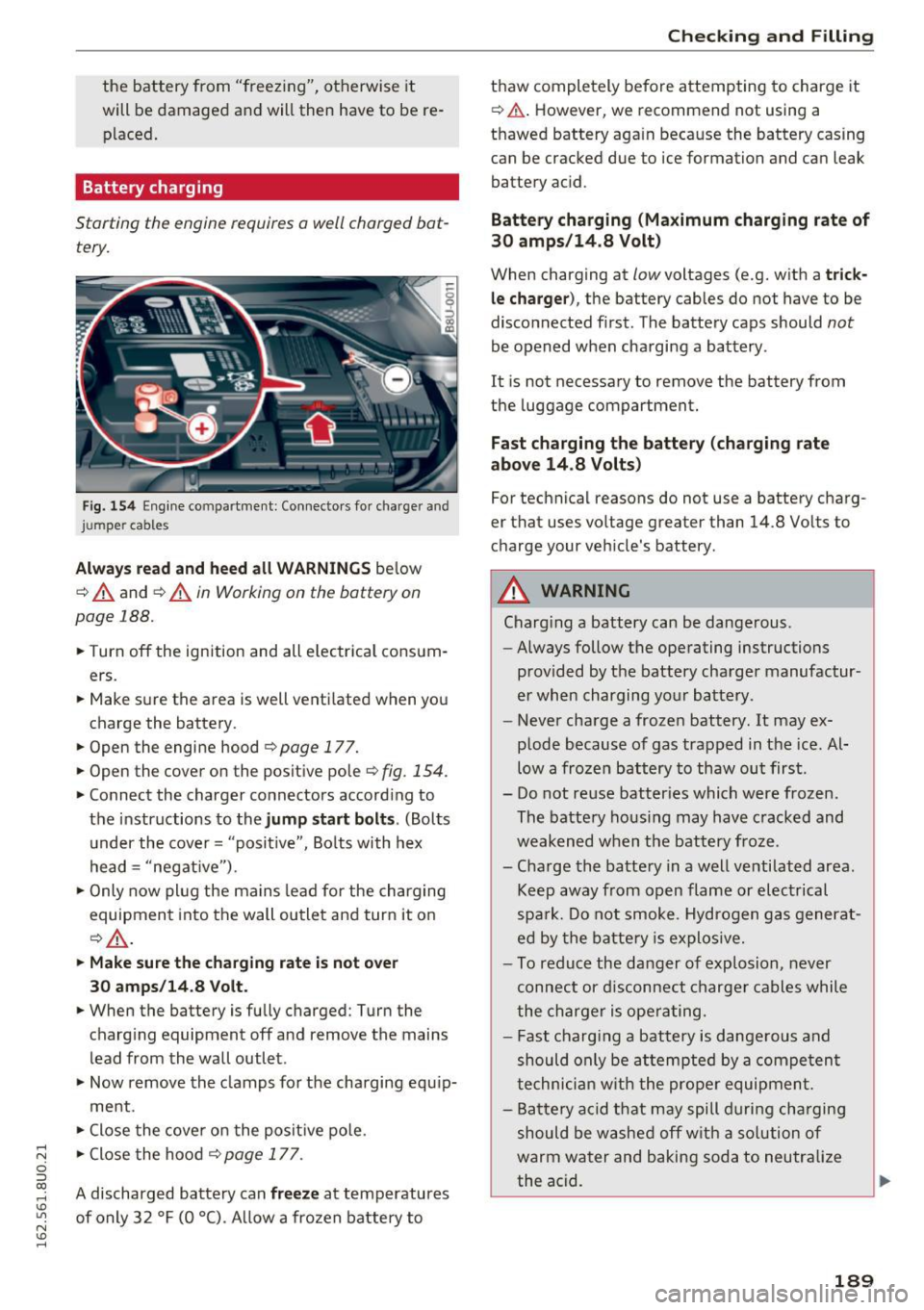
Fi g. 1S 4 Engine co mpartme nt: Connectors fo r charger and
j u mpe r cables
Alwa ys read and heed all WARNINGS be low
¢ A and ¢ A in Working on the battery on
page 188.
.. Turn off the ignition and all e lectrical consum
ers.
.. Make s ure the area is well venti lated when yo u
charge the battery.
.. Open the engine hood
¢ page 177.
.. Open the cover on the posit ive pole ¢
fig. 154.
.. Connect the charger co nnectors accord ing to
the instructions to the
jump start bolt s. (Bolts
u nder the cove r= "posit ive", Bo lts with hex
head= ''negat ive").
.,. Only now pl ug the mains lead for the charging
equipment into the wall ou tlet and turn it on
¢ .,&. .
.. Make sure the ch arging rate is not over
30 amp s/14.8 Volt.
.. When the battery is fully charged: Turn the
charging equipment off and remove the mains
lead from the wall outlet .
.,. Now remove the clamps fo r the charging equ ip-
me nt.
.. Close the cove r o n t he posit ive pole.
.. Close the hood
¢ page 177.
A discharged ba ttery can
fre eze at temperatures
of only 32 °F (0 °C) . A llow a frozen batte ry to
Checking and Filling
thaw completely before a ttempting to charge it
¢ & . However, we recommend not using a
thawed battery aga in beca use the battery casing
can be cracked due to ice formation and can leak
battery ac id .
Battery charging (Maximum charging rate of
30 amps /14 .8 V olt)
When charging at /ow voltages (e.g. w ith a t ric k
le charge r),
the battery cables do not have to be
disco nnected f irst . The battery caps should
not
be opened when charging a battery .
It is not necessa ry to remove the battery from
the luggage compartment.
Fa st charging the batt ery (cha rging rate
above 14 .8 Volt s)
For technical reasons do not use a battery charg
er that uses vo ltage greater than 14.8 Volts to
charge your veh icle's battery .
A WARNING
-
Charging a battery can be dange rous.
- Always follow the operating instructions
provided by t he battery cha rge r manufactur
er when charging yo ur battery .
- Never charge a frozen battery. It may ex
p lode because of gas trapped in the ice. Al
low a froze n battery to thaw out first .
- Do not reuse batteries which were frozen .
The batte ry hous ing may have c racked and
weakened when the battery froze .
- Charge the battery in a well ve ntilated area .
Keep away from open flame or electrical
spa rk. Do not smoke . Hydrogen gas generat
ed by the batte ry is explos ive.
- To reduce the danger of exp losion, never
connect or d isconnect charge r cables while
t he charger is ope ra ting.
- F ast charg ing a battery is d ange rous and
should only be at tempted by a competen t
technici an with the prope r equipmen t.
- Ba ttery a cid that may spill duri ng cha rging
should be washe d off w it h a so lution of
warm water and baking soda to neutra lize
the acid.
189