battery AUDI Q3 2016 Owner's Manual
[x] Cancel search | Manufacturer: AUDI, Model Year: 2016, Model line: Q3, Model: AUDI Q3 2016Pages: 252, PDF Size: 62.81 MB
Page 192 of 252
Check ing and F illing
CJ) Note
Never use a fast charger as a booster to start
the engine . This will serious ly damage sensi
tive electronic components, such as control
units, relays, radio, etc., as well as the battery
charger.
Battery replacement
The new battery must have the same specifica
tions and dimensions as the original equipment
battery .
Intelligent energy management in your vehicle is
responsible for distributing the electrical energy
throughout your vehicle
¢ page 157. The intelli
gent energy management system wi ll keep the
engine battery charged better then veh icles w ith
out this system. To make sure the addit ional
e lectrica l energy is available once again after you
have changed the battery, we recommend that
you install batteries of the same type and manu
facture only (the same as those installed at the
time your veh icle was delivered). Specifications
are listed on the battery housing. Your author
ized Audi dealer must code the battery in the en
ergy management system to enable you to use
the energy manageme nt functions correctly after
replacing the battery.
If it is not possible to use a battery of this type,
the new battery must have the same capacity,
voltage (12-volts), amperage, construction and p lug sealing.
When installing the battery, make sure the igni
tion and all electrical consumers are turned off.
@ Note
Make sure the ventilation hose on the side of
the battery is connected, otherw ise fumes or
battery acid can leak out.
@ For the sake of the environment
Because of the problem of proper disposal of
a battery, we recommend your authorized
Audi dea ler change the battery for you. Bat
teries contain sulfuric ac id and lead and must
always be disposed of properly in compliance
190
with all environmenta l regulations. Disposing
of vehicle batteries improperly is very danger
ous to the environment.
Windshield washer system
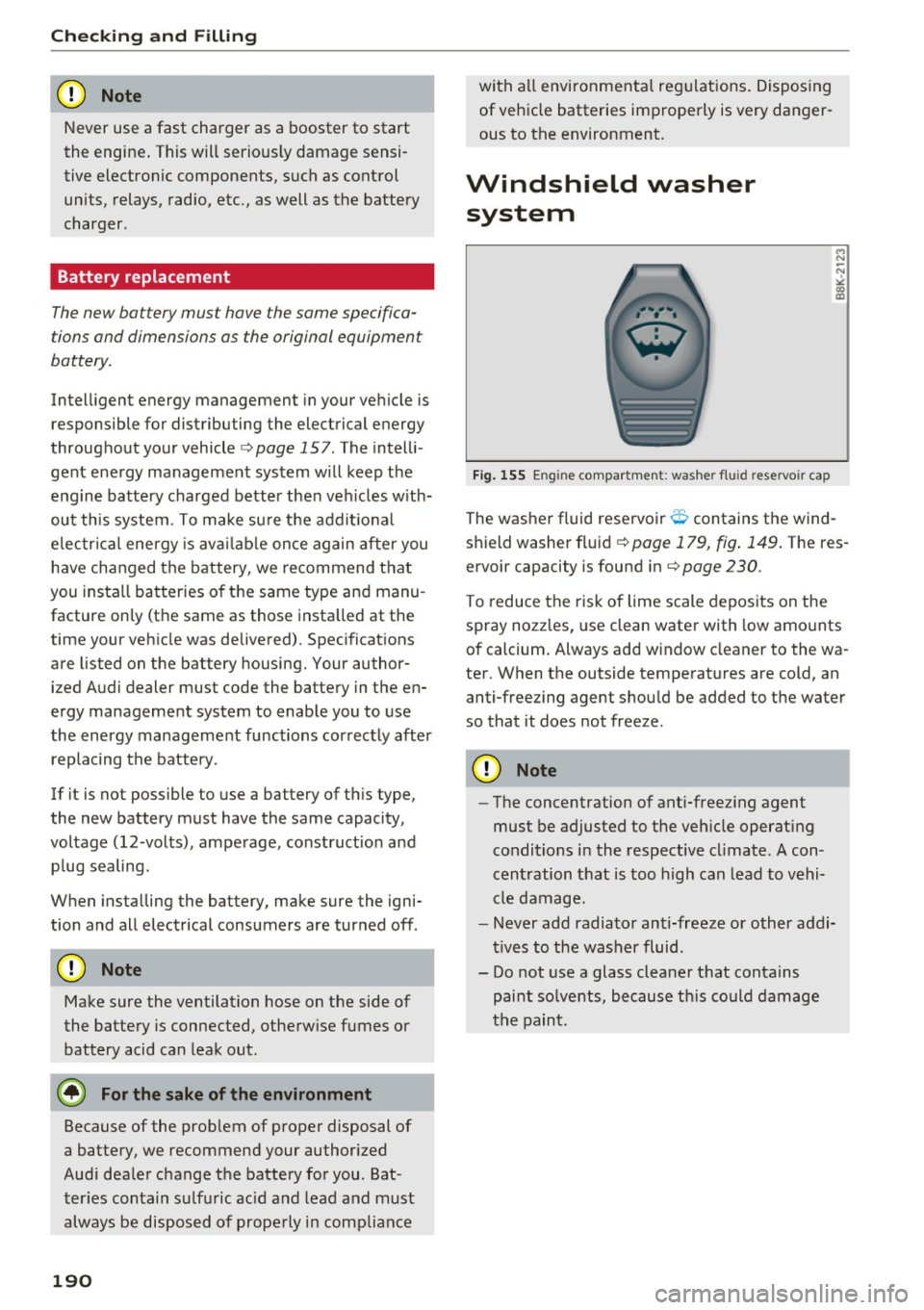
Fig. 155 Eng ine compartment: washe r fluid reservoir cap
M N
-N ,.:
"' m
The washer fluid reservoir O contains the wind
shield washer flui d¢
page 179, fig. 149. The res
ervoir capacity is found in
¢ page 230.
To reduce the risk of lime scale depos its on the
spray nozzles, use clean water with low amounts
of calcium . Always add window cleaner to the wa
ter. When the outside temperatures are cold, an
anti-freez ing agent shou ld be added to t he water
so that it does not freeze .
(D Note
-The concentration of anti-freezing agent
must be adjusted to the vehicle operating
conditions in the respective climate. A con
centration that is too high can lead to vehi
cle damage.
- Never add radiator anti-freeze or other addi
t ives to the washer fluid.
- Do not use a glass cleaner that contains
paint solvents, because th is could damage
the paint.
Page 197 of 252
... N 0 ::,
~
...
'° V, N
'° ...
(a) Curb weight
(b) Accessory weight
(c) Vehicle capacity weigh t, and
(d) Production options we ight
Ma ximum (permissible)
inflation pressure
means the maximum cold infla
tion pressure to which a t ire may
be inflated. Also called "maxi
mum inflation pressure."
Normal occupant weight
means 150 lbs. (68 kilograms)
times the number of occupants
seated in the veh icle up to the to
tal seating capacity of your vehi c le.
Occupant distribution
means distribution of occupants
in a vehicle.
Outer diameter
means the overall diameter of an
inflated new tire.
Overall width
means the linear distance be
tween the exteriors of the side
walls of an inflated tire, including
elevations due to labeling, deco
rations, or protective bands or
ribs .
Wheels
Ply
means a layer of rubber-coated
parallel cords .
Production options weight
means the combined weight of
those installed regular production
options weighing over 5 lbs. (2.3 kg) in excess of those standard
items which they replace, not pre
viously considered in curb weight
or accessory weight, including
heavy duty brakes, ride levelers,
roof rack, heavy duty battery, and
special trim .
Radial ply tire
means a pneumatic tire in which
the ply cords that extend to the beads are laid at substantially 90
degrees to the centerline of the
tread.
Recommended inflation
pressure
see ~ page 194, Cold tire infla
tion pressure .
Reinforced tire
means a tire designed to operate
at higher loads and at higher in
flation pressures than the corre sponding standard tire. Rein
forced tires may be identified as .,.
195
Page 223 of 252
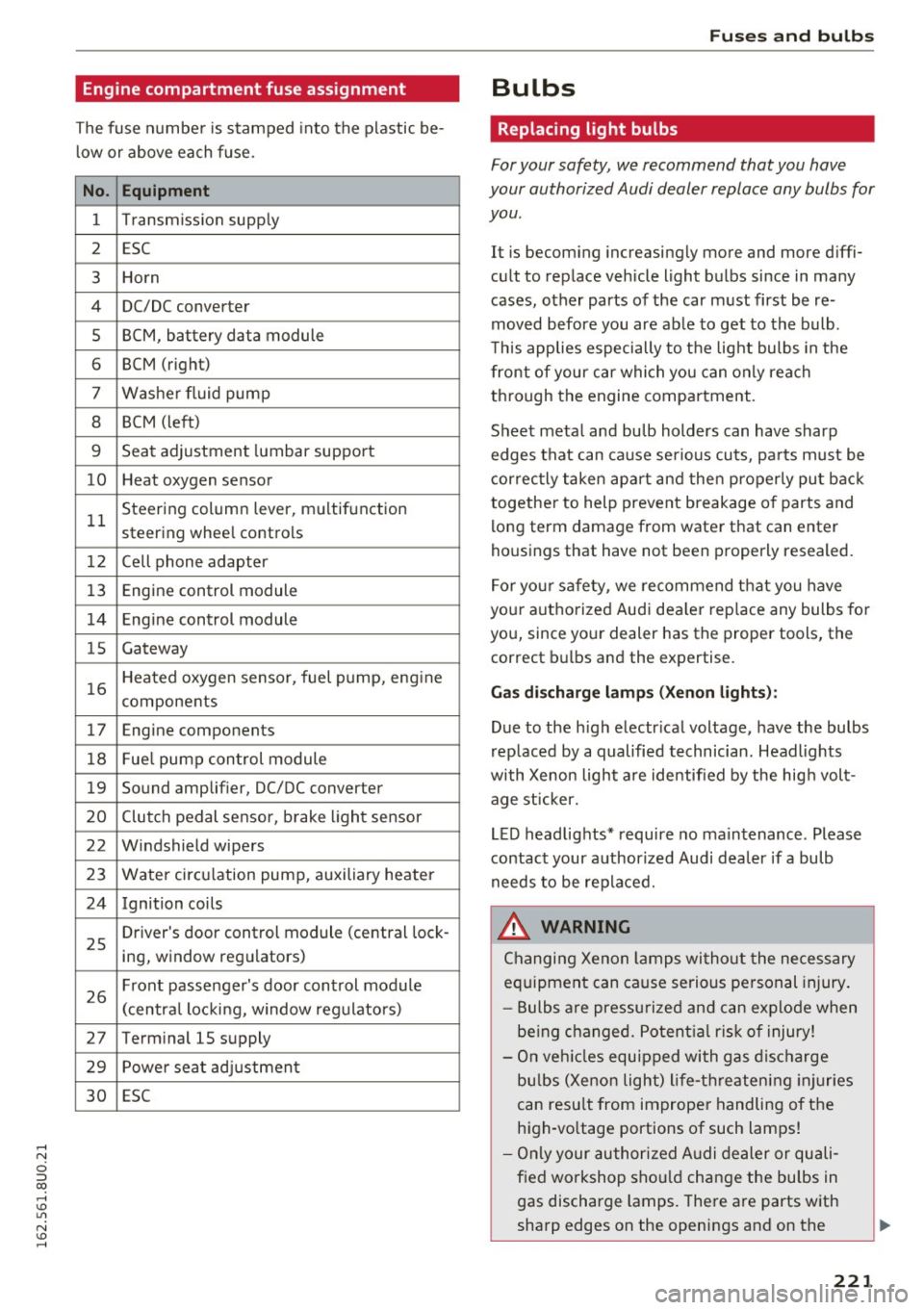
Engine compartment fuse assignment
The fuse number is stamped into the plastic be
low or above each fuse.
No. Equipment
1 Transmiss ion supply
2 ESC
3 Horn
4 DC/DC
converter
5 BCM, battery data module
6 BCM (right)
7 Washer fluid pump
8 BCM (left)
9 Seat adjustment lumbar support
10 Heat oxygen sensor
11 Steering
column lever, multifunction
steering wheel contro ls
1 2 Cell phone adapter
13 Engine control
module
14 Engine control module
15 Gateway
16 Heated oxygen sensor, fuel pump,
engine
components
17 Engine components
18 Fue l pump control module
19 Sound
amplifier, DC/DC converter
20 Clutch pedal sensor, brake light sensor
22 Windshield wipers
23 Water circu
lation pump, auxiliary heater
24 Ignition coils
25 Driver's door
control module (central lock-
ing, window regu lators)
26 Front
passenger's door control module
(centra l locki ng, window reg ulators)
27 Terminal 15 supply
29 Powe r seat adjustment
30 ESC
Fuses an d bulb s
Bulbs
Replacing light bulbs
For your safety, we recommend that you have
your authorized Audi dealer replace any bulbs for
you .
It is becoming increasingly more and more diffi
cult to replace vehicle light bulbs since in many
cases, other parts of the car m ust first be re
moved before you are able to get to the bulb .
T his applies especially to the light bulbs in the
front of your car which you can only reach
through the engine compartment .
Sheet metal and bu lb holders can have sharp
edges that can cause serious cuts, pa rts must be
correctly taken apart and then properly put back
together to help prevent breakage o f parts and
long term damage from water that can enter
housings that have not been properly resealed.
For your safety, we recommend t hat you have
your authorized Aud i dea le r rep lace any bulbs fo r
you, since your dealer has the proper tools, the
correct bulbs and the expertise.
Gas di schar ge la mps (Xe no n light s):
Due to the high electr ical voltage, have the bulbs
rep laced by a qualified technician. Headlights
with Xenon light are identified by the hig h volt
age st icker.
LED headlights* require no maintenance . Please
contact your authorized Audi dea ler if a bulb
needs to be replaced.
_&. WARNING
Changing Xenon lamps wi thout the necessary
equipment can cause serious personal injury .
- Bulbs are pressu rized and can explode when
be ing changed. Potent ial ris k of injury!
- On veh icles equipped with gas disc harge
bu lbs (Xenon light) life-threatening injuries
can resu lt from improper handling of the
high-vo ltage portions of such lamps!
- Only your authorized A udi dealer or quali
fied workshop sho uld change the bulbs in
gas discharge lamps. There are parts with
sharp edges on the openings and on the
221
Page 225 of 252
Emergency situations
General
This chapter is intended for trained emergency
crews and working personnel who have the nec
essary tools and equipment to perform these
operations.
Starting by pushing or
towing
(D Note
Vehicles with an automatic transmission
cannot be started by pushing or towing.
Starting with jumper
cables
If necessary, the engine can be started by con
necting it to the battery of another vehicle .
If the engine should fail to start because of a dis
charged or weak battery, the battery can be con
nected to the battery of
another vehicle, using a
pair of jumper cables to start the engine.
Jumper cables
Use only jumper cables of sufficiently large cross
section
to carry the starter current safely. Refer
to the manufacturer's specifications.
Use only jumper cables with
insulated terminal
clamps which are distinctly marked :
plus(+) cable in most cases colored red
minus(·) cable
in most cases colored black.
A WARNING
Batteries contain electricity, acid, and gas.
Any of these can cause very serious or fatal in
jury. Follow the instructions below for safe
handling of your vehicle's battery.
-Always shield your eyes and avoid leaning
over the battery whenever possible.
-A discharged battery can freeze at tempera
tures just below 32 °F (0 °C). Before con
necting a jumper cable, you must thaw the
Emergency situations
frozen battery completely, otherwise it
could explode .
- Do not allow battery acid to contact eyes or
skin. Flush any contacted area with water immediately.
- Improper use of a booster battery to start a
vehicle may cause an explosion.
- Vehicle batteries generate explosive gases.
Keep sparks, flame and lighted cigarettes
away from batteries.
- Do not try to jump start any vehicle with a
low acid level in the battery .
- The voltage of the booster battery must also
have a 12-Volt rating. The capacity (Ah) of
the booster battery should not be lower
than that of the discharged battery. Use of
batteries of different voltage or substantial
ly different "Ah" rating may cause an explo
sion and personal injury .
- Never charge a frozen battery. Gas trapped
in the ice may cause an explosion.
- Never charge or use a battery that has been
frozen . The battery case may have be weak
ened .
- Use of batteries of different voltage or sub
stantially different capacity (Ah) rating may
cause an explosion and injury. The capacity
(Ah) of the booster battery should not be
lower than that of the discharged battery.
- Before you check anything in the engine
compartment, always read and heed all
WARNINGS
r::!)page 177.
(D Note
-Applying a higher voltage booster battery
will cause expensive damage to sensitive
electronic components, such as control
units, relays, radio, etc.
- There must be no electrical contact between
the vehicles as otherwise current could al
ready start to flow as soon as the positive
(+) terminals are connected.
(D Tips
- The discharged battery must be properly
connected to the vehicle's electrical system. ..,.
223
Page 226 of 252
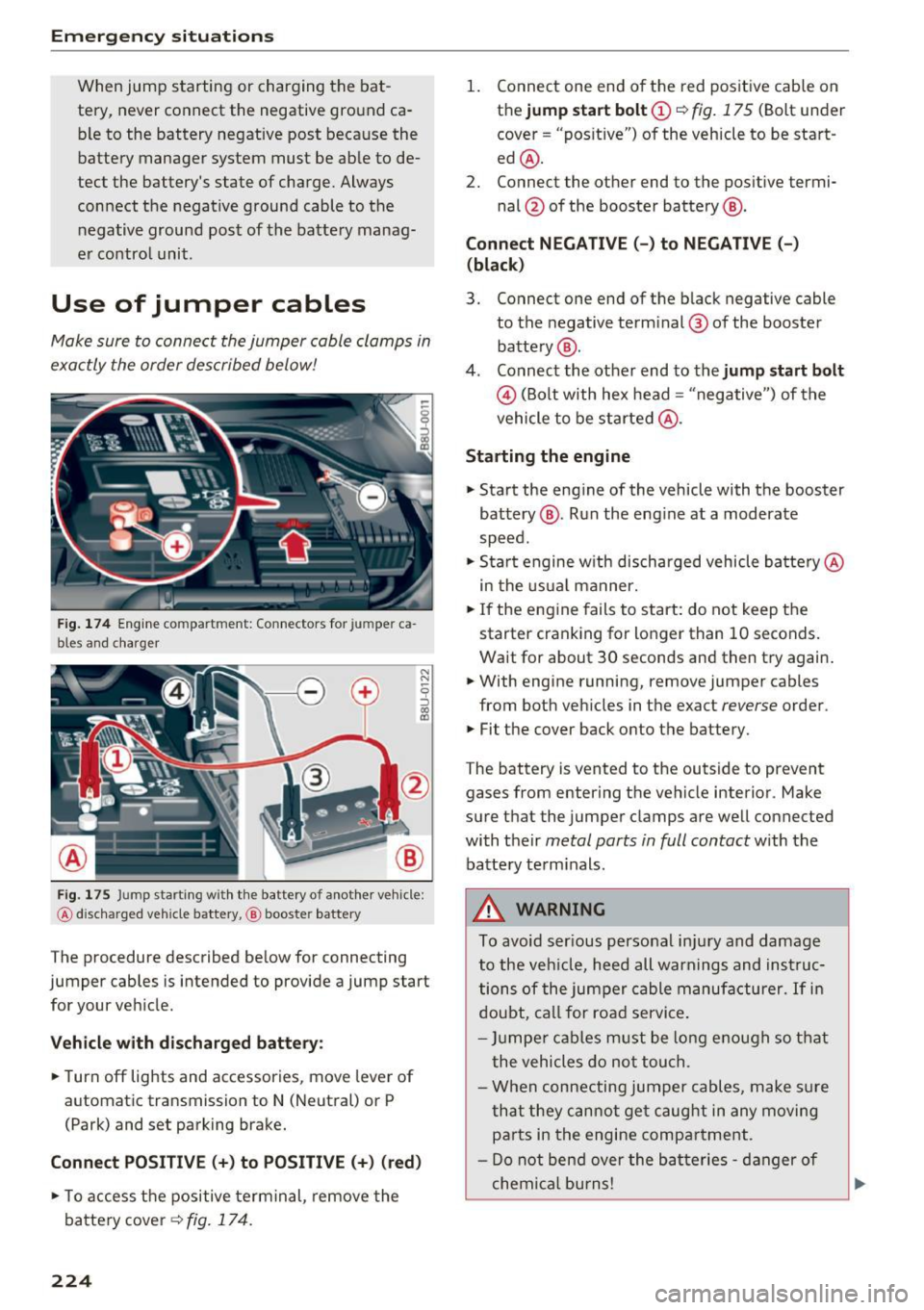
Emergency situations
When jump starting or charging the bat
tery, never connect the negative ground ca
ble to the battery negative post because the
battery manager system must be able to de
tect the battery's state of charge. Always
connect the negative ground cable to the
negative ground post of the battery manag
er contro l unit.
Use of jumper cables
Make sure to connect the jumper cable clamps in
exactly the order described below!
F ig . 1 74 Engine compar tment: Connectors for jumper ca
bles and charger
N N ~ 9 ::, 00 CXl
F ig. 175 Jump starti ng wit h the battery of another veh icle:
@ discharged vehicle battery,@booster battery
The procedure described below for connecting
jumper cables is intended to provide a jump start for your vehicle.
Vehicle with discharged battery:
• Turn off lights and accessories, move lever of
automatic transmission to N (Neutral) or P
(Park) and set parking brake.
Connect POSITIVE (+) to POSITIVE (+) (red)
• To access the positive terminal, remove the
battery cover
c::> fig. 17 4.
224
1. Connect one end of the red pos itive cable on
the
jump start bolt (D c::> fig. 175 (Bolt under
cover= "positive") of the vehicle to be start
ed @.
2. Connect the other end to the positive termi-
nal @ of the booster battery @.
Connect NEGATIVE (- ) to NEGATIVE (-)
(black)
3. Connect one end of the black negative cable
to the negative term inal @ of the booster
battery @.
4. Connect the other end to the
jump start bolt
@ (Bolt with hex head = "negative") of the
vehicle to be started @.
Starting the engine
• Start the eng ine of the vehicle with the booster
battery @. Run the eng ine at a moderate
speed.
• Sta rt engine w ith discharged vehicle ba ttery @
in the usual manner.
• If the engine fails to start: do not keep the
starter cranking for longer than 10 seconds.
Wait for about 30 seconds and then try again.
• With engine running, remove jumper cables
from both vehicles in the exact
reverse order.
• Fit the cover back onto the battery.
The battery is vented to the outside to prevent
gases from entering the vehicle interior . Make
sure that the jumper clamps are well connected
with their
metal parts in full contact with the
battery terminals.
&_ WARNING
To avoid ser ious personal injury and damage
to the vehicle, heed all warnings and instruc
tions of the jumper cable manufacturer. If in
doubt, call for road service.
- Jumper cables must be long enough so that
the vehicles do not touch .
- When connecting jumper cables, make sure
that they cannot get caug ht in any moving
parts in the engine compartment.
- Do not bend over the batteries - danger of
chemical burns!
Page 227 of 252
.... N
c:i ::J CX)
.... I.Cl U"I
N I.Cl ......
-The battery cell lock ing screws must be
t ightened secure ly.
- Befo re yo u check anything in the en gine
compartment, a lways read and heed a ll
WARNINGS
¢ page 177.
(D Note
Imp ro per hook -u p of jum pe r cables can r uin
the gene rato r.
-Always con nect POSIT NE
(+ ) to POSITI VE
(+ ), and NEGATIVE( -) to NEGATIVE( -)
ground post of the battery manager contro l
u nit .
- Check that all sc rew p lugs on the batter y
ce lls are screwed in firmly . If not, t ighten
pl ugs prior to connecting clamp on negative
batte ry te rminal.
- Please note t hat the procedure fo r con nect
i ng a jumper cab le as desc ribed above ap
p lies specif ica lly to the case of yo ur vehicle
being jump start ed. Wh en you are giv ing a
ju mp sta rt to anothe r vehicle, do
not con
n ec t t he neg ative (-) ca b le to the negative
( -) t ermina l on the disch arged b attery @
¢
fig. 175. In ste ad , secure ly connec t the
negative( -) ca b le to either a solid me tal
com ponent th at is f irm ly bolted to the e n
gine block o r to t he engine block i tsel f. If
the battery that is be ing c ha rged does not
vent to the outs ide, escap ing batte ry ga s
could ignite and exp lode!
Towing with a tow truck
General hints
Your Audi requires s pecial handling for towing .
The following informa tion is to be used by com
mercia l tow tr uck operators who know how to op
e ra te the ir equip men t safely.
- Ne ver tow your Audi, towing will cause dam
age to the engine and transmission .
- Never wrap the safety chains or winch cables
around the brake lines.
- To prevent unnecessary damage, your Audi
must be transported with a flat bed truck .
Emergency situations
-To load the vehicle on to the flat bed , use the
towing loop found in the vehicle tools and at
tach to the front or rear anchorage
¢ page 225 and ¢ page 226.
A WARNING
A veh icle being towed is not safe for passen
ge rs. Neve r allow a nyo ne to ride in a vehicle
b eing towed, for any reason .
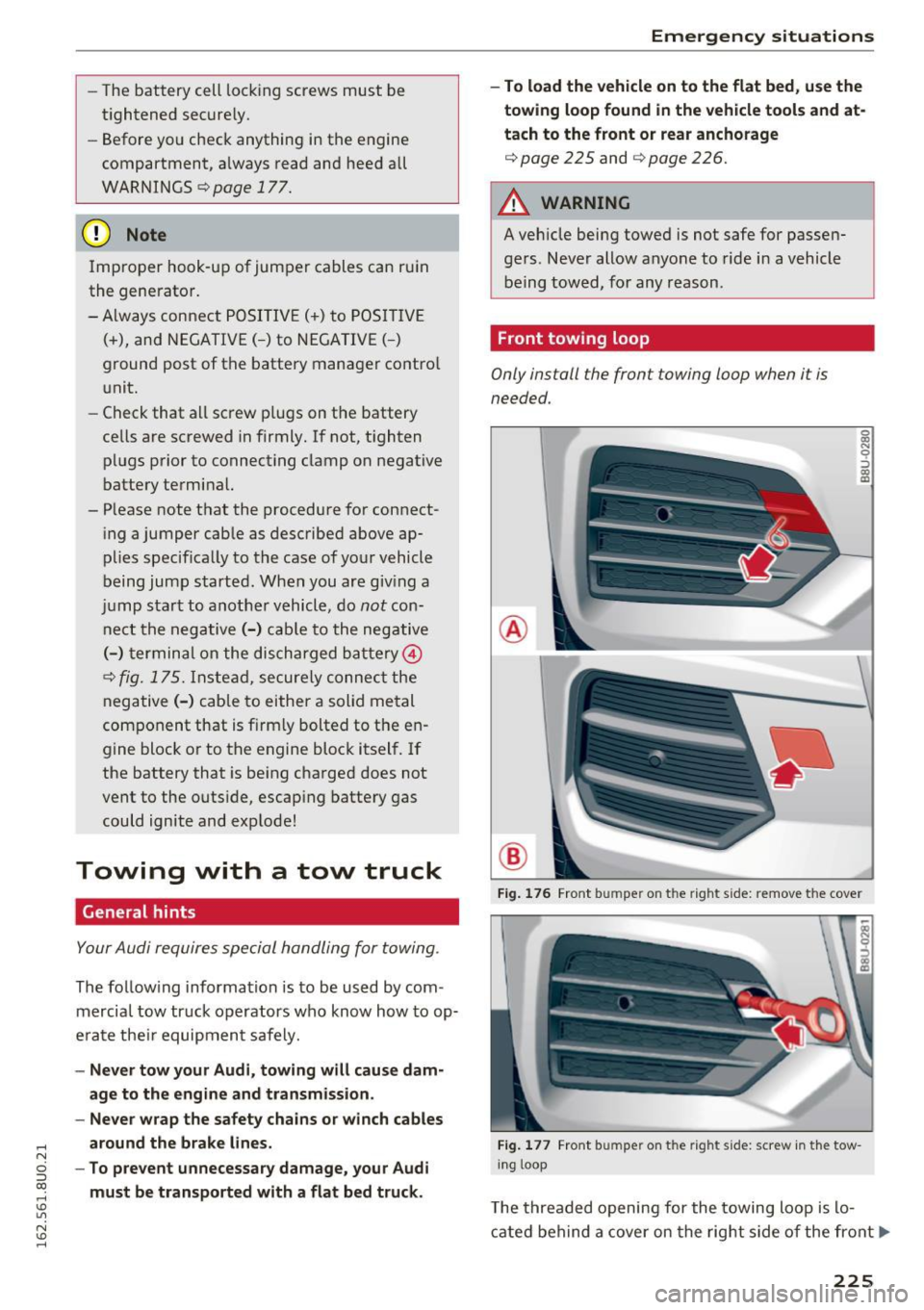
Front towing loop
Only ins tall the front towing loop when i t is
needed .
®
®
-
0 0) N 9 ::>
gi
Fig. 176 Front bum pe r o n th e rig "h t side : remove t he co ver
Fi g. 177 Fron t bum per o n th e right sid e: screw in t he tow
in g loop
The threaded opening for the towing loop i s lo
cate d be hind a cove r on t he rig ht side of the front .,.
225
Page 231 of 252
.... N
c:i ::J CX)
.... I.Cl U"I
N I.Cl ....
Technical data
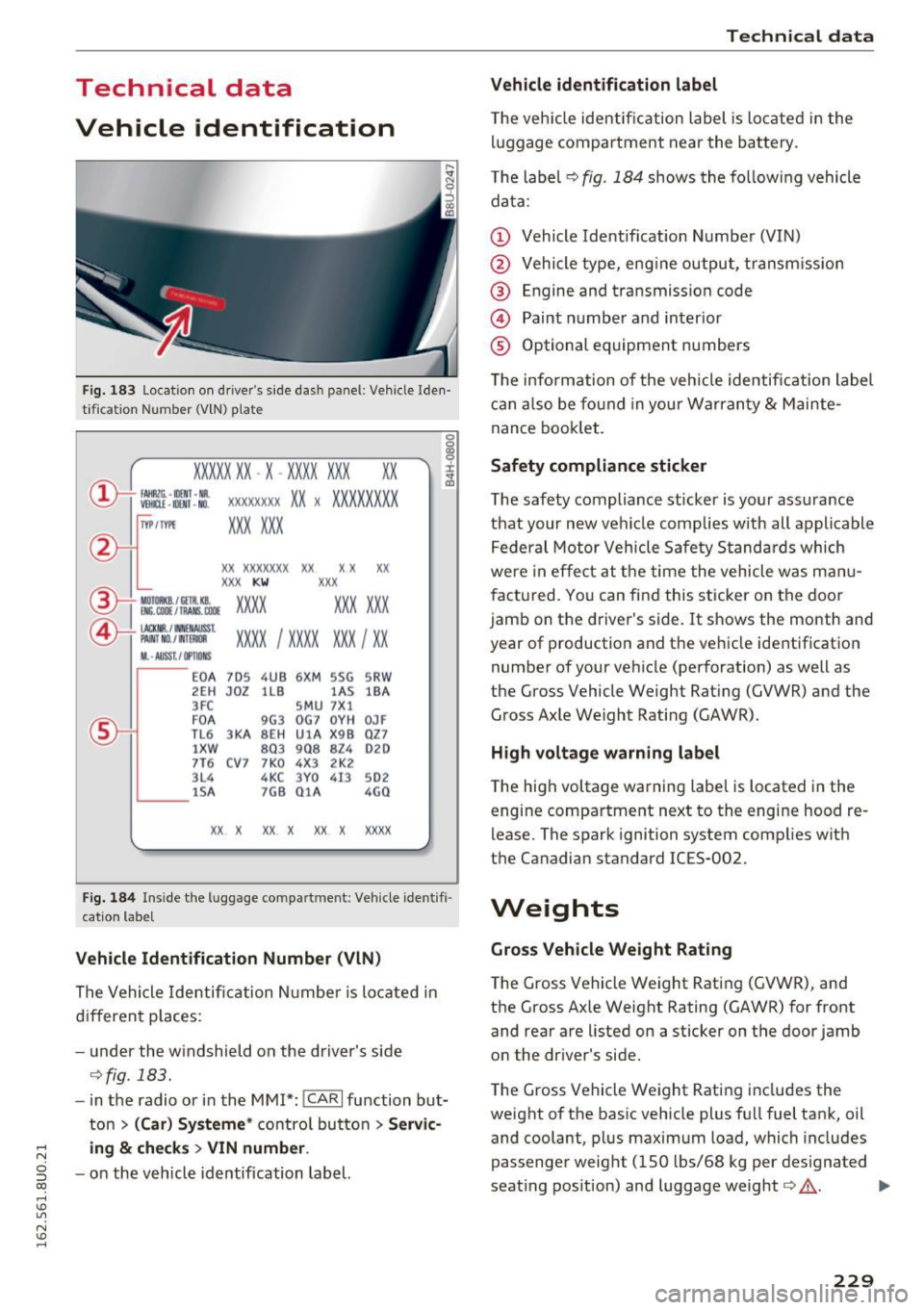
Vehicle identification
F ig. 183 Location on d river 's side dash panel: Vehicle Iden·
ti fic ation Number (VlN) p late
XXXXX XX -X -XXXX XXX XX
CD+ ~t :1:: xxxxxxxx xx x xxxxxxxx
TVP/fffl XXX XXX
XX XXXXXXX XX X X xx
XXX KW XXX
®i ~:J·f lfils~~ XXXX XXX XXX
®-+ ~N:a=i~l xxxx ; xxxx xxx ; xx
II. · AUSS, I OPTIONS
,__ __
EO A 7D5
2EH J0Z
3FC
FOA
TL6 3KA
lXW
7T6 CV7
3L4
lSA
4UB 6XM 5SG
llB l AS
SMU 7Xl
9G3 0G7 0YH
8EH
Ul A X 98
803 908 824
7K0 4X3 2K2
4KC 3Y0 413
7GB 01A
5RW
18 A
0JF
Q Z7
020
502
4G0
XX . X XX X XX X XXXX
Fig. 184 Inside the luggage compartment: Vehicle identifi
cat ion labe l
Veh icle Identification Number (VlN )
The Vehicle Identification Number is located in
different p laces :
- under the windshield on the driver's side
¢ fig . 183.
-in the radio or in the MMI*: !CARI function but
ton
> ( Car ) Systeme * control button > Servic
ing
& checks > VIN number .
-on the vehicle identification label.
Technical data
Vehicle identification label
The veh icle identification label is located in the
luggage compartment near the battery.
T he label¢
fig. 184 shows the following vehicle
data:
(D Vehicle Identification Number (VIN)
@ Vehicle type, eng ine output, transm ission
@ Engine and transmission code
@ Paint number and interior
® Optional equipment numbers
T he information of the veh icle identification label
can also be found in your Warranty
& Mainte
nance booklet.
Safety compliance sticker
The safety compliance sticker is your assurance
that your new vehicle complies w ith all applicable
Federal Motor Vehicle Safety Standards which
were in effect at the time the vehicle was manu
factured. You can find this sticker on the door
jamb on the driver 's side. It shows the month and
year of production and the vehicle identification number of your vehicle (perforation) as well as
the Gross Vehicle Weight Rat ing (GVWR) and the
Gross Axle Weight Rating (GAWR).
H igh voltage warning label
The high voltage warning label is located in the
engine compartment next to the engine hood re
lease. The spark ignition system complies with
the Canadian standard ICES-002.
Weights
Gross Vehicle Weight Rating
The Gross Vehicle Weight Rating (GVWR), and
the Gross Axle Weight Rating (GAWR) for front
and rear are listed on a sticker on the door jamb
on the driver 's side.
The Gross Vehicle Weight Rating includes the
weight of the basic vehicle plus full fuel tank, oil
and coolant, plus maximum load, which includes
passenger weight (150 lbs/68 kg per des ignated
seating position) and luggage weight
c:> .&, . .,.
229
Page 238 of 252
Index
A
A/C (a utomat ic cl imate contro l system) . . . . 65
A/C (manua l cl imate contro l system) . . . . . . 63
Accessories .. .. .. .... .. ....... .... 53,234
Adap tive dampe rs . . . . . . . . . . . . . . . . . . . . . . 80
Adapt ive dampers ( indicator light) . . . . . . . . 18
Adapt ive Light (defective) . . . . . . . . . . . . . . . 1 8
Adding Eng ine coolant .. ............. .... .. .
E ng ine oi l .. .. .. .. . ... ... .... .. .. .. .
Addit ional accessories
Additives 184
18
1
234
Eng ine oil . . . . . . . . . . . . . . . . . . . . . . . . . . 181
Ad justab le s teer ing colum n . . . . . . . . . . . . . . 67
Ad justi ng
Steer ing colum n . . . . . . . . . . . . . . . . . . . . . . 67
Adj usting the center conso le lighting . . . . . . 43
A irbag .... .. .. .... .... · · · · · · · · · · · · · · 1
12
W arning/indi cator lights . . . . . . . . . . . . . . . 16
Airbag system .... .. ........ ...... ... .
Advanced Airbag-System .......... ... .
Advanced Airbag System components .. .
Ca re .... .. .. ............... .... .. .
Ch ildren . .. .. .. .. . .......... .. .. .. . 1
27
116
1 18
125
133
Ch ild rest raints . . . . . . . . . . . . . . . . . . . . . 134
Components (front airbags) . . . . . . . . . . . 118
Danger of fitting a child safety seat on the
front passenger seat . . . . . . . . . . . . . . . . . 113
Disposal . . . . . . . . . . . . . . . . . . . . . . . . . . . 125
Front airbags . .................. 116, 117
H ow do the front airbags work? . . . . . . . . 120
H ow many airbags does my vehicle have? 118
H ow the Advanced A irbag System compo-
nents work together . . . . . . . . . . . . . . . . . 120
I mportant inform ation . . . . . . . . . . . . . . . 112
I ndicator light . . . . . . . . . . . . . . . . . . . . . . 122
Monitoring . . . . . . . . . . . . . . . . . . . . . . . . . 122
PASSENGER AIR BAG OFF light . . . . . . . . . 122
Repairs . . . . . . . . . . . . . . . . . . . . . . . . . . . . 125
Safety instructions . . . . . . . . . . . . . . . . . . . 124
Side airbags . . . . . . . . . . . . . . . . . . . . . . . . 126
Side curtain airbags . . . . . . . . . . . . . . . . . . 129
We ight-sens ing mat . . . . . . . . . . . . . . . . . 133
When must the system be inspected? . . . 122
All season tires . . . . . . . . . . . . . . . . . . . . . . . 206
All weathe r lights . . . . . . . . . . . . . . . . . . . . . . 39
236
All wheel drive
Alte rna to r
refer to Gene rato r .. .. ............. .. .
Ant i-free ze
Windshie ld washer system . .. .... ... . .
also refer to Engine coolant system .... .
Anti- lock b raking system 156
15
190
1 83
Warn ing/ indicator lights . . . . . . . . . . . . . . . 16
Ant i-Lock Br aking Sys tem . . . . . . . . . . . . . . 151
Ant i- slip regulat io n
War ning/ indicato r ligh ts . . . . . . . . . . . . . . . 16
Anti-Slip Regulation . . . . . . . . . . . . . . . . . . . 151
Ant i-theft systems
E lec tron ic immobilizer. . . . . . . . . . . . . . . . . 32
Armrest . . . . . . . . . . . . . . . . . . . . . . . . . . . . . . 51
Asht ray . . . . . . . . . . . . . . . . . . . . . . . . . . . . . . 53
Audi Se rvice Repair Manuals and Literatu re 232
A UTO
Automat ic climate control system . . . . . . . 65
Automat ic headl igh ts . . . . . . . . . . . . . . . . . 39
Automatic be lt retractor . . . . . . . . . . . . . . . 107
A utomat ic key . . . . . . . . . . . . . . . . . . . . . . . . . 28
Automat ic post-collis ion braking system . . 152
Automatic transmission . . . . . . . . . . . . . . . . . 82
Dr iving tips . . . . . . . . . . . . . . . . . . . . . . . . . . 83
Hill descent control . . . . . . . . . . . . . . . . . . . 85
K ick-down . . . . . . . . . . . . . . . . . . . . . . . . . . . 86
Se lector lever emergency release . . . . . . . . 86
Se lector lever positions . . . . . . . . . . . . . . . . 82
S hi ft ing manually . . . . . . . . . . . . . . . . . . . . 85
Steering wheel with sh ift padd les . . . . . . . . 85
t ipt roni c mode . . . . . . . . . . . . . . . . . . . . . . . 85
Automat ic w ipe/wash system . . . . . . . . . . . . 45
Auto Sa fe ty Hotline . . . . . . . . . . . . . . . . . . . 102
Average consumpt ion . . . . . . . . . . . . . . . . . . . 22
Average speed . . . . . . . . . . . . . . . . . . . . . . . . 22
Avo id dam ag ing t he ve hicle . . . . . . . . . . . . . 159
B
Battery . . . . . . . . . . . . . . . . . . . . . . . . . . 15, 187
Battery lo cat ion insi de the luggage compa rt-
ment..... .. .. .. .. .. ... .... ........ 18 7
Charge leve l . . . . . . . . . . . . . . . . . . . . . . . . 157
Charging . . . . . . . . . . . . . . . . . . . . . . . . . . . 189
Energy managem ent . . . . . . . . . . . . . . . . . 157
Page 239 of 252
Important warnings when working on the
battery . . . . . . . . . . . . . . . . . . . . . . . . . . . .
187
Jump starting . . . . . . . . . . . . . . . . . . . . . . . 223
Replacing the battery . . . . . . . . . . . . . . . . 190
Winter operation . . . . . . . . . . . . . . . . . . . . 187
Working on the battery . . . . . . . . . . . . . . . 187
Before driving . . . . . . . . . . . . . . . . . . . . . . . . . 95
Belt tensioners . . . . . . . . . . . . . . . . . . . . . . . 110
Blended gasoline . . . . . . . . . . . . . . . . . . . . . 173
Blower
Automatic climate control system . . . . . . .
65
Manual climate control system . . . . . . . . . . 63
Booster seats . . . . . . . . . . . . . . . . . . . . . . . . 140
Brake fluid
Changing the brake fluid . . . . . . . . . . . . . .
186
Checking the brake fluid level . . . . . . . . . . 186
Brakes . . . . . . . . . . . . . . . . . . . . . . . . . . . . . . 154
Brake booster . . . . . . . . . . . . . . . . . . . . . . . 154
New brake pads . . . . . . . . . . . . . . . . . . . . . 154
Parking brake . . . . . . . . . . . . . . . . . . . . . . . . 71
Brake system
Brake fluid . . . . . . . . . . . . . . . . . . . . . . . . .
186
Brake fluid specifications for refill and re
placement . . . . . . . . . . . . . . . . . . . . . . . . . 186
Brake light defective . . . . . . . . . . . . . . . . . .
18
Fluid reservoir . . . . . . . . . . . . . . . . . . . . . . 186
Warning/indicator lights . . . . . . . . . . . . . . . 13
Worn brake pads symbol . . . . . . . . . . . . . . . 16
Braking
Brake assist . . . . . . . . . . . . . . . . . . . . . . . .
151
Emergency braking funct ion . . . . . . . . . . . . 73
Starting on inclines . . . . . . . . . . . . . . . . . . . 73
Break-in period
Tires . . . . . . . . . . . . . . . . . . . . . . . . . . . . . .
159
Breaking in . . . . . . . . . . . . . . . . . . . . . . . . . . 159
New tires . . . . . . . . . . . . . . . . . . . . . . . . . . 198
Bulbs . . . . . . . . . . . . . . . . . . . . . . . . . . . . . . . 221
C
California Proposition 65 Warning . . . . . . . 178
Battery specific . . . . . . . . . . . . . . . . . . . . . 188
Capacities . . . . . . . . . . . . . . . . . . . . . . . . . . . 230
Engine oil . . . . . . . . . . . . . . . . . . . . . . . . . . 179
Caps for wheel bolts , removing . . . . . . . . . . 215
Care . . . . . . . . . . . . . . . . . . . . . . . . . . . . . . . . 168
Index
Cargo area
refer to Loading the luggage compart-
ment...... ... .. .. .................
100
Cargo floor . . . . . . . . . . . . . . . . . . . . . . . . . . . 61
Catalytic converter . . . . . . . . . . . . . . . . . . . . 159
Center armrest . . . . . . . . . . . . . . . . . . . . . . . . 51
Centra l locking . . . . . . . . . . . . . . . . . . . . . . . . 27
Central locking sw itch . . . . . . . . . . . . . . . . . 31
Convenience key . . . . . . . . . . . . . . . . . . . . . . 30
Emergency locking . . . . . . . . . . . . . . . . . . . . 32
Luggage compartment lid . . . . . . . . . . . . . . 33
Panorama roof . . . . . . . . . . . . . . . . . . . . . . . 37
Powe r windows . . . . . . . . . . . . . . . . . . . . . . 3 7
Remote control key . . . . . . . . . . . . . . . . . . .
29
Certification . . . . . . . . . . . . . . . . . . . . . . . . . 235
Changing engine oil . . . . . . . . . . . . . . . . . . . 182
Checking
Engine coolant level . . . . . . . . . . . . . . . . . .
183
Child restraints
Danger of using child restraints in the front
seat....... ... .. .. ................ .
113
Where can I get additional information
about child restraints and their use? . . . .
149
Child restraints system anchors. . . . . . . . . . 144
Child safety . . . . . . . . . . . . . . . . . . . . . . . . . .
132
Important safety instructions for using child
safety seats . . . . . . . . . . . . . . . . . . . . . . . .
135
Important th ings to know when driving with
children . . . . . . . . . . . . . . . . . . . . . . . . . . .
132
Installing a child restraint using the LATCH
system . . . . . . . . . . . . . . . . . . . . . . . . . . . .
146
Mounting and re leasing the anchorage
hook . . . . . . . . . . . . . . . . . . . . . . . . . . . . . .
146
Tether anchors . . . . . . . . . . . . . . . . . . . . . . 147
Tether s traps . . . . . . . . . . . . . . . . . . . . . . . 147
Child safety lock
Rear doors . . . . . . . . . . . . . . . . . . . . . . .
35, 36
Child safety seats
Booster seats . . . . . . . . . . . . . . . . . . . . . . .
140
Convertible child seats . . . . . . . . . . . . . . . 138
Convertible locking retractor . . . . . . . . . . 143
Danger of using child restraints in the front
seat...... .... .. .. ............... ..
113
How do I properly install a child safety seat
in my vehicle? . . . . . . . . . . . . . . . . . . . . . . .
135
Infant seats . . . . . . . . . . . . . . . . . . . . . . . . 137
LATCH system . . . . . . . . . . . . . . . . . . . . . . 146
237
Page 241 of 252
Declarat ion of compliance
Au di side assist . . . . . . . . . . . . . . . . . . . . . 23 5
Ce ll phone package . . . . . . . . . . . . . . . . . . 235
Convenience key. . . . . . . . . . . . . . . . . . . . . 235
Cruise contro l . . . . . . . . . . . . . . . . . . . . . . . 235
Electronic immob ilizer . . . . . . . . . . . . . . . . 235
Remo te control key . . . . . . . . . . . . . . . . . . 235
Defective light bulb warning . . . . . . . . . . . . . 18
D efro st ing (windows)
M anual clima te con trol system . . . . . . . . . . 64
Defrost ing (winds hield)
Automatic climate control system . . . . . . . 65
D EF (instrument cluster) . . . . . . . . . . . . . . . . 23
D eter mini ng cor rec t load l imit . . . . . . . . . . 205
Dig ita l compass . . . . . . . . . . . . . . . . . . . . . . . 47
D imensions . . . . . . . . . . . . . . . . . . . . . . . . . . 230
D istance . . . . . . . . . . . . . . . . . . . . . . . . . . . . . 2 2
Doors Chi ld safety lock . . . . . . . . . . . . . . . . . . . 35, 36
Emergency locking . . . . . . . . . . . . . . . . . . . . 32
Door, hood or luggage compartment lid wa rn-
ing ... .. .. .. .. ............. .. .. .... .. 23
D river inform ation syste m . . . . . . . . . . . . . . . 20
E ff ic iency p rogram . . . . . . . . . . . . . . . . . . . . 23
On -board compu ter . . . . . . . . . . . . . . . . . . . 22
Operating using m ultifunction steering
wheel . . . . . . . . . . . . . . . . . . . . . . . . . . . . . . 21
Operating using windshie ld w iper lever . . . 21
Overview . . . . . . . . . . . . . . . . . . . . . . . . . . . . 20
Service interval display . . . . . . . . . . . . . . . . 25
D river seat
refer to Seat ing pos ition . . . . . . . . . . . . . . . 96
D rive se lect . . . . . . . . . . . . . . . . . . . . . . . . . . . 80
I ndica tor ligh t . . . . . . . . . . . . . . . . . . . . . . . 18
Steer ing . . . . . . . . . . . . . . . . . . . . . . . . . . . . 80
Driving offroad . . . . . . . . . . . . . . . . . . . . . . . 162
Driving safe ly . . . . . . . . . . . . . . . . . . . . . . . . . 95
D riving throug h wate r . . . . . . . . . . . . . . . . . 162
Driving t ime . . . . . . . . . . . . . . . . . . . . . . . . . . 22
D ust filte r
refer to Pollutant filter . . . . . . . . . . . . . . . . 62
E
Economical driving . . . . . . . . . . . . . . . . . . . . 160
Index
Efficiency program . . . . . . . . . . . . . . . . . . . . . 23
Fuel economy messages . . . . . . . . . . . . . . . 24
Other equ ipment . . . . . . . . . . . . . . . . . . . . . 24
Overv iew . . . . . . . . . . . . . . . . . . . . . . . . . . . . 23
El ectrome chanical parking b rake
War ning/ indica to r lig hts . . . . . . . . . . . . . . . 14
also refer to Parking b rake . . . . . . . . . . . . . 71
El ectrome chanical steering . . . . . . . . . . . . . 156
I nd icator lig ht . . . . . . . . . . . . . . . . . . . . . . 156
E lectron ic differentia l lock
War ning/ indicator lights . . . . . . . . . . . . . . . 16
E lectron ic Diffe rential Lock . . . . . . . . . . . . . 151
El ectron ic immobilizer . . . . . . . . . . . . . . . . . . 32
E lectron ic power contro l
(EPC) warn ing/ indicator light . . . . . . . . . . . 17
E lectron ic stabilization control
ESC offroad mode . . . . . . . . . . . . . . . . . . . 152
Hill descent assist . . . . . . . . . . . . . . . . . . . 153
El ectron ic St abiliz ati on Contro l . . . . . . . . . . 151
E lectron ic Stabi liza tion Contro l (ESC)
War ning/ indica to r li ghts . . . . . . . . . . . . . . . 16
Emergency f lasher . . . . . . . . . . . . . . . . . . . . . 42
Warning/ indicato r lights . . . . . . . . . . . . . . . 19
E mergency locking fro nt passenge r's door . . 32
E mergency operation
E mergency b raking function . . . . . . . . . . . . 73
Front passenger 's doo r . . . . . . . . . . . . . . . . 32
F uel fi lle r doo r . . . . . . . . . . . . . . . . . . . . . . 176
L uggage comp artmen t lid . . . . . . . . . . . . . . 35
Panorama roo f . . . . . . . . . . . . . . . . . . . . . . . 38
Sun shade (roof) . . . . . . . . . . . . . . . . . . . . . 38
E mergency release
Se lector lever . . . . . . . . . . . . . . . . . . . . . . . . 86
Emergency start ing . . . . . . . . . . . . . . . . . . . 223
Energy management . . . . . . . . . . . . . . . . . . 157
Battery power. . . . . . . . . . . . . . . . . . . . . . . . 1S
Driver notif ication . . . . . . . . . . . . . . . . . . . . 15
En gine
C oo lant . . . . . . . . . . . . . . . . . . . . . . . . . . . . 18 3
Data ... .. .. .. .. .. .... . ..... ... .. .. 231
Starting with jumpe r cab les . . . . . . . . . . . 223
Start ing (convenience key) . . . . . . . . . . . . . 69
Start ing ( ignition lock) . . . . . . . . . . . . . . . . 67
Stopping (conven ience key) . . . . . . . . . . . . . 70
Stoppi ng ( ignition lock) . . . . . . . . . . . . . . . . 68
239