wheel AUDI Q3 2016 User Guide
[x] Cancel search | Manufacturer: AUDI, Model Year: 2016, Model line: Q3, Model: AUDI Q3 2016Pages: 252, PDF Size: 62.81 MB
Page 51 of 252
Seats and storage
General information
Important information
A WARNING
-
Refer to ¢ page 95, Driving safety for i m
portant information, tips, suggestions and
warnings that you should read and follow for
your own safety and the safety of your pas
sengers.
Why is your seat adjustment so important?
The safety belts and the airbag system can only
provide maximum protection if the front seats
are correctly adjusted.
There are various ways of adjusting the front
seats to provide safe and comfortable support
for the driver and the front passenger. Adjust
your seat properly so that:
- you can easily and quick ly reach all the switches
and controls in the instrument pane l
- your body is properly supported thus reducing
physical stress and fatigue
- the safety belts and airbag system can offer
maximum protection
¢ page 112.
In the following sections, you will see exact ly
how you can best adjust your seats.
There are special regulations and instructions for in stalling a ch ild safety seat on the front pas
senger's seat . Always follow the information re
garding child safety provided in
¢ page 132,
Child safety .
A WARNING
Incorrect seating position of the driver and all
other passengers can result in serious person
al injury.
- Always keep yo ur feet on the floor when the
vehicle is in motion -never put your feet on
top of the instrument pane l, out of the win
dow or on top of the seat cushion. Th is ap
plies especially to the passengers. If your
seating pos it ion is inco rrect, you increase
Seat s and sto rage
the risk of injury in the case of sudden brak
ing or an accident. If the airbag inflates and
the seating posit ion is incorrect, th is could
result in persona l injury or even death.
- It is important for both the driver and front
passenger to keep a distance of at least
10 inches (25 cm) between themselves and
the steering wheel and/or instrument pan
el. If you're sitt ing any closer than this, the
ai rbag system cannot protect you properly.
I n addition, the front seats and head re
stra ints must be adjusted to you r body
height so that they can give you maximum
protection.
- Always try to keep as much dis tance as pos
sible between yourself and the steering
wheel or instrument pane l.
- Do not adjust the driver's o r front passeng
er's seat while the vehicle is moving . Your
seat may move unexpectedly, causing sud
den loss of vehicle contro l and personal in
jury. If you ad just your seat while the veh icle
is moving, you are o ut of pos ition.
Driver's seat
The correct seat position is important for safe
and relaxed driving.
We recommend that you adjust the driver's seat
in the following manner:
.. Adjust the seat in fore and aft direction so that
you can easi ly push the pedals to the f loor
while keeping yo ur knees slight ly bent ¢
A in
Why is your seat adjustment so important? on
page 49.
.. Adjust the seatback so that when you sit with
your back against the seatback, you can still
grasp the top of the stee ring wheel.
.. Adj ust the head restra int so the uppe r edge is
as
even as possib le w it h the top of yo ur head. If
tha t is no t possible, t ry to adjus t the hea d re
st raint so tha t it is as close to this pos it ion as
possible
¢ page 51. .,.
49
Page 52 of 252
Seats and storage
_& WARNING
Never place any objects in the driver's foot
well. An object could get into the pedal area and interfere with pedal function. In case of
sudden braking or an accident, you would not
be able to brake or accelerate.
Front passenger's seat
Always move the front passenger seat into the
rearmost position.
To avoid contact with the airbag while it is de
ploying, do not sit any closer to the instrument
panel than necessary and always wear the three
point safety belt provided adjusted correctly. We
recommend that you adjust the passenger's seat
i n th e following manner:
• Move the front passenger seat into the rear
most position of the fore and aft adjustment
range ¢,&.
in Why is your seat adjustment so
important? on page 49.
• Bring the backrest up to an (almost) upright
position. Do not ride with the seat reclined.
• Adjust the head restraint so the upper edge is
as even as possible with the top of your head. If
that is not possible, try to adjust the head re
straint so that it is as close to this position as
possible¢
page 51.
• Place your feet on the floor in front of the pas
senger's seat.
Front seats
Manual seat adjustment
Applies to vehicles: with manually adjustable seats
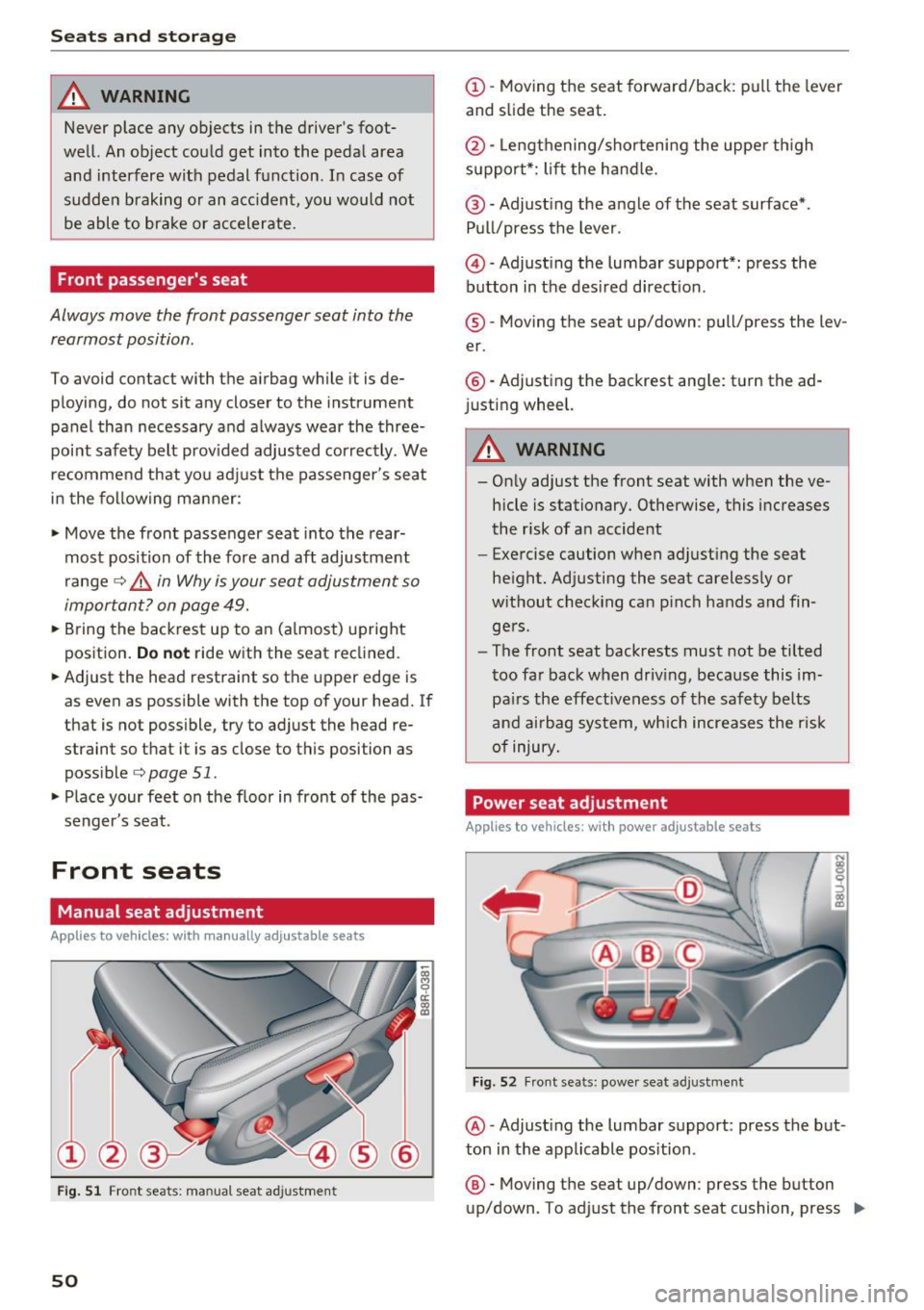
Fig. 51 Front seats: manua l seat adjustme nt
50
(D -Moving the seat forward/back: pull the lever
and slide the seat.
@-Lengthen ing/shortening the upper thigh
support*: lift the handle.
@ -Adjusting the angle of the seat surface*.
Pull/press the lever.
@) -Adjusting the lumbar support*: press the
button in the desired direction.
® -Moving the seat up/down: pull/press the lev
er.
@ -Adjusting the backrest angle: turn the ad
ju sting wheel.
_& WARNING
-Only adjust the front seat with when the ve
hicle is stationary. Otherwise, this increases
the risk of an accident
- Exercise caution when adjusting the seat
height. Adjusting the seat carelessly or
without checking can pinch hands and fin gers.
- The front seat backrests must not be tilted
too far back when driving, because this im
pairs the effectiveness of the safety belts
and airbag system, which increases the risk
of injury.
Power seat adjustment
Applies to vehicles: with power adjustable seats
Fig . 52 Front seats: power seat adjustme nt
@ -Adjusting the lumbar support: press the but
ton in the applicable position.
@ -Moving the seat up/down: press the button
up/down. To adjust the front seat cushion, press
IJJI,
Page 65 of 252
.... N
c:i ::J CX)
.... I.Cl U"I
N I.Cl ......
Manual climate control system controls
Applies to vehicles: with manual climate control system
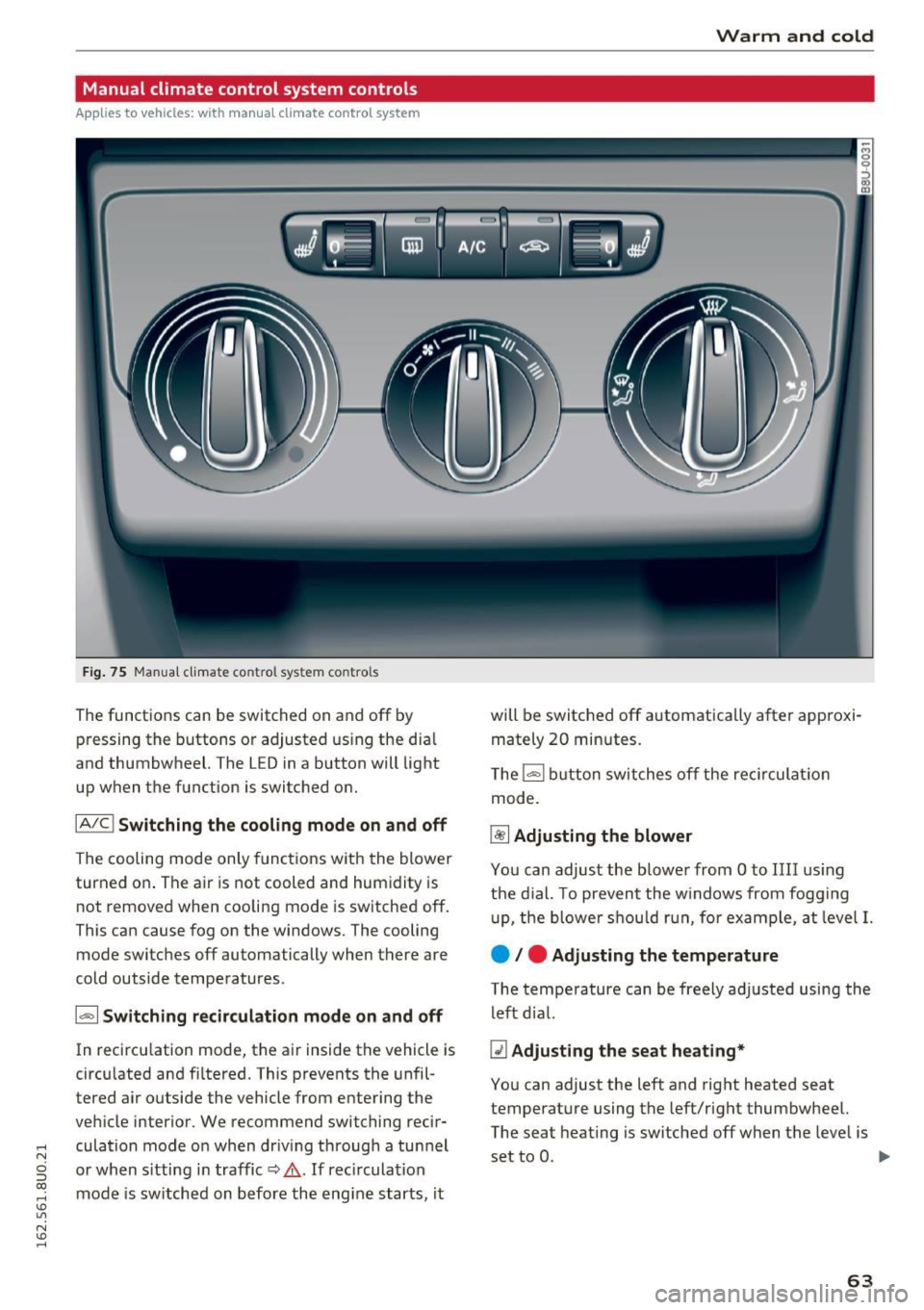
Fig . 75 Manua l clima te co ntro l sys tem contro ls
The functions can be sw itched on and off by
pressing the buttons or adjusted us ing the dia l
and thumbwheel. The L ED in a button will light
up when the function is switched on.
IA/C l Switchin g the coolin g mod e on and off
The cooling mode only functions with the blower
turned on . The air is not cooled and humidity is
not removed when cooling mode is sw itched off.
This can cause fog on the windows. The cooling
mode switches off automatically when there are
cold outside temperatures .
1- 1 Sw itching recircul ation m ode on and off
In recircu lation mode, the air ins ide the vehicle is
circu lated and filtered. This prevents the unfil
tered air outside the vehicle from entering the
vehicle interior . We recommend switching recir
culation mode o n when driv ing through a tun nel
or when s itting in traffic
c::, .&. . If rec irculat ion
mode is sw itched on before the eng ine starts, it
Warm and cold
will be switched off automatically after approxi
mately 20 minutes.
T he
l= I button switches off the rec irculat ion
mode.
~ Adjusting the blower
You can adjust the blowe r from Oto IIII us ing
the d ia l. T o prevent the w indows from fogging
u p, the blowe r sh ou ld r un, for example, at level
I.
e / e Adjusting the temperature
The temperature can be freely adjusted using the
left dial.
Q1 Adju sting the seat heating *
You can adjust the left and right heated seat
temperature using the left/right thumbwheel.
The seat heat ing is switched off when the level is
set to 0.
ll-
63
Page 66 of 252
Warm and cold
~ Switching the rear window defogger on
and off
The rear window defogger only operates when
the engine is running .
It switches off automati
cally after approximate ly 10 to 20 minutes, de
pending on the outside temperature.
Adjusting air distribution and air vents
You can adjust the vents where the air will flow
out of. The air distribution is easi ly adjusted be
tween the two symbols positioned next to each
other
(®/;J/ •,,J/ ~).
In the ~ setting, the windshield and side win
dows are defrosted or cleared of condensation as
quickly as possible . The maximum amount of air
f lows mainly from the vents below the wind
sh ield. Recircu lation mode switches off .
You can open or close the center and rear vents in the cockpit and the vents in the rear center con- sole
using the ridged thumbwheels . The levers
adjust the direction of the airflow from the vents.
A WARNING
- You shou ld not use the recirculation mode
for an extended period since no fresh air is
drawn in. With the a ir-conditioning switch
ed off, the windows can fog up, which in
creases the risk of an accident!
- Individuals w ith reduced sensit iv ity to pain
or temperature could develop burns when
using the seat heating* function . To reduce
the ris k of injur y, these individua ls should
not use seat heating*.
(D Note
To avoid damaging the seat heating* ele
ments, do not kneel on the seats or place
heavy pressure on one area of the seat.
Deluxe automatic climate control system controls
Applies to vehicles: w ith deluxe automatic climate control
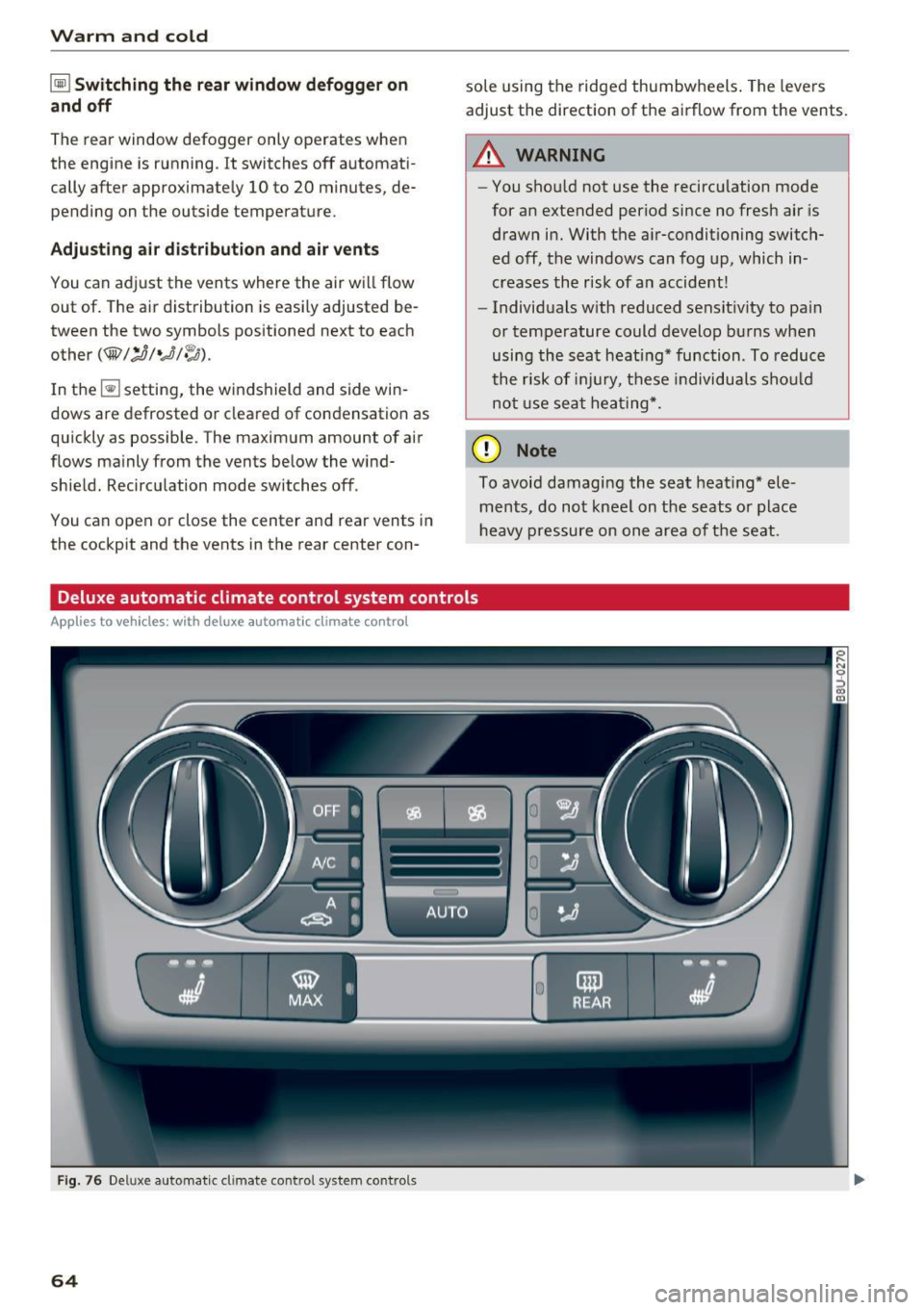
Fig. 76 Deluxe automatic climate control system co ntrol s
64
Page 68 of 252
Warm and cold
IQiil REARI Switching the rear window defogger
on and off
The rear window defogger only operates when
the engine is running and will be automatically
switched off after approximately 10 minutes.
Synchronization
If you press the !AUTOI button longer, yo u can
transfer the driver temperat ure setting to the
front passenger. Synchronization is switched off
as soon as the temperature for the front pas
senger's side is changed.
Air vents
You can open or close the center and rear vents in
the cockpit and the vents in the rear center con
sole using the ridged thumbwheels. The levers
adjust the direction of the airflow from the vents.
Switching the temperature measurement
units
The temperature display can be switched be
tween°( and °F. Press and hold down the
j..., .1
button c:> fig. 76 and turn the knob on the dr iver's
side for 3 seconds -.
A WARNING
-You should not use the recirculation mode
for an extended period since no fresh air is
drawn in. With the air-conditioning switch
ed off, the windows can fog up, which in
creases the risk of an accident.
- Individuals with reduced sensitivity to pain
or temperature could develop burns when
using the seat heating* function. To reduce
the risk of injury, these indiv iduals should
not use seat heating*.
{tD Note
To avoid damaging the seat heating* ele
ments, do not kneel on the seats or place
heavy pressure on one area of the seat.
66
Page 69 of 252
..... N
c:i ::J CX)
..... I.Cl U"I
N I.Cl ......
Driving
Steering
Manually adjustable steering wheel
The steering wheel position is fully adjus table up
and down and forward and back .
Fig. 77 Lever under the ste ering column
Fi rst, ad just t he driver 's sea t correct ly.
• Pull the lever ~
fig. 77 ~ .&,.
• Move the steer ing whee l to the desired posi
t ion.
• Push the lever against the steeri ng column un-
ti l it locks .
There must be a t least 10 inches (25 cm) be
tween your chest and the center of the stee rin g
wheel. If yo u cannot sit mo re than 10 inches (25
cm) from the steering whee l, see if adaptive
equipment is available to help you reach the ped
als and increase the distance from the steering
wheel.
F or detai led information on how to adjust the
driver's seat, see
~ page 50 .
.&_ WARNING
Improper use of steer ing whee l adjustment
and improper seating position can cause ser i
ous pe rsonal injury.
- Adjust the steer ing whee l co lumn on ly w hen
the vehicle is not mov ing to prevent loss of
vehicle control.
- Adjust the driver's seat or steering wheel so
that there is a min imum of 10 inches (25
cm) betwee n your chest and t he s teer ing
wheel
~page 96, fig. 107 . If you cannot
-
Drivi ng
maintain t his minim um distance, the airbag
system cannot p rotect yo u proper ly.
- If physical limitations prevent you from sit
ting 10 inches (25 cm) or more from the
steer ing whee l, check with your author ized
Audi dealer to see if adaptive equipment is
ava ilable.
- If the steer ing whee l is aligned w ith your
face, the supplementa l driver's a irbag can
not provide as much protect io n in an acc i
dent. Always make sure that the steer ing
wheel is aligned with you r chest.
- Always hold the steering wheel w ith your
hands at the 9 o'clock and 3 o' clock posi
tions to reduce the risk of pe rso nal injur y if
the dr iver's a irbag dep loys .
- Never ho ld the stee ring wheel at the 12
o'cl ock position or wi th you r hands inside
the stee rin g wheel rim or on the s teer ing
wheel h ub. Holding the stee ring w heel the
wrong way can cause serious inj uries to the
hands, arms and head if the driver's airbag
deploys .
Starting and stopping
the engine (vehicles with
an ignition lock)
Starting the engine
Applies to veh icles: w it h ign ition lock
The ignition is switched on and the engine start
ed with the key in the ignition.
Fig. 78 Ignit io n lock: positio n of th e ig ni tion key
Switching the ignition on /off
• To switch t he ignit ion on, t urn the igni tion key
to position
(D . ..,.
67
Page 70 of 252
Driving
"'T o switch the ignition off, turn the ignition key
to position @.
Starting the engine
"' Press the b rake pedal and put the selector leve r
in to P or N.
"'T urn the key to pos it ion @. The ignition key au
tomatica lly returns to position
(I) . Do not press
the accelerator pedal when doing this.
If the engine does not sta rt immed iate ly, stop
the starting procedure and repeat after 30 sec
onds. To restart the engine, turn the ignition key
back to position @.
A WARNING
- Never allow the engine to run in confined
spaces -danger of asp hyxiation .
-
-Never remove the ignit ion key from the ign i
t ion look while the vehicle is moving . Other
wise , the steering lock cou ld sudden ly en
gage and you would not be able to stee r the
vehicle .
- Always take the key with you whenever you
leave your vehicle . Otherw ise, the engi ne
cou ld be sta rted o r electrical equ ipment
s uch as the power w indows co uld be operat
ed . This can lead to se rious i nju ry.
- Never leave children or pe rsons requiring as
sistance unattended i n the vehicle . The
doo rs c an be lo cked usi ng the remote trans
mit ter, preven ting people from escapin g
from the vehicle on thei r own in the event of
an emergency. Depending on the time of
year, people inside the vehicle can be ex
posed to very hig h or very low tempera
tures.
(D Note
Avoid high engine speed, full throttle, and heavy engine load as long as the engine has
not reached operat ing temperature yet. You
could damage the engi ne.
@ For the sake of the environment
Do not let the engine run while parked to
warm up. Begin dr iving immediately . This re
duces unnecessary emiss ions.
68
(D Tips
- Some noise after start ing the engine is nor
ma l and is no cause for concern.
- If you leave the ve hicle w ith the ignition
switched on, the ign ition wi ll switch off af
ter a certain amount of time. Make sure that
electrical equipment such as the exterior
lights are switched off.
- If it is d ifficult to turn the key to pos ition
(D , turn the steering wheel back and forth
slightly to release the steering wheel lock.
Stopping the engine
App lies to vehicles: with ignition lock
Stopping the engine
"' Bring the vehicle to a full stop .
"'T urn the key to posi tion @.
Engag ing the steering lock
Requi rement: the se lector lever must be in P.
"' Remove the ignition key in position @
c::> page 67, fig. 78 c::> &_ .
"'Tur n the steering whee l until you hear the
steer ing whee l lock .
The locke d steer ing helps prevent vehicle the ft.
A WARNING
-Never turn off the engine before the vehicle
has come to a complete stop. The full func
tion of the brake booster and the power
steer ing is not guaranteed. You must use
more force to turn or brake if necessary. Be
cause you cannot stee r and brake as you
usually would, this cou ld lead to crashes
a nd se rio us in juries.
- For safety reasons, yo u sh ould always park
your veh icle w ith the se lector lever i n P.
Othe rwise, the vehicle could inadve rten tly
roll aw ay.
- The rad iator fa n can cont in u e to run for up
t o 10 minutes even af ter yo u have turned
off the engine an d remove d the igni tion key.
The rad iator fan can also turn on again if the
eng ine coolant heats up because of intense .,._
Page 74 of 252
Driving
When start ing from a stop
- T he in tegr al hi ll sta rt as sis t helps y ou when
driving by automatically releasing the park ing
brake¢
page 72, Starting from a stop.
- When starting on incl ines, the hill start assist
prevents the vehicle from unintentionally roll
ing back . The braking force
of the parking brake
is only released if sufficient drive power has
been built up at the wheels.
Em erg enc y bra ke f unction
An emergency braking functions ens ures that the
vehicle can be s lowed down even if the
normal
brakes fail¢ page 73, Emergency braking
function.
,&. WARNING
- Do not press the accelerator pedal inadver
tently when the veh icle is stationary and the
engine is running and a gear is selected.
Otherwise t he vehicle w ill start to move im
med iate ly and could result in a c rash.
- If the power supply fa ils, the released park
ing bra ke can no longe r engage. In th is
case, pa rk the veh icle on leve l ground and
sec ure it by placing the selector lever in the
P position. See an author ized Audi dealer or
authorized Aud i Service Faci lity for assis
tance .
(D Tips
-If the parking b rake is set while the ignition
i s sw itched off, the. indicator light in the
b utton and -(USA models) /. (Cana
da models) will turn off after a certain
amount of time.
- Occasiona l noises when the parking brake is
set and re leased are normal and are not a
cause for concern.
- When the vehicle is parked, the parking
brake goes thro ugh a self-test cycle at reg u
l ar intervals. Any no ises assoc iated with this
are normal.
- If there is a power fa ilure, the parking brake
will not set if it is re leased, and it will not
release if it is set¢,&. See an authorized
72
-
Audi dealer or author ized Audi Service Fa
cility for assistance.
Parking
.. Press the brake pedal to stop the veh icle.
.. To set the park ing brake, pull on the© switch.
.. Select the P position .
.. Turn the engine off¢,& .
.. Turn the steering wheel when par king on in
cl ines so that the wheels w ill roll into the cu rb
if the vehicle starts moving.
,&. WARNING
- Always take the veh icle key with yo u when
leaving the vehicle, even for a short period
of time. This applies part icularly when chil
dren remain in the vehicle. Otherwise chil
dren could start the engine, release the
parking brake or operate electrical equip
ment such as power w indows, which in
creases the risk of an accident.
-
- No one should remain in the veh icle w hen it
is locked, especially ch ild ren. Locked doors
make it more difficult for emergency work
ers to get into the veh icle, wh ich puts lives
at risk.
Starting from a stop
The start assist function ensures that the park
ing broke is released automatically upon start
ing.
Stopping and setting the parking brake
.. To set the park ing brake, pull on the(®) switch.
Starting and automat ically r elea sing the
parking brake
.. When you press the acce lerator pedal, the
parking brake is automat ica lly re leased and
your vehicle beg ins to move .
When stopping at a traffic signa l or stopping in
c ity traff ic, the parking brake can be applied . The
vehicle does not have to be held with the brake pedal. The park ing brake elim inates the tendency
to c reep when a se lector lever position is engag-
ed. As soon as yo u press t he accelerator pedal,
1J1>
Page 79 of 252
.... N
c:i :::J CX)
.... I.Cl U"I
N I.Cl ......
General information
Appl ies to vehicles: with Audi side assist
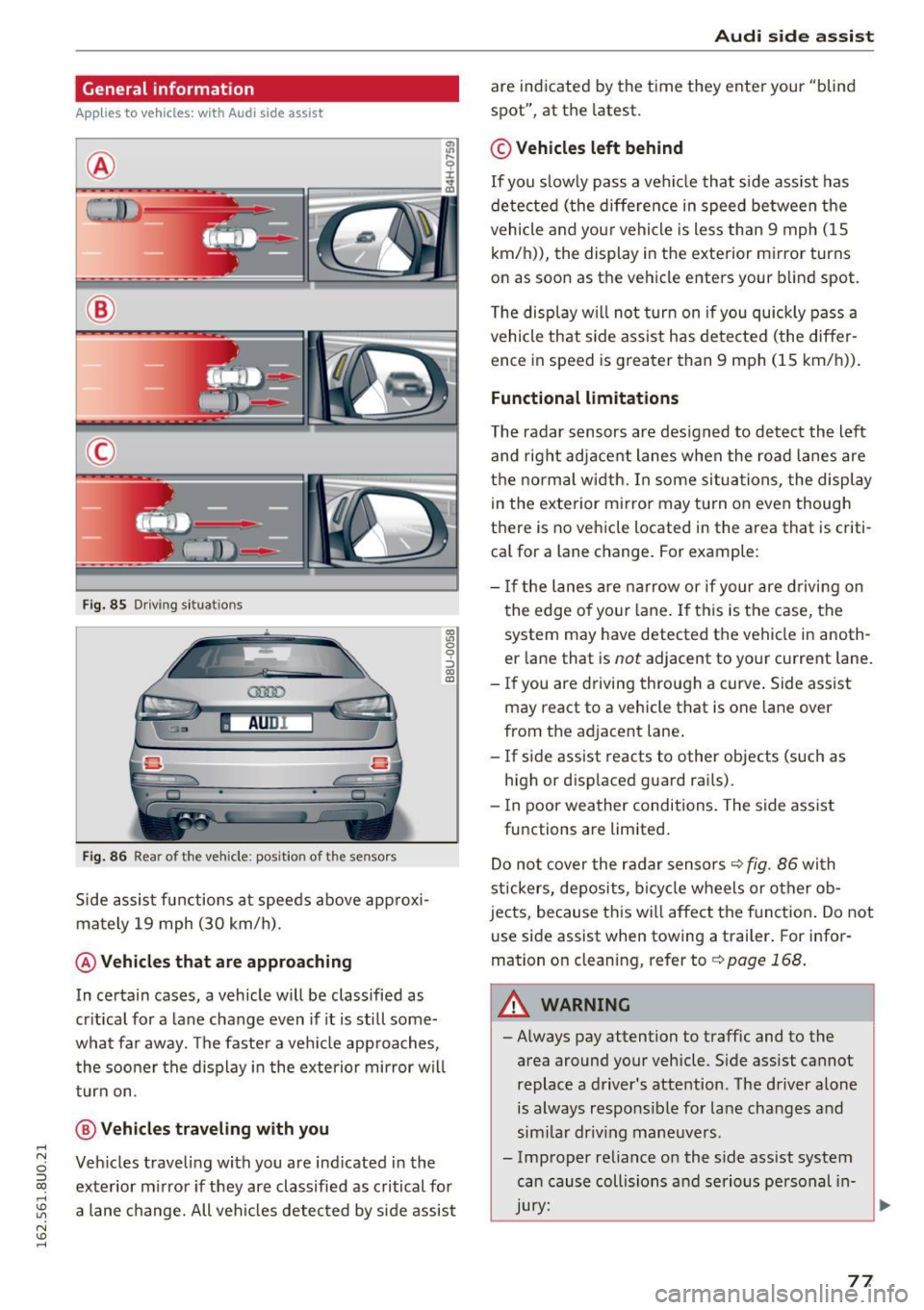
®
®
©
Fig. 85 Driving si tuat ions
Fig. 86 Rear of the veh icle: pos ition of the sensors
Side assist functions at speeds above approxi
mately
19 mph (30 km/h).
@ Vehicles that are approaching
:'ll 0
0
::':,
"' m
In certain cases, a vehicle will be classified as
critical for a lane change even if it is still some
what far away. The faster a vehicle approaches,
the sooner the display in the exterior mirror will
turn on.
@ Vehicles traveling with you
Vehicles traveling with you are indicated in the
exterior mirror if they are classified as critical for
a lane change. All vehicles detected by side assist
Audi side assist
are indicated by the time they enter your "blind
spot", at the latest.
© Vehicles left behind
If you slowly pass a vehicle that side assist has
detected (the difference in speed between the
vehicle and your vehicle is less than 9 mph (15
km/h)), the display in the exterior mirror turns
on as soon as the vehicle enters your blind spot.
The display will not turn on if you quickly pass a
vehicle that side assist has detected (the differ
ence in speed is greater than 9 mph (15 km/h)).
Functional limitations
The radar sensors are designed to detect the left
and right adjacent lanes when the road lanes are
the normal width. In some situations, the display
in the exterior mirror may turn on even though
there is no vehicle located in the area that is criti
cal for a lane change. For example:
- If the lanes are narrow or if your are driving on
the edge of your lane. If this is the case, the
system may have detected the vehicle in anoth
er lane that is
not adjacent to your current lane.
- If you are driving through a curve. Side assist
may react to a vehicle that is one lane over
from the adjacent lane.
- If side assist reacts to other objects (such as
high or displaced guard rails).
- In poor weather conditions. The side assist
functions are limited.
Do not cover the radar sensors
~ fig. 86 with
stickers, deposits, bicycle wheels or other ob
jects, because this will affect the function. Do not
use side assist when towing a trailer. For infor
mation on cleaning, refer to ¢
page 168.
A WARNING
=
-Always pay attention to traffic and to the
area around your vehicle . Side assist cannot
replace a driver's attention. The driver alone is always responsible for lane changes and
similar driving maneuvers .
- Improper reliance on the side assist system can cause collisions and serious personal in-
-
Jury: ~
77
Page 80 of 252
Audi side assist
-Never rely only on side assist when chang
ing lanes.
- Always check rear view mirrors to make
sure that it is safe to change lanes.
- Side assist cannot detect a ll vehicles under
all conditions- danger of acc ident!
- Please note that side assist indicates there
are approaching vehicles, or vehicles in your blind spot, only after your vehicle has
reached a driving speed of at least 19 mph
(30 km/h).
- In certain situations, the system may not function or its funct ion may be limited. For
example:
- if veh icles are approaching or being left
behind very quickly. The display may not
turn on in time.
- in poor weather conditions such as heavy
rain, snow or heavy mist.
- on very w ide lan es, in tight curves or if
there is a rise in the road su rface. Vehicles
in the adjacent lane may not be detected
because they are outside of the sensor
range.
(D Note
The sensors can be displaced by impacts or
damage to the bumper, wheel housing and
underbody. This can affect the system. Have
your authorized Audi dealer or authorized
Audi Serv ice Facility check their function.
(D} Tips
- If the window glass in the driver 's door or
front passenger's door has been tinted, the
display in the exterior mirror may be misin
terpreted.
- For Declaration of Comp liance to United
States FCC and Industry Canada regu lations
c;, page235.
78
Switching on and off
App lies to vehicles: wit h Audi side assist
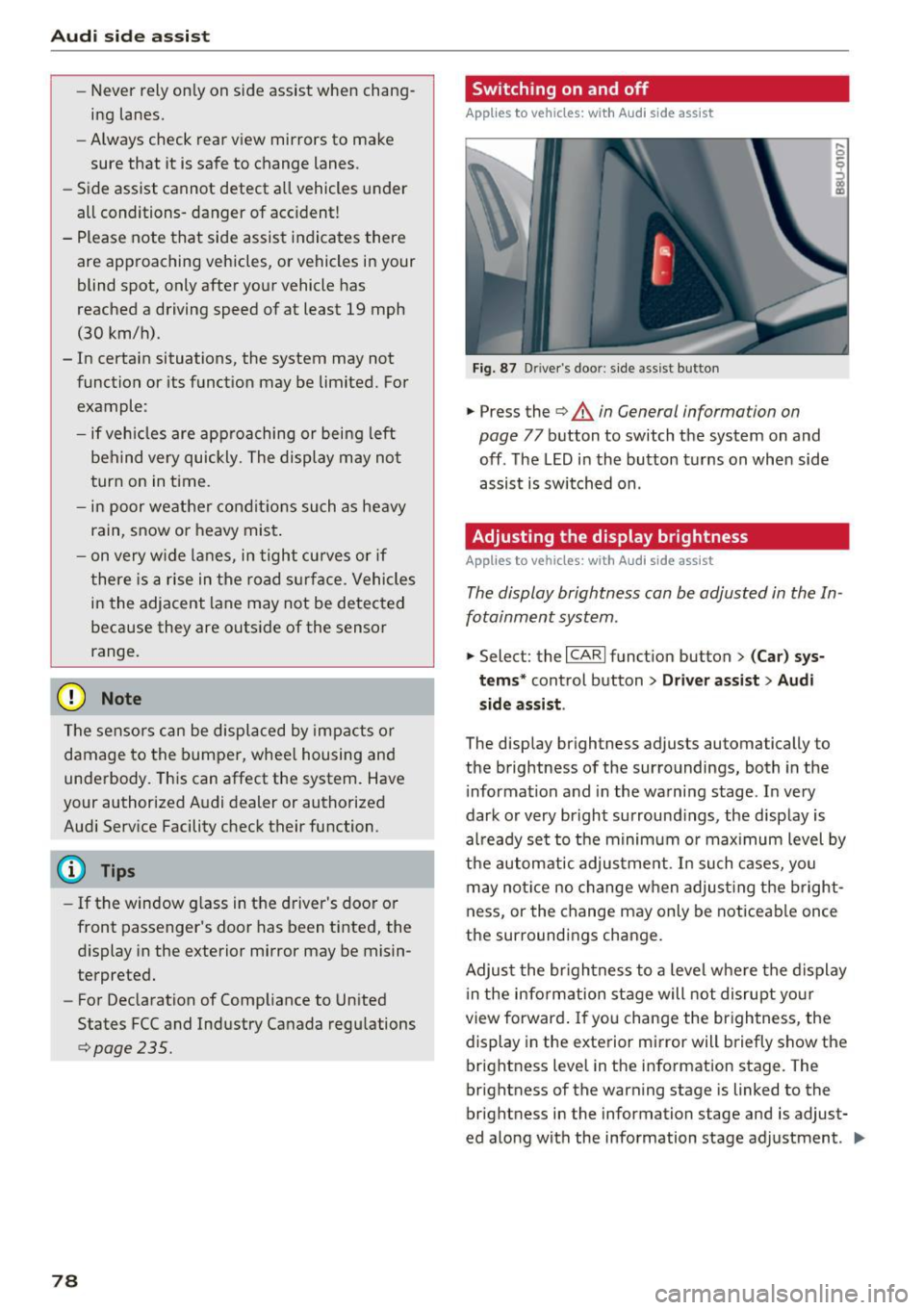
Fig. 87 D river's door: s ide assist button
.,. Press the c;, &. in General information on
page
77 button to switch the system on and
off . The LED in the button turns on when side
assist is switched on .
Adjusting the display brightness
Applies to vehicles: wit h Aud i side ass ist
! a,
The display brightness can be adjusted in the In
fotainment system .
.,. Select: the I CARI function button > (Car) sys
tems *
control button > Driver assist > Audi
side assis t.
The display brightness adjusts automatically to
the brightness of the surroundings, both in the
i nformation and in the warning stage . In very
dark or very bright surround ings, the display is
al ready set to the minimum or max imum level by
the automatic adjustment. In such cases, you
may notice no change when adjust ing the bright
ness, or the change may only be noticeable once
the surroundings change.
Adjust the br ightness to a level where the display
i n the information stage will not disrupt your
view forward. If you change the brightness, the
display in the exterior mirror will briefly show the
brightness level in the information stage. The
brightness of the warning stage is linked to the
brightness in the information stage and is adjust
ed along with the information stage adjustment . .,,.