ABS AUDI Q3 2016 Owner's Manual
[x] Cancel search | Manufacturer: AUDI, Model Year: 2016, Model line: Q3, Model: AUDI Q3 2016Pages: 252, PDF Size: 62.81 MB
Page 188 of 252
Checking and Filling
Brake fluid
Checking brake fluid level
The brake fluid level can be checked with a quick
glance.
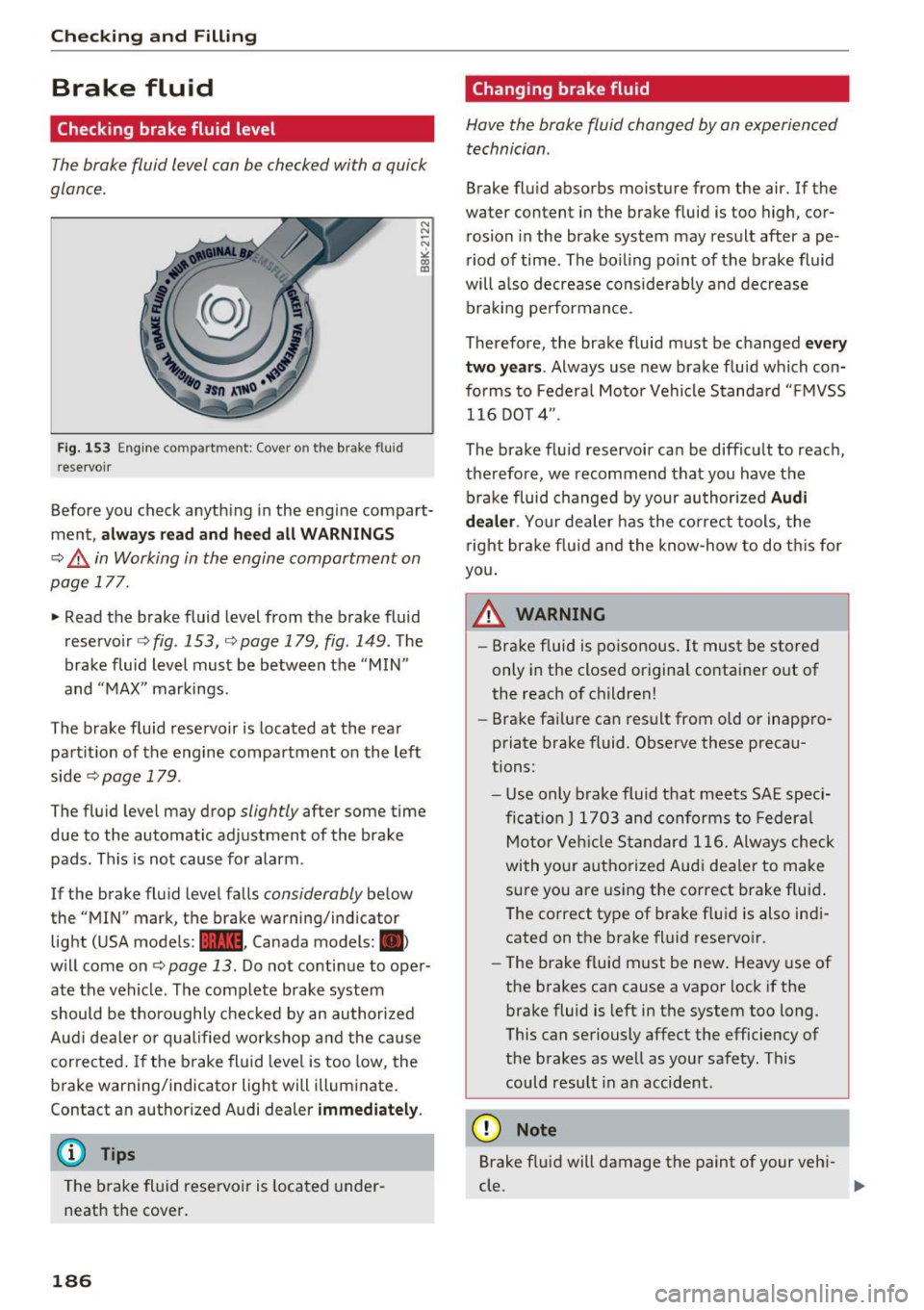
Fig. 153 Eng ine compartment: Cover on the brake fluid
r eservoir
Before you check anything in the engine compart
ment,
always read and heed all WARNINGS
¢ A in Working in the engine compartment on
page 177.
., Read the brake fluid level from the brake fluid
reservoir
<=> fig . 153, ¢page 179, fig . 149 . The
brake fluid level must be between the
" MIN"
and "MAX " markings.
The brake fluid reservoir is located at the rear
partition of the engine compartment on the left
side ¢
page 179 .
The fluid level may drop slightly after some time
due to the automatic adjustment of the brake
pads . This is not cause for alarm .
If the brake fluid level falls
considerably below
the ' 'MIN" mark, the brake warning/indicator
light (USA models:
1111 , Canada models:. )
will come on¢
page 13 . Do not continue to oper
ate the vehicle . The complete brake system
should be thoroughly checked by an authorized
Aud i dealer or qualified workshop and the cause
corrected. If the brake fluid level is too low, the
brake warning/indicator light w ill illuminate.
Contact an author ized Audi dealer
immediately.
(D} Tips
The brake fluid reservoir is located under
neath the cover.
186
Changing brake fluid
Have the brake fluid changed by an experienced
technician .
Brake fluid absorbs moisture from the air. If the
water content in the brake fluid is too high, cor
rosion in the brake system may result after ape
riod of time . The boiling po int of the brake fluid
will a lso decrease considerably and decrease
braking performance.
Therefore , the brake fluid must be changed
every
two years .
Always use new brake fluid which con
forms to Feder-al Motor Vehicle Standard "FMVSS
116 DOT 4 ".
The brake fluid reservoir can be difficult to reach ,
therefore, we recommend that you have the
brake fluid changed by your author ized
Audi
dealer .
Your dealer has the correct tools, the
right brake fluid and the know-how to do this for
you.
A WARNING
- Brake fluid is poisonous. It must be stored
only in the closed original container out of
the reach of children!
- Brake fai lure can result from o ld or inappro
priate brake fluid. Observe these precau
tions:
- Use only brake fluid that meets SAE speci
fi cation
J 1703 and conforms to Federal
Motor Veh icle Standard 116. Always check
with your authorized Audi dealer to make
sure you are using the correct brake fluid .
The correct type of brake f luid is also indi
cated on the brake fluid reservoir.
- The brake fluid must be new . Heavy use of
the brakes can cause a vapor lock if the
brake fluid is left in the system too long .
This can seriously affect the efficiency of
the brakes as well as your safety. This
could result in an accident.
(D Note
Brake fluid will damage the paint of your vehi-
cle .
lilJJ,
Page 189 of 252
@ For the sake of the environment
Because of the problem of proper disposal of
brake fluid as we ll as the special toots re
quired and the necessary expertise, we rec
ommend that you have the brake fluid
changed by your authorized Audi dealer .
Battery
General information
Under normal operating conditions, the battery
in your Audi does not need any maintenance.
With
high outside temperatures or long daily
drives we recommend that you have the electro
lyte level checked by an authorized Audi dealer or
qualified workshop. The electrolyte level should
also be checked each time the battery is charged
c> page 189.
Have the battery checked when you take your ve
hicle in for serv ice. You are well advised to re
place a battery t hat is older than 5 years.
With certain types of airbag deployment, the battery is disconnected from the vehicle electri
cal system for safety reasons
c> & in Repair, care
and disposal of the airbags on page 125 .
Disconnecting the battery terminals
Some vehicle functions (power window regula
tors, for example) are lost if the battery termi nals are disconnected. These functions have to be
relearned after the battery terminals are con
nected again. To prevent th is, the battery should
only be disconnected from the vehicle e lectr ica l
system when abso lutely necessary for repairs.
Vehicles not driven for long periods
If you do not drive your vehicle over a period of
several days or weeks, electrical components are
gradually cut back or sw itched off. This reduces
energy consumption and maintains starting ca
pability over a longer pe riod
c> page 157.
Some of the conven ience functions may not oper
ate, such as the interior lights or the power seat
adjustment. The convenience functions will be
available again when you turn on the ignition and
start the engine.
Checking and Filling
Winter operation
During the winter months, battery capacity tends
to decrease as temperatures drop . This is be
cause more power is also consumed while start
ing, and the headlights, rear window defogger,
etc., are used more often.
Avo id unnecessary power consumption, particu
larly in city traffic or when traveling only short
distances . Let your authorized Audi dealer check
the capacity of the vehicle battery before winter
sets in
c> page 189. A well charged battery will
not only prevent starting problems when the
weather is cold, but will also last longer .
(D Tips
If your vehicle is left standing for several
weeks at extremely low temperatures, the ve
hicle battery should be removed and stored
where it w ill not freeze. This will prevent it
from be ing damaged and having to be re
placed.
Working on the battery
Be especially careful when working on or near
the battery.
The battery is located in the engine compart
ment . Before you check anything in the engine
compartment ,
read and heed all WARNINGS
c>,& ,
Always heed the safety warnings, when working
on the vehicle battery or the veh icle electrical
system to prevent injury.
The following WARNINGS are very important
when working on the battery:
Always heed the following WARNING SYM·
BOLS and safety precautions when working on
the battery.
®
Always wear eye protection.
A
Battery acid contains sulfuric acid. Al-
ways wear gloves and eye protection .
187
Page 201 of 252
different tire speeds. For this reason, in case of emergency, only
use a spare tire that has the same
circumference as the regular
tires.
&_ WARNING -
-Only use tire/rim combina tions and suitable wheel bolts
that have been approved by
Audi. Otherwise, damage to
the vehicle and an accident could result.
-For technical reasons, it is not
possible to use tires from oth
er vehicles - in some cases,
you cannot even use tires from
the same vehicle model.
-Make sure that the tires you
select have enough clearance
to the vehicle . Replacement
tires should not be chosen
simply based on the nominal
size, because tires with a dif
ferent construction can differ
greatly even if they are the
same size. If there is not
enough clearance, the tires or
the vehicle can be damaged and this can reduce driving
safety and increase the risk of
an accident.
Wheels
-Only use tires that are more
than 6 years old when abso lutely necessary and drive
carefully when doing so.
-Do not use run-flat tires on
your vehicle. Using them when
not permitted can lead to ve
hicle damage or accidents.
- If you install wheel covers on
the vehicle, make sure they al low enough air circulation to
cool the brake system. If they
do not, this could increase the
risk of an accident.
Tire wear/damage
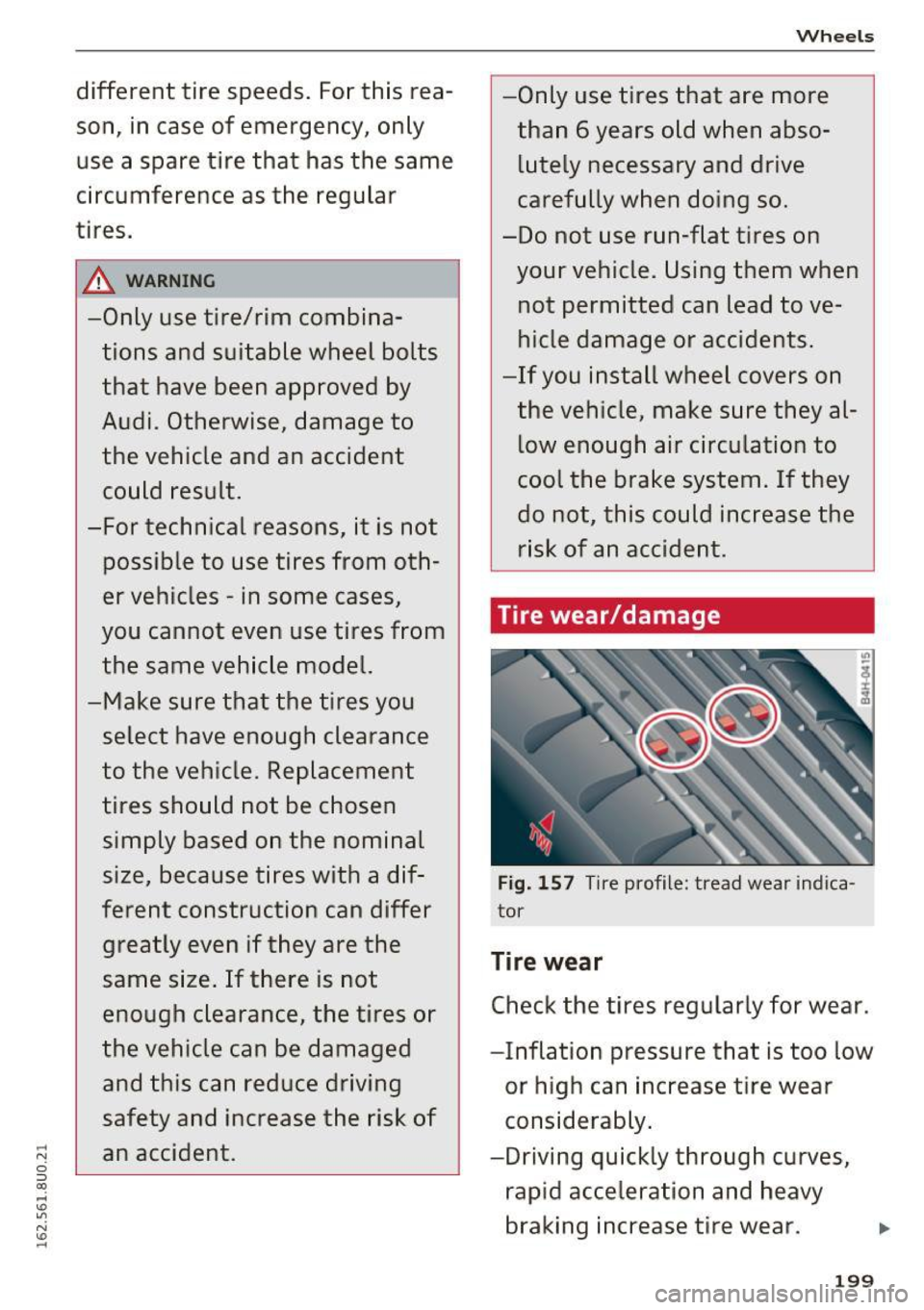
Fig. 157 Ti re profi le: tread wear indica
tor
Tire wear
Check the tires regularly for wear .
-Inflation pressure that is too low
or high can increase tire wear
considerably.
-Driving quickly through curves,
rapid acceleration and heavy
braking increase tire wear. ..
199
Page 211 of 252
.... N
c:i :::J CX)
.... I.Cl U"I
N I.Cl ......
also reduces fuel efficiency and tire tread life,
and may affect the vehicle's handling and stop
ping ability.
Please note that the TPMS is not a substitute for
proper tire maintenance, and it is the driver's re
sponsibility to maintain correct tire pressure,
even if under-inflation has not reached the level
to trigger illumination of the TPMS low tire pres
sure telltale.
Your vehicle has also been equipped with a TPMS
malfunction indicator to indicate when the sys
tem is not operating properly. The TPMS mal
function indicator is combined with the low tire
pressure telltale. When the system detects a
malfunct ion, the telltale will flash for approxi
mately one minute and then remain continuous ly
illuminated. This sequence will continue upon
subsequent vehicle start-ups as long as the mal
function exists.
When the malfunction indicator is illuminated,
the system may not be ab le to detect or signal
low tire pressure as intended . TPM S malfunctions
may occur for a variety of reasons, including the
installation of replacement or alternate tires or
wheels on the vehicle that prevent the TPMS
from functioning properly . Always check the
TPMS malfunction telltale after replacing one or
more tires or wheels on your vehicle to ensure
that the replacement or alternate tires and
wheels allow the TPMS to continue to function
properly.
Wheels
If the Tire Pressure Monitoring System
indicator appears
Applies to vehicles : wi th tire pressure mo nito rin g sys te m
The tire pressure indicator in the instrument
cluster informs you if the tire pressure is too low
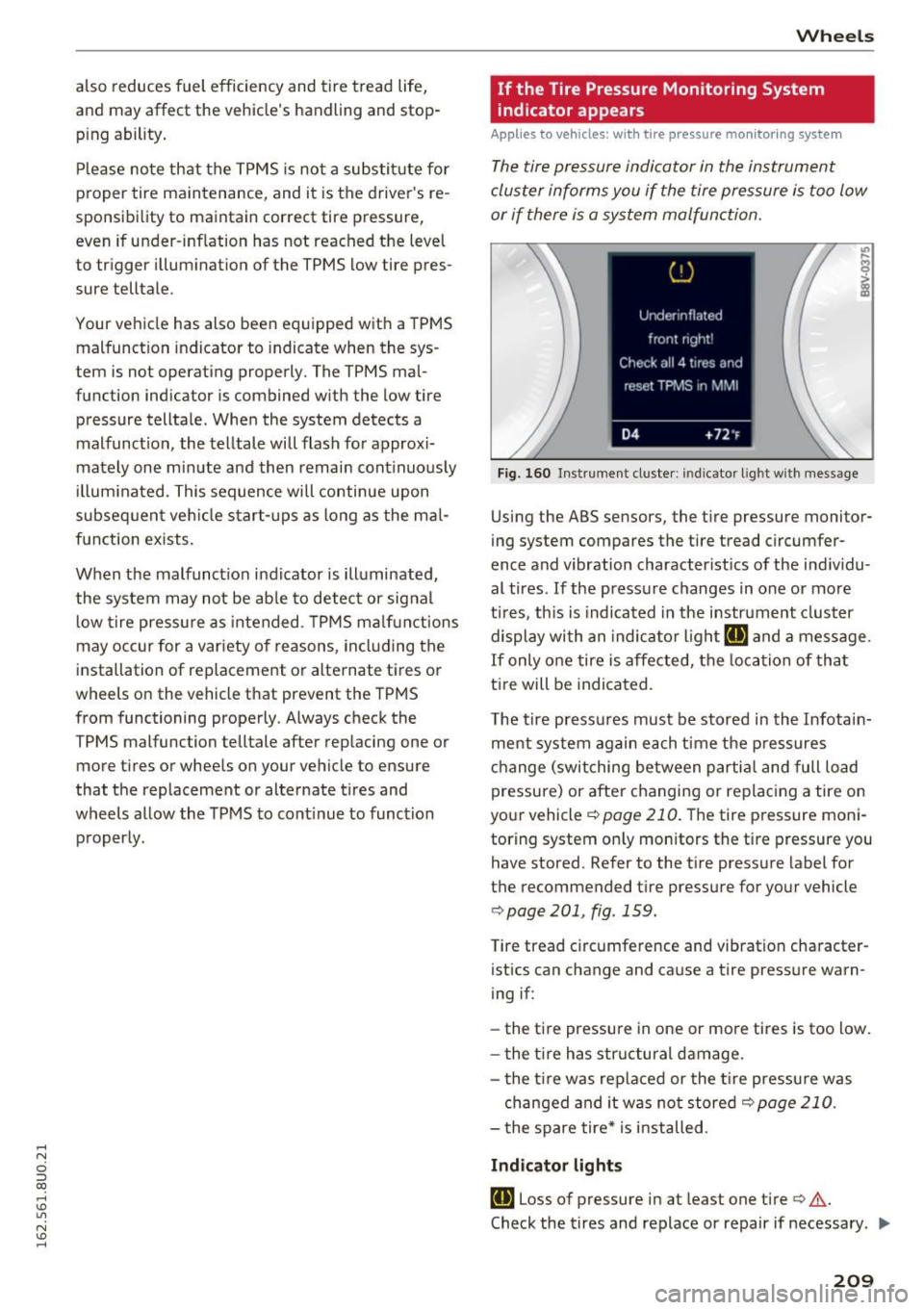
or if there is a system malfunction.
Fig. 160 Instrument cluster : indicator lig ht with message
Using the ABS sensors, the tire pressure monitor
ing system compares the tire tread circumfer
ence and vibration characterist ics of the ind ividu
al tires. If the pressure changes in one or more
t ire s, this is indicated in the instrument cluster
display with an indicator light
[I] and a message.
If only one tire is affected, the location of that
ti re will be indicated.
The tire pressures must be stored in the Infotain
ment system again each time the pressures
change (switching between partial and full load
pressure) or after changing or replacing a tire on
your vehicle ~
page 210. The tire pressure moni
toring system on ly monitors the tire pressure you
have stored. Refer to the tire pressure label for
the recommended tire pressure for your vehicle
¢ page 201, fig . 159.
Tire tread c ircumference and vibration character
istics can change and cause a tire pressure warn
ing if :
- the tire pressure in one or more tires is too low.
- the tir e has str uctural damage.
- the tir e was replaced or the tire pressure was
changed and it was not stored¢
page 210.
-the spare tire* is installed .
Indicator lights
[I] Loss of pressure in at least one tire¢,& .
Check the tires and replace or repair if necessary . ..,
209
Page 214 of 252
Emergency assistance
-Support the vehicle securely with appropri
ate stands if work is to be performed under
neath the vehicle; otherwise, there is a po
tential risk for injury .
(D Tips
The vehicle jack* in your vehicle is mainte
nance-free.
Folding chocks
Applies to veh icles: with folding chocks
The folding chocks ore part of the on board tool
kit.
---
Fig. 162 Open the folding c hocks.
• To use the folding chocks, lift up the support
plate (!) and insert them using both "tabs" into
the slotted holes on the base plate@¢.&_ .
8_ WARNING
-The folding chock will not work and can lose
its stability if the support plate "tabs" are
not securely fitted in the slots on the base
plate. If th is is the case, the vehicle could
start moving when changing a tire.
- Never use fold ing chocks that are damaged
or that were not assembled correctly.
212
Removing the subwoofer
Appl ies to vehicles: with subwoofer
The subwoofer must be removed before the
spare tire can be removed.
Fig. 163 Spare wheel well: subwoofe r
Removing the subwoofer
• Remove the cargo floor .
• Press the tabs on the connector(!) together.
• Remove the connector @and set the removed
cable aside .
• Remove the wing bolt and then remove the re-
tainer underneath it.
• Carefully remove the subwoofer.
Installing the subwoofer
• Carefully place the subwoofer in the rim well.
The word "FRON T" on the subwoofer must face
forward.
• Insert the connector that was removed.
• Secure the subwoofer with the wing bolt.
• Reinsert the cargo floor .
Space-saving spare tire
(compact spare tire)
Applies to vehicles: with space-saving spare tire (compact
spare tire)
Fig. 164 Luggage compartment: space -sav ing spare t ire
(compact spare tire)