ABS AUDI Q3 2016 User Guide
[x] Cancel search | Manufacturer: AUDI, Model Year: 2016, Model line: Q3, Model: AUDI Q3 2016Pages: 252, PDF Size: 62.81 MB
Page 108 of 252
Safe ty belts
instrument panel, windshield, or whatever else is
in the way
r:!> fig. 113. This impact with the vehi
cle interior has all the energy they had just be
fore the crash.
Never rely on airbags alone for protection . Even
when they deploy, airbags provide only additional
protection. A irbags are not supposed to dep loy in
all kinds of accidents. A lthough your Audi is
equipped w ith airbags, all vehicle occupants, in
cluding the driver, must wear safety belts cor
rectly in order to minimize the risk of severe in
jury or death in a crash .
Remember too, that airbags will deploy only
once and that your safety belts are always there
to offer protect ion in those accidents in wh ic h
airbags are not supposed to deploy or when they
have a lready deployed . Unbel ted occupants can
also be thrown o ut of the veh icle where eve n
mo re severe or fatal injuries can occur .
It is also important for the rear pass engers to
wear safety belts correctly. Unbelted passengers
i n t he re ar seats endanger no t on ly themse lves
but also the drive r and other passengers
~ fig . 114. In a frontal collision they will be
thrown forward violently, where they can hit and
in jure the driver and/or front seat passenger.
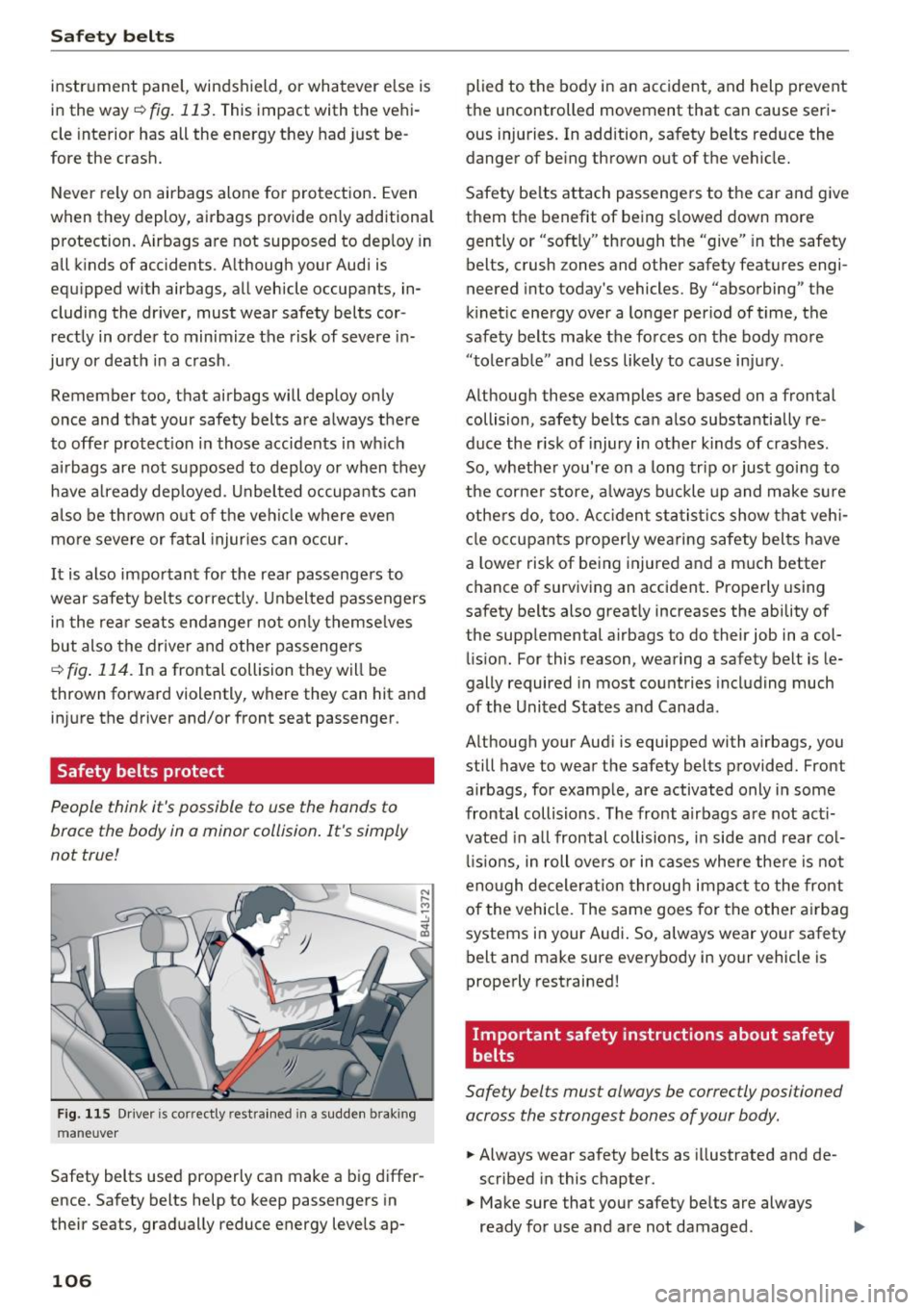
Safety belts protect
People think it's possible to use the hands to
brace the body in a minor collision . It's simply
not true!
F ig . 11 5 Driver is co rrectly restrai ned in a sudde n brak ing
m aneu ver
Safety belts used properly can make a b ig d iffer
ence. Safety belts help to keep passengers in
their seats, gradually reduce energy levels ap-
106
plied to the body in an accident , and help prevent
the uncontrolled movement that can cause seri
ous injuries. In add ition, sa fety belts red uce the
danger of being thrown out of the vehicle.
Safety be lts attach passengers to the car and g ive
them the benefit of being s lowed down more
gently or "soft ly" thro ugh the "give" in the safety
belts, crush zones and other safety feat ures engi
neered into today's vehicles. By "absorbing" the
k inet ic energy over a longer per iod of t ime, the
safety belts make the forces on the body more
"tolerab le" and less likely to cause inju ry .
Although these examples are based on a frontal
collision, safety be lts ca n also substantially re
duce the r isk o f injury in ot her kinds of crashes .
So, whethe r yo u're on a long trip or just goi ng to
the cor ne r store, a lways b uckle up and make s ure
othe rs do, too. Ac ciden t st at ist ics show that veh i
cle o ccupants prope rly wearing safety bel ts have
a lowe r risk of being injured and a m uch better
chance of surviving an acc ident . Properly using
safety be lts also great ly increases the ability of
the supp lemental airbags to do their job in a col
li sion. For this reason, wearing a safety belt is le
gally required in most countries including much
of the United States and Canada .
Although your Aud i is equipped with airbags, you
still have to wear the safety belts provided. Front
airbags, for examp le, are activated only in some
frontal collisions. The front airbags are not act i
vated in all frontal collisions, in side and rear co l
li sions, in roll overs or in cases where the re is not
eno ugh deceler ation throug h impa ct to the front
of the vehicle . The same goes for the other a irbag
systems in your Audi. So, always wear your safety
belt and make sure everybody in your vehicle is
properly rest rained!
Important safety instructions about safety
belts
Safe ty belts must always be correctly positioned
acros s the strongest bones of your body .
.,. Always wear safety belts as illustrated and de
scribed in this chapter.
.,. Make sure that your safety be lts are always
ready fo r use a nd are not damaged .
Page 118 of 252
Airbag system
Front airbags
Description of front airbags
The airbag system can provide supplemental
protection to properly restrained front seat occu
pants .
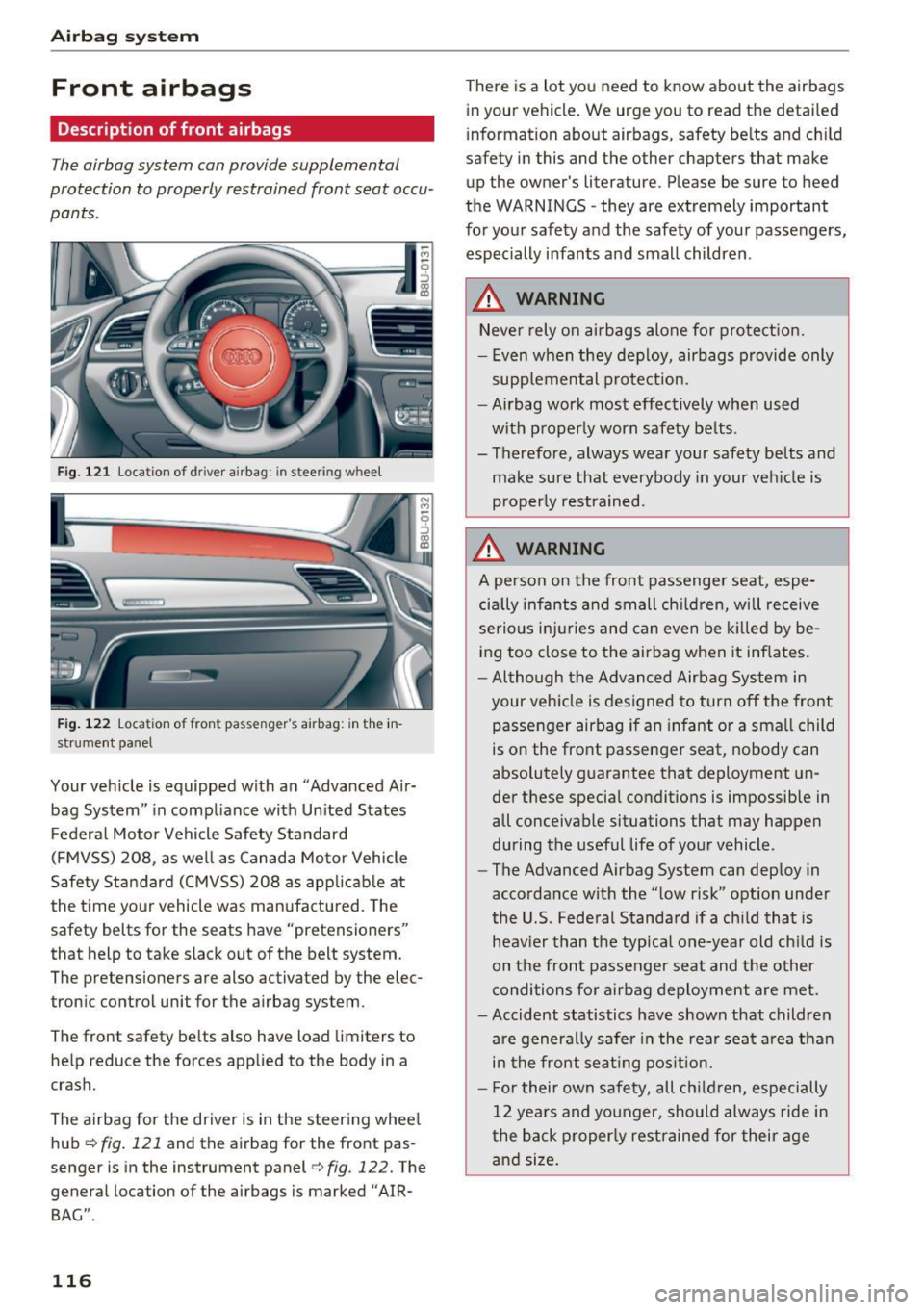
Fig. 121 Location of d river airbag : in steer ing w hee l
Fig. 122 Location of front passenger's airbag: in the in
strument panel
Your veh icle is equipped with an "Advanced Air
bag System" in compliance with Un ited States
Federal Motor Vehicle Safety Standard
(FMVSS) 208, as well as Canada Motor Vehicle
Safety Standard (CMVSS) 208 as applicable at
the time your vehicle was manufactured. The
safety belts for the seats have "pretensioners"
that help to take slack out of the belt system .
The pretensioners are also activated by the elec
tronic control unit for the airbag system.
The front safety be lts also have load limiters to
help reduce the forces applied to the body in a
crash.
The airbag for the driver is in the steering wheel
hub <=>
fig. 121 and the airbag for the front pas
senger is in the instrument panel
<=>fig. 122. The
general location of the airbags is marked "AIR
BAG".
116
There is a lot you need to know about the airbags
in your vehicle . We urge you to read the detai led
i nformation about airbags, safety belts and ch ild
safety in this and the other chapters that make
up the owner's literature. Please be sure to heed
the WARNINGS -they are extremely important
for your safety and the safety of your passengers,
especially infants and small children .
.&_ WARNING -
Never rely on airbags alone for protection.
- Even when they deploy, airbags provide only
supp lemental protection.
- Airbag work most effectively when used
with properly worn safety belts .
- Therefore, always wear your safety belts and make sure that everybody in your vehicle is
properly restrained .
.&_ WARNING
A person on the front passenger seat, espe
cially infants and small ch ildren, wi ll receive
serious injuries and can even be killed by be
ing too close to the airbag when it inf lates.
- Although the Advanced Airbag System in
-
your vehicle is designed to turn off the front
passenger airbag if an infant or a small child
is on the front passenger seat, nobody can
absolutely guarantee that deployment un
der these special conditions is impossible in
all conceivable situations that may happen
during the useful life of your vehicle.
- The Advanced Airbag System can deploy in
accordance with the "low risk" option under
the U.S. Federal Standard if a child that is
heav ier than the typical one-year old ch ild is
on the front passenger seat and the other
conditions for airbag deployment are met.
- Accident statistics have shown that children
are generally safer in the rear seat area than
in the front seating pos ition.
- For their own safety, all children, especially
12 years and younger, should always ride in
the back properly restrained for their age
and size.
Page 120 of 252
Airbag syste m
-a small adu lt or teenager is on the front pas
senger seat
- a passenger who is not sitting upright with
their back against a non -reclined backrest with
their feet on the vehicle floor in front of the
seat is on the front passenger seat.
I f the front passenger airbag dep loys, the Feder
al Standard requires the airbag to meet the "low
risk" deployment criteria to help reduce the risk
of injury through interaction with the airbag.
"Low risk" deployment occurs in those crashes
that take place at lower decelerations as def ined
in the electronic control unit.¢
page 122
Alway s remember: Even though your vehicle is
equ ipped w ith Advanced Airbags, the safest place
for children is properly restrained on the back
seat . Please be sure to read the important infor
mat ion in the sections that follow and be sure to
heed a ll of the WARN INGS.
A WARNING
To red uce the risk of inj ury when an ai rbag in
fla tes, a lways wear safety bel ts p roperly.
- If you are unrestrained, leaning fo rwa rd, s it
t ing s ideways or o ut of pos ition in any way,
yo ur risk of in jury is much h igher .
- Yo u will also re ceive serious injur ies and
could even be killed if you are up aga inst the
airbag or too close to it when it inflates -
even with an Advanced Airbag
¢page 112.
A WARNING
A child in a rearward-facing chi ld safety seat
installed on the front passenger seat wi ll be
ser iously injured and can be killed if the front
airbag inflates - even w ith an Advanced Airbag
System.
- Although the Advanced A irbag System in
your vehicle is designed to turn off the front
airbag when a rearward-facing child re
straint has been installed on the front pas
senger seat, nobody can absolutely g uaran
tee that deployment is impossible in all con
ceivable s ituations that may happen during
the useful life of your vehicle .
- The inflating a irbag w il l hit the child safety
seat or infant c arrier with great force and
118
w ill smash the child safety seat and child
aga inst the back rest, center armrest, door,
or roof.
- Always install rearward-facing child re
straints in the back seat.
- If you must install a rearward facing child
safety seat on the front passenger seat be
cause of exceptional circumstances and the
PASSENGER AIR BAG OFF light does not
come on and stay on, immediately install
the rea r-facing child safety seat in a rear
seating posi tion and have the ai rbag system
inspected by your au thori zed Au di dealer.
A WARNING
If, in exceptional ci rcums tances, you must in
stall a forward-facing child res traint on the
front passenger's seat:
- Always make sure the forward-fa cing sea t
has been des igned and certified by its man
ufacturer for use on a front seat with a pas
senger front and side airbag.
- Never put the fo rward -facing child restraint
up against or very nea r the instrument pan ·
el.
-Always move the passenge r seat into its
rearmost position in the seat's fo re and aft
ad justment range, as far away from the a ir
bag as poss ible, before install ing the for
ward-facing chi ld restraint. The backrest
m ust be adjusted to an upr ight position.
- Make sure that the
PASSENGER AIR BAG
OFF
li ght comes on and stays on all t he time
wheneve r the ign it ion is switched on.
Advanced Airbag System components
The fro nt passenge r seat i n your veh icle has a lot
of ve ry important parts of the Advanced A irbag
System i n it. These parts incl ude t he weight
sens ing mat, senso rs, wir ing, bracke ts, and
more . The f unction o f the system in the front
passenger seat is checked by the electro nic con
tro l unit when the ignition is on . The control unit
monitors the Advanced Airbag System and turns
the airbag ind icator light on when a malfunction
i n the system components is detected. The func-
tion of the a irbag ind icator light is described in .,_
Page 128 of 252
Airbag syste m
with these requirements and we recommend
that you have your dealer perform this service
for you.
Other things that can affect Advanced
Airbag performance
Changing the vehicle's suspension system can
change the way that the Advanced Airbag System
performs in a crash. For examp le, using t ire-r im
comb inat ions not approved by Audi, lower ing the
veh icle, changing the stiffness of the suspens ion,
including the springs, suspension struts, shock
absorbers etc . can change the forces that are
measured by the airbag sensors and sent to the
electronic control unit. Some suspension changes
can, for example, increase the force levels meas
ured by the sensors and make the airbag system
deploy in crashes in wh ich it would not deploy if
the changes had not been made. Other kinds of
changes may reduce the force levels meas ured by
the sensors and prevent the airbag from deploy ing when it should.
A WARNING
Changing the vehicle's suspension including
use of unapproved tire-rim combinations can
change Advanced Airbag performance and in
crease the risk of serious personal injury in a
crash.
- Never install suspension components that
do not have the same performance charac
teristics as the components originally instal
led o n your veh icle .
- Never use tire-rim comb inations that have
not been approved by Audi.
A WARNING
Items stored between the safety belt buckle
and the center console can cause the senso rs
in the buckle to send the wrong info rmation
to the electronic control module and prevent
t he Advanced Airbag System from wor king
properly.
- Always make sure tha t noth ing can interfere
with the safety be lt buck les and that they
are not obstructed.
126
Side airbags
Description of side airbags
The airbag system can provide supplemental
protection to properly restrained occupants .
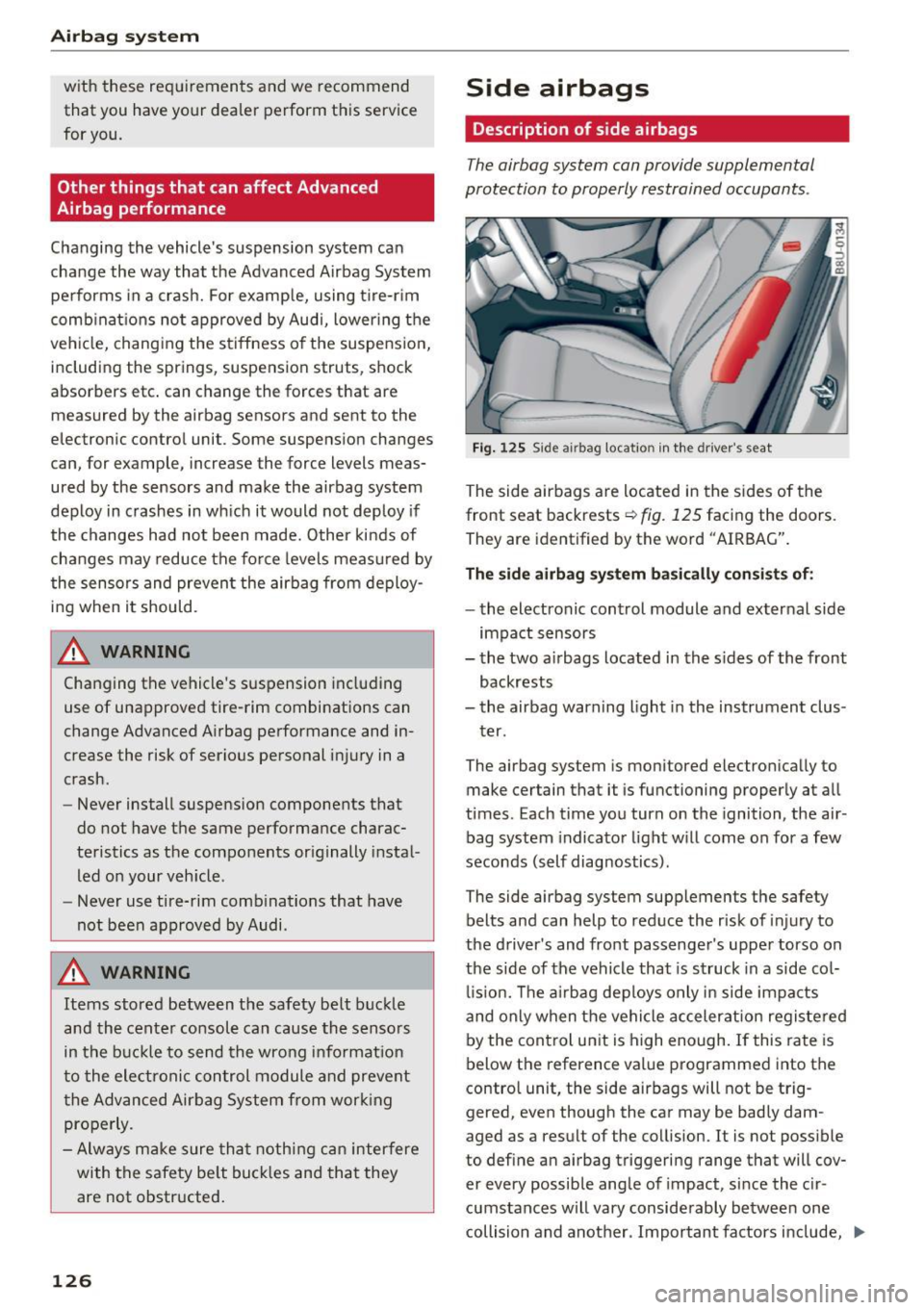
Fig. 125 S ide a irbag locat io n in the driver's seat
The side airbags are located in the sides of the
front seat backrests ¢
fig. 125 facing the doors.
They are identified by the word "AIRBAG".
The sid e airbag system ba sically con sis t s o f:
- the electronic control module and external side
impact sensors
- the two a irbags located in the s ides of the front
backrests
- the airbag warning light in the instrument clus -
ter.
The airbag system is monitored electronica lly to
make certain that it is functioning properly at a ll
t imes. Each time you turn on the ignition, the air
bag system indicator light w ill come on for a few
seconds (self diagnostics) .
The side airbag system supplements the safety belts and can help to reduce the risk of injury to
the driver's and front passenger's upper torso on
the side of the vehicle that is struck in a side co l
li sion. The a irbag deploys only in side impacts
and only when the vehicle acceleration registered by the control unit is high enough. If this rate is
below the reference val ue programmed into the
contro l unit, the side airbags will not be trig-
gered, even though the car may be badly dam-
aged as a result of the collision. It is not possible
to define an airbag triggering range that will cov er every possible angle of impact, si nce the c ir
cumstances w ill vary conside rably between one
collision and another . Important factors include, .,,.
Page 142 of 252
Child safety
Booster seats and safety belts
Properly used booster seats can help protect
children weighing between about 40 lbs . and 80
lbs. (18 kg and 36 kg) who are less than 4
ft. 9
in. (57 inches/1.45 meters) tall .
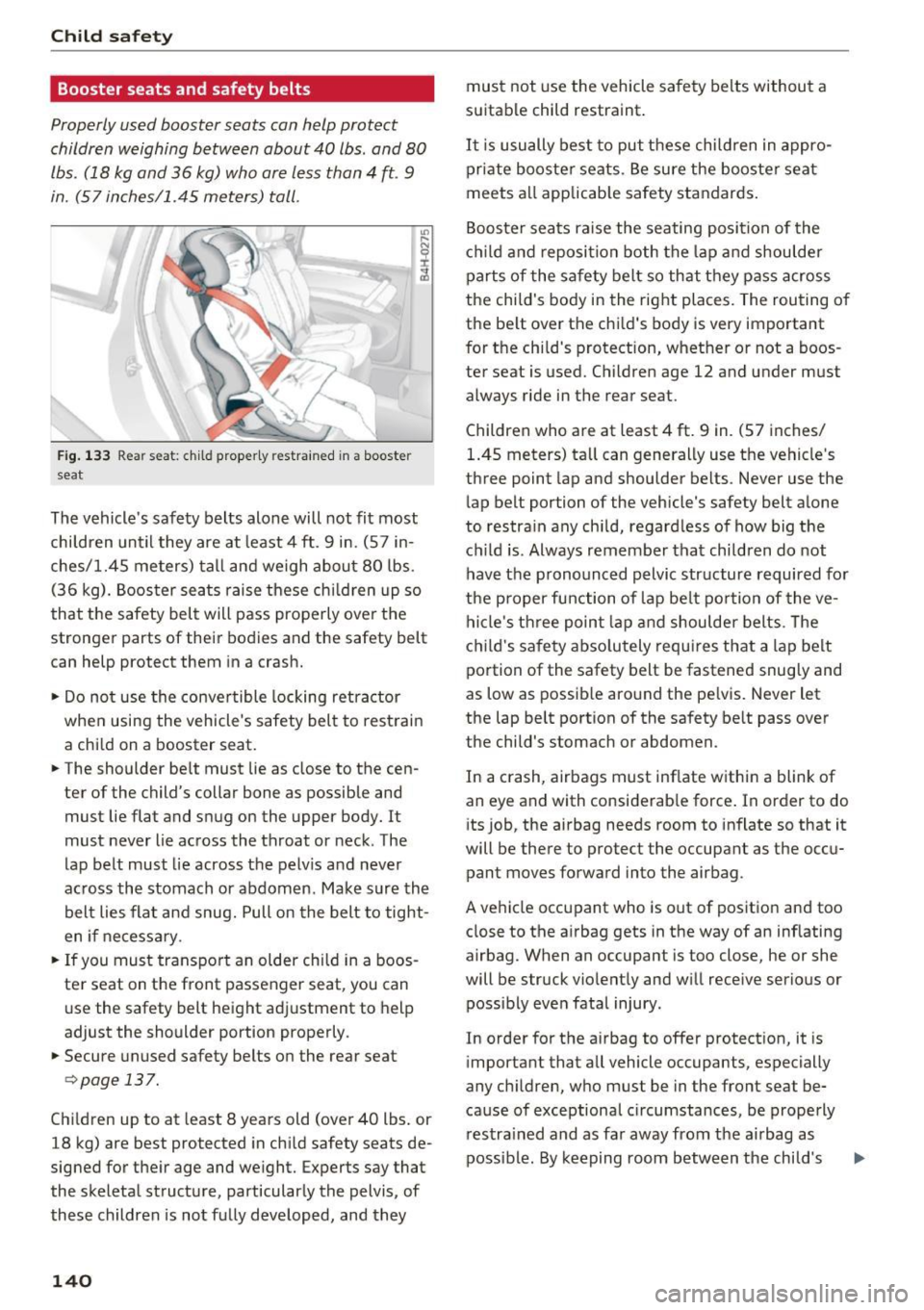
Fig. 133 Rear seat: ch ild proper ly restrained in a booster
seat
The vehicle's safety belts alone will not fit most
children until they are at least 4
ft . 9 in. (57 in
ches/1.45 meters) tall and weigh about 80 lbs .
(36 kg). Booster seats raise these chi ld ren up so
that the safety belt will pass properly
over the
stronger parts of their bodies and the safety belt
can help protect them in a crash.
• Do not use the convertible locking retractor
when using the vehicle's safety belt to restrain
a chi ld on a booster seat.
• The shoulder be lt must lie as close to the cen
ter of the child's collar bone as possible and
must lie flat and snug on the upper body. It
must never lie across the throat or neck. The
lap belt must lie across the pelv is and never
across the stomach or abdomen . Make sure the
belt lies flat and snug. Pull on the belt to tight
en if necessary .
• If you must transport an older child in a boos
te r seat on the front passenger seat , you can
use the safety belt height adjustment to help
adjust the shoulder portion properly .
• Secure unused safety belts on the rear seat
c> page 137.
Children up to at least 8 years old (over 40 lbs. or
18 kg) are best protected in child safety seats de
signed for their age and weight. Experts say that
the skeletal structure, particularly the pelvis, of
these children is not fully developed, and they
140
must not use the vehicle safety belts without a
suitable child restraint .
It is usually best to put these children in appro
pr iat e booste r seats. Be sure the booster seat
meets all applicab le safety standards.
Booster seats raise the seating position of the
child and reposition both the lap and shoulder
parts of the safety belt so that they pass across
the child's body in the right places. The routing of
the be lt
over the chi ld's body is very important
for the child's protection, whether or not a boos
ter seat is used. Children age 12 and under m ust
always ride in the rear seat.
Ch ildren who are at least 4
ft. 9 in. (57 inches/
1.45 meters) ta ll can generally use the vehicle 's
three point lap and shoulder belts . Never use the
lap belt portion of the vehicle's safety belt alone
to restrain any child, regard less of how big the
c hi ld is. Always remember that children do not
have the p ronounced pelvic structure required for
the proper function of lap belt portion of the
ve
hicle's three point lap and shoulder belts. The
c hi ld's safety absolutely requ ires that a lap belt
portion of the safety belt be fastened snugly and
as low as possible around the pe lvis. Never let
the lap belt portion of the safety belt pass over
the child's stomach or abdomen.
In a crash, airbags must inflate within a blink of
an eye and with considerab le force . In order to do
i ts job, the airbag needs room to inflate so that it
will be there to protect the occupant as the occu
pant
moves forward into the airbag.
A ve hicle occ upant who is out of position and too
close to the a irbag gets in the way of an inflating
airbag. When an occupant is too close, he or she
will be struck vio lently and will receive serious or
possibly even fatal injury .
In order for the a irbag to offer protection, it is
important that all vehicle occupants, especially
any ch ildren, who must be in the front seat be
cause of exceptional c ircumstances, be properly
re stra ined and as far away from the a irbag as
possible. By keeping room between the child's .,..
Page 153 of 252
shared, please see your contract with the
wireless telecommunications provider and the
"About Aud i connect" tab in your vehicle's
MMI:
! MENUI button> Audi connect > About
Audi conn ect.
Electronic Stabilization
Control (ESC)
Description
ESC helps to improve road ho ld ing and vehicle
dynamics to help reduce the probability of skid
d ing and loss of vehicle control. It works only
when the engine is runn ing . E SC detects certain
d ifficult dr iving sit uat ions, including when t he
ve hicl e is begin ning to spin (yaw) out of contro l
and helps you to ge t the veh icle back under con
tro l by se lective ly braking the wheels, and/or re
ducing engine powe r and provid ing steering as
sistance to help hold the vehicle on the dr iver's
intended course. The indicator light
GJ in the in
strument cluster blinks when ESC is taking action
to help you co ntrol the vehicle.
ESC has limitations. It is important to remember
that ESC cannot overcome the laws of physics. It
will not a lways be able to help out under all con
d itions you may come up aga inst. For example,
ESC may not always be able to help you master
situations where there is a sudden change in the
coeff icient of friction of the road surface. When
there is a section of dry road that is sudde nly cov
e red with water, slush o r snow, ESC cannot pe r
form the same way it wo uld on the dry s urface . If
the vehicle hydrop lanes (rides on a cushion of wa
ter i nstead of the road su rface), ESC wi ll not be
ab le to he lp you steer the veh icle because contact
with the pavement has been interrupted and the
ve hicle cannot be braked or steered. Dur ing fast
cornering, pa rticula rly on w inding roads, ESC
cannot always deal as effect ively w it h difficult
d riving si tuations tha n at lowe r speeds. When
tow ing a t raile r, ESC is not able to help you re
ga in con trol as it would if you we re not towing a
tra iler .
A lways adjust yo ur speed and driving sty le to
road, traffic and weathe r cond itions. ESC cannot
override the vehicle's physical lim its, increase the
Intellig ent Technology
available t ract ion, or keep a vehicle on the road if
road departure is a resu lt of driver inattention .
Instead, ESC improves the possib ility o f keeping
the vehicle under contro l and on the road d uring
extreme maneuvers by us ing the driver's steer ing
i nputs to help keep the veh icle go ing in the in
tended direction.
If you are traveling at a speed
that causes you to run off the road before ESC c an p rovide any assistance, you may not exper i
en ce the benefi ts of ESC.
ESC is switched o n all the time . In certa in s itua
t ions when you need less tract ion, you can sw itch
off AS R by press ing the button
[fil c:> page 152,
fig. 141. B e sure to switc h ASR on again whe n
you no longer need less tract ion .
T he following systems are integrated in the ESC:
Anti-lock brak ing system (ABS )
ABS prevents the wheels from locking when brak ing . The vehicle can still be steered even dur ing
hard braking. Apply steady pressure to the brake
pedal. Do not pump the pedal. A pulsing in the
brake pedal ind icates that the system is acting to
stab ilize the ve hicle.
Brake assist system
The brake assist system can decrease braking dis
tance. It increases braking powe r when the dr iver
presses the brake peda l quickly in emergency sit
uat io ns. You must press a nd ho ld the bra ke pedal
u nt il the dange rous situation is over.
Anti-slip regulation (ASR)
ASR reduces engine power whe n the dr ive wheels
begin spin ning and adapts the force to the road
co ndit ions. This makes it eas ier to s tart, acce ler
ate and d rive up incl ines.
Electronic differential lock (EDL)
The EDL brakes wheels that are spinning and
transfers the drive power to the other dr ive
wheel or wheels if the vehicle is equ ipped with all
whee l drive*) . This function is not available a t
highe r speeds .
In extreme cases, EDL automat ica lly switches off
to keep t he brake o n the braked wheel from over
hea ting . T he veh icle is still working co rrectly. EDL.,.
151
Page 154 of 252
Intelligent Technology
will switch on again automat ically when condi
tions have returned to normal.
Steering recommendation
The ESC helps to stabilize the veh icle by changing
the steering torque.
Selective wheel torque control
Selective wheel torque control is used when driv
i n g on curves . The front wheel on the inside of
the c urve or both wheels on the inside of the
curve are braked selectively as needed. This al
lows more precise driving in curves.
Automatic post-collision braking system
The "Automatic post-collision brak ing system"
can help to reduce the r isk of slid ing and of other
coll is ions after an accident . If the airbag control
module detects a collision above a certain vehicle
speed, the vehicle is braked by the ESC.
The vehicle does not brake automatically if :
- the driver presses the accelerator pedal, or
- the braking force generated by the pressed
brake pedal is greater than the braking force
that would be initiated by the system, or
- the ESC, the brake system or the vehicle electri
cal system are not functioning.
A WARNING
- The ESC and its integrated systems cannot
overcome the limits posed by natural physi-
Switching on and off
cal laws. This is especially important on slip
pery or wet roads. If the systems beg in act
ing to stabilize your vehicle, you should im
mediately alter your speed to match the
road and traffic conditions. Do not let the
increased safety provided tempt you into
taking risks. This could increase your risk of
a collision.
- Please note the risk of a collision increases
when dr iv in g fast, especially through curves
and on slippery or wet roads, and when dr iv
ing too close to objects ahead. The ESC and
its integrated systems cannot always pre
vent collisions -there is still a risk of acci
dents!
- Press the accelerator peda l carefully when
accelerating on even, slippery surfaces such
as ice and snow. The drive wheels can spin
even when these control systems are instal
led and this can affect driving stability and
increase the risk of a collision .
@ Tips
-ABS and ASR only function correctly when
all four wheels are equipped with identical
tires. Different tire sizes can lead to a reduc
tion in engine power.
- You may hear noises when the systems de
scribed are working.
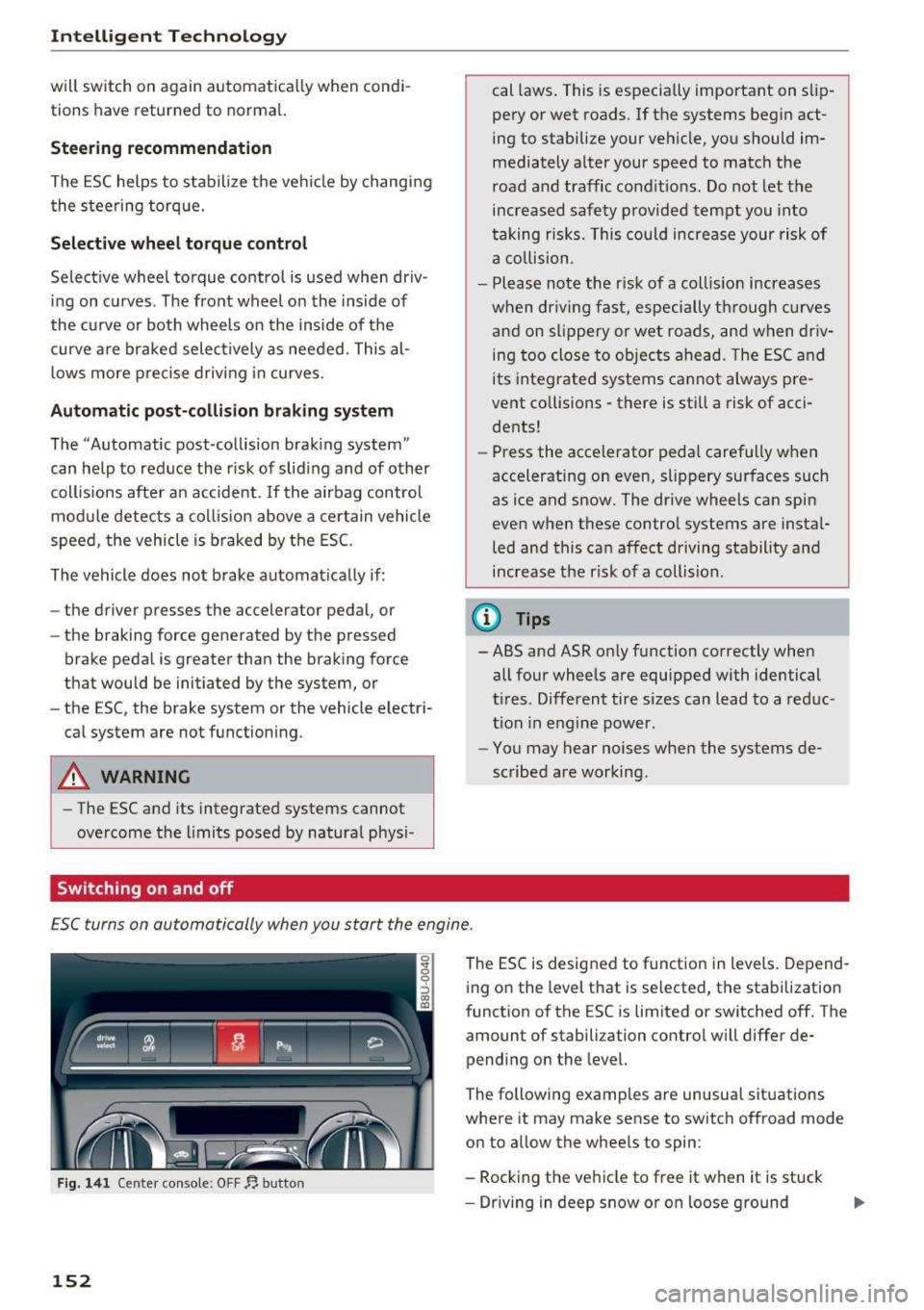
£SC turns on automatically when you start the engine .
Fig. 141 Center console: OFF rJ. button
152
The ESC is designed to function in levels. Depend
i ng on the level that is selected, the stabilization
function of the ESC is limited or switched off. The amount of stabilization control will differ de
pending on the level.
The following examples are unusual situations
where it may make sense to switch offroad mode
on to allow the wheels to spin:
- Rocking the vehicle to free it when it is stuck
- Dr iving in deep snow or on loose ground
Page 166 of 252
Trailer mod e
Trailer mode
Driving with a trailer
General information
Your Audi was designed primarily for passenger
transportation.
If you plan to tow a trailer, please remember that
the additional load will affect durability, economy and performance.
Trailer towing not only places more stress on the
vehicle, it also calls for more concentration from
the driver.
F or this reason, always follow the operating and
driving instructions provided and use common
sense.
Technical requirements
Tr aile r hitch
Use a weight-carrying hitch conforming to the
gross trailer weight. The hitch must be suitable
for your veh icle and trailer and must be mounted
securely on the vehicle's chassis at a technically
sound
location . Use only a trailer hitch with a re
movable ball mount . Always check w ith the t rail
er hitch man ufact urer to make su re that you are
using the co rrect hitch .
Do not use a bump er hit ch .
The hitch must be installed in such a way that it
does not interfere with the impact -absorbing
bumper system. No mod ificat ions should be
made to the vehicle exhaust and brake systems .
From t ime to t ime, check that a ll hitch mount ing
bolts rema in securely fastened.
When you are not tow ing a tra iler, remove the
tra iler hitch ba ll mount . This prevents the hitch
from caus ing damage shou ld your veh icle be
s truck from be hind ¢
,&..
Trailer brakes
If your trailer is equipped with a brak ing system,
check to be sure that it conforms to all regula
tions .
164
The trailer hydraulic brake system must not be
directly connected to the vehicle's hydraulic
brake system ¢&. .
Safety chains
Always use safety chains between you r vehicle
and the trailer.
Trailer lights
Traile r lights must meet all regulations . Be sure
to check w ith your author ized Audi dealer for cor
r ec t wiring , switches, and relays.
M irrors
If you are unable to see the traffic behind you us
ing the regular outs ide mirrors, then you
must in
stall extended mirrors . It is important that you
always have clear vision to the rear.
.&_ WARNING
- If a tra ile r has e lectr ica l brakes p lease no te
t hat these brakes are not activated by the
factory-fit ted contro l unit -risk of accident!
- After removing the trai ler hitch, do not
store it in your vehicle. In case of sudden
braking, the hitch co uld fly forward and in
jure you or yo ur passengers.
- Never install a "we ight distribu ting" or
"load eq ualizing" trailer hitch on your vehi
cle. The vehicle was not designed for these
kinds of trailer hitches. The hitch attach ment can fail, caus ing the tra iler to tear
loose from the vehicle.
- The Gross Vehicle Weight Rating for your
veh icle, found on the safety compliance la
be l on the driver's s ide B-pillar, must never
be exceeded under any circumstances . Ex
ceed ing the Gross Vehicle Weight Rat ing of
your veh icle is likely to damage yo ur vehicle,
and such damage will not be covered by
your Limited New Vehicle Warranty . Exceed
ing the Gross Vehicle Weight Rating will al
so change the performance and handling
characteristics of your vehicle, which could
cause a crash result ing in serious injury or
death.
Page 169 of 252
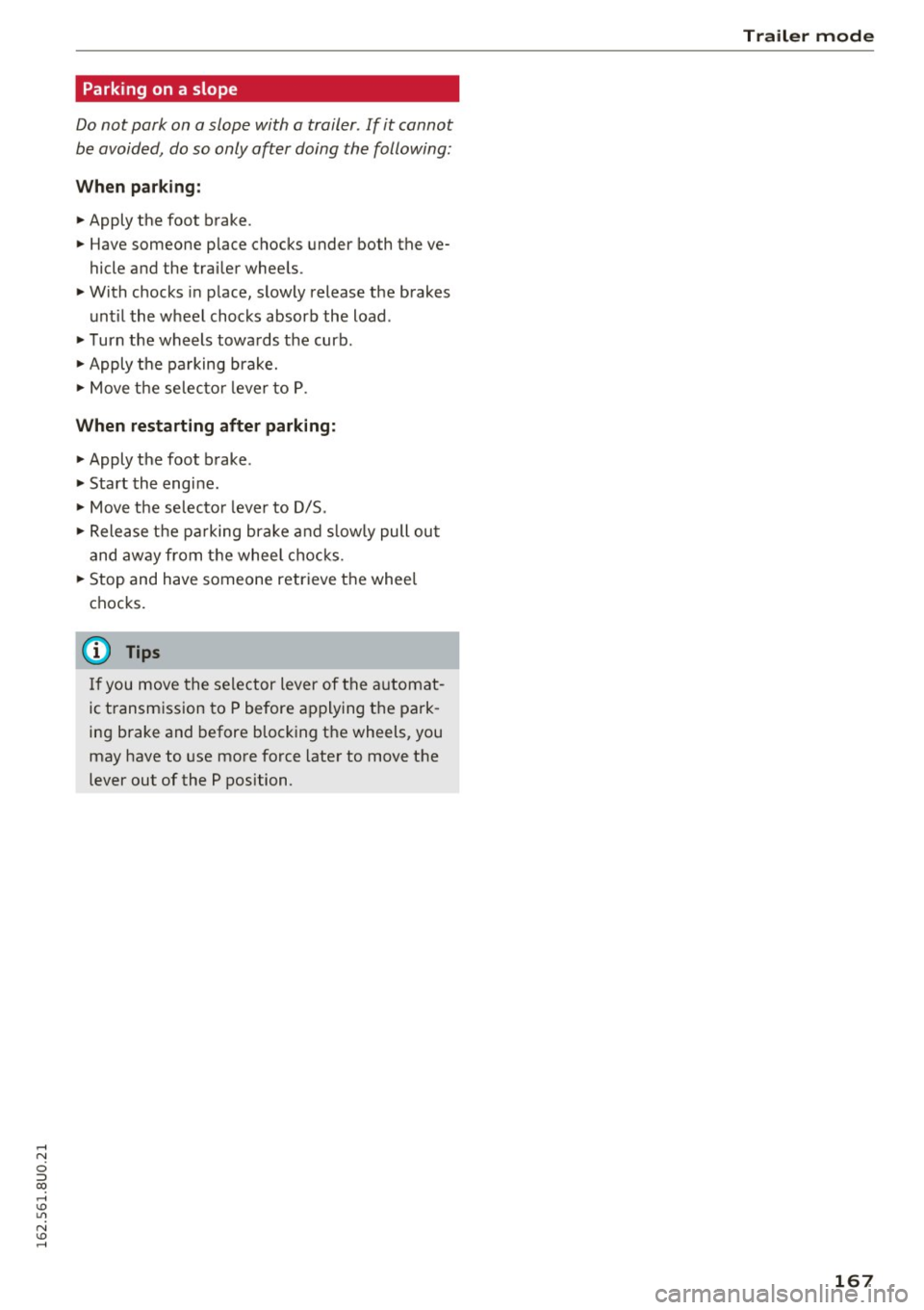
Parking on a slope
Do not pork on a slope with a trailer. If it cannot
be avoided, do so only ofter doing the following:
When parking:
.. Apply the foot brake .
.. Have someone place chocks under both the ve
hicle and the trailer wheels .
.. With chocks in place, slowly release the brakes
until the wheel chocks absorb the load .
.. Turn the wheels towards the curb .
.. Apply the parking brake .
.. Move the selector lever to P.
When restarting after parking:
.. Apply the foot brake .
.. Start the engine .
.. Move the selecto r lever to D/S .
.,. Release the parking brake and slowly pull out
and away from the wheel chocks .
.. Stop and have someone retrieve the wheel
chocks.
(D Tips
If you move the selector lever of the automat
ic transmission to P before applying the park
ing brake and before blocking the wheels, you
may have to use more force later to move the
lever out of the P position.
Trailer mode
167
Page 173 of 252
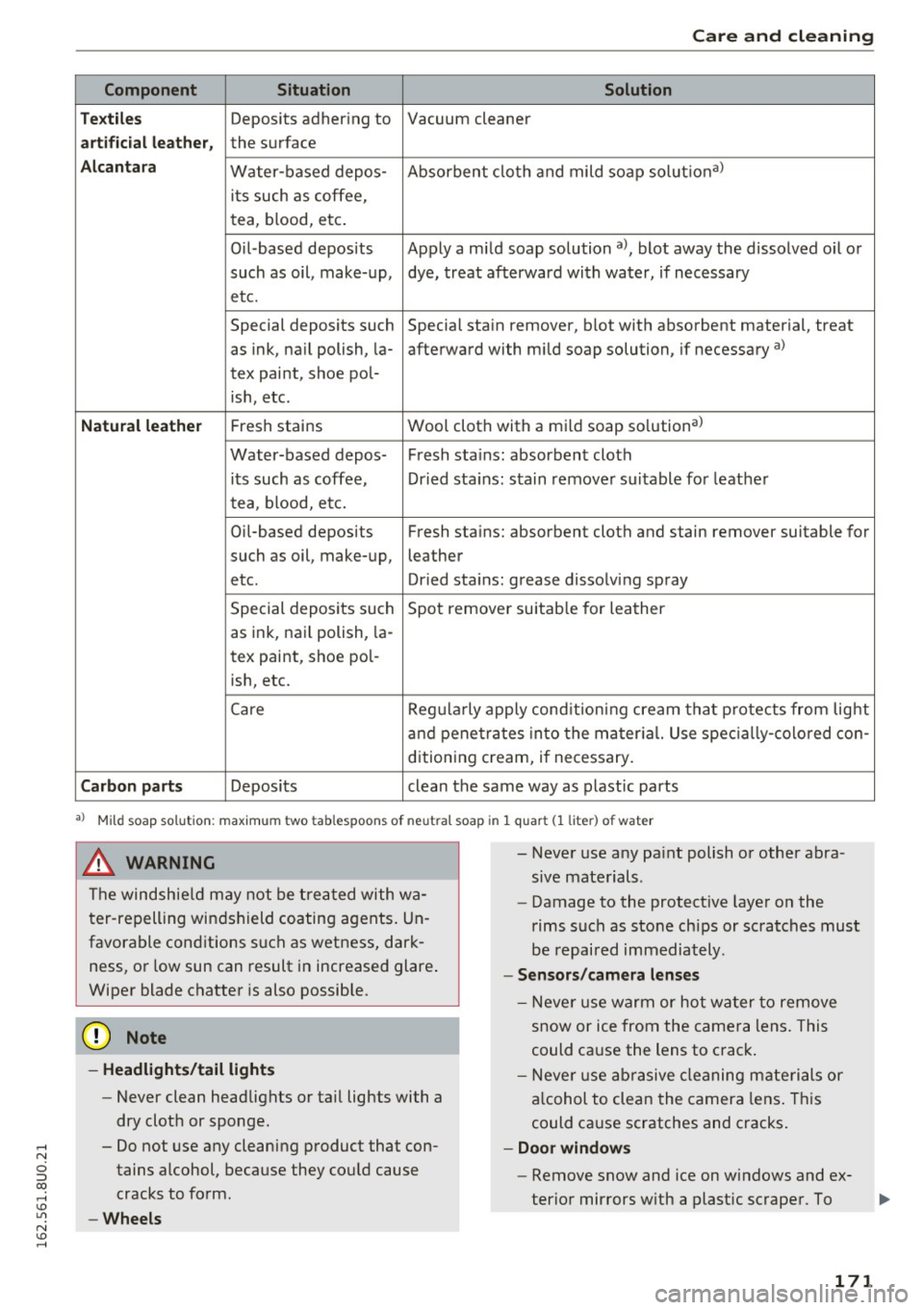
Care and cleaning
Component Situation Solution
T ex til es
Deposits adhering to Vacuum cleaner
art ifici al leat her, the surface
A lcan tara Water-based depos- Absorbent cloth and mild soap
solutional
its such as coffee,
tea, blood, etc.
Oil-based deposits Apply a mild soap solution al, blot away the dissolved oil or
such as oil, make-up, dye, treat afterward with water, if necessary
etc.
Special deposits such Special stain remover, b lot with absorbent material, treat
as ink, nail polish, la-afterward with mild soap solution, if necessary al
tex paint, shoe pol-
ish, etc.
Natu ral le ath er Fresh stains Wool cloth with a mild soap solution al
Water-based depos-Fresh stains: absorbent cloth
its such as coffee, Dried sta ins: stain remover su itable for leathe r
tea, blood, etc.
Oil-based deposits Fresh stains: absorbent cloth and stain remover suitable for
such as oil, make-up, leather
etc . Dried stains : grease dissolving spray
Special deposits such Spot remover suitable for leather
as ink, nail polish, la-
tex paint, shoe pol-
ish, etc.
Ca re Regularrly apply cond itioning cream that p rotects from light
and penetrates into the ma ter ial. Use spec ially-colored con-
ditionirng cream, if necessary.
Carbon p art s Deposits clean the same way as plastic parts
a) Mild soap solution: maximum two tablespoons of neutral soap in 1 q uart (1 liter) of water
.8, WARNING
The windshield may not be trea ted with wa
ter-repelling windshield coating agents. Un
favorable cond itions such as wetness, dark
ness, or low sun can result in increased glare.
Wiper blade chatter is also possible.
@ Note
- Headlight s/tail li ghts
- Never clean headlights or tail lights with a
dry cloth or sponge.
- Do not use any cleaning product that con
tains alcohol, because they could cause
cracks to form.
- Whe els
-
- Never use a ny pa int polish or other abra
sive materials .
- Damage to the protect ive layer on the
rims such as sto ne ch ips or scratches must
be repaired immediately .
-Sen sor s/camera lenses
-Neve r use warm or hot water to remove
snow or ice from the camera lens . This
could ca use the lens to crack .
- Neve r use ab rasive cleaning materials or
a lcohol to clean the camera lens . This
could cause scratches and cracks .
-Door window s
-Remove snow and ice on windows and ex-
terior mirrors w ith a plast ic scraper. To
171