service AUDI Q3 2016 Owner's Manual
[x] Cancel search | Manufacturer: AUDI, Model Year: 2016, Model line: Q3, Model: AUDI Q3 2016Pages: 252, PDF Size: 62.81 MB
Page 113 of 252
Service and disposal of safety belt preten
sioner
The safety belt pretensioners are parts of the
safety be lts on your Audi. Installing, removing,
servicing or repairing of belt pretensioners can
damage the safety belt system and prevent it
from working correctly in a collision .
There are some important things you have to know to make sure that the effectiveness of the
system w ill not be impaired and that discarded
components do not cause injury or pollute the
environment.
A WARNING
-
Improper care, serv icing and repa ir proce
dures can increase the r isk of personal injury
and death by preven ting a safety be lt preten
sioner from activating when needed or acti
vating it unexpectedly:
- T he be lt pretensione r system can be act ivat
ed only once.
If belt pretensioners have
been ac tiva ted, the system must be re
placed.
- Never repair, adjust, or ch ange any parts of
the safety be lt system .
- Safety belt systems in cl ud ing safety belt
pretens ioners cannot be repaired. Specia l
procedures are req uired for removal, insta l
lation and disposa l of this system.
- For any work on the safety bel t system, we
strongly recommend that you see your au
thorized Aud i dea ler or qualified technician
who has an A udi approved repair manual,
train ing and spec ial equ ipment necessary.
@ For the sake of the environment
Undep loyed airbag modu les and pretension
ers might be classified as Perch lorate Materi
al -spec ia l handling may apply, see
www.dtsc.ca.gov/hazardouswaste/perchlo rate. When the veh icle or parts of the re
straint system including air bag modules safe
ty belts with pretensioners are scrapped, all
app licabl e laws and regula tions must be ob
served. Your authorized Audi dealer is familiar
w it h these req uirements and we recommend
S afet y be lts
that you have your dealer perform this service
for you .
111
Page 128 of 252
Airbag syste m
with these requirements and we recommend
that you have your dealer perform this service
for you.
Other things that can affect Advanced
Airbag performance
Changing the vehicle's suspension system can
change the way that the Advanced Airbag System
performs in a crash. For examp le, using t ire-r im
comb inat ions not approved by Audi, lower ing the
veh icle, changing the stiffness of the suspens ion,
including the springs, suspension struts, shock
absorbers etc . can change the forces that are
measured by the airbag sensors and sent to the
electronic control unit. Some suspension changes
can, for example, increase the force levels meas
ured by the sensors and make the airbag system
deploy in crashes in wh ich it would not deploy if
the changes had not been made. Other kinds of
changes may reduce the force levels meas ured by
the sensors and prevent the airbag from deploy ing when it should.
A WARNING
Changing the vehicle's suspension including
use of unapproved tire-rim combinations can
change Advanced Airbag performance and in
crease the risk of serious personal injury in a
crash.
- Never install suspension components that
do not have the same performance charac
teristics as the components originally instal
led o n your veh icle .
- Never use tire-rim comb inations that have
not been approved by Audi.
A WARNING
Items stored between the safety belt buckle
and the center console can cause the senso rs
in the buckle to send the wrong info rmation
to the electronic control module and prevent
t he Advanced Airbag System from wor king
properly.
- Always make sure tha t noth ing can interfere
with the safety be lt buck les and that they
are not obstructed.
126
Side airbags
Description of side airbags
The airbag system can provide supplemental
protection to properly restrained occupants .
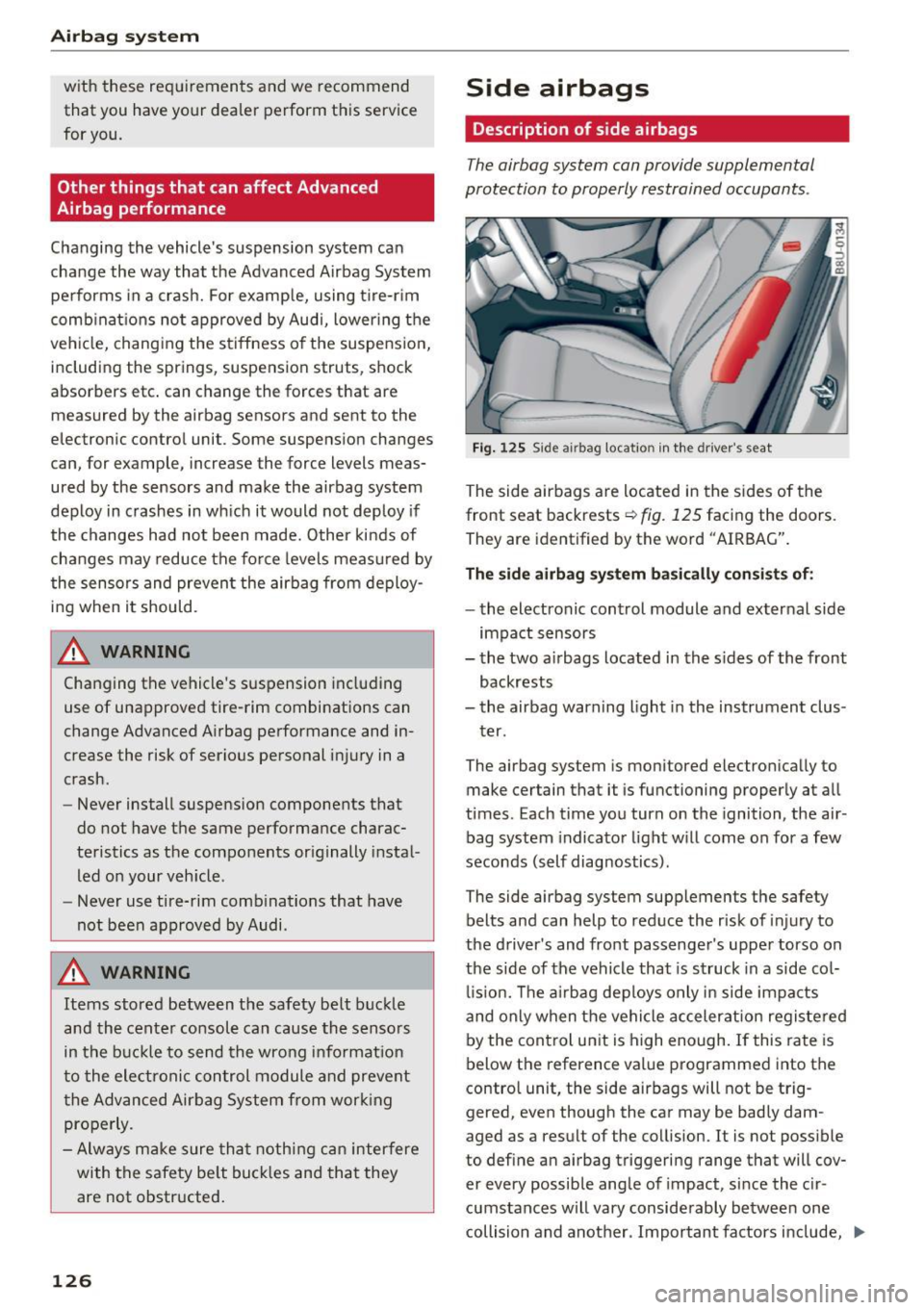
Fig. 125 S ide a irbag locat io n in the driver's seat
The side airbags are located in the sides of the
front seat backrests ¢
fig. 125 facing the doors.
They are identified by the word "AIRBAG".
The sid e airbag system ba sically con sis t s o f:
- the electronic control module and external side
impact sensors
- the two a irbags located in the s ides of the front
backrests
- the airbag warning light in the instrument clus -
ter.
The airbag system is monitored electronica lly to
make certain that it is functioning properly at a ll
t imes. Each time you turn on the ignition, the air
bag system indicator light w ill come on for a few
seconds (self diagnostics) .
The side airbag system supplements the safety belts and can help to reduce the risk of injury to
the driver's and front passenger's upper torso on
the side of the vehicle that is struck in a side co l
li sion. The a irbag deploys only in side impacts
and only when the vehicle acceleration registered by the control unit is high enough. If this rate is
below the reference val ue programmed into the
contro l unit, the side airbags will not be trig-
gered, even though the car may be badly dam-
aged as a result of the collision. It is not possible
to define an airbag triggering range that will cov er every possible angle of impact, si nce the c ir
cumstances w ill vary conside rably between one
collision and another . Important factors include, .,,.
Page 152 of 252
Intelligent Technology
Intelligent Technology
Notice about data
recorded by the Event
Data Recorder and
vehicle control modules
Event Data Re corder
This vehicle is equipped wi th an Event Data Re
corder (EDR) . The main purpose of an E DR is to
record, in certain crash or near crash -like situa
tions, such as an airbag deploym ent or h itting a
road obstacle, data that will assist in understand
ing how a veh icle 's systems performed . The EDR
is designed to record data related to veh icle dy
namics a nd safety systems for a sho rt period of
time, typically 30 seconds or less . The E DR in this
veh icle is designed to reco rd s uch data as :
- How various systems in your vehicle were oper
at ing;
- Whether or not the driver and passenger safety
belts were buckled/fastened;
- How far ( if at all) the driver was depressing the
acce lerator and/or brake peda l; and,
- How fast the ve hicle was trave ling.
These data can help provide a better understand ing of the ci rc u mstances in which c rashes and in
juries occur. NOT E: EDR data are recorded by yo ur
veh icle only if a non-trivia l crash situat ion occurs;
no data are recorded by the EDR under normal
driving conditions and no personal data (e .g .,
name, gender, age, and crash location) a re re
corded . H owever , other pa rties , such as law en
forcement, cou ld combine the EDR data w it h the
type o f person ally identifyi ng dat a routine ly ac
qu ired dur ing a crash invest igat ion .
To read data reco rded by an EDR, specia l equip
men t is req uire d, and access to the veh icle or the
E DR is needed. In ad dition to the vehicle manu
facturer, other parties, s uch a s law enforcement,
that have t he specia l equipment, can read the in
formation if they have access to the vehicle or the E DR.
Some s tate laws restrict the re trieva l or down
loading of data stored by ED Rs insta lled in a vehi
cle fo r the express purpose of retrieving data af -
150
ter an accident or crash event withou t the own
er 's consent.
Audi will not access the EDR and /or sim ilar data
o r g ive it to others -
- unless t he ve hicle ow ner (o r lessee if the vehi
cle has been leased) ag rees; o r
- upon the offic ial request by the police; or
- upon the order of a court of law or a govern-
ment agency; or
- for the defense of a lawsuit through the jud icia l
discovery process.
- Audi may also use the data for research about
veh icle operation and safety perfo rmance or
prov ide the data to a th ird party for research
purposes w itho ut identify ing t he specific vehi
cle or info rmat ion about the ident ity of its own
er or lessee and only afte r th e re co rded vehicle
d ata has been a ccessed.
Vehicle control modules
You r vehicle is also equ ipped with a number of
e lectronic cont rol modules for va rious vehicle
syste ms, such as engine ma nagement, em iss io n
contro l, air bag s, a nd safety be lts.
These electronic control modules record data
dur ing norma l vehicle operation t hat may be
n eeded by tra ined techn ic ians for d iagnost ic and
r ep air pur poses. The re cording capab ility of these
modules is lim ited to dat a (no sou nd is recor d
ed). Only a sma ll amount of data is actually re
corded over a very limited period of time, or stor
ed when a system fault is detected by a contro l
module . Some of the data stored may relate to
vehicle speed, direction, or braking, as well as re
straint system use and performance in the event
of a crash . Stored data can also only be read a nd
down loaded w it h specia l equipment that is d i
r ec tly connec ted to the vehicle.
(D Tips
Your vehicle may be e quipped w it h Aud i con
n ect . Yo ur use of certain Aud i connect fea
tures requires wire less services that are p ro
v ided by a third party wireless telecomm uni
cations provider. Fo r de tails regarding how in
fo rmation obtained through Aud i connect is
collecte d, processe d, transmitted, use d, an d ..,.
Page 158 of 252
Intelligent Technology
Electromechanical
steering
The electromechanical steering sup ports the
driver's steering movements .
Power steering adapts electronically based on
the vehicle speed .
Indicator lights and mess ages
• Steering fault! Do not drive veh icle!
If thi s ind ic a tor light t urns o n and stays o n and
this message appears, the power steering may
have fa iled.
S top the veh icle in a safe lo cat io n as soo n as pos
sib le. Do
not c on tinue driving. See an author ized
Aud i dea ler o r authorized Aud i Serv ice Facility fo r
assistance.
If the ind icator lig ht t urns on, the steer ing wheel
may be mo re diff icu lt to move o r more sensitive
than usual. The stee ring wheel may also be at a n
angle when dr iving straight .
Dr ive s low ly to your author ized A udi dealer or au
thor ized Audi Se rvice Facility to have the ma l
f u nction co rrected.
E£-ij St eering lock: System fault! Plea se contact
deal er.
There is a malfunction in the electronic steering
lock.
D rive to an a uthorized Audi dea le r or a uthorized
Audi Service Facility immediately to have the
malfunct ion corrected.
@ Tips
If the . or Erj indicato r light on ly stays on
for a short time, you may continue driv ing.
All wheel drive (quattro)
Applies to vehicles: with all wheel drive
In oil wheel drive, oil four wheels ore powered .
General information
In a ll w heel d rive, the d rivi ng power is divided be
tween a ll four wheels . This happens au tomatical-
156
ly depending on yo ur driv ing behavior as we ll as
the cur rent road conditions . Refer to
Q page 151.
The all whee l dr ive concep t is designed fo r high
engine power. Yo ur vehicle is except ion ally pow
erf ul and has excellent drivin g charac teristics
both un der normal driving conditions and on
snow and ice . Always read and follow safety pre
cautions
c:> .&, .
Winter tires
By using all whee l dr ive, your ve hicle has goo d
f orward motion wi th standard tires in w inte r con
ditions . However, in winte r we recommend using
winter or all-season tires on all four wheels, be
cause this will improve the brak ing effect
c:> page 206, Winter tires .
Snow chains
If there are snow chain laws, snow chains m ust
also be used o n veh icles with all wheel drive
c:> page 206, Snow chains.
Replacing tires
Fo r vehicles with all wheel drive, on ly wheels with
t h e same ro lli ng circ umfe rence sho uld be used .
Avoid whee ls with different t read depths
Q page 198 , New tires or wheels .
A WARNING
-Also, in vehicles with all wheel drive, adapt
your driving sty le to the current road and
traffic conditions. Do not let t he increased
safety prov ided tempt you in to taking r isks,
because this inc reases t he risk of an acc i
dent.
- The braking ab ility o f your vehicle is limited
t o th e trac tion of th e wh eels. I n this way, it
is no t differe nt from a two wheel drive vehi
cle. Do no t be tempte d to accelerate to a
hi gh speed when the ro ad is slip pery this in
creases the risk of an accident .
- N ote tha t on wet s tree ts, the front wheels
can " hydrop lane" i f driv ing at spee ds tha t
are too high. Unlike front wheel drive
veh icles, t he engine does not
rev higher sud
de nly when t he vehicle begins hydroplan ing.
For this reason, pay attention to the road
Page 163 of 252
Drive smoothly and keep a lookout ahead
Vehicles use the most fuel when they are acceler
ating .
11-Avoid unnecessary accelerating and braking.
Vehicles use the most fuel when they are acceler ating . If you anticipate what is going to happen
next, you will need to brake less and, thus, accel
erate less . Let the vehicle coast whenever possi
ble - for example when you see that the next traf
f ic light is red .
Avoid full throttle
Driving a t modera te speeds saves fuel and im
proves your mileage .
11-Try and keep well be low your car's max imum
speed.
Accelerating gent ly reduces fuel consumption,
engine wear, and does not disturb the environ
ment.
F ue l cons umption, exha ust emissions and engine
noise increase disproportionately at high speeds.
If you drive at approximately three quarters of
top speed, fuel consumpt ion will be reduced by
one half. Never drive faster than the posted
speed limit and weather conditions permit.
Reducing unnecessary idling
Even when your car is just idling i t burns up fuel.
11-S hut the engine off w hen you are not driving
the vehicle.
11-Do not warm up the vehicle by letting the en-
gine ru n at idle .
It makes sense to shut off the eng ine in traffic
jams, when wa iting for trains to pass at rai lroad
crossings, or at traffic lights that have long waits
on red . Turn ing the eng ine off for just 30 -40 sec
onds saves more fue l than is bu rned starting the
engine agai n.
It takes a long t ime for the engine to warm up
fu lly when it is runni ng at idle . However, wear
and noxious emiss ions are especially high when
the eng ine is wa rm ing up . So you should d rive
Driving and the envir onment
away as soon as you start the eng ine and avoid
running at high rpms w hil e the engine is sti ll
warming up .
(D Note
Do not leave eng ine idling una ttended after
starting. If wa rning lights shou ld come on to
i ndicate improper operation, they would go
unheeded. Extended idling also prod uces
heat, which could result in overheating or
other damage to the vehicle or other proper
ty .
Regular maintenance
A badly tuned engine unnecessarily wastes a lot
of fuel .
11-Have your vehicle serviced at regular interva ls.
By having your vehicle regular ly serv iced by an
authorized Audi dea ler helps to ensure that it
runs properly and economically. The cond ition of
your vehicle not only affects its safety and ability
to hold its value, it also affects
fuel con sump
tion .
Chec k your oil each t ime you fill your tank.
T he amount o f oi l used is related to engine load
and speed.
It is normal fo r the oil consump tion of a new en
gine to reach its lowest value after a ce rtain m ile
age has been dr iven.
You m ust dr ive your ve hicle about 3,000 m iles
(5,000 kilometers) befo re yo u can prope rly as
sess oil consumpt io n.
T h is also app lies to fuel consumption and eng ine
output.
(D Note
- Have your vehicle maintained properly and in accordance with the se rvice recommenda
tions i n your Warranty
& M aintenance book-
le t. La ck of prope r maintenan ce as we ll as
imp roper use of the ve hicle will im pair the
function of the em ission cont rol sys tem and
co uld lead to damage . .,.
161
Page 170 of 252
Care and cleaning
Care and cleaning
General information
Regular, prope r care helps to maintain your vehi
cle's value.
It can a lso be a requirement when
submitting war ranty claims for cor rosion damage
and pa int defects on the body.
The necessary care prod ucts can be obtained
from your authorized Audi dealer o r authorized
Aud i Service Facility. Read and follow the instruc
tions for use on the packaging.
A WARNING
- Using cleaning and care products incorrectly
can be dangero us to your hea lth .
- Always store clean ing and care products out
of reach of children to reduce the r isk of po i
so ning .
@ For the sake of the environment
- Preferab ly use environmentally-friendly
products when buying cleaning agents.
- Do not dispose of leftove r clean ing and care
products wit h household t rash.
Car washes
The longer that deposits remain on the veh icle,
the more the surface may be damaged. High
temperatures such as those caused by sunlight
increase the damaging effect.
Before washing, rinse
off heavy deposits with
p lenty of water.
Stubborn deposits s uch as bird droppings or tree
sap are best removed with plenty of water and a mic rofibe r cloth.
A lso, wash the underside of yo ur vehicle once
road sa lt stops being used for the season .
Pressure washers
When washing your veh icles with a pressure
washer, always follow t he ope ra ti ng inst ructions
p rovided w ith the pressure washer. This is espe
cially important in regard to the pressure and
spraying distance . Do not a im the spray directly
at seals on side windows, doors, the hood, the
168
rear lid or the sunroo f* or at tires rubber hoses I I
insulating material, sensors* or camera lenses* .
Keep a distance of at least 16 inches (40 cm) .
Do no t remove snow and ice with a pressure
washe r.
Neve r use rota ry no zzles or high pressure noz
z les.
The water temperatu re must not be above 140 °F
(60 °().
Automatic car washes
Spray
off the vehicle before washing.
Make su re that the windows and roof * are closed
and t he windshie ld wipers are
off . Follow instruc
tions from the car wash operato r, especially if
there are accessories attached to your vehicle.
If possible, use car washes that do not have
brushes.
Washing
by hand
Clean the vehicl e starting from the top and work
in g down using a soft sponge or cleaning br ush .
Use solvent-free cleaning products.
Washing vehicles with matte finish paint
by
hand
To avo id damaging the paint w hen washing, fi rst
remove dust and large pa rt icl es from your vehi
cle. Insects, grease spots and fingerprints are
best removed with a special cleane r for matte
finish paint .
Apply the p rodu ct using a microfiber cloth. To
avoid damaging the paint surface, do not use too
much pressure.
Rinse the vehicle thorough ly w ith wate r. Then
clean using a neutra l shampoo and a soft m icr o
fiber cloth .
R inse the ve hicle thorough ly again a nd let it air
dry. Remove any water residue using a leather
cloth.
A WARNING
- Only wash the vehicle when the ignition is
off and follow the instr uctions from the car
-
Page 172 of 252
Care and cleaning
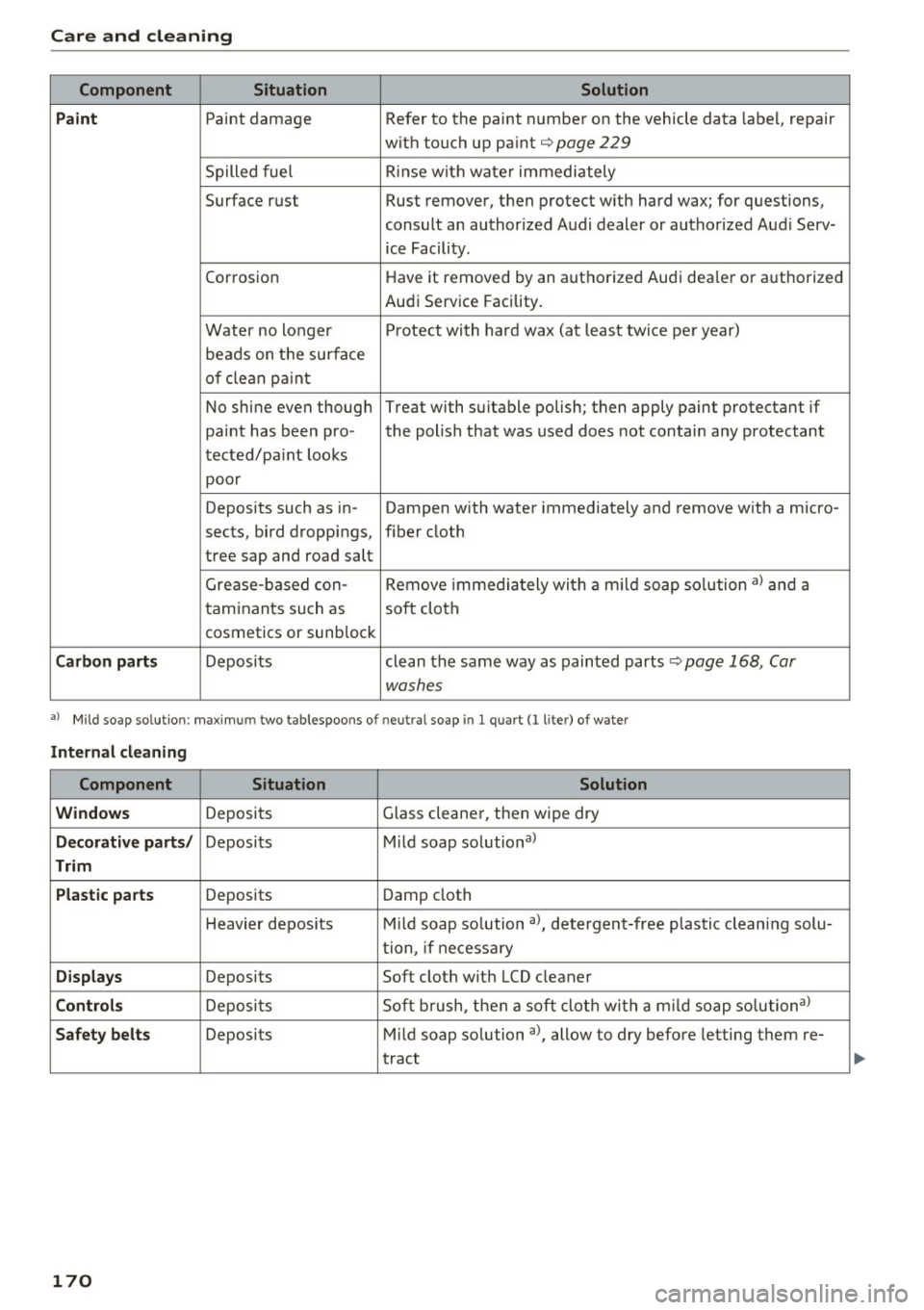
Component Situation Solution
Paint
Paint damage Refer to the paint number on the vehicle data label, repair
with touch up paint
c::;, page 229
Spilled fuel Rinse with water immediately
Surface rust Rust remover, then protect with hard wax; for questions,
consult an 1 authorized Audi dealer or authorized Audi Serv-
ice Facility.
Corrosion Have
it removed by an authorized Audi dealer or authorized
Audi Service Facility.
Water no longer Protect with hard wax (at least twice per year)
beads on the surface
of clean paint
No shine even though Treat with suitable polish; then apply paint protectant if
paint has been pro -the polish that was used does not contain any protectant
tected/paint looks
poor
Deposits such as in-Dampen with water immediately and remove with a micro-
sects, bird droppings, fib er cloth
tree sap and road salt
Grease-based con- Remove immedia tely with a m ild soap solution al and a
taminants such as soft cloth
cosmetics or sunb lock
Carbon parts Deposits clean the same way as painted parts c::;, page 168 , Car
washes
• > M ild soap so lution: ma xim um tw o tabl espoo ns of n eu tral soap i n 1 quart (1 li ter) of w ater
Internal cleaning
Component Situation Solution
Windows
Deposits Glass
cleane r, then wipe dry
Decorative parts/ Deposits Mild soap solutiona l
Trim
Plastic parts
Deposits Damp cloth
Heavier deposits Mild soap so lution al, detergent-free p lastic cleaning solu-
tion, if necessary
Displays Deposits Soft cloth with LCD cleaner
Controls Deposi ts Soft
brush, then a soft cloth w ith a mild soap solutiona)
Safety belts Deposits Mild
soap so lution a>, allow to dry before letting them re-
tract
170
Page 174 of 252
Care and cleaning
avoid scratches, move the scraper on ly in
one direction and not back and forth.
- Never remove snow or ice from door win
dows and mirrors using warm or hot water
because this could cause cracks to form .
- To avoid damage to the rear w indow de
fogger, do not apply any stickers on the
heating wires on the inside of the window .
- Decorati ve parts /trim
- Never use chrome care or cleaning prod-
ucts.
- Paint
- To red uce the risk of scratches, the vehicle
must be free of dirt and dust before pol
ishing or waxing .
- T o prevent pa int damage, do not polish or
wax the veh icle in direct sunlight.
- To red uce the risk of pa int damage, do not
polish away rust spots.
- Remove cosmetics and sunscreen immedi
ately -these could damage the paint.
- Di spla ys
- To avoid scratches, do not use dry cleaning
methods on displays .
-Controls
- Make sure that no fluids enter the con-
trols, because this could cause damage.
- Safety belts
- Do not remove the safety belts to clean
them.
- Never clean safety belts o r th eir compo
nents chemically or with cor rosive fl uids
or so lvents and neve r al low sha rp objects
t o come into con ta ct w ith the safe ty belts.
T his could cause damage to the belt web
bing .
-If there is damage to the webbing, the
connections, the retractors or the buckles,
have them replaced by an author ized Audi
dealer or authorized Audi Service Facility.
- Textiles /art ificial leather/ Alcantara
- Never treat artificia l leather/ Alcantara
w ith leather care products, so lvents, floor
polish, shoe polish, spot remove or similar
prod uct s.
- Have a specialist remove st ubborn stains
to prevent damage.
172
- Never use steam cleaners, brushes, hard
sponges, etc . when cleaning .
- D o not turn on the seat heating* to dry the
seat.
- Objects w ith sharp edges s uch as zippe rs,
rivets on clothing or be lts can cause dam
age to the surface .
- Open hook and loop fasteners, fo r exam
p le on clothing, can damage seat covers.
Make sure hook and loop fastene rs are
closed.
- Natu ral leathe r
- Never treat leather with solvents, floor
polish, shoe polish, spot remover or sim i
lar p roducts .
- Objects w ith sharp edges such as zippe rs,
rivets on clothing or belts can cause dam
age to the surface.
- Never use steam cleaners, brushes, hard
sponges, etc. when cleaning.
- Do not turn on the seat heating * to dry the
seat.
- To he lp prevent the leather from fad ing,
do not leave the vehicle in d irect sunlight
for long periods of time . If leav ing the ve
h icl e parked fo r long pe riods of time, you
should cove r the leathe r to pro te ct it from
d irec t sunlight.
{D Tips
- Insects are easier to remove from paint that
has been freshly waxed.
- Regular waxing can prevent rust spots from
forming.
Page 176 of 252
Fuel and Refueling
CJ) Note
-Methanol fuels which do not meet these re
quirements may cause corrosion and dam
age to plastic and rubber components in the
fuel system.
- Do not use fuels that fail to meet the speci
fied criteria in this chapter.
- If you are unable to determine whether or
not a particular fuel blend meets the speci
fications, ask your service station or its fuel
supplier .
- Do not use fuel for which the contents can
not be identified.
- Fuel system damage and performance prob
lems resulting from the use of fuels differ
ent from those specified a re not the respon
s ibilit y of Audi and are not covered under
the New Vehicle or the Emission Control
System Warranties.
- If you experience a loss of fuel economy or
driveability and performance prob lems due
to the use of one of these fuel blends, we
recommend that you switch to unblended
fuel.
Gasoline additives
A major concern among many auto manufactur
ers is carbon deposit build-up caused by the type
of gasoline you use .
Although gasoline grades differ from one manu
facturer to another, they have certain things in
common. All gasoline grades contain substances
that can cause deposits to collect on vita l engine
parts, such as fuel injectors and intake valves. Al
though most gasoline brands include additives to
keep eng ine and fuel systems clean, they are not
equally effective .
Audi recommends using TOP TIER Detergent Gas
oline . For more information on TOP TIER Deter
gent Gasoline, please go to the official website
(www.toptiergas .com) .
After an extended period of using in adequate
fuels, built -up carbon deposits can rob your en
g ine of peak performance .
174
(D Note
-Damage or malfunction due to poor fuel
quality is not covered by the Audi New Vehi
cle Limited Warranty.
- Do not add aftermarket fuel additive prod
ucts to your fuel tank .
Refueling
Fuel filler neck
The fuel filler neck is located on the right rear
s ide panel behind the fuel filler flap .
If the power locking system should fail , you can
still open the flap manually -for detailed instruc
tions see
Q page 176.
You can find the fuel tank capacity of your vehicle in
¢ page 230.
The label on the inside of the fuel fi ller flap tells
you the correct fuel for your vehicle. For more in
formation about fuel specifications, see
¢ page 173.
Your vehicle fuel tank has an on-board refueling
vapor recovery system. This feature helps to pre
vent fuel vapors from escaping from the tank and polluting the envi ronment while you refuel your
vehicle . In order to fill the tank properly while
protect ing the env ironment, please follow this
refueling procedure carefully.
A WARNING
Under normal operat ing conditions, never ca r
ry additional fu el containers in your car. Gas
canisters and other containers used to trans
port fue l can be dangerous . Such containers,
fu ll or empty, may leak and could cause a fire
in a collision. If you must transport fuel to
use for your lawn mower, snow blower, etc .,
be very careful and always observe local and
state laws regarding the use, transportation
and storage of such fuel containers . Make cer
tai n the container meets industry standards
(ANSI/ASTM F8S2 -86) .
Page 182 of 252
Check ing and F illing
Audi oil quality standard
Gas olin e
VW 502 00 or
engi ne vw 50400
Using the proper engine oil is important for the
functionality and service life of the engine. Your
engine was factory-filled with a high-quality oil
which can usually be used throughout the entire
year .
Q) Note
Your Limited New Vehicle Warranty does not
cover damage or malfunctions due to failure
to follow recommended maintenance and use
requirements as set fo rth in the Audi Owner's
Manual and Wa rranty
& Maintenance booklet.
- Use only a high qua lity eng ine oi l th at ex-
pressly complies with the Audi oil qua lity
stan dard specified for your vehi cle's engine.
Using any o ther oil can cause serious engine
damage .
- Do not mix any lubricants o r other addit ives
i nto the engine oil. Doing so can cause en
gine damage.
(D Tips
I f you nee d to add oi l and there is none availa
ble that meets the Audi o il qu ality st andard
your engine requires, you may ad d a total of
no more than 0 .5 quart/liter of a high-quality
"synthet ic"oil that meets the following speci
fications.
- ACEA A3 o r API SM with a viscosity g rade of
SAE OW-30, SAE 5W-30 or SAE 5W-40.
- For more information about engine oi l that
has been approved for your vehicle, please
contact either your authorized Audi dea ler
or Audi Custome r Relat ions at
1 (800) 822-2834 or visit our web site at
www.audiusa.com or www .aud icanada .ca.
Engine oil consumption
The engine in your vehicle depends on an ade
quate amount of oil to lubricate and cool all of
its moving parts .
In order to provide effective lubrication and cool
ing of internal engine components, all internal
180
combust ion engines consume a certa in amo unt
of oil. Oil consumption varies from engine to en
gine and may change significantly over the life of
the engine. Typically, engines w ith a specified
break-in period (see
c:::;, page 159) consume more
o il dur ing the break-in per iod than they consume
af ter o il consumption has stab ilized .
Under normal conditions, the rate of oil con
sumption depends on the quality and viscos ity of
the oil, the RPM (revo lutions per m inute) at
wh ich the engine is operated, the amb ient tem
perature and road condit ions. Further factors a re
the amount of o il di lution from wate r co ndensa
tion or fue l resid ue an d the oxidation level of the
o il. As any engine is sub ject to wear as mileage
builds up, the oi l cons umption may increase over
time unt il replacement of worn components may
become necessary.
With a ll these variab les coming into p lay, no
standard rate of oil consumption can be estab
li shed or specified. The re is no alternative to reg
u lar and frequent checking of the oi l level, see
Note.
If the yellow engine oil level warning symbo l Ell
in the instrument cluster lights up, you sho uld
check the oil level as soon as possible
c:::;, page 181. Top off the oil at your earliest con
venience
c:::;,page 181.
A WARNING
Before you check anyth ing in the e ng ine com
partment, always read and heed all WARN
I NGS
c:::;, .&. in Working in the engin e compart
ment on page 177.
(D Note
Driving w ith an insuffic ient oil level is likely to
cause severe damage to the eng ine.
(D Tips
- The oil pressure warn ing d isplay. is not
an indicator of the oil level. Do not rely on
it. Instead, check the oil level in your en
g ine at regular int ervals , pr eferably each
time you refuel, and alway s before going
on a long trip .