brake fluid AUDI Q3 2016 Owners Manual
[x] Cancel search | Manufacturer: AUDI, Model Year: 2016, Model line: Q3, Model: AUDI Q3 2016Pages: 252, PDF Size: 62.81 MB
Page 5 of 252
Safety belts . . . . . . . . . . . . . . . . . . . . . . . . 107
Belt tensioners . . . . . . . . . . . . . . . . . . . . . . 110
Airbag system ............... .... . 112
Important information . . . . . . . . . . . . . . . 112
Front airbags ...................... . 116
Monitoring the Advanced Airbag System . 122
Side airbags . . . . . . . . . . . . . . . . . . . . . . . . 126
Side curtain airbags . . . . . . . . . . . . . . . . . . 129
Child safety . . . . . . . . . . . . . . . . . . . . . . 132
Important information . . . . . . . . . . . . . . . 132
Child seats ............... ...... ... . 13 7
Securing child seats . . . . . . . . . . . . . . . . . . 141
LATCH system (Lower anchorages and
tethers for children) . . . . . . . . . . . . . . . . .
144
Addit ional information 149
Driver messages . . . . . . . . . . . . . . . . . 150
Intelligent Technology . . . . . . . . . . 150
Notice about data recorded by the Event
Data Recorder and vehicle control
modul es . . . . . . . . . . . . . . . . . . . . . . . . . . .
150
Electronic Stabilization Control ( ESC) . . . . 151
Brakes . . . . . . . . . . . . . . . . . . . . . . . . . . . . . 154
Electromechanical steering . . . . . . . . . . . . 156
All wheel drive (quattro) . . . . . . . . . . . . . . 156
Energy management . . . . . . . . . . . . . . . . . 157
Driving and the environment . . . . 159
Breaking in . . . . . . . . . . . . . . . . . . . . . . . . . 159
Avoid damaging the vehicle . . . . . . . . . . . 159
Catalytic converter . . . . . . . . . . . . . . . . . . . 159
Shutting down vehicle . . . . . . . . . . . . . . . . 160
Economical and environmentally-friendly
driving . . . . . . . . . . . . . . . . . . . . . . . . . . . .
160
Driving offroad . . . . . . . . . . . . . . . . . . . . . . 162
Trailer mode . . . . . . . . . . . . . . . . . . . . . 164
Driving with a trailer . . . . . . . . . . . . . . . . . 164
Trailer mode notes . . . . . . . . . . . . . . . . . . . 166
Operating instructions . . . . . . . . . . . 168
Care and cleaning . . . . . . . . . . . . . . . . 168
General information . . . . . . . . . . . . . . . . . 168
Car washes . . . . . . . . . . . . . . . . . . . . . . . . . 168
Cleaning and care information . . . . . . . . . 169
Table of contents
Fuel and Refueling . . . . . . . . . . . . . . .
173
Gasoline . . . . . . . . . . . . . . . . . . . . . . . . . . . 173
Refueling . . . . . . . . . . . . . . . . . . . . . . . . . . 17 4
Checking and Filling . . . . . . . . . . . . . 177
Hood . . . . . . . . . . . . . . . . . . . . . . . . . . . . . . 177
E ngine compa rtment . . . . . . . . . . . . . . . . . 179
Engine oil . . . . . . . . . . . . . . . . . . . . . . . . . . 179
Cooling system . . . . . . . . . . . . . . . . . . . . . . 183
Brake fluid . . . . . . . . . . . . . . . . . . . . . . . . . 186
Battery . . . . . . . . . . . . . . . . . . . . . . . . . . . . 187
Windshield washer system 190
Wheels ........ .. ................. 191
Wheels and Tires . . . . . . . . . . . . . . . . . . . . 191
Tire pressure monitoring system 208
Troubleshooting ............. .. .. 211
Emergency assistance . . . . . . . . . . . 211
General information . . . . . . . . . . . . . . . . . 211
Vehicle tool kit . . . . . . . . . . . . . . . . . . . . . . 211
Folding chocks . . . . . . . . . . . . . . . . . . . . . . 212
Removing the subwoofer............. . 212
Space-saving spare tire (compact spare
tire).. .. .. .. .. .. .. .... ... .. .. .. .. ..
212
Replacing wheels . . . . . . . . . . . . . . . . . . . . 213
Fuses and bulbs . . . . . . . . . . . . . . . . . . 219
Fuses. .... .. .. .. .. ....... ........ .. 219
Bulbs . . . . . . . . . . . . . . . . . . . . . . . . . . . . . . 221
Emergency s ituations . . . . . . . . . . . . 223
General . . . . . . . . . . . . . . . . . . . . . . . . . . . . 223
Starting by pushing or towing . . . . . . . . . . 223
Start ing with jumper cables ........... 223
Use of jumper cables . . . . . . . . . . . . . . . . . 224
Towing with a tow truck . . . . . . . . . . . . . . 225
Raising the vehicle . . . . . . . . . . . . . . . . . . . 227
Technical Data . . . . . . . . . . . . . . . . . . . 229
Technical data . . . . . . . . . . . . . . . . . . . . 22 9
Vehicle identification . . . . . . . . . . . . . . . . . 229
Weights . . . . . . . . . . . . . . . . . . . . . . . . . . . 229
D . . 1mens1ons
.. .. . ... ................ . 230
3
Page 15 of 252
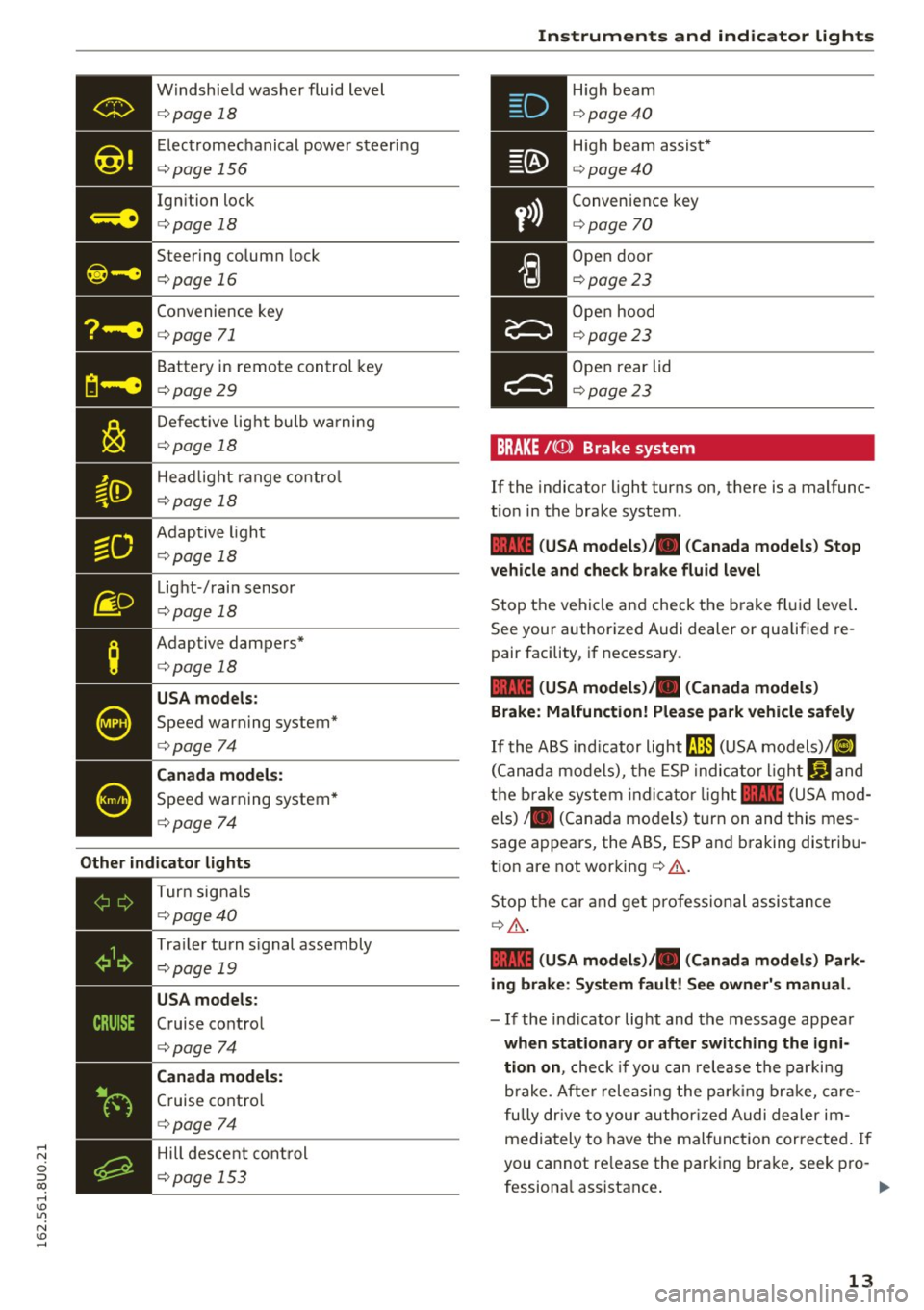
Windshield washer fluid level
c:> page 18
Electromec hanical power steer ing
c:> page 156
Ignition lock
c:> page 18
Steering column lock
c:> page 16
Convenience key
c:> page 71
Battery in remote control key
c:>page 29
Defe ct ive lig ht bulb w arning
c:> page 18
Head lig ht range co ntro l
c:>page 18
Adaptive ligh t
c:>page 18
Light-/rain sensor
c:> page 18
Adaptive dampers*
c:>page 18
USA models:
Speed warning system*
c:>page 74
Canada models:
Speed warning system *
c:>page 74
Other indicator lights
T ur n s ignals
c:>page 40
Traile r turn s ignal assembly
c:> page 19
USA models:
Cruise co ntro l
c:>page 74
Canada models:
Cruise co ntro l
c:>page 74
Hill des ce nt cont rol
c:> page 153
Instruments and ind icator lights
Convenience key
c:> page 70
Open door
c:> page 23
Ope n hoo d
c:>page 23
- Open rear lid
- c:>page23
BRAKE /(0) Brake system
If the indicato r light turns on, there is a malfunc
t ion in the brake system .
1111 (USA models);a (Canada models) Stop
v ehicle and check brake fluid level
Stop t he vehi cle a nd check t he b rake fluid leve l.
See your author ized Audi dealer or qualified re
pair facility, if necessa ry .
1111 (USA models) ;a (Canada models)
Brake: Malfunction! Please park vehicle safely
I f the A BS ind icator light rJJ:1 (USA models) /[iJ
( C an ad a m od el s), th e ES P indica to r li ght
Bl and
t h e b rake sys tem indica tor lig ht
1111 (USA mod
els) /. (C ana da mode ls) turn on and this mes
sage a ppears, the ABS, ESP an d braking distrib u
t ion are not wor king
c:> &. .
Stop t he c ar an d get p ro fess ional assis ta n ce
c:> &. .
1111 (USA models) ;a (Canada models) Park
ing brake : System fault! See owner's manual.
- If the ind icator light and the message appea r
when stationary or after switching the igni
tion on ,
check if you can release the par kin g
b ra ke. Af te r r ele asi ng the par king br ake, care
fully drive to your author ized Audi de aler im
media tely to have t he mal funct ion corre cted . If
you ca nnot re lease the park ing bra ke, seek pro-
fessiona l assistance . .,.
13
Page 16 of 252
Instruments and indicator lights
-If the indicator light and the message appear
while d riving , the emergency braking function
may not be ava ilab le . It may not be possib le to
set the parking brake or release it once it has been set. Seek professiona l assistance.
(USA models) : If the warning light
1111 and the
warn ing light
[I] appear together, immed iate ly
contact your authori zed Audi dealer or qualified
workshop to have all brake pads inspected
,:::;, page 16.
When the light comes on, an audib le wa rning sig
na l is also given.
A WARNING
- Always observe the warnings in
,:::;, page 177, before opening the hood and
check ing the b rake fl uid .
- Driving with low brake fl uid is a sa fety haz
ar d. Stop the car and get professional ass is
tance.
- If the 1111 (USA models) ;III (Canada mod
els) brake system i ndicator lig ht t urns on to
ge th er wit h the ABS an d ESC indica to r
l igh ts, the ABS/ ESC regulating functi on may
have failed. Func tions tha t st abilize the ve
hicle are no longe r available. This cou ld
ca use the vehicle to swerve and increase the
risk of sliding . Stop the car and get profes
sional assistance .
- If the bra ke warn ing/indicator light does
not go o ut after a few seconds and the park
ing brake is released, or lights up while you
are driving, t he flu id leve l in the brake fluid
rese rvoir is too low. If you believe that it is
safe to do so, proceed immediately a t low
speed to the nearest au thori zed Audi dealer
o r qualifie d works hop and have the brake
sys tem inspe cte d.
- Always keep in min d that afte r sev era l brake
applica tions, you w ill need greate r pressure
on the brake pedal to stop yo ur vehicle. Do
not rely on straine d brakes to respond w ith
ma ximum stopping power in critical situa
t ions . You must allow for increased braking
distances. The extra distance used up by
fading b rakes could lead to an acc ident.
14
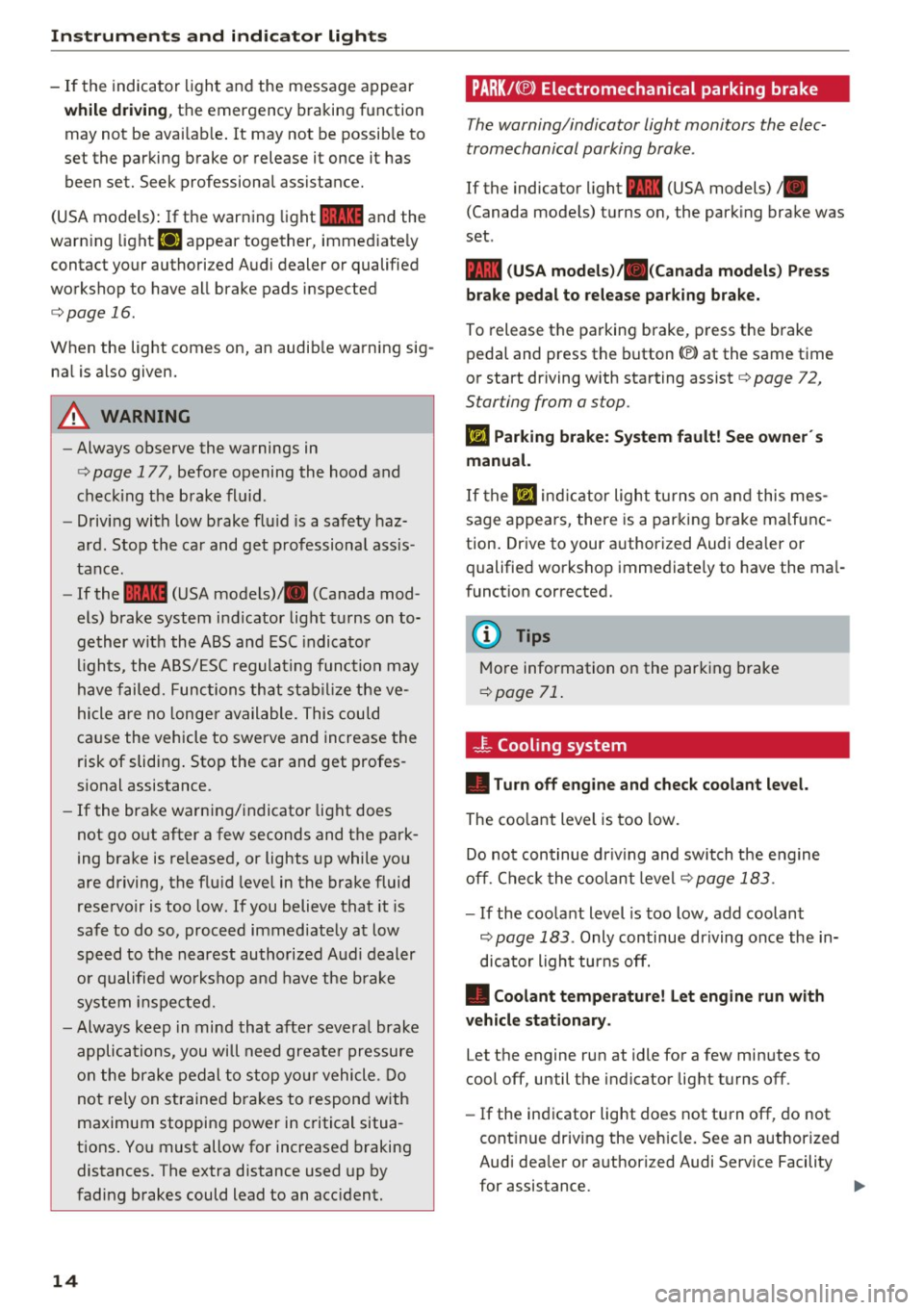
PARK!< ®> Electromechanical parking brake
The warning/indicator light monitors the elec
tromechanical parking brake .
If the indicator light - (USA models) ;Ill
(Canada mode ls) tu rns on, the park ing brake was
set .
- (USA models);lll (Canada models) Press
brake pedal to release parking brake.
To release the parking b rake, press the brake
pedal and press the button(®) at the same time
or start driving with starting assist
c::;, page 72,
Starting from a stop.
Ill Parking brake: System fault! See owner 's
manual.
I f the Ill ind ic a tor light turns on and t his mes
sage appea rs, there is a par king bra ke m alfu nc
tion . Drive to your authorized Audi dea ler or
qualified workshop imme diate ly to have the ma l
funct ion corrected.
(D Tips
M ore information on the par king brake
c::;, page 71 .
-F-Cooling system
• Turn off engine and check coolant level.
The coo lant level is too low.
Do not con tinue dr iving and swit ch t he engine
off. Che ck the coolan t l evel
c::;, page 183 .
-If the coo lant level is too low, add coolant
c::;, page 183 . Only continue dr iving once the in
dicato r light turns off.
• Coolant temperature! Let engine run with
vehicle stationary .
Let the engine run at idle fo r a few min utes to
cool off, until the indicator lig ht turns off .
- If the ind icator light does not turn off, do not
cont inue driving the veh icle. See an a uthorized
Audi dea le r or a uthorized Audi Service Facility
for assistance. ..,.
Page 157 of 252
intervals and fac ilitat es a better reaction time for
the brak es in wet weather.
The braki ng effect can also be red uced if you are
driving on salted roads and you do not apply the b rakes for long periods of time . The layer of salt
on th e brake rotors and brake pads must be worn
off first when the brakes are applied~&, .
Cor ro sion
Leaving the vehicle par ked for long periods of
time, low m ileage and avo iding heavy brak ing
can contribute to corros ion on the brake rotors
and dirty brake pads.
If you usually avo id heavy b raking or if there is
cor ros io n present , occasional heavy braking at
high speeds is recommended to clean the brake
rotors and pads~&, .
Brake system malfunct ion
if you notice that the bra ke pedal travel has sud
denly
go tten larger , the n a brake circu it may have
failed ~&. .
Low brake fluid level
When the brake flu id level is low , malfunct ions in
the brake system may occ ur. The brake flu id leve l
i s elect ronically mo nitored .
Brake booster
The brake booster amplifies the pressure you ap
p ly to the brake pedal.
It only works when the en
g ine is running ~&, .
Brak e lining we ar status
Brake lining wea r may be checked by visual in
spection of the condition of the brake pads
through the open ings in the wheel. If necessary,
the wheel may be removed for this inspection
~ page 213, Replacing wheels .
.8, WARNING
-New bra ke pads don 't have the best stop
ping power and must be "bro ken- in" dur ing
the init ial 250 m iles ( 400 km). Yo u can
compensate for this by p ressing the brake
peda l more firm ly . T his also applies later
when new pads are installed .
Intelligent Technology
- You shou ld pe rform braking maneuvers for
the purpose of cleaning the brake system
only if road condit ions permit . Other road
users must not be put at r isk -you may
cause an accident!
- Before descending a steep grade, reduce
speed and sh ift tra nsmission in to a lower
gea r or lower dr iving range . Do not r ide the
b rakes or hold the pedal down too long or
too often. Th is co uld cause t he b rakes to ge t
hot and dim inish b raking effic ien cy.
- D o not " ride the bra kes " by rest ing you r foot
on the ped al when you do no t intend to
brake . T his may ca use the brakes to ove r
heat, premature wear and increased stop
ping distance .
- Under cer tain clima tic and ope rating condi
tions such as passing t hrough water, driving
in heavy rain o r after washing the vehicle,
the effectiveness of the brakes can be re
duced. In winter, ice can accumu late on the
brake pads, lin ings, discs and drums . Care
fully apply brakes for a test . Brakes will d ry
and ice coat ings will be cleaned off after a
few ca refu l bra ke applications .
- Driving for an extended period of t ime on
salt-covered roads without using your b rakes can also affect braking eff icien cy.
Clea n off acc umulated salt coat ing fr om
b rake discs an d pads w ith a few careful
brake applicat ions .
- If you damage the front s poile r, or if you in
s t all a different spoiler, be s ure the a ir flow
to the front brakes is not obstructed. Other
wise the brake system could overheat reduc
ing the effectiveness of the ent ire brake sys
tem.
- Fai lu re of one brake circ uit w ill impa ir the
braking capability resulting in an increased
stopping distance . Avoid driving the vehicle
and have it towed to the nearest authorized
Aud i deale r or qualified worksho p.
- Never let the ve hicle roll to a stop with the
e ngine shut off.
- If the brake booster is not working, the
brake pedal must be pressed cons iderab ly
harder to make up for the lack of booster
assis tance .
155
Page 167 of 252
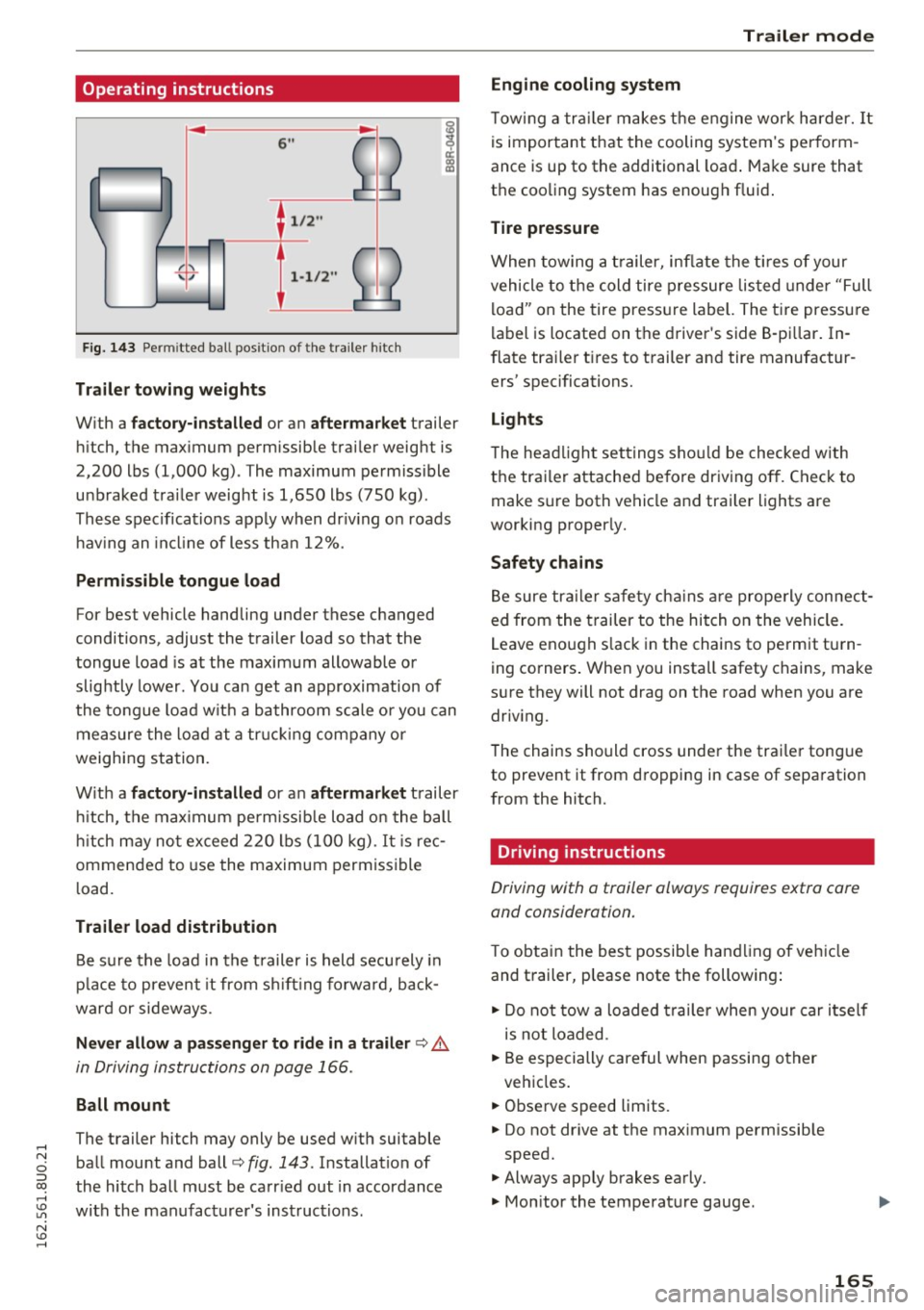
Operating instructions
6" r-2
~·~
1/2"
1·1/2"
ill
Fig. 143 Permitted ball pos ition of the trailer hitch
Trailer towing weights
With a
factory-installed or an aftermarket trailer
hitch, the maximum permissib le trailer weight is
2,200 lbs (1,000 kg). The maximum permiss ible
unbraked trailer weight is 1,650 lbs (750 kg).
These specifications apply when dr iv ing on roads
h av ing an incl ine of less than 12%.
Permissible tongue load
For best vehicle handling under these changed
conditions, adjust the trailer load so that the
tongue load is at the maximum allowable or
slightly lower. You can get an approximation of
the tongue load w ith a bathroom scale o r you can
measure the load at a trucking company or
weighing station.
With a
factory-installed or an aftermarket trailer
hit ch, the maximum permissib le load on the ball
hitch may not exceed 220 lbs (100 kg).
It is rec
ommended to use the maximum permissible
l oad.
Trailer load distribution Be sure the load in the trailer is held securely in
place to prevent it from s hiftin g forward, back
ward or sideways.
Never allow a passenger to ride in a trailer ¢.&.
in Driving instructions on page 166.
Ball mount
The trailer hitch may only be used w ith suitable
ball mount and ball¢
fig. 143. Installation of
the hitch ball must be carr ied out in accordance
with the manufacturer's instructions.
Trailer mode
Engine cooling system
To wing a trailer makes the engine work harder. It
is important that the cooling system's perform
ance is up to the additional load . Make sure that
the cooling system has enough fluid .
Tire pressure
When towing a trailer, inflate the tires of your
vehicle to th e cold tire pressure lis ted under "Full
load" on the tire pressure label. The tire pressu re
label is located on the driver's side B-pi llar . In
flate trailer t ires to trailer and tire manufactur
ers' specifications.
Lights
T he headlight settings shou ld be checked with
the trai ler attached before driving off. Check to
make s ure both vehicle and trailer lights are
working properly.
Safety chains
Be sure trailer safety chains are properly connect
ed from the trailer to the hitch on the vehicle.
Leave enough s lack in the chains to permit turn
ing corners . When you install safety chains, make
sure they will not drag on the road when you are
driv ing.
The chains should cross under the trai ler tongue
to prevent it from dropping in case of separation
from the hitch.
Driving instructions
Driving with o trailer always requires extra core
and consideration .
To obtain the best possib le handling of vehicle
and trailer, p lease note the following:
.. Do not tow a loaded trailer when your car itself
is not loaded.
.. Be especially care ful when passing other
vehicles .
.. Observe speed limits.
.. Do not drive at the maximum permissib le
speed.
.. Always apply brakes early.
.. Mon itor the temperature gauge .
165
Page 179 of 252
.... N
c:i ::J CX)
.... I.Cl U"I
N I.Cl ......
Checking and Filling Hood
Opening the hood
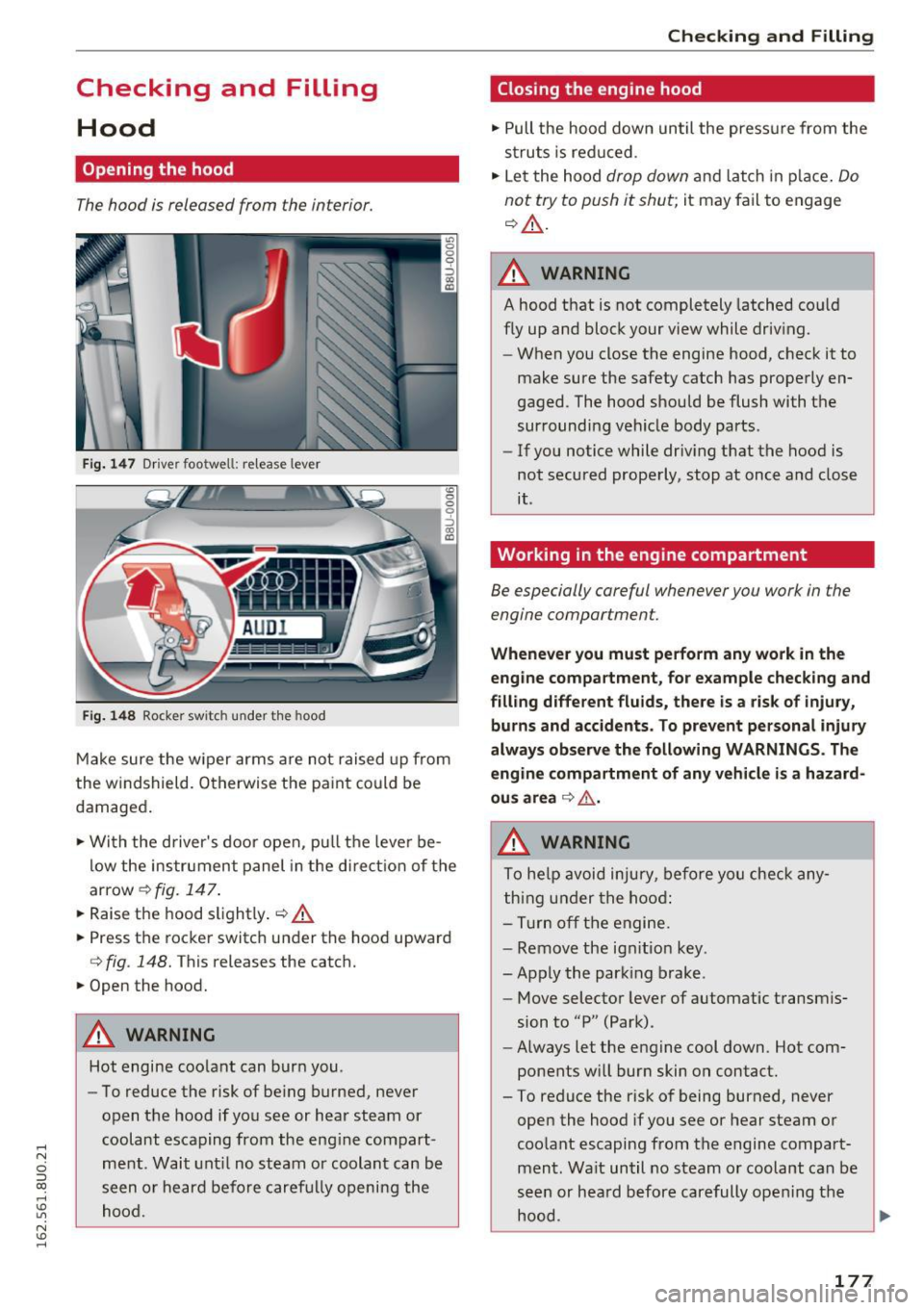
The hood is released from the interior.
Fig. 147 Driver footwell: release lever
Fig. 14 8 Rocke r switch under t he hood
<0 0 0
0
::,
"' CD
Make sure the w iper arms are not raised up from
the w indshield. O therwise the paint coul d be
damaged .
.,. Wi th the d river's doo r open, p ull th e leve r be
l ow the ins trument panel in the direct io n of the
arrow¢
fig. 1 47.
.,. Raise the hood s lightly . q &.
.,. Press t he roc ker switc h under the hood upward
Q fig. 148. This releases the catch.
.,. Open the hood.
A WARNING
Hot engine coolant can burn you.
- To reduce the risk of be ing burned, never
open t he hood if you see or hear steam or
coolant escaping from the eng ine compart
me nt. Wait unt il no steam or coolant can be
seen o r he ard before caref ully opening the
hood.
Checking and Filling
Closing the engine hood
., Pull the hood down until the press ure from the
s tr uts is red uced .
.,. Le t the hood
drop down and lat ch in p lace . Do
not try to push it shut;
it may fail to engage
q &_ .
A WARNING
A hood that is not completely latched co uld
fly up and block your view while driv ing.
- When you close the engine hood, check it to
make sure the safety catch has prope rly en
gaged. The hood should be flush with th e
sur rounding veh icle body parts.
- If you notice while driv ing that the hood is
not secured prope rly, stop at once and close
it .
Working in the engine compartment
Be especially careful whenever you work in the
engine compartment.
-
Whenever you must pe rform any work in the
eng ine compartment , for e xample check ing and
filling diff erent fluids, there is a ris k of injury,
burns and accidents. To prevent personal injury
always ob serv e the following WARNINGS . Th e
engine compartment of any veh icle is a hazard
ou s area
q .&. .
A WARNING
To he lp avoid injury, before yo u check any
t hing under the hoo d:
- Turn off the engi ne .
- Remove the ign ition key.
- Apply the park ing brake .
- Move selector lever of automatic transmis-
sion to "P" (Park).
- Always let the engine cool down. Hot com
ponents w ill bur n skin on contact.
-
-To reduce the risk of being burned, never
open the hood if you see or hear steam or
coo lant escaping from the engine compart
ment. Wa it until no steam o r coolant can be
seen or hea rd before carefully opening the
hood.
177
Page 180 of 252
Checking and Filling
-Keep children away from the engine com
partment.
- Never spill fluids on hot engine compo
nents. They can cause a fire.
- Never touch the radiator fan. The auxiliary
electric fan is temperature controlled and
can switch on suddenly.
- Never open the coolant reservoir cap when
the engine is still warm. The coolant system
is pressurized and hot coolant could spray
out.
- Protect your face, hands and arm from steam or hot engine coolant by placing a
thick rag over the cap when you open the
coolant reservoir .
- Do not remove the engine cover under any
circumstances. This increases the risk of
burns .
- If work on the fuel system or the electrical
system is necessary:
-Always disconnect the battery.
- Never smoke or work near heaters or open
flames. Fluids in the engine compartment
could start a fire.
- Keep an approved fire extinguisher imme
diately available.
- To avoid electrical shock and personal injury
while the engine is running or being started,
never touch:
- Ignition cables
- Other components of the high voltage
electronic ignition system.
- If you must perform a check or repair with
the engine running:
- First, fully apply the parking brake, move
selector lever of automatic transmission
to "P" (Park).
- Always use extreme caution to prevent
clothing, jewelry, or long hair from get-
178
ting caught in the radiator fan, V-belts or
other moving parts, or from contacting
hot parts. Tie back hair before starting,
and do not wear clothing that will hang or
droop into the engine.
- Minimize exposure to emission and chemi
cal hazards
c::> & .
A WARNING
California Proposition 65 Warning:
- Engine exhaust, some of its constituents,
and certain vehicle components contain or
emit chemicals known to the State of Cali
fornia to cause cancer and birth defects and
reproductive harm. In addition, certain flu
ids contained in vehicles and certain prod
ucts of component wear contain or emit
chemicals known to the State of California
to cause cancer and birth defects or other
reproductive harm .
- Battery posts, terminals and related acces
sories contain lead and lead compounds,
chemicals known to the State of California
to cause cancer and reproductive harms.
Wash hands after handling.
([) Note
When adding fluids, always make sure that
they are poured into the proper container or
filler opening, otherwise serious damage to
vehicle systems will occur.
@ For the sake of the environment
To detect leaks in time, inspect the vehicle
floor pan from underneath regularly. If you
see spots from oil or other vehicle fluids, have
your vehicle inspected by an authorized Audi dealer .
Page 181 of 252
.... N
c:i ::J CX)
.... I.Cl U"I
N I.Cl ......
Checking and Filling
Engine compartment
Engine compartment overview
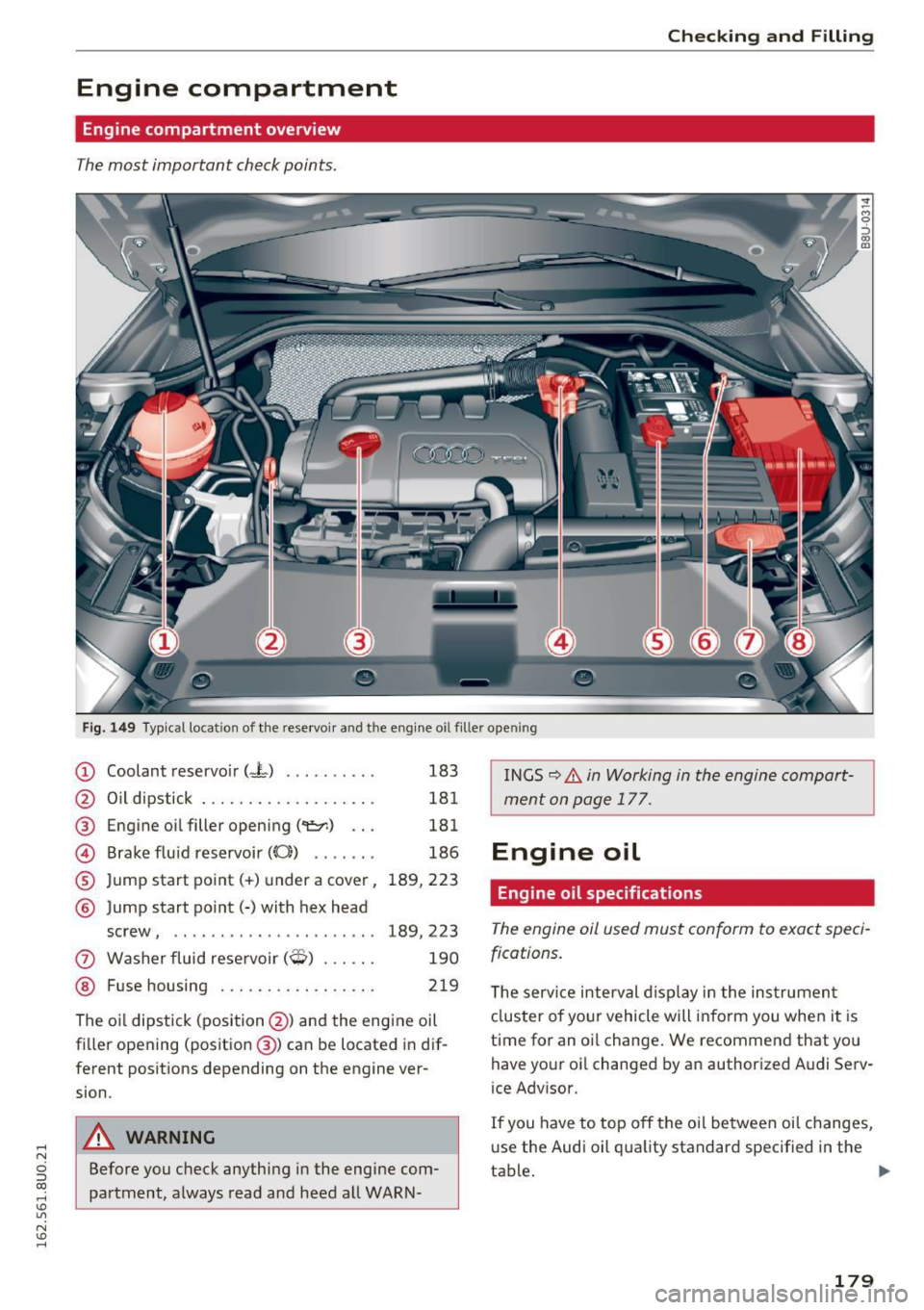
The most important check points.
Fig. 149 Typical location of the reservoir a nd the engine o il fil ler ope ning
(D Coolant reservoir (-L) . . . . . . . . . . 183
@ Oil dipstick . . . . . . . . . . . . . . . . . . . 181
@ Engine oil filler opening ('1!::r.) . . . 181
@ Brake fluid reservoir (0) . . . . . . . 186
® Jump start point(+) under a cover, 189, 223
® Jump start point(-) with hex head
screw, . . . . . . . . . . . . . . . . . . . . . .
189, 223
0 Washer fluid reservoir($) . . . . . . 190
@ Fuse housing . . . . . . . . . . . . . . . . . 219
The oil dipstick (position @) and the engine oil
filler opening (position @) can be located in dif
ferent positions depending on the engine ver
sion.
A WARNING
Before you check anything in the engine com
partment, always read and heed all WARN- INGS
9 .&. in Working in the engine
compart
ment on page 177.
Engine oil
Engine oil specifications
The engine oil used must conform to exact speci
fications.
T he serv ice interval d isplay in the instrument
cluster of your vehicle will inform you when it is
time for an oil change . We recommend that you
have your oil changed by an authorized Audi Serv
ice Advisor.
If you have to top off the oil between oil changes,
us e the Audi oil quality standard specified in the
tab~ .
~
179
Page 188 of 252
Checking and Filling
Brake fluid
Checking brake fluid level
The brake fluid level can be checked with a quick
glance.
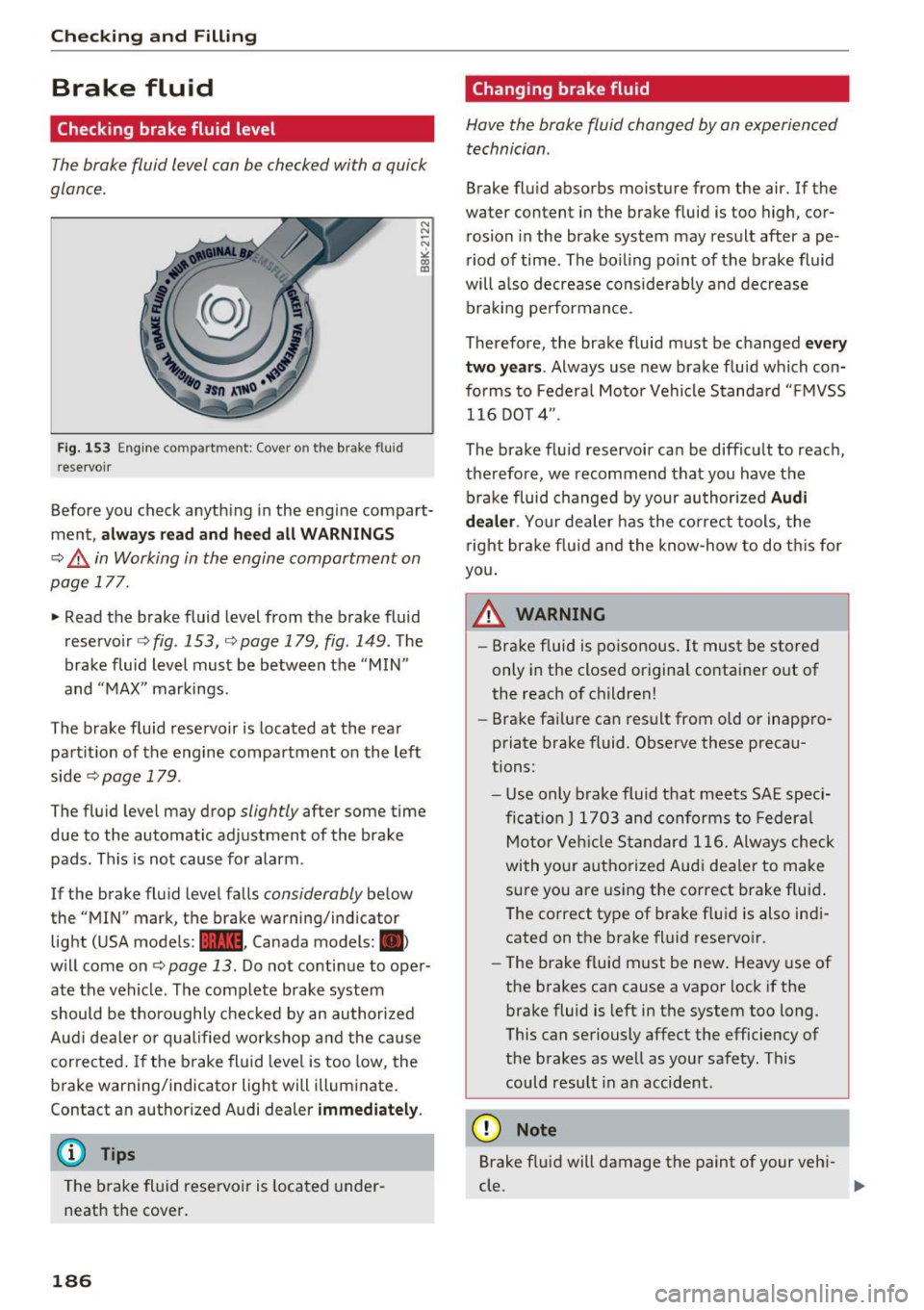
Fig. 153 Eng ine compartment: Cover on the brake fluid
r eservoir
Before you check anything in the engine compart
ment,
always read and heed all WARNINGS
¢ A in Working in the engine compartment on
page 177.
., Read the brake fluid level from the brake fluid
reservoir
<=> fig . 153, ¢page 179, fig . 149 . The
brake fluid level must be between the
" MIN"
and "MAX " markings.
The brake fluid reservoir is located at the rear
partition of the engine compartment on the left
side ¢
page 179 .
The fluid level may drop slightly after some time
due to the automatic adjustment of the brake
pads . This is not cause for alarm .
If the brake fluid level falls
considerably below
the ' 'MIN" mark, the brake warning/indicator
light (USA models:
1111 , Canada models:. )
will come on¢
page 13 . Do not continue to oper
ate the vehicle . The complete brake system
should be thoroughly checked by an authorized
Aud i dealer or qualified workshop and the cause
corrected. If the brake fluid level is too low, the
brake warning/indicator light w ill illuminate.
Contact an author ized Audi dealer
immediately.
(D} Tips
The brake fluid reservoir is located under
neath the cover.
186
Changing brake fluid
Have the brake fluid changed by an experienced
technician .
Brake fluid absorbs moisture from the air. If the
water content in the brake fluid is too high, cor
rosion in the brake system may result after ape
riod of time . The boiling po int of the brake fluid
will a lso decrease considerably and decrease
braking performance.
Therefore , the brake fluid must be changed
every
two years .
Always use new brake fluid which con
forms to Feder-al Motor Vehicle Standard "FMVSS
116 DOT 4 ".
The brake fluid reservoir can be difficult to reach ,
therefore, we recommend that you have the
brake fluid changed by your author ized
Audi
dealer .
Your dealer has the correct tools, the
right brake fluid and the know-how to do this for
you.
A WARNING
- Brake fluid is poisonous. It must be stored
only in the closed original container out of
the reach of children!
- Brake fai lure can result from o ld or inappro
priate brake fluid. Observe these precau
tions:
- Use only brake fluid that meets SAE speci
fi cation
J 1703 and conforms to Federal
Motor Veh icle Standard 116. Always check
with your authorized Audi dealer to make
sure you are using the correct brake fluid .
The correct type of brake f luid is also indi
cated on the brake fluid reservoir.
- The brake fluid must be new . Heavy use of
the brakes can cause a vapor lock if the
brake fluid is left in the system too long .
This can seriously affect the efficiency of
the brakes as well as your safety. This
could result in an accident.
(D Note
Brake fluid will damage the paint of your vehi-
cle .
lilJJ,
Page 189 of 252
@ For the sake of the environment
Because of the problem of proper disposal of
brake fluid as we ll as the special toots re
quired and the necessary expertise, we rec
ommend that you have the brake fluid
changed by your authorized Audi dealer .
Battery
General information
Under normal operating conditions, the battery
in your Audi does not need any maintenance.
With
high outside temperatures or long daily
drives we recommend that you have the electro
lyte level checked by an authorized Audi dealer or
qualified workshop. The electrolyte level should
also be checked each time the battery is charged
c> page 189.
Have the battery checked when you take your ve
hicle in for serv ice. You are well advised to re
place a battery t hat is older than 5 years.
With certain types of airbag deployment, the battery is disconnected from the vehicle electri
cal system for safety reasons
c> & in Repair, care
and disposal of the airbags on page 125 .
Disconnecting the battery terminals
Some vehicle functions (power window regula
tors, for example) are lost if the battery termi nals are disconnected. These functions have to be
relearned after the battery terminals are con
nected again. To prevent th is, the battery should
only be disconnected from the vehicle e lectr ica l
system when abso lutely necessary for repairs.
Vehicles not driven for long periods
If you do not drive your vehicle over a period of
several days or weeks, electrical components are
gradually cut back or sw itched off. This reduces
energy consumption and maintains starting ca
pability over a longer pe riod
c> page 157.
Some of the conven ience functions may not oper
ate, such as the interior lights or the power seat
adjustment. The convenience functions will be
available again when you turn on the ignition and
start the engine.
Checking and Filling
Winter operation
During the winter months, battery capacity tends
to decrease as temperatures drop . This is be
cause more power is also consumed while start
ing, and the headlights, rear window defogger,
etc., are used more often.
Avo id unnecessary power consumption, particu
larly in city traffic or when traveling only short
distances . Let your authorized Audi dealer check
the capacity of the vehicle battery before winter
sets in
c> page 189. A well charged battery will
not only prevent starting problems when the
weather is cold, but will also last longer .
(D Tips
If your vehicle is left standing for several
weeks at extremely low temperatures, the ve
hicle battery should be removed and stored
where it w ill not freeze. This will prevent it
from be ing damaged and having to be re
placed.
Working on the battery
Be especially careful when working on or near
the battery.
The battery is located in the engine compart
ment . Before you check anything in the engine
compartment ,
read and heed all WARNINGS
c>,& ,
Always heed the safety warnings, when working
on the vehicle battery or the veh icle electrical
system to prevent injury.
The following WARNINGS are very important
when working on the battery:
Always heed the following WARNING SYM·
BOLS and safety precautions when working on
the battery.
®
Always wear eye protection.
A
Battery acid contains sulfuric acid. Al-
ways wear gloves and eye protection .
187