fuel pressure AUDI Q3 2016 Owners Manual
[x] Cancel search | Manufacturer: AUDI, Model Year: 2016, Model line: Q3, Model: AUDI Q3 2016Pages: 252, PDF Size: 62.81 MB
Page 5 of 252
Safety belts . . . . . . . . . . . . . . . . . . . . . . . . 107
Belt tensioners . . . . . . . . . . . . . . . . . . . . . . 110
Airbag system ............... .... . 112
Important information . . . . . . . . . . . . . . . 112
Front airbags ...................... . 116
Monitoring the Advanced Airbag System . 122
Side airbags . . . . . . . . . . . . . . . . . . . . . . . . 126
Side curtain airbags . . . . . . . . . . . . . . . . . . 129
Child safety . . . . . . . . . . . . . . . . . . . . . . 132
Important information . . . . . . . . . . . . . . . 132
Child seats ............... ...... ... . 13 7
Securing child seats . . . . . . . . . . . . . . . . . . 141
LATCH system (Lower anchorages and
tethers for children) . . . . . . . . . . . . . . . . .
144
Addit ional information 149
Driver messages . . . . . . . . . . . . . . . . . 150
Intelligent Technology . . . . . . . . . . 150
Notice about data recorded by the Event
Data Recorder and vehicle control
modul es . . . . . . . . . . . . . . . . . . . . . . . . . . .
150
Electronic Stabilization Control ( ESC) . . . . 151
Brakes . . . . . . . . . . . . . . . . . . . . . . . . . . . . . 154
Electromechanical steering . . . . . . . . . . . . 156
All wheel drive (quattro) . . . . . . . . . . . . . . 156
Energy management . . . . . . . . . . . . . . . . . 157
Driving and the environment . . . . 159
Breaking in . . . . . . . . . . . . . . . . . . . . . . . . . 159
Avoid damaging the vehicle . . . . . . . . . . . 159
Catalytic converter . . . . . . . . . . . . . . . . . . . 159
Shutting down vehicle . . . . . . . . . . . . . . . . 160
Economical and environmentally-friendly
driving . . . . . . . . . . . . . . . . . . . . . . . . . . . .
160
Driving offroad . . . . . . . . . . . . . . . . . . . . . . 162
Trailer mode . . . . . . . . . . . . . . . . . . . . . 164
Driving with a trailer . . . . . . . . . . . . . . . . . 164
Trailer mode notes . . . . . . . . . . . . . . . . . . . 166
Operating instructions . . . . . . . . . . . 168
Care and cleaning . . . . . . . . . . . . . . . . 168
General information . . . . . . . . . . . . . . . . . 168
Car washes . . . . . . . . . . . . . . . . . . . . . . . . . 168
Cleaning and care information . . . . . . . . . 169
Table of contents
Fuel and Refueling . . . . . . . . . . . . . . .
173
Gasoline . . . . . . . . . . . . . . . . . . . . . . . . . . . 173
Refueling . . . . . . . . . . . . . . . . . . . . . . . . . . 17 4
Checking and Filling . . . . . . . . . . . . . 177
Hood . . . . . . . . . . . . . . . . . . . . . . . . . . . . . . 177
E ngine compa rtment . . . . . . . . . . . . . . . . . 179
Engine oil . . . . . . . . . . . . . . . . . . . . . . . . . . 179
Cooling system . . . . . . . . . . . . . . . . . . . . . . 183
Brake fluid . . . . . . . . . . . . . . . . . . . . . . . . . 186
Battery . . . . . . . . . . . . . . . . . . . . . . . . . . . . 187
Windshield washer system 190
Wheels ........ .. ................. 191
Wheels and Tires . . . . . . . . . . . . . . . . . . . . 191
Tire pressure monitoring system 208
Troubleshooting ............. .. .. 211
Emergency assistance . . . . . . . . . . . 211
General information . . . . . . . . . . . . . . . . . 211
Vehicle tool kit . . . . . . . . . . . . . . . . . . . . . . 211
Folding chocks . . . . . . . . . . . . . . . . . . . . . . 212
Removing the subwoofer............. . 212
Space-saving spare tire (compact spare
tire).. .. .. .. .. .. .. .... ... .. .. .. .. ..
212
Replacing wheels . . . . . . . . . . . . . . . . . . . . 213
Fuses and bulbs . . . . . . . . . . . . . . . . . . 219
Fuses. .... .. .. .. .. ....... ........ .. 219
Bulbs . . . . . . . . . . . . . . . . . . . . . . . . . . . . . . 221
Emergency s ituations . . . . . . . . . . . . 223
General . . . . . . . . . . . . . . . . . . . . . . . . . . . . 223
Starting by pushing or towing . . . . . . . . . . 223
Start ing with jumper cables ........... 223
Use of jumper cables . . . . . . . . . . . . . . . . . 224
Towing with a tow truck . . . . . . . . . . . . . . 225
Raising the vehicle . . . . . . . . . . . . . . . . . . . 227
Technical Data . . . . . . . . . . . . . . . . . . . 229
Technical data . . . . . . . . . . . . . . . . . . . . 22 9
Vehicle identification . . . . . . . . . . . . . . . . . 229
Weights . . . . . . . . . . . . . . . . . . . . . . . . . . . 229
D . . 1mens1ons
.. .. . ... ................ . 230
3
Page 17 of 252
& WARNING
-Never open the hood if you can see or he ar
steam or coolant escaping from the engine
compartment. This inc reases t he risk of
burns . Wa it until you no longe r see or hea r
steam o r coolant escap ing .
- The engine compartment in any veh icle can
be a dangerous area. Stop the eng ine and
allow it to coo l before working in t he engine
compartment . A lways fo llow the informa
ti on foun d in ¢
page 177 .
(D Note
Do not contin ue d riving if the. indicator
light turns o n -thi s increases the r isk of en
gi ne damage.
"t!:r. Engine oil pressure
The red engine oil pressure warning symbol re
quires immediate service or repair . Driving with a
low-oil-pressure indication is likely to inflict se
v e re damage to the engine .
• Turn off engine! Oil pressure is too low.
Tur n off the engine an d do not cont inue d riving .
C hec k the engine oil leve l¢
page 181.
- If the engine oil leve l is too low, a dd engine o il
¢
page 181 . Only cont inue driv ing if the ind i
cator lig ht t urns off.
- If the engine oil leve l is correc t and the i ndica
tor light sti ll tur ns on, turn the eng ine off and
do not continue driving . See you r auth orized
Audi dealer or qualif ied repa ir facility.
@ Tips
-The engine oil pressure symbol. is not
an indicator for a low engine oil level. Do
not rely on it. Instead, check the oil level in
your engine at regular intervals, preferably
each time you refuel, and always before
going on a long trip.
- The yellow oil level warning indication
Ill
requires oil r efill or workshop service with
out delay . Do not wait until the red oil
pressure warning. starts to flash before
you respond to the low oil level warning Instruments and ind
icator lights
IIJ. By then, your engine may already have
suffered serious damage.
0 Battery
The . warn ing/ indicato r light illum inates when
you sw itch on the ig nition and m ust go out after
t h e e ngine has started .
• Alternator fault: Battery is not being charg
ed .
If the indic ator ligh t turns on and the message
appea rs, the re is a ma lfunction in t he generator
o r vehicle e lectr ica l system.
D rive to your au thor ized A udi dealer or qu alified
wor kshop im medi ate ly. Bec au se the vehicle bat
te ry is d ischa rgin g, turn off all u nnecessary elec
t rical eq uipment such as the rad io . Seek p rofes
s iona l assistance if the battery charge level is too
low.
(•) Low battery charge: Battery will be charged
while driving .
If the indic ator ligh t turns on an d the mess age
appea rs, there may be limi ted sta rting abili ty .
If this message turns off after a little whi le, the
ba tte ry ch arge d eno ugh while dr iv ing .
If the message does not turn off, have yo ur au
t h orized Audi de aler or q ual ified works hop cor
r ec t t he ma lf u nct ion.
4t Safety belts
This warning/indicator light reminds you to put
on your safety b elt.
The . war ning/ indicator light illum inates when
t h e ignit io n is switched on to remind t he driver
and any front passenge r to put on the safety be lt.
Addi tionally , a n acous tic w arnin g (go ng) will also
sou nd.
@ Tips
Fo r mor e In forma tion ¢ pag e 104, Saf ety
bel t warning light .
15
Page 182 of 252
Check ing and F illing
Audi oil quality standard
Gas olin e
VW 502 00 or
engi ne vw 50400
Using the proper engine oil is important for the
functionality and service life of the engine. Your
engine was factory-filled with a high-quality oil
which can usually be used throughout the entire
year .
Q) Note
Your Limited New Vehicle Warranty does not
cover damage or malfunctions due to failure
to follow recommended maintenance and use
requirements as set fo rth in the Audi Owner's
Manual and Wa rranty
& Maintenance booklet.
- Use only a high qua lity eng ine oi l th at ex-
pressly complies with the Audi oil qua lity
stan dard specified for your vehi cle's engine.
Using any o ther oil can cause serious engine
damage .
- Do not mix any lubricants o r other addit ives
i nto the engine oil. Doing so can cause en
gine damage.
(D Tips
I f you nee d to add oi l and there is none availa
ble that meets the Audi o il qu ality st andard
your engine requires, you may ad d a total of
no more than 0 .5 quart/liter of a high-quality
"synthet ic"oil that meets the following speci
fications.
- ACEA A3 o r API SM with a viscosity g rade of
SAE OW-30, SAE 5W-30 or SAE 5W-40.
- For more information about engine oi l that
has been approved for your vehicle, please
contact either your authorized Audi dea ler
or Audi Custome r Relat ions at
1 (800) 822-2834 or visit our web site at
www.audiusa.com or www .aud icanada .ca.
Engine oil consumption
The engine in your vehicle depends on an ade
quate amount of oil to lubricate and cool all of
its moving parts .
In order to provide effective lubrication and cool
ing of internal engine components, all internal
180
combust ion engines consume a certa in amo unt
of oil. Oil consumption varies from engine to en
gine and may change significantly over the life of
the engine. Typically, engines w ith a specified
break-in period (see
c:::;, page 159) consume more
o il dur ing the break-in per iod than they consume
af ter o il consumption has stab ilized .
Under normal conditions, the rate of oil con
sumption depends on the quality and viscos ity of
the oil, the RPM (revo lutions per m inute) at
wh ich the engine is operated, the amb ient tem
perature and road condit ions. Further factors a re
the amount of o il di lution from wate r co ndensa
tion or fue l resid ue an d the oxidation level of the
o il. As any engine is sub ject to wear as mileage
builds up, the oi l cons umption may increase over
time unt il replacement of worn components may
become necessary.
With a ll these variab les coming into p lay, no
standard rate of oil consumption can be estab
li shed or specified. The re is no alternative to reg
u lar and frequent checking of the oi l level, see
Note.
If the yellow engine oil level warning symbo l Ell
in the instrument cluster lights up, you sho uld
check the oil level as soon as possible
c:::;, page 181. Top off the oil at your earliest con
venience
c:::;,page 181.
A WARNING
Before you check anyth ing in the e ng ine com
partment, always read and heed all WARN
I NGS
c:::;, .&. in Working in the engin e compart
ment on page 177.
(D Note
Driving w ith an insuffic ient oil level is likely to
cause severe damage to the eng ine.
(D Tips
- The oil pressure warn ing d isplay. is not
an indicator of the oil level. Do not rely on
it. Instead, check the oil level in your en
g ine at regular int ervals , pr eferably each
time you refuel, and alway s before going
on a long trip .
Page 196 of 252
Wheels
Bead
means the part of the tire that is
made of steel wires, wrapped or
reinforced by ply cords and that is
shaped to fit the rim .
Bead separation
means a breakdown of the bond
between components in the bead.
Cord
means the strands forming the
plies in the tire.
Cold tire inflation pressure
means the tire pressure recom
mended by the vehic le manufac
turer for a tire of a des ignated
size that has not been driven for more than a couple of miles (kilo
meters) at low speeds in the
three hour period before the tire pressure is measured or adj usted.
Curb weight
means the weight of a motor ve
hicle w ith standard equipment in
cluding the maximum capacity of
fuel, oil, and coolant, air condi
tioning and additiona l weight of
op tional equipment.
E x tra load tire
means a tire des igned to operate
at higher loads and at h igher in -
194
flation pressures than t he corre
spond ing standa rd tire. Extra load
tires may be identified as "XL",
"xl" , "EXTRA LOAD" , or "RF" on
the sidewall.
Gross A xle Weight Rating
("GAWR ")
means the load-carrying capacity
of a single axle system , measured
at the ti re-gro und interfaces.
Gross Vehicle Weight Rating
("GVWR")
means the max imum total loaded
weight of the vehicle .
Groove
means the space between two ad
jacent tread ribs .
Load rating (code)
means the maximum load tha t a
tire is rated to carry for a given in
flation pressure. You may not find
this informat ion on all ti res be
cause it is not required by law .
Maximum load rating
means the load rating for a tire at
the maximum permissible infla
tion p ressure for that ti re .
Maximum loaded vehicle
weight
means the sum of:
Page 204 of 252
Wheels
-Overloading can lead to loss of vehicle control and increase
the risk of an accident. Read and follow the important safe
ty precautions inc:::> page 203,
Tires and vehicle load limits.
-The tire must flex more if the tire pressure is too low or if
the vehicle speed or load are
too high . This heats the tire up
too much. This increases the
risk of an accident because it
can cause the tire to burst and
result in loss of vehicle con
trol.
-Incorrect tire pressure in
creases tire wear and has a
negative effect on driving and
Tire pressure table
Please note that the information
contained in the following table
was correct at the time of print ing, and the information is sub
ject to change . If there are differ
ences between this information
and the tire pressures specified
on the label on the driver's side 8- pillar, always follow the specifica
tion on the 8-pillar label
c:::>
page 201, fig. 158.
202
braking behavior, which in
creases the risk of an accident.
(D Note
Replace lost valve caps to re
duce the risk of damage to the
tire valves.
@ For the sake of the environment
Tire pressure that is too low in
creases fuel consumption.
(D Tips
Audi recommends using the
tire pressure specified for a
normal load c:::>
table on
page 203
or for a full load
when the vehicle is partially
loaded.
Make sure that the tire designa
tion on your tire matches the des ignation on the tire pressure label
and the tire pressure table.
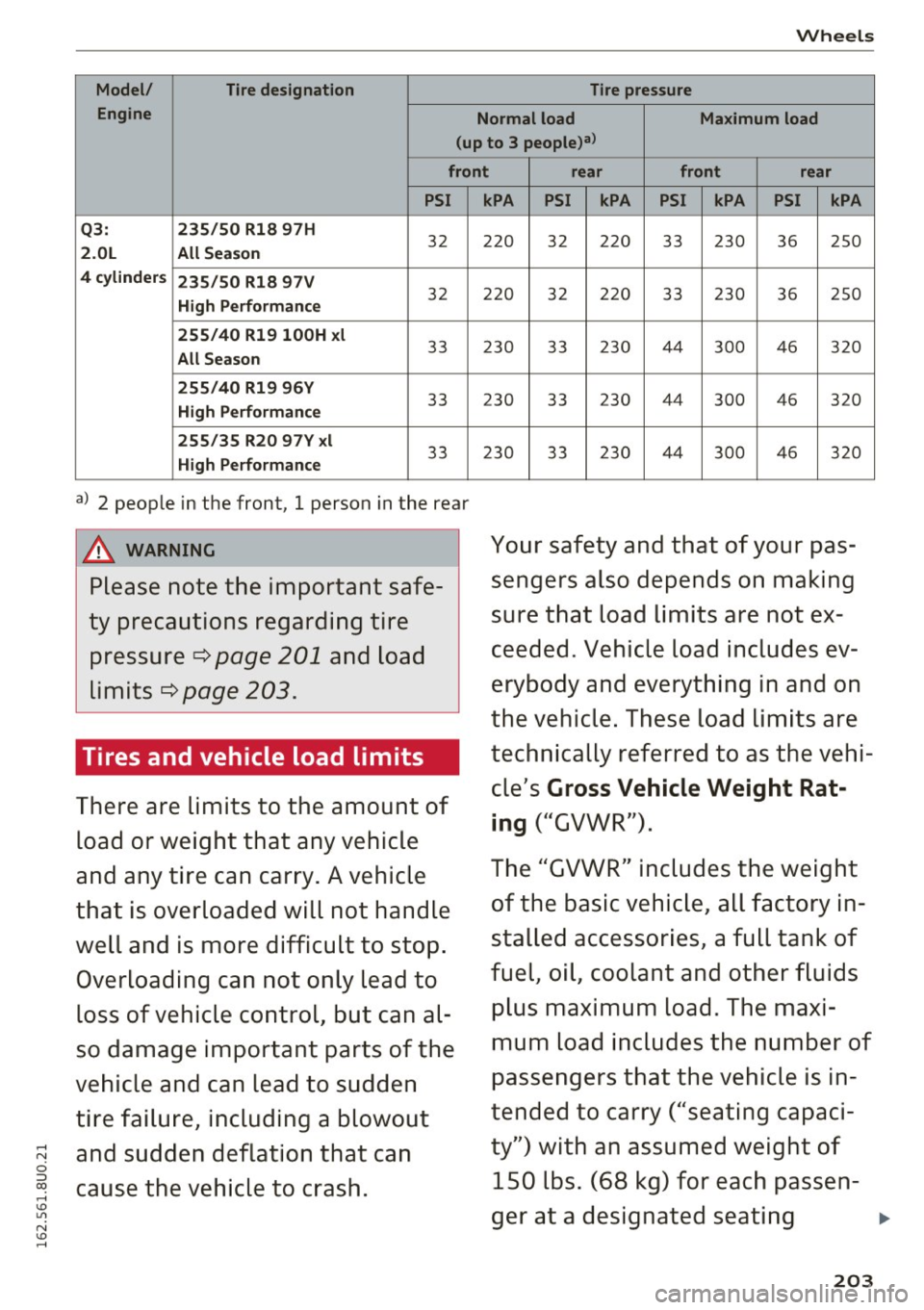
The following table lists recom mended tire pressures in cold
tires according to the load and
the size of the tires installed.
Page 205 of 252
Wheels
Model/ Tire designation Tire pressure
Engine Normal load Maximum load
(up to 3 people)a>
front rear front rear
PSI
Q3: 235/50 Rl8 97H
2.0L All Season
32
4 cylinders
235/50 Rl8 97V
High Performance
32
255/40 Rl9 l00H xl
All Season
33
255/40 Rl9 96Y
High Performance
33
255/35 R20 97Y xl
High Performance
33
a) 2 people in the front , 1 person in the re ar
A WARNING
-
Please note the important safe-
ty precautions regarding tire
pressure
c=> page 201 and load
limits ¢
page 203.
Tires and vehicle load limits
There are limits to the amount of
load or weight that any vehicle
and any tire can carry. A vehicle
that is overloaded will not handle
well and is more difficult to stop.
Overloading can not only lead to
loss of vehicle control, but can al
so damage important parts of the
vehicle and can lead to sudden
tire failure, including a blowout
and sudden deflation that can
cause the vehicle to crash.
kPA PSI kPA PSI kPA PSI kPA
220 32 220 3 3 23 0 36 2 50
220 32 220 33 230 36 250
230 33 230 44 300 46 320
2 30 33 230 44
300 46
320
230 33 230 44 300 46 320
Your safety and that of your pas
sengers also depends on making
sure that load limits are not ex
ceeded. Vehicle load includes ev
erybody and everything in and on
the vehicle. These load limits are
technically referred to as the vehi
cle's
Gross Vehicle Weight Rat
ing
("GVWR").
The "GVWR" includes the weight
of the basic vehicle, all factory in
stalled accessories, a full tank of
fuel, oil, coolant and other fluids
plus maximum load. The maxi
mum load includes the number of
passengers that the vehicle is in
tended to carry ("seating capaci
ty") with an assumed weight of
150 lbs. (68 kg) for each passen-
ger at a designated seating
11--
203
Page 208 of 252
Wheels
and a special procedure. You must not repair or
disassemble them¢&. .
A WARNING
Wheel bolts that are tightened or repaired in
correctly can become loose and result in loss
of vehicle control, which increases the risk of
an accident. For the correct t ightening specifi
cation, refer to ¢
page 214, After changing a
wheel .
- Always keep the wheel bolts and the
threads in the wheel hub clean and free of grease.
- Only use wheel bolts that fit the rim .
- Always have damaged rims repaired by an
authorized Audi dealer or authorized Aud i
Service Facility . Never repair or disassemble
rims yourself, because this inc reases the risk
of an accident.
Winter tires
Winter tires s ignificantly improve the vehicle's
handling when driving in winter conditions . Be
cause of their construction (width, compound,
tread pattern), summer tires provide l ess trac
tion on ice and snow.
.,. Use winter tires on all four wheels.
.,. Only use winter tires that are approved for your
vehicle.
.,. Please note that the maximum permitted
speed may be lower with winter tires
q .&,. . An
authori zed Audi dealer or authori zed Audi Serv
ice Facility can inform you about the maximum
permitted speed for your tires .
.,. Check the tire pressure after install ing wheels
q page 201.
The effectiveness of winter tires is reduced great
ly when the tread is worn down to a depth of
0 .157 inch (4 mm). The character istics of winter
tires also decrease greatly as the tire ages, re
gardless of the remaining tread.
A WARNING
- Never drive faster than the maximum per
mitted speed for your tires. This cou ld cause
the tires to heat up too much. This increases
206
-
the risk of an accident because it can cause
the tire to burst.
- Always adapt your driving to the road and
traffic conditions . Drive carefully and reduce
your speed on icy or slippery roads . Even
winter tires can lose traction on black ice .
@ For the sake of the environment
Reinstall summer tires at the appropriate
time, because they prov ide better handling
when roads are free of snow and ice. Summer
tires cause less road noise, tire wear and fuel
consumpt ion .
(D Tips
You can also use all season tires instead of
winter tires. Please note that in some coun
tries where winter tires are required, only
winter tires w ith the ~ symbol may be per
mitted.
Snow chains
Snow chains improve traction in the snow .
.,. Only install snow chains on the front wheels.
This applies also to vehicles with all wheel
drive* .
.,. Check and correct the seating of the snow
chains if necessary after driving a few feet. Fol
low the instructions from the manufacturer.
.,. Note the maximum permitted speed when dr iv
ing with snow chains. Do not exceed 30 mph (SO km/h).
Snow cha ins not only improve the
driving in win
ter road conditions, but also the
braking .
Use of snow chains is only permitted with certain
rim/tire combinat ions due to technical reasons .
Check with an author ized Audi dealer or author
ized Audi Service Facility to see if you may use
snow chains.
The snow chains must have
low-profile links and
must not be thicker than 0.53 inch (13.5 mm),
including the lock.
You must remove the chains when driving on
roads that are
free of snow . When roads are free ..,.
Page 211 of 252
.... N
c:i :::J CX)
.... I.Cl U"I
N I.Cl ......
also reduces fuel efficiency and tire tread life,
and may affect the vehicle's handling and stop
ping ability.
Please note that the TPMS is not a substitute for
proper tire maintenance, and it is the driver's re
sponsibility to maintain correct tire pressure,
even if under-inflation has not reached the level
to trigger illumination of the TPMS low tire pres
sure telltale.
Your vehicle has also been equipped with a TPMS
malfunction indicator to indicate when the sys
tem is not operating properly. The TPMS mal
function indicator is combined with the low tire
pressure telltale. When the system detects a
malfunct ion, the telltale will flash for approxi
mately one minute and then remain continuous ly
illuminated. This sequence will continue upon
subsequent vehicle start-ups as long as the mal
function exists.
When the malfunction indicator is illuminated,
the system may not be ab le to detect or signal
low tire pressure as intended . TPM S malfunctions
may occur for a variety of reasons, including the
installation of replacement or alternate tires or
wheels on the vehicle that prevent the TPMS
from functioning properly . Always check the
TPMS malfunction telltale after replacing one or
more tires or wheels on your vehicle to ensure
that the replacement or alternate tires and
wheels allow the TPMS to continue to function
properly.
Wheels
If the Tire Pressure Monitoring System
indicator appears
Applies to vehicles : wi th tire pressure mo nito rin g sys te m
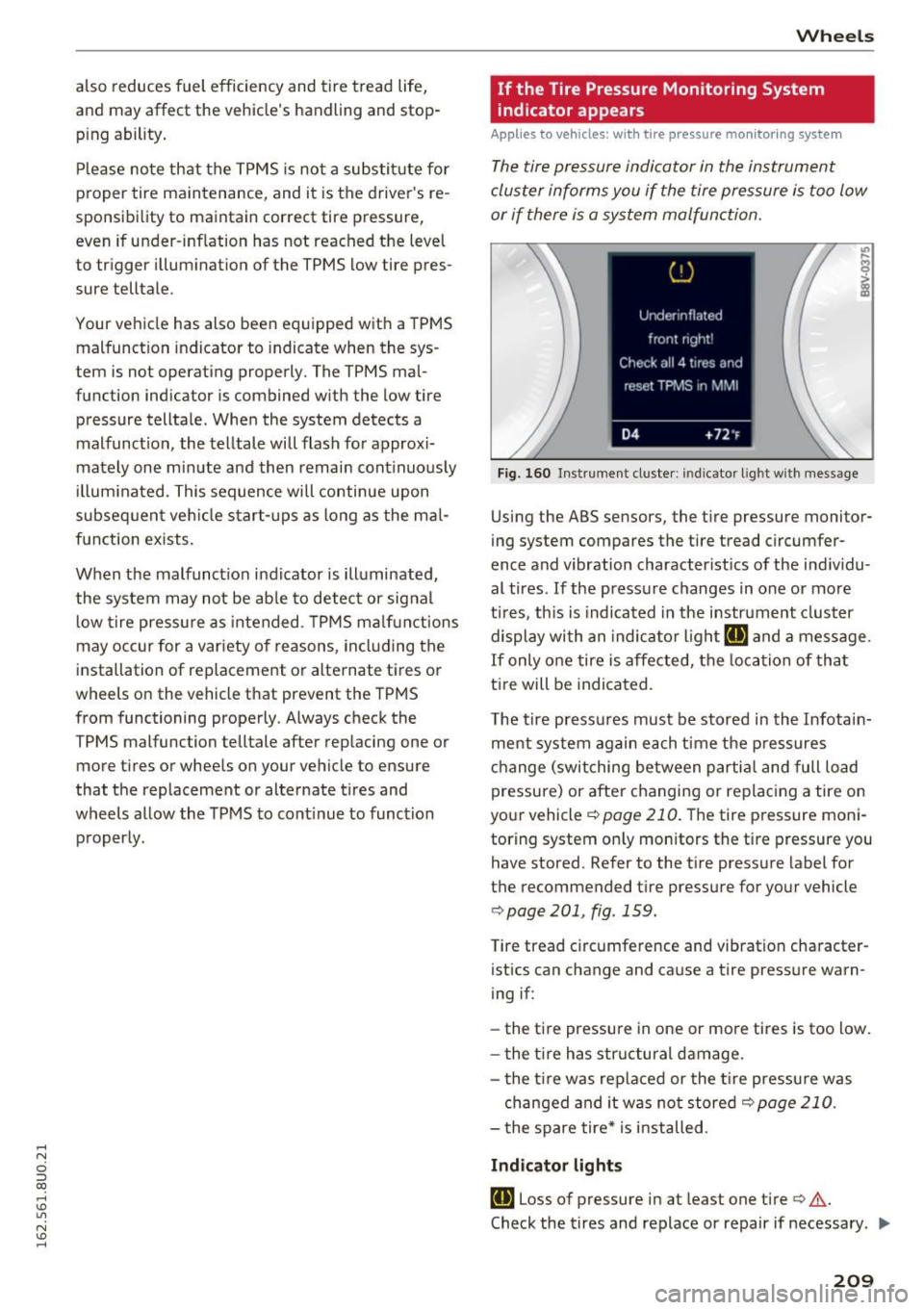
The tire pressure indicator in the instrument
cluster informs you if the tire pressure is too low
or if there is a system malfunction.
Fig. 160 Instrument cluster : indicator lig ht with message
Using the ABS sensors, the tire pressure monitor
ing system compares the tire tread circumfer
ence and vibration characterist ics of the ind ividu
al tires. If the pressure changes in one or more
t ire s, this is indicated in the instrument cluster
display with an indicator light
[I] and a message.
If only one tire is affected, the location of that
ti re will be indicated.
The tire pressures must be stored in the Infotain
ment system again each time the pressures
change (switching between partial and full load
pressure) or after changing or replacing a tire on
your vehicle ~
page 210. The tire pressure moni
toring system on ly monitors the tire pressure you
have stored. Refer to the tire pressure label for
the recommended tire pressure for your vehicle
¢ page 201, fig . 159.
Tire tread c ircumference and vibration character
istics can change and cause a tire pressure warn
ing if :
- the tire pressure in one or more tires is too low.
- the tir e has str uctural damage.
- the tir e was replaced or the tire pressure was
changed and it was not stored¢
page 210.
-the spare tire* is installed .
Indicator lights
[I] Loss of pressure in at least one tire¢,& .
Check the tires and replace or repair if necessary . ..,
209
Page 242 of 252
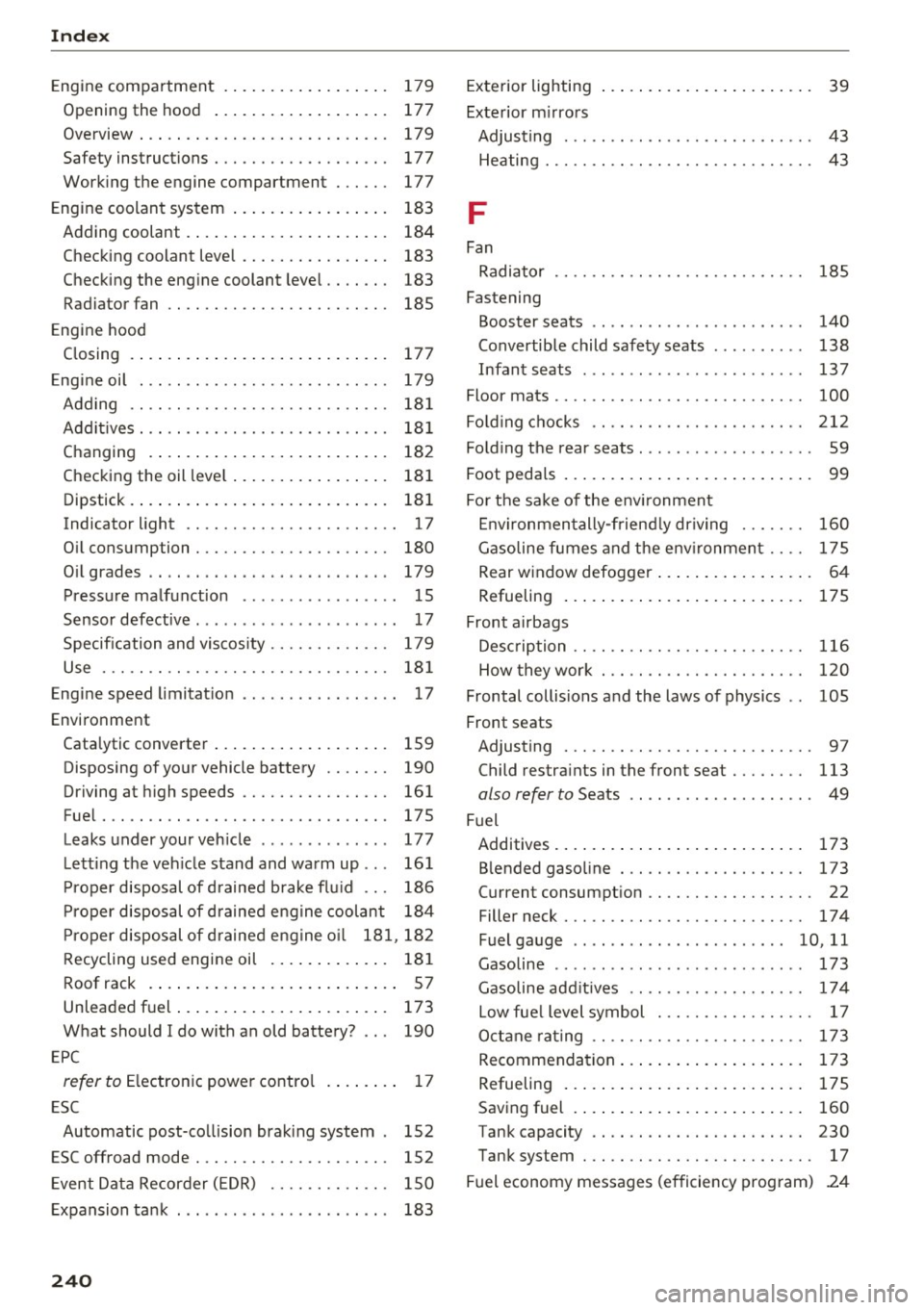
Index
Engine compartment . . . . . . . . . . . . . . . . . . 179
Opening the hood . . . . . . . . . . . . . . . . . . . 177
Overview . . . . . . . . . . . . . . . . . . . . . . . . . . . 179
Safety instructions . . . . . . . . . . . . . . . . . . . 177
Working the engine compartment . . . . . . 177
Engine coolant system ................ .
Adding coolant .................. ... .
Checking coolant level ............ ... .
Checking the engine coolant level .. .. .. .
Radiator fan .. .. ................... .
Engine hood 183
184
183
183 18S
Closing . . . . . . . . . . . . . . . . . . . . . . . . . . . . 177
Engine oil . . . . . . . . . . . . . . . . . . . . . . . . . . . 179
Adding . . . . . . . . . . . . . . . . . . . . . . . . . . . . 181
Addit ives. . . . . . . . . . . . . . . . . . . . . . . . . . . 181
Changing . . . . . . . . . . . . . . . . . . . . . . . . . . 182
Checking the oil level . . . . . . . . . . . . . . . . . 181
Dipstick. . . . . . . . . . . . . . . . . . . . . . . . . . . . 181
Indicator light . . . . . . . . . . . . . . . . . . . . . . . 17
Oil consumption . . . . . . . . . . . . . . . . . . . . . 180
Oil grades . . . . . . . . . . . . . . . . . . . . . . . . . . 179
Pressure malfunction . . . . . . . . . . . . . . . . . 15
Sensor defective . . . . . . . . . . . . . . . . . . . . . . 17
Specif ication and viscos ity . . . . . . . . . . . . . 179
Use . . . . . . . . . . . . . . . . . . . . . . . . . . . . . . . 181
Engine speed limitation . . . . . . . . . . . . . . . . . 17
Environment Catalytic converter . . . . . . . . . . . . . . . . . . . 159
Disposing of your vehicle battery . . . . . . . 190
Driving at high speeds . . . . . . . . . . . . . . . . 161
Fuel . .. .. .. .. .. ... .. ..... ..... .. .. . 175
Leaks under your vehicle . . . . . . . . . . . . . . 177
Letting the vehicle stand and warm up . . . 161
Proper disposal of drained brake flu id . . . 186
Proper disposal of drained engine coolant 184
Proper disposal of drained engine o il 181, 182
Recycling used engine oil . . . . . . . . . . . . . 181
Roof rack . . . . . . . . . . . . . . . . . . . . . . . . . . . 5 7
Unleaded fuel . . . . . . . . . . . . . . . . . . . . . . . 173
What should I do with an old battery? 190
EPC
refer to Electronic power control . . . . . . . . 17
ESC Automatic post-collision braking system . 152
ESC offroad mode . . . . . . . . . . . . . . . . . . . . . 152
Event Data Recorder (EDR) . . . . . . . . . . . . . 150
Expansion tank . . . . . . . . . . . . . . . . . . . . . . . 183
240
Exterior lighting . . . . . . . . . . . . . . . . . . . . . . . 39
Exterior mirrors Adjusting . . . . . . . . . . . . . . . . . . . . . . . . . . . 43
Heating . . . . . . . . . . . . . . . . . . . . . . . . . . . . . 43
F
Fan
Radiator 185
Fastening Booster seats . . . . . . . . . . . . . . . . . . . . . . . 140
Convertible child safety seats . . . . . . . . . . 138
Infant seats . . . . . . . . . . . . . . . . . . . . . . . . 137
Floor mats . . . . . . . . . . . . . . . . . . . . . . . . . . . 100
Fold ing chocks . . . . . . . . . . . . . . . . . . . . . . . 212
Folding the rear seats . . . . . . . . . . . . . . . . . . . 59
Foot pedals . . . . . . . . . . . . . . . . . . . . . . . . . . . 99
For the sake of the env ironment
Environmentally-friendly driving . . . . . . . 160
Gasoline fumes and the env ironment . . . . 175
Rear window defogger . . . . . . . . . . . . . . . . . 64
Refueling . . . . . . . . . . . . . . . . . . . . . . . . . . 175
Front airbags Description . . . . . . . . . . . . . . . . . . . . . . . . . 116
How they work . . . . . . . . . . . . . . . . . . . . . . 120
Frontal collisions and the laws of physics . . 105
Front seats Adjusting . . . . . . . . . . . . . . . . . . . . . . . . . . . 97
Child restraints in the front seat . . . . . . . . 113
also refer to Seats . . . . . . . . . . . . . . . . . . . . 49
Fuel Additives. . . . . . . . . . . . . . . . . . . . . . . . . . . 173
Blended gasoline . . . . . . . . . . . . . . . . . . . . 173
Current consumption . . . . . . . . . . . . . . . . . . 22
Filler neck..... .. .. ............... .. 174
Fuel gauge . . . . . . . . . . . . . . . . . . . . . . . 10, 11
Gasoline . . . . . . . . . . . . . . . . . . . . . . . . . . . 173
Gasoline add it ives . . . . . . . . . . . . . . . . . . . 174
Low fuel level symbol . . . . . . . . . . . . . . . . . 17
Octane rating . . . . . . . . . . . . . . . . . . . . . . . 173
Recommendation . . . . . . . . . . . . . . . . . . . . 173
Refueling . . . . . . . . . . . . . . . . . . . . . . . . . . 175
Saving fuel . . . . . . . . . . . . . . . . . . . . . . . . . 160
Tank capacity . . . . . . . . . . . . . . . . . . . . . . . 230
Tank system . . . . . . . . . . . . . . . . . . . . . . . . . 17
Fuel economy messages (efficiency program)
24
Page 243 of 252
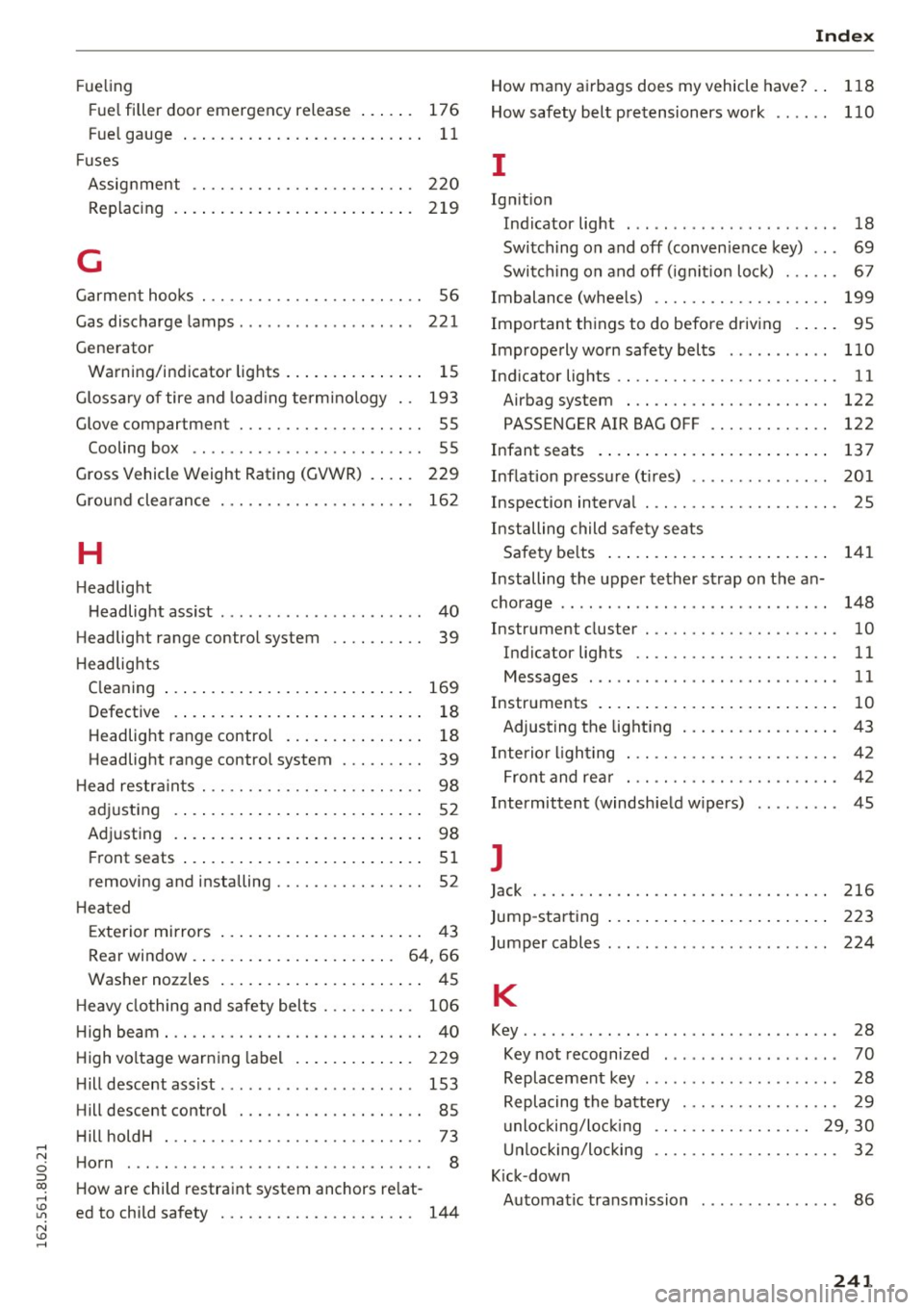
Fueling
Fuel filler door em ergency rel ease . . . . . . 176
Fuel gauge . . . . . . . . . . . . . . . . . . . . . . . . . . 11
Fuses Assignment . . . . . . . . . . . . . . . . . . . . . . . . 220
Replacing . . . . . . . . . . . . . . . . . . . . . . . . . . 219
G
Garment hooks . . . . . . . . . . . . . . . . . . . . . . . . 56
Gas discharge lamps......... ...... ... . 221
Generator Warning/indicator lights . . . . . . . . . . . . . . . 15
Glossary of tire and load ing terminology . . 193
Glove compartment . . . . . . . . . . . . . . . . . . . . 55
Cooling box . . . . . . . . . . . . . . . . . . . . . . . . . 55
Gross Vehicle W eight Rating (GVWR) . . . . . 229
Ground clearance . . . . . . . . . . . . . . . . . . . . . 162
H
Headlight
Headlight assist . . . . . . . . . . . . . . . . . . . . . . 40
Headlight range control system . . . . . . . . . . 39
H eadlights
Cleaning . . . . . . . . . . . . . . . . . . . . . . . . . . . 169
Defective . . . . . . . . . . . . . . . . . . . . . . . . . . . 18
Headlight range control . . . . . . . . . . . . . . . 18
Headlight range cont rol system . . . . . . . . . 39
Head restra ints . . . . . . . . . . . . . . . . . . . . . . . . 98
adjusting . . . . . . . . . . . . . . . . . . . . . . . . . . . 52
Adjusting . . . . . . . . . . . . . . . . . . . . . . . . . . . 98
Front seats . . . . . . . . . . . . . . . . . . . . . . . . . . 51
removing and installing . . . . . . . . . . . . . . . . 52
Heated Exterior mirrors . . . . . . . . . . . . . . . . . . . . . . 43
Rear window . . . . . . . . . . . . . . . . . . . . . . 64, 66
Wash er no zzles . . . . . . . . . . . . . . . . . . . . . . 45
H eavy clothing and safety belts . . . . . . . . . . 106
High beam . . . . . . . . . . . . . . . . . . . . . . . . . . . . 40
High voltage warning label . . . . . . . . . . . . . 229
Hill descent assist . . . . . . . . . . . . . . . . . . . . . 153
Hill descent cont rol . . . . . . . . . . . . . . . . . . . . 85
H ill holdH . . . . . . . . . . . . . . . . . . . . . . . . . . . . 73
Horn . . . . . . . . . . . . . . . . . . . . . . . . . . . . . . . . . 8
How are child restraint syst em anchors relat -
ed to child safety . . . . . . . . . . . . . . . . . . . . . 144
Index
How many airbags does my vehicle have? . . 118
How safety belt pretensioners work . . . . . . 110
I
Ignition
Indicator light . . . . . . . . . . . . . . . . . . . . . . . 18
Switching on and off (convenience key) . . . 69
Switching on and off (ignit ion lock) . . . . . . 67
Imbalance (wheels) . . . . . . . . . . . . . . . . . . . 199
Important things to do before driving . . . . . 95
Improperly worn safety belts ........... 110
Indicato r lights .. .. ...... ..... ...... .. . 11
Airbag system . . . . . . . . . . . . . . . . . . . . . . 122
PASSENGER AIR BAG O FF . . . . . . . . . . . . . 122
Infant seats . . . . . . . . . . . . . . . . . . . . . . . . . 13 7
Inflation pressure (tires) . . . . . . . . . . . . . . . 201
I nspe ction interval . . . . . . . . . . . . . . . . . . . . . 25
Installing child safety seats
Safety belts . . . . . . . . . . . . . . . . . . . . . . . . 141
Installing the upper tether strap on the an-
chorage . . . . . . . . . . . . . . . . . . . . . . . . . . . . . 148
Inst rument clus te r . . . . . . . . . . . . . . . . . . . . . 10
Indi cato r lights . . . . . . . . . . . . . . . . . . . . . . 11
Messages . . . . . . . . . . . . . . . . . . . . . . . . . . . 11
Instruments . . . . . . . . . . . . . . . . . . . . . . . . . . 10
Adjusting the lighting . . . . . . . . . . . . . . . . . 43
Interior l ighting . . . . . . . . . . . . . . . . . . . . . . . 42
Front and rear . . . . . . . . . . . . . . . . . . . . . . . 42
Intermittent (windshield wipers) . . . . . . . . . 45
J
Ja ck 216
Jump-starting . . . . . . . . . . . . . . . . . . . . . . . . 223
Jumper cables . . . . . . . . . . . . . . . . . . . . . . . . 224
K
Key ..... .... ... .. .. ... ........... ... . 28
Key not recognized . . . . . . . . . . . . . . . . . . . 70
Replacement key . . . . . . . . . . . . . . . . . . . . . 28
Replacing the battery . . . . . . . . . . . . . . . . . 29
unlocking/locking . . . . . . . . . . . . . . . . . 29, 30
Unlocking/locking . . . . . . . . . . . . . . . . . . . . 32
Kick -down
Automatic transmission . . . . . . . . . . . . . . . 86
241