ABS AUDI Q3 2017 Owner´s Manual
[x] Cancel search | Manufacturer: AUDI, Model Year: 2017, Model line: Q3, Model: AUDI Q3 2017Pages: 236, PDF Size: 58.93 MB
Page 95 of 236
a:,
a:,
...... N r--. N .... 0 0 ::, a:,
-Press the accelerator pedal carefully when
accelerating on smooth, slippery surfaces
such as ice and snow. The drive wheels can
spin even when these control systems are
installed and this can affect driving stability
and increase the risk of a collision.
(D Tips
- The ABS and ASR only function correctly
when all four wheels have a similar wear
Switching on/off
Intelligent Technology
condition. Different tire sizes can lead to a
reduction in engine power.
- You may hear noises when the systems de
scribed are working .
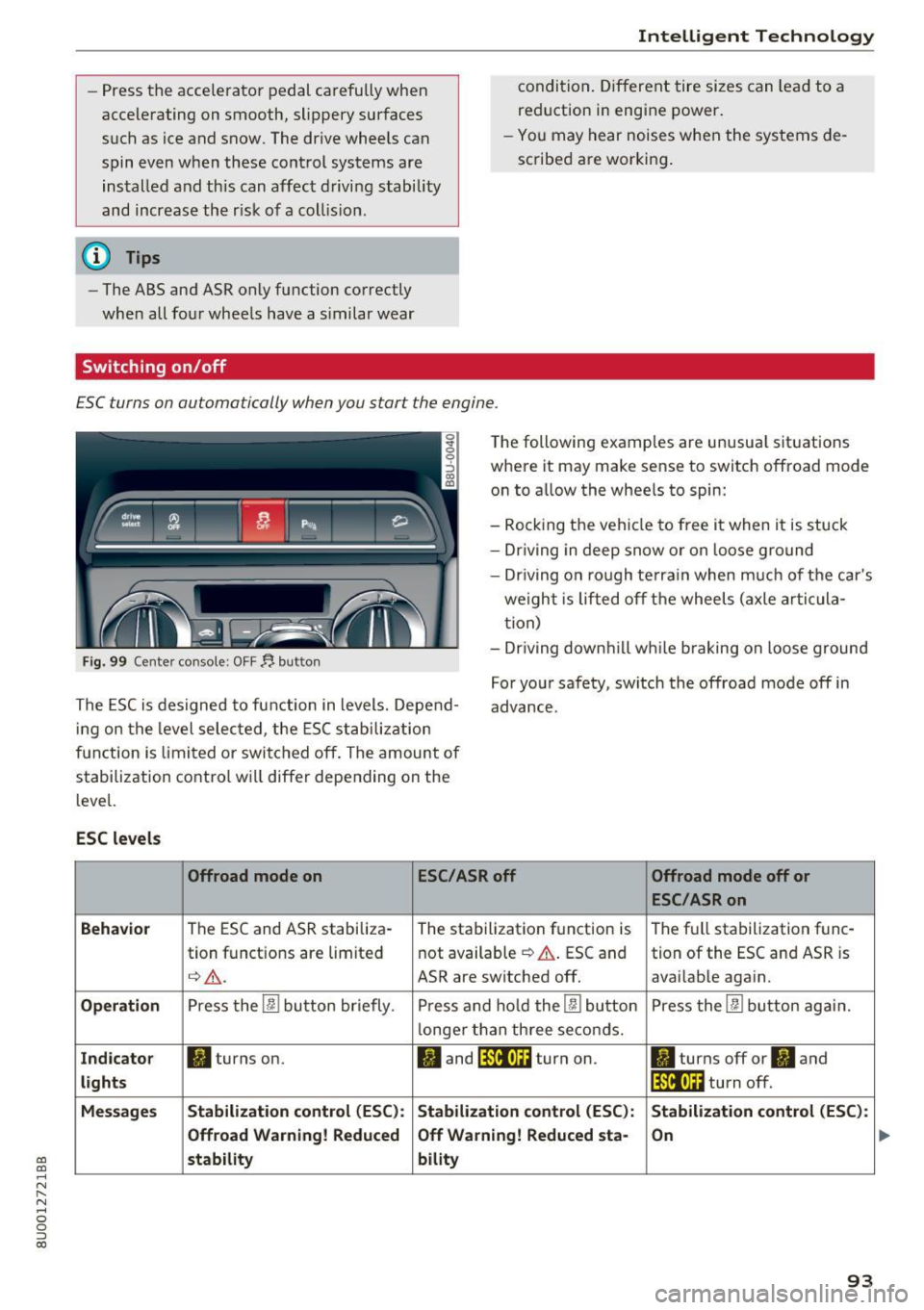
ESC turns on automatically when you start the engine .
Fig. 99 Center console: OFF~ button
The following examples are unusual situations
where it may make sense to switch offroad mode
on to allow the wheels to spin:
- Rocking the vehicle to free it when it is stuck
- Dr iving in deep snow or on loose ground
- Driving on rough terrain when much of the car's
weight is lifted off the wheels (axle articula
tion)
- Dr iving downh ill wh ile braking on loose ground
The ESC is designed to function in levels. Depend
ing on the level selected , the ESC stabilization
function is limited or switched off. The amount of
stabilization control will differ depending on the
level. For your safety, switch the offroad mode off in
advance.
ESC
levels
Offroad mode on ESC/ASRoff Offroad mode off or
ESC/ASRon
Behavior
The ESC and ASR stabiliza- The stabilization function is The full stabilization func-
tion functions are limited not available
~ A. ESC and tion of the ESC and ASR is
q_,& _ ASR are switched off. avai lable again.
Operation Press the 00 button briefly. Press and hold the 00 button Press the 00 button again.
l onger than three seconds.
Indicator II turns on. II and lf'tii•Ui turn on. ltl turns off or II and
lights lfilf•l~i turn off.
Messages Stabilization control (ESC): Stabilization
control (ESC): Stabilization control (ESC):
Offroad Warning! Reduced Off Warning! Reduced
sta-
On
stability bility
93
Page 108 of 236
Driving safety
-Always put objects, for example, luggage or
other heavy items in the luggage compart
ment.
- Always secure objects in the luggage com
partment using the tie-down eyelets and
suitable straps.
A WARNING
Heavy loads will influence the way your vehi
cle handles. To help reduce the risk of a loss
of control leading to serious personal injury:
- Always keep in mind when transporting
heavy objects, that a change in the center of
gravity can also cause changes in vehicle
handling:
- Always distribute the load as evenly as
possible.
- Place heavy objects as far forward in the
luggage compartment as possible.
- Never exceed the Gross Axle Weight Rating or the Gross Vehicle Weight Rating specified
on the safety compliance sticker on the left
door jamb. Exceeding permissible weight
standards can cause the vehicle to slide and handle differently .
- Please observe information on safe driving
¢page 100.
A WARNING
To help prevent poisonous exhaust gas from
being drawn into the vehicle, always keep the
rear lid closed while driving.
- Never transport objects larger than those fitting completely into the luggage area be
cause the rear lid cannot be fully closed .
- If you absolutely must drive with the rear lid open, observe the following notes to reduce
the risk of poisoning:
- Close all windows,
- Close the Panoramic sliding sunroof*,
- Open all air outlets in the instrument pan-
el,
- Switch off the air recirculation,
- Set the fresh air fan to the highest speed .
106
A WARNING
,--
Always make sure that the doors, all win
dows, the Panoramic sliding sunroof* and the
rear lid are securely closed and locked to re
duce the risk of injury when the vehicle is not
being used .
-After closing the rear lid, always make sure
that it is properly closed and locked.
- Never leave your vehicle unattended espe
cially with the rear lid left open. A child
could crawl into the vehicle through the lug
gage compartment and close the rear lid be
coming trapped and unable to get out. Be
ing trapped in a vehicle can lead to serious
personal injury.
- Never let children play in or around the vehi
cle.
- Never let passengers ride in the luggage
compartment. Vehicle occupants must al
ways be properly restrained in one of the ve
hicle's seating positions.
(D Tips
- Air circulation helps to reduce window fog
ging. Stale air escapes to the outside
through vents in the trim panel. Be sure to keep these slots free and open .
- The tire pressure must correspond to the
load. The tire pressure is shown on the tire
pressure label. The tire pressure label is lo
cated on the driver's side B-pillar . The tire
pressure label lists the recommended cold
tire inflation pressures for the vehicle at its
maximum capacity weight and the tires that
were on your vehicle at the time it was man
ufactured. For recommended tire pressures
for normal load conditions, please see chap
ter
¢ page 181.
Tie-downs
The luggage compartment is equipped with four
tie-downs to secure luggage and other items.
Use the tie-downs to secure your cargo properly
¢page 105, Loading the luggage compartment . ..,_
Page 112 of 236
Safe ty belts
-Failure to pay attention to the warn ing light
that come on, could lead to personal injury.
Why use safety belts?
Frontal collisions and the law of physics
Frontal crashes create very strong forces for peo
ple riding in vehicles.
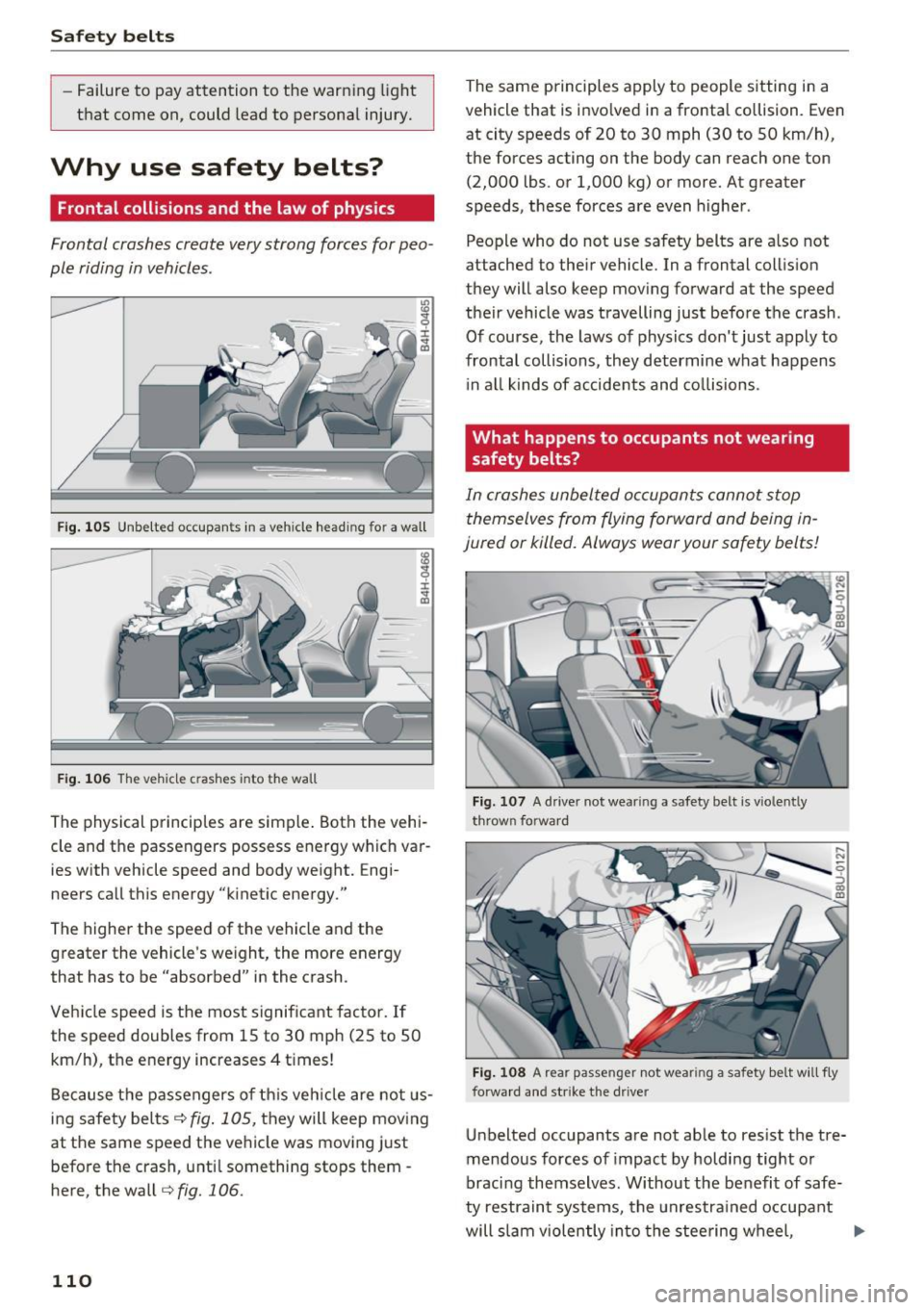
F ig . 10 5 Unbe lted occupants in a ve hicle headi ng for a wall
Fig . 1 06 The ve hicle c ras hes into the wall
The physical principles are simple . Both the vehi
cle and the passengers possess energy wh ich var
ies with vehicle speed and body weight. Engi
neers call this energy "kinet ic energy."
The higher the speed of the vehicle and the greater the vehicle's we ight, the more energy
that has to be "absorbed" in the crash .
Vehicle speed is the most significant fac tor. If
the speed doubles from 15 to 30 mph (25 to 50
km/h), the energy increases 4 times!
Because t he passengers of th is veh icle are not us
ing safety belts<=>
fig. 105, they will keep mov ing
at the same speed the vehicle was moving just
befo re the crash , u nti l something stops them -
here, the wall
r=> fig. 106.
110
The same principles apply to people sitting in a
veh icle that is invo lved in a frontal collision . Even
at city speeds of 20 to 30 mph (30 to 50 km/h) ,
the forces acting on the body can reach one ton
(2,000 lbs . or 1,000 kg) or more. At greater
speeds, these forces are even higher .
People who do not use safety belts are a lso not
attached to their vehicle. In a frontal collis ion
they will also keep mov ing fo rward at the speed
their vehicle was travelling just before the crash .
Of course, the laws of physics don't just apply to
frontal collisions, they determine what happens
i n a ll kinds of accide nts and co llisions .
What happens to occupants not wearing
safety belts?
In crashes unbel ted occupants cannot stop
themselves from flying forward and being in
jured or killed. Always wear your safety belts!
F ig. 107 A drive r not wea ring a safety belt is vio lent ly
t h row n forward
Fig. 108 A rea r passe nge r not wea ring a safety be lt will fly
forwa rd an d str ike t he drive r
Unbelted occ upants are not ab le to res ist the tre
mendous forces of impact by holdi ng tight or
braci ng themselves. Without the benefit of safe
ty restraint systems, the unrestra ined occupant
will slam violently into the stee ring wheel ,
Ill>
Page 113 of 236
a:,
a:,
...... N r--. N
"" 0 0 ::, a:,
instrument panel, windshield, or whatever e lse is
in the way
r=) fig. 107. This impact with the vehi
cle interior has all the energy they had just be
fore the crash.
Never rely on airbags alone for protection. Even
when they deploy, airbags provide on ly additional
protection. Airbags are not supposed to dep loy in
all kinds of accidents. A lthough your Audi is
equipped with airbags, all vehicle occupants, in
cluding the dr iver, must wear safety belts cor
rectly in order to minimize the risk of severe in
jury or death in a crash .
Remember too, that airbags will deploy only
once and that your safety belts are always there
to offer protect ion i n those acc idents in w hich
airbags are not supposed to deploy or when they
have a lready deployed. Unbelted occupants can
also be thrown o ut of the vehi cle where even
more severe or fatal injur ies can occur.
It is also important for the rear passengers to
wear safety bel ts correctly . Unbelted passengers
in the rear seats endanger not on ly themse lves
but also the driver and other passengers
¢ fig . 108. In a frontal collision they will be
thrown forward violently, where they can hit and
in jure the driver and/or front seat passenger .
Safety belts protect
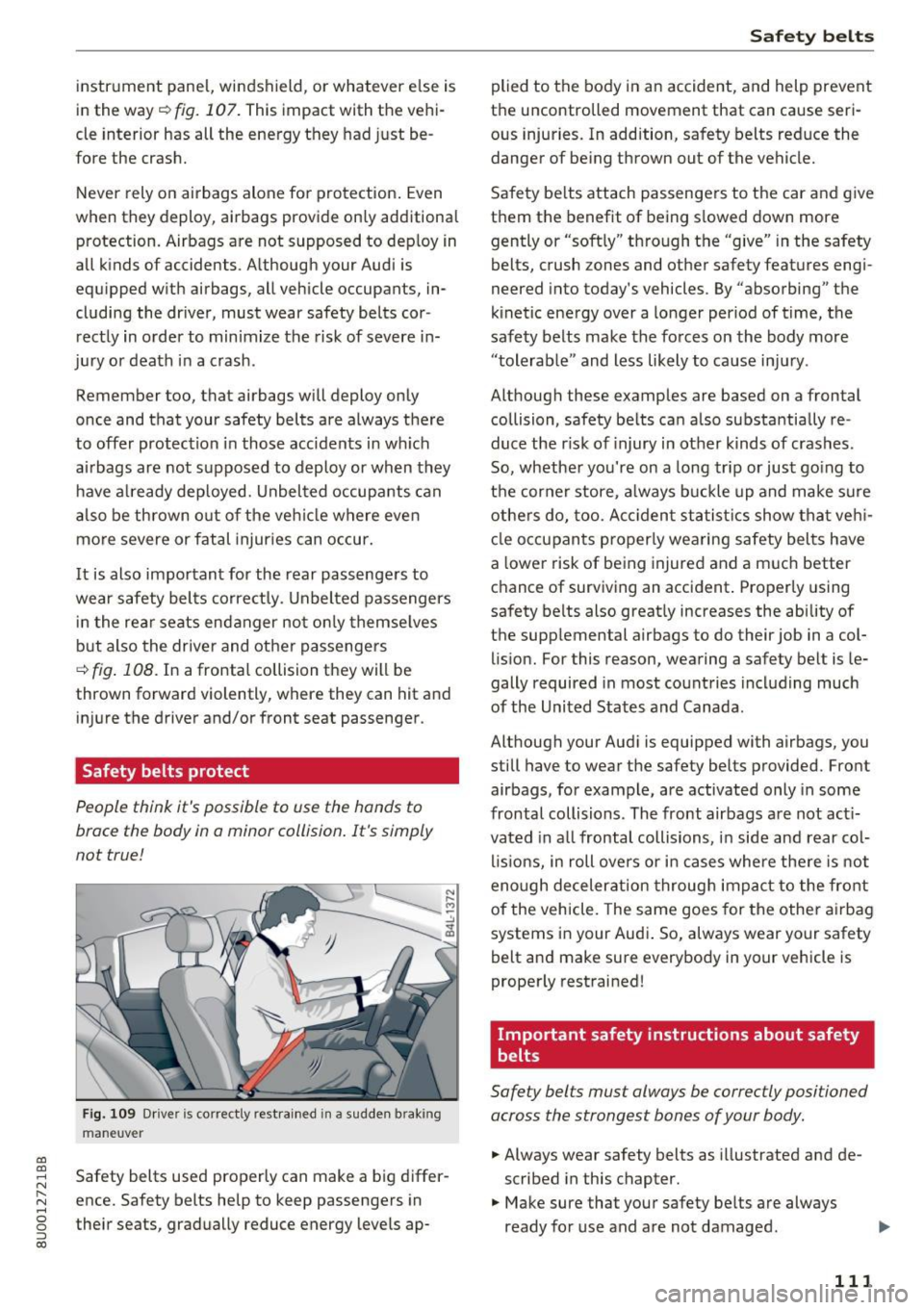
People think it's possible to use the hands to
brace the body in a minor collision. It 's simply
not true!
Fi g. 1 09 Driver is correctly restra ined in a sudde n braking
maneuver
Safety belts used properly can make a big differ
ence. Safety belts help to keep passengers in
their seats, gradually reduce energy levels ap-
Safet y bel ts
plied to the body in an accident, and help prevent
the uncontrolled movement that can cause seri
ous injuries. In addition, safety belts reduce the
danger of be ing thrown out of the vehicle.
Safety be lts attach passengers to the car and give
t h em the benefit of being s lowed down more
gently or "softly" th rough the "give" in the safety
belts, crush zones and other safety features engi
neered into today's vehicles. By "absorbing" the
kinetic ene rgy over a longer period of time, the
safety belts make the forces on the body more "tolerab le" and less likely to ca use injury .
Although these examples are based on a frontal collision, safety belts can also substantially re
duce the r isk of injury in ot her k inds of crashes.
So, whether you're on a long trip or just go ing to
the corner store, a lways buckle up and make sure
others do, too. Acc iden t statist ics show that veh i
cle occupants properly wea ring safety belts have
a lower risk of being injured and a much better
chance of surviving an accident . Properly using
safety belts also greatly increases the ability of
the supp lemental airbags to do their job in a col
lision. For this reason, wearing a safety belt is le
gally required in most count ries including much
of the United States and Canada .
Although your Aud i is equipped with airbags, you
still have to wear the safety belts provided. Front airbags, for example, are activated only in some
frontal collisions. The front airbags are not act i
vated in a ll frontal collisions, in side and rear col
l is ions, in roll overs or i n cases where the re is not
enough deceleration through impact to the front
of the vehicle. The same goes for the other a irbag
systems in your Audi . So, always wear your safety
belt and make sure everybody in your vehicle is
properly restrained!
Important safety instructions about safety
belts
Safety belts must always be correctly positioned
across the strongest bones of your body.
.,. Always wear safety belts as illustrated and de
scribed in this chapter .
.,. Make sure that your safety belts are always
ready for use and are not damaged.
111
Page 123 of 236
-Never place additional items on the seat
that can increase the total weight registered
by the weight-sensing mat and can cause in
jury in a crash .
Front airbags
Description of front airbags
The airbag system can provide supplemental
protection to properly restrained front seat occu
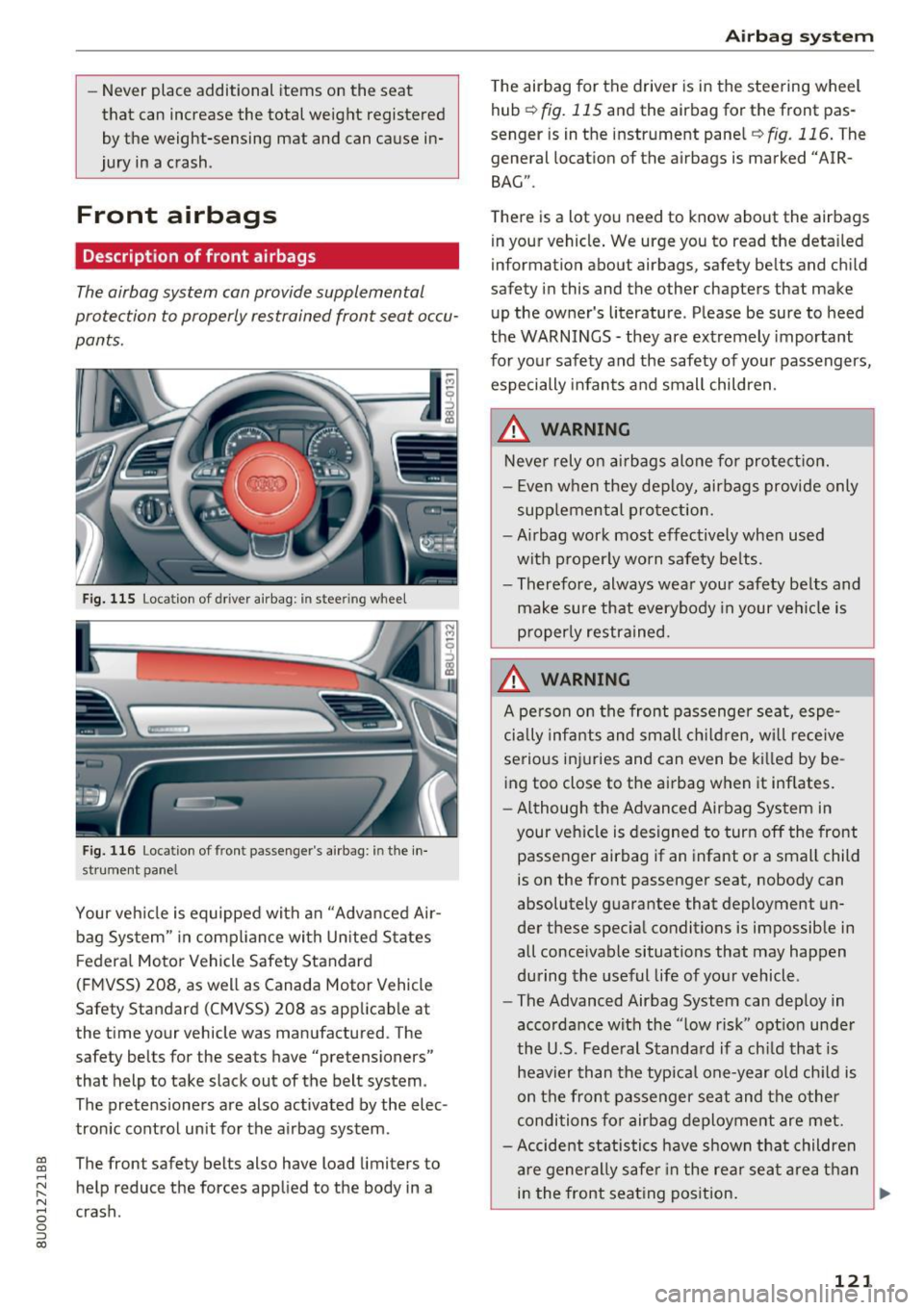
pants.
Fig. 1 15 Location of driver airbag: i n stee ring wheel
Fig. 116 Location of front passenger's airbag: in the in
st rument panel
Your veh icle is equipped with an "Advanced Air
bag System" in compliance with United States
F edera l Motor Vehicle Safety Standard
(FMVSS) 208 , as well as Canada Motor Vehicle
Safety Standard (CMVSS) 208 as app licab le at
the time your vehicle was manufactured . The
safety belts for the seats have "pretensioners"
that help to take slack out of the belt system.
The pretensioners are also activated by the elec
tron ic control unit for the airbag system .
~ The front safety belts also have load limiters to ......
~ help reduce the forces applied to the body in a N
8 crash .
0 ::, (X)
Airb ag sys tem
The airbag for the drive r is in the steering wheel
hub ~
fig. 115 and the airbag for the front pas
senger is in the instrument panel
~ fig. 116. The
general locat ion of the airbags is marked "AIR
BAG".
There is a lot you need to know about the airbags
i n your vehicle . We urge you to read the deta iled
information about airbags, safety belts and child
safety in this and the other chapters that make
up the owner's literature . Please be sure to heed
the WARNINGS -they are extremely important
for you r safety and the safety of your passengers,
especially infan ts and small children .
_&. WARNING
-
Never rely on ai rbags alone fo r protect ion.
- E ven w hen they deploy, airbags provide only
supp lemental protection.
- Airbag work most effectively when used
with p roperly worn safety belts .
- Therefore, always wear your safety belts and
make sure that everybody in your ve hicle is
p roperly restrained.
_&. WARNING
A pe rson on the front passenger seat, espe
cia lly infants and small ch ildren, wi ll receive
serious injuries and can even be ki lled by be
ing too close to the airbag when it inf lates.
- Although the Advanced Airbag System in
your veh icle is designed to turn off the front
passenger airbag ifan infant or a small child
is on the front passenger seat, nobody can
absolutely guarantee that deployment un
der these specia l conditions is impossible in
all conceivable situations that may happen
during the useful life of yo ur vehicle .
- The Advanced Airbag System can dep loy in
accordance with the "low risk" option under
the U .S . Fede ral Standa rd if a ch ild that is
heavier than the typica l one-year old ch ild is
on the front passenger seat and the other
conditions fo r airbag deployment are met.
- Accident statistics have shown that children
are generally safe r in the rear sea t area t han
in the front seating pos ition .
Ill-
121
Page 125 of 236
00
00
......
"' ,....
"' ...... 0 0 :::,
00
If the front passenger airbag is turned off, the
PASSENGER AIR BAG OFF light in the center of
the instrument panel will come on and stay on.
The front airbag on the passenger side may
not
deploy (the PASSENGER AIR BAG OFF light does
not illuminate and stay lit) if:
- a small adult or teenager is on the front pas
senger seat
- a passenger who is not sitting upright with
their back against a non-reclined backrest with
their feet on the vehicle floor in front of the
seat is on the front passenger seat.
If the front passenger airbag deploys, the Feder
al Standard requires the airbag to meet the "low
risk" deployment criteria to help reduce the risk
of injury through interaction with the airbag.
"Low risk" deployment occurs in those crashes
that take place at lower decelerations as defined
in the electronic control unit.
c::;, page 12 7
Always remember: Even though your vehicle is
equipped with Advanced Airbags, the safest place
for childre n is properly restrained on the back
seat. Please be sure to read the important infor
mation in the sections that follow and be sure to
heed all of the WARNINGS.
A WARNING
To reduce the risk of injury when an airbag in
flates, always wear safety belts properly.
- If you are unrestrained, leaning forward, sit
ting sideways or out of position in any way,
your risk of injury is much higher.
- You will also receive serious injuries and
could even be killed if you are up against the
airbag or too close to it when it inflates -
even with an Advanced Airbag
¢ page 117.
A WARNING
A child in a rearward-facing child safety seat
installed on the front passenger seat will be
seriously injured and can be killed if the front
airbag inflates -even with an Advanced Airbag
System .
- Although the Advanced Airbag System in
your vehicle is designed to turn off the front
airbag when a rearward-facing child re-
Airbag system
straint has been installed on the front pas
senger seat, nobody can absolutely guaran
tee that deployment is impossible in all con
ceivable situations that may happen during
the useful life of your vehicle .
- The inflating airbag will hit the child safety
seat or infant carrier with great force and
will smash the child safety seat and child
against the backrest, center armrest, door,
or roof.
- Always install rearward-facing child re
straints in the back seat.
- If you must install a rearward facing child
safety seat on the front passenger seat be
cause of exceptional circumstances and the
PASSENGER AIR BAG OFF light does not
come on and stay on, immediately install
the rear-facing child safety seat in a rear
seating position and have the airbag system inspected by your authorized Audi dealer.
A WARNING
-If, in exceptional circumstances, you must in-
stall a forward-facing child restraint on the
front passenger's seat:
-Always make sure the forward-facing seat
has been designed and certified by its man
ufacturer for use on a front seat with a pas
senger front and side airbag .
- Never put the forward-facing child restraint
up against or very near the instrument pan
el.
- Always move the front passenger seat to
the highest position in the up and down ad
justment range and move it back to the rearmost position in the seat's fore and aft
adjustment range, as far away from the air
bag as possible, before installing the for
ward-facing child restraint.
-Always make sure that the safety belt upper
anchorage is behind the child restraint and
not next to or in front of the child restraint
so that the safety belt will be properly posi
tioned.
- Always move the passenger seat into its
rearmost position in the seat's fore and aft
123
Page 133 of 236
a:,
a:,
...... N r--. N .-< 0 0 ::, a:,
module must always be repaired immediately by an authorized Audi dealer .
- The airbag system can be activated only
once. After an airbag has inflated, it must
be replaced by an authorized Audi dealer or
qualified technician who has the technical
information, training and special equipment
necessary.
- The airbag system can be deployed only
once. After an airbag has been deployed, it
must be replaced with new replacement
parts designed and approved especially for
your Audi model version. Replacement of complete airbag systems or airbag compo
nents must be performed by qualified work
shops only. Make sure that any airbag serv
ice action is entered in your Audi Warranty
& Maintenance booklet under AIRBAG RE
PLACEMENT RECORD.
@) For the sake of the environment
Undeployed airbag modules and pretension
ers might be classified as Perchlorate Materi
al -special handling may apply, see
www.dtsc .ca.gov/hazardouswaste/perchlo
rate . When the vehicle or parts of the re
straint system including airbag modules safe
ty belts with pretensioners are scrapped, all
applicable laws and regulations must be ob
served. Your authorized Audi dealer is familiar
with these requirements and we recommend
that you have your dealer perform this service
for you .
Other things that can affect Advanced
Airbag performance
Changing the vehicle's suspension system can
change the way that the Advanced Airbag System
performs in a crash. For example, using tire-rim
combinations not approved by Audi, lowering the
vehicle, changing the stiffness of the suspension,
including the springs, suspension struts, shock
absorbers etc. can change the forces that are measured by the airbag sensors and sent to the
electronic control unit . Some suspension changes
can, for example, increase the force levels meas
ured by the sensors and make the airbag system
Airbag system
deploy in crashes in which it would not deploy if
the changes had not been made. Other kinds of
changes may reduce the force levels measured by
the sensors and prevent the airbag from deploy
ing when it should.
A WARNING
-Changing the vehicle 's suspension including
use of unapproved tire-rim combinations can
change Advanced Airbag performance and in
crease the risk of serious personal injury in a
crash.
- Never install suspension components that
do not have the same performance charac
teristics as the components originally instal
led on your vehicle.
- Never use tire-rim combinations that have
not been approved by Audi.
A WARNING
=
Items stored between the safety belt buckle
and the center console can cause the sensors in the buckle to send the wrong information
to the electronic control module and prevent
the Advanced Airbag System from working properly.
-Always make sure that nothing can interfere
with the safety belt buckles and that they are not obstructed.
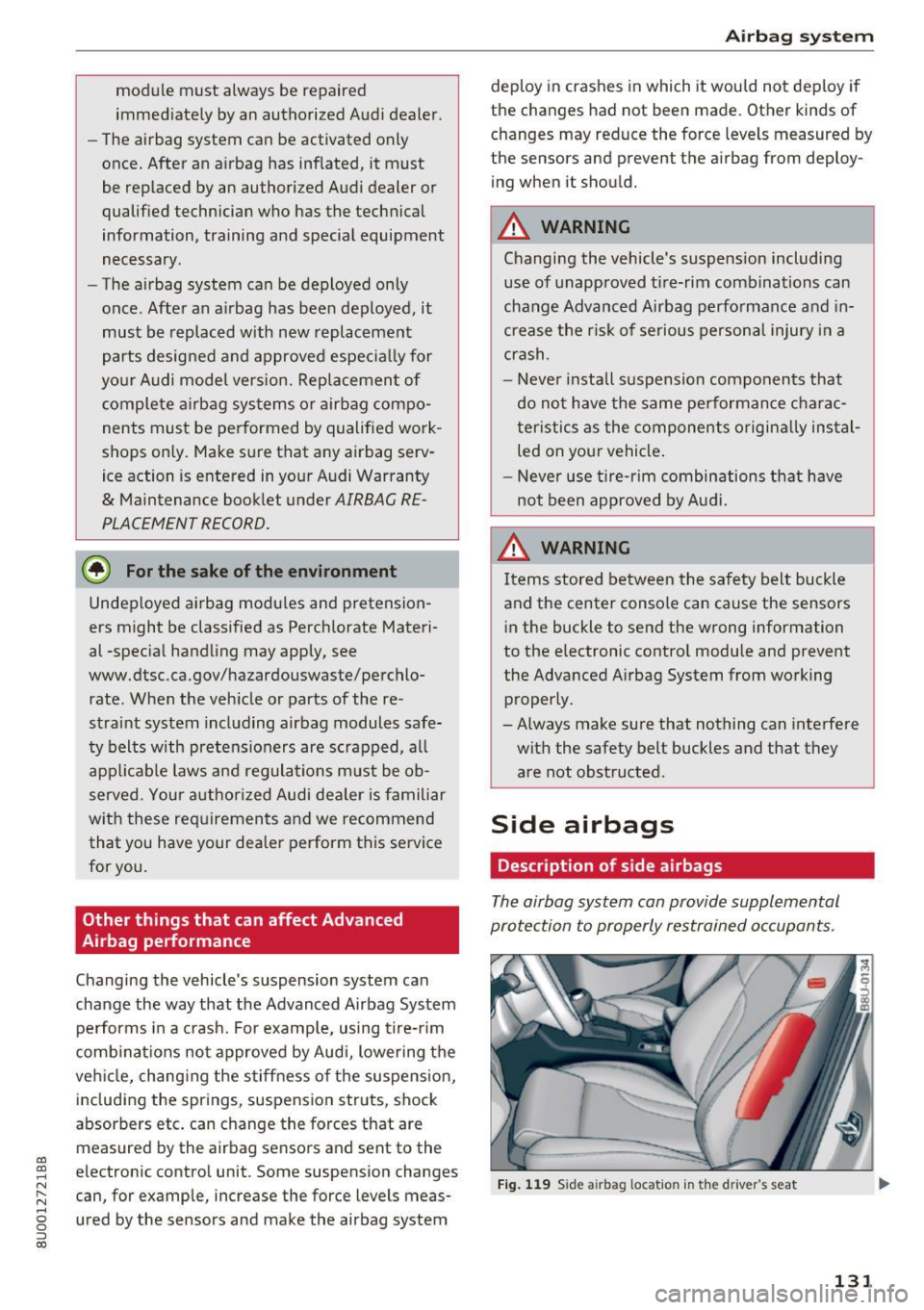
Side airbags
Description of side airbags
The airbag system can provide supplemental
protection to properly restrained occupants.
Fig. 119 S ide a irbag locatio n in the driver's seat
131
Page 148 of 236
Child safety
use the safety belt height adjustment to help
adjust the shoulder portion properly .
~ Secure unused safety belts on the rear seat
<=>page 142.
Children up to at least 8 years old (over 40 lbs. or
18 kg) are best protected in child safety seats de
signed for their age and weight. Experts say that
the skeletal structure, particularly the pelvis, of
these children is not fully developed, and they
must not use the vehicle safety belts without a
suitable child restraint.
It is usually best to put these children in appro priate booster seats . Be sure the booster seat
meets all applicable safety standards .
Booster seats raise the seating position of the
child and reposition both the lap and shoulder
parts of the safety belt so that they pass across
the child's body in the right places . The routing of
the belt over the child's body is very important
for the child's protection , whether or not a boos
ter seat is used. Children age 12 and under must
always ride in the rear seat .
Children who are at least 4 ft. 9 in. (57 inches/
1.45 meters) tall can generally use the vehicle's
three point lap and shoulder belts. Never use the
lap belt portion of the vehicle's safety belt alone
to restrain any child, regardless of how big the
child is. Always remember that children do not
have the pronounced pelvic structure required for
the proper function of lap belt portion of the ve
hicle 's three point lap and shoulder belts. The
child 's safety absolutely requires that a lap belt
portion of the safety belt be fastened snugly and
as low as possible around the pelvis . Never let
the lap belt portion of the safety belt pass over
the child's stomach or abdomen.
In a crash, airbags must inflate within a blink of
an eye and with considerable force . In order to do
its job, the airbag needs room to inflate so that it
will be there to protect the occupant as the occu
pant moves forward into the airbag.
A vehicle occupant who is out of position and too
close to the airbag gets in the way of an inflating
airbag. When an occupant is too close, he or she
will be struck violently and will receive serious or
possibly even fatal injury.
146
In order for the airbag to offer protection, it is
important that all vehicle occupants , especially
any children, who must be in the front seat be
cause of exceptional circumstances, be properly
restrained and as far away from the airbag as
possible. By keeping room between the child's
body and the front of the passenger compart
ment, the airbag can inflate completely and pro
vide supplemental protection in certain frontal
collisions.
.&_ WARNING
Not using a booster seat, using the booster
seat improperly, incorrectly installing a boos
ter seat or using the vehicle safety belt im
properly increases the risk of serious personal
injury and death in a collision or other emer
gency situation. To help reduce the risk of se rious personal injury and/or death:
- The shoulder belt must lie as close to the
center of the child's collar bone as possible
and must lie flat and snug on the upper
body .
It must never lie across the throat or
neck . The lap belt must lie across the pelvis
and never across the stomach or abdomen.
Make sure the belt lies flat and snug. Pull on
the belt to tighten if necessary.
- Failure to properly route safety belts over a
child's body will cause severe injuries in an
accident or other emergency situation
r=:> page 109.
- The rear side of the child safety seat should
be positioned as close as possible to the
backrest on the vehicle seat. Adjust or re
move the rear seat head restraint if it is dif
ficult to install the child seat with the head
restraint in placer=;,
page 46. Install the
head restraint again immediately once the
child seat is removed . Driving without head
restraints or with head restraints that are
not properly adjusted increases the risk of
serious or fatal neck injury dramatically.
- Never let a child put the shoulder belt under
the arm or behind the back, because it could
cause severe injuries in a crash.
- Children on the front seat of any car, even
with Advanced Airbags, can be seriously in-
-
jured or even killed when an airbag inflates. .,
Page 181 of 236
a)
a)
.... N r-N .... 0
0
::, a)
For this reason, in case of emer
gency, only use a spare tire that
has the same circumference as
the regular tires.
& WARNING -
-Only use tire/rim combina
tions and suitable wheel bolts
that have been approved by
Audi. Otherwise, damage to
the vehicle and an accident
could result.
-For technical reasons, it is not possible to use tires from oth
er vehicles - in some cases,
you cannot even use tires from
the same vehicle model.
-Make sure that the tires you select have enough clearance
to the vehicle . Replacement
tires should not be chosen
simply based on the nominal
size, because tires with a dif
ferent construction can differ greatly even if they are the
same size. If there is not
enough clearance, the tires or
the vehicle can be damaged
and this can reduce driving
safety and increase the risk of
an accident.
-Only use tires that are more
than six years old when abso-
Wheels
lutely necessary and drive
carefully when doing so.
-Do not use run-flat tires on
your vehicle . Using them when
not permitted can lead to ve
hicle damage or accidents.
-If you install wheel covers on
the vehicle, make sure they al low enough air circulation to
cool the brake system. If they
do not, this could increase the
risk of an accident.
Tire wear/damage
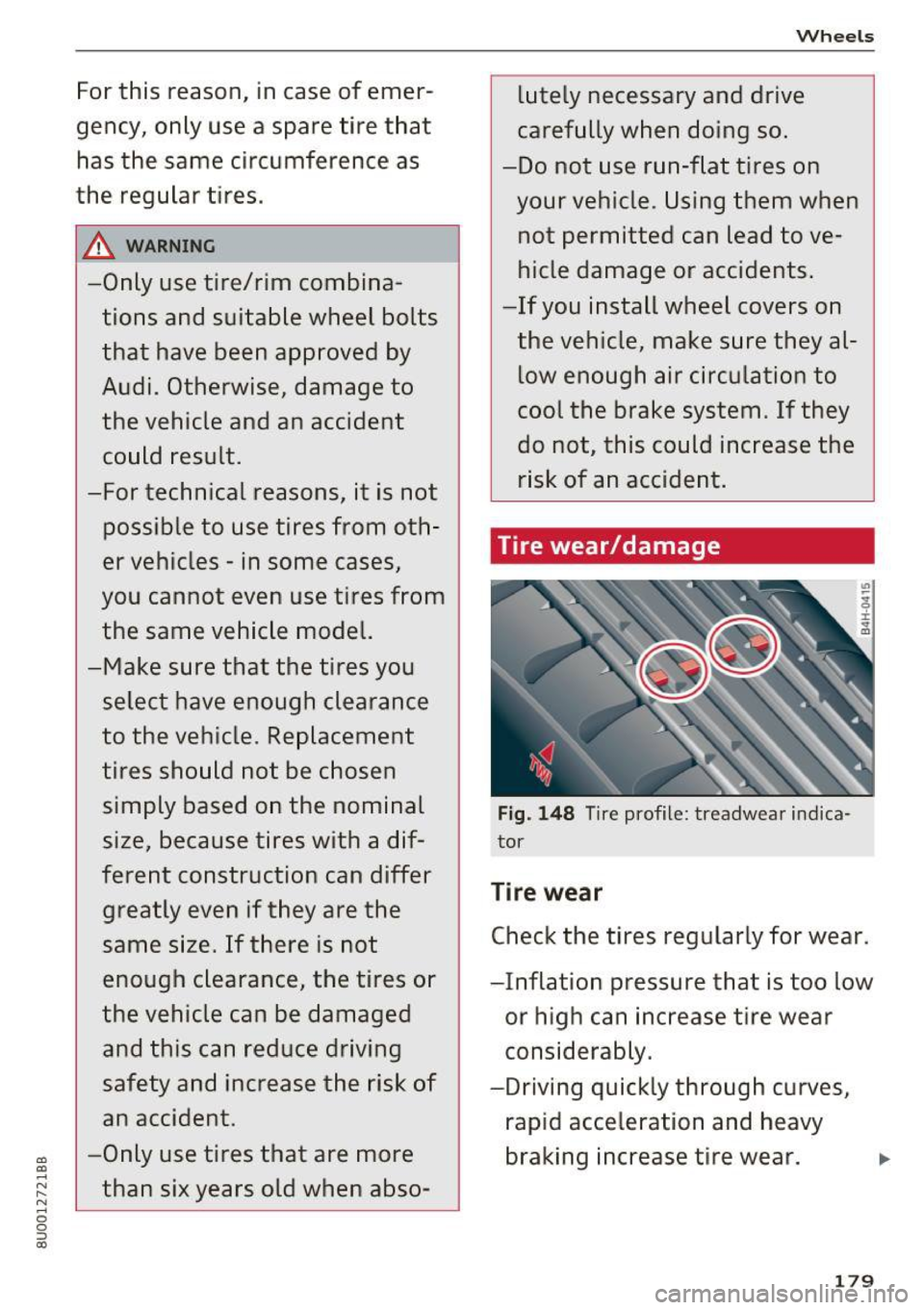
Fig. 148 Tire profile: treadwear indica
tor
Tire wear
Check the tires regularly for wear.
-Inflation pressure that is too low or high can increase tire wear
considerably.
-Driving quickly through curves, rapid acceleration and heavy
braking increase tire wear.
179
Page 191 of 236
00
00
......
"' ,....
"' ...... 0 0 :::,
00
also reduces fuel e fficiency and tire tread life,
and may affect the vehicle's handling and stop p ing ability .
Pl ease no te that the TPMS is not a substi tute for
p roper tire maintenance, and it is the drive r's re
sponsib ility to maintain cor rect tire pressure,
even if under-inflation has not reached the leve l
to tr igger illum inat ion of the TPMS low tire pres
sure telltale.
Your vehicle has also been eq uipped with a TPMS
mal funct ion indicator to indicate when the sys
tem is not operating properly. The TPMS mal
function indicator is combined w ith the low tire
pressure tellta le. Whe n the system detects a
malfunct ion, the telltale will flash for approx i
mately one min ute and then remai n cont inuo usly
i llum inated. This sequence will continue upon
s ubseq uen t ve hicl e start- ups as long as the m al
f u nction ex ists.
When the malfunct io n in dicator is ill uminated,
the system may not be ab le to detect or signa l
l ow tire press ure as intended . TPM S malfu nctions
may oc cur for a var iety of reasons, incl uding the
installation of replacement or alternate ti res o r
wheels on the vehicle that prevent the TPMS
from functioning properly . Always check the
TPMS malfunction telltale after rep lacing one or
more t ires or whee ls on your ve hicle to ensure
that the replacement or alternate tires and
wheels allow the TPMS to cont inue to funct ion
p roperly.
If the Tire Pressure Monitoring System
ind icator appears
A ppl ies to: ve hicles with Tir e Pressure Moni toring System in
di cato r
The tire pressure indicator in the instrument
cluster informs you if the tire pressure is too low
or if th ere is a system malfunction .
Using the ABS sensors, the tire p ressure mo nitor
i ng system compa res the tire tread circumfer
e n ce and vib ra tion characteristics of the individ u
a l tir es .
If the pressure c hanges in o ne or more
wheels , th is is indica ted in the instrument clus ter
d is p la y with a n
[I] indica to r li ght and a message.
Wh eel s
If only one tire is affected, the location of tha t
t ir e will be indicated.
T he tire press ures mus t be store d in the Infot ain
ment system again each t ime the pressures
c h ange (switching between partia l and full load
pressure) or after changing or replacing a tire on
yo ur vehicle
r::!;> page 190 . The tire pressure mon i
toring system on ly monitors the tire pressure you
have stored . Refer to the t ire pressure label for
the recommended t ire press ure fo r yo ur vehicle
r::!;>page 181, fig . 150 .
Tire tread c ircumfe rence and vibration cha racter
istics can change and cause a tire pressu re warn
i ng if :
- the t ire pressure in one or more tires is too low.
- the t ire has str uctural damage .
- t he t ire w as rep lace d or the t ire pressu re was
changed and it was no t store d
r::!;> page 190.
- t he spare tire* is i nstalled.
Indicator lights
[I] -Loss of pressu re in at leas t one tire r::!;> & .
Check the tires and replace or repair if necessary .
Check/correct the pressures of all fou r tires and
store the pressu re again in the menu disp lay
r::!;>page 190.
ffim (T ire Pressure Moni tor ing Sys tem) Tire
pre ssure: Syst em malfunction!. Ifm appears
after sw itching the ignition on or while d riv in g
and the
[I] i ndic ator ligh t in the i nstru men t clus
te r blinks for approx imately one minute and then
stays on, the re is system ma lf u nction . Try to
store the co rrect tire pressures
r::!;> page 190 . If
the indicator light does turn off or turns on again
after a short period of time, drive to an author
ized Audi dealer or author ized Audi Se rvice Facili
ty immediate ly to have the ma lfunction correct
ed.
_&. WARNING
- I f the tire p ressure in dicator appears in the
d isp lay, redu ce you r speed immedi ately and
a void any h ard stee ring or bra king m aneu
vers . S to p as soon as poss ible and check the
tires an d their pressure .
~
189