ECO mode AUDI Q3 2017 Owner´s Manual
[x] Cancel search | Manufacturer: AUDI, Model Year: 2017, Model line: Q3, Model: AUDI Q3 2017Pages: 236, PDF Size: 58.93 MB
Page 133 of 236
a:,
a:,
...... N r--. N .-< 0 0 ::, a:,
module must always be repaired immediately by an authorized Audi dealer .
- The airbag system can be activated only
once. After an airbag has inflated, it must
be replaced by an authorized Audi dealer or
qualified technician who has the technical
information, training and special equipment
necessary.
- The airbag system can be deployed only
once. After an airbag has been deployed, it
must be replaced with new replacement
parts designed and approved especially for
your Audi model version. Replacement of complete airbag systems or airbag compo
nents must be performed by qualified work
shops only. Make sure that any airbag serv
ice action is entered in your Audi Warranty
& Maintenance booklet under AIRBAG RE
PLACEMENT RECORD.
@) For the sake of the environment
Undeployed airbag modules and pretension
ers might be classified as Perchlorate Materi
al -special handling may apply, see
www.dtsc .ca.gov/hazardouswaste/perchlo
rate . When the vehicle or parts of the re
straint system including airbag modules safe
ty belts with pretensioners are scrapped, all
applicable laws and regulations must be ob
served. Your authorized Audi dealer is familiar
with these requirements and we recommend
that you have your dealer perform this service
for you .
Other things that can affect Advanced
Airbag performance
Changing the vehicle's suspension system can
change the way that the Advanced Airbag System
performs in a crash. For example, using tire-rim
combinations not approved by Audi, lowering the
vehicle, changing the stiffness of the suspension,
including the springs, suspension struts, shock
absorbers etc. can change the forces that are measured by the airbag sensors and sent to the
electronic control unit . Some suspension changes
can, for example, increase the force levels meas
ured by the sensors and make the airbag system
Airbag system
deploy in crashes in which it would not deploy if
the changes had not been made. Other kinds of
changes may reduce the force levels measured by
the sensors and prevent the airbag from deploy
ing when it should.
A WARNING
-Changing the vehicle 's suspension including
use of unapproved tire-rim combinations can
change Advanced Airbag performance and in
crease the risk of serious personal injury in a
crash.
- Never install suspension components that
do not have the same performance charac
teristics as the components originally instal
led on your vehicle.
- Never use tire-rim combinations that have
not been approved by Audi.
A WARNING
=
Items stored between the safety belt buckle
and the center console can cause the sensors in the buckle to send the wrong information
to the electronic control module and prevent
the Advanced Airbag System from working properly.
-Always make sure that nothing can interfere
with the safety belt buckles and that they are not obstructed.
Side airbags
Description of side airbags
The airbag system can provide supplemental
protection to properly restrained occupants.
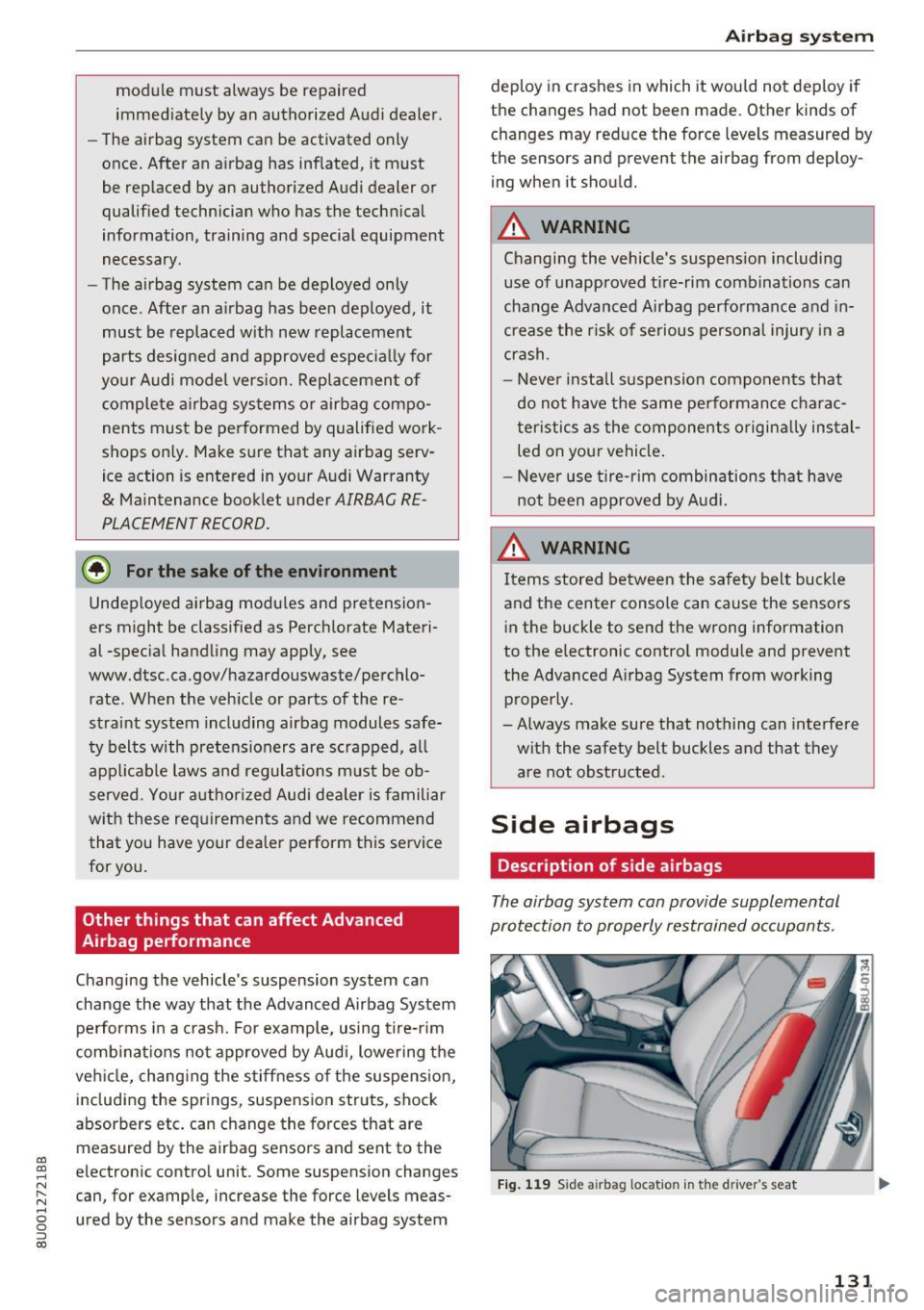
Fig. 119 S ide a irbag locatio n in the driver's seat
131
Page 141 of 236
00
00
......
"' ,....
"' ...... 0 0 :::,
00
Advanced Airbags and the weight-sensing
mat in the front seat
The Advanced Airbag System in your vehicle de
tects the presence of an infant or child in a child
restraint on the front passenger seat using the
weight-sensing mat in the seat cushion and the
sensor below the safety belt latch on the front passenger seat that measures the tension on the
safety belt .
The weight-sensing mat measures total weight
of the child and the child safety seat and a child blanket on the front passenger seat. The weight
on the front passenger seat is related to the de
sign of the chi ld restraint and its "footprint", the
size and shape of the bottom of the chi ld re
stra int as it sits on the seat. The weight of a child
restraint and its "footp rint" vary for different
kinds o f child restraints and for the different
models of the same kind of child restraint of
fered by child restraint manufacturers.
The weight ranges for the individual types,
makes and models of child restraints that the
NHTSA has specified in the Safety Standard to
gether with the weight ranges of typical infants
and typical 1 year-old child have been stored in
the control unit of the Advanced Airbag System .
When a child restraint is be ing used on the front
passenger seat with a typical 1 year-old child, the
Advanced Airbag System compares the weight measured by the weight sensing mat with the in
formation stored in the electronic contro l unit.
The electronic control un it also registers the ten
sion on the front passenger safety belt . The ten
sion on the safety belt for the front passenger
seat will be d ifferent fo r an ad ult who is properly
using the safety belt as compared to the tension
on the belt when it is used to attach a chi ld re
straint to the seat. The sensor below the latch for
the safety belt for the front seat passenger measures the tens ion on the belt. The input from
this sensor is then used with the weight to "de
cide", whether there is a child restraint w ith a
typical 1 year-old child on the front passenger
seat and whet her o r not the a irbag must be
turned off.
Ch ild safety
Child restraints and Advanced Airbags
Regardless of the ch ild restraint that you use,
make s ure tha t it has been cer tified to mee t Safe
ty Standards and has been cert ified by its manu
facturer for use with an airbag. Always be sure
that the c hild restraint is properly installed at
one of the rear seating positions. If in exception
al circumstances you must use it on the front
passenger seat, carefully read all of the informa
t ion on child safety and Advanced A irbags and
heed all of the applicable WARNINGS . Make cer
ta in that the ch ild restraint is correctly recog
nized by the weight-sensing mat ins ide the front
passenge r seat, that the front passenge r airbag
is turned off and that the airbag status is always
correctly signaled by the
PASSENGER AIR BAG
OFF
light .
Many types and models of child restra ints have
been avai lab le over the years, new models are in
t roduced regu larly incorporating new and im
proved designs and older models are taken out of
production. Child restraints are not standardized.
Child restra ints of the same type typically have
different weights and sizes and different 'foot
pr ints,' the size and shape of the bottom of the
ch ild rest raint that sits on the seat, when they
are installed on a vehicle seat. These d ifferences
make it virt ua lly impossib le to certify comp liance
wi th the requi rements for advanced a irbags w it h
each and every child restraint tha t has ever been
sold in the past or wi ll be so ld over the course of
the usefu l life of your vehicle .
For t his reason, the Uni ted States N ation al High
way Traffic Sa fety Administration has published a
list of specific type, makes and mode ls of chi ld
restraints that must be used to certify compli
ance of the Advanced Airbag System in your vehi
cle w ith the suppress ion requirements of Federal
Motor Vehicle Safety Standard 208 . These child
restra ints are:
Subpart A - C ar b ed child r estra int s
Model Manufactured on or
after
Angel Guard Angel September 2S, 2007 R ide AA2403FOF
139
Page 180 of 236
Wheel s
Occupant loading and distri
bution for vehicle normal load
for various designated seat ing
capacit ies
Refer to the tire inflation pres
sure label ¢
page 181, fig . 150
for the number of seating posi
tions . Refer to the table¢
table
on page 183
for the number of
people that correspond to the ve
hicle normal load .
New tires or wheels
Audi recommends having all work
on tires or wheels performed by
an authorized Audi dealer or au
thorized Audi Service Facility .
These facilities have the proper knowledge and are equipped with
the required tools and replace
ment parts.
.,. New tires do not yet have the
optimum gripping properties. Drive carefully and at moderate
speeds for the first 350 miles (500 km) with new tires .
.,. Only use tires with the same de
sign, size (rolling circumference)
and as close to the same tread pattern as poss ible on all four
wheels .
178
.,.Do not replace tires individually .
At least replace both tires on the
same axle at the same time.
.,. Audi recommends that you use
Audi Original Tires. If you would
like to use different tires, please
note that the tires may perform
differently even if they are the
same size ¢
,&..
.,. If you would like to equip your
vehicle with a tire/rim combina
tion that is different from what
was installed at the factory, con
sult with an authorized Audi
dealer or authorized Audi Service Facility before making a pur
chase ¢&, .
If the spare t ire is different from
the regular tires installed on the
vehicle -for example, if winter
tires or wide tires are installed -
then only use the spare tire tem
porarily in case of emergency and
drive carefully while it is in use. It
should be replaced with a regular
tire as soon as possible.
Applies to: vehicles with all wheel
drive: all four wheels must be
equipped with tires that are the
same brand and have the same
construction and tread pattern so
that the drive system is not dam aged by different wheel speeds . .,.
Page 189 of 236
00
00
......
"' ,....
"' ...... 0 0 :::,
00
& WARNING
Using incorrect snow chains or insta lling snow
chains incorrectly can result in loss of vehicle
control, which increases the risk of an acc i
dent.
(D Note
Snow chains can damage the rims/wheel cov
ers * if the chains come into direct contact
wit h them . Remove the wheel covers * first .
Use coated snow chains.
Low aspect ratio tires
Your Aud i is factory-equipped with low aspect ra
tio tires . These t ires have been thoroughly tested
and been se lected specifica lly for you r model for
the ir supe rb performance, road feel and handling
u nder a va riety of d riving conditions. As k yo ur au
thor ized Audi dealer for mo re de tails.
The low aspect ratio of these t ires is indicated by
a numera l of
55 or l ess in the tire's size desig na
tion . The numera l rep resents t he rat io of the
tire's sidewall he ight in rela tion t o its tread w idth
expressed in percen tage. Conventional t ires have
a height/w idth ratio of 60 or more .
The performan ce of low -aspect-r atio tire s is par
ticularly sen sitiv e to impr oper infla tion pre s
s ure . It is therefore important that low a spect
ratio tires are infl ated to the specified pressure
and that the inflation pre ssure is regularl y
checked and ma inta ined . Tire pre ssure s should
be checked at least once a month and alwa ys
before a long trip
c> page 181.
What you can do to avoid tire and rim damage
Low aspect rat io tires can be damaged more easi
ly by impact with potholes, curbs, gul lies or
ridges on the road, pa rticularly if the tire is un
de rinflated .
In order to minimize the occurrence of impact
damage to the t ires of your ve hicle, we recom
mend that you observe the follow ing precau
tions:
Wh eel s
-Always maintain recommended inflat ion pres
sures . Check your tire pressure every 2,000
m iles (3,000 km) and add air if necessary .
- Drive carefully on roads wit h potholes, deep
gu llies or ridges . T he impact from dr iving
through or over such obstacles can damage
your tires. Impact with a curb may a lso cause
damage to your tires.
-After any impact, immed iate ly inspect your
tires or have them inspected by the nearest au
thorized Audi dealer . Replace a damaged tire as
soon as possible .
- Inspect your tires every 2,000 m iles (3,000 km)
for damage and wear. Damage is not a lways
easy to see . Damage can lead to loss of a ir and
unde rinflat ion, wh ic h could eventually cause
t ire fa ilu re . If yo u be lieve th at a t ire may have
been damaged, repla ce the tire as soon as pos
sible.
- These tires may we ar mo re quickly tha n others.
- Please also remember that, while these tires
de live r responsive ha nd ling, they may ride less
comfort ably and make more noise t han other
choices .
Reduced performance in winter/cold season
conditions
All t ires are des igned for certai n pu rposes. The
l ow aspect ratio, ultra h igh performance tires
origina lly installed on your vehicle are intended
for maximum dry and wet road performance and handling. They are not suitable for co ld, snowy or
icy weather conditions. If you drive under those
c ircumstances, you should equip your vehicle
with all-season or winter tires, which offer better
t ract ion under those conditions . We suggest you
u se the recommended s now or a ll-season tires
spe cified for your veh icle, o r the ir equiva lent.
Refer to
c> page 186 for more detailed informa
t ion regard ing winter tires.
Uniform tire quality grad ing
- Tread wear
- Traction AA ABC
- Temperature ABC
187
Page 212 of 236
Emergency situations
@ Tips
The discharged battery must be properly con
nected to the vehicle's electrical system .
When jump starting or charging the battery,
never connect the negative ground cable to
the battery negative post because the battery
manager system must be able to detect the
battery's state of charge . Always connect the
negat ive ground cable to the negative ground
pos t of the battery manager control unit.
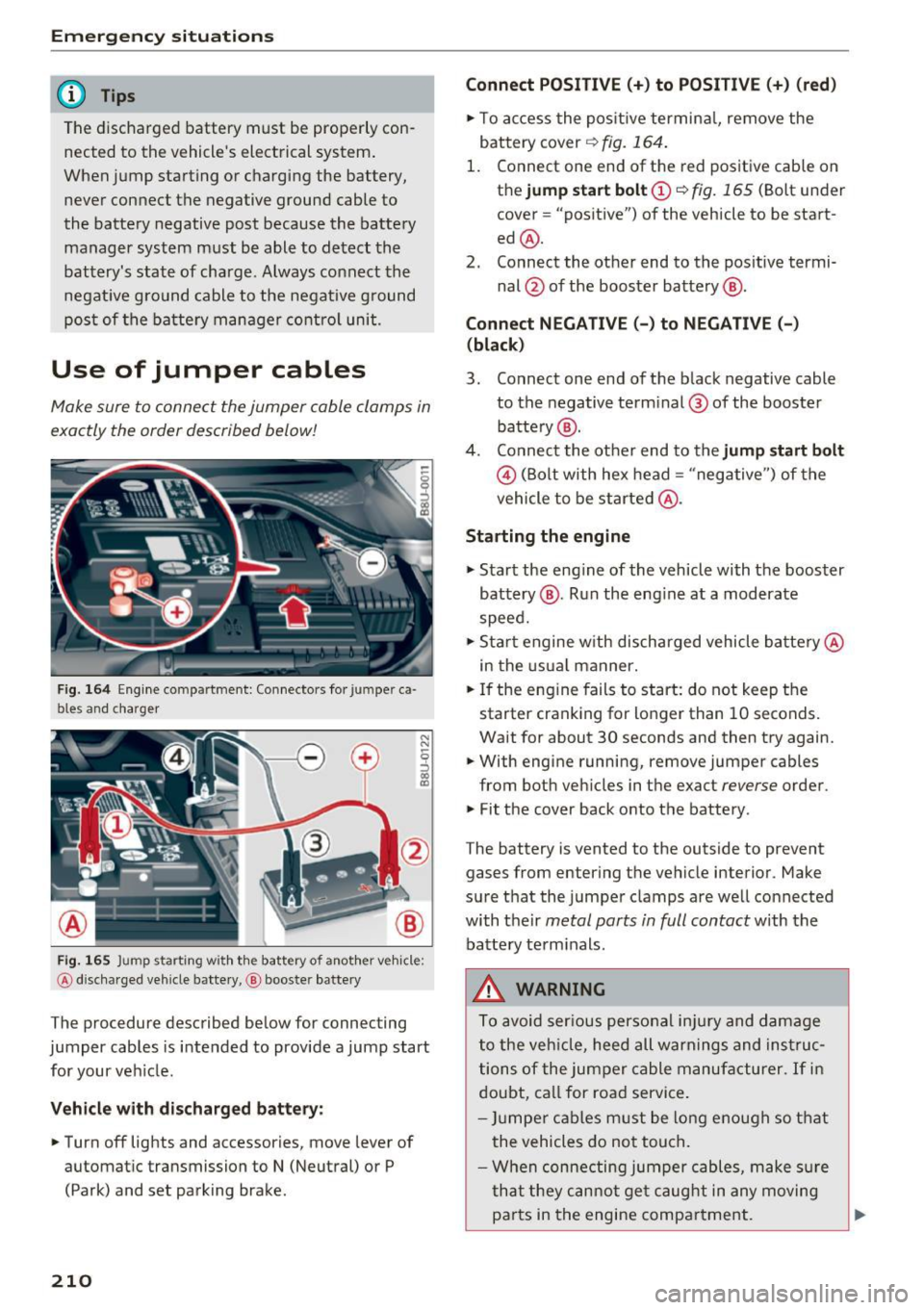
Use of jumper cables
Make sure to connect the jumper cable clamps in
exactly the order described below!
Fig. 164 Engine compartmen t: Connectors fo r ju m pe r ca
bles and charger
Fig. 165 J u mp starting w ith the battery of another vehicle :
@ discha rged vehicle bat te ry, @ booste r battery
The procedure described below for connecting
jumper cables is intended to provide a jump start
for your veh icle.
Vehicle with discharged battery:
.. Turn off lights and accessories, move lever of
automatic transmission to
N (Neutral) or P
(Park) and set park ing brake .
210
Connect POSITIVE(+) to POSITIVE (+) (red)
.. To access the positive terminal, remove the
battery cover
r:!) fig. 164.
1. Connect one end of the red positive cable on
the
jump start bolt (D ~ fig. 165 (Bolt under
cover= "positive") of the vehicle to be start
ed @.
2. Connect the other end to the positive termi-
nal@ of the booster battery @.
Connect NEGATIVE(-) to NEGATIVE(-)
(black)
3. Connect one end of the black negative cable
to the negative terminal ® of the booster
battery @.
4. Connect the other end to the
jump start bolt
© (Bolt with hex head= "negative") of the
vehicle to be started @.
Starting the engine
.,. Start the eng ine of the vehicle with the booster
battery @. Run the eng ine at a moderate
speed .
.,. Start engine w ith discharged vehicle battery@
in the usual manner.
.. If the engine fails to start: do not keep the
starter cranking for longer than 10 seconds.
Wait for about 30 seconds and then try again .
.. With engine running, remove jumper cables
from both vehicles in the exact
reverse order .
.,. Fit the cover back onto the battery .
The battery is vented to the outside to prevent gases from entering the vehicle interior . Make
sure that the jumper clamps are well connected
with their
metal parts in full contact with the
batte ry terminals.
A WARNING
To avoid serious personal inju ry and damage
to the veh icle, heed all warnings and instruc
tions of the jumper cable manufacturer.
If in
doubt, call for road service.
- Jumper cables must be long enough so that
the vehicles do not touch .
- When connecting jumper cables, make sur e
that they cannot get caug ht in any moving
pa rts in the engine compartment. ..,.
Page 226 of 236
Index
Cleaning plastic parts . . . . . . . . . . . . . . . . . . 193
Cleaning rims . . . . . . . . . . . . . . . . . . . . . . . . 192
Cleaning textiles . . . . . . . . . . . . . . . . . . . . . . 194
Climate control system Driv e select . . . . . . . . . . . . . . . . . . . . . . . . . . 83
Climate control system (automatic) Adjusting the temperature . . . . . . . . . . . . . 57
Air distribution .... ........... .... .... 57
Air vents . . . . . . . . . . . . . . . . . . . . . . . . . . . . 57
AUTO (automatic mode) . . . . . . . . . . . . . . . 57
Blower . . . . . . . . . . . . . . . . . . . . . . . . . . . . . 57
Changing the temperature unit . . . . . . . . . 57
Defrosting the windshield . . . . . . . . . . . . . . 57
Description . . . . . . . . . . . . . . . . . . . . . . . . . . 53
Operation . . . . . . . . . . . . . . . . . . . . . . . . . . . 56
Rear window defogger . . . . . . . . . . . . . . 55, 57
Recirculation mode . . . . . . . . . . . . . . . . . . . 56
Synchronizing . . . . . . . . . . . . . . . . . . . . . . . . 57
Climate control system (manual)
Adjusting the temperature . . . . . . . . . . . . . 55
Air distribution, air vents . . . . . . . . . . . . . . . 55
Blower . . . . . . . . . . . . . . . . . . . . . . . . . . . . . 54
Defrosting the windows . . . . . . . . . . . . . . . 55
Description . . . . . . . . . . . . . . . . . . . . . . . . . . 53
Operation . . . . . . . . . . . . . . . . . . . . . . . . . . . 54
Rear window defogger . . . . . . . . . . . . . . . . . 55
Recircula tion mode . . . . . . . . . . . . . . . . . . . 54
Closing Hood . . . . . . . . . . . . . . . . . . . . . . . . . . . . . . 161
Panorama glass roof . . . . . . . . . . . . . . . . . . 33
Windows . . . . . . . . . . . . . . . . . . . . . . . . . . . 32
Closing/opening By remote control . . . . . . . . . . . . . . . . . . . . 25
W ith the central locking switch . . . . . . . . . 27
W ith the convenience key . . . . . . . . . . . . . . 26
With the door lock . . . . . . . . . . . . . . . . . . . . 28
Cockpit (overview) . . . . . . . . . . . . . . . . . . . . . . 6
Color number . . . . . . . . . . . . . . . . . . . . . . . . 215
Com ing home . . . . . . . . . . . . . . . . . . . . . . . . . 36
Compartments . . . . . . . . . . . . . . . . . . . . . 47, 48
Compass in the mirror . . . . . . . . . . . . . . . . . . 42
Compl iance . . . . . . . . . . . . . . . . . . . . . . . . . . 221
Consumer information . . . . . . . . . . . . . . . . . 218
Consumer Information . . . . . . . . . . . . . . . . . 107
Consumption (fuel) ................ 20, 215
Contacting NH TSA . . . . . . . . . . . . . . . . . . . . 107
224
Convenience key
Indicator lights . . . . . . . . . . . . . . . . . . . . . . 63
Start ing the engine . . . . . . . . . . . . . . . . . . . 62
Stopping the engine . . . . . . . . . . . . . . . . . . 62
Switching the ignition on . . . . . . . . . . . . . . 62
Unlocking /locking . . . . . . . . . . . . . . . . . . . . 26
Convenience opening/closing
Convertible child safety seats
Convertible locking retractor ............ 32
144
Activating . . . . . . . . . . . . . . . . . . . . . . . . . . 149
Deactivating . . . . . . . . . . . . . . . . . . . . . . . . 149
Using to secure a child safety seat . . . . . . 149
Cooling mode (automatic climate control sys-
tem) . . . . . . . . . . . . . . . . . . . . . . . . . . . . . . . . 56
Cooling mode (manual climate control sys-
tem) . . . . . . . . . . . . . . . . . . . . . . . . . . . . . . . . 54
Cooling system Adding coolant . . . . . . . . . . . . . . . . . . . . . . 166
Coolant . . . . . . . . . . . . . . . . . . . . . . . . . . . . 166
Coolant level checking . . . . . . . . . . . . . . . . 166
Coolant temperature . . . . . . . . . . . . . . . . . . . 8
Indicator light . . . . . . . . . . . . . . . . . . . . . . . 13
Crossing water . . . . . . . . . . . . . . . . . . . . . 58 , 67
Cruise control system
Chang ing speed . . . . . . . . . . . . . . . . . . . . . . 79
Overriding the cruise control system . . . . . 79
Preselecting speed . . . . . . . . . . . . . . . . . . . . 79
Switching off . . . . . . . . . . . . . . . . . . . . . . . . 79
switching on . . . . . . . . . . . . . . . . . . . . . . . . . 78
Cup holders . . . . . . . . . . . . . . . . . . . . . . . . . . . 47
Current consumption 20
D
Data recorder . . . . . . . . . . . . . . . . . . . . . . . . . 98
Date .......... .................... .... 9
Daytime running lights . . . . . . . . . . . . . . . . . 35
Declaration of compliance Audi s ide ass ist . . . . . . . . . . . . . . . . . . . . . 221
Cell phone package . . . . . . . . . . . . . . . . . . 221
Conv enience key . . . . . . . . . . . . . . . . . . . . . 221
Cruise control . . . . . . . . . . . . . . . . . . . . . . . 221
E le ctronic immobilizer................ 221
Remote control key . . . . . . . . . . . . . . . . . . 221
Defect ive light bulb
Indicator light . . . . . . . . . . . . . . . . . . . . . . . 16
Page 227 of 236
00
00
......
"' ,....
"' ...... 0 0 :::,
00
Defrosting (windows)
Manual climate control system . . . . . . . . . . 55
Defrosting (windshield)
Automatic climate control system . . . . . . . 57
DEF (instrument cluster) . . . . . . . . . . . . . . . . 10
Det ermin ing correct load limit . . . . . . . . . . 185
Digital compass . . . . . . . . . . . . . . . . . . . . . . . 42
Dimensions . . . . . . . . . . . . . . . . . . . . . . . . . . 216
Dimming the rearview mirror . . . . . . . . . . . . 38
Display Cleaning . . . . . . . . . . . . . . . . . . . . . . . . . . . 193
Distance . . . . . . . . . . . . . . . . . . . . . . . . . . . . . 20
Doors Child safety lock............... ..... .. 31
Emergency locking . . . . . . . . . . . . . . . . . . . . 28
Driver information system
Driver messages . . . . . . . . . . . . . . . . . . . . . . 20
Efficiency program............ .. .... .. 21
Indicator lights . . . . . . . . . . . . . . . . . . . . . . 10
On-board computer . . . . . . . . . . . . . . . . . . . 20
Operating using the multifunction steering
wheel . . . . . . . . . . . . . . . . . . . . . . . . . . . . . . 20
Operating using windshie ld wiper lever . . . 19
Overview . . . . . . . . . . . . . . . . . . . . . . . . . . . . 19
Service interval display . . . . . . . . . . . . . . . 170
D river seat
refer to Seating position
101
Drive select
Indicator light . . . . . . . . . . . . . . . . . . . . . . . 17
also refer to Audi drive select . . . . . . . . . . . 83
Driving economically . . . . . . . . . . . . . . . . . . . 58
Driving offroad . . . . . . . . . . . . . . . . . . . . . . . . 66
Driving safely . . . . . . . . . . . . . . . . . . . . . . . . 100
Driving through water . . . . . . . . . . . . . . . 58, 67
Dr iving time . . . . . . . . . . . . . . . . . . . . . . . . . . 20
Dust filter
refer to Pollutant filter . . . . . . . . . . . . . . . . 53
E
EDL
refer to Electronic Differentia l Lock . . . . . . 92
Eff iciency program
Fuel economy messages . . . . . . . . . . . . . . . 22
Other equipment . . . . . . . . . . . . . . . . . . . . . 21
Overview . . . . . . . . . . . . . . . . . . . . . . . . . . . . 21
Elect rome chanica l park ing brake . . . . . . . . . 64
Index
El ectromechanical steering . . . . . . . . . . . . . . 96
I ndica tor light . . . . . . . . . . . . . . . . . . . . . . . 96
El ectron ic differentia l lock
Indicator light . . . . . . . . . . . . . . . . . . . . . . . 14
Electron ic Differential Lock . . . . . . . . . . . . . . 92
Electronic immobilizer . . . . . . . . . . . . . . . . . . 24
Electronic stabilization control
Indicator light . . . . . . . . . . . . . . . . . . . . . . . 14
Electronic Stabilization Control . . . . . . . . . . . 92
Hill descent assist . . . . . . . . . . . . . . . . . . . . 94
Offroad mode . . . . . . . . . . . . . . . . . . . . . . . . 93
Emergency assistance . . . . . . . . . . . . . . . . . 197
Emergency braking function . . . . . . . . . . . . . 65
Emergency flashers . . . . . . . . . . . . . . . . . . . . 36
Indicator light . . . . . . . . . . . . . . . . . . . . . . . 17
Emergency locking front passenger's door . . 28
Emergency operation
Front passenger's door . . . . . . . . . . . . . . . . 28
Fuel filler door . . . . . . . . . . . . . . . . . . . . . . 158
Luggag e compartment lid . . . . . . . . . . . . . . 31
Panorama roof . . . . . . . . . . . . . . . . . . . . . . . 34
Sun shade (roof) . . . . . . . . . . . . . . . . . . . . . 34
Emergency release Selector lever . . . . . . . . . . . . . . . . . . . . . . . . 72
Emergency starting . . . . . . . . . . . . . . . . . . . 209
Emissions data . . . . . . . . . . . . . . . . . . . . . . . 215
Energy management . . . . . . . . . . . . . . . . . . . 97
Indicator light . . . . . . . . . . . . . . . . . . . . . . . 13
Engine Coolant . . . . . . . . . . . . . . . . . . . . . . . . . . . . 166
Engine data . . . . . . . . . . . . . . . . . . . . . . . . 217
Start ing with jumper cables ........... 209
Start ing (convenience key) . . . . . . . . . . . . . 62
Starting (ignition lock) . . . . . . . . . . . . . . . . 60
Stopping (convenience key) . . . . . . . . . . . . . 62
Stopping (ignition lock) . . . . . . . . . . . . . . . . 61
Engine compartment Open ing/closing the hood . . . . . . . . . . . . . 161
Ove rview . . . . . . . . . . . . . . . . . . . . . . . . . . . 162
Safety precautions . . . . . . . . . . . . . . . . . . . 159
Engine control (indicator light) . . . . . . . . . . . 15
Engine coolant Radiator fan . . . . . . . . . . . . . . . . . . . . . . . . 167
Eng ine oil . . . . . . . . . . . . . . . . . . . . . . . . . . . 162
Adding . . . . . . . . . . . . . . . . . . . . . . . . . . . . 164
Changing . . . . . . . . . . . . . . . . . . . . . . . . . . 165
Checking the engine oil level . . . . . . . . . . . 164
225