tires AUDI Q3 2017 Owner´s Manual
[x] Cancel search | Manufacturer: AUDI, Model Year: 2017, Model line: Q3, Model: AUDI Q3 2017Pages: 236, PDF Size: 58.93 MB
Page 189 of 236
00
00
......
"' ,....
"' ...... 0 0 :::,
00
& WARNING
Using incorrect snow chains or insta lling snow
chains incorrectly can result in loss of vehicle
control, which increases the risk of an acc i
dent.
(D Note
Snow chains can damage the rims/wheel cov
ers * if the chains come into direct contact
wit h them . Remove the wheel covers * first .
Use coated snow chains.
Low aspect ratio tires
Your Aud i is factory-equipped with low aspect ra
tio tires . These t ires have been thoroughly tested
and been se lected specifica lly for you r model for
the ir supe rb performance, road feel and handling
u nder a va riety of d riving conditions. As k yo ur au
thor ized Audi dealer for mo re de tails.
The low aspect ratio of these t ires is indicated by
a numera l of
55 or l ess in the tire's size desig na
tion . The numera l rep resents t he rat io of the
tire's sidewall he ight in rela tion t o its tread w idth
expressed in percen tage. Conventional t ires have
a height/w idth ratio of 60 or more .
The performan ce of low -aspect-r atio tire s is par
ticularly sen sitiv e to impr oper infla tion pre s
s ure . It is therefore important that low a spect
ratio tires are infl ated to the specified pressure
and that the inflation pre ssure is regularl y
checked and ma inta ined . Tire pre ssure s should
be checked at least once a month and alwa ys
before a long trip
c> page 181.
What you can do to avoid tire and rim damage
Low aspect rat io tires can be damaged more easi
ly by impact with potholes, curbs, gul lies or
ridges on the road, pa rticularly if the tire is un
de rinflated .
In order to minimize the occurrence of impact
damage to the t ires of your ve hicle, we recom
mend that you observe the follow ing precau
tions:
Wh eel s
-Always maintain recommended inflat ion pres
sures . Check your tire pressure every 2,000
m iles (3,000 km) and add air if necessary .
- Drive carefully on roads wit h potholes, deep
gu llies or ridges . T he impact from dr iving
through or over such obstacles can damage
your tires. Impact with a curb may a lso cause
damage to your tires.
-After any impact, immed iate ly inspect your
tires or have them inspected by the nearest au
thorized Audi dealer . Replace a damaged tire as
soon as possible .
- Inspect your tires every 2,000 m iles (3,000 km)
for damage and wear. Damage is not a lways
easy to see . Damage can lead to loss of a ir and
unde rinflat ion, wh ic h could eventually cause
t ire fa ilu re . If yo u be lieve th at a t ire may have
been damaged, repla ce the tire as soon as pos
sible.
- These tires may we ar mo re quickly tha n others.
- Please also remember that, while these tires
de live r responsive ha nd ling, they may ride less
comfort ably and make more noise t han other
choices .
Reduced performance in winter/cold season
conditions
All t ires are des igned for certai n pu rposes. The
l ow aspect ratio, ultra h igh performance tires
origina lly installed on your vehicle are intended
for maximum dry and wet road performance and handling. They are not suitable for co ld, snowy or
icy weather conditions. If you drive under those
c ircumstances, you should equip your vehicle
with all-season or winter tires, which offer better
t ract ion under those conditions . We suggest you
u se the recommended s now or a ll-season tires
spe cified for your veh icle, o r the ir equiva lent.
Refer to
c> page 186 for more detailed informa
t ion regard ing winter tires.
Uniform tire quality grad ing
- Tread wear
- Traction AA ABC
- Temperature ABC
187
Page 190 of 236
Wheels
Quality grades can be found where applicable on
the tire side wall between tread shoulder and maximum section width
¢ page 171, fig. 147.
For example: Tread wear 200, Traction AA, Tem
perature
A.
All passenger car tires must conform to Federal
Safety Requirements in addition to these grades.
Tread wear
The tread wear grade is a comparative rating
based on the wear rate of the tire when tested
under controlled conditions on a specified gov
ernment test course.
For example, a tire graded 150 would wear one
and one half (1 1/2) times as well on the govern
ment course as a tire graded 100.
The relative performance of tires depends upon
the actual conditions of their use, however, and may depart significantly from the norm due to
variations in driving habits, service practices and differences in road characteristics and climate.
Traction
The traction grades, from highest to lowest, are
AA, A, Band
C. Those grades represent the tire 's
ability to stop on wet pavement as measured un
der controlled conditions on specified govern ment test surfaces of asphalt and concrete. A tire
marked C may have poor traction performance
¢&_ .
Temperature
The temperature grades are A (the highest), B,
and C, representing the tire's resistance to the
generation of heat and its ability to dissipate heat when tested under controlled conditions on
a specified indoor laboratory test wheel.
Sustained high temperature can cause the mate rial of the tire to degenerate and reduce tire life,
and excessive temperature can lead to sudden
tire failure ¢&. .
The grade C corresponds to a level of perform
ance which all passenger car tires must meet un
der the Federal Motor Vehicle Safety Standard
No. 109 . Grades Band A represent higher levels
188
of performance on the laboratory test wheel than
the minimum required by law.
A WARNING -
The traction grade assigned to this tire is
based on straight-ahead braking traction
tests, and does not include acceleration, cor nering, hydroplaning or peak traction charac
teristics .
A WARNING
The temperature grade for this tire is estab
lished for a tire that is properly inflated and
not overloaded. Excessive speed, underinfla
tion, or excessive loading, either separately or
in combination, can cause heat buildup and
possible tire failure.
A WARNING
Temperature grades apply to tires that are properly inflated and not over or underinflat
ed.
Tire pressure monitoring system
(l) General notes
Appl ies to: vehicles with tire pressure mon itoring system
-
Each tire, including the spare (if provided),
should be checked monthly when cold and inflat
ed to the inflation pressure recommended by the
vehicle manufacturer on the vehicle placard or
tire inflation pressure label. (If your vehicle has
tires of a different size than the size indicated on
the vehicle placard or tire inflation pressure la
bel, you should determine the proper tire infla
tion pressure for those tires).
As an added safety feature, your vehicle has been
equipped with a tire pressure monitor ing system
(TPMS) that illuminates a low tire pressure tell
tale when one or more of your tires is significant-
ly under-inflated. Accordingly, when the low tire
pressure telltale illuminates, you should stop and
check your tires as soon as possible, and inflate
them to the proper pressure . Driving on a signifi
cantly under-inflated tire causes the tire to over
heat and can lead to tire failure . Under-inflation ..,.
Page 191 of 236
00
00
......
"' ,....
"' ...... 0 0 :::,
00
also reduces fuel e fficiency and tire tread life,
and may affect the vehicle's handling and stop p ing ability .
Pl ease no te that the TPMS is not a substi tute for
p roper tire maintenance, and it is the drive r's re
sponsib ility to maintain cor rect tire pressure,
even if under-inflation has not reached the leve l
to tr igger illum inat ion of the TPMS low tire pres
sure telltale.
Your vehicle has also been eq uipped with a TPMS
mal funct ion indicator to indicate when the sys
tem is not operating properly. The TPMS mal
function indicator is combined w ith the low tire
pressure tellta le. Whe n the system detects a
malfunct ion, the telltale will flash for approx i
mately one min ute and then remai n cont inuo usly
i llum inated. This sequence will continue upon
s ubseq uen t ve hicl e start- ups as long as the m al
f u nction ex ists.
When the malfunct io n in dicator is ill uminated,
the system may not be ab le to detect or signa l
l ow tire press ure as intended . TPM S malfu nctions
may oc cur for a var iety of reasons, incl uding the
installation of replacement or alternate ti res o r
wheels on the vehicle that prevent the TPMS
from functioning properly . Always check the
TPMS malfunction telltale after rep lacing one or
more t ires or whee ls on your ve hicle to ensure
that the replacement or alternate tires and
wheels allow the TPMS to cont inue to funct ion
p roperly.
If the Tire Pressure Monitoring System
ind icator appears
A ppl ies to: ve hicles with Tir e Pressure Moni toring System in
di cato r
The tire pressure indicator in the instrument
cluster informs you if the tire pressure is too low
or if th ere is a system malfunction .
Using the ABS sensors, the tire p ressure mo nitor
i ng system compa res the tire tread circumfer
e n ce and vib ra tion characteristics of the individ u
a l tir es .
If the pressure c hanges in o ne or more
wheels , th is is indica ted in the instrument clus ter
d is p la y with a n
[I] indica to r li ght and a message.
Wh eel s
If only one tire is affected, the location of tha t
t ir e will be indicated.
T he tire press ures mus t be store d in the Infot ain
ment system again each t ime the pressures
c h ange (switching between partia l and full load
pressure) or after changing or replacing a tire on
yo ur vehicle
r::!;> page 190 . The tire pressure mon i
toring system on ly monitors the tire pressure you
have stored . Refer to the t ire pressure label for
the recommended t ire press ure fo r yo ur vehicle
r::!;>page 181, fig . 150 .
Tire tread c ircumfe rence and vibration cha racter
istics can change and cause a tire pressu re warn
i ng if :
- the t ire pressure in one or more tires is too low.
- the t ire has str uctural damage .
- t he t ire w as rep lace d or the t ire pressu re was
changed and it was no t store d
r::!;> page 190.
- t he spare tire* is i nstalled.
Indicator lights
[I] -Loss of pressu re in at leas t one tire r::!;> & .
Check the tires and replace or repair if necessary .
Check/correct the pressures of all fou r tires and
store the pressu re again in the menu disp lay
r::!;>page 190.
ffim (T ire Pressure Moni tor ing Sys tem) Tire
pre ssure: Syst em malfunction!. Ifm appears
after sw itching the ignition on or while d riv in g
and the
[I] i ndic ator ligh t in the i nstru men t clus
te r blinks for approx imately one minute and then
stays on, the re is system ma lf u nction . Try to
store the co rrect tire pressures
r::!;> page 190 . If
the indicator light does turn off or turns on again
after a short period of time, drive to an author
ized Audi dealer or author ized Audi Se rvice Facili
ty immediate ly to have the ma lfunction correct
ed.
_&. WARNING
- I f the tire p ressure in dicator appears in the
d isp lay, redu ce you r speed immedi ately and
a void any h ard stee ring or bra king m aneu
vers . S to p as soon as poss ible and check the
tires an d their pressure .
~
189
Page 192 of 236
Wheels
- The driver is responsib le for maintaining the
correct tire pressure. You must check the
t ire pressure regu larly.
- Under certain conditions (such as a sporty
dr iv ing style, winter cond itions o r unpaved
roads), the pressure mon itor indicator may
be delayed.
- Do not use r un-flat tires on your vehicle. Us
ing them when not permitted can lead to
vehicle damage or accidents.
@ Tips
- The t ire pressure monitoring system can al
so stop work ing when there is an ESC mal
funct ion.
- Using snow chains may result in a system
malfunction.
- The t ire pressu re monitoring system in your
A udi was calib rated with "A udi Orig inal
Tires"¢ page
178. We recommend t hat you
use these t ires.
Storing tire pressures
A pp lies to: ve hicles w ith Tire P ress ure Monitoring System in
di cato r
.-Make sure before storing that the tire pressures
of a ll fo ur t ires meet the spec ified val ues and
are adapted to the load¢ page
179 .
.-Switc h the ign ition on .
.- Se lect: the
ICARI function button > (Car ) Sys
tems * co ntro l bu tton > Servicing & che cks >
Tire pre ssure monitoring > Store tire p ressures
> Ye s, s tore now.
(D Tips
Do not store the tire press ures if snow c hains
are insta lled.
190
Page 193 of 236
00
00
......
"' ,....
"' ...... 0 0 :::,
00
Care and cleaning
General information
Regular, proper care helps to maintain your vehi
cle's value. It can a lso be a requirement when
submitting warranty claims for corrosion damage
and paint defects on the body.
The necessary care products can be obtained
from an authorized Audi dealer or authorized
Audi Service Facility . Read and follow the instruc
tions for use on the packaging.
A WARNING
- Us ing clean ing and care products incorrectly
can be dangerous to your health.
- Always store clean ing and care products out
of reach of children to reduce the r isk of po i
son ing .
@ For the sake of the environment
- Preferably purchase env ironmenta lly-friend
l y cleaning products.
- Do not d ispose of leftover cleaning and care
products with household trash.
Car washes
T he longer that deposits remain on the vehicle,
the more the surface may be damaged. High
temperatures such as those caused by sunlight increase the damag ing effect.
Befor e washing, rinse
off heavy depos its with
p lenty of water.
S tubborn depos its such as bird droppings or tree
sap are best removed with plenty of water and a
microfiber cloth.
A lso, wash t he un derside of yo ur vehicle once
road sa lt stops being used for the season .
Pressure washers
When washing your ve hicle w ith a pressure wash
e r, a lways fo llow the operating instructions pro
vided wi th the p ressure washer. This is especially
i mportant in rega rd to the pressure and sp raying
d istance . Do not aim the spray directly at seals on
side windows, doors, the hood, the luggage com-
Ca re and cleaning
partment lid or the panorama glass roof* or at
tires, rubber hoses, insulating material, sensors *
o r camera lenses* . Keep a distance of at least 16
in
(40 cm).
Do not remove snow and ice with a pressure
washer.
Never use cone nozz les o r high press ure nozzles .
T he water temperatu re must not be above
140 °F
(60 °().
Automatic car washes
Spray off the vehicle before washing.
Make s ure that the windows and roo f* are closed
and the windshie ld wipers are
off . Follow instruc
tions from the car wash ope rator, especially if
there are accessories attached to your vehicle.
If possible, use car washes that do not have
brushes .
Washing by hand
Clean the ve hicl e starting from the top and wor k
i ng down using a soft sponge o r cleaning br ush.
U se solven t-free cleaning produ cts.
Washing vehicles with matte finish paint by
hand
T o avo id damag ing the pa int w hen washi ng, fi rst
remove dust and large pa rticl es from you r vehi
cle . Insects, grease spots and fingerprints are
best removed w ith a special cleaner for matte
finish paint.
Apply t he product using a microf iber cloth . To
avoid damaging the paint surface, do not use too
much pressure.
Rinse the ve hicl e thoroug hly w ith wate r. Then
cl ean usi ng a neutral shampoo and a soft micro
fiber cloth .
Rinse the ve hicl e thorough ly aga in and let it air
dry. Remove any wate r residue using a chamois.
WARNING
-On ly wash the vehicle when the ign ition is
off and follow the instr uctions from the car
191
Page 204 of 236
Emergency assistance
After you have loosened a ll wheel bo lts and
raised the vehicle off the ground, remove and re
p lace the whee l as fo llows:
Removing the wheel
.,. Remove the topmost wheel bol t comp letely
with the
he xagonal socket in t he screwd river
hand le (vehicle tool kit)
¢ fig. 158 and set it
aside on a
clean s ur face.
.,. Screw the threaded end of the
alignment pin
from the tool k it hand-tight into the empty bolt
hole¢
fig. 159 .
.,. The n remove the other wheel bolts as described
above.
.,. Take off the wheel leav ing the a lignment pin in
the bo lt hole ¢ 0.
Putting on the spare tire
.,. Push the spare tire over the alig nment pin
¢ (D .
.,. Screw on the wheel bo lts and tighten them
slightly using the hex agonal socke t.
.,. Remove the a lignment pi n an d in se rt an d tight
en t he rem aining wheel bol t slightly like the
res t.
.,. Turn the jack handle counter-clockwise to lower
the ve hicle until the jack is fully re leased .
.,. Use the wheel bolt wrench to tighten all wheel
bolts firmly. Tighten them
in a crisscross pat
tern,
from one bol t to the (app roximately) op
pos ite one, to keep the whee l cente red .
.,. Perfo rm the steps req uire d afte r changing the
whee l ¢
page 199, After changing a wheel.
&, WARNING
Do not us e the he xagon al so cke t in t he screw
dr iver han dle to tig hten the wheel bol ts . I t is
not poss ib le to tighten t he bo lts to the re
quired torque usin g t he he xagonal socket -
r is k of accident!
(D Note
W hen removi ng or inst alling the whee l, the
r im cou ld hit the brake roto r and dama ge t he
rotor . Work ca ref ull y and have a seco nd per
son to help you.
202
(D Tips
- When mo unting tires with unidirectional
tread design
make sure the trea d pattern is
pointed the right way¢
page 202.
-The wheel bolts s hould be clean an d easy to
t u rn. Check fo r dirt and corrosion on the
matin g surfaces of both the wheel and the
hub. Remove all dirt from these s urfaces be
fore remounting the whee l.
Tires with unidirectional tread design
Tires with unidirectional tread design mus t be
mounted with their tread pattern pointed in the
right direction .
Using a spare tire with a tread pattern
intended for use in a specific direction
When using a s pare tire w ith a t read patter n in
te nded for use in a specif ic direct ion, please note
t h e followi ng :
- The d irection of rotation is marked by an
arrow
on the side of the tire .
-If the spare tire has to be installed in the incor
rect direction, use the spare tire on ly tempora
r il y since the tire will not be able to ac hieve its
op timum performa nce characterist ics w ith re
gard to aquap la ni ng, no ise a nd wear.
- W e recommend that you pay part icu lar atten
t ion to th is fact d urin g we t wea ther an d that
you a djust your spee d to matc h road cond i
tion s.
- Rep lace the flat tire w it h a new one an d have it
inst alled o n your ve hicle as soon as possib le to
res tore the h andlin g advan tage s of a unidir ec
tional tire .
Notes on wheel changing
Please read t he informat ion ¢ pa ge 17 8, New
tires or wheels
if yo u ar e go ing to use a spare tire
which is d ifferent from the t ires o n your ve hicle.
A ft er yo u ch an ge a tire:
- Check the tire pressure on the spare immedi-
ately after installation. .,.
Page 205 of 236
a:,
a:,
.... N r--. N .... 0 0 ::, a:,
-Ha ve the wheel b olt tightening torque
ch ecked wit h a to rque wr ench a s soon a s po s
s ible b y your auth orized Audi dealer or qu ali·
fied works hop.
- With steel and allo y wheel rims , the wheel
bolts a re correctl y tight ened at a to rque of
105
ft lbs (140 Nm ).
- If you n oti ce th at the wheel bolts are cor roded
a nd d iff icult to tu rn w hile c hang ing a t ire ,
they should be replaced be fore you check th e
t ighte nin g torqu e.
- Repla ce the flat t ire with a new one and h ave
i t insta lled on you r veh icle as so on a s possi
ble . Remo unt the whee l co ver .
Until then, d riv e with extra ca re and at redu ced
spee ds.
A WARNING
- If you are going to equ ip your vehicle w ith
t ir es or rims which differ from those which
were factory installed, then be sure to read
the informat io n
¢ page 178, N ew tires or
wheels.
- Always make sure the damaged wheel or
even a flat tire and the jack and tool kit a re
properly secured in the luggage compart
ment and are not loose in the passenger
compartmen t.
- In an accident o r sudden maneuver they
cou ld fly forward, injuring anyone in the ve
hicle.
- Always store damaged whee l, ja ck a nd too ls
sec urely in the luggage compartment . Oth
erwise, in an accident or sudden maneuver
they could fly forward, ca using injury to pas
sengers in the vehicle .
(D Note
Do not use commercia lly available tire seal
ants . Otherwise, the electrical components of
the t ire pressure monitoring system* will no
longer work properly and the sensor for the
tire pressure mon itor ing system" will have to
be replaced by qualified workshop.
.
Em ergen cy a ssis tanc e
Spare tire
Space-saving spare tire (compact spare
tire)
Applies to: veh icles with spare tir e/space-saving spare tire
(compact spare tire)
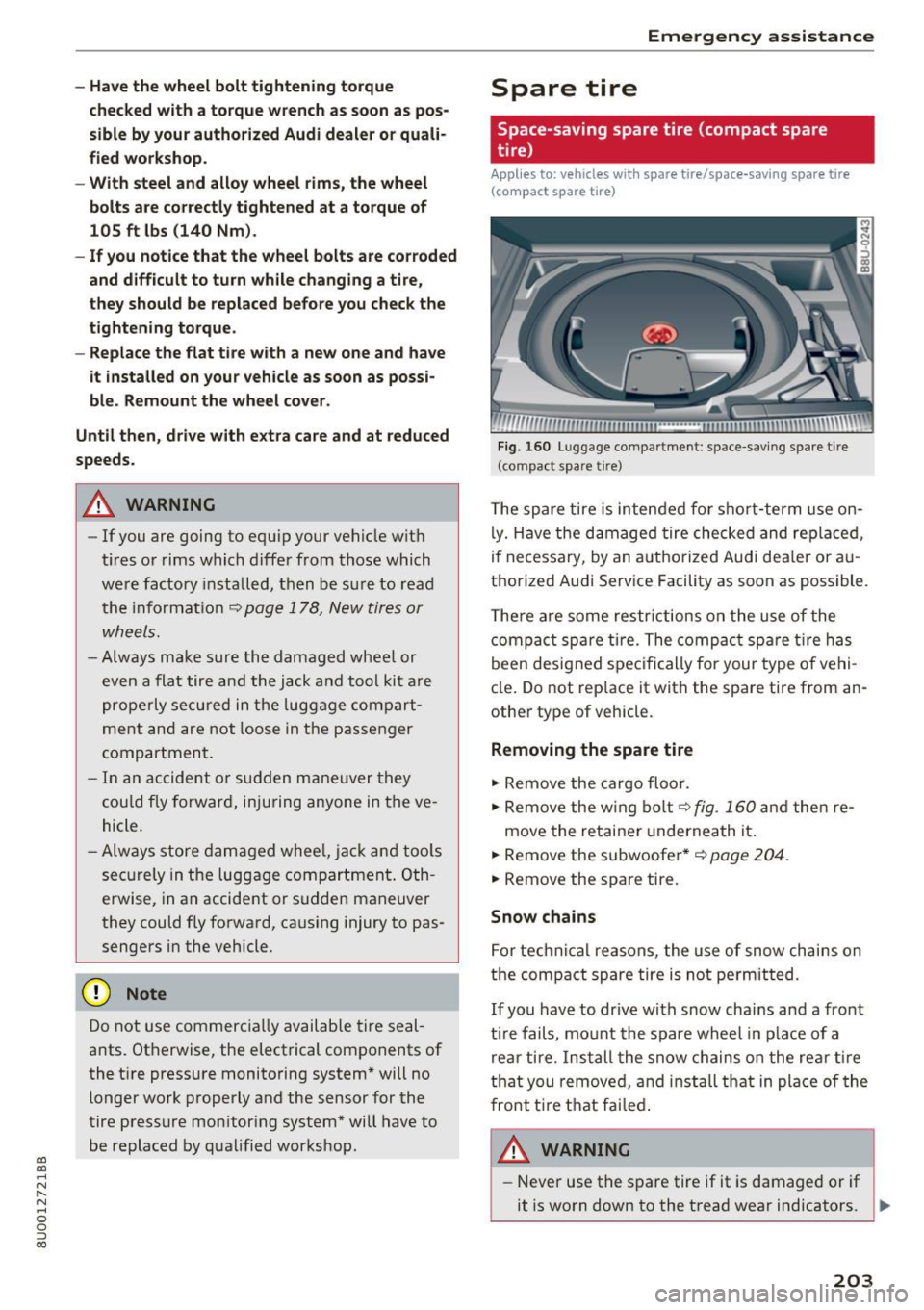
F ig. 160 Lugg age compar tme nt: space -s a ving s pare tire
( c ompact spa re
tir e)
The spare tire is intended fo r sh ort -term use on
ly. Have the damaged tire checked and replaced ,
i f necessary, by an authorized Aud i dea ler or au
thorized Aud i Service Facility as soon as possible.
T here are some restr ictions on the use of the
compact spare tire . The compac t spa re t ire has
been designed specifically for your type of vehi
cle . Do not rep lac e it with the spare tire from an
other type of vehicle .
Removing the spare tire
.,. Remove the cargo floo r.
.,. Remove the w ing bo lt
¢ fig. 160 an d then re-
move the retaine r underneath it .
.,. Remov e the subwoofer*
¢ page 204.
.,. Remov e the spar e tir e.
Snow chains
For technical reasons, the use of snow chains on
the compact spare tire is not pe rmitted .
If you have to drive with snow chains and a front
tire fails , mo unt the spare wheel in place of a
rear tire. Install the snow chains o n the rear t ire
that you removed, and install that in place of the
front t ire that fai led .
A WARNING
-Never use the spare tire if it is damaged or if
it is worn down to the tread wear indicators . .,.
203
Page 206 of 236
Emerg ency assis ta nce
- If the spare tire is more than 6 years old,
use it only in an emergency and with ex
treme caution and careful driving.
- The spare tire is intended only for tempora
ry and short-term use .
It should be replaced
as soon as possible with the normal wheel
and t ire .
- After mounting the compact spare tire, the
tire pressure must be checked as soon as
poss ible. The tire pressure of the compact
spare tire must be
4.2 bar; otherwise, you
risk having an accident.
- Do not drive faster than SO mph
(80 km/h).
Yo u risk having an accident.
- Avoid full-throttle accelerat ion, heavy brak
ing, and fast cornering . You risk having an
acc ident.
- Never dr ive using more than one spare
wheel and tire . You risk having an accident .
- Normal summer or winter tires must not be mounted on the compact spare wheel rim.
- For technical reasons, the use of tire chains
on the spare tire is not perm itted. If it is
necessary to drive with t ire chains, the spare
wheel m ust be mounted on the front axle in
the event of a flat in a rear tire. The new ly
available front wheel m ust then be insta lled
in place of the rear wheel with the flat tire.
Installing the tire chain before mounting
the wheel and t ire is recommended.
- Loose items in the passenger compartment
can cause serious perso nal injury during
hard braking or in an accident. Never store
the spare tire or jack and too ls in the pas
senger compartment.
204
Removing the subwoofer
App lies to : vehicles wit h subwoofer
The subwoofer must be removed before the
spare tire*ltemporary spare tire* can be re moved.
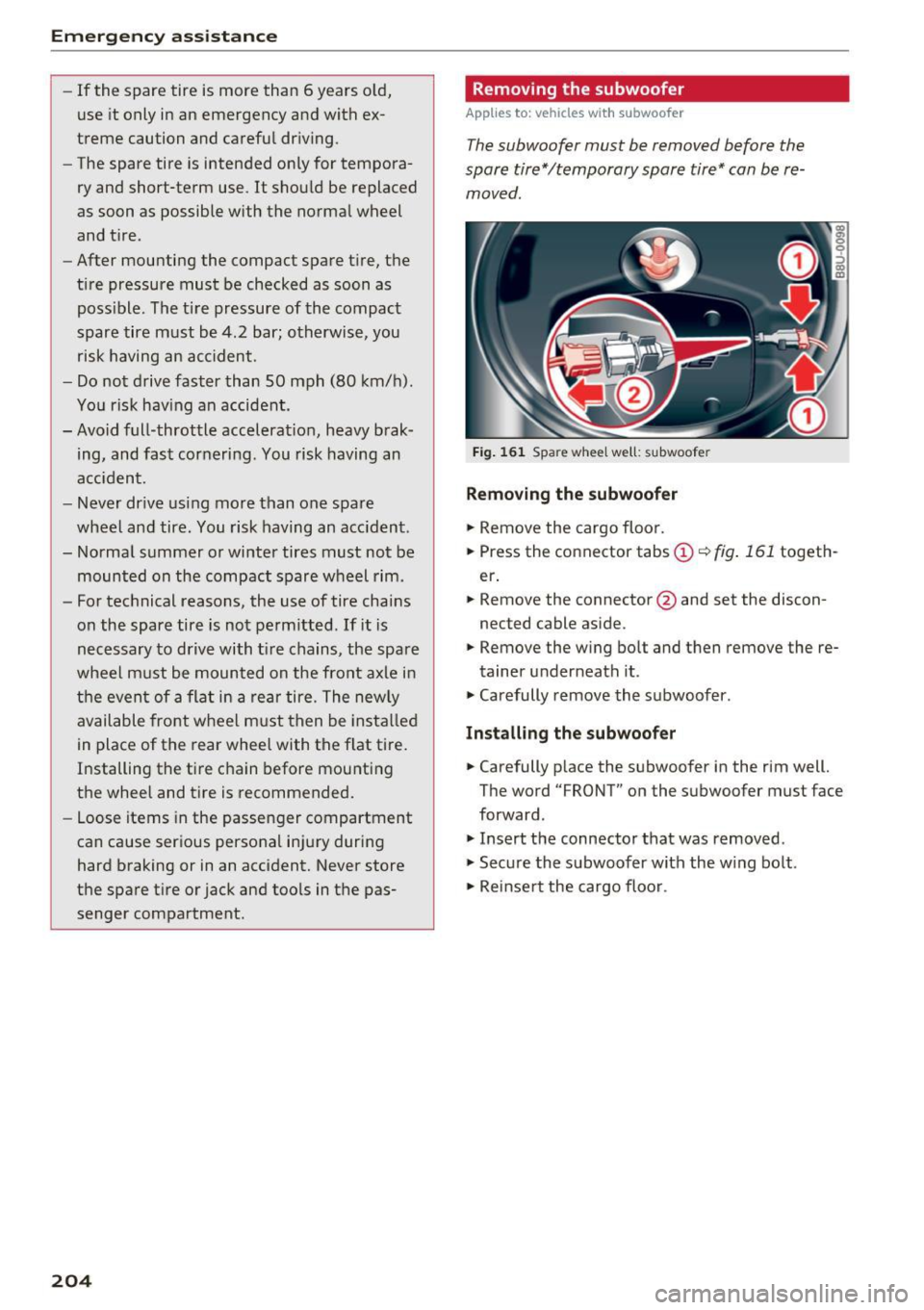
Fig . 161 Spare whee l we ll: subwoofe r
Removing th e subwoo fer
.. Remove the cargo floor .
.. Press the connector
tabs @¢fig . 161 togeth
er .
.. Remove the connector @and set the discon
nected cable aside.
.. Remove the wing bo lt and then remove the re-
tainer underneath it .
.,. Carefully remove the s ubwoofer .
Insta llin g the sub woofer
.. Carefully place the subwoofer in the rim well.
The word "FRONT" on the subwoofer must face
forward.
.. Insert the connector that was removed .
.,. Secure the subwoofer with the w ing bo lt.
.. Reinse rt the cargo floor .
Page 222 of 236
Consumer inf orm ation
@ For the sake of the env ironment
- Changing the engine settings wi ll adversely
affect emission levels. Th is is detrimental to
the environment and increases fuel con
sumption.
- A lways observe environmental regu lations
when disposing of old engine o il, used brake
fl ui d, d irty engine coolant, spent batteries
or worn out tires.
- Undeployed airbag modules and pretension
ers mig ht be classified as Perchlorate Mate
rial -special handl ing may apply, see
www.dtsc .ca.gov/hazardouswaste/perchlo
r ate. When the vehicle or parts of the re
straint system including airbag modu les
safety be lts wi th pretensioners are scrap
ped, all applicab le laws and regulations
must be observed. Your authorized Audi
dealer is familiar with these requirements
and we recommend that you have your deal er perform this service for you.
Accessories and technical changes
Additional accessories and parts replacement
Always consult an authorized Audi dealer before
purchasing accessories.
Your vehicle incorporates the latest safety design
features ensuring a high standard of active and passive safety.
This safety could be comp romised by non-ap
proved changes to the vehicle . For this reason, if
parts have to be replaced, please observe the fo l
lowing points when insta lling addit ional accesso
ries:
Approved Audi accessories and genuine Audi parts are available from author ized Audi dealers.
These dealers also have the necessary facilities,
too ls and trained specialists to install the parts
and accessories properly.
220
A WARNING
-
Using the wrong spare parts or using non-ap-
proved accessories can cause damage to the
vehicle and serious personal injury.
- Use only accessories expressly approved by
Aud i and genuine Audi spare parts
- These parts and accessor ies have been spe
cially designed to be used on your vehicle.
- Never install accessor ies such as telephone
cradles or beverage holders on airbag covers
or w ith in the airbag deployment zones. Do
ing so will increase the risk of injury if a ir
bags are triggered in an accident!
- Before you check anything in the eng ine
compartment, always read and heed all
WARN INGS
Qpage 159.
(D Note
-If items other than genu ine Audi spare
parts, add-on equipment and accessory
items are used or if repair wor k is not per
formed a ccording to specified methods, this
c an resul t in severe damage to you r vehi
cle's eng ine and body (such as corrosion)
and adve rsely af fect your vehicle's war ranty.
- I f emergency repai rs must be performed
elsewhere, have the vehicle exam ined by an
authorized A udi dealer as soon as possib le .
- T he manuf acture r ca nnot be held liable for
damage which occurs d ue to failure to com
ply with these stipulations.
Technical Modifications '
Our guidelines must be complied with when tech
nical modifications are made .
Always consult an a uthorized Audi de aler bef ore
sta rt ing work on any modifica tions.
This will help ensure that vehicle fu nction, per
fo rmance and safety are not impaired
Q ,& .
Attempting to work on electronic components
and the software used with them can cause mal
funct io ns. Because of the way elect ronic compo
nen ts a re interconnected with each othe r, such
malfunc tions c an also have an adverse affect on
othe r systems that are not d irectl y involved. This ..,.
Page 224 of 236
Index
A
A/C (automatic climate control system) 56
A/C (manual climate control system) . . . . . . 54
ABS
refer to Anti-Lock Braking System . . . . . . . 92
Accessories . . . . . . . . . . . . . . . . . . . . . . . 46, 220
Active lane assist
Cleaning the camera area . . . . . . . . . . . . .
192
Adaptive dampers. . . . . . . . . . . . . . . . . . . . . . 83
Adapt ive dampers (in dicator light) . . . . . . . . 17
Adapt ive light . . . . . . . . . . . . . . . . . . . . . . . . . 83
Indicator light . . . . . . . . . . . . . . . . . . . . . . . 16
Additional accessories . . . . . . . . . . . . . . . . . 220
Adjusting the center console lighting . . . . . . 37
Adjusting the steering wheel . . . . . . . . . . . . . 60
advanced key
refer to Convenience key . . . . . . . . . . . . . . . 62
A irbag .... .. .. .... ........... .... ... 117
Indicator l ight . . . . . . . . . . . . . . . . . . . . . . . 14
Airbag system . . . . . . . . . . . . . . . . . . . . . . . . 133
Advanced Airbag-System . . . . . . . . . . . . . . 121
Advanced Airbag System components . . . 124
Care . . . . . . . . . . . . . . . . . . . . . . . . . . . . . . 130
Ch ildr en . . . . . . . . . . . . . . . . . . . . . . . . . . . 138
Child restraints . . . . . . . . . . . . . . . . . . . . . 139
Components (front airbags) . . . . . . . . . . . 124
Danger of fitting a child safety seat on the
front passenger seat . . . . . . . . . . . . . . . . .
118
Disposal . . . . . . . . . . . . . . . . . . . . . . . . . . . 130
Front airbags . .................. 121, 122
How do the front airbags work? . . . . . . . . 126
H ow many airbags does my vehicle have? 124
How the Advanced Airbag System compo-
nents work together . . . . . . . . . . . . . . . . .
125
Important information ........ .. .. .. .
I ndicator light .. .. .............. ... .
Monitoring ..... .. .............. ... .
PASSENGER AIR BAG OFF light ........ .
Repairs
s f t . . a e y instructions ............ .... .. .
Side airbags .. .. ........ ..... .. .. .. .
Side curtain airbags .............. ... .
w. ht .
e1g -sensing mat ............. ... .
When must the system be inspected? .. .
117
127
127
128
130
129 131
134
139
127
Air conditioning . . . . . . . . . . . . . . . . . . . . . . . 53
All season tires 186
222
All weather lights . . . . . . . . . . . . . . . . . . . . . . 35
All wheel drive . . . . . . . . . . . . . . . . . . . . . . . .
97
Alternator
refer to Alternator (indicator light) . . . . . . 13
Alternator (indicator light) . . . . . . . . . . . . . . 13
Ant i-freeze
Windshield washer system
169
Anti- lock braking system
Indicator light . . . . . . . . . . . . . . . . . . . . . . .
14
Anti-Lock Braking System . . . . . . . . . . . . . . . 92
Anti-slip regulation
Indicator light . . . . . . . . . . . . . . . . . . . . . . .
14
Anti-Slip Regulation . . . . . . . . . . . . . . . . . . . . 92
Armrest....... ... .. .. ................ 45
ASR
refer to Anti-Slip Regulation . . . . . . . . . . . . 92
Audi drive select . . . . . . . . . . . . . . . . . . . . . . . 83
Audi Service Repair Manuals and Literature 218
AUTO
Automatic climate control system . . . . . . .
57
Automat ic headl ights . . . . . . . . . . . . . . . . . 35
Auto Lock (central locking) . . . . . . . . . . . . . .
23
Automatic belt retractor . . . . . . . . . . . . . . . 112
Automatic post-collision braking system . . . 92
Automatic transmission . . . . . . . . . . . . . . . . . 67
Driving tips . . . . . . . . . . . . . . . . . . . . . . . . . . 69
Emergency mode . . . . . . . . . . . . . . . . . . . . . 72
Hill descent control . . . . . . . . . . . . . . . . . . . 70
Kick-down . . . . . . . . . . . . . . . . . . . . . . . . . . . 71
Manua l shifting . . . . . . . . . . . . . . . . . . . . . . 71
Selector lever emergency release . . . . . . . . 72
Selector lever positions . . . . . . . . . . . . . . . . 68
Steering wheel with sh ift paddles. . . . . . . . 71
tiptronic mode . . . . . . . . . . . . . . . . . . . . . . . 71
Automatic wipe/wash system . . . . . . . . . . . . 40
Auto Safety Hotline . . . . . . . . . . . . . . . . . . . 107
Average consumpt ion . . . . . . . . . . . . . . . . . . . 20
Average speed . . . . . . . . . . . . . . . . . . . . . . . . 20
Avoid damaging the vehicle . . . . . . . . . . . . . . 58
B
Bag/securing hooks . . . . . . . . . . . . . . . . . . . . 48
Battery
Jump starting . . . . . . . . . . . . . . . . . . . . . . .
209
also refer to Vehicle battery . . . . . . . . . . . 168
Before driving . . . . . . . . . . . . . . . . . . . . . . . . 100