seats AUDI Q3 2017 Owner´s Manual
[x] Cancel search | Manufacturer: AUDI, Model Year: 2017, Model line: Q3, Model: AUDI Q3 2017Pages: 236, PDF Size: 58.93 MB
Page 147 of 236
a:,
a:,
...... N r--. N
'"' 0 0 ::, a:,
restraint in place c!;> page 46. Install the
head restraint again immediately once the
child seat is removed. Driving without head
restraints or with head restraints that are
not properly adjusted increases the risk of
serious or fatal neck injury dramatically .
- Always read and heed all WARNINGS when
ever using a child restrained in a vehicle is
being used¢
page 109, Safety belts,
¢ page 117, Airbag system and
¢page 137, Important information.
_& WARNING
If exceptional circumstances require the use
of a forward-facing child restraint on the
front passenger's seat, the child's safety and
well-being require that the following special
precautions be taken:
- Make sure the forward-facing seat has been
designed and certified by its manufacturer
for use on a front seat with a passenger
front and side airbag .
- Always follow the manufacturer's instruc
tions provided with the child safety seat or
infant carrier.
- Always move the front passenger seat to
the highest position in the up and down ad
justment range and move it back to the
rearmost position in the seat's fore and aft
adjustment range, as far away from the air
bag as possible, before installing the for
ward-facing child restraint.
- Always make sure that the safety belt upper
anchorage is behind the child restraint and
not next to or in front of the child restraint
so that the safety belt will be properly posi
tioned.
- Always make sure that nothing prevents the
front passenger's seat from being moved to
the rearmost position in its fore and aft ad
justment range.
- Always make sure the backrest is in an up
right position.
- Make sure that the
PASSENGER AIR BAG
OFF
light comes on and stays on all the time
whenever the ignition is switched on.
Child safety
- If the light does not stay on, perform the
checks¢
page 12 7, Monitoring the Ad
vanced Airbag System.
-T ake the child restraint off the front passen
ger seat and install it properly at one of the rear seat positions if the
PASSENGER AIR
BAG OFF
light does not stay on whenever
the ignition is switched on.
Booster seats and safety belts
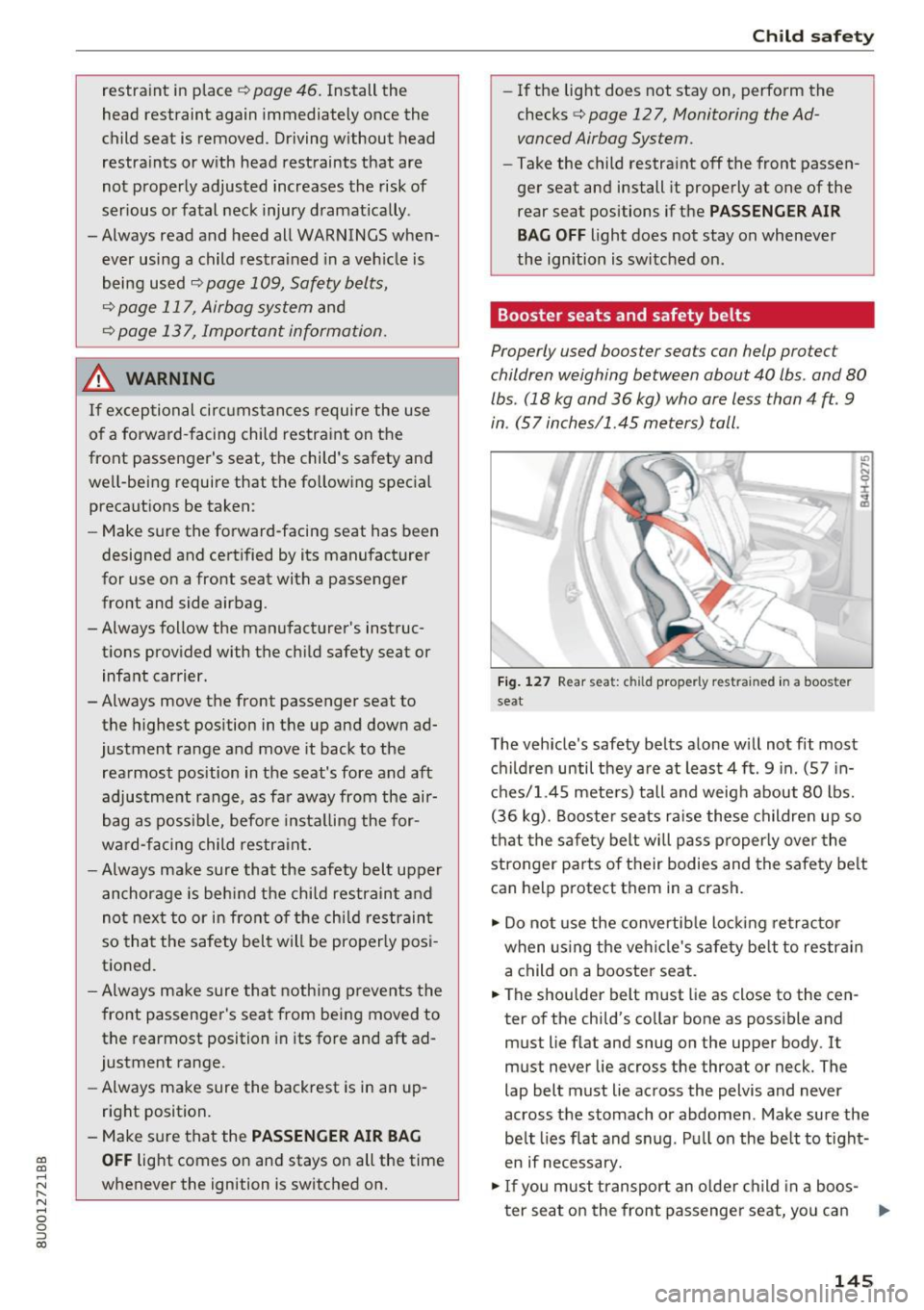
Properly used booster seats can help protect
children weighing between about 40 lbs . and 80
lbs . (18 kg and 36 kg) who are less than 4 ~-9
in . (57 inches/1 .45 meters) tall.
Fig. 127 Rear seat: child properly restrained in a boos ter
seat
The vehicle's safety belts alone will not fit most
children until they are at least 4 ft . 9 in . (57 in
ches/1.45 meters) tall and weigh about 80 lbs.
(36 kg). Booster seats raise these children up so
that the safety belt will pass properly over the
stronger parts of their bodies and the safety belt
can help protect them in a crash.
"' Do not use the convertible locking retractor
when using the vehicle's safety belt to restrain
a child on a booster seat.
"'Th e shoulder belt must lie as close to the cen
ter of the child's collar bone as possible and
must lie flat and snug on the upper body. It
must never lie across the throat or neck. The
lap belt must lie across the pelvis and never
across the stomach or abdomen . Make sure the
belt lies flat and snug . Pull on the belt to tight
en if necessary.
"'If you must transport an older child in a boos-
ter seat on the front passenger seat, you can
IIJJ,
145
Page 148 of 236
Child safety
use the safety belt height adjustment to help
adjust the shoulder portion properly .
~ Secure unused safety belts on the rear seat
<=>page 142.
Children up to at least 8 years old (over 40 lbs. or
18 kg) are best protected in child safety seats de
signed for their age and weight. Experts say that
the skeletal structure, particularly the pelvis, of
these children is not fully developed, and they
must not use the vehicle safety belts without a
suitable child restraint.
It is usually best to put these children in appro priate booster seats . Be sure the booster seat
meets all applicable safety standards .
Booster seats raise the seating position of the
child and reposition both the lap and shoulder
parts of the safety belt so that they pass across
the child's body in the right places . The routing of
the belt over the child's body is very important
for the child's protection , whether or not a boos
ter seat is used. Children age 12 and under must
always ride in the rear seat .
Children who are at least 4 ft. 9 in. (57 inches/
1.45 meters) tall can generally use the vehicle's
three point lap and shoulder belts. Never use the
lap belt portion of the vehicle's safety belt alone
to restrain any child, regardless of how big the
child is. Always remember that children do not
have the pronounced pelvic structure required for
the proper function of lap belt portion of the ve
hicle 's three point lap and shoulder belts. The
child 's safety absolutely requires that a lap belt
portion of the safety belt be fastened snugly and
as low as possible around the pelvis . Never let
the lap belt portion of the safety belt pass over
the child's stomach or abdomen.
In a crash, airbags must inflate within a blink of
an eye and with considerable force . In order to do
its job, the airbag needs room to inflate so that it
will be there to protect the occupant as the occu
pant moves forward into the airbag.
A vehicle occupant who is out of position and too
close to the airbag gets in the way of an inflating
airbag. When an occupant is too close, he or she
will be struck violently and will receive serious or
possibly even fatal injury.
146
In order for the airbag to offer protection, it is
important that all vehicle occupants , especially
any children, who must be in the front seat be
cause of exceptional circumstances, be properly
restrained and as far away from the airbag as
possible. By keeping room between the child's
body and the front of the passenger compart
ment, the airbag can inflate completely and pro
vide supplemental protection in certain frontal
collisions.
.&_ WARNING
Not using a booster seat, using the booster
seat improperly, incorrectly installing a boos
ter seat or using the vehicle safety belt im
properly increases the risk of serious personal
injury and death in a collision or other emer
gency situation. To help reduce the risk of se rious personal injury and/or death:
- The shoulder belt must lie as close to the
center of the child's collar bone as possible
and must lie flat and snug on the upper
body .
It must never lie across the throat or
neck . The lap belt must lie across the pelvis
and never across the stomach or abdomen.
Make sure the belt lies flat and snug. Pull on
the belt to tighten if necessary.
- Failure to properly route safety belts over a
child's body will cause severe injuries in an
accident or other emergency situation
r=:> page 109.
- The rear side of the child safety seat should
be positioned as close as possible to the
backrest on the vehicle seat. Adjust or re
move the rear seat head restraint if it is dif
ficult to install the child seat with the head
restraint in placer=;,
page 46. Install the
head restraint again immediately once the
child seat is removed . Driving without head
restraints or with head restraints that are
not properly adjusted increases the risk of
serious or fatal neck injury dramatically.
- Never let a child put the shoulder belt under
the arm or behind the back, because it could
cause severe injuries in a crash.
- Children on the front seat of any car, even
with Advanced Airbags, can be seriously in-
-
jured or even killed when an airbag inflates. .,
Page 149 of 236
00
00
......
"' ,....
"' ...... 0 0 :::,
00
- Never let a child stand or kneel on any seat,
for example the front seat.
- Never let a child ride in the cargo area of
your vehicle.
- Always remember that a child leaning for
ward, sitting sideways or out of position in
any way during an accident can be struck by
a deploying airbag. This will result in serious
personal injury or death.
- If you must install a booster seat on the
front passenger seat because of exceptional
circumstances the
P A SS ENGER AIR BAG
OFF
light must come on and stay on, when
ever the ignition is switched on.
- If the
PASSENGER A IR BAG OFF light does
not come on and stay on, perform the
checks descr ibed
c:> page 12 7, Monitoring
the Advanced Airbag System.
- Take the ch ild restraint off the front passen
ger seat and install it p roperly at one of the
rear seat positions if the
PA SSENGER A IR
BA G OFF
light does not stay on whenever
the ignition is switched on.
- Always read and heed all WARN INGS when
ever using a child restrained in a vehicle is
being used
r=;, page 109, Safety belts,
c:> page 117, Airbag system
and
c:> page 13 7, Important information.
Securing child seats
Securing a child safety seat using a safety
belt
Safety belts for the rear seats and the front pas
senger can be locked with the convertible locking retractor to properly secure child safety seats .
The safety belts emergency locking retractors for
the rear seats safety belts and for the front pas
senger's seat safety belt have a convertib le lock
ing retractor for child restraints. The safety belt
must be locked so that belt webbing cannot un
reel. The retractor can be activated to lock the
safety belt and prevent the safety belt webbing
from loosening up during normal driving. A child
safety seat can only be properly installed when
the safety belt is locked so that the child and
child safety seat w ill stay in place .
Child safety
Always remember : Even though your vehicle is
equipped with an Advanced Airbag system, all
children, especially those 12 years and younger,
should always ride in the back seat properly re
strained for their age and size.
A WARNING
=
Improperly installed child safety seats in
crease the risk of serious personal injury and
death in a collision .
-
-Always make sure that the safety belt re
tractor is locked when installing a child
safety seat. An un locked safety be lt retrac
tor cannot hold the ch ild safety seat in place
du ring normal driving or in a c rash.
- Always buckle the child safety seat fi rm ly in
p lace even if a ch ild is not sitt ing in it. A
loose child safety seat can fly around during
a sudden stop or in a co llision.
- Always make sure that the rear seat back
rest to which the center rear safety belt is
attached is securely latched whenever the
rear center safety belt is being used to se
cure a child restraint.
- If the backrest is not securely latched, the
child and the child restraint will be thrown
forward together with the backrest and w ill
strike parts of the veh icle inter ior. The child
can be seriously injured or killed .
- Never install rear-facing child safety seats
or infant carriers on the front passenger
seat . A child w ill be seriously injured and
can be killed when the passenger a irbag in
flates.
- The inflating airbag will h it the ch ild safety
seat or infant ca rr ier with great force and
will smash the child safety seat and child aga inst the backrest, cente r armrest, door
or roof .
- Always install rear-fac ing child safety seats
or infant car riers on the rear seat.
- Forward-facing child safety seats o r infant
carriers installed on the front passenger's
seat may interfere with the deployment of
the airbag and cause serio us injury to the
child .
- It is sa fer to install a forward -facing child
safety seat on the rear seat.
147
Page 152 of 236
Child safety
_& WARNING
Improperly installed child safety seats in
crease the risk of serious personal injury and
death in a collision.
- Never unfasten the safety belt to deactivate
the convertible locking retractor for child re
straints while the vehicle is moving. You
would not be restrained and could be seri
ously injured in an accident.
-Always read and heed all WARNINGS when ever using a child restrained in a vehicle is
being used
9page 137. Special precautions
apply when installing a child safety seat on
the front passenger seat~
page 118, Child
restraints on the front seat -some impor
tant things to know.
LATCH system (lower
anchorages and tethers
for children)
Child Restraint System anchors and how
are they related to child safety
T o provide a simpler and more pra cticable way to
attach the child restraint on the vehicle seat,
Federal regulations require special lower ancho
rages in vehicles and devices on new child re
stra ints to attach to the veh icle anchorages .
In the United States, the combination of the
tether anchorages and the lower anchorages is now generally called the LATC H system for
" l ower Anchorages and Tethers for Children" . In
Canada, the terms "top tether" w ith "lower uni
versal ancho rages" (or "lower universal anchor
age bars") are used to describe the system.
I n other countr ies the term "ISO FIX " is used to
describe the lower anchorages.
F orward-facing child restraints manufactured af
ter September 1, 1999, are required by U .S . fed
eral regulations to comply with new child head movement performance requirements. These
new perfo rmance requirements make a tether
necessary on most new child seats.
I nstalling a child restraint that requ ires a top
tether without one ca n serio usly impair the per-
150
formance of the c hild restraint and its ab ility to
protect the child in a co llision. Installing a child
restra int that requires a top tether without the
top tether may be a violation of state law .
Child restraint manufacturers offer LATCH lower
anchorages on their ch ild seats with hook-on or
push-on connectors attached to adjustab le
straps.
In addition to the LATCH lower anchorages, these
child restra int systems usually require the use of
tether straps to help keep the child restra int
firmly in place .
_& WARNING
Improper installation of child restraints wi ll
i ncrease the risk of injury and death in a
crash .
- Always follow the instructions provided by
the manufacturer of the ch ild restraint you
intend to install in your vehicle .
- Never install a child restraint without a
proper ly attached top tether strap if the
child restraint manufacture r's instructions
require the top tether s trap to be used.
- Improper use of child restraint LATCH lower
anchorage points can lead to injury in a co lli
sion . T he LA TC H l ower anchorage points are
designed to withstand only those loads im
posed by correctly fitted child restraints .
- Never mo unt t wo child rest raint systems on
one LA TC H lowe r an chorage point.
- Never secure or attach any luggage or othe r
item to the LA TC H lowe r an chorages.
Location
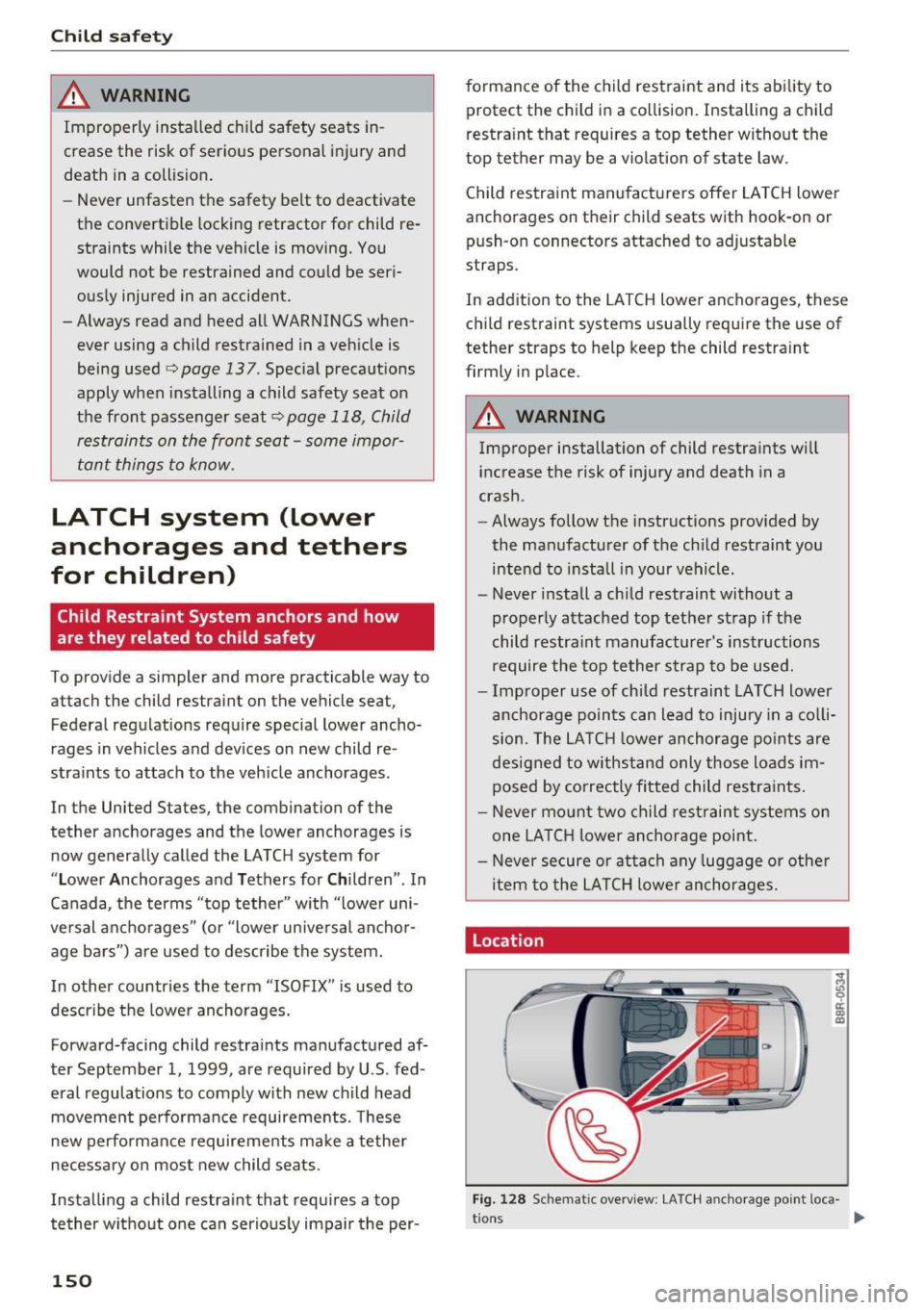
Fig. 128 Sc hematic overv iew: LATCH ancho rage poin t loca ·
t ion s
Page 153 of 236
a:,
a:,
...... N r-,. N
'"' 0 0 ::, a:,
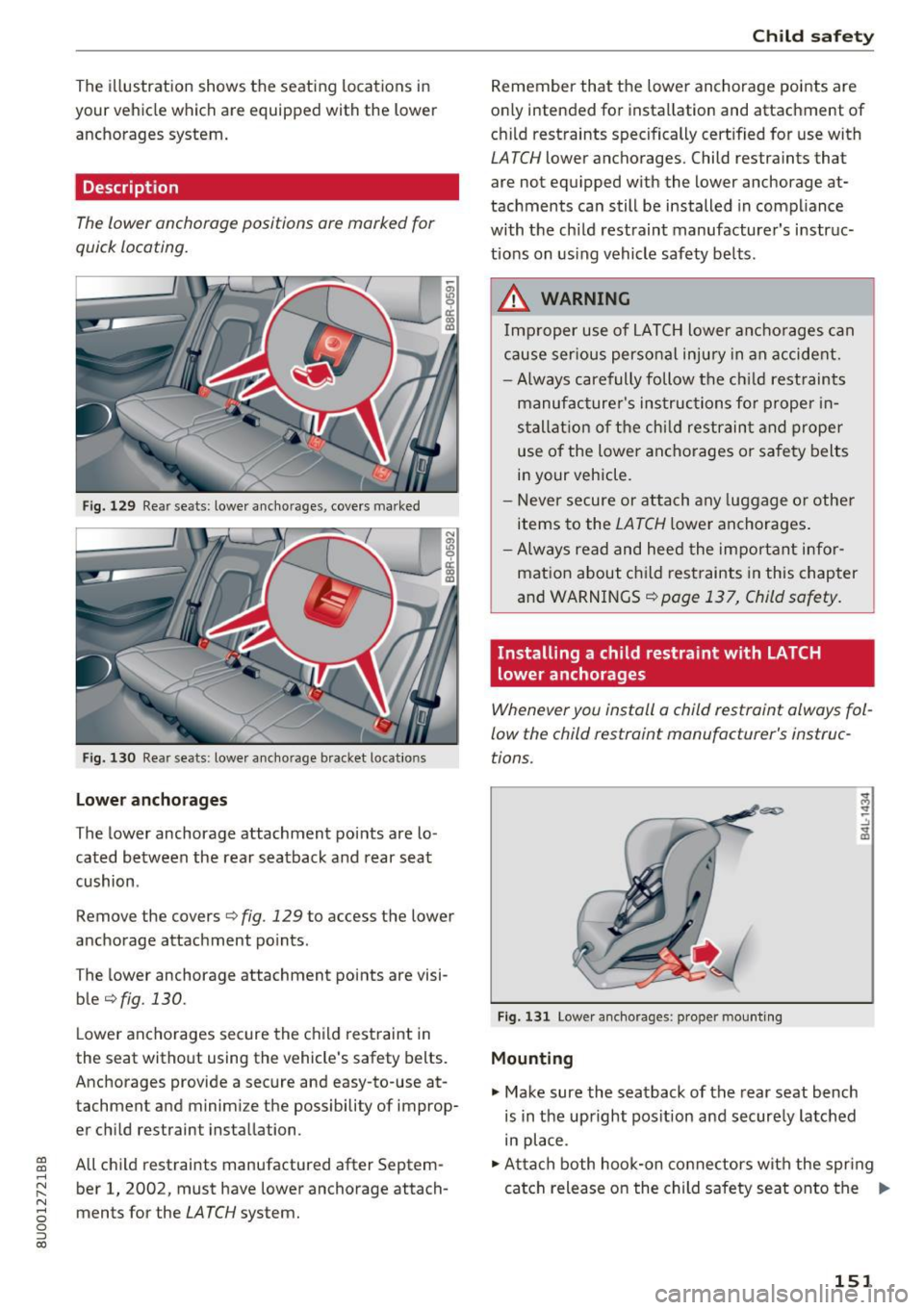
The illustration shows the seating locations in
your vehicle which are equipped with the lower
anchorages system.
Description
The lower anchorage positions are marked for
quick locating.
Fig. 129 Rea r seats: lowe r ancho rages, covers marked
Fig. 130 Rear seats: lower anc ho rage bracket locations
Lower anchorages
The lower anchorage attachment points are lo
cated between the rear seatback and rear seat
cushion .
Remove the covers¢
fig. 129 to access the lower
anchorage attachment points .
The lower anchorage attachment points are visi
b le
¢ fig. 130.
Lower anchorages secure the c hild restraint in
the seat without using the vehicle's safety belts.
Anchorages provide a secure and easy-to-use at
tachment and minim ize the possibility of improp
er chi ld restraint installation.
All child restraints manufactured after Septem ber 1, 2002, must have lower anchorage attach
ments for the
LATCH system.
Child safety
Remember that the lower anchorage points are
only intended for installation and attachment of
c h ild restraints specifically certified for use with
LATCH lower anchorages. Child restraints that
are not equipped with the lower anchorage at
tachments can still be installed in compliance
with the ch ild restraint manufacturer's instruc
tions on using vehicle safety belts.
_&. WARNING
Impro per use of LATCH lower anchorages can
cause serious personal injury in an accident.
- Always carefully follow the child restraints
manufacture r's instruc tions for proper in
stallation of the child restrain t and proper
use of the lower a hchorages or safety belts
in your vehicle.
- Never secure or attach any luggage or other
items to the
LATCH lower anchorages .
- Always read and heed the important info r
mation about child restraints in this chapter
and WARNINGS
r=>page 137, Child safety.
Installing a child restraint with LATCH
lower anchorages
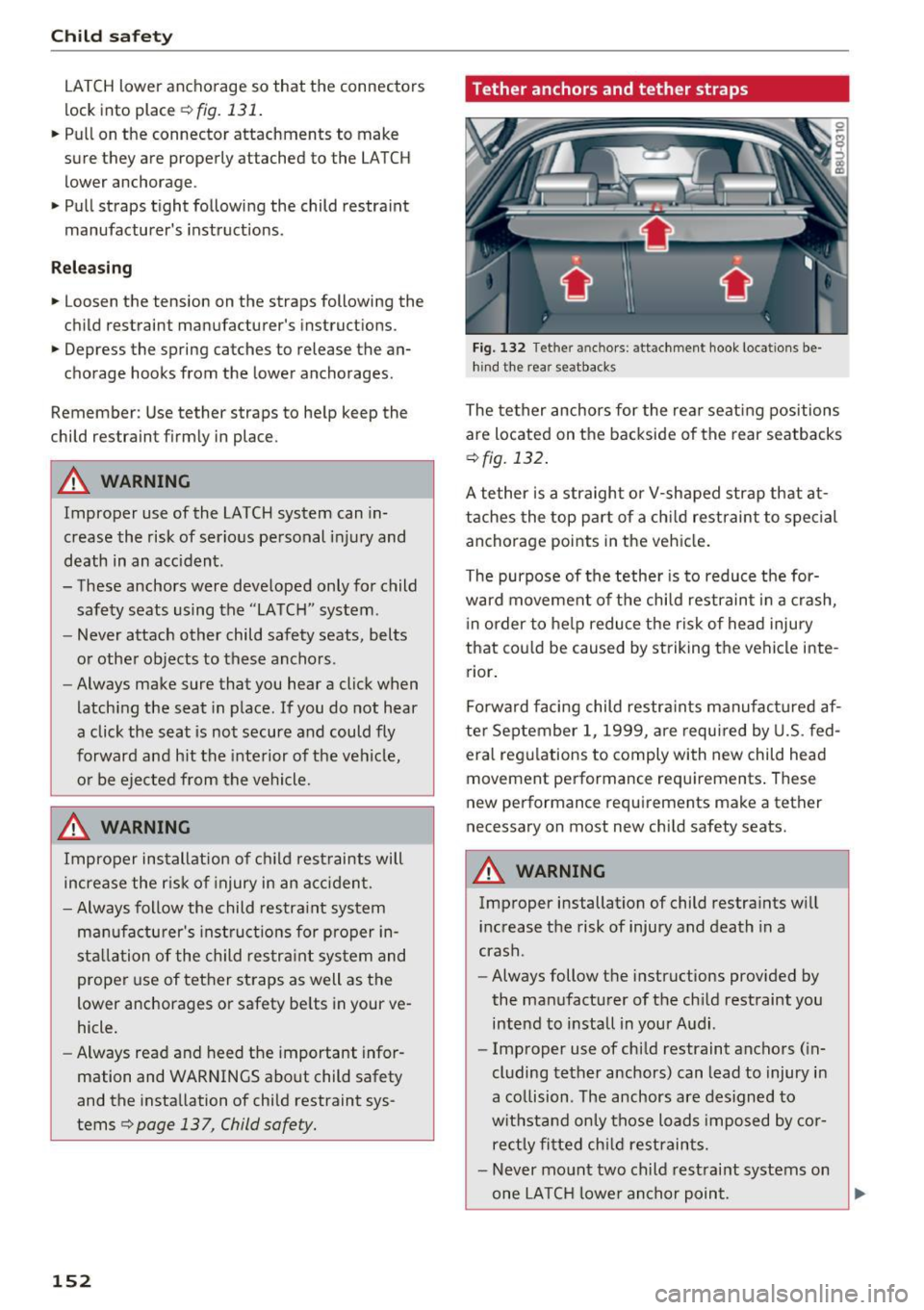
Whenever you install a child restraint always fol
low the child restraint manufacturer's instruc
tions.
Fig . 131 Lower anchorages : proper mounting
Mounting
"'M ake sure the seatback of the rear seat bench
is in the upright pos ition and securely la tched
in place .
"' Attach both hook-on connectors with the spr ing
catch release on the child safety seat onto the
IJJ,,
151
Page 154 of 236
Child safety
LATCH lower anchorage so that the connectors
lock into place
¢ fig. 131 .
.. Pull on the connector attachments to make
sure they are properly attached to the LATCH
lower anchorage .
.. Pull straps t ight following the child restra int
manufacturer's instructions.
R eleasing
.. Loosen the tension on the straps following the
ch ild restraint manufacturer's instruct ions .
.. Depress the spring catches to release the an
chorage hooks from the lower anchorages.
Remember: Use tether straps to help keep the
child restraint firmly in place.
A WARNING
Improper use of the LATCH system can in
crease the risk of serious personal injury and
death in an acc ident.
- These anchors were developed only for child
safety seats us ing the "LATCH" system.
- Never attach other child safety seats, belts
or other objects to these anchors.
- Always make sure that you hear a click when
latch ing the seat in place. If you do not hear
a click the seat is not secure and could fly
forward and h it the inte rior of the vehicle,
o r be ejected from the vehicle.
A WARNING
Improper ins tallation of ch ild rest raints will
increase the r isk of injury in an acc ident.
- Always follow the child restra int system
manufactu rer's instruct io ns for proper in
st al lation of the child res tra int system and
proper use of tether straps as well as the
lower anchorages or safety be lts in your ve
hicle .
- Always read and heed the important infor
mation and WARNINGS about child safety
and the installation of child restraint sys
tems
¢page 137, Child safety.
152
Tether anchors and tether straps
Fig. 132 Tether anchors: attachment hook locations be
hi nd the rear seatbac ks
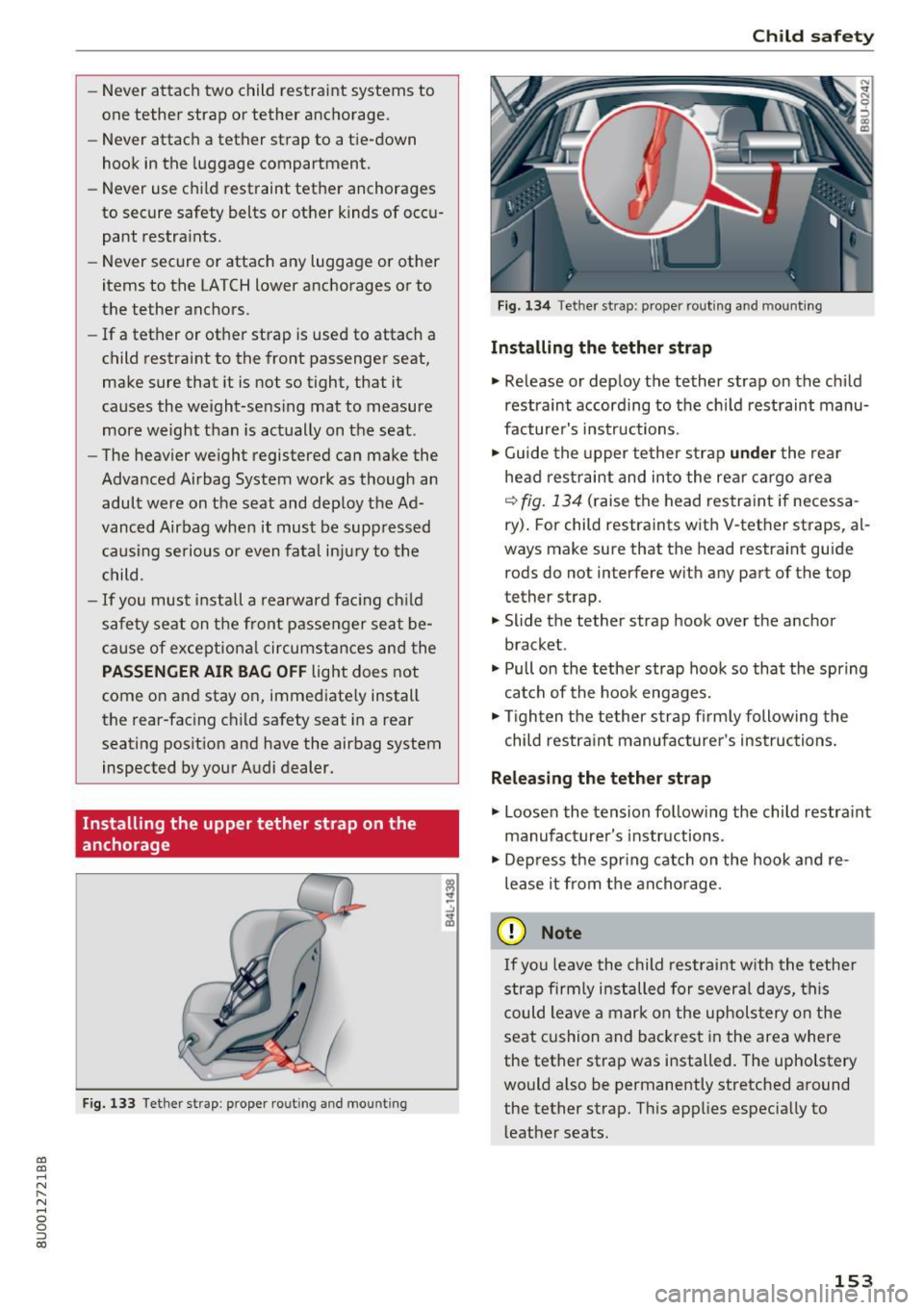
The tether anchors for the rear seat ing positions
are located on the backside of the rear seatbacks
¢ fig. 132.
A tether is a straight or V-shaped strap that at
taches the top par t of a ch ild restrain t to special
anchorage points in the vehicle .
The purpose of the tether is to reduce the for
ward movement of the child restrain t in a crash,
i n order to help reduce the risk of head injury
that cou ld be caused by striking the vehicle inte
rior.
Forward facing child restra ints manufac tured af
te r September 1, 1999, are requi red by U.S . fed
era l reg ulations to comply with new child head
movement performance req uirements . These
new performance requ irements make a tether
necessary on most new child safety seats.
A WARNING
Improper installation of child restra ints w ill
increase the risk of injury and death in a
crash .
- Always follow t he i nstructions provided by
the manufacturer of the ch ild restraint you
intend to i nstall in your Audi.
- Improper use of chi ld restraint anchors ( in
cluding tether anchors) can lead to injury in
a co llision . The anchors are designed to
w it h stand on ly those loads imposed by cor
re ctly fi tted ch ild restraints.
- Never mo unt two ch ild rest raint systems on
one LA TC H l owe r anchor point.
Ill-
Page 155 of 236
a:,
a:,
...... N r--. N
'"' 0 0 ::, a:,
-Never attach two child restraint systems to
one tether strap or tether anchorage.
- Never attach a tether strap to a tie-down
hook in the luggage compartment.
- Never use child restraint tether anchorages
to secure safety belts or other kinds of occu
pant restraints.
- Never secure or attach any luggage or other
items to the LA TCH lower anchorages or to
the tether anchors.
- If a tether or other strap is used to attach a
child restraint to the front passenger seat,
make sure that it is not so tight, that it
causes the weight-sens ing mat to measure
more weight than is actually on the seat .
- The heavier weight registered can make the
Advanced Airbag System work as though an
adult were on the seat and dep loy the Ad
vanced Airbag when it must be supp ressed
ca using se rious o r even fatal injur y to the
c hild.
- If you must install a re arward fac ing ch ild
safety seat on the front passenger seat be
cause of except io na l circumstances and the
PASSENGER AIR BAG O FF light does not
come on and stay on, immediate ly install
the rear-fac ing child safety seat in a rear
seating position and have the airbag system
inspected by your Audi dealer.
Installing the upper tether strap on the
anchorage
F ig. 133 Tether str ap : pro pe r ro uting an d mountin g
Ch ild sa fety
Fig. 134 Tet her st rap : p ro p er r out ing an d mount ing
Installing the tether st rap
• Release or deploy the tether strap on the ch ild
restraint according to the ch ild restraint manu
facture r's instructions .
• Guide the upper tether strap
under the re a r
head restraint and in to the rear ca rgo area
~ fig. 134 (raise the head restraint if necessa
ry) . For child restraints w ith V-teth er straps, al
ways make sur e that th e head restraint guide
r ods do not interfere w ith any part of the top
tether strap.
• Slide the tether strap hook over the anchor
bracket .
• Pull on the tethe r strap hook so that the spring
catch of the hook engages.
• Tighten the tether s trap firm ly following the
child restra int manufacture r's instruc tions.
Releasing the tether strap
• Loose n the tension fo llow ing the child restra int
manufac turer's instr uctions .
• Dep ress the spr ing catch on the hook and re
le ase it from the anchorage.
(D Note
If yo u leave the child restrai nt w ith the tethe r
strap firmly i nstalled for several days, th is
could leave a mark on the uphols tery on the
seat cushion and backrest i n the area where
the tether strap was installed. The upholstery
would a lso be permanently stretched around
the tether strap. This app lies espec ia lly to
l eather seats.
153
Page 175 of 236
"' "' -N
" N
-0
0
::, a)
® Mud and snow capability
"M/5" or "M+S" indicates the tire
has properties making it suitable
to drive in mud or snow.~ indi
cates a winter tire .
@ Composition of the tire cord
and materials
The number of plies indicates the
number of rubber ized fabric lay
ers in the t ire. In general : the
more layers, the more weight a
tire can carry . Tire manufacturers
must also specify the materials
used in the tire . These incl ude
stee l, nylon, polyester and other
materials .
@Maximum permitted load
This number indicates the maxi
mum load in kilograms and
pounds that the tire can carry.
@ Uniform tire quality grade
standards for treadwear,
traction and temperature resistance
T read wear, trac tion and temper
ature ranges
¢ page 187.
@ Running direction
The arrows indicate the running
direction of un idirectional t ires.
You must always follow the speci- fied running direction
¢
page 202.
€3) Maximum permitted
inflation pressure
Wheels
T his number ind icates the max i
mum pressure to which a tire can
be inflated unde r normal operat
ing conditions.
Glossary of tire and loading
terminology
Accessory weight
means the combined we igh t (in
excess of those standard items
wh ich may be replaced) of auto
matic transmission, power steer
ing, power brakes, power win
dows, power seats, radio, and
heater, to the extent that these
items are available as factory-in
stalled equipment (whether in
stalled or not).
Aspect ratio
means the ratio of the height to
the w idth of the tire in percent .
Numbers of 55 or lower indicate a
low s idewall for improved steer
ing response and better overall
handling on dry pavement .
173
Page 225 of 236
00
00
......
"' ,....
"' ...... 0 0 :::,
00
Belt tensioners . . . . . . . . . . . . . . . . . . . . . . . 115
Blended gasoline . . . . . . . . . . . . . . . . . . . . . 155
Blower
automatic Climate control system . . . . . . .
57
Manual climate control system . . . . . . . . . . 54
Booster seats . . . . . . . . . . . . . . . . . . . . . . . . 145
Brake fluid
Checking the brake fluid level . . . . . . . . . .
168
Brakes . . . . . . . . . . . . . . . . . . . . . . . . . . . . . . . 94
Brake booster . . . . . . . . . . . . . . . . . . . . . . . . 94
Brake fluid . . . . . . . . . . . . . . . . . . . . . . . . . 168
Electromechanical parking brake . . . . . . . . 64
Indicator light . . . . . . . . . . . . . . . . . . . . . . . 16
New brake pads . . . . . . . . . . . . . . . . . . . . . . 94
Braking
Brake assist . . . . . . . . . . . . . . . . . . . . . . . . .
92
Emergency braking function . . . . . . . . . . . . 65
Indicator light . . . . . . . . . . . . . . . . . . . . . . . 12
Worn brake pads . . . . . . . . . . . . . . . . . . . . . 15
Breaking in
New engine . . . . . . . . . . . . . . . . . . . . . . . . .
58
New tires . . . . . . . . . . . . . . . . . . . . . . . . . . 178
Bulbs . . . . . . . . . . . . . . . . . . . . . . . . . . . . . . . 207
C
California Proposition 65 Warning . . . . . . . 160
Battery specific . . . . . . . . . . . . . . . . . . . . . 168
Capacities
Fueltank . .. .. ............... .. .. .. .
216
Washer fluid reservoir ............... . 216
Caps for wheel bolts, removing . . . . . . . . . . 199
Ca re . . . . . . . . . . . . . . . . . . . . . . . . . . . . . . . . 191
Cargo area
refer to Loading the luggage compart-
ment. ... .. .. ................ ..... .
105
Cargo floor ......... ....... ...... ... .. 51
Catalytic converter . . . . . . . . . . . . . . . . . . . . 158
Center armrest . . . . . . . . . . . . . . . . . . . . . . . . 45
Central locking . . . . . . . . . . . . . . . . . . . . . . . . 23
Central locking switch . . . . . . . . . . . . . . . . . 27
Convenience key . . . . . . . . . . . . . . . . . . . . . . 26
Em ergency locking . . . . . . . . . . . . . . . . . . . . 28
Luggage compartment lid . . . . . . . . . . . . . . 28
Panorama roof . . . . . . . . . . . . . . . . . . . . . . . 32
Power windows . . . . . . . . . . . . . . . . . . . . . . 32
Index
Remote control key . . . . . . . . . . . . . . . . . . . 25
Setting . . . . . . . . . . . . . . . . . . . . . . . . . . . . . 27
Certification . . . . . . . . . . . . . . . . . . . . . . . . . 221
Changing engine oil . . . . . . . . . . . . . . . . . . . 165
Child restraints
Danger of using child restraints in the front
seat....... ... .. .. .................
118
Where can I get additional information
about child restraints and their use? . . . .
154
Child restraints system anchors......... . 150
Child safety . . . . . . . . . . . . . . . . . . . . . . . . . . 137
Important safety instructions for using child
safety seats . . . . . . . . . . . . . . . . . . . . . . . .
140
Important things to know when driving with
children . . . . . . . . . . . . . . . . . . . . . . . . . . .
137
Installing a child restraint using the LATCH
system . . . . . . . . . . . . . . . . . . . . . . . . . . . .
151
Mounting and releasing the anchorage
hook . . . . . . . . . . . . . . . . . . . . . . . . . . . . . .
151
Tether anchors . . . . . . . . . . . . . . . . . . . . . . 152
Tether straps .. .. .. ................. 152
Child safety lock
Power windows . . . . . . . . . . . . . . . . . . .
31, 32
Rear doors . . . . . . . . . . . . . . . . . . . . . . . . . . 31
Child safety seats
Booster seats . . . . . . . . . . . . . . . . . . . . . . .
145
Convertible child seats . . . . . . . . . . . . . . . 144
Convertible locking retractor . . . . . . . . . . 149
Danger of using child restraints in the front
seat ...... .... .. .. ............... ..
118
How do I properly install a child safety seat
. h. l 7 140 rn my ve 1c e ..... .. ... ........... .. .
Infant seats . . . . . . . . . . . . . . . . . . . . . . . .
143
LATCHsystem . .. .. ............... .. 151
Lower anchorages . . . . . . . . . . . . . . . . . . . 151
Safety instructions . . . . . . . . . . . . . . . . . . . 140
Unused safety be lts on the rear seat . . . . 142
Child seats . . . . . . . . . . . . . . . . . . . . . . . . . . 143
Securing . . . . . . . . . . . . . . . . . . . . . . . . . . . 147
Cleaning ... .... .. .. ............... .. 191
Cleaning/removing ice from windows . . . . . 193
Cleaning Alcantara . . . . . . . . . . . . . . . . . . . . 194
Cleaning artificial leather . . . . . . . . . . . . . . . 194
Cleaning carbon parts . . . . . . . . . . . . . 193, 194
Cleaning controls . . . . . . . . . . . . . . . . . . . . . 193
Cleaning decorative parts and trim . . . 192, 193
Cleaning exhaust tail pipes . . . . . . . . . . . . . 192
223
Page 226 of 236
Index
Cleaning plastic parts . . . . . . . . . . . . . . . . . . 193
Cleaning rims . . . . . . . . . . . . . . . . . . . . . . . . 192
Cleaning textiles . . . . . . . . . . . . . . . . . . . . . . 194
Climate control system Driv e select . . . . . . . . . . . . . . . . . . . . . . . . . . 83
Climate control system (automatic) Adjusting the temperature . . . . . . . . . . . . . 57
Air distribution .... ........... .... .... 57
Air vents . . . . . . . . . . . . . . . . . . . . . . . . . . . . 57
AUTO (automatic mode) . . . . . . . . . . . . . . . 57
Blower . . . . . . . . . . . . . . . . . . . . . . . . . . . . . 57
Changing the temperature unit . . . . . . . . . 57
Defrosting the windshield . . . . . . . . . . . . . . 57
Description . . . . . . . . . . . . . . . . . . . . . . . . . . 53
Operation . . . . . . . . . . . . . . . . . . . . . . . . . . . 56
Rear window defogger . . . . . . . . . . . . . . 55, 57
Recirculation mode . . . . . . . . . . . . . . . . . . . 56
Synchronizing . . . . . . . . . . . . . . . . . . . . . . . . 57
Climate control system (manual)
Adjusting the temperature . . . . . . . . . . . . . 55
Air distribution, air vents . . . . . . . . . . . . . . . 55
Blower . . . . . . . . . . . . . . . . . . . . . . . . . . . . . 54
Defrosting the windows . . . . . . . . . . . . . . . 55
Description . . . . . . . . . . . . . . . . . . . . . . . . . . 53
Operation . . . . . . . . . . . . . . . . . . . . . . . . . . . 54
Rear window defogger . . . . . . . . . . . . . . . . . 55
Recircula tion mode . . . . . . . . . . . . . . . . . . . 54
Closing Hood . . . . . . . . . . . . . . . . . . . . . . . . . . . . . . 161
Panorama glass roof . . . . . . . . . . . . . . . . . . 33
Windows . . . . . . . . . . . . . . . . . . . . . . . . . . . 32
Closing/opening By remote control . . . . . . . . . . . . . . . . . . . . 25
W ith the central locking switch . . . . . . . . . 27
W ith the convenience key . . . . . . . . . . . . . . 26
With the door lock . . . . . . . . . . . . . . . . . . . . 28
Cockpit (overview) . . . . . . . . . . . . . . . . . . . . . . 6
Color number . . . . . . . . . . . . . . . . . . . . . . . . 215
Com ing home . . . . . . . . . . . . . . . . . . . . . . . . . 36
Compartments . . . . . . . . . . . . . . . . . . . . . 47, 48
Compass in the mirror . . . . . . . . . . . . . . . . . . 42
Compl iance . . . . . . . . . . . . . . . . . . . . . . . . . . 221
Consumer information . . . . . . . . . . . . . . . . . 218
Consumer Information . . . . . . . . . . . . . . . . . 107
Consumption (fuel) ................ 20, 215
Contacting NH TSA . . . . . . . . . . . . . . . . . . . . 107
224
Convenience key
Indicator lights . . . . . . . . . . . . . . . . . . . . . . 63
Start ing the engine . . . . . . . . . . . . . . . . . . . 62
Stopping the engine . . . . . . . . . . . . . . . . . . 62
Switching the ignition on . . . . . . . . . . . . . . 62
Unlocking /locking . . . . . . . . . . . . . . . . . . . . 26
Convenience opening/closing
Convertible child safety seats
Convertible locking retractor ............ 32
144
Activating . . . . . . . . . . . . . . . . . . . . . . . . . . 149
Deactivating . . . . . . . . . . . . . . . . . . . . . . . . 149
Using to secure a child safety seat . . . . . . 149
Cooling mode (automatic climate control sys-
tem) . . . . . . . . . . . . . . . . . . . . . . . . . . . . . . . . 56
Cooling mode (manual climate control sys-
tem) . . . . . . . . . . . . . . . . . . . . . . . . . . . . . . . . 54
Cooling system Adding coolant . . . . . . . . . . . . . . . . . . . . . . 166
Coolant . . . . . . . . . . . . . . . . . . . . . . . . . . . . 166
Coolant level checking . . . . . . . . . . . . . . . . 166
Coolant temperature . . . . . . . . . . . . . . . . . . . 8
Indicator light . . . . . . . . . . . . . . . . . . . . . . . 13
Crossing water . . . . . . . . . . . . . . . . . . . . . 58 , 67
Cruise control system
Chang ing speed . . . . . . . . . . . . . . . . . . . . . . 79
Overriding the cruise control system . . . . . 79
Preselecting speed . . . . . . . . . . . . . . . . . . . . 79
Switching off . . . . . . . . . . . . . . . . . . . . . . . . 79
switching on . . . . . . . . . . . . . . . . . . . . . . . . . 78
Cup holders . . . . . . . . . . . . . . . . . . . . . . . . . . . 47
Current consumption 20
D
Data recorder . . . . . . . . . . . . . . . . . . . . . . . . . 98
Date .......... .................... .... 9
Daytime running lights . . . . . . . . . . . . . . . . . 35
Declaration of compliance Audi s ide ass ist . . . . . . . . . . . . . . . . . . . . . 221
Cell phone package . . . . . . . . . . . . . . . . . . 221
Conv enience key . . . . . . . . . . . . . . . . . . . . . 221
Cruise control . . . . . . . . . . . . . . . . . . . . . . . 221
E le ctronic immobilizer................ 221
Remote control key . . . . . . . . . . . . . . . . . . 221
Defect ive light bulb
Indicator light . . . . . . . . . . . . . . . . . . . . . . . 16