seats AUDI Q3 2017 Owner´s Manual
[x] Cancel search | Manufacturer: AUDI, Model Year: 2017, Model line: Q3, Model: AUDI Q3 2017Pages: 236, PDF Size: 58.93 MB
Page 131 of 236
-make sure that the safety belt tension sensor is
not blocked. Shake the safety be lt latch on the
front passenger seatback and forth;
- If a strap or tether is being used to tie the child
safety seat to the front passenger seat, make
sure that it is not so tight that it causes the
weight-sensing mat to measure more weight
than is actually on the seat.
If the PASSENGER AIR BAG OFF li ght still d oes
not come on
and does not stay on continuously
(when the ignition is switched on),
- take the child restraint off the front passenger
seat and install it properly at one of the rear
seat positions. Have the airbag system inspect
ed by your authori zed Audi dealer immediately.
- move the child to a rear seat position and make
sure that the child is properly restra ined in a
child restraint that is appropriate for its size
and age .
The
PAS SENGER AIR BAG O FF light shou ld NOT
come on when the ignition is on and an adult is
sitting in a proper seating position on the front
passenger seat. If the
PASSENGER AIR BAG OFF
light comes on and stays on or flashes for about
5 seconds while driving, under these circ umstan
ces, make su re that:
- the adult on the front passenger seat is proper
ly seated on the center of the seat cushion with
his or her back up aga inst the backrest and the
back rest is not recl ined
<=? page 101, Correct
passenger seating positions,
- the adult is not taking weig ht off the seat by
hold ing on to the passenger assist handle
above the fron t passenger door o r su pporting
their weight on the armres t,
- the safety be lt is be ing p roperly wo rn and that
there is not a lo t of slack in the safe ty be lt web
bing,
- accessory seat cove rs or cushions or othe r
t h ings t hat may cause an inco rrect read ing or
impression on the weight-sensing mat under
the upho lstery of the seat have been removed
from the front passenger seat,
~ - a safety be lt extender has not been left in the ......
~ safety belt latch for the front passenger seat . N ...... 0 0
:::,
00
Airb ag sys tem
In add ition to the PASSENGER AIR BAG OFF
li ght in the center of the instrument panel, the
message
PAS SENGER AIR BAG OF F or PASSEN ·
G ER AIR BAG ON
will briefly appear in the instru
ment cluster d isp lay. This is to inform the driver
of the current front passenger airbag status.
Important safety instructions on
monitoring the Advanced Airbag System
A WARNING
-An a irbag system that is not functioning prop-
erly cannot prov ide supplemental protect ion
i n a fronta l crash.
- If the ai rbag ind icator light
c:> page 14
comes when the veh icle is being used, have
the system inspected immediately by your
author ized Audi dealer.
It is possible that
the airbag will inflate when it is not sup
posed to, or w ill not inflate w hen it should.
A WARNING
If the fron t airbag i nflates, a chi ld without a
chi ld restraint, in a rearward-facing ch ild safe
ty seat or in a forward-facing chi ld restraint
that has not been properly installed will be
seriously in jured and can be ki lled .
- Even tho ugh yo ur vehicle is equipped with
an Advanced A irbag System, make certain
that all children, especia lly 12 years and
younger, always ride on the back seat prop
erly restrained for the ir age and s ize .
- Always install fo rward or rear-facing child
safety seats on the rear seat -even with an
Advanced Airbag System.
- If you must install a rearward-facing child
safety seat on the front passenger seat be
cause of exceptional circumstances and the
PASSENGER AIR BAG OFF light does not
appear and stay on, immediately install the rear-facing chi ld safety seat in a rea r seat ing
position and have the a irbag sys tem in
spected by your autho rized Aud i dea ler.
- A t igh t tether or other strap on a rearward
facing chi ld restraint attached to the front
passenger sea t can put too much pressure
129
Page 132 of 236
Airbag system
on the weight-sensing mat in the seat and
register more weight than is actually on the
seat. The heavier weight registered can
make the system work as though an adult
were on the seat and deploy the Advanced
Airbag when it must be suppressed causing
serious or even fatal injury to the child.
- If, in exceptional circumstances, you must
install a forward-facing child restraint on
the front passenger seat, always move the
seat into its rearmost position in the seat's
fore and aft adjustment range, as far away
from the airbag as possible. The backrest
must be adjusted to an upright position.
Make sure that the
PASSENGER AIR BAG
OFF
light comes on and stays on all the time
whenever the ignition is switched on.
A WARNING
- If the PASSENGER AIR BAG OFF light does
not go out when an adult is sitting on the
front passenger seat after taking the steps
described above, make sure the adult is
properly seated and restrained at one of the
rear seating positions.
- Have the airbag system inspected by your
authorized Audi dealer before transporting
anyone on the front passenger seat.
{D) Tips
If the weight-sensing mat in the front passen
ger seat detects an empty seat, the front air
bag on the passenger side will be turned off,
and
PASSENGER AIR BAG OFF will stay on.
Repair , care and disposal of the airbags
Parts of the airbag system are installed at many
different places on your Audi. Installing, remov
ing, servicing or repairing a part in an area of the
vehicle can damage a part of an airbag system
and prevent that system from working properly in a collision .
There are some important things you have to
know to make sure that the effectiveness of the
system will not be impaired and that discarded
130
components do not cause injury or pollute the
environment.
A WARNING
Improper care, servicing and repair proce
dures can increase the risk of personal injury
and death by preventing an airbag from de ploying when needed or deploying an airbag
unexpectedly:
-
- Never cover, obstruct, or change the steer
ing wheel horn pad or airbag cover or the in
strument panel or modify them in any way .
- Never attach any objects such as cupholders
or telephone mountings to the surfaces cov
ering the airbag units.
- For cleaning the horn pad or instrument panel, use only a soft, dry cloth or one mois
tened with plain water. Solvents or cleaners
could damage the airbag cover or change
the stiffness or strength of the material so
that the airbag cannot deploy and protect properly.
- Never repair, adjust, or change any parts of
the airbag system.
- All work on the steering wheel, instrument
panel, front seats or electrical system (in
cluding the installation of audio equipment,
cellular telephones and CB radios, etc.)
must be performed by a qualified technician
who has the training and special equipment
necessary.
- For any work on the airbag system, we strongly recommend that you see your au
thorized Audi dealer or qualified workshop .
- Never modify the front bumper or parts of
the vehicle body.
-Always make sure that the side airbag can
inflate without interference:
- Never install seat covers or replacement
upholstery over the front seatbacks that
have not been specifically approved by
Audi.
- Never use additional seat cushions that
cover the areas where the side airbags in
flate.
- Damage to the original seat covers or to
the seam in the area of the side airbag
Page 137 of 236
a:,
a:,
...... N r--. N
'"' 0 0 ::, a:,
registered by the control unit is high enough . If
this rate is below the referenc e va lue program
med into the contro l unit, the side curtain airbag
will not be triggered, even though the car may be
badly damaged as a result of the collision. It is
not possible to define an airbag triggering range
that will cover every poss ible a ngle of impact,
since the circumstances will vary considerab ly be
tween one coll is ion and another. Impo rtant fac
tors incl ude , fo r example , the nature (ha rd or
soft) of the impacting object , the ang le of im
pact, vehicle speed, etc .
¢ page 135, How side
curtain airbags work.
Aside from their normal s afety function, safe ty
be lts work to help keep the driver or front pas
senger in position in the event of a collision so
that the side curtain airbags can provide protec
tion .
The airbag system is not a s ubstitute for yo ur
safety be lt. Rather, it is part of the overa ll occu
pant restraint system in your vehicle. Always re
member that the airbag system can only help to
protect you if you are wearing your safety belt
and wear ing it properly . Th is is another reason
why you should always wear your safety belts ,
n ot j ust because the law requires you to do so
¢ page 109, General information .
It is important to remember that while the s ide
curta in a irbag system is des igned to he lp reduce
the likelihood of ser ious injuries, other i njuries,
for example, swel ling, b ruising, and m ino r abra
sions can a lso be associated w ith these airbags.
Remember too, these a irbags w ill dep loy only
once and only in certa in kinds of acc iden ts -your
safety be lts are always there to offer protection .
The side curtain airbag system basically
con sists of:
- T he elec tronic contro l module and external side
impact sensors
- T he side c urtain airbags above the front and
rea r side windows with ejection mitigation fea
tures
- T he airbag indicator light in the instrument
panel
The airbag system is monitored e lectronically to
make certain it is f unct ion ing properly at all
Airb ag sys tem
times. Each time you turn on the ignition, the air
bag system indicato r light wi ll come on for a few
seconds (self diagnostics) .
The side curtain airbag is not activated :
- if the ignition is turned off,
- in side co ll isions when the accele ration meas-
ured by the sensor is too low,
- in rear-end collisions.
A WARNING
- Safety belts an d the airbag system will only
p rovide protec tion when occupants are in
the proper seat ing position
¢ page 44,
Front seats.
- If the ai rbag ind ic a tor light~ page 14
comes when the veh icle is being used, have
the system inspected immediately by your
authorized Audi dealer . It is possib le that
the airbag will inflate when it is not sup
posed to, or w ill not inf late when it should.
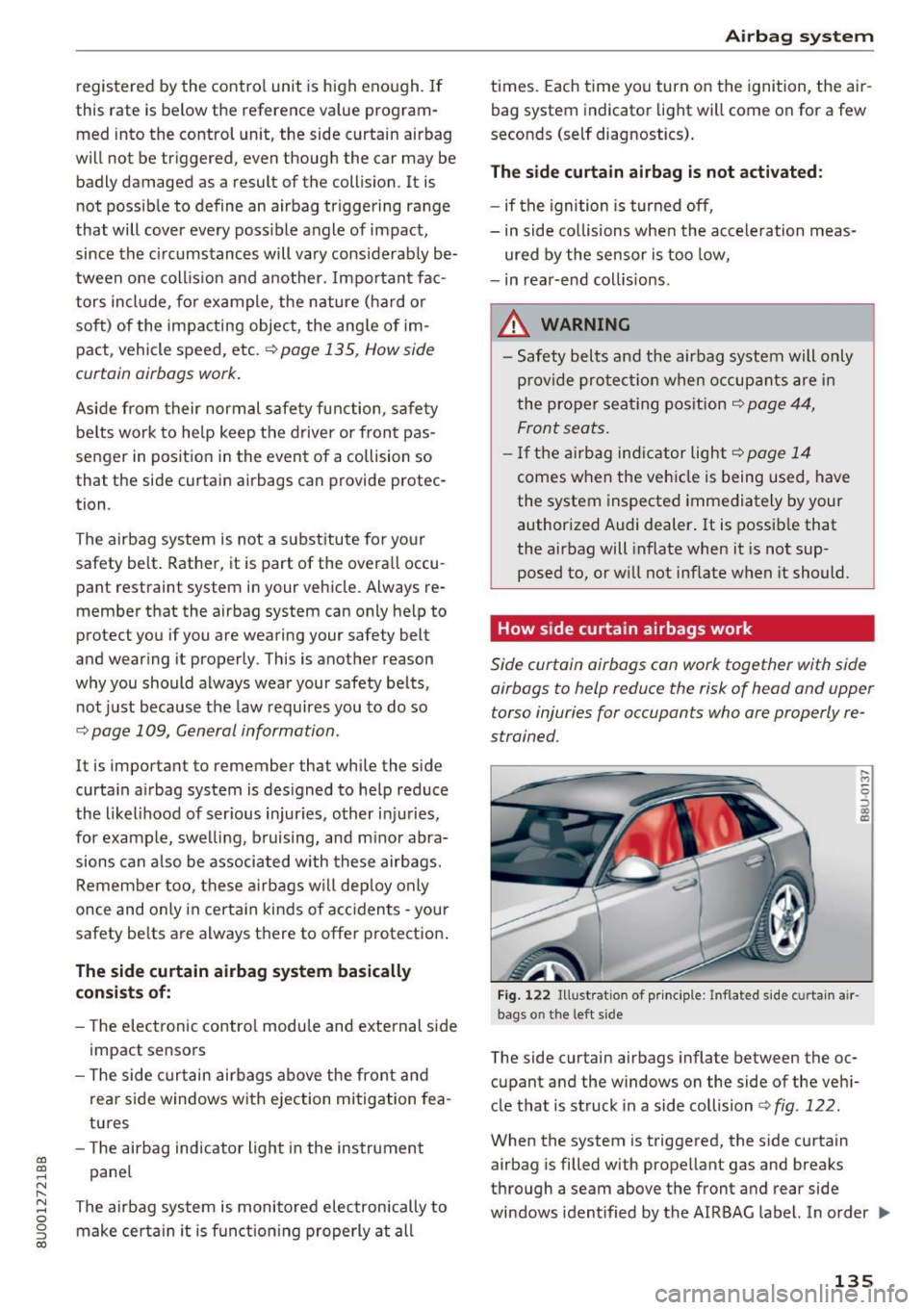
How side curtain airbags work
Side curtain airbags con work together with side
airbags to help reduce the risk of head and upper
torso injuries for occupants who ore properly re
strained .
Fig. 122 Illust ration of pr incip le: Inflated s ide curta in air
bags o n the le ft s ide
The side curtain airbags inflate between the oc
cupant and the w indows on the side of the veh i-
cle that is struck in a side collision
¢ fig . 122.
When the system is triggered, the side curtain
airbag is filled with propellant gas and breaks
through a seam above the front and rear side
windows identified by the AIRBAG label. In order
liJ,
135
Page 139 of 236
00
00
......
"' ,....
"' ...... 0 0 :::,
00
Child safety
Important information
Introduction
The rear seat is generally the safest place in a
collision .
The physical principles of what happens when
your vehicle is in a crash apply also to children
c:> page 110, What happens to occupants not
wearing safety belts? .
But unlike adults and
teenagers, their muscles and bones are not fully
developed. In many respects children are at
greater r isk of serious injury in crashes than
adults .
Because children's bodies are not fu lly devel
oped, they requ ire restraint systems especially
des igned for their size, we ight, and body struc
ture. Many countr ies and all states of the United
States and provinces of Canada have laws requir
ing the use of approved child restraint systems
for infants and small children .
I n a frontal crash at a speed of 20- 3 5 mph
(30-56 km/h) the forces acting on a 13-pound
(6 kg) infant will be more than 20 times the
weight of the child . This means the weight of the
child would suddenly be more than 260 pounds (120 kg) . Under these conditions, only an appro
priate child restraint properly used can reduce
the risk of serious injury . Child restra ints, like
adult safety belts, must be used properly to be
effect ive. Used improperly, they can increase the
risk of serious injury in an accident.
All ch ildren, especially those 12 years and young
er must always ride in the back seat proper ly re
stra ined for their age and size. If you must install
a child restra int on the front passenger seat in
exceptional circumstances, be sure to read and
heed the important information and warnings
c:> page 118. Infants and other children who are
properly restrained in an appropriate child re
straint that is for their size and age can benefit
from the protection that supplemental side air
bags provide in some kinds of crashes.
For more information please see information
provided by the:
Ch ild safety
- National Highway Traffic Safety Administration
(NHTSA), currently at: http:/ /www.safe
rcar.gov (for the USA)
- Transport Canada Information Centre, current-
ly at: http://www.tc .gc.ca (for Canada)
Consult the chi ld safety seat manufacturer's in
structions in order to be sure the seat is right for
yo ur child's size
c:> page 140, Important safety
instructions for using child safety seats .
Please
be sure to read and heed all of the important in
formation and WARNINGS about child safety,
Advanced Airbags, and the installation of child restra ints in this chapter .
There is a lot you need to know about the Ad
vanced Airbags in your vehicle and how they work
when infants and children in child restraints are on the front passenger seat . Because of the large
amount of important informat ion, we cannot re
peat it all he re. We urge you to read the detailed
information in this owner 's ma nual about airbags
and the Advanced Airbag System in your vehicle and the very important information about trans
porting children on the front passenger seat.
P lease be sure to heed the WARNINGS -they are
extremely important for your safety and the safe
ty of your passengers, especially infants and
small children.
A WARNING
-- Accident statistics have shown that children are generally safer in the rear seat area than
in the front seat ing pos ition. Always restrain
any child age 12 and under in the rear.
- All vehicle occupants and especially children must be restrained prope rly whenever r iding
in a vehicle. An unrestra ined or improperly
rest rained child cou ld be inju red by striking
the interior or by being ejected from the ve hicle during a sudden maneuver or impact.
An unrestrained or improperly restrained
child is also at greater risk of injury or death
through contact w ith an inflating a irbag.
-A suitable ch ild restraint properly installed
and used at one of the rear seating positions
provides the h ighest degree of protect ion
for infants and small children in most acci
dent situat ions.
1 37
Page 140 of 236
Child safety
A WARNING
Children on the front seat of any car even with
Advanced Airbags can be seriously injured or even killed when an airbag inflates. A child in
a rearward-facing child safety seat installed
on the front passenger seat will be seriously
injured and can be killed if the front airbag in
flates .
- The inflating airbag will hit the child safety
seat or infant carrier with great force and
will smash the child safety seat and child
against the backrest, center armrest, or
door .
- Always install rear-facing child safety seats
on the rear seat.
-If you must install a rearward facing child
safety seat on the front passenger seat in
exceptional circumstances and the
PASSEN
GER AIR BAG OFF
light does not come on
and stay on, immediately install the rear
facing child safety seat in a rear seating po
sition and have the airbag system inspected
immediately by your Audi dealer.
A WARNING
If, in exceptional circumstances, you must in
stall a forward-facing child restraint on the
front passenger's seat:
- Always make sure the forward-facing seat
has been designed and certified by its man
ufacturer for use on a front seat with a pas
senger front and side airbag.
- Always follow the manufacturer's instruc
tions provided with the child safety seat or
carrier .
- Always move the front passenger seat to
the highest position in the up and down ad
justment range and move it back to the
rearmost position in the seat's fore and aft
adjustment range, as far away from the air
bag as possible, before installing the for
ward-facing child restraint.
- Always make sure that the safety belt upper
anchorage is behind the child restraint and
not next to or in front of the child restraint
so that the safety belt will be properly posi
tioned.
138
- Always make sure that the PASSENGER AIR
BAG OFF
light comes on and stays on all the
time whenever the ignition is switched on.
(D Tips
Always replace child restraints that were in
stalled in a vehicle during a crash. Damage to
a child restraint that is not visible could cause
it to fail in another collision situation.
Advanced front airbag system and children
Your vehicle is equipped with a front "Advanced
Airbag System" in compliance with United States
Federal Motor Vehicle Safety Standard (FMVSS)
208, as well as Canada Motor Vehicle Safety
Standard (CMVSS) 208 as applicable at the time
your vehicle was manufactured.
The Advanced Airbag system in your vehicle has
been certified to meet the "low-risk" require
ments for 3- and 6-year old children on the pas
senger side and small adults on the driver side.
The low risk deployment criteria are intended to
reduce the risk of injury through interaction with
the airbag that can occur, for example, by being
too close to the steering wheel and instrument
panel when the airbag inflates. In addition, the
system has been certified to comply with the
"suppression" requirements of the Safety Stand
ard, to turn off the front airbag for infants up to
12 months who are restrained on the front pas
senger seat in child restraints that are listed in
the Standard.
Even though your vehicle is equipped with an Ad
vanced Airbag system, all children, especially
those 12 years and younger, should always ride
in the back seat properly restrained for their age
and size. The airbag on the passenger side makes
the front seat a potentially dangerous place for a child to ride. The front seat is not the safest place
for a child in a forward-facing child safety seat. It
can be a very dangerous place for an infant or a
larger child in a rearward-facing seat.
Page 142 of 236
Child safety
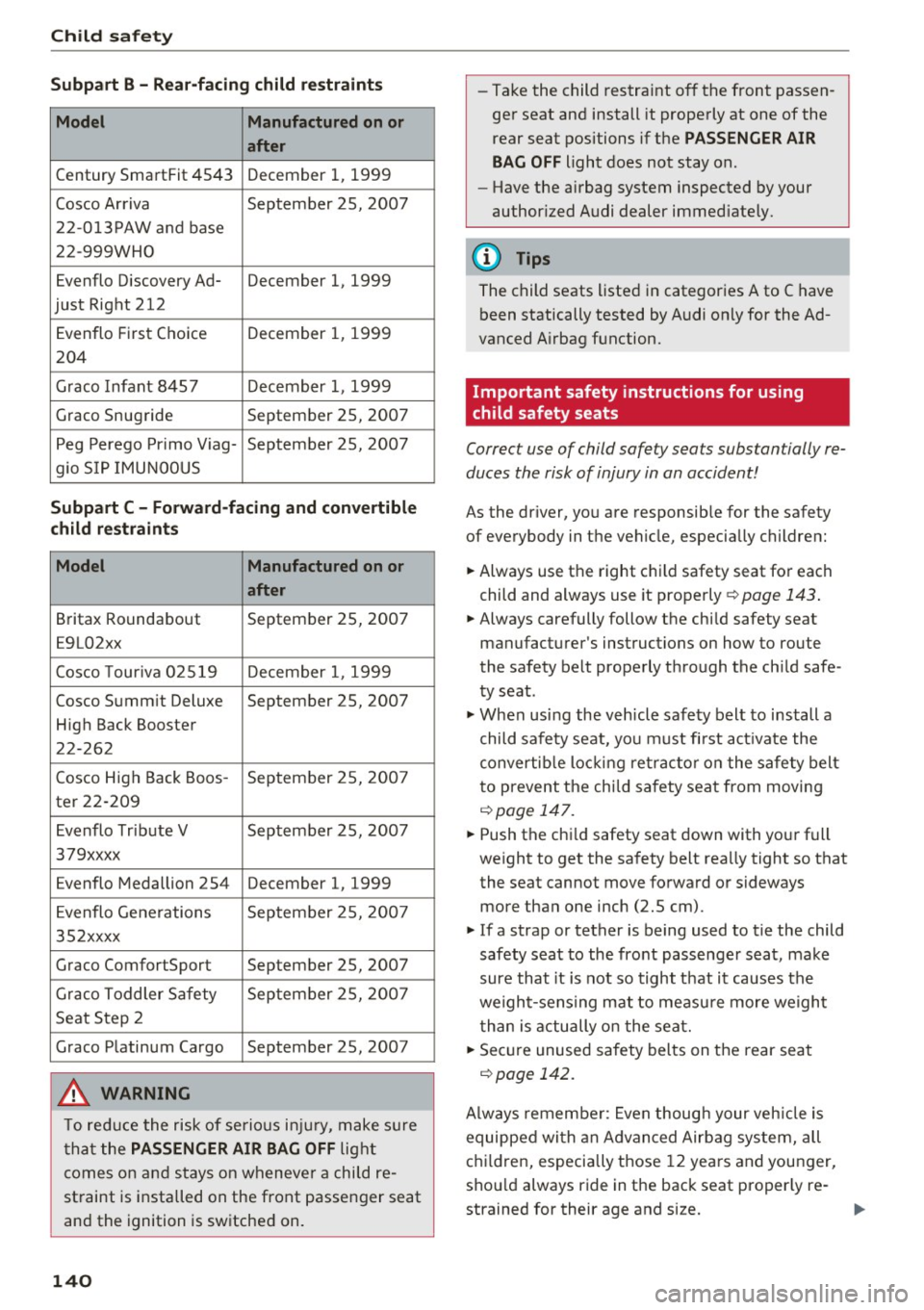
Subpart B - Rear-facing child restraints
Model Manufactured on or
after
Century SmartFit 4543 December 1, 1999
Cosco Arriva September 25, 2007
22-013PAW and base
22-999WHO
Evenflo Discovery Ad- December 1, 1999
just Right 212
Evenflo First Cho ice December 1, 1999
204
G raco Infant 8457 December 1 , 1999
Graco Snug ride September 25, 2007
Peg Perego Primo Viag- September 25, 2007
gio SIP IMUNOOUS
Subpart C -Forward -facing and convertible
child restraints
Model Manufactured on or
after
Britax Roundabout September 25, 2007
E9L02xx
Cosco Tour iva 02519 December 1, 1999
Cosco Summit Deluxe September 25, 2007
High Back Booster
22-262
Cosco High Back Boos-
September 2S, 2007
ter 22-209
Evenflo Tribute V September 25, 2007
379xxxx
Evenflo Medallion 254 December 1, 1999
Evenflo Generations September 25, 2007
352xxxx
Graco ComfortSport September 25, 2007
Graco Toddler Safety September 25, 2007
Seat Step 2
Graco Platinum Cargo September 25, 2007
.,&. WARNING
To reduce the risk of serious i njury, make sure
t ha t the
PASSENGER AIR BAG OFF light
com es on and stays on whenever a child re
straint is installed on the front passenger seat
and the ignition is switched on.
140
-Take the child restraint off the front passen
ger seat and install it properly at one of the
rear seat positions if the
PASSENGER AIR
BAG OFF
light does not stay on .
- Have the airbag system inspected by your
authorized Audi dealer immed iately.
@ Tips
The child seats listed in categor ies A to C have
been statically tested by Audi only for the Ad
vanced Airbag function.
' Important safety instructions for using
child safety seats
Correct use of child safety seats substantially re
duces the risk of injury in an accident!
As the dr iver, you are responsible for the safety
of everybody in the vehicle, especially children:
.. Always use the right child safety seat for each
child and always use it properly ¢
page 143 .
.. Always carefully follow the child safety seat
manufacturer's instructions on how to route
the safety belt properly through the child safe
ty seat.
.. When using the vehicle safety belt to install a
child safety seat, you must first activate the
convertible locking retractor o n the safety belt
to prevent t he child safety seat from moving
c::>page 147.
.. Push the chi ld safety seat down with your full
weight to get the safety belt really tight so that
the seat cannot move forward or sideways
more than one inch (2.5 cm) .
.. If a strap or tether is being used to tie the child
safety seat to the front passenger seat , make
sure that it is not so tight that it causes the
we ight-sensing mat to measure more weight
than is actually on the seat.
.. Secure unused safety belts on the rear seat
c::> page 142 .
Always remembe r: Even though your vehicle is
equipped with an Advanced Airbag system, all
children, especially those 12 years and younger,
shou ld always ride in the back seat properly re-
strained for their age and size. .,._
Page 143 of 236
00
00
......
"' ,....
"' ...... 0 0 :::,
00
& WARNING
Not using a c hild safety sea t, using the wrong
child safety seat or improperly installing a
child restraint increases the r isk of serious
personal injury and death.
- All vehi cle occupants and especially children
must be restrained properly whenever riding
in a vehicle. An unrestrained or improperly
restrained child could be injured by striking
the interior or by being ejected from the ve
hicle during a sudden maneuver or impact.
An unrestrained or imp roperly restrained
child is also at greater risk of inju ry or death
through contact with an inflating airbag .
- Commercially available ch ild safety seats
are required to comply with U.S. Federa l
Motor Vehicle Safety Standard (FMVSS) 213
(in Canada CMVSS 213).
- When buying a ch ild restraint, select one
that fits your child and the vehicle .
- Only use child restraint systems that fully
contact the flat portion of the seat cush
ion . The child restraint must not tip or
lean to either s ide . Audi does not recom
mend using child safety seats that rest on
legs or tube- like frames. They do not pro
vide adequa te contact with the sea t.
- Always heed a ll legal requ irements pe r
taining to the installation and use of child
safety seats and carefully fo llow the in
structions provided by the manufacturer
of the seat you are using.
- Never allow ch ildren under 57 inches
(1.45 meters) to wear a normal safety belt .
They must always be restrained by a proper child restraint system. Otherwise, they
cou ld sustain injur ies to the abdomen and
neck areas during sudden braking maneu
vers or acc idents.
- Never let more than one child occupy a child
safety seat .
- Never let babies or older chi ldren ride in a
vehicle while sitting on the lap of another passenger .
- Ho ld ing a chi ld in your arms is never a sub
stit ute for a child restra int system.
Ch ild safety
-The strongest person cou ld not ho ld the
ch ild with the forces that exist in an acci
dent. The child will strike the interior of
the vehicle and can also be struck by the
passenger.
- The child and the passenger can also in
jure each other in an accident.
- Never install rear-facing child safety seats
or infant carriers on the front passenger
seat . A child w ill be seriously injured and
can be killed when the passenger a irbag in
flates - even with an Advanced Airbag Sys
tem.
- Make sure the re is e nough space in front of
the child in the child seat. If ne cessary, ad
just the angle and position of the se at in
front of the ch ild seat.
- The inflating airbag will h it the c hild safety
seat o r infant carr ier with great force and
will smash the child safety seat and child
against the backrest, center armrest, door
or roof .
-Always install rear -facing child safety seats
or infant carriers on the rear seat.
- Forward -facing child safety seats insta lled
on the front passenger's seat can interfere
with the airbag when it inflates and cause serio us injury to the chi ld. Always install for
ward-facing ch ild safety seats on the rear
seat .
- If exceptional c ircumstances requ ire the use
of a forward-facing child restraint on the
front passenger's seat, the ch ild's safety
and well-being requ ire that the following
specia l precautions be ta ken:
- Make sure the forward -facing seat has
been designed and certified by its manu
facturer for use on a front seat with a pas
senger front and side airbag.
- Always carefully follow the man ufacturer's
instruct ions prov ided with the ch ild safety
seat or carrier.
- Always move the front passenger seat to
the h ighest position in the up and down
adjustment range and move it back to the
rearmost position in the seat's fore and
aft ad justmen t range, as far away from
141
Page 144 of 236
Child safety
the airbag as possible, before installing
the forward-facing child restraint.
- Always make sure that the safety be lt up
per anchorage is behind the child restra int
and not next to or in front of the child re
straint so that the safety belt will be prop
erly positioned.
- Always make sure that nothing prevents
the front passenger's seat from be ing
moved to the rearmost pos it ion in its fore
and aft adjustment range.
- Always make sure that the backrest is in the upr ight position .
- Always buckle the child safety seat firmly in
place even if a child is not s itting in it. A
loose child safety seat can fly around during
a sudden stop or in a collis ion.
- Always read and heed all WARNINGS when
ever using a child restrained in a veh icle is
being used
r:!;> page 109, Safety belts,
r:!;> page 117 , Airbag system and
r:!;> page 13 7, Child safety .
,8. WARNING
To reduce the risk of se rious injury, make s ure
that the
PASSENGER AIR BAG OFF light
comes on and stays on whenever a child re
straint is installed on the front passenger seat
and the ignition is sw itched on.
- Take the ch ild restraint off the front passen
ger seat and install it properly at one of the
rear seat positions if the
PASSENGER AIR
BA G OF F
light does not stay on.
- Have the airbag system inspected by your
authorized Audi dealer immediately.
142
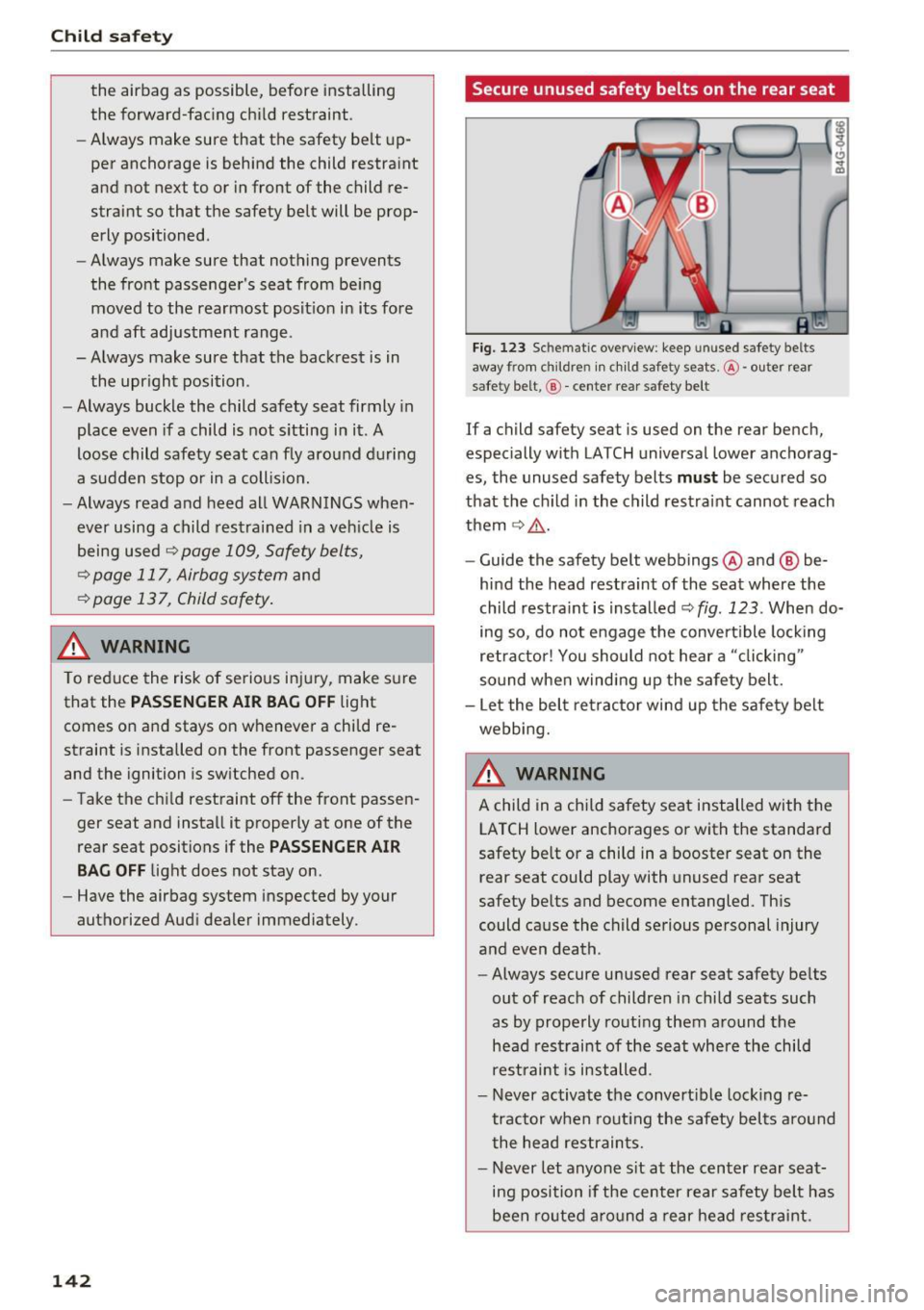
Secure unused safety belts on the rear seat
Fig. 123 Schematic overview: keep unused safety belts
away from children in ch ild safety seats. @· ou ter rear
safety belt,® -center rear safety belt
If a child safety seat is used on the rear bench,
especially with LATCH universal lower anchorag
es, the unused safety belts
mu st be secured so
that the ch ild in the child restraint cannot reach
them
r:!;> .& -
-Guide the safety belt webbings @and @ be·
hind the head restraint of the seat where the
child restra int is installed
~fig . 123. When do·
ing so, do no t engage the convert ible locking
retractor! You should not hear a "cl icking"
sound when winding up the safety belt.
- Let the belt re trac to r wind up the safe ty belt
webbing.
~ WARNING
-A child in a child safety seat installed with the
LATCH lower anchorages or with the standard
safety be lt or a child in a booster seat on the
rear seat could play with unused rear seat
safety belts and become entangled. This
could cause the child serious personal injury
and even death.
- Always secure unused rear seat safety belts
out of reach of children in child seats such
as by properly ro uting them around the
head restraint of the seat where the child
restraint is installed.
- Never activate the convert ible lock ing re·
tractor when rout ing the safety belts aro und
the head restrain ts.
- Never let anyone s it at the center rear seat
ing position if the center rear safety belt has
been routed around a rear head restraint.
Page 145 of 236
Child seats
Infant seats
Babies and infants up to about one year old and
20 lbs. or 9 kg need special rearward -facing
child restraints that support the back, neck and
head in a crash .
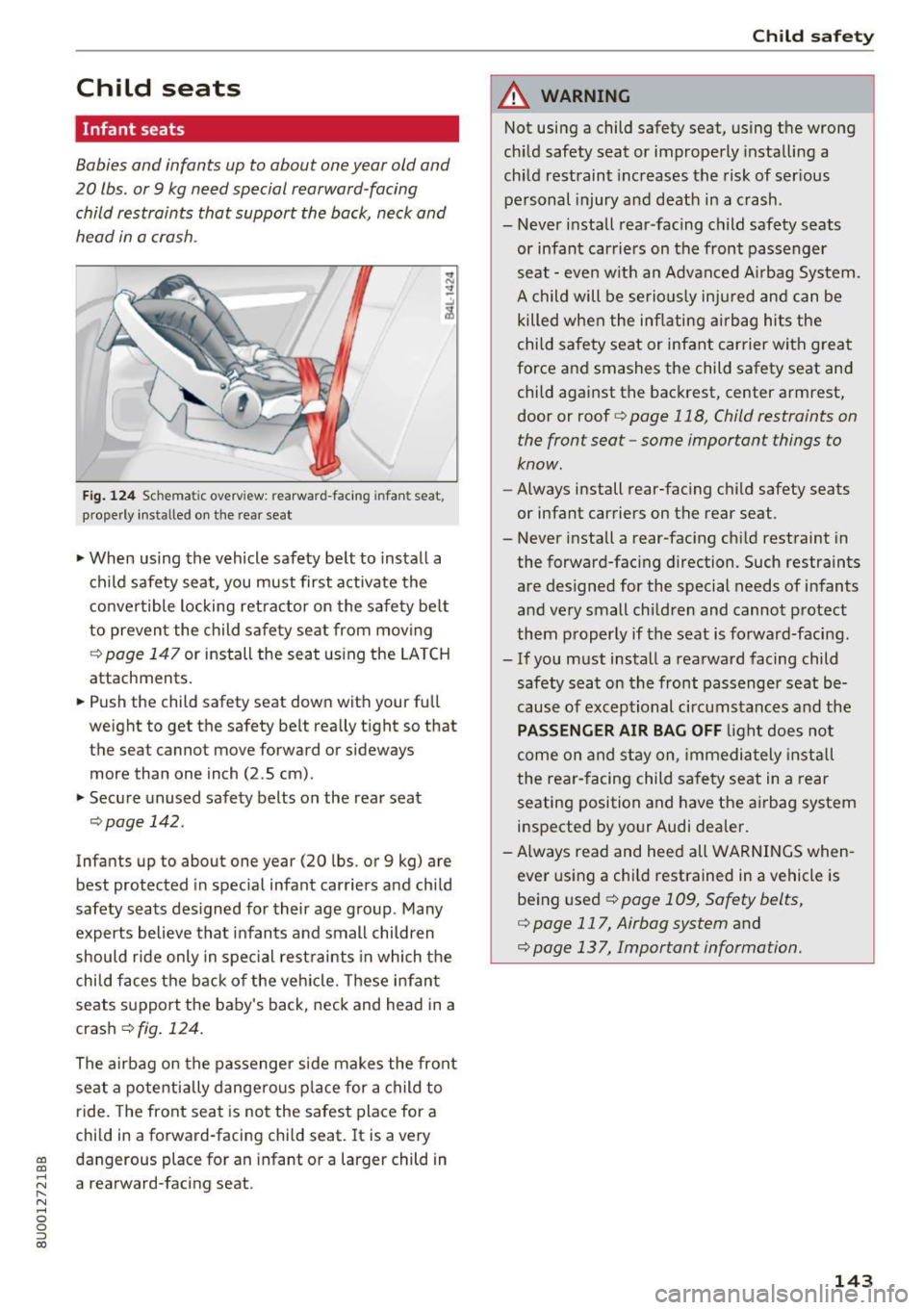
Fig. 124 Schemat ic overview: rearward-facing infant seat,
properly installed on the rear seat
"'When using the vehicle safety belt to install a
child safety seat, you must first activate the
convertible locking retractor on the safety be lt
to prevent the child safety seat from moving
¢ page 147 or install the seat using the LA TC H
attachments.
"' Push the child safety seat down with your full
weight to get the safety belt really tight so that
the seat cannot
move forward or sideways
more than one inch (2.5 cm).
"'Secure unused safety belts on the rear seat
¢page 142.
Infants up to about one year (20 lbs. or 9 kg) are
best protected in special infant carriers and child
safety seats des igned for their age group . Many
experts believe that infants and small children
should ride only in spec ial restraints in which the
chi ld faces the back of the vehicle. These infant
seats support the baby 's back, neck and head in a
crash
c!;> fig . 124.
The airbag on the passenger side makes the front
seat a potentially dangero us p lace for a child to
ride. The front seat is not the safest place for a
chi ld in a forward-facing child seat. It is a very
a:1 dangerous place for an infant or a larger child in a:,
~ a rearward-facing seat. r--. N
'"' 0 0 ::, a:,
Child sa fety
A WARNING
-Not using a child safety seat, using the wrong
ch ild safety seat or improperly installing a
child restraint increases the risk of ser ious
personal injury and death in a crash .
- Never install rear-facing child safety seats
or infant carriers on the front passenger
seat -even w ith an Advanced A irbag System .
A child will be serio usly inj ured and can be
killed when the inf lating airbag hits the
chi ld safety seat or infant carrier with great
force and smashes the child safety seat and
child against the backrest, center armrest,
door or roof
c!;> page 118, Child restraints on
the front seat -some important things to
know.
- Always install rear-fac ing child safety seats
or infant carriers on the rear seat.
- Never install a rear-facing child restraint in
the forward-facing direction . Such restraints
are designed for the special needs of infants
and very small children and cannot protect
them p roperly if the seat is forward-faci ng.
- If you must install a rearward facing child
safety seat on the front passenger seat be
cause of exceptional circumstances a nd the
PASSENGER AIR BAG OFF li ght does not
come on and stay on, immediately install
the rea r-facing child sa fety seat in a rear
seating position and have the a irbag system
inspected by your Audi dealer .
-A lways read and heed all WARNINGS when
ever using a child restrained in a vehicle is
be ing used
c!;> page 109, Safety belts,
c:> page 117 , Airbag system and
c:> page 137, Important information.
143
Page 146 of 236
Child safety
Convertible child safety seats
Properly used convertible child safety seats can
help protect toddlers and children over age one
who weigh between 20 and 40 lbs. (9 and 18 kg)
in a crash.
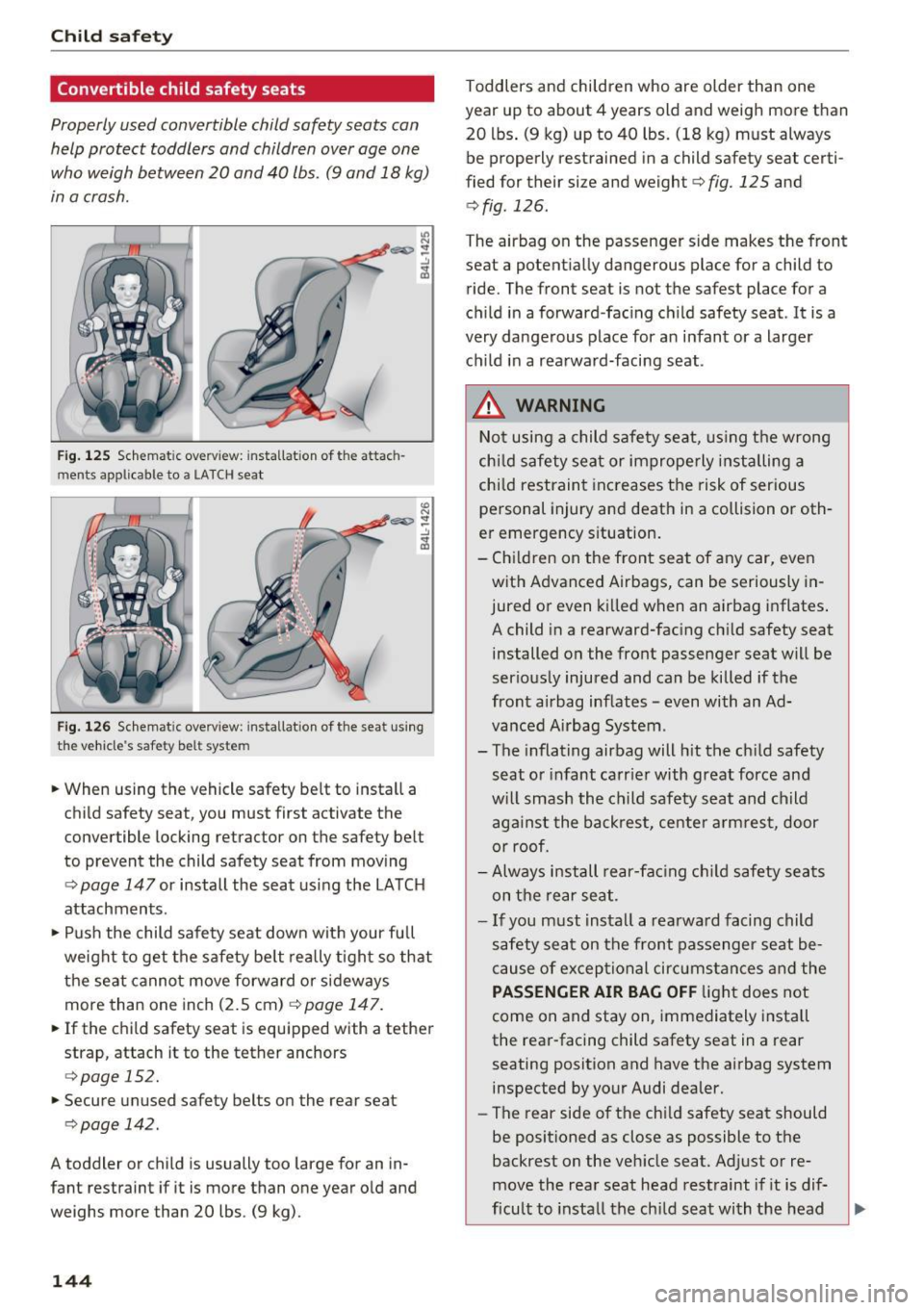
Fig. 125 Schematic overv iew: installat ion of the attach
ments app licable to a LATCH seat
Fig. 126 Schemat ic overview: installat ion of the seat using
the vehicle 's safety belt system
.. When using the vehicle safety be lt to install a
child safety seat, you must first activate the
convertible locking retractor on the safety belt
to prevent the child safety seat from mov ing
¢ page 147 or install the seat using the LATCH
attachments .
.. Push the child safety seat down with your full
weight to get the safety be lt really tight so that
the seat cannot move forward or sideways more than one inch (2 .5 cm) ¢
page 147.
.. If the child safety seat is equipped with a tether
strap, attach it to the tether anchors
¢page 152.
.. Secure unused safety belts on the rear seat
¢page 142.
A toddler or child is usually too large for an in
fant restraint if it is more than one year old and
weighs more than 20 lbs . (9 kg).
144
Toddlers and children who are older than one
year up to about 4 years old and weigh more than
20 lbs . (9 kg) up to 40 lbs. (18 kg) must always
be properly restrained in a child safety seat certi
fied for their size and weight¢
fig. 125 and
i=>fig. 126.
The airbag on the passenger side makes the front
seat a potentially dangerous place for a child to
ride. The front seat is not the safest place for a
child in a forward-facing child safety seat .
It is a
very dangerous place for an infant or a larger
ch ild in a rearward-facing seat .
.&_ WARNING
Not using a child safety seat, us ing the wrong
ch ild safety seat or imprope rly installing a
chi ld restraint increases the risk of serious
personal injury and death in a collision or oth
er emergency situation.
- Ch ildren on the front seat of any car, even
with Advanced Airbags, can be seriously in
jured or even killed when an airbag inflates .
A child in a rearward-fac ing ch ild safety seat
installed on the front passenger seat will be
serious ly injured and can be killed if the
front airbag inflates -even with an Ad
vanced Airbag System .
- The inflating airbag will h it the chi ld safety
seat or infant carr ier with great force and
w ill smash the child safety seat and child
aga inst the backrest, center a rm rest, door
or roof.
- Always install rear-fac ing ch ild safety seats
on the rear seat.
- If you must install a rearwa rd facing child
safety seat on the front passenger seat be
cause of exceptional circ umstances a nd the
PASSENGER AIR BAG OFF light does not
come on and stay on, immediately install
the rear-facing child safety seat in a rear seating position and have the airbag system
inspected by your Audi dealer .
- The rear side of the ch ild safety seat should
be positioned as close as possible to the
backrest on the veh icle seat. Adjust or re
move the rear seat head restraint if it is dif-
ficult to install the ch ild seat with the head "'