lock AUDI Q3 2017 Owner´s Manual
[x] Cancel search | Manufacturer: AUDI, Model Year: 2017, Model line: Q3, Model: AUDI Q3 2017Pages: 236, PDF Size: 58.93 MB
Page 160 of 236
Checking and Filling
-Never f ill the fuel container with fuel
while it is in or on the vehicle. Stat ic elec
tricity is d ischarged when filling wh ich can
cause the f uel vapors to ignite and in
creases the r isk of an explos ion .
- Always p lace a fuel container on the
ground before fi lling .
- Always hold the fuel nozzle comp letely in
the fuel container when fi lling .
- If the fue l conta iner is made of metal, the
fue l nozzle must always be in contact wit h
the conta iner w hen filling it w ith fue l. Th is
prevents static electr ic ity from discharg
ing.
- Never sp ill fuel in the veh icle or the lug
gage compartment . Evaporated fue l is ex
plosive and increases the risk of se rio us i n
jury o r death.
- Follow legal requireme nts when usi ng,
s t o ring and tran spo rting fuel cont ainers.
- Ma ke sure the fue l conta iner confo rms to
i ndu stry st anda rds (A NSI/ ASTM F852-86).
0 Note
- Remove spilled fuel from vehicle paint im
mediately, because it can damage paint.
- Never drive until the fuel tank is completely
empty . The ir regular supp ly of fuel that re
su lts from that ca n cause engine m isfires .
Uncombusted f ue l w ill enter the exha ust
sy stem a nd incr ease t he risk of damage to
the c atalyt ic converter.
@ For the sake of the environment
Do not ove rfi ll the f uel tank, othe rw ise fue l
can le ak out when the vehicle is wa rm ing up.
(0 Tips
The f uel fi ller door on yo ur vehicle does not
loc k if yo u lock the vehicle from the inside .
158
Fuel filler door emergency release
If the cen tral locking system is faulty, the fuel
filler door can be unlocked manually .
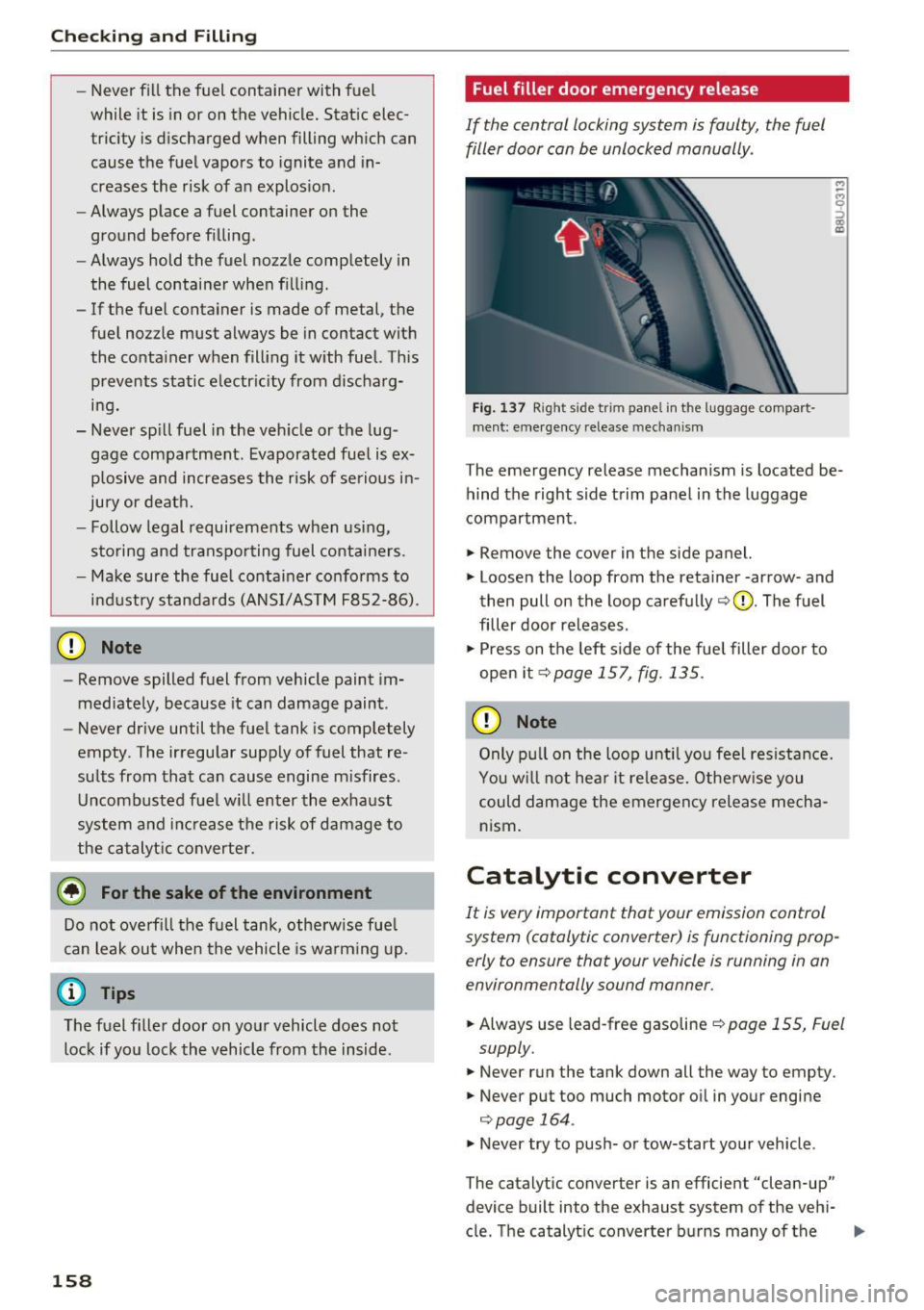
Fig. 13 7 Right side trim panel in t he lugg age compar t
m ent: eme rge ncy rele ase mecha nis m
T he emergency release mechan ism is located be
hind the right s ide trim panel in the luggage
compartment.
.,. Remove the cover in t he side panel.
.,. Loosen the loop from the retainer -arrow- and
then pull on the loop carefu lly ¢ @ . The f uel
fill er door releases.
.,. Press on t he left s ide of the fue l filler doo r to
open i t¢
page 15 7, fig. 135.
(D Note
Only p ull on t he loo p until yo u feel res ista nce.
You w ill not hea r it re lease. Othe rw ise you
c o uld d amage the emergen cy rele ase mech a
nism .
Catalytic converter
It is very important that your emission control
system (catalytic converter) is functioning prop
erly to ensure that your vehicle is running in an
environmentally sound manner .
.,. Always use lead -free gasoline ¢ page 155, Fuel
supply.
.,. Never r un the tank down all the way to empty .
.,. Never put too much motor oi l in your engine
¢ page 164 .
.,. Never try to push- or tow-start your vehicle .
The catalytic conve rter is an efficient "clean-up"
device built into the exhaust system of the veh i-
cle. The catalyt ic converter burns many of the
lilJ,
Page 168 of 236
Check ing and F illing
areas, into open streams or down sewage
drains .
- Recycle used engine oil by taking it to a used
engine oil collection facility in your area, or
contact a service station .
Cooling system
Coolant
The engine coo ling system is filled wi th a mixture
of pur ified w ate r a nd coolan t addit ive at the fa c
tory . T h is coo lant must not be not changed.
The coolant leve l is monito red throug h the . in
d icator light~
page 13 . Howeve r, we do re com
mend occasionally check ing the coo la nt level
manually.
I f you must add coolant, use a m ixt ur e of wa ter
and coolant addit ive. M ixing the coolant additive
with d istilled wate r is recommen ded .
Coolant additive
The coolant additive is made of a nti-freezi ng a nd
corros ion protection agents . Only use the fo llow
i n g coolant add it ives. These additives may be
mixed w it h each other.
Coolant additive Specification
G13 TL774J
G12++ T
L 774 G
The amount of coo lant additive that needs to be
mixed wit h wate r depends on the climate where
the vehicle will be operated . If the coolant addi
tive percentage is too low, the coolant can freeze
and damage the engine.
Coolant Freeze protec-
additive tion
Warm reg ions min . 40% m in . -13 °F
max . 45% (
- 25
°()
Co ld regions min. 50% max
. -40 °F
max. 55% (-40 °()
0 Note
- Befo re the start of winter, have your author
i zed Audi dealer or authorized A udi Service
Fac ility check if the coolant additive in you r
166
vehicle matches t he percentage app ropriate
for the climate . This is especially important
when driving in colder climates.
- If the app ropriate coo lant additive is not
available in an eme rgency, do not add any
other additive. You could damage the en
gine. If this happens, only use water and re
store the correct m ixture ratio with t he
specified coo lant add itive as soo n as poss i
bl e.
- Only ref ill w ith new coolant.
- Radiator sealant must not be mixed with
the coolant.
· Adding coolant
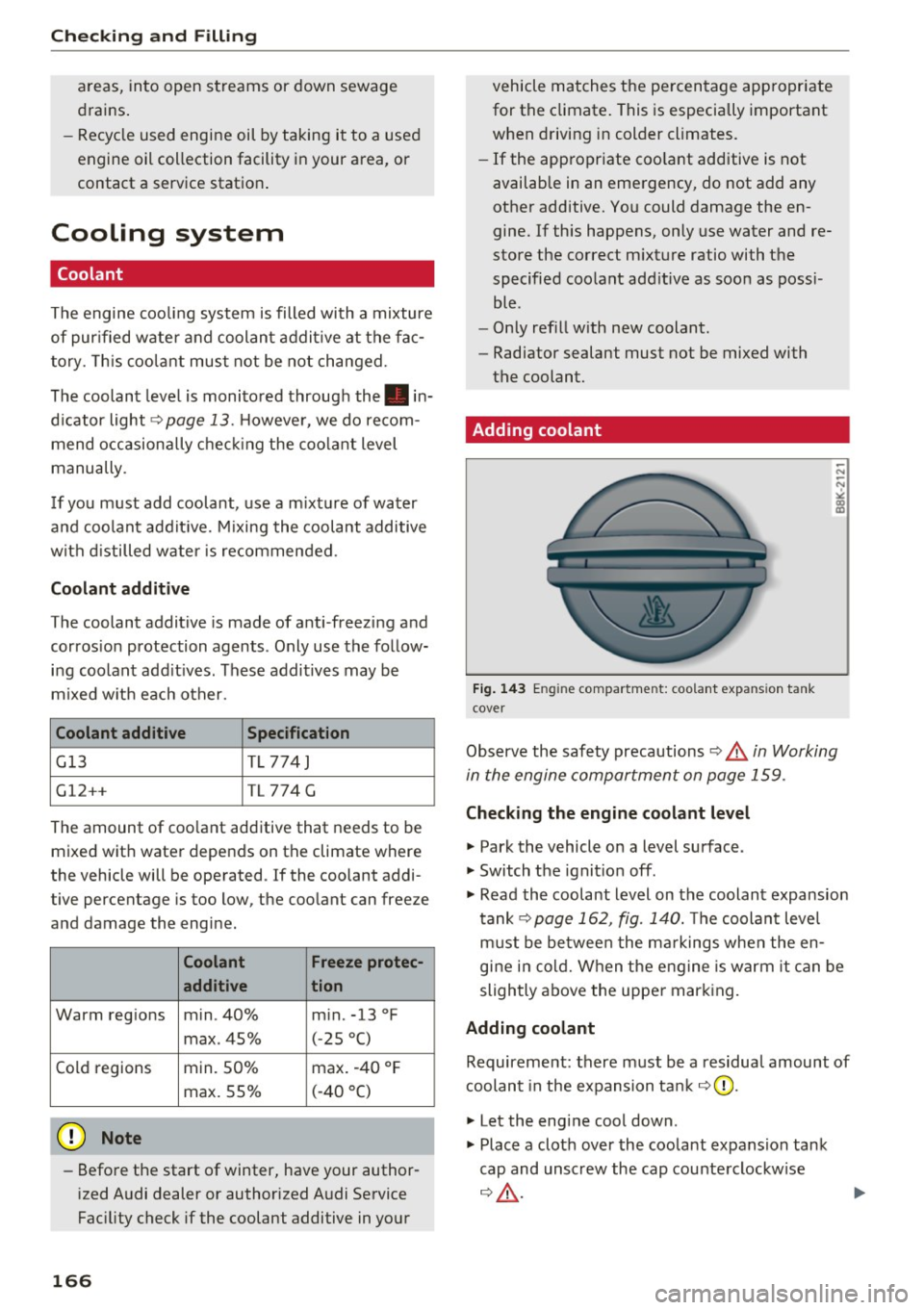
Fi g. 14 3 En gin e compartment: coo lant expa nsio n ta nk
cove r
Observe the safety precautions ~.& in Working
in the engine compartment on page 159 .
Checking the engine coolant level
.. Park the vehicle on a level surface .
.. Switch the ignit io n off.
.. Read the coolant level on the coolant expansion
t ank ~
page 162, fig. 140. The coolant leve l
m ust be be twee n the m arkings when the en
gi ne i n co ld. W hen t he engine is warm it can be
slightly above the upper mar king.
Adding coolant Requirement: there must be a residua l amount of
coolan t in the expansion tank ~(}).
.,. Let the engi ne cool down .
.. Place a clot h over the coolant expans ion tank
cap and unscrew the cap counte rclockw ise
~ .& -
Page 188 of 236

Wheels
and a special procedure. You must not repair or
disassemble them¢&. .
A WARNING
Wheel bolts that are tightened or repaired in
correctly can become loose and result in loss
of vehicle control, which increases the risk of
an accident. For the correct t ightening specifi
cation, see ¢
page 199, After changing a
wheel .
- Always keep the wheel bolts and the
threads in the wheel hub clean and free of grease.
- Only use wheel bolts that fit the rim .
- Always have damaged rims repaired by an
authorized Audi dealer or authorized Audi
Service Facility . Never repair or disassemble
rims yourself, because this increases the risk
of an accident.
Winter tires
Winter tires significantly improve the vehicle's
handling when driving in winter conditions . Be
cause of their construction (width, compound,
tread pattern), summer tires provide l ess trac
tion on ice and snow.
.,. Use winter tires on all four wheels.
.,. Only use winter tires that are approved for your
vehicle.
.,. Please note that the maximum permitted
speed may be lower with winter tires
q .&,. . An
authori zed Audi dealer or authori zed Audi Serv
ice Facility can inform you about the maximum
permitted speed for your tires .
.,. Check the tire pressure after install ing wheels
q page 181.
The effectiveness of winter tires is reduced great
ly when the tread is worn down to a depth of
0 .157 in (4 mm). The characteristics of winter
tires also decrease greatly as the tire ages, re
gardless of the remaining tread.
A WARNING
- Never drive faster than the maximum per
mitted speed for your tires. This could cause
the tires to heat up too much. This increases
186
-
the risk of an accident because it can cause
the tire to burst.
- Always adapt your driving to the road and
traffic conditions . Drive carefully and reduce
your speed on icy or slippery roads . Even
winter tires can lose traction on black ice .
@ For the sake of the environment
Reinstall summer tires at the appropriate
time, because they provide better handling
when roads are free of snow and ice. Summer
tires cause less road noise, tire wear and fuel
consumption .
(D Tips
You can also use all season tires instead of
winter tires. Please note that in some coun
tries where winter tires are required, only
winter tires with the~ symbol may be per
mitted.
Snow chains
Snow chains not only improve the driving in win
ter road conditions, but also the braking.
.,. Only install snow chains on the front wheels .
This applies also to vehicles with a ll wheel
drive* .
.,. Check and correct the seating of the snow
chains after driving a few feet, if necessary. Fol
low the instructions from the manufacturer.
.,. Note the maximum permitted speed when driv
ing with snow chains. Do not exceed 30 mph
(SO km/h) .
Use
fine-mesh snow chains. They must not add
more than 0.53 inch (13 .5 mm) in height, includ
ing the chain lock.
You must remove the snow chains on roads with
out snow. Otherwise , you could impair driving
ability and damage the tires .
Use of snow chains is only permitted with certain
rim/tire combinations due to technical reasons.
Check with an authorized Audi dealer or author i z ed Audi Service Facility to see if you may use
snow chains.
Page 195 of 236
00
00
.-I
"' ,....
"' ...... 0 0 :::,
00
Care and cleaning
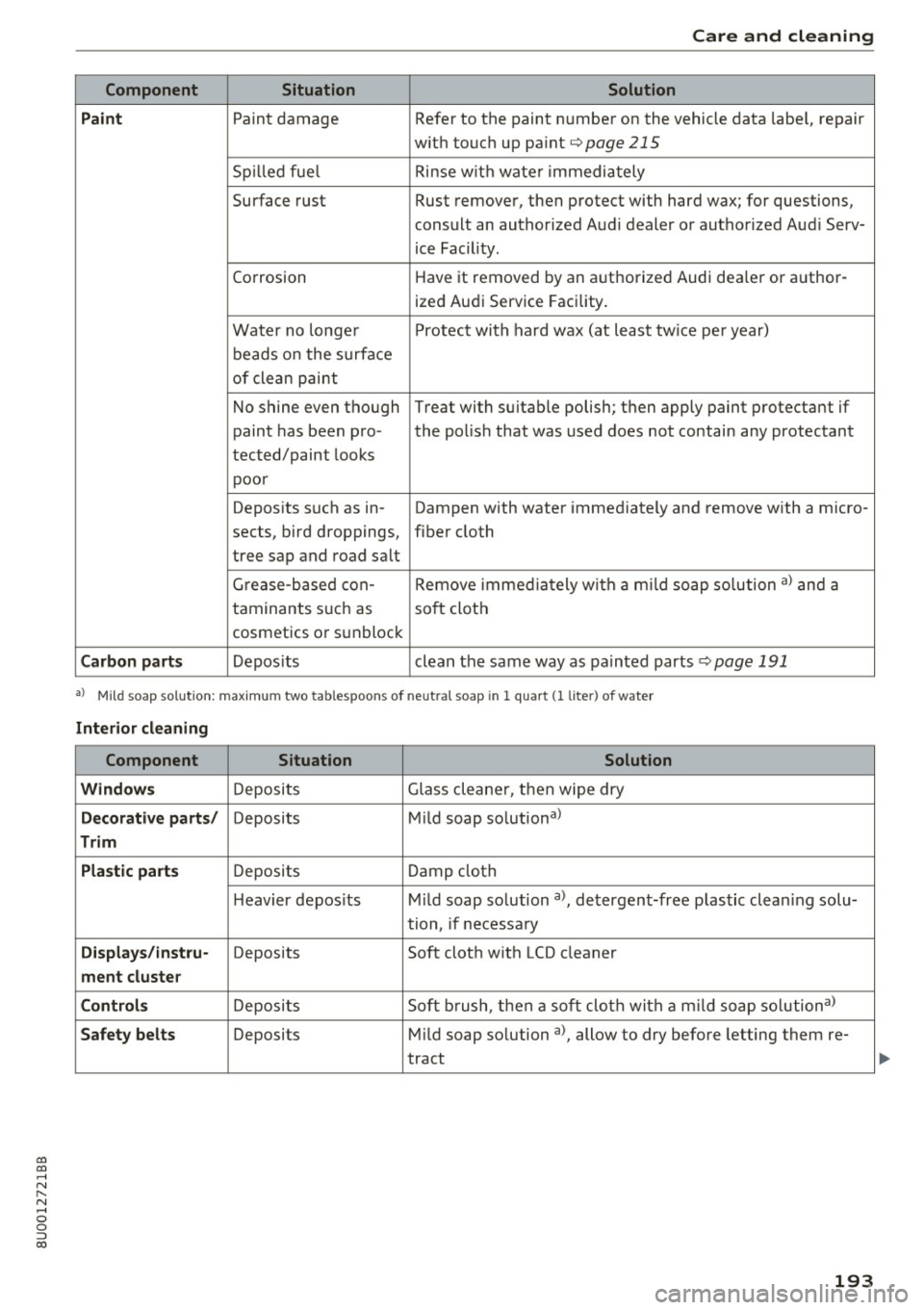
Component Situation Solution
Paint
Paint damage Refer to the paint number on the vehicle data label, repair
w ith touch up pa int
c;,poge 215
Spilled fuel Rinse with wate r immediately
Surface rust Rust remover, then protect with hard wax; for questions,
consult an authorized Audi dealer or authorized Audi Serv-
ice Facility.
Corrosion Have
it removed by an authorized Audi dea ler or author-
ized Audi Service Facility.
Water no longer Protect with hard wax (at least twice per year)
beads on the surface
of clean paint
No shine even though Treat with su itable polish; then apply paint protectant if
paint has been pro- the polish that was used does not contain any protectant
tected/paint looks poor
Deposits such as in -Dampen with water immediately and remove w ith a micro-
sects, bird droppings, fiber clloth
tree sap and road salt
Grease-based con- Remove
immediat ely with a mild soap so lution
al and a
taminants such as soft cloth
cosmetics or sunblock
Carbon parts Depos its clean the same way as painted parts c;, page 191
a) Mild soap solution: max im um two tablespoons of neutral soap in 1 quar t (1 liter) of water
Interior cleaning
Component Situation Solution
Windows
Deposits Glass cleaner, then wipe dry
Decorative parts/ Deposits Mild soap solutiona>
Trim
Plastic parts
Deposits Damp cloth
He avier deposits Mild soap solution a), detergent-free plastic clean ing solu-
tion, if necessary
Oisplays/instru -Deposits Soft
cloth with LCD cleaner
ment cluster
Controls
Deposits Soft brush, then a soft
cloth with a mild soap solutiona>
Safety belts Deposits Mild
soap solution al, allow to dry before letting them re-
tract
193
Page 200 of 236
Emerg ency assis ta nce
Folding chocks
Applies to: ve hicles w ith fol ding chocks
The folding chocks* are part of the vehicle tool
kit.
-- -,,,.
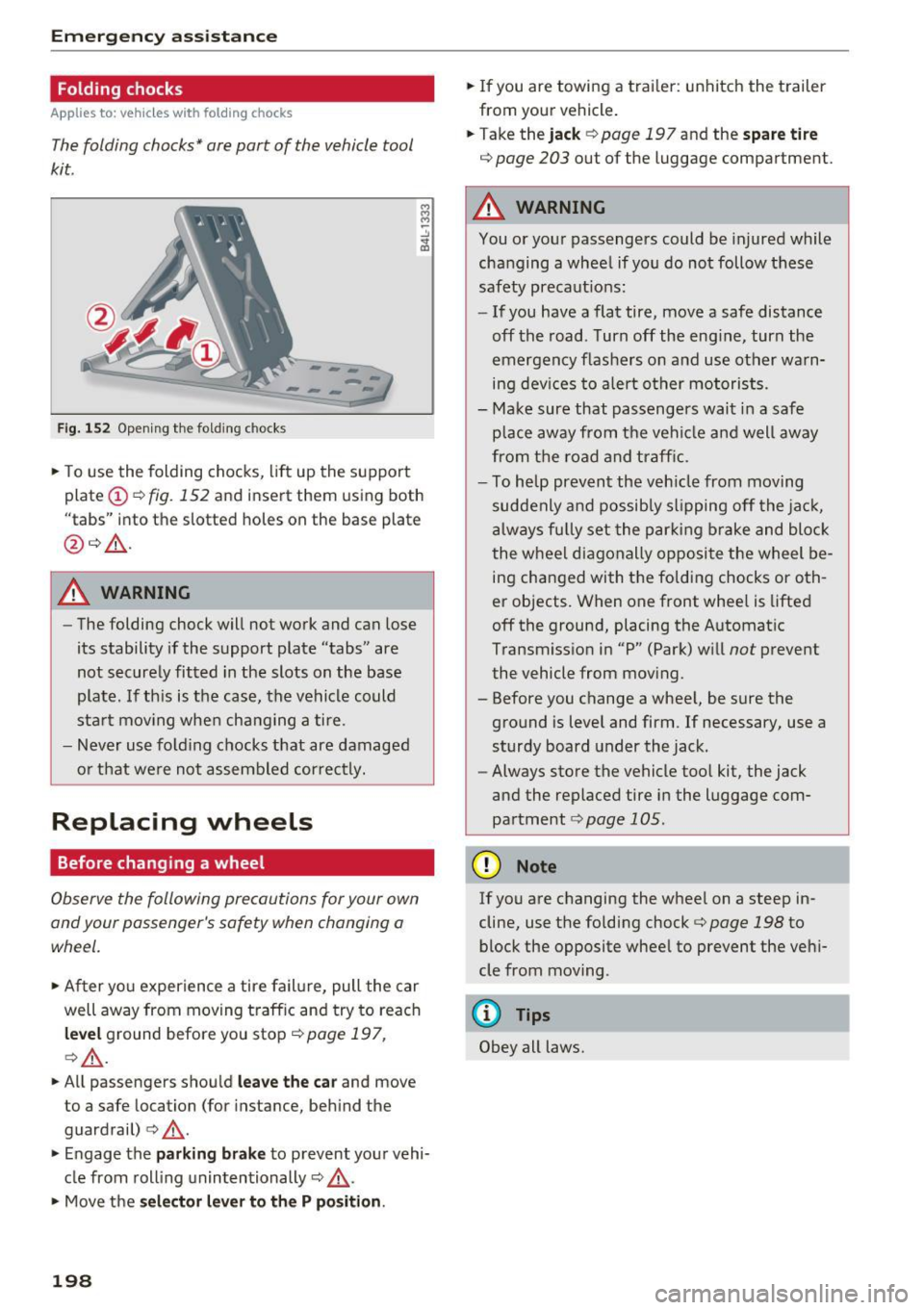
F ig. 152 Opening the fo lding chocks
• To use the folding chocks, lift up the support
plate (!)¢
fig. 152 and insert them using both
"tabs" into the slotted holes on the base plate
@ ¢_& .
A WARNING
-The folding chock will not work and can lose
its stability if the support plate "tabs" are
not securely fitted in the slots on the base
plate. If th is is the case, the vehicle could
start mov ing when changing a tire.
- Never use fo ld ing chocks that are damaged
o r that were not assembled cor rectly.
Replacing wheels
Before changing a wheel
Observe the following precautions for your own
and your passenger's safety when changing a
wheel.
• After you experience a tire failure, pull the car
well away from moving t raffic and try to reach
l ev el ground before you stop¢
page 197,
¢_& .
• All passengers shou ld leav e th e car and move
to a safe location (for instance, beh ind the
guardrail)
¢ _& .
• Engage the park in g br ake to prevent your vehi
cle from roll ing unintentionally ¢_& .
• Move the selec to r l eve r to the P po sition.
198
• If you are towing a trai ler : unhitch the t railer
from your veh icle.
• Take the jac k
¢page 197 and the sp are tire
¢
page 203 out of the luggage compartment.
A WARNING
You or your passengers could be injured while
changing a wheel if you do not follow these
safety precaut ions:
- If you have a flat tire, move a safe distance
off the road . Turn off the eng ine, turn the
emergency f lashers on and use other warn
ing dev ices to alert other motorists.
- Make sure that passengers wait in a safe
place away from the vehicle a nd well away
from the road and traff ic.
- To he lp prevent the veh icle from moving
suddenly and possib ly sl ipping off the jac k,
always fu lly set the par king b rake and block
the whee l diagonally opposite the wheel be
ing changed with the folding chocks or oth
er objects. When one front whee l is lifted
off the ground, placing the Automat ic
Transmission in "P" (Park) w ill
not prevent
the vehicle from moving.
- Before you change a whee l, be sure the
ground is level and firm . If necessary, use a
sturdy board under the jack.
- Always store the vehicle too l kit, the jack
and the replaced tire in the luggage com
partment
¢ page 105.
(D Note
If you are changing the wheel on a steep in
cline, use the folding chock¢
page 198 to
block the opposite whee l to prevent the vehi
cle from moving.
@ Tips
Obey all laws.
Page 202 of 236
Emergency assistance
Loosening and tightening the wheel bolts
The wheel bolts must be loosened before raising
the vehicle.
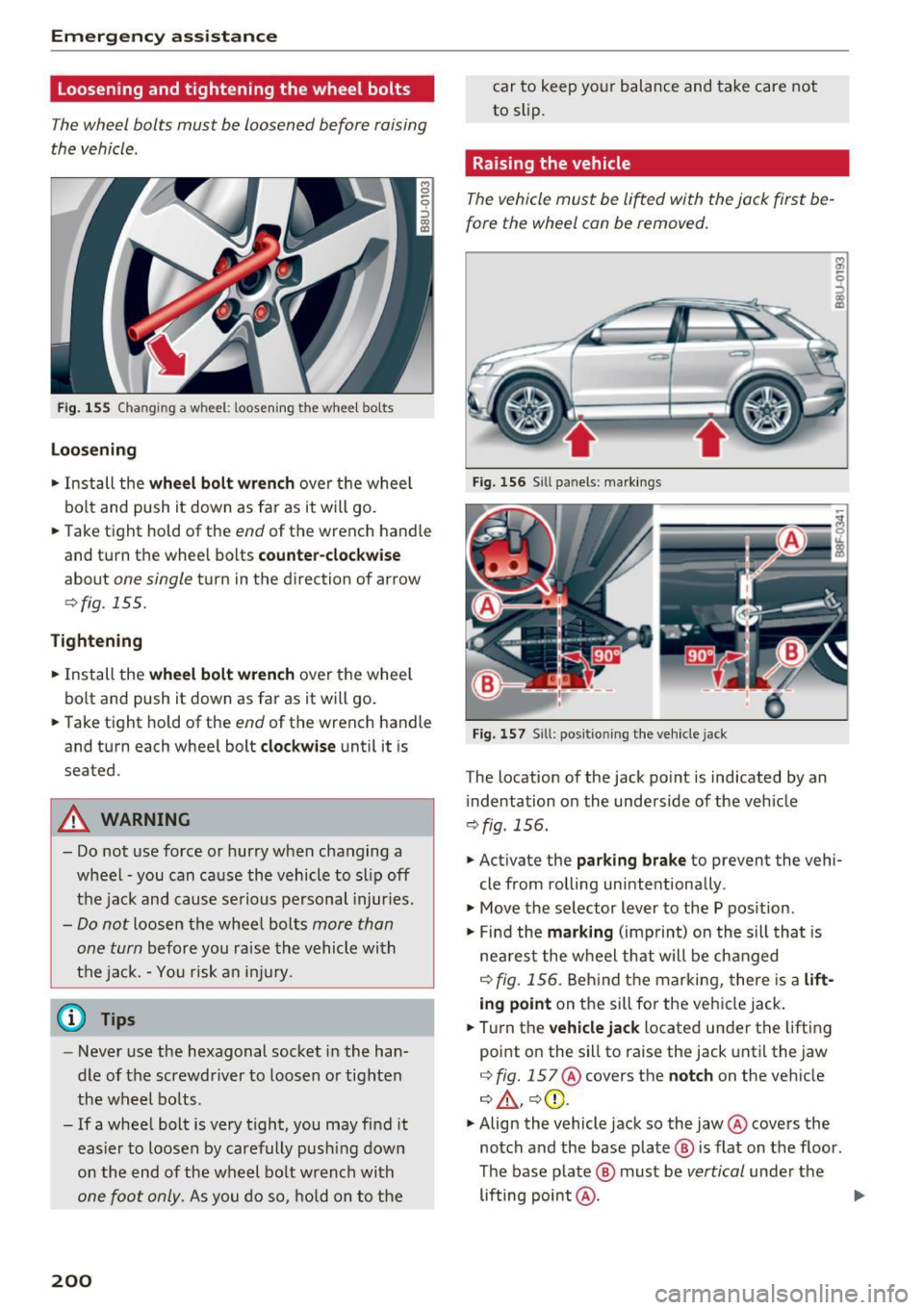
Fig. 1 55 Changing a w heel : loosening the w hee l bo lts
Loosening
• Inst all the wheel bolt wrench ove r th e whee l
bolt and push it down as far as i t will go.
• Take tight hold of the
end of the wrench handle
and turn t he whee l bolts
counter-clockwise
about one single turn in the d irection of arrow
q fig . 155.
Tightening
• Install the wheel bolt wrench over the whee l
bolt and push it down as far as it will go.
• Take tight hold of the
end of the wrench handle
and turn each whee l bolt
clockw ise until it is
seated.
A WARNING
- Do not use force or hurry when changing a
wheel· you can ca use the vehicle to sl ip off
t h e jack and cause s erious pe rsonal injur ies.
- Do not loosen the whee l bolts mo re than
one turn
before you ra ise th e vehicle with
t h e ja ck .· You risk an i njur y.
(O} Tips
-Neve r use the he xagonal socket i n the han
dle of the screwd river to loosen or tighten
th e w heel bo lts.
- If a wh ee l bolt is very t ight, you may fi nd it
eas ier to loosen by carefully push ing down
on th e end of th e wh eel bo lt wren ch wi th
one
fo ot on ly. As you do so, hold on to t he
200
car to keep yo ur ba lance and ta ke c are not
to slip.
Raising the vehicle
T he vehicle must be lifted wit h the jack first be
fore the wheel can be removed .
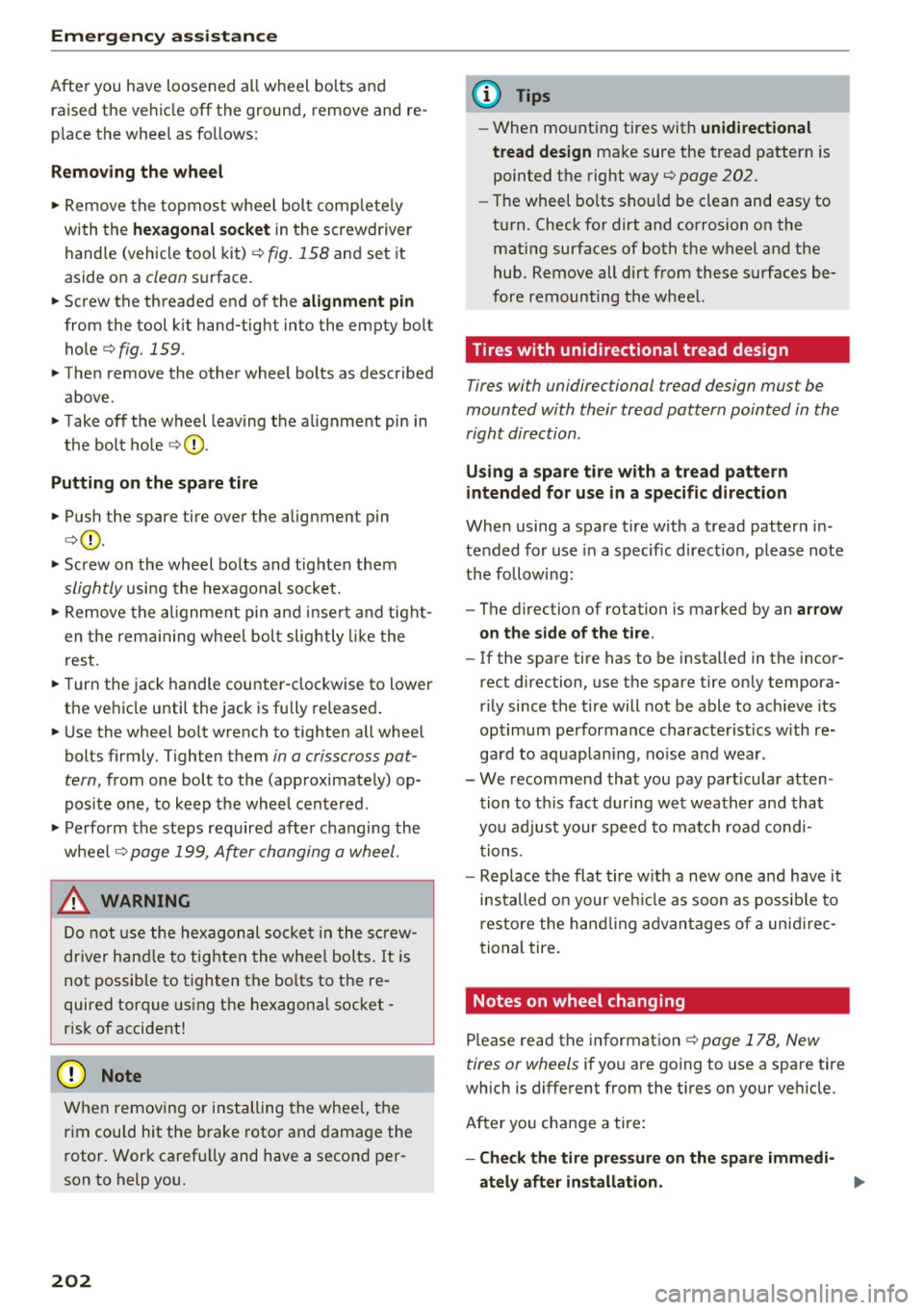
Fig. 156 S ill pa nels: mark in gs
Fig . 157 S ill : pos it io nin g the ve hicle jack
The location of the jack po int is indicated by an
i ndenta tion o n the underside of the veh icle
q fig . 15 6.
• Activate the parking brake to prevent the vehi
cle from rolling uninte ntionally .
• Mov e the se lector lever to the P pos it ion .
• Find the
marking (imp rint) on the s ill that is
nea res t the w heel th at will be ch anged
¢ fig. 156 . Beh ind t he marking, there is a lift
ing point on t he sill fo r the ve hicle jack .
• Tur n the
vehicle jack located un der the liftin g
point o n the sill to raise the jack until the jaw
¢ fig . 157 @covers the notch on the veh icle
¢ ,& , ¢(D .
• Align the vehicle jack so the jaw@ cove rs the
no tch and the base pla te ® is fla t on t he f loor .
Th e base p late @ must be
vertical unde r the
lif ting poin t@ . ..,_
Page 204 of 236
Emergency assistance
After you have loosened a ll wheel bo lts and
raised the vehicle off the ground, remove and re
p lace the whee l as fo llows:
Removing the wheel
.,. Remove the topmost wheel bol t comp letely
with the
he xagonal socket in t he screwd river
hand le (vehicle tool kit)
¢ fig. 158 and set it
aside on a
clean s ur face.
.,. Screw the threaded end of the
alignment pin
from the tool k it hand-tight into the empty bolt
hole¢
fig. 159 .
.,. The n remove the other wheel bolts as described
above.
.,. Take off the wheel leav ing the a lignment pin in
the bo lt hole ¢ 0.
Putting on the spare tire
.,. Push the spare tire over the alig nment pin
¢ (D .
.,. Screw on the wheel bo lts and tighten them
slightly using the hex agonal socke t.
.,. Remove the a lignment pi n an d in se rt an d tight
en t he rem aining wheel bol t slightly like the
res t.
.,. Turn the jack handle counter-clockwise to lower
the ve hicle until the jack is fully re leased .
.,. Use the wheel bolt wrench to tighten all wheel
bolts firmly. Tighten them
in a crisscross pat
tern,
from one bol t to the (app roximately) op
pos ite one, to keep the whee l cente red .
.,. Perfo rm the steps req uire d afte r changing the
whee l ¢
page 199, After changing a wheel.
&, WARNING
Do not us e the he xagon al so cke t in t he screw
dr iver han dle to tig hten the wheel bol ts . I t is
not poss ib le to tighten t he bo lts to the re
quired torque usin g t he he xagonal socket -
r is k of accident!
(D Note
W hen removi ng or inst alling the whee l, the
r im cou ld hit the brake roto r and dama ge t he
rotor . Work ca ref ull y and have a seco nd per
son to help you.
202
(D Tips
- When mo unting tires with unidirectional
tread design
make sure the trea d pattern is
pointed the right way¢
page 202.
-The wheel bolts s hould be clean an d easy to
t u rn. Check fo r dirt and corrosion on the
matin g surfaces of both the wheel and the
hub. Remove all dirt from these s urfaces be
fore remounting the whee l.
Tires with unidirectional tread design
Tires with unidirectional tread design mus t be
mounted with their tread pattern pointed in the
right direction .
Using a spare tire with a tread pattern
intended for use in a specific direction
When using a s pare tire w ith a t read patter n in
te nded for use in a specif ic direct ion, please note
t h e followi ng :
- The d irection of rotation is marked by an
arrow
on the side of the tire .
-If the spare tire has to be installed in the incor
rect direction, use the spare tire on ly tempora
r il y since the tire will not be able to ac hieve its
op timum performa nce characterist ics w ith re
gard to aquap la ni ng, no ise a nd wear.
- W e recommend that you pay part icu lar atten
t ion to th is fact d urin g we t wea ther an d that
you a djust your spee d to matc h road cond i
tion s.
- Rep lace the flat tire w it h a new one an d have it
inst alled o n your ve hicle as soon as possib le to
res tore the h andlin g advan tage s of a unidir ec
tional tire .
Notes on wheel changing
Please read t he informat ion ¢ pa ge 17 8, New
tires or wheels
if yo u ar e go ing to use a spare tire
which is d ifferent from the t ires o n your ve hicle.
A ft er yo u ch an ge a tire:
- Check the tire pressure on the spare immedi-
ately after installation. .,.
Page 208 of 236
Fuses and bulbs
(D Tips
- The following table does not list fuse loca
tions that are not used.
- Some of the equipment listed in the follow
ing tables applies only to certain model ver
sions or certain optional equipment.
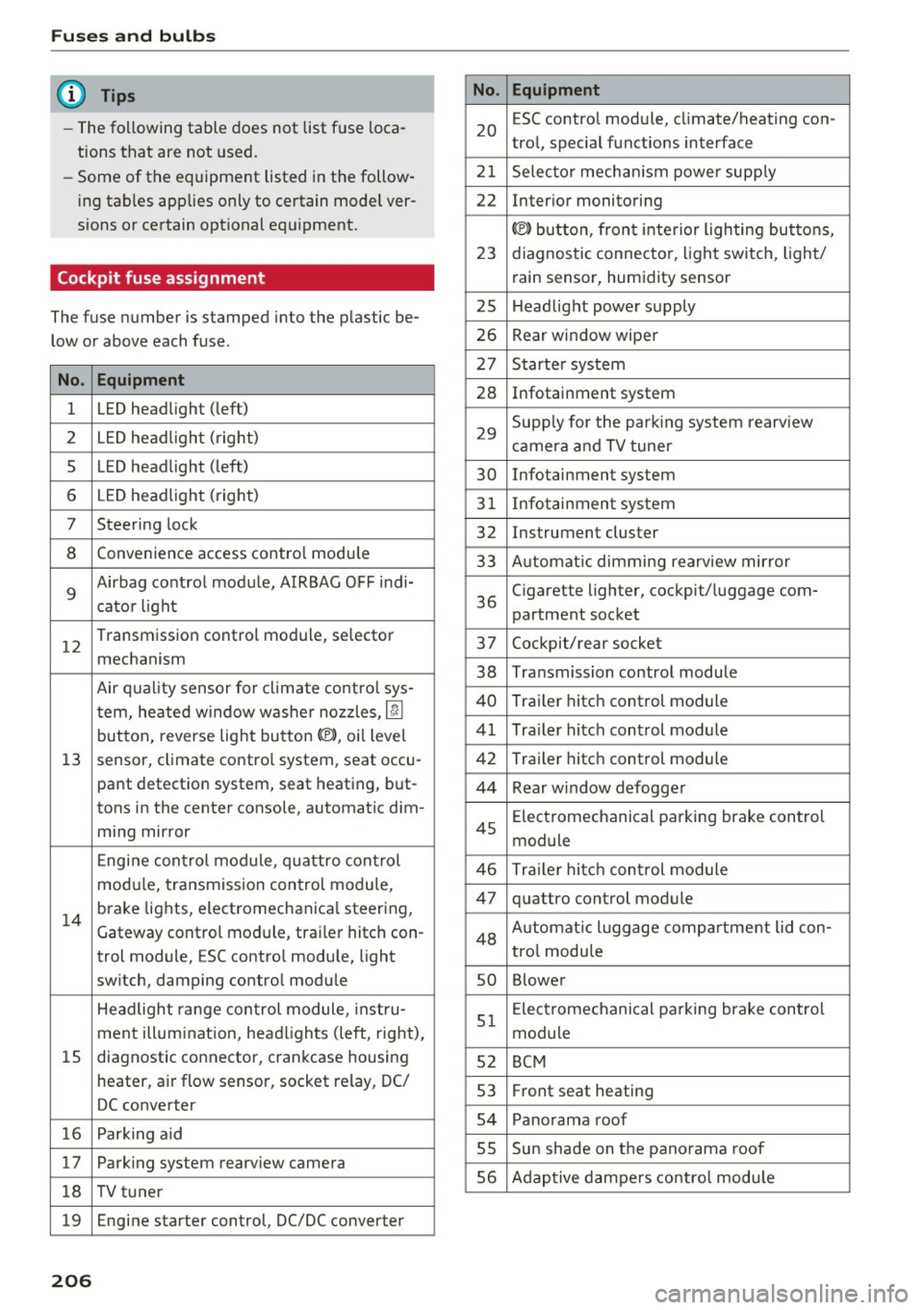
Cockpit fuse assignment
The fuse number is stamped into the plastic be
low or above each fuse.
No. Equipment
1 LED headlight (left)
2 LED headlight ( right)
5 LED headlight (left)
6 LED headlight (right)
7 Steering lock
8 Convenience access contro l module
9
Airbag control module, AIRBAG OFF indi-
cator light
12
Transmission control module, selector
mechanism
Air quality sensor for cl imate control sys-
tern, heated w indow washer nozzles ,
lj]
button, reverse light button<®>, oi l level
13 sensor, climate contro l system, seat occu-
pant detection system, seat heating, but-
tons in the center console, automatic dim-
ming mirror
Engine control module, quattro control
modu le, transmission control module,
14
brake lights, electromechanica l steering,
Gateway control module, trai ler hitch con-
trol module, ESC contro l module, light
switch, damping control module
Headlight range control module , instru-
ment illumination, headlights (left, right),
15 diagnostic connector, crankcase housing
heater, a ir flow sensor, socket relay, DC/
DC converter
16 Park ing aid
17 Parking system rearview camera
18 TV tuner
19 Engine starter control, DC/DC converter
206
No . Equipment
20
ESC contro l module, climate/heating con-
trol, special functions interface
21 Selector mechanism power supply
22 Interior monitoring
© button, front interior lighting buttons,
23 diagnostic connector, light switch, light/
rain sensor, humidity sensor
25 Headlight power supply
26 Rear window wiper
27 Starter system
28 Infotainment system
29
Supply for the parking system rearv iew
camera and TV tuner
30 Infotainment system
31 Infotainment system
32 Instrument cluster
33 A utomat ic dimming rearview mirror
36
Cigarette lighter, cockpit/luggage com-
partment socket
37 Cockpit/rear socket
38 Transmission control module
40 Trailer hitch control module
41 Tra iler hitch control module
42 Trailer hitch control module
44 Rear window defogger
45
Electromechanical parking brake control
module
46 Trailer hitch control module
47 quattro control module
48 Aut omat ic lu ggage compartment lid con-
tro l module
so Blower
51
Electromechanical parking brake control
module
52 BCM
53 Fr ont seat heating
54 Panorama roof
SS Sun shade on the panorama
roof
56 Adaptive dampers control module
Page 209 of 236
00
00
......
"' ,....
"' ...... 0 0 :::,
00
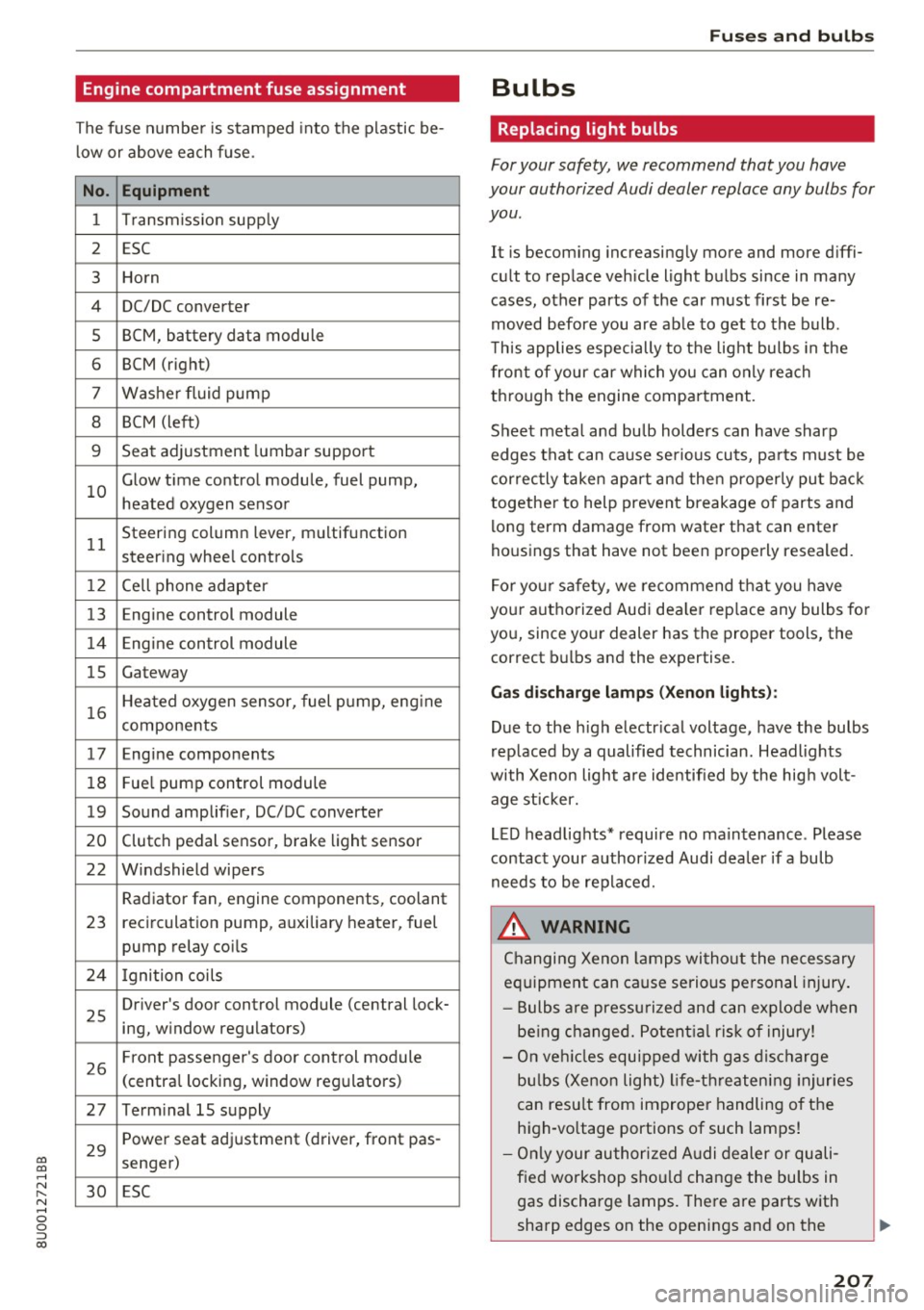
Engine compartment fuse assignment
The fuse number is stamped into the plastic be
low or above each fuse.
No. Equipment
1 Transmiss ion supply
2 ESC
3 Horn
4 DC/DC
converter
5 BCM, battery data module
6 BCM (right)
7 Washer fluid pump
8 BCM (left)
9 Seat adjustment lumbar support
10 Glow time
control module, fuel pump,
heated oxygen sensor
11 Steering
column lever, multifunction
steer ing whee l controls
1 2 Cell phone adapter
13 En
gine control module
14 Engine control module
15 Gateway
16 Heated oxygen sensor, fuel pump, eng
ine
components
17 Engine components
18 Fue
l pump control module
19 Sound amplifier, DC/DC converter
20 Clutch pedal sensor, brake light sensor
22 Windshield wipers Radiator fan, engine components, coolant
23 recirculation pump, auxiliary
heater, fuel
pump relay coils
24 Ignition coils
25 Driver's door
control module (central lock-
ing, window regulators)
26 Front passenger's door control module
(centra
l locking, window regulators)
27 Term inal 15 supply
29 Power seat adjustment (driver,
front pas-
senger)
30 ESC
Fu ses an d bulb s
Bulbs
Replacing light bulbs
For your safety, we recommend that you have
your authorized Audi dealer replace any bulbs for
you .
It is becoming increasingly more and more diffi
cult to replace vehicle light bulbs since in many
cases, other parts of the car must first be re
moved before you are able to get to the bulb .
T his applies especially to the light bulbs in the
front of your car which you can only reach
through the engine compartment .
Sheet metal and bu lb holders can have sharp
edges that can cause serious cuts, pa rts must be
correctly taken apart and then properly put back
together to help prevent breakage o f parts and
long term damage from water that can enter
housings that have not been properly resealed.
For your safety, we recommend that you have
your authorized Aud i dea ler rep lace any bulbs fo r
you, since your dealer has the proper tools, the
correct bulbs and the expertise.
Gas di schar ge la mps (Xe no n ligh ts):
Due to the high electr ical voltage, have the bulbs
rep laced by a qualified technician. Headlights
with Xenon light are identified by the hig h volt
age st icker.
LED headlights* require no maintenance . Please
contact your authorized Audi dea ler if a bulb
needs to be replaced.
_&. WARNING
Changing Xenon lamps wi thout the necessary
equipment can cause serious personal injury .
- Bulbs are pressu rized and can explode when
be ing changed. Potent ial ris k of injury!
- On veh icles equipped with gas disc harge
bu lbs (Xenon light) life-threatening injuries
can resu lt from improper handling of the
high-vo ltage portions of such lamps!
- Only your authorized A udi dealer or quali
f ied workshop sho uld change the bulbs in
gas discharge lamps. There are parts with
sharp edges on the openings and on the
207
Page 213 of 236
-Do not b end over the batteries -danger of
chemical burns!
- The battery cell locking screws must be
tightened securely.
- Before you check anyth ing in the engine
compartment, a lways read and heed all
WARNINGS
¢ page 159.
(D Note
Improper hook-up of jumper cables can ruin
the generator.
- Always connect POSITIVE(+) to POSITIVE
( + ), and NEGATIVE(-) to NEGATIVE(-)
ground post of the battery manager contro l
unit.
- Check that all screw p lugs on the battery
cells are screwed in firmly . If not, tighten
plugs prior to connecting clamp on negative
battery terminal.
- Please note that the procedure for connect
ing a jumper cable as described above ap
plies specif ically to the case of your vehicle
being jump started. When you are giv ing a
jump start to another vehicle, do
not con
nect the negative( -) cab le to the negative
(-) terminal on the discharged battery@
¢ fig. 165. Instead, securely connect the
negative (-) cable to either a solid metal
component that is firm ly bolted to the en
gine block or to the engine block itself. If
the battery that is being charged does not
vent to the outs ide, escaping battery gas
could ignite and explode!
Towing with a tow truck
General hints
Your Audi requires special handling for towing .
The follow ing information is to be used by com
mercial tow tr uck operators who know how to op
erate their equipment safely .
-Never tow your Audi, towing will cause dam-
age to the engine and transmission .
a:, ~ -Never wrap the safety chains or winch cables
~ around the brake lines. N
"" 0 0 ::, a:,
Emergency situations
-To prevent unnecessary damage , your Audi
must be transported with a flat bed truck.
- To load the vehicle on to the flat bed, use the
towing loop found in the vehicle tools and at·
tach to the front or rear anchorage
¢ page 211 and ¢ page 212.
A WARNING ~ -
A veh icle being towed is not safe for passen
gers . Never allow anyone to ride in a vehicle
being towed, for any reason .
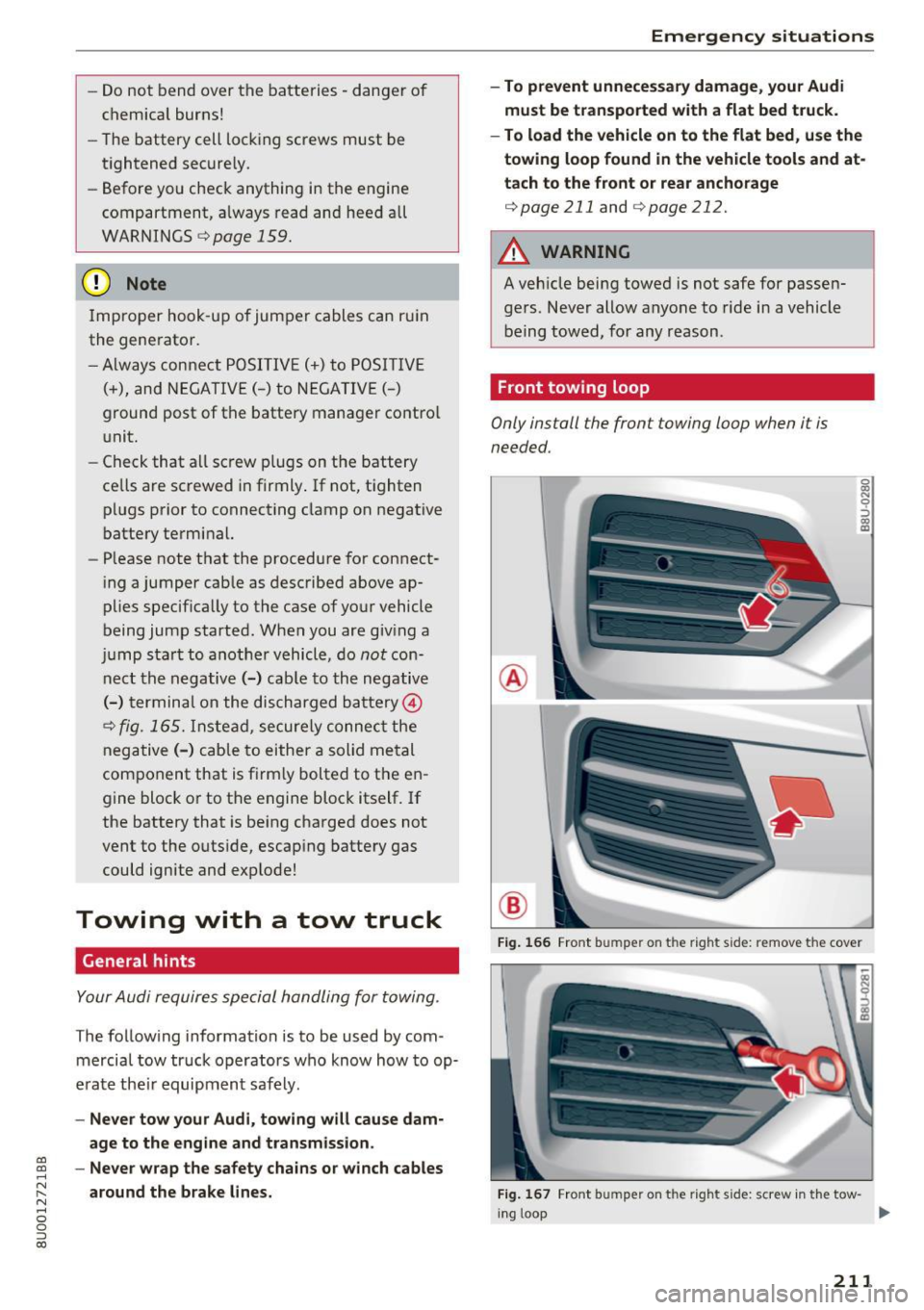
Front towing loop
Only install the front towing loop when it i s
needed.
®
®
0 0:, N 9 ::> 0:, a)
Fig. 166 Front bumpe r o n the right s ide: re move t he co ver
Fig. 167 Front bum pe r o n th e righ t side : screw in the tow-
in g loop ...
211