ESP AUDI Q3 2017 Owner´s Manual
[x] Cancel search | Manufacturer: AUDI, Model Year: 2017, Model line: Q3, Model: AUDI Q3 2017Pages: 236, PDF Size: 58.93 MB
Page 183 of 236
This can especially have a nega
tive effect on handling, on the
risk aquaplaning when driving
through water, when driving
through curves and when brak ing, which increase s the risk of
an accident.
Tire pressure
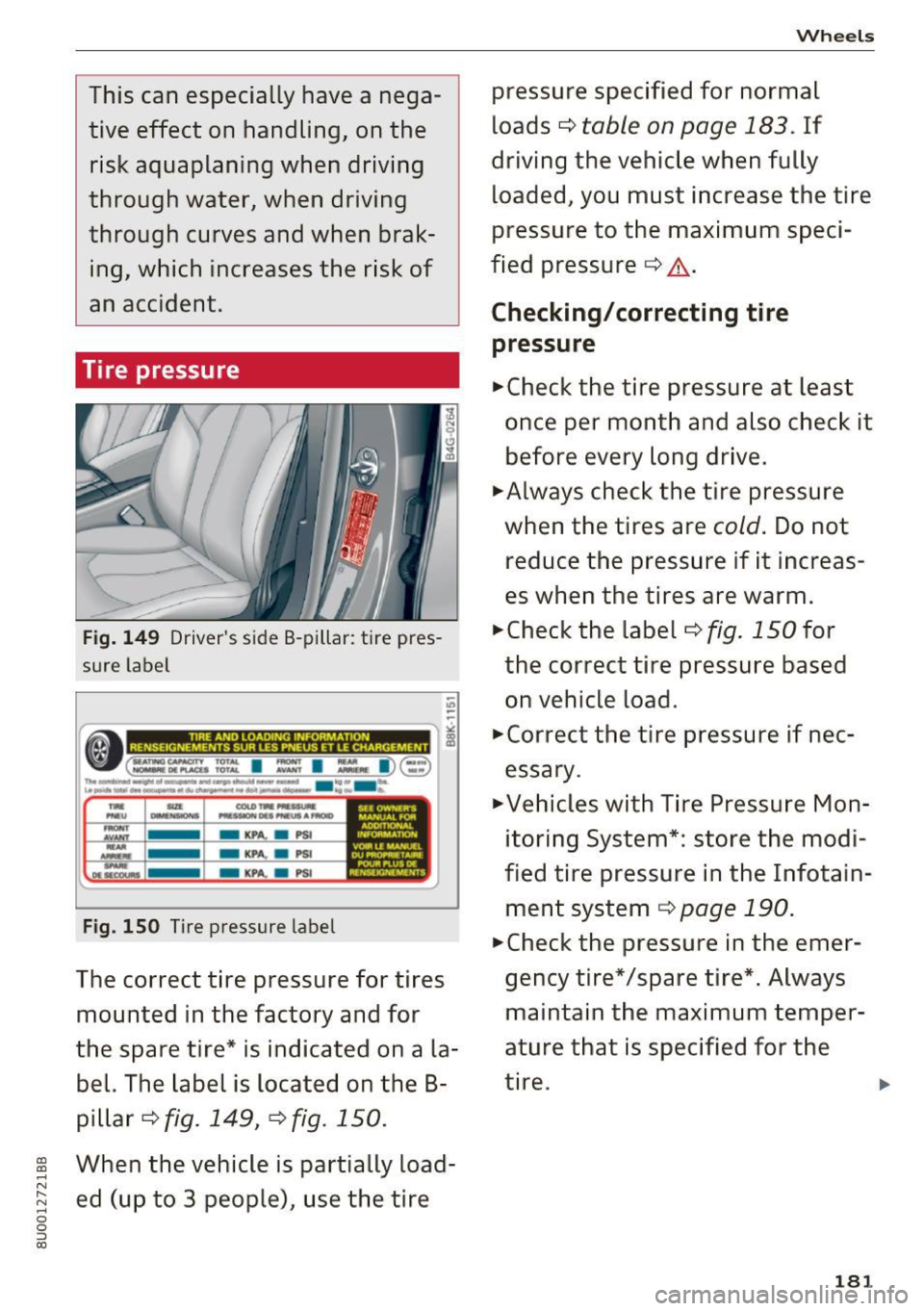
Fig. 149 Driver's side B-pillar: tire pres
sure label
-"' -,--------------- -
• ===========
= i (:=:=a : I =:: I :.. I) (':: ~) n,.......,.._,.,.. ......... _.__......, _ _.., .... _ ... l ................... . __.......... .......... ..._ .. .,,, ..
Fig. 150 Tire pressure label
The correct tire pressure for tires
mounted in the factory and for
the spare tire* is indicated on a la
bel. The label is located on the B
pillar ¢
fig. 149, ¢ fig. 150.
; When the vehicle is partially load-
N
~ ed (up to 3 people), use the tire
0 0 ::,
"'
Wheels
pressure specified for normal
loads¢
table on page 183. If
driving the vehicle when fully loaded, you must increase the tire
pressure to the maximum speci
fied pressure ¢.&, .
Checking/correcting tire
pressure
.,..Check the tire pressure at least
once per month and also check it before every long drive .
.,..Always check the tire pressure
when the tires are
cold. Do not
reduce the pressure if it increas
es when the tires are warm .
.,..Check the label ¢
fig. 150 for
the correct tire pressure based on vehicle load.
.,..Correct the tire pressure if nec
essary.
.,..Vehicles with Tire Pressure Mon
itoring System*: store the modi
fied tire pressure in the Infotain
ment system ¢
page 190.
.,..Check the pressure in the emer
gency tire* /spare tire* . Always
maintain the maximum temper
ature that is specified for the
tire. .,.
181
Page 189 of 236
00
00
......
"' ,....
"' ...... 0 0 :::,
00
& WARNING
Using incorrect snow chains or insta lling snow
chains incorrectly can result in loss of vehicle
control, which increases the risk of an acc i
dent.
(D Note
Snow chains can damage the rims/wheel cov
ers * if the chains come into direct contact
wit h them . Remove the wheel covers * first .
Use coated snow chains.
Low aspect ratio tires
Your Aud i is factory-equipped with low aspect ra
tio tires . These t ires have been thoroughly tested
and been se lected specifica lly for you r model for
the ir supe rb performance, road feel and handling
u nder a va riety of d riving conditions. As k yo ur au
thor ized Audi dealer for mo re de tails.
The low aspect ratio of these t ires is indicated by
a numera l of
55 or l ess in the tire's size desig na
tion . The numera l rep resents t he rat io of the
tire's sidewall he ight in rela tion t o its tread w idth
expressed in percen tage. Conventional t ires have
a height/w idth ratio of 60 or more .
The performan ce of low -aspect-r atio tire s is par
ticularly sen sitiv e to impr oper infla tion pre s
s ure . It is therefore important that low a spect
ratio tires are infl ated to the specified pressure
and that the inflation pre ssure is regularl y
checked and ma inta ined . Tire pre ssure s should
be checked at least once a month and alwa ys
before a long trip
c> page 181.
What you can do to avoid tire and rim damage
Low aspect rat io tires can be damaged more easi
ly by impact with potholes, curbs, gul lies or
ridges on the road, pa rticularly if the tire is un
de rinflated .
In order to minimize the occurrence of impact
damage to the t ires of your ve hicle, we recom
mend that you observe the follow ing precau
tions:
Wh eel s
-Always maintain recommended inflat ion pres
sures . Check your tire pressure every 2,000
m iles (3,000 km) and add air if necessary .
- Drive carefully on roads wit h potholes, deep
gu llies or ridges . T he impact from dr iving
through or over such obstacles can damage
your tires. Impact with a curb may a lso cause
damage to your tires.
-After any impact, immed iate ly inspect your
tires or have them inspected by the nearest au
thorized Audi dealer . Replace a damaged tire as
soon as possible .
- Inspect your tires every 2,000 m iles (3,000 km)
for damage and wear. Damage is not a lways
easy to see . Damage can lead to loss of a ir and
unde rinflat ion, wh ic h could eventually cause
t ire fa ilu re . If yo u be lieve th at a t ire may have
been damaged, repla ce the tire as soon as pos
sible.
- These tires may we ar mo re quickly tha n others.
- Please also remember that, while these tires
de live r responsive ha nd ling, they may ride less
comfort ably and make more noise t han other
choices .
Reduced performance in winter/cold season
conditions
All t ires are des igned for certai n pu rposes. The
l ow aspect ratio, ultra h igh performance tires
origina lly installed on your vehicle are intended
for maximum dry and wet road performance and handling. They are not suitable for co ld, snowy or
icy weather conditions. If you drive under those
c ircumstances, you should equip your vehicle
with all-season or winter tires, which offer better
t ract ion under those conditions . We suggest you
u se the recommended s now or a ll-season tires
spe cified for your veh icle, o r the ir equiva lent.
Refer to
c> page 186 for more detailed informa
t ion regard ing winter tires.
Uniform tire quality grad ing
- Tread wear
- Traction AA ABC
- Temperature ABC
187
Page 190 of 236
Wheels
Quality grades can be found where applicable on
the tire side wall between tread shoulder and maximum section width
¢ page 171, fig. 147.
For example: Tread wear 200, Traction AA, Tem
perature
A.
All passenger car tires must conform to Federal
Safety Requirements in addition to these grades.
Tread wear
The tread wear grade is a comparative rating
based on the wear rate of the tire when tested
under controlled conditions on a specified gov
ernment test course.
For example, a tire graded 150 would wear one
and one half (1 1/2) times as well on the govern
ment course as a tire graded 100.
The relative performance of tires depends upon
the actual conditions of their use, however, and may depart significantly from the norm due to
variations in driving habits, service practices and differences in road characteristics and climate.
Traction
The traction grades, from highest to lowest, are
AA, A, Band
C. Those grades represent the tire 's
ability to stop on wet pavement as measured un
der controlled conditions on specified govern ment test surfaces of asphalt and concrete. A tire
marked C may have poor traction performance
¢&_ .
Temperature
The temperature grades are A (the highest), B,
and C, representing the tire's resistance to the
generation of heat and its ability to dissipate heat when tested under controlled conditions on
a specified indoor laboratory test wheel.
Sustained high temperature can cause the mate rial of the tire to degenerate and reduce tire life,
and excessive temperature can lead to sudden
tire failure ¢&. .
The grade C corresponds to a level of perform
ance which all passenger car tires must meet un
der the Federal Motor Vehicle Safety Standard
No. 109 . Grades Band A represent higher levels
188
of performance on the laboratory test wheel than
the minimum required by law.
A WARNING -
The traction grade assigned to this tire is
based on straight-ahead braking traction
tests, and does not include acceleration, cor nering, hydroplaning or peak traction charac
teristics .
A WARNING
The temperature grade for this tire is estab
lished for a tire that is properly inflated and
not overloaded. Excessive speed, underinfla
tion, or excessive loading, either separately or
in combination, can cause heat buildup and
possible tire failure.
A WARNING
Temperature grades apply to tires that are properly inflated and not over or underinflat
ed.
Tire pressure monitoring system
(l) General notes
Appl ies to: vehicles with tire pressure mon itoring system
-
Each tire, including the spare (if provided),
should be checked monthly when cold and inflat
ed to the inflation pressure recommended by the
vehicle manufacturer on the vehicle placard or
tire inflation pressure label. (If your vehicle has
tires of a different size than the size indicated on
the vehicle placard or tire inflation pressure la
bel, you should determine the proper tire infla
tion pressure for those tires).
As an added safety feature, your vehicle has been
equipped with a tire pressure monitor ing system
(TPMS) that illuminates a low tire pressure tell
tale when one or more of your tires is significant-
ly under-inflated. Accordingly, when the low tire
pressure telltale illuminates, you should stop and
check your tires as soon as possible, and inflate
them to the proper pressure . Driving on a signifi
cantly under-inflated tire causes the tire to over
heat and can lead to tire failure . Under-inflation ..,.
Page 192 of 236
Wheels
- The driver is responsib le for maintaining the
correct tire pressure. You must check the
t ire pressure regu larly.
- Under certain conditions (such as a sporty
dr iv ing style, winter cond itions o r unpaved
roads), the pressure mon itor indicator may
be delayed.
- Do not use r un-flat tires on your vehicle. Us
ing them when not permitted can lead to
vehicle damage or accidents.
@ Tips
- The t ire pressure monitoring system can al
so stop work ing when there is an ESC mal
funct ion.
- Using snow chains may result in a system
malfunction.
- The t ire pressu re monitoring system in your
A udi was calib rated with "A udi Orig inal
Tires"¢ page
178. We recommend t hat you
use these t ires.
Storing tire pressures
A pp lies to: ve hicles w ith Tire P ress ure Monitoring System in
di cato r
.-Make sure before storing that the tire pressures
of a ll fo ur t ires meet the spec ified val ues and
are adapted to the load¢ page
179 .
.-Switc h the ign ition on .
.- Se lect: the
ICARI function button > (Car ) Sys
tems * co ntro l bu tton > Servicing & che cks >
Tire pre ssure monitoring > Store tire p ressures
> Ye s, s tore now.
(D Tips
Do not store the tire press ures if snow c hains
are insta lled.
190
Page 193 of 236
00
00
......
"' ,....
"' ...... 0 0 :::,
00
Care and cleaning
General information
Regular, proper care helps to maintain your vehi
cle's value. It can a lso be a requirement when
submitting warranty claims for corrosion damage
and paint defects on the body.
The necessary care products can be obtained
from an authorized Audi dealer or authorized
Audi Service Facility . Read and follow the instruc
tions for use on the packaging.
A WARNING
- Us ing clean ing and care products incorrectly
can be dangerous to your health.
- Always store clean ing and care products out
of reach of children to reduce the r isk of po i
son ing .
@ For the sake of the environment
- Preferably purchase env ironmenta lly-friend
l y cleaning products.
- Do not d ispose of leftover cleaning and care
products with household trash.
Car washes
T he longer that deposits remain on the vehicle,
the more the surface may be damaged. High
temperatures such as those caused by sunlight increase the damag ing effect.
Befor e washing, rinse
off heavy depos its with
p lenty of water.
S tubborn depos its such as bird droppings or tree
sap are best removed with plenty of water and a
microfiber cloth.
A lso, wash t he un derside of yo ur vehicle once
road sa lt stops being used for the season .
Pressure washers
When washing your ve hicle w ith a pressure wash
e r, a lways fo llow the operating instructions pro
vided wi th the p ressure washer. This is especially
i mportant in rega rd to the pressure and sp raying
d istance . Do not aim the spray directly at seals on
side windows, doors, the hood, the luggage com-
Ca re and cleaning
partment lid or the panorama glass roof* or at
tires, rubber hoses, insulating material, sensors *
o r camera lenses* . Keep a distance of at least 16
in
(40 cm).
Do not remove snow and ice with a pressure
washer.
Never use cone nozz les o r high press ure nozzles .
T he water temperatu re must not be above
140 °F
(60 °().
Automatic car washes
Spray off the vehicle before washing.
Make s ure that the windows and roo f* are closed
and the windshie ld wipers are
off . Follow instruc
tions from the car wash ope rator, especially if
there are accessories attached to your vehicle.
If possible, use car washes that do not have
brushes .
Washing by hand
Clean the ve hicl e starting from the top and wor k
i ng down using a soft sponge o r cleaning br ush.
U se solven t-free cleaning produ cts.
Washing vehicles with matte finish paint by
hand
T o avo id damag ing the pa int w hen washi ng, fi rst
remove dust and large pa rticl es from you r vehi
cle . Insects, grease spots and fingerprints are
best removed w ith a special cleaner for matte
finish paint.
Apply t he product using a microf iber cloth . To
avoid damaging the paint surface, do not use too
much pressure.
Rinse the ve hicl e thoroug hly w ith wate r. Then
cl ean usi ng a neutral shampoo and a soft micro
fiber cloth .
Rinse the ve hicl e thorough ly aga in and let it air
dry. Remove any wate r residue using a chamois.
WARNING
-On ly wash the vehicle when the ign ition is
off and follow the instr uctions from the car
191
Page 195 of 236
00
00
.-I
"' ,....
"' ...... 0 0 :::,
00
Care and cleaning
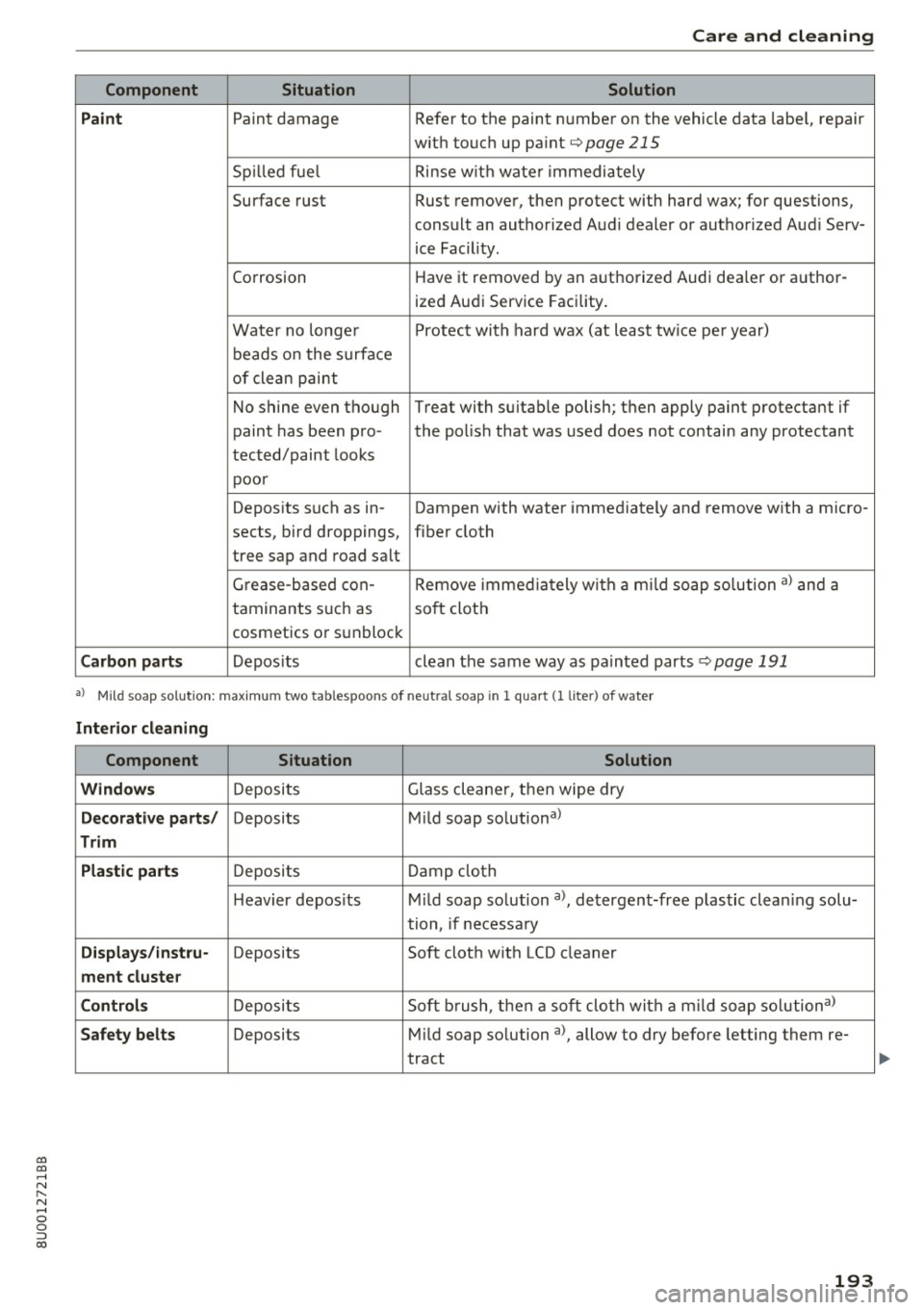
Component Situation Solution
Paint
Paint damage Refer to the paint number on the vehicle data label, repair
w ith touch up pa int
c;,poge 215
Spilled fuel Rinse with wate r immediately
Surface rust Rust remover, then protect with hard wax; for questions,
consult an authorized Audi dealer or authorized Audi Serv-
ice Facility.
Corrosion Have
it removed by an authorized Audi dea ler or author-
ized Audi Service Facility.
Water no longer Protect with hard wax (at least twice per year)
beads on the surface
of clean paint
No shine even though Treat with su itable polish; then apply paint protectant if
paint has been pro- the polish that was used does not contain any protectant
tected/paint looks poor
Deposits such as in -Dampen with water immediately and remove w ith a micro-
sects, bird droppings, fiber clloth
tree sap and road salt
Grease-based con- Remove
immediat ely with a mild soap so lution
al and a
taminants such as soft cloth
cosmetics or sunblock
Carbon parts Depos its clean the same way as painted parts c;, page 191
a) Mild soap solution: max im um two tablespoons of neutral soap in 1 quar t (1 liter) of water
Interior cleaning
Component Situation Solution
Windows
Deposits Glass cleaner, then wipe dry
Decorative parts/ Deposits Mild soap solutiona>
Trim
Plastic parts
Deposits Damp cloth
He avier deposits Mild soap solution a), detergent-free plastic clean ing solu-
tion, if necessary
Oisplays/instru -Deposits Soft
cloth with LCD cleaner
ment cluster
Controls
Deposits Soft brush, then a soft
cloth with a mild soap solutiona>
Safety belts Deposits Mild
soap solution al, allow to dry before letting them re-
tract
193
Page 196 of 236
Care and cleaning
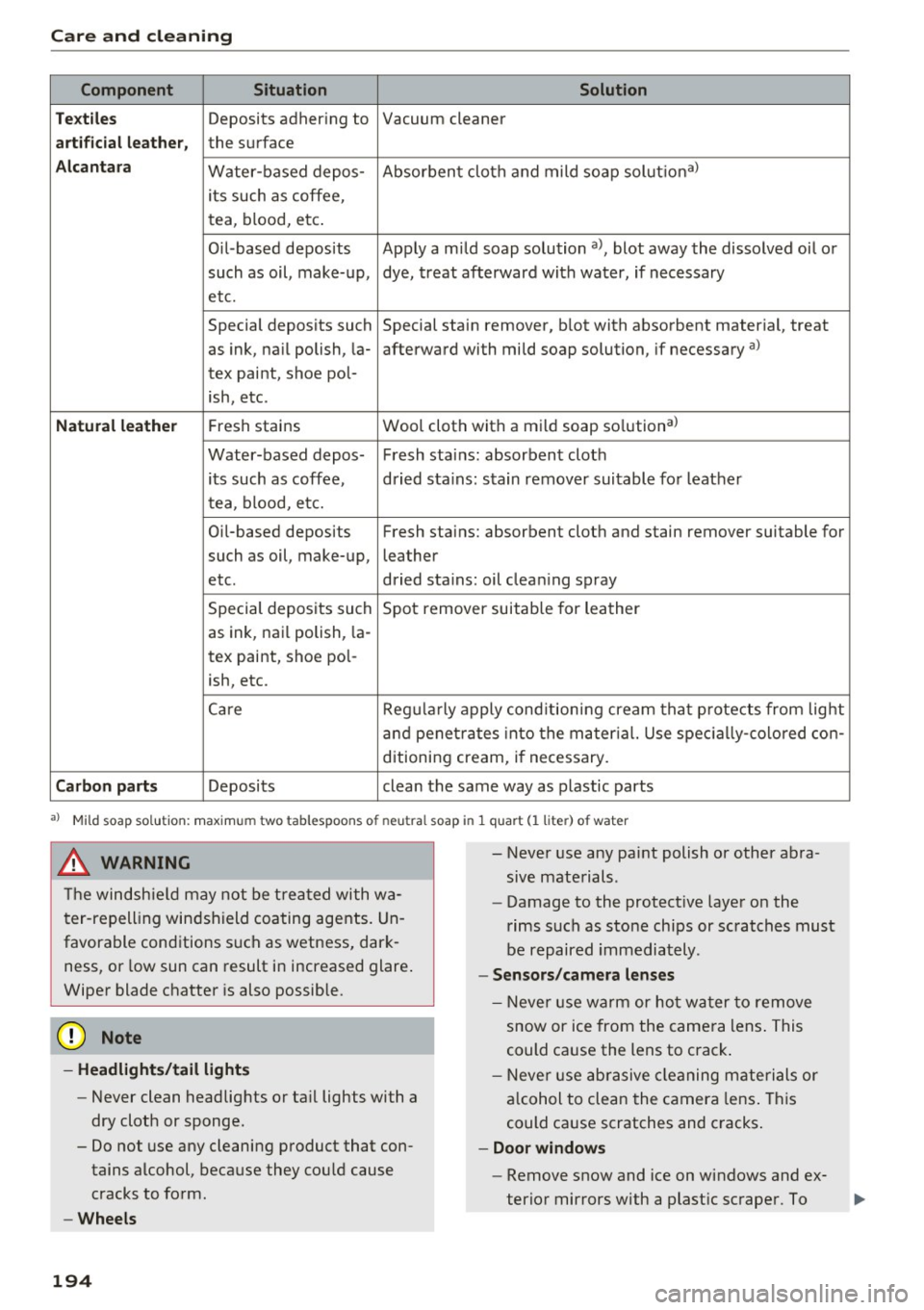
Component Situation Solution
Te xtil es
Deposits adhering to Vacuum cleaner
artifi cial le ather , the surface
Alcan tara Water-based depos- Absorbent cloth and mild soap
solutional
its such as coffee,
tea, blood, etc.
O il-based deposits Apply a mild soap solution a), blot away the dissolved oil o r
such as oil, make-up, dye, treat afterward with water, if necessary
etc.
Special deposits such Special sta ,in remover, blot with absorbent material, treat
as ink, na il polish, la- afterward with mild soap solution, if necessary al
tex paint, shoe pol-
ish, etc.
Natural leather Fresh stains Wool cloth with a m
ild soap solutional
Water-based depos- Fresh stains: absorbent cloth its such as coffee, dried sta ins: stain remover suitable fo r leather
tea, blood, etc.
Oil-based deposits Fresh stains: absorbent cloth and stain remover suitable for
such as oil, make-up, leather
etc. dried sta
ins: oil clean ing sp ray
Special deposits such Spot remover suitable for leather
as ink, nai l polish, la -
tex paint, shoe pol-
ish, etc.
Ca re Regularly apply cond itioning cream tha t protects from light
a nd penetr ates into the ma ter ial. Use spec ia lly-co lored con -
ditioning cream, i f necessary.
Carbon parts Deposits clean the same way as plastic parts
a) Mild soap sol ution: maxim um two tablesp oons of neutral soap in 1 quart (l liter) of water
_& WARNING
The windshie ld may not be trea ted with w a
ter-repelling windshield coating agents. Un
favorable conditions s uch as wetness, dark
ness, or low sun can result in increased glare .
Wiper blade chatter is also possib le.
(D Note
- Headlights/tail light s
-Never clean headlights or ta il lights with a
dry cloth or sponge.
- Do not use any cleaning p roduct that con
tains alcohol, because they cou ld cause
cracks to form.
- Wheels
194
-
- Never use any paint polish or other abra
sive materials.
- Damage to the protect ive layer on the
rims such as stone chips or scratches must
be repaired immediately.
- Sensors /camera lenses
- N ever use wa rm or ho t wa ter to remove
snow or ice from the camera lens . This
could ca use the lens to crack .
- N eve r use abrasive cleaning m aterials or
a lcohol to clea n the camera lens . This
could cause scratches and c racks .
-Door windows
- Remove snow and ice on windows and ex-
terior mirrors with a plast ic scraper. To
Page 199 of 236
a:,
a:,
...... N r--. N .-< 0 0 ::, a:,
Emergency assistance
General information
.. Park the vehicle as far as poss ible from moving
traffic in the event of a breakdown. In the event
of a flat tire, park the vehicle on a leve l surface .
It you are on a steep h ill, be especially careful.
.. Set the parking brake .
.. Switch the emergency flashe rs on .
.. Put on a reflective vest .
.. Set up the warn ing triang le, if available .
.. Have the passengers exi t the veh icle. They
sho uld move to a safe place, for example be
hind a guard rail.
_& WARNING
Follow the steps given above. This is for your
protection and the for the safety of other d riv
ers.
_& WARNING
Improper use of the vehicle jack can cause se
rious personal injuries .
- Never use the screw driver hex head to
t ighten whee l bolts, since the bolts cannot
attain the necessary tighten ing torque if you
use the hex head, potentially causing an ac
c ident .
- The factory-supplied jack is intended only
for your vehicle model. Under no circum
stances should it be used to lift heavy
vehicles o r other loads; yo u ris k inju ring
yo urself.
- Never start the engine when the vehicle is
ra ised, which could cause a n accident.
- Support the veh icle secure ly with app ropr i
a te s tan ds if wor k is to be performed under
neath t he vehicle; otherwise, the re is a po
tent ial ris k for i njur y.
- Never use the jack s upplied with yo ur Audi
on another vehicle, pa rtic ularly o n a heav ie r
one. The jack is only suitable for u se on the
vehicle it came wit h.
Emergen cy a ssis tanc e
Equipment
Vehicle tool kit
Fig. 151 Lu gg age compartmen t: cargo floo r cove r fo lded
u pwa rd
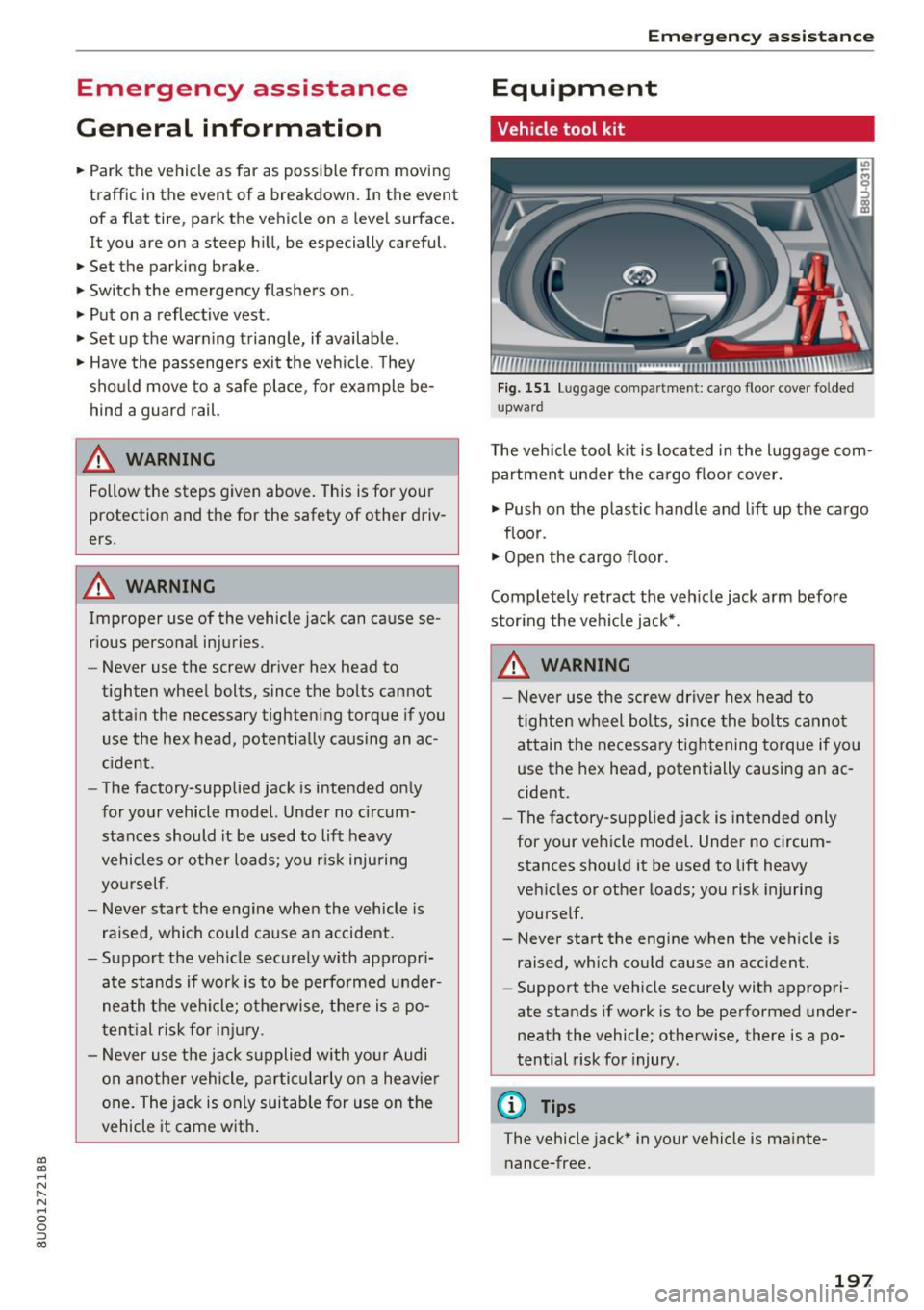
T he veh icle tool k it is located in the luggage com
partment under the cargo floor cover.
.. Push on the p lastic handle and lift up the cargo
floor .
.. Open the cargo floor.
Completely retract the veh icle jack a rm before
stor ing the ve hicle jack*.
_& WARNING
- Never use the screw driver hex head to
tighten wheel bo lts, since the bolts cannot
attain the necessary tightening torque if yo u
use the hex head, potentially causing an ac
cident.
- The factory-supp lied jack is intended only
for your ve hicle model. Under no circum
stances shou ld it be used to lift heavy
veh icles or other loads; you risk injuring
yourse lf.
- Never start the engine when the ve hicle is
raised, which could cause an accident.
- Support the vehicle securely with appropri
ate stands if wo rk is to be performed under
neath the vehicle; otherwise, there is a po
tential risk fo r injury .
@ Tips
The vehicle jack * in your vehicle is mainte
nance-free.
197
Page 209 of 236
00
00
......
"' ,....
"' ...... 0 0 :::,
00
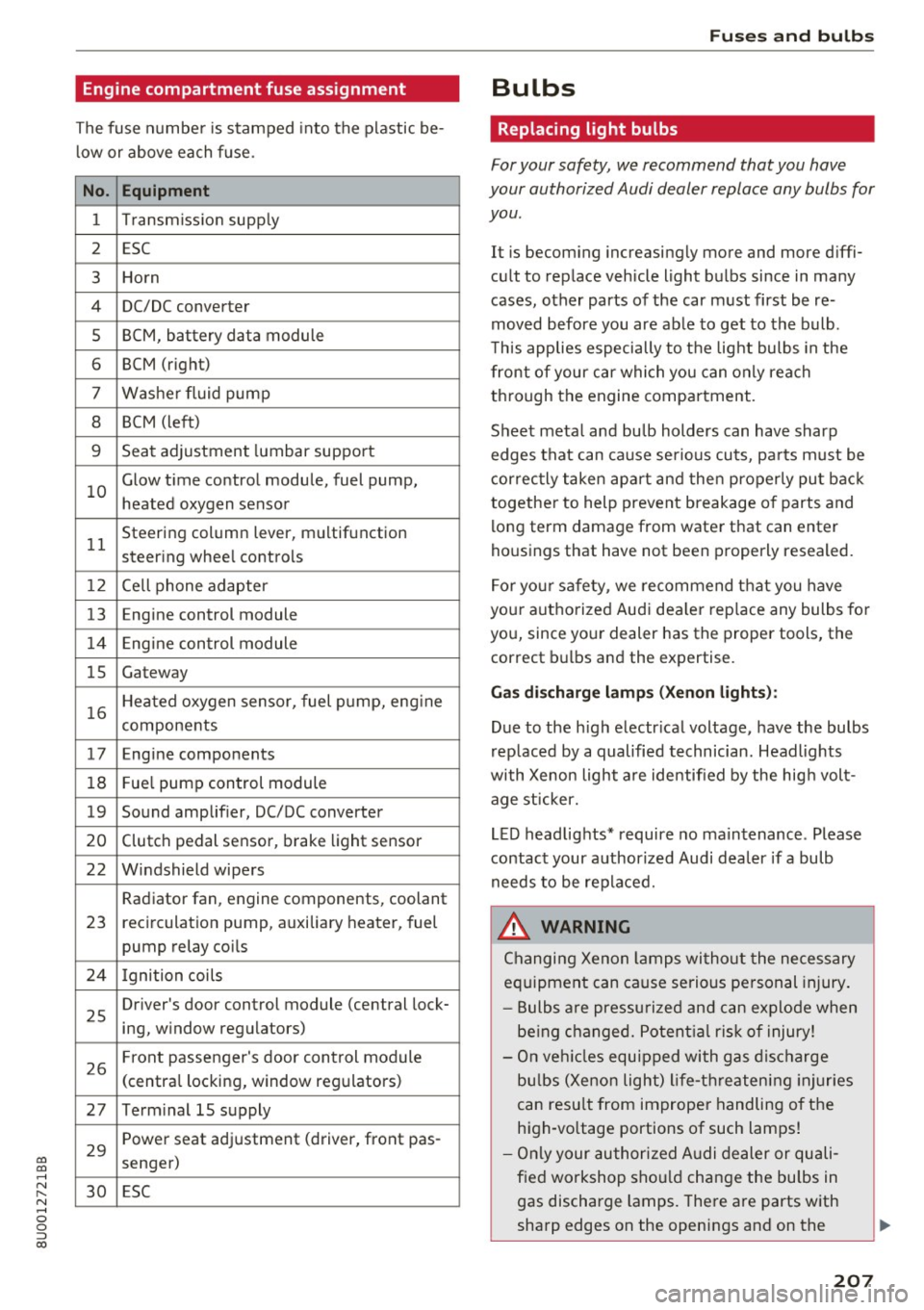
Engine compartment fuse assignment
The fuse number is stamped into the plastic be
low or above each fuse.
No. Equipment
1 Transmiss ion supply
2 ESC
3 Horn
4 DC/DC
converter
5 BCM, battery data module
6 BCM (right)
7 Washer fluid pump
8 BCM (left)
9 Seat adjustment lumbar support
10 Glow time
control module, fuel pump,
heated oxygen sensor
11 Steering
column lever, multifunction
steer ing whee l controls
1 2 Cell phone adapter
13 En
gine control module
14 Engine control module
15 Gateway
16 Heated oxygen sensor, fuel pump, eng
ine
components
17 Engine components
18 Fue
l pump control module
19 Sound amplifier, DC/DC converter
20 Clutch pedal sensor, brake light sensor
22 Windshield wipers Radiator fan, engine components, coolant
23 recirculation pump, auxiliary
heater, fuel
pump relay coils
24 Ignition coils
25 Driver's door
control module (central lock-
ing, window regulators)
26 Front passenger's door control module
(centra
l locking, window regulators)
27 Term inal 15 supply
29 Power seat adjustment (driver,
front pas-
senger)
30 ESC
Fu ses an d bulb s
Bulbs
Replacing light bulbs
For your safety, we recommend that you have
your authorized Audi dealer replace any bulbs for
you .
It is becoming increasingly more and more diffi
cult to replace vehicle light bulbs since in many
cases, other parts of the car must first be re
moved before you are able to get to the bulb .
T his applies especially to the light bulbs in the
front of your car which you can only reach
through the engine compartment .
Sheet metal and bu lb holders can have sharp
edges that can cause serious cuts, pa rts must be
correctly taken apart and then properly put back
together to help prevent breakage o f parts and
long term damage from water that can enter
housings that have not been properly resealed.
For your safety, we recommend that you have
your authorized Aud i dea ler rep lace any bulbs fo r
you, since your dealer has the proper tools, the
correct bulbs and the expertise.
Gas di schar ge la mps (Xe no n ligh ts):
Due to the high electr ical voltage, have the bulbs
rep laced by a qualified technician. Headlights
with Xenon light are identified by the hig h volt
age st icker.
LED headlights* require no maintenance . Please
contact your authorized Audi dea ler if a bulb
needs to be replaced.
_&. WARNING
Changing Xenon lamps wi thout the necessary
equipment can cause serious personal injury .
- Bulbs are pressu rized and can explode when
be ing changed. Potent ial ris k of injury!
- On veh icles equipped with gas disc harge
bu lbs (Xenon light) life-threatening injuries
can resu lt from improper handling of the
high-vo ltage portions of such lamps!
- Only your authorized A udi dealer or quali
f ied workshop sho uld change the bulbs in
gas discharge lamps. There are parts with
sharp edges on the openings and on the
207
Page 218 of 236
Tech nical data
A WARNING
- The actual Gross Axle Weight Rating at the
front and rear axles should not exceed the
permissible weights, and their comb inat ion
must not exceed the Gross Veh icle Weight
Rating .
- Exceeding pe rm iss ible weight ratings can
resu lt in ve hicle damage, acc idents a nd per
so nal inj ury.
([) Note
- The vehicle capacity weight figures app ly
when the load is distributed evenly in the
vehicle (passe ngers and luggage). When
transporting a heavy load in the lugg age
compartment, carry the load as near to the
rear axle as possible so that the vehicle's
handling is not impaire d.
- Do not exceed the maximum permissib le
axle loads o r the maximum gross vehicle
Dimensions
we ight . A lways remember that the vehi cle's
hand ling will be affected by the extra load.
Therefore, adjust your speed according ly .
- Always observe local regulations .
Notes about technical
data
The values may differ for some markets depend
i ng on equ ipment installed in certain markets
and the measur ing methods .
P lease note that the specifications listed in the
vehicle documentat ion a lways take precedence.
(D Tips
Missing technical data was not ava ilable at
the time of pr int ing.
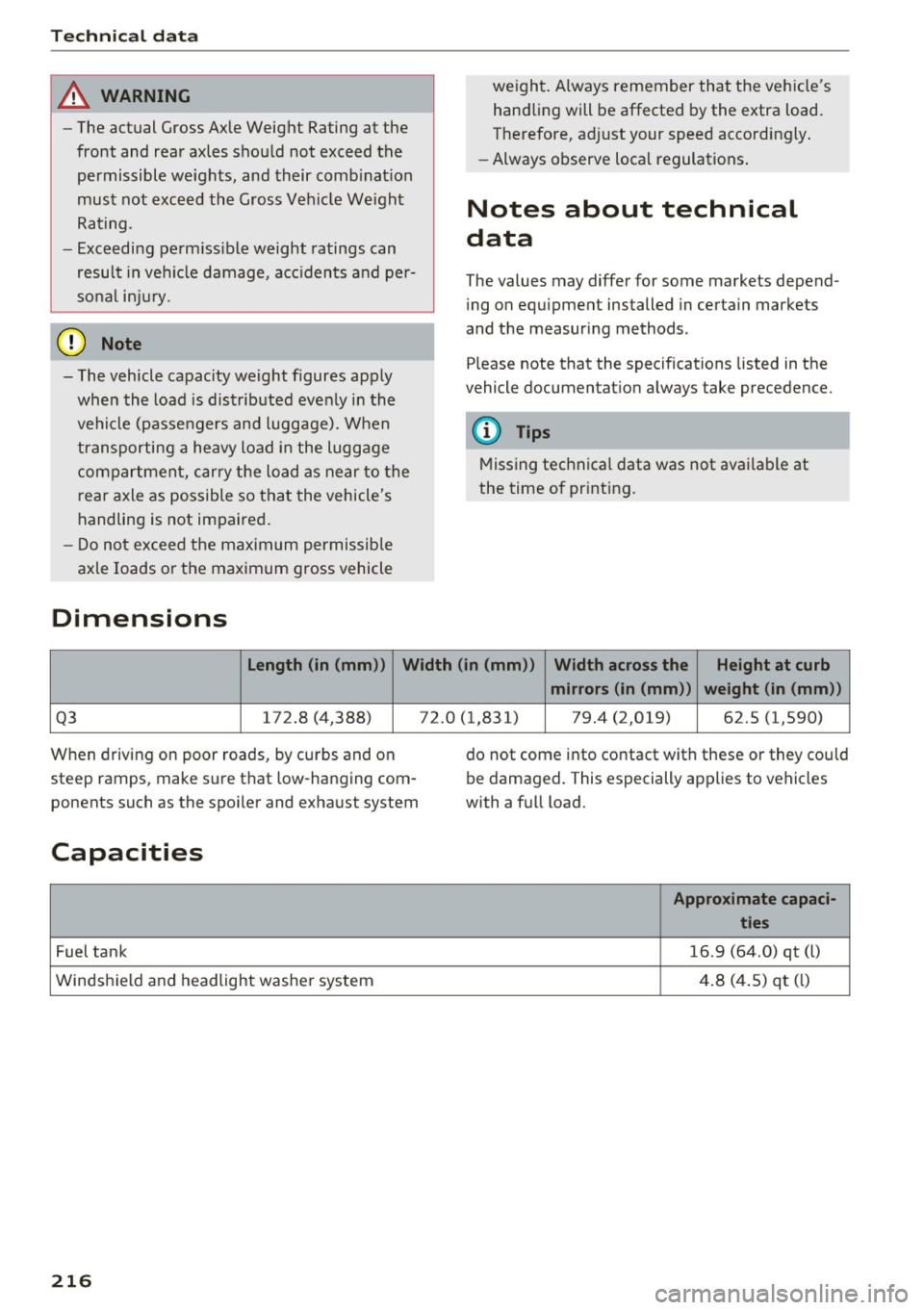
Length (in (mm)) Width (in (mm )) Width across the Height at curb
Q3 172.8 (4,388)
When driving on poor roads, by c urbs and on
steep ramps, make s ure that low -hanging com
ponents such as the spo ile r and exha ust system
Capacities
Fuel tank
Winds hield and headlight washe r system
216
mirrors (in (mm )) weight (in (mm))
72 .0 (1,831) 79.4 (2,019) 62.5 (1,590)
do not come into contact with these or they cou ld
be damaged. This especially applies to vehicles
with a f ull load.
Approximate capaci-
ties
16.9 (64.0) qt (l)
4.8 (4.5) qt ( l)