ESP AUDI Q3 2017 Owner´s Manual
[x] Cancel search | Manufacturer: AUDI, Model Year: 2017, Model line: Q3, Model: AUDI Q3 2017Pages: 236, PDF Size: 58.93 MB
Page 148 of 236
Child safety
use the safety belt height adjustment to help
adjust the shoulder portion properly .
~ Secure unused safety belts on the rear seat
<=>page 142.
Children up to at least 8 years old (over 40 lbs. or
18 kg) are best protected in child safety seats de
signed for their age and weight. Experts say that
the skeletal structure, particularly the pelvis, of
these children is not fully developed, and they
must not use the vehicle safety belts without a
suitable child restraint.
It is usually best to put these children in appro priate booster seats . Be sure the booster seat
meets all applicable safety standards .
Booster seats raise the seating position of the
child and reposition both the lap and shoulder
parts of the safety belt so that they pass across
the child's body in the right places . The routing of
the belt over the child's body is very important
for the child's protection , whether or not a boos
ter seat is used. Children age 12 and under must
always ride in the rear seat .
Children who are at least 4 ft. 9 in. (57 inches/
1.45 meters) tall can generally use the vehicle's
three point lap and shoulder belts. Never use the
lap belt portion of the vehicle's safety belt alone
to restrain any child, regardless of how big the
child is. Always remember that children do not
have the pronounced pelvic structure required for
the proper function of lap belt portion of the ve
hicle 's three point lap and shoulder belts. The
child 's safety absolutely requires that a lap belt
portion of the safety belt be fastened snugly and
as low as possible around the pelvis . Never let
the lap belt portion of the safety belt pass over
the child's stomach or abdomen.
In a crash, airbags must inflate within a blink of
an eye and with considerable force . In order to do
its job, the airbag needs room to inflate so that it
will be there to protect the occupant as the occu
pant moves forward into the airbag.
A vehicle occupant who is out of position and too
close to the airbag gets in the way of an inflating
airbag. When an occupant is too close, he or she
will be struck violently and will receive serious or
possibly even fatal injury.
146
In order for the airbag to offer protection, it is
important that all vehicle occupants , especially
any children, who must be in the front seat be
cause of exceptional circumstances, be properly
restrained and as far away from the airbag as
possible. By keeping room between the child's
body and the front of the passenger compart
ment, the airbag can inflate completely and pro
vide supplemental protection in certain frontal
collisions.
.&_ WARNING
Not using a booster seat, using the booster
seat improperly, incorrectly installing a boos
ter seat or using the vehicle safety belt im
properly increases the risk of serious personal
injury and death in a collision or other emer
gency situation. To help reduce the risk of se rious personal injury and/or death:
- The shoulder belt must lie as close to the
center of the child's collar bone as possible
and must lie flat and snug on the upper
body .
It must never lie across the throat or
neck . The lap belt must lie across the pelvis
and never across the stomach or abdomen.
Make sure the belt lies flat and snug. Pull on
the belt to tighten if necessary.
- Failure to properly route safety belts over a
child's body will cause severe injuries in an
accident or other emergency situation
r=:> page 109.
- The rear side of the child safety seat should
be positioned as close as possible to the
backrest on the vehicle seat. Adjust or re
move the rear seat head restraint if it is dif
ficult to install the child seat with the head
restraint in placer=;,
page 46. Install the
head restraint again immediately once the
child seat is removed . Driving without head
restraints or with head restraints that are
not properly adjusted increases the risk of
serious or fatal neck injury dramatically.
- Never let a child put the shoulder belt under
the arm or behind the back, because it could
cause severe injuries in a crash.
- Children on the front seat of any car, even
with Advanced Airbags, can be seriously in-
-
jured or even killed when an airbag inflates. .,
Page 149 of 236
00
00
......
"' ,....
"' ...... 0 0 :::,
00
- Never let a child stand or kneel on any seat,
for example the front seat.
- Never let a child ride in the cargo area of
your vehicle.
- Always remember that a child leaning for
ward, sitting sideways or out of position in
any way during an accident can be struck by
a deploying airbag. This will result in serious
personal injury or death.
- If you must install a booster seat on the
front passenger seat because of exceptional
circumstances the
P A SS ENGER AIR BAG
OFF
light must come on and stay on, when
ever the ignition is switched on.
- If the
PASSENGER A IR BAG OFF light does
not come on and stay on, perform the
checks descr ibed
c:> page 12 7, Monitoring
the Advanced Airbag System.
- Take the ch ild restraint off the front passen
ger seat and install it p roperly at one of the
rear seat positions if the
PA SSENGER A IR
BA G OFF
light does not stay on whenever
the ignition is switched on.
- Always read and heed all WARN INGS when
ever using a child restrained in a vehicle is
being used
r=;, page 109, Safety belts,
c:> page 117, Airbag system
and
c:> page 13 7, Important information.
Securing child seats
Securing a child safety seat using a safety
belt
Safety belts for the rear seats and the front pas
senger can be locked with the convertible locking retractor to properly secure child safety seats .
The safety belts emergency locking retractors for
the rear seats safety belts and for the front pas
senger's seat safety belt have a convertib le lock
ing retractor for child restraints. The safety belt
must be locked so that belt webbing cannot un
reel. The retractor can be activated to lock the
safety belt and prevent the safety belt webbing
from loosening up during normal driving. A child
safety seat can only be properly installed when
the safety belt is locked so that the child and
child safety seat w ill stay in place .
Child safety
Always remember : Even though your vehicle is
equipped with an Advanced Airbag system, all
children, especially those 12 years and younger,
should always ride in the back seat properly re
strained for their age and size.
A WARNING
=
Improperly installed child safety seats in
crease the risk of serious personal injury and
death in a collision .
-
-Always make sure that the safety belt re
tractor is locked when installing a child
safety seat. An un locked safety be lt retrac
tor cannot hold the ch ild safety seat in place
du ring normal driving or in a c rash.
- Always buckle the child safety seat fi rm ly in
p lace even if a ch ild is not sitt ing in it. A
loose child safety seat can fly around during
a sudden stop or in a co llision.
- Always make sure that the rear seat back
rest to which the center rear safety belt is
attached is securely latched whenever the
rear center safety belt is being used to se
cure a child restraint.
- If the backrest is not securely latched, the
child and the child restraint will be thrown
forward together with the backrest and w ill
strike parts of the veh icle inter ior. The child
can be seriously injured or killed .
- Never install rear-facing child safety seats
or infant carriers on the front passenger
seat . A child w ill be seriously injured and
can be killed when the passenger a irbag in
flates.
- The inflating airbag will h it the ch ild safety
seat or infant ca rr ier with great force and
will smash the child safety seat and child aga inst the backrest, cente r armrest, door
or roof .
- Always install rear-fac ing child safety seats
or infant car riers on the rear seat.
- Forward-facing child safety seats o r infant
carriers installed on the front passenger's
seat may interfere with the deployment of
the airbag and cause serio us injury to the
child .
- It is sa fer to install a forward -facing child
safety seat on the rear seat.
147
Page 150 of 236
Child safety
-Always read and heed all WARNINGS when
ever using a child restrained in a vehicle is
being used ¢
page 13 7. Special precautions
apply when installing a child safety seat on
the front passenger seat¢
page 118, Child
restraints on the front seat -some impor
tant things to know.
_& WARNING
Always take special precautions if you must
install a forward or rearward-facing child re
straint on the front passenger's seat in excep
tional situations:
- Whenever a forward or rearward-facing
child restraint is installed on the front pas
senger seat, the
PASSENGER AIR BAG OFF
light must come on and stay on whenever
the ignition is switched on.
- If the
PASSENGER AIR BAG OFF light does
not come on and stay on, perform the
checks described
¢ page 127, Monitoring
the Advanced Airbag System.
- Take the child restraint off the front passen
ger seat and install it properly at one of the
rear seat positions if the
PASSENGER AIR
BAG OFF
light does not stay on whenever
the ignition is switched on .
- Improper installation of child restraints can
reduce their effectiveness or even prevent
them from providing any protection .
-An improperly installed child restraint can interfere with the airbag as it deploys and
seriously injure or even kill the child.
-Always carefully follow the manufacturer's
instructions provided with the child safety
seat or carrier.
- Never place additional items on the seat
that can increase the total weight registered by the weight-sensing mat and can cause in
jury in a crash.
_& WARNING
Forward-facing child restraints:
- Always make sure the forward-facing seat
has been designed and certified by its man
ufacturer for use on a front seat with a pas
senger front and side airbag.
148
-
- Never put the forward-facing child restraint
up, against or very near the instrument pan
el.
- Always move the front passenger seat to
the highest position in the up and down ad
justment range and move it back to the rearmost position in the seat's fore and aft
adjustment range, as far away from the air
bag as possible, before installing the for
ward-facing child restraint.
-Always make sure that the safety belt upper
anchorage is behind the child restraint and
not next to or in front of the child restraint
so that the safety belt will be properly posi
tioned.
- Make sure that the
PASSENGER AIR BAG
OFF
light comes on and stays on all the time
whenever the ignition is switched on.
_& WARNING
Rearward-facing child restraints:
-A child in a rearward-facing child safety seat
installed on the front passenger seat will be
seriously injured and can be killed if the
front airbag inflates -even with an Ad
vanced Airbag System.
- The inflating airbag will hit the child safety
seat or infant carrier with great force and
will smash the child safety seat and child
against the backrest, center armrest, door
or roof.
- Always be especially careful if you must in
stall a rearward facing child safety seat on
the front passenger seat in exceptional cir
cumstances .
- A tight tether strap on a rearward-facing child restraint attached to the front passen
ger seat can put too much pressure on the
weight-mat in the seat and register a heavi
er weight in the Advanced Airbag System.
The heavier weight registered can make the
system work as though an adult were on the
seat and deploy the Advanced Airbag when
it must be suppressed causing serious or
even fatal injury to the child.
Page 155 of 236
a:,
a:,
...... N r--. N
'"' 0 0 ::, a:,
-Never attach two child restraint systems to
one tether strap or tether anchorage.
- Never attach a tether strap to a tie-down
hook in the luggage compartment.
- Never use child restraint tether anchorages
to secure safety belts or other kinds of occu
pant restraints.
- Never secure or attach any luggage or other
items to the LA TCH lower anchorages or to
the tether anchors.
- If a tether or other strap is used to attach a
child restraint to the front passenger seat,
make sure that it is not so tight, that it
causes the weight-sens ing mat to measure
more weight than is actually on the seat .
- The heavier weight registered can make the
Advanced Airbag System work as though an
adult were on the seat and dep loy the Ad
vanced Airbag when it must be supp ressed
ca using se rious o r even fatal injur y to the
c hild.
- If you must install a re arward fac ing ch ild
safety seat on the front passenger seat be
cause of except io na l circumstances and the
PASSENGER AIR BAG O FF light does not
come on and stay on, immediate ly install
the rear-fac ing child safety seat in a rear
seating position and have the airbag system
inspected by your Audi dealer.
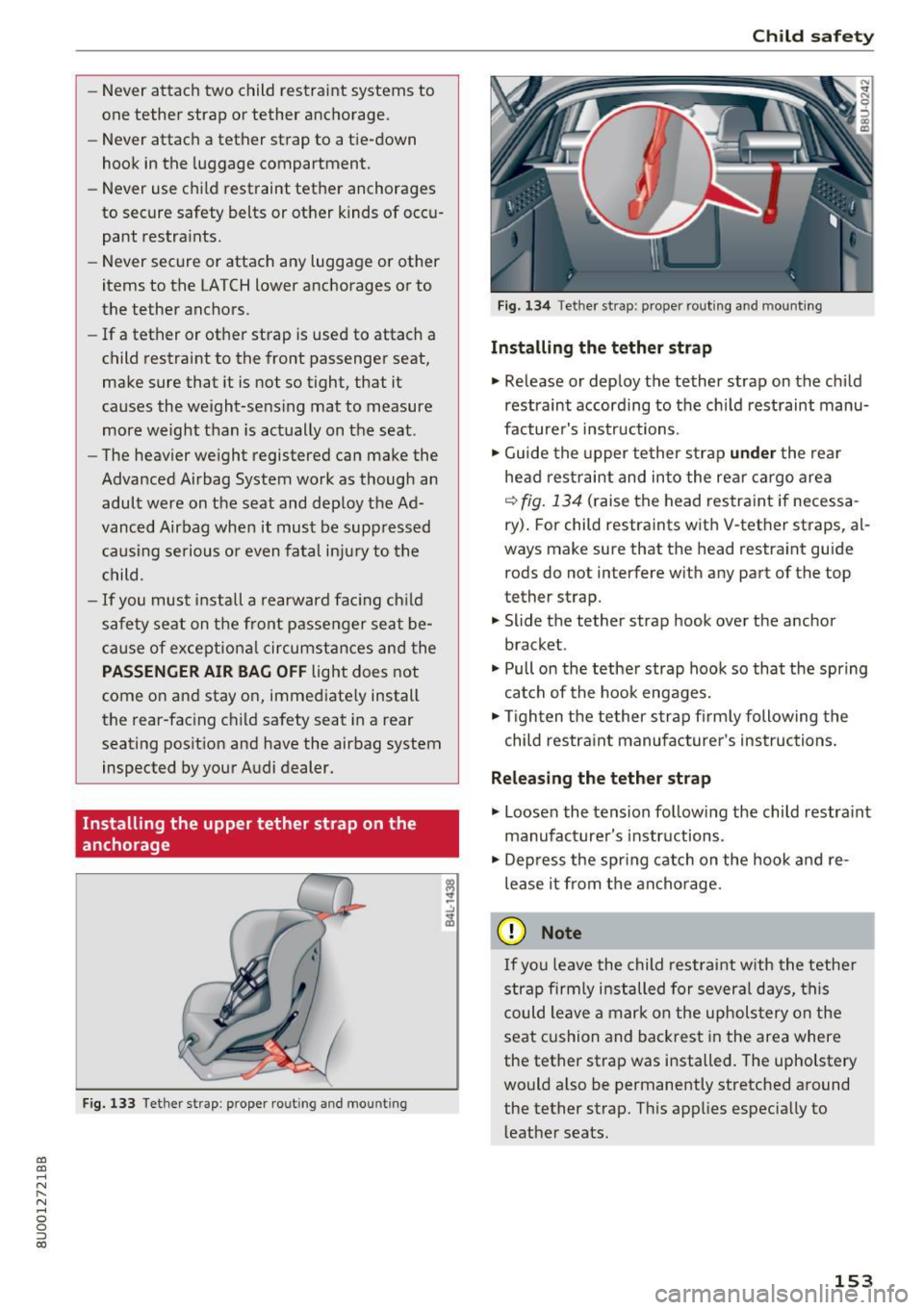
Installing the upper tether strap on the
anchorage
F ig. 133 Tether str ap : pro pe r ro uting an d mountin g
Ch ild sa fety
Fig. 134 Tet her st rap : p ro p er r out ing an d mount ing
Installing the tether st rap
• Release or deploy the tether strap on the ch ild
restraint according to the ch ild restraint manu
facture r's instructions .
• Guide the upper tether strap
under the re a r
head restraint and in to the rear ca rgo area
~ fig. 134 (raise the head restraint if necessa
ry) . For child restraints w ith V-teth er straps, al
ways make sur e that th e head restraint guide
r ods do not interfere w ith any part of the top
tether strap.
• Slide the tether strap hook over the anchor
bracket .
• Pull on the tethe r strap hook so that the spring
catch of the hook engages.
• Tighten the tether s trap firm ly following the
child restra int manufacture r's instruc tions.
Releasing the tether strap
• Loose n the tension fo llow ing the child restra int
manufac turer's instr uctions .
• Dep ress the spr ing catch on the hook and re
le ase it from the anchorage.
(D Note
If yo u leave the child restrai nt w ith the tethe r
strap firmly i nstalled for several days, th is
could leave a mark on the uphols tery on the
seat cushion and backrest i n the area where
the tether strap was installed. The upholstery
would a lso be permanently stretched around
the tether strap. This app lies espec ia lly to
l eather seats.
153
Page 158 of 236
Check ing and F illing
CJ) Note
- Methanol fuels which do not meet these re
q uirements may cause corros ion and dam
age to plast ic and rubber components in the
fuel system.
- Do not use fuels that fail to meet the speci fied criter ia in this chapter.
- If you are unable to determine whether or
not a particular fuel blend meets the speci
ficat ions, ask your service station or its fuel
supplier .
- Do not use fuel for wh ich the contents can
not be identified.
- Fuel system damage and performance prob lems result ing from the use of fue ls differ
ent from those specified a re not the respon
s ibility of Audi and are not covered under
the New Veh icle o r the Emiss ion Control
System Warra nties.
- If you experience a loss of fue l economy or
driveability and pe rformance prob lems due
to the use of one of these fuel b lends, we
r ecommend t hat you swi tch to u nblended
fuel.
Gasoline additives
A major concern among many auto manufactur
ers is carbon deposit build-up caused by the type
of gasoline you use .
A lthough gasoline grades dif fer from one manu
facturer to another, they have certain things in
common. All gaso line grades contain substances
that can cause deposits to collect on v ita l eng ine
parts, such as fue l injectors and intake valves. Al
though most gasoline brands include additives to
keep eng ine and fuel systems clean, they a re not
equa lly effective .
Aud i recommends using TOP TIER Detergent Gas
oline . For more i nformation on TOP TIER Deter
gent Gasoline, please go to the official website (www.toptiergas .com) .
After an extended period of using inadequate
fue ls, built -up carbon depos its can rob your en
g ine of peak performance .
156
(D Note
-Damage o r mal func tion d ue to poor f uel
quality is no t covered by the Audi New Vehi
cle Lim ited Warranty .
- Do not ad d aftermar ket fuel addi tive prod
ucts to your fue l tank .
Refueling
Fuel filler neck
The fuel filler neck is located on the right rea r
s ide panel behind the fuel fille r flap .
If the power lock ing system shou ld fail , you can
still open the flap manually -fo r detailed instruc
tions see
Q page 158.
You can find the fuel tank capacity of your vehicle
i n
¢ page 216.
The label o n the inside of the f uel fi ller flap tells
you the correct fuel for your vehicle. For more in
format ion about fuel specifications, see
¢ page 155.
You r vehicle f uel tank has an on-board refueling
vapor recovery system. T his feature helps to pre
vent fue l vapors from escaping from the tank and
polluting the enviro nment wh ile you refue l your
vehicle . In order to fill the tank proper ly wh ile
protect ing the e nvir onment, please follow th is
r efue ling p rocedure carefully.
A WARNING
U nder no rmal opera ting co nd itions, neve r ca r
r y addi tional f uel con tainers in your car. Gas
caniste rs and o ther con tainers used to trans
port fue l can be dangero us. Such containe rs,
f ull or empty, may leak and could cause a fi re
in a co llision. If you must transport fuel to
use for your lawn mower, snow blower, etc .,
be ve ry ca reful and always observe local and
state laws regarding the use, transportation
and storage of such fuel containers . Make cer
tai n the co ntai ner mee ts industry s tandards
(A NS I/AS TM F 8S2 -86) .
Page 168 of 236
Check ing and F illing
areas, into open streams or down sewage
drains .
- Recycle used engine oil by taking it to a used
engine oil collection facility in your area, or
contact a service station .
Cooling system
Coolant
The engine coo ling system is filled wi th a mixture
of pur ified w ate r a nd coolan t addit ive at the fa c
tory . T h is coo lant must not be not changed.
The coolant leve l is monito red throug h the . in
d icator light~
page 13 . Howeve r, we do re com
mend occasionally check ing the coo la nt level
manually.
I f you must add coolant, use a m ixt ur e of wa ter
and coolant addit ive. M ixing the coolant additive
with d istilled wate r is recommen ded .
Coolant additive
The coolant additive is made of a nti-freezi ng a nd
corros ion protection agents . Only use the fo llow
i n g coolant add it ives. These additives may be
mixed w it h each other.
Coolant additive Specification
G13 TL774J
G12++ T
L 774 G
The amount of coo lant additive that needs to be
mixed wit h wate r depends on the climate where
the vehicle will be operated . If the coolant addi
tive percentage is too low, the coolant can freeze
and damage the engine.
Coolant Freeze protec-
additive tion
Warm reg ions min . 40% m in . -13 °F
max . 45% (
- 25
°()
Co ld regions min. 50% max
. -40 °F
max. 55% (-40 °()
0 Note
- Befo re the start of winter, have your author
i zed Audi dealer or authorized A udi Service
Fac ility check if the coolant additive in you r
166
vehicle matches t he percentage app ropriate
for the climate . This is especially important
when driving in colder climates.
- If the app ropriate coo lant additive is not
available in an eme rgency, do not add any
other additive. You could damage the en
gine. If this happens, only use water and re
store the correct m ixture ratio with t he
specified coo lant add itive as soo n as poss i
bl e.
- Only ref ill w ith new coolant.
- Radiator sealant must not be mixed with
the coolant.
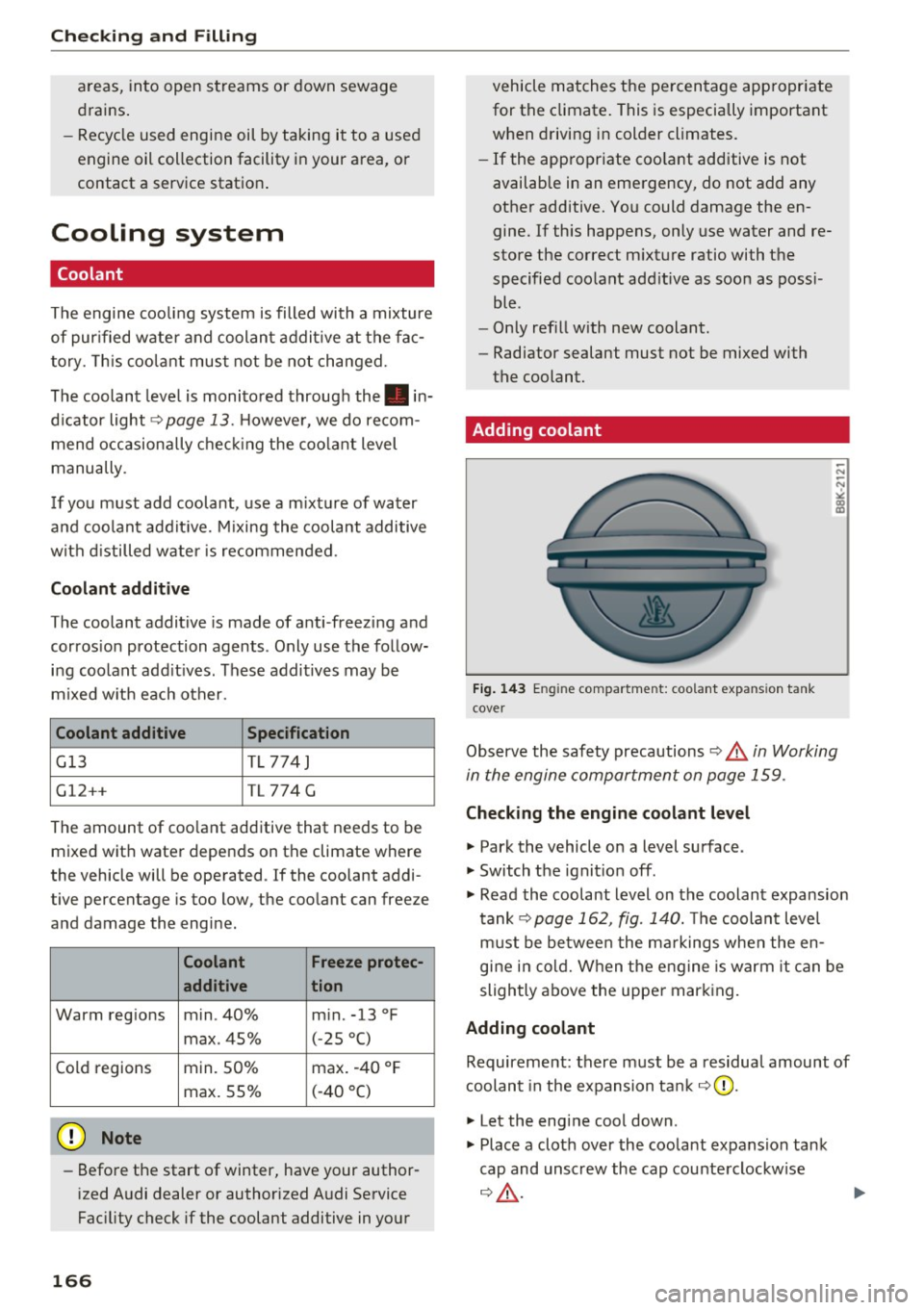
· Adding coolant
Fi g. 14 3 En gin e compartment: coo lant expa nsio n ta nk
cove r
Observe the safety precautions ~.& in Working
in the engine compartment on page 159 .
Checking the engine coolant level
.. Park the vehicle on a level surface .
.. Switch the ignit io n off.
.. Read the coolant level on the coolant expansion
t ank ~
page 162, fig. 140. The coolant leve l
m ust be be twee n the m arkings when the en
gi ne i n co ld. W hen t he engine is warm it can be
slightly above the upper mar king.
Adding coolant Requirement: there must be a residua l amount of
coolan t in the expansion tank ~(}).
.,. Let the engi ne cool down .
.. Place a clot h over the coolant expans ion tank
cap and unscrew the cap counte rclockw ise
~ .& -
Page 169 of 236
00
00
......
"' ,....
"' ...... 0 0 :::,
00
~ Add coolant mixed in the correct ratio
¢ page 166 up to the upper marking.
~ Make sure that the fluid level rema ins stable.
Add more coolant if necessary.
~ Close the cap securely.
Coolant loss usually indicates there is a leak. Im
mediately drive your vehicle to an authorized
Audi dealer or authori zed Audi Service Facility
and have the cooling system inspected. If the
cooling system is not leaking, a loss can come
from the coolant boiling through overheating
and be ing pushed out of the cooling system.
.&, WARNING
The cool ing system is pressu rized and can be
come very hot. To reduce the r is k of burns
from hot coolant :
- Do not open the coo lant expansion tank cap
when the engine is hot. This increases the risk of burns.
- Stop the engine and allow it to cool.
- Protect your face, hands and arms from es -
caping coolant and steam by covering the
coolant tank cap with a large, thick cloth .
- T urn the coo lant tank cap co unterclo ckwise
slowly and keep light pressu re on the cap .
- T o reduce the risk of burns , do not allow any
antifreeze o r coolant to drip onto the ex
haust system or hot engine components.
T he ethylene glycol in engine coolant can
catch fire under certain circumstances .
- T he coo lant add itive and the coolant can be
dangerous to your health . For this reason,
keep the coolant in the original container
and away from children. There is a risk of
poisoning.
- When working in the engine compartment,
remember that the radiator fan can switch
on even if the ignition is switched off, which
increases the risk of injury .
Do not add coolant if the expansion tank is
empty. Air could enter the cooling system and
damage the engine. If this is the case, do not
cont inue driv ing . See an authorized Audi deal -
Check ing and Filling
er or authorized Aud i Service Facility for assis
tance .
- Before the start of winter, have your author
ized Aud i dea ler or a uthorized Audi Serv ice
Facility check if the coolant additive in your
vehicle matches the percentage appropriate
for the climate. This is especially important
when driving in colder climates.
- If the appropr iate coo lant add itive is not
availab le in an emergency, do not add any
other additive . You could damage the en
gine. If this happens, only use water and re
store the correct m ixtu re ratio with the
specified coolant add it ive as soo n as poss i
ble .
- Only refill w ith new coolant.
- Radiator sealant must not be mixed with
the coolant .
Radiator fan
T he radiator fan switches on automatically by it
self.
An auxiliary e lectr ic radiator fan switches on and
off depend ing on coolant temperature and other
vehicle operating conditions.
After you switch the engine off, the auxiliary fan c a n continue running for up to 10 m inutes - even
with the ignition off . It can even switch on aga in
later by itself ¢.& , if
- the temperature of the engine coolant rises due
to the heat build-up from the engine in the en
gine compartment, or
- the engine compartment heats up bec ause the
veh icle is parked in in tense sunlight.
.&, WARNING
--
- To reduce the r isk of personal injury never
touch the radiator fan .
- The auxiliary e lectr ic fan is temperature
controlled and can switch on s uddenly even
when the engine is not runn ing .
- The auxiliary radiator fan sw itches on auto
mat ica lly when the eng ine coolant reaches a
certa in temperature and will continue to run
until the coolant temperature d rops .
167
Page 172 of 236
Check ing and F illing
To reduce the risk o f lime sca le deposits on the
spray nozzles, use clean water with low amounts
of calcium. A lways add window cleaner to the wa
ter. When the outs ide temperatures are cold, an
anti-freezing agent should be added to the water
so that it does not freeze.
@ Note
-The concentration of anti-freezing agent
must be adjusted to the vehicle operating
cond itions in t he respective climate. A con
centration that is too high can lead to veh i
cle damage.
- Never add rad iator anti-freeze or other add i
tives to the washe r fluid .
- Do not use a glass cleaner that contains
paint solvents, beca use this cou ld damage
the pa int.
Service interval display
The service interval display detects when your ve
hicle is due for service.
The se rvice interva l disp lay works in two stages:
- Inspection o r oil change reminder : after acer-
ta in d istance is driven, a message appears in
the instrument cluster d isp lay every t ime the
ignition is sw itched on . T he remain ing distance
o r time is d isp layed b riefly.
- In spection or oil change due : if you r vehicle
has reached an inspection o r oi l change interval
o r both intervals at the same time, the mes
sage
Inspection due! or Oil change due! or Oil
change and in spection due!
a ppears br iefly a f
ter switching the ignition on .
Checking service intervals
You can check the rema ining distance o r time un
til the next oil change o r next inspection.
- Se lect: the
ICARI function button > (Car ) Sys
tems *
contro l button > Servicing & checks >
Ser vice interval display .
Resetting the indicator
Your author ized Audi dealer or authorized Audi
Serv ice Facility will reset the serv ice interval dis
p lay after pe rforming serv ice.
170
If you have changed the oi l yourself, yo u must re
set the oi l change interval.
Perform the fo llow ing to reset t he d isp lay:
- Select: the
I CARI funct io n button > (Car) Sy s
tem s*
control button > Serv icing & check s >
Service interval di splay . Turn the contro l knob
downwa rd to
Re set oil change int erval and
press the control knob .
(D Note
-On ly reset t he oil change ind icator if the oi l
was changed.
- Following the se rvic e interva ls is cr itica l to
ma inta ining the se rvice life and val ue of
yo ur vehicle, es pecially the eng ine. Even if
the mileage on the ve hicl e is low, do not ex
ceed t he time fo r the next service .
Page 175 of 236
"' "' -N
" N
-0
0
::, a)
® Mud and snow capability
"M/5" or "M+S" indicates the tire
has properties making it suitable
to drive in mud or snow.~ indi
cates a winter tire .
@ Composition of the tire cord
and materials
The number of plies indicates the
number of rubber ized fabric lay
ers in the t ire. In general : the
more layers, the more weight a
tire can carry . Tire manufacturers
must also specify the materials
used in the tire . These incl ude
stee l, nylon, polyester and other
materials .
@Maximum permitted load
This number indicates the maxi
mum load in kilograms and
pounds that the tire can carry.
@ Uniform tire quality grade
standards for treadwear,
traction and temperature resistance
T read wear, trac tion and temper
ature ranges
¢ page 187.
@ Running direction
The arrows indicate the running
direction of un idirectional t ires.
You must always follow the speci- fied running direction
¢
page 202.
€3) Maximum permitted
inflation pressure
Wheels
T his number ind icates the max i
mum pressure to which a tire can
be inflated unde r normal operat
ing conditions.
Glossary of tire and loading
terminology
Accessory weight
means the combined we igh t (in
excess of those standard items
wh ich may be replaced) of auto
matic transmission, power steer
ing, power brakes, power win
dows, power seats, radio, and
heater, to the extent that these
items are available as factory-in
stalled equipment (whether in
stalled or not).
Aspect ratio
means the ratio of the height to
the w idth of the tire in percent .
Numbers of 55 or lower indicate a
low s idewall for improved steer
ing response and better overall
handling on dry pavement .
173
Page 180 of 236
Wheel s
Occupant loading and distri
bution for vehicle normal load
for various designated seat ing
capacit ies
Refer to the tire inflation pres
sure label ¢
page 181, fig . 150
for the number of seating posi
tions . Refer to the table¢
table
on page 183
for the number of
people that correspond to the ve
hicle normal load .
New tires or wheels
Audi recommends having all work
on tires or wheels performed by
an authorized Audi dealer or au
thorized Audi Service Facility .
These facilities have the proper knowledge and are equipped with
the required tools and replace
ment parts.
.,. New tires do not yet have the
optimum gripping properties. Drive carefully and at moderate
speeds for the first 350 miles (500 km) with new tires .
.,. Only use tires with the same de
sign, size (rolling circumference)
and as close to the same tread pattern as poss ible on all four
wheels .
178
.,.Do not replace tires individually .
At least replace both tires on the
same axle at the same time.
.,. Audi recommends that you use
Audi Original Tires. If you would
like to use different tires, please
note that the tires may perform
differently even if they are the
same size ¢
,&..
.,. If you would like to equip your
vehicle with a tire/rim combina
tion that is different from what
was installed at the factory, con
sult with an authorized Audi
dealer or authorized Audi Service Facility before making a pur
chase ¢&, .
If the spare t ire is different from
the regular tires installed on the
vehicle -for example, if winter
tires or wide tires are installed -
then only use the spare tire tem
porarily in case of emergency and
drive carefully while it is in use. It
should be replaced with a regular
tire as soon as possible.
Applies to: vehicles with all wheel
drive: all four wheels must be
equipped with tires that are the
same brand and have the same
construction and tread pattern so
that the drive system is not dam aged by different wheel speeds . .,.