warning AUDI Q3 2017 Owner´s Manual
[x] Cancel search | Manufacturer: AUDI, Model Year: 2017, Model line: Q3, Model: AUDI Q3 2017Pages: 236, PDF Size: 58.93 MB
Page 97 of 236
00
00
......
"' ,....
"' ...... 0 0 :::,
00
compensate for the slightly reduced bra king
force by pressing firmly on the brake peda l. Avoid
heavy braking during the break -in period .
Operating condit ion s and dr iving habits
The brakes on today's automobiles a re sti ll s ub
ject to wear, depend ing largely on ope rating con
ditions and driving habits¢& . On vehicles that
are either driven most ly in stop-and -go city traf
fic or are driven hard, the brake pads should be
checked by your authorized Aud i dealer more of
ten than specified in the
Warran ty & Mainte
n anc e boo kle t .
Failure to have your brake pads
inspected can resu lt in reduced brake perform
ance.
On steep slopes, you should use the braking ef
fect of the eng ine. This way, you prevent unnec
essary wear on the brake system . If you must use
your brakes, do not hold the b rakes down cont in
uously. P ump t he b rakes at intervals.
Operating no ise
Noises may occur when braking depend ing on the
speed, braking force and outs ide cond itions such
as tempe rature and humidity .
Effect of water or road salt
In certain situations, for example after driving
through water, in heavy ra in, after overnight con
densat ion or after washing your car, the braking
effect can be reduced by mo isture or ice on the
brake rotors and brake pads . The brakes must be
"dr ied" fi rst w it h a few careful brake applica
tions .
At highe r speeds and with the windsh ield w ipers
turned on, the brake pads press aga inst the brake
rotors for a short amount of time. This action,
which is not felt by the d river, happens a t regular
i nte rvals and ens ures a better reaction time fo r
the brakes in wet weather.
The bra king effect can also be redu ced if you are
d riving on salted roads and you do not apply t he
b ra kes fo r long pe riods of time. The layer of sa lt
on the brake rotors and brake pads m ust be worn
off first when the b rakes are applied¢& .
Intellig ent Technology
Corrosion
Leaving t he vehicle pa rked fo r lo ng periods of
t ime, low mileage and avoiding heavy braking
can contrib ute to corrosion on the brake rotors
and to dirty brake pads .
If you usua lly avoid heavy bra king or if there is
corrosion present, occasiona l heavy braking at
high speeds is recommended to clean the brake
rotors and pads¢& .
Brake system malfunction
if you no tice that the b rake peda l t ravel has sud
denly
gotten larger, then a b rake c ircuit may have
f ailed ¢ & .
Low brake fluid level
When the brake fluid level is low, malfu nctions in
the b rake system may occur. The b rake fl uid level
is e lec tron ically moni tored.
Brake booster
The brake booster amplifies the pressure you ap
ply to the brake pedal.
It only works when the en
gine is running~ &.
Brake lining wear statu s
Brake lining wear may be checked by visual in
spect ion of the condition of the brake pads
t h rough the openings in the wheel. If necessary,
the wheel may be removed for this i nspection
¢ page 198, Replacing wheels .
,&. WARNING
-New brake pads don't have the bes t stop
ping power and m ust be "broken-in" during
the initial 250 mi (400 km) . You
can com
pensate for this by pressing the brake pedal
more firmly . This a lso applies later when
new pads are installed.
- You shou ld perform braking maneuvers for
the purpose of cleaning the brake system
only if road condit ions permit. Other road
users must not be put at r isk - you may
cause an accident!
- Before descending a steep grade, reduce
speed a nd sh ift transmission into a lower
95
Page 98 of 236
Intelligent Technology
gear or lower driving range. Do not ride the
brakes or hold the pedal down too long or
too often. This could cause the brakes to get hot and diminish braking efficiency .
- Do not "ride the brakes" by resting your foot
on the pedal when you do not intend to
brake. This may cause the brakes to over
heat, premature wear and increased stop
ping distance.
- Under certain climatic and operating condi
tions such as passing through water, driving in heavy rain or after washing the vehicle ,
the effectiveness of the brakes can be re
duced . In winter, ice can accumulate on the
brake pads, linings, discs and drums . Care
fully apply brakes for a test. Brakes will dry and ice coatings will be cleaned off after a
few careful brake applications.
- Driving for an extended period of time on
salt-covered roads without using your
brakes can also affect braking efficiency .
Clean off accumulated salt coating from
brake discs and pads with a few careful
brake applications .
- If you damage the front spoiler, or if you in
stall a different spoiler, be sure the air flow
to the front brakes is not obstructed. Other
wise the brake system could overheat reduc
ing the effectiveness of the entire brake sys
tem.
- Failure of one brake circuit will impair the
braking capability resulting in an increased
stopping distance. Avoid driving the vehicle
and have it towed to the nearest authorized
Audi dealer or qualified workshop.
- Never let the vehicle roll to a stop with the
engine shut off.
- If the brake booster is not working, the
brake pedal must be pressed considerably
harder to make up for the lack of booster
assistance.
96
Electromechanical
steering
The electromechanical steering supports the
driver's steering movements .
Power steering adapts electronically based on
the vehicle speed .
Indicator lights and messages
• Steering fault! Do not drive vehicle!
If this indicator light turns on and stays on and
this message appears, the power steering may
have failed.
Do
not continue driving . See an authorized Audi
dealer or authorized Audi Service Facility for as
sistance.
If the indicator light turns on, the steering wheel
may be more difficult to move or more sensitive
than usual. The steering wheel may also be at an
angle when driving straight.
Drive slowly to an authorized Audi dealer or au
thorized Audi Service Facility to have the mal
function corrected .
(;r, lj Steering lock: System fault! Please contact
dealer.
There is a malfunction in the electronic steering
lock.
Drive to an authorized Audi dealer or authorized
Audi Service Facility immediately to have the malfunction corrected.
A WARNING
Have the system malfunction corrected as
soon as possible by an authorized Audi dealer
or authorized Audi Service Facility, as this in
creases the risk of an accident .
{!) Tips
If the . or 'T j indicator light only stays on
for a short time, you may continue driving.
-
Page 99 of 236
00
00
......
"' ,....
"' ...... 0 0 :::,
00
All wheel drive (quattro)
A ppl ies to: ve hicles wit h all wheel drive
In oil wheel drive, oil four wheels ore powered.
General info rmation
I n all wheel drive, t he driving power is divided be
tween all four wheels . This happens automatical
ly depending on your driving behavior as well as
the current road conditions. Also see
¢ page 92.
The a ll wheel d rive concept is designed for h igh
engine powe r. Your vehicle is exceptionally pow
erful and has excellent driving characteristics both under norma l driving conditions and on
snow and ice. Always read and fo llow safety pre
cautions ¢.&. .
Winter t ires
By using all wheel drive, yo ur vehicle has good
forward motion with standard tires in w inter con
ditions. However, we recommend using winter or
all season tires on
all four whee ls in the winter,
because this will improve the
broking effect.
Snow cha in s
If there are snow chain laws, snow chains must
a lso be used on vehicles with a ll wheel drive
¢ page 186, Snow chains.
Replacing t ires
F or vehicles w ith all wheel dr ive, only wheels w ith
the same ro lling circumference shou ld be used .
Avoid using tires with different tread depths
¢ page 178, New tires or wheels .
A WARNING
-Also, in vehicles with a ll wheel drive, adapt
your dr iv ing style to the current road and
traff ic conditions. Do not let the increased
safety provided tempt you into tak ing risks,
because th is increases the r is k of an acci
dent.
- The braking ability of your veh icle is limited
to the tract ion of the wheels . In this way, it
is not diffe rent from a two whee l dr ive vehi
cl e. Do not be tempted to accelerate to a
high speed when the road is slippe ry, be
cause this increases the risk of an accident .
Intellig ent Technology
- Note that on wet streets, the front wheels
can "hydrop lane" if dr iv ing at speeds that
are too high . Un like front wheel drive
veh icles, the engine does not rev higher sud
denly when the vehicle begins hydroplan ing .
For this reason, adapt yo ur speed to the
road conditions to red uce the risk of an acci
dent.
Energy management
The starting ability is optimized
The energy management system manages the
electrical energy distribution and optimizes the
availability of electrical energy for starting the
engine.
When a vehicle with a conventiona l energy sys
tem is not driven for a long time , the vehicle bat
tery is drained by equipment (for example, the
immobilizer). In certa in circumstances, there
could may not be enough energy to start the en
gine.
Yo ur vehicle is equipped with an intel ligent ener
gy management system for distributing electrici
ty . Th is sign ificantly improves the start ing ability
and increases the vehicle battery life .
The energy management system Is made up of
battery diagnosis , idling current manag em en t,
and dynamic energy manag ement .
Battery diagn osis
The battery diagnosis determines the vehicle bat
tery charge level. The sensors determine the bat
tery voltage, the battery current, and the battery
temperature. The current charge level and the
performance of the vehicle battery a re deter
mined based on this.
Idling current management
The idling current management decreases the energy used while parked. With the engine
switched off, it manages the energy dis tribution
to the d ifferent e lectr ica l components. Data from
the battery d iagnosis is taken into account for
t hi s.
97
Page 102 of 236
Driving sa fe ty
Driving safety
General notes
Safe driving habits
Please remember -safety first!
This chapter contains important information,
tips, instruct ions and warn ings that you need to
read and observe for your own safety, the safety
of your passengers and others. We have summar ized here what you need to know about safety
be lts, a irbags, child restra ints as well as child
safety. Your safety is for us
priority number 1 . Al
ways observe t he i nfo rmation and wa rn ings in
this section - for your own safety as well as tha t
of yo ur passengers.
The information i n this section applies to all
model ve rsions of your vehicle . Some of the fea
tures descr ibed in t his sec tions may be s tanda rd
eq uipment on some models, or may be optional
equipment on others . If yo u are not sure, ask
your author ized Audi dealer.
A WARNING
- Always make sure that you follow the in
structions and heed the WARNINGS in th is
Manual.
It is in your interest and in the in
te rest of your passengers.
-
- Always keep t he comp lete Owner's Litera
ture in your A udi when you lend or se ll your
vehicle so that this important information
will always be available to the d river and
passenge rs.
- Always keep the Owner 's literature handy so
that you can find it easily if you have ques
t ions.
Safety equipment
The safety features are part of the occupant re
straint system and work together to help reduce
the risk of injury in a wide variety of occident si t
uations.
Your safety and the safety of yo ur passenge rs
should not be left to chan ce. Advan ces in tech
nology have made a var iety of features av ail ab le
to help reduce t he risk of injury in an accident .
100
The following is a list of just a few of the sa fety
features in your Audi :
- sophis tic ated safety be lts fo r dr ive r and all pas-
senge r seat ing pos itions,
- belt fo rce limi ters for the front seats,
- be lt pretensione rs fo r the seats,
- belt height adjustment for the front seats,
- head restraints for each seating position,
- front airbags,
- side airbags in the front seats,
- side curtain airbags with eject io n m it igat io n
features,
- special LA TC H anchorages for ch ild rest rai nts,
- adj ustab le steer ing col umn.
These ind iv idual safety features, can work to
gether as a system to he lp protect you and your
passengers in a wide range of acc idents. These
features cannot wo rk as a system if they are not
a lways cor rec tly ad justed and cor rect ly used.
Safety i s everybody' s responsibil ity!
Important things to do before driving
Safety is everybody 's job! Vehicle and occupant
safety always depends on the informed and care
ful driver .
For your safety and the safety of your passen
gers,
before driving always:
.,. Make sure that a ll lights and signals are operat
ing correctly .
.,. Make sure that the tire pressure is correct .
.,. Make sure that a ll w indows are clean and afford
good vis ibility to the outs ide .
.,. Secure all luggage and othe r items ca refully
~ page 105, ~page 47 .
.,. Ma ke sure that noth ing ca n interfere wi th the
pedals.
.,. Adjust front seat, head restraint and mirrors
correctly for yo ur height.
.,. Instruct passenge rs to adjust the head re
straints according to their he ight.
.,. Make sure to use the rig ht child restraint cor
rectly to protect children
r=> page 13 7, Child
safety . ..,.
Page 103 of 236
a:,
a:,
...... N r--. N .... 0 0 ::, a:,
.. Sit properly in your seat and make sure that
your passengers do the same
¢page 44, Front
seats .
.. Fasten your safety belt and wear it properly. Al
so instruct your passengers to fasten their safe
ty belts properly
¢page 109.
What impairs driving safety?
Safe driving is directly related to the condition of
the vehicle, the driver as well as the driver's abili
ty to concentrate on the road without being dis
tracted.
The driver is responsible for the safety of the ve
h icle and all of its occupants . If your ability to
drive is impaired, safety risks for everybody in the
veh icle increase and you also become a hazard to
everyone else on the road ¢_& .T herefo re:
.. Do not let yourself be distracted by passengers
or by using a cellular telephone.
.. NEVER dr ive when your dr iv ing ability is im
paired (by medications, alcohol, drugs, etc.).
.. Observe a ll traff ic laws, rules of the road and
speed limits and plain common sense.
.. ALWAYS adjust your speed to road, traffic and
weather conditions.
.. Take frequent breaks on long trips. Do not drive
for more than two hours at a stretch.
.. Do NOT drive when you are tired, under pres
sure or when you are stressed.
A WARNING
Impai red dr iv ing safety increases the risk of
ser ious personal inju ry and death whenever a
vehicle is being used.
Dr iving safety
Correct passenger
seating positions
Proper seating position for the driver
The proper driver seating position is important
for safe, relaxed driving.
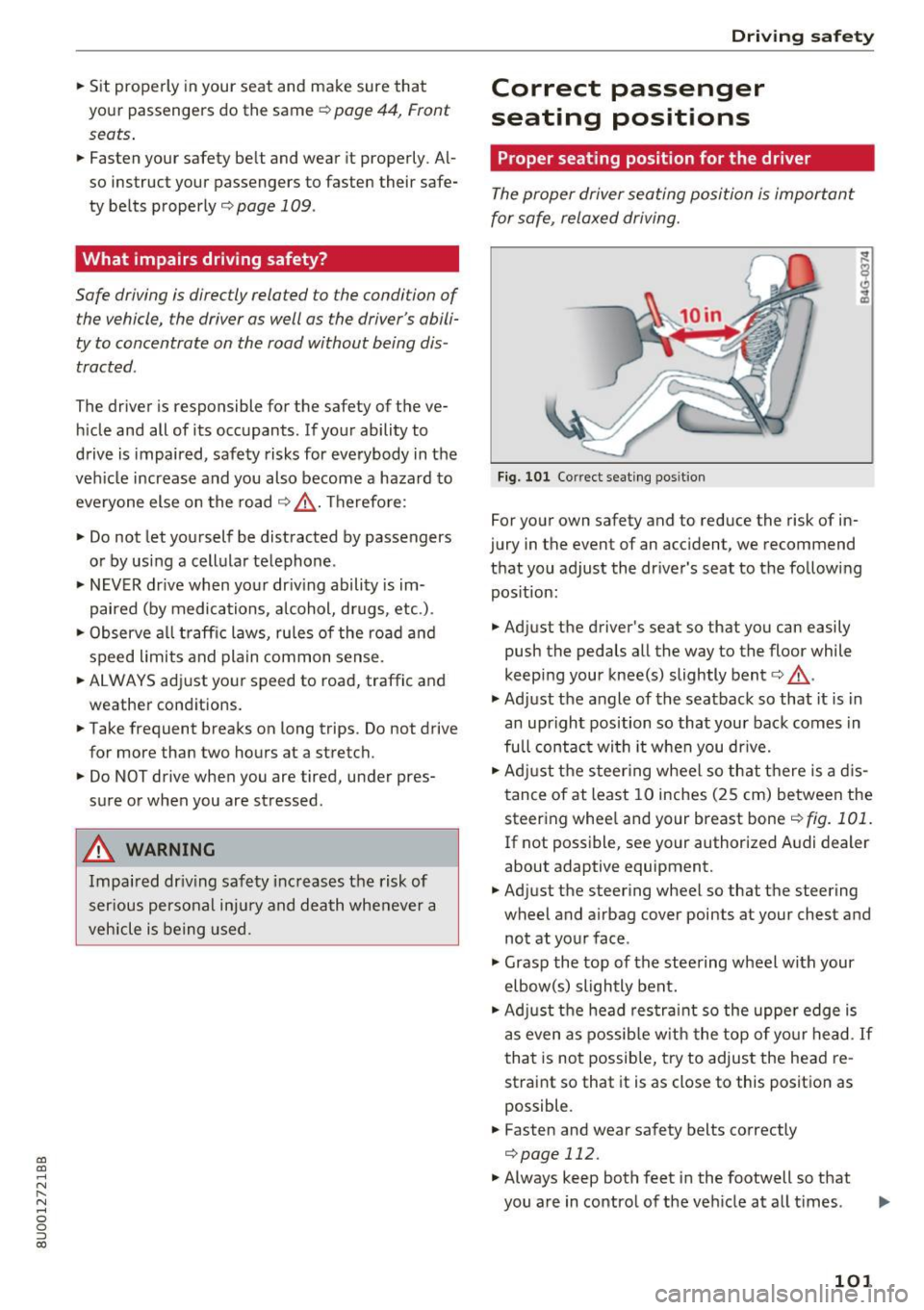
F ig. 101 Cor rect seating position
For your own safety and to reduce the risk of in
jury in the event of an accident, we recommend
that you adjust the driver's seat to the following pos ition:
.. Adjust the driver's seat so that you can easily
push the pedals all the way to the floor while
keep ing your knee(s) slightly bent¢_& .
.,. Adjust the angle of the seatback so that it is in
an upright position so that your back comes in
full contac t wi th it when you dr ive.
.. Adj ust the steer ing wheel so that there is a d is
tance of at least 10 inches (25 cm) between the steering whee l and your breast bone¢
fig. 101.
If not possible, see your author ized A udi dealer
about adaptive equipment.
.. Adjust the steering wheel so that the steering
wheel and airbag cover points at your chest and
not at your face .
.,. Grasp the top of the steering wheel with your
elbow(s) slightly bent .
.. Ad just the head res tra int so the upper edge is
as even as possib le w ith the top of yo ur head.
If
that is no t possib le, try to adjust the head re
straint so that it is as close to this position as
possible .
.. Fasten and wear safety belts correctly
¢page 112.
.. Always keep both feet i n the footwell so that
you are in control of the veh icle at all t imes .
101
Page 104 of 236
Driving safety
For detailed information on how to adjust the
driver's seat, see ¢
page 44.
A WARNING
Drivers who are unbelted, out of position or
too close to the airbag can be seriously in
jured by an airbag as it unfolds. To help re
duce the risk of serious personal injury:
- Always adjust the driver's seat and the
steering wheel so that there are at least
10 inches (25 cm) between your breastbone
and the steering wheel.
- Always hold the steering wheel on the out
side of the steering wheel rim with your
hands at the 9 o'clock and 3 o'clock posi
tions to help reduce the risk of personal in
jury if the driver's airbag inflates.
- Never hold the steering wheel at the
12 o'clock position or with your hands at
other positions inside the steering wheel
rim or on the steering wheel hub. Holding
the steering wheel the wrong way can cause serious injuries to the hands, arms and head
if the driver's airbag deploys.
- Pointing the steering wheel toward your
face decreases the ability of the su pplemen
tal driver's airbag to protect you in a colli
sion.
- Always sit in an upright position and never lean against or place any part of your body
too close to the area where the airbags are
located.
- Before driving, always adjust the front seats
and head restraints properly and make sure
that all passengers are properly restrained.
- Never adjust the seats while the vehicle is
moving . Your seat may move unexpectedly
and you could lose control of the vehicle.
- Never drive with the backrest reclined or
tilted far back! The farther the backrests are
tilted back, the greater the risk of injury due
to incorrect positioning of the safety belt
and improper seating position.
- Children must always ride in child safety
seats¢
page 137. Special precautions ap
ply when installing a child safety seat on the
front passenger seat
q page 117.
102
-
Proper seating position for the front
passenger
The proper front passenger seating position is
important for safe, relaxed driving.
For your own safety and to reduce the risk of in
jury in the event of an accident, we recommend
that you adjust the seat for the front passenger
to the following position :
.,. Adjust the angle of the seatback so that it is in
an upright position and your back comes in full
contact with it whenever the vehicle is moving.
.,. Adjust the head restraint so the upper edge is
as even as possible with the top of your head. If
that is not possible, try to adjust the head re
straint so that it is as close to this position as
possible ¢
page 45.
.,. Keep both feet flat on the floor in front of the
front passenger seat.
.,. Fasten and wear safety belts correctly
¢page 112.
For detailed information on how to adjust the
front passenger's seat, see
¢ page 44.
A WARNING
Front seat passengers who are unbelted, out
of position or too close to the airbag can be
seriously injured or killed by the airbag as it
unfolds. To help reduce the risk of serious
personal injury:
- Passengers must always sit in an upright po
sition and never lean against or place any
part of their body too close to the area
where the airbags are located.
- Passengers who are unbelted, out of posi
tion or too close to the airbag can be seri
ously injured by an airbag as it unfolds with
great force in the blink of an eye.
- Always make sure that there are at least
10 inches (25 cm) between the front pas
senger's breastbone and the instrument
panel.
- Each passenger must always sit on a seat of
their own and properly fasten and wear the
safety belt belonging to that seat.
- Before driving, always adjust the front pas senger seat and head restraint properly.
Page 105 of 236
00
00
......
"' ,....
"' ...... 0 0 :::,
00
- Always keep your feet on the floor in front
of the seat. Never rest them on the seat, in
strument panel, out of the window, etc. The
airbag system and safety belt will not be able to protect you properly and can even in
crease the risk of injury in a crash.
- Never drive with the backrest reclined or
tilted far back! The farther the backrests are
tilted back, the greater the risk of injury due
to incorrect positioning of the safety belt
and improper seating position .
- Children must always ride in child safety
seats¢
page 137 . Special precaut ions ap
ply when installing a ch ild safety seat on the
front passenger seat ¢
page 117.
Proper seating positions for passengers in
rear seats
Rear seat passengers must sit upright with both
feet on the floor consistent with their physical
size and be properly restrained whenever the ve hicle is in use.
To reduce the risk of injury caused by an incorrect
seating position in the event of a sudden braking
maneuver or an accident, your passengers on the
rear bench seat must always observe the follow
ing:
~ Make sure that the seatback is securely latched
in the upright position¢
page 49.
~ If there is a passenger on the rear center seat
ing position, slide the center head restraint up
ward at least to the next notch ¢
page 46.
~ Keep both feet flat in the footwell in front of
the rear seat .
~ Fasten and wear safety belts properly
¢page 112.
~ Make sure that children are always properly re
strained in a child restraint that is appropriate
for their size and age ¢
page 13 7.
A WARNING
Passengers who are improperly seated on the
rear seat can be seriously injured in a crash.
- Each passenger must always sit on a seat of
their own and properly fasten and wear the
safety belt belonging to that seat.
Driving safety
- Safety belts only offer maximum protection
when the seatback is securely latched in the
upright position and the safety belts are properly positioned on the body . By not sit
ting upright, a rear seat passenger increases
the risk of personal injury from improperly
positioned safety belts!
- Always adjust the head restraint properly so
that it can give maximum protection.
Proper adjustment of head restraints
Correctly adjusted head restraints are an impor
tant part of your vehicle's occupant restraint sys
tem and can help to reduce the risk of injuries in
accident situations.
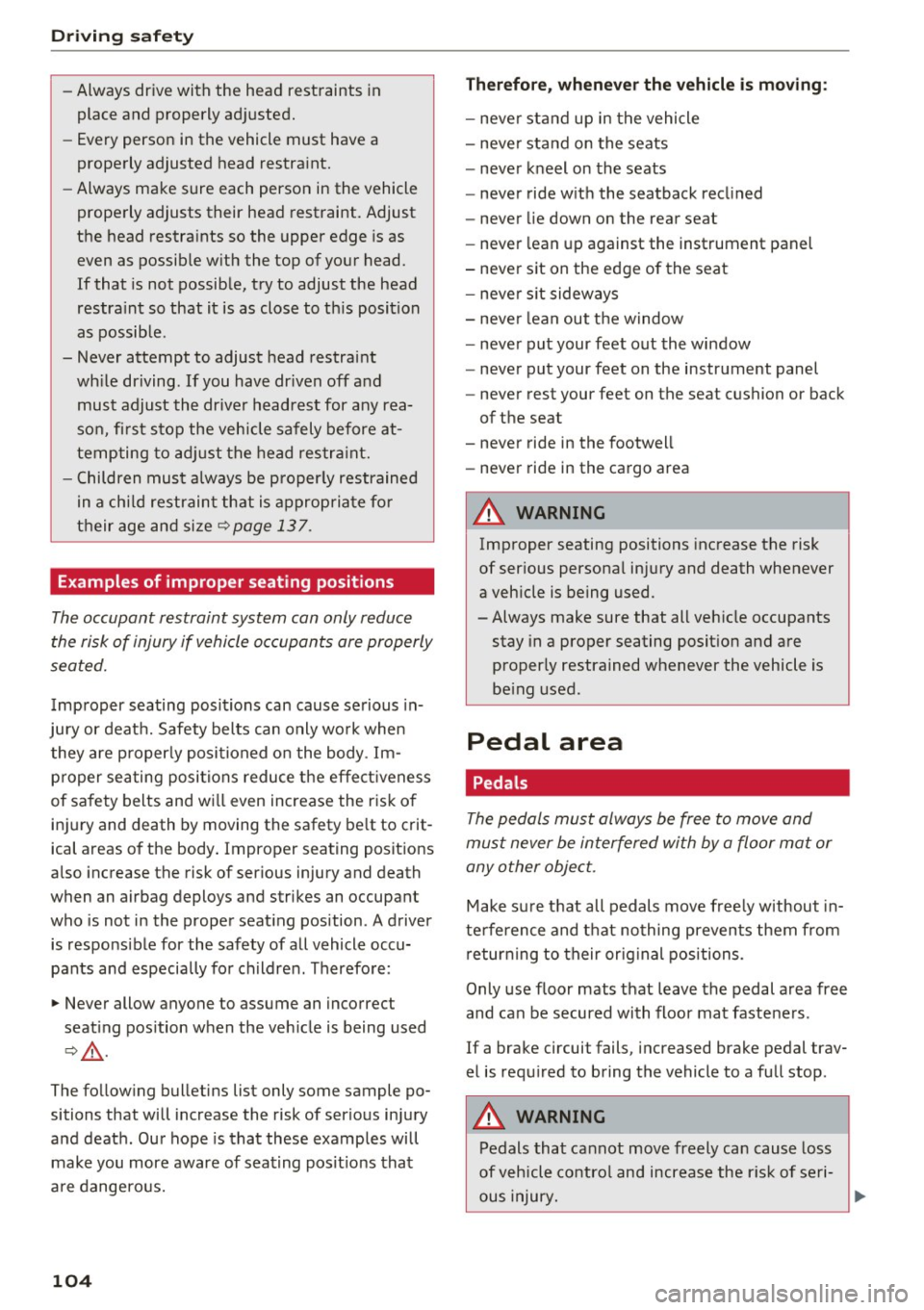
Fig. 102 Head restraint: vi ew ed from t he front
The head restraints must be correctly adjusted to
achieve the best protection.
~ Adjust the head restraints so the upper edge is
as even as possible with the top of your head. If
that is not possible, try to adjust the head re
straint so that it is as close to this position as
possible
¢ fig . 102.
~ If there is a passenger on the rear center seat
ing position, slide the center head restraint up
ward at least to the next notch .
Adjusting head restraints¢
page 45.
A WARNING
-All seats are equipped w ith head restraints.
Driving without head restraints or with head
restraints that are not properly adjusted in
creases the risk of serious or fata l neck injury
dramatically . To help reduce the risk of injury: ..,
103
Page 106 of 236
Driving sa fe ty
-Always drive with the head restraints i n
place and properly adjusted.
- Every person in the vehicle must have a
properly adjusted head restra int.
- Always make sure each person in the vehicle
properly adjusts their head restraint. Adjust
the head restra ints so the upper edge is as
even as possib le w ith the top of your head.
If that is not possib le, try to adjust the head
restra int so that it is as close to th is position
as possib le.
- Never attempt to adjust head restraint wh ile driving.
If you have dr iven off and
must adjust the driver headrest for any rea
son, fi rst stop the vehicle safely before at
tempting to ad just the head restr aint.
- Children must always be p roperly restrained
in a chi ld restrain t th at is appropria te fo r
their age and si ze
~page 137.
Examples of improper seating positions
The occupant restraint system can only reduce
the risk of injury if vehicle occupants are properly
seated.
I mp roper seating positions can cause se rious in
ju ry or deat h. Safety belts can only wo rk when
they are p roperly posi tioned o n the body . Im
p roper seating posi tions reduce t he effe ct iveness
of sa fety belts and w ill even increase the r isk o f
in jury and death by moving the safety be lt to crit
ical areas of the body . Improper seating posit ions
also increase the risk of ser ious injury and death
when an airbag deploys and strikes an occupant
who is not in the prope r seat ing position. A driver
is respo nsible for the safety of all vehicle occu
pants and especially fo r children. Therefo re:
~ Never allow anyone to assume an incorrect
seat ing pos ition w hen the veh icle is being used
~ .&. -
The follow ing bulletins list only some sample po
sitions that will inc rease the risk of serious inju ry
and death. Ou r hope is that these examples will
make you more aware of seat ing pos it io ns that
a re dangero us.
104
Therefore , whenever the vehicle is moving :
-neve r stand up in the vehicle
- neve r sta nd on the seats
- neve r kneel on the seats
- never ride w ith the seatback recl ined
- neve r lie down on the rear seat
- neve r lean up against the instrument panel
- never s it on the edge of the seat
- neve r sit sideways
- neve r lean out t he window
- neve r put your feet o ut the window
- never put your feet on the instrument panel
- neve r rest your feet on the seat cushion or back
of the seat
- never ride in the footwell
- never ride in the cargo area
'
A WARNING
Imp roper seating positions inc rease the risk
of ser ious personal injury and death whenever
a veh icle is being used.
- Always make sure that all veh icle occupants
stay in a proper seating posit ion and are
properly restrained whenever the vehicle is be ing used .
Pedal area
Pedals
The pedals must alway s be free to move and
must never be interfered with by a floor mat or
any o ther object.
Mak e su re t hat all pedals move free ly w ithout in
te rfe rence and t hat nothing prevents them from
r etur ning to their orig inal positions.
Only use floor mats that leave the pedal a rea free
and can be secured wi th floor ma t faste ne rs.
If a brake circuit fails, i ncreased brake pedal trav
el is requ ired to bring the vehicle to a fu ll stop.
A WARNING
Pedals that ca nnot move freely ca n cause loss
of vehicle contro l and increase the r is k of seri
ous injury.
Page 107 of 236
a:,
a:,
...... N r--. N .... 0 0 ::, a:,
-Never place any objects in the driver's foot
well. An object could get into the pedal area and interfere w ith pedal function. In case of
sudden braking or an accident, you would not be able to brake or accelerate!
- Always make sure that nothi ng can fall or
move into the dr iver's footwell.
Floor mats on the driver side
Always use floor mots that con be securely at
tached to the floor mot fasteners and do not in
terfere with the free movement of the pedals .
.. Make sure that the floor mats are properly se
cured and cannot move and interfere with the
pedals
q .&, .
Use only floor mats that leave the pedal area un
obstructed and that are firmly secured so that
they cannot slip out of position. You can obtain
suitable floor mats from your authorized Audi
dealer .
F loor mat fasteners are installed in your Audi.
Fl oor mats used in your vehicle must be attached
to these fasteners. Proper ly securing the floor
mats will prevent them from sliding into posi
tions that could interfere with the pedals or im pair safe operation of your vehicle in other ways.
A WARNING
Peda ls that cannot move free ly can result i n a
loss of vehicle control and increase the risk of
ser ious personal injury .
-Always make sure that floor mats are prop erly secured.
- Never place or install floor mats or other
floo r coverings in the veh icle that ca nnot be
prope rly secured in place to prevent them
from slipp ing and in terfering with the ped
als or the abili ty to contro l the vehicle.
- Never place or insta ll floor mats or o ther
floo r coverings on top of already insta lled
floo r ma ts. Addit ional floor mats and othe r
coverings w ill reduce the size of the peda l
area and interfere with the pedals .
- Always properly reinstall and secu re floor
mats that have been taken o ut for cleaning .
Driving safety
-Always make sure that objects cannot fall
into the driver footwell while the vehicle is
mov ing. Objects can become trapped under
the brake pedal and accelerator pedal caus ing a loss of vehicle control.
Storing cargo correctly
Loading the luggage compartment
All luggage and other objects must be properly stowed and secured in the luggage compart
ment.
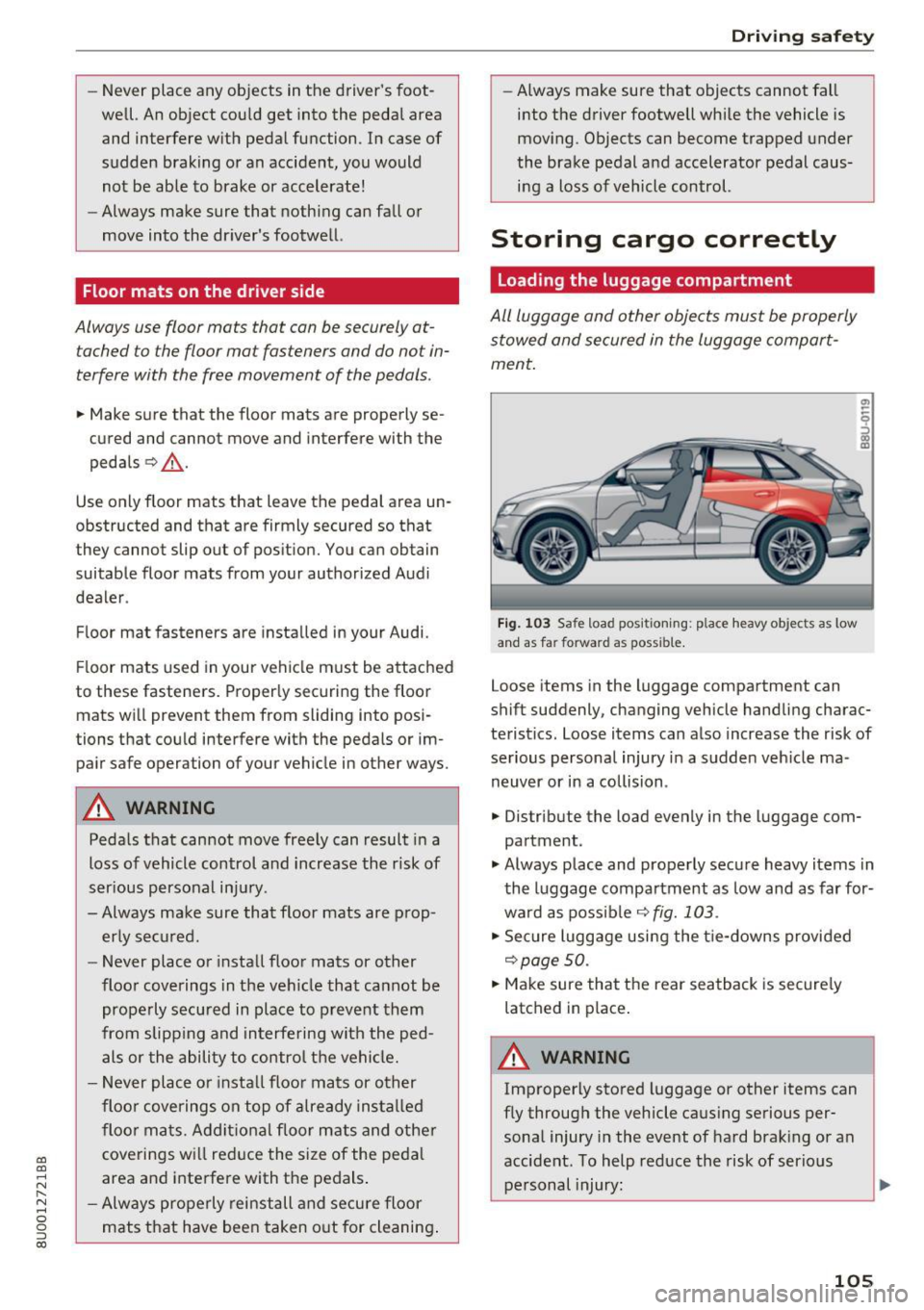
Fi g. 103 Safe load pos ition ing: place heavy objects as low
and as fa r forward as poss ible.
Loose items in the luggage compartment can
shift suddenly, changing vehicle handling charac
teristics. Loose items can also increase the risk of
serious personal injury in a sudden veh icle ma
neuver or in a collision .
.. Distribute the load evenly in the luggage com
partment.
.,. Always place and properly secure heavy items in
the luggage compartment as low and as far for
ward as possib le
q fig. 103 .
.. Sec ure luggage usi ng the t ie-downs provided
q pogeSO.
.. Make sure that the rear seatback is secure ly
latched in place .
A WARNING
Improperly stored luggage or other items can
fly through the vehicle caus ing serious per
sona l injury i n the event of hard brak ing or an
accident. To help reduce the risk of serio us
personal injury :
~
105
Page 108 of 236
Driving safety
-Always put objects, for example, luggage or
other heavy items in the luggage compart
ment.
- Always secure objects in the luggage com
partment using the tie-down eyelets and
suitable straps.
A WARNING
Heavy loads will influence the way your vehi
cle handles. To help reduce the risk of a loss
of control leading to serious personal injury:
- Always keep in mind when transporting
heavy objects, that a change in the center of
gravity can also cause changes in vehicle
handling:
- Always distribute the load as evenly as
possible.
- Place heavy objects as far forward in the
luggage compartment as possible.
- Never exceed the Gross Axle Weight Rating or the Gross Vehicle Weight Rating specified
on the safety compliance sticker on the left
door jamb. Exceeding permissible weight
standards can cause the vehicle to slide and handle differently .
- Please observe information on safe driving
¢page 100.
A WARNING
To help prevent poisonous exhaust gas from
being drawn into the vehicle, always keep the
rear lid closed while driving.
- Never transport objects larger than those fitting completely into the luggage area be
cause the rear lid cannot be fully closed .
- If you absolutely must drive with the rear lid open, observe the following notes to reduce
the risk of poisoning:
- Close all windows,
- Close the Panoramic sliding sunroof*,
- Open all air outlets in the instrument pan-
el,
- Switch off the air recirculation,
- Set the fresh air fan to the highest speed .
106
A WARNING
,--
Always make sure that the doors, all win
dows, the Panoramic sliding sunroof* and the
rear lid are securely closed and locked to re
duce the risk of injury when the vehicle is not
being used .
-After closing the rear lid, always make sure
that it is properly closed and locked.
- Never leave your vehicle unattended espe
cially with the rear lid left open. A child
could crawl into the vehicle through the lug
gage compartment and close the rear lid be
coming trapped and unable to get out. Be
ing trapped in a vehicle can lead to serious
personal injury.
- Never let children play in or around the vehi
cle.
- Never let passengers ride in the luggage
compartment. Vehicle occupants must al
ways be properly restrained in one of the ve
hicle's seating positions.
(D Tips
- Air circulation helps to reduce window fog
ging. Stale air escapes to the outside
through vents in the trim panel. Be sure to keep these slots free and open .
- The tire pressure must correspond to the
load. The tire pressure is shown on the tire
pressure label. The tire pressure label is lo
cated on the driver's side B-pillar . The tire
pressure label lists the recommended cold
tire inflation pressures for the vehicle at its
maximum capacity weight and the tires that
were on your vehicle at the time it was man
ufactured. For recommended tire pressures
for normal load conditions, please see chap
ter
¢ page 181.
Tie-downs
The luggage compartment is equipped with four
tie-downs to secure luggage and other items.
Use the tie-downs to secure your cargo properly
¢page 105, Loading the luggage compartment . ..,_