ABS AUDI Q3 2018 User Guide
[x] Cancel search | Manufacturer: AUDI, Model Year: 2018, Model line: Q3, Model: AUDI Q3 2018Pages: 230, PDF Size: 57.03 MB
Page 109 of 230
a
co
...... N r--. N .... 0 0 ::, co
-Failure to pay attention to the warn ing light
that come on, could lead to persona l injury.
Why use safety belts?
Frontal collisions and the law of physics
Frontal crashes create very strong forces for peo
ple riding in vehicles .
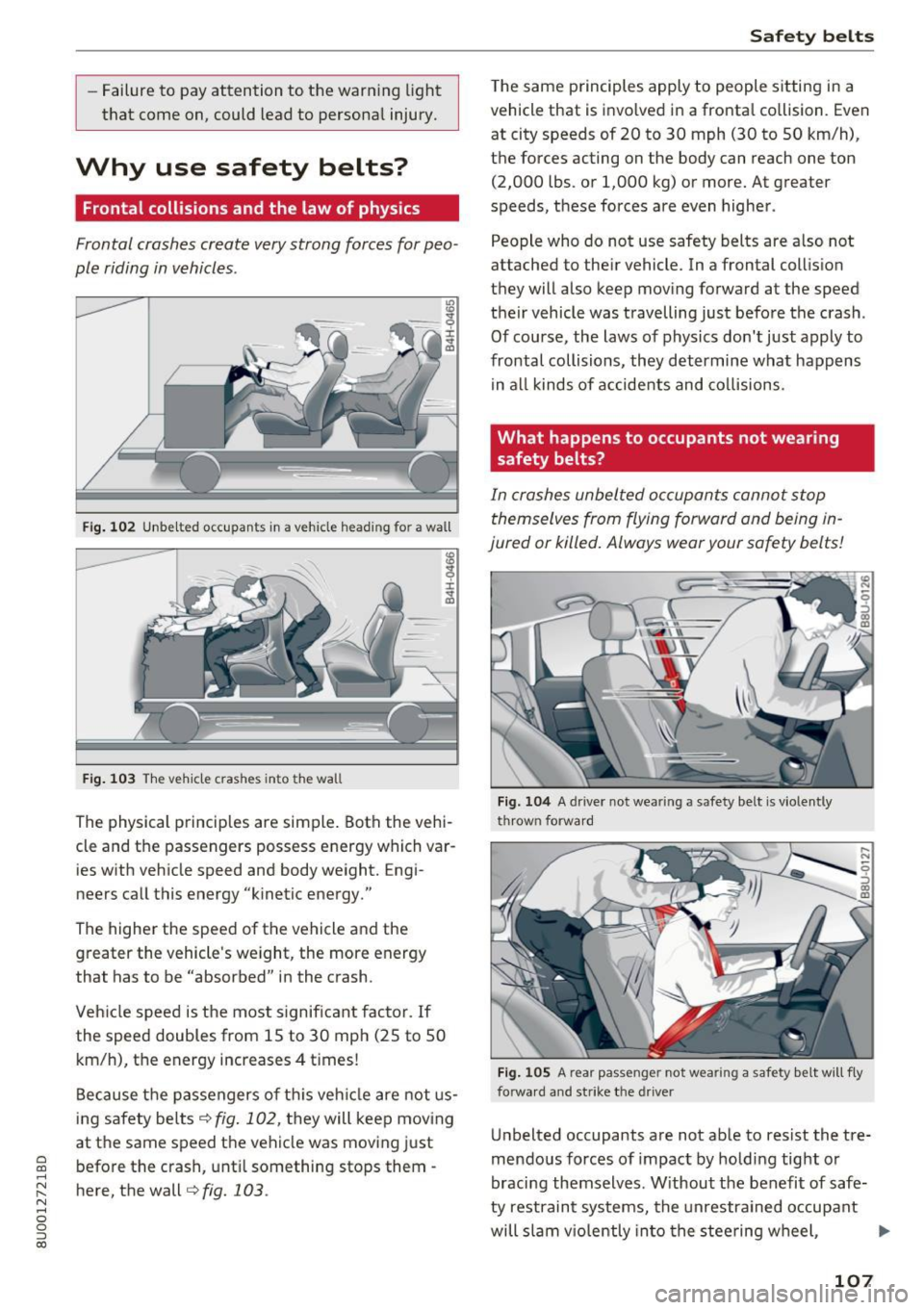
Fig. 102 Unbelted occupants in a vehicle heading for a wall
Fig. 103 The vehicle crashes into the wall
The physical principles are simple. Both the vehi
cle and the passengers possess energy which var ies with vehicle speed and body weight. Engi
neers call this energy "kinetic energy."
The higher the speed of the vehicle and the greater the vehicle's we ight, the more energy
that has to be "absorbed" in the crash.
Veh icle speed is the most significant factor. If
the speed doubles from 15 to 30 mph (25 to 50
km/h), the energy increases 4 t imes!
Because the passengers of this vehicle are not us
ing safety belts
¢fig. 102, they will keep moving
at the same speed the vehicle was moving just
before the crash, until something stops them -
here, the wall¢
fig. 103 .
Safety belts
The same p rinciples apply to people sitting in a
vehicle that is invo lved in a fronta l co llision. Even
at city speeds of 20 to 30 mph (30 to 50 km/h),
the forces acting on the body can reach one ton
(2,000 lbs. or 1,000 kg) or more. At greater
speeds, these forces are even higher.
People who do not use safety belts are a lso not
attached to the ir vehicle. In a frontal collis ion
they will also keep moving forward at the speed
their vehicle was travelling just before the crash .
Of course, the laws of physics don't just apply to
frontal collisions, they determine what happens in all kinds of accidents and collisions .
What happens to occupants not wea ring
safety belts?
In crashes unbelted occupants cannot stop
themselves from flying forward and being in
jured or killed. Always wear your safety belts!
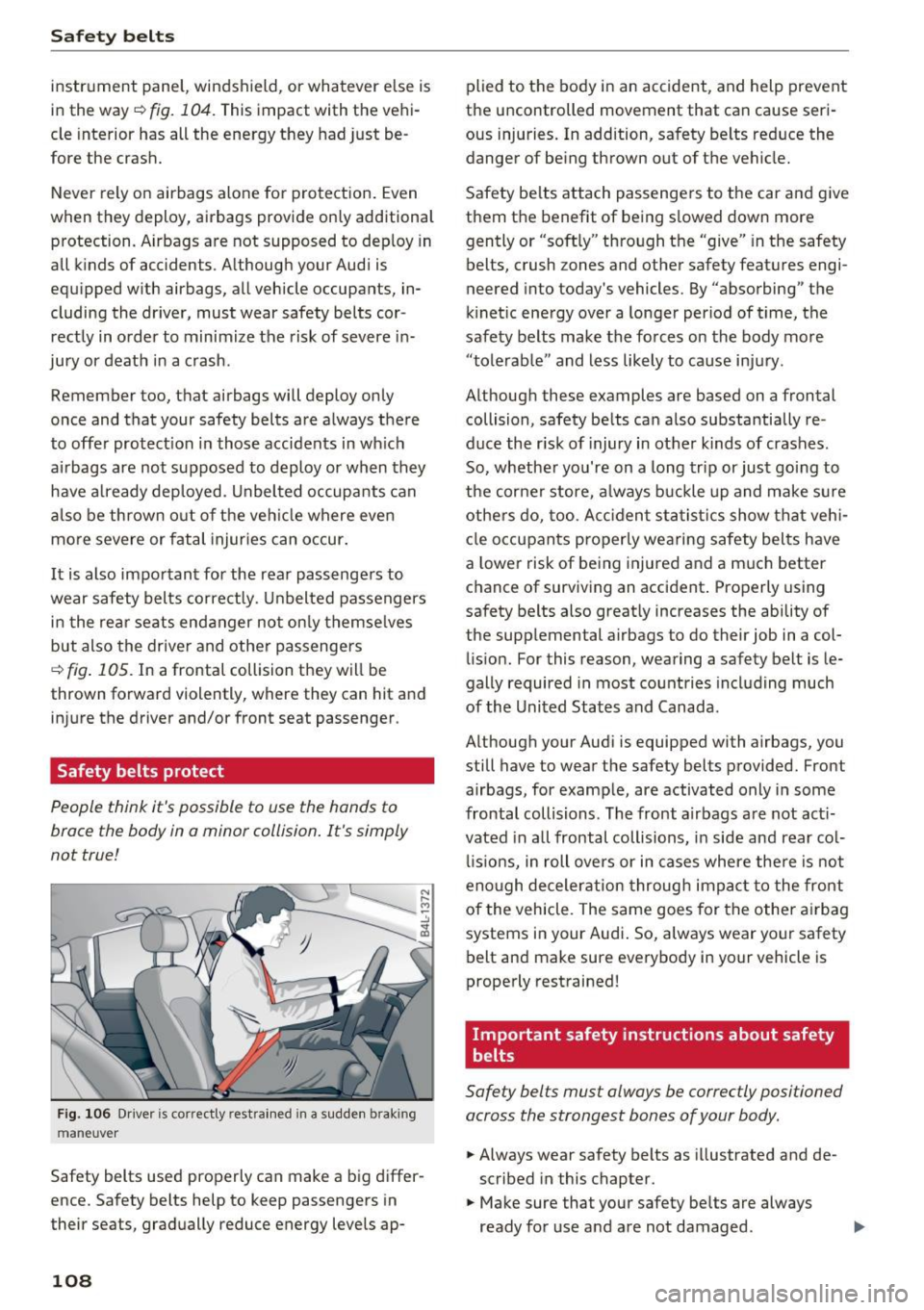
Fig. 104 A driver not wearing a safety belt is violently
th row n forwar d
Fig. 10S A rear passe nger not wearing a safety belt will fly
forward a nd strike the driver
Unbelted occupants are not able to resist the tre
mendous forces of impact by holding tight or
bracing themselves . Without the benefit of safe
ty restraint systems, the unrestrained occupant
will slam viol ently into th e steering wheel, .,.
107
Page 110 of 230
Safe ty belts
instrument panel, windshield, or whatever else is
in the way
r:!> fig. 104. This impact with the vehi
cle interior has all the energy they had just be
fore the crash.
Never rely on airbags alone for protection . Even
when they deploy, airbags provide only additional
protection. A irbags are not supposed to dep loy in
all kinds of accidents. A lthough your Audi is
equipped w ith airbags, all vehicle occupants, in
cluding the driver, must wear safety belts cor
rectly in order to minimize the risk of severe in
jury or death in a crash .
Remember too, that airbags will deploy only
once and that your safety belts are always there
to offer protect ion in those accidents in wh ic h
airbags are not supposed to deploy or when they
have a lready deployed . Unbel ted occupants can
also be thrown o ut of the veh icle where eve n
mo re severe or fatal injuries can occur .
It is also important for the rear pass engers to
wear safety belts correctly. Unbelted passengers
i n t he re ar seats endanger no t on ly themse lves
but also the drive r and other passengers
~ fig . 1 OS. In a frontal collision they will be
thrown forward violently, where they can hit and
in jure the driver and/or front seat passenger.
Safety belts protect
People think it's possible to use the hands to
brace the body in a minor collision . It's simply
not true!
F ig . 10 6 Driver is co rrectly restrai ned in a sudde n brak ing
m aneu ver
Safety belts used properly can make a b ig d iffer
ence. Safety belts help to keep passengers in
their seats, gradually reduce energy levels ap-
108
plied to the body in an accident , and help prevent
the uncontrolled movement that can cause seri
ous injuries. In add ition, sa fety belts red uce the
danger of being thrown out of the vehicle.
Safety be lts attach passengers to the car and g ive
them the benefit of being s lowed down more
gently or "soft ly" thro ugh the "give" in the safety
belts, crush zones and other safety feat ures engi
neered into today's vehicles. By "absorbing" the
k inet ic energy over a longer per iod of t ime, the
safety belts make the forces on the body more
"tole rab le" and less likely to cause inju ry .
Although these examples are based on a frontal
collision, safety be lts ca n also substantially re
duce the r isk o f injury in ot her kinds of crashes .
So, whethe r yo u're on a long trip or just goi ng to
the cor ne r store, a lways b uckle up and make s ure
othe rs do, too. Ac ciden t st at ist ics show that veh i
cle o ccupants prope rly wearing safety bel ts have
a lowe r risk of being injured and a m uch better
chance of surviving an acc ident . Properly using
safety be lts also great ly increases the ability of
the supp lemental airbags to do their job in a col
li sion. For this reason, wearing a safety belt is le
gally required in most countries including much
of the United States and Canada .
Although your Aud i is equipped with airbags, you
still have to wear the safety belts provided. Front
airbags, for examp le, are activated only in some
frontal collisions. The front airbags are not act i
vated in all frontal collisions, in side and rear co l
li sions, in roll overs or in cases where the re is not
eno ugh deceler ation throug h impa ct to the front
of the vehicle . The same goes for the other a irbag
systems in your Audi. So, always wear your safety
belt and make sure everybody in your vehicle is
properly rest rained!
Important safety instructions about safety
belts
Safe ty belts must always be correctly positioned
acros s the strongest bones of your body .
.,. Always wear safety belts as illustrated and de
scribed in this chapter.
.,. Make sure that your safety be lts are always
ready fo r use a nd are not damaged .
Page 120 of 230
Airbag system
Front airbags
Description of front airbags
The airbag system can provide supplemental
protection to properly restrained front seat occu
pants.
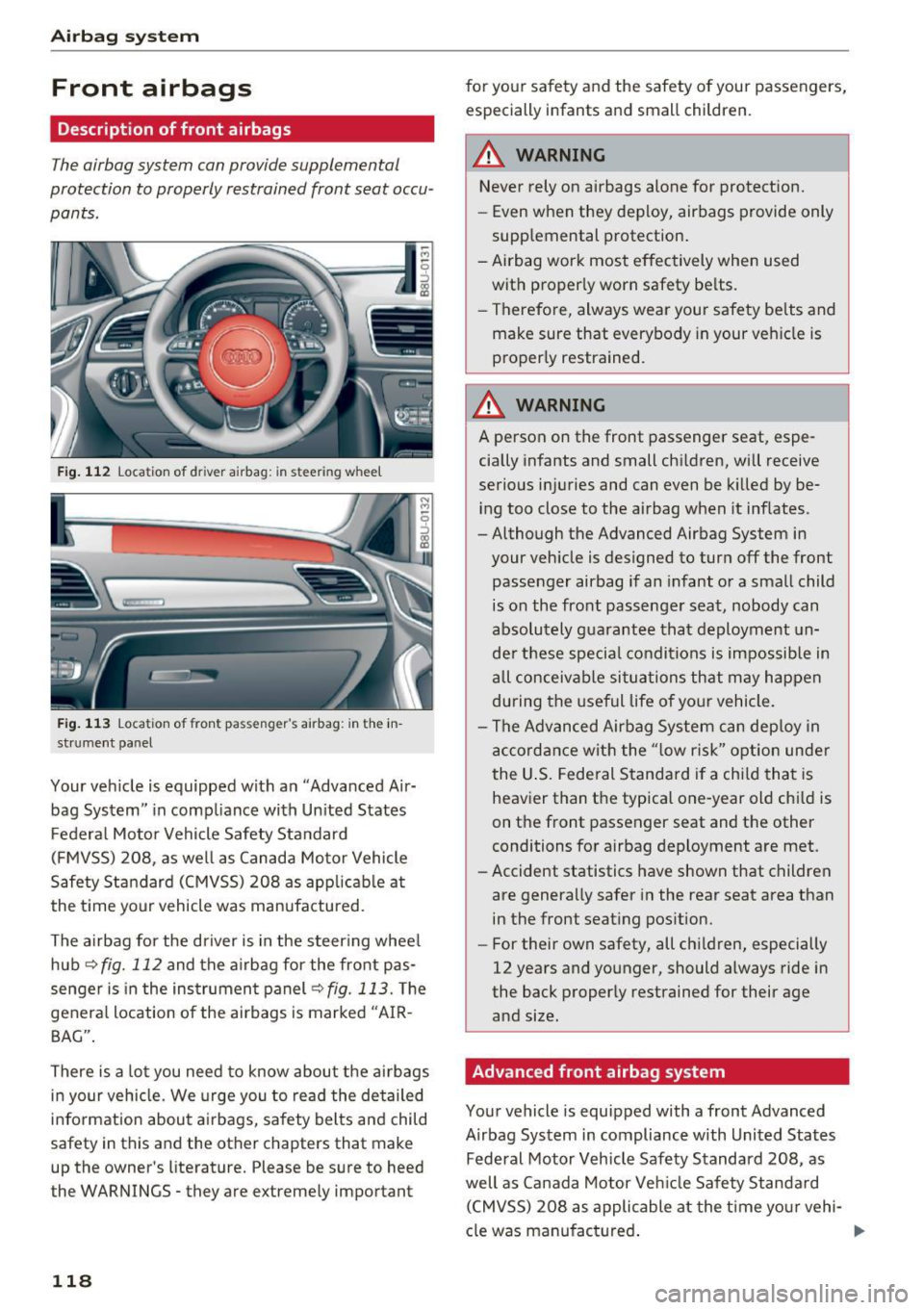
Fig. 112 Location of driver airbag: in steering whee l
Fig. 113 Location of front passenger's airbag: in th e in
strument panel
Your veh icle is equipped with an "Advanced Air
bag System " in compliance with Un ited States
Federal Motor Vehicle Safety Standard
(FMVSS) 208, as well as Canada Motor Vehicle
Safety Standard (CMVSS) 208 as applicable at
the time your vehicle was manufactured.
The airbag for the driver is in the steer ing whee l
hub~
fig. 112 and the airbag for the front pas
senger is in the instrument panel
~fig. 113. Th e
general location of the airbags is marked "AIR
BAG" .
There is a lot you need to know about the airbags
in your vehicle . We urge you to read the detailed
information about airbags, safety belts and child
safety in this and the other chapters that make
up the owner 's literature. Please be sure to heed
the WARNINGS - they are extreme ly important
118
for your safety and the safety of your passengers,
especially infants and small children.
A WARNING -
Never rely on airbags alone for protection.
- Even when they deploy, airbags provide only
supplemental protection.
- Airbag work most effectively when used with proper ly worn safety belts.
- Therefore, always wear your safety be lts and
make sure that everybody in your veh icle is
proper ly restrained.
A WARNING
A person on the front passenger seat, espe
cially infants and small chi ldren, will receive
serious injuries and can even be killed by be ing too close to the airbag when it inflates.
- Although the Advanced Airbag System in
your veh icle is designed to turn off the front
passenger airbag if an infant or a small child
is on the front passenger seat, nobody can
absolutely guarantee that deployment un
der these special conditions is impossible in
all conceivable situations that may happen
during the useful life of your vehicle.
- The Advanced Airbag System can dep loy in
accordance with the "lo w risk" option under
the U.S. Federal Standard if a child that is
heavier than the typical one-year old chi ld is
on the front passenger seat and the other
conditions for airbag deployment are met.
-Accident statistics have shown that children
are generally safer in the rear seat area than
in the front seat ing position.
- For their own safety, all children, especially
12 years and younger, should always ride in
the back properly restrained for their age and size.
Advanced front airbag system -
Your vehicle is equipped with a front Advanced
Airbag System in compliance with United States
Federal Motor Vehicle Safety Standard 208, as
well as Canada Motor Vehicle Safety Standa rd
(CMVSS) 208 as applicable at the time your vehi
cle was manufactured .
Page 122 of 230
Airbag syste m
If the front passenger airbag deploys , the Feder
al Standard requires the airbag to meet the "low risk" deployment criteria to help reduce the risk
of injury through interaction with the airbag.
"Low risk" deployment occurs in those crashes
that take place at lower decelerations as defined in the electronic control unit . ~
page 124
Alway s rem ember: Even though you r veh icle is
equipped with Advanced Airbags, the safest place
for children is properly restrained on the back
seat. Please be sure to read the important infor
mat io n in the sections that follow and be sure to
heed a ll of the WARN INGS .
_& WARNING
To reduce the risk of inj ury when an airbag in
flates, a lways wear safety belts properly .
-If you are unrestrained, leaning forwa rd, s it
t ing s ideways or o ut of pos ition in any way,
yo ur risk of injury is much higher .
- Yo u will also receive serious injur ies and
could even be killed if you are up aga inst the
airbag or too close to it when it inflates -
even with an Advanced Airbag r:!> page 114.
_& WARNING
A child in a rearward-facing child safety seat
installed on the front passenger seat wi ll be
ser iously injured and can be killed if the front
airbag inflates -even w ith an Advanced Airbag
System .
- Although the Advanced A irbag System in
your vehicle is designed to turn off the front
airbag when a rea rward-facing child re
straint has been insta lled on the front pas
senger seat, nobody can absolutely guaran
tee that deployment is impossible in all con
ceivable s ituations that may happen during
the useful life o f you r vehicle .
- T he inflating a irbag w ill hit the child safety
seat or infant carrier with great force and
will smash the chi ld safety seat and child
against the backrest, center armrest, door,
or roof.
- Always install rearward-facing chi ld re
straints in the back seat.
120
- If you must install a rearwa rd facing child
safety seat on the front passenger seat be
cause of exceptional circumstances and the
PA SS EN GER AIR BAG OFF light does not
come on and stay on, immediately install
the rea r-facing child safety seat in a rear
seating position and have the ai rbag system
inspected by your authori zed Aud i dealer.
_& WARNING
If, in exceptional ci rcums tances , you must in
stall a forward-facing child restraint on the
front passenger's seat :
- Always make sure the forward-facing sea t
has been des igned and certified by its man
ufacturer for use on a front seat with a pas
senger front and side airbag.
- Never put the forward -facing child restraint
up against or very near the instrument pan
el.
- Always move the front passenger seat to
the highest posit ion in the up and down ad
justment range and move it back to the
rearmost posit ion in the seat's fore and aft
adjustment range, as far away from the a ir
bag as poss ible, before installing the for
ward-facing chi ld restrain t.
- Always make sure that the safety be lt upper
anchorage is behind the ch ild restraint and
not next to o r in front of the child rest raint
so that the safety be lt will be p roperly posi
tioned.
- Always move the passenge r seat into its
rearmost posit ion i n the seat's fo re and aft
ad justmen t range, as far away from the a ir
bag as poss ible, before install ing the for
ward-facing chi ld restraint. The backrest
must be adjusted to an upright position.
- Ma ke sure that the
PASSENGER AIR BAG
OFF
li ght comes on and stays on all the time
whenever the ign it ion is switched on.
' Advanced Airbag System components
The front passenger seat in your veh icle has a lot
of very impo rtant parts of the Advanced A irbag
System in it . These parts include the weight-
sensing mat, sensors , wir ing, brackets, and .,.
Page 130 of 230

Airbag system
service action is entered in your Audi War
ranty
& Maintenance book let under AIRBAG
REPLACEMENT RECORD.
@ For the sake of the environment
Undeployed airbag modules and pretension
ers might be classified as Perchlorate Materi
al -special handling may apply, see
www.dtsc.ca.gov/hazardouswaste/perchlo
rate. When the vehicle or parts of the re
straint system including airbag modules safe
ty belts with pretens ioners are scrapped, al l
applicable laws and regulat ions must be ob
served. Your authorized Audi dealer is familiar
with these requ irements and we recommend
that you have your dealer perform this service
for you.
Other things that can affect Advanced
Airbag performance
Changing the vehicle's suspension system can
change the way that the Advanced Airbag System
performs in a crash. For examp le, using t ire-rim
combinations not approved by Audi, lower ing the
veh icle, changing the stiffness of the suspens ion,
including the springs , suspension struts, shock
absorbers etc . can change the forces that are
measured by the airbag sensors and sent to the
electronic control unit. Some suspension changes
can, for example, increase the force levels meas
ured by the sensors and make the airbag system
deploy in crashes in which it would not deploy if
the changes had not been made . Other kinds of
changes may reduce the force levels measured by
the sensors and prevent the airbag from deploy
ing when it should .
A WARNING
Changing the vehicle's suspension including
use of unapproved tire-rim combinations can
change Advanced Airbag performance and in
crease the risk of serious personal in jury in a
crash.
- Never install suspension components that
do not have the same performance charac
teristics as the components originally instal
led on your veh icle .
128
.
-Never use tire-rim combinations that have
not been approved by Aud i.
A WARNING
Items stored between the safety belt buckle
and the center conso le can cause the sensors
in the buckle to send the wrong information
to the electronic control module and prevent
the Advanced A irbag System from wo rking
p roperly.
-Always make sure that nothing can interfere
w ith the safety belt buckles and that they
are not obstructed.
Side airbags
Description of side airbags
The airbag system can provide supplemental
protection to properly restrained occupants.
Fig. 116 Sid e a irbag locatio n in the dr ive r's seat
The side airbags are located in the s ides of the
front seat backrests
~ fig . 116 facing the doors .
They are identified by the word "AIRBAG ".
The side airbag system basically consists of:
-the electronic control module and external side
impact sensors
- the two airbags located in the sides of the front
backrests
- the airbag warning light in the instrument clus-
ter.
The airbag system is mon itored electron ically to
make certain that it is functioni ng properly at a ll
times. Each time you turn on the ignition, the air
bag system indicator light will come on for a few
seconds (self diagnostics). .,,_
Page 145 of 230
0 co ......
"' ,....
"' ...... 0 0 :::,
00
use the safety belt height adjustment to help
adjust the shoulder portion properly .
~ Secure unused safety belts on the rear seat
¢ page 139.
Children up to at least 8 years old (over 40 lbs. or
18 kg) are best protect ed in child safety s eats de
signed for their age and weight. Experts say that
the skeletal structure, particularly the pelvis, of
these children is not fully developed, and they
must not use the vehicle safety belts without a
suitable child restra int .
It is usually best to put these children in appro priate booster seats . Be sure the booster seat
meets all applicable safety standards .
Booster se ats raise the seating position of the
child and reposition both the lap and shoulder
parts of the safety belt so that they pass across
the child's body in the right places. The rout ing of
the belt over the child's body is very important
for the child's protection, whether or not a boos
ter seat is used. Chi ld ren age 12 and unde r must
a lways ride in the rear seat .
Ch ildren who are at least 4 ft . 9 in. (57 inches/
1.45 mete rs) tall ca n genera lly use the veh icle's
three po int lap and shoulder be lts. Neve r use the
l ap belt po rtion of the vehicle 's safety belt alone
to restrain any child, regardless of how big the
chi ld is. A lways remember that children do not
hav e the pronounced pelvic structure required for
the proper function of lap belt port ion of the ve
h icle 's three point lap and shoulder be lt s. The
chi ld 's safety absolutely requires that a lap belt
port ion of the safety belt be fastened snugly and
as low as possible around the pelvis . Never let
the lap belt portion of the safety belt pass over
the child's stomach or abdomen.
In a crash, a irbags must inflate within a blink of
an eye and wit h considerable force . In order to do
its job, the airbag needs room to inflate so that it
will be there to p rotect the occupant as the occu
pant moves forward into the a irbag.
A vehicle occupant who is out of position and too
close to the airbag gets in the way of an inflating
ai rbag. When an occ upant is too close, he o r she
will be struck v iolently and will receive ser ious or
possibly even fatal injury.
Ch ild safety
In order for the a irbag to offer protection, it is
important that a ll vehicle occupants, especially
any ch ildren, who m ust be in the front seat be
cause of exceptiona l circumstances, be properly
res tra ined and as far away from the airbag as
poss ible. By keeping room between the child 's
body and the front of the passenger compart
ment, the a irbag can inflate completely and pro
vide s upplementa l protec tion in certain frontal
collisions.
A WARNING
-
Not using a booster seat, using the booster
seat improperly, incorrect ly installing a boos
ter seat or using the vehicle safety belt im
properly increases the risk of serious personal
i njury and death in a collision or other emer
gency situation. To help reduce the risk of se rious personal injury and/or death:
- The shou lder belt must lie as close to the
center of the ch ild's collar bone as possible
and must lie flat and snug on the upper
body. It must never lie across the throat or
neck. The lap belt must lie ac ross the pelvis
and never across the stomach o r abdomen.
Make sure the bel t lies flat and sn ug. Pu ll on
the belt to tighten if necessary.
- Fail ure to properly route safety bel ts over a
child's body w ill cause severe injuries in an
accident or other emergency situation
¢ page 106.
- The rear side of the chi ld safety seat should
be positioned as close as possible to the
backrest on the vehicle seat. Adjust or re
move the rear seat head restraint if it is dif
f icult to insta ll the ch ild seat with the head
restraint in place¢
page 44 . Install the
head restraint again immed iately once the
child seat is removed . Driving without head
rest raints or with head restra ints that a re
not properly adj usted increases the r is k of
serio us or fatal ne ck in jury dramatically .
- Never let a chi ld put the shoulder belt under
the arm or behind the ba ck, because i t could
cause severe inj uries in a crash .
- Ch ild ren on the fron t seat of any car, even
with Advanced Airbags, can be seriously in-
jured or even ki lled when an airbag inflates .
Ill>
143
Page 176 of 230
Wheels
differently even if they are the
same size
c::> .,&..
~ If you would like to equip your
vehicle with a tire/rim combina tion that is different from what
was installed at the factory, con
sult with an authorized Audi
dealer or authorized Audi Service
Facility before making a pur
chase
c::> ,& .
If the spare tire is different from
the regular tires installed on the
vehicle - for example, if winter
tires or wide tires are installed -
then only use the spare tire tem porarily in case of emergency and
drive carefully while it is in use. It
should be replaced with a regular
tire as soon as possible.
Applies to: vehicles with all wheel
drive: all four wheels must be
equipped with tires that are the
same brand and have the same
construction and tread pattern so
that the drive system is not dam
aged by different wheel speeds. For this reason, in case of emer
gency, only use a spare tire that has the same circumference as
the regular tires.
174
A WARNING -
-Only use tire/rim combina tions and suitable wheel bolts
that have been approved by
Audi. Otherwise, damage to
the vehicle and an accident
could result.
-For technical reasons, it is not possible to use tires from oth
er vehicles - in some cases,
you cannot even use tires from
the same vehicle model.
-Make sure that the tires you select have enough clearance
to the vehicle. Replacement
tires should not be chosen
simply based on the nominal size, because tires with a dif
ferent construction can differ
greatly even if they are the
same size. If there is not
enough clearance, the tires or
the vehicle can be damaged and this can reduce driving
safety and increase the risk of
an accident.
-Only use tires that are more than six years old when abso
lutely necessary and drive
carefully when doing so.
-Do not use run-flat tires on
your vehicle. Using them when ...
Page 185 of 230
0 co ......
"' ,....
"' ...... 0 0 :::,
00
A WARNING 1 = -
The traction grade ass igned to this tire is
based on straight-ahead braking traction
tests, and does not include acceleration, cor nering, hydroplaning or peak tract ion charac
teristics.
A WARNING
The temperature grade for this t ire is estab
lished for a t ire that is properly inflated and
no t overloaded. Excess ive speed, underinfla
tion, or excessive loading, either separately or
in combination, can cause heat buildup and
possible tire failure.
A WARNING
Temperature grades apply to tires that are properly inflated and not over or underinflat
ed.
Tire pressure monitoring system
(!) General notes
Applies to: veh icles with tire pressure monitoring system
-
Each tire, including the spare (if provided),
should be checked monthly when co ld and inflat
ed to the inflation pressure recommended by the
vehicle manufacturer on the vehicle placa rd or
tire i nflat ion pressure label. (If your vehicle has
tires of a different s ize tha n the s ize indicated on
the veh icle placard or tire inflation pressure la
be l, yo u sh ou ld de termine the prope r tire infla
tion pressure for those tires).
As an added safety feature, your veh icle has been
eq uipped w ith a tire pressu re monito ring sys tem
(TPMS) that ill uminates a low tire p ress ure te ll
tale when one or more of your tires is significan t
l y under-inflated. Accordingly, when the low tire
p ressure tellta le illuminates, you should stop and
check yo ur tires as soon as possible, and inflate
them to the proper pressure. Driving on a s ignifi
cantly under-i nflated tire causes the tire to over
h eat and can lead to t ire failure . Unde r-inflation
a lso reduces fuel efficiency and t ire t read life,
Wh eel s
and may affect the vehicle 's handling an d stop
ping ability.
Please note tha t the TPM S is not a s ubstitute fo r
prope r ti re maintenance, a nd it is the dr iver's re
spons ibility to maintain co rrect t ire pressure,
even if under-inflatio n has not reached the level
to t rigge r ill umination of the TPMS low t ire pres
s ur e te lltale .
Yo ur vehicle has also been equipped with a TPMS
malfunction indicator to indicate when the sys
tem is not ope rating properly. The TP MS ma l
funct ion indicator is combined with the low t ire
pressure telltale. When the system detects a
malfu nction, the telltale w ill flash for app roxi
mately one m inute and t hen rema in continuously
illuminated . Thi s seque nce w ill cont inue upon
s u bsequent vehicle star t-ups as long as the mal
funct ion exists.
When the malfunction indicator is illum inated,
the system may not be able to detect o r signal
l ow tire p ressure as intended. TPMS malfunct ions
may occur fo r a v arie ty of reaso ns, including the
insta llation o f replacement or al ternate tires or
whee ls on the vehicle that p revent the TPMS
from functioning proper ly . Always check the
TPMS ma lf u nction te lltale after replac ing one or
more tires or wheels on yo ur vehicle to ensure
that the rep lacement or a lt ernate tires and
wheels allow the TPMS to continue to function prope rly.
' If the Tire Pressure Monitoring System
indicator appears
Applies to: vehicles wi th Tire Pressur e Mon ito ring System in·
dicator
The tire pressure indicator in the ins trument
cluster informs you if the tire pressure is too low
or if there is a system malfunction .
Using the ABS sensors, the tire pressure monitor
ing system compares the tire tread c ircumfer
ence and v ibration characterist ics of the ind ividu
al tires. If the pressure changes in one o r more
whee ls, this is indicated in the inst rument cl uste r
display with t he
[IJ indica to r light and a mes
sage . If only one tire is affec ted, the locat ion of
that tire w ill be indicated. .,,.
183
Page 190 of 230
Care and cleaning
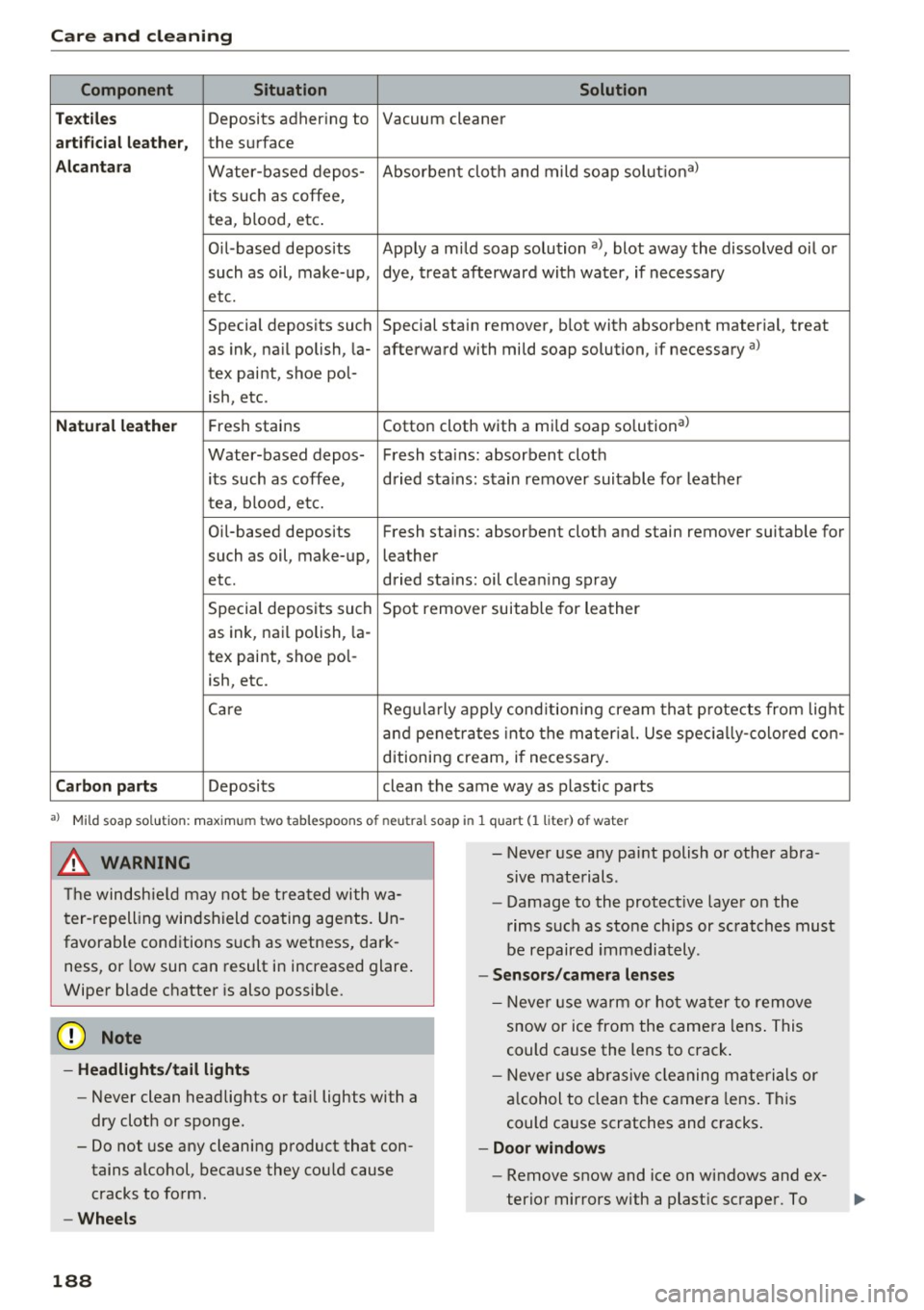
Component Situation Solution
Te xtil es
Deposits adhering to Vacuum cleaner
artifi cial le ather , the surface
Alcan tara Water-based depos- Absorbent cloth and mild soap
solutional
its such as coffee,
tea, blood, etc.
O il-based deposits Apply a mild soap solution a), blot away the dissolved oil o r
such as oil, make-up, dye, treat afterward with water, if necessary
etc.
Special deposits such Special sta ,in remover, blot with absorbent material, treat
as ink, na il polish, la- afterward with mild soap solution, if necessary al
tex paint, shoe pol-
ish, etc.
Natural leather Fresh stains Cotton cloth w
ith a mi ld soap solutional
Water-based depos- Fresh stains: absorbent cloth its such as coffee, dried sta ins: stain remover suitable fo r leather
tea, blood, etc.
Oil-based deposits Fresh stains: absorbent cloth and stain remover suitable for
such as oil, make-up, leather
etc. dried sta
ins: oil clea ning sp ray
Special deposits such Spot remover suitable for leather
as ink, nai l polish, la -
tex paint, shoe pol-
ish, etc.
Ca re Regularly apply cond itioning cream tha t protects from light
a nd penetr ates into the ma ter ial. Use spec ia lly-co lored con -
ditioning cream, i f necessary.
Carbon parts Deposits clean the same way as plastic parts
a) Mild soap sol ution: maxim um two tablesp oons of neutral soap in 1 quart (l liter) of water
_& WARNING
The windshie ld may not be trea ted with w a
ter-repelling windshield coating agents. Un
favorable conditions s uch as wetness, dark
ness, or low sun can result in increased glare .
Wipe r blade chatter is also possib le.
(D Note
- Headlights/tail light s
-Never clean headlights or ta il lights with a
dry cloth or sponge.
- Do not use any cleaning p roduct that con
tains alcohol, because they cou ld cause
cracks to form.
- Wheels
188 -
- Never use any paint polish or other abra
sive materials.
- Damage to the protect ive layer on the
rims such as stone chips or scratches must
be repaired immediately.
- Sensors /camera lenses
- N ever use wa rm or ho t wa ter to remove
snow or ice from the camera lens . This
could ca use the lens to crack .
- N eve r use abrasive cleaning m aterials or
a lcohol to clea n the camera lens . This
could cause scratches and c racks .
-Door windows
- Remove snow and ice on windows and ex-
terior mirrors with a plast ic scraper. To
Page 200 of 230
Emergency assistance
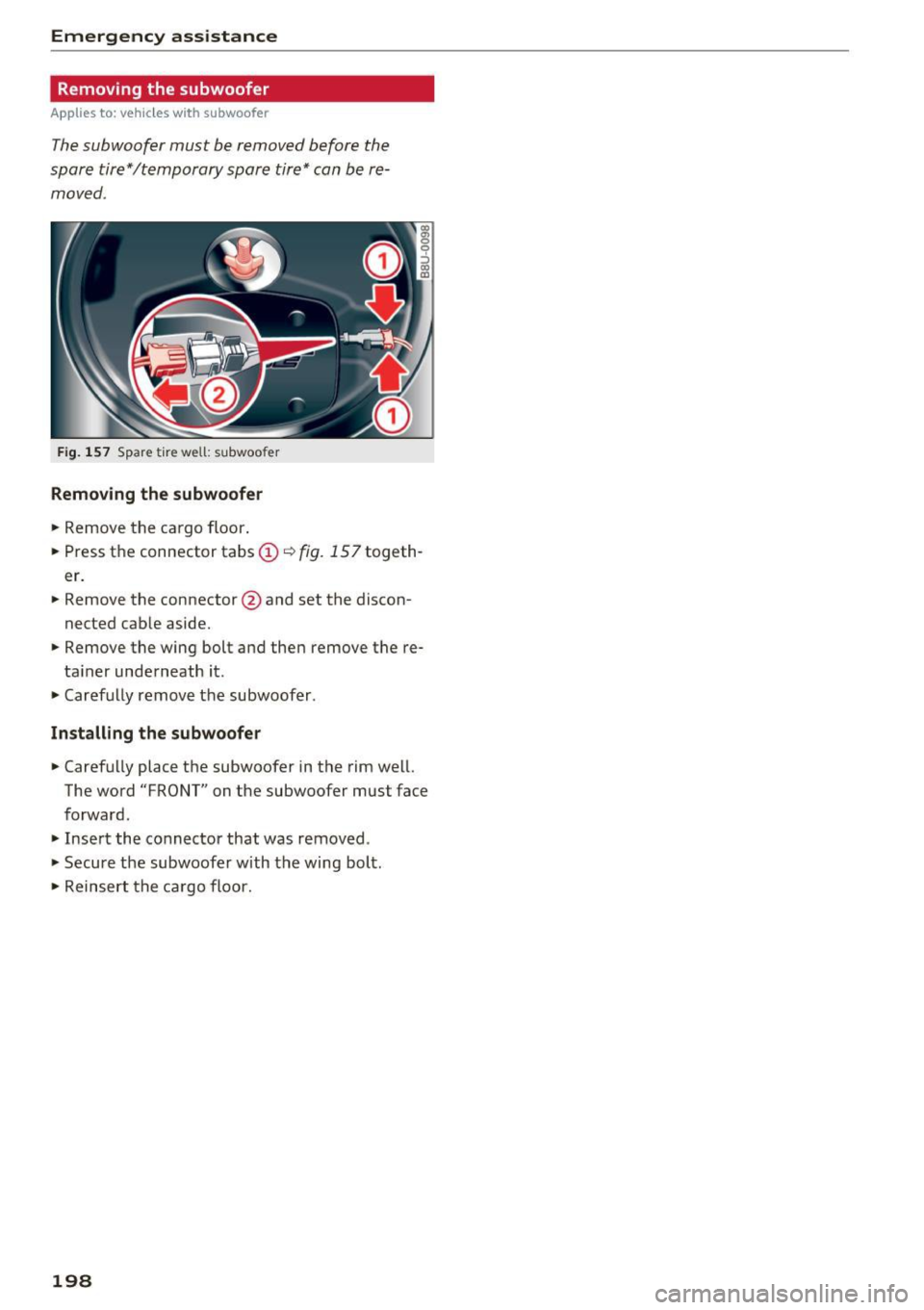
Removing the subwoofer
Applies to: vehicles w ith s ubwoofer
The subwoofer must be removed before the
spare tire*ltemporary spare tire* can be re moved .
Fig. 15 7 Spare tire well: subwoofer
Removing the subwoofer
., Remove the ca rgo floor .
• Press the connector tabs
(D ¢ fig. 157 togeth
er.
• Remove the connector @and set the discon
nected cab le aside.
• Remove the wing bolt and then remove the re-
ta iner unde rneath it .
• Carefully remove t he subwoofer.
Installing the subwoofer
• Carefu lly place t he subwoofer in the rim well.
The word "FRONT" on the subwoofer must face
forward .
., Inse rt the connector that was removed .
• Secure the subwoofer with the wing bolt .
• Reinsert the ca rgo floor.
198