air condition AUDI Q3 2018 User Guide
[x] Cancel search | Manufacturer: AUDI, Model Year: 2018, Model line: Q3, Model: AUDI Q3 2018Pages: 230, PDF Size: 57.03 MB
Page 118 of 230
Airbag system
about children and Advanced Airbags
c:>page 134.
Even though your vehicle is equipped with an Ad
vanced Airbag System, make certain that all chil
dren, especially those 12 years and younger, al
ways ride in the back seat proper ly restrained for
their age and size. The airbag on the passenger
side makes the front seat a potentially dangerous place for a child to ride. The front seat is not the
safest place for a child in a forward-facing child
safety seat . It can be a very dangerous place for
an infant or a child in a rearward-fac ing seat.
The Advanced Airbag System in your veh icle has
been cert ified to comply with the requirements
of United States Federal Motor Vehicle Safety
Standard (FMVSS) 208, as well as Canada Motor
Veh icle Safety Standard (CMVSS) 208 as applica
b le at the time your vehicle was manufactured.
According to requirements, the front Advanced
Airbag System on the passenger side has been
certified for "suppression" for infants of about
12 month old and younger and for "low risk de
ployment" for children aged 3 to 6 years o ld (as
defined in the standard) .
The
PASSENGER AIR BAG OFF light in the instru
ment panel tells you when the front Advanced
Airbag on the passenger side has been turned off by the electronic control unit.
Each time you switch on the ignition, the
PAS
SENGER AIR BAG OFF
light will come on for a
few seconds and:
- will stay on if the front passenger seat is not
occupied,
-will stay on if there is a small chi ld or child re
straint on the front passenger seat,
- will go off if the front passenger seat is occu
pied by an adult as registered by the weight
sensing mat
c:> page 124, Monitoring the Ad
vanced Airbag System.
The PASSENGER AIR BAG OFF light comes on
when the control unit detects a tota l we ight on
the front passenger seat that requires the front
airbag to be turned off.
If the total weight on the front passenger seat is
more than that of a typical 1 year-old child but
116
less than the weight of a sma ll adult, the front
airbag on the passenger side can dep loy (the
PASSENGER AIR BAG OFF light does not come
on). If the
PASSENGER AIR BAG OFF light does
not come on, the front airbag on the passenger
s ide has not been turned off by the electron ic
control unit and can deploy if the control unit
senses an impact that meets the conditions stor
ed in its memory.
For example, the airbag may deploy if:
-a small ch ild that is heav ier than a typica l 1
year-old child is on the front passenger seat (regardless of whether the child is in one of the
child safety seats listed
c:> page 136), o r
- a child who has outgrown ch ild restraints is on
the front passenger seat.
If the front passenger airbag is turned off, the
PASSENGER AIR BAG OFF light comes on in the
i nstrument cluster and stays on.
The front airbag on the passenger side may
not
deploy (the PASSENGER AIR BAG OFF light does
not illuminate and stay lit) even if a small adult
or teenager, or a passenger who is not sitting up
right with their back against a non-reclined back
rest with the ir feet on the vehicle floor in front of
the seat is on the front passenger seat
c:> page 98, Proper seating position for the driver.
If the front passenger a irbag deploys, the Feder
al Standard requires the airbag to meet the "low
risk" deployment criteria to reduce the r isk of in
jury through interact ion w ith the airbag. "Low
risk" deployment occurs in those crashes that
take place a t lower decelerations as defined in
the e lectronic control unit
c:> page 125, PASSEN
GER AIR BAG OFF light.
Always remember, a child safety seat or infant
carrier installed on the front seat may be struck
and knocked out of position by the rapidly inflat
i ng passenger's airbag in a frontal collision . The
airbag could greatly reduce the effectiveness of
the child restraint and even seriously injure the
ch ild during inflation.
For this reason, and because the back seat is the
safest place for children -when proper ly restrain
ed according to their age and size -we strongly
Ill>
Page 120 of 230
Airbag system
Front airbags
Description of front airbags
The airbag system can provide supplemental
protection to properly restrained front seat occu
pants.
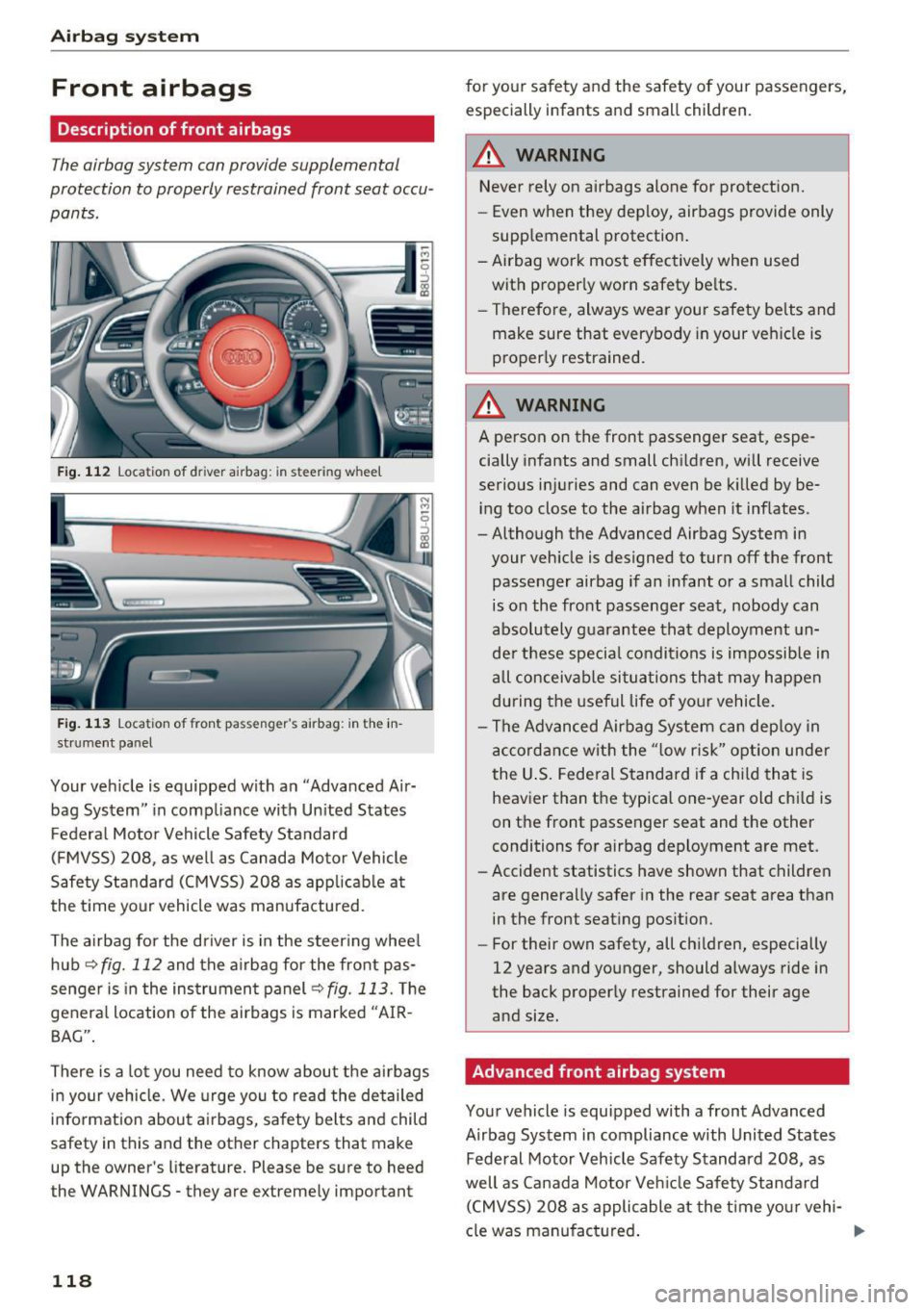
Fig. 112 Location of driver airbag: in steering whee l
Fig. 113 Location of front passenger's airbag: in th e in
strument panel
Your veh icle is equipped with an "Advanced Air
bag System " in compliance with Un ited States
Federal Motor Vehicle Safety Standard
(FMVSS) 208, as well as Canada Motor Vehicle
Safety Standard (CMVSS) 208 as applicable at
the time your vehicle was manufactured.
The airbag for the driver is in the steer ing whee l
hub~
fig. 112 and the airbag for the front pas
senger is in the instrument panel
~fig. 113. Th e
general location of the airbags is marked "AIR
BAG" .
There is a lot you need to know about the airbags
in your vehicle . We urge you to read the detailed
information about airbags, safety belts and child
safety in this and the other chapters that make
up the owner 's literature. Please be sure to heed
the WARNINGS - they are extreme ly important
118
for your safety and the safety of your passengers,
especially infants and small children.
A WARNING -
Never rely on airbags alone for protection.
- Even when they deploy, airbags provide only
supplemental protection.
- Airbag work most effectively when used with proper ly worn safety belts.
- Therefore, always wear your safety be lts and
make sure that everybody in your veh icle is
proper ly restrained.
A WARNING
A person on the front passenger seat, espe
cially infants and small chi ldren, will receive
serious injuries and can even be killed by be ing too close to the airbag when it inflates.
- Although the Advanced Airbag System in
your veh icle is designed to turn off the front
passenger airbag if an infant or a small child
is on the front passenger seat, nobody can
absolutely guarantee that deployment un
der these special conditions is impossible in
all conceivable situations that may happen
during the useful life of your vehicle.
- The Advanced Airbag System can dep loy in
accordance with the "lo w risk" option under
the U.S. Federal Standard if a child that is
heavier than the typical one-year old chi ld is
on the front passenger seat and the other
conditions for airbag deployment are met.
-Accident statistics have shown that children
are generally safer in the rear seat area than
in the front seat ing position.
- For their own safety, all children, especially
12 years and younger, should always ride in
the back properly restrained for their age and size.
Advanced front airbag system -
Your vehicle is equipped with a front Advanced
Airbag System in compliance with United States
Federal Motor Vehicle Safety Standard 208, as
well as Canada Motor Vehicle Safety Standa rd
(CMVSS) 208 as applicable at the time your vehi
cle was manufactured .
Page 121 of 230
0 co ......
"' ,....
"' ...... 0 0 :::,
00
The front Advanced Airbag System supp lements
the safety belts to provide additional protection
for the driver's and front passenger's heads and upper bodies in frontal crashes. The airbags in
flate only in frontal impacts when the veh icle de
celerat ion is high enough.
The front Advanced Airbag System for the front
seat occupants is not a substitute for your safety belts. Rather, it is part of the overall occupant re
straint system in your vehicle. Always remember
that the a irbag system can only help to protect
you, if you are sitting upr ight, wear ing your safe
ty belt and wear ing it properly. This is why you
and your passengers m ust always be properly re
stra ined, not just because the law requ ires you to
be .
The Advanced Airbag System i n your veh icle has
been certified to meet the " low r is k" requ ire
ments for 3 and 6 year-o ld children on the pas
senger side and very sma ll adults on the driver
side . The low risk dep loyment criteria are intend
ed to he lp reduce the risk of injury through inter
action with the front a irbag that can occur, for
examp le, by being too close to the steering wheel
and instrument panel when the airbag inflates .
In addition, the system has been certified to
comp ly w ith the "suppression" requirements of
the Safety Standard, to turn off the front a irbag
for infants 12 months old and younger who are
restrained on the front passenger seat in c hild re
stra ints that are listed in the Standard
~ page 136, Child restraints and Advanced Air
bags.
"S uppress ion" requ ires the front a irbag on t he
passenger side to be turned off if:
- a ch ild up to about one year of age is restra ined
on the front passenger seat in one of the rear
facing o r forward-fac ing infant restra ints listed
in Federal Motor Vehicle Safety Standard
208
with wh ich the Advanced Airbag System in your
vehicle was ce rtified. For a l isti ng of the ch ild
restraints that were used to certify your vehi
cle's compliance with the US Safety Standard
~ page 136,
Airb ag sys tem
-weight less than a threshold leve l stored in the
control unit is detected on the front passenger
seat.
When a person is detected on the front passen ger seat, weigh ing more than the total weight of
a chi ld that is about 1 year old restrained in one
of the rear -facing or forward-fac ing infant re
straints (listed in Federal Motor Vehicle Safety Standard
208 with which the Advanced A irbag
System in your veh icle was certified), the front
airbag on the passenger side may or may not de
ploy.
The
PAS SEN GER AIR BA G OFF light comes on
when the electronic control unit detects a tota l
we ight on the front passenger seat that requ ires
the front a irbag to be turned off. If the
P A SSEN ·
GER AIR BAG OFF
light does not come on, the
front airbag on the passenger side has not been
turned off by the con trol unit and can dep loy i f
the control unit senses an impact that meets the
conditions stored in its memory.
If the to tal weight on the front passenger sea t is
more than that of a typ ica l 1 year-old, but less
than the weight of a small adult, the front airbag on the passenger side may deploy (the
PASSEN
GER AIR BAG O FF
light does not come on).
For e xample , the air bag ma y deplo y if:
- a small ch ild that is heav ier than a typ ica l 1
yea r-o ld child is on the front passenger seat
(regardless of whethe r the child is in one of the
child safety seats liste d
~page 136),
-a child who has outgrown c hild rest raints is on
t he front passenge r seat.
If the front passenger a irbag is turned off, the
PASSENGER AIR BAG OFF light in the center of
t h e in str ument pane l wi ll come on and s tay on.
The front airbag on the passenger side may
not
deploy (the PASSENGER AIR BAG OFF light does
not ill umi nate and s tay lit) if:
- a small adult or teenager is on the front pas
senger seat
- a passenger who is not s itting upright with
their back against a non -reclined backrest with
their feet on the vehicle floor in front of the
seat is on the front passenger seat . .,,.
119
Page 127 of 230

a
co
...... N r--. N
'"' 0 0 ::, co
PASSENGER AIR BAG OFF light
Fig. 115 Sect ion from the instrument panel: PASSENGER
AIR BAG O FF light
The PA SSENGER AIR BAG O FF ligh t is located i n
the center of the instrument panel¢
fig. 115 .
The PASSENGER AIR BAG OFF light will come on
and stay on to tell you when the front Advanced
Ai rbag on the passenger side has been turned off
by the electronic control unit . Each time you turn
on the ignition, the
PASSEN GER AIR BAG OFF
light will flash for a few seconds and:
- will stay on if the front passenger sea t is not
occupied,
- will stay on if the re is a small child or child re
straint on the front passenger seat,
- will go ou t if the front passenge r seat is occu
pied by an adul t as reg istered by the weight
sensing mat.
The
PASSENGER AIR BAG OFF light mu st come
on and stay on
if the ignition is on and
- a car bed has been installed on t he front seat,
o r
- a rearward-facing child restraint has been in
stalled on the front passenger seat, or
- a forward-facing child restra int has been instal
led on the front passenger seat, or
- the weight registered on the front passenger
seat is equal to or less than the combined
weight of a typical 1 year-old restrained in one
of the rear-facing or forward-fac ing infant re
straints listed in Federal Motor Vehicle Safety
Sta ndard 208 w ith w hic h the Adva nced A irbag
System in your veh icle was certified.
I f the front passenger seat is not occupied, the
front a irbag w ill not deploy, and the
PASSENGER
Airb ag sys tem
AIR BAG OFF light wi ll stay on. Never install a
rearward-facing child restraint on the front pas
senger seat, the safest place for a ch ild in any
k ind of child restraint is at one of the seating po
sitions on the rear seat¢
page 115, Child re
straints on the front seat -some important
things to know
and ¢ page 134, Child safety.
If the PAS SENGER AIR BAG OFF light comes on
when one of the conditions listed above is met,
be su re to check the light regularly to make cer
ta in that the
PASSENGER AIR BAG OFF li ght
stays on continuously whenever the ignition is
on. If the
PASSENGER AIR BAG OFF li ght does
not appear and not s tay o n all the time, stop as
soon as it is safe to do so and
- reactivate the system by turning the ignit ion
off and then t urning it on again;
- remove and re insta ll the child restraint . Make
sure that the child restraint is properly insta l
led and tha t the safety belt for the fro nt pa s
senger seat has bee n correct ly routed around
the child res traint as desc ribed in the c hild re
stra int man ufactu rer's instructions;
- make sure that the convert ible lo ck ing retrac
t or on the safety belt for the front passenger
seat has been activated and that the safety belt
has been pulled tight. The belt m ust not be
loose or have loops of slack so that the sensor
below the safety belt latc h on the seat can do
its job¢
page 144 .
-make sure that things that may increase the
weight of the child and ch ild safety seat are not
be ing transported on the front passe nger seat;
- make sure that the safety be lt tens ion sensor is
not blocked . Shake the safety belt latch on the
front passe nger seatback and forth;
- If a strap or tether is being used to tie the child
safety seat to the front passenger seat, make
sure that it is not so tight that it causes the
weight-sens ing mat to measu re more weight
t han is actually on the seat.
If th e PA SS ENGER AIR BA G OFF light still does
not come on
and does not stay on continuously
(whe n the ignition is switc hed on),
- take the child restraint off the front passenger
seat and insta ll it properly at one of the rear
Iii--
125
Page 136 of 230
Child safety
Child safety
Important information
Introduction
The rear seat is generally the safest place in a
collision .
The physical principles of what happens when
your vehicle is in a crash apply also to children
¢ page 10 7, What happens to occupants not
wearing safety belts? .
But unlike adults and
teenagers, their muscles and bones are not fully
developed. In many respects children are at
g reater r isk of serious injury in crashes than
adults .
Because children's bodies are not fully devel
oped, they require restraint systems especially
des igned for their size, weight, and body struc
ture. Many countries and all states of the United
States and provinces of Canada have laws requir
ing the use of approved child restraint systems
for infants and small children .
I n a frontal crash at a speed of 20-35 mph
(30-56 km/h) the forces acting on a 13 -pound
(6 kg) infant will be more than 20 times the
weight of the child. This means the weight of the child would suddenly be more than 260 pounds
(120 kg) . Under these conditions, only an appro
priate child restraint properly used can reduce
the risk of serious injury . Child restra ints, like
adu lt safety belts, must be used properly to be
effect ive. Used improperly, they can increase the
risk of serious injury in an acc ident.
All ch ildren, especially those 12 years and young
er must always ride in the back seat properly re
stra ined for their age and size. If you must insta ll
a child restraint on the front passenger seat in
exceptional circumstances, be sure to read and
heed the important information and warnings
¢page 115. Infants and other children who are
properly restrained in an appropriate child re
straint that is for their si ze and age can benefit
from the protection that supplemental side air
bags provide in some kinds of crashes .
For more information please see information
provided by the:
134
- National Highway Traffic Safety Administration
(NHTSA), currently at: http :/ /www.safe
rcar.gov (for the USA)
- Transport Canada Information Centre, current-
ly at: http://www.tc.gc.ca (for Canada)
Consult the child safety seat manufacturer's in
structions in order to be sure the seat is right fo r
your chi ld's size ¢
page 137, Important safety
instructions for using child safety seats .
Please
be sure to read and heed all of the important in
formation and WARNINGS about child safety,
Advanced Airbags, and the installation of child restra ints in this chapter .
There is a lot you need to know about the Ad
vanced Airbags in your vehicle and how they work
when infants and children in child restraints are on the front passenger seat . Because of the large
amount of important informat ion , we cannot re
peat it all here. We urge you to read the detailed
i nformation in this owner's manual about airbags
and the Advanced Airbag System in your vehicle
and the very important information about trans
porting children on the front passenger seat.
Please be sure to heed the WARNINGS -they are
extremely important for your safety and the safe
ty of your passengers, especially infants and
small children .
A WARNING
-Accident statistics have shown that children
are generally safer in the rear seat area than
in the front seat ing pos ition. Always restrain
any child age 12 and under in the rear.
-All vehicle occupants and especially children
must be restra ined prope rly whenever rid ing
in a vehicle. An un restrained or improperly
restrained child could be injured by striking
the interior or by being ejected from the ve
hicle during a sudden maneuver or impact.
An unrestrained or improperly restrained
child is a lso at greater risk of injury or death
through contact w ith an inflating airbag.
-A suitable ch ild restraint properly installed
and used at one of the rear seating positions
provides the highest degree of protect ion
for infants and small children in most acc i
dent situat ions.
Page 186 of 230
Wheels
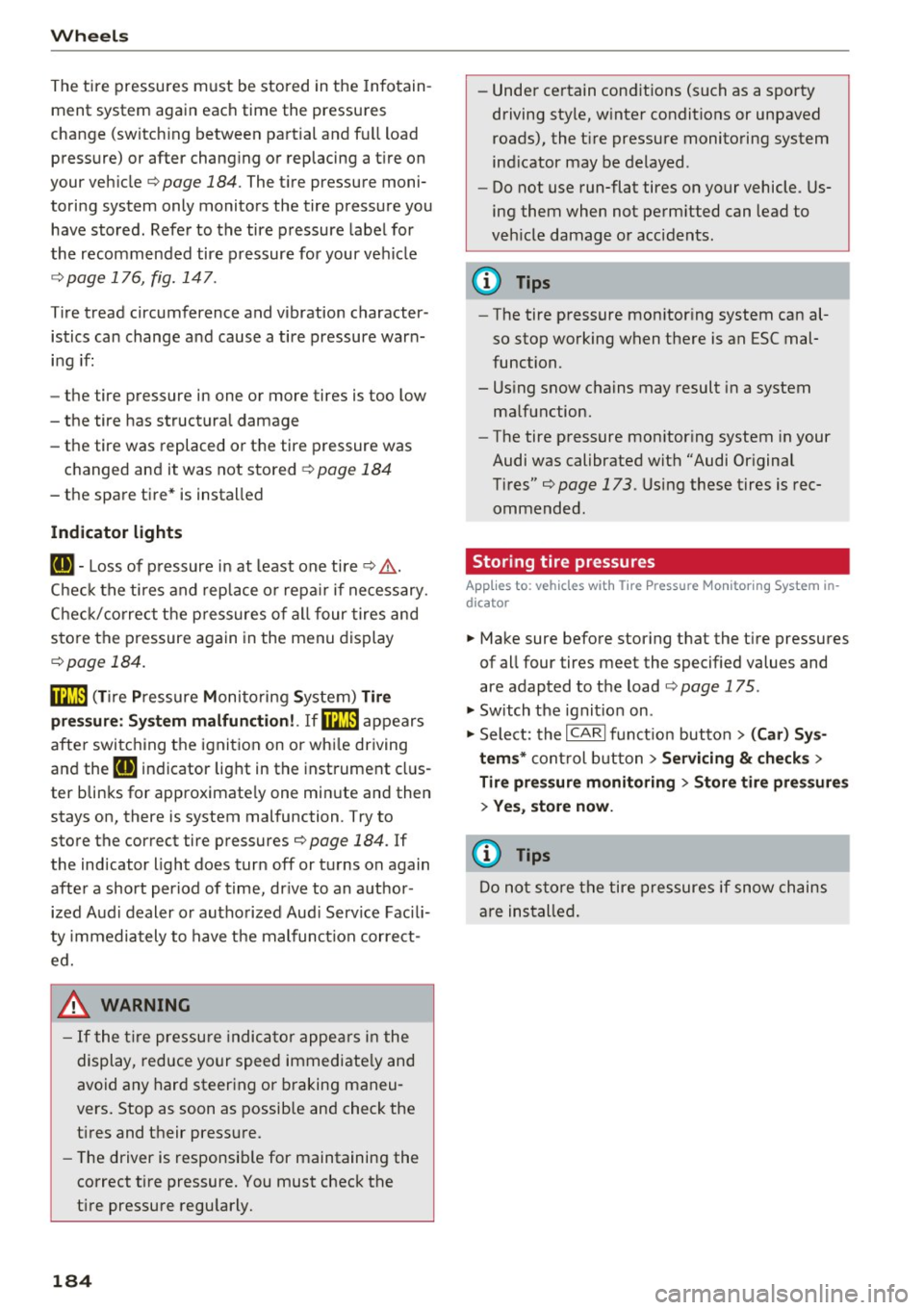
The tire pressures must be stored in the Infotain
ment system again each time the pressures
change (switch ing between partial and full load
pressure) or after changing or replacing a tire on
your vehicle
c:::> page 184. The tire pressure moni
toring system only monitors the tire pressure you have stored . Refer to the tire pressure label for
the recommended tire pressure for your vehicle
c:::> page 176, fig. 147.
Tire tread circumference and vibration character istics can change and cause a t ire pressure warn
ing if:
- the tire pressure in one or more tires is too low
- the tire has structural damage
- the tire was replaced or the tire pressure was
changed and it was not stored
c:::> page 184
- the spare tire* is installed
Indicator lights
ti] -Loss of pressure in at least one tire c:::> & .
Check the tires and replace or repair if necessary.
Check/correct the p ressures of all four tires and
store the pressure again in the menu display
c:::> page 184.
@m (Ti re Pressure Monitoring System) Tire
pressure : System malfunction!. If@m
appears
after switching the ignit ion on or whi le driving
and the
ti] indicator light in the instrument clus
ter blinks for approximately one minute and then
stays on, there is system malfunction. Try to
store the correct tire pressures
c:::> page 184. If
the indicator light does turn off or turns on again
after a short period of time, dr ive to an author
ized Audi dealer or authorized Aud i Service Facili
ty immediately to have th e malfunct ion correct
ed.
_& WARNING
- If the tire pressure indicator appea rs in the
display, reduce your speed immediate ly and
avoid any hard steering or braking maneu
vers. Stop as soon as possib le and check the
t ir es and their pressure.
- The driver is responsible for maintaining the
correct tire pressure. You must check the
tire pressure regularly.
184
'
-Under certain conditions (such as a sporty
driving style, w inter conditions or unpaved
roads), the tire pressure monitoring system
ind icator may be delayed .
- Do not use run-flat tires on your vehicle. Us
ing them when not permitted can lead to
veh icle damage or accidents.
(D Tips
- The tire pressure monitor ing system can al
so stop working when there is an ESC mal
function.
- Using snow chains may result in a system
malfunction.
- The tire pressure monitor ing system in your
Audi was calibrated with "Audi Or iginal
Tires"
c:::> page 173. Using these tires is rec
ommended.
Storing tire pressures
App lies to: vehicles wit h Tire Pressure Monito rin g Syste m in
dic ator
.. Make sure before storing that the tire pressures
of all four tires meet the specified values and
are adapted to the load <=:>page
175 .
.. Switch the ignition on.
.. Select: the
I CARI funct ion button > (Car) Sys
tems *
control button > Servicing & checks >
Tire pressure monitoring > Store tire pressures
> Yes, store now.
(D Tips
Do not store the tire pressures if snow chains
are installed.
Page 190 of 230
Care and cleaning
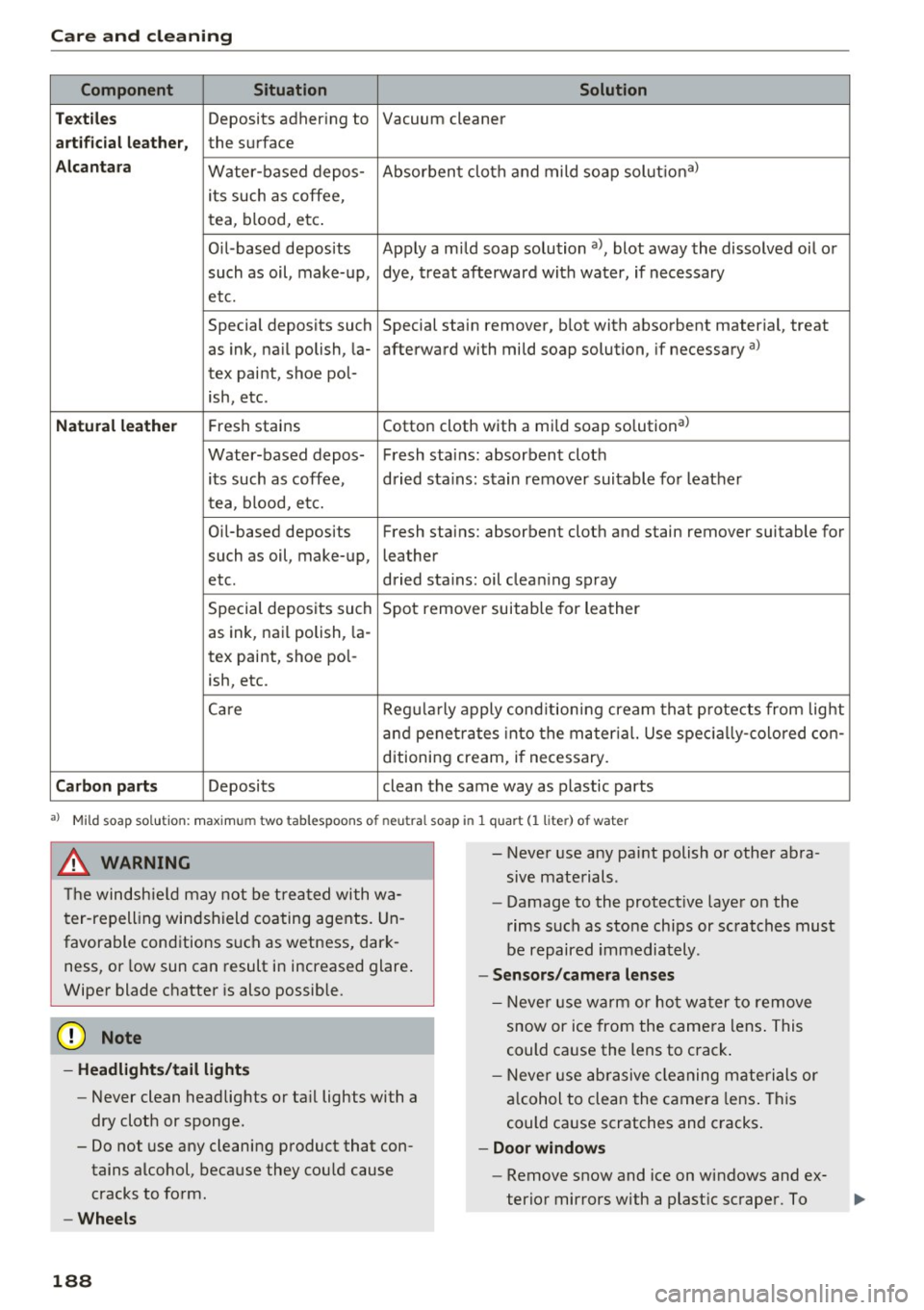
Component Situation Solution
Te xtil es
Deposits adhering to Vacuum cleaner
artifi cial le ather , the surface
Alcan tara Water-based depos- Absorbent cloth and mild soap
solutional
its such as coffee,
tea, blood, etc.
O il-based deposits Apply a mild soap solution a), blot away the dissolved oil o r
such as oil, make-up, dye, treat afterward with water, if necessary
etc.
Special deposits such Special sta ,in remover, blot with absorbent material, treat
as ink, na il polish, la- afterward with mild soap solution, if necessary al
tex paint, shoe pol-
ish, etc.
Natural leather Fresh stains Cotton cloth w
ith a mi ld soap solutional
Water-based depos- Fresh stains: absorbent cloth its such as coffee, dried sta ins: stain remover suitable fo r leather
tea, blood, etc.
Oil-based deposits Fresh stains: absorbent cloth and stain remover suitable for
such as oil, make-up, leather
etc. dried sta
ins: oil clea ning sp ray
Special deposits such Spot remover suitable for leather
as ink, nai l polish, la -
tex paint, shoe pol-
ish, etc.
Ca re Regularly apply cond itioning cream tha t protects from light
a nd penetr ates into the ma ter ial. Use spec ia lly-co lored con -
ditioning cream, i f necessary.
Carbon parts Deposits clean the same way as plastic parts
a) Mild soap sol ution: maxim um two tablesp oons of neutral soap in 1 quart (l liter) of water
_& WARNING
The windshie ld may not be trea ted with w a
ter-repelling windshield coating agents. Un
favorable conditions s uch as wetness, dark
ness, or low sun can result in increased glare .
Wipe r blade chatter is also possib le.
(D Note
- Headlights/tail light s
-Never clean headlights or ta il lights with a
dry cloth or sponge.
- Do not use any cleaning p roduct that con
tains alcohol, because they cou ld cause
cracks to form.
- Wheels
188 -
- Never use any paint polish or other abra
sive materials.
- Damage to the protect ive layer on the
rims such as stone chips or scratches must
be repaired immediately.
- Sensors /camera lenses
- N ever use wa rm or ho t wa ter to remove
snow or ice from the camera lens . This
could ca use the lens to crack .
- N eve r use abrasive cleaning m aterials or
a lcohol to clea n the camera lens . This
could cause scratches and c racks .
-Door windows
- Remove snow and ice on windows and ex-
terior mirrors with a plast ic scraper. To
Page 214 of 230
Consumer Information
Consumer Information
Warranty coverages
Your Audi is covered by the following warran
ties:
- New Vehicle Limited Warranty
- Limited Warranty Against Corrosion Perfora-
tion
- Emissions Control System Warranty
- Emissions Performance Warranty
- California Emissions Control Warranty (USA
vehicles only)
- California Emissions Performance Warranty
(USA vehicles only)
Detailed information regarding your warranties
can be found in your
Warranty & Maintenance
booklet .
Operating your vehicle
outside the U.S.A. or
Canada
Government regulati ons in the United States and
Canada require that automobi les meet specific
emission regulations and safety standards.
Therefore, vehicles built for the U.S.A. and Cana
da differ from vehicles sold in other countries.
If you plan to take your vehicle outside the conti
nenta l limits of the United States or Canada,
there is the poss ibility that:
- un leaded fue ls for vehicles with catalytic con
verter may not be available;
- fuel may have a considerably lower octane rat
ing . Improper fuel may cause engine damage;
- service may be inadequate due to lack of proper
service facilities, tools or testing equipment;
- r eplacement parts may not be readily available.
- Nav igation systems for veh icles built for the
U.S .A . and Canada will not necessarily work in
Europe, and may not work in other countries
outside of North America.
212
(D Note
Audi cannot be responsib le for mechanical
damage that could result from inadequate
f u el, service or parts ava ilability.
Audi Service Repair
Manuals and Literature
Audi Official Factory Service Manuals and Litera
ture are published as soon as poss ible after mod
el introd uction . Service Manuals and literature
are available to order from the Audi Technical Lit
erature Ordering Center at :
www.audi.techliterature .com
Maintenance
General '
Your vehicle has been designed to help keep
maintenance requirements to a min imum. How
ever, a certain amount of regular maintenance is
still necessary to assure your vehicle's safety,
economy and reliability . For detailed vehicle
maintena nce consult your Warranty & Mainte
nance booklet .
Under difficult operating conditions, for exam
ple at extremely low outside temperatures, in
very dusty regions, whe n towing a trailer very fre
quently, etc., some service work should be per
formed between the intervals specified. This ap
plies particularly to:
- oil changes, and
- cleaning or replac ing the a ir filter .
'
@) For the sake of the environment
By regularly maintain ing your vehicle, you
help make sure that em iss ion standards are
maintained, thus minimizing adverse effects
on the environment .
Important considerations for you and your
vehicle
The increasing use of electronics, sophisticated
fuel injection and emission control systems, and
the genera lly increas ing technica l complexity of ..,_
Page 215 of 230
0 co ......
"' ,....
"' ...... 0 0 :::,
00
today's automobiles, have steadily reduced the
scope of maintenance and repairs which can be
carried out by vehicle owners.
Also, safety and
environmental
concerns place very strict limits
on the nature of repairs and adjustments to en
gine and transmission parts which an owner can perform .
Maintenance, adjustments and repairs usually re
quire special tools, testing devices and other
equipment available to specially trained work
shop personnel in order to assure proper per
formance, reliability and safety of the vehicle and
its many systems.
Improper maintenance, adjustments and repairs
can impair the operation and reliability of your
vehicle and even void your vehicle warranty .
Therefore, proof of servicing in accordance with
the maintenance schedule may be a condition for upholding a possible warranty claim made within
the warranty period.
Above all , operational safety can be adversely af
fected, creating unnecessary risks for you and
your passengers.
If in doubt about any servicing, have it done by
your authorized Audi dealer or any other properly equipped and qualified workshop. We strongly urge you to give your authorized Audi dealer the
opportunity to perform all scheduled mainte nance and necessary repairs. Your dealer has the
facilities, original parts and trained specialists to keep your vehicle running properly .
Performing limited maintenance yourself
The following pages describe a limited number of
procedures which can be performed on your vehi
cle with ordinary tools, should the need arise and
trained personnel be unavailable. Before per
forming any of these procedures, always thor
oughly read all of the applicable text and careful ly follow the instructions given . Always rigorously
observe the
WARNINGS provided .
Before you check anything in the engine com
partment, always read and heed all WARNINGS
c::> .&. and c::> .&. in Working in the engine compart
ment on page 155. Consumer Information
A WARNING
-
Serious personal injury may occur as a result
of improperly performed maintenance, ad
justments or repairs .
- Always be extremely careful when working
on the vehicle. Always follow commonly ac
cepted safety practices and general com
mon sense. Never risk personal injury.
- Do not attempt any of the maintenance,
checks or repairs described on the following
pages if you are not fully familiar with these
or other procedures with respect to the ve
hicle, or are uncertain how to proceed.
- Do not do any work without the proper tools
and equipment. Have the necessary work
done by your authorized Audi dealer or an
other properly equipped and qualified work
shop.
- The engine compartment of any motor vehi cle is a potentially hazardous area. Never
reach into the area around or touch the radi
ator fan.
It is temperature controlled and
can switch on suddenly - even when the en
gine is off and the ignition key has been re
moved. The radiator fan switches on auto
matically when the coolant reaches a certain
temperature and will continue to run until
the coolant temperature drops.
- Always remove the ignition key before any
one gets under the vehicle.
- Always support your vehicle with safety
stands if it is necessary to work underneath
the vehicle . The jack* supplied with the vehi
cle is not adequate for this purpose and
could collapse causing serious personal in
jury.
- If you must work underneath the vehicle
with the wheels on the ground, always make
sure the vehicle is on level ground, that the
wheels are always securely blocked and that the engine cannot be started.
- Always make sure the transmission selector
lever (automatic transmission) is in P (Park
position) and the park brake is applied.
213
Page 217 of 230
0 co ....
"' ,-...
"' .... 0 0 :::,
00
Technical Modifications
Our guidelines must be complied with when tech
nical modifications are made .
Always consult an authorized Audi dealer before
starting work on any modificat ions.
This will he lp ensure that vehicle function, per
formance and safety are not impaired
c> ..&. .
Attempting to work on e lectronic components
and the software used with them can cause ma l
functions. Because of the way electronic compo nents are interconnected with each other, such
malfunct ions can also have an adverse affect on
other systems that are not directly involved. This
means that you risk both a substa ntial reduction
in the operational safety of your veh icle and an
i n creased wea r of ve hicle pa rts
c::> ,.&. .
Author ized Audi dealers w ill perform this work in
a profess ional and competent manner or, in spe
cial cases, refer you to a professional company
that spec ializes in such modific atio ns.
.&, WARNING
Improper repairs and mod ifi cat ions can
change the w ay veh icle systems work and
cause damage to the veh icle and ser ious per
sonal injury.
(D Note
If emergency repa irs mus t be pe rformed else
where, have the vehicle exam ined by an au
thorized A udi dealer as soon as possib le .
Declaration of
compliance for telecom munications equipment
and electronic systems
The manufacturer is not liable for rad io m alfu nc
tions t hat are caused by unauthori zed changes to
the equipment.
Equipment
The fol low ing equipmen t comp lies w it h FCC sec
tion 15 and RSS-Gen:
Consumer Inf ormation
- Audi adapt ive cr uise control*
- Aud i side assist*
- Electronic immob ilize r
- Remote control key
- Cell phone package*
FCC Part 15.19
This device complies with part 15 of the FCC
Rules . Operation is subject to the fo llowing two
condit ions: (1) This device may not cause harmful
interference, and (2) this device must accept any
interference rece ived, includ ing interference that
may cause undesired operation .
FCC Part 15.21
Changes or mod ificat ions not express ly approved
by the party responsible for compliance could
vo id the user's authority to operate the equ ip
ment .
RSS-Gen
This device complies with Industry Canada's li
cence-exempt RSSs. Operation is subject to the
follow ing two conditions:
(1) This dev ice may not cause interference; and
(2) This dev ice m ust accept any interference, in
clud ing interfe rence that may cause undes ired
operation of the dev ice .
CNR-Gen
Le present appareil est conforme aux CNR d'ln
dustrie Canada applicables aux appare ils radio
exemp ts de licence . L'explo itat ion est autor isee
aux deux conditions su ivantes:
1) l'appareil ne do it pas produire de b rouillage;
2) l'appareil do it accepter tout brouillage radioe
lectr ique subi, meme si le brouillage est suscept i
ble d'en compromettre le fonct ionnement .
215