ECO mode AUDI Q3 2018 Owner's Manual
[x] Cancel search | Manufacturer: AUDI, Model Year: 2018, Model line: Q3, Model: AUDI Q3 2018Pages: 230, PDF Size: 57.03 MB
Page 129 of 230
0 co ......
"' ,....
"' ...... 0 0 :::,
00
OFF light comes on and stays on all the time
whenever the ignition is switched on.
A WARNING
- If the PASSENGER AIR BAG OFF light does
not go out when an adult is sitting on the
front passenger seat after taking the steps described above, make sure the adult is
properly seated and restrained at one of the
rear seating positions .
- Have the airbag system inspected by your
authorized Audi dealer before transporting
anyone on the front passenger seat.
{D) Tips
If the weight -sensing mat in the front passen
ger seat detects an empty seat, the front air
bag on the passenger side will be turned off,
and
PASSENGER AIR BAG OFF will stay on.
Repair, care and disposal of the airbags
Parts of the airbag system are installed at many
different places on your Audi. Installing, remov
ing, servicing or repairing a part in an area of th e
vehicle can damage a part of an airbag system and prevent that system from working properly in a collision .
There are some important things you have to know to make sure that the effectiveness of the
system will not be impaired and that discarded
components do not cause injury or pollute the
environment.
A WARNING
Improper care, servicing and repair proce
dures can increase the risk of personal injury
and death by preventing an airbag from de
ploying when needed or deploying an airbag
unexpectedly:
-
- Never cover, obstruct, or change the steer
ing wheel horn pad or airbag cover or the in
strument panel or modify them in any way.
- Never attach any objects such as cupholders
or telephone mountings to the surfaces cov
ering the airbag units.
Airbag system
-For cleaning the horn pad or instrument
panel, use only a soft, dry cloth or one mois
tened with plain water . Solvents or cleaners
could damage the airbag cover or change
the stiffness or strength of the material so
that the airbag cannot deploy and protect
properly.
- Never repair, adjust, or change any parts of
the airbag system.
-All work on the steering wheel, instrument panel, front seats or electrical system (in
cluding the installation of audio equipment,
cellular telephones and CB radios, etc.) must be performed by a qualified technician
who has the training and special equipment
necessary.
- For any work on the airbag system, we
strongly recommend that you see your au
thorized Audi dealer or qualified workshop.
- Never modify the front bumper or parts of the vehicle body.
- Always make sure that the side airbag can
inflate without interference:
- Never install seat covers or replacement
upholstery over the front seatbacks that
have not been specifically approved by
Audi .
- Never use additional seat cushions that
cover the areas where the side airbags in
flate.
- Damage to the original seat covers or to
the seam in the area of the side airbag
module must always be repaired immedi
ately by an authorized Audi dealer.
- The airbag system can be activated only
once. After an airbag has inflated, it must
be replaced by an authorized Audi dealer or
qualified technician who has the technical
information, training and special equipment
necessary.
- The airbag system can be deployed only
once. After an airbag has been deployed, it
must be replaced with new replacement
parts designed and approved especially for
your Audi model version. Replacement of complete airbag systems or airbag compo
nents must be performed by qualified work-
shops only. Make sure that any airbag
Ill-
127
Page 138 of 230
Child safety
Advanced Airbags and the weight-sensing mat in the front seat
The Advanced Airbag System in your vehicle de
tects the presence of an infant or child in a child
restraint on the front passenger seat using the
weight -sensing mat in the seat cushion and the
sensor below the safety belt latch on the front
passenger seat that measures the tension on the
safety belt .
The weight-sensing mat measures total weight
of the child and the child safety seat and a child blanket on the front passenger seat . The weight
on the front passenger seat is related to the de
sign of the child restraint and its "footprint ", the
size and shape of the bottom of the child re
straint as it sits on the seat. The weight of a child
restraint and its "footprint" vary for different
kinds of child restraints and for the different
models of the same kind of child restraint of
fered by child restraint manufacturers.
The weight ranges for the individual types,
makes and models of child restraints that the
NHTSA has specified in the Safety Standard to
gether with the weight ranges of typical infants
and typical 1 year-old child have been stored in
the control unit of the Advanced Airbag System .
When a child restraint is being used on the front
passenger seat with a typical 1 year-old child, the
Advanced Airbag System compares the weight
measured by the weight sensing mat with the in
formation stored in the electronic control unit.
The electronic control unit also registers the ten
sion on the front passenger safety belt. The ten
sion on the safety belt for the front passenger
seat will be different for an adult who is properly
using the safety belt as compared to the tension
on the belt when it is used to attach a child re
straint to the seat. The sensor below the latch for
the safety belt for the front seat passenger
measures the tension on the belt. The input from
this sensor is then used with the weight to "de
cide" , whether there is a child restraint with a
typical 1 year-old child on the front passenger
seat and whether or not the airbag must be
turned off.
136
· Child restraints and Advanced Airbags
Regardless of the child restraint that you use,
make sure that it has been certified to meet Safe
ty Standards and has been certified by its manu
facturer for use with an airbag. Always be sure
that the child restraint is properly installed at
one of the rear seating positions . If in exception
al circumstances you must use it on the front passenger seat, carefully read all of the informa
tion on child safety and Advanced Airbags and heed all of the applicable WARNINGS. Make cer
tain that the child restraint is correctly recog
nized by the weight-sensing mat inside the front
passenger seat, that the front passenger airbag
is turned off and that the airbag status is always
correctly signaled by the
PASSENGER AIR BAG
OFF
light.
Many types and models of child restraints have
been available over the years, new models are in
troduced regularly incorporating new and im
proved designs and older models are taken out of
production. Child restraints are not standardized.
Child restraints of the same type typically have
differen t weights and si zes and different 'foot
prints,' the size and shape of the bottom of the
child restraint that sits on the seat, when they
are installed on a vehicle seat. These differences
make it virtually impossible to certify compliance
with the requirements for advanced airbags with
each and every child restraint that has ever been
sold in the past or will be sold over the course of
the useful life of your vehicle.
For this reason, the United States National High
way Traffic Safety Administration has published a
list of specific type, makes and models of child
restraints that must be used to certify compli
ance of the Advanced Airbag System in your vehi
cle with the suppression requirements of Federal
Motor Vehicle Safety Standard 208. These child
restraints are:
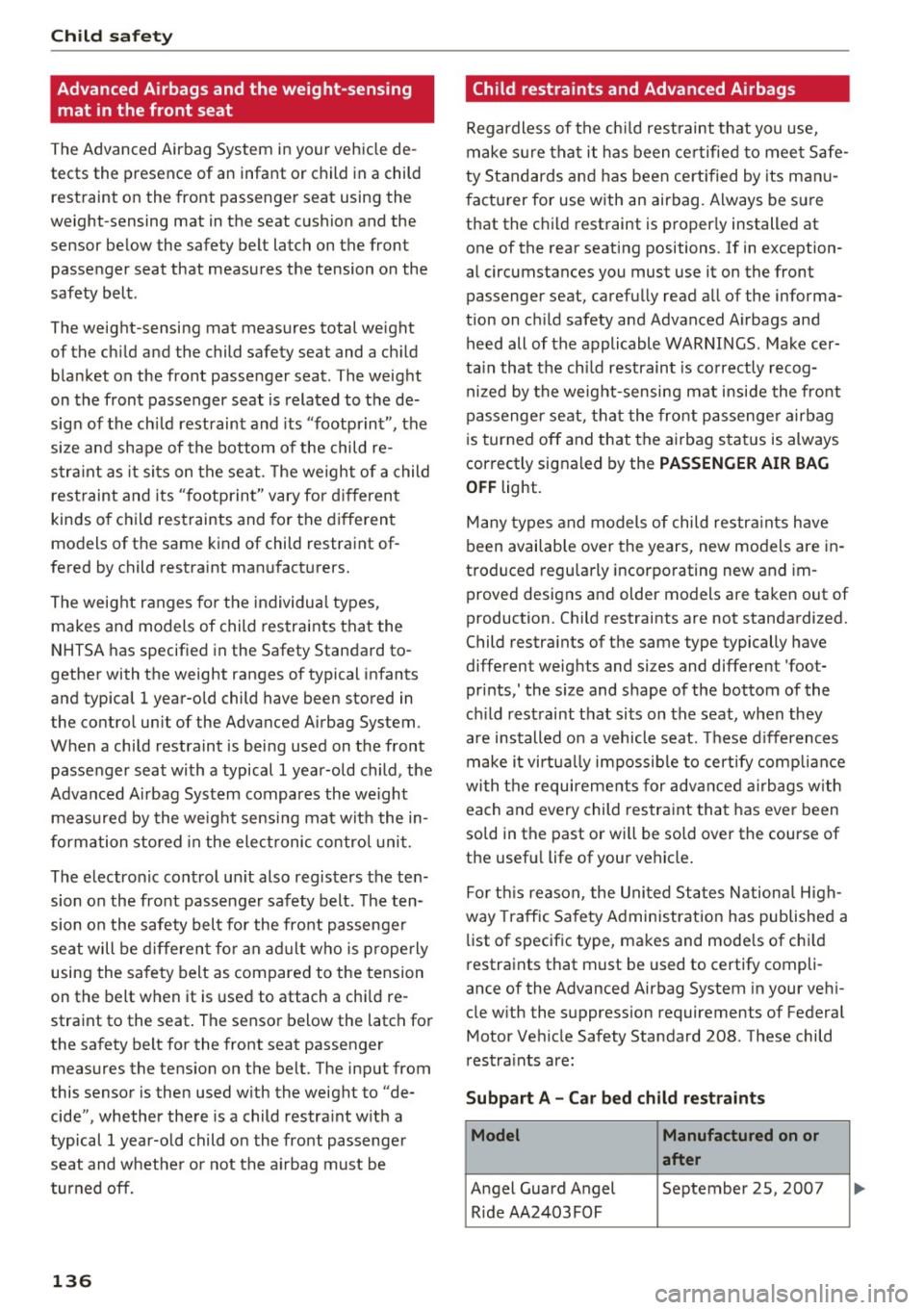
Subpart A - Car bed child restraints
Model Manufactured on or
after
Angel Guard Angel September 25, 2007 Ride AA2403FOF
Page 175 of 230

0 C0
-N
" N
-0
0
::, a)
by the tire manufacturer. This in
formation is used to contact con
sumers if a tire defect requires a
recall.
Ve hicle capacity weight
means the rated cargo and lug
gage load plus 150 lbs. (68 k ilo
grams) times the vehicle's desig
nated seating capacity.
Vehicle ma ximum load on the
tire
means that load on an individual
tire that is determined by distrib
uting to each axle its share of the
maximum loaded vehicle weight
and dividing by two.
Vehicle normal load on the tire
means that load on an individual
tire that is determined by distrib
uting to each axle its share of the
curb weight, accessory weight,
and normal occupant weight (dis
tributed in accordance with¢
ta
ble on page
178) and dividing by
two.
Occupant loading and distr i
bution for vehicle normal load
for various design ated seating
capacities
Refer to the tire inflation pres
sure label¢
page 176, fig. 147
Wheels
for the number of seating posi
tions . Refer to the table ¢
table
on page
178 for the number of
people that correspond to the ve
hicle normal load.
New tires or wheels
Audi recommends having all work
on tires or wheels performed by an authorized Audi dealer or au
thorized Audi Service Facility.
These facilities have the proper
knowledge and are equipped with
the required tools and replace ment parts.
.,,. New tires do not yet have the
optimum gripp ing properties .
Drive carefully and at moderate
speeds for the first 350 miles (500 km) with new tires.
.,,. Only use tires with the same de
sign, size (rolling circumference)
and as close to the same tread
pattern as possible on all four
wheels.
.,,. Do not replace tires individually .
At least replace both tires on the
same axle at the same time.
.,,. Audi recommends that you use
Audi Original Tires . If you would
like to use different tires, please note that the tires may perform ...
173
Page 180 of 230
Wheels
and the tire pressures specified
on the label on the driver's side B
pillar, always follow the specifica
tion on the B-pillar label
¢ page 176, fig. 146.
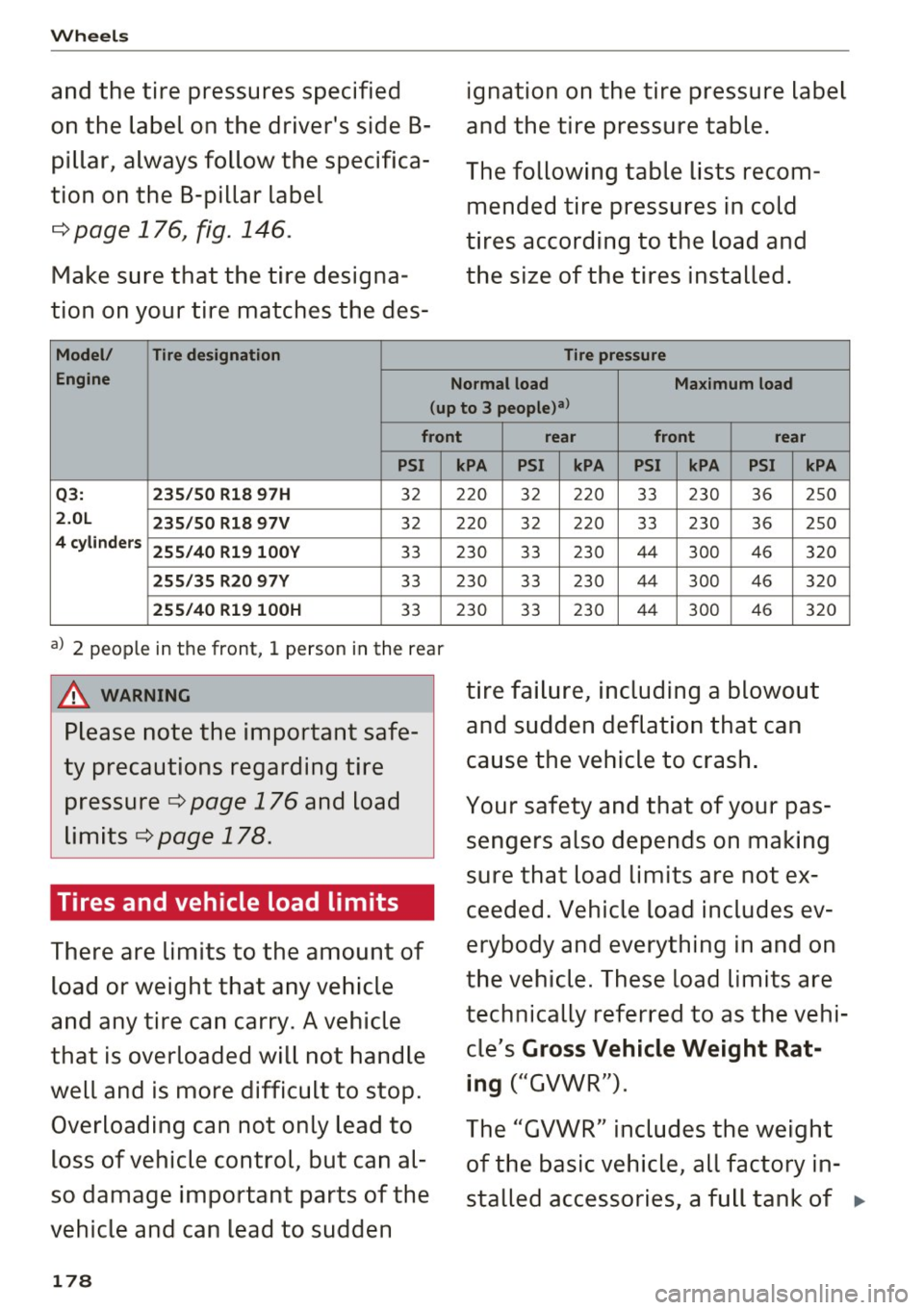
Make sure that the tire designa
tion on your tire matches the des-
Model/ Tire designation
Engine
ignation on the tire pressure label
and the tire pressure table.
The following table lists recom mended tire pressures in cold
tires according to the load and
the size of the tires installed.
Tire pressure
Normal load Maximum load
(up to 3 people)a)
front rear front rear
PSI
Q3: 235/50 Rl8 97H 32
2.0L
235/50 Rl8 97V 32
4 cylinders 255/40 Rl9 l00Y 33
255/35 R20 97Y 33
255/40 Rl9 l00H 33
a) 2 peop le in the front ; 1 perso n in the rear
.8, WARNING
Please note the important safe
ty precautions regarding tire
pressure ¢
page 176 and load
limits ¢
page 178.
Tires and vehicle load limits
There are limits to the amount of
load or weight that any vehicle
and any tire can carry. A vehicle
that is overloaded will not handle
well and is more difficult to stop.
Overloading can not only lead to
loss of vehicle control, but can al
so damage important parts of the
vehicle and can lead to sudden
178
kPA PSI kPA PSI kPA PSI kPA
220 32 220 33 230 36 250
220 3 2 22 0
33 230
36 250
230 33 230 44
300 46 320
230 33 230 44 300 4
6 320
230 33 230 44 300 46 320
tire failure, including a blowout
and sudden deflation that can
cause the vehicle to crash.
Your safety and that of your pas
sengers also depends on making
sure that load limits are not ex
ceeded. Vehicle load includes ev
erybody and everything in and on
the vehicle. These load limits are
technically referred to as the vehi
cle's
Gross Vehicle Weight Rat
ing
("GVWR").
The "GVWR" includes the weight
of the basic vehicle, all factory in
stalled accessories, a full tank of
11>
Page 206 of 230
Emergency situations
@ Tips
The discharged battery must be properly con
nected to the vehicle's electrical system .
When jump starting or charging the battery,
never connect the negative ground cable to
the battery negative post because the battery
manager system must be able to detect the
battery's state of charge . Always connect the
negat ive ground cable to the negative ground
pos t of the battery manager control unit.
Use of jumper cables
Make sure to connect the jumper cable clamps in
exactly the order described below!
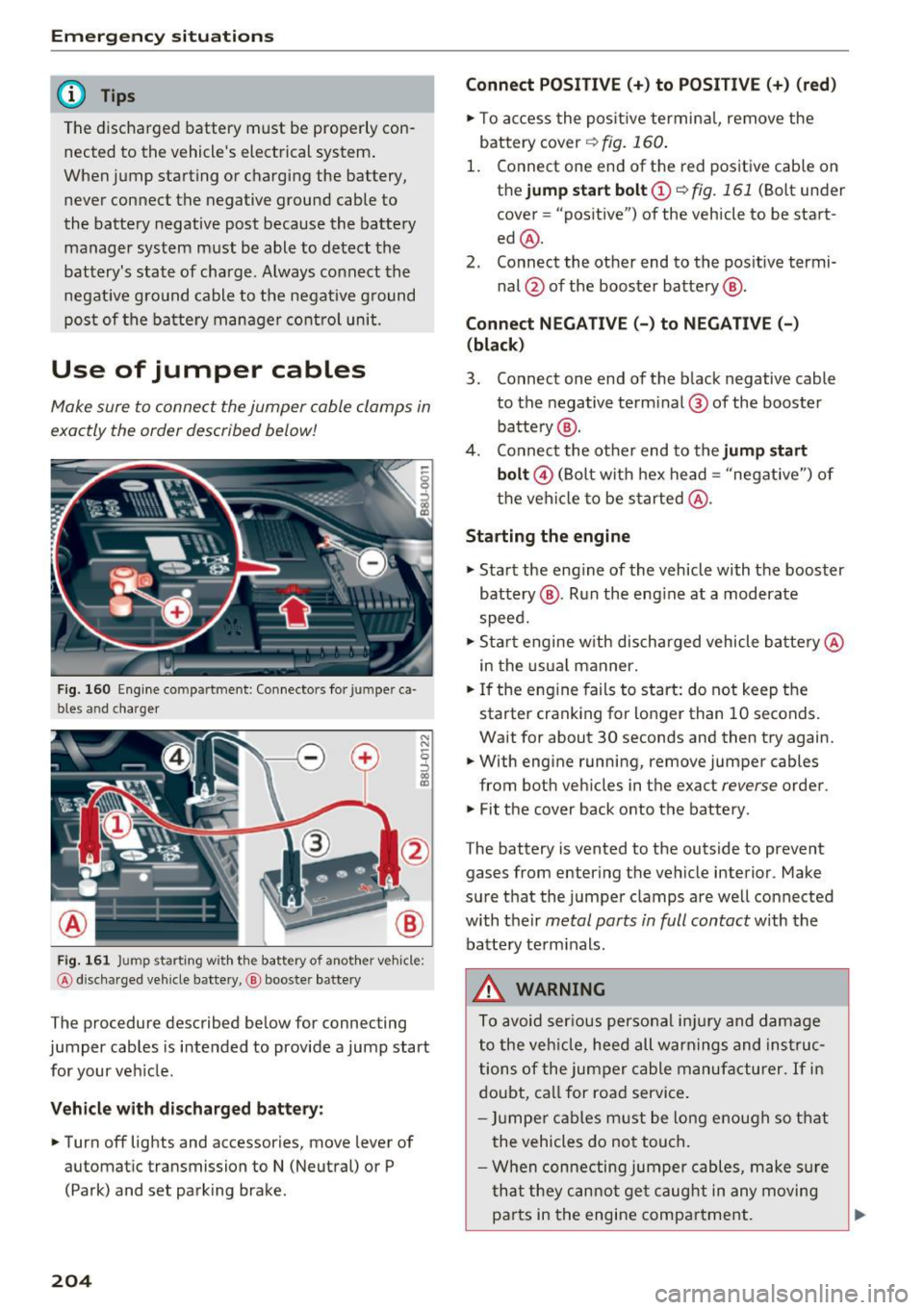
Fig. 160 Engine compartmen t: Connectors fo r ju m pe r ca
bles and charger
Fig. 161 J u mp starting w ith the battery of another vehicle :
@ discha rged vehicle bat te ry, @ booste r battery
The procedure described below for connecting
jumper cables is intended to provide a jump start
for your veh icle.
Vehicle with discharged battery:
.. Turn off lights and accessories, move lever of
automatic transmission to
N (Neutral) or P
(Park) and set park ing brake .
204
Connect POSITIVE(+) to POSITIVE (+) (red)
.. To access the positive terminal, remove the
battery cover
r:!) fig. 160.
1. Connect one end of the red positive cable on
the
jump start bolt (D ~ fig. 161 (Bolt under
cover= "positive") of the vehicle to be start
ed @.
2. Connect the other end to the positive termi-
nal@ of the booster battery @.
Connect NEGATIVE(-) to NEGATIVE(-)
(black)
3. Connect one end of the black negative cable
to the negative terminal ® of the booster
battery @.
4. Connect the other end to the
jump start
bolt @
(Bolt with hex head = "negative") of
the vehicle to be started @.
Starting the engine
"'Start the eng ine of the vehicle with the booster
battery @. Run the eng ine at a moderate
speed .
.,. Start engine w ith discharged vehicle battery@
in the usual manner.
.. If the engine fails to start: do not keep the
starter cranking for longer than 10 seconds.
Wait for about 30 seconds and then try again .
.. With engine running, remove jumper cables
from both vehicles in the exact
reverse order.
"' Fit the cover back onto the battery .
The battery is vented to the outside to prevent gases from entering the vehicle interior . Make
sure that the jumper clamps are well connected
with their
metal parts in full contact with the
batte ry terminals.
A WARNING
To avoid serious personal inju ry and damage
to the veh icle, heed all warnings and instruc
tions of the jumper cable manufacturer.
If in
doubt, call for road service.
- Jumper cables must be long enough so that
the vehicles do not touch .
- When connecting jumper cables, make sur e
that they cannot get caug ht in any moving
pa rts in the engine compartment. ..,.
Page 220 of 230
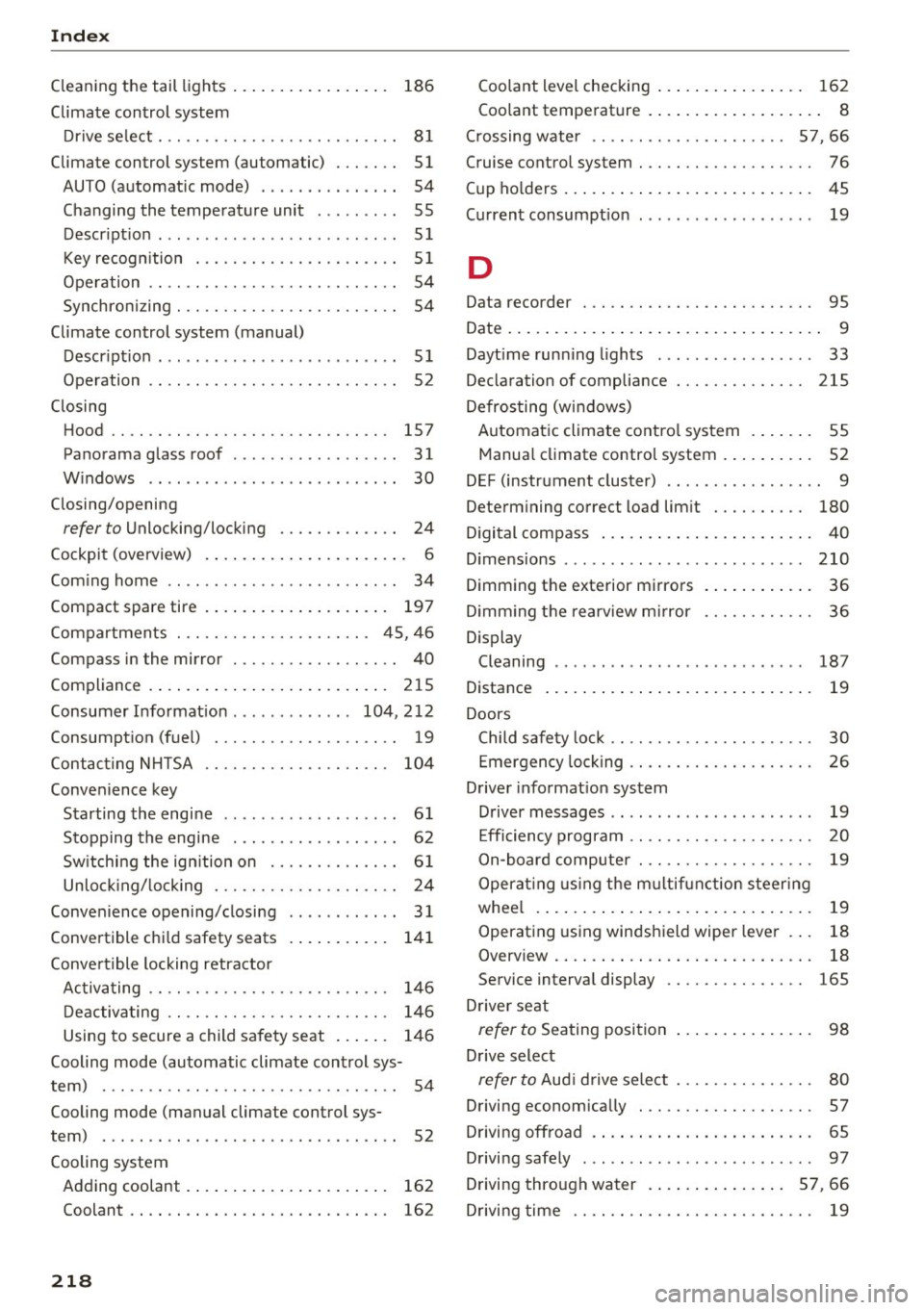
Index
Cleaning the tail lights . . . . . . . . . . . . . . . . . 186
Climate control system Drive se lect. . . . . . . . . . . . . . . . . . . . . . . . . . 8 1
Climate control system (automatic) . . . . . . . 51
AU TO (automatic mode) . . . . . . . . . . . . . . . 54
Changing the tempe rature unit . . . . . . . . . 55
Descr ipt io n . . . . . . . . . . . . . . . . . . . . . . . . . . 51
Key recogn ition . ............. .... .. .. 5 1
Operation . . . . . . . . . . . . . . . . . . . . . . . . . . . 54
Synchro nizing . . . . . . . . . . . . . . . . . . . . . . . . 54
Climate control system (manual) Descr ipt io n . . . . . . . . . . . . . . . . . . . . . . . . . . 5 1
Operation . . . . . . . . . . . . . . . . . . . . . . . . . . . 5 2
Closing Hood . . . . . . . . . . . . . . . . . . . . . . . . . . . . . . 157
Pano rama glass roof . . . . . . . . . . . . . . . . . . 31
W indows .. .... .................. ... 30
Closing/opening
refer to Unlocking/locking . . . . . . . . . . . . . 24
Cockpit (overview) . . . . . . . . . . . . . . . . . . . . . . 6
Com ing home . . . . . . . . . . . . . . . . . . . . . . . . . 34
Compact spare tire . . . . . . . . . . . . . . . . . . . . 197
Compartments . . . . . . . . . . . . . . . . . . . . . 45, 46
Compass in the mirror . . . . . . . . . . . . . . . . . . 40
Compliance . . . . . . . . . . . . . . . . . . . . . . . . . . 215
Consumer Info rmat ion ............. 104, 2 12
Consumpt ion (f ue l) . . . . . . . . . . . . . . . . . . . . 19
Cont acti ng NH TSA . . . . . . . . . . . . . . . . . . . . 104
Convenience key Starting the engi ne . . . . . . . . . . . . . . . . . . . 61
S topping the engine . . . . . . . . . . . . . . . . . . 62
Sw itchi ng the ignition on . . . . . . . . . . . . . . 6 1
Unlo cking/lock ing . . . . . . . . . . . . . . . . . . . . 24
Convenience opening/closing . . . . . . . . . . . . 31
Convertible chi ld safety seats . . . . . . . . . . . 141
Conve rt ible locking retractor
Activa ting . . . . . . . . . . . . . . . . . . . . . . . . . . 146
D eactivating . . . . . . . . . . . . . . . . . . . . . . . . 146
Using to secure a child safety seat . . . . . . 146
Cooling mode (automatic climate control sys-
tem) . . . . . . . . . . . . . . . . . . . . . . . . . . . . . . . . 54
Cooling mode (manual climate control sys-
tem) . . . . . . . . . . . . . . . . . . . . . . . . . . . . . . . . 52
Cooling system Adding coolant . . . . . . . . . . . . . . . . . . . . . . 162
Coolant . . . . . . . . . . . . . . . . . . . . . . . . . . . . 162
218
Coolant level checking . . . . . . . . . . . . . . . . 162
Coo lant temperature . . . . . . . . . . . . . . . . . . . 8
C rossing water . . . . . . . . . . . . . . . . . . . . . 5 7, 66
Cruise control system . . . . . . . . . . . . . . . . . . . 76
Cup ho lders . . . . . . . . . . . . . . . . . . . . . . . . . . . 45
C u rrent consumpt ion . . . . . . . . . . . . . . . . . . . 19
D
Data recorder . . . . . . . . . . . . . . . . . . . . . . . . . 95
Date.... ... .. .. .. .. .. ... . .. .... ... .. .. 9
Dayt ime run ning lights . . . . . . . . . . . . . . . . . 33
Declaration of compliance . . . . . . . . . . . . . . 215
Defros ting (w indows)
Automat ic climate contro l system . . . . . . . 55
Manua l cl imate control system . . . . . . . . . . 52
D EF (instrument clus ter) . . . . . . . . . . . . . . . . . 9
Dete rm ining correct load limit . . . . . . . . . . 180
D igital compass . . . . . . . . . . . . . . . . . . . . . . . 40
D imens ions . . . . . . . . . . . . . . . . . . . . . . . . . . 210
Dimming t he exterior mirro rs . . . . . . . . . . . . 36
D imm ing the rearv iew mi rror . . . . . . . . . . . . 3 6
D isplay
Cleaning . . . . . . . . . . . . . . . . . . . . . . . . . . . 187
Distance . . . . . . . . . . . . . . . . . . . . . . . . . . . . . 19
Doors Child safe ty lo ck . . . . . . . . . . . . . . . . . . . . . . 30
E mergency locking . . . . . . . . . . . . . . . . . . . . 26
Driver informat ion system
D river messages . . . . . . . . . . . . . . . . . . . . . . 19
E ffic iency program . . . . . . . . . . . . . . . . . . . . 20
On-board comp uter . . . . . . . . . . . . . . . . . . . 19
Operat ing using t he m ultif unction steer ing
whee l . . . . . . . . . . . . . . . . . . . . . . . . . . . . . . 19
Operat ing using windsh ield wiper lever . . . 18
Overv iew . . . . . . . . . . . . . . . . . . . . . . . . . . . . 18
Se rvice interva l display . . . . . . . . . . . . . . . 165
D rive r se at
refer to Seating posi tion . . . . . . . . . . . . . . . 98
D rive select
refer to Aud i d rive select . . . . . . . . . . . . . . . 80
Driving econom ically . . . . . . . . . . . . . . . . . . . 57
Driving off road . . . . . . . . . . . . . . . . . . . . . . . . 65
Drivi ng safe ly . . . . . . . . . . . . . . . . . . . . . . . . . 97
D riving through water .. ... . .. .... ... 57, 66
D rivi ng time . . . . . . . . . . . . . . . . . . . . . . . . . . 19
Page 221 of 230
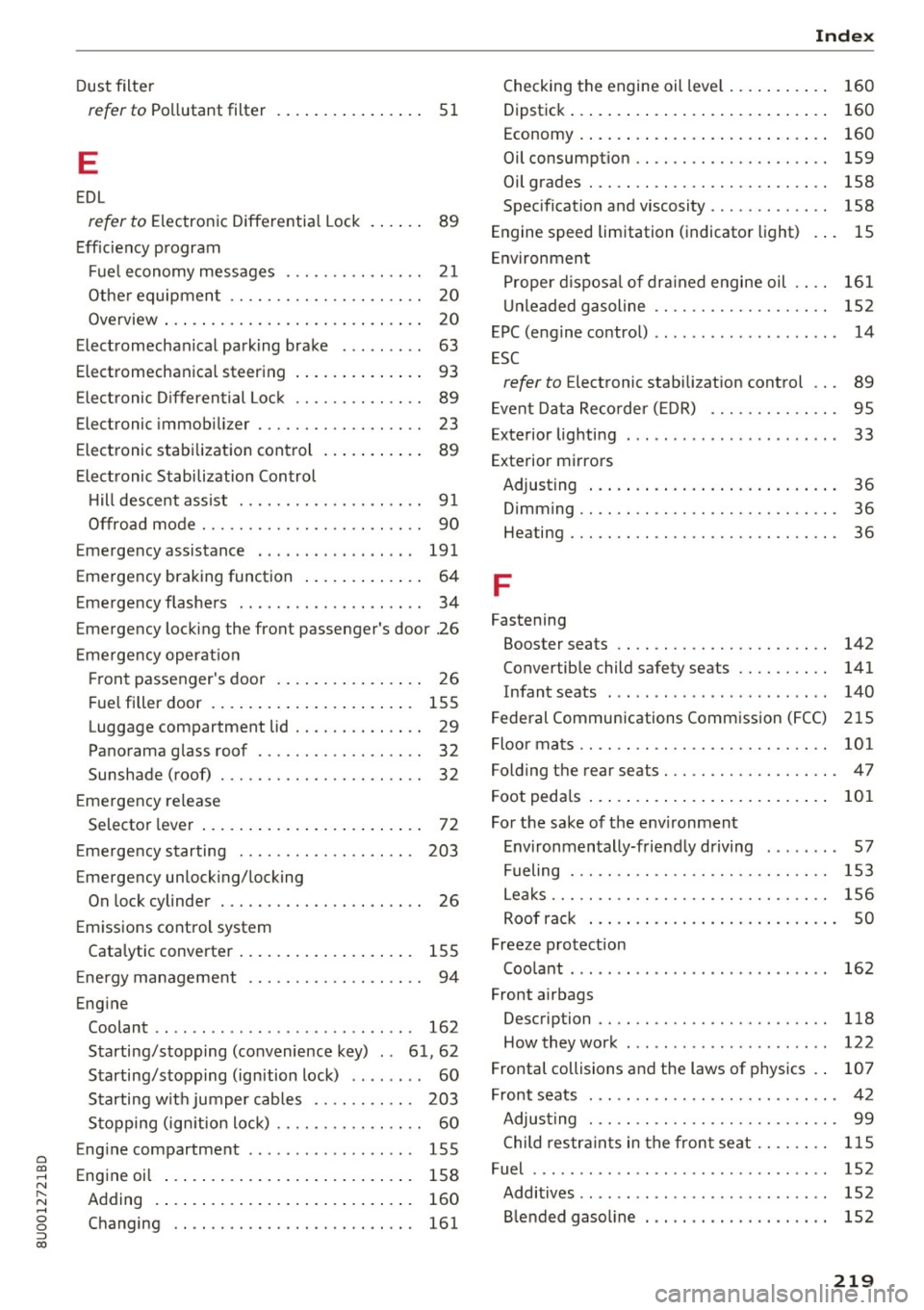
0 co ......
"' ,....
"' ...... 0 0 :::,
00
Dust filter
refer to Pollutant filter . . . . . . . . . . . . . . . . S 1
E
EDL
refer to Electronic Differential Lock . . . . . . 89
Efficiency program
Fuel economy messages . . . . . . . . . . . . . . .
21
Other equipment . . . . . . . . . . . . . . . . . . . . . 20
Overview . . . . . . . . . . . . . . . . . . . . . . . . . . . . 20
Electromechanical parking brake . . . . . . . . . 63
Electromechanical steering . . . . . . . . . . . . . . 93
E lectronic Differential Lock . . . . . . . . . . . . . .
89
Electronic immobilizer . . . . . . . . . . . . . . . . . . 23
Electronic stabilization control . . . . . . . . . . .
89
Electronic Stabilization Control
Hill descent assist . . . . . . . . . . . . . . . . . . . .
91
Offroad mode . . . . . . . . . . . . . . . . . . . . . . . . 90
Emergency assistance . . . . . . . . . . . . . . . . . 191
Emergency braking function . . . . . . . . . . . . . 64
Emergency flashers . . . . . . . . . . . . . . . . . . . . 34
Emergency locking the front passenger's door .26
Emergency operation
Front passenger's door . . . . . . . . . . . . . . . .
26
Fuel filler door . . . . . . . . . . . . . . . . . . . . . . 155
Luggage compartment lid . . . . . . . . . . . . . . 29
Panorama glass roof . . . . . . . . . . . . . . . . . . 32
Sunshade (roof) . . . . . . . . . . . . . . . . . . . . . . 32
Emergency release
Selector lever . . . . . . . . . . . . . . . . . . . . . . . .
72
E mergency starting . . . . . . . . . . . . . . . . . . . 203
Emergency unlocking/locking
On lock cylinder . . . . . . . . . . . . . . . . . . . . . .
26
Emissions control system
Catalytic converter . . . . . . . . . . . . . . . . . . .
155
Energy management . . . . . . . . . . . . . . . . . . . 94
Engine
Coolant . . . . . . . . . . . . . . . . . . . . . . . . . . . .
162
Starting/stopping (convenience key) . . 61, 62
Starting/stopping (ignition lock) . . . . . . . . 60
Starting with jumper cables . . . . . . . . . . . 203
Stopping (ign ition lock) . . . . . . . . . . . . . . . .
60
Engine compartment . . . . . . . . . . . . . . . . . . 155
Engine oil . . . . . . . . . . . . . . . . . . . . . . . . . . . 158
Adding . . . . . . . . . . . . . . . . . . . . . . . . . . . . 160
Changing . . . . . . . . . . . . . . . . . . . . . . . . . . 161
Index
Checking the engine oil level . . . . . . . . . . . 160
Dipstick . . . . . . . . . . . . . . . . . . . . . . . . . . . . 160
Economy... ... .. .. ................. 160
Oil consumption . . . . . . . . . . . . . . . . . . . . . 159
Oil grades . . . . . . . . . . . . . . . . . . . . . . . . . . 158
Specification and viscosity . . . . . . . . . . . . . 158
Engine speed limitation (indicator light) 15
Environment
Proper disposal of drained engine oil . . . .
161
Unleaded gasoline . . . . . . . . . . . . . . . . . . . 152
EPC (engine control) . . . . . . . . . . . . . . . . . . . . 14
ESC
refer to Electronic stabilization control . . . 89
Event Data Recorder (EDR) . . . . . . . . . . . . . . 95
Exterior lighting
33
Exterior mirrors Adjusting . . . . . . . . . . . . . . . . . . . . . . . . . . . 36
D. . 1mm1ng .. .. .. .. .. ............... .. . 36
Heating . . . . . . . . . . . . . . . . . . . . . . . . . . . . . 36
F
Fastening
Booster seats . . . . . . . . . . . . . . . . . . . . . . .
142
Convertible child safety seats . . . . . . . . . . 141
Infant seats . . . . . . . . . . . . . . . . . . . . . . . . 140
Federal Communications Commission (FCC) 215
Floor mats . . . . . . . . . . . . . . . . . . . . . . . . . . . 101
Folding the rear seats. . . . . . . . . . . . . . . . . . . 47
Foot pedals . . . . . . . . . . . . . . . . . . . . . . . . . . 101
For the sake of the environment
Environmentally-friendly driving . . . . . . . .
57
Fueling . . . . . . . . . . . . . . . . . . . . . . . . . . . . 153
Leaks. . . . . . . . . . . . . . . . . . . . . . . . . . . . . . 156
Roof rack . . . . . . . . . . . . . . . . . . . . . . . . . . . SO
Freeze protection Coo lant . . . . . . . . . . . . . . . . . . . . . . . . . . . .
162
Front airbags
Description . . . . . . . . . . . . . . . . . . . . . . . . .
118
How they work . . . . . . . . . . . . . . . . . . . . . . 122
Frontal collisions and the laws of physics . . 107
Front seats . . . . . . . . . . . . . . . . . . . . . . . . . . . 42
Adjusting . . . . . . . . . . . . . . . . . . . . . . . . . . . 99
Child restraints in the front seat ...... . .
Fuel
. . ...... ... .. .. ... ....... ... .. . .
115
152
Additives . . . . . . . . . . . . . . . . . . . . . . . . . . . 152
Blended gasoline . . . . . . . . . . . . . . . . . . . . 152
219
Page 222 of 230
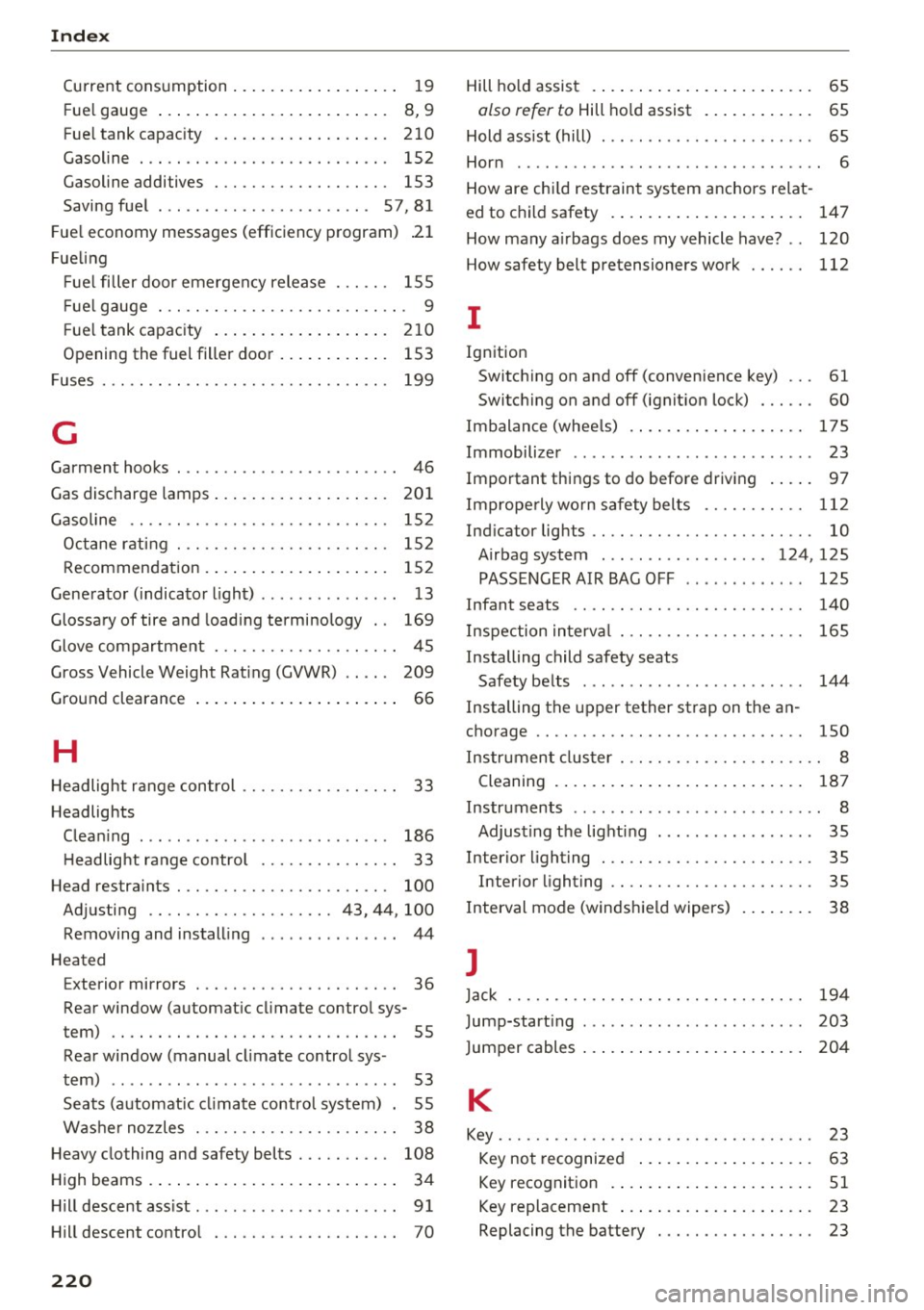
Index
Current consumption . . . . . . . . . . . . . . . . . . 19
Fuel gauge . . . . . . . . . . . . . . . . . . . . . . . . . 8, 9
Fuel tank capacity ................... 210
Gasoline . . . . . . . . . . . . . . . . . . . . . . . . . . . 152
Gasoline additives . . . . . . . . . . . . . . . . . . . 153
Saving fuel . . . . . . . . . . . . . . . . . . . . . . . 57, 81
Fuel economy messages (efficiency program) .21
Fueling Fuel filler door emergency release . . . . . . 155
F uel gauge . . . . . . . . . . . . . . . . . . . . . . . . . . . 9
F uel tank capacity . . . . . . . . . . . . . . . . . . . 210
Opening the fuel filler door . . . . . . . . . . . . 153
Fuses . . . . . . . . . . . . . . . . . . . . . . . . . . . . . . . 199
G
Garment hooks . . . . . . . . . . . . . . . . . . . . . . . . 46
Gas discharge lamps . . . . . . . . . . . . . . . . . . . 201
Gasoline . . . . . . . . . . . . . . . . . . . . . . . . . . . . 152
Octane rating . . . . . . . . . . . . . . . . . . . . . . . 152
Recommendation . . . . . . . . . . . . . . . . . . . . 152
Generator (indicator light) . . . . . . . . . . . . . . . 13
Glossary of tire and loading terminology . . 169
Glove compartment . . . . . . . . . . . . . . . . . . . . 45
Gross Vehicle Weight Rating (GVWR) . . . . . 209
Ground clearance . . . . . . . . . . . . . . . . . . . . . . 66
H
Headlight range control . . . . . . . . . . . . . . . . . 33
Headlights Cleaning . . . . . . . . . . . . . . . . . . . . . . . . . . . 186
H eadlight range control . . . . . . . . . . . . . . . 33
Head restraints . . . . . . . . . . . . . . . . . . . . . . . 100
Adjusting .. .. ................ 43, 44, 100
Removing and installing . . . . . . . . . . . . . . . 44
Heated Exterior mirrors . . . . . . . . . . . . . . . . . . . . . . 36
Rear window (automatic climate control sys-
tem) . . . . . . . . . . . . . . . . . . . . . . . . . . . . . . . 55
Rear window (manual climate control sys -
tem) . . . . . . . . . . . . . . . . . . . . . . . . . . . . . . . 53
Seats (automatic climate control system) . 55
Washer nozzles . . . . . . . . . . . . . . . . . . . . . . 38
Heavy clothing and safety belts . . . . . . . . . . 108
High beams . . . . . . . . . . . . . . . . . . . . . . . . . . . 34
Hill descent assist ... . .. .. ...... .. .. .. .. 91
Hill descent control . . . . . . . . . . . . . . . . . . . . 70
220
Hill hold assist . . . . . . . . . . . . . . . . . . . . . . . . 65
also refer to Hill hold assist . . . . . . . . . . . . 65
Hold ass ist (hill) . . . . . . . . . . . . . . . . . . . . . . . 65
Horn . . . . . . . . . . . . . . . . . . . . . . . . . . . . . . . . . 6
How are child restraint system anchors relat-
ed to child safety . . . . . . . . . . . . . . . . . . . . . 147
How many a irbags does my vehicle have? . . 120
How safety belt pretensioners work 112
I
Ignition
Switching on and off (convenience key) . . . 61
Switching on and off (ignition lock) . . . . . . 60
Imbalance (wheels) . . . . . . . . . . . . . . . . . . . 175
Immobilizer . . . . . . . . . . . . . . . . . . . . . . . . . . 23
Important things to do before driving . . . . . 97
Improperly worn safety belts . . . . . . . . . . . 112
Indicator lights . . . . . . . . . . . . . . . . . . . . . . . . 10
Airbag system . . . . . . . . . . . . . . . . . . 124, 125
PASSENGER AIR BAG OFF . . . . . . . . . . . . . 125
Infant seats . . . . . . . . . . . . . . . . . . . . . . . . . 140
Inspection interval . . . . . . . . . . . . . . . . . . . . 165
Installing child safety seats Safety belts . . . . . . . . . . . . . . . . . . . . . . . . 144
Installing the upper tether strap on the an
chorage . . . . . . . . . . . . . . . . . . . . . . . . . . . . . 150
Instrument cluster . . . . . . . . . . . . . . . . . . . . . . 8
Cleaning . . . . . . . . . . . . . . . . . . . . . . . . . . . 187
Instruments . . . . . . . . . . . . . . . . . . . . . . . . . . . 8
Adjusting the lighting . . . . . . . . . . . . . . . . . 35
Interior lighting . . . . . . . . . . . . . . . . . . . . . . . 35
Interior lighting . . . . . . . . . . . . . . . . . . . . . . 35
Interval mode (windshield wipers) . . . . . . . . 38
J
Jack . . . . . . . . . . . . . . . . . . . . . . . . . . . . . . . . 194
Jump-starting . . . . . . . . . . . . . . . . . . . . . . . . 203
Jumper cables . . . . . . . . . . . . . . . . . . . . . . . . 204
K
Key........ .. .. .. .. .. ... .......... ... 23
Key not recognized . . . . . . . . . . . . . . . . . . . 63
Key recognition . . . . . . . . . . . . . . . . . . . . . . 51
Key replacement . . . . . . . . . . . . . . . . . . . . . 23
Replacing the battery . . . . . . . . . . . . . . . . . 23