brake AUDI Q3 2018 Owner's Guide
[x] Cancel search | Manufacturer: AUDI, Model Year: 2018, Model line: Q3, Model: AUDI Q3 2018Pages: 230, PDF Size: 57.03 MB
Page 160 of 230
Checking and Filling
Engine compartment overview
The most important check points.
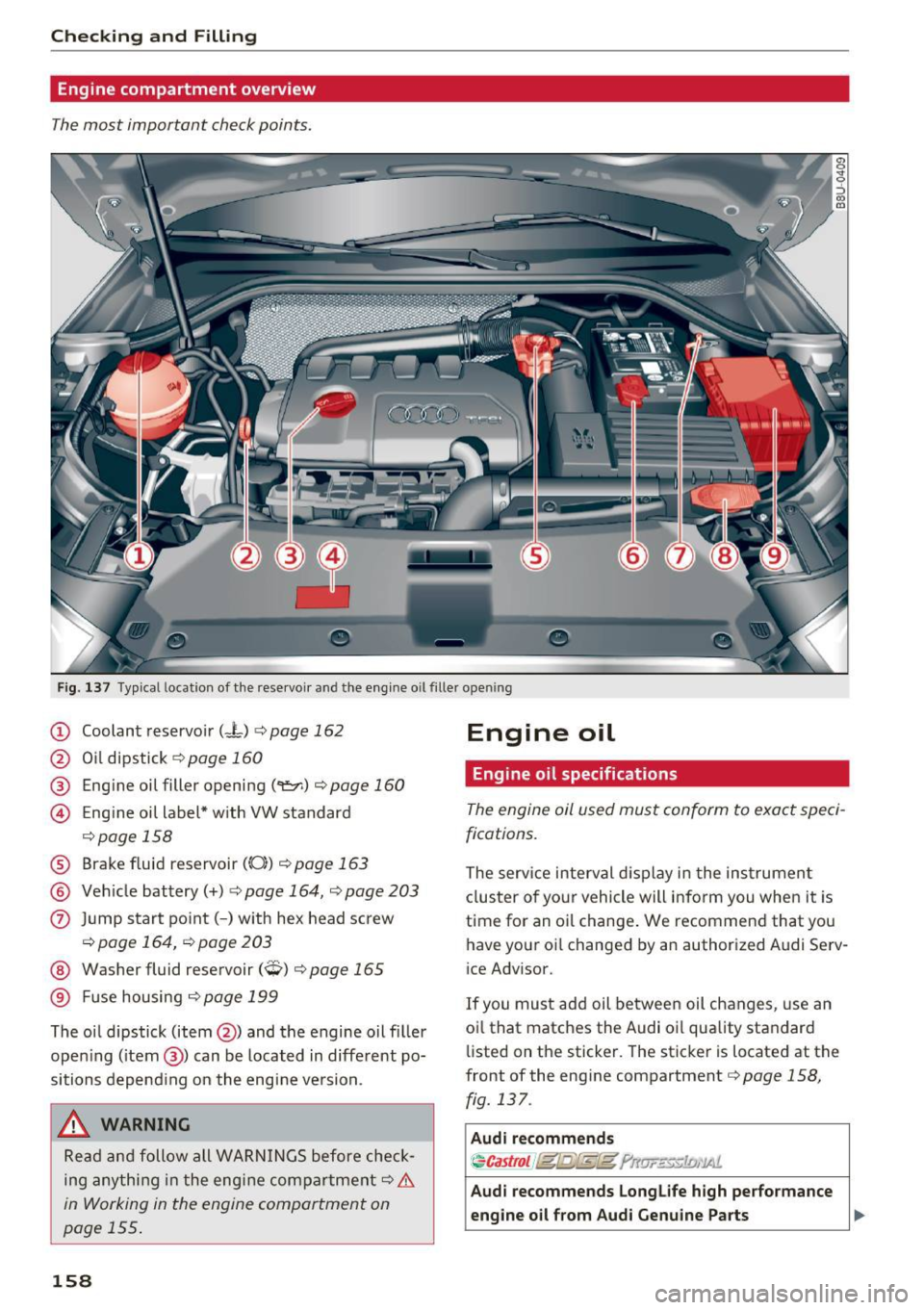
Fig. 137 Typical location of the rese rvoir and the engine o il fil le r open ing
(D Coolant reservoir ( - L) ¢ page 162
@ Oil dipstick ¢ page 160
® Engine oil filler opening ('t:::r.) ¢page 160
© Eng ine oil label* w ith VW standard
evpage 158
® Brake f luid reservoir ((0)) ¢ page 163
® Vehicle battery(+) ¢ page 164, evpage 203
(?) Jump start point( -) w ith hex head screw
ev page 164, ev page 203
@ Washer fluid reservoir (O) ev page 165
® Fuse housing c:::> page 199
The oil dipstick (item @) and the engine oil fi ller
open ing (item @) can be located in different po
sitions depend ing on the engine version.
_& WARNING
Read and follow all WARN INGS before check
ing anything i n the engi ne compa rtment¢ &.
in Working in the engine compartment on
page 155 .
158
Engine oil
Engine oil specifications
The engine oil used must conform to exact speci
fications.
The serv ice interval d isplay in the inst rumen t
cluster of your vehicle will inform you when it is
time for an o il change . We recommend that you
have your oi l changed by a n authorized Audi Se rv
i ce Advisor.
If you must add oil betwee n oil changes, use an
oi l that matches the Audi oil quality standard
li sted on the sticker. The sticker is located at the
front of the eng ine compartment ¢
page 158,
fig. 137 .
Audi re commend s
~Castrol /fg/j;Sf.g;fg f'r
eng ine oil from Aud i Genuine Pa rt s
liJI,
Page 165 of 230
a
co
...... N r-,. N
"" 0 0 ::, co
Audi dealer or authorized Audi Service Facility
and have the cooling system inspected. If the
cooling system is not leaking, a loss can come
from the coolant boiling through overheating
and being pushed out of the cooling system.
A WARNING
- The cooling system is under pressure . Do
not open the coolant expansion tank cap
when the engine is hot . This increases the
risk of burns .
- The coolant additive and the coolant can be
dangerous to your health. For this reason,
keep the coolant in the original container
and away from children. There is a risk of
poisoning.
- When working in the engine compartment,
remember that the radiator fan can switch
on even if the ignition is switched off, which
increases the risk of injury.
CD Note
-
Do not add coolant if the expansion tank is
empty . Air could enter the cooling system and
damage the engine.
If this is the case, do not
continue driving. See an authorized Audi deal
er or authorized Audi Service Facility for assis
tance.
Brake fluid
Fig. 141 Eng ine compartment: cap on brake flu id reservoir
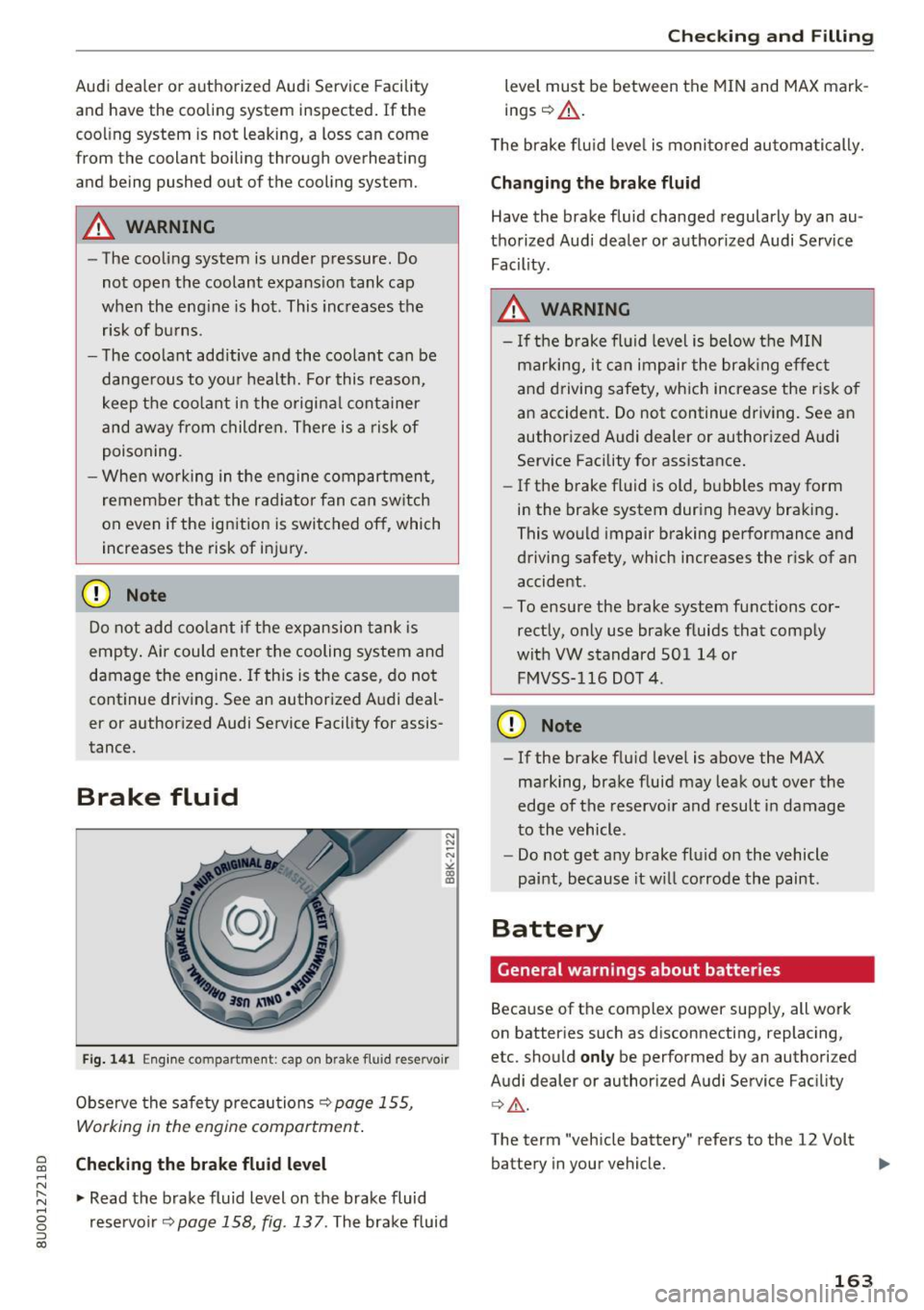
Observe the safety precautions ¢ page 155,
Working in the engine compartment .
Checking the brake fluid level
~ Read the brake fluid Level on the brake fluid
reservoir ~
page 158, fig . 13 7. The brake fluid
Checking and Filling
Level must be between the MIN and MAX mark
ings
~ A .
The brake fluid Level is monitored automatically.
Changing the brake fluid
Have the brake fluid changed regularly by an au
thorized Audi dealer or authorized Audi Service Facility .
A WARNING
- If the brake fluid level is below the MIN
marking, it can impair the braking effect
and driving safety, which increase the risk of
an accident. Do not continue driving. See an
authorized Audi dealer or authorized A udi
Service Facility for assistance.
- If the brake fluid is old, bubbles may form
in the brake system during heavy braking .
This would impair braking performance and driving safety, which increases the risk of an
accident .
- To ensure the brake system functions cor
rectly, only use brake fluids that comply
with VW standard 501 14 or
FMVSS-116 DOT 4.
CD Note
- If the brake flu id level is above the MAX
marking, brake fluid may Leak out over the
edge of the reservoir and result in damage
to the vehicle.
- Do not get any brake fluid on the vehicle
paint, because it will corrode the paint.
Battery
General warnings about batteries
Because of the complex power supp ly, all work
on batteries such as disconnecting, replacing,
etc. should
only be performed by an authorized
Audi dealer or authorized Audi Service Facility
¢ .&,.
The term "vehicle battery " refers to the 12 Volt
battery in your vehicle.
163
...
Page 171 of 230
0 C0
-N
" N
-0 g a)
Glossary of tire and loading
terminology
Accessory weight
means the combined we ight (in
excess of those standard items
which may be replaced) of auto matic transmission, power steer
ing, power brakes, power win
dows, power seats, radio, and
heater, to the extent that these
items a re available as factory- in
stalled equipment (whether in
stalled or not) .
Aspect ratio
means the ratio of the height to
the width o f the tire in percent .
Numbers of 55 or lower indicate a
low s idewal l for improved steer
ing response and better overall
handling on dry pavement.
Bead
means the part of the t ire that is
made of steel wires, wrapped or
reinforced by ply cords and that is
shaped to fit the rim .
Bead separation
means a breakdown of the bond
between components in the bead .
Wheels
Cord
means the strands forming the
plies in the tire.
Cold tire inflation pressure
means the tir e pressure recom
mended by the vehicle manufac
tu rer for a tire of a designated
size that has not been driven for
more than a couple of m iles (k ilo
meters) at low speeds in the
three hour period before the t ire
pressure is measured or adjusted .
Curb weight
means the weight of a motor ve
hicle with standard equipment in
cluding the maximum capacity of
f u el, o il, and coolant, a ir cond i
tioning and additional weight of
optio nal eq uipment .
Extra load tire
means a tire designed to operate
at higher loads and at higher in
flat ion pressu res than the corre
sponding standard tire . Extra load
tires may be ident ified as "X L",
"xl", "EXTRA LOAD", or "RF" on
the sidewall. .,.
169
Page 173 of 230
0 C0
-N ,... N
-0
0
::, a)
Production options weight
means the combined weight of
those installed regular production
options weighing over 5 lbs.
(2 .3 kg) in excess of those stand
ard items which they replace, not
previously considered in curb
weight or accessory we ight, in
cluding heavy duty brakes, ride
levelers, roof rack, heavy duty
battery, and special trim.
Radial ply tire
means a pneumatic tire in which
the ply cords that extend to the beads are laid at substantially
90 degrees to the centerline of
the tread.
Re commended inflation
pressure
see ¢ page 169, Cold tire infla
tion pressure .
Reinforced tire
means a tire designed to operate
at higher loads and at h igher in
flation pressures than the corre
sponding standard tire. Rein
forced tires may be identified as
"XL" "xl" "EXTRA LOAD" or "RF" 1 , ,
on the sidewall.
Wheels
Rim
means a metal support for a tire
or a tire and tube assembly upon
which the tire beads are seated.
Rim diamet er
means nominal d iameter of the
bead seat. If you change your
wheel size, you will have to pur
chase new tires to match the new
rim diameter.
Rim size designat ion
means rim diameter and width .
Rim width
means nominal distance between
r im
flanges .
Sidewall
means that portion of a tire be
tween the tread and bead.
Speed rating (letter code )
means the speed at which a tire is
designed to be driven for extend
ed periods of time . The rat ings
range from
93 mph (150 km/h)
to
186 mph (298 km/h) ¢ table
on page 167.
You may not find
this information on all tires be
cause it is not required by law.
The speed rating letter code,
where applicable, is molded on
the tire sidewall and indicates the ...
17 1
Page 177 of 230
0
"' .... N
" N .... 0 0 ::,
"'
not permitted can lead to ve
hicle damage or accidents.
-If you install wheel covers on the vehicle, make sure they allow enough air circulation to
cool the brake system. If they
do not, this could increase the risk of an accident.
Tire wear/damage
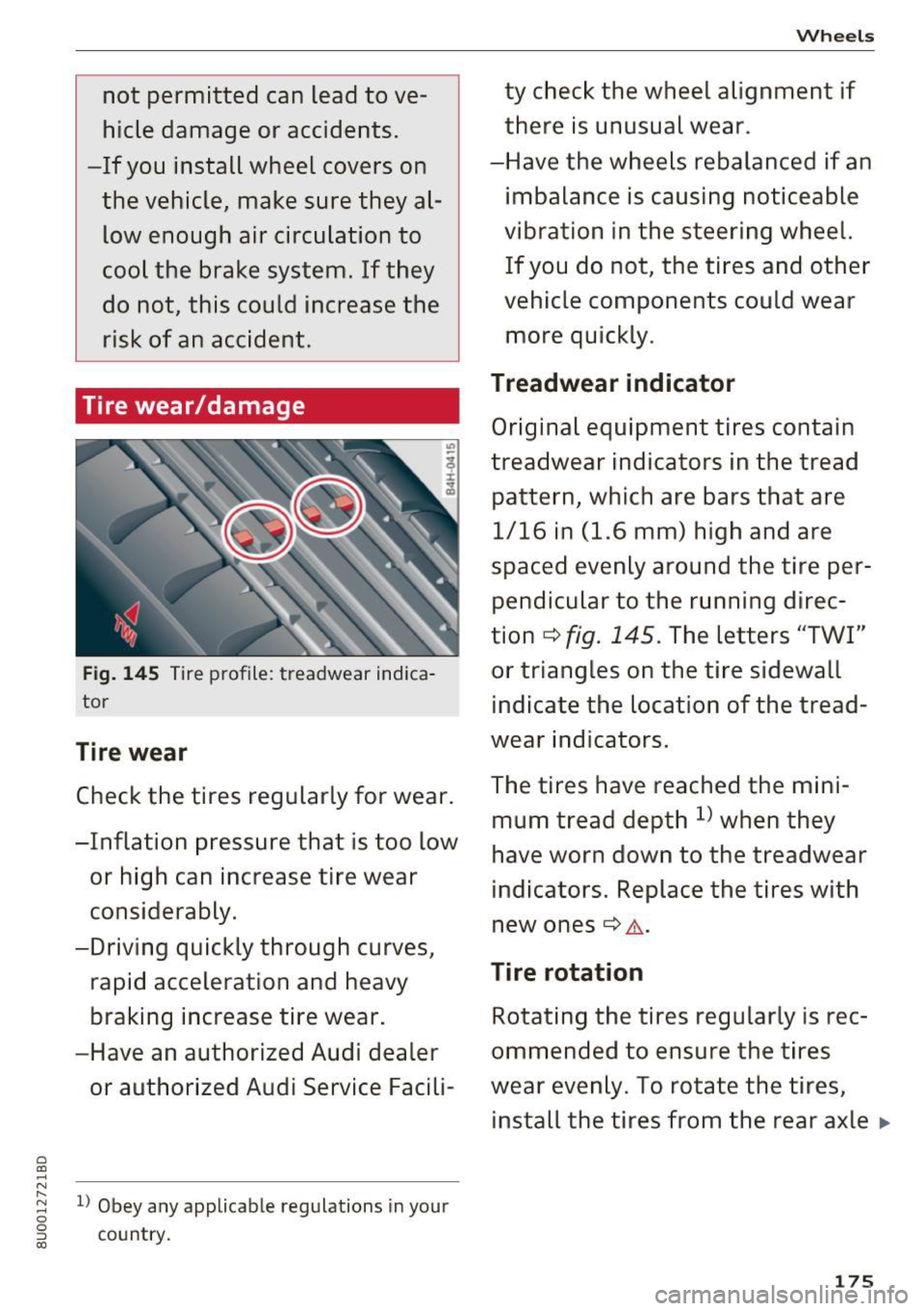
Fig. 145 Tire profile : treadwear indica
tor
Tire wear
Check the tires regularly for wear.
-Inflation pressure that is too low or high can increase tire wear
considerably.
-Driving quickly through curves, rapid acceleration and heavy
braking increase tire wear.
-Have an authorized Audi dea ler
or authorized Audi Service Facili-
l ) Obey any applicable regulations in your
country.
Wheels
ty check the wheel alignment if
there is unusual wear.
-Have the wheels rebalanced if an imbalance is causing noticeable
vibration in the steering wheel. If you do not, the tires and other
vehicle components could wear more quickly.
Treadwear indicator
Original equipment tires contain
treadwear indicators in the tread pattern, which are bars that are 1/16 in (1.6 mm) high and are
spaced evenly around the tire per pendicular to the running d irec
tion
i:::> fig. 145. The letters "TWI "
or triang les on the tire sidewall
indicate the location of the tread
wear indicators.
The tires have reached the mini mum tread depth
l ) when they
have worn down to the treadwear
indicators. Replace the tires with
new ones
i:::> .&..
Tire rotation
Rotating the tires regularly is rec
ommended to ensure the tires
wear evenly. To rotate the tires, install the tires from the rear axle ..,.
175
Page 181 of 230
fuel, oil, coolant and other fluids plus maximum load. The maxi
mum load includes the number of
passengers that the vehicle is in
tended to carry ("seating capaci
ty") with an assumed weight of
1 50 lbs. (68 kg) for each passen
ger at a designated seating posi
tion and the total weight of any
luggage in the vehicle. If you tow
a trailer, the weight of the trailer
hitch and the tongue weight of
the loaded trailer must be includ
ed as part of the vehicle load.
The
Gr oss Axle Weight R ating
("GAWR") is the maximum load
that can be applied at each of the
veh icle's two axles.
The fact that there is an upper limit to your vehicle's Gross Vehi
cle Weight Rating means that the
total weight of whatever is being
carried in the vehicle (including
the weight of a trai ler hitch and
the tongue weight of the loaded
trailer) is limited. The more pas
sengers in the vehicle or passen
gers who are heavier than the
standard weights assumed mean
that less weight can be carried as
~ luggage.
-N
" N
-0
0
::, a)
Wheels
The Gross Vehicle Weight Rating and the Gross Axle Weight Rating
are listed on the safety compli
ance sticker label located on the
driver's side B-pillar.
_&. WA RNIN G
Overloading a vehicle can cause
loss of vehicle control, a crash
or other accident, serious per
sonal injury, and even death.
- Carrying more weight than
your vehicle was designed to carry will prevent the vehicle
from handling properly and increase the risk of the loss of
vehicle control.
-The brakes on a vehicle that
has been overloaded may not
be able to stop the vehicle
within a safe distance.
- Tires on a vehicle that has
been overloaded can fail sud
denly, including a blowout and
sudden deflation, causing loss
of control and a crash.
- Always make sure that the to
tal load being transported -
including the weight of a trail
er hitch and the tongue
weight of a loaded trailer -
does not make the vehicle heavier than the vehicle's
Gross Veh icle Weight Rating .
179
Page 188 of 230

Care and cleaning
wash operator to reduce the risk of acci
dents.
- To reduce the risk of cuts, protect yourself
from sharp metal components when wash ing the underbody or the inside of the wheel
housings.
- After washing the vehicle, the braking effect
may be delayed due to moisture on the
brake rotors or ice in the winter. This in
creases the risk of an accident. The brakes
must be dried first with a few careful brake
applications.
(D Note
- If you wash the vehicle in an automatic car
wash, you must fold the exterior mirrors in
to reduce the risk of damage to the mirrors.
Power folding exterior mirrors* must only
be folded in and out using the power folding
function.
- To reduce the risk of paint damage, do not
wash the vehicle in direct sunlight. -
To reduce the risk of damage to the surface,
do not use insect removing sponges, kitchen
sponges or similar items.
- Matte finish painted vehicle components:
- To reduce the risk of damage to the sur-
face, do not use polishing agents or hard
wax.
- Never use protective wax. It can destroy
the matte finish effect.
- Do not place any stickers or magnetic
signs on vehicle parts painted with matte
finish paint. The paint could be damaged
when the stickers or magnets are re
moved.
@ For the sake of the environment
Only wash the veh icle in facilities spec ially de
signed for that purpose. This will reduce the
risk of dirty water contaminated with oil from
entering the sewer system.
Cleaning and care information
When clean ing and caring for individual vehicle
components, refer to the following tables. The
information contained there is simply recom
mendations. For quest ions or for components that are
not listed, consult an authorized Aud i
dealer or authorized Audi Service Facility. Also
follow the information found in¢&..
Exterior cleaning
Component Situation Solution
Windshield wiper
Deposits ¢ page 39, Cleaning the wiper blades
blades
Headlights/
Deposits Soft sponge with a mi ld soap solutiona >
Tail lights
Sensors/
Deposits Sensors: soft cloth with solvent-free cleaning solution
Camera lenses Camera lenses: soft cloth with alcohol-free cleaning solu-
tion
Snow/ice Hand brush/so
lvent-free de -icing spray
Wheels Road salt Water
Brake dust Acid-free special cleaning solution
Exhaust tail pipes Road salt Water, cleaning solution suitable for stainless steel, if
necessary
Decorative parts/ Deposits Mild soap solution al, a cleaning solution suitable for
Trim stainless steel, if necessary
186
Page 193 of 230
a
co
...... N r--. N
'"' 0 0 ::, co
Emergency assistance
General information
.. Park the vehicle as far as poss ible from moving
traffic in the event of a breakdown. In the event
of a flat tire, park the vehicle on a leve l surface .
It you are on a steep h ill, be especially careful.
.. Set the parking brake.
.. Switch the emergency flashe rs on .
.. Put on a reflective vest .
.. Set up the warn ing triang le, if available .
.. Have the passengers exi t the veh icle. They
sho uld move to a safe place, for example be
hind a guard rail.
_& WARNING
Follow the steps given above. This is for your
protection and the for the safety of other d riv
ers.
Equipment
Vehicle tool kit
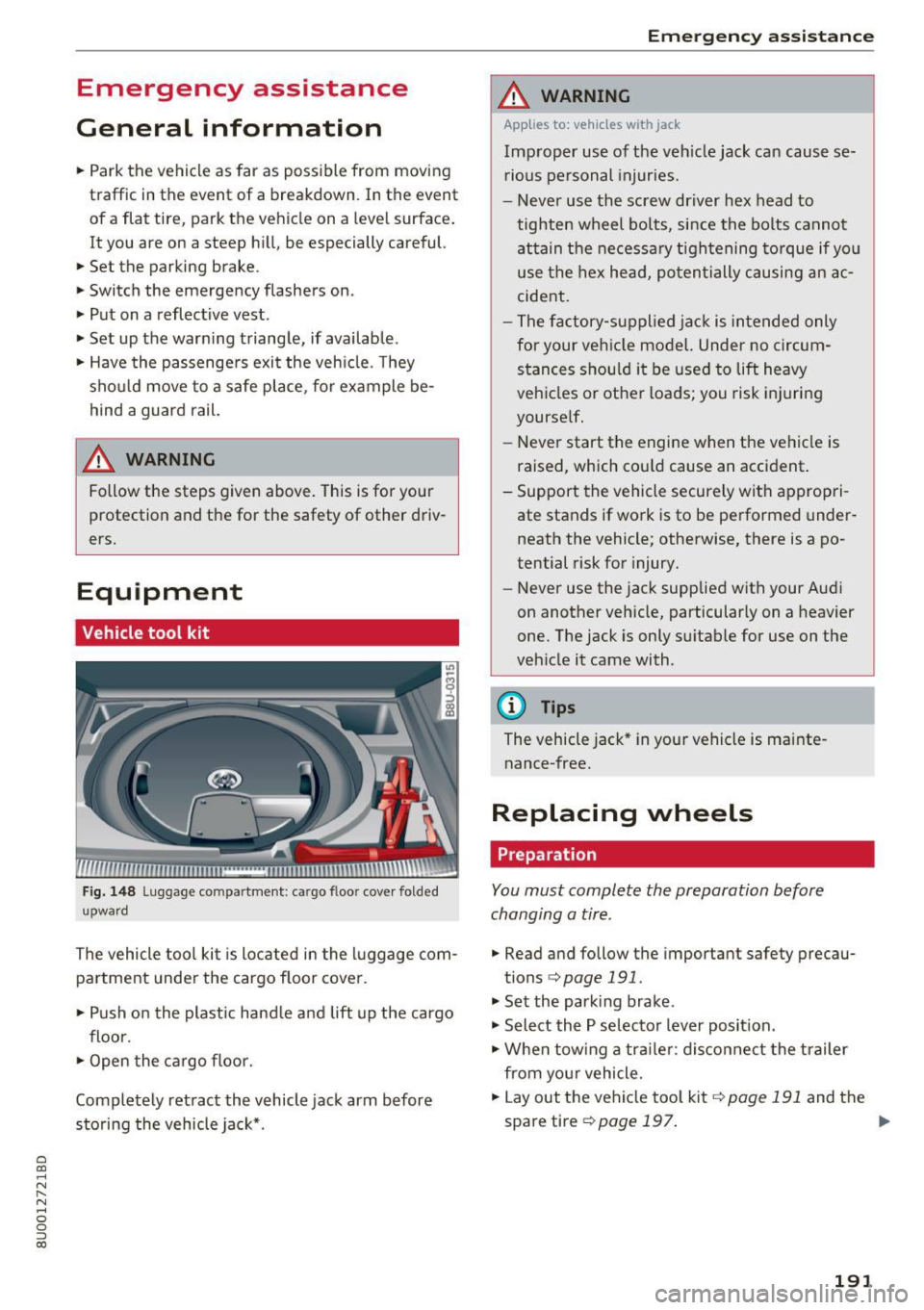
Fig. 1 48 Luggage compartmen t: ca rgo floor cover folded
upward
The vehicle tool kit is located in the luggage com
partment under the cargo floor cover .
.. Push on the plast ic hand le a nd lift up the cargo
floor.
.. Open the cargo floor.
Completely ret ract the vehicle jac k arm before
sto ring the vehicle jack*.
Em ergen cy a ssis tanc e
_& WARNING
-Applies to: ve hicles with jack
Improper use of the veh icle jack can cause se
rious pe rsonal injuries.
- Never use the screw driver hex head to
tighten wheel bolts, since the bolts cannot attain the necessa ry t ightening to rque if yo u
use the hex head, po ten tially causing an ac
cident .
- The factory-supplied jack is intended only
for your ve hicl e mode l. Under no circum
s tances shou ld it be used to lift heavy
vehicles o r other loads; you risk i njuring
yourse lf.
- Never start the engine when the vehicle is
raised, which cou ld cause an accident .
- Support the vehicle securely with appropri
ate stands if work is to be performed under
neath the vehicle; otherwise, there is a po
tential risk for injury.
- Never use the jack supplied with your Audi
on another vehicle, particularly on a heavier
one. The jack is only su itable for use on the
veh icle it came with .
{!) Tips
The vehicle jack * in your vehicle is mainte
nance-free.
Replacing wheels
Preparation
You must complete the preparation before
changing a tire .
.. Read and follow the important safety precau-
tions
<=:> page 191.
.,. Set the park ing brake .
.,. Select the P selector lever posit ion.
.,. W hen tow ing a tra iler: disconnect the trailer
from yo ur vehicle .
.. Lay out the vehi cle too l kit ¢
page 191 and the
spare tire
<=:> page 197.
191
Page 194 of 230

Emergency assistance
& WARNING
You or your passengers could be injured while changing a wheel if you do not follow these
safety precautions :
- If you have a flat ti re, move a safe d ista nee
off the road . Turn off the engine, turn the
emergency flashers on and use other warn·
ing devices to alert other motorists.
- Make sure that passengers wait in a safe
place away from the vehicle and well away
from the road and traffic.
- To help prevent the vehicle from moving
suddenly and possibly slipping off the jack,
always fully set the parking brake and block
the front and back of the wheel diagonally
opposite the wheel being changed with the
folding chocks or other objects. When one
front wheel is lifted off the ground, placing
the Automatic Transmission in "P" (Park)
will
not prevent the vehicle from moving.
- Before you change a wheel, be sure the
ground is level and firm. If necessary, use a
sturdy board under the jack .
- Always store the vehicle tool kit, the jack
and the replaced tire in the luggage com
partment
c:> page 102 .
(D Tips
Obey all laws.
Changing a wheel
When you change a wheel, follow the sequence
described below step-by-step and in exactly that
order.
1. Remove the decorative wheel cover* or the
wheel bolt caps*. For more details see also
<=:>page 193.
2. Loosen the wheel bolts c:> page 193.
3. Locate the proper mounting point for the
jack and align the jack below that point
<=:>page 194.
4. Lift the car with the jack c:> page 194 .
5. Remove the wheel with the flat tire and then
install the
spare tire <=:>page 195.
6. Tighten all wheel bolts lightly.
7.
Lower the vehicle with the jack.
192
8. Use the wheel bolt wrench and firmly tighten
all wheel bolts in a crisscross pattern
<=:>page 193.
9. Replace the decorative wheel cover* or the
wheel bolt caps*.
& WARNING
Always read and follow all WARNINGS and in
formation
c:> .&. in Raising the vehicle on
page 194
and <=:>page 196.
After changing a wheel
A wheel change is not complete without the do·
ing the following .
.,. Always store the vehicle tool kit, the jack* and
the replaced tire in the luggage compartment
c:>page 102.
.,. Check the tire pressure of the spare tire as soon
as possible .
.,. As soon as possible, have the
tightening tor·
ques
on all wheel bolts checked with a torque
wrench. The correct tightening torque is
10S ft lbs (140 Nm).
.,. Have the flat tire
replaced as soon as possible.
(D Tips
- If you notice that the wheel bolts are cor
roded and difficult to turn while changing a
tire, they should be replaced before you check the tightening torque.
- Drive at reduced speed until you have the
tightening torques checked .
Page 196 of 230
Emerg ency assis ta nce
Raising the vehicle
The vehicle must be li~ed with the jack first be
fore the wheel can be removed .
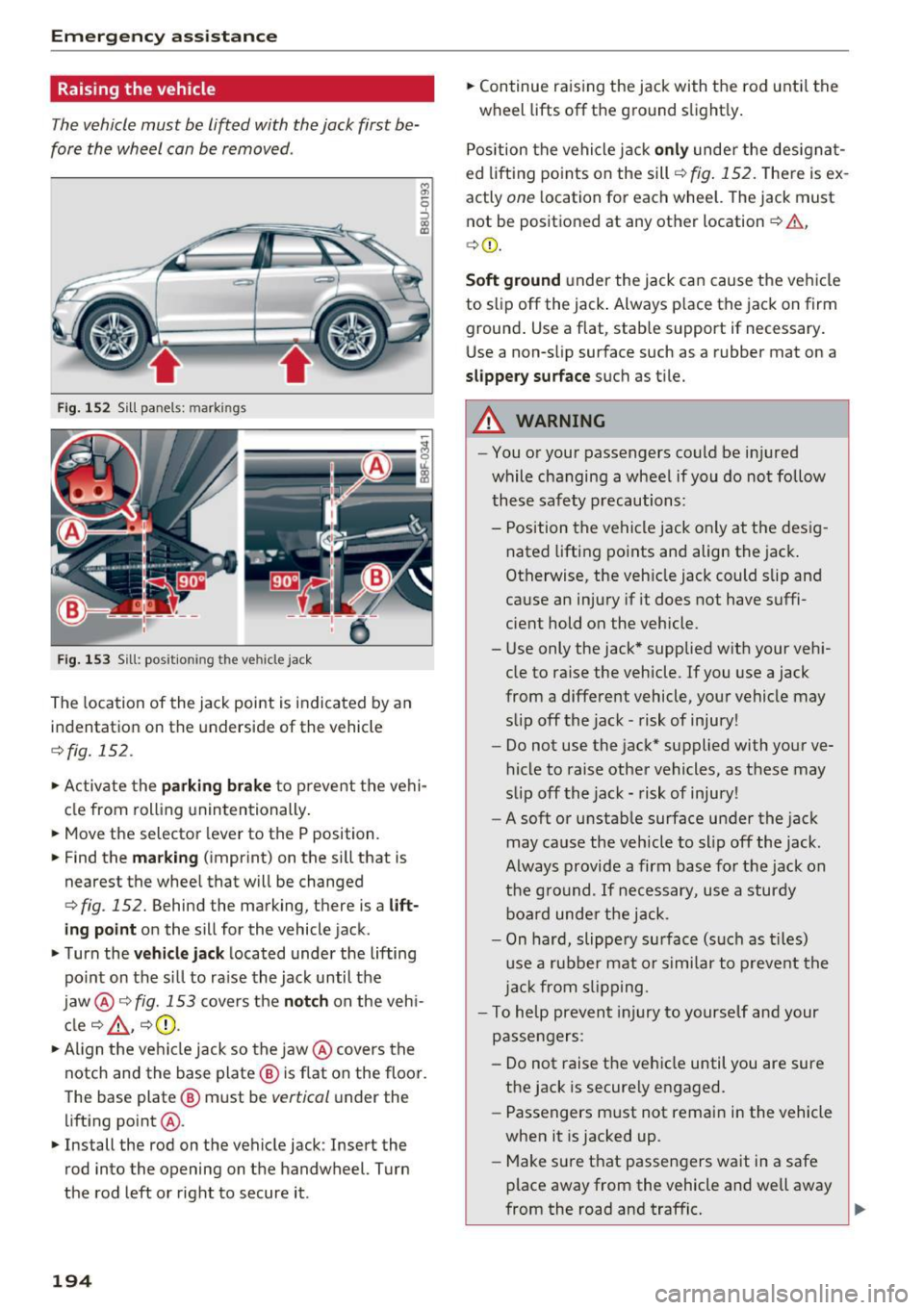
Fig. 152 Sill panels : mark in gs
Fig. 153 Sill : pos itio nin g th e ve hicle jack
The location of the jack point is indicated by an
indentation on the underside of the vehicle
¢ fig. 152 .
,.. Activate the pa rking brake to prevent the vehi
cle from rolling unintentionally .
,.. Move the selector lever to the P position.
,.. Find the
m arki ng (imprint) on the sill that is
nearest the wheel that will be changed
c> fig . 152. Behind the marking, there is a li ft
ing po int
on the sill for the vehicle jack.
• Turn the
veh icle jack located under the lifting
point on the s ill to ra ise the jack until the
jaw @¢
fig. 153 covers the notch on the veh i
cle ¢
.&_, ¢(D .
,.. Align the vehicle jack so the jaw @covers the
notch and the base plate @ is flat on the floor .
The base plate @ must be
vertical under the
lifting point @.
,.. Install the rod on the vehicle jack : Insert the
rod into the opening on the handwheel. Turn
the rod left or right to secure it .
194
• Continue raising the jack with the rod until the
wheel lifts off the ground slight ly.
Position the vehicle jack
only under the designat
ed lifting points on the sill
c> fig. 152. There is ex
actly
one l ocation fo r each wheel. The jack must
not be positioned at any other location
c> & ,
¢(I) .
So ft ground
under the jack can cause the vehicle
to slip off the jack . Always place the jack on firm
ground . Use a flat, stable support if necessary.
Use a non-slip surface such as a rubber mat on a
sl ippery su rf ace such as tile.
A WARNING
-
- You or your passengers could be injured
while changing a wheel if you do not follow
these safety precautions:
- Position the vehicle jack only at the desig
nated lifting points and align the jack .
Otherwise, the veh icle jack could slip and
cause an injury if it does not have suffi
cient hold on the vehicle.
- Use only the jack* supplied with your vehi cle to raise the vehicle. If you use a jack
from a different vehicle, your vehicle may
slip off the jack - risk of injury!
- Do not use the jack* supplied with your ve
hicle to raise other vehicles, as these may
slip off the jack - risk of injury!
- A soft or unstab le surface under the jack
may cause the vehicle to slip off the jack .
Always provide a firm base for the jack on
the gro und .
If necessary, use a sturdy
board unde r th e jack .
- On hard, slippe ry surface (such as t iles)
use a rubber mat or s imilar to prevent the
jac k from slipping.
- To he lp prevent injury to yourself and your
passengers:
- Do not raise the vehicle until you are sure
the jack is securely engaged.
- Passengers must not remain i n the vehicle
when it is jacked up .
- Make sure that passengers wait in a safe
place away from the vehicle and well away
from the road and traffic. .,,.