radiator AUDI Q5 2013 User Guide
[x] Cancel search | Manufacturer: AUDI, Model Year: 2013, Model line: Q5, Model: AUDI Q5 2013Pages: 316, PDF Size: 78.89 MB
Page 243 of 316
engine is warm, the level may be slightly
above the "MAX" marking .
The location of the coolant expansion tank
can be seen in the engine compartment illus
tration ¢
page 235.
To obtain an accurate reading, the engine
must be switched
off.
The expansion tank in your vehicle is equipped
with an electric coolant level sensor.
When the coolant level is too low, the warning
light in the Auto-Check System¢
page 30 will
blink until you add coolant and the level has
been restored to normal. Even though there is
an electric coolant level sensor, we still rec
ommend you check the coolant level from
time to time.
Coolant loss
Coolant loss may indicate a leak in the cooling
system. In the event of coolant loss, the cool
ing system should be inspected immediately
by your authorized Audi dealer.
It is not
enough merely to add coolant.
In a
sealed system, losses can occur only if
the boiling point of the coolant is exceeded as
a result of overheating.
(D Note
Do not add any type of radiator leak seal
ant to your vehicle's engine coolant. Add
ing radiator repair fluid may adversely af
fect the function and performance of your
cooling system and could result in damage
not covered by your New Vehicle Limited
Warranty.
Adding coolant
Be very careful when adding engine coolant.
Before you check anything in the engine com
partment,
always read and heed all WARN
INGS ¢ A in Working in the engine compart
ment on page 233.
... Turn off the engine .
... Let the engine cool down.
Checking and filling 241
... Place a thick rag over the coolant expansion
tank ¢
page 240, fig. 199 and carefully turn
the cap counter-clockwise ¢
A.
... Add coolant.
... Twist the cap on again
tightly.
Replacement engine coolant must conform to
exact specifications ¢
page 240, Coolant. We
recommend using only coolant additive
Gl2+
+, Gl3
or in an emergency Gl2 +. Do not use a
different additive . In an emergency use plain
water until you can get the correct additive and can restore the correct ratio. This should
be done as soon as possible .
If you have lost a considerable amount of
coolant, then you should add cold antifreeze
and cold water only when the engine is cold.
Always use
new engine coolant when refilling.
Do not fill coolant above the "MAX" mark. Ex
cess coolant will be forced out through the
pressure relief valve in the cap when the en
gine becomes hot.
A WARNING
- The cooling system is under pressure and
can get very hot. Reduce the risk of
scalding from hot coolant by following
these steps.
- Turn
off the engine and allow it to cool
down.
- Protect your face, hands and arms from
escaping fluid and steam by covering
the cap with a large, thick rag.
- Turn the cap slowly and very carefully
in a counter-clockwise direction while
applying light, downward pressure on
the top of the cap .
- To avoid being burned, do not spill an
tifreeze or coolant on the exhaust sys
tem or hot engine parts. Under certain
conditions, the ethylene glycol in en
gine coolant can catch fire.
-Antifreeze is poisonous. Always store an
tifreeze in its original container and well
out of the reach of children.
~
•
•
Page 244 of 316
24 2 Ch ecking and filling
-If you drain the coolant, it must be
caught and safely stored in a p roper
conta iner clearly marked "poison".
(D Note
- Coolant pollutes the env ironment and
could cause an engine fire . Excess coo l-
ant will be forced out through the pres
sure relief valve in the cap when the en
gine becomes hot.
- If, in an emergency, only water can be
added , the correct ratio between water
and antifreeze¢
page 240 must be re
stored as soon as possible .
@ For the sake of the environment
Drained coolant should not be reused. Al
ways dispose of used coolant while observ ing all environmental regulations.
Radiator fan
The radiator fan switches on automatically by
itself
The radiator fan is driven by the engine via the
V-be lt . The viscous clutch regulates the speed
of the fan accord ing to t he temperature of the
coolant.
An auxiliary electric radiator fan* switches on
a nd off depending on coolant temperature
and other ve hicle operating conditions.
After you switch the engine off, the auxiliary
fan can cont inue running for up to 10 minutes
- even with the ignition off. It can even switch
on again later by itself¢&. , if
- the temperature of the engine coolant rises
due to the heat build-up from the engine in
the engine compartment, or
- the engine compartment heats up because
the veh icle is parked in intense sunlight.
_&. WARNING
- To reduce the r isk of personal injury nev
er to uch the radiator fa n. -
The a uxiliary electric fan is temperat ure
controlled and can switch on suddenly
even when the engine is not running.
- The auxiliary radiator fan switches on a u
tomatically when the engine coolant reaches a certai n temperature and will
continue to ru n until the coolant temper
ature drops.
Brake fluid
Checking brake fluid level
The brake fluid level can be checked with a
quick glance.
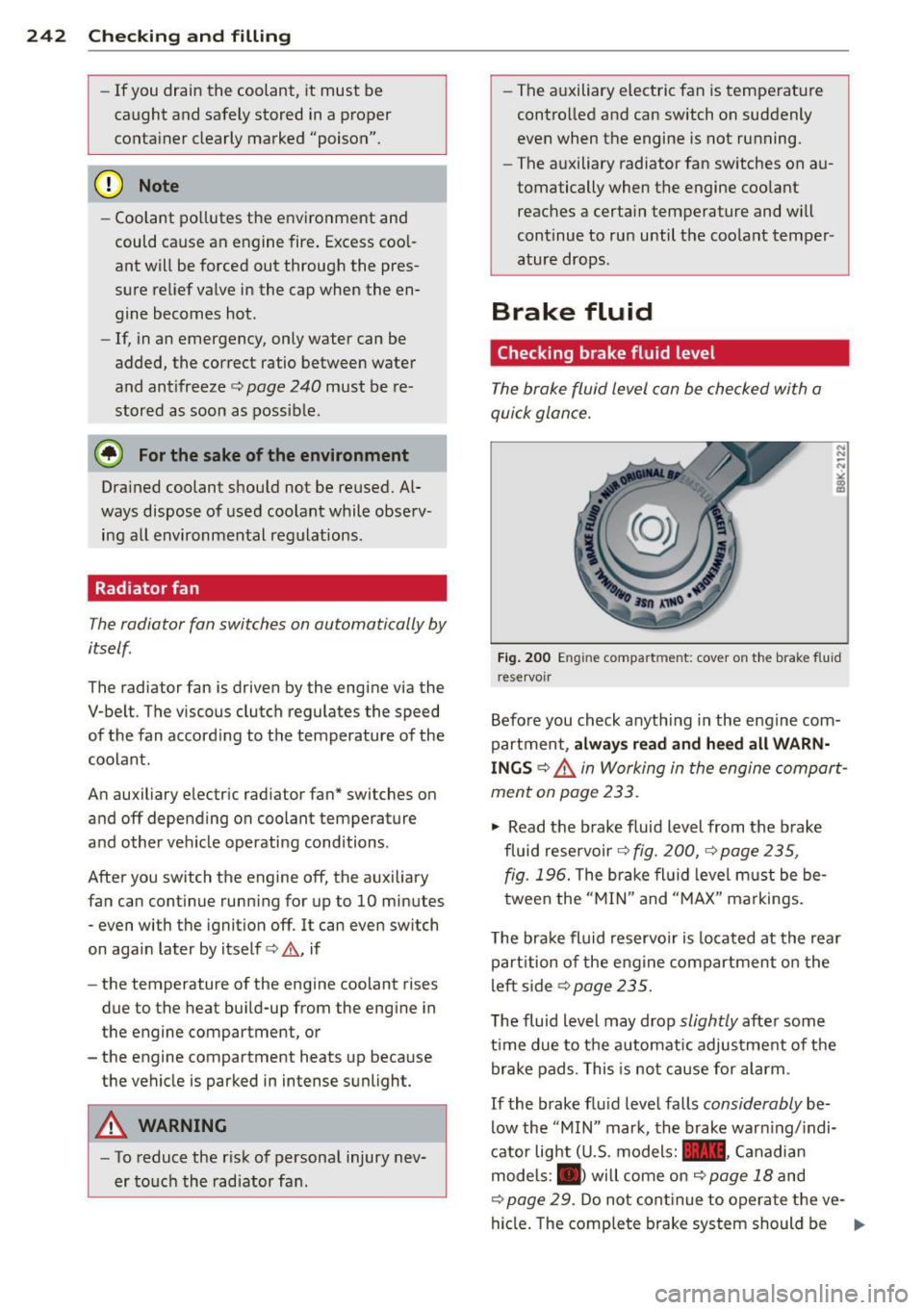
F ig. 2 00 Engine compart men t: cover on t he brake fluid
reservoir
Befo re you check anyth ing in the engine com
partment,
alway s read and he ed all WARN
INGS c::> ,&. in Working in the engine compart
ment on page 233.
.,. Read the brake fluid level from the b rake
fluid reservoir
c::> fig. 200, c::> page 235,
fig. 196.
The brake fl uid level m ust be be
tween the "MIN" and "MAX" markings.
T he bra ke fluid reservo ir is located at the rear
part ition o f the e ngine compartment on the
left s ide
c::> page 235.
The fluid level may drop slightly afte r some
t ime due to the a utomatic adjustment of the
brake pads. This is not cause for a larm .
If the brake fl uid level falls
considerably be
low the
"MIN" mar k, the brake war ning/ indi
cator light ( U.S. models:
1111 , Canadian
models :. will come on
c::> page 18 and
c::>page 29. Do not con tinue to operate the ve-
hicle . The comp lete brake system should be ..,.
Page 289 of 316
Front towing loop
Do not install the front towing loop until it is
needed.
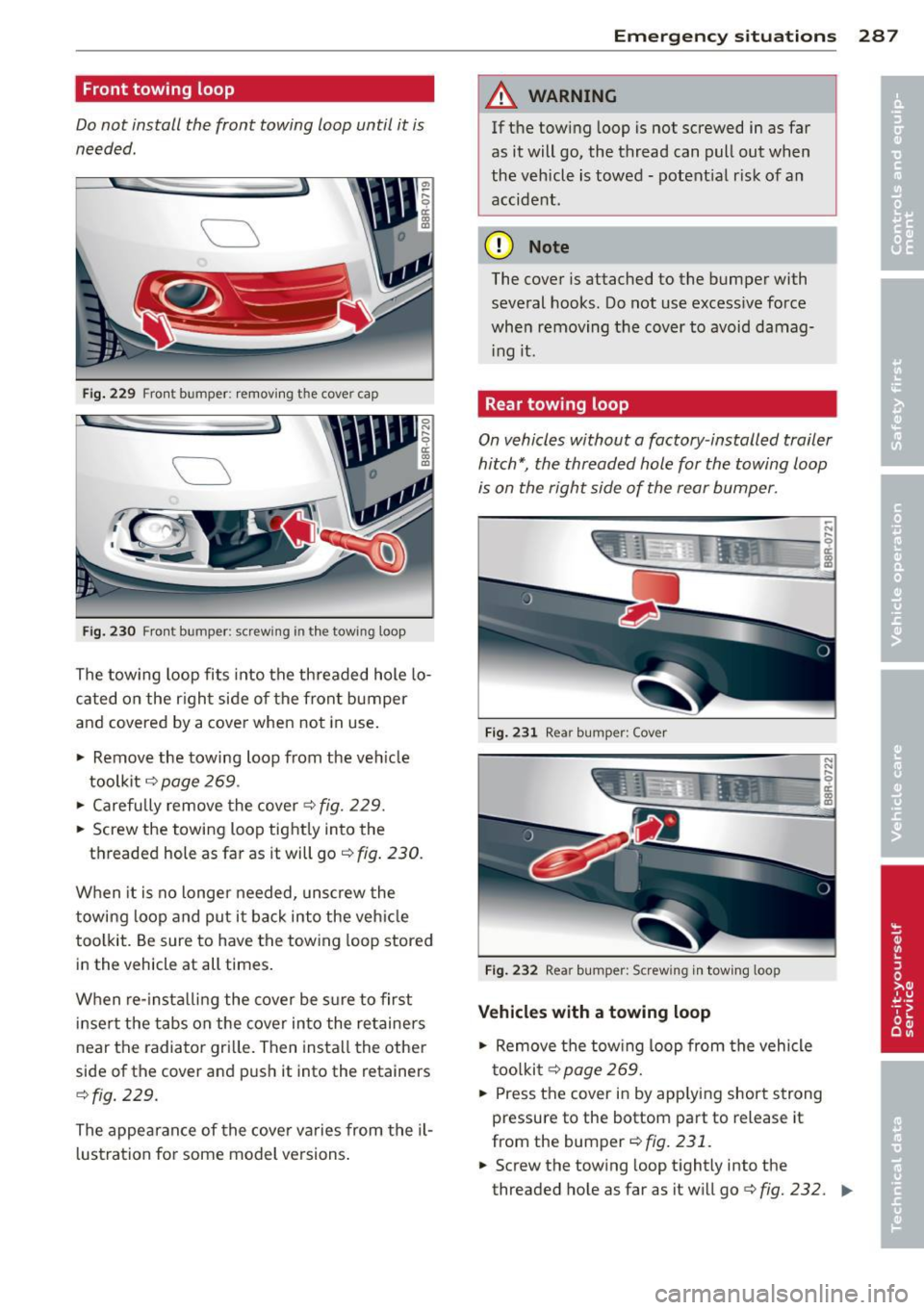
Fig. 229 Fro nt bumper : removing the cover cap
Fig. 230 Front bumper: screwing in the towing loop
The towing loop fits into the th readed hole lo
cated on the r igh t side of the fron t bumper
and covered by a cove r when not in use.
"' Remove the towing loop from the veh icle
toolkit
c:::> page 269.
"' Carefu lly remove the cover
c:::>fig. 229.
"' Screw the towing loop tightly into the
threaded hole as far as it will go
c:::> fig. 230.
When it is no longer needed, unscrew the
towing loop and put it back into the veh icle
too lkit. Be sure to have the towing loop stored
in the vehicle at all times.
When re- insta llin g the cover be s ure to first
i nse rt the tabs on the cover in to the retainers
near the radiator gri lle. Then install the other
side of the cover and p ush it into the retainers
c:::> fig . 229.
The appearance of the cove r va ries from the il
l ustration fo r some model versions .
Emergenc y situ ation s 287
A WARNING
If the tow ing loop is not screwed in as far
as it will go, the thread can pull out when
the vehicle is towed -potent ia l risk of an
accide nt.
(D Note
The cover is attached to the bumper with
several hooks. Do not use excess ive force
when removing t he cover to avoid damag
i ng it.
Rear towing loop
On vehicles without a factory-installed trailer
hitch*, the threaded hole for the towing loop
is on the right side of the rear bumper.
Fi g. 231 Rear b umper: Cover
N N .... -- o
!
Fig . 232 Rear bumper: Screwing in tow ing loop
V ehicles with a towing loop
"' Remove the tow ing loop from the vehicle
t oo lki t
c:::> page 269.
"' Press the cover in by app lying short strong
pressure to the bottom part to release it
from the bumper
c:!) fig. 231.
"' Screw the tow ing loop t ightly into the
threaded hole as far as it w ill go
¢ fig. 232. ..,.
Page 306 of 316

304 Index
Electronic immobilizer . . . . . . . . . . . . . . . . 38
Electronic power control
( E PC) warn ing/ indicato r light . .. .... .. 15
Electroni c Stab ili za tion Con trol (ESC) ... 197
ESC Offroad mode ......... ... .. .. . 198
H ill descent assist ......... .... .... 199
Warning/indicator lights ....... .. .... 15
E mergency braking . . . . . . . . . . . . . . . . . . . 90
E mergency flasher . . . . . . . . . . . . . . . . . . . 52
Warning/indicator lights ... .. .. .... . . 16
Emergency key .. .. .... ...... .. .. .. .. 36
Starting engine ........... ... .. .. .. 85
Emergency locking of the doo rs . . . . . . . . . 42
E mergency operation
L uggage compartment lid .. .. .. .. ... . 45
Emergency release
Selector lever . .... .... ..... .. .. .. . 128
Emergency star ting ........ .. .. .. .. . 284
Em ergency towing ............. .... . 286
Emergency unlocking
I gn ition key . . . . . . . . . . . . . . . . . . . . . . . 38
Energy management ....... .. .. .. .. . 203
En gin e
Compartment .. ........ .. .. .. .... . 235
Coolant .... ... .......... .. .. .... . 240
Hood .. .... ... .......... ........ . 233
Jump starting ............ .... .... . 105
Start-Stop-System . . . . . . . . . . . . . . . . . . 91
Starting . . . . . . . . . . . . . . . . . . . 83, 86, 98
Starting with jumper cables .. .. .. ... 284
Stopping . . . . . . . . . . . . . . . . . . . 85, 87, 98
E ngine compartment
Safety instructions ........ .. .. .. .. . 233
Working the engine compartment .... 233
Engine coolant system .......... .... . 240
Adding coolant . .......... .. .. .... . 241
Check ing coolant level ....... .. .... . 240
Malfunction . . . . . . . . . . . . . . . . . . . . . . . 30
Radiator fan ... .. ..... ... .... .. .. . 242
Engine coolant temperature Temperature gauge ........... .... . . 10
En gin e data ... ............ .. .. .. .. . 292
Eng ine hood
C losing .. .. ... .. ..... ..... .. .. .. . 233
H ow to release the hood ....... .. ... 233 E
ngine oi l .. .... .. ... .. ........ .. .. 235
Adding ... .... .. .. ... ........ .. .. 238
Additives .. .. .. .. .. ... ........ .. .. 238
Chang ing ..... .. ............. .... 239
Check oil level ... ............. .... 238
Consumption .. .. ................ . 238
Level .... ... .. .. .. ... .. ... ..... .. . 34
Oil consumpt ion .. .......... ...... . 237
Oil grades . .. .. . ............ .... .. 235
Pressure malfunction ....... .... .. .. . 30
Sensor defective . . . . . . . . . . . . . . . . . . . . 34
Specification and viscosity ....... .. .. 235
En gine speed limitation . . . . . . . . . . . . . . . 34
Environment Break-in per iod ... ............. .... 20S
Catalytic converter ................ . 206
Dispos ing of your ve hicle battery ..... 246
Driving at high speeds ............. . 207
Driving to minimize pollution and noise 207
Fuel .... .. .... .. ............. .... 231
Fu el economy .. . .. ............ .. .. 207
Leaks under your vehicle .......... .. 233
Letting the vehicle stand and warm up . 207
Proper disposal of drained brake fluid . 243
Proper disposal of drained engine cool-
ant .. .... .... .. ............. .... 241
Proper disposal of drained engine
o il . . . . . . . . . . . . . . . . . . . . . . . . . 238, 239
Recycling used engine oil ........... . 238
Roof rack . .. .. .. .. ........... .... . 72
Unl eaded fuel .. .. ............. .. .. 22 8
What shoul d I do with an old battery? . 246
EPC
refer to Electronic power control ..... . 15
ESC
refer to Electronic Stabili zation Control
(ESC) .... ... .. .. .. ... .. ... ..... .. . 15
ESC Offroad mode . . . . . . . . . . . . . . . . . . . 198
E thy l alcoho l (Fuel) ..... ... ... ... .. .. 229
Event Data Recorder (EDR) . . . . . . . . . . . . 197
E xhaus t tai l pipes
C leaning . ..... .. .. ... ........ .. .. 223
Expansion tank .. .. ..... ........... . 240
Explanation of some technical terms ... 209
Page 307 of 316
Exterior mirrors
Adj usting .. .... .. .... ... .. .. .. .... 57
Dimming ... .... ...... ... .. .. .. .. .. 58
Heating .. .. ............. .... .. .... 57
E yeg lasses compartment .... .. .. .. .. .. 7 7
F
Fall line
Fan 209
Radiator . ......... ... .... ... ... .. 242
F astening
Booste r seats ... .. .... ... .. .. .. .. . 186
Convertible child safety seats . .. .. .. . 185
Infant seats .... ......... .... .. .. . 184
Fl at t ire
C hanging . ... ... .. ... ... .. .. .. ... 274
Fl exibl e fuel . .. ... .. ... ... .. .. .. .. . 229
F loor mats . . . . . . . . . . . . . . . . . . . . . . . . . 144
F og lights . . . . . . . . . . . . . . . . . . . . . . . . . . 50
Foldi ng chocks ......... ...... .... .. 269
F olding the rear seat forward . . . . . . 67, 68
F oo t pedals .. ............. .. .. .. .. . 14 4
For the sake of the environment
Gasoline fumes and the environment . . 231
L ett ing t he engine wa rm up . . . . . . 83, 86
Reducing e ng ine noise by ea rly ups hift-
in g .... .. .. .. .. ........... .. .. .. .. 11
Refue ling .. ............. .... .. ... 23 1
Saving fue l by ea rly upshift ing . ... .. .. 11
Front airbags Descr ipt io n ... .............. ... ... 161
H ow t hey wo rk ........... .. .. .. .. . 166
Fronta l co llisions and t he laws of physics 150
Fr ont ash tray . . . . . . . . . . . . . . . . . . . . . . . . 7 5
F ro nt seats .. .. ........ ... .. .. .. .. .. 61
Ad justi ng .. .. .. ......... .. .. .. ... 1 41
C hil d restra ints in the fron t seat . .. .. . 158
Fue l
Addit ives . ......... ......... .... .. 228
Blended gasoline ... ...... .. .. .. .. . 228
Consu mpt io n ............ .. .. .. .. .. 23
Fill er ne ck .. .... ......... .. .. .. .. . 230
Fu el g auge . . . . . . . . . . . . . . . . . . . . . . . . 12
Gasoline ... .. ... .. ..... ... .. .. ... 228
Gasoline additives ..... ... .. .. .. .. . 230
Octane rating ..... .... ... .. .. .. .. . 228
Inde x 305
Recommendation ... . .. .. ..... ... .. 228
Ref uelling ... .. .... . ... ...... ... .. 231
Rese rve ... .. .. .. .. . .. ... .... ... .. . 12
Tank capac ity .. .. ................. 292
Unlocking the fuel fi ller flap by hand .. 232
Fuel economy messages (efficiency p ro -
gram) . ... .. .. .... ... .. .. ..... ... .. . 25
Fuel fi lle r flap
Unl ocking the fuel fi lle r flap by hand .. 232
Fuel supply too low . . . . . . . . . . . . . . . . . . 33
Fuse a rrangeme nt ... . .. .. ..... ... .. 280
G
Ga rage door opener ( HomeLink) ... .. .. 135
Gas d ischarge lamps .. ............... 283
Ga uges
Engine coolant temperature ..... .. .. . 10
Fuel gauge . . . . . . . . . . . . . . . . . . . . . . . . 12
Tachometer . . . . . . . . . . . . . . . . . . . . . . . 11
General i llustration
Instruments and controls .... ... .. .. .. 8
General rules and dr iv ing t ips ..... .. .. 209
B efo re driv ing offro ad .......... .. .. 209
D riv ing o ffroad . .. .... ............. 209
G lossary of tire and loading terminology 249
G love compartment . . . . . . . . . . . . . . . . . . 76
Cooling box . . . . . . . . . . . . . . . . . . . . . . . . 77
GPS cont rolled clock . . . . . . . . . . . . . . . . . . 12
Gradient angle .. .. .. ... ....... ..... 209
Gross Vehicle Weight Rating (GVWR) ... 290
G round clearance 209
H
Head lights
Adaptive light .. .. .. ... ....... ...... 51
F og lights . .. .. .. ................. . 50
Head light range con trol de fec tive .. .. . 34
L eft hand dr ive, r igh t h and dr ive .. .. .. . 51
Rear fog lights ...... .. .. ..... ... .. . 50
Trave l mode ....... . .. .. ..... ... .. . 51
Washer reservo ir . .... ........... .. 247
Washer system . . . . . . . . . . . . . . . . . . . . . 54
Hea d restraints .. .. .... ........... .. 142
Adjus ting ....... .. . .. .. ..... ... .. 142
Front seats . . . . . . . . . . . . . . . . . . . . . . . . 65
Rea r seats . . . . . . . . . . . . . . . . . . . . . . . . . 65
•
•
Page 310 of 316
308 Index
Opening Panoramic sliding sunroof .. .. ... ... .. 47
Operate your vehicle econom ically and
minim ize po llution .. ... .. .. .. .. .. .. . 207
Opt ional equ ipment
Marked with an asterisk . . . . . . . . . . . . . . . 6
Other equipm ent (efficiency program)
Outside mirrors 25
refer
to Exterior mirrors . .. .. .. .. .. . . 57
Outside temperature display ..... .. .... 21
Owner's manual How the Owner's Manua l is organized . . . 6
p
Paint
Touch-up ................. ... .... . 221
Paint No ... ........ ..... .. .. .. .. .. . 290
Pano ramic sliding sunroo f
Conven ience opening/closing . .. .... .. 47
Emergency closing ........... ... .... 48
Opening and clos ing ......... ... .... 47
P ar king ... ........ ......... .. .. .. .. 89
Au tom atic tran smi ssion ... .. .. .. .. . 125
Parking brake ............... .. .... .. 88
also ref er to Electromechanica l parking
brake .. .... ............... .. .... .. 88
Parking system
refer to Audi park ing system plus with
rearview camera .............. .... . 129
Parts replacement .......... .... .... 297
PASSENGER AIR BAG OFF light . . . . . . . . 168
Passive safety system ..... .. .. .. .. .. . 139
Pedals ...... ............ ..... .. .. . 144
Physical principles of a frontal collision . 150
Polishing .. .. ................ ... ... 220
Pollutant filter (climate control) .. ...... 79
Power locking system . . . . . . . . . . . . . . . . . 38
Emergency locking .......... .. .... .. 42
Locking and unlocking the vehicle from
ins id e ... .. ................ ..... .. 42
Rea r lid/trunk lid .. ......... .. .. .. .. 43
Selective unlock feature ... .. .. .... .. 39
Settings ... ... ... ... .... .. .. .. .. .. 39
Switch ... .. ................ ... ... . 42
Unlock ing and locking veh icle .... ..... 40 Power
locks
W indows open and closed ............ 47
Power meter (hybrid drive) ....... .... . 98
Power sea t adjustmen t ... ....... .... . 62
Power steering
refer to Electromechanical power assist 201
Power window regulators
Convenience opening/clos ing .... .... . 47
Malfunctions .. .. ... .. .... .... .. .. . 47
Switches . . . . . . . . . . . . . . . . . . . . . . . . . . 46
Pregnant women
Spec ial considerations when wearing a
safety belt . . . . . . . . . . . . . . . . . . . . . . . 154
Proper safe ty belt position .......... .. 153
Proper seating position
Front passenger .. ................. 141
Occupants ..... .. ............. .... 140
Rear passengers . . . . . . . . . . . . . . . . . . . 142
Protective tray . . . . . . . . . . . . . . . . . . . . . . . 70
Q
Question
What happens to unbelted occupants? 150
Why safety belts? ....... ...... .... 149
R
Radiator fan .. .. .. ... ... .... ....... 242
Rain sensor . . . . . . . . . . . . . . . . . . . . . . . . . 54
Defective ... .. .. ....... ...... .. .. . 33
Reading lights
Front ......... .. .................. 53
Rear . .... .. .. .. ...... ....... .... . 53
Rear fog lights .... ....... .... ...... . SO
Rear lid
Automatic operation . . . . . . . . . . . . . . . . 44
Opening and closing ... ... ... .. .. .. . 43
Rear light
Defective . . . . . . . . . . . . . . . . . . . . . . . . . 33
Rear seats
Adjusting seat . . . . . . . . . . . . . . . . . . . . . 64
Rearview camera Parking mode 1 ... .......... .... .. 132
Parking mode 2 .. ... ... .... ..... .. 132
Rear view mirror . .. .......... ...... .. 58
Rear window heating ................. 81
Recirculation mode (climate control) ... . 80