flat tire AUDI Q5 2013 Owners Manual
[x] Cancel search | Manufacturer: AUDI, Model Year: 2013, Model line: Q5, Model: AUDI Q5 2013Pages: 316, PDF Size: 78.89 MB
Page 5 of 316
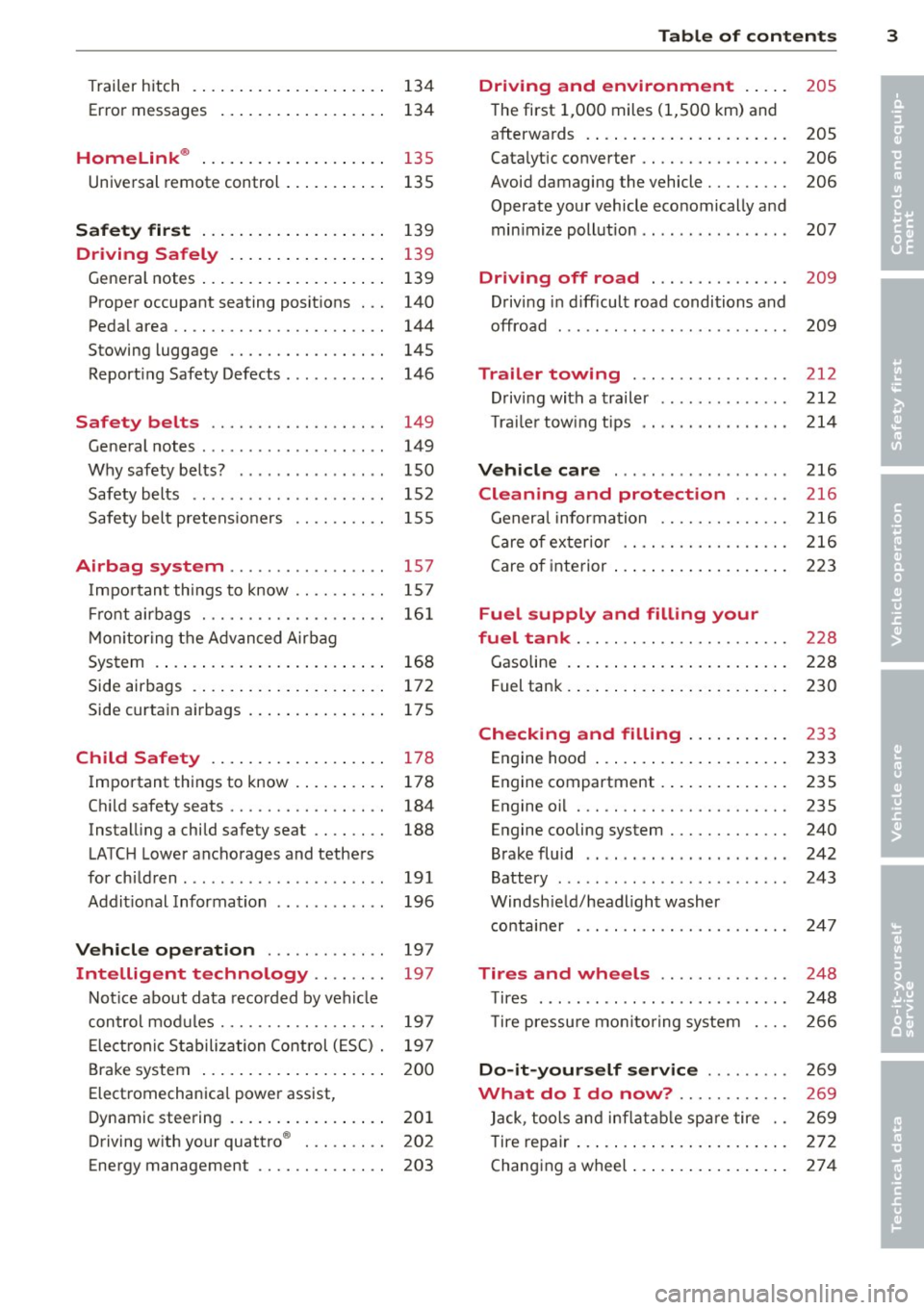
Trailer hitch . ..... .... ... .. .. .. . .
Error messages
Homelink ® ... .. .... ... .. .. .. . .
Universal remote control ... .. .. .. . . 134
134
135
135
S afet y fir st . . . . . . . . . . . . . . . . . . . . 139
Dri ving Safely . . . . . . . . . . . . . . . . . 139
Gene ral notes ..... .... ... .. .. .. . .
Proper occupant seating posit ions . . .
Pedal area .. .. ............. .. .. . .
Stowing luggage ................ .
Report ing Safety Defects .......... .
Safety belts .................. .
General notes ................... .
Why safety belts? ............... .
Safety belts ..... .. ... ... .. .. .. . .
Safety bel t pretens ioners ......... .
Airbag sy stem .......... ...... .
Important things to know ......... .
Fr ont airbags ............ .... .. . .
M on itoring the A dvanced Airbag
System .... .. ... .. ..... ... .. .. . .
Side airbags . ... ...... ... .. .. .. . .
Side curtain airbags .... ... .. .. .. . .
Child Safety .. .. .... ... .. .. .. . .
Important things to know . ... .. .. . .
Ch ild safety seats ................ .
Instal ling a child safety seat .. .. .. . .
LATC H Lower anchorages and tethers
for chi ldren .... .. .. ... ... .. .. .. . .
Addit ional Information 139
140
144
145
146
149 149
150
152
155
157
157
16 1
168
172
175
178
178
184
188
191
196
Vehicle operation . . . . . . . . . . . . . 197
Intelligent technology . . . . . . . . 197
Not ice about data recorded by vehi cle
con trol mod ules . . . . . . . . . . . . . . . . . . 197
E lect ronic S tabiliz ation Control ( ESC) . 19 7
Brake system . . . . . . . . . . . . . . . . . . . . 200
Elect romechanical power assist,
Dynamic stee ring . . . . . . . . . . . . . . . . . 201
Driving w ith your quattro ® . . . . . . . . . 202
Energy management . . . . . . . . . . . . . . 203
Table of contents 3
Driving and environment . . . . .
205
The first 1,000 miles (1,500 km) and
afterwa rds . . . . . . . . . . . . . . . . . . . . . . 205
Catalytic converter . . . . . . . . . . . . . . . . 206
Avoid damaging the vehicle . . . . . . . . . 206
Operate your vehicle economically and
min imize pollut ion . . . . . . . . . . . . . . . . 207
Driving off road . . . . . . . . . . . . . . . 209
Drivi ng in difficult road conditions and
offroad . . . . . . . . . . . . . . . . . . . . . . . . . 209
Trailer towing . . . . . . . . . . . . . . . . . 212
D riving with a trailer . . . . . . . . . . . . . . 212
T rai le rtow ingtips ... .. .. ..... .... 214
Vehicle care . . . . . . . . . . . . . . . . . . . 216
Cleaning and protection . . . . . . 216
General infor mation . . . . . . . . . . . . . . 216
Care of ex ter ior . . . . . . . . . . . . . . . . . . 216
Care of interior . . . . . . . . . . . . . . . . . . . 223
Fuel supply and filling your
fuel tank . . . . . . . . . . . . . . . . . . . . . . .
228
Gasoline . . . . . . . . . . . . . . . . . . . . . . . . 228
F uel tank. . . . . . . . . . . . . . . . . . . . . . . . 230
Checking and filling . . . . . . . . . . . 233
Engine hood . . . . . . . . . . . . . . . . . . . . . 233
Engine compartment . . . . . . . . . . . . . . 235
Engine oil . . . . . . . . . . . . . . . . . . . . . . . 235
Engine cooling system . . . . . . . . . . . . . 240
Brake fluid . . . . . . . . . . . . . . . . . . . . . . 242
Battery . . . . . . . . . . . . . . . . . . . . . . . . . 243
Windsh ield/headlight washer
containe r . . . . . . . . . . . . . . . . . . . . . . . 24 7
Tires and wheels . . . . . . . . . . . . . . 248
T ires . . . . . . . . . . . . . . . . . . . . . . . . . . . 248
T ire pressu re mo nitoring system 266
Do-it-your self service . . . . . . . . . 269
What do I do now? . . . . . . . . . . . . 269
Jack , tools and inflatab le sp are tire . . 269
T ire repa ir . . . . . . . . . . . . . . . . . . . . . . . 272
Changing a wheel ... . .. .. ..... ... . 274
•
•
Page 77 of 316
Ashtray
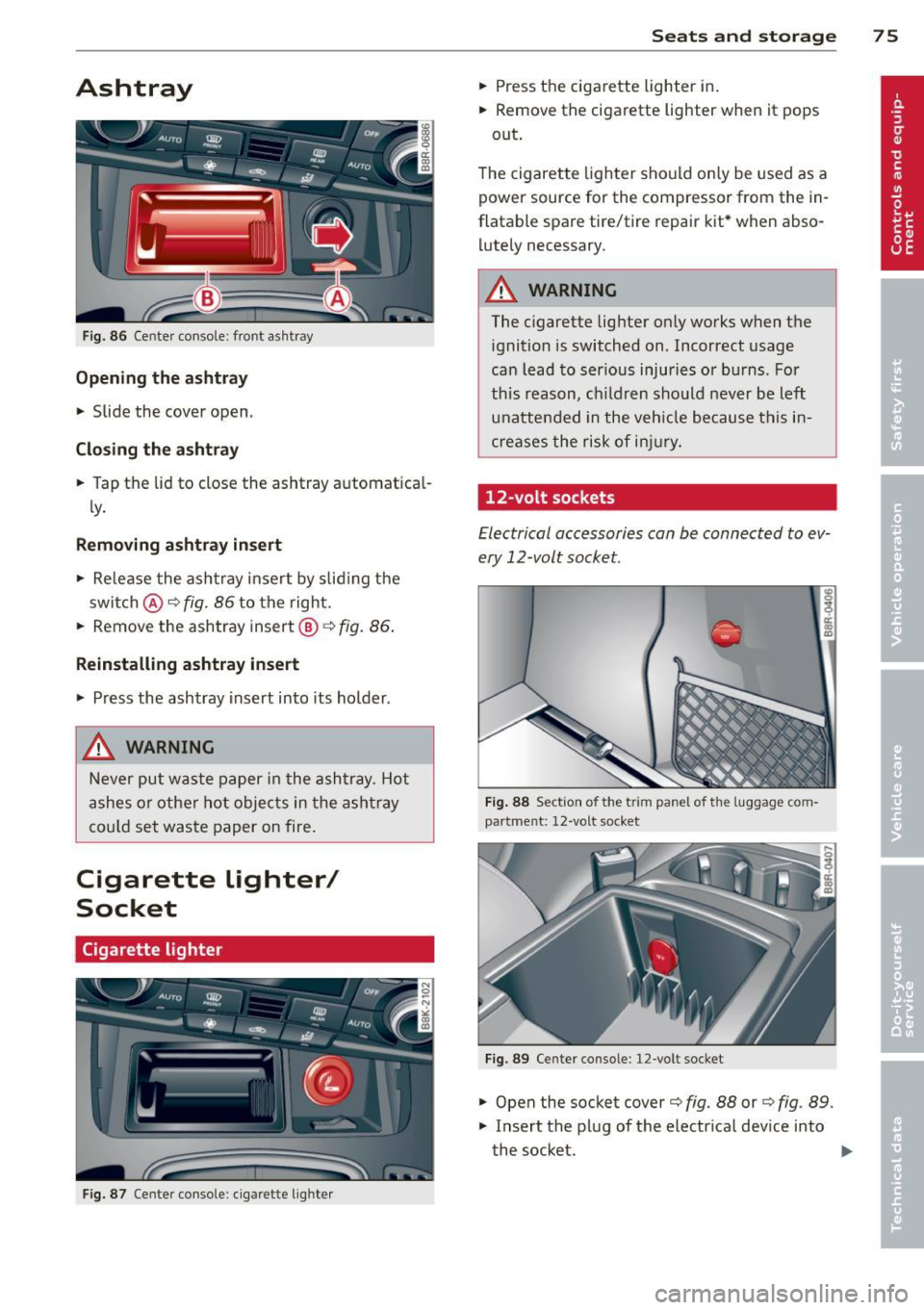
Fig. 86 Center console: front ashtray
Opening the ashtray
.,. Slide the cover open .
Closing the ashtray
.,. Tap the lid to close the ashtray automatical
ly.
Removing ashtray insert
.,. Re lease the ashtray insert by sliding the
switch @c:>
fig. 86 to the right .
.,. Remove the ashtray insert@
c:> fig. 86 .
Reinstalling ashtray insert
.,. Press the ashtray insert into its holder .
_& WARNING
Never put waste paper in the ashtray . Hot
ashes or othe r hot objects in the ashtray
cou ld set waste paper on fire.
Cigarette Lighter/
Socket
Cigarette lighter
Fig. 87 Ce nter console: c igarette lighter
Seats and storage 75
.,. Press the cigarette lighter in .
.,. Remove the cigarette lighter when it pops
out .
The cigarette lighter should only be used as a
power source for the compressor from the in
flatable spare tire/tire repair kit* when abso
lutely necessary.
_& WARNING
The cigarette lighter only works when the ignition is switched on. Incorrect usage
can lead to ser ious injuries or burns. For
this reason, ch ildren should never be left
unattended in the vehicle because this in
creases the risk of injury.
12-volt sockets
Electrical accessories can be connected to ev
ery 12-volt socket.
Fig. 88 Section of the t rim pane l of the luggage com
partme nt: 12-volt socket
Fig. 89 Center console: 12-volt socket
I er a, m
.,. Open the socket cover c:> fig. 88 or c:> fig . 89 .
.,. Insert the plug of the electrical device into
the socket. .,.
Page 148 of 316
146 Driving Safel y
to reduce the risk of inj ury when the vehi
cle is not be ing used.
- After closing the rear lid, always make
sure that it is properly closed and locked.
- Never leave your vehicle unattended es
pecially with the rear lid left open . A
child could crawl into the vehicle through
the luggage compartment and close the
rear lid becoming trapped and unable to
get out . Be ing trapped in a vehicle can
lead to serious persona l injury.
- Never let children p lay in or around the
vehicle .
- Never let passengers r ide in the luggage
compartment . Veh icle occupan ts must
always be proper ly restrained in one of
the vehicle's seating positions.
(D Tips
- Air circulation helps to reduce window
fogging . Sta le air escapes to the o utside
th rough vents in the trim pane l. Be su re
to keep these slots free and open.
- The tire pressure must correspond to the
load . The t ire pr essure is shown on the
tire p ressu re label. The tire pressure la
bel is loc ate d on the driver's s ide B-pi lla r.
The tire pressure label lists the recom
men ded cold t ire inflat ion pressu res for
the veh icle at its maximum capacity
weight and the tires that were on your
vehicle at the time it was manufact ured.
For recommended t ire pressures for nor
mal load conditions, please see chapter
Q page252.
Tie-downs
The luggage compartment is equipped with
four tie-downs to secure luggage and other
items .
Use the tie-downs to secure your cargo prop
erly ¢ page 145, Loading the luggage com
partment .
In a coll is ion, the laws of phys ics mean that
even smaller items that are loose in the vehi
cle will become heavy missiles that can cause se
rious injury. Items in t he vehi cle possess en
ergy which vary with vehicle speed and the
weight of t he item . Vehicle speed is the most
s ignificant factor.
F or example, in a frontal collision at a speed
of 30 mph (48 km/h), the forces acting on a 10 -lb (5 kg) object a re abo ut 20 times the
normal weight of the item. This means that
the weight of the item would sudden ly be
about 200 lbs . (90 kg) . You can imag ine the
injur ies that a 200 lbs . (90 kg) item fly ing
fr ee ly t hro ugh the passenger compa rtment
cou ld cause in a col lision like this.
_& WARNING
We ak, damaged or imprope r straps used
to secure items to tie-downs can fail dur
i ng hard braking or in a collision and cause
se rious pe rsonal injury.
-Always use s uita ble mo unt ing straps an d
p roperly secu re items to the tie-downs in
the l uggage compa rtment to he lp pre
vent items from shift ing or fly ing fo r
ward as dangerous missiles.
- When the rea r seat backrest is folded
down, a lways use suitable mounting
straps and properly secure items to the
tie-downs in the luggage compartment
to hel p prevent items from fly ing for
ward as dangerous missiles into the pas
senger compartment.
- Never attach a chi ld safety seat t ether
s trap to a t ie-down .
Reporting Safety
Defects
Applicable to U.S.A.
If yo u b eli eve that your vehi cle
has a def ect whi ch could cau se
a crash or could cau se injury or
death, you should immediately
inform the National Highway
Traffic Safet y Administration ""
Page 174 of 316
172 Airbag system
dealer is familiar with these requirements
and we recommend that you have your
dealer perform this service for you.
Other things that can affect Advanced
Airbag performance
Changing the vehicle's suspension system can
change the way that the Advanced Airbag Sys
tem performs in a crash. For example, using
tire-rim combinations not approved by Audi, lowering the vehicle, changing the stiffness of
the suspension, including the springs, suspen
sion struts, shock absorbers etc. can change
the forces that are measured by the airbag
sensors and sent to the electronic control
unit. Some suspension changes can, for exam ple, increase the force levels measured by the
sensors and make the airbag system deploy in
crashes in which it would not deploy if the
changes had not been made . Other kinds of
changes may reduce the force levels meas
ured by the sensors and prevent the airbag
from deploying when it should.
The sensors in the safety belt buckle for the
driver and front passenger seat tell the elec
tronic control module if the safety belt is
latched or not.
If the safety belt is being used,
the front airbag will deploy at a slightly high
er rate of vehicle deceleration than if the safe
ty belt is not being used. Therefore, in a par
ticular collision, it is possible that an airbag
will not deploy at a seating position where the
safety belt is being used but will inflate at the
position where the safety belt is not being
used. It is important that nothing interfere
with the safety belt buckles so that the sen
sors can send the correct information about
safety belt use to the electronic control unit.
A WARNING
Changing the vehicle's suspension includ
ing use of unapproved tire-rim combina
tions can change Advanced Airbag per
formance and increase the risk of serious
personal injury in a crash.
- Never install suspension components
that do not have the same performance characteristics as the components origi
nally installed on your vehicle.
- Never use tire-rim combinations that
have not been approved by Audi.
A WARNING
= -
Items stored between the safety belt
buckle and the center console can cause
the sensors in the buckle to send the
wrong information to the electronic con
trol module and prevent the Advanced Air
bag System from working properly.
- Always make sure that nothing can inter
fere with the safety belt buckles and that
they are not obstructed.
Side airbags
Description of side airbags
The airbag system can provide supplemental
protection to properly restrained occupants.
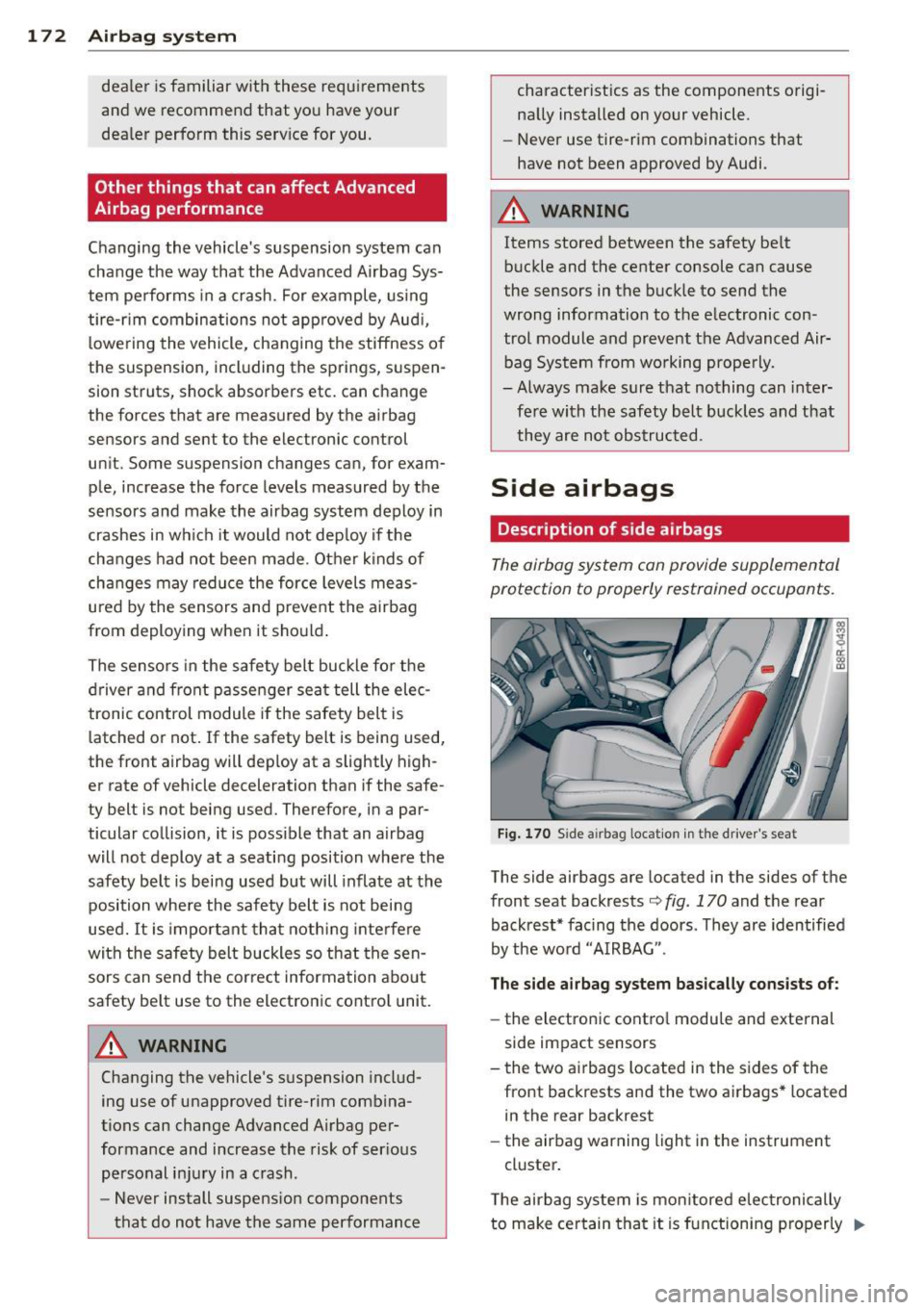
Fig. 170 S ide a irbag location in the driver's seat
The side airbags are located in the sides of the
front seat backrests¢
fig. 170 and the rear
backrest* facing the doors. They are identified
by the word "AIRBAG".
The side airbag system basically consists of:
-the electronic control module and external
side impact sensors
- the two airbags located in the sides of the
front backrests and the two airbags* located
in the rear backrest
- the airbag warning light in the instrument
cluster.
The airbag system is monitored electronically
to make certain that it is functioning properly ..,.
Page 215 of 316
Operating instructions
6"
~ ~
I 1,2 ..
-{ }
l::_
-
2
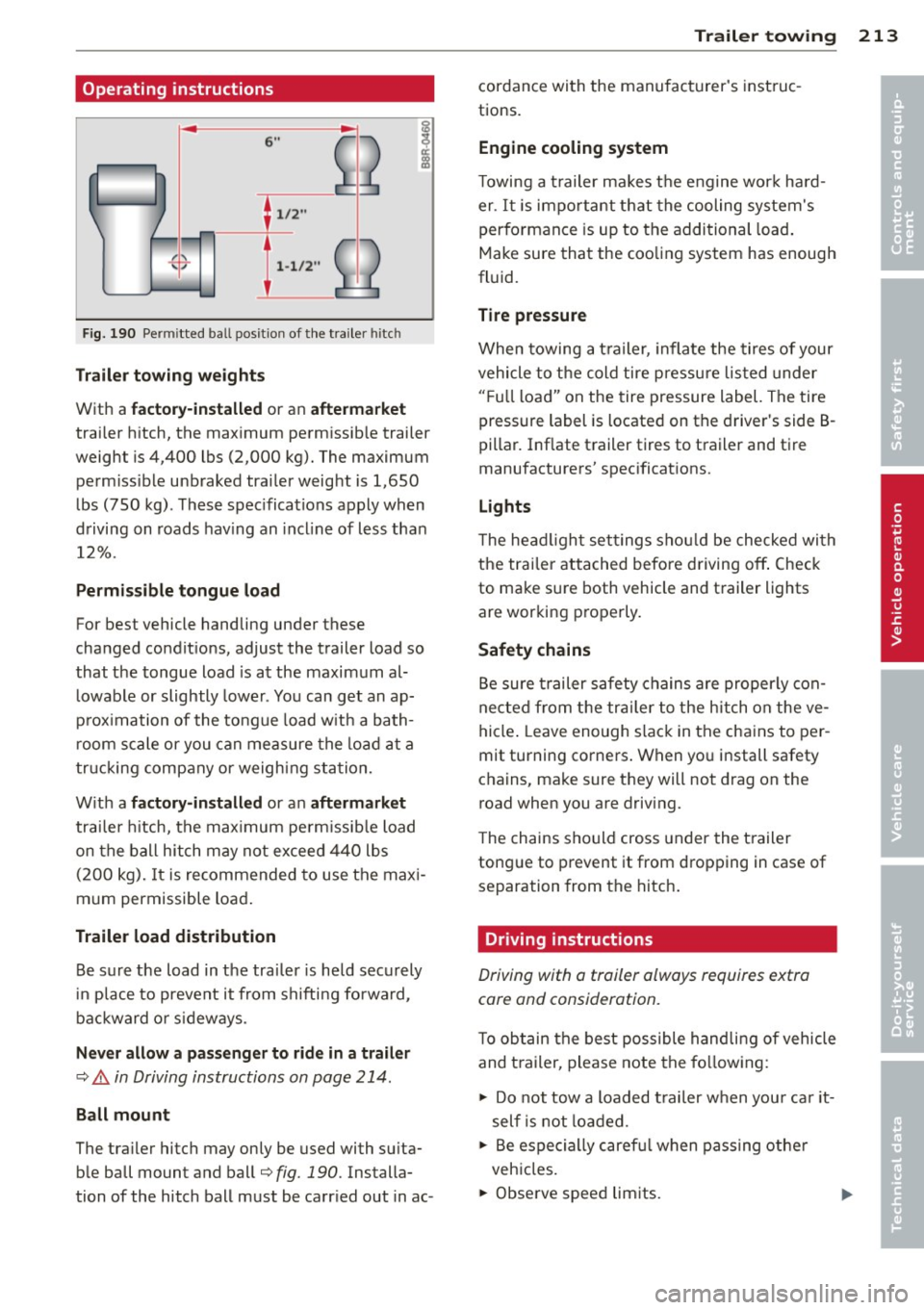
Fig. 190 Permit ted ball position of the trailer hitch
Trailer towing weights
With a factory-installed or an aftermarket
trailer hitch, the maximum permissible trailer
weight is 4,400 lbs (2,000 kg). The maximum permissible unbraked trailer weight is 1,650
lbs (750 kg) . These specifications apply when
driving on roads having an incline of less than
12%.
Permissible tongue load
For best vehicle handling under these
changed conditions, adjust the trailer load so
that the tongue load is at the maximum al
lowable or slightly lower . You can get an ap
proximation of the tongue load with a bath
room scale or you can measure the load at a
trucking company or weighing station.
With a
factory-installed or an aftermarket
trailer hitch, the maximum permissible load
on the ball hitch may not exceed 440 lbs
(200 kg).
It is recommended to use the maxi
mum permissible load.
Trailer load distribution
Be sure the load in the trailer is held securely
in place to prevent it from shifting forward,
backward or sideways.
Never allow a passenger to ride in a trailer
¢.&. in Driving instructions on page 214.
Ball mount
The trailer hitch may only be used with suita
ble ball mount and ball¢
fig. 190. Installa
tion of the hitch ball must be carried out in ac-
Trailer towing 213
cordance with the manufacturer's instruc
tions.
Engine cooling system
Towing a trailer makes the engine work hard
er .
It is important that the cooling system's
performance is up to the additional load.
Make sure that the cooling system has enough
fluid.
Tire pressure
When towing a trailer, inflate the tires of your
vehicle to the cold tire pressure listed under
"Full load" on the tire pressure label. The tire
pressure label is located on the driver's side B
pillar. Inflate trailer tires to trailer and tire
manufacturers' specifications.
Lights
The headlight settings should be checked with
the trailer attached before driving off. Check
to make sure both vehicle and trailer lights
are working properly.
Safety chains
Be sure trailer safety chains are properly con
nected from the trailer to the hitch on the ve
hicle. Leave enough slack in the chains to per
mit turning corners. When you install safety
chains, make sure they will not drag on the
road when you are driving.
The chains should cross under the trailer
tongue to prevent it from dropping in case of
separation from the hitch.
Driving instructions
Driving with a trailer always requires extra
care and consideration.
To obtain the best possible handling of vehicle
and trailer, please note the following :
.,. Do not tow a loaded trailer when your car it
self is not loaded .
.,. Be especially careful when passing other
vehicles.
.,. Observe speed limits.
•
•
Page 250 of 316
248 Tire s and whee ls
Tires and wheels
Tires
General notes
Tires may be the least appreciated and most
abused parts of a motor vehicle .
Tires may be the least appreciated and most
abused parts of a motor vehicle. Tires are,
however, one of the most important parts of a
vehicle, particularly considering the compara
tive ly small patch of rubber on each tire that
assures that all -important contact between
you, your vehicle and the road.
Maintaining the correct tire pressure, making
sure that your vehicle and its tires do not have
to carry more weight than they can safe ly han
d le, avoiding damage from road hazards and
reg ularly inspecting t ires for damage includ
ing cuts, slashes irregu la r wear and overall
condition are the most important things that
you can do to he lp avoid sudden tire failure in
cluding tread separation and blowouts.
A vo idin g dama ge
I f you have to drive over a curb or similar ob
stacle, drive very slow ly and as close as possi
ble at a right angle to the curb.
A lways keep chem icals including grease, oil,
gasoline and b rake fluid off the tires.
Inspect the tires regularly for damage (cuts,
cracks or bl isters, etc.). Remove any foreign
bod ies embedded in the treads.
St orin g tire s
Mark tires when you remove them to indicate
the direction of rotation . Th is ensures you to
be ab le to mount them correctly when you re
install them.
When removed, the wheels or tires should be
stored in a cool, dry and preferably dark place .
Store tires in a vertical position if they are not mounted on rims, in a horizontal position if
they are mounted on rims. N
ew tir es
New t ires have to be broken in¢&,. .
The tread depth of new t ires may vary, accord
ing to the type and make of t ire and the tread
pattern .
Hidden damag e
Damage to tires and r ims is often not readily
vis ible . If you notice unusual vibrat ion or the
vehicle pulls to one s ide, th is may ind icate
that one of the t ires has been damaged . T he
t ir es must be checked immed iate ly by an au
tho rized Aud i dea le r or q ualified wor kshop.
Unidirecti onal t ires
A un idirectional tire can be identified by ar
rows on the sidewall, that po int in the direc
t ion the t ire is designed to rotate. You must
fol low the specified direction of rotation . This
is necessary so that these tires can develop
their optimum characteristics regarding grip, road noise, wear and hydrop laning resistance.
For more information ¢
page 2 78.
A WARNING
-New tires or tires that are old, worn or
damaged cannot provide maximum con
trol and braking ability .
-
-New tires tend to be slippery and must
also be broken-in. To reduce the risk of losing control, a collision and serious
pe rsonal injuries, drive w ith specia l care
for the first 350 miles (560 km).
- Driving with worn or damaged tires can lead to loss of control, sudden tire fail
ure, including a blowou t and sudden de
flation, c rashes and serious personal in
juries . Have worn or damaged tires re
p laced immediate ly.
- Tires age even if they are not being used
and can fai l sudden ly, especially at high
speeds. Tires that are more than 6 years
old can only be used in an emergency
and then w ith special care and at low
speed.
Page 251 of 316
-Never mount used tires on yo ur vehicle if
yo u are not sure of their "previous histo
ry." Old used tires may have been dam
aged even though the damage cannot be
seen that can lead to sudden tire failure
and loss of vehicle control.
- If you notice unusual vibration or if the
vehicle pulls to one side when d riving, al
ways stop as soon as it is safe to do so
and check the wheels and tires for dam
age .
(D Note
Please note that summe r and wi nte r tires
are designed for the cond itions that are
Glossary of tire and loading terminology
Accessory weight means the comb ined weight (in excess of
those sta ndard items which may be rep laced)
of au toma tic transmission, power steer ing ,
power brakes, power windows, power seats,
radio, and heater, to the extent that these
items are availab le as factory-installed equip
ment (whether installed or not) .
Aspect ratio
means the rat io o f the height to the w idth of
the tire in percent . Numbers of 55 or lower in
dicate a low sidewall for improved steering re
sponse and better overa ll handling on dry
pavement .
Bead
means the part of the t ire t hat is made o f
steel wires, wrapped or reinforced by ply cords
and that is shaped to fit the r im.
Bead separation
means a b reakdown of the bond between
components in the bead .
Cord means the strands forming the plies in the
tire.
Tire s an d wheel s 249
typica l in those seasons . Aud i recommends
using winter tires during the winter
months . Low temperatures signif icant ly
dec rease the e lasticity of summer t ires,
which affects tract ion and brak ing ability.
If summer t ires are used i n very co ld tem
peratures, cracks ca n form o n the tread
bars , res ulting in perma nen t tire damage
that can cause loud driving noise and un
bala nced ti re s. Audi i s not respon sible for
th is type of damage .
Cold tire inflation pressure
means the t ire p ress ure recommended by t he
vehicle manufacture r fo r a tire o f a des ignated
s ize t hat has not bee n driven for more than a
coup le o f miles (k ilometers) at low speeds in
the three hour period before the tire press ure
is m easured or adjusted.
Curb weight
me ans the we ight of a motor ve hicle with
st andard equipmen t incl ud ing the max imum
capacity of fuel, oi l, and coolant, air condi
tioning and additional weig ht of optiona l
equipment.
Extra load tire
means a t ire design to oper ate a t higher load s
and at higher inflation pressures than the cor
responding standa rd tire . Extra load tires may
be identified as "XL", "x l", "EXTRA LOAD", o r
"RF" on the sidewal l.
Gross Axle Weight Rating ("GAWR")
me ans the load-ca rry ing capac ity of a single
axle system , measured at the tire -ground in
te rfaces.
Gross Vehicle Weight Rating ( "GVWR ")
mea ns the maximum total loaded we ight of
the ve hicl e. .,..
•
•
Page 252 of 316

250 Tires and wheels
Groove
means the space between two adjacent tread
ribs .
Load rating (code)
means the maximum load that a tire is rated
to carry for a given inflation pressure. You
may not find this informat ion on all tires be
cause it is not req uired by law.
Maximum load rating
means the load rating for a t ire at the max i
mum permissible inflation pressure for that
tire.
Maximum loaded vehicle weight
means the sum of:
(a) Curb weight
(b) Accessory weight
(c) Vehicle capacity we ight, and
(d) Production options weight
Maximum (permissible) inflation pressure
means the maximum cold inflation pressure
to which a tire may be inflated. Also called
"maximum inflation pressure ."
Normal occupant weight
means 150 lbs. (68 kilograms) times the
number of occupants seated in the vehicle up
to the total seating capacity of your vehicle .
Occupant distribution
means distribution of occupants in a vehicle.
Outer diameter
means the overa ll diameter of an inflated new
tire.
Overall width
means the linear distance between the exteri
ors of the sidewalls of an inflated tire, includ
ing elevations due to labeling, decorations, or
protective bands o r ribs .
Ply
means a layer of rubber-coated parallel cords.
Production options weight
means the combined weight of those insta lled
regular production options weighing over 5
lbs. (2.3 kg) in excess of those standard items
which they replace, not previously considered
in curb weight or accessory we ight, including
heavy duty brakes, ride levelers, roof rack,
heavy duty battery, and special tr im .
Radial ply tire
means a pneumat ic tire in which the ply cords
that extend to the beads are laid at substan
t ia lly 90 degrees to the center line of the
tread .
Recommended inflation pressure
see<=> page 249, Cold tire inflation pressure.
Reinforced tire
means a t ire design to operate at higher loads
and at h igher inflation pressures than the cor
responding standa rd tire. Reinforced tires
may be identified as "XL" "xl" "EXTRA LOAD"
' ' '
or "RF" on the sidewa ll.
Rim
means a metal support for a tire or a tire and
tube assembly upon which the tire beads are
seated.
Rim diameter
means nom inal diameter of the bead seat. If
you change your wheel s ize, you will have to
purchase new tires to match the new rim di
ameter.
Rim size designation
means r im diameter and width .
Rim width
means nominal distance between rim flanges.
Sidewall
means that portion of a tire between the
t read and bead.
Page 253 of 316
Speed rating (letter code)
means the speed at wh ich a tire is des igned to
be driven for extended periods of t ime . The
ratings range from 93 mph (150 km/h) to
186 mph (298 km/h) ¢
page 260 . You may
not find this information on all tires because
it is not required by law.
The speed rating letter code, where applica ble, is molded on the tire sidewall and indi
cates the maximum permissible road speeds
¢ &. in Winter tires on page 264.
Tire pressure monitoring system*
means a system that detects when one or
more of a vehicle's tires are underinflated and
illuminates a low tire pressure warn ing te ll
tale .
Tread
means that port ion of a tire that comes into
contact with the road.
Tread separation
means pulling away of the tread from the tire
carcass .
Treadwear indicators (TWI)
means the projections within the pr incipal
grooves designed to give a visual ind ication of
the degrees of wear of the tread. See
¢
page 258, Tread Wear Indicator (TWI) for
mo re inf ormat ion on measuring tire wear.
Uniform Tire Quality Grading
is a tire information system developed by the
United States National Highway Traffic Safety
Admin istration (N HTSA) that is designed to
help buyers make relative comparisons among
tires . Th e U TQG is not a safety rating and not a
g ua ran tee that a tir e will last for a prescribed
number of mi les (kilometers) or perform in a
certain way. It simply gives tire buyers addi
tional information to combine with other con-
Tires and wheels 251
siderations, such as price, brand loyalty and
dealer recommendations. Under UTQG, tires
are graded by the t ire manufacturers in three
areas : treadwear, traction, and temperature
resistance. The UTQG informat ion on the tires,
molded into the sidewalls .
U.S. DOT Tire Identification Number (TIN)
This is the tire's "serial number". It begins
with the letters "DOT" and indicates that the
tire meets all federa l standards. The next two
numbers or letters indicate the plant where it
was manufactured, and the last four numbers
represent the week and year of manufacture.
For example,
DOT ... 2212 ...
means that the tire was produced in the 22nd
week of 2012. The other numbers are market
ing codes that may or may not be used by the
tire manufacturer. This information is used to
contact consumers if a tire defect requires a
recall.
Vehicle capacity weight
means the rated cargo and luggage load plus
150 lbs. (68 k ilograms) times the vehicle's to
tal seating capacity as listed on the label lo
cated on the driver's side B -pillar .
Vehicle maximum load on the tire
means that load on an individual tire that is
determined by distributing to each axle its
share of the maximum loaded vehicle weight
and dividing by two.
Vehicle normal load on the tire
means that load on an individual tire that is
determined by distributing to each ax le its
share of the curb weight, accessory weight,
and normal occupant weight (distr ibuted in
accordance with table below¢
page 252)
and dividing by two.
•
•
Page 254 of 316
252 Tires and wheels
Occupant loading and distribution for vehicle normal load for various designated seating
capacities
Designated seating capacity,
number of occupants Vehicle normal load
, number Occupant distribution in a nor-
of occupants _____ mally loaded vehicle
5 3 2 in fro nt, 1 in back seat
Cold tire inflation pressure
Tire pressure affec ts the overall handling , performance and safe ty of a vehicle.
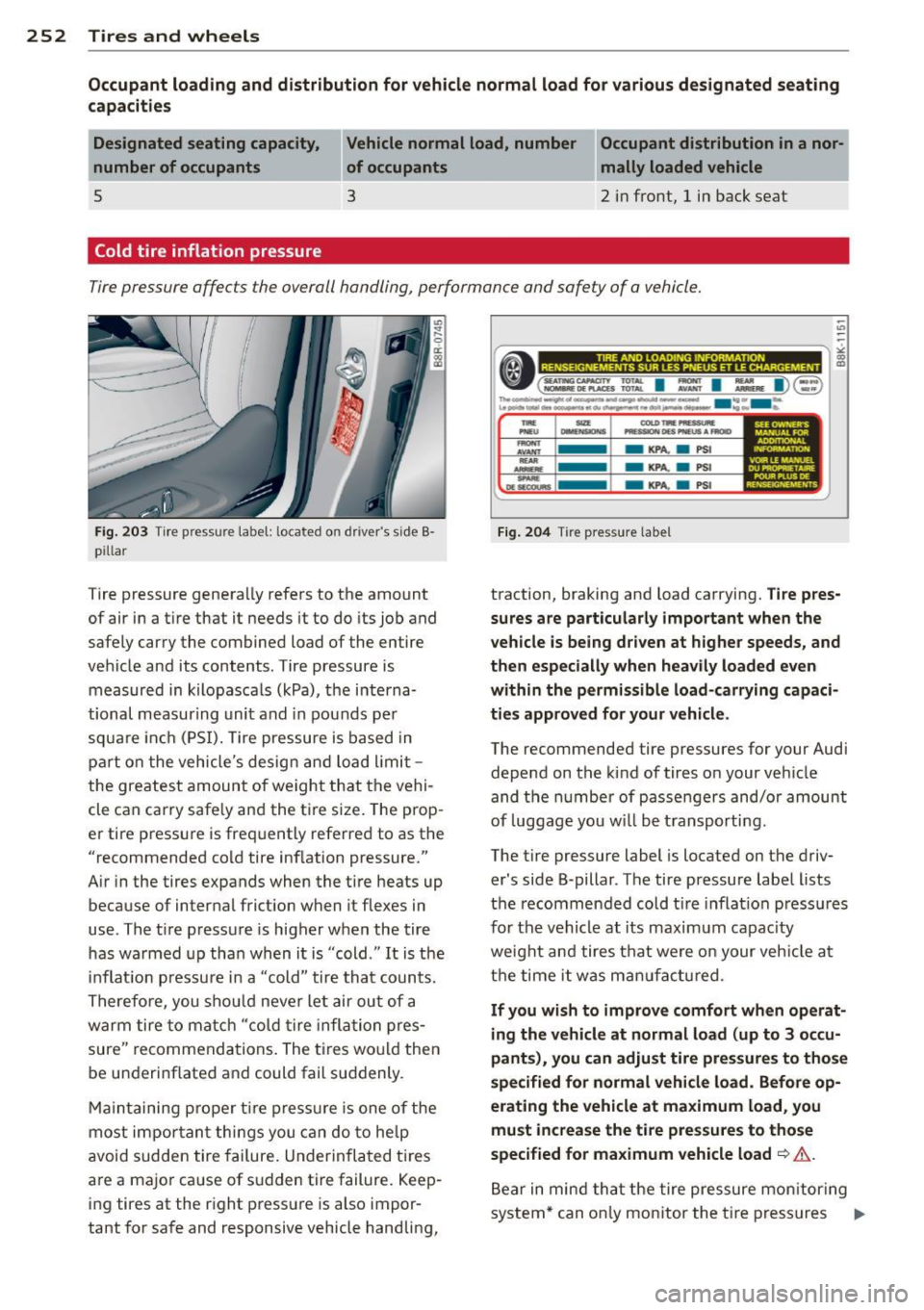
Fi g. 2 03 Tire p ress ure la b el: loca ted on driver's side B ·
p ill ar
Tire pressure genera lly refers to the amount
of air in a t ire that it needs it to do its job and
safely carry the combined load of the entire
vehicle and its contents . Tire pressure is
measured in kilopasca ls (kPa), the i nterna·
tional measur ing unit and in pou nds pe r
squa re inc h (PSI). Tire pressure is based in
par t on the vehicle's desig n and load limit -
the greatest amoun t of weight that the vehi·
cle can carry safe ly and the t ire size . The prop·
er tire pressure is freq uently referred to as the
" recommended cold tire inf lation pressure."
A ir in the tires expands when the tire heats up
because of internal frict ion when it flexes in
use . The t ire p ressu re is higher when the tire
h as wa rmed up tha n when it is "cold ." It is the
in flat io n pressu re i n a "cold" tire that counts.
Th erefore, you shou ld neve r let air ou t of a
warm tire to match " co ld tire inflat ion pres
sure" recommendations . The t ires wo uld then
be underinflated and could fail su ddenly .
M ain taining p roper t ire pr essu re is one of the
most im po rt an t th ings you ca n d o to he lp
avoid sudden tire failure. Underin fla ted t ires
a re a ma jo r cause of s udden tire failure. Keep·
i n g tires at the right pressure is also impor
tant for safe and responsive vehicle handling,
-U'>
-
---------------------- ,;
•(=~= I: I::... 1)§ :l!: n-...,....,....,~ ...... ~-...,..., ..... _ ... U ........ ~-·~N.-..-.we..... .... lllt-
-AVANT ...,.
-...... .. _
-KPA. a PSI
- KPA.
a PSI
-KPA. a PSI
Fig. 20 4 Tire pr essure labe l
SEE OWNEJICS MANUA1 FOA A,DOITl<>N.IU. INfORMATlON VOIR L£ MANUll DUPR0ftlET""" P"OUR i-t.US DE RENSEIGMEMENfS
traction, braking and load carrying. Tire pres
sures are particularly important when the
vehicle is being driven at higher speeds, and
then especially when heavily loaded even
within the permissible load-carrying capaci
ties approved for your vehicle .
The recommended tire pressures f or y our Audi
depe nd on the kind of tires o n your ve hicle
and the numbe r of passe ngers and/o r amount
of luggage you w ill be t ransporti ng .
The tire pressure label is located on the driv
er 's side B-pillar . The tire pressure labe l lists
the recommended cold t ire inflat io n press ures
for the vehicle at its maximum capac ity
weig ht an d tires t hat were o n your veh icle at
t h e time it was m anufactur ed .
If you wish to improve comfort wh en operat
ing the vehicle at normal load (up to 3 occu
pant s), you can ad just tire pre ssure s to tho se
specified for normal vehicle load . Before op
erating the vehicle at maximum load, you
mu st increase the ti re pressures to those
specified for maximum vehicle load
¢ .&. .
Bear in min d that the tire pressure mon itor ing
system * can o nly mo nitor the tir e press ures .,.