towing AUDI Q5 2013 User Guide
[x] Cancel search | Manufacturer: AUDI, Model Year: 2013, Model line: Q5, Model: AUDI Q5 2013Pages: 316, PDF Size: 78.89 MB
Page 215 of 316
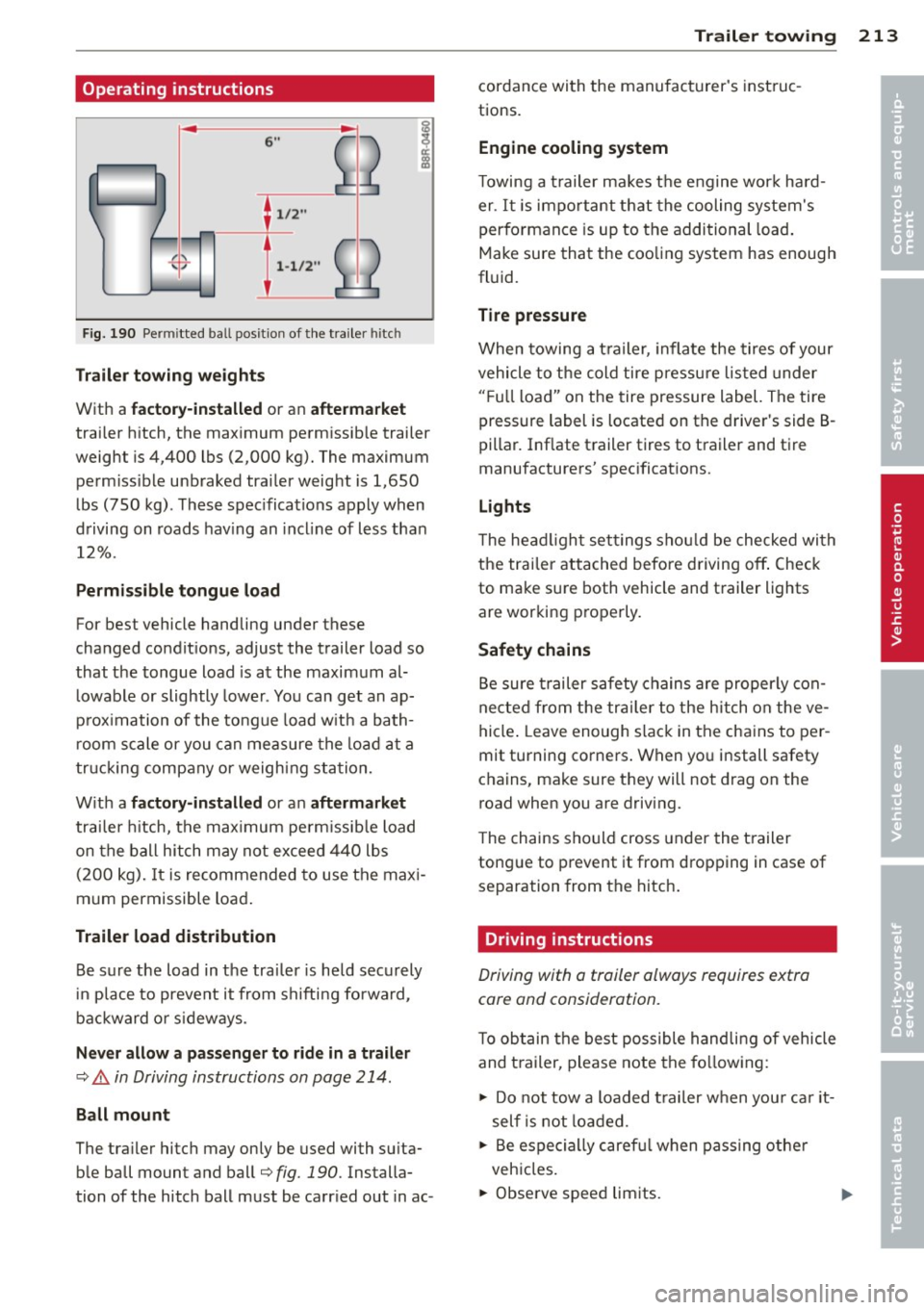
Operating instructions
6"
~ ~
I 1,2 ..
-{ }
l::_
-
2
Fig. 190 Permit ted ball position of the trailer hitch
Trailer towing weights
With a factory-installed or an aftermarket
trailer hitch, the maximum permissible trailer
weight is 4,400 lbs (2,000 kg). The maximum permissible unbraked trailer weight is 1,650
lbs (750 kg) . These specifications apply when
driving on roads having an incline of less than
12%.
Permissible tongue load
For best vehicle handling under these
changed conditions, adjust the trailer load so
that the tongue load is at the maximum al
lowable or slightly lower . You can get an ap
proximation of the tongue load with a bath
room scale or you can measure the load at a
trucking company or weighing station.
With a
factory-installed or an aftermarket
trailer hitch, the maximum permissible load
on the ball hitch may not exceed 440 lbs
(200 kg).
It is recommended to use the maxi
mum permissible load.
Trailer load distribution
Be sure the load in the trailer is held securely
in place to prevent it from shifting forward,
backward or sideways.
Never allow a passenger to ride in a trailer
¢.&. in Driving instructions on page 214.
Ball mount
The trailer hitch may only be used with suita
ble ball mount and ball¢
fig. 190. Installa
tion of the hitch ball must be carried out in ac-
Trailer towing 213
cordance with the manufacturer's instruc
tions.
Engine cooling system
Towing a trailer makes the engine work hard
er .
It is important that the cooling system's
performance is up to the additional load.
Make sure that the cooling system has enough
fluid.
Tire pressure
When towing a trailer, inflate the tires of your
vehicle to the cold tire pressure listed under
"Full load" on the tire pressure label. The tire
pressure label is located on the driver's side B
pillar. Inflate trailer tires to trailer and tire
manufacturers' specifications.
Lights
The headlight settings should be checked with
the trailer attached before driving off. Check
to make sure both vehicle and trailer lights
are working properly.
Safety chains
Be sure trailer safety chains are properly con
nected from the trailer to the hitch on the ve
hicle. Leave enough slack in the chains to per
mit turning corners. When you install safety
chains, make sure they will not drag on the
road when you are driving.
The chains should cross under the trailer
tongue to prevent it from dropping in case of
separation from the hitch.
Driving instructions
Driving with a trailer always requires extra
care and consideration.
To obtain the best possible handling of vehicle
and trailer, please note the following :
.,. Do not tow a loaded trailer when your car it
self is not loaded .
.,. Be especially careful when passing other
vehicles.
.,. Observe speed limits.
•
•
Page 216 of 316
214 Trailer towing
• Do not drive at the maximum permissible
speed.
• Always apply brakes early .
• Monitor the temperature gauge.
W eig ht distribution
Towing a loaded tra ile r with an empty car re
sults in a highly unstable distribution of
weight . If this cannot be avoided, drive at very
low speeds only to avoid the risk of losing
steering control.
A "balanced" rig is easier to operate and con
trol. This means that the tow vehicle should
be loaded to the extent possible and permissi
b le, while keeping the trailer as light as possi
ble under the circumstances. Whenever possi
ble, transfer some cargo to the luggage com
partment of the tow vehicle wh ile observing
tongue load requirements and vehicle loading
considerations .
Speed
The higher the speed, the more difficult it be
comes for the driver to control the rig . Do not
drive at the maximum permissible speed . Re
duce your speed eve n mo re if load, weathe r or
wind condi tions are unfavorable -part icu larly
when going dow nhill.
Reduce vehicle speed immediately if the t rail
e r shows the slightest sign of swaying. Do not
tr y to s top the sw ayin g by acce ler atin g.
Observe speed limits . In some areas, speeds
for vehicles towing trailers are lower tha n for
regula r vehicles.
Always apply brakes early . When driv ing
downhill, shift into a lower gear to use the en
g ine b raking effect to slow the vehicle. Use of
the brakes alone can cause them to overheat
and fail.
Coolant temperature
T he coolant temperature gauge
c:> page 10
must be observed carefully . If the needle
moves close to the upper end of the scale , re
duce speed immed iate ly and/or turn off the
a ir cond itione r. If the coolant temperature warning light in
the instr ument cluster starts flashing., pull
off the road, stop and let the engine
idle for
about two minutes to prevent heat build-up.
A WARNING
Anyone not properly restrained in a mov
i ng vehicle is at a much greater risk in a n
accident . Never let anyone ride in your ca r
who is not p roperly wea ring the rest raints
p rov ided by Audi.
Trailer towing tips
Important to know
Your vehicle handles d ifferently when towing
-
a trai ler because of the additional weight and
different weight distr ibut ion. Safety, perform
ance and economy will greatly depend on how ca refully you load your trai ler and ope rate
you r rig.
Befo re you actually tow your tra iler, practice
turning, stopping and backing up in an area
away from t raffic. Keep pract ic ing unt il you
have become completely familiar wit h the way
yo ur vehicle-tra iler combination behaves and
responds.
Backi ng up is difficult and requ ires practice.
Backi ng up w ith a t railer gene rally requires
stee ring action opposite to tha t when backing
u p you r vehicle witho ut a tr ailer.
Maintai n a greater d ista nce between your ve
hicle and the one in front of you. You w ill need
more room to stop. To compensate fo r the
t railer, you w ill need a larger than normal
tu rning rad ius.
When passing, remembe r that you cannot ac
ce le rate as fas t as you no rma lly would be
ca use of the added load. Make sure yo u have
enough room to pass . After passing, a llow
plenty of room for yo ur trailer before cha ng
ing lanes again.
Avoid jer ky s tarts, sharp t urns o r rapid lane
changes.
Page 259 of 316
-Always make sure that the total load be
ing transported - including the weight of
a trailer hitch and the tongue weight of a
loaded trailer -does not make the vehi
cle heav ier than the vehicle's Gross Vehi
cle Weight Rating.
Determining correct load limit
Use the example below to cal
culate the total weight of the
passengers and luggage or oth
er things that you plan to trans
port so that you can make sure
that your vehicle will not be
overloaded.
Steps for Determining Correct Load Limit
1. Locate the statement "THE
COMBINED WEIGHT OF OC
CUPANTS AND CARGO
SHOULD NEVER EXCEED XXX KG OR XXX LBS" on your ve
hicle's placard (tire inflation
pressure label)
¢ page 252,
fig. 203.
2. Determine the combined
weight of the driver and pas sengers that will be riding in
your vehicle.
3. Subtract the combined
weight of the driver and pas sengers from
"XXX" kilo
grams or
"XXX" pounds
Tires and wheels 257
shown on the sticker
¢page 252, fig. 203.
4. The resulting figure equals
the available amount of car
go and luggage load capaci
ty. For example, if the
"XXX"
amount equals 1400 lbs.
and there will be five
150
lbs. passengers in your vehi
cle, the amount of available
cargo and luggage load ca
pacity is
650 lbs. (1400-7 50
(5
X 150) = 650 lbs.)
5. Determine the combined
weight of luggage and cargo being loaded on the vehicle.
That weight may not safely
exceed the available cargo
and luggage load capacity
calculated in Step
4.
6. If your vehicle will be towing
a trailer, load from your trail
er will be transferred to your
vehicle. Consult this manual
to determine how this re duces the available cargo
and luggage load capacity of
your vehicle.
.,. Check the tire sidewall
(¢ page 259, fig. 207) to de
termine the designated load rating for a specific tire.
•
•
'
Page 271 of 316
What do I do now?
Jack, tools and
inflatable spare tire
Onboard tool kit and vehicle jack
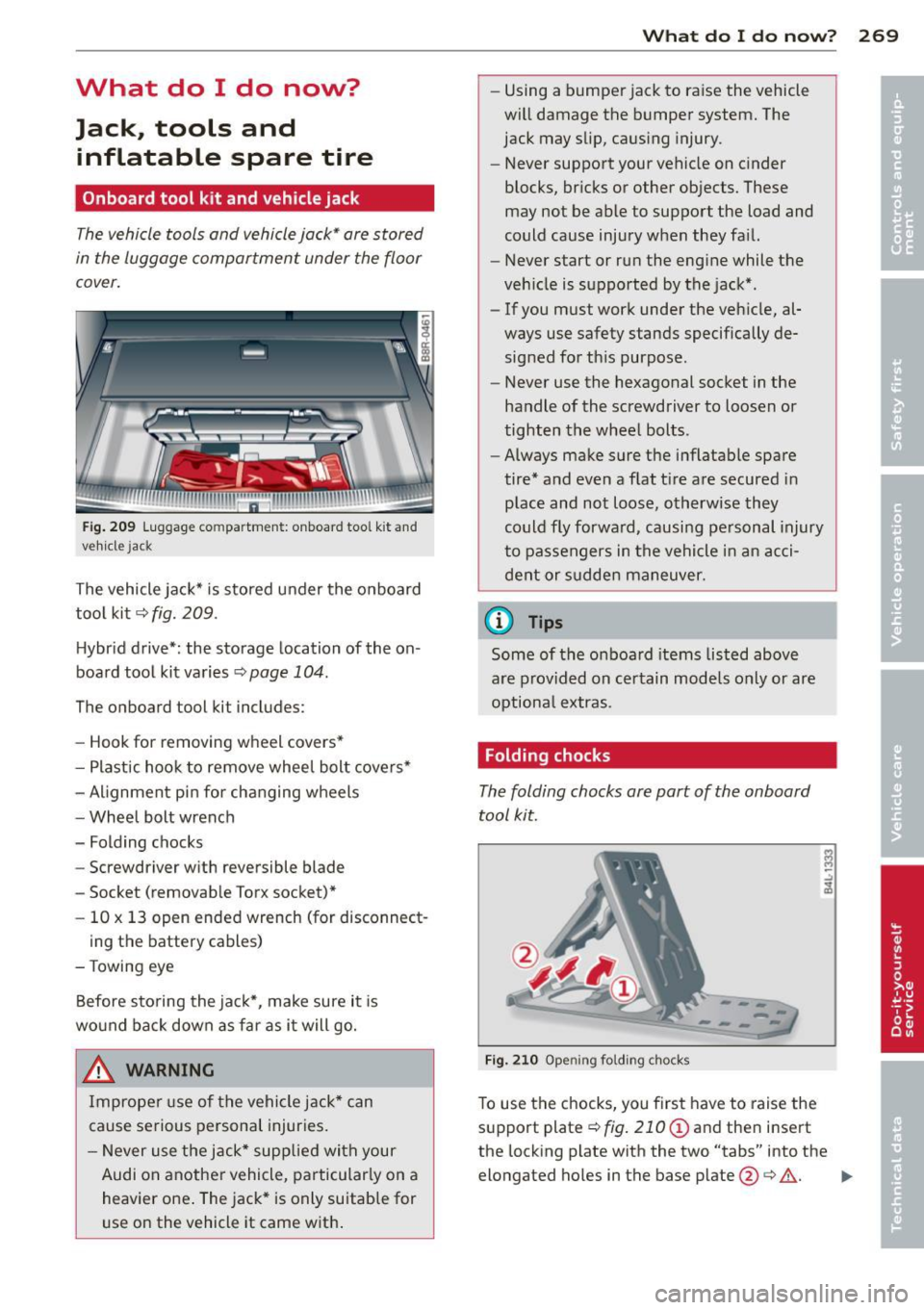
The vehicle tools and vehicle jack* are stored
in the luggage compartment under the floor
cover.
Fig . 209 Luggage co mpa rtment: onboard too l kit and
v e hicle jack
The vehicle jack* is sto red under the on board
tool kit¢
fig. 209.
Hybr id drive*: the storage location of the on
board tool kit varies
¢ page 104.
The on board tool kit includes:
- Hook for removing wheel covers*
- Plastic hook to remove wheel bolt covers*
- Al ignment p in for changing wheels
- Wheel bolt wrench
- Folding chocks
- Screwdriver with reversible blade
- Socket (removable Torx socket)*
- 10 x 13 open ended wrench (for disconnect-
ing the battery cables)
- Towing eye
Before storing the jack*, make sure it is
wound back down as far as it will go.
A WARNING
Imprope r use of the vehicle jack* can
cause serious personal injuries.
- Never use the j ack* supplied with your
Audi on another vehicle, particularly on a heavier one . The jack* is only suitable for
use on the vehicle it came with .
What do I d o now ? 269
-Using a bumper jack to ra ise the vehicle
will damage the bumper system. The
jack may slip, causing injury.
- Never support your vehicle on cinder
blocks, br icks or other objects. These
may not be able to support the load and
could cause injury when they fa il.
- Never start or run the engine while the
veh icle is supported by the jack* .
- If you must work under the vehicle, al
ways use safety stands specifically de signed for th is purpose .
- Never use the hexagonal socket in the
handle of the screwdriver to loosen or
tighten the wheel bolts .
- Always make sure the inflatable spare
tire* and even a flat tire are secured in
place and not loose, otherwise they
could fly forward, causi ng personal injury
to passengers in the vehicle in an acci
dent or sudden maneuver.
(0 Tips
Some of the on board items listed above
a re provided on certain models only or are
optiona l extras.
Folding chocks
The folding chocks are part of the on board
tool kit.
Fig . 210 Ope ning folding chocks .
To use the chocks, you first have to raise the
support plate¢
fig. 210 (D and then insert
the locking plate with the two "tabs" into the
elongated holes in the base plate@¢& . ""
Page 286 of 316
284 Emergency situations
Emergency situations
General
This chapter is intended for trained emer
gency crews and working personnel who
have the necessary tools and equipment to
perform these ope rations.
Starting by pushing or
towing
Q;) Note
Vehicles with an automati c transmission
cannot be started by pushing or towing .
Starting with jumper
cables
If necessary, the engine can be started by
connecting it to the battery of another vehi
cle.
If the engine should fail to start because of a
discharged or weak battery, the battery can be
connected to the battery of
another veh icle,
using a
pair of jumper cables to start the en
g ine .
Jumper cables
Use only jumper cables of sufficiently large
cross section to carry the starter current safe
ly. Refer to the manufacturer's specifications.
Use only jumper cables with
insulated termi
na l clamps which are distinctly marked:
plus(+) cable in most cases colored red
minu s(-) cable
in most cases colored black .
A WARNING
Batteries contain electricity, ac id, and gas .
Any of these can cause very serious or fatal
inju ry. Follow the instructions below for
safe handling of your veh icle's battery.
- Always shield you r eyes and avoid lean
ing over the battery whenever possible.
- A discharged battery can freeze at tem
peratures just be low 32 °F (0 °C). Before connecting a
jumper cable, you must
thaw the frozen battery complete ly, oth
erwise it could explode.
- Do not allow battery acid to contact eyes
or skin . Flush any contacted area with
water immediately .
- Improper use of a booster battery to start a vehicle may cause an explosion.
- Vehicle batteries generate explosive gas
es. Keep sparks, flame and lighted ciga
rettes away from batteries.
- Do not try to jump start any vehicle with a low ac id level in the battery.
- The vo ltage of the booster battery must
also have a 12-Volt rating . The capacity
(Ah) of the booster battery should not be
lower than that of the discharged bat
tery . Use of batteries of d ifferent voltage
or substantially different "Ah" rating
may cause an exp losion and personal in
jury.
- Never charge a frozen batte ry. Gas trap
ped in the ice may cause an explosion.
- Never charge or use a battery that has
been frozen. The battery case may have
be weakened.
- Use of batter ies of different voltage or
substantially different capacity (Ah) rat
ing may cause an exp losion and injury.
The capacity (Ah) of the booster battery
should not be lower than that of the dis
charged battery.
- Before you check anything in the engine
compartment, always read and heed a ll
WARNINGS ¢
page 226, Engine com
partment.
«I) Note
-Applying a higher voltage booster bat
tery will cause expensive damage to sen
sitive electronic components, such as
contro l units, relays, rad io, etc .
- There must be no electrical contact be
tween the vehicles as otherwise current
could already start to flow as soon as the
positive(+) terminals are connected. ..,_
Page 288 of 316
28 6 Em ergency sit uat ions
_& WARNING
To avoid serious personal injury and dam
age to the vehicle, heed all warnings and
instructions of the jumper cable manufac
turer. If in doubt, call for road serv ice.
- Jumper cables must be long enough so
that the vehicles do not touch.
- When connecting jumper cables, make
surethattheycannotgetca ughtinany
moving parts in the eng ine compart
ment.
- Do not bend over the batteries -danger
of chemical burns!
- The battery cell locking screws must be
t ightened securely.
- Before you check anything in the engine
compartment, always read and heed all
WARNINGS
c:> page 226, Engine com
partment .
Improper hook-up of jumper cables can ru
in the generator.
- Always connect POSITIVE( +) to POS I
TIVE(+), and NEGATIVE( -) to NEGATIVE
(-) ground post of the battery manager
control unit.
- Check that a ll screw plugs on the battery
cells are screwed in firmly . If not, tighten
plugs prior to connecting clamp on nega
tive battery terminal.
- Please note that the procedure for con
nect ing a jumper cable as described
above applies spec ifically to the case of
your vehicle being jump started. When
you are giving a jump start to anothe r ve
hicle, do
not connect the negat ive (-) ca
ble to the negat ive (-) term inal on the
discharged bat tery ©
c:> fig. 2 28. In
stead, securely connect the negative(-)
cable to e ithe r a solid metal component
that is firm ly bolted to the engine block
or to the engine block itse lf. If the bat
tery that is being charged does not vent
to the outside, escaping battery gas
could ignite and exp lode!
-
Emergency towing
with commercial tow
truck
General hints
Your Audi requires special handling for tow
ing.
T he following information is to be used by
commercial tow truck operators who know
how to op erate their equipment safely.
- Nev er tow your Audi , towing will cau se
damage to the engine and tr an smi ssion .
- Ne ver wrap th e safety chain s or winch ca
ble s around the brak e lines.
- To pre vent unne ce ss ary damage, your Audi
mus t be tr an sp o rt ed with a flat bed tru ck.
- To load th e vehi cle on to th e flat b ed, use
the towing l oop found in the ve hicle to ols
an d att ach to th e front or r ea r a ncho rage
c:>page 287 and Qpage 287.
_& WARNING
= -
A vehicle being towed is not safe for pas
sengers. Never allow anyone to ride in a
vehicle being towed, for any reason.
Page 289 of 316
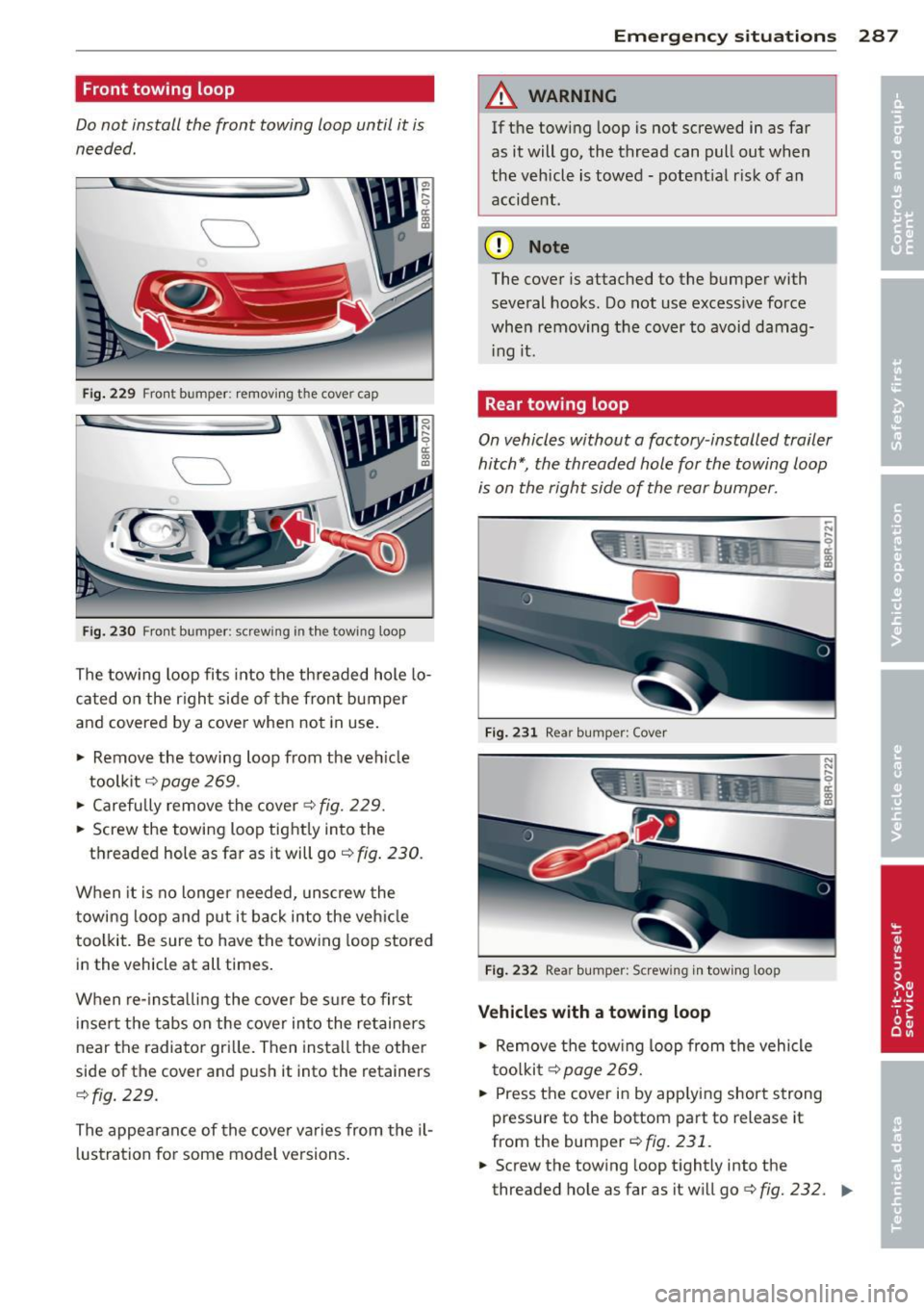
Front towing loop
Do not install the front towing loop until it is
needed.
Fig. 229 Fro nt bumper : removing the cover cap
Fig. 230 Front bumper: screwing in the towing loop
The towing loop fits into the th readed hole lo
cated on the r igh t side of the fron t bumper
and covered by a cove r when not in use.
"' Remove the towing loop from the veh icle
toolkit
c:::> page 269.
"' Carefu lly remove the cover
c:::>fig. 229.
"' Screw the towing loop tightly into the
threaded hole as far as it will go
c:::> fig. 230.
When it is no longer needed, unscrew the
towing loop and put it back into the veh icle
too lkit. Be sure to have the towing loop stored
in the vehicle at all times.
When re- insta llin g the cover be s ure to first
i nse rt the tabs on the cover in to the retainers
near the radiator gri lle. Then install the other
side of the cover and p ush it into the retainers
c:::> fig . 229.
The appearance of the cove r va ries from the il
l ustration fo r some model versions .
Emergenc y situ ation s 287
A WARNING
If the tow ing loop is not screwed in as far
as it will go, the thread can pull out when
the vehicle is towed -potent ia l risk of an
accide nt.
(D Note
The cover is attached to the bumper with
several hooks. Do not use excess ive force
when removing t he cover to avoid damag
i ng it.
Rear towing loop
On vehicles without a factory-installed trailer
hitch*, the threaded hole for the towing loop
is on the right side of the rear bumper.
Fi g. 231 Rear b umper: Cover
N N .... -- o
!
Fig . 232 Rear bumper: Screwing in tow ing loop
V ehicles with a towing loop
"' Remove the tow ing loop from the vehicle
t oo lki t
c:::> page 269.
"' Press the cover in by app lying short strong
pressure to the bottom part to release it
from the bumper
c:!) fig. 231.
"' Screw the tow ing loop t ightly into the
threaded hole as far as it w ill go
¢ fig. 232. ..,.
Page 290 of 316
288 Emergency situations
Vehicles with a trailer hitch*
.,. Install the trailer hitch .
.,. Attach the towing bar o r the towing cab le
to the trai ler hitc h.
Unscrew the towing loop again a fter use and
i nstall the cover in the b umpe r. Re tur n the
towing loop to t he vehicle too lk it . Be sure to
have the towing loop stored in the vehicle at
a ll t imes.
A WARNING
- If the towing loop is not screwed in as far
as it will go, t he thread ca n pull out when
the vehicle is towed - potential risk of an acc ident .
- If your veh icle has a
trailer hitch* on ly
use a specia l towing bar to p revent dam
aging the ball h itch . Th ese towing bars
have been specially designed for trailer
t owing hitches.
- If your veh icle has a
trailer hitch* use on
ly specia l towing cables .
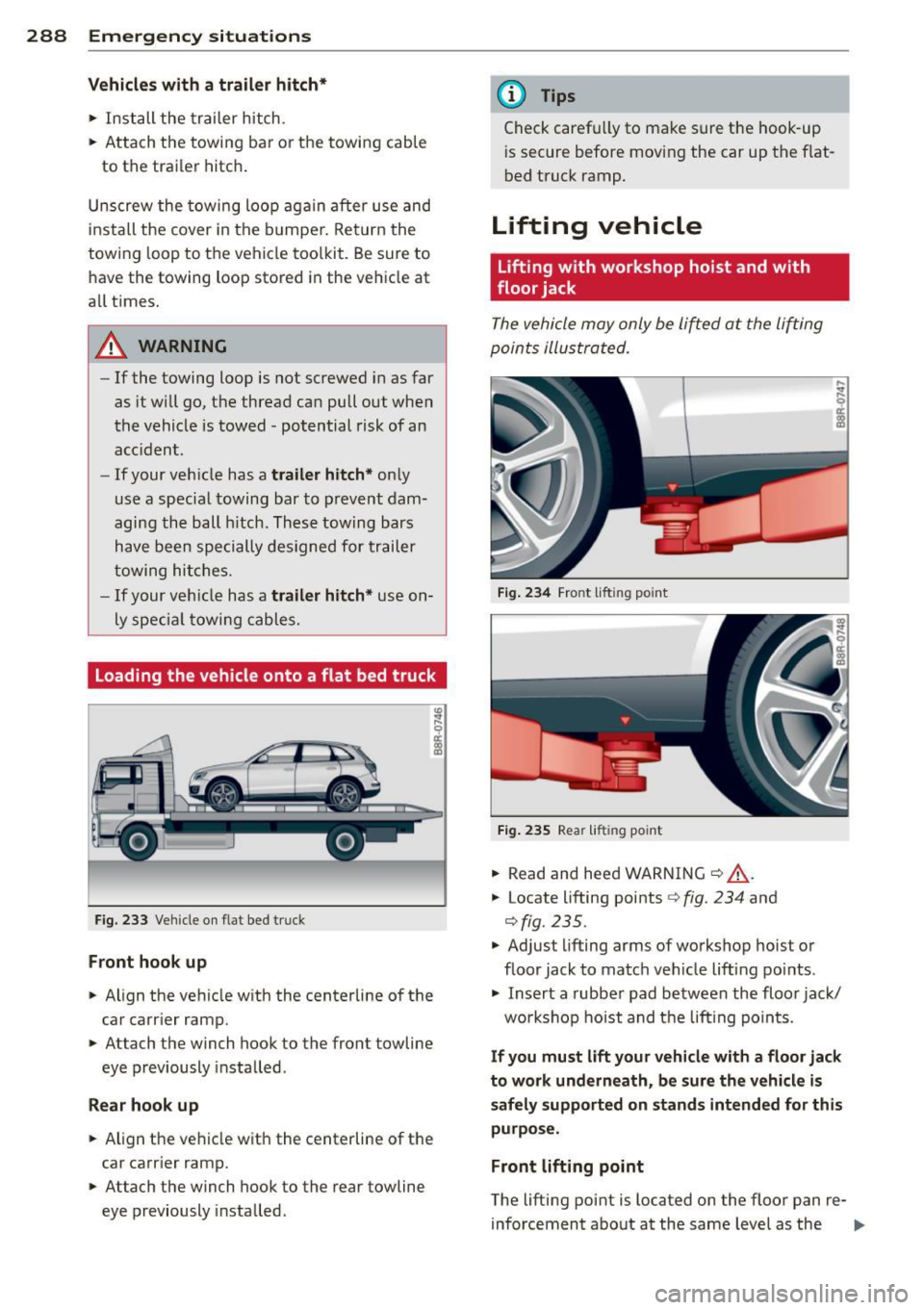
Loading the vehicle onto a flat bed truck
Fig. 2 33 Veh icle on flat bed truck
F ront hook up
.,. Align the vehicle w ith the centerline of the
car carrier ramp .
.,. Atta ch the winch hook to the front towline
eye previously insta lled .
Rear hook up
.,. Align the ve hicle with the centerline of the
car carr ier ramp .
.,. Attach the winch hook to the rear towline
eye previously installed .
(D Tips
Check caref ully to make sure t he hook -up
i s secure before mov ing the car up the f lat
b ed truck ramp .
Lifting vehicle
Lifting with workshop hoist and with
floor jack
The vehicle may only be lifted at the lif ting
points illustr ated.
Fig. 2 34 Fro nt li ftin g point
Fig . 2 3 5 Rea r liftin g po int
.,. Read and heed WARNING c::> .&._ .
.,. Locate lifting points c::> fig . 234 and
<=:>fig. 235 .
.,. Adjust lifting arms of workshop hoist o r
floor jack to matc h ve hicle lift ing po ints .
.,. Insert a rubbe r pad b etween the floo r jack/
workshop hoist and t he lift ing poin ts.
If you must lift your vehicle with a floor jack
to work undern eath, be sure the vehicle is
safely supported on stand s intended for this
purpo se .
Front lifting point
The lifting poi nt is located on the floor pan re-
inforcement abo ut at the same level as the
II>
Page 297 of 316
Consumer Information
Warranty coverages
Your Audi is covered by the following war
ranties :
- New Vehicle Limited Warranty
- Limited Warranty Against Corrosion Perfo-
ration
- Emissions Control System Warranty
- Emissions Performance Warranty
- California Emissions Con trol Warranty (USA
vehicles only)
- California Emissions Performance Warranty
(USA vehicles only)
Detailed information regarding your warran
ties can be found in your
Warranty & Mainte
nance booklet .
Operating your vehicle
outside the U.S.A. or
Canada
Government regulations in the United States
and Canada require that automobiles meet
specific emission regulations and safety
standards. Therefore, veh icles built for the
U.S.A. and Canada differ from vehicles sold in
other countries .
If you p lan to take your vehicle outside the
continental limits of the United States or Can
ada, there is the possibility that:
- unleaded fuels for vehicles with cata lytic
converter may not be available;
- fuel may have a considerably lower octane
rating . Improper fuel may cause engine
damage ;
- service may be inadequate due to lack of
proper service facilities, tools or testing
equipment ;
- replacement parts may not be readily availa
ble.
- Navigation systems for vehicles built for the
U.S.A. and Canada will not necessari ly work
in Europe, and may not work in other coun
tries outside of North America.
Consumer Information 295
@ Note
Audi cannot be responsible for mechanical
damage that could result from inadequate
fuel, service or parts availab ility.
Audi Service Repair
Manuals and Literature
Audi Offic ial Factory Service Manuals and Lit
erature are published as soon as possible after
model introduction. Service Manuals and liter
atu re are availabl e to order from the Audi
T echnical Literature Ordering Center at:
www.audi.techliterature.com
Maintenance
' General
Your vehicle has been designed to help keep
maintenance requirements to a minimum.
However, a certain amount of regular mainte
nance is still necessary to assure your vehicle's
safety, economy and reliability . For detailed
vehicle maintenance consult your Warranty
&
Maintenance booklet.
Under difficult operating conditions , for ex
ample at extremely low outside temperatures ,
in very dusty regions, when towing a tra iler
very frequently, etc., some serv ice work
shou ld be pe rformed between the intervals
specified. This applies particularly to:
- oil changes, and
- cleaning or replacing the air filter .
® For the sake of the environment
By regularly maintaining your vehicle, you
help make sure that emission standards
are maintained, thus min imizi ng adverse
effects on the environment .
Important considerations for you and
your vehicle
The increasing use of electronics , sophisticat
ed fuel injection and emission contro l sys-
tems, and the genera lly increasing technica l ..,_
•
•
Page 306 of 316

304 Index
Electronic immobilizer . . . . . . . . . . . . . . . . 38
Electronic power control
( E PC) warn ing/ indicato r light . .. .... .. 15
Electroni c Stab ili za tion Con trol (ESC) ... 197
ESC Offroad mode ......... ... .. .. . 198
H ill descent assist ......... .... .... 199
Warning/indicator lights ....... .. .... 15
E mergency braking . . . . . . . . . . . . . . . . . . . 90
E mergency flasher . . . . . . . . . . . . . . . . . . . 52
Warning/indicator lights ... .. .. .... . . 16
Emergency key .. .. .... ...... .. .. .. .. 36
Starting engine ........... ... .. .. .. 85
Emergency locking of the doo rs . . . . . . . . . 42
E mergency operation
L uggage compartment lid .. .. .. .. ... . 45
Emergency release
Selector lever . .... .... ..... .. .. .. . 128
Emergency star ting ........ .. .. .. .. . 284
Em ergency towing ............. .... . 286
Emergency unlocking
I gn ition key . . . . . . . . . . . . . . . . . . . . . . . 38
Energy management ....... .. .. .. .. . 203
En gin e
Compartment .. ........ .. .. .. .... . 235
Coolant .... ... .......... .. .. .... . 240
Hood .. .... ... .......... ........ . 233
Jump starting ............ .... .... . 105
Start-Stop-System . . . . . . . . . . . . . . . . . . 91
Starting . . . . . . . . . . . . . . . . . . . 83, 86, 98
Starting with jumper cables .. .. .. ... 284
Stopping . . . . . . . . . . . . . . . . . . . 85, 87, 98
E ngine compartment
Safety instructions ........ .. .. .. .. . 233
Working the engine compartment .... 233
Engine coolant system .......... .... . 240
Adding coolant . .......... .. .. .... . 241
Check ing coolant level ....... .. .... . 240
Malfunction . . . . . . . . . . . . . . . . . . . . . . . 30
Radiator fan ... .. ..... ... .... .. .. . 242
Engine coolant temperature Temperature gauge ........... .... . . 10
En gin e data ... ............ .. .. .. .. . 292
Eng ine hood
C losing .. .. ... .. ..... ..... .. .. .. . 233
H ow to release the hood ....... .. ... 233 E
ngine oi l .. .... .. ... .. ........ .. .. 235
Adding ... .... .. .. ... ........ .. .. 238
Additives .. .. .. .. .. ... ........ .. .. 238
Chang ing ..... .. ............. .... 239
Check oil level ... ............. .... 238
Consumption .. .. ................ . 238
Level .... ... .. .. .. ... .. ... ..... .. . 34
Oil consumpt ion .. .......... ...... . 237
Oil grades . .. .. . ............ .... .. 235
Pressure malfunction ....... .... .. .. . 30
Sensor defective . . . . . . . . . . . . . . . . . . . . 34
Specification and viscosity ....... .. .. 235
En gine speed limitation . . . . . . . . . . . . . . . 34
Environment Break-in per iod ... ............. .... 20S
Catalytic converter ................ . 206
Dispos ing of your ve hicle battery ..... 246
Driving at high speeds ............. . 207
Driving to minimize pollution and noise 207
Fuel .... .. .... .. ............. .... 231
Fu el economy .. . .. ............ .. .. 207
Leaks under your vehicle .......... .. 233
Letting the vehicle stand and warm up . 207
Proper disposal of drained brake fluid . 243
Proper disposal of drained engine cool-
ant .. .... .... .. ............. .... 241
Proper disposal of drained engine
o il . . . . . . . . . . . . . . . . . . . . . . . . . 238, 239
Recycling used engine oil ........... . 238
Roof rack . .. .. .. .. ........... .... . 72
Unl eaded fuel .. .. ............. .. .. 22 8
What shoul d I do with an old battery? . 246
EPC
refer to Electronic power control ..... . 15
ESC
refer to Electronic Stabili zation Control
(ESC) .... ... .. .. .. ... .. ... ..... .. . 15
ESC Offroad mode . . . . . . . . . . . . . . . . . . . 198
E thy l alcoho l (Fuel) ..... ... ... ... .. .. 229
Event Data Recorder (EDR) . . . . . . . . . . . . 197
E xhaus t tai l pipes
C leaning . ..... .. .. ... ........ .. .. 223
Expansion tank .. .. ..... ........... . 240
Explanation of some technical terms ... 209