check engine light AUDI Q5 2013 Owner's Manual
[x] Cancel search | Manufacturer: AUDI, Model Year: 2013, Model line: Q5, Model: AUDI Q5 2013Pages: 316, PDF Size: 78.89 MB
Page 246 of 316
244 Checking and filling
Vehicles not driven for long periods
If you do not drive you r vehicle over a pe riod
of severa l days or weeks, electrical compo
nents are gradually cut back or switched off.
This reduces energy consumption and main
tains starting capability over a longer period
¢page 203.
Take into consideration that when yo u un lock
your vehicle, some convenience functions, such as the interior lights or the power seat
adjustment, may not be available. The con
venience funct ions w ill be available again
when you turn on the ignition and start the
engine .
Winter operation
During the winter months, battery capacity
tends to decrease as temperatures drop . This
is because more power is also consumed while
start ing, and the headl ights, rear window de
fogger, etc., are used more often .
Avoid unnecessary power consumption, par
ticularly in city traffic or when traveling only
short distances . Let your authorized Audi
dealer check the capacity of the vehicle bat
tery before winter sets in¢
page 245. A well
cha rged battery w ill not only prevent starting
prob lems when the weather is cold , but will
a lso last longer .
Working on the battery
Be especially careful when working on or near
the battery.
The battery is located in the luggage compart
ment under the floor. Before you check any
thing in the luggage compartment,
read and
heed all WARNINGS
¢ _&..
Hybr id drive*: you can find impo rtant informa
tion about the high voltage battery under
¢page 97 .
Always heed the safety warnings , when work
ing on the vehicle battery or the vehicle elec
trical system to prevent injury.
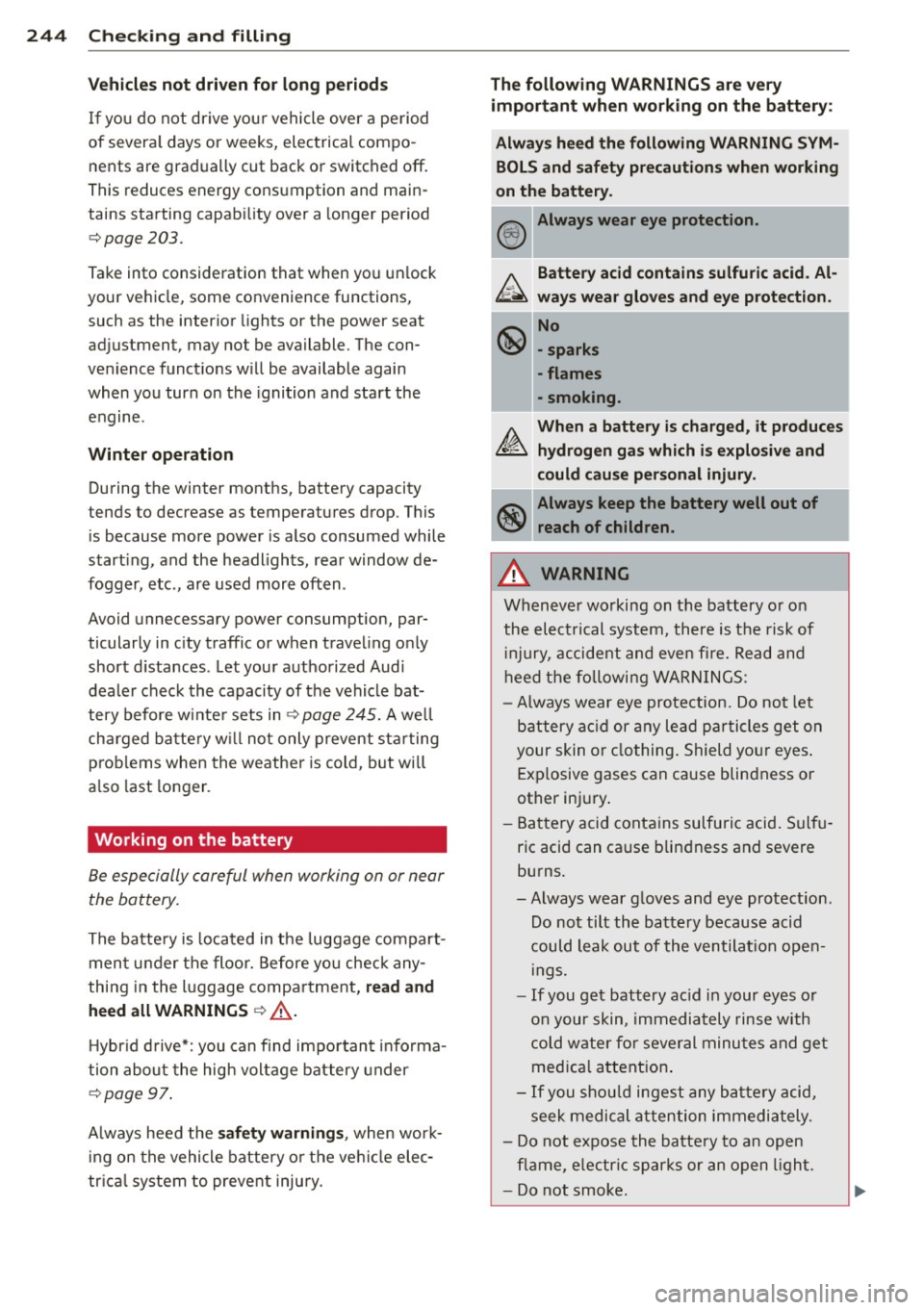
The following WARNINGS are very
important when working on the battery:
Always heed the following WARNING SYM BOLS and safety precaution s when working
on the battery.
@) Always wear eye protection .
I>. Battery acid contains sulfuric acid_-Al
~ ways wear gloves and eye protection.
~ No
\!=51 -sparks
-flames
-smoking.
A When a battery is charged, it produces
~ hydrogen gas which is explosive and
could cause personal injury.
/G Always keep the battery well out of
V!!JI reach of children.
A WARNING "--
Whenever working on the battery or on
the electrical system, there is the risk of
in jury, accident and even fi re. Read and
heed the following WARNINGS :
- Always wear eye protection. Do not let
battery ac id or any lead particles get on
your skin or clothing. Shield your eyes .
Exp losive gases can cause blindness or
other injury .
- Ba ttery acid contains sulfuric acid. Sulfu
ric acid can ca use blindness and severe
burns .
- Always wear gloves and eye protection .
Do not tilt the battery because acid
could leak out of the ventilat ion open
i ngs.
- If you get battery ac id in your eyes or
on your skin, immediately rinse with
cold water fo r several minutes and get
med ical attention .
-If you should ingest any battery acid,
seek medical attention immediately.
- Do not expose the battery to an open
flame, electr ic sparks or an open light.
- Do not smoke.
-
1
I
Page 247 of 316

-Do not interchange the positive and neg
ative cables .
- When working on the battery , be sure
not to short-circuit the terminals with
tools or other metal objects. This would cause the battery to heat up very quickly,
which could lead to damage or explosion
and personal injury.
- When a battery is charged, it produces
hydrogen gas which is explosive and
could cause personal injury .
- Always keep the battery well out of the
reach of children .
- Before work is done on the electrical sys
tem, disconnect the negative ground ca
ble .
- Before performing any work on the elec
trical system , switch off the engine and
ignition as well as any electrical equip
ment. The negative cable on the battery
must be disconnected. If you are just go
ing to replace a light bulb, then it is
enough to switch off the lights.
- Before disconnecting the battery , switch
off the anti-theft alarm system! Other
wise you will set off the alarm.
- When disconnecting the battery, first
disconnect the negative cable and then
the positive cable.
- Before reconnecting the battery, make
sure all electrical consumers are switch
ed off. Reconnect the positive cable first
and then the negative cable. Never inter
change the cables - this could start a fire!
- Never charge a fro zen or a thawed-out
battery. It could explode! If a battery has
frozen, then it must be replaced. A dis
charged battery can freeze over at 32°F
(OOC) .
-Make sure the vent hose is always attach
ed to the opening on the side of the bat
tery.
- Never use batteries which are damaged.
There is the danger of an explosion! Al
ways replace a damaged battery.
Checking and filling 245
A WARNING
California Proposition 65 Warning:
- Battery posts, terminals and related ac cessories contain lead and lead com
pounds, chemicals known to the State of
California to cause cancer and reproduc
tive problems . Wash hands after han
dling.
Q) Note
- Do not disconnect the vehicle battery
when the ignition is switched on or when
the engine is running, otherwise , you will
damage electronic components in the
electrical system.
- If your vehicle is going to stand for a
long period of time without being driven,
protect the battery from "freezing", oth
erwise it will be damaged and will then
have to be replaced.
Battery charging
Starting the engine requires a well charged
battery.
Fig. 201 Engin e compart ment: Co nn ectors for charger
and j umper cab les
Always read and heed all WARNINGS below
¢ .&. and ¢,&. in Working on the battery on
page 244.
~ Hybrid drive*: read the important informa
tion concerning a dead high voltage battery
under
¢ page 105.
~ Turn off the ignition and all electrical con
sumers.
~ Make sur e the area is well ventilated when
you charge the battery . ..,.
Page 249 of 316
install batteries of the same type and manu
facture only (the same as those installed at
the t ime your vehicle was delivered) . Specifi
cations are listed on the battery housing. Your
authorized dealer must code the battery in
the energy management system to enable you
to use the energy management functions cor rectly after replacing the battery .
If it is not possible to use a battery of this
type, the new battery must have the same ca
pacity, voltage (12 volts), amperage, con
struction and plug sea ling .
When installing the battery, make sure the ig
nition and all electr ica l consumers are turned
off.
(D Note
- Make sure the ventilation hose on the
s ide of the batte ry is connected, other
wise fumes or battery acid can leak out .
- Vehicles with the Start-Stop-System* are
equipped with a special cycle-proof AGM
battery . Installing a different type of
battery can cause problems in the vehi
cle elec trical system. When replacing the
vehicle battery, always insta ll one with
the same specifications as the original
battery.
@ For the sake of the environment
Because of the problem of proper disposal
of a battery, we recommend your author
ized Audi dealer change the battery for
you. Batteries contain su lfuric acid and
lead and must always be disposed of prop
erly in compliance with all environmental
regu lations . D isposing of vehicle batteries
improperly is very dangerous to the envi
ronment .
Checkin g and fillin g 247
Windshield/headlight
washer container
Fig. 202 Eng in e compar tment: cov er on the w inds hield
and headl ight* washe r fl uid reservoir
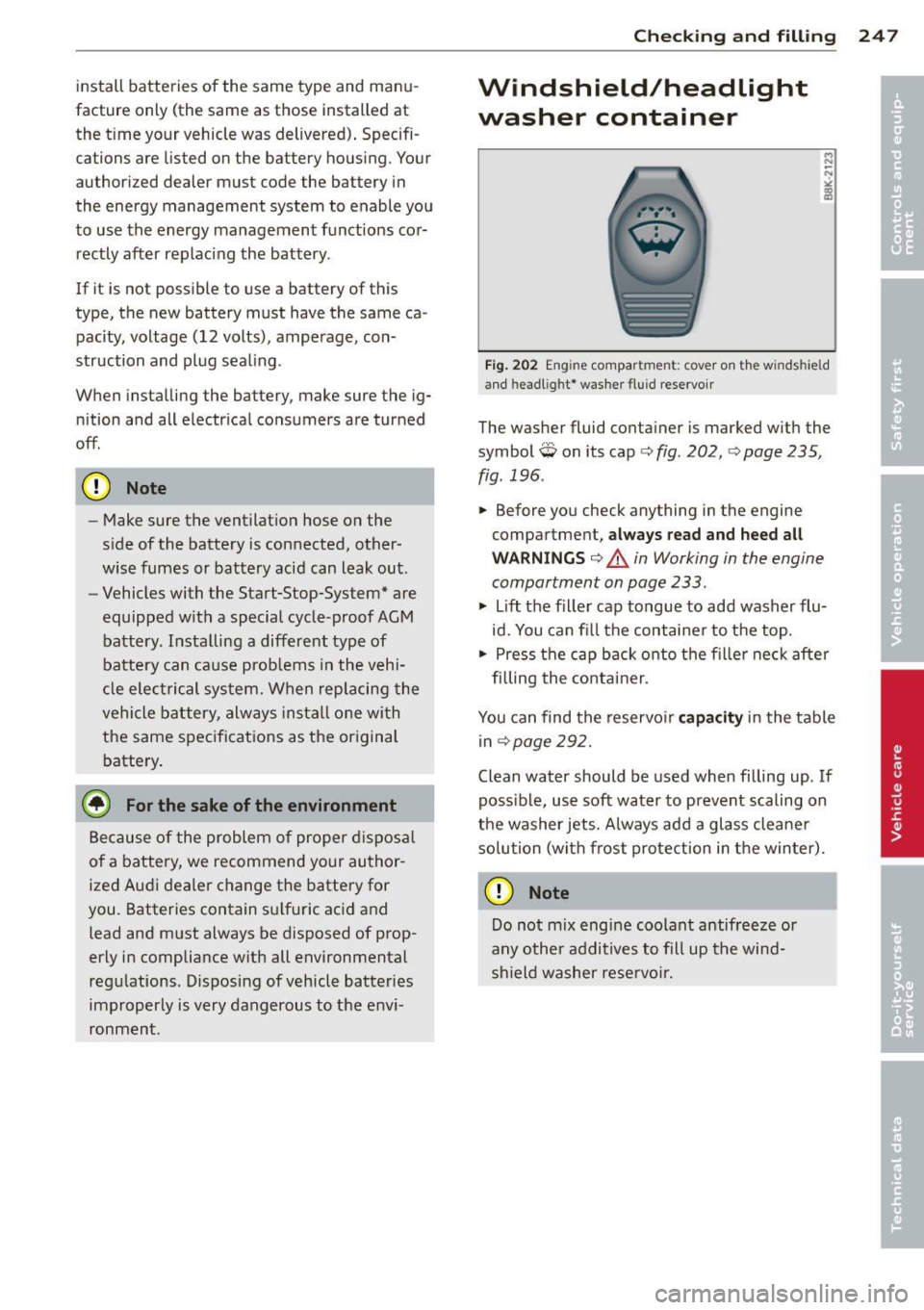
The washer fluid container is marked with the
symbol
Q on its cap c::> fig. 202, c::> page 235,
fig . 196 .
.., Before you check anything in the engine
compartment,
always read and heed all
WARNINGS c::> &. in Working in the engine
compartment on page 233 .
.., Lift the filler cap tongue to add washer flu
id . You can fill the container to the top.
.., Press the cap back onto the filler neck after
f illing the container.
You can find the reservoir
capacity in the table
in
c::> page 292.
Clean water should be used when filling up. If
possible, use soft water to prevent scaling on
the washer jets. A lways add a glass cleaner
solution (with frost protection in the winter).
(D Note
Do not mix engine coolant antifreeze o r
any other additives to fill up the wind
sh ield washer reservoir.
Page 286 of 316
284 Emergency situations
Emergency situations
General
This chapter is intended for trained emer
gency crews and working personnel who
have the necessary tools and equipment to
perform these ope rations.
Starting by pushing or
towing
Q;) Note
Vehicles with an automati c transmission
cannot be started by pushing or towing .
Starting with jumper
cables
If necessary, the engine can be started by
connecting it to the battery of another vehi
cle.
If the engine should fail to start because of a
discharged or weak battery, the battery can be
connected to the battery of
another veh icle,
using a
pair of jumper cables to start the en
g ine .
Jumper cables
Use only jumper cables of sufficiently large
cross section to carry the starter current safe
ly. Refer to the manufacturer's specifications.
Use only jumper cables with
insulated termi
na l clamps which are distinctly marked:
plus(+) cable in most cases colored red
minu s(-) cable
in most cases colored black .
A WARNING
Batteries contain electricity, ac id, and gas .
Any of these can cause very serious or fatal
inju ry. Follow the instructions below for
safe handling of your veh icle's battery.
- Always shield you r eyes and avoid lean
ing over the battery whenever possible.
- A discharged battery can freeze at tem
peratures just be low 32 °F (0 °C). Before connecting a
jumper cable, you must
thaw the frozen battery complete ly, oth
erwise it could explode.
- Do not allow battery acid to contact eyes
or skin . Flush any contacted area with
water immediately .
- Improper use of a booster battery to start a vehicle may cause an explosion.
- Vehicle batteries generate explosive gas
es. Keep sparks, flame and lighted ciga
rettes away from batteries.
- Do not try to jump start any vehicle with a low ac id level in the battery.
- The vo ltage of the booster battery must
also have a 12-Volt rating . The capacity
(Ah) of the booster battery should not be
lower than that of the discharged bat
tery . Use of batteries of d ifferent voltage
or substantially different "Ah" rating
may cause an exp losion and personal in
jury.
- Never charge a frozen batte ry. Gas trap
ped in the ice may cause an explosion.
- Never charge or use a battery that has
been frozen. The battery case may have
be weakened.
- Use of batter ies of different voltage or
substantially different capacity (Ah) rat
ing may cause an exp losion and injury.
The capacity (Ah) of the booster battery
should not be lower than that of the dis
charged battery.
- Before you check anything in the engine
compartment, always read and heed a ll
WARNINGS ¢
page 226, Engine com
partment.
«I) Note
-Applying a higher voltage booster bat
tery will cause expensive damage to sen
sitive electronic components, such as
contro l units, relays, rad io, etc .
- There must be no electrical contact be
tween the vehicles as otherwise current
could already start to flow as soon as the
positive(+) terminals are connected. ..,_
Page 306 of 316

304 Index
Electronic immobilizer . . . . . . . . . . . . . . . . 38
Electronic power control
( E PC) warn ing/ indicato r light . .. .... .. 15
Electroni c Stab ili za tion Con trol (ESC) ... 197
ESC Offroad mode ......... ... .. .. . 198
H ill descent assist ......... .... .... 199
Warning/indicator lights ....... .. .... 15
E mergency braking . . . . . . . . . . . . . . . . . . . 90
E mergency flasher . . . . . . . . . . . . . . . . . . . 52
Warning/indicator lights ... .. .. .... . . 16
Emergency key .. .. .... ...... .. .. .. .. 36
Starting engine ........... ... .. .. .. 85
Emergency locking of the doo rs . . . . . . . . . 42
E mergency operation
L uggage compartment lid .. .. .. .. ... . 45
Emergency release
Selector lever . .... .... ..... .. .. .. . 128
Emergency star ting ........ .. .. .. .. . 284
Em ergency towing ............. .... . 286
Emergency unlocking
I gn ition key . . . . . . . . . . . . . . . . . . . . . . . 38
Energy management ....... .. .. .. .. . 203
En gin e
Compartment .. ........ .. .. .. .... . 235
Coolant .... ... .......... .. .. .... . 240
Hood .. .... ... .......... ........ . 233
Jump starting ............ .... .... . 105
Start-Stop-System . . . . . . . . . . . . . . . . . . 91
Starting . . . . . . . . . . . . . . . . . . . 83, 86, 98
Starting with jumper cables .. .. .. ... 284
Stopping . . . . . . . . . . . . . . . . . . . 85, 87, 98
E ngine compartment
Safety instructions ........ .. .. .. .. . 233
Working the engine compartment .... 233
Engine coolant system .......... .... . 240
Adding coolant . .......... .. .. .... . 241
Check ing coolant level ....... .. .... . 240
Malfunction . . . . . . . . . . . . . . . . . . . . . . . 30
Radiator fan ... .. ..... ... .... .. .. . 242
Engine coolant temperature Temperature gauge ........... .... . . 10
En gin e data ... ............ .. .. .. .. . 292
Eng ine hood
C losing .. .. ... .. ..... ..... .. .. .. . 233
H ow to release the hood ....... .. ... 233 E
ngine oi l .. .... .. ... .. ........ .. .. 235
Adding ... .... .. .. ... ........ .. .. 238
Additives .. .. .. .. .. ... ........ .. .. 238
Chang ing ..... .. ............. .... 239
Check oil level ... ............. .... 238
Consumption .. .. ................ . 238
Level .... ... .. .. .. ... .. ... ..... .. . 34
Oil consumpt ion .. .......... ...... . 237
Oil grades . .. .. . ............ .... .. 235
Pressure malfunction ....... .... .. .. . 30
Sensor defective . . . . . . . . . . . . . . . . . . . . 34
Specification and viscosity ....... .. .. 235
En gine speed limitation . . . . . . . . . . . . . . . 34
Environment Break-in per iod ... ............. .... 20S
Catalytic converter ................ . 206
Dispos ing of your ve hicle battery ..... 246
Driving at high speeds ............. . 207
Driving to minimize pollution and noise 207
Fuel .... .. .... .. ............. .... 231
Fu el economy .. . .. ............ .. .. 207
Leaks under your vehicle .......... .. 233
Letting the vehicle stand and warm up . 207
Proper disposal of drained brake fluid . 243
Proper disposal of drained engine cool-
ant .. .... .... .. ............. .... 241
Proper disposal of drained engine
o il . . . . . . . . . . . . . . . . . . . . . . . . . 238, 239
Recycling used engine oil ........... . 238
Roof rack . .. .. .. .. ........... .... . 72
Unl eaded fuel .. .. ............. .. .. 22 8
What shoul d I do with an old battery? . 246
EPC
refer to Electronic power control ..... . 15
ESC
refer to Electronic Stabili zation Control
(ESC) .... ... .. .. .. ... .. ... ..... .. . 15
ESC Offroad mode . . . . . . . . . . . . . . . . . . . 198
E thy l alcoho l (Fuel) ..... ... ... ... .. .. 229
Event Data Recorder (EDR) . . . . . . . . . . . . 197
E xhaus t tai l pipes
C leaning . ..... .. .. ... ........ .. .. 223
Expansion tank .. .. ..... ........... . 240
Explanation of some technical terms ... 209
Page 308 of 316
306 Index
Heated (upho lder . .... . ...... ... .. .. .... .. 74
Exterior m irrors ... .... ... .. .. .... .. 57
Rear window ............. .... ...... 81
Seats .. ...... ........... ........ .. 81
Washer fluid nozz les . . . . . . . . . . . . . . . . 54
H eating ...... .. .. ..... ... .. .. .... .. 79
H eavy clothing and safety belts . .. ..... 1 52
High beam . .. ............. .. .. .. ... . 52
War ning/ indicato r lights ... .. .. .. .. . . 17
High voltage warning labe l .. .. .... .. . 290
H ill descent assist . . . . . . . . . . . . . . . . . . . 199
Hill descent control ........ .. .. .... . 126
H omelink (remote con tro l)
H ood 13
5
Opening . .. .. .. .. .......... ... .. . 233
Release lever . ........... .. .. .... . 233
Ho rn . .. ...... ........... .... .... .. . 8
H ow are c hild restra int sys tem anchors re -
l ated to child sa fe ty ..... ... .. .. .... . 19 1
H ow many airbags does my vehicle have? 164
How often sho uld I check my t ire pres-
sures? .. .. ................. .. .... . 255
H ow sa fety belt pretensioners wo rk ... . 1 55
H ybr id d rive .. .. .. ...... .... ... .. .. .. 97
12 vo lt batteries .... ... .. .. .. .. .. . 105
Consumpt io n disp lay ...... .. .. .... . 10 4
E fficien t drive mode ....... .. .. .... . 10 2
E ne rgy flow d isplay .. ... .. .. .. .... . 103
EV mode ... ... .. ..... ... .. .. .... . 100
H igh vo ltage battery . . . . . . . . . . . 97, 105
High vo ltage system .......... .. .. .. 97
Operating modes ......... .... .... . 100
Power meter . . . . . . . . . . . . . . . . . . . . . . . 98
Start ing the veh icle ...... ... .. .. .... 98
Transport . . . . . . . . . . . . . . . . . . . . . . . . 106
H ydroplaning ............... .. .... . 259
I
Ignition
Switching on/off . ..... ... .. .. .... .. 83
I gnition key
E mergency unloc king . . . . . . . . . . . . . . . . 3 8
Ignition lock . . . . . . . . . . . . . . . . . . . . . . . . 83
M alfunct io n . . . . . . . . . . . . . . . . . . . 31, 34
Important things to do before driving .. 139 Improperly worn sa
fety belts . ... .. .. .. 155
Ind icator lig hts . . . . . . . . . . . . . . . . . . 14 , 99
Airbag system ................ .... 168
P ASS ENG ER A IR BAG OF F ....... .. .. 168
Infant seats .. .. .. .... .... ..... .. .. 184
Inflatab le spare tire . .. .. ..... ... .. .. 270
I n flating . ..... .. .. ... ..... ... .. .. 271
Installing child safety sea ts
S af ety be lts . . . . . . . . . . . . . . . . . . . . . . 188
Installing the upper tether strap on the
ancho rage .. .. .. .. ... .. .. ... ..... .. 195
Instrument cluster .... .. ..... ... .. .. . 98
Instrument ligh ting ............. .... . 51
Instruments and controls ........ .. .. . 10
General illustration . . . . . . . . . . . . . . . . . . 8
Interior lights
Dimming .. ..................... ... 53
Front . .. .. .... .................... 53
Rea r ..... .. .. .. ............. .... . 53
Interval wiping .... ... .. ..... .... . .. . 54
Rain sensor . . . . . . . . . . . . . . . . . . . . . . . . 54
J
Jump-star ting ..... .. .... .... ... .. .. 284
Jumper cables ... .. ... .. .. ... ..... .. 285
Jump start ing 105
K
Key ...... .. .... .. .. ... .. ..... ... .. . 36
Battery replacement . . . . . . . . . . . . . . . . 3 7
Check light . . . . . . . . . . . . . . . . . . . . . . . . 3 7
Emergency key . . . . . . . . . . . . . . . . . . . . . 85
Ig nit io n/engine o n/off .............. . 83
Key replacement . . . . . . . . . . . . . . . . . . . 36
Master key with remote control . . . . . . . 36
Mechan ica l key . .. ...... ....... .. .. . 37
Removing . .. .. .. ............. .... . 85
K ick-down
t iptro nic .. .. .. .. ... .. .. ... ..... .. 127
L
Lane Change Assistant
refer to Side assist . . . . . . . . . . . . . . . . . 116
Page 309 of 316
------------------------------~I~ n~ d~ e~x~ 307
LA TC H
Description ........... ......... .. .
Installing a child restraint . ... .. .. .. .
Locat ion
Mounting and releasing the anchorage
hook
. . ' .. ... ................ ... '
191
192
193
192
193
Lateral angle ................. ... ... 209
L eather
Cleaning . .. .. ........... .. .. .. .. .
Left hand drive
Lifting jack
Lifting vehicle
Light
............ .... .. ....
224
225
51
276
288
Coming home ............ .... .. .... SO
Daytime running lights . . . . . . . . . . . . . . SO
Driving light control ....... .. .. .. .. .. 49
Emergency flashers . . . . . . . . . . . . . . . . . 52
E xterior lighting . . . . . . . . . . . . . . . . . . . . SO
H igh beam .............. .. .. .. .... 52
High beam warning/indicator light ... .. 17
L eaving home . . . . . . . . . . . . . . . . . . . . . . SO
Sensor ..... .. ................ ..... 49
Sensor defective .......... .. .. .. .. .. 33
Switching on and
off ...... .. .. .. .. .. 49
Travel mode ............. .... .. .... 51
T urn signals ................ .... ... 52
Loading the luggage compartment . .... 145
L ocking
Power locking switch . . . . . . . . . . . . . . . . 42
Rear lid/trunk lid ......... .. .. .. .. .. 43
Remote control key . . . . . . . . . . . . . . . . . 40
Using the mechanica l key ... ... .. .. .. 41
L ow beams .. ............. .... .. .... 49
Defective . . . . . . . . . . . . . . . . . . . . . . . . . 3 3
Lower universal anchorages (Canada) .. . 191
Luggage compartment ............ .. .. 67
Cargo net . ................. ... .... 70
Cover .. ... . .... ............. .. .. .. 69
Expanding . . . . . . . . . . . . . . . . . . . . 67, 68
Storage hooks . . . . . . . . . . . . . . . . . . . . . 70
Stowing . . . . . . . . . . . . . . . . . . . . . . . . . 145
Tie-down r ings ... .. ...... .. .. .. .. .. 68
also refer to Loading the luggage com-
partment .. ............. .. .. .. .. . 145
Luggage compartment lid
Emergency unlocking .......... ... ... 45
Lumbar support .............. ... .... 62
M
Maintenance .. .... ................ . 295
Malfunction Ind icator Lamp (MIL) 16, 26
Master key Battery replacement ........... .. .. . 37
Check light .. .. .. ................. . 37
Matte finish paint .... .............. . 219
Mechan ical key .. .. .. ..... ........... 37
Memory for driver's seat ............. . 63
Recalling settings .... ............. . 63
Storing settings .. ... ... ..... .. .. .. . 63
Mileage Average ..... .. .... ................ 23
Instantaneous ... ................. . 23
Mirrors Activating the digital compass ........ 59
Adjusting the exterior mirrors . . . . . . . . . 57
dimming ... ..... ................ .. 58
Monitoring the Advanced Airbag System 168
Multi-use attachment ............ .... . 77
N
Natural leather .. .. ................. 224
New tires and wheels
NHTSA Contacting
Number of seats
' .. .. .............. .
0
Occupant seating positions
Octane rating ... .. .. ... ....... .... . 259
146
149
140
228
Odometer . . . . . . . . . . . . . . . . . . . . . . . . . . 13
Offroad mode
refer to ESC Offroad mode . . . . . . . . . . 198
OFF (climate control) . . . . . . . . . . . . . . . . . 80
Oil
refer to Engine oil . . . . . . . . . . . . 235, 238
Oil consumption . ...... ........... .. 238
On-Board D iagnost ic System (OBD)
Data Link Connector (DLC) ............ 26
Electronic speed limiter ......... .... . 27
Malfunction Indicat or Lamp (M IL) .. .. . 26
Onboard tool
kit ....... ............. 269
Open door or rear lid warning .......... 21
•
•