fluid AUDI Q5 2013 Owner's Manual
[x] Cancel search | Manufacturer: AUDI, Model Year: 2013, Model line: Q5, Model: AUDI Q5 2013Pages: 316, PDF Size: 78.89 MB
Page 245 of 316

thoroughly checked by an authorized Audi
dealer or qualified workshop and the cause
corrected .
If the brake fluid level is too low ,
the brake warning/indicator light will i llum i
nate. Con tact an au thori zed Aud i dealer
im ·
mediately .
Changing brake fluid
Have the brake fluid changed by an experi
enced technician .
Brake fluid absorbs moist ure from the a ir. If
the water con tent in the brake fluid is too
h igh, corrosion in the brake system may resul t
after a per iod of t ime . The bo iling po int of the
brake fluid w ill also decrease considerably and
decrease b raking performance .
There fore, the brake flu id must be changed
e very two years . Always use new brake fluid
which conforms to Fede ral Motor Vehicle
Standard "FMVSS 116 DOT 4 ".
The brake flu id reservoir can be difficult to
reac h, therefore , we recommend that you
h ave the brake flu id changed by your author
iz ed
Audi dealer . Your deale r has the co rrect
too ls, the right b rake fluid and the know-how
to do this fo r you.
_& WARNING ,~
- Brake fluid is po isonous. I t must be s to r
ed only in the closed orig inal container
o ut o f the reac h of c hildren!
- Brake fa ilure can resu lt from old o r inap
propriate b rake fluid. Observe these pre
cautions :
- Use o nly bra ke fluid t hat meets SAE
specification
J 1703 and confo rms to
Federal Motor Vehicle Sta ndard 116 .
Always check wi th you r auth orized Audi
deale r to make s ure you are using the
correct brake f luid . The co rrec t type of
brake fluid is a lso indicated on the
brake fluid reservoir .
- The brake f lui d m ust be new. Heavy use
of the b rakes can ca use a vapor lock if
the brake fl uid is left in the system too
long . This can ser io usly affect the effi-
Checkin g and fillin g 243
ciency of the brakes as well as your
safety. Th is co uld resu lt in an accident.
(D Note
B ra ke fluid will damage the pa int o f you r
vehicle .
@ For the sake of the environment
Because o f the p rob lem of proper disposal
of bra ke fluid as well as the spec ia l t oo ls
r equire d an d the necessary expe rtise, we
recommend that yo u have the brake f luid
changed by yo ur authorized Aud i dea ler.
Battery
General information
Under n o rmal ope ra ti ng cond itions , the b at
te ry in yo ur Audi does not need any ma inte
nance . With
high outside temperat ures or
l ong daily drives we recommend that you have
the e lectrolyte leve l checked by an authorized
Audi dealer or qualified workshop. The elec
troly te level should also be checked each t ime
the battery is charged
c:> page 245 .
Have the battery checked when yo u take you r
vehicle in for service. You are well advised to
replace a battery that is older than 5 years .
With certain types of airbag deployment, the battery is disconnected from the veh icle elec
trical system for safety reasons
c:> .&. in Re
pair, care and disposal of the airbags on
page 171 .
Hybrid drive* : you can find important informa
tion about the high voltage battery under
c:> page 97.
Di sconnecting the battery terminals
Some vehicle functions (power window reg u
lators, for example) are lost if t he battery te r
mina ls are disconnected. These f unctions have
to be relearned after the ba ttery termina ls are
con nected aga in . To prevent th is, the battery
shou ld only be d isconnected from the veh icle
electrica l system when abso lutely necessary
fo r repa irs. ..,_
•
•
Page 249 of 316
install batteries of the same type and manu
facture only (the same as those installed at
the t ime your vehicle was delivered) . Specifi
cations are listed on the battery housing. Your
authorized dealer must code the battery in
the energy management system to enable you
to use the energy management functions cor rectly after replacing the battery .
If it is not possible to use a battery of this
type, the new battery must have the same ca
pacity, voltage (12 volts), amperage, con
struction and plug sea ling .
When installing the battery, make sure the ig
nition and all electr ica l consumers are turned
off.
(D Note
- Make sure the ventilation hose on the
s ide of the batte ry is connected, other
wise fumes or battery acid can leak out .
- Vehicles with the Start-Stop-System* are
equipped with a special cycle-proof AGM
battery . Installing a different type of
battery can cause problems in the vehi
cle elec trical system. When replacing the
vehicle battery, always insta ll one with
the same specifications as the original
battery.
@ For the sake of the environment
Because of the problem of proper disposal
of a battery, we recommend your author
ized Audi dealer change the battery for
you. Batteries contain su lfuric acid and
lead and must always be disposed of prop
erly in compliance with all environmental
regu lations . D isposing of vehicle batteries
improperly is very dangerous to the envi
ronment .
Checkin g and fillin g 247
Windshield/headlight
washer container
Fig. 202 Eng in e compar tment: cov er on the w inds hield
and headl ight* washe r fl uid reservoir
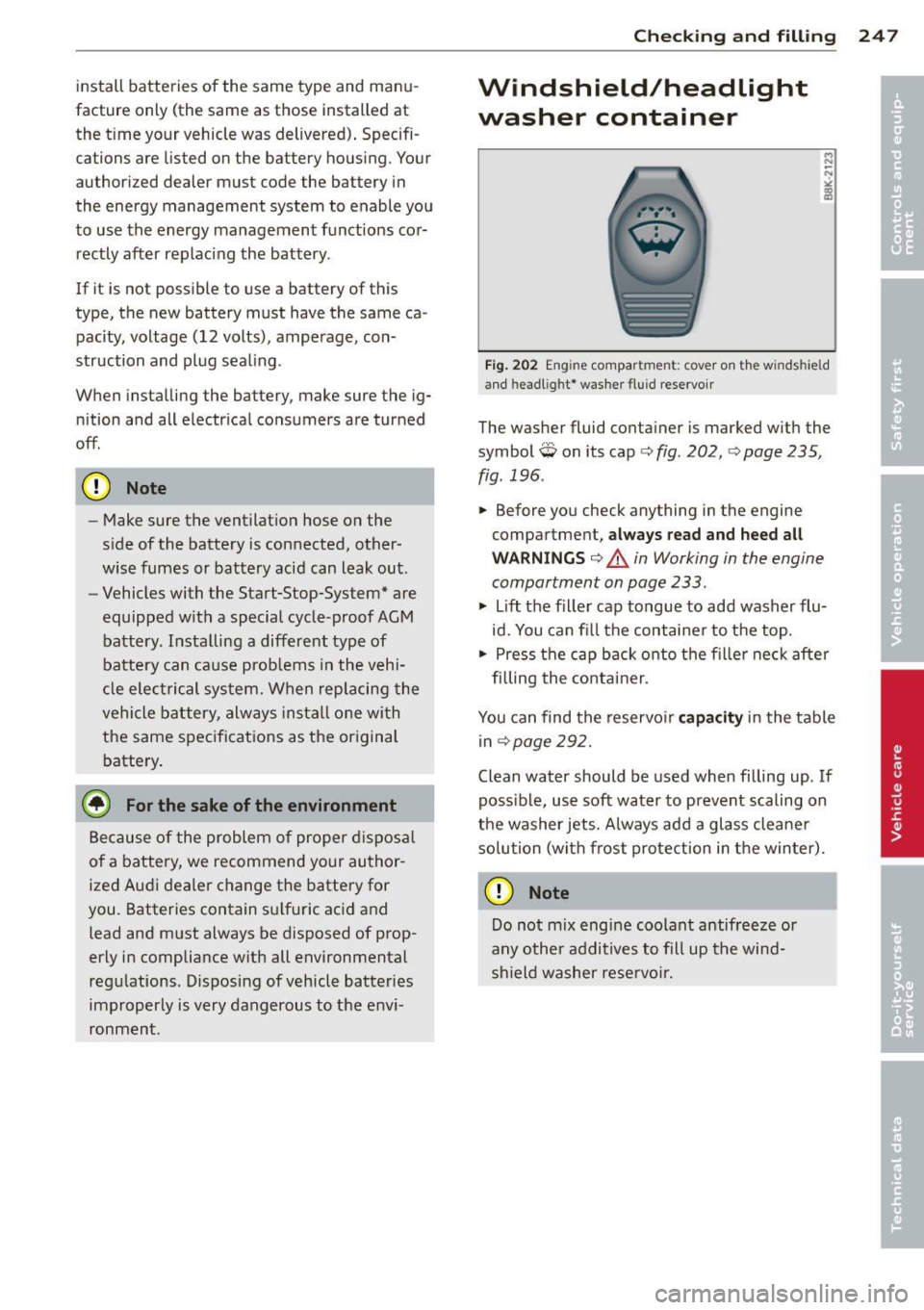
The washer fluid container is marked with the
symbol
Q on its cap c::> fig. 202, c::> page 235,
fig . 196 .
.., Before you check anything in the engine
compartment,
always read and heed all
WARNINGS c::> &. in Working in the engine
compartment on page 233 .
.., Lift the filler cap tongue to add washer flu
id . You can fill the container to the top.
.., Press the cap back onto the filler neck after
f illing the container.
You can find the reservoir
capacity in the table
in
c::> page 292.
Clean water should be used when filling up. If
possible, use soft water to prevent scaling on
the washer jets. A lways add a glass cleaner
solution (with frost protection in the winter).
(D Note
Do not mix engine coolant antifreeze o r
any other additives to fill up the wind
sh ield washer reservoir.
Page 250 of 316
248 Tire s and whee ls
Tires and wheels
Tires
General notes
Tires may be the least appreciated and most
abused parts of a motor vehicle .
Tires may be the least appreciated and most
abused parts of a motor vehicle. Tires are,
however, one of the most important parts of a
vehicle, particularly considering the compara
tive ly small patch of rubber on each tire that
assures that all -important contact between
you, your vehicle and the road.
Maintaining the correct tire pressure, making
sure that your vehicle and its tires do not have
to carry more weight than they can safe ly han
d le, avoiding damage from road hazards and
reg ularly inspecting t ires for damage includ
ing cuts, slashes irregu la r wear and overall
condition are the most important things that
you can do to he lp avoid sudden tire failure in
cluding tread separation and blowouts.
A vo idin g dama ge
I f you have to drive over a curb or similar ob
stacle, drive very slow ly and as close as possi
ble at a right angle to the curb.
A lways keep chem icals including grease, oil,
gasoline and b rake fluid off the tires.
Inspect the tires regularly for damage (cuts,
cracks or bl isters, etc.). Remove any foreign
bod ies embedded in the treads.
St orin g tire s
Mark tires when you remove them to indicate
the direction of rotation . Th is ensures you to
be ab le to mount them correctly when you re
install them.
When removed, the wheels or tires should be
stored in a cool, dry and preferably dark place .
Store tires in a vertical position if they are not mounted on rims, in a horizontal position if
they are mounted on rims. N
ew tir es
New t ires have to be broken in¢&,. .
The tread depth of new t ires may vary, accord
ing to the type and make of t ire and the tread
pattern .
Hidden damag e
Damage to tires and r ims is often not readily
vis ible . If you notice unusual vibrat ion or the
vehicle pulls to one s ide, th is may ind icate
that one of the t ires has been damaged . T he
t ir es must be checked immed iate ly by an au
tho rized Aud i dea le r or q ualified wor kshop.
Unidirecti onal t ires
A un idirectional tire can be identified by ar
rows on the sidewall, that po int in the direc
t ion the t ire is designed to rotate. You must
fol low the specified direction of rotation . This
is necessary so that these tires can develop
their optimum characteristics regarding grip, road noise, wear and hydrop laning resistance.
For more information ¢
page 2 78.
A WARNING
-New tires or tires that are old, worn or
damaged cannot provide maximum con
trol and braking ability .
-
-New tires tend to be slippery and must
also be broken-in. To reduce the risk of losing control, a collision and serious
pe rsonal injuries, drive w ith specia l care
for the first 350 miles (560 km).
- Driving with worn or damaged tires can lead to loss of control, sudden tire fail
ure, including a blowou t and sudden de
flation, c rashes and serious personal in
juries . Have worn or damaged tires re
p laced immediate ly.
- Tires age even if they are not being used
and can fai l sudden ly, especially at high
speeds. Tires that are more than 6 years
old can only be used in an emergency
and then w ith special care and at low
speed.
Page 258 of 316
256 Tire s and wheel s
-If the tire is not flat and you do not have
to change a wheel immed iately, drive at
reduced speed to the nearest service sta
t ion to check the tire pressure and add
air as required .
(D Note
Driving without va lve stem caps can cause
damage to the t ire valves . To prevent this,
always make sure that factory installed
valve stem caps on all wheels are securely mounted on the
valve .
@) For the sake of the environment
Underinf lated tires will a lso increase the
fue l consumption .
Tires and vehicle load limits
There are limits to the amount of load or
weight that any veh icle and any t ire ca n car ry.
A vehicle that is overloaded w ill not ha ndle
well a nd is more difficult to stop. Over load ing
can not on ly lead to loss of vehicle contro l,
but can a lso damage important parts of the
ve hicle and can lead to sudden tire failure , in
cluding a blowout and sudden deflation that
can cause the veh icle to crash .
Your safety and that of yo ur passenge rs a lso
depends on making sure that load limits are not exceeded. Vehicle load includes everybody
a nd everyth ing in and on the vehicle . T hese
load limits are tech nica lly refe rred to as the
ve hicle 's
Gross V ehicle Weight Rating
("GVWR").
The "GVWR" includes the we ight of the basic
vehicle, all factory insta lled accesso ries, a full
tank of fuel, oi l, coo la nt and othe r fluids pl us
maximum load. The maxim um load includes
the number of passengers that t he vehi cle is
intended to carry ("seating capacity") w ith an
assumed weight o f 150 lbs (6 8 kg) for each
passenger at a designated seating pos ition
and the tota l weight of any l uggage in th e
ve
hicle. If you tow a trailer, the weight of the
trailer hitch and the tongue weig ht of the loaded tra
ile r must be included as part of the
vehicle load .
T he
Gro ss Axle Weight Rating (" GAWR") is
the max imum load th at can be applied at e ach
of the vehicle's two axles .
T he Gross Vehicle Weight Rat ing and the
G ross Ax le Weight Ra ting are listed on the
sa fety comp liance s ticke r label lo cated on the
driver's side B-pillar. Your Audi has 5 seat ing
positions, 2 in the front and 3 in the rear fo r
total seat ing capac ity of 5. Each seating posi
t ion has a seat be lt
c:> page 149, Safety bel ts.
The fact that there is an upper limit to yo ur
vehicle's G ross Vehicle Weight Rating means
that the total weight of whatever is being car
ried in the vehicle ( includ ing the weight of a
tra iler hitch and the tongue weight of the
loaded tra iler) is lim ited . The more passen
gers in the vehicle or passenge rs w ho are
heavier than th e standard we ights assumed
mea n tha t less we ight can be carried as lug
gage .
T he t ire pressure label on your Aud i also lis ts
the max imum combi ned weig ht of a ll of the
occupants and luggage or other cargo that
the vehi cle can carry . For t he lo ca tion of the
label <=>page 252, fig. 203.
A WARNING
Overloading a vehicle can cause loss of ve
hi cle cont ro l, a c rash or other accident, se
rious personal injury, and even death.
- Ca rrying more we ight than your veh icle
was des igned to carry wi ll prevent the
veh icle from handling pr operly and in
crease the risk of the loss of vehicle con
trol.
- The brakes on a vehicle that has been
overloaded may not be able to stop the
veh icle w ith in a safe distance.
- Tires on a vehicle that has been overload
ed can fail s uddenly, including a blowout
a nd sudden defla tion, causing loss of
contro l and a c rash .
~
Page 261 of 316
A WARNING
Sudden tire failure can lead to loss of con
trol, a crash and serious personal injury!
- Never drive a vehicle when the tread on
any tire is worn down to the wear indica
tors.
- Worn tires are a safety hazard, they do
not grip well on wet roads and increase
your risk of "hydroplaning" and loss of
control.
- Always keep chemicals that can cause
tire damage, such as grease, oil, gasoline
and brake fluid away from t ires.
- Tires age even if they are not be ing used
and can fail suddenly, especially at high
speeds . Tir es that are more than 6 years
old can only be used in an emergency
and then with special care and at lower
speeds.
- Never mount used tires on your vehicle if
you are not sure of their" previous histo
ry ." Old used tires may have been dam
aged even though the damage cannot be
seen that can lead to sudden tire failure
and loss of vehicle control. Tires and wheels 259
New tires and replacing tires and wheels
New tires and wheels have to be broken in
.
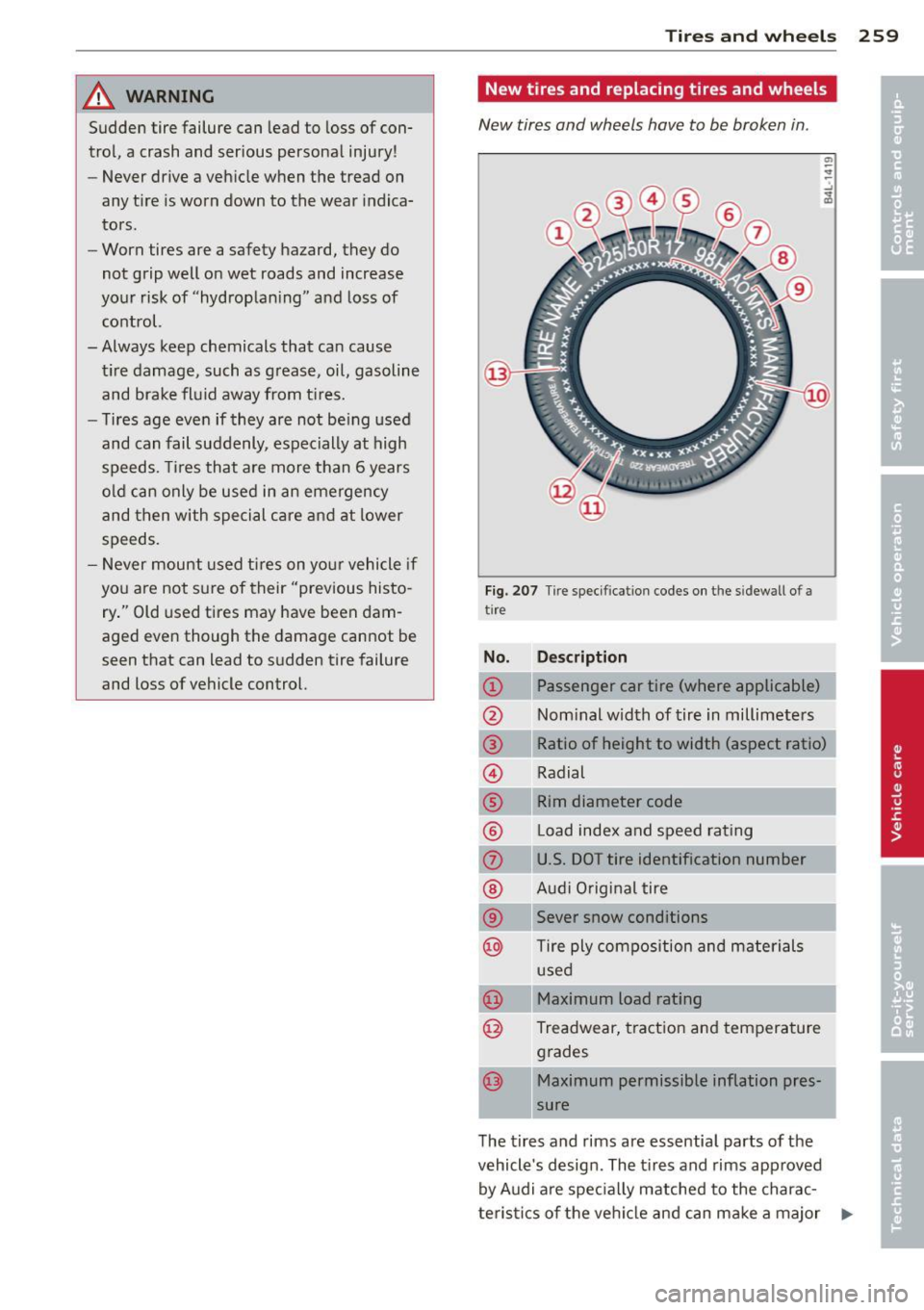
Fig. 207 Tir e specificat ion codes on t he s idewall o f a
tire
No. Description
CD Passenger car tire (where applicable)
@ Nominal width of tire in millimeters
® Ratio of height to width (aspect ratio)
© Radial
® Rim diameter code
® Load index and speed rat ing
(f) U.S. DOT tire identification number
® Audi Original tire
® Sever snow conditions
@ Tire ply composition and materials
used
@ Maximum load rating
@ Treadwear, traction and temperature
grades
@ Maximum permissible inflation pres-
sure
The tires and rims are essential parts of the
vehicle's design . The tires and rims approved
by Audi are specially matched to the charac
teristics of the vehicle and can make a major .,.
•
Page 294 of 316
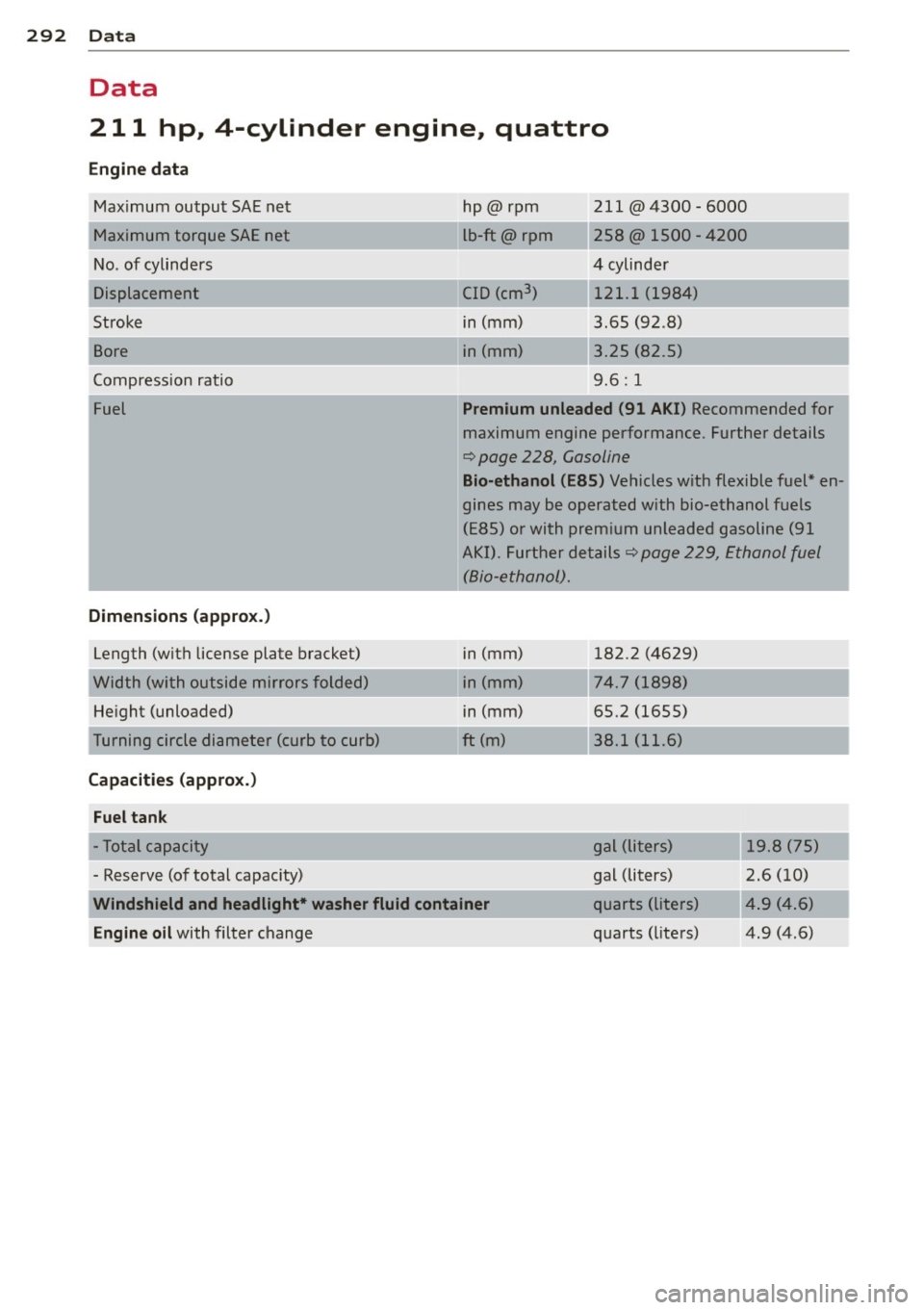
292 Data
Data
211 hp, 4-cylinder engine, quattro
Engine data
Maximum output SA E ne t
M aximum torque SAE net
No . of cylinders
Displacement
Stroke
Bore
C ompression ratio
Fuel
Dimensions (approx.)
Length (with license plate bracket)
W idth (with outside mirrors folded)
He ight (unloaded)
Tu rning circle di ame ter (curb to c urb)
Capacities (approx.)
Fuel tank
h p@rpm
l b-ft@rpm
C ID (cm
3
)
in (mm)
i n (mm) 211 @4300 - 6000
258@ 1500 -
4200
4 cylinde r
121.1 (1984)
3.65 (92 .8)
3 .25 (82.5)
9.6: 1
Premium unleaded (91 AKI ) Recommended for
m aximum engine performance. Further details
¢ page 228, Gasoline
Bio-ethanol (E85 ) Vehicles with flexible fuel* en
g ines may be operated with bio-ethanol fuels
( E85) or with premium unleaded gasoline (91
A KI). Further details~ page 229, Ethanol fuel
(Bio-e thanol) .
in (mm)
i n (mm)
i n (mm)
ft
(m)
182.2 (4629)
74 .7 ( 1898)
65.2 (1655)
3 8 .1 ( 11.6)
- To tal cap acity gal (
liters)
-------------
1 9.8 (75)
2 .6 ( 10)
- Reserve (o f total capacity) gal (liters)
Windshield and headlight* washer fluid container
Engine oil
with filter change quarts (liters)
q
uarts (liters) 4.9 (4 .6)
Page 295 of 316
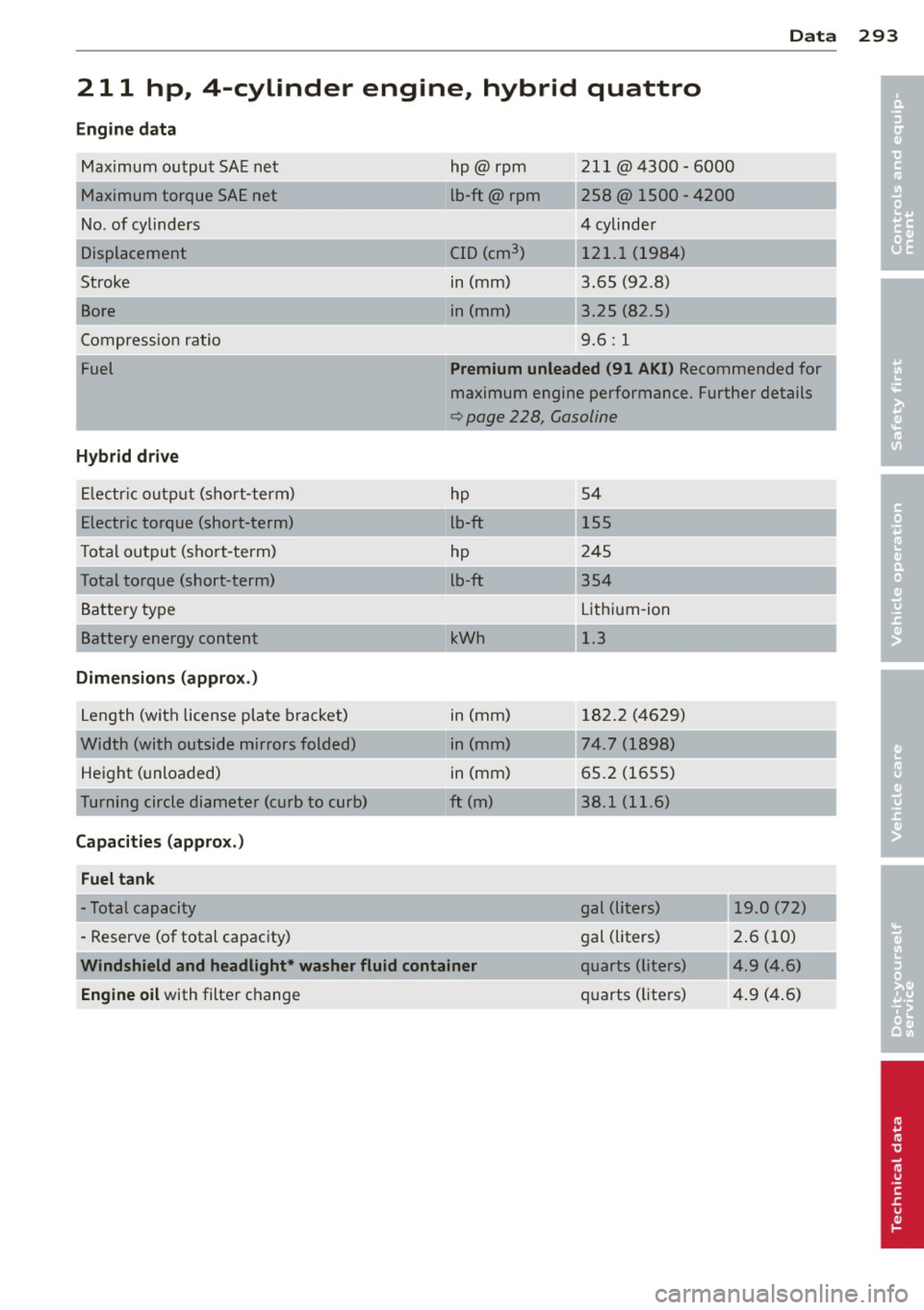
Data
211 hp, 4-cylinder engine, hybrid quattro
Engine data
Maximum output SAE net
Maximum torque SAE net
No . of cylinders
Displacement
Stroke
Bore
Compression ratio
Fuel
Hybrid drive
Electric output (short-term)
Electric torque (short-term)
T otal output (short-term)
Total torque (short-term)
Battery type
Battery energy content
Dimensions (approx.)
Length (with license plate bracket)
Width (with outside mirrors folded) Height (unloaded)
Turning circle diameter (curb to curb)
Capacities (approx.)
Fuel tank
- Total capacity
- Reserve (of total capacity) hp@rpm
lb-ft@ rpm
-~,
ClD (cm3
)
in (mm)
in (mm) 211 @4300
-6000
258@ 1500 -4200
4 cylinder 121.1 (1984)
3.65 (92 .8)
3.25 (82 .5)
9.6: 1
Premium unleaded (91 AKI) Recommended for
maximum engine performance. Further details
c:> page 228, Gasoline
hp 54
lb-ft 155
hp 245
lb-ft 354
Lithium-ion
kWh 1.3
in (mm) 182.2 (4629)
in (mm) 74.7 (1898)
in (mm) 65.2 (1655)
ft (m)
38.1 (11.6)
gal (liters) 19 .0 (72)
gal (liters) 2.6 (10)
Windshield and headlight* washer fluid container quarts (liters) 4.9 (4.6)
Engine
oil with filter change quarts
(liters) 4 .9 (4 .6)
293
•
•
Page 296 of 316
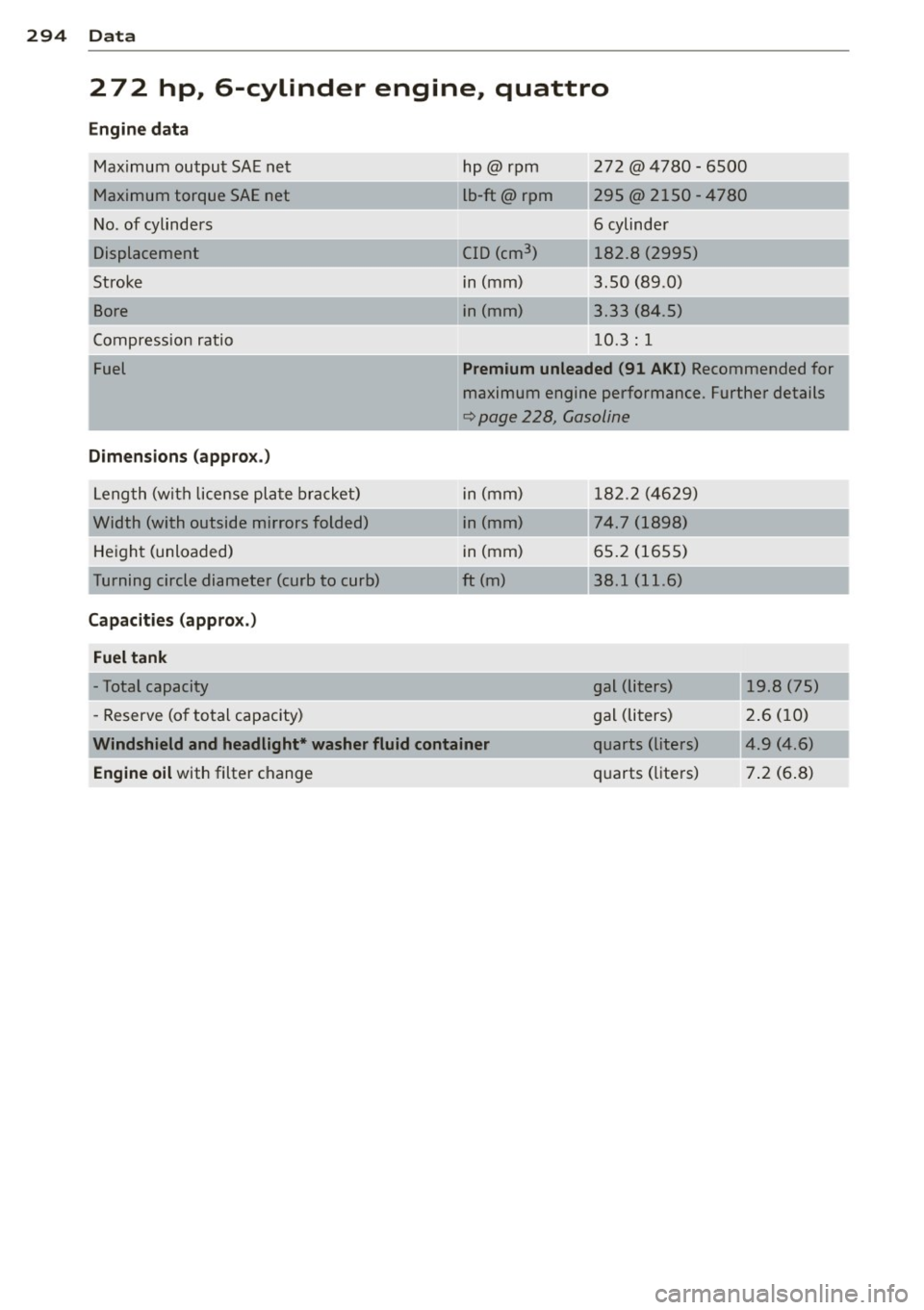
294 Data
2 72 hp, 6-cylinder engine, quattro
Engine data Maximum output SAE net
Maximum torque SAE net
N o. of cylinders
Displacement
Strok e
Bore
C ompression ratio
Fuel
Dimensions (approx .)
Leng th (wit h license pl ate brac ket)
Width (with outside mirrors folded) He igh t (unloaded)
T urning circle diamet er (curb to curb)
Capacities (appro x.)
Fuel tank
- Total capacity
- Reserve (o f to tal capacity) h
p@rpm
L b-ft@ rpm
C ID (cm
3
)
in (mm)
i n (mm) 272 @4780 - 6500
295@ 2
150- 4780
6 cylinde r
182.8 (2995)
3.50 (89.0)
3 .33 (84.5)
1 0.3 : 1
Premium unleaded (91 AKI) Recommended for
m aximum engine performance. Further details
¢ pag e 228, Gasoline
i n (mm) 1 82.2 (4 629)
i n (mm)
74.7 (1898)
i n (mm) 65.2 (165 5)
ft (m) 38.1 (11.6)
gal (liters) 19.8 (75)
g al (li ters) 2.6 (1 0)
Windshield and headlight* washer
fluid container quarts (liters) 4.9 (4.6)
Engine oil with filter c hange q
uarts (lite rs) 7 .2 (6 .8)
Page 299 of 316
-Always make sure the transm ission se
lector lever (automatic transmiss ion) is
in P (Park position) and the park brake is
applied.
@) For the sake of the environment
- Changing the eng ine settings w ill ad
versely affect em ission levels. This is det
rimental to the environment and increas
es fuel consumption .
- Always observe env ironmental regula
tions when d isposing of old engine oil,
used brake fluid, dirty engine coolant,
spent batter ies or worn out t ires.
- Undeployed airbag modules and preten
s ioners might be classified as Perchlo
rate Material -specia l hand ling may ap
ply, see www.dts c.ca .gov/hazardous
waste/perch lorate. When the veh icle or
parts of the restraint system includ ing
airbag modules safety belts with preten
sioners are scrapped, all applicable laws
and regulations must be observed. Your
a uthorized Audi dea ler is familiar w ith
these requirements and we recommend
that you have your dea ler perform this
serv ice for you .
Additional accessories,
modifications and
parts replacement
Additional accessories and parts
replacement
Always consult an authorized Audi dealer be
fore purchasing accessories.
Your veh icle incorporates the latest safety de
sig n featu res ensu ring a high standard of ac
tive and passive safety.
This safety could be compromised by non-ap proved changes to the veh icle. For this reason,
if parts have to be replaced, please observe
the following points when install ing addition
a l accessories:
Con sumer In formation 297
Approved Audi accesso ries and genuine Audi
parts are available from authorized Audi deal
ers.
T hese dea lers a lso have the necessary facili
ties, tools and trained specialists to install the
parts and accessories proper ly.
A WARNING
Using the wrong spare parts or using non
approved accessories can cause damage to
the vehicle and serious persona l injury.
- Use on ly accessories express ly approved
by Audi and genu ine Audi spare parts
- These parts and accessories have been
specially designed to be used on your ve
hicle .
- Never install accessories such as tele
phone cradles or beverage holders on air
bag covers or within the airbag deploy
ment zones . Do ing so will increase the
risk of injury if a irbags are triggered in an
accident!
- Before you check anything in the engine
compa rtment, always read and heed all
WARNINGS ~
page 226.
(D Note
-If items other than genuine Audi spare
parts, add-on equipment and accessory
items are used or if repair work is not
performed accord ing to specified meth
ods, this can result in severe damage to
your vehicle's engine and body (such as
corrosion) and adversely affect your vehi
cle's warranty .
- If emergency repairs must be performed
elsewhere, have the vehicle examined by
an authorized Audi dealer as soon as
possible.
- The manufacturer cannot be held liable
for damage wh ich occurs due to failure
to comply with these stipulations.
•
•
Page 302 of 316
300 Index
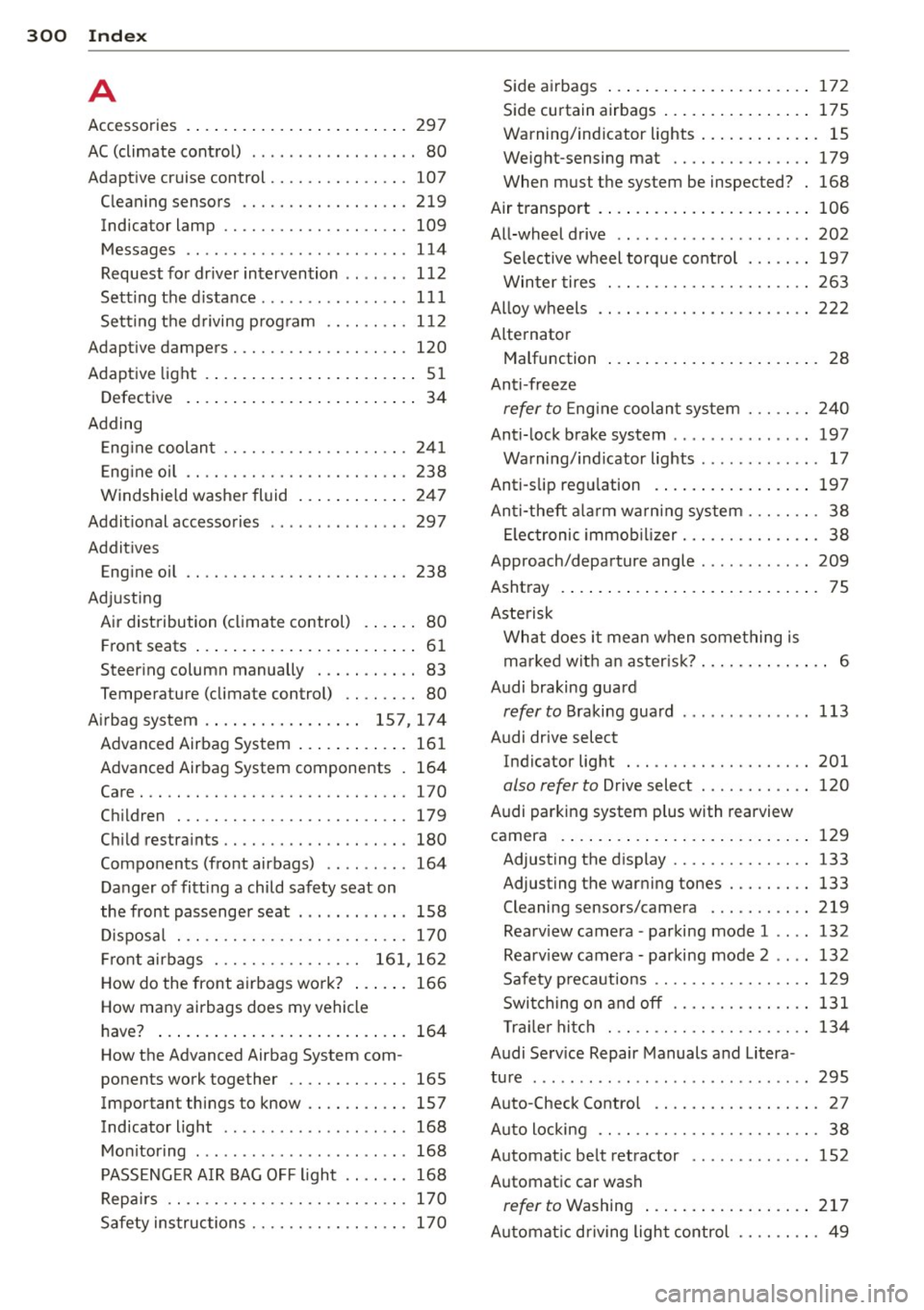
A
Accessories 297
AC (climate control) . . . . . . . . . . . . . . . . . . 80
Adaptive cruise control . . . . . . . . . . . . . . . 107
Cleaning sensors ......... .. .. .... . 219
Indicator lamp . . . . . . . . . . . . . . . . . . . . 109
Messages .. ..... ........... ... .. . 114
Request for dr iver intervention . . . . . . . 11 2
Setting the d istance ........ ... .. ... 111
Setting the d riving p rog ram .. .. .... . 112
Adapt ive dampers . . . . . . . . . . . . . . . . . . . 120
Adaptive light . .. . ...... ... ... ..... .. 51
Defective . . . . . . . . . . . . . . . . . . . . . . . . . 34
Adding
E . l ngine coo ant ........... .. .. .... . 241
E ng ine oi l ............... .. .. .. .. . 238
W indshie ld washer fluid ... .. .. .... . 247
Addit ional accesso ries ... ... .. .. .. .. . 297
Additives
Eng ine oil .... ........... .. .. .... .
238
Adjusting
A ir dist ribution (climate control) . .... .
80
Front seats .... .. ..... ... .. .. .... .. 6 1
Steer ing column manually . .. .. .... .. 83
Temperature (climate control) .. .. .. . . 80
A irbag system . . . . . . . . . . . . . . . . . 157, 174
Advanced Airbag System ... .. .. .... . 161
Advanced Airbag System components . 164
Care . .. .. ............... .. .. .... . 170
Chi ldren . ............... .... .... . 179
Ch'ld t .
1 res ra 1nts ........... .. .. .. .. . 180
Components (front airbags) .. .. .. .. . 164
Danger of fitting a child safety seat on
the front passenger seat . .. .. .. .... .
158
Disposa l ..... ........... .. .. .. .. . 170
Fr ont airbags . . . . . . . . . . . . . . . . 16 1, 16 2
How do the front airbags work? ..... . 166
How many airbags does my vehicle
have? ..... ... .. ..... ... .. .. .... .
164
How the Advanced Airbag System com-
ponents work together ...... .. .... .
165
Important things to know .. .. .. .. .. . 157
Ind icator light ..... ...... .. .. .. .. . 168
Monitoring . ................ ... ... 168
PASSENG ER A IR BAG OFF light .. .. .. . 168
Repa irs .. .. .. . .......... .. .. .. .. . 170
Safety ins tructions ........ .. .. .. .. . 170
S ide a irbags ..... ... .. ..... .... . .. 172
Side curtain airbags .... ..... ... .. .. 175
Warning/ind icator lights ..... ... .. .. . 15
w. ht .
e1g -sensing mat . . . . . . . . . . . . . . . 179
When must the system be inspected? . 168
Air t ransport . ..... .. ... ..... ... .. .. 106
All-wheel drive .. .. ................ . 202
Selective wheel torque co ntrol . . . . . . . 19 7
Winter tires ... .. ............. .... 2 63
Al loy wheels .... .. ... .......... .... 222
Alternator
Malfunction . . . . . . . . . . . . . . . . . . . . . . .
28
Anti-free ze
refer to E ng ine coolan t sys tem ... .. .. 2 40
Anti- lock brake system .............. . 197
Warning/ind icator lights .. ... ..... .. . 17
Anti-slip reg ulation . .. .. ..... .... . .. 197
An ti-theft a la rm warn ing system . .. .. .. . 38
El ectronic immob il iz er .......... .... . 38
Approach/depa rture angle ........... . 209
Ashtray .... .... .. .. ... .. ..... ... .. . 75
Aste risk
What does it mean when something is
ma rked wit h an as ter isk? ..... ... .. .. .. 6
Audi braking guard
refer to Braking gua rd ............. . 113
Audi drive select
Indicator lig ht . .. ............. .. ..
201
also refer to Drive select .. ...... .... 120
Audi parking system plus with rearview
camera . ... .... .. .. ... .. ..... ... ..
129
Adjusting the d isplay ............. .. 133
Adjusting the war ning tones ..... .... 133
Cleaning sensors/camera ... .... .. .. 219
Rearv iew camera -parking mode 1 ... . 132
Rea rv iew camera -parking mode 2 .. .. 132
Safety p recautio ns ............. .... 129
Swi tch ing on a nd off ........... .... 131
Tra ile r hi tch . .. .. ... .......... .... 134
Audi Serv ice Repair Manuals a nd Litera -
ture . .. ... ... .. .. .. ... ... ... .. .. ..
295
Auto-Check Contro l . . . . . . . . . . . . . . . . . . 27
A ut o locking . . . . . . . . . . . . . . . . . . . . . . . . 38
Automat ic be lt retractor . .. ... ..... .. 152
Automatic car wash
refer to Washing ... ... ..... ... .. .. 217
A utomat ic d riving light control ...... .. . 49