tow AUDI Q5 2013 Owner's Guide
[x] Cancel search | Manufacturer: AUDI, Model Year: 2013, Model line: Q5, Model: AUDI Q5 2013Pages: 316, PDF Size: 78.89 MB
Page 216 of 316
214 Trailer towing
• Do not drive at the maximum permissible
speed.
• Always apply brakes early .
• Monitor the temperature gauge.
W eig ht distribution
Towing a loaded tra ile r with an empty car re
sults in a highly unstable distribution of
weight . If this cannot be avoided, drive at very
low speeds only to avoid the risk of losing
steering control.
A "balanced" rig is easier to operate and con
trol. This means that the tow vehicle should
be loaded to the extent possible and permissi
b le, while keeping the trailer as light as possi
ble under the circumstances. Whenever possi
ble, transfer some cargo to the luggage com
partment of the tow vehicle wh ile observing
tongue load requirements and vehicle loading
considerations .
Speed
The higher the speed, the more difficult it be
comes for the driver to control the rig . Do not
drive at the maximum permissible speed . Re
duce your speed eve n mo re if load, weathe r or
wind condi tions are unfavorable -part icu larly
when going dow nhill.
Reduce vehicle speed immediately if the t rail
e r shows the slightest sign of swaying. Do not
tr y to s top the sw ayin g by acce ler atin g.
Observe speed limits . In some areas, speeds
for vehicles towing trailers are lower tha n for
regula r vehicles.
Always apply brakes early . When driv ing
downhill, shift into a lower gear to use the en
g ine b raking effect to slow the vehicle. Use of
the brakes alone can cause them to overheat
and fail.
Coolant temperature
T he coolant temperature gauge
c:> page 10
must be observed carefully . If the needle
moves close to the upper end of the scale , re
duce speed immed iate ly and/or turn off the
a ir cond itione r. If the coolant temperature warning light in
the instr ument cluster starts flashing., pull
off the road, stop and let the engine
idle for
about two minutes to prevent heat build-up.
A WARNING
Anyone not properly restrained in a mov
i ng vehicle is at a much greater risk in a n
accident . Never let anyone ride in your ca r
who is not p roperly wea ring the rest raints
p rov ided by Audi.
Trailer towing tips
Important to know
Your vehicle handles d ifferently when towing
-
a trai ler because of the additional weight and
different weight distr ibut ion. Safety, perform
ance and economy will greatly depend on how ca refully you load your trai ler and ope rate
you r rig.
Befo re you actually tow your tra iler, practice
turning, stopping and backing up in an area
away from t raffic. Keep pract ic ing unt il you
have become completely familiar wit h the way
yo ur vehicle-tra iler combination behaves and
responds.
Backi ng up is difficult and requ ires practice.
Backi ng up w ith a t railer gene rally requires
stee ring action opposite to tha t when backing
u p you r vehicle witho ut a tr ailer.
Maintai n a greater d ista nce between your ve
hicle and the one in front of you. You w ill need
more room to stop. To compensate fo r the
t railer, you w ill need a larger than normal
tu rning rad ius.
When passing, remembe r that you cannot ac
ce le rate as fas t as you no rma lly would be
ca use of the added load. Make sure yo u have
enough room to pass . After passing, a llow
plenty of room for yo ur trailer before cha ng
ing lanes again.
Avoid jer ky s tarts, sharp t urns o r rapid lane
changes.
Page 217 of 316
@ Tips
-Do not tow a traile r during the break-in
period o f your vehicle .
- If you tow a t railer, your A udi may re
quire more frequent maintenance due to
the extra load
¢ page 295.
Parking on a slope
Do not park on a slope with a trailer. If it can
not be avoided, do so only after doing the fol
lowing:
When parking:
.,. Apply t he foo t brake .
.,. Have someone place c hocks under bo th the
vehicle and the trai ler whee ls .
.,. With chocks in p lace, s lowly re lease the
brakes unti l th e wheel chocks absorb the
l oad .
.,. Turn the wheels towards the curb .
.,. Apply t he pa rking brake .
.,. Mov e the sel ecto r leve r to P .
When restarting after parking:
.,. Apply the foot brake .
.,. Start the eng ine .
.,. Move the selecto r lever to D/S .
.,. Re lease th e par kin g b rake and slowly pull
out and away from the whee l cho cks .
.,. Stop and have someone re tr ieve the w hee l
chocks.
(D Tips
If you move the selector lever of t he a uto
mat ic t ran sm ission to P before app lyi ng
t he p ark in g br ake an d bef ore blocking the
wheels, you may have to use mo re force
later to move the lever out of t he P posi
tion.
Trailer towin g 215
•
•
Page 223 of 316
Aluminum trim
Use only neutral -pH products to remove spots
and depos its from alum in um s urfaces.
Chrome care products and alkaline cleaners
will attack aluminum surfaces and can dam
age them over time.
A WARNING
Always read and heed all WARNINGS and other information ¢
page 216.
Touch-up paint
Minor paint damages should be touched up
immediately.
"" Use either a touch-up pa int stick or spray
paint to cover minor scratches and nicks.
Your author ized A udi dealer has touch-up
pa int for minor sc ra tches and stone ch ips.
Scratches shou ld be touched up soon after
they occur to prevent corrosion .
If a spot starts to rust, howeve r, a simple
t ouch- up job w ill not be enough. The affected
sur face must be sanded smooth and coated
with an anti-r ust primer before the painted
finish can be restored.
The number for the origina l vehicle paint can
be found on the vehicle identi ficat ion labe l
¢page 290.
A WARNING
Always read and heed a ll WARNINGS and
other information
¢ page 216.
Windows
Clear vision to all sides .
Clea n all windows regularly to remove road
fi lm and ca r wash wax b uild up.
"" Remove snow from windows using a brush .
"" Use a plast ic ice scraper to remove ice from
windows and mirro rs.
"" Remove other res idue on the windows with
a sp ray -on glass cleaner.
Cleaning and protec tion
"" Wipe the windows dry with a clean piece of
cloth or kitchen paper towe l.
T he best way to remove snow from windows
and mirrors is to use a brush . Use a non-abra
sive
plastic ice scrape r -better sti ll, a spray
deicer - to remove
ice from windows and mir
rors.
T he windows must not be cleaned with insect
remover or wax since these can interfere with
the function of the windshie ld w iper blades
(chatter) .
Oil, grease, o r si licone residue can be removed
with
gla ss cleane r or silicone remove r. How
ever, wax residue requires the use of a specia l
ly formulated so lvent. Please contact your au
thori zed Audi dealer for advice on safe prod
ucts for wax removal.
Windows should also be cleaned on the inside
at regu lar intervals .
Never dry windows wit h the same chamo is
that you use to dry painted surfaces . Wax resi
due o n the chamois can impair vision through
the windows .
A WARNING
-Always read and heed all WARNINGS and
other information ¢
page 216.
-The windsh ield must not be treated with
water-repellent materials. They can in
crease glare under poor v is ibility condi
tions such as wetness, darkness, or when the sun is low on the hor izon. In addi
tion, they can ca use the w indshie ld w ip
ers to ch atter.
@ Note
- Never use warm o r hot wate r to remove
snow and ice from w indows and mirro rs.
T his could cause the glass to crack.
- T o prevent damage to the wires of the
rear defogger, do not place any adhesive
st ic kers on the ins ide of the rear w indow
over the wires.
221
•
•
Page 227 of 316
By contrast, leather types that are covered by
a co lored finish layer are more durable. This
has a posit ive effect on the leather's resist
ance to wear and soiling in daily use. On the
other hand, the typical characterist ics of natu
ral leather are barely or not apparent . Howev
er, this does not mean that the leather itself
i s of infer ior quality.
C ar e and h and ling
Because of the exclusive nature of the types of
leather that Audi uses and the ir unique prop
erties (such as sensitivity to o ils, grease, so il
ing, etc.), you will need to be somewhat care
fu l w ith these leathers, and a certain type of
care is required. For examp le, da rk clot hing
materia ls can d iscolor leather seats (especial
l y i f such clothing is damp and was not dyed
correctly) . Dust and dirt particles in pores,
fo lds, and seams can have an abrasive effect
and can damage the leather surface as we ll as
weaken seams.
The leather sho uld be cleaned regularly as
needed. After having been used for a re lative ly
long time, your leather seats will acquire a
rich aged finish. This is a characteristic of nat
ura l leather and a sign of true quality.
In order to maintain the va lue of this natura l
product over the life of your vehicle, you
should follow the recommendations below:
(D Note
- To keep your leather from bleaching out,
do not a llow it to be exposed to bright
sunlight for long periods of time. If you
have to leave the vehicle parked outside
for long periods, cover the leather to
protect it from d irect exposure to su n
light.
- Sharp objects on clothing, such as zip
pers, rivets or sharp pieces on be lts can
l eave pe rmanent scratches o r sc rape
mar ks on the surface of the lea ther.
{O) Tips
-After each time you clean the leathe r and
at regu la r i nte rva ls, use a leather prese r-
Cleaning and protec tion 225
vative c ream that contains UV -b locke rs
and that works into the leather. This
cream wi ll nour ish and mo isturize the
leather, helping it to breathe and stay
supple. It also helps to build up a protec
t ive coating on the surface.
- Clean the leather every 2 - 3 months,
and clean any areas that get soiled.
- Remove fresh marks made by ballpo int
pens, ink, lipstick, shoe polish, etc. as
soon as poss ible.
- Preserve the color of the leather as need
ed by us ing a specia l co lored leather care
cream to touch up areas of uneve n color .
Cleaning and caring for leather
upholstery and trim
Applies to vehicles: wi th natural leather
Natural leather requires special care and at
tention .
Normal cleaning
.. Clean soiled areas with a slightly moistened
cotton or woolen cloth.
More stubborn dirt
.. More st ubborn dirt can be removed using a
cloth saturated with a mild soap solut ion
(2
tablespoons mild liquid soap).
.. Never allow the soap solution to saturate
the leather, and make certain that no water
soaks into the seams .
.. Wipe off the soap so lution with a soft, dry
cloth.
Cleaning spo ts
.. Remove fresh water-based spots (such as
coffee, tea, juices, blood) with an absorbent
cloth or pape r towel.
.. Remove fresh
grease or oil -based spots
(suc h as bu tte r, mayonnaise, chocolate) with
an absorben t cloth or paper towel, o r use
t he cleaner from the leather care kit if the
spot has not yet penetrated into t he surface
of the leathe r.
.. Use an oil/grease dissolving spray, if
oil /
grease spots ha ve dried on.
•
•
Page 258 of 316
256 Tire s and wheel s
-If the tire is not flat and you do not have
to change a wheel immed iately, drive at
reduced speed to the nearest service sta
t ion to check the tire pressure and add
air as required .
(D Note
Driving without va lve stem caps can cause
damage to the t ire valves . To prevent this,
always make sure that factory installed
valve stem caps on all wheels are securely mounted on the
valve .
@) For the sake of the environment
Underinf lated tires will a lso increase the
fue l consumption .
Tires and vehicle load limits
There are limits to the amount of load or
weight that any veh icle and any t ire ca n car ry.
A vehicle that is overloaded w ill not ha ndle
well a nd is more difficult to stop. Over load ing
can not on ly lead to loss of vehicle contro l,
but can a lso damage important parts of the
ve hicle and can lead to sudden tire failure , in
cluding a blowout and sudden deflation that
can cause the veh icle to crash .
Your safety and that of yo ur passenge rs a lso
depends on making sure that load limits are not exceeded. Vehicle load includes everybody
a nd everyth ing in and on the vehicle . T hese
load limits are tech nica lly refe rred to as the
ve hicle 's
Gross V ehicle Weight Rating
("GVWR").
The "GVWR" includes the we ight of the basic
vehicle, all factory insta lled accesso ries, a full
tank of fuel, oi l, coo la nt and othe r fluids pl us
maximum load. The maxim um load includes
the number of passengers that t he vehi cle is
intended to carry ("seating capacity") w ith an
assumed weight o f 150 lbs (6 8 kg) for each
passenger at a designated seating pos ition
and the tota l weight of any l uggage in th e
ve
hicle. If you tow a trailer, the weight of the
trailer hitch and the tongue weig ht of the loaded tra
ile r must be included as part of the
vehicle load .
T he
Gro ss Axle Weight Rating (" GAWR") is
the max imum load th at can be applied at e ach
of the vehicle's two axles .
T he Gross Vehicle Weight Rat ing and the
G ross Ax le Weight Ra ting are listed on the
sa fety comp liance s ticke r label lo cated on the
driver's side B-pillar. Your Audi has 5 seat ing
positions, 2 in the front and 3 in the rear fo r
total seat ing capac ity of 5. Each seating posi
t ion has a seat be lt
c:> page 149, Safety bel ts.
The fact that there is an upper limit to yo ur
vehicle's G ross Vehicle Weight Rating means
that the total weight of whatever is being car
ried in the vehicle ( includ ing the weight of a
tra iler hitch and the tongue weight of the
loaded tra iler) is lim ited . The more passen
gers in the vehicle or passenge rs w ho are
heavier than th e standard we ights assumed
mea n tha t less we ight can be carried as lug
gage .
T he t ire pressure label on your Aud i also lis ts
the max imum combi ned weig ht of a ll of the
occupants and luggage or other cargo that
the vehi cle can carry . For t he lo ca tion of the
label <=>page 252, fig. 203.
A WARNING
Overloading a vehicle can cause loss of ve
hi cle cont ro l, a c rash or other accident, se
rious personal injury, and even death.
- Ca rrying more we ight than your veh icle
was des igned to carry wi ll prevent the
veh icle from handling pr operly and in
crease the risk of the loss of vehicle con
trol.
- The brakes on a vehicle that has been
overloaded may not be able to stop the
veh icle w ith in a safe distance.
- Tires on a vehicle that has been overload
ed can fail s uddenly, including a blowout
a nd sudden defla tion, causing loss of
contro l and a c rash .
~
Page 259 of 316
-Always make sure that the total load be
ing transported - including the weight of
a trailer hitch and the tongue weight of a
loaded trailer -does not make the vehi
cle heav ier than the vehicle's Gross Vehi
cle Weight Rating.
Determining correct load limit
Use the example below to cal
culate the total weight of the
passengers and luggage or oth
er things that you plan to trans
port so that you can make sure
that your vehicle will not be
overloaded.
Steps for Determining Correct Load Limit
1. Locate the statement "THE
COMBINED WEIGHT OF OC
CUPANTS AND CARGO
SHOULD NEVER EXCEED XXX KG OR XXX LBS" on your ve
hicle's placard (tire inflation
pressure label)
¢ page 252,
fig. 203.
2. Determine the combined
weight of the driver and pas sengers that will be riding in
your vehicle.
3. Subtract the combined
weight of the driver and pas sengers from
"XXX" kilo
grams or
"XXX" pounds
Tires and wheels 257
shown on the sticker
¢page 252, fig. 203.
4. The resulting figure equals
the available amount of car
go and luggage load capaci
ty. For example, if the
"XXX"
amount equals 1400 lbs.
and there will be five
150
lbs. passengers in your vehi
cle, the amount of available
cargo and luggage load ca
pacity is
650 lbs. (1400-7 50
(5
X 150) = 650 lbs.)
5. Determine the combined
weight of luggage and cargo being loaded on the vehicle.
That weight may not safely
exceed the available cargo
and luggage load capacity
calculated in Step
4.
6. If your vehicle will be towing
a trailer, load from your trail
er will be transferred to your
vehicle. Consult this manual
to determine how this re duces the available cargo
and luggage load capacity of
your vehicle.
.,. Check the tire sidewall
(¢ page 259, fig. 207) to de
termine the designated load rating for a specific tire.
•
•
'
Page 271 of 316
What do I do now?
Jack, tools and
inflatable spare tire
Onboard tool kit and vehicle jack
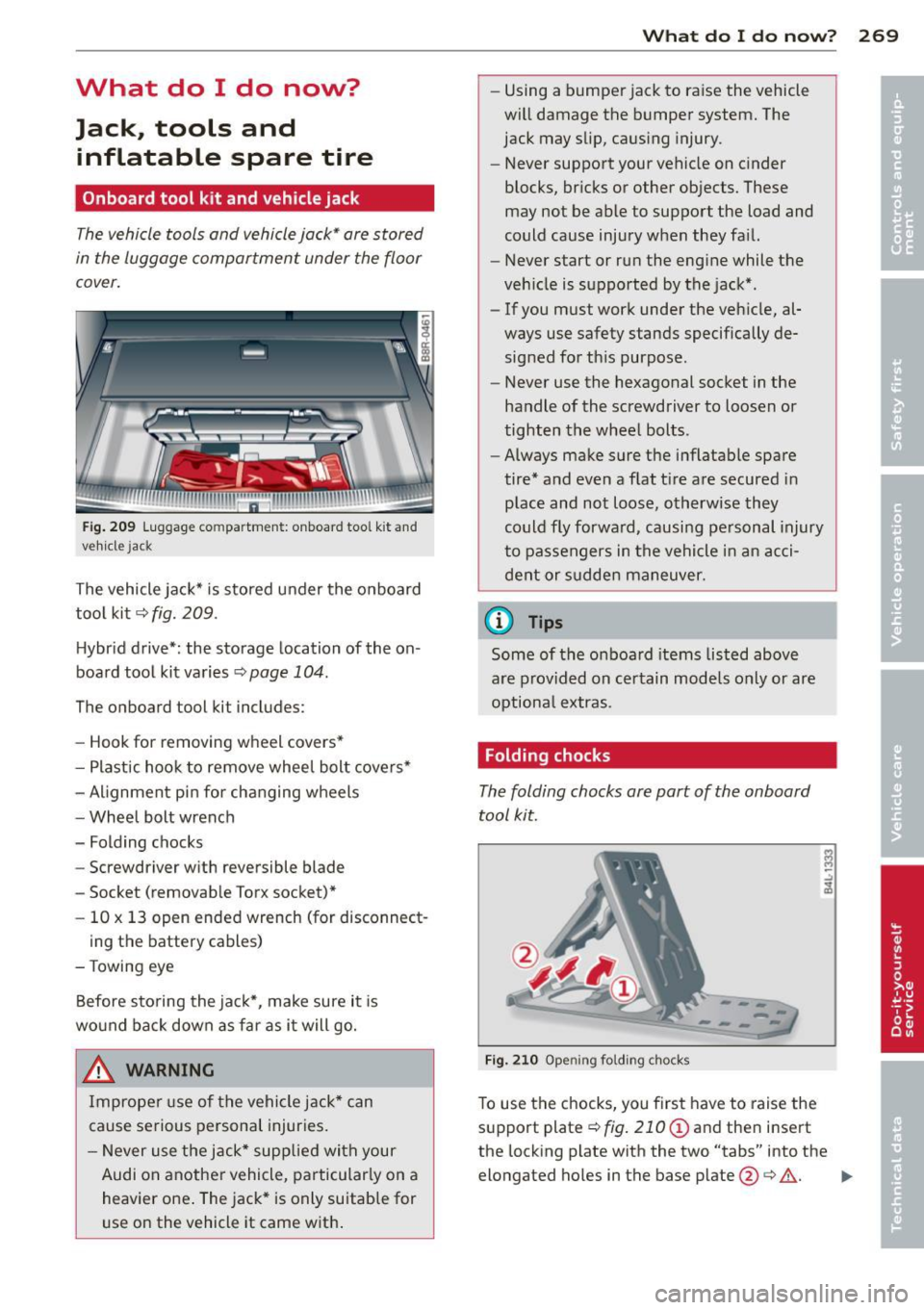
The vehicle tools and vehicle jack* are stored
in the luggage compartment under the floor
cover.
Fig . 209 Luggage co mpa rtment: onboard too l kit and
v e hicle jack
The vehicle jack* is sto red under the on board
tool kit¢
fig. 209.
Hybr id drive*: the storage location of the on
board tool kit varies
¢ page 104.
The on board tool kit includes:
- Hook for removing wheel covers*
- Plastic hook to remove wheel bolt covers*
- Al ignment p in for changing wheels
- Wheel bolt wrench
- Folding chocks
- Screwdriver with reversible blade
- Socket (removable Torx socket)*
- 10 x 13 open ended wrench (for disconnect-
ing the battery cables)
- Towing eye
Before storing the jack*, make sure it is
wound back down as far as it will go.
A WARNING
Imprope r use of the vehicle jack* can
cause serious personal injuries.
- Never use the j ack* supplied with your
Audi on another vehicle, particularly on a heavier one . The jack* is only suitable for
use on the vehicle it came with .
What do I d o now ? 269
-Using a bumper jack to ra ise the vehicle
will damage the bumper system. The
jack may slip, causing injury.
- Never support your vehicle on cinder
blocks, br icks or other objects. These
may not be able to support the load and
could cause injury when they fa il.
- Never start or run the engine while the
veh icle is supported by the jack* .
- If you must work under the vehicle, al
ways use safety stands specifically de signed for th is purpose .
- Never use the hexagonal socket in the
handle of the screwdriver to loosen or
tighten the wheel bolts .
- Always make sure the inflatable spare
tire* and even a flat tire are secured in
place and not loose, otherwise they
could fly forward, causi ng personal injury
to passengers in the vehicle in an acci
dent or sudden maneuver.
(0 Tips
Some of the on board items listed above
a re provided on certain models only or are
optiona l extras.
Folding chocks
The folding chocks are part of the on board
tool kit.
Fig . 210 Ope ning folding chocks .
To use the chocks, you first have to raise the
support plate¢
fig. 210 (D and then insert
the locking plate with the two "tabs" into the
elongated holes in the base plate@¢& . ""
Page 272 of 316
2 70 What do I do now ?
& WARNING
-The ch ock cannot fulfil its function and
may lose its stab ility if t he "tabs" on the
s u pport plate are not inserted cor rectly
in to the elongat ed ho les i n th e b ase
pla te. If th is happens, the veh icle may
sta rt to move wh ile a wheel is being
change d.
- N ever u se the f old ing chocks if they are
damaged o r if th ey have no t been assem
bled correc tly .
Removing bass box
Appl ies to vehicles: wit h bass box
Before the inflatable spare tire" can be taken
out, the bass box mus t be removed.
Fig . 211 Spare w hee l well : Bas s box
Removing bass box
., Lift up the cargo floor using the hand le .
., Sq ueeze the locking ta bs
c:::> fig . 211 © of
the connector .
., Disconnect the connector @and place the
l ead to one side.
., Turn the large screw counter -cloc kwise .
., Carefully remove the bass box .
Installing bass box
., Carefully place the bass box in the wheel.
The inscr ipt io n "FRO NT" on the bass box
must face forward .
., Reconnect the connector that was removed .
., Secure the bass box wi th the large sc rew.
., Fold the cargo floor back down.
Inflatable spare tire
Applies to vehicles: w ith inflatable spare t ire
The inflatable spare tire expands to its full di
ameter when it is inflated .
Fig . 2 12 In flatable spa re t ire wi th compresso r
Removing inflatable spare tire
., Lift up t he cargo floo r using the handle .
., Remove the dirt t ray .
., Tur n the large screw
c:::>fig. 212 co u nte r
clockw ise .
., Remove the bass box as required
¢ page 270 .
., Take out the inflatable spa re tire .
., Always store the vehicle tool kit, the jack*
and the rep laced tire in the luggage com
pa rtment
¢ page 145.
Stow ing the inflatable spare tire
., Release the air by unscrewing the va lve
stem .
., Screw the valve stem back in afterwards .
., Wait a few hours before p lacing the wheel
in the spare wheel well¢
A-
., Inst all the bass box as required¢ page 270.
., Se cure t he wheel with t he large screw .
., Place the d irt tr ay b ack in .
., Fold t he cargo floor back down.
After using the inflatable spare wheel
T he inflatab le spare tire can be re-used as
lo ng as it is not damaged a nd is not wo rn
down to the t read wear indi ca tors ¢
_A .
When you let the a ir out of the inf latab le
spar e tir e, it does not ass ume its folded shape
again for severa l hours . U nti l then, it cannot
be pla ced ba ck in the spare whee l we ll and
stowed secu re ly.
Page 273 of 316
/! WARNING
-Never use the spare tire if it is damaged
or if it is worn down to the tread wear in
dicators .
- If the inflatable spare tire is more than 6
years old, use it on ly in an emergency
and with extreme ca ution and carefu l
dr iv ing.
- The inflatab le spare tire is intended only
for temporary and short-term use . It
should be replaced as soon as poss ible
with the no rma l wheel and tire.
- The tire pressure value for the inflatable
spare t ire is located on the driver's side
8-p illar
c::> page 252, fig. 204.
- Maximum permiss ible speed is 50 mph
(80 km/h).
- Avoid full-throttle acce lerat ion, heavy
braking, and fast corner ing.
- When the air is let out of the inflatable
spare wheel, it does not assume its fold
ed shape for severa l hours. Until then, it
cannot be placed back in the spare wheel
well and stowed secu rely.
- Never drive with more than one inflata
ble spare tire.
- For technical reasons, the use of tire
chains on the inf latable spare tire is not
permitted .
If it is necessary to d rive w it h
t ir e cha ins, the inflatable spare whee l
must be mo unted on the fron t axle in the
event of a fla t in a rea r tire. The new ly
available front wheel must then be in
sta lled in place of the rear whee l with
the flat tire. Installing t he tire chain be
f ore mounting the whee l and tire is rec
ommended.
- loose items in the passenger compart
me nt can cause serious personal in jury
dur ing hard braking or in an acc ident.
Never store the inf latable spare tire o r
jack* and tools in the passenge r com
partment .
CD Note
-The inf latable spare tire has been devel
oped spec ifically for this vehicle model.
What do I d o now ? 271
It must not be exchanged or used for
ot her vehicle models . Sim ila rly, inflata
ble t ires from other vehicle models must
not be used.
- Norma l summer or winte r ti res m ust not
be installed on the inf latable tire rim.
Inflating inflatable spare tire
Applies to vehicles: with inflatable spare tire
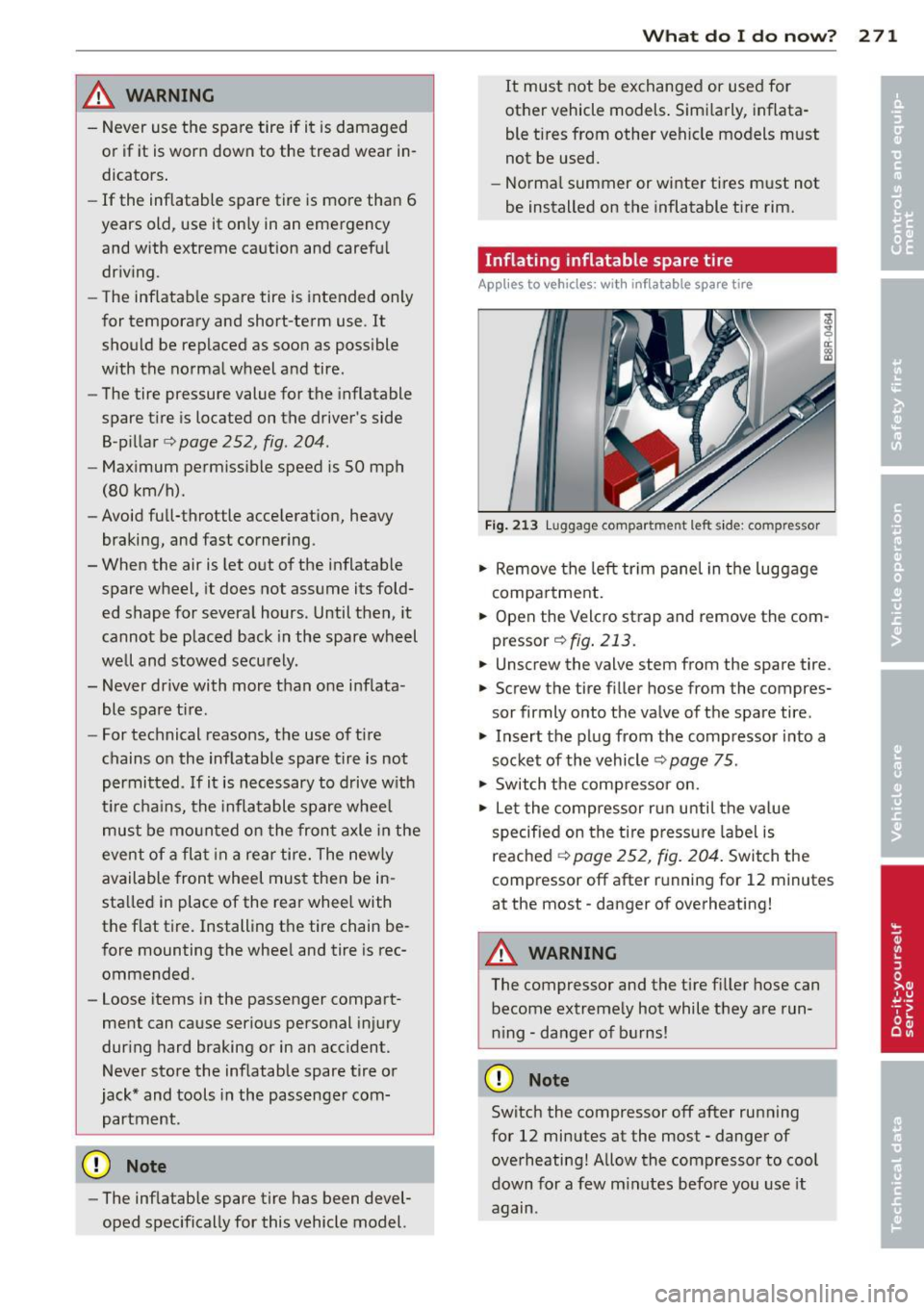
Fig. 2 13 Lu ggage compartme nt left s ide: comp ressor
.,. Remove the left tr im panel in the luggage
compa rtment.
.,. Open the Velcro strap and
remove the com
pressor ¢
fig. 213.
.,. Unscrew the valve stem from the spare tire .
.,. Screw the tire f iller hose from the compres
sor firmly onto the va lve of the spare tire .
.,. Insert the pl ug from the comp ressor into a
socket of th e vehicle ¢
page 75.
.,. Switch t he comp ressor on.
.,. let the compressor r un unti l t h e va lue
specif ied on the ti re press ure la bel is
reached
c::> page 2 52, fig . 204 . Switch the
compressor off after r unning for 12 minutes
at the most -danger of overheating!
A WARNING
The compressor and the tire filler hose can
become extreme ly hot while t hey a re run
n ing -da nger of b urns!
CD Note
Switch the compressor off after running
for 12 mi nutes at the most -danger of
ove rheating! Allow the compressor to cool
down for a few m inutes befo re you use it
again .
Page 276 of 316
274 What do I do no w?
Special ca re is requ ired if you are repairin g
t he t ire o n a steep incline.
@ Tips
- Do not operate the compressor for more
than 12 minutes continuously, otherwise i t can overheat. Once the compressor has
cooled, you can continue to use it.
- If sealant has spi lled out, let it dry and
then you can remove it by pee ling it away
like a fo il.
- Remember to obtain a new bottle of
sealant from your authorized Audi dealer
after repairing a tire. After this, the func
tionality of the tire repair set is restored.
- Obey all laws.
Changing a wheel
Before changing a wheel
Observe the following precautions for your
own and your passenger's safety when chang
ing a wheel .
.,. After you experience a tire fa ilure, pull the
car well away from moving traffic and try to
reach
le ve l ground before yo u stop ¢&_ .
.,. All p assengers sho uld
le ave the c ar and
move to a safe location (for instance, behind
the guardrai l)¢
,A .
.,. Engage the parking brake to prevent your
vehicle from ro lling un intentionally¢ &_.
.,. Move
selecto r le ver to pos ition P ¢ ,A .
.,. If you are tow ing a trailer: unhitch the trail
er from your veh icle.
.,. Block the diagonally opposite wheel with
the fo ld ing chocks or other objects.
.,. Take the
jack * and the inflatab le spare tir e*
out o f the luggage compartmen t
¢page 269.
A WARNING
You or your passengers cou ld be injured
while changing a whee l if yo u do not fol
low these safety precautions:
-
- If you have a flat tire, move a safe d is
tance off the road. Turn off the engine,
turn the emergency flashers on and use
other warning devices to a lert other mo
torists.
- Make sure that passengers wait in a safe
place away from the vehicle and well
away from the road and traffic.
- To help prevent the vehicle from moving
suddenly a nd possib ly slipping off the
jack*, always fully set the pa rking brake
a nd b lock the wheel d iagonally opposite
t he wheel be ing c hanged w it h t he fold
ing chocks or other objec ts. When one
front wheel is lifted off the ground, plac
ing the Automatic Transmission in P
(Park) will
not prevent the vehicle from
mov ing.
- Before you change a wheel, be sure t he
ground is level and firm. If necessary,
use a sturdy board under the jack*.
- Always store the vehicle tool kit, the
jack * and the replaced tire in the luggage
compartment¢
page 145.
Changing a wheel
When you change a wheel, follow these
quence described below step-by-step and in
exactly that order.
1. Remove the decorative wheel cover* . For
more details see also ¢
page 2 75, Deco
rative wheel covers
or¢ page 2 75,
Wheels with wheel bolt caps .
2. Loosen the wheel bolts ¢ page 276 .
3. Locate the prope r mounting point fo r the
jack* and align the jack * below that point
¢ page 276.
4 .
Lift the c ar with t he jack *¢ page 2 76 .
5 . Remove the
wheel with the flat tir e and
then insta ll the
inflatable spare tire*
¢ page 277 .
6. Tighten all whee l bolts lightly.
7.
Lower the vehicle with the jack*.
8. Use the wheel bolt wrench and
firmly
t ighten all wheel bolts¢ page 276.
9. Replace the decorative
whe el cover *.