weight AUDI Q5 2013 Service Manual
[x] Cancel search | Manufacturer: AUDI, Model Year: 2013, Model line: Q5, Model: AUDI Q5 2013Pages: 316, PDF Size: 78.89 MB
Page 254 of 316
252 Tires and wheels
Occupant loading and distribution for vehicle normal load for various designated seating
capacities
Designated seating capacity,
number of occupants Vehicle normal load
, number Occupant distribution in a nor-
of occupants _____ mally loaded vehicle
5 3 2 in fro nt, 1 in back seat
Cold tire inflation pressure
Tire pressure affec ts the overall handling , performance and safe ty of a vehicle.
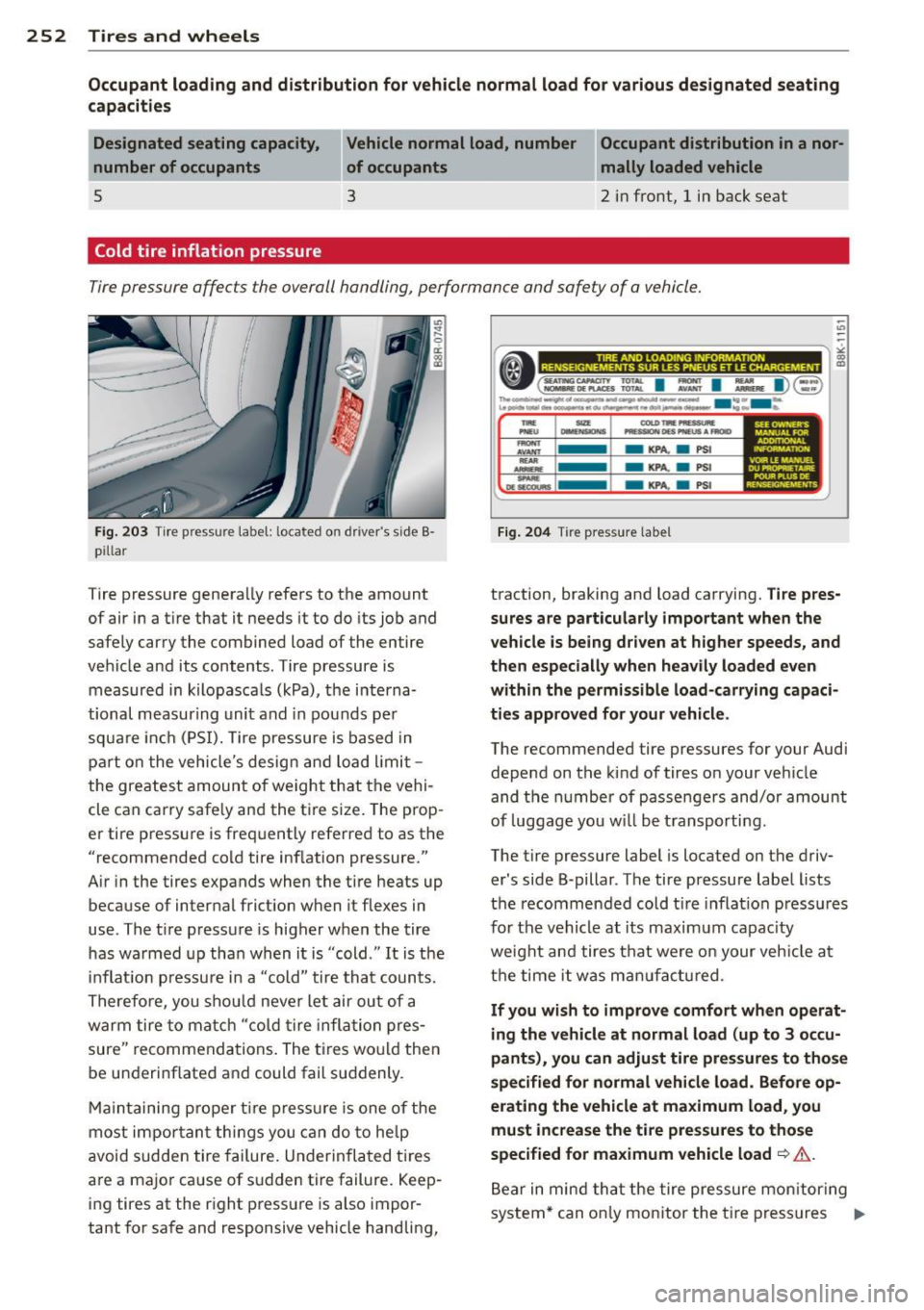
Fi g. 2 03 Tire p ress ure la b el: loca ted on driver's side B ·
p ill ar
Tire pressure genera lly refers to the amount
of air in a t ire that it needs it to do its job and
safely carry the combined load of the entire
vehicle and its contents . Tire pressure is
measured in kilopasca ls (kPa), the i nterna·
tional measur ing unit and in pou nds pe r
squa re inc h (PSI). Tire pressure is based in
par t on the vehicle's desig n and load limit -
the greatest amoun t of weight that the vehi·
cle can carry safe ly and the t ire size . The prop·
er tire pressure is freq uently referred to as the
" recommended cold tire inf lation pressure."
A ir in the tires expands when the tire heats up
because of internal frict ion when it flexes in
use . The t ire p ressu re is higher when the tire
h as wa rmed up tha n when it is "cold ." It is the
in flat io n pressu re i n a "cold" tire that counts.
Th erefore, you shou ld neve r let air ou t of a
warm tire to match " co ld tire inflat ion pres
sure" recommendations . The t ires wo uld then
be underinflated and could fail su ddenly .
M ain taining p roper t ire pr essu re is one of the
most im po rt an t th ings you ca n d o to he lp
avoid sudden tire failure. Underin fla ted t ires
a re a ma jo r cause of s udden tire failure. Keep·
i n g tires at the right pressure is also impor
tant for safe and responsive vehicle handling,
-U'>
-
---------------------- ,;
•(=~= I: I::... 1)§ :l!: n-...,....,....,~ ...... ~-...,..., ..... _ ... U ........ ~-·~N.-..-.we..... .... lllt-
-AVANT ...,.
-...... .. _
-KPA. a PSI
- KPA.
a PSI
-KPA. a PSI
Fig. 20 4 Tire pr essure labe l
SEE OWNEJICS MANUA1 FOA A,DOITl<>N.IU. INfORMATlON VOIR L£ MANUll DUPR0ftlET""" P"OUR i-t.US DE RENSEIGMEMENfS
traction, braking and load carrying. Tire pres
sures are particularly important when the
vehicle is being driven at higher speeds, and
then especially when heavily loaded even
within the permissible load-carrying capaci
ties approved for your vehicle .
The recommended tire pressures f or y our Audi
depe nd on the kind of tires o n your ve hicle
and the numbe r of passe ngers and/o r amount
of luggage you w ill be t ransporti ng .
The tire pressure label is located on the driv
er 's side B-pillar . The tire pressure labe l lists
the recommended cold t ire inflat io n press ures
for the vehicle at its maximum capac ity
weig ht an d tires t hat were o n your veh icle at
t h e time it was m anufactur ed .
If you wish to improve comfort wh en operat
ing the vehicle at normal load (up to 3 occu
pant s), you can ad just tire pre ssure s to tho se
specified for normal vehicle load . Before op
erating the vehicle at maximum load, you
mu st increase the ti re pressures to those
specified for maximum vehicle load
¢ .&. .
Bear in min d that the tire pressure mon itor ing
system * can o nly mo nitor the tir e press ures .,.
Page 255 of 316
Tires an d wheel s 253
you have stored. The system does not recog
nize the load condition of your vehicle.
The effectiveness of the ti re pressu re monitor
ing sys tem* will be impaired if you store nor
mal load pressures but then operate the vehi
cle at its maximum load¢,& .
See the illustration ¢
fig. 203 for the location
of the label on dr iver's side B-pillar (co lor of
the actual labe l and exact location on the ve
hicle wi ll vary slig htly) .
Note that the fo llowing tab le is accurate a t
the t ime o f go ing to press and is subject to
Tire de signation
c h ange. In the event of discrepancies, the ti re
pressure label located o n the driver's side B
pillar always takes precedence .
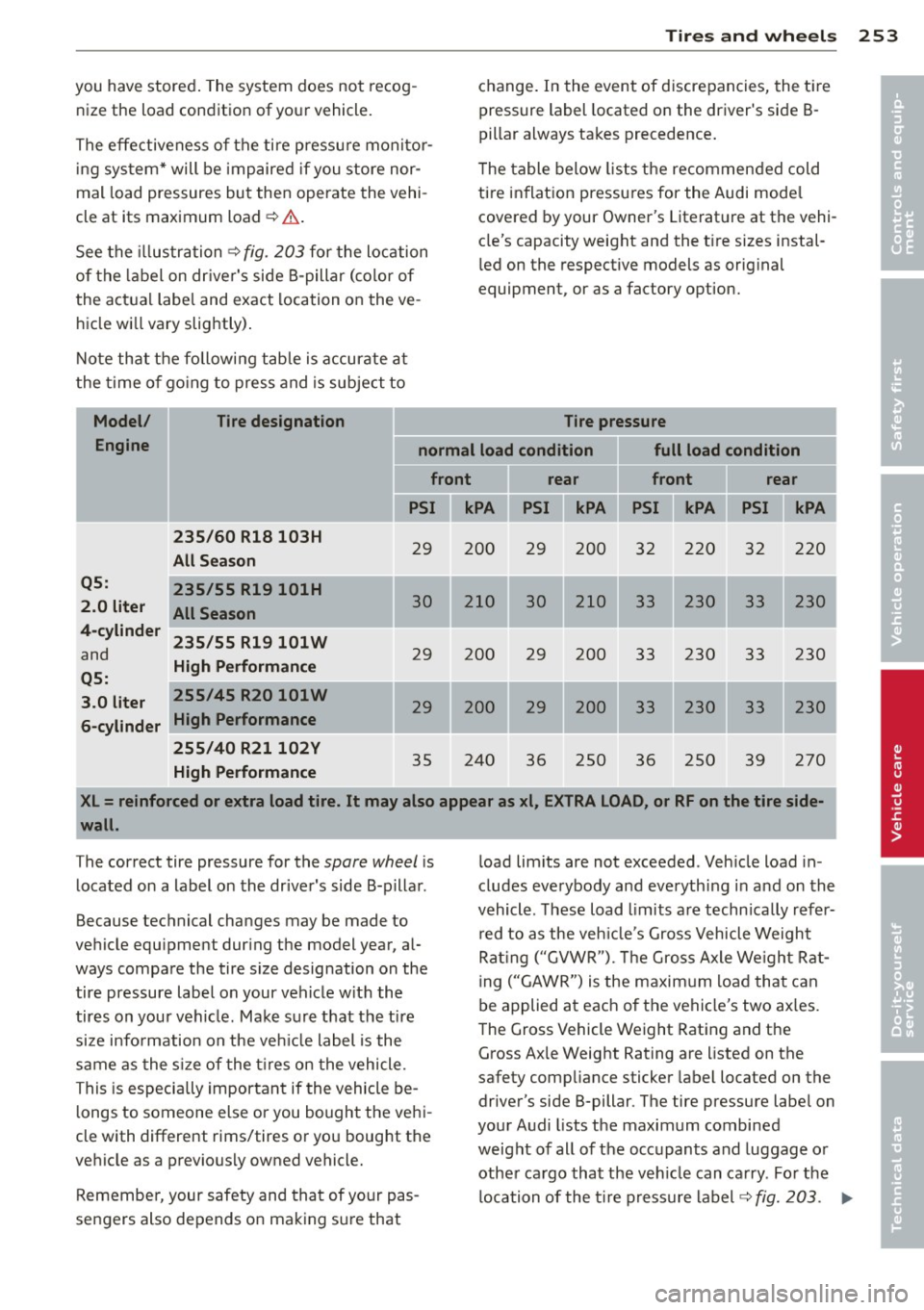
T he table below lists the recommended cold
ti re inflation pressures for the Audi mode l
covered by your Owner's Literat ure at the vehi
cle's capacity weight and the t ire sizes instal
l ed on the respective models as orig inal
equipment, or as a factory option.
Tire pressure
Model /
Engine normal load condition full load condition
front rear front rear
Q5 :
2.0 liter
4-cylinder
and
Q5:
3.0 liter
6 -cy lind er 235
/60 Rl8 103H
All S eason
235 /55 Rl9 101H
All Season
235 /55 Rl 9101W
High P erforman ce
255 /45 R20 101W
High Performance
255 /40 R21102Y
High Perfo rmance PSI
29
29
29
35
kAA ~I kAA ~I kAA ~I kAA
200 29 200 3
2 220 32 220
210 30 210
33 230
33 230
200 29 200 33 230 33 230
'
200 29 200 33 230 33 230
I
240 36 250 36 250 39 270
X
L= reinforced or extra load tire. It may also appear as xl, EXTRA LOAD , or RF on the tire side
wall.
The correct tire pressure for the spare wheel i s
located on a label on the dr ive r's side B-p illa r.
Because tec hnical changes may be made to
vehicle equ ipment dur ing the model year, al
ways compare the tire size designation on the tire pressure label on your vehicle w it h the
tires on your vehicle . Make su re t hat the tire
size info rmation on the veh icle label is the
same as the s ize of the t ires on the vehicle.
This is especia lly important if the vehicle be
l ongs to someone else or you bought the vehi
cle with different rims/tires or yo u bought the
vehicle as a previous ly owned vehicle.
Remembe r, your safety and that of yo ur pas
sengers also depends on making sure that load lim
its are not exceeded . Veh icle load in
cludes everybody and eve ryth ing in and on the
vehicle . These load limits a re techn ica lly refer
r ed to as the veh icle's Gross Vehicle Weight
Rat ing ("GVWR"). The Gross Axle We igh t Rat
ing ("GAWR") is the maxim um load that can
be applied at each of the vehicle's two ax les.
The Gross Vehicle Weight Rating and the Gross Ax le Weight Rating are listed on the
safety comp liance sticker label located on the
driver's side B-pillar . The tire pressure labe l on
your Audi lists the maximum combined
weight of all of the occupants and luggage o r
other ca rgo that the veh icle can ca rry . Fo r the
location of the t ire pressure label ¢
fig. 203. IJI,,
•
•
Page 256 of 316
254 Tire s and wheel s
A WARNING
Overloading a vehicle can cause loss of ve
hicle control, a crash or other accident, se
rious personal injury, and even death .
- Carrying more weight than your vehicle
was designed to carry will prevent the
vehicle from handling properly and in crease the risk of a loss of veh icle con
trol.
- The brakes on a vehicle that has been
overloaded may not be able to stop the
vehicle within a safe distance .
- Tires on a vehicle that has been overload
ed can fail suddenly causing loss of con
trol and a crash .
- Always make sure that the total load be
ing transported -including the we ight of
a tra iler hitch and the tongue weight of a
loaded trailer -does not make the veh i
cle heav ier than the veh icle's Gross Vehi
cle Weight Rating.
A WARNING
- Incorrect tire pressures and/or underin
flation can lead to a serious o r fatal acci
dent.
- Incorrect tire pressures and/or underin
flation cause increased tire wea r and can
affect the handling of the vehicle .
- Incorrect tire pressures and/or underin
flation can also lead to sudden tire fa il
ure, including a blowo ut and sudden de
flation, causing loss of vehicle control.
Checking tire pressure
-
The correct tire pressure for the tires originol
ly installed on your vehicle is listed on the tire
pressure label located on driver's side 8-pil
lar .
The recommended tire pressures are on the
tire pressure labe l and in the tab le
c:::> page 252, Cold tire inflation pressure .This
means that the pressure must be checked and
adjusted when the tire has not been driven for more than a couple of m iles (k ilometers) at
low speeds during the p revious three hours . Air in the tires expands when the tire heats up
as a result of interna l friction as it flexes in
u se . The tire pressure is h igher when the tire
has warmed up than when it is "cold."
It is the inflation pressure in a "co ld" tire that
counts . Therefore, you should never let air out
of a warm tire to match "Cold t ire inflat ion
pressure" recommendat ions
c:::> page 252 . The
t ires wou ld then be underinflated and could
fail suddenly .
The tire pressure label on your Audi lists the recommended co ld tire inflation pressures at
maximum capacity for the new, orig inal
equipment tires that were on your vehicle at
the time it was manufactured . Fo r the loca
t ion of the labe l
c:::>page 252, fig . 203 .
Most tires lose air naturally over t ime . They
can a lso lose some air if you drive over a pot
hole or hit a curb while park ing. It is usually
not possible to see whether the rad ia l tires
used today are underinflated jus t by looki ng
at them.
T he refo re, be sure to check t ire p ressures at
least once a month and always before going
o n a long trip. Ma ke sure to take the numbe r
of peop le and the amou nt o f luggage into ac
count when adjust ing tire pressu re for a trip -
even one that yo u wo uld not consider to be
" long." See
c:::> page 256, Tires and vehicle
load limits
for more important information .
Always use an ac curate tire p ress ure ga uge
when checking and adj usting inflation pres
s u res . Check a ll of the tires and be sure not to
forget the spare tire. If the pressure in any t ire
is too high when the tire is "cold," let air out
of the tire s low ly w ith the edge of the tire
gauge and keep checking the pressure until
you reach the pressure that is co rrect fo r the
load (passengers and luggage) and k ind of
dr iv ing you plan to do.
If the pressure in any tire is too low, note the
difference between the p ressure in the co ld
t ire and the pressure you need and add the air
t h at you need to reach the cor rect pressure for
t h e ve hicl e load (passengers and luggage) for
the tires on your vehicle as listed on the on
Page 258 of 316
256 Tire s and wheel s
-If the tire is not flat and you do not have
to change a wheel immed iately, drive at
reduced speed to the nearest service sta
t ion to check the tire pressure and add
air as required .
(D Note
Driving without va lve stem caps can cause
damage to the t ire valves . To prevent this,
always make sure that factory installed
valve stem caps on all wheels are securely mounted on the
valve .
@) For the sake of the environment
Underinf lated tires will a lso increase the
fue l consumption .
Tires and vehicle load limits
There are limits to the amount of load or
weight that any veh icle and any t ire ca n car ry.
A vehicle that is overloaded w ill not ha ndle
well a nd is more difficult to stop. Over load ing
can not on ly lead to loss of vehicle contro l,
but can a lso damage important parts of the
ve hicle and can lead to sudden tire failure , in
cluding a blowout and sudden deflation that
can cause the veh icle to crash .
Your safety and that of yo ur passenge rs a lso
depends on making sure that load limits are not exceeded. Vehicle load includes everybody
a nd everyth ing in and on the vehicle . T hese
load limits are tech nica lly refe rred to as the
ve hicle 's
Gross V ehicle Weight Rating
("GVWR").
The "GVWR" includes the we ight of the basic
vehicle, all factory insta lled accesso ries, a full
tank of fuel, oi l, coo la nt and othe r fluids pl us
maximum load. The maxim um load includes
the number of passengers that t he vehi cle is
intended to carry ("seating capacity") w ith an
assumed weight o f 150 lbs (6 8 kg) for each
passenger at a designated seating pos ition
and the tota l weight of any l uggage in th e
ve
hicle. If you tow a trailer, the weight of the
trailer hitch and the tongue weig ht of the loaded tra
ile r must be included as part of the
vehicle load .
T he
Gro ss Axle Weight Rating (" GAWR") is
the max imum load th at can be applied at e ach
of the vehicle's two axles .
T he Gross Vehicle Weight Rat ing and the
G ross Ax le Weight Ra ting are listed on the
sa fety comp liance s ticke r label lo cated on the
driver's side B-pillar. Your Audi has 5 seat ing
positions, 2 in the front and 3 in the rear fo r
total seat ing capac ity of 5. Each seating posi
t ion has a seat be lt
c:> page 149, Safety bel ts.
The fact that there is an upper limit to yo ur
vehicle's G ross Vehicle Weight Rating means
that the total weight of whatever is being car
ried in the vehicle ( includ ing the weight of a
tra iler hitch and the tongue weight of the
loaded tra iler) is lim ited . The more passen
gers in the vehicle or passenge rs w ho are
heavier than th e standard we ights assumed
mea n tha t less we ight can be carried as lug
gage .
T he t ire pressure label on your Aud i also lis ts
the max imum combi ned weig ht of a ll of the
occupants and luggage or other cargo that
the vehi cle can carry . For t he lo ca tion of the
label <=>page 252, fig. 203.
A WARNING
Overloading a vehicle can cause loss of ve
hi cle cont ro l, a c rash or other accident, se
rious personal injury, and even death.
- Ca rrying more we ight than your veh icle
was des igned to carry wi ll prevent the
veh icle from handling pr operly and in
crease the risk of the loss of vehicle con
trol.
- The brakes on a vehicle that has been
overloaded may not be able to stop the
veh icle w ith in a safe distance.
- Tires on a vehicle that has been overload
ed can fail s uddenly, including a blowout
a nd sudden defla tion, causing loss of
contro l and a c rash .
~
Page 259 of 316
-Always make sure that the total load be
ing transported - including the weight of
a trailer hitch and the tongue weight of a
loaded trailer -does not make the vehi
cle heav ier than the vehicle's Gross Vehi
cle Weight Rating.
Determining correct load limit
Use the example below to cal
culate the total weight of the
passengers and luggage or oth
er things that you plan to trans
port so that you can make sure
that your vehicle will not be
overloaded.
Steps for Determining Correct Load Limit
1. Locate the statement "THE
COMBINED WEIGHT OF OC
CUPANTS AND CARGO
SHOULD NEVER EXCEED XXX KG OR XXX LBS" on your ve
hicle's placard (tire inflation
pressure label)
¢ page 252,
fig. 203.
2. Determine the combined
weight of the driver and pas sengers that will be riding in
your vehicle.
3. Subtract the combined
weight of the driver and pas sengers from
"XXX" kilo
grams or
"XXX" pounds
Tires and wheels 257
shown on the sticker
¢page 252, fig. 203.
4. The resulting figure equals
the available amount of car
go and luggage load capaci
ty. For example, if the
"XXX"
amount equals 1400 lbs.
and there will be five
150
lbs. passengers in your vehi
cle, the amount of available
cargo and luggage load ca
pacity is
650 lbs. (1400-7 50
(5
X 150) = 650 lbs.)
5. Determine the combined
weight of luggage and cargo being loaded on the vehicle.
That weight may not safely
exceed the available cargo
and luggage load capacity
calculated in Step
4.
6. If your vehicle will be towing
a trailer, load from your trail
er will be transferred to your
vehicle. Consult this manual
to determine how this re duces the available cargo
and luggage load capacity of
your vehicle.
.,. Check the tire sidewall
(¢ page 259, fig. 207) to de
termine the designated load rating for a specific tire.
•
•
'
Page 263 of 316
T up to 118 mph (190 km/h)
U up to 124 mph (200 km/ h)
H up to 130 mph (210 km/ h)
V up to 149 mph (240 km/h)1
)
Z over 149 mph (240 km/h)1l
W up to 168 mph (270 km/h)1
)
Y up to 186 mph (298 km/h)1
)
Your veh icle is no rma lly factory equipped with
tires , which possess excellent driving charac
teristics and give your Audi opt imum driving
comfort . An e lectronic speed limiter
c::> page 2 7 wi ll normally prevent you r vehicle
from go ing faster than the tire speed ra ting
c:::> .& .
U.S . DOT T ire Identification Numb er (TIN )
and tire manufacture date
This is the t ire's "serial number". It begins
with the letters "DOT" and indicates that the
tire meets all federal standards . The next two
numbers or letters indicate the plant where it
was manufactured, and the last four numbers r ep resent the week and year of manufacture.
F or
examp le, the numbers 22 12 mean that
the tire was produced in the 22nd week o f
20 12. The other numbe rs are marketing co
des that may or may not be used by the tire
manufactu rer. This information is used to con
tact consumers if a tire defec t requi res a re
call.
Aud i O riginal ti re
Tires with the identification "AO" or "RO" have
been specia lly matched with your Audi . We
recommend using only these tires because
t hey meet the highest standards regard ing
safety and driving character istics when used
correctly . Your authorized Audi dealer w ill
g lad ly provide you with more information .
Tire ply compo sit ion and material s used
The number of plies ind icates the number of
layers of rubber-coated fabric in the t ire. In
general, the greater the number of plies, the
ll Fo r tires wit h a m ax im um s pee d ca pabil ity over 149
mph (2 4 0 k m/h) , tire man ufacturers some times u se
th e le tters " ZR."
Tire s an d wheel s 261
more weight a tire can support . Tire manufac
turers also must indicat e the materials in the
tire, which incl ude steel, nylon, po lyester, and
others.
Ma ximum Load Rating
This number indicates the maximum load in
ki lograms and pounds that can be ca rried by
the tire.
Tire quality grading for treadwear,
tract ion, and temp erature re sis tance
Tread wear, traction and temperat ure grades
c::> page 2 62 .
Maximum Permissible Inflation Pressu re
T his number is the greatest amount of a ir
pressure that should ever be put in the tire
u nder normal driving conditions .
A WARNING
-Using incorrect or unmatched tires and/
or wheels or improper tire and wheel
comb inat ions can lead to loss of control,
col lis ion and serious personal injury.
- Always use t ires, rims and whee l bolts
that meet the specifications of original
factory- installed tires or other combina
tions that have been specifically ap proved by the vehicle manufacturer.
- Tires age even if they are not being used
a nd can fai l sudden ly, especially at high
speeds. Tires that are more than 6 yea rs
old can only be used in an emergency
a nd then w ith special care and at lower
speeds.
- Neve r mo unt used tires o n your veh icle if
you are not sure of the ir "previo us histo
ry." O ld used tires may have been dam
aged even though the damage cannot be
seen that ca n lead to sudden tire fai lure
and loss of vehicle control.
•
•
Page 291 of 316
jack mounting point ¢ fig. 234 . Do not lift
the vehicle at the vertical sill reinforcement.
Rear lifting point
T h e lift ing poin t is lo cate d on th e vertical rein
fo rc ement o f the lower s ill for th e on boar d
jack*
¢ fig . 235.
Lifting with vehicle jack*
Refe r to ¢ page 2 76 .
A WARNING
- To reduce the r is k o f se rious injury a nd
vehicle da mage.
- Always lift the ve hicle on ly at the spe
cial w ork shop h oist and flo or jack lift
points illustrated¢
fig. 234 and
¢fig. 235 .
-Fai lure to lift the vehicle at these
poi nts could cause the ve hicle to tilt or
fa ll from a lift if the re is a change in ve
h icl e w eigh t distr ibu tion and balance .
This might happen, for exam ple, w hen
heavy c ompone nts su ch as the engi ne
b lo ck or tran smi ss ion ar e removed .
- W hen re mov ing heavy co m ponents like
th ese , a nch or ve hicle to ho ist or add cor
res pon din g weig hts to maintai n the cen
ter o f gravity . Othe rwise, the vehicle
mig ht tilt or s lip off the hoist , causi ng
serious persona l injury .
(D Note
- Be aw ar e of t he fo llow ing poin ts be fore
lift ing t he vehicle:
- The vehicle should never be lifted or
jacked up from underneath the engine oil pan, the transmission housing, the
front or rear axle or the body side members. This could lead to serious
damage.
- To avoid damage to the underbody or
chassis frame, a rubber pad must be
inserted between the floor jack and
the lift points .
- Before driving over a workshop hoist,
check that the vehicle weight does not
-
Emergency situations 289
exceed the permissible lifting capacity
of the hoist .
- Before driving over a workshop hoist ,
ensure that there is sufficient clear
ance between the hoist and low parts
of the vehicle.
•
•
Page 292 of 316
2 90 General information
General information Explanation of
technical data
Some of the technical data listed in this man
ual requires further explanation .
The technical data for your vehicle is listed in
the charts starting on
r:::> page 292. This sec
tion provides general information, notes and restrictions which apply to this data .
Vehicle identification
The key data is given on the vehicle identifica
tion number (VIN) plate and the vehicle data
sticker.
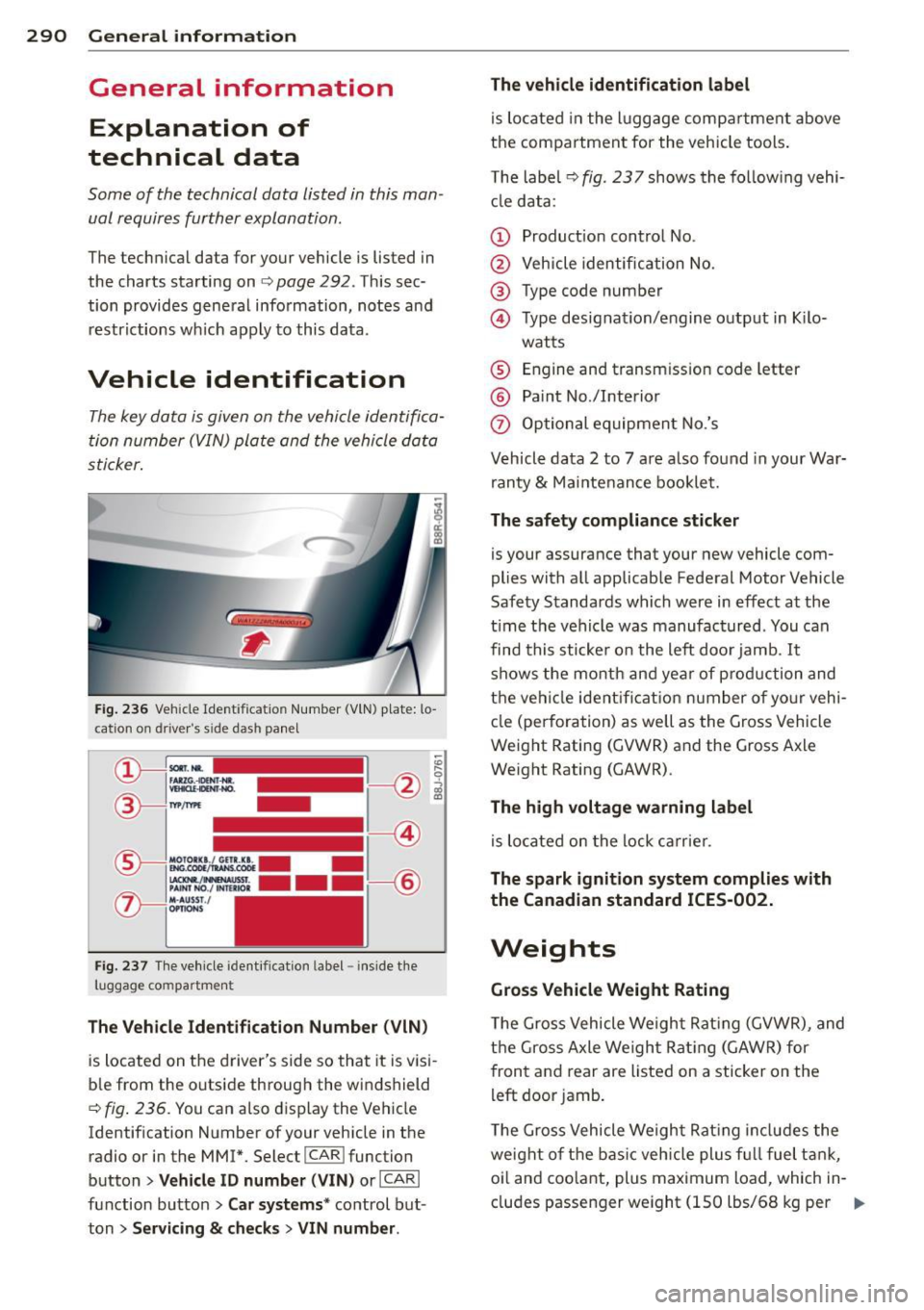
Fig. 236 Veh icle Ide ntific atio n Number (VlN) p late: lo
cation on driver 's sid e das h panel
Fig. 237 The vehicle identi fication label -inside the
luggage co mpa rtmen t
The Vehicle Identification Number (VIN)
is located on the driver's side so that it is visi
b le from the outside through the windshield
r:::> fig . 236. You can also display the Vehicle
Identification Number of your vehicle in the
radio or in the MM!*. Select
! CAR ! function
button>
Vehicle ID number (VIN) or !CARI
function button> Car systems* control but
ton >
Servicing & checks > VIN number . The
vehicle identification label
is located in the luggage compartment above
the compartment for the vehicle tools.
The label¢
fig. 23 7 shows the follow ing vehi
cle data :
(D Production control No.
@ Vehicle identification No.
® Type code number
@ Type designation/engine output in Kilo-
watts
® Engine and transmission code letter
@ Paint No./Interior
(f) Optional equipment No.'s
Vehicle data 2 to 7 are also found in your War
ranty
& Maintenance booklet.
The safety compliance sticker
is you r assurance that your new vehicle com
plies with all applicable Federal Motor Vehicle
Safety Standards which were in effect at the
t ime the vehicle was manufactured . You can
find this sticker on the left door jamb .
It
shows the month and year of production and
the vehicle ident ification number of your vehi
cle (perforation) as well as the Gross Vehicle
Weight Rating (GVWR) and the Gross Axle
Weight Rating (GAWR) .
The high voltage warning label
is located on the lock carrier.
The spark ignition system complies with
the Canadian standard ICES-002.
Weights
Gross Vehicle Weight Rating
The Gross Vehicle Weight Rating (GVWR), and
the Gross Axle Weight Rating (GAWR) for
front and rear are listed on a sticker on the
left door jamb.
The Gross Vehicle Weight Rating includes the
weight of the basic vehicle plus fu ll fuel tank,
oi l and coolant, plus maximum load , which in
cludes passenger weight (150 lbs/68 kg per
Ill>
Page 293 of 316
designated seating position) and luggage
weight ~&. .
Gross Axle Weight Rating
The G ross Axle Weight Rating is the maximum
lo ad that can be applied at each axle of the
vehicle
q .&. .
Vehicle capacity weight
The vehicle capac ity we ight (max. load) is list
ed on the driver 's side 8-p illar.
Roof weight
The maximum permissible roof weight is
165 lbs (75 kg). The roof weight is made up
of the weight of the roof rack system and the
weight of the object be ing transported
q page 72, Roof load .
..&, WARNING
- The actual Gross Axle Weight Rating at
the front and rear axles sho uld not ex
ceed the permissible weights, and their
combination must not exceed the Gross
Vehicle Weight Rating.
- Exceeding permissible we ight ratings can
result in vehicle damage, accidents and
persona l injury.
Q) Note
- The vehicle capacity weight figures apply
when the load is distributed evenly in the
vehicle (passengers and luggage). When
transporting a heavy load in the luggage
compartment, carry the load as near to
the rear axle as possible so that the veh i
cle's handling is not impaired.
- Do not exceed the maximum permissible
axle loads or the maximum gross vehicle
weight . Always remember that the vehi
cle's handling will be affected by the ex
tra load. Therefore, adjust your speed ac
cordingly.
- Always observe local regulations.
-
General information 291
Dimensions
The specifications refer to the basic model.
Differences may occur depending on the mod
el type and options ordered, for example, tire
sizes.
(D Note
When driving up steep ramps, on rough
roads, over curbs, etc. it is important to re
member that some parts of your vehicle,
such as spoilers or exhaust system compo nents, may be close to the ground . Be
careful not to damage them .
•
•
Page 307 of 316
Exterior mirrors
Adj usting .. .... .. .... ... .. .. .. .... 57
Dimming ... .... ...... ... .. .. .. .. .. 58
Heating .. .. ............. .... .. .... 57
E yeg lasses compartment .... .. .. .. .. .. 7 7
F
Fall line
Fan 209
Radiator . ......... ... .... ... ... .. 242
F astening
Booste r seats ... .. .... ... .. .. .. .. . 186
Convertible child safety seats . .. .. .. . 185
Infant seats .... ......... .... .. .. . 184
Fl at t ire
C hanging . ... ... .. ... ... .. .. .. ... 274
Fl exibl e fuel . .. ... .. ... ... .. .. .. .. . 229
F loor mats . . . . . . . . . . . . . . . . . . . . . . . . . 144
F og lights . . . . . . . . . . . . . . . . . . . . . . . . . . 50
Foldi ng chocks ......... ...... .... .. 269
F olding the rear seat forward . . . . . . 67, 68
F oo t pedals .. ............. .. .. .. .. . 14 4
For the sake of the environment
Gasoline fumes and the environment . . 231
L ett ing t he engine wa rm up . . . . . . 83, 86
Reducing e ng ine noise by ea rly ups hift-
in g .... .. .. .. .. ........... .. .. .. .. 11
Refue ling .. ............. .... .. ... 23 1
Saving fue l by ea rly upshift ing . ... .. .. 11
Front airbags Descr ipt io n ... .............. ... ... 161
H ow t hey wo rk ........... .. .. .. .. . 166
Fronta l co llisions and t he laws of physics 150
Fr ont ash tray . . . . . . . . . . . . . . . . . . . . . . . . 7 5
F ro nt seats .. .. ........ ... .. .. .. .. .. 61
Ad justi ng .. .. .. ......... .. .. .. ... 1 41
C hil d restra ints in the fron t seat . .. .. . 158
Fue l
Addit ives . ......... ......... .... .. 228
Blended gasoline ... ...... .. .. .. .. . 228
Consu mpt io n ............ .. .. .. .. .. 23
Fill er ne ck .. .... ......... .. .. .. .. . 230
Fu el g auge . . . . . . . . . . . . . . . . . . . . . . . . 12
Gasoline ... .. ... .. ..... ... .. .. ... 228
Gasoline additives ..... ... .. .. .. .. . 230
Octane rating ..... .... ... .. .. .. .. . 228
Inde x 305
Recommendation ... . .. .. ..... ... .. 228
Ref uelling ... .. .... . ... ...... ... .. 231
Rese rve ... .. .. .. .. . .. ... .... ... .. . 12
Tank capac ity .. .. ................. 292
Unlocking the fuel fi ller flap by hand .. 232
Fuel economy messages (efficiency p ro -
gram) . ... .. .. .... ... .. .. ..... ... .. . 25
Fuel fi lle r flap
Unl ocking the fuel fi lle r flap by hand .. 232
Fuel supply too low . . . . . . . . . . . . . . . . . . 33
Fuse a rrangeme nt ... . .. .. ..... ... .. 280
G
Ga rage door opener ( HomeLink) ... .. .. 135
Gas d ischarge lamps .. ............... 283
Ga uges
Engine coolant temperature ..... .. .. . 10
Fuel gauge . . . . . . . . . . . . . . . . . . . . . . . . 12
Tachometer . . . . . . . . . . . . . . . . . . . . . . . 11
General i llustration
Instruments and controls .... ... .. .. .. 8
General rules and dr iv ing t ips ..... .. .. 209
B efo re driv ing offro ad .......... .. .. 209
D riv ing o ffroad . .. .... ............. 209
G lossary of tire and loading terminology 249
G love compartment . . . . . . . . . . . . . . . . . . 76
Cooling box . . . . . . . . . . . . . . . . . . . . . . . . 77
GPS cont rolled clock . . . . . . . . . . . . . . . . . . 12
Gradient angle .. .. .. ... ....... ..... 209
Gross Vehicle Weight Rating (GVWR) ... 290
G round clearance 209
H
Head lights
Adaptive light .. .. .. ... ....... ...... 51
F og lights . .. .. .. ................. . 50
Head light range con trol de fec tive .. .. . 34
L eft hand dr ive, r igh t h and dr ive .. .. .. . 51
Rear fog lights ...... .. .. ..... ... .. . 50
Trave l mode ....... . .. .. ..... ... .. . 51
Washer reservo ir . .... ........... .. 247
Washer system . . . . . . . . . . . . . . . . . . . . . 54
Hea d restraints .. .. .... ........... .. 142
Adjus ting ....... .. . .. .. ..... ... .. 142
Front seats . . . . . . . . . . . . . . . . . . . . . . . . 65
Rea r seats . . . . . . . . . . . . . . . . . . . . . . . . . 65
•
•