seats AUDI Q5 2013 Workshop Manual
[x] Cancel search | Manufacturer: AUDI, Model Year: 2013, Model line: Q5, Model: AUDI Q5 2013Pages: 316, PDF Size: 78.89 MB
Page 194 of 316
192 Child Safety
-Always follow the instructions provided
by the manufacturer of the child re
straint you intend to install in your vehi
cle.
- Never install a child restraint without a
properly attached top tether strap if the
child restraint manufacturer's instruc
tions require the top tether strap to be
used.
- Improper use of child restraint LATCH
lower anchorage points can lead to injury
in a collision. The LATCH lower anchorage
points are designed to withstand only
those loads imposed by correctly fitted
child restraints.
- Never mount two child restraint systems
on one LATCH lower anchorage point.
- Never secure or attach any luggage or
other item to the LATCH lower anchorag
es .
(j) Tips
-In Canada, the terms "top tether" with
"lowe r universal anchorages" (or "lower
universal anchorage bars") are used to
describe the system.
- In other countries, the term "ISOFIX" is
used to describe the lower anchorages.
Location
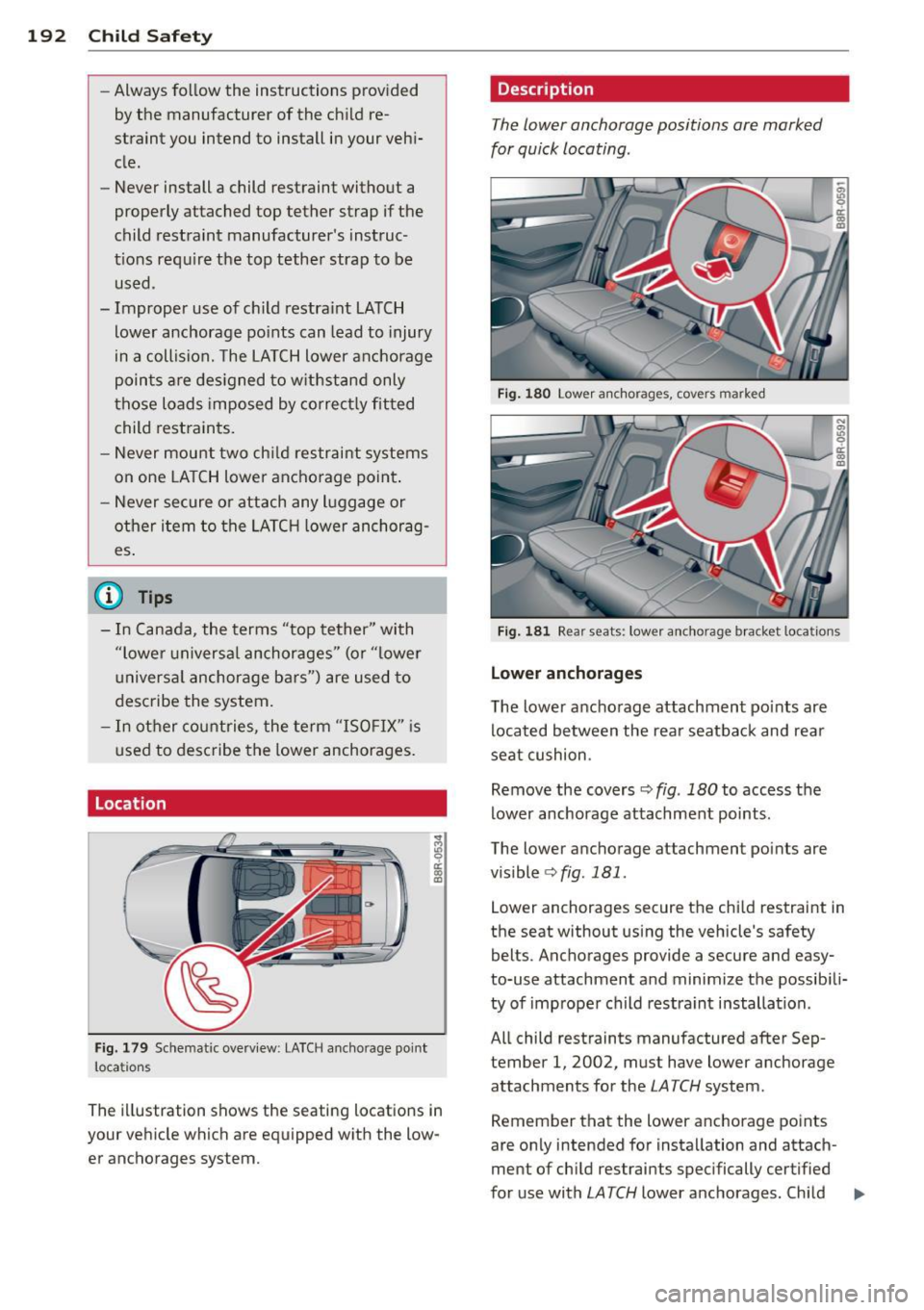
Fig. 179 Schematic overview: LATCH a nch orage point
locations
The illustration shows the seating locations in
your vehicle which are equipped with the low
er anchorages system.
Description
The lower anchorage positions are marked
for quick locating.
Fig. 180 Lower anchorages, covers marked
Fig. 181 Rear seats: lower anc horage bracket locations
Lower anchorages
The lower anchorage attachment points are
located between the rear seatback and rear
seat cushion.
Remove the covers ¢
fig. 180 to access the
lower anchorage attachment points.
The lower anchorage attachment points are
visible
c:> fig. 181 .
Lower anchorages secure the chi ld restraint in
the seat without using the vehicle's safety
belts. Anchorages provide a secure and easy
to-use attachment and minimize the possibili
ty of improper child restraint installation .
All child restraints manufactured after Sep
tember 1, 2002, must have lower anchorage
attachments for the
LATCH system.
Remember that the lower anchorage points
are only intended for installation and attach
ment of child restraints specifically certified
for use with
LATCH lower anchorages. Child ..,_
Page 195 of 316
restraints that are not equipped with the low
er anchorage attachments can still be instal
led in compliance with the ch ild restra int
manufacturer's instructions on using vehicle
safety belts.
A WARNING
Improper use of LATCH lower anchorages
can cause serious personal injury in an ac
cident.
-Always carefully follow the ch ild re
straints manufacturer's inst ruct ions for
proper installation of the child restra int
and proper use of the lowe r anchorages
or safe ty belts in your vehicle.
- Never secure o r attach any luggage or
other items to the
LATCH lower ancho
rages.
- Always read and heed the important in
formation about ch ild restra ints in this
chapter and WARNINGS
~ page 178,
Child Safety.
Installing a child restraint with LATCH
lower anchorages
Whenever you install a child restraint always
follow the child restraint manufacturer's in
structions.
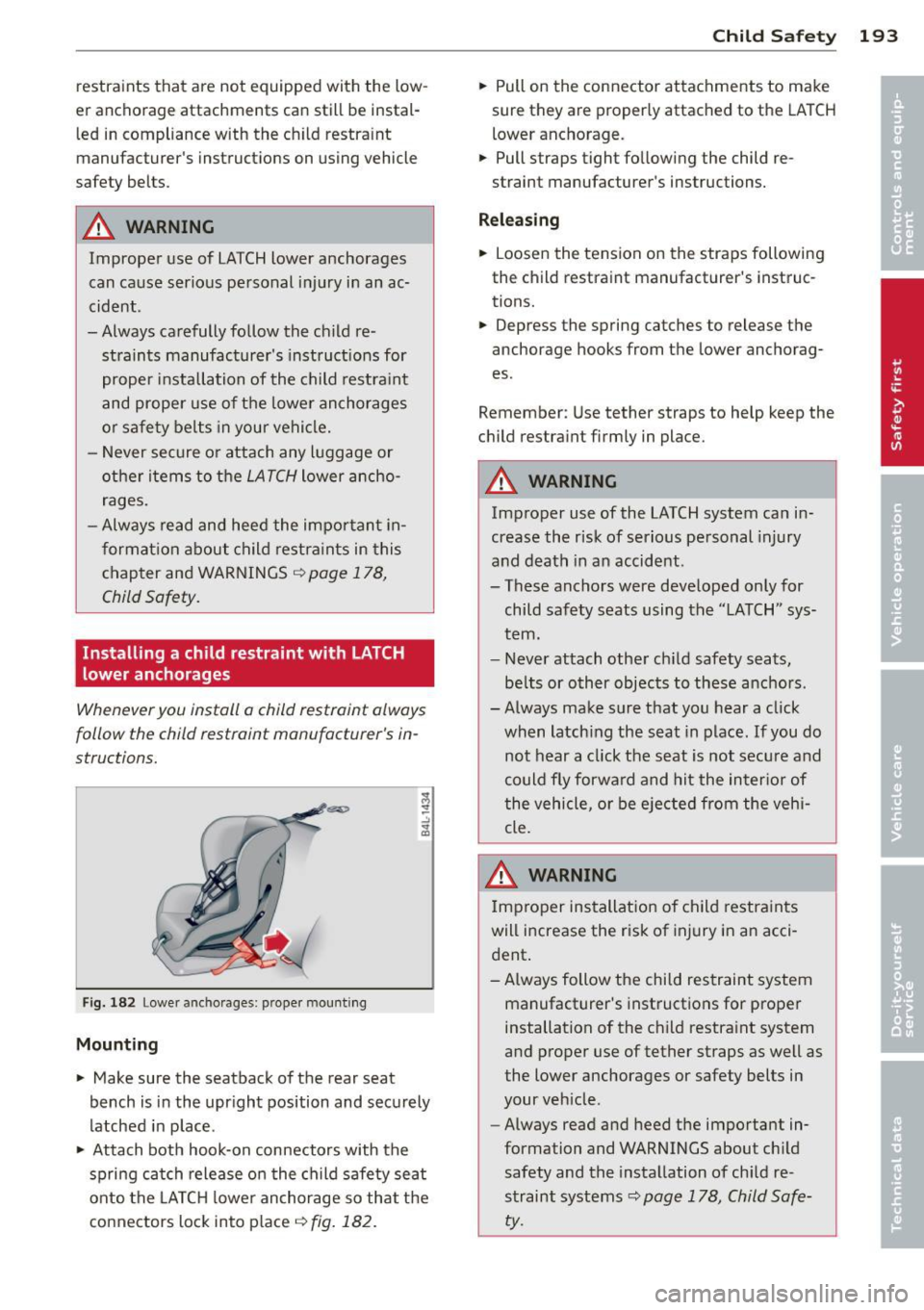
F ig. 182 Lower ancho rages: proper mount ing
Mounting
~ Make sure the seatback of the rear seat
bench is in the upr ight position and securely
latched in place.
~ Attach both hook-on connectors with the
spring catch release o n the child safety seat
onto the LATC H lower anchorage so that the
connectors lock into place
~ fig. 182.
Child S afety 193
~ Pull on the connector attachments to make
sure they are properly attached to the LATCH
lower anchorage.
~ Pull straps tight following the child re
straint manufacturer's instructions.
Relea sing
~ Loosen the tension on the straps following
the child restraint manufacturer's instruc
tions.
~ Depress the spring catches to release the
anchorage hooks from the lower anchorag
es .
Remember: Use tether straps to help keep the
ch ild restraint firmly in place.
A WARNING
Improper use of the LATCH system can in
crease the risk of serious personal injury
and death in an accident .
- These anchors were developed only for
child safety seats using the "LATCH" sys
tem.
- Never attach other ch ild safety seats,
be lts or other objects to these anchors.
- Always make sure that you hear a click when latch ing the seat in place. If you do
not hear a click the seat is not secu re and
could fly forwa rd and hit the inter ior of
the vehicle, or be e jected from the vehi
cle.
A WARNING
Improper installat ion of child restraints
will i ncrease the risk of injury in an acci
dent .
- A lways follow the child restraint system
manufacturer's instructions for proper
installation of the ch ild restra int system
and proper use of tether straps as well as
the lower anchorages or safety belts in
your veh icle.
- Always read and heed the important in
formation and WARNINGS about child
safety and the instal lation of ch ild re
straint systems~
page 178, Child Safe
ty.
-
Page 196 of 316
194 Child Safe ty
Tether anchors and tether straps
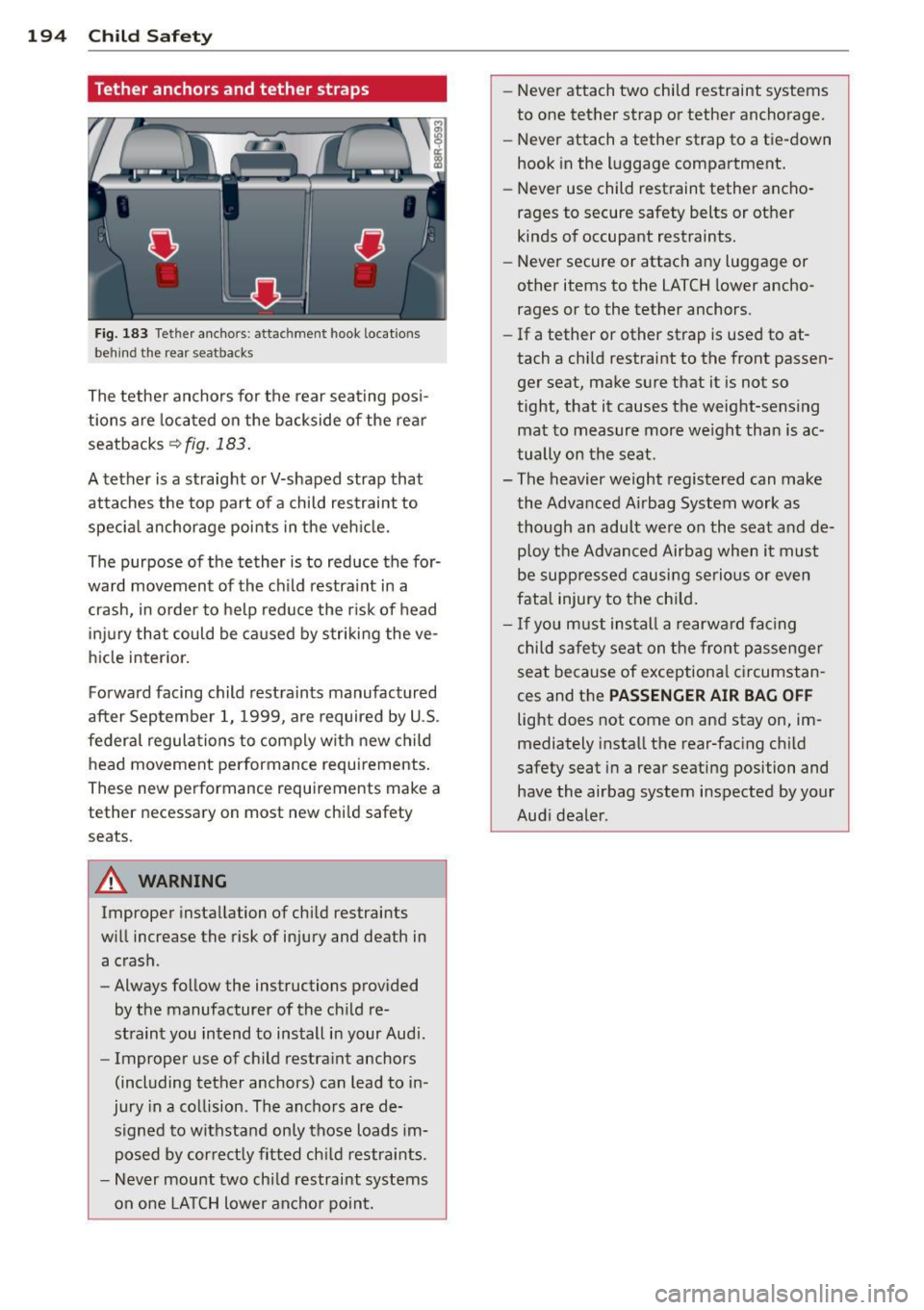
Fig. 183 Tethe r ancho rs: attachment hook locatio ns
behind the rea r sea tbacks
The tether anchors for the rear seating posi
tions are located on the backside of the rea r
seatbacks
~ fig. 183.
A tether is a straight or V-shaped strap that
attaches the top part of a child restraint to
specia l anchorage points in the veh icle.
The purpose of the tether is to reduce the for·
ward movement of the ch ild restra int in a
crash, in order to help reduce the r isk of head
in ju ry that could be ca used by striking the ve
hicle interior.
Forward facing child restra ints manufactured
after September 1, 1999, are required by U .S .
federal regulations to comply with new child
head movement performance requirements.
These new performance requ irements make a
tether necessary on most new chi ld safety
seats.
A WARNING
Improper insta llation of chi ld restraints
w ill increase the risk of injury and death in
a crash.
- Always follow the instructions prov ided
by the manufacturer of the ch ild re
stra int you intend to install in your Audi.
- Improper use of c hild restra int anchors
(including tether anchors) can lead to in ·
jury in a co llision. Th e anchors are de·
sign ed to withstand only those loads im
posed by cor rect ly fi tted ch ild restraints.
- Never mou nt two chi ld restraint systems
on one LA TCH lower anchor po int. -
Never attach two child restraint systems
to one tether strap or tether anchorage .
- Never attach a tether strap to a tie-down
hook in the luggage compartment.
- Never use child restraint tether ancho
rages to secure safety belts or other
kinds of occupant restraints.
- Never secure or attac h any luggage or
other items to the LATCH lower ancho
rages or to the tether anchors.
- If a tether or other strap is used to at
tach a chi ld restraint to the front passen
ger seat, make sure that it is not so
tight, that it causes the weight-sensing mat to measure more we ight than is ac
tually on the seat.
- The heavier weight registered can make the Advanced Airbag System work as
though an adult were o n the seat and de·
p loy the Advanced Airbag when it mus t
be supp ressed causi ng serio us or even
fatal injury to the ch ild .
- If you must ins tall a rearw ard fa cing
c h ild safe ty seat on the fro nt passenger
seat because of exceptiona l circumstan
ces and the
PASSENGER AIR BAG OFF
light does not come on and stay on , im
mediately insta ll the rear-fac ing child
safety seat in a rear seating position and have the airbag system inspected by your
Aud i deale r.
Page 197 of 316
Installing the upper tether strap on the
anchorage
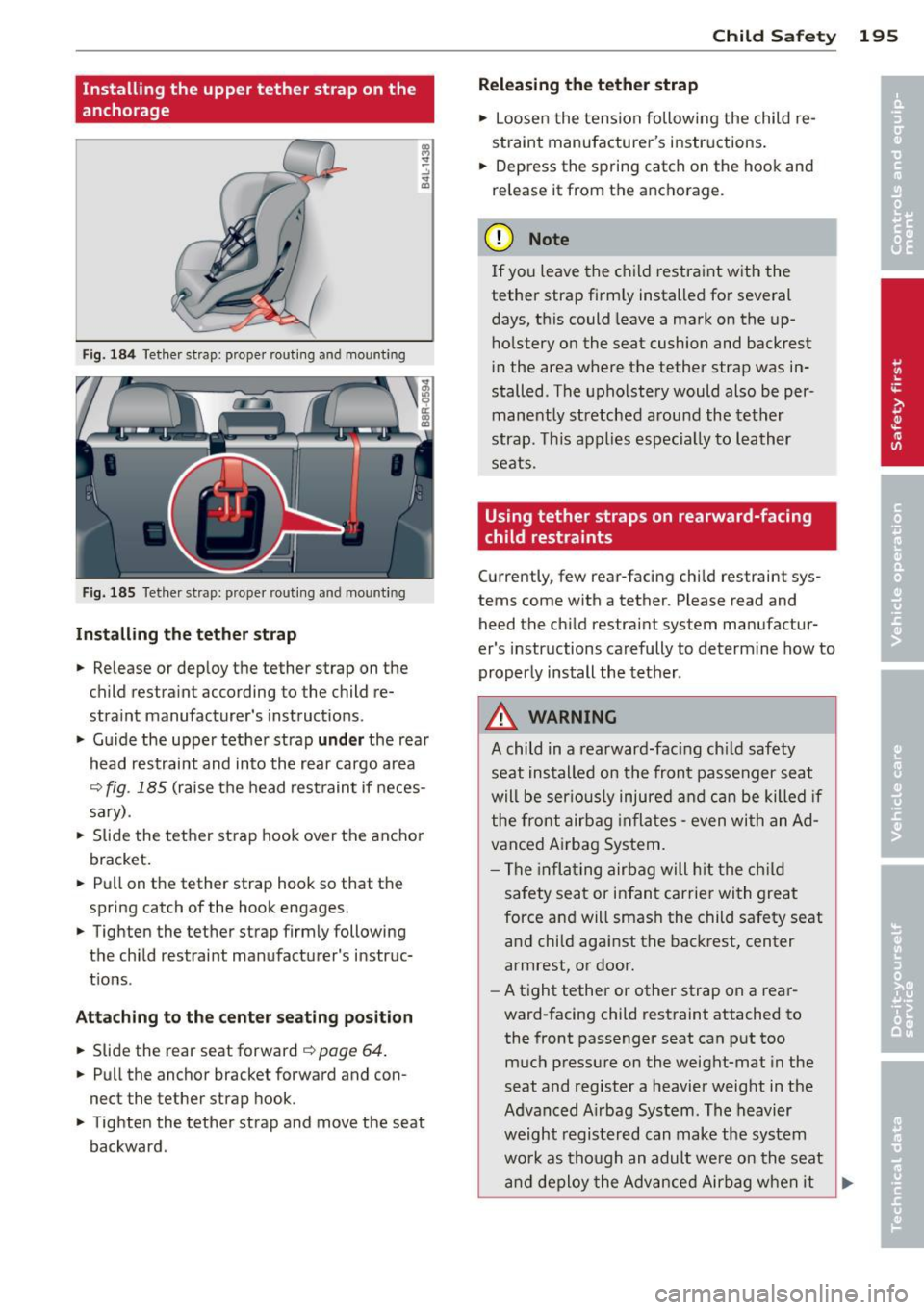
Fig. 184 Tether strap: proper routi ng and mounting
Fig. 185 Tether strap: proper rou ting and mounting
In sta ll ing the tether strap
• Release or deploy the tether strap on the
child restra int according to the child re
straint manufacturer's instructions .
• Gu ide the upper tether strap
under the rear
head restraint and into the rear cargo area
Q fig. 185 (raise the head restraint if neces
sary) .
• Slide the tether st rap hook over the ancho r
bracket.
• Pu ll on the tether strap hook so that the
spring catch of the hook engages.
• Tighten the tether strap firmly following
the child restrai nt manufacturer's instruc
t ions .
Attaching to the cent er seating po sition
• Slide the rear seat forward ¢ page 64.
• Pull the anchor bracket forward and con
nect the tether strap hook.
• Tighten the tether strap and move the seat
backward .
Child Safet y 195
Releasing th e teth er strap
• Loosen the tension following the child re
straint manufacturer's instructions.
• Depress the spring catch on the hook and
release it from the anchorage.
(D Note
If you leave the child restraint w ith the
tether strap firmly installed fo r several
days, t his could leave a mark on the up
holstery on the seat cushion and backrest
in the area where the tether strap was in
stalled . The upholstery would also be per
manently stretched around the tether
strap. This applies especia lly to leather
seats.
Using tether straps on rearward-facing
child restraints
Currently, few rear-facing child restraint sys
tems come with a tether. Please read and
heed the ch ild restraint system manufactur
er's instructions carefully to determine how to
properly install the tether .
A WARNING
A child in a rearward-fac ing ch ild safety
seat installed on the front passenger seat
will be ser ious ly injured and can be killed if
the front airbag inflates -even with an Ad
vanced Airbag System.
- The inflating airbag will h it the ch ild
safety seat or infant carrier with great
force and will smash the child safety seat
and child against the backrest, center
armrest, or door.
- A tight tether or other strap on a rear
ward-facing child restraint attached to
the front passenger seat can put too
much pressure on the weight-mat in the
seat and register a heavier weight in the
Advanced A irbag System. The heavier
weight registered can make the system
wo rk as though an adult we re on the seat
a nd deploy the Advanced Airbag when it
Page 206 of 316
204 Intelligent technology
With the engine turned off
If you listen to the radio, for example, with
the engine turned off or use othe r MMI* func
tions, the battery is being discharged .
If sta rting capability is jeopardized due to en
e rgy consumption, the following warning ap
pears in the radio or MMI* display:
Please start engine, otherwise system will
switch off in 3 minute s.
The warning ind icates that the system will be
turned off automatically after 3 m inutes .
If
you wish to continue using the functions , you
have to start the engi ne.
With the engine running
Although electrical energy is generated when
the vehicle is being driven, the battery can be
come discharged . This happens most ly when
l ittle energy is be ing generated and a great
deal consumed and the battery's state of
cha rge is not optimal.
To br ing the energy balance back into equili
brium, consumers which require especially
l arge amounts of energy are tempo rari ly cut
back or switched off. Heating sys tems in par
ticular requi re a great dea l of energy . If you
notice, for example , that the heated seats* or
the heated rear window are not heating, they
have been temporar ily cut back or switched
off. These systems will be ava ilable again as
soon as the energy balance has bee n restored.
You will a lso notice that engine idle speed has
been increased slightly. This is norma l and not
a cause for concern . By increasing engine idle
speed the add itional energy required is gener
ated and the battery is charged .
Page 225 of 316
& WARNING
Too much undercoating in the wrong pla
ces can cause a fire.
- Do not apply additional undercoating or
rustproofing on or near the exha ust
manifold, exhaust pipes, cata lytic con
verter or heat shie lds . Wh ile driving, the
substance used for undercoating could overheat and cause a f ire.
- Always read and heed all WARNINGS and other information
c:> page 216.
Exhaust tail pipes
-
Road sa lt and other corros ive materia ls will
damage the mater ial in the exhaust tail p ipes
if they are not cleaned regula rly . Do not clean
the ta il p ipes with whee l cleaner, paint polis h,
chrome polish or othe r abrasive cleane rs.
C lean the tail p ipes wi th car care prod ucts
that are s uitab le for stain less stee l.
Your authori zed Audi dealer can provide clean
in g p roducts t hat have been tested and ap
p roved for you r vehi cle.
Care of interior
Radio and MMI* display
.,. Clean the d isp lay w ith a soft clea n cloth and
an LCD cleane r.
The display can be cleaned w ith a professio
na lly available "LCD cleaner". The cloth shou ld
be slightly dampened with the clean ing flu id
to clean the display .
(D Note
To avoid scratching the display, you should
never clean it dry .
MMI control console
Applies to vehicles: with MMI
.. First clean the MMI control console with a
brus h to remove dust from the hous ing .
.,. The n w ipe the MMI con tro l c onso le w ith a
cl ean, soft, s ligh tly damp cloth .
Cleaning and protec tion 223
The M MI contro l console sho uld be cleaned
with a brush first so that no dirt is t rapped be
tween the buttons and the housing . We rec
ommend giving the MMI control conso le a fi
nal wipe with a cloth moistened with water
and dish washing detergent .
(D Note
To prevent damage, make s ure that no flu
i d ever gets into t he MMI contro l conso le.
Aluminum trim
Use only neutral-pH products to remove spots
and deposits from aluminum surfaces .
Chrome care products a nd a lkaline cleaners
will attack a luminum surfa ces and ca n dam
age them over t ime .
& WARNING ~
Always read and heed all WARN INGS and
other info rmation
c:> page 216.
Fabrics and fabric coverings
Fabrics and fab ric coverings (e.g . seats, door
trim pane ls, etc .) sho uld be cleaned at regular
intervals w ith a vacuum cle aner. This removes
su rface dirt particles which could become em
bedded in the fabric through use . Steam
cleaners sho uld not be used , because the
steam te nds to p ush the dirt deeper into the
fabric and lo ck it the re.
Normal cleaning
Generally, we recommend us ing a soft sponge
o r a lint -free microfibe r clo th to t he clean fab
r ic. B rushes s hou ld only be used for carpets
and floo r mats, since othe r fabr ic surfa ces
cou ld be harmed by br ushes.
Normal su rface stains can be cleaned using a
comme rc ially availab le foam cleaner . Spread
the foam o n the su rface of t he fabric with a
soft sponge and wo rk it in gently . D o no t satu
ra te the f abric. Then pat the foam dry using
absorbent, dry cloths (e .g . m icrofi ber cloth)
and vac uum it after it has dried compl etely .
Ill>
•
•
Page 227 of 316
By contrast, leather types that are covered by
a co lored finish layer are more durable. This
has a posit ive effect on the leather's resist
ance to wear and soiling in daily use. On the
other hand, the typical characterist ics of natu
ral leather are barely or not apparent . Howev
er, this does not mean that the leather itself
i s of infer ior quality.
C ar e and h and ling
Because of the exclusive nature of the types of
leather that Audi uses and the ir unique prop
erties (such as sensitivity to o ils, grease, so il
ing, etc.), you will need to be somewhat care
fu l w ith these leathers, and a certain type of
care is required. For examp le, da rk clot hing
materia ls can d iscolor leather seats (especial
l y i f such clothing is damp and was not dyed
correctly) . Dust and dirt particles in pores,
fo lds, and seams can have an abrasive effect
and can damage the leather surface as we ll as
weaken seams.
The leather sho uld be cleaned regularly as
needed. After having been used for a re lative ly
long time, your leather seats will acquire a
rich aged finish. This is a characteristic of nat
ura l leather and a sign of true quality.
In order to maintain the va lue of this natura l
product over the life of your vehicle, you
should follow the recommendations below:
(D Note
- To keep your leather from bleaching out,
do not a llow it to be exposed to bright
sunlight for long periods of time. If you
have to leave the vehicle parked outside
for long periods, cover the leather to
protect it from d irect exposure to su n
light.
- Sharp objects on clothing, such as zip
pers, rivets or sharp pieces on be lts can
l eave pe rmanent scratches o r sc rape
mar ks on the surface of the lea ther.
{O) Tips
-After each time you clean the leathe r and
at regu la r i nte rva ls, use a leather prese r-
Cleaning and protec tion 225
vative c ream that contains UV -b locke rs
and that works into the leather. This
cream wi ll nour ish and mo isturize the
leather, helping it to breathe and stay
supple. It also helps to build up a protec
t ive coating on the surface.
- Clean the leather every 2 - 3 months,
and clean any areas that get soiled.
- Remove fresh marks made by ballpo int
pens, ink, lipstick, shoe polish, etc. as
soon as poss ible.
- Preserve the color of the leather as need
ed by us ing a specia l co lored leather care
cream to touch up areas of uneve n color .
Cleaning and caring for leather
upholstery and trim
Applies to vehicles: wi th natural leather
Natural leather requires special care and at
tention .
Normal cleaning
.. Clean soiled areas with a slightly moistened
cotton or woolen cloth.
More stubborn dirt
.. More st ubborn dirt can be removed using a
cloth saturated with a mild soap solut ion
(2
tablespoons mild liquid soap).
.. Never allow the soap solution to saturate
the leather, and make certain that no water
soaks into the seams .
.. Wipe off the soap so lution with a soft, dry
cloth.
Cleaning spo ts
.. Remove fresh water-based spots (such as
coffee, tea, juices, blood) with an absorbent
cloth or pape r towel.
.. Remove fresh
grease or oil -based spots
(suc h as bu tte r, mayonnaise, chocolate) with
an absorben t cloth or paper towel, o r use
t he cleaner from the leather care kit if the
spot has not yet penetrated into t he surface
of the leathe r.
.. Use an oil/grease dissolving spray, if
oil /
grease spots ha ve dried on.
•
•
Page 251 of 316
-Never mount used tires on yo ur vehicle if
yo u are not sure of their "previous histo
ry." Old used tires may have been dam
aged even though the damage cannot be
seen that can lead to sudden tire failure
and loss of vehicle control.
- If you notice unusual vibration or if the
vehicle pulls to one side when d riving, al
ways stop as soon as it is safe to do so
and check the wheels and tires for dam
age .
(D Note
Please note that summe r and wi nte r tires
are designed for the cond itions that are
Glossary of tire and loading terminology
Accessory weight means the comb ined weight (in excess of
those sta ndard items which may be rep laced)
of au toma tic transmission, power steer ing ,
power brakes, power windows, power seats,
radio, and heater, to the extent that these
items are availab le as factory-installed equip
ment (whether installed or not) .
Aspect ratio
means the rat io o f the height to the w idth of
the tire in percent . Numbers of 55 or lower in
dicate a low sidewall for improved steering re
sponse and better overa ll handling on dry
pavement .
Bead
means the part of the t ire t hat is made o f
steel wires, wrapped or reinforced by ply cords
and that is shaped to fit the r im.
Bead separation
means a b reakdown of the bond between
components in the bead .
Cord means the strands forming the plies in the
tire.
Tire s an d wheel s 249
typica l in those seasons . Aud i recommends
using winter tires during the winter
months . Low temperatures signif icant ly
dec rease the e lasticity of summer t ires,
which affects tract ion and brak ing ability.
If summer t ires are used i n very co ld tem
peratures, cracks ca n form o n the tread
bars , res ulting in perma nen t tire damage
that can cause loud driving noise and un
bala nced ti re s. Audi i s not respon sible for
th is type of damage .
Cold tire inflation pressure
means the t ire p ress ure recommended by t he
vehicle manufacture r fo r a tire o f a des ignated
s ize t hat has not bee n driven for more than a
coup le o f miles (k ilometers) at low speeds in
the three hour period before the tire press ure
is m easured or adjusted.
Curb weight
me ans the we ight of a motor ve hicle with
st andard equipmen t incl ud ing the max imum
capacity of fuel, oi l, and coolant, air condi
tioning and additional weig ht of optiona l
equipment.
Extra load tire
means a t ire design to oper ate a t higher load s
and at higher inflation pressures than the cor
responding standa rd tire . Extra load tires may
be identified as "XL", "x l", "EXTRA LOAD", o r
"RF" on the sidewal l.
Gross Axle Weight Rating ("GAWR")
me ans the load-ca rry ing capac ity of a single
axle system , measured at the tire -ground in
te rfaces.
Gross Vehicle Weight Rating ( "GVWR ")
mea ns the maximum total loaded we ight of
the ve hicl e. .,..
•
•
Page 302 of 316
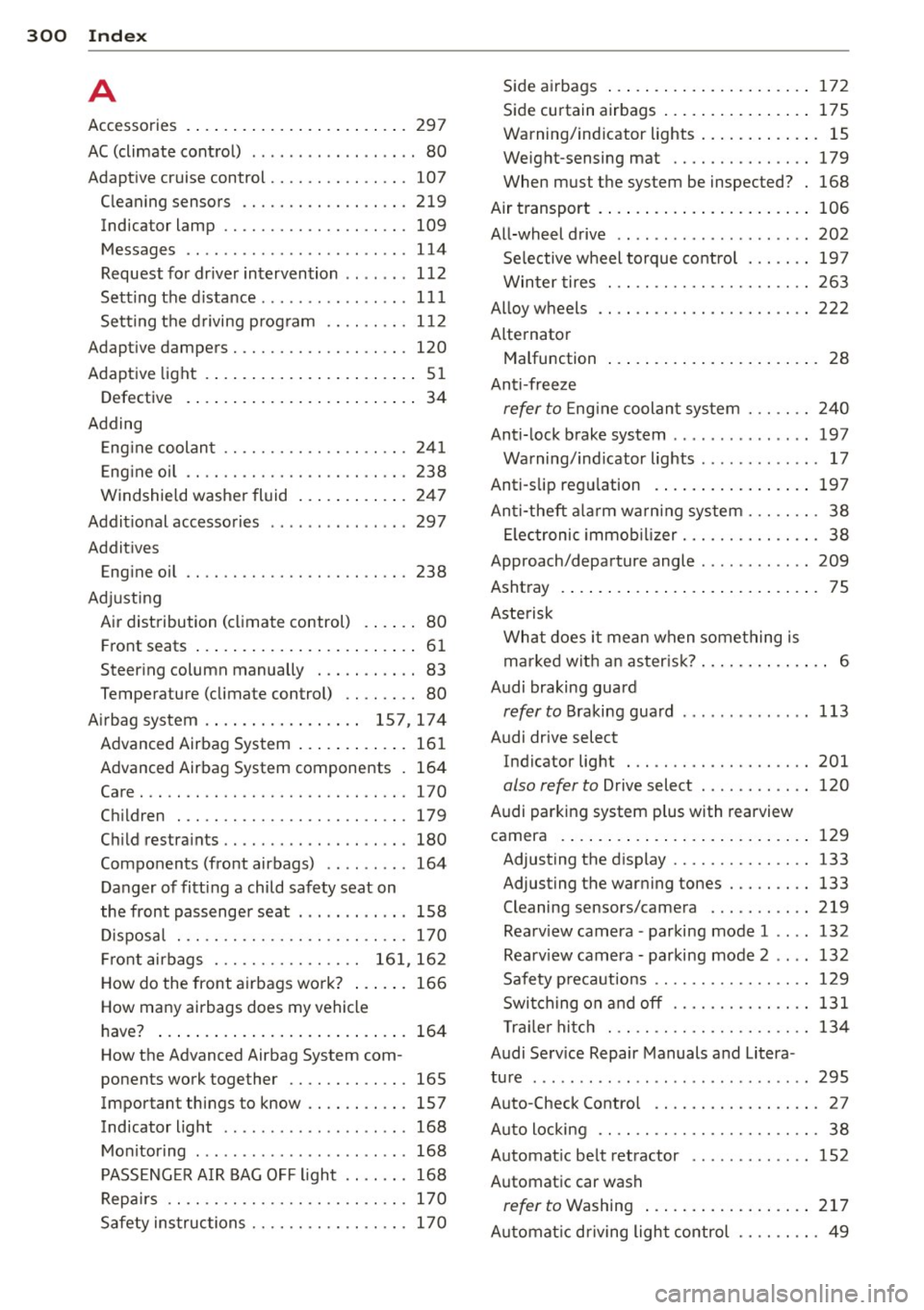
300 Index
A
Accessories 297
AC (climate control) . . . . . . . . . . . . . . . . . . 80
Adaptive cruise control . . . . . . . . . . . . . . . 107
Cleaning sensors ......... .. .. .... . 219
Indicator lamp . . . . . . . . . . . . . . . . . . . . 109
Messages .. ..... ........... ... .. . 114
Request for dr iver intervention . . . . . . . 11 2
Setting the d istance ........ ... .. ... 111
Setting the d riving p rog ram .. .. .... . 112
Adapt ive dampers . . . . . . . . . . . . . . . . . . . 120
Adaptive light . .. . ...... ... ... ..... .. 51
Defective . . . . . . . . . . . . . . . . . . . . . . . . . 34
Adding
E . l ngine coo ant ........... .. .. .... . 241
E ng ine oi l ............... .. .. .. .. . 238
W indshie ld washer fluid ... .. .. .... . 247
Addit ional accesso ries ... ... .. .. .. .. . 297
Additives
Eng ine oil .... ........... .. .. .... .
238
Adjusting
A ir dist ribution (climate control) . .... .
80
Front seats .... .. ..... ... .. .. .... .. 6 1
Steer ing column manually . .. .. .... .. 83
Temperature (climate control) .. .. .. . . 80
A irbag system . . . . . . . . . . . . . . . . . 157, 174
Advanced Airbag System ... .. .. .... . 161
Advanced Airbag System components . 164
Care . .. .. ............... .. .. .... . 170
Chi ldren . ............... .... .... . 179
Ch'ld t .
1 res ra 1nts ........... .. .. .. .. . 180
Components (front airbags) .. .. .. .. . 164
Danger of fitting a child safety seat on
the front passenger seat . .. .. .. .... .
158
Disposa l ..... ........... .. .. .. .. . 170
Fr ont airbags . . . . . . . . . . . . . . . . 16 1, 16 2
How do the front airbags work? ..... . 166
How many airbags does my vehicle
have? ..... ... .. ..... ... .. .. .... .
164
How the Advanced Airbag System com-
ponents work together ...... .. .... .
165
Important things to know .. .. .. .. .. . 157
Ind icator light ..... ...... .. .. .. .. . 168
Monitoring . ................ ... ... 168
PASSENG ER A IR BAG OFF light .. .. .. . 168
Repa irs .. .. .. . .......... .. .. .. .. . 170
Safety ins tructions ........ .. .. .. .. . 170
S ide a irbags ..... ... .. ..... .... . .. 172
Side curtain airbags .... ..... ... .. .. 175
Warning/ind icator lights ..... ... .. .. . 15
w. ht .
e1g -sensing mat . . . . . . . . . . . . . . . 179
When must the system be inspected? . 168
Air t ransport . ..... .. ... ..... ... .. .. 106
All-wheel drive .. .. ................ . 202
Selective wheel torque co ntrol . . . . . . . 19 7
Winter tires ... .. ............. .... 2 63
Al loy wheels .... .. ... .......... .... 222
Alternator
Malfunction . . . . . . . . . . . . . . . . . . . . . . .
28
Anti-free ze
refer to E ng ine coolan t sys tem ... .. .. 2 40
Anti- lock brake system .............. . 197
Warning/ind icator lights .. ... ..... .. . 17
Anti-slip reg ulation . .. .. ..... .... . .. 197
An ti-theft a la rm warn ing system . .. .. .. . 38
El ectronic immob il iz er .......... .... . 38
Approach/depa rture angle ........... . 209
Ashtray .... .... .. .. ... .. ..... ... .. . 75
Aste risk
What does it mean when something is
ma rked wit h an as ter isk? ..... ... .. .. .. 6
Audi braking guard
refer to Braking gua rd ............. . 113
Audi drive select
Indicator lig ht . .. ............. .. ..
201
also refer to Drive select .. ...... .... 120
Audi parking system plus with rearview
camera . ... .... .. .. ... .. ..... ... ..
129
Adjusting the d isplay ............. .. 133
Adjusting the war ning tones ..... .... 133
Cleaning sensors/camera ... .... .. .. 219
Rearv iew camera -parking mode 1 ... . 132
Rea rv iew camera -parking mode 2 .. .. 132
Safety p recautio ns ............. .... 129
Swi tch ing on a nd off ........... .... 131
Tra ile r hi tch . .. .. ... .......... .... 134
Audi Serv ice Repair Manuals a nd Litera -
ture . .. ... ... .. .. .. ... ... ... .. .. ..
295
Auto-Check Contro l . . . . . . . . . . . . . . . . . . 27
A ut o locking . . . . . . . . . . . . . . . . . . . . . . . . 38
Automat ic be lt retractor . .. ... ..... .. 152
Automatic car wash
refer to Washing ... ... ..... ... .. .. 217
A utomat ic d riving light control ...... .. . 49
Page 303 of 316
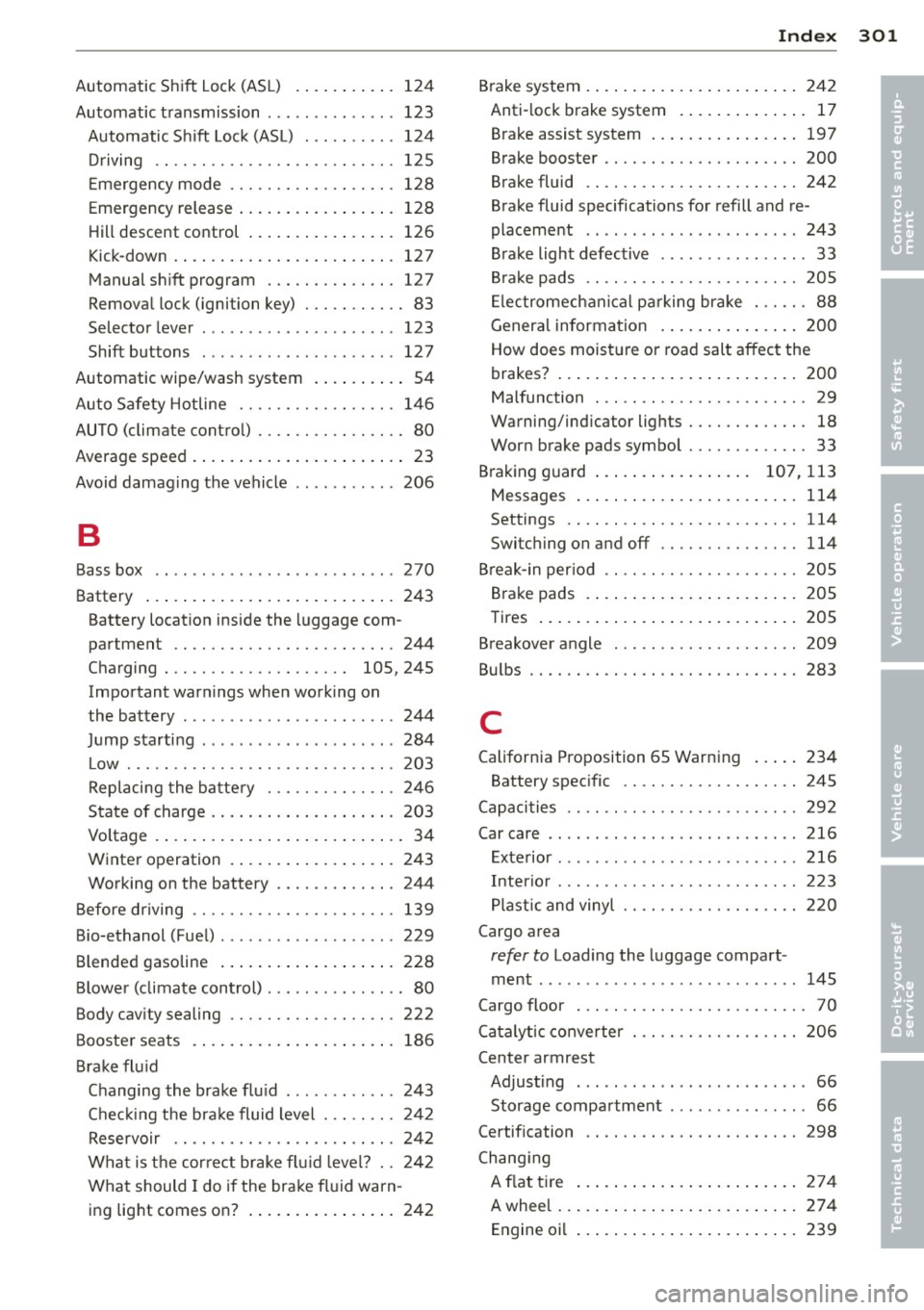
Index 301
-----------------------------------.......
Automatic Shift Lock (ASL) . ... .. .. .. . 124
Automatic transmission .......... .... 123
Automatic S hift Lock (ASL) . .. .. .. .. . 124
Driving .. .. ............. .. .. .. ... 125
E mergency mode ......... .. .. .. .. . 128
E me rgency release . . . . . . . . . . . . . . . . . 128
Hill descent control .... ... .. .. .. .. . 126
Kick -down . ..... ...... ... .. .. .. ... 127
Manual sh ift program ..... .. .. .. .. . 127
Removal lock (ignition key) . .. .. .. .. .. 83
Selector lever ......... ...... .... .. 123
Shift buttons .... .. ...... .. .. .. .. . 127
Automatic wipe/wash system . . . . . . . . . . 54
Auto Safety Hotline ........ .. .. .. .. . 146
AUTO (climate contro l) . . . . . . . . . . . . . . . . 80
Average speed . . . . . . . . . . . . . . . . . . . . . . . 23
Avoid damag ing the vehicle ...... . ... . 206
B
Bass box .. ............ ...... .... .. 270
Battery . . . . . . . . . . . . . . . . . . . . . . . . . . . 243
Battery locat ion inside the luggage com-
partment .. ............. .... .. .. . 244
C harging . . . . . . . . . . . . . . . . . . . . 105 , 245
Important war nings when working on
the battery . . . . . . . . . . . . . . . . . . . . . . . 244
Jump starting ............... ... ... 284
L ow . .. .. .. ................. .. .. . 203
Replacing the batte ry ..... .. .. .. .. . 246
State of charge . .. ..... ... .. .. .. ... 203
Voltage .... .... ...... ... .. .. .. .... 34
Winter operation . ..... ... .. .. .. .. . 243
Working on the battery . . . . . . . . . . . . . 244
B efore driving ............. .... .. .. . 139
Bio-ethanol (Fuel) .... ...... .. .. .. .. . 229
Blended gasoline ... .... ... .. .. .. ... 228
B lower (climate control) . . . . . . . . . . . . . . . 80
Body cav ity sealing ......... .. .. .. .. . 222
B ooster seats .. .. .. .... ... .. .. .... . 186
Brake flu id
Changing the brake flu id .... ... ... .. 243
C hec kin g the bra ke fluid level . .. .. .. . 242
Reservoir .. .. ........... .. .. .. ... 24 2
Wha t is the cor rect brake flu id leve l? . . 24 2
What should I do if the brake flu id warn -
ing light comes on? .... ... .. .. .. .. . 242 Brake system .
..... ... .. .. ..... ... .. 242
Anti- lock b rake system . . . . . . . . . . . . . . 17
Brake assist system .. .. ..... ... .. .. 197
Brake booster .. .. ................. 200
Brake fluid .. .. .. .... ............. 242
B rake fluid specifications fo r refill and re
placeme nt . . . . . . . . . . . . . . . . . . . . . . . 243
B ra ke light defective . . . . . . . . . . . . . . . . 33
B ra ke pads .. .. .. .. . .............. 205
El ec tromechan ical par king br ake . .. .. . 88
General informa tion . ... .... ... .. .. 2 00
How does moist ure or road salt affect the
brakes? ... .. .. .. .. . ... ...... ... .. 200
Malfunction . . . . . . . . . . . . . . . . . . . . . . . 29
Warning/ind icator lights ............ . 18
Wor n brake pads symbol . . . . . . . . . . . . . 33
Braking guard . . . . . . . . . . . . . . . . . 107, 113
Messages . . . . . . . . . . . . . . . . . . . . . . . . 114
Settings .. .. .. .. .. ............... 114
Switching on and off ........... .. .. 114
B reak-in per iod .. .. .. . .............. 205
B rake pads .. .... .. . .. .. ..... ... .. 205
Tires ... .. .. .... .. . .. .. ..... ... .. 205
B reakove rangle . .. .... ........... .. 209
Bu lbs ........ .. ...... ............. 283
C
Californ ia Proposition 65 Warning ... .. 234
Battery spec ific . . . . . . . . . . . . . . . . . . . 245
C ap aci ties .. .. .. .. .... ........... .. 292
Car care .......... .. ..... .......... 216
E xterior . . . . . . . . . . . . . . . . . . . . . . . . . . 216
Inte rio r ... .. .. .. .. ............... 223
Plast ic and vinyl .. .... ............. 220
Cargo a rea
refer to Loading the l uggage compart -
ment . ...... .. .... .......... ..... 145
Cargo floor . . . . . . . . . . . . . . . . . . . . . . . . . 70
Cata lytic converter . .... ......... .... 2 06
Center armrest Adjusting . . . . . . . . . . . . . . . . . . . . . . . . . 66
Storage compa rtment .. .. .. ... ... .. . 66
Certification .. .. .. .. ............... 298
Changi ng
A flat t ire ... .... .. . .. .. ..... ... .. 274
A whee l ... .. .... .. . .. .. ..... ... .. 274
Engine oi l ... .... .. . .. .. ..... ... .. 239
•
•