jump start AUDI Q5 2013 Owners Manual
[x] Cancel search | Manufacturer: AUDI, Model Year: 2013, Model line: Q5, Model: AUDI Q5 2013Pages: 316, PDF Size: 78.89 MB
Page 6 of 316
4 Table of contents
Fuses and bulbs ....... .. .. ... .
Elect rical fuses . ....... ... .. .. ... .
Bulbs .. .. .. ... ... .... ... .. .. ... .
Emergency situations ... .. ... .
General .... ... .. ..... ... .. .. ... .
Starting by push ing or tow ing . .. .. . .
Starting with jumper cables .. .. .. . .
Use of jumper cab les .. .. .. .. .. .. . .
Eme rgency towing with commercial
tow truck .. ................ ... . .
Lift ing vehicle . ........... .... ... .
Technical data ............. .. . .
General information .. .. .. .. . .
Explana tion of te chnical data . .. ... .
Vehicle iden tifica tion .... ...... .. . .
Weights ... ... .. ..... ... .. .. ... .
Dimensions .... .. ..... ... .. .. ... .
Data .. .. .. .. .. .. .... ... .. .. .. . .
2 11 hp, 4 -cylinder engine, quattro .. .
2 11 hp, 4-cylinder engine, hybrid
quattro ...... ............. ..... .
272 hp, 6-cylinder engine, quattro . . .
Consumer Information ..... . .
Warranty coverages ....... .. .. ... .
Operating your vehicle outside the
U .S .A . or Canada .......... ... .. . .
Aud i Service Repair Man uals and 280
280
283
284 284
284
284
285
286 288
290 290
290
290
290
29 1
292
2 92
293
294
295 295
295
Literature . . . . . . . . . . . . . . . . . . . . . . . 295
M ain tenance . . . . . . . . . . . . . . . . . . . . . 295
Addi tional accesso ries , modifications
and parts replacement . . . . . . . . . . . . 297
D eclaration o f Compliance,
Te lecommunications and E lectronic
Systems . . . . . . . . . . . . . . . . . . . . . . . . 298
Index . . . . . . . . . . . . . . . . . . . . . . . . . . 300
Page 107 of 316
Additional information about the vehicle tool kit may be found under
c::> page 269 and
about the tire repa ir set under
c::> page 2 72 .
(D Tips
The right storage compartment in the lug
gage compartment and its contents must
always be kept in the vehicle. The veh icle
m ust not be operated w ithout the tire re
pa ir set.
Charging the batteries
Applies to vehicles: with hybrid drive
The vehicle is equipped with two 12 volt bat
ter ies and a h igh voltage battery.
If the
12 volt batter ies are dead, they may be
charged with a charger or the vehicle may be
jump started with assistance from another ve
hicle in the same way as a conventional vehi
cle .
The same applies to the high voltage battery
if it is d ischarged . However, in this case, the
charg ing process is accompanied w ith mes
sages in the inst rument cluste r display. The
i gnit ion m ust be switched on and all unneces
sary electric components m ust be turned off.
The connections in the engine compartment
are used for both charging and jump starting
c::> page 245 or c::> page 284.
Vehicle not ready to start. See owner's
manual
This message appears if the high voltage bat
tery charge level is too low. The vehicle can no
l onge r be started with its own power. The
high voltage battery must be charged with a
charger or the vehicle must be jump started
with the aid of another vehicle.
Afte r the connecting the cha rger or jumper ca
b les, the ignition must be turned off for ap
proximately two minutes and then turned on
again. After no more than one m inute, one of
the following indicator lights turns on in the instrument cluster d isp lay. Hybrid 105
II Charging battery. Please wait ...
If
the indicator light turns on and this mes
sage appears, the high voltage battery is
charging or the vehicle is being jump started
with assistance from another vehicle.
If the 12 vo lt batteries are dead, the -
indicator light turns on. The charging proce
dure takes longer in this case because the
12
volt batteries are charged first. The procedure
goes faster with the ignition switched off.
Vehicle ready to start.
This message appears if the charging proce
dure was successfu l. The vehicle may be start
ed again.
Battery could not be charged enough to
start vehicle.
T his message appears if the charging proce
dure was not successful or it was interrupted.
This may happen if the charger or the battery
in the veh icle that is assist ing is too weak.
If
the vehicle cannot be started, see an author
ized repa ir facility for assistance .
(D Tips
- The charger should deliver a current of at
least
30 A. Otherwise charging the high
voltage battery will take considerably longer. A current between
50 A and 70 A
is ideal.
- The ve hicle that is assist ing should be
somewhat within the same vehicle class
when jump starting a vehicle. A smaller
vehicle's battery may be drained.
- After approximately
30 minutes, the
c harging procedure ends because the ig
nition is automatically turned off.
If you
would like to continue to charge the bat
tery, turn the ignition on again.
Page 237 of 316
Checking and filling 235
Engine compartment
Engine compartment
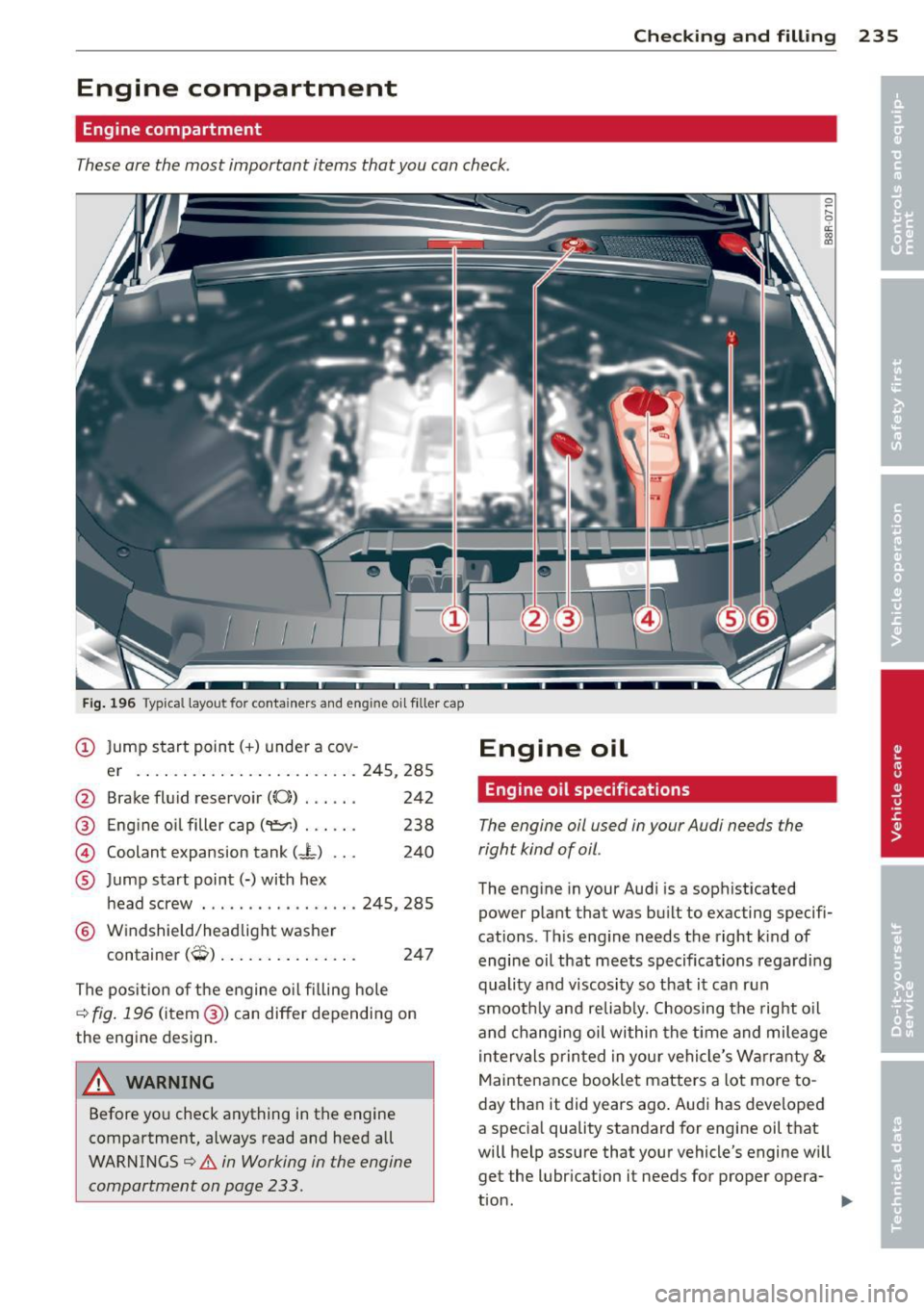
These are the most important items that you can check.
Fig. 196 Typical layout for contain ers and engine oil filler cap
(D Jump start point( +) under a cov -
er .. .. .. .. .............. .. 245, 285
@ Brake fluid reservoir ((0)) . . . . . . 242
@ Eng ine oil filler cap
("t=:?1) . . . . . . 238
@ Coolant expansion tank (J-) . . . 240
® Jump start point(-) with hex
head screw ........... .... .. 245, 285
® Windshield/headlight washer
container
(0) . . . . . . . . . . . . . . . 247
The pos ition of the engine o il filling hole
¢ fig. 196 (item@) can differ depending on
the engine design.
A WARNING
-
Before you check anything in the engine
compartment, always read and heed all
WARNINGS ¢&. in Working in the engine
compartment on page 233.
Engine oil
Engine oil specifications
The engine oil used in your Audi needs the
right kind of oil .
The engine in your Audi is a sophisticated
power plant that was bu ilt to exacting specifi
cations. This eng ine needs the right k ind of
engine oil that meets specifications regarding
quality and viscosity so that it can run
smooth ly and reliab ly. Choosing the right oil
and changing oil within the time and mileage
intervals printed in your vehicle's Warranty
&
Maintenance booklet matters a lot more to
day than it did years ago . Audi has developed
a specia l quality standard for engine oil that
will help assure that your vehicle's engine will
get the lubrication it needs for proper opera-
tion. .,..
Page 248 of 316
246 Checking and filling
• Open the engine hood ¢ page 233.
• Remov e the cover (!) by pressing on the ar
row ¢
fig. 201.
• Open the cover @on the positive term inal.
• Connect the charger connectors according
to the instruct ions to the
jump start bolts.
(Bolts under the cover = "positive ", Bolts
with hex head= "negative").
• Only now plug the mains lead for the charg
i ng equipment into the wall outlet and turn
iton ¢,&. .
• Make sure the charging rate is not over
30 amps/14.8 Volt.
• When the battery is fully charged: Turn the
charging equ ipment off and remove the
mains lead from the wall outlet.
• Now remove the clamps for the charging
equipment.
• Close the cover @on the positive term inal
and re-install the cover (!).
• Close the hood ¢
page 233.
A discharged battery can freeze at tempera
tures of on ly 32 °F (0 °C). A llow a frozen bat
tery to thaw completely befo re attempt ing to
cha rge it~ &. . H owever, we recommend not
using a thawed battery again because the bat
tery casing can be cracked due to ice forma
tion and can leak battery acid.
Battery charging (Maximum charging rate
of
30 amps/14.8 Volt)
When charging at low voltages (e.g . with a
trickle charger ), the battery cables do not
have to be d isconnected first. The battery
caps should
not be opened when charging a
battery .
It is not necessary to remove the battery from
the luggage compartment.
Fast charging the battery (charging rate
above 14.8 Volts )
For technical reasons do not use a battery
charger that uses voltage greater than 14.8
Volts to charge your vehicle's battery.
.&_ WARNING
Charging a battery can be dangerous. -
Always follow the operating instructions
provided by the battery charger manu
facturer when charging your battery.
- Never charge a frozen battery. It may ex
plode because of gas trapped in the ice.
Allow a frozen battery to thaw out first.
- Do not reuse batteries wh ich were fro
zen. The battery housing may have
cracked and weakened when the battery
froze.
- Charge the battery in a well ventilated
area. Keep away from open flame or elec
tr ica l spark. Do not smoke. Hydrogen gas
generated by the battery is explosive.
- To reduce the danger of explosion, never
connect or disconnect charger cab les
while the charger is ope rat ing.
- Fast charging a battery is dangerous and
should only be attempted by a compe
tent technician with the proper equip
ment.
- Battery acid that may spill dur ing charg
ing should be washed off with a solution
of warm wat er and baking soda to neu
tralize the acid.
(I) Note
Never use a fast charger as a booster to
start the engine. This will seriously dam
age sensitive electronic components, such
as contro l units, re lays, radio, etc., as well
as the battery charger.
Battery replacement
The new battery must have the same specifi
cations and dimensions as the original equip
ment battery.
Intelligent energy management in your vehi
cle is responsible for distributing the electri
ca l energy throughout your vehicle
¢
page 203 . The intelligent energy manage
ment system will keep the engine battery
charged better then vehicles without this sys
tem . To make sure the additional electrical en
ergy is ava ilable once again after you have
changed the battery, we recommend that you ..,.
Page 286 of 316
284 Emergency situations
Emergency situations
General
This chapter is intended for trained emer
gency crews and working personnel who
have the necessary tools and equipment to
perform these ope rations.
Starting by pushing or
towing
Q;) Note
Vehicles with an automati c transmission
cannot be started by pushing or towing .
Starting with jumper
cables
If necessary, the engine can be started by
connecting it to the battery of another vehi
cle.
If the engine should fail to start because of a
discharged or weak battery, the battery can be
connected to the battery of
another veh icle,
using a
pair of jumper cables to start the en
g ine .
Jumper cables
Use only jumper cables of sufficiently large
cross section to carry the starter current safe
ly. Refer to the manufacturer's specifications.
Use only jumper cables with
insulated termi
na l clamps which are distinctly marked:
plus(+) cable in most cases colored red
minu s(-) cable
in most cases colored black .
A WARNING
Batteries contain electricity, ac id, and gas .
Any of these can cause very serious or fatal
inju ry. Follow the instructions below for
safe handling of your veh icle's battery.
- Always shield you r eyes and avoid lean
ing over the battery whenever possible.
- A discharged battery can freeze at tem
peratures just be low 32 °F (0 °C). Before connecting a
jumper cable, you must
thaw the frozen battery complete ly, oth
erwise it could explode.
- Do not allow battery acid to contact eyes
or skin . Flush any contacted area with
water immediately .
- Improper use of a booster battery to start a vehicle may cause an explosion.
- Vehicle batteries generate explosive gas
es. Keep sparks, flame and lighted ciga
rettes away from batteries.
- Do not try to jump start any vehicle with a low ac id level in the battery.
- The vo ltage of the booster battery must
also have a 12-Volt rating . The capacity
(Ah) of the booster battery should not be
lower than that of the discharged bat
tery . Use of batteries of d ifferent voltage
or substantially different "Ah" rating
may cause an exp losion and personal in
jury.
- Never charge a frozen batte ry. Gas trap
ped in the ice may cause an explosion.
- Never charge or use a battery that has
been frozen. The battery case may have
be weakened.
- Use of batter ies of different voltage or
substantially different capacity (Ah) rat
ing may cause an exp losion and injury.
The capacity (Ah) of the booster battery
should not be lower than that of the dis
charged battery.
- Before you check anything in the engine
compartment, always read and heed a ll
WARNINGS ¢
page 226, Engine com
partment.
«I) Note
-Applying a higher voltage booster bat
tery will cause expensive damage to sen
sitive electronic components, such as
contro l units, relays, rad io, etc .
- There must be no electrical contact be
tween the vehicles as otherwise current
could already start to flow as soon as the
positive(+) terminals are connected. ..,_
Page 287 of 316
@ Tips
-The discharged battery must be properly
connected to the vehicle's electrical sys
tem. When jump start ing or charging the
battery, never connect the negative
ground cable to the battery negative
post because the battery manager sys
tem must be able to detect the battery's
state of cha rge . A lways connect the neg
ative g round cab le to the negative
gro und post o f the battery manage r con
trol uni t.
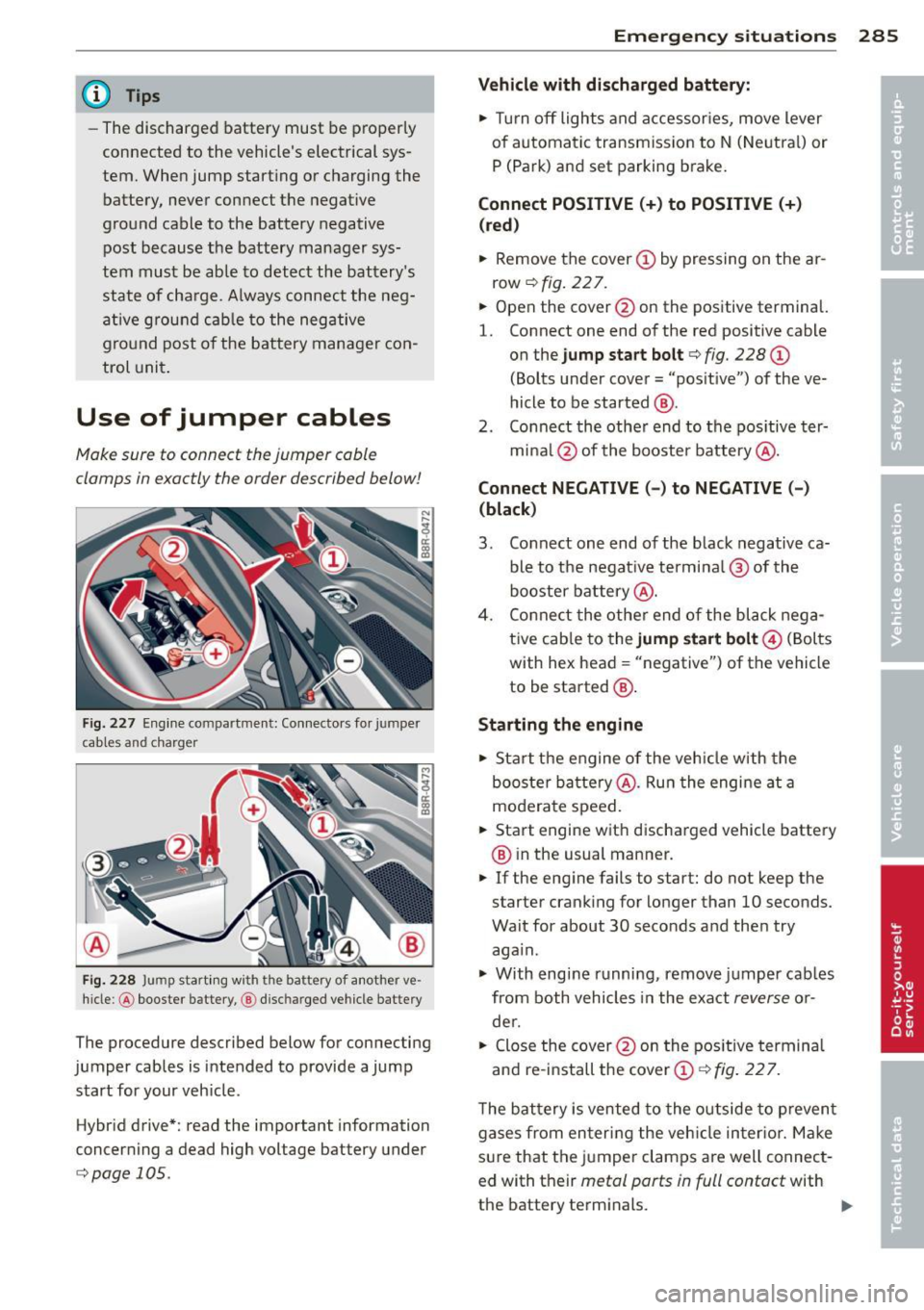
Use of jumper cables
Make sure to connect the jumper cobl e
clomps in exactly the order describ ed b elow!
Fig. 227 Engine co mpartmen t: Con ne ctors fo r jum per
c ables a nd char ger
Fi g. 22 8 Jump s tart in g w ith t he ba ttery of a not her ve
hi cle :@ booster battery, @ disc harged vehicle bat tery
The procedure described below for connecting
jumper cables is intended to provide a jump
start for your veh icle .
Hybr id drive*: read the important information
concerning a dead high voltage bat te ry under
c::;, page 105 .
Emergenc y situ ation s 285
Vehicle with discharged b attery:
.,. Turn off lights and accessor ies, move lever
o f automatic transmiss ion to N (Neutra l) or
P (Pa rk) and set parking brake.
Connect POSITIVE (+) to POSITIVE (+ )
(r ed)
.,. Remove the cover(!) by pressing on the ar
row
¢ fig. 227.
.,. Open the cover @on th e positive terminal.
1. Connect one end of the red pos it ive cable
on the
jump start bolt c::;, fig. 228 (D
(Bolts under cover= "po sit ive") of the ve
hicle to be started @.
2. Connect the othe r end to the pos itive ter-
mi na l@ of the booster battery @.
Connect NEGATIVE (-) to NEGATIVE (- )
(black )
3. Connect one end of the black negative ca
ble to the negative termi na l@ of the
booster battery @.
4 . Co nnect the othe r end o f the black nega
tive cab le to the
jump sta rt b olt © (Bolts
with hex head = "negative") of the vehicle
to be started @.
Starting the engine
.,. Start the engine of the veh icle w ith the
booster ba tte ry @ . Ru n the engine at a
moderate speed .
.,. Start eng ine wit h discha rged vehicle battery
@ in the usual manner .
.,. If the eng ine fails to start: do not keep the
starter crank ing for longer than 10 seconds.
Wait for about 30 seconds and then try
aga in .
.,. With engine running, remove jumper cab les
from both vehicles in the e xact
reverse o r
de r .
.,. Close the cover @on the pos itive termina l
and re -install the cover
(D c::;, fig . 22 7.
T he battery is vented to the outside to preven t
gases from en ter ing the veh icle in ter io r. Ma ke
su re that the jumper clamps are well connect
ed with their
metal parts in full contact with
the battery te rm inals.
Page 288 of 316
28 6 Em ergency sit uat ions
_& WARNING
To avoid serious personal injury and dam
age to the vehicle, heed all warnings and
instructions of the jumper cable manufac
turer. If in doubt, call for road serv ice.
- Jumper cables must be long enough so
that the vehicles do not touch.
- When connecting jumper cables, make
surethattheycannotgetca ughtinany
moving parts in the eng ine compart
ment.
- Do not bend over the batteries -danger
of chemical burns!
- The battery cell locking screws must be
t ightened securely.
- Before you check anything in the engine
compartment, always read and heed all
WARNINGS
c:> page 226, Engine com
partment .
Improper hook-up of jumper cables can ru
in the generator.
- Always connect POSITIVE( +) to POS I
TIVE(+), and NEGATIVE( -) to NEGATIVE
(-) ground post of the battery manager
control unit.
- Check that a ll screw plugs on the battery
cells are screwed in firmly . If not, tighten
plugs prior to connecting clamp on nega
tive battery terminal.
- Please note that the procedure for con
nect ing a jumper cable as described
above applies spec ifically to the case of
your vehicle being jump started. When
you are giving a jump start to anothe r ve
hicle, do
not connect the negat ive (-) ca
ble to the negat ive (-) term inal on the
discharged bat tery ©
c:> fig. 2 28. In
stead, securely connect the negative(-)
cable to e ithe r a solid metal component
that is firm ly bolted to the engine block
or to the engine block itse lf. If the bat
tery that is being charged does not vent
to the outside, escaping battery gas
could ignite and exp lode!
-
Emergency towing
with commercial tow
truck
General hints
Your Audi requires special handling for tow
ing.
T he following information is to be used by
commercial tow truck operators who know
how to op erate their equipment safely.
- Nev er tow your Audi , towing will cau se
damage to the engine and tr an smi ssion .
- Ne ver wrap th e safety chain s or winch ca
ble s around the brak e lines.
- To pre vent unne ce ss ary damage, your Audi
mus t be tr an sp o rt ed with a flat bed tru ck.
- To load th e vehi cle on to th e flat b ed, use
the towing l oop found in the ve hicle to ols
an d att ach to th e front or r ea r a ncho rage
c:>page 287 and Qpage 287.
_& WARNING
= -
A vehicle being towed is not safe for pas
sengers. Never allow anyone to ride in a
vehicle being towed, for any reason.
Page 303 of 316
Index 301
-----------------------------------.......
Automatic Shift Lock (ASL) . ... .. .. .. . 124
Automatic transmission .......... .... 123
Automatic S hift Lock (ASL) . .. .. .. .. . 124
Driving .. .. ............. .. .. .. ... 125
E mergency mode ......... .. .. .. .. . 128
E me rgency release . . . . . . . . . . . . . . . . . 128
Hill descent control .... ... .. .. .. .. . 126
Kick -down . ..... ...... ... .. .. .. ... 127
Manual sh ift program ..... .. .. .. .. . 127
Removal lock (ignition key) . .. .. .. .. .. 83
Selector lever ......... ...... .... .. 123
Shift buttons .... .. ...... .. .. .. .. . 127
Automatic wipe/wash system . . . . . . . . . . 54
Auto Safety Hotline ........ .. .. .. .. . 146
AUTO (climate contro l) . . . . . . . . . . . . . . . . 80
Average speed . . . . . . . . . . . . . . . . . . . . . . . 23
Avoid damag ing the vehicle ...... . ... . 206
B
Bass box .. ............ ...... .... .. 270
Battery . . . . . . . . . . . . . . . . . . . . . . . . . . . 243
Battery locat ion inside the luggage com-
partment .. ............. .... .. .. . 244
C harging . . . . . . . . . . . . . . . . . . . . 105 , 245
Important war nings when working on
the battery . . . . . . . . . . . . . . . . . . . . . . . 244
Jump starting ............... ... ... 284
L ow . .. .. .. ................. .. .. . 203
Replacing the batte ry ..... .. .. .. .. . 246
State of charge . .. ..... ... .. .. .. ... 203
Voltage .... .... ...... ... .. .. .. .... 34
Winter operation . ..... ... .. .. .. .. . 243
Working on the battery . . . . . . . . . . . . . 244
B efore driving ............. .... .. .. . 139
Bio-ethanol (Fuel) .... ...... .. .. .. .. . 229
Blended gasoline ... .... ... .. .. .. ... 228
B lower (climate control) . . . . . . . . . . . . . . . 80
Body cav ity sealing ......... .. .. .. .. . 222
B ooster seats .. .. .. .... ... .. .. .... . 186
Brake flu id
Changing the brake flu id .... ... ... .. 243
C hec kin g the bra ke fluid level . .. .. .. . 242
Reservoir .. .. ........... .. .. .. ... 24 2
Wha t is the cor rect brake flu id leve l? . . 24 2
What should I do if the brake flu id warn -
ing light comes on? .... ... .. .. .. .. . 242 Brake system .
..... ... .. .. ..... ... .. 242
Anti- lock b rake system . . . . . . . . . . . . . . 17
Brake assist system .. .. ..... ... .. .. 197
Brake booster .. .. ................. 200
Brake fluid .. .. .. .... ............. 242
B rake fluid specifications fo r refill and re
placeme nt . . . . . . . . . . . . . . . . . . . . . . . 243
B ra ke light defective . . . . . . . . . . . . . . . . 33
B ra ke pads .. .. .. .. . .............. 205
El ec tromechan ical par king br ake . .. .. . 88
General informa tion . ... .... ... .. .. 2 00
How does moist ure or road salt affect the
brakes? ... .. .. .. .. . ... ...... ... .. 200
Malfunction . . . . . . . . . . . . . . . . . . . . . . . 29
Warning/ind icator lights ............ . 18
Wor n brake pads symbol . . . . . . . . . . . . . 33
Braking guard . . . . . . . . . . . . . . . . . 107, 113
Messages . . . . . . . . . . . . . . . . . . . . . . . . 114
Settings .. .. .. .. .. ............... 114
Switching on and off ........... .. .. 114
B reak-in per iod .. .. .. . .............. 205
B rake pads .. .... .. . .. .. ..... ... .. 205
Tires ... .. .. .... .. . .. .. ..... ... .. 205
B reakove rangle . .. .... ........... .. 209
Bu lbs ........ .. ...... ............. 283
C
Californ ia Proposition 65 Warning ... .. 234
Battery spec ific . . . . . . . . . . . . . . . . . . . 245
C ap aci ties .. .. .. .. .... ........... .. 292
Car care .......... .. ..... .......... 216
E xterior . . . . . . . . . . . . . . . . . . . . . . . . . . 216
Inte rio r ... .. .. .. .. ............... 223
Plast ic and vinyl .. .... ............. 220
Cargo a rea
refer to Loading the l uggage compart -
ment . ...... .. .... .......... ..... 145
Cargo floor . . . . . . . . . . . . . . . . . . . . . . . . . 70
Cata lytic converter . .... ......... .... 2 06
Center armrest Adjusting . . . . . . . . . . . . . . . . . . . . . . . . . 66
Storage compa rtment .. .. .. ... ... .. . 66
Certification .. .. .. .. ............... 298
Changi ng
A flat t ire ... .... .. . .. .. ..... ... .. 274
A whee l ... .. .... .. . .. .. ..... ... .. 274
Engine oi l ... .... .. . .. .. ..... ... .. 239
•
•
Page 306 of 316

304 Index
Electronic immobilizer . . . . . . . . . . . . . . . . 38
Electronic power control
( E PC) warn ing/ indicato r light . .. .... .. 15
Electroni c Stab ili za tion Con trol (ESC) ... 197
ESC Offroad mode ......... ... .. .. . 198
H ill descent assist ......... .... .... 199
Warning/indicator lights ....... .. .... 15
E mergency braking . . . . . . . . . . . . . . . . . . . 90
E mergency flasher . . . . . . . . . . . . . . . . . . . 52
Warning/indicator lights ... .. .. .... . . 16
Emergency key .. .. .... ...... .. .. .. .. 36
Starting engine ........... ... .. .. .. 85
Emergency locking of the doo rs . . . . . . . . . 42
E mergency operation
L uggage compartment lid .. .. .. .. ... . 45
Emergency release
Selector lever . .... .... ..... .. .. .. . 128
Emergency star ting ........ .. .. .. .. . 284
Em ergency towing ............. .... . 286
Emergency unlocking
I gn ition key . . . . . . . . . . . . . . . . . . . . . . . 38
Energy management ....... .. .. .. .. . 203
En gin e
Compartment .. ........ .. .. .. .... . 235
Coolant .... ... .......... .. .. .... . 240
Hood .. .... ... .......... ........ . 233
Jump starting ............ .... .... . 105
Start-Stop-System . . . . . . . . . . . . . . . . . . 91
Starting . . . . . . . . . . . . . . . . . . . 83, 86, 98
Starting with jumper cables .. .. .. ... 284
Stopping . . . . . . . . . . . . . . . . . . . 85, 87, 98
E ngine compartment
Safety instructions ........ .. .. .. .. . 233
Working the engine compartment .... 233
Engine coolant system .......... .... . 240
Adding coolant . .......... .. .. .... . 241
Check ing coolant level ....... .. .... . 240
Malfunction . . . . . . . . . . . . . . . . . . . . . . . 30
Radiator fan ... .. ..... ... .... .. .. . 242
Engine coolant temperature Temperature gauge ........... .... . . 10
En gin e data ... ............ .. .. .. .. . 292
Eng ine hood
C losing .. .. ... .. ..... ..... .. .. .. . 233
H ow to release the hood ....... .. ... 233 E
ngine oi l .. .... .. ... .. ........ .. .. 235
Adding ... .... .. .. ... ........ .. .. 238
Additives .. .. .. .. .. ... ........ .. .. 238
Chang ing ..... .. ............. .... 239
Check oil level ... ............. .... 238
Consumption .. .. ................ . 238
Level .... ... .. .. .. ... .. ... ..... .. . 34
Oil consumpt ion .. .......... ...... . 237
Oil grades . .. .. . ............ .... .. 235
Pressure malfunction ....... .... .. .. . 30
Sensor defective . . . . . . . . . . . . . . . . . . . . 34
Specification and viscosity ....... .. .. 235
En gine speed limitation . . . . . . . . . . . . . . . 34
Environment Break-in per iod ... ............. .... 20S
Catalytic converter ................ . 206
Dispos ing of your ve hicle battery ..... 246
Driving at high speeds ............. . 207
Driving to minimize pollution and noise 207
Fuel .... .. .... .. ............. .... 231
Fu el economy .. . .. ............ .. .. 207
Leaks under your vehicle .......... .. 233
Letting the vehicle stand and warm up . 207
Proper disposal of drained brake fluid . 243
Proper disposal of drained engine cool-
ant .. .... .... .. ............. .... 241
Proper disposal of drained engine
o il . . . . . . . . . . . . . . . . . . . . . . . . . 238, 239
Recycling used engine oil ........... . 238
Roof rack . .. .. .. .. ........... .... . 72
Unl eaded fuel .. .. ............. .. .. 22 8
What shoul d I do with an old battery? . 246
EPC
refer to Electronic power control ..... . 15
ESC
refer to Electronic Stabili zation Control
(ESC) .... ... .. .. .. ... .. ... ..... .. . 15
ESC Offroad mode . . . . . . . . . . . . . . . . . . . 198
E thy l alcoho l (Fuel) ..... ... ... ... .. .. 229
Event Data Recorder (EDR) . . . . . . . . . . . . 197
E xhaus t tai l pipes
C leaning . ..... .. .. ... ........ .. .. 223
Expansion tank .. .. ..... ........... . 240
Explanation of some technical terms ... 209
Page 308 of 316
306 Index
Heated (upho lder . .... . ...... ... .. .. .... .. 74
Exterior m irrors ... .... ... .. .. .... .. 57
Rear window ............. .... ...... 81
Seats .. ...... ........... ........ .. 81
Washer fluid nozz les . . . . . . . . . . . . . . . . 54
H eating ...... .. .. ..... ... .. .. .... .. 79
H eavy clothing and safety belts . .. ..... 1 52
High beam . .. ............. .. .. .. ... . 52
War ning/ indicato r lights ... .. .. .. .. . . 17
High voltage warning labe l .. .. .... .. . 290
H ill descent assist . . . . . . . . . . . . . . . . . . . 199
Hill descent control ........ .. .. .... . 126
H omelink (remote con tro l)
H ood 13
5
Opening . .. .. .. .. .......... ... .. . 233
Release lever . ........... .. .. .... . 233
Ho rn . .. ...... ........... .... .... .. . 8
H ow are c hild restra int sys tem anchors re -
l ated to child sa fe ty ..... ... .. .. .... . 19 1
H ow many airbags does my vehicle have? 164
How often sho uld I check my t ire pres-
sures? .. .. ................. .. .... . 255
H ow sa fety belt pretensioners wo rk ... . 1 55
H ybr id d rive .. .. .. ...... .... ... .. .. .. 97
12 vo lt batteries .... ... .. .. .. .. .. . 105
Consumpt io n disp lay ...... .. .. .... . 10 4
E fficien t drive mode ....... .. .. .... . 10 2
E ne rgy flow d isplay .. ... .. .. .. .... . 103
EV mode ... ... .. ..... ... .. .. .... . 100
H igh vo ltage battery . . . . . . . . . . . 97, 105
High vo ltage system .......... .. .. .. 97
Operating modes ......... .... .... . 100
Power meter . . . . . . . . . . . . . . . . . . . . . . . 98
Start ing the veh icle ...... ... .. .. .... 98
Transport . . . . . . . . . . . . . . . . . . . . . . . . 106
H ydroplaning ............... .. .... . 259
I
Ignition
Switching on/off . ..... ... .. .. .... .. 83
I gnition key
E mergency unloc king . . . . . . . . . . . . . . . . 3 8
Ignition lock . . . . . . . . . . . . . . . . . . . . . . . . 83
M alfunct io n . . . . . . . . . . . . . . . . . . . 31, 34
Important things to do before driving .. 139 Improperly worn sa
fety belts . ... .. .. .. 155
Ind icator lig hts . . . . . . . . . . . . . . . . . . 14 , 99
Airbag system ................ .... 168
P ASS ENG ER A IR BAG OF F ....... .. .. 168
Infant seats .. .. .. .... .... ..... .. .. 184
Inflatab le spare tire . .. .. ..... ... .. .. 270
I n flating . ..... .. .. ... ..... ... .. .. 271
Installing child safety sea ts
S af ety be lts . . . . . . . . . . . . . . . . . . . . . . 188
Installing the upper tether strap on the
ancho rage .. .. .. .. ... .. .. ... ..... .. 195
Instrument cluster .... .. ..... ... .. .. . 98
Instrument ligh ting ............. .... . 51
Instruments and controls ........ .. .. . 10
General illustration . . . . . . . . . . . . . . . . . . 8
Interior lights
Dimming .. ..................... ... 53
Front . .. .. .... .................... 53
Rea r ..... .. .. .. ............. .... . 53
Interval wiping .... ... .. ..... .... . .. . 54
Rain sensor . . . . . . . . . . . . . . . . . . . . . . . . 54
J
Jump-star ting ..... .. .... .... ... .. .. 284
Jumper cables ... .. ... .. .. ... ..... .. 285
Jump start ing 105
K
Key ...... .. .... .. .. ... .. ..... ... .. . 36
Battery replacement . . . . . . . . . . . . . . . . 3 7
Check light . . . . . . . . . . . . . . . . . . . . . . . . 3 7
Emergency key . . . . . . . . . . . . . . . . . . . . . 85
Ig nit io n/engine o n/off .............. . 83
Key replacement . . . . . . . . . . . . . . . . . . . 36
Master key with remote control . . . . . . . 36
Mechan ica l key . .. ...... ....... .. .. . 37
Removing . .. .. .. ............. .... . 85
K ick-down
t iptro nic .. .. .. .. ... .. .. ... ..... .. 127
L
Lane Change Assistant
refer to Side assist . . . . . . . . . . . . . . . . . 116