rims AUDI Q5 2013 Owners Manual
[x] Cancel search | Manufacturer: AUDI, Model Year: 2013, Model line: Q5, Model: AUDI Q5 2013Pages: 316, PDF Size: 78.89 MB
Page 224 of 316
222 Cleaning and protec tio n
-To h elp prevent dirt fr om scratch ing the
win dow, always scrape in a f orward di
rection -pu shing the scraper away from
you -never back and fo rth.
- Water leaking from the inside of the rear
windows may damage sensitive electrical
components located either under the
rear parcel shelf or in the rear trunk area.
Always ensure that water
never leaks
through the body sect ion of the vehicle.
You can do this by using waterp roof pro
tection
over the vehi cle's electr ical com
ponen ts (e.g., when ins tall ing window
tinting) .
- Damage or malf unct ion of electrical
componen ts due to wa ter damage or any
other outside influence is not covered by
the Audi New Vehicle Limited Warranty .
See your Warranty
& Maintenance book
l et for add itiona l details about your war
ranty.
Cast (light ) alloy wheels
Cast (light) alloy wheels require special care.
... Wash the whee ls w ith a sponge or hose
brush
every other week .
... For deep cleaning afterwards, use only a
dedicated
acid-free cast alloy wheel cleaner.
., Rub a coat of
liquid wa x onto the r ims every
three month . Be sure to reach and treat a ll
parts of the rim .
To preserve the decorat ive appearance of the
cast a lloy whee ls, some specia l care is neces
sary. In add it io n to road dirt and sa lt, b rake
dust is a lso cor ros ive . If left o n for too long,
b rake dust ca n cause pitting.
Use on ly special
acid-free cleaners formulated
for a lloy rims . Safe products are available at
your author ized Audi dealer. Never leave the
cleane r on the r ims longe r than spec ified o n
the label.
If no t rinsed off p romp tly, the a cid
con tained in some cleaners can attack the
threads on the whee l bolts.
Never use ab ras ive or metal polishing clean
i ng agen ts.
If the pro te ct ive coa ting has been chipped, e.g
. by kicked up road dirt, to uch it
u p as soon as possible.
A WARNING
--
- Moisture and ice on b rakes may affect
brak ing eff ic iency
c::> page 200, Brake sys
tem.
Test the brakes carefully each t ime
you wash the vehicle .
- Always read and heed all WARNINGS and
other information
c::> page 216.
Body cavity sealing
The body cavity sealing does not need to be
checked.
All body cavit ies which could be affected by
corros ion have been thorough ly protected at
the factory.
T his sealing does not require any inspection or
additional treatment. If any wax shou ld seep
o ut of the cavity when the ambient tempera
ture is high, it can be
removed with a p lastic
scraper and a suitable solvent .
A WARNING
-Solvents can be dangerous.
- Benz ine is flammab le and toxic. If you
use benz ine for removing the wax, keep
sparks , flame and lighted cigarettes
away . Never dump benz ine on the
g round, into open streams or down sew
age d rains.
- Be s ure to
observe all safety and environ
men tal regulat ions. Follow all instruc
tions on the container.
- Always read and heed all WAR NINGS and
other info rmation
c::> page 216.
Chassis
Have the undercoating checked for damage
from time to time .
The lower body shell of your Aud i is also thor
oughly protected against corros io n.
Any damage to the undercoat ing ca used by
road hazards should be repaired prompt ly.
Page 250 of 316
248 Tire s and whee ls
Tires and wheels
Tires
General notes
Tires may be the least appreciated and most
abused parts of a motor vehicle .
Tires may be the least appreciated and most
abused parts of a motor vehicle. Tires are,
however, one of the most important parts of a
vehicle, particularly considering the compara
tive ly small patch of rubber on each tire that
assures that all -important contact between
you, your vehicle and the road.
Maintaining the correct tire pressure, making
sure that your vehicle and its tires do not have
to carry more weight than they can safe ly han
d le, avoiding damage from road hazards and
reg ularly inspecting t ires for damage includ
ing cuts, slashes irregu la r wear and overall
condition are the most important things that
you can do to he lp avoid sudden tire failure in
cluding tread separation and blowouts.
A vo idin g dama ge
I f you have to drive over a curb or similar ob
stacle, drive very slow ly and as close as possi
ble at a right angle to the curb.
A lways keep chem icals including grease, oil,
gasoline and b rake fluid off the tires.
Inspect the tires regularly for damage (cuts,
cracks or bl isters, etc.). Remove any foreign
bod ies embedded in the treads.
St orin g tire s
Mark tires when you remove them to indicate
the direction of rotation . Th is ensures you to
be ab le to mount them correctly when you re
install them.
When removed, the wheels or tires should be
stored in a cool, dry and preferably dark place .
Store tires in a vertical position if they are not mounted on rims, in a horizontal position if
they are mounted on rims. N
ew tir es
New t ires have to be broken in¢&,. .
The tread depth of new t ires may vary, accord
ing to the type and make of t ire and the tread
pattern .
Hidden damag e
Damage to tires and r ims is often not readily
vis ible . If you notice unusual vibrat ion or the
vehicle pulls to one s ide, th is may ind icate
that one of the t ires has been damaged . T he
t ir es must be checked immed iate ly by an au
tho rized Aud i dea le r or q ualified wor kshop.
Unidirecti onal t ires
A un idirectional tire can be identified by ar
rows on the sidewall, that po int in the direc
t ion the t ire is designed to rotate. You must
fol low the specified direction of rotation . This
is necessary so that these tires can develop
their optimum characteristics regarding grip, road noise, wear and hydrop laning resistance.
For more information ¢
page 2 78.
A WARNING
-New tires or tires that are old, worn or
damaged cannot provide maximum con
trol and braking ability .
-
-New tires tend to be slippery and must
also be broken-in. To reduce the risk of losing control, a collision and serious
pe rsonal injuries, drive w ith specia l care
for the first 350 miles (560 km).
- Driving with worn or damaged tires can lead to loss of control, sudden tire fail
ure, including a blowou t and sudden de
flation, c rashes and serious personal in
juries . Have worn or damaged tires re
p laced immediate ly.
- Tires age even if they are not being used
and can fai l sudden ly, especially at high
speeds. Tires that are more than 6 years
old can only be used in an emergency
and then w ith special care and at low
speed.
Page 255 of 316
Tires an d wheel s 253
you have stored. The system does not recog
nize the load condition of your vehicle.
The effectiveness of the ti re pressu re monitor
ing sys tem* will be impaired if you store nor
mal load pressures but then operate the vehi
cle at its maximum load¢,& .
See the illustration ¢
fig. 203 for the location
of the label on dr iver's side B-pillar (co lor of
the actual labe l and exact location on the ve
hicle wi ll vary slig htly) .
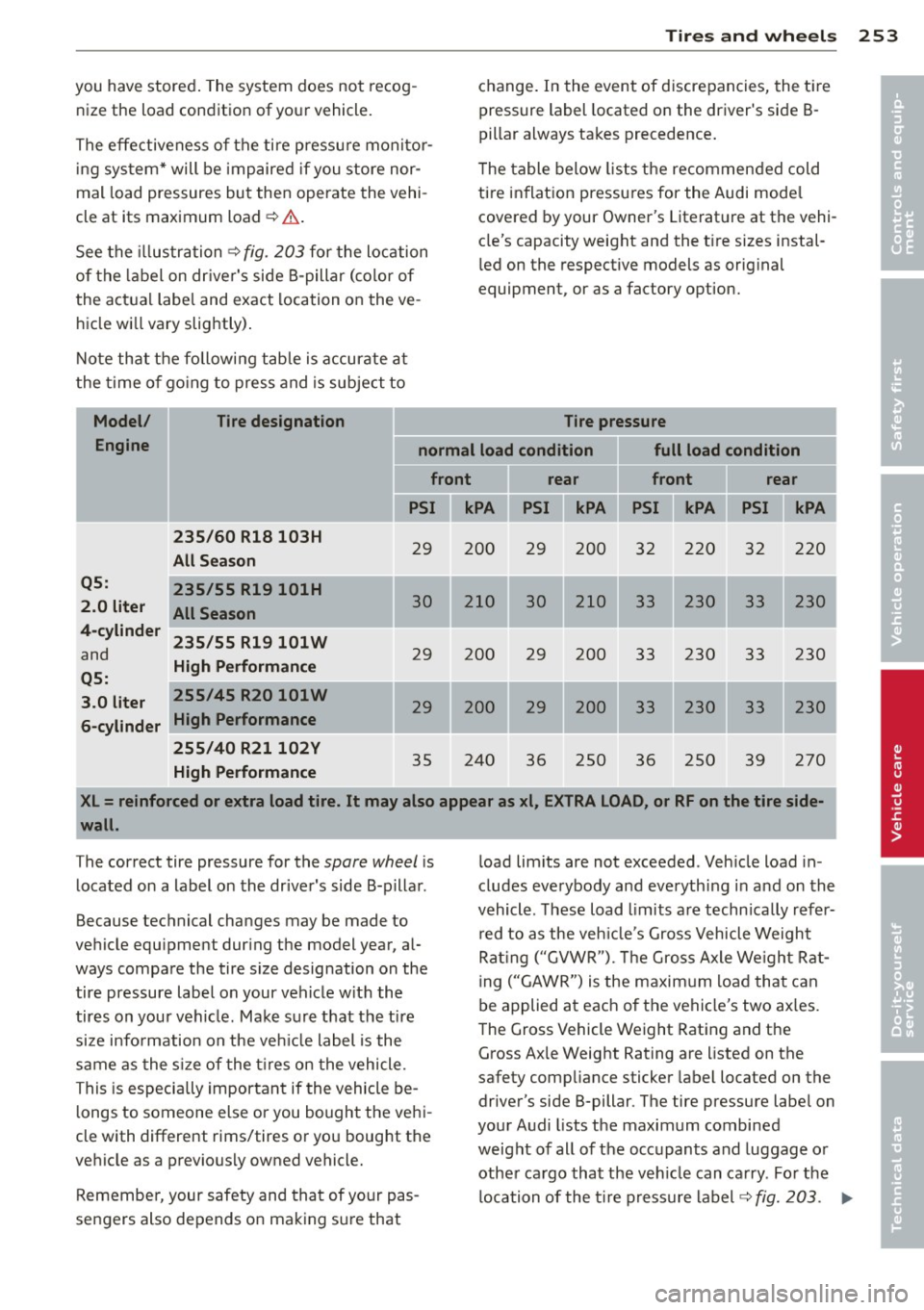
Note that the fo llowing tab le is accurate a t
the t ime o f go ing to press and is subject to
Tire de signation
c h ange. In the event of discrepancies, the ti re
pressure label located o n the driver's side B
pillar always takes precedence .
T he table below lists the recommended cold
ti re inflation pressures for the Audi mode l
covered by your Owner's Literat ure at the vehi
cle's capacity weight and the t ire sizes instal
l ed on the respective models as orig inal
equipment, or as a factory option.
Tire pressure
Model /
Engine normal load condition full load condition
front rear front rear
Q5 :
2.0 liter
4-cylinder
and
Q5:
3.0 liter
6 -cy lind er 235
/60 Rl8 103H
All S eason
235 /55 Rl9 101H
All Season
235 /55 Rl 9101W
High P erforman ce
255 /45 R20 101W
High Performance
255 /40 R21102Y
High Perfo rmance PSI
29
29
29
35
kAA ~I kAA ~I kAA ~I kAA
200 29 200 3
2 220 32 220
210 30 210
33 230
33 230
200 29 200 33 230 33 230
'
200 29 200 33 230 33 230
I
240 36 250 36 250 39 270
X
L= reinforced or extra load tire. It may also appear as xl, EXTRA LOAD , or RF on the tire side
wall.
The correct tire pressure for the spare wheel i s
located on a label on the dr ive r's side B-p illa r.
Because tec hnical changes may be made to
vehicle equ ipment dur ing the model year, al
ways compare the tire size designation on the tire pressure label on your vehicle w it h the
tires on your vehicle . Make su re t hat the tire
size info rmation on the veh icle label is the
same as the s ize of the t ires on the vehicle.
This is especia lly important if the vehicle be
l ongs to someone else or you bought the vehi
cle with different rims/tires or yo u bought the
vehicle as a previous ly owned vehicle.
Remembe r, your safety and that of yo ur pas
sengers also depends on making sure that load lim
its are not exceeded . Veh icle load in
cludes everybody and eve ryth ing in and on the
vehicle . These load limits a re techn ica lly refer
r ed to as the veh icle's Gross Vehicle Weight
Rat ing ("GVWR"). The Gross Axle We igh t Rat
ing ("GAWR") is the maxim um load that can
be applied at each of the vehicle's two ax les.
The Gross Vehicle Weight Rating and the Gross Ax le Weight Rating are listed on the
safety comp liance sticker label located on the
driver's side B-pillar . The tire pressure labe l on
your Audi lists the maximum combined
weight of all of the occupants and luggage o r
other ca rgo that the veh icle can ca rry . Fo r the
location of the t ire pressure label ¢
fig. 203. IJI,,
•
•
Page 261 of 316
A WARNING
Sudden tire failure can lead to loss of con
trol, a crash and serious personal injury!
- Never drive a vehicle when the tread on
any tire is worn down to the wear indica
tors.
- Worn tires are a safety hazard, they do
not grip well on wet roads and increase
your risk of "hydroplaning" and loss of
control.
- Always keep chemicals that can cause
tire damage, such as grease, oil, gasoline
and brake fluid away from t ires.
- Tires age even if they are not be ing used
and can fail suddenly, especially at high
speeds . Tir es that are more than 6 years
old can only be used in an emergency
and then with special care and at lower
speeds.
- Never mount used tires on your vehicle if
you are not sure of their" previous histo
ry ." Old used tires may have been dam
aged even though the damage cannot be
seen that can lead to sudden tire failure
and loss of vehicle control. Tires and wheels 259
New tires and replacing tires and wheels
New tires and wheels have to be broken in
.
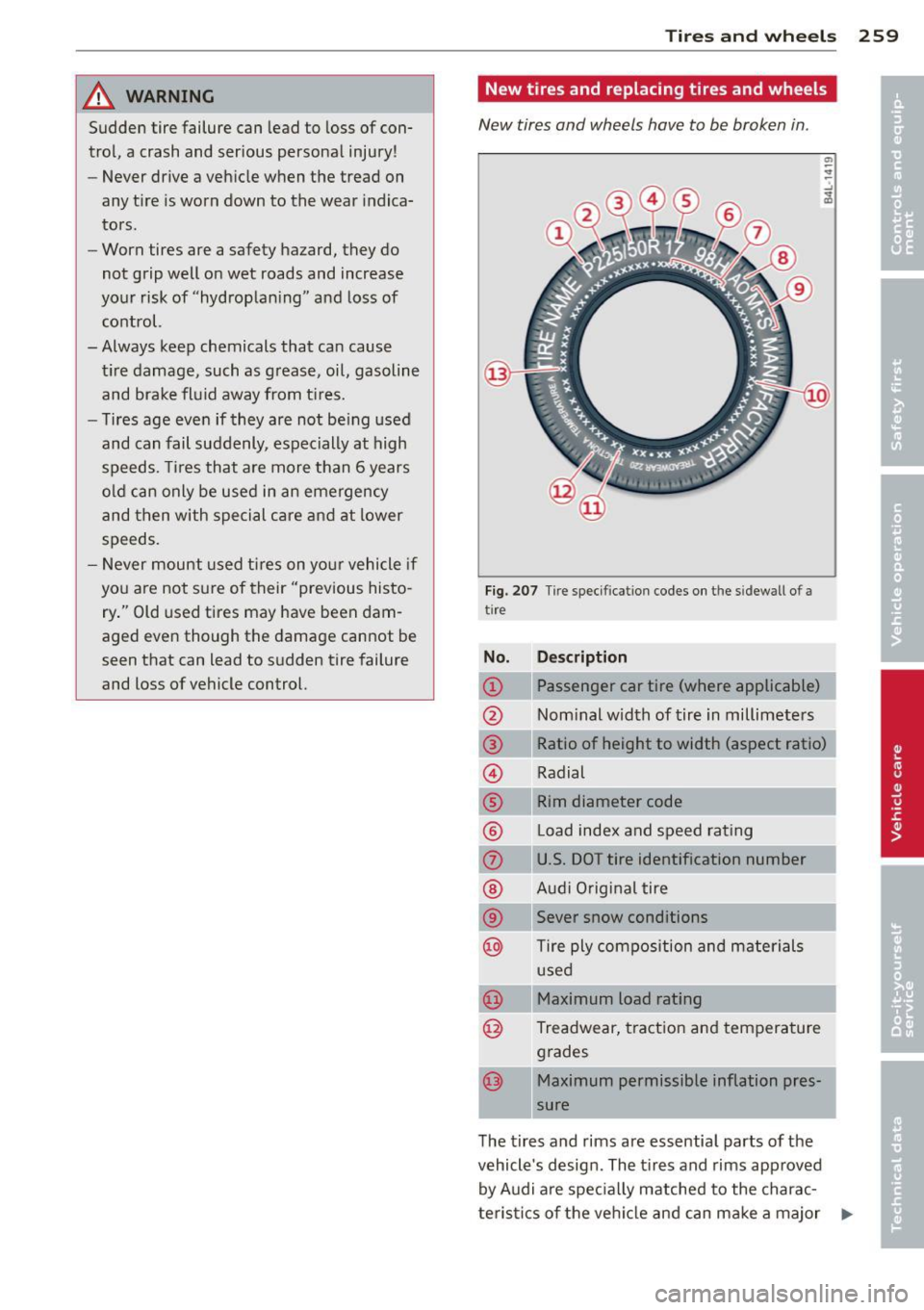
Fig. 207 Tir e specificat ion codes on t he s idewall o f a
tire
No. Description
CD Passenger car tire (where applicable)
@ Nominal width of tire in millimeters
® Ratio of height to width (aspect ratio)
© Radial
® Rim diameter code
® Load index and speed rat ing
(f) U.S. DOT tire identification number
® Audi Original tire
® Sever snow conditions
@ Tire ply composition and materials
used
@ Maximum load rating
@ Treadwear, traction and temperature
grades
@ Maximum permissible inflation pres-
sure
The tires and rims are essential parts of the
vehicle's design . The tires and rims approved
by Audi are specially matched to the charac
teristics of the vehicle and can make a major .,.
•
Page 263 of 316
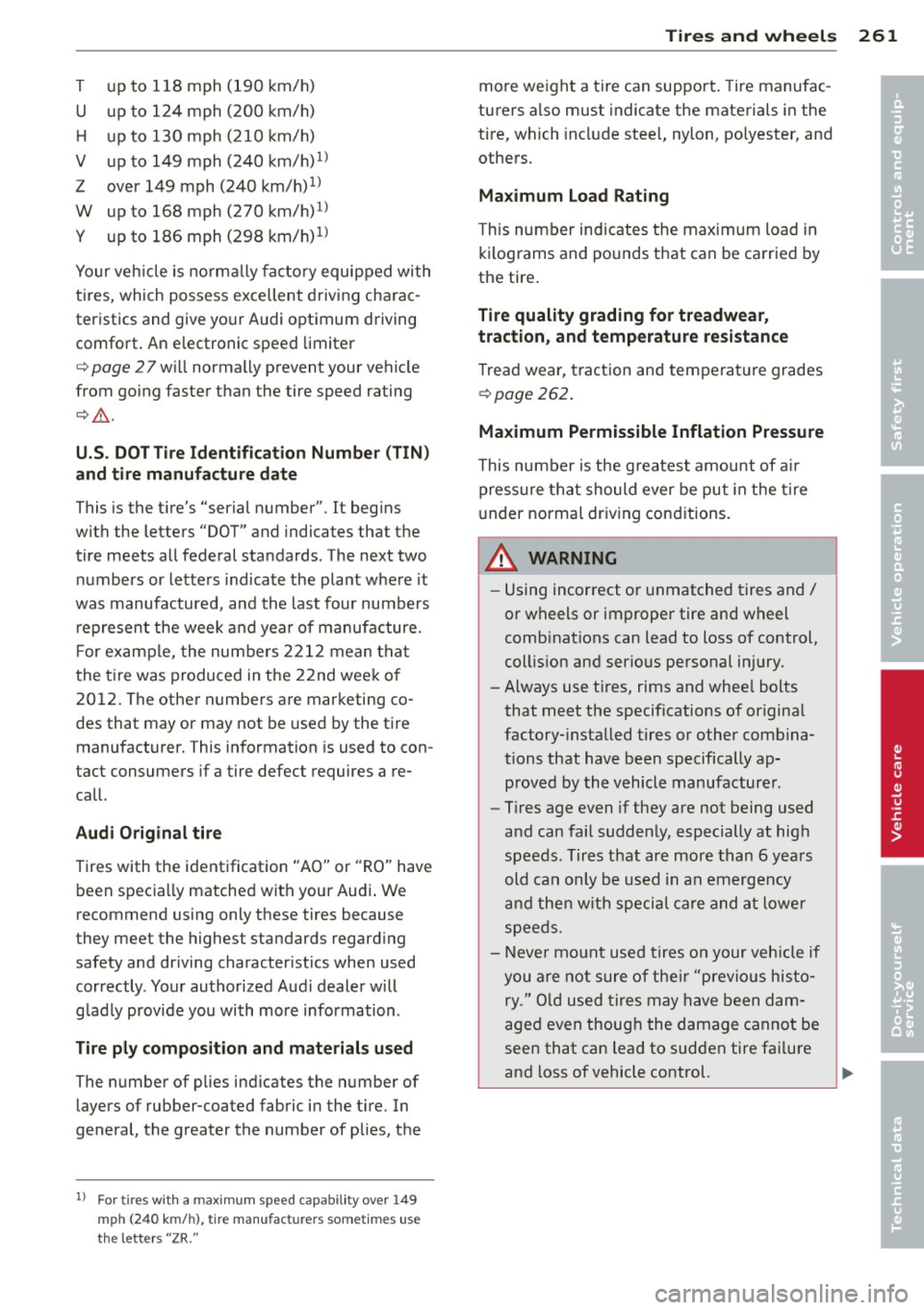
T up to 118 mph (190 km/h)
U up to 124 mph (200 km/ h)
H up to 130 mph (210 km/ h)
V up to 149 mph (240 km/h)1
)
Z over 149 mph (240 km/h)1l
W up to 168 mph (270 km/h)1
)
Y up to 186 mph (298 km/h)1
)
Your veh icle is no rma lly factory equipped with
tires , which possess excellent driving charac
teristics and give your Audi opt imum driving
comfort . An e lectronic speed limiter
c::> page 2 7 wi ll normally prevent you r vehicle
from go ing faster than the tire speed ra ting
c:::> .& .
U.S . DOT T ire Identification Numb er (TIN )
and tire manufacture date
This is the t ire's "serial number". It begins
with the letters "DOT" and indicates that the
tire meets all federal standards . The next two
numbers or letters indicate the plant where it
was manufactured, and the last four numbers r ep resent the week and year of manufacture.
F or
examp le, the numbers 22 12 mean that
the tire was produced in the 22nd week o f
20 12. The other numbe rs are marketing co
des that may or may not be used by the tire
manufactu rer. This information is used to con
tact consumers if a tire defec t requi res a re
call.
Aud i O riginal ti re
Tires with the identification "AO" or "RO" have
been specia lly matched with your Audi . We
recommend using only these tires because
t hey meet the highest standards regard ing
safety and driving character istics when used
correctly . Your authorized Audi dealer w ill
g lad ly provide you with more information .
Tire ply compo sit ion and material s used
The number of plies ind icates the number of
layers of rubber-coated fabric in the t ire. In
general, the greater the number of plies, the
ll Fo r tires wit h a m ax im um s pee d ca pabil ity over 149
mph (2 4 0 k m/h) , tire man ufacturers some times u se
th e le tters " ZR."
Tire s an d wheel s 261
more weight a tire can support . Tire manufac
turers also must indicat e the materials in the
tire, which incl ude steel, nylon, po lyester, and
others.
Ma ximum Load Rating
This number indicates the maximum load in
ki lograms and pounds that can be ca rried by
the tire.
Tire quality grading for treadwear,
tract ion, and temp erature re sis tance
Tread wear, traction and temperat ure grades
c::> page 2 62 .
Maximum Permissible Inflation Pressu re
T his number is the greatest amount of a ir
pressure that should ever be put in the tire
u nder normal driving conditions .
A WARNING
-Using incorrect or unmatched tires and/
or wheels or improper tire and wheel
comb inat ions can lead to loss of control,
col lis ion and serious personal injury.
- Always use t ires, rims and whee l bolts
that meet the specifications of original
factory- installed tires or other combina
tions that have been specifically ap proved by the vehicle manufacturer.
- Tires age even if they are not being used
a nd can fai l sudden ly, especially at high
speeds. Tires that are more than 6 yea rs
old can only be used in an emergency
a nd then w ith special care and at lower
speeds.
- Neve r mo unt used tires o n your veh icle if
you are not sure of the ir "previo us histo
ry." O ld used tires may have been dam
aged even though the damage cannot be
seen that ca n lead to sudden tire fai lure
and loss of vehicle control.
•
•
Page 264 of 316
26 2 T ire s and wheel s
-All four wheels must be fitted with radia l
t ires of the same type, size (roll ing c ir
cumference) and the same tread pattern.
Driv ing with different tires reduces veh i
cle handling and can lead to a loss of
control.
- If the spare tire is not the same as the
t ir es that are mounted on the veh icle -
for example with wi nter tires - on ly use
the spare tire for a short period of time
and dr ive with extra care. Refit the no r
ma l road whee l as soon as safely possi
ble.
- Never drive faster than the maxim um
speed for which the tires on your vehicle
are rated because tires that are drive n
faster than their rated speed can fail
sudden ly.
- Overloading ti res cause heat build- up,
sudden tire failure, including a blowout
and sudden deflation and loss of control.
- Temperature grades app ly to tires that
are properly inflated and not over or un
derinflated.
- For technical reasons it is not a lways
poss ible to use wheels from other
vehicles -in some cases not even wheels
from the same vehicle model.
- If you install wheel tr im discs on the ve
hicle whee ls, make sure that the air flow
to the brakes is not blocked . Reduced air
flow to the brakes can them to overheat,
increasing stopping d istances and caus
ing a collision.
- Run flat t ires may on ly be used on
vehicles that we re eq uipped w it h them
at the f acto ry. The vehicle must have a
chassis des igned for r un flat t ires . Incor
rect use of run flat tires can lead to vehi
cle damage or acc idents . Check with an
authorized Audi dealer or t ire specia list
to see if your vehicle can be equipped
with run flat t ires. If run flat tires are
used, they must be installed o n all four
wheels. Mix ing tire types is not permit
ted. (D Note
- For technical reasons, it is not generally
poss ible to use the wheel rims from oth
er veh icles. T his can hold tr ue for wheels
of the same vehicle type.
- If the spare tire is diffe rent from the
tires that you have mounted on your ve
hicle (for example winter tires or wide
profi le tires), then use the spare tire for a
short period of time only and drive w ith
extra care. Replace the flat tire w it h the
ti re mat ching the othe rs on your vehicle
as soon as possi ble.
- Never d rive without the valve stem cap.
T he v alves co uld get damaged.
@ For the sake of the environment
Dispose of o ld tires in accordance w ith the
l ocal requirements.
Uniform tire quality grading
- Tread wear
- Tra ction AA A B (
- Temperature ABC
Quality grades can be found where applicab le
on the tire s ide wall between tread shoulder
and maximum section width
¢ page 259,
fig . 207 .
For example: Tread wear 200 , Traction AA ,
Temperature A .
All passenger car ti res must conform to Feder
al Safety Requirements in add ition to these
grades .
Tread wear
The tread wear g rade is a comparative rating
based on the wear rate of the tire when tested
u nder contro lled conditions o n a specified
government test course.
F o r example, a tire graded
150 wo uld wear
one and one ha lf
(11/2) times as well on the
government course as a ti re graded
100.
Page 267 of 316
driving a few yards and correct if neces
sary . Follow the instructions from the
snow cha in manufacturer when doing so.
(D Tips
Where snow chains are mandatory oncer
tain roads, this norma lly also applies to
veh icles with all-whee l dr ive .
Wheel bolts
Wheel bolts must always be tightened to the
correct torque.
The design o f whee l bolts is matched to the
factory insta lled r ims . If different rims are fit
ted, the correct wheel bo lts wit h the right
l ength and correctly shaped bolt heads must
be used. This ensures that wheels are f itted
securely and that the brake system functions
correctly .
In certain circumstances, you may not use
wheel bo lts from a different vehicle -even if it
is the same model<=>
page 297.
A WARNING
Improperly tightened or maintained wheel
bolts can become loose caus ing loss of
cont ro l, a co llision and serious persona l in
Jury .
- Always keep the w heel bolts and the
threads in the wheel hubs clea n so the
w hee l bolts can t urn easily and be p rop
erly t igh tened.
- Never grease or oil the wheel bolts and
the threads in the wheel h ubs. They can
become loose wh ile d riving if greased or
oiled, even if tightened to the specified
torq ue.
- Only use whee l bo lts that belong to the
rim being installed .
- Never use different whee ls bolts on your
vehicle.
- Alw ays m ain ta in the co rrec t tig hten ing
torq ue fo r the wheel bo lts to reduce the
risk of a wheel loss . If the tightening tor
que of the wheel bo lts is too low, they
can loosen and come out when the vehi-
Tire s an d wheel s 265
cle is mov ing. If the tightening torq ue is
too high, the wheel bolts and threads
can be damaged and the whee l can be
come loose.
@ Note
The specified torque for the whee l bolts is
105 ft lb (140 Nm) with a to lerance of
± 7,4 ft lb(± 10 Nm). Torque wheel bolts
diagonally . After changi ng a wheel, the
torque m ust be checked as soon as poss i
ble with a to rque wrench -preferably by an
a uthorized Aud i dea le r or qualified wor k
shop.
Low aspect ratio tires
Your A udi is fac tory -eq uipped w ith low aspect
ratio tires . These tires have been tho ro ughly
tested and been se lected specifically for your
model for their superb performance, road fee l
and handling under a variety of driving condi
tions . Ask your authorized Aud i dealer for
more details.
The low aspect ratio of these t ires is ind icated
by a numeral of
55 or less in the tire's size
designation. The numera l represents the ratio
of the tire's sidewa ll height in relation to its
tread width exp ressed in percentage. Conven
tiona l tires have a he ight/w idth ratio of 60 or
more.
The performance of low-a spect-r atio tire s is
particularly sensit ive to improper inflation
pre ssure. It is therefor e important that low
a spect ratio tire s are inflated to the specified
pres sure and that th e inflation pr essure i s
regularly checked and maintained. Tire pre s
sure s should be chec ked at lea st once a
month and always before a long trip
<=> page 2 54, Checking tire pressure.
What you can do to avo id tire and rim
damage
Low aspect ratio tires can be damaged mo re
easily by impact w ith potholes, curbs, gull ies
or ridges on the road, particularly if the tire is
under inflated . ..,.
•
•
Page 281 of 316
-Replace the flat tire with a new one and
have it installed on your vehicle a s soon as
possible. Remount the wheel co ve r.
U ntil th en, driv e with extr a car e and at re
du ced speeds .
~ WARNING
-
-If you are going to equip your vehicle
with t ires or rims wh ich differ from those
wh ich were factory installed, then be
sure to read the informat ion
c:> page 259,
New tires and replacing tires and
wheels.
- Always make sure the damaged wheel or
even a flat tire and the jack * and tool kit
are properly secured in th e luggage com·
partment and are not loose in the pas·
senger compartment.
- In an accident o r sudden maneuver they
c ou ld fly forward, inju ring anyone in the
vehicle .
- Always store damaged w heel, jac k* and
tools secure ly in the luggage compart
ment. Otherw ise, in an acc iden t or sud
den maneuver they cou ld fly forward,
causing injury to passenge rs i n the vehi·
cle .
What do I do now? 2 79
•
•
Page 311 of 316
-----------------------------~I~ n~ d~ e~x 309
Red symbols . . . . . . . . . . . . . . . . . . . . . . . . 28
Refill engine oil ...................... 31
Refuelling . .. ............. .... .. .. . 231
Release lever for hood ............... 233
Remote control
H omelink ...................... .. 135
Remote control key
Unlock ing and locking ............... 40
Remote rear lid release ... .. .. .. .. .. 43
Repair manuals ................... .. 295
Repairs Airbag system
Replacing A fuse
... .. .. .... .. .... ... .. .. ...
Light bulbs ... ... ..... ... .. .. .. .. . 170
280
283
Tires and whee ls . ..... ... .. .. .. .. . 260
Report ing Safety Defects . . . . . . . . 146, 1 47
Reset button . ............. .... .. .... 13
Retractor
' . .. .... ...... ... .. .. .. .. .
Right hand d rive
Rims Cast alloy 1
5 2
5 1
222
Roof rack .... .... ...... ... .. .. .. .... 70
Attac hment points ..... ... .. .. .. .. .. 71
Instal ling the attachments ... .. .. .. .. 72
Instal ling the roof rack .............. 71
Roof load .. ............. .... .. .... 72
Rule of behavior offroad .. ... .. .. .. .. . 209
s
Safe d riving hab its .................. 139
Safety belt position . . . . . . . . . . . . . . . . . 153
Safety belt he ight adjustment ....... 155
Safety belts worn by pregnant women . 154
Safety belt pretensioner . . . . . . . . . . . . . . 155
Service and disposal ............... 156
Safety belts .. ............. .... .. .. . 152
C leaning ... .. .... .... ... .. .. .. ... 226
Danger to passengers who do not wear a
safety belt . . . . . . . . . . . . . . . . . . . . . . . 150
Fastening .. ............. .... .. ... 152
H eight adjustment .......... .. .. .. . 155
Improperly worn ... ..... ... .. .. .. . 155
Not wo rn ........................ 150
Safety belt position . . . . . . . . . . . . . . . . 153
S afety instructions ........ .. .. .. .. . 152 Securing child safety seats . . .
. . . . . . . 188
Specia l considerations for pregnant
women ... .. .. .. .. . .. ... .... ... .. 154
Unfastening . .. .. ................. 154
Warning/ind icator light . . . . . . . . . 16, 149
Why YOU MUST wear them .......... 149
Wor n properly ... .. . .. .. ..... ... .. 151
Safety compliance sticker ..... ... .. .. 290
Safety eq uipment ...... ............. 139
Safety features for occupant restraint and
protection ......................... 139
Safety gu idelines
Seat adjustment .. .................. 61
Safe ty i nstr uct ions
E ngine compartment . ... .... ... .. .. 233
f or side c urtain airbags . ..... ... .. .. 177
for using child safety seats ... ... .. .. 181
for using safety belts ............... 152
Monitoring the Advanced Airbag Sys-
tem ............................. 170
Safety sys tems
Warning/indicator lights ..... ... .. .. . 15
Seat Heating . .... .. .... ... .......... .. . 81
N umber of sea ts . ............. .... 1 49
Ventila tion .. .... .. . .. .. ..... ... .. . 81
Seat adjustment . . . . . . . . . . . . . . . . . . . . . 62
Drive r's seat . . . . . . . . . . . . . . . . . . . . . . . 61
Fron t passenger's seat . . . . . . . . . . . . . . . 62
F ron t seats .. .. .. .... ............. . 61
Head restraints .. .. . ... .... ... .. .. 142
Memory .. .. .... .. . .. .. ..... ... .. . 63
Seat be lts
refer to Safety belts . . . . . . . . . . . . . . . . 149
Seating capac ity .................... 149
Seati ng position
Driver
. . .. .. . ' .. .. . .. .. ..... ... . .
Front passenger .. .. ........... ... .
How to adj ust the front seats ....... .
Incorrect seat position ............. .
Occupants ....................... .
Rea r passengers .. .. . .. .. ..... ... . .
Sea transport 140
141
141
143
140
142
106
Se lective unlock feature . . . . . . . . . . . . . . . 39
Se lective wheel torque control (all-wheel
drive) ......... ... .. ............... 197
•
•