light AUDI Q5 2014 Owners Manual
[x] Cancel search | Manufacturer: AUDI, Model Year: 2014, Model line: Q5, Model: AUDI Q5 2014Pages: 316, PDF Size: 78.41 MB
Page 198 of 316
196 Child Safety
cir cumstances and the PASSENGER AIR
BAG OFF
light does not come on and
stay on, immediately install the rear-fac
ing child safety seat in a rear seating po
sit ion and have the airbag system in
spected by your Aud i dealer .
Additional Information
Sources of information about child
restraints and their use
There are a number of sources of additional
information about ch ild restraint select ion, in
stallat io n and use:
NHTSA advises that the best child safety seat
is the one that fits your child and fits in your
vehicle, and that you w ill use correctly and
consistently.
Try before you buy!
U.S National Highway Traffic Safety Admin
istration
Te l.: 1-888 -327-4236 (TTY : 1-800-424-9153)
http ://www.nhtsa.gov
National SAFE KIDS Campaign
Tel.: (202) 662-0600
http ://www.safekids.org
Safety BeltSafe U .S.A
Tel.: (800) 745-SAFE (English)
Tel.: (800) 747-SANO (Spanish)
http ://www.carseat.org
Transport Canada Information Centre
Tel.: 1-800-333-0371 or call
1-613-998-8616 if you are in the Ottawa area
http ://www.tc.gc.ca/eng/roadsafety/
menu .htm
Audi Customer Relations
Tel.: (800) 822 -2834
Page 199 of 316
Intelligent technology Notice about data
recorded by vehicle
control modules
Your vehicle is not equipped with an Event Da
ta Recorder (EDR), installed by some manu
facturers for the express purpose of capturing
data for retrieval after an accident or crash
event. EDR's are sometimes called "crash re
corders".
Some state laws restrict the retr ieval or down
loading of data stored by EDR's that were in
stalled in a vehicle for the express purpose of
retrieving data after an accident or crash
event without the owner's consent.
Although your vehicle is not equipped with an
EDR, it is equipped with a number of electron
ic control modules for various vehicle systems
such as, for examp le, engine function, emis
sion control, as well as for the airbags and
safety belts.
These electronic control modules also record
vehicle-related data during norma l vehicle op
eration for diagnostic and repair purposes.
The recording capacity of the electronic con
trol modules is limited to data (no sound is re
corded) and only a small amount of data is ac
tually recorded over a very limited period of
time and stored when a system fault or other
condition is sensed by a control unit. Some of
the data then stored may relate to vehicle
speed, direction, braking as we ll as restraint
system use and performance in the event of a
crash or other condition. Stored data can only be read and downloaded with special equip
ment.
Electronic Stabilization
Control (ESC)
Description
The Electronic Stabilization Control (ESC) rein
forces driver safety. It reduces the risk of slip
ping and improves driving stability. ESC de
tects critical s ituations such as the vehicle
Intelligent technology 197
oversteering and understeering or the whee ls
spinning . The vehicle is stabilized by applying
the brakes or reducing eng ine torque . Once
the ESC is active, the indicator light
G1 blinks
in the instrument cluster.
ESC includes the anti-lock brake system (ABS),
brake assist system, anti-slip regulation
(ASR), electronic differential lock (EDL), dy
namic steering*, hill descent assist and selec
tive wheel torque control.
Anti-lock brake system (ABS)
ABS prevents the whee ls from locking up
when braking . The vehicle can still be steered
even during hard braking. App ly steady pres
sure to the brake pedal. Do not pump the ped
al. A pulsing in the brake pedal indicates that
the system is helping you to brake the vehicle .
Brake assist system
The brake assist system can decrease braking
distance. It increases braking power when the
driver presses the brake pedal quickly in emer
gency situations . You must press and hold the
brake pedal until the situation is over . In
vehicles with adaptive cruise control*, the
brake assist system is more sensitive if the
distance detected to the vehicle ahead is too
small.
Anti-slip regulation (ASR)
ASR reduces engine power when the drive
wheels beg in to sp in and adapts the force to
the road conditions. This makes it easier to
start, accelerate and drive up hill s.
Electronic differential lock (EDL)
The EDL brakes wheels that are spinning and
transfers the drive power to the othe r whee ls .
T his function is available up to about 78 mph
(125 km/h) .
In extreme cases, EDL automatically switches
off to help keep the brake on the braked wheel
from overheat ing. EDL will switch on again au
tomatically when conditions have returned to
normal.
•
•
Page 200 of 316
198 Intelligent technology
Dynamic ste ering *
On vehicles with dynamic stee ring* , ES C helps
stabilize the st eering in critical s ituations .
Selective wh eel torque c ontrol
The selective whee l torque control operates
when dr iv ing through curves . T he front wheel
on the inside of the curve or both wheels on
the inside of the curv e are braked selective ly
as needed. This m inimizes sliding in the front
wheels and allows for more pr ecise driving
through curves . T he system may not act ivate
when driving in wet or snowy cond itions .
A WARNING
-ESC, ABS, ASR, EDL dynamic steering"
and the se lective wheel torque control
cannot overcome the laws of physics .
Th is is especially important on slippery
or wet roads.
If the systems begin act ing
to stabilize yo ur vehicle , you sho uld im
med iately change your speed to ma tch
the road and traffic condit ions. Do not
let the increased safety provided by
these systems tempt you to take risks. Do ing so wi ll increase the risk of a loss of
vehicle control, collision and serious per
sonal injuries .
- Always adapt your speed to road, traff ic
and weather condit ions. The risk of Los-
ing cont ro l of the veh icle increases when
Switching on/off
-
driving too fast, espec ially through
curves and on slippery or wet roads, and
when dr iv ing too close to vehicles up
ahead . ESC, ABS, the brake ass ist sys
tem, ASR, ED L, dynam ic steering* and
the selective whe el torque cont ro l can
not p revent collisions.
- Always accelerate with special care on
even, smooth surfaces such as those that
are wet or covered with ice and snow.
The drive wheel s can spin eve n w ith
these assistance sys tems t hat can not al
ways he lp to red uce the risk of loss of ve
hicle control.
(0 Tips
- ABS and ASR only work correctly when
all four whee ls are equipped wi th identi
cal tires . Different tire sizes can lead to a
reduction in engine powe r.
- Yo u may hear noises when the systems
described are working .
-If the ind icator light&] or llB (USA
mode ls)/ [iJ (Canada models) appears,
there may be a malfunction
c:::, page 15,
c:::, page 17.
-When installing a factory-supplied roof
rack system on the roof railing, the ESC
w ill adapt itse lf to a different center of
gravity.
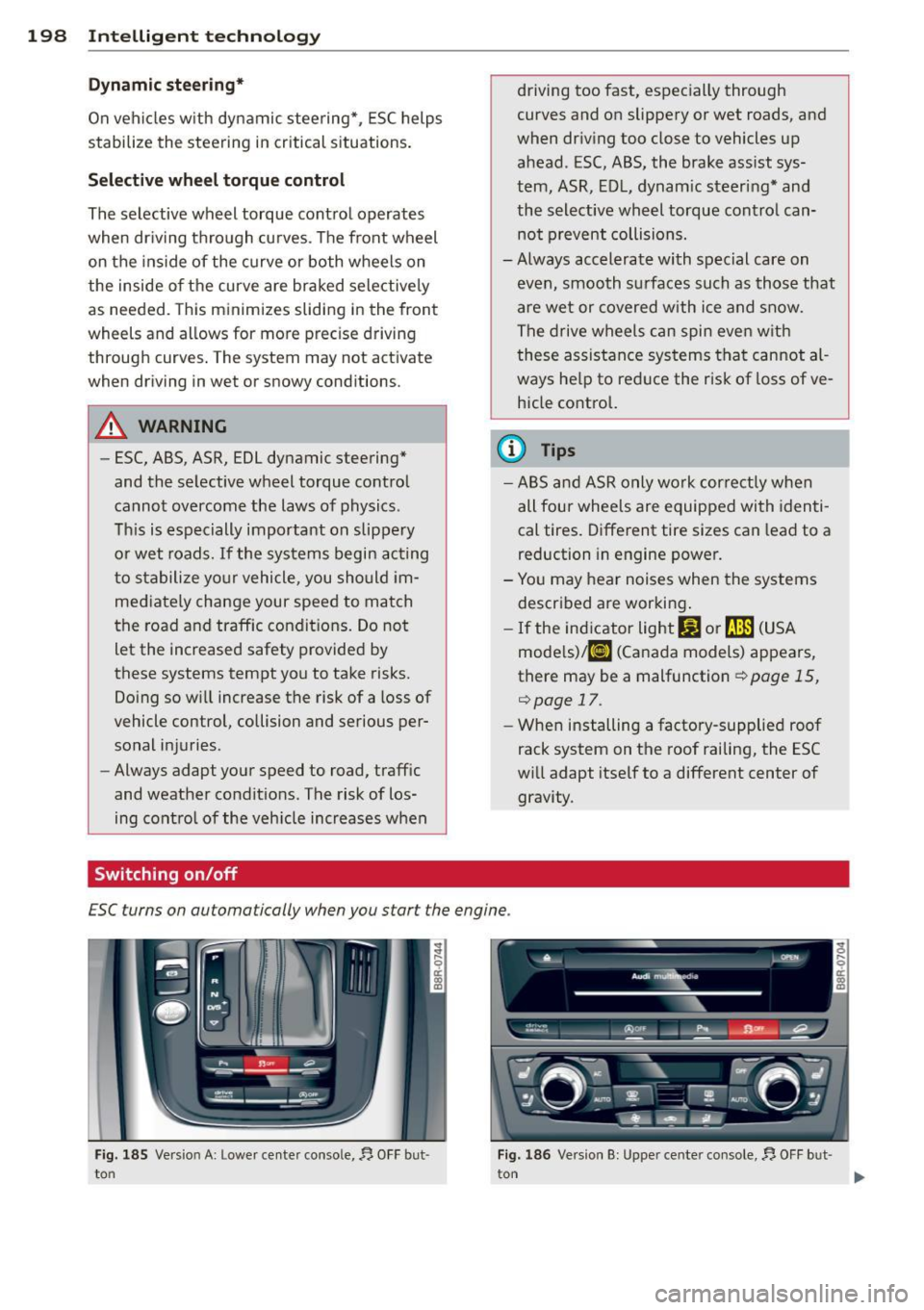
ESC turn s on automa tically when you star t the engine .
Fig . 18 5 Ve rs io n A: L ower ce nte r conso le , fJ. O FF b ut·
to n Fig. 186 Ve rs io n B: Uppe r ce nte r co nso le, fJ. OF F bu t
t on
Page 203 of 316
Fa u lts in th e brake sy stem
If you should notice a sudden increase in
brake peda l travel, then one of the two brake
circuits may have failed~.&..
Low brak e flu id level
Malfunct ions can occur in the brake syste m if
the brake fl uid leve l is too low. The b rake fluid
l eve l is monito red electronically.
Brake boost er
The brake booster increases the pressure that
you generate w ith the brake pedal.
It only op
e rates while the eng ine is running or with the
i gnit ion sw itched on (hybr id dr ive*)~ .&,.
Brake lining wear statu s
Brake lining wear may be checked by visual in
spection of the condition of the brake pads
through the openings in the whee l. If neces
sa ry, the wheel may be removed for this in
spection
~ page 2 73, Changing a wheel.
.&_ WARNING
=
- You should perform braking maneuvers
for the purpose of clean ing the brake
system on ly if road conditions permit.
Other road users must not be put at risk -
you may cause an acc ident!
- Before descending a steep grade, reduce speed and shift transmiss ion into a lower
gear or lower driving range. Do not ride
the brakes or hold the pedal down too long or too often. This could cause the
brakes to get hot and dimin ish b raking
efficiency.
- Do not "ride the brakes" by resting your
foot on the pedal when you do not intend
to brake. Th is may cause the b rakes to
overheat, premat ure wear and increased
stopp ing distance .
- Under certain climat ic and operating
c ondit ions such as passing through wa
ter, driving in heavy rain or after wash ing
the vehicle, the effectiveness of the brakes can be reduced. In winter, ice can
accumulate on the brake pads, linings,
discs and drums. Carefully apply brakes
Int ellig ent technolog y 201
for a test . Brakes will dry and ice coat
ings w ill be cleaned
off after a few care
ful brake applicat ions.
- Driving for an extended period of time on
salt-covered roads without using your
brakes can a lso affect braking efficiency.
Clean
off accumulated salt coating from
brake discs and pads with a few ca reful
brake applications.
- If you damage the front spoiler, or if you install a different spoiler, be sure the ai r
f low to the front brakes is not obst ruct
ed. Otherw ise the bra ke system could
overhea t reducing the effectiveness of
the entire brake system .
- Failure of one b rake circuit will impair
the braking capab ility result ing in an in
creased stopping distance. Avoid driving
the vehicle and have it towed to the near
est a uthorized Audi dea ler or q ualified
workshop.
- Never let the vehicle roll to a stop with
the eng ine shut off .
- If the b rake booster is not working, the
brake peda l must be pressed considera
bly harder to make up for the lack of
booster assistance.
Electromechanical
power assist, Dynamic
steering
The electromechonical power assist helps the
driver when steering.
Power s teer ing adap ts electronically based on
the ve hicle speed .
Indicator lights and messages
• Stee ring d efec tiv e! Do not d rive vehi cle!
If this indicator light turns on and stays on
and this message appears, the power steer ing
may have failed .
Stop the vehicle in a safe location as soon as
poss ible. Do
not continue driving. See your
authorized Aud i dea ler or other qualified re-
pair facility fo r ass istance. ..,.
•
•
Page 204 of 316
202 Intelligent technology
iT-ij Dynamic steering: System fault! You can
cont inue driving
If the indicator light turns on and the mes
sage appears, the steer ing may be more diffi
cult to move or more sensitive than usual. The
steering may also be at an angle when driving
straight.
Drive slow ly to your authorized Audi dealer or
qualified workshop to have the malfunction
corrected .
iT-ij Dynamic steering: Initializing
Audi drive select*: if the indicator light blinks
and the driver message appears, the dynamic
steer ing* is reinitialized. Once you sta rt the
engine after this is finished, the steering
wheel will be easy to move. Re-ini tialization
might be necessary if the steering wheel was
moved hard to the left and right while the ve
h icle was not moving . The display turns off if
the initiali zation was successful.
- If the . or
tTij indicator light on ly stays
on for a short time, you may continue
driving.
- The dynamic steering* stability systems
¢
page 197 are not available in the event
of a system malfunction.
- For additional information on dynamic
steering* ¢
page 120.
Driving with your
quattro
With all-wheel drive, all four wheels are driv
en.
General information
W ith all-wheel dr ive, power is distributed to
all four wheels. This happens automatically
depending on your driving sty le and the road
conditions at the time . See also ¢
page 197.
A center different ial distr ibutes the dr iv ing
power var iably to the front and rear axle . It
works together with se lective wheel torque control, which activates when driving through
curves
r=:>
page 198.
The all-wheel drive concept is designed for
high eng ine power. Your veh icle is except ion
ally powerfu l and has excellent driving charac
teristics both under normal driving conditions
and on snow and ice . Always read and follow
safety precaut ions r=;,
,&.
Winter tires
When driving in the winter, your vehicle with
all-wheel drive has an advantage, even with
regular tires. In winter road conditions it may
be advisable to mount winter tires (or all-sea
son tires) for improved driveability and brak
ing : these tires must be mounted on
all four
wheels.
See also r=;, page 262, Winter tires.
Tire chains
Where tire chains are mandatory on certain
roads, this norma lly also app lies to veh icles
with all-wheel driver=;,
page 263, Snow
chains .
Replacing wheels/tires
Vehicles with a ll-wheel drive must always
have tires of the same size. A lso avoid tires
with different tread depths. For deta ils see
page
r=;, page 2 SB, New tires and replacing
tires and wheels.
A WARNING
-Always adjust your dr iv ing to road and traf-
f ic conditions. Do not let the extra safety
afforded by all-wheel drive tempt you into
taking extra risks .
- Although the all-wheel drive is very ef
fective, always remember that braking
capacity is lim ited by tire traction. You
should therefore not drive at excessive
speeds on icy or slippery road surfaces.
- On wet road surfaces, be careful not to
drive too fast because the front wheels
could begin to slide on top of the water
(aquaplaning). If this should occur, you
will have no warning from a sudden in crease in eng ine speed as w ith a front
wheel drive veh icle. Always drive at
Page 205 of 316
speeds which are suited to the road con
ditions -risk of crash.
Energy management
Starting ability is optimized
Energy management controls the distribution
of electrical energy and thus optimizes the
availability of electrical energy for starting
the engine .
If a vehicle with a conventional energy system
is not driven for a long period of time , the bat
tery is discharged by idling cu rrent consumers
(e.g. immobilizer). In ce rtain c ircumstances it
can result in there being insuff icient ene rgy
avai lab le to s tart the engine .
I ntelligent energy management in your vehi
cle hand les the d ist ribution of electrical ener
gy. Starting ab ility is marked ly imp roved and
the life of the battery is extended.
Basically , energy management consists of
b atter y dia gno sis, idling curr ent manag e
m ent
and dynami c en ergy m anag emen t.
Battery diagnosis
Battery d iagnosis continuously determ ines
the state of the battery . Sensors determ ine
battery vo ltage, battery curren t and battery
temperature. This dete rm ines the current
state of charge and the power of the battery .
Idling current management
Idling current management reduces energy
consumpt ion wh ile the veh icle is stand ing .
W ith the ignition switched off, it cont ro ls the
energy s upply to the va rio us electr ical compo
nents. Data from battery diagnosis is consid
ered.
D epending on the batte ry's state of charge,
i nd ividual consumers are grad ua lly turned off
to p revent excessive discharge of the battery
and thus maintain starting capability .
Dynamic energy management
W hil e the vehicle is being driven, dynamic en
e rgy management dist ributes t he energy gen-
Int ellig ent technolog y 203
erated according to the needs of the individ u
al components. It regulates consumption, so
that more electrical energy is not being used
than is being generated and ensures an opti
mal state of charge for the battery.
(D Tips
- But even energy management cannot
negate the limits of physics. Consider
that the power and life of a battery are
limited.
- If start ing ability is t hreatened, the indi
cator light(•] appears¢
page 34 .
What you should know
The highest priority is given to maintaining
star ting capability.
The battery is severe ly taxed in short-distance
driving, in city traff ic and during the cold time
of year. Abundant elect rical energy is re
quired, but only a lit tle is generated . It is also
crit ical if the engine is not running and electri
cal components are turned on. In this in
stance ene rgy is be ing consumed but none is
being genera ted .
It is in precisely these situations that you will
not ice energy management actively regulat
ing the d istribution of ene rgy.
Vehicle stand s for an e xtended period
If you do not drive your vehicle over a period
of several days or weeks, e lectr ical compo
nents are gradually cut back or switched off.
This reduces energy consumption and ma in
ta ins start ing capability over a longer pe riod .
Some of the convenience func tions may not
opera te , such as the interior ligh ts or the
power seat adjustment. The convenience
funct ions w ill be available again when you
switch on the ignition and start the engine.
With the en gine turn ed off
If you listen to the radio, for exam ple, w ith
the engine turned off or use other MMI* func-
tions, the battery is being discharged .
11>-
•
•
Page 206 of 316
204 Intelligent technology
If starting capability is jeopa rdized due to en
ergy consumption, the following warning ap
pears in the radio or MMI* display:
Please start engine, otherwise system will
switch off in 3 minutes.
The warning ind icates that the system will be
turned off automatically after 3 minutes. If
you wish to continue using the functions, you
have to start the engine .
With the engine running
Although electrical energy is generated when
the vehicle is be ing driven, the battery can be
come discharged . Thi s happens mostly when
little ene rgy is being generated and a great
deal consumed and the battery's state o f
charge is not optima l.
To bring the energy balance back into equili
brium, consumers which require especially
l arge amounts of energy are temporarily cut
back or switched off. Heating systems in par
ticular require a great dea l of energy. If you
notice, for example, that the heated seats* or
the heated rear window are not heating, they
have been temporar ily cut back or switched
off. These systems will be ava ilable again as
soon as the energy balance has been restored.
You will also notice that engine idle speed has been increased slightly. This is normal and not
a cause for concern . By increas ing engine idle
speed the add it iona l energy required is gener
ated and the battery is charged.
Page 209 of 316
A WARNING ,~
- Do not park your vehicle over flammable
materials such as grass or leaves because
the high temperature of the diesel par
t icu late filter could start a fire .
- Do not apply an underbody protectant in the exhaust system area or a fire could sta rt.
Avoid damaging the
vehicle
When you are driving on poor roads, o r over
curbs, steep ramps, etc., make ce rtain that
l ow -lying parts such as spoi lers and exhaust
system parts do not bottom out and get dam
aged.
This is especially true for vehicles with low
slung chassis (sports chassis)* and f ully load
ed vehicles.
Shutting down vehicle
I f you wou ld like your veh icle to remain inop
erative for a longer period of time, contact an
Audi or other specialized dealer. They can ad
vise you on necessary precautions e.g . corro
sion prevention, ma intenance and storage.
Pay attention to add itiona l information con
cerning the battery. Refer to
c::> page 242 .
Operate your vehicle
economically and
minimize pollution
General
Your personal style of driving will determine
the economy of your vehicle, as well as ex
haust and noise levels.
Fuel economy, environmental impact, and
wear on your engine, brakes and t ires largely
depend on th ree factors:
- you r persona l dr iving style
- operating conditions
- technica l lim itations
Dri vin g and en vironm ent 207
If you ant ic ipate what you need to do next and
drive economically, yo u can easily cut yo ur
fuel consumpt ion by 10 -15 percent. T his sec
tion w ill give you some tips on how you can
help the env ironment and your pocketbook.
Q) Tips
The consumption estimates as published
by ENVIRONMENTAL PROTECTION AGENCY
(EPA) and Transport Canada may not corre
spond to your actual consumption on the road, which will vary depending upon vehi
cle load and speed, road and weather con
dit ions, t rip leng th, etc.
Drive smoothly and keep a lookout
ahead
Vehicles use the most fuel when they are ac
celerating .
.,. Avo id u nnecessary accelerating and b rak ing.
Vehicles use the most fuel when they are ac
ce le rat ing . If you ant icipate what is going to
happen next, you will need to brake less and,
thu s, acce le rate less. Le t the vehicle coast
whenever possible -for examp le when you see
that the next t raff ic light is re d.
Avoid full throttle
Driving at moderate speeds saves fuel and
improves your mileage.
.,. Try and keep well below your car 's maximum
speed.
Acce le rat ing gently reduces fue l cons ump
tion, eng ine wear, and does not disturb the
environment.
Fuel consumpt ion, exhaust emiss ions and e n
gine noise inc rease disproport ionately at high
speeds . If you driv e at app rox imately th ree
quarte rs of top speed, fuel consumption w ill
be reduced by one ha lf. Never d rive fas ter
t han the pos ted speed limi t and weathe r con
ditions pe rmit.
•
•
Page 210 of 316
208 Driving and environment
Reducing unnecessary idling
Even when your car is just idling it burns up
fuel.
.,. Shut the engine off when you are not driving
the vehicle.
.,. Do not warm up the vehicle by letting the
engine run at idle .
The idling phase is automatically reduced for
vehicles with the Start-Stop -System* . It is ef
fic ient to sw itch
off the eng ine in vehicles
without the Start-Stop-System* when stopped
at railroad crossings and long red lights. Turn
ing the eng ine
off for just 30-40 seconds
saves more fuel than is burned by sta rting the
engine again .
It takes a long time for the engine to wa rm up
fu lly when it is running at idle. However , wear
and nox ious emissions are especially high
when the engine is warming up. So you should
drive away as soon as you start the engine and
avoid running at high rpms while the engine is
still warming up.
(D Note
Do not leave engine idling unattended af
ter starting. If warning lights should come
on to indicate improper operation, they
would go unheeded. Extended idling also
produces heat, which could resu lt in over
heat ing or other damage to the vehicle or
other property .
Regular maintenance
A badly tuned engine unnecessarily wastes a
lot of fuel .
.,. Have your vehicle serviced at regular inter-
vals.
By having your vehicle regularly serviced by an
author ized Audi dealer helps to ensure that it
runs properly and economically . The condition
of your vehicle not only affects its safety and
ab ility to hold its value, it also affects
fuel
consumption. Check
your oil each time you fill your tank.
The amount of oi l used is re lated to engine
load and speed.
It is normal for the oil consumption of a new
engine to reach its lowest value after a certa in
mileage has been driven .
You must drive your veh icle about 3,000 mi les
(5,000 kilometers) before you can properly
assess oil consumpt ion.
This also app lies to fuel consumption and en
gine output .
(0 Note
- Have your veh icle ma inta ined properly
and in accordance with the service rec
ommendations in your Warranty
& Ma in
tenance booklet. Lack of proper ma inte
nance as well as improper use of the ve
hicle will impair the function of the
em iss ion control system and could lead
t o damage.
- Do not alter or remove any component of
the Emission Control System unless ap
proved by the manufacturer.
- Do not alter or remove any device, such
as heat shie lds , switches, ignition wires,
valves, which are designed to protect
your vehicle's Emission Control System
and other important vehicle compo
nents.
' Fewer short trips
Fuel consumption will always be relatively
high on short trips.
... Try to avoid driving sho rt distances w it h a
cold engine .
T he eng ine and catalytic converter have to
reach their optimal
operating temperature to
reduce fuel consumpt ion and nox ious emis
sions effectively.
Jus t after starting, a cold engine in a mid-s ize
car only achieves a fuel economy of 6-8 mi les
per gallon (30 -40 l/100 km). After about a
half a mile, fuel economy climbs to 12 mpg .,..
Page 215 of 316
Trailer towing Driving with a trailer
General information
Your Audi was designed primarily for passen
ger transportation .
If you plan to tow a trailer, please remember
that the additional load will affect durability,
economy and performance .
T railer towing not only places more stress on
the vehicle, it also calls for more concentra
tion from the driver.
For this reason, always follow the operating
and driving instructions provided and use
common sense.
Technical requirements
Trailer hitch
Use a weight-carrying hitch conforming to the
gross trailer weight. The hitch must be suita
ble for your vehicle and trailer and must be
mounted securely on the vehicle's chassis at a
technically sound location. Use only a trailer
hitch with a removable ball mount. Always
check with the trailer hitch manufacturer to
make sure that you are using the correct
hitch.
Do not use a bumper hitch.
T he hitch must be installed in such a way that
it does not interfere with the impact-absorb
ing bumper system. No modifications should
be made to the vehicle exhaust and brake sys
tems . From time to time, check that all hitch
mounting bolts remain securely fastened.
When you are not towing a trailer, remove the
trailer hitch ball mount. This prevents the
hitch from causing damage should your vehi
cle be struck from behind
¢ &. .
Trailer brakes
If your trailer is equipped with a braking sys
tem, check to be sure that it conforms to all
regulations .
Trailer towing 213
The trailer hydraulic brake system must not be
directly connected to the vehicle's hydraulic
brake system
¢ &. .
Safety chains
Always use safety chains between your vehicle
and the trailer.
Trailer lights
Trailer lights must meet all regulations . Be
sure to check with your authorized Audi dealer
for correct wiring, switches, and relays.
Mirrors
If you are unable to see the traffic behind you
using the regular outside mirrors, then you
must install extended mirrors.
It is important
that you always have clear vision to the rear .
.8, WARNING
- If a trailer has electrical brakes please
note that these brakes are not activated
by the factory-fitted control unit -risk of
accident!
- After removing the trailer hitch, do not
store it in your vehicle. In case of sudden
braking, the hitch could fly forward and
injure you or your passengers.
- Never install a "weight distributing" or
"load equalizing" trailer hitch on your ve
hicle. The vehicle was not designed for
these kinds of trailer hitches . The hitch
attachment can fail, causing the trailer
to tear loose from the vehicle .
- The Gross Vehicle Weight Rating for your
vehicle, found on the safety compliance
label on the driver's side B-pillar, must
never be exceeded under any circumstan
ces. Exceeding the Gross Vehicle Weight
Rating of your vehicle is likely to damage
your vehicle, and such damage will not
be covered by your Limited New Vehicle
Warranty. Exceeding the Gross Vehicle
Weight Rating will also change the per
formance and handling characteristics of
your vehicle, which could cause a crash resulting in serious injury or death.
-
•
•