light AUDI Q5 2014 Manual Online
[x] Cancel search | Manufacturer: AUDI, Model Year: 2014, Model line: Q5, Model: AUDI Q5 2014Pages: 316, PDF Size: 78.41 MB
Page 169 of 316
must always sit in an upright position,
must not lean against or place any part
of their body too close to the area where
the airbags are located .
- Occupants who are unbelted, out of posi
tion or too close to the airbag can be se riously injured by an airbag as it unfolds
with great force in the blink of an eye
~ page 158.
A WARNING
A child in a rearward-facing child safety
seat installed on the front passenger seat
will be seriously injured and can be killed if
the front airbag inflates -even with an Ad
vanced Airbag System.
- The inflating airbag will hit the child
safety seat or infant carrier with great
force and will smash the child safety seat
and child against the backrest, center
armrest, door or roof.
- Always install rear-facing child safety
seats on the rear seat.
- If you must install a rearward facing
child safety seat on the front passenger
seat because of exceptional circumstan
ces and the
PASSENGER AIR BAG OFF
light does not come on and stay on, im
mediately install the rear-facing child
safety seat in a rear seating position and
have the airbag system inspected by your
authorized Audi dealer .
A WARNING
Objects between you and the airbag will
increase the risk of injury in a crash by in
terfering with the way the airbag unfolds
or by being pushed into you as the airbag
inflates.
- Never hold things in your hands or on
your lap when the vehicle is in use.
- Never transport items on or in the area
of the front passenger seat. Objects
could move into the area of the front air
bags during braking or other sudden ma
neuver and become dangerous projec-
Airbag system 167
tiles that can cause serious personal in
jury if the airbags inflate.
- Never place or attach accessories or oth
er objects (such as cupholders, tele phone brackets, large, heavy or bulky ob
jects) on the doors, over or near the area marked "AIRBAG" on the steering wheel,
instrument panel, seat backrests or be
tween those areas and yourself. These
objects could cause injury in a crash, es
pecially when the airbags inflate.
- Never recline the front passenger's seat
to transport objects. Items can also
move into the area of the side airbag or
the front airbag during braking or in a
sudden maneuver. Objects near the air bags can become projectiles and cause
injury, particularly when the seat is re
clined.
A WARNING
The fine dust created when airbags deploy
can cause breathing problems for people
with a history of asthma or other breath ing conditions.
- To reduce the risk of breathing problems,
those with asthma or other respiratory
conditions should get fresh air right
away by getting out of the vehicle or
opening windows or doors.
- If you are in a collision in which airbags
deploy, wash your hands and face with mild soap and water before eating.
- Be careful not to get the dust into your
eyes, or into any cuts or scratches .
- If the residue should get into your eyes,
flush them with water. •
•
Page 170 of 316
168 Airbag system
Monitoring the
Advanced Airbag System
Airbag monitoring indicator light
Two separate indicators monitor the function
of the Advanced Airbag System: the airbag
monitoring indicator light and the
PASSEN
GER AIR BA G OFF
light.
The Advanced Airbag System (including the
electronic control unit, sensor circuits and sys
tem wiring) is monitored continuously to
make sure that it is functioni ng properly
whenever the ignit ion is on. Each t ime you
turn on the ignition, the airbag monitoring in
d icator light
fl will come on fo r a few seconds
(self diagnosti cs) .
The system must be inspected when the
indicator light
fl:
- does not come on when the ignit ion is
swit ched on,
- does not go out a few seconds after yo u
have swi tched on the ign ition, o r
- comes on w hile d riving .
If an airbag system malfunction is detected,
the indicator light will first start flash ing to
catch the driver's atte ntion and then stay on
continuously to se rve as a constant reminder
to have the system inspected immediately .
If a malfunction occurs that turns the front
a irbag on the passenger side off, the
PASSEN
GER AIR BAG OFF
li ght will come on and stay
on whenev er the ignition is on.
A WARNING
An air bag system that is not func tioni ng
prope rly ca nnot provide supplemen tal p ro
t ect ion in a fron tal cr ash .
-If the airbag indic ator light¢ p age 1 6
comes whe n the vehicle is be ing used,
have t he system inspected immediate ly
by yo ur aut ho rized Aud i dea ler . It is pos
sible that the a irbag will inf late when it
is not s upposed to, or w ill not inflate
when it should.
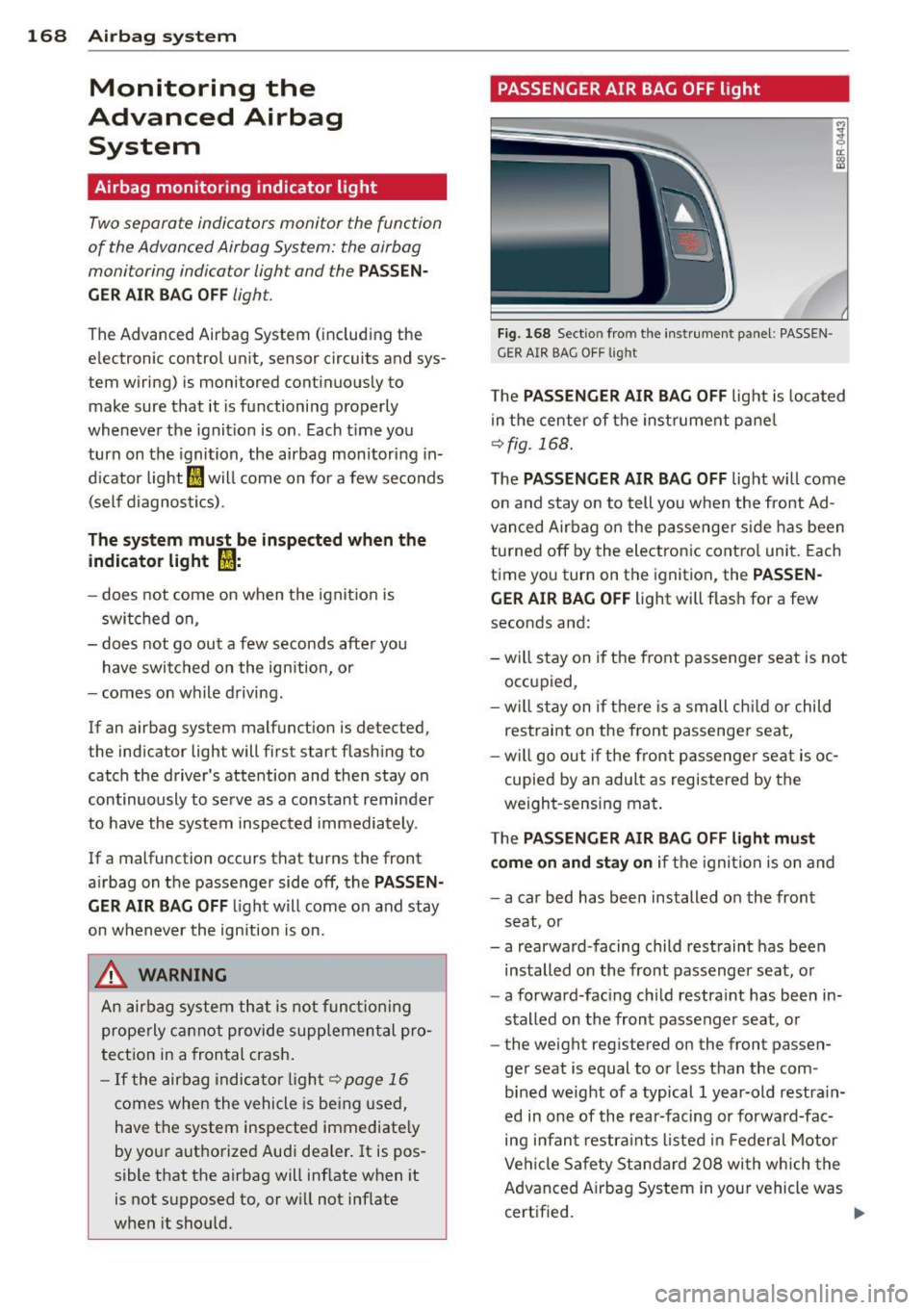
PASSENGER AIR BAG OFF l ight
Fig . 168 Sec tion fro m the instr ument pa ne l: PASSEN
GER AIR SAG OFF lig ht
T he PASSENGER AIR BAG OFF light is loca ted
i n the center of t he in st rument p anel
¢fig. 168 .
The PASSENGER AIR BAG OFF light w ill come
o n and stay o n to tell you w hen the front Ad
van ced Air bag o n the pas senge r side has been
tu rned off by the ele ct ronic contro l uni t. Each
t ime you turn on the ignition, the
PASSEN
GER AIR BAG OFF
light will flas h for a few
seconds and:
- will stay on if the front passenger seat is not
occupied,
- wil l sta y on if t here is a small ch ild or child
restrai nt on the front passenge r seat,
- will go out i f th e front p assenge r sea t is oc
cupied by an adult as registered by the
weight -sensing mat .
T he
PASSENGER AIR BAG OFF light must
come on and stay on
if the igni tion is on and
- a car bed has been installed on the front
seat, or
- a rearward-facing child restraint has been
installed on the front passenger seat, o r
- a forward-fac ing ch ild restra int has been in
s talled on the front passenger seat, or
- the weight reg iste red on the front passen
ger seat is equal to or less than t he com
b ined weight of a typical 1 year -o ld restra in
ed in one of the rea r-facing or forwa rd-fac
ing infant restra ints listed in Federal Motor
Veh icle Safety Stan dard 208 wi th wh ich the
Advanced A irbag System in you r vehicle wa s
cert ified.
II>-
Page 171 of 316
If the fron t passenger seat is not occupied,
the front airbag will not deploy, and the
PAS
SENGER AIR BAG OF F
light will stay on. Nev
er in sta ll a rearward-fac ing ch ild restra int on
t he fron t passenger seat, the safest place for
a child in any kind of child restraint is at one
of the seating positions on the rear seat
¢ page 158, Child restraints on the front seat
- some important things to know
and
¢ page 178, Child Safety .
If the PASSENGER AIR BAG OFF light c om es
on
when one of the conditions listed above is
met, be sure to check the light regularly to
make certa in that the
PAS SENGER AIR BAG
O FF
light stays on cont inuous ly whenever the
ignition is on . If the
PASSENGER AIR BAG
OFF
light does not appear and not stay on all
the time, stop as soon as it is safe to do so
and
- reactivate the system by turning the ignition
off and then t urning it on again;
- remove and reinstall the child restraint .
Make sure that the child restraint is properly
installed and that the sa fety be lt for the
front passenger seat has been correct ly
routed around the child restraint a s desc ri
bed in the child restraint manufacturer 's in
structions;
- make sure that the convertible locking fea
ture on the safety be lt for the front passen
ger seat has been activated and that the
safety belt has been pulled tight . The belt
mus t not be loose o r have loops of slack so
that the sensor below the safety be lt latch
on the seat can do its job ¢
page 188.
-make su re that th ings that may increase the
weight of the ch ild and child safe ty seat are
not being transported on the front passen
ger seat ;
- make su re that the safety bel t tension sen
sor is not b locked . Shake t he safety belt
l atch on the front passenger seatback and
forth;
- If a strap or tether is being used to tie the
child safety seat to the front passenger
seat, make sure that it is not so tight that it
A irbag system 169
causes the weight -sensing mat to measure
more weight than is act ually on the seat .
If the PASSENGER AIR BAG OFF light still
d oes not come on
and does not stay on con
tin uous ly (when the ignition is switched on) ,
- take the child rest ra int off the front passen-
ge r seat and install it properly a t one of the
rear seat positions. Have the airbag system
inspected by yo ur authorized Audi dealer
immediate ly .
- move the child to a rear seat position and
make sure t hat the child is properly restrain
ed in a c hild restra int that is appropriate for
its size and age.
T he
PASSENGER AIR BAG OFF light sho uld
NOT come on when the ignition is on and an
adult is sitting in a proper seating position on
the front passenger seat. If the
PASSENGER
AIR BAG OFF
ligh t comes on and stays on or
flashes for about 5 seconds wh ile driving, un
der these c ircumstances , make sure that:
- the adult on the front passenger seat is
properly seated on the center of the seat
cushion wi th his or her back up aga inst the
backrest and the backrest is not recl ined
¢ page 140, Proper occupant seating posi
tions,
- the adult is not tak ing weight off the seat by
holding on to the passenger assist handle
above the front passe nger door or support
ing their weight on the armrest ,
- the safety belt is being properly wo rn and
tha t there is not a lot of s lack in the safety
be lt webbing ,
- ac cesso ry seat covers or cushions o r other
t hings tha t may cause an incorrect reading
or impression on the we ight-sensing mat
under the upho lstery of the seat have been
removed from the front passenger seat,
- a sa fety belt exten der has not been left in
the safety belt latch for the front passenger
seat.
In add it ion to the
PASSENGER AIR BAG OFF
li ght in the cente r of the instrumen t panel,
the message
PASSENGER AIR BAG OFF or
PASSENGER AIR BAG ON wi ll briefly appear ll-
•
•
Page 172 of 316
1 70 Airbag system
in the instrument cluster display. This is to in
form the driver of the current front passenger
airbag status.
Important safety instructions on
monitoring the Advanced Airbag System
A WARNING
An airbag system that is not functioning properly cannot provide supplemental pro
tection in a frontal crash.
- If the airbag indicator light¢
page 16
comes when the vehicle is being used,
have the system inspected immediately
by your authori zed Audi dealer. It is pos
sible that the airbag will inflate when it
is not supposed to, or will not inflate
when it should .
A WARNING
If the front airbag inflates, a child without
a child restraint, in a rearward-facing child
safety seat or in a forward-facing child re
straint that has not been properly installed
will be seriously injured and can be killed.
- Even though your vehicle is equipped
with an Advanced Airbag System, make certain that all children, especially 12
years and younger, always ride on the back seat properly restrained for their
age and size.
- Always install forward or rear-facing
child safety seats on the rear seat -even
with an Advanced Airbag System.
- If you must install a rearward-facing
child safety seat on the front passenger
seat because of exceptional circumstan
ces and the
PASSENGER AIR BAG OFF
light does not appear and stay on, imme
diately install the rear-facing child safety
seat in a rear seating position and have
the airbag system inspected by your au
thorized Audi dealer.
- A tight tether or other strap on a rear
ward-facing child restraint attached to
the front passenger seat can put too
much pressure on the weight-sensing
-
mat in the seat and register more weight
than is actually on the seat. The heavier
weight registered can make the system
work as though an adult were on the seat and deploy the Advanced Airbag when it
must be suppressed causing serious or
even fatal injury to the child.
- If, in exceptional circumstances, you
must install a forward-facing child re
straint on the front passenger seat, al
ways move the seat into its rearmost po
sition in the seat's fore and aft adjust
ment range, as far away from the airbag
as possible. The backrest must be adjust
ed to an upright position. Make sure that
the
PASSENGER AIR BAG OFF light
comes on and stays on all the time when
ever the ignition is switched on .
A WARNING
-
-
-If the PASSENGER AIR BAG OFF light
does not go out when an adult is sitting
on the front passenger seat after taking
the steps described above, make sure the
adult is properly seated and restrained at
one of the rear seating positions.
- Have the airbag system inspected by
your authorized Audi dealer before trans
porting anyone on the front passenger
seat.
(D Tips
If the weight-sensing mat in the front pas
senger seat detects an empty seat, the
front airbag on the passenger side will be
turned off, and
PASSENGER AIR BAG OFF
will stay on.
Repair , care and disposal of the airbags
Par ts of the airbag system are ins talled at
many different places on your Audi. Installing,
removing, servicing or repairing a part in an
area of the vehicle can damage a part of an
airbag system and prevent that system from
working properly in a collision. .,..
Page 174 of 316
172 Airbag system
dealer is familiar with these requirements
and we recommend that you have your
dealer perform this service for you.
Other things that can affect Advanced
Airbag performance
Changing the vehicle's suspension system can
change the way that the Advanced Airbag Sys
tem performs in a crash. For example, using
tire-rim combinations not approved by Audi, lowering the vehicle, changing the stiffness of
the suspension, including the springs, suspen
sion struts, shock absorbers etc. can change
the forces that are measured by the airbag
sensors and sent to the electronic control
unit. Some suspension changes can, for exam ple, increase the force levels measured by the
sensors and make the airbag system deploy in
crashes in which it would not deploy if the
changes had not been made . Other kinds of
changes may reduce the force levels meas
ured by the sensors and prevent the airbag
from deploying when it should.
The sensors in the safety belt buckle for the
driver and front passenger seat tell the elec
tronic control module if the safety belt is
latched or not.
If the safety belt is being used,
the front airbag will deploy at a slightly high
er rate of vehicle deceleration than if the safe
ty belt is not being used. Therefore, in a par
ticular collision, it is possible that an airbag
will not deploy at a seating position where the
safety belt is being used but will inflate at the
position where the safety belt is not being
used. It is important that nothing interfere
with the safety belt buckles so that the sen
sors can send the correct information about
safety belt use to the electronic control unit.
A WARNING
Changing the vehicle's suspension includ
ing use of unapproved tire-rim combina
tions can change Advanced Airbag per
formance and increase the risk of serious
personal injury in a crash.
- Never install suspension components
that do not have the same performance characteristics as the components origi
nally installed on your vehicle.
- Never use tire-rim combinations that
have not been approved by Audi.
A WARNING
= -
Items stored between the safety belt
buckle and the center console can cause
the sensors in the buckle to send the
wrong information to the electronic con
trol module and prevent the Advanced Air
bag System from working properly.
- Always make sure that nothing can inter
fere with the safety belt buckles and that
they are not obstructed.
Side airbags
Description of side airbags
The airbag system can provide supplemental
protection to properly restrained occupants.
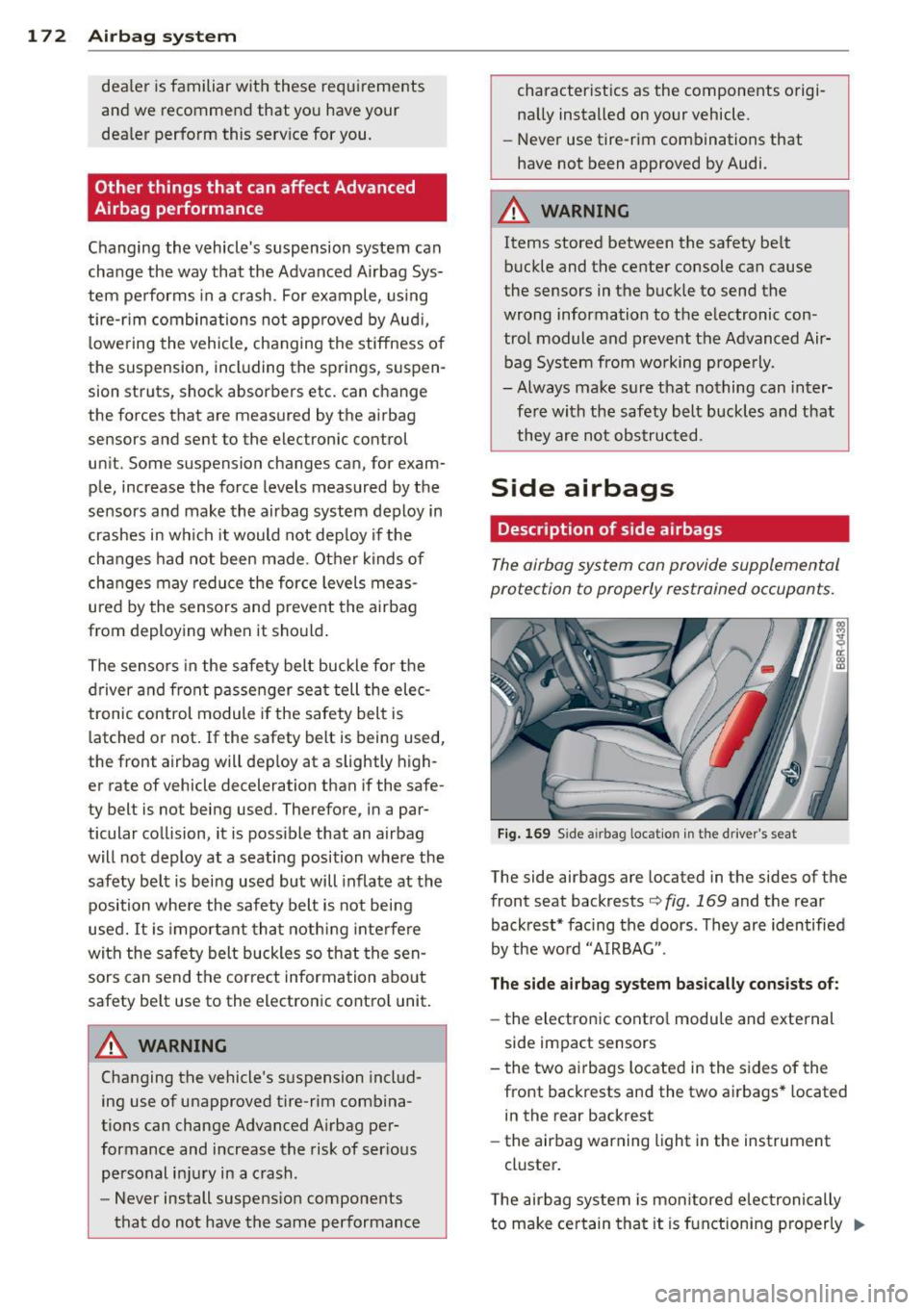
Fig. 169 Side a irbag location in the driver's seat
The side airbags are located in the sides of the
front seat backrests¢
fig. 169 and the rear
backrest* facing the doors. They are identified
by the word "AIRBAG".
The side airbag system basically consists of:
-the electronic control module and external
side impact sensors
- the two airbags located in the sides of the
front backrests and the two airbags* located
in the rear backrest
- the airbag warning light in the instrument
cluster.
The airbag system is monitored electronically
to make certain that it is functioning properly ..,.
Page 175 of 316
at all times. Each time you turn on the igni
tion, the airbag system indicator light will
come on for a few seconds (self diagnostics).
The s ide a irbag sys tem supp lements the safe
ty belts and can help to reduce the risk of in
jury to the driver's and front passenge r's up
per torso on the side of the vehicle that is
struck in a side co llision. The airbag deploys
only in s ide impacts and on ly when the veh icle
acceleration registered by the control u nit is
h igh enough . If this rate is below the refer
ence va lue programmed into the control un it,
the side airbags will not be triggered, even
though the ca r may be badly damaged as a re
sult of the collision .
It is not possible to de
fine an ai rbag triggering range that will cover
every possible angle of impact, since the cir
cumstances wi ll vary considerably between
one co llision and another. Important factors
include, for examp le, the nat ure (hard or soft)
of the impacting object, the ang le of impact,
veh icle speed, etc. c::>
page 174, Important
safety instructions on the side airbag system.
Aside from the ir norma l safety function, safe
ty belts work to he lp keep the driver or front
passenger in posit ion in the event of a side
coll is ion so that the side a irbags can provide
p rotection.
The airbag system is
not a substitute for your
safety bel t. Rathe r, it is pa rt of the overall oc
cupant restraint system i n your veh icle . Al
ways remember that the side airbag sys tem
can only he lp to p rotec t you if yo u are wear ing
your safety belt and wear ing it properly. This
is another reason w hy you sho uld a lways wear
your safety belts, not just beca use the law re
q uir es you to do soc::>
page 149, General
notes.
It is important to remember that while the
supp lemental side a irbag system is designed
to reduce the like lihood of serious injur ies,
other in juries, for example, swell ing, bruising,
and minor abras ions can also be associated
w ith deployed s ide a irbags. Remember too,
side a irbags w ill deploy on ly once and o nly in
certain kinds of accidents - you r safety belts
are a lways there to offer prote ction.
A irbag system 173
Vehicle damage, repair costs o r even t he lack
of ve hicle damage are not necessarily a n indi
cation o f ove r-sensitive or failed airbag activa
tion. In some coll is ions, both front and side
airbags may i nflate. Remember too, that air
bags will deploy only o nce a nd only in certain
ki nds of coll is ions -your safety belts are al
ways t he re to offe r protection in those acc i
den ts in which a irbags a re no t supposed to
deploy or when they have already deployed .
The side airbag system will not deploy:
-when the ignit io n is turned off
- in side co llisions whe n the acceleration
measured by the sensor is too low
- in front-end collisions
- in rear -end co llisions
- in rollove rs .
In some types of ac cidents the front airbags,
s ide cu rtain air bags and s ide air bags may be
trigge red togethe r.
&_ WARNING ~
- Safety belts and the airbag system wi ll
only provide protection when occupants
are in the proper seating position
c::>page 174.
-If the airbag ind icator light c::> page 16
comes when the veh icle is being used,
have the system inspected immediate ly
by your authorized Audi dealer. It is pos
sible t hat the airbag will inflate when it
is not supposed to, or will not infla te
when it should.
•
•
Page 177 of 316
-Objects between you and the airbag can
increase the risk of injury in an accident
by interfering with the way the airbag
unfolds or by being pushed into you as
the airbag inflates .
- Never place or attach accessories or
other objects (such as cupholders, tele
phone brackets, or even large, bulky
objects) on the doors, over or near the
area marked "AIRBAG" on the seat
backrests.
- Such objects and accessories can be
come dangerous projectiles and cause
injury when the supplemental side air
bag deploys .
- Never carry any objects or pets in the
deployment space between them and
the airbags or allow children or other
passengers to travel in this position .
- Always use the built -in coat hooks only
for lightweight clothing . Never leave any
heavy or sharp-edged objects in the
pockets that may interfere with side air
bag deployment and can cause personal
injury in an accident.
- Always prevent the side a irbags from be
ing damaged by heavy objects knocking
against or hitting the sides of the seat
backs.
- The airbag system can only be trigge red
once.
If the airbag has been triggered,
the system must be replaced by an au
thorized Audi dealership .
- Damage (cracks, deep scratches etc .) to
the original seat covers or to the seam in
the area of the side airbag module must
always be repaired immediately by an au
thorized Audi dealer .
- If children are seated improperly, their
risk of injury increases in the case of an
accident ~ page 178, Child Safety .
- Never attempt to modify any compo
nents of the airbag system in any way .
- In a side collision, side airbags will not
function properly if sensors cannot cor rectly measure increasing air pressure in
side the doors when air escapes through
Airbag system 175
larger, unclosed openings in the door
panel.
- Never drive with interior door trim pan
els removed .
- Never drive when parts have been re
moved from the inside door panel and
the open ings they leave have not been
properly closed.
- Never drive when loudspeakers in the
doors have been removed unless the
speaker holes have been p roperly
closed.
- Always make certain that openings are
covered or filled if additiona l speakers
or other equipment is installed in the
inside door panels .
- Always have work on the doors done by
an authorized Audi dealer or qualified
workshop.
Side curtain airbags
Description of side curtain airbags
The side curtain airbag sy stem can provide
supplemental protection to properly restrain
ed occupants .
e R
'
a: a, m
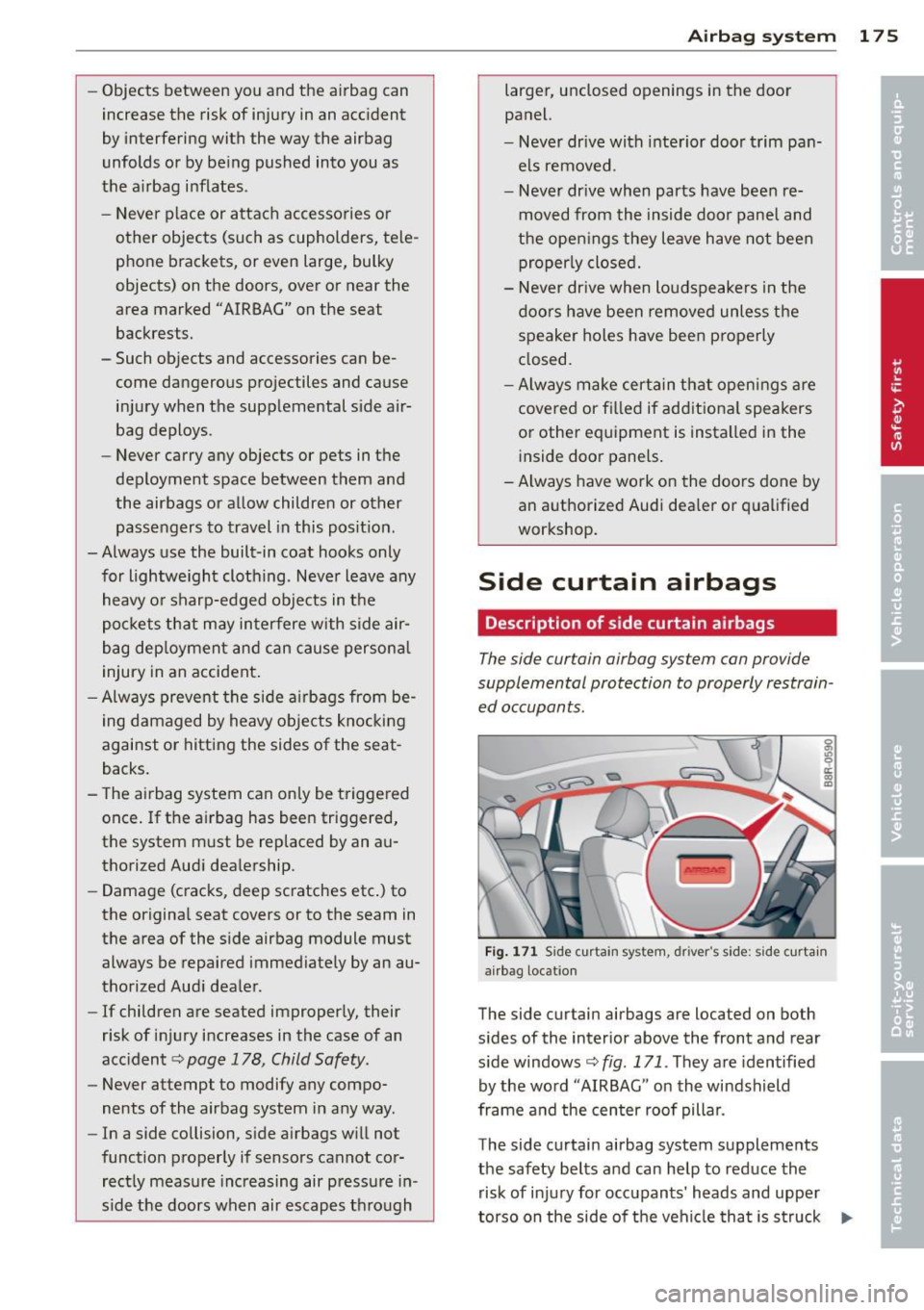
Fig. 171 Side curta in syst em , dri ver's side: sid e cur tain
airb ag loc ation
The side curtain airbags are located on both
sides of the interior above the front and rear
side windows ~ fig . 171 . They are identified
by the word "AIRBAG" on the windshield
frame and the center roof pillar.
T he side curtain airbag system supplements
the safety belts and can help to reduce the risk of injury for occupants' heads and upper
torso on the side of the vehicle that is struck .,.
Page 178 of 316
17 6 Airbag syst em
in a side collision. The side curtain airbag in
f lates in side impacts and on ly when the vehi
cle acce lerat ion reg istered by the contro l unit
is high enough. If this rate is below the refer
ence value programmed into the control unit,
the side airbags will not be triggered, even
though the car may be badly damaged as a re
sult of the collision.
It is not possible to de
fine an a irbag tr igger ing range that will cover
every possible angle of impact, since the c ir
cumstances w ill vary considerably between
one co llision and another . Important factors
include, for examp le, the nat ure (hard or soft)
of the impacting object, the ang le of impact,
vehicle speed, etc.
c:> page 176, How side cur
tain airbags work.
Aside from their normal safety function, safe
ty belts work to he lp keep the driver or front
passenger in position in the event of a co lli
sion so that the side curtain airbags can pro
vide p rotection.
The airbag system is not a subst itute for your
safety belt. Rather, it is part of the overall oc
cupant restraint system in your veh icle. Al
ways remember that the airbag system can
only help to protect you if you are wea ring
your safety be lt and wear ing it prope rly. This
i s ano ther reason why you shou ld always wear
your safety be lts, not jus t be ca use the law re
qu ires you to do soc;,
page 149, General
notes.
It
is important to remember that whi le the
side curtain a irbag sys tem is designed to he lp
reduce the like lihood o f serious injuries, other
inj uries, for example, swelling, bruising, and
minor abrasions can also be associated with
these airbags. Remember too, these airbags
will dep loy only once and only in certain k inds
of acc idents - your safety belts are always
there to offer protection.
The side curtain airb ag system b asic all y
consists of:
- The electronic control module and externa l
s ide impact sensors
- The side curtai n airbags above the front and
rear side w indows -
The airbag indicator light in the instrument
panel
T he airbag system is mo nitore d elec tronically
to make certain i t is func tioning properly at all
t imes . Each t ime yo u turn on the ignition, the
airbag system indicator light will come on for
a few seconds (sel f diagnostics).
The side curtain airbag is not activated:
- if the ignition is tur ned off,
- in side co llisions whe n the accele ration
mea sured by the sensor is too low,
- in rear-end col lisions.
A WARNING
- Safety belts and the airbag system will
only provide pro te ction when occupant s
are i n the proper seating posi tion
c:>page 61, General recommendations.
- If th e airbag ind ic a tor light c:>page 16
comes when the veh icle is being used,
have the system ins pected immediately
by your authorized A udi dealer. It is pos
sible that the airbag will inflate when it
is not supposed to, or will not inflate
when it should.
How side curtain airbags work
Side curtain airbags can work together with
side airbags to help reduce the risk of head
and upper torso injuries for occupants who
are properly restrained.
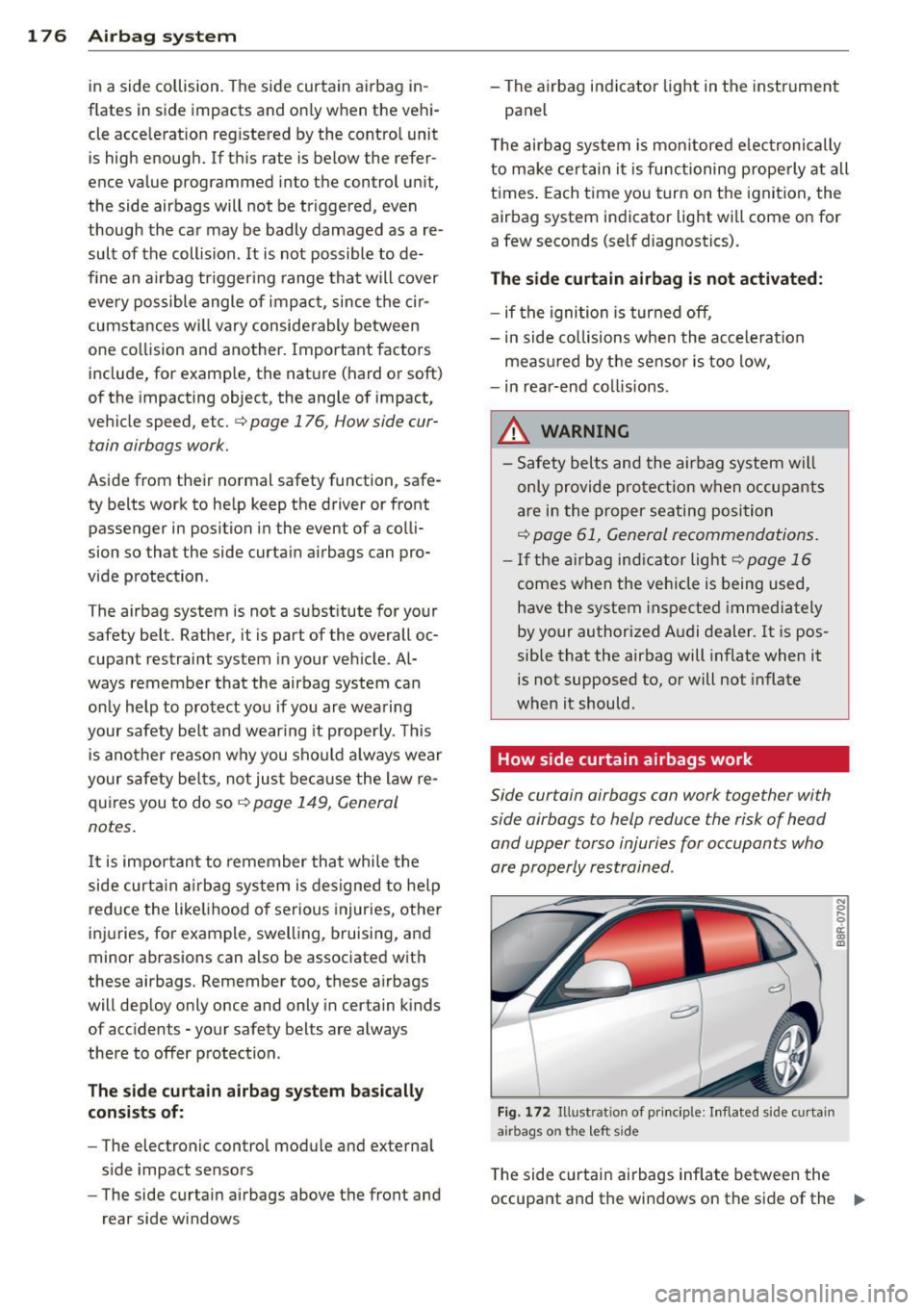
Fi g. 172 Illustration of p rinciple: I nflated side curtai n
a irbags on the left side
The side c urtain airbags inflate be tween the
occupant and the windows on the s ide of the
Ill-
Page 179 of 316
vehicle that is struck in a side collision
~fig. 172.
When the system is triggered , the side curtain
airbag is filled with propellant gas and breaks
through a seam above the front and rear side
windows identified by the AIRBAG label. In or
der to help provide this additional protection,
the side curtain airbag must inflate within the
blink of an eye at very high speed and with
great force. The side curtain airbag could in
jure you if your seating position is not proper
or upright or if items are located in the area
where the supplemental side curtain airbag
inflates . This applies especially to children
~page 178.
Although they are not a soft pillow, side cur
tain airbags can "cushion" the impact and in
this way they can help to reduce the risk of in
jury to the head and the upper part of the
body.
A fine dust may develop when the airbag de
ploys. This is quite normal and does not mean
there is a fire in the vehicle.
Important safety instructions on the
side curtain airbag system
Airbags are only supplemental restraints. Al
ways properly wear safety belts and ride in a
proper seating position.
There is a lot that you and your passengers
must know and do to help the safety belts and
airbags do their job to provide supplemental
protection.
A WARNING
Improperly wearing safety belts and im
proper seating positions increase the risk
of serious personal injury and death when
ever a vehicle is being used.
- Never let occupants place any parts of
their bodies in the area from which the
side curtain airbags inflate.
-Always make sure that the side curtain
airbags can inflate without interference.
Unsuitable accessories fitted inside the
Airbag system 177
expansion range of a head airbag can
dangerously interfere with its function. A
deploying head airbag develops enough
force to catapult any piece of add-on
component out of its path of inflation
and into the passenger compartment. An
occupant hit by such a projectile can suf
fer serious injury or death~
page 296,
Technical Modifications.
-Do not swivel the sun visors to the side if
you have any objects clipped onto them
(for example pens). If the airbag should
deploy, you could be injured by these ob
jects.
- Use the built-in coat hooks only for light
weight clothing. Never leave any heavy or sharp-edged objects in the pockets that
may interfere with airbag deployment
and can cause personal injury in an acci
dent.
- Never use hangers to hang clothing from
the hooks.
- Only use factory-installed sun shades or,
in the case of shades installed after the
vehicle leaves the factory, only Audi roll up sunscreens may be used
~ page 295,
Additional accessories and parts re
placement.
- Always sit in proper seating position and
wear safety belts while traveling so that
the side curtain airbags can help provide
protection.
- The airbag system can only be triggered
once . If the airbag has been triggered,
the system must be replaced by an au
thorized Audi dealer or qualified work
shop.
-Always have work involving the side cur
tain airbag system, removal and installa
tion of the airbag components, or other repairs performed by an authorized Audi
dealer or qualified workshop. Otherwise
the airbag system may not work correct
ly.
- Never attempt to modify any compo
nents of the airbag system in any way.
•
•
Page 181 of 316
-Always install rear-facing child safety
seats on the rear seat.
- If you must install a rearward facing
child safety seat on the front passenger
seat in exceptional circumstances and
the
PASSENGER AIR BAG OFF light does
not come on and stay on, immediately
install the rear-facing child safety seat in
a rear seating position and have the air
bag system inspected immediately by
your Audi dealer.
_& WARNING
If, in exceptional circumstances, you must
install a forward-facing child restraint on
the front passenger's seat:
- Always make sure the forward-facing
seat has been designed and certified by its manufacturer for use on a front seat
with a passenger front and side airbag.
- Always follow the manufacturer's in
structions provided with the child safety
seat or carrier.
- Always move the passenger seat into its
rearmost position in the seat's fore and
aft adjustment range, as far away from
the airbag as possible before installing
the child restraint. The backrest must be
adjusted to an upright position .
- Always make sure that the
PASSENGER
AIR BAG OFF
light comes on and stays
on all the time whenever the ignition is
switched on.
(D Tips
Always replace child restraints that were
installed in a vehicle during a crash. Dam
age to a child restraint that is not visible
could cause it to fail in another collision
situation.
Advanced front airbag system and children
Your vehicle is equipped with a front "Ad
vanced Airbag System" in compliance with United States Federal Motor Vehicle Safety
Child Safety 1 79
Standard (FMVSS) 208 as applicable at the
time your vehicle was manufactured.
The Advanced Airbag system in your vehicle
has been certified to meet the "low-risk" re
quirements for 3- and 6-year old children on
the passenger side and small adults on the driver side. The low risk deployment criteria
are intended to reduce the risk of injury
through interaction with the airbag that can
occur, for example, by being too close to the
steering wheel and instrument panel when
the airbag inflates . In addition, the system
has been certified to comply with the "sup
pression" requirements of the Safety Stand
ard, to turn off the front airbag for infants up
to 12 months who are restrained on the front
passenger seat in child restraints that are list
ed in the Standard.
Even though your vehicle is equipped with an
Advanced Airbag system, all children, espe cially those 12 years and younger, should al
ways ride in the back seat properly restrained
for their age and size. The airbag on the pas
senger side makes the front seat a potentially dangerous place for a child to ride . The front
seat is not the safest place for a child in a for
ward-facing child safety seat. It can be a very
dangerous place for an infant or a larger child
in a rearward-facing seat .
Advanced Airbags and the weight
sensing mat in the front seat
The Advanced Airbag System in your vehicle
detects the presence of an infant or child in a
child restraint on the front passenger seat us
ing the weight -sensing mat in the seat cush
ion and the sensor below the safety belt latch
on the front passenger seat that measures the
tension on the safety belt.
The weight -sensing mat measures total
weight of the child and the child safety seat
and a child blanket on the front passenger seat. The weight on the front passenger seat
is related to the design of the child restraint
and its "footprint", the size and shape of the
bottom of the child restraint as it sits on the ..,.
•
•