ABS AUDI Q5 2014 Owner's Manual
[x] Cancel search | Manufacturer: AUDI, Model Year: 2014, Model line: Q5, Model: AUDI Q5 2014Pages: 316, PDF Size: 78.41 MB
Page 218 of 316
216 Trailertowing
-Do not tow a trailer during the break-in
period of your vehicle .
- If you tow a trailer, your Audi may re
quire more frequent maintenance due to
the extra load
<=> page 293.
Parking on a slope
Do not park on a slope with a trailer. If it can
not be avoided, do so only after doing the fol
lowing:
When parking:
,,. Apply the foot brake.
,,. Have someone place chocks under both the
vehicle and the trai ler wheels.
,,. With chocks in place, slowly re lease the
brakes until the whee l chocks absorb the
load.
,,. Turn the wheels towards the curb .
,,. Apply the parking brake .
,,. Move the selector lever to P.
When restarting after parking:
,,. Apply the foot brake.
,,. Start the eng ine.
,,. Move the selector lever to D/S.
,,. Re lease the park ing brake and slowly pull
out and away from the wheel chocks.
,,. Stop and have someone retrieve the wheel
chocks.
@ Tips
If you move the selector lever of the auto
mat ic transmission to P before applying
the parking brake and before blocking the
wheels, you may have to use more force
later to move the lever out of the P posi
tion.
Page 222 of 316
220 Vehicle care and cleaning
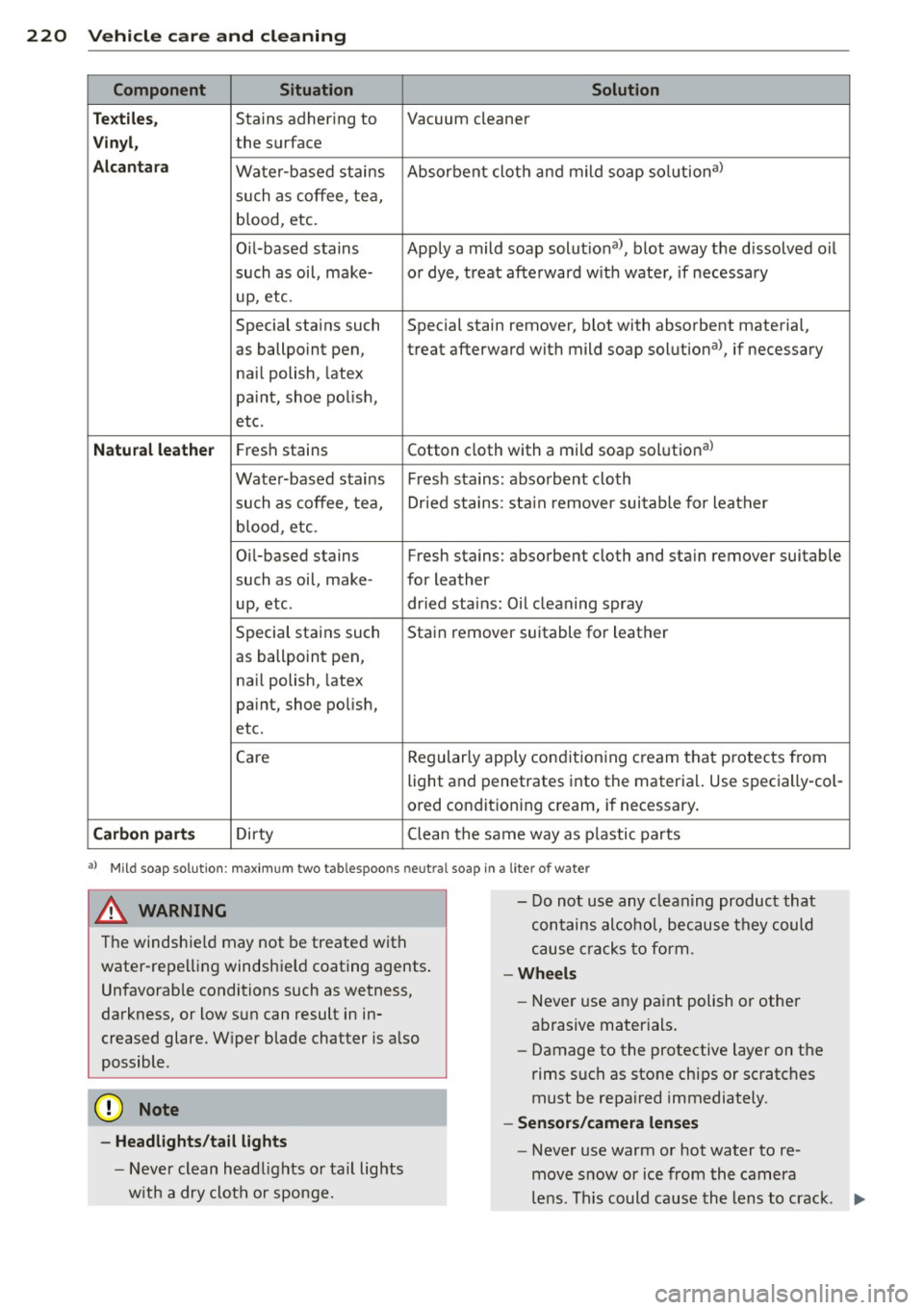
Component Situation Solution
T ex tile s,
Stains adhering to Vacuum cleaner
Vin yl, the surface
Alcan ta ra Water -based stains Absorbent cloth and mild soap solutiona>
such as coffee, tea,
blood, etc.
O il-based stains Apply a mild soap solutiona>, blot away the d issolved oil
such as oil, make- or dye, treat afte rward w ith water, if necessary
up, etc.
Special stains such Special stain remover, b lot with absorbent material,
as ballpoint pen, treat afterward with mild soap solutiona>, if necessary
na il polish, latex
pa int, shoe po lish,
etc.
Natu ral leather Fresh stains Cotton cloth with a mild soap solutiona>
Wate r-based stains Fresh s tains: absorbent cloth
such as coffee, tea, Dr ied stains: sta in remover sui table for leather
blood, etc.
Oi l-based stains Fresh stains: absorbent cloth and sta in remover suitable
such as oil, make- for leather
up, etc. dried stains: Oil cleaning spray
Special stains such Stain remover suitable for leather
as ballpo int pen,
na il polish, latex
pa int, shoe polish,
etc.
Care Regular
ly apply condit ion ing c ream that protec ts from
light a nd penetrates into the materia l. Use specially-col-
ored conditioning cream, if necessary.
Carbon part s Dirty Clean tlhe same way as plastic parts
a) Mi ld soap solut ion : maximum two tablespoons neut ra l soap in a lite r of wate r
& WARNING
The windshie ld may not be treated with
water -repe lling windshield coating agents .
Unfavorab le conditions such as wetness,
darkness, or low sun can result in in
creased glare. W iper blade chatter is a lso
possible .
(V Note
-Headlights /tail lights
- Never clean headlights or tail lights
w it h a dry cloth or sponge. -
Do not us e any cleaning product that
contains alcohol, because they could
cause cracks to form.
-Wheels
- Never use any paint polish or other
abrasive mater ials.
- Damage to the protective layer on the
rims such as stone chips or scratc hes
must be repa ired immediately.
- Sensor s/camera lenses
- Never use warm or hot water to re-
move snow or ice from the camera
le ns. Th is could cause th e lens to crack . ""
Page 243 of 316
Brake fluid
Checking brake fluid level
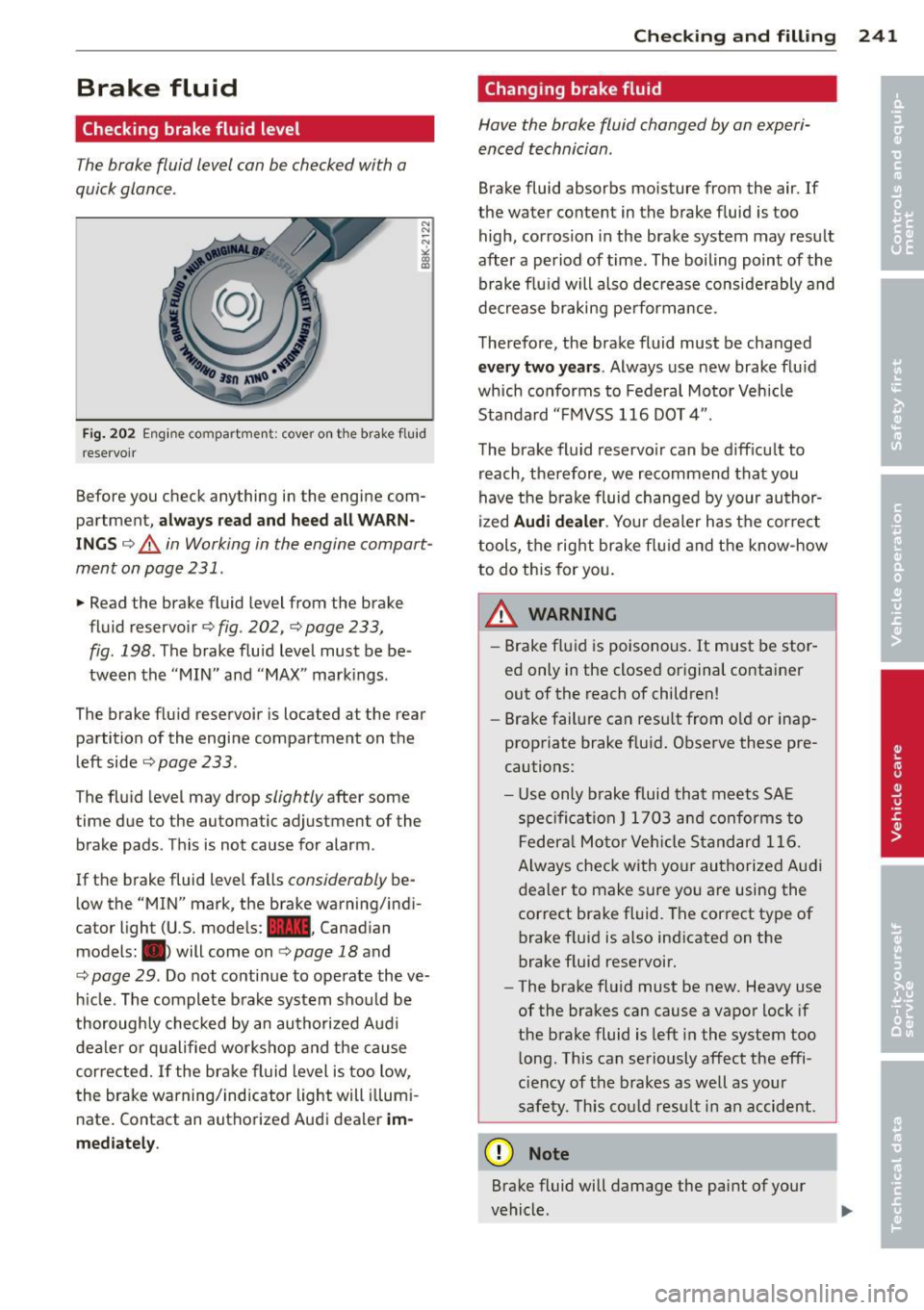
The brake fluid level can be checked with a
quick glance.
N
N
;:;;
" 03
"'
Fi g. 202 Eng ine compartment: cover on the brake flu id
reservoir
Before you check anything in the engine com
partment,
a lwa ys read and heed all WARN
ING S c:> .&.. in Working in the engine compart
ment on page 231 .
~ Read the brake fluid level from the brake
fluid reservoir
c:> fig. 202, <=> page 233,
fig . 198 .
The brake flu id level must be be
tween the "MIN" and "MAX" markings.
The brake fluid reservoir is located at the rear
partition of the engine compartment on the
left side
c::> page 2 33 .
The fluid level may drop slightly after some
time due to the automatic adjustment of the
brake pads . This is not cause for alarm .
If the brake fluid level falls
considerably be
low the "MIN" mark, the brake warning/indi
cator light (U.S. models:~, Canadian
models: .) will come on
c> page 18 and
c::> page 29 . Do not continue to operate the ve
h icle. The complete brake system should be
thoroughly checked by an authorized Aud i
dealer o r qualified workshop and the cause
corrected.
If the brake fluid level is too low,
the brake warning/indicator light will illum i
nate . Contact an authorized Audi dealer
im
m ediatel y.
Checkin g and fillin g 241
Changing brake fluid
Have the brake fluid changed by on experi
enced technician .
Brake fluid absorbs moisture from the air. If
the water content in the brake fluid is too
high, corrosion in the brake system may result
after a period of time . The boiling point of the
brake flu id will also dec rease considerably and
decrease braking pe rformance.
Therefore, the brake fluid must be changed
every two years. Always use new brake flu id
which conforms to Federal Motor Vehicle
Standard "F MVSS 116 DOT 4".
The brake fluid reservo ir can be d iff icult to
reach, the refore, we recommend that you
have the brake fluid changed by your author
i zed
Audi d ealer. Your dealer has t he correct
tools, the right brake fl uid and the know-how
to do this for you .
A WARNING -.
-Brake fluid is poisonous . It must be stor
ed only in the closed original container
out of the reach of children!
- Brake failure can resu lt from o ld or inap
propriate brake f luid. Observe these pre
cautions:
- Use only brake fluid that meets SAE
spe cificat ion
J 1 7 03 and conforms to
Federa l Moto r Ve hicl e Standard 116.
Always check with yo ur authorized Audi
dealer to make sure yo u are using the
correct bra ke fluid. The correct type of
brake f luid is also indicated on the
brake f luid reservoir.
- The brake fluid must be new. Heavy use
of the brakes can cause a vapor lock if
the brake fluid is left in the system too
l ong . This can seriously affect the effi
c iency of the brakes as well as your
safety. Th is cou ld resu lt in an accident.
(D Note
Brake fluid will damage the paint of your
vehicle .
Page 244 of 316
242 Checking and filling
@ For the sake of the environment
Be cause of the problem of proper disposa l
of brake flu id as we ll as the special tools
req uired and the necessary expert ise, we
recommend that you have the b rake fluid
changed by your author ized Audi dealer.
Battery
General information
Unde r normal operating conditions, the bat
tery in your A udi does not need any mainte
nance. With
high outside temperatures or
long daily dr ives we recommend that you have
the elect ro lyte level checked by an authorized
Aud i dea ler o r qualified workshop . The elec
trolyte leve l sho uld a lso be c hecked each t ime
the battery is c harged ¢
page 244.
Have the battery checked when you take your
ve hicle in for service . Yo u are well adv ised to
replace a bat tery that is older tha n 5 yea rs .
W ith certa in types of a irbag deployment, t he
battery is d isconnected from the vehicle elec
tr ica l system fo r safety reasons ¢
& in Re
pair, core and disposal of the airbags on
page 171.
Hybr id d rive *: you can find important i nforma
tion about the high voltage battery under
¢ page 97.
Disconnecting the battery terminals
Some veh icle functions (power w indow regu
lators, for example) are lost if the battery ter
minals a re discon nected. These functions have
to be re learned after the ba tte ry term inals a re
connect ed aga in. To prevent this , the battery
should only be d isconnected from the vehicle
e lec tric al sys te m whe n absolu tely necessa ry
for rep airs.
Vehicles not driven for long periods
If yo u do not dr ive you r vehicle over a pe riod
of severa l days or w eeks, ele ct rical com po
n e nt s are gr adually cu t ba ck o r swi tched off .
T his redu ce s energy consu mp tion and mai n- ta
ins s tart ing c apability over a longer pe riod
¢ page 203.
Take i nto consi deratio n that whe n you unl ock
yo ur vehicle, some conven ien ce f un ctions ,
s u ch as the inte rior ligh ts or the powe r sea t
adjustment, may not be availab le. T he con
venience functions will be avai lab le aga in
when you tu rn on the ign ition and start t he
engine.
Winter operation
Du ring the winte r mon ths, bat tery ca pac ity
tends to dec rease as tem peratures drop . This
is beca use more power is a lso consumed wh ile
starting, and the headlights, rear wi ndow de
fogger, etc ., are used more often.
Avoid unnecessary powe r consum ption, pa r
t icu lar ly in city traffic or when traveling only
sho rt distances. Let your authori zed Aud i
dealer check the capacity of the vehicle bat
te ry before winter sets in ¢
page 244. A well
c h arged battery will not on ly preven t starti ng
problems when the wea ther is cold, but w ill
also last lo nger.
Working on the battery
Be especially careful when working on or near
the ba ttery.
The battery is located in the luggage compart
me nt under the floor . B efo re you c hec k any
t hi ng in the luggage compartmen t,
read and
heed all WARNINGS
¢ & -
Hybrid dr ive* : yo u can find impo rtant informa
t io n about the h igh vol tage ba tte ry unde r
¢page 97 .
Always heed the safety warnings , when work
ing on the v ehicle ba tte ry or the vehicle e lec
t rical sys tem to preven t inju ry .
Page 268 of 316
266 Tire s and wheels
When the malfunction indicator is illuminat
ed, the system may not be able to detect or
signal low t ire pressure as intended. TPMS
malfunctions may occur for a variety of rea
sons, including the installation of replace
ment or alternate tires or wheels on the vehi
cle that prevent the TPMS from funct ioning
properly . Always check the TPMS malfunct ion
tellta le after replacing one or more t ires or
wheels on your veh icle to ensure that the re
p lacement or a lternate tires and wheels allow
the TPMS to continue to function properly.
Tire pressure indicator appears
Applies to vehicles: with tire pressure monitoring system
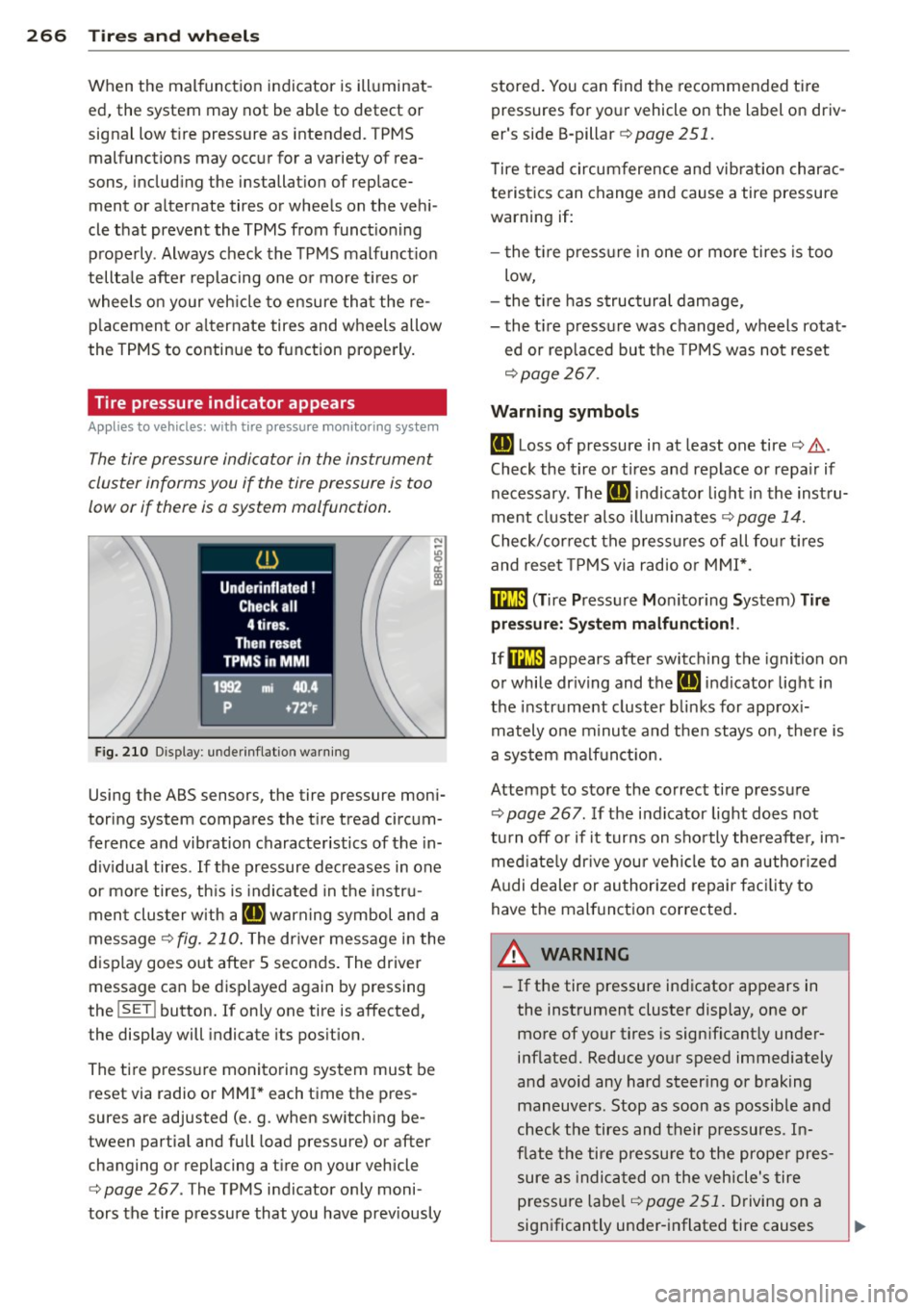
The tire pressure indicator in the instrument
cluster informs you if the tire pressure is too
low or if there is a system malfunction.
N
I
Fig. 210 Display: underinflation warning
Using the ABS sensors, the tire pressure moni
toring system compares the tire tread circum
ference and vibration characteristics of the in
dividual tires. If the pressure decreases in one
or more tires, th is is indicated in the instru
ment cluster w ith a
IE warning symbol and a
message
¢fig . 210. The dr iver message in the
display goes out after 5 seconds. The driver
message can be displayed again by pressing
the
! SET ! button. If on ly one tire is affected,
the display will indicate its position.
The tire pressure monitoring system must be
reset via radio or MMI * each time the pres
sures are adjusted (e. g . when switching be
tween partia l and full load pressure) or after
changing or replacing a tire on your vehicle
¢
page 267. The TPMS indicator only moni
tors the tire pressure that you have prev iously stored
. You can find the recommended tire
pressures for your vehicle on the label on driv
er's side B-pillar ¢
page 251.
Tire tread circumference and vibration charac
teristics can change and cause a tire pressure
warning if:
- the tir e pressure in one or more tires is too
low,
- the tir e has structural damage,
- the tir e pressure was changed, wheels rotat-
ed or replaced but the TPMS was not reset
¢page 267.
Warning symbols
IE Loss of pressure in at least one tire¢ .&..
Check the tire or tires and replace or repa ir if
necessary. The
IE indicato r light in the inst ru
ment cluster als o illuminates
¢ page 14.
Check/correct the pressures of all four tires
and reset TPMS via radio or MMI*.
ffim (T ire Pressure Mon itor ing System) Tire
pressure: System malfunction!.
If@m appears after switching the ignition on
or while dr iving and the
IE indicator light in
the instrume nt cluster blink s for app rox i
mately one minute and then stays on, there is
a system malfunction.
Attempt to store the correct tire pressure
¢
page 267 . If the indicator light does not
tu rn
off or if it turns on shortly thereafter, im
mediately drive you r vehicle to an authorized
A udi dealer or authorized repair facility to
have the malfunction corrected.
A WARNING
=
- If the tire pressure indicator appears in
the instrument cluster display, one or
more of your tires is sign ificant ly under
inflated. Reduce your speed immediately
and avoid any hard steer ing or braking
maneuvers. Stop as soon as possible and
check the tires and their pressures. In
flate the tire pressure to the proper pres
sure as ind icated on the vehicle's tire
p ressu re lab el¢
page 251. Driving on a
significantly under-inflated tire causes
Page 269 of 316
the tire to overheat and can lead to tire
failure. Under-inflation also is likely to
impair the vehicle's handling and stop
ping ability .
- The driver is responsible for maintaining
the correct tire pressures. You must
check the tire pressures regularly.
- Under certain conditions (such as a spor
ty driving style, winter conditions or un paved roads), the pressure monitor indi
cator may be delayed.
-Ask your authorized Audi dealer if run flat tires may be used on your vehicle .
Your vehicle registration becomes invalid if you use these tires when not permit
ted. Damage to your vehicle or accidents
could also result.
@ Tips
- The tire pressure monitoring system
stops working when there is an ESC/ABS
malfunction.
- Using snow chains may result in a system
malfunction.
- The tire pressure monitoring system on
your Audi was developed using tires with the "AO" or "RO" identification on the
tire sidewall¢
page 258. We recom
mend using these tires.
Reset tire pressure monitoring system
Applies to vehicles: with tire pressure monitoring system
If the tire pressure is adjusted, wheels are ro
tated or changed, the TPMS must be reset via
radio or MMI* .
.,. Before resetting the TPMS, the current pres
sures of all four tires must correspond to
the specified values. Adjust the tire pressure and reset the pressure in the tire pressure
monitoring system according to the load
you are carrying
¢ page 251 .
.. Turn on the ignition .
.,. Select :
I CARI function button > Tire pressure
monitoring
> Store now . Or
.,. Select: I CARI function button > Car systems*
control button > Servicing & checks > Tire
pressure monitoring
> Store tire pressures.
Tires and wheels 267
(D Tips
Do not store the tire pressure if there are
snow chains on the tire.
•
•
Page 270 of 316
268 What do I do now?
What do I do now?
Jack, tools and
inflatable spare tire
Onboard tool kit and vehicle jack
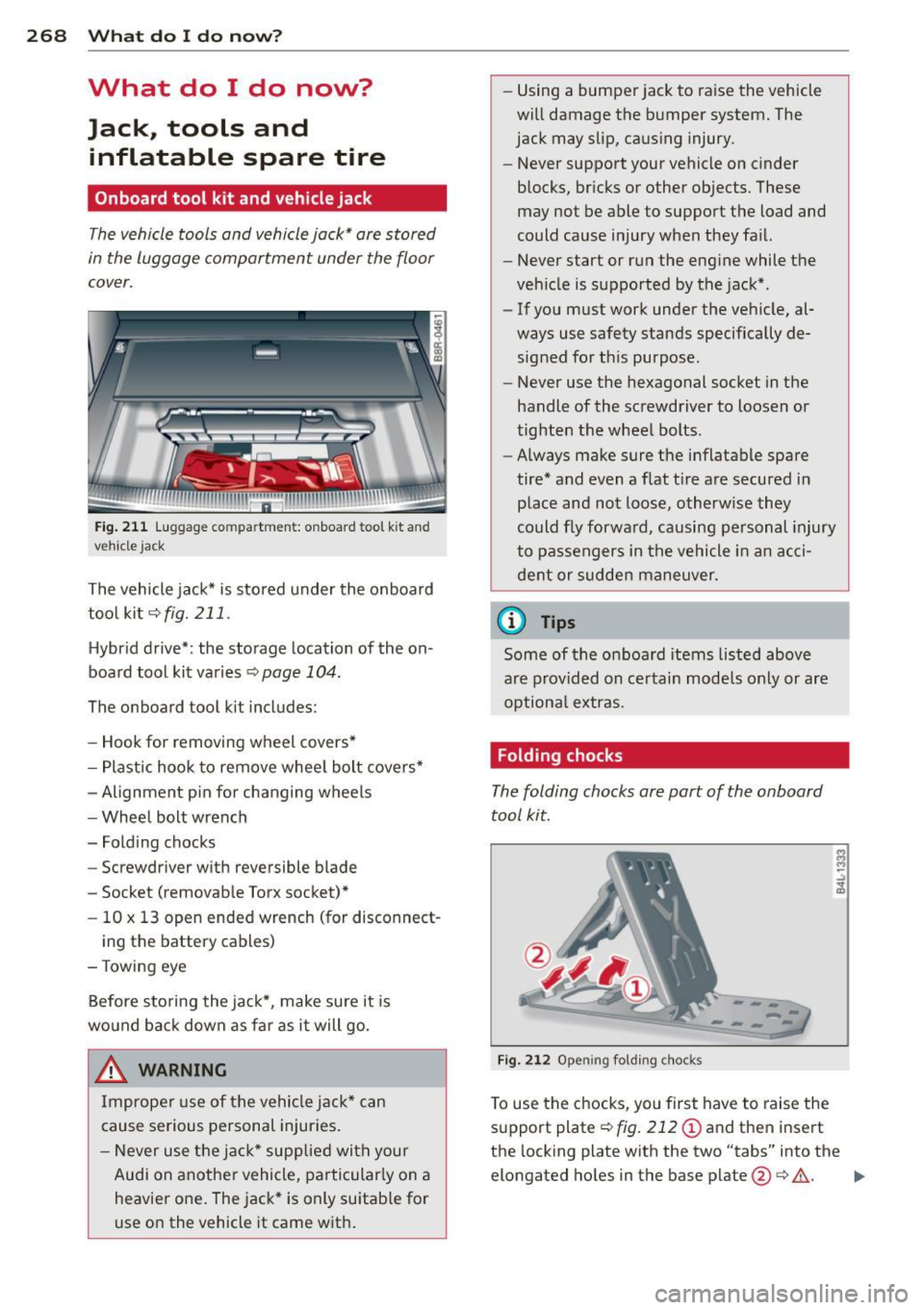
The vehicle tools and vehicle jack* are stored
in the luggage compartment under the floor
cover.
Fig . 211 Luggage compartment: on board tool kit and
vehicle jack
The vehicle jack* is stored under the on board
tool kit¢
fig. 211.
Hybrid drive*: the storage location of the on
board tool kit varies
¢ page 104.
The onboard tool kit includes:
- Hook for removing wheel covers*
- Plastic hook to remove whee l bolt covers*
- Alignment p in for changing wheels
- Wheel bolt wrench
- Folding chocks
- Screwdriver with reversible blade
- Socket (removable Torx socket)*
- 10 x 13 open ended wrench (for disconnect-
ing the battery cables)
-Towing eye
Before storing the jack*, make sure it is
wound back down as far as it will go.
& WARNING
Improper use of the vehicle jack* can
cause serious personal injuries.
- Never use the jack* supplied with your
Audi on another vehicle, particularly on a
heavier one . The jack* is only suitab le for
use on the vehicle it came with . -
Using a bumper jack to raise the vehicle
will damage the bumper system. The
jack may slip, causing injury.
- Never support your vehicle on cinder
blocks, bricks or other objects. These
may not be able to support the load and
could cause injury when they fa il.
- Never start or run the engine while the
veh icle is supported by the jack*.
- If you must work under the vehicle, al
ways use safety stands specifically de
signed for this purpose.
- Never use the hexagonal socket in the
handle of the screwdriver to loosen or
tighten the wheel bolts.
- Always make sure the inflatable spare
tire* and even a flat t ire are secured in
place and not loose, otherw ise they
could fly forward, causing personal injury
to passengers in the vehicle in an acci
dent or sudden maneuver.
@ Tips
Some of the on board items listed above
are provided on certain models only or are
optiona l extras.
Folding chocks
The folding chocks are part of the on board
tool kit.
Fi g. 2 12 Open ing folding choc ks
To use the chocks, you first have to raise the
support plate¢
fig . 212 (D and then insert
the locking plate with the two "tabs" into the
elongated holes in the base plate @¢& .
Ill>
Page 271 of 316
_& WARNING
-The chock cannot fulfil its funct ion and
may lose its stability if the "tabs" on the
support plate are not inserted cor rectly
into the elongated holes in the base
pla te. If th is happens, the vehicle may
st ar t to move whi le a wheel is being
changed .
- Never use the folding chocks if they are
damaged or i f th ey have not been assem
bled correct ly .
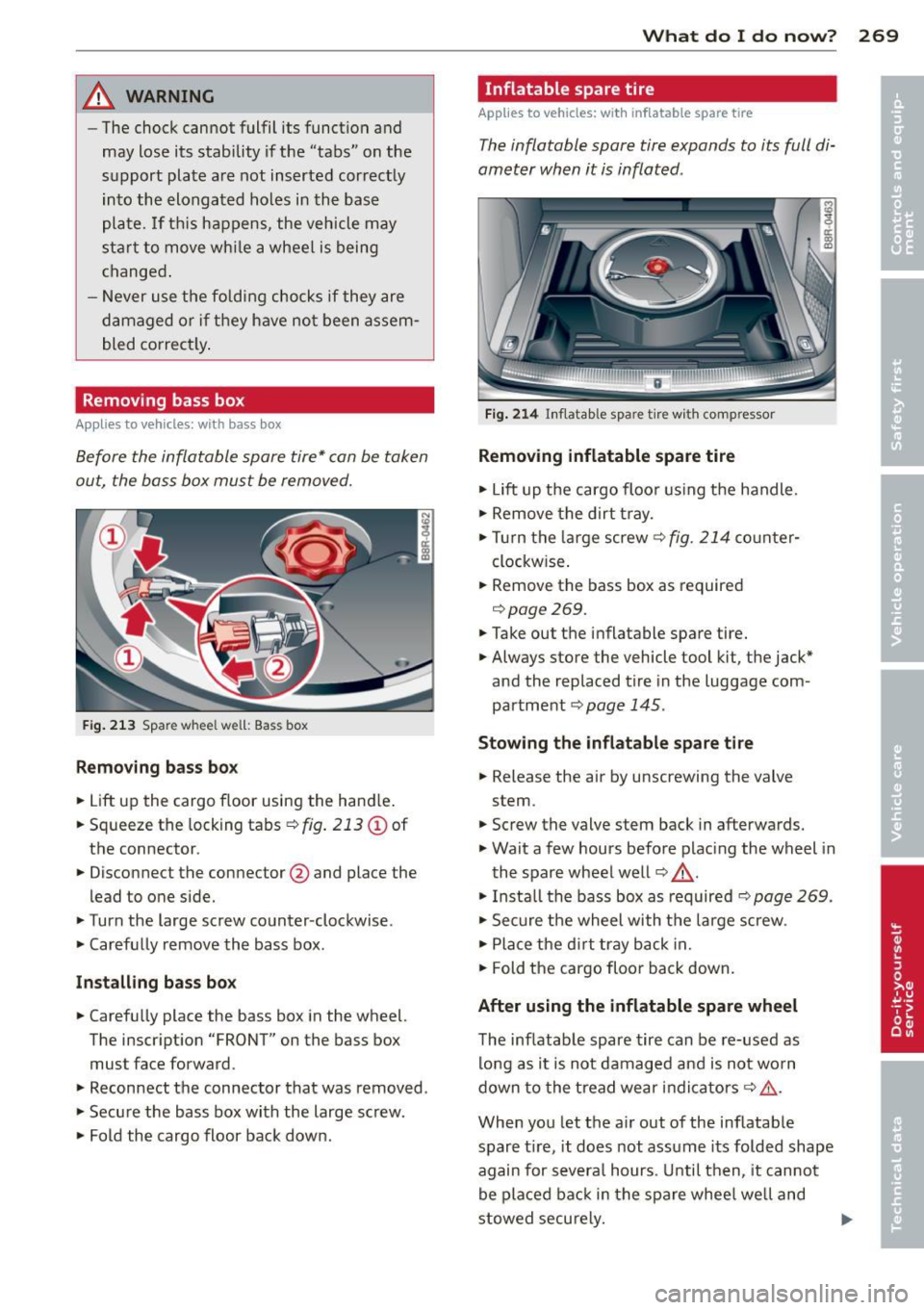
Removing bass box
Applies to vehicles: with bass box
Before the inflatable spare tire* can be taken
out, the bass box must
be removed.
Fig . 2 13 Spare w hee l well : Bas s box
Removing bas s bo x
.,. Lift up the cargo floor using the hand le .
.,. Sq ueeze the locking tabs
c:!;> fig . 213 (D of
the connector.
.,. Disconnect the connector @and place the
lead to one side.
.,. Turn the large screw counter -clockwise .
.,. Carefu lly remove the bass box .
Install ing bas s bo x
.,. Carefu lly place the bass box in the wheel.
The inscr ipt ion "FRONT" on the bass box
must face forward .
.,. Reconnect the connector that was removed .
.,. Secure the bass box with the large screw.
.,. Fold the cargo floor back down.
What do I d o now ? 269
Inflatable spare tire
Applies to vehicles: with inflatable spare tire
The inflatable spare tire expands to its full di
ameter when it is inflated.
Fi g. 21 4 In flatable spa re t ire w it h comp ressor
Removing inflatable spare tire
.,. Lift up the cargo floo r using t he handle .
.,. Remove the dirt t ray .
.,. Turn the large screw
c:!;> fig. 214 co unter
clockw ise .
.,. Remove the bass box as required
c:!;> page 269 .
.,. Take out the inflatable spare tire .
.,. Always store the vehicle tool kit, the jack*
and the replaced tire in the luggage com
partment
c:!;> page 145.
Stowing the inflatabl e spare t ire
.,. Release the air by unscrewing the valve
stem .
.,. Screw the valve stem back in afterwards .
.,. Wait a few hours befo re placing the wheel in
the spare wheel well
c:!;> .,&. .
"'Insta ll the bass box as required c:!;> page 269 .
.,. Secure the wheel with t he la rge screw .
.,. Place the d irt tr ay back in .
.,. Fold the cargo floor back down.
After using the inflatable spare wheel
T he inflatab le spare tire can be re-used as
l ong as it is not damaged and is not wo rn
down to the t read wea r indica tors
c:!;> ,& .
When you let the a ir out of the inflatab le
spare t ire , it does not assume its folded shape
again for s evera l hours . U nti l then , it canno t
be pla ced ba ck in the spare whee l we ll and
stowed secure ly.
Page 282 of 316
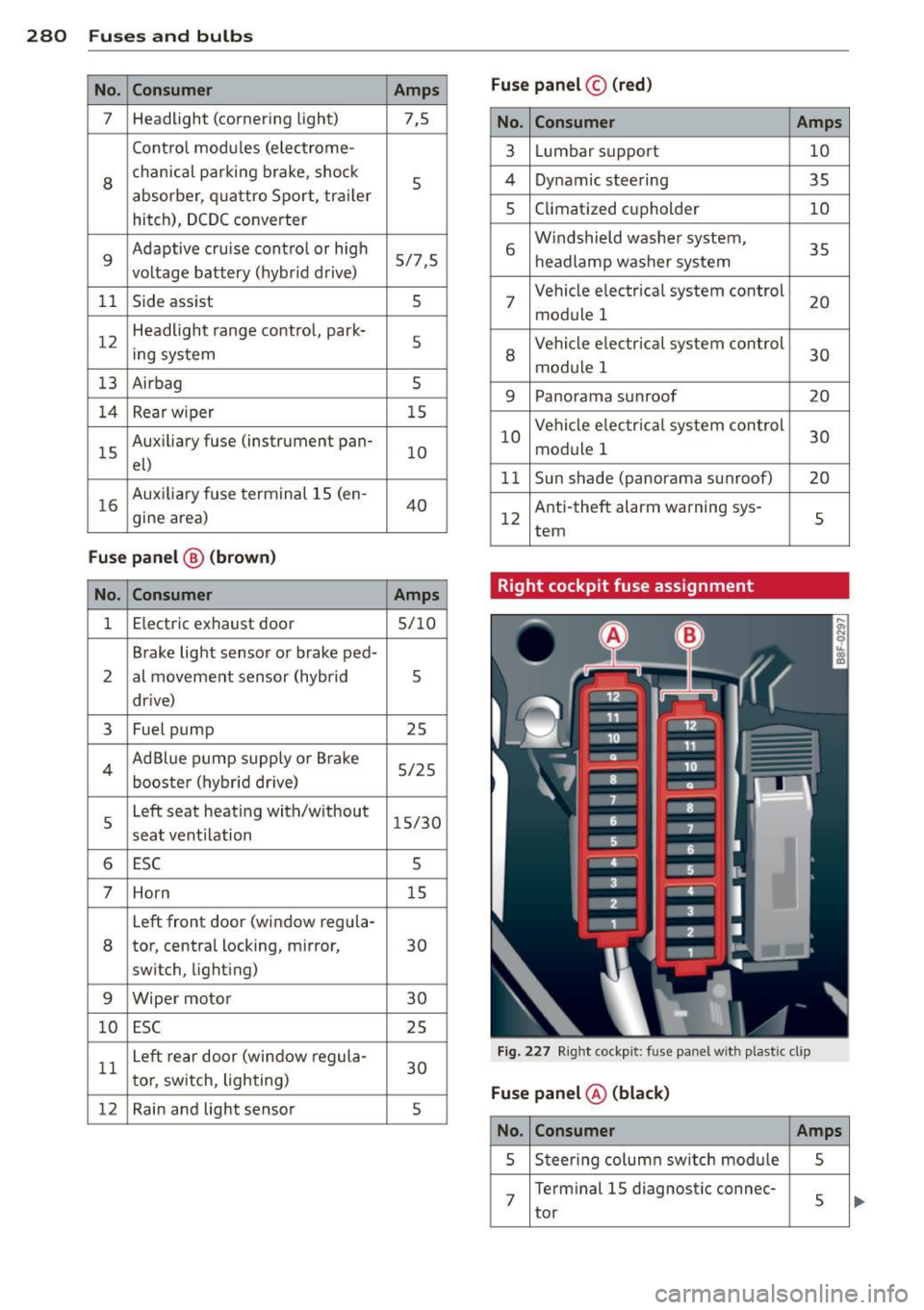
280 Fuses and bulbs
No. Consumer Amps Fuse panel
© (red )
7 Headlight (corner
ing light)
7,5 No. Consumer Amps
Contro l modu les (e lec trome-
3 Lum bar s upport 10
8
chanic al par king br ake, sho ck
5
absorber, q uatt ro Spor t, tra ile r
hitch), DCDC converter 4
Dynamic stee ring
35
5 Climat ized cu pholder 10
9
Adaptive cruise contro l or hig h
5/7,5
vo ltage battery (hybr id d rive) 6
W indshield w asher system,
35
h eadlamp washer sys tem
1 1 Side ass ist 5
7 Vehicle e
lectrical system control
20
module 1
12 H
eadlight range contro l, par k·
5
ing sys tem
8
Ve hicle e lec tric al syste m control
30
mod ule 1
13 Airbag
5
9 Panorama sunroof
20
1 4 Rear wiper 15
1 5 Aux
iliary fuse (instrument pan·
10
el)
16
Auxi liary fuse term inal 15 (en -
40
gine area) 10
Vehicle e
lectrica l system control
30
module 1
1 1 Sun shade (panorama s unroof) 20
1 2 Anti-theft alarm warning sys·
s
tern
Fuse panel
@ (brown)
No. Consumer Amps Right cockpit fuse assignment
1 Electric exhaust door
5/10
Brake lig ht sensor o r brake ped·
2 al movem ent s ensor (hybrid 5
dr ive)
3 Fuel pump 25
4 AdBl
ue p ump supp ly o r Br ake
5/25
booste r (hybr id drive)
5 Left seat heati
ng wit h/w ithout
15/30
seat vent ilation
6 ESC 5
7 Horn 15
Left front door (window regula ·
8 tor, central locking, m irror,
30
sw itch, light ing)
9 Wipe r moto r 30
10 ESC 25
11 Le
ft r ear do or (win dow regul a-
30
t o r, sw itch, lighting)
12 Rain and light se
nso r
5
Fig. 22 7 Right cockp it: fuse panel wit h plast ic clip
Fuse panel ® (black)
No. Consumer Amps
5 Steering column sw itch mod ule s
7
Terminal 15 diagnostic connec·
tor
5
Page 288 of 316
286 Emergency situations
Front towing loop
Do not install the front towing loop until it is
needed.
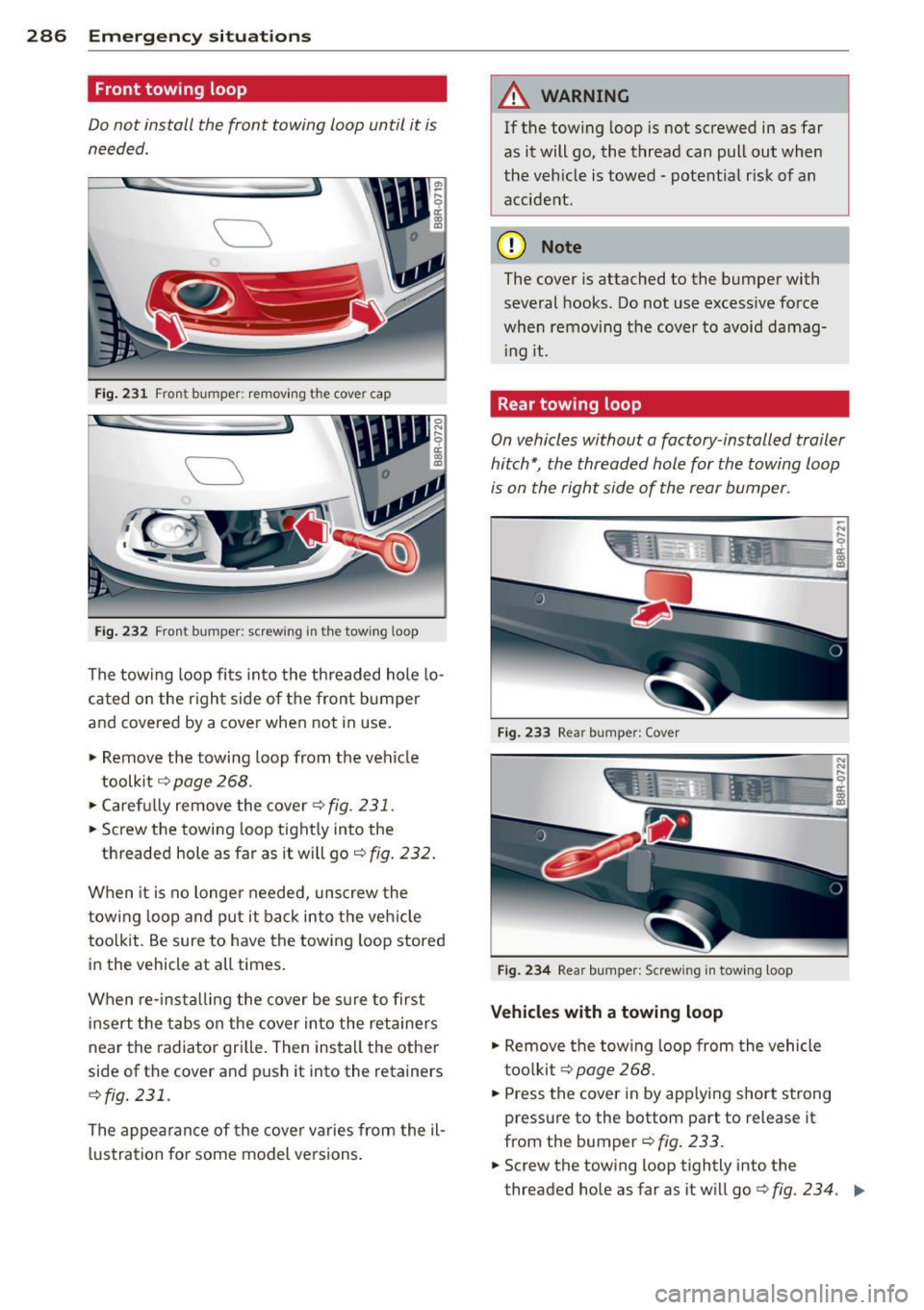
Fig. 231 Front bumper: removing th e cove r cap
Fig. 232 Fron t bumper: screw ing in t he tow ing loop
The towing loop fits into the threaded hole lo
cated on the right side of the front bumper
and covered by a cover when not in use.
• Remove the towing loop from the vehicle
toolkit
c::> page 268 .
• Carefully remove the cover c::> fig. 2 31.
• Screw the towing loop tight ly into the
threaded hole as far as it will go
c::> fig. 232.
When it is no longer needed, unscrew the
towing loop and put it back into the vehicle
too lkit . Be sure to have the towing loop stored
in the vehicle at all times.
When re-installing the cover be s ure to first
insert the tabs on the cover into the retaine rs
near the radiator grille. Then install the other
side of the cover and push it into the retainers
c::> fig . 231 .
The appearance of the cove r varies from the il
lustration for some model versions .
A WARNING
-If the towing loop is not screwed in as far
as it will go, the thread can pull out when
the veh icle is towed - potent ial r isk of an
accident.
(D Note
The cover is attached to the bumper with
several hooks. Do not use excess ive force
when removing the cover to avoid damag
i ng it.
Rear towing loop
On vehicles without a factory -installed trailer
hitch* , the threaded hole for the towing loop
is on the right side of the rear bumper.
Fig. 233 Rear bump er: Cov er
Fig. 234 Rea r bumper : Screw ing in towing loop
Vehicles with a towing loop
• Remove the tow ing loop from the vehicle
toolkit
c:> page 268.
• Press the cover in by app lying short strong
pressure to the bottom part to release it
from the bumper
c::> fig. 233.
• Screw the towing loop tightly into the
threaded hole as far as it will go
c:> fig. 234. ""