automatic transmission AUDI Q5 2015 User Guide
[x] Cancel search | Manufacturer: AUDI, Model Year: 2015, Model line: Q5, Model: AUDI Q5 2015Pages: 302, PDF Size: 75.01 MB
Page 127 of 302
M N
co
a:
co
,...., \!) 1.1"1
N 1.1"1 ,....,
(Neutral) for more than approximately 1 second,
without the brake pedal being pressed.
Release button
The release button on the selector lever prevents
the lever from be ing acc identally shifted into cer
tain positions. Pressing this button deactivates
the selector lever lock . Depending on the direc
tion of the shift, the se lector lever locks at differ
ent positions. The positions are highlighted in
the illustration¢
fig. 135.
Ignition key safety interlock
The key cannot be removed from the igni tion un
l ess the se lector lever is in the P park position .
When the ignition key is removed, the selector
l ever will be locked in the P position.
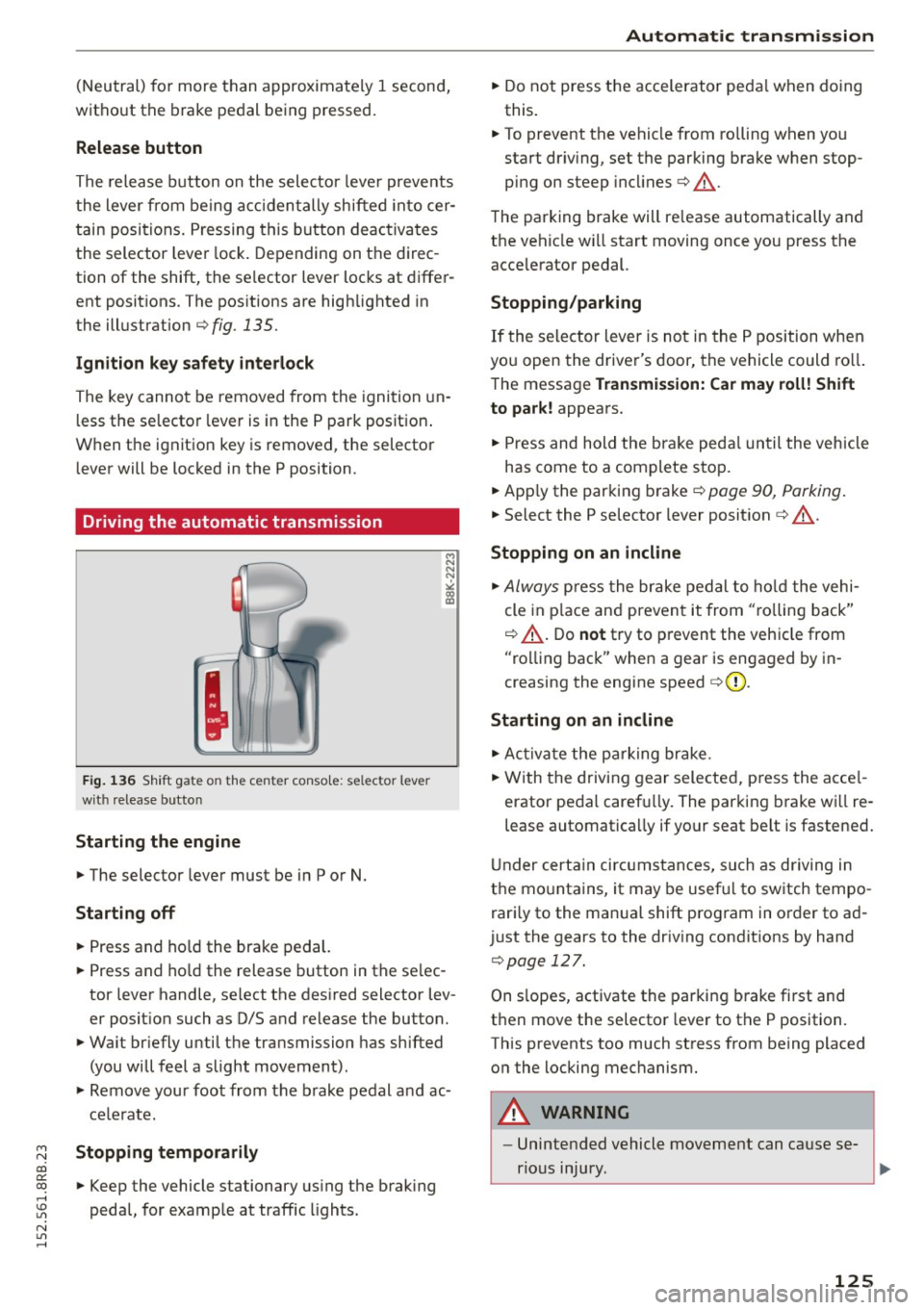
Driving the automatic transmission
Fig. 136 Shift gate on the center conso le: selector lever
with release button
Starting the engine
.,. The selector lever must be in P or N.
Starting off
.,. Press and hold the brake pedal.
.,. Press and ho ld the release button in the se lec
tor lever handle, select the desired selector lev
er position such as D/S and release the button.
.,. Wait br iefly until the transmission has shifted
(you will feel a slight movement).
.,. Remove your foot from the brake pedal and ac
celerate.
Stopping temporarily
.,. Keep the vehicle stationary using the brak ing
pedal, for example at traffic lights.
Automatic transmission
.,. Do not press the accelerator peda l when doing
this.
.,. To prevent the vehicle from rolling when you
start dr iv ing, set the parking brake when stop
ping on steep incl ines¢ &_.
The parking brake will re lease automatically and
the vehicle wi ll start moving once you press the
acce lerator pedal.
Stopping/parking
If the selector lever is not in the P position when
you open the driver's door, the vehicle could roll.
The message
Transmission: Car may roll! Shift
to park!
appears.
.,. Press and hold the brake pedal until the vehicle
has come to a complete stop.
.,. App ly the parking brake¢
page 90, Parking .
.,. Select the P se lector lever position ¢ &_ .
Stopping on an incline
.,. Always press the brake pedal to hold the vehi
cle in place and prevent it from "ro lling back"
¢ &_ . Do
not try to prevent the vehicle from
"rolling back" when a gear is engaged by in
creasing the engine speed
c> (D .
Starting on an incline
.,. Activate the parking brake .
.,. With the driving gear selected, press the acce l
erator pedal carefu lly. The parking brake wi ll re
lease automatically if your seat belt is fastened.
Under certain circumstances, such as driving in
the mountains, it may be usefu l to switch tempo
rari ly to the manual shift program in order to ad
just the gears to the driving conditions by hand
¢page 127 .
On s lopes, activate the parking brake first and
then move the selector lever to the P position .
This prevents too much stress from being placed on the locking mechanism .
A WARNING ,_
-Unintended vehicle movement can cause se-
rious injury.
~
125
Page 128 of 302
Automatic transmission
-Never leave your vehicle with the engine
running while in gear. If you must leave your
vehicle when the engine is running, activate
the parking brake and move the selector lev er to P.
- Power is still transmitted to the wheels
when the engine is running at idle. To pre
vent the vehicle from "creeping", you must keep your foot on the brake when the engine
is running and the selector lever is in D/S or
R or "tiptronic" mode is selected.
- Do not press the accelerator pedal when
changing the selector lever position while
the vehicle is stationary and the engine is
running.
- Never shift into R or P while driving.
- Before driving down a steep slope, reduce
your speed and shift into a lower gear with
"tiptronic".
- Do not ride the brakes or press the brake
pedal too often or too long when driving
down a hill. Constant braking causes the
brakes to overheat and substantially re
duces braking performance, increases brak
ing distance or causes complete failure of
the brake system.
- To prevent the vehicle from rolling back
when stopping on inclines, always hold it in
place with the brake pedal or parking brake.
- Never hold the vehicle on an incline with a
slipping clutch. The clutch opens automati
cally when it becomes too hot from the
overload. An indicator lamp[!] illuminates
and a driver message appears
<=> page 127
when the clutch is overloaded .
-If the engine must remain running, never
have any driving position engaged when
checking under the hood. Make sure these
lector lever has securely engaged and is
locked in P with the parking brake set
<=>page 221. Otherwise, any increase in en
gine speed may set the vehicle in motion,
even with the parking brake applied.
0 Note
- When stopping on an incline, do not try to
hold the vehicle in place by pressing the ac
celerator pedal while a driving gear is se-
126
lected. This can cause the transmission to
overheat and can damage it. Activate the
parking brake or press the brake pedal to
prevent the vehicle from rolling.
- Allowing the vehicle to roll when the engine
is stopped and the selector lever is in N will
damage the transmission because it is not
lubricated under those circumstances.
{!) Tips
For safety reasons, the parking brake is re
leased automatically only when the driver's
safety belt is engaged in the buckle.
Hill descent control
The hill descent control system assists the driver
when driving down declines.
Hill descent control is activated when the selec
tor lever is in D/S and you press the brake pedal.
The transmission automatically selects a gear
that is suitable for the incline. Hill descent con
trol tries to maintain the speed achieved at the
time of braking, within physical and technical limitations.
It may still be necessary to adjust the
speed with the brakes.
Hill descent control switches off once the decline
levels out or you press the accelerator pedal.
When the speed is set in the cruise control sys
tem <=>
page 95, hill descent control is also acti
vated .
A WARNING
Hill descent control cannot overcome physical
limitations, so it may not be able to maintain
a constant speed under all conditions. Always
be ready to apply the brakes.
Page 129 of 302
M N
co ~ co
rl I.O
"' N
"' rl
Manual shift program
Using the manual shift program you can man
ually select gears.
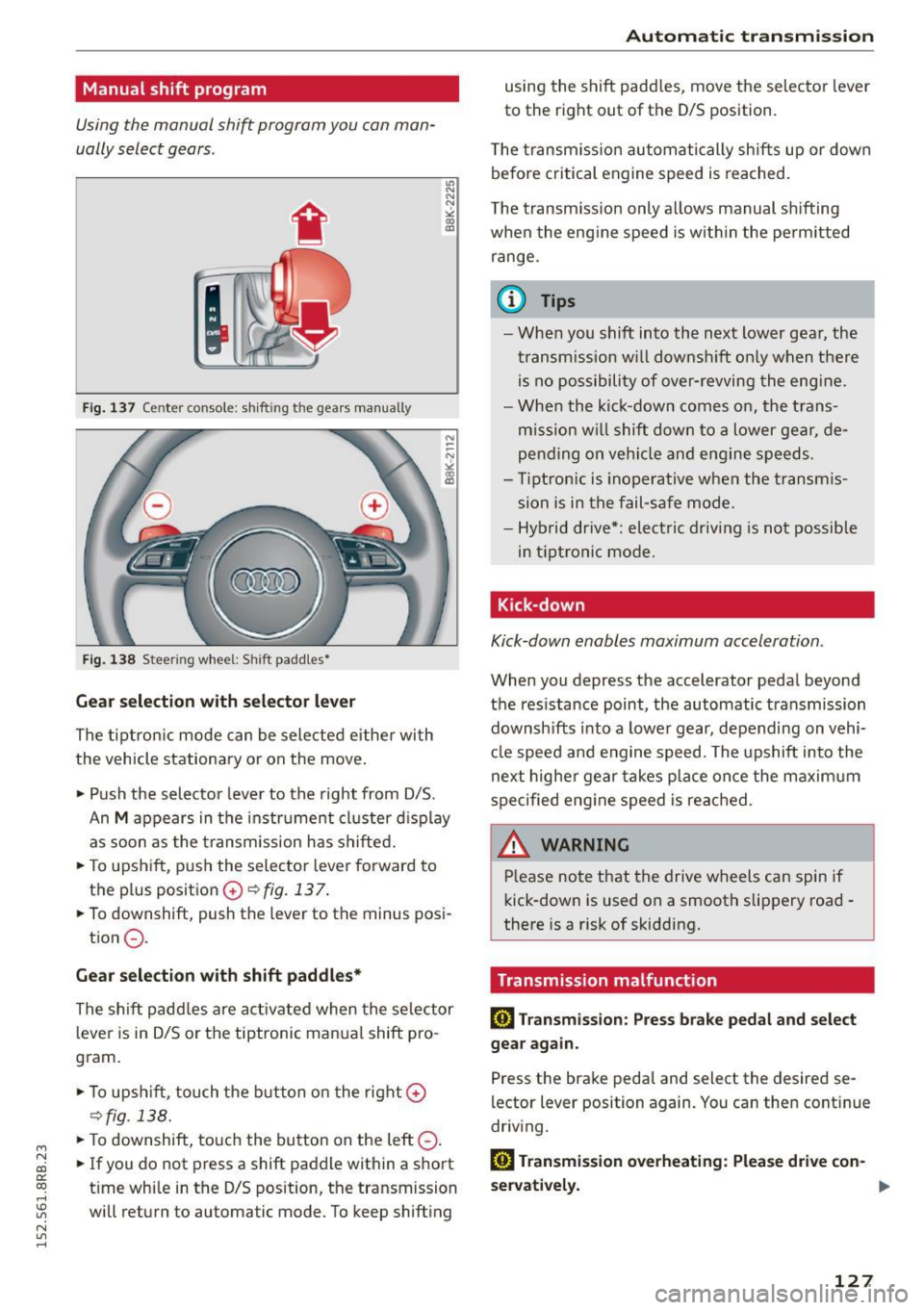
Fig. 137 Center console: shift ing t he g ears manually
Fig. 138 Stee ring whee l: Shi ft paddles•
Gear selection with selector lever
The tiptronic mode can be selected either with
the vehicle stationary or on the move.
• Push the selector lever to the right from D/S.
"' N N N :,:,
18
An M appears in the instrument cluster display
as soon as the transm ission has shifted.
• To upshift, push the selector lever forward to
the plus position
0 ~fig. 137.
• To downshift, push the lever to the minus posi-
tion
0 .
Gear selection with shift paddles*
The shift paddles are activated when the selector
lever is in D/S or the tiptronic manual shift pro
gram.
• To upshift , touch the button on the right
0
~fig. 138.
• To downshift, touch the button on the left 0-
• If you do not press a shift paddle within a short
t ime whi le in the D/S position, the transmission
will return to automatic mode. To keep shifting
Automatic transmission
using the shift padd les, move the selector lever
to the right out of the D/S position.
T he transmission automatically shifts up or dow n
before critical engine speed is reached.
T he transmission only allows manual shifting
when the engine speed is withi n the permitted
range.
@ Tips
- When you shift into the next lower gear, the
transmission will downshift only when there
is no possibility of over-revving the engine.
- When the kick-down comes on, the trans
mission will shift down to a lower gear, de
pending on vehicle and engine speeds.
- Tiptronic is ino perative when the transmis
sion is in the fail-safe mode .
- Hybrid drive*: electric d riving is not possible
in tiptronic mode.
Kick-down
Kick-down enables maximum acceleration .
When you depress the accelerator pedal beyond
the resistance point, the automatic transmission
downsh ifts into a lower gear, depending on vehi
cle speed and engine speed . The upshift into the
next higher gear takes pla ce once the maximum
specified eng ine speed is reached .
A WARNING
-Please note that the drive wheels can spin if
kick-down is used on a smooth slippery road -
there is a risk of skidding.
Transmission malfunction
rm Transmission: Press brake pedal and select
gear again.
Press the brake pedal and select the desired se
lector lever position again. You can then cont inue
driving .
rm Transmission overheating: Please drive con-
servatively. ..,.
127
Page 130 of 302
Automatic transmission
The transmission temperature has increased sig
nificant ly due to the sporty driving man ner. Drive
in a less sporty manner unti l the temperature re
turns to the normal range and the indicato r light
sw itches of.
[§J Transmi ssion malfunction: You can continue
driving
There is a sys tem ma lf u nction in the tr ansmis
sion . You may continue driving. Drive to your au
thorized A udi dealer or qualified repair facility
soon to have the malf unct io n corrected.
[§J Transmi ssion malfunction: Limited driving
functionality
T here is a sys tem ma lf u nction in the transmis
si on . The tr ansmis sion is sw itch ing t o emergen cy
mode. This mode only shi fts in to cert ain gears o r
will no longer shift a t all. The engine may s tall.
Drive to yo ur aut ho rized Audi dea le r o r qu alified
repair facility immediately to have the ma lf u nc
tion corrected.
[§J Transmission malfunction: Stop vehicle and
shift to park .
Do not contin ue dr ivi ng. Sele ct the P se lec tor lev
e r p osition and see yo ur auth o rize d Aud i de aler
or qualified repair fac ility for assistance .
(D Note
If the tra n sm ission switc hes to e mergency
mo de, you sho uld take the vehicle to an au
t horized A udi d ealershi p as soo n as poss ible
to have the co ndition corrected .
128
Selector lever emergency release
If the vehicle's power supply fails, the selector
lever can be released in an emergency .
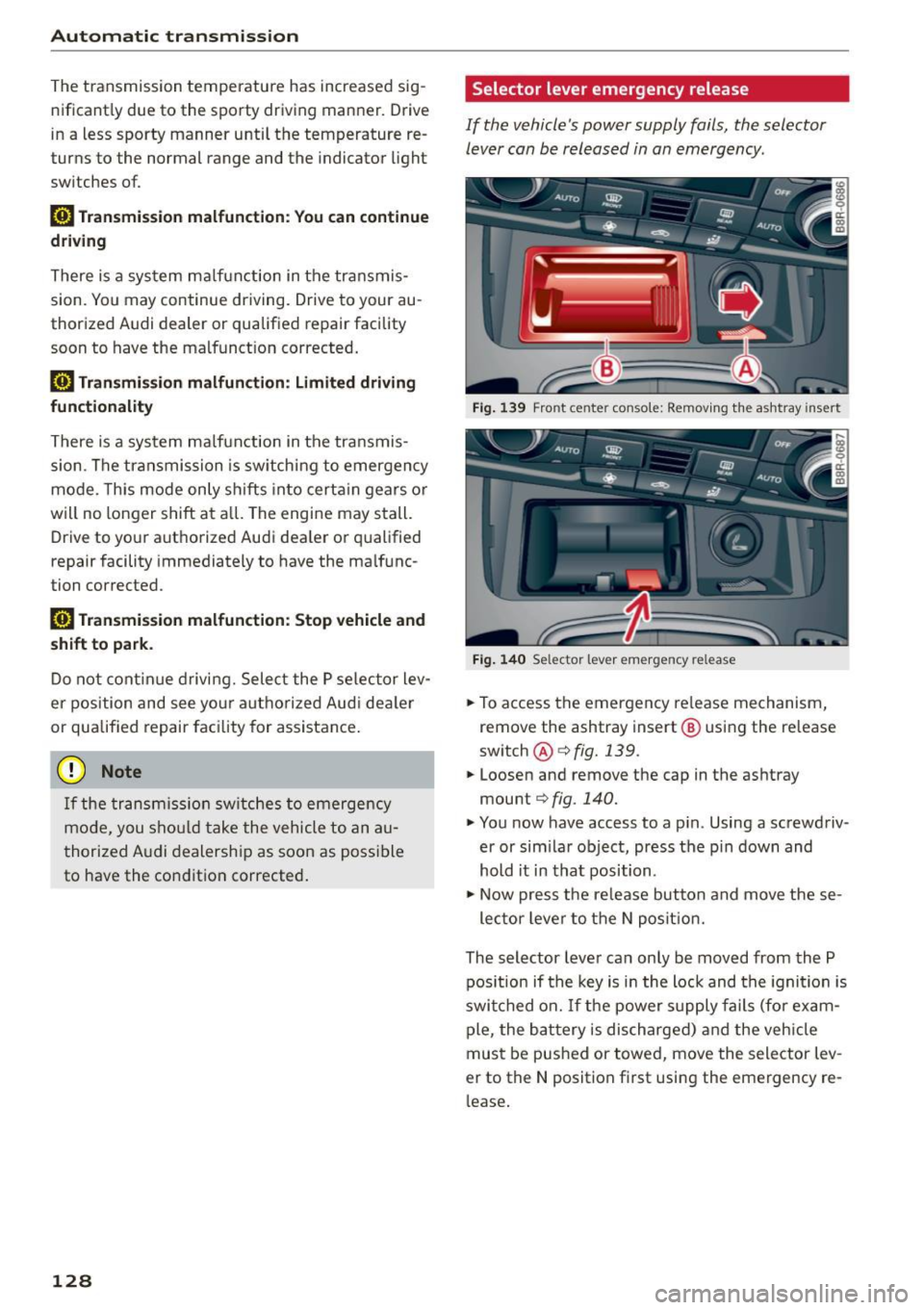
Fig. 139 Fro nt ce nte r co nsole: R emov ing t he ashtray insert
Fig. 140 Selector lev er em erg en cy re le ase
.. To access the emergency re lease mechanism,
remove the ashtray insert @ using the re lease
switch @<:::?
fig. 139 .
.. Loosen and remove the cap in the ashtray
mount
c::? fig. 140.
.. You now have access to a p in . Using a sc rewdriv
er or sim ilar o bject, press the p in down and
hold it in that position .
.. Now press t he re lease but to n and move these-
le cto r leve r to t he N posit ion.
The selector leve r ca n only be mov ed from the P
pos it ion if the key is in the lock and the igni tion is
swi tched on. If th e power supp ly fails (fo r ex am
ple, the bat tery is dis ch arge d) and the veh icle
mus t be pushed or towe d, move the selector lev
er to the N position f irst using the emergency re
l ease .
Page 224 of 302
Checking and Filling
-Always let the engine cool down. Hot com
ponents will burn skin on contact .
- To reduce the risk of being burned, never
open the hood if you see or hear steam or
coolant escaping from the engine compart
ment . Wait until no steam or coolant can be
seen or heard before carefully opening the
hood.
- Keep children away from the engine com
partment .
- Never spill fluids on hot engine compo
nents . They can cause a fire .
- Never touch the radiator fan. The auxiliary
electric fan is temperature controlled and
can switch on suddenly.
- Never open the coolant reservoir cap when
the engine is still warm. The coolant system
is pressurized and hot coolant could spray
out .
- Protect your face, hands and arm from steam or hot engine coolant by placing a
thick rag over the cap when you open the coolant reservoir .
- Do not remove the engine cover under any
circumstances. This increases the risk of
burns.
- If work on the fuel system or the electrical
system is necessary :
- Always disconnect the battery.
- Never smoke or work near heaters or open
flames . Fluids in the engine compartment
could start a fire.
- Keep an approved fire extinguisher imme
diately available.
- To avoid electrical shock and personal injury
while the engine is running or being started, never touch:
- Ignition cables
- Other components of the high voltage
electronic ignition system.
- If you must perform a check or repair with
the engine running:
- First, fully apply the parking brake , move
selector lever of automatic transmission
to P (Park).
222
- Always use extreme caution to prevent
clothing, jewelry, or long hair from getting
caught in the radiator fan, V-belts or other
moving parts, or from contacting hot
parts . Tie back hair before starting, and do
not wear clothing that will hang or droop
into the engine.
- Minimize exposure to emission and chemi
cal hazards
~ ,&. .
&, WARNING
California Proposition 65 Warning:
- Engine exhaust , some of its constituents,
and certain vehicle components contain or
emit chemicals known to the State of Cali
fornia to cause cancer and birth defects and
reproductive harm. In addition, certain flu
ids contained in vehicles and certain prod
ucts of component wear contain or emit
chemicals known to the State of California
to cause cancer and birth defects or other
reproductive harm.
- Battery posts, terminals and related acces sories contain lead and lead compounds,
chemicals known to the State of California
to cause cancer and reproductive harms .
Wash hands after handling .
('.!) Note
When adding fluids, always make sure that
they are poured into the proper container or
filler opening, otherwise serious damage to
vehicle systems will occur.
@ For the sake of the environment
To detect leaks in time, inspect the vehicle
floor pan from underneath regularly. If you
see spots from oil or other vehicle fluids, have
your vehicle inspected by an authorized Audi dealer.
Page 273 of 302
M N
co
a:
co
,...., \!) 1.1"1
N 1.1"1 ,....,
Emergency situations
General
This chapter is intended for trained emergency
crews and working personnel who have the nec
essary tools and equipment to perform these
operations.
Starting by pushing or
towing
(D Note
Vehicles with an automatic transmission
cannot be started by pushing or towing.
Starting with jumper
cables
If necessary, the engine can be started by con
necting it to the battery of another vehicle.
If the engine should fail to start because of a dis
charged or weak battery, the battery can be con
nected to the battery of
another vehicle, using a
pair of jumper cables to start the engine .
Jumper cables
Use only jumper cables of sufficiently large cross
section
to carry the starter current safely. Refer
to the manufacturer's specifications.
Use only jumper cables with
insulated terminal
clamps which are distinctly marked:
plus(+) cable in most cases colored red
minus(-) cable
in most cases colored black.
A WARNING
Batteries contain electricity, acid, and gas.
Any of these can cause very serious or fatal in
jury . Follow the instructions below for safe
handling of your vehicle's battery.
-Always shield your eyes and avoid leaning
over the battery whenever possible.
-A discharged battery can freeze at tempera
tures just below 32 °F (0 °C). Before con
necting a jumper cable, you must thaw the
Emergency situations
frozen battery completely, otherwise it
could explode.
- Do not allow battery acid to contact eyes or
skin. Flush any contacted area with water immediately.
- Improper use of a booster battery to start a
vehicle may cause an explosion.
- Vehicle batteries generate explosive gases.
Keep sparks, flame and lighted cigarettes
away from batteries.
- Do not try to jump start any vehicle with a
low acid level in the battery.
- The voltage of the booster battery must al
so have a 12-Volt rating. The capacity (Ah)
of the booster battery should not be lower
than that of the discharged battery. Use of
batteries of different voltage or substantial
ly different" Ah" rating may cause an explo
sion and personal injury.
- Never charge a frozen battery. Gas trapped
in the ice may cause an explosion.
- Never charge or use a battery that has been
frozen. The battery case may have be weak
ened ,
- Use of batteries of different voltage or sub stantially different capacity (Ah) rating may
cause an explosion and injury. The capacity
(Ah) of the booster battery should not be
lower than that of the discharged battery.
- Before you check anything in the engine
compartment, always read and heed all
WARNINGS
q page 221.
(D Note
-Applying a higher voltage booster battery
will cause expensive damage to sensitive
electronic components, such as control
units, relays, radio, etc.
- There must be no electrical contact between
the vehicles as otherwise current could al
ready start to flow as soon as the positive
(+) terminals are connected.
(D Tips
- The discharged battery must be properly
connected to the vehicle's electrical system. .,..
271
Page 274 of 302
Emergency situation s
When jump starting or charging the battery,
never connect the negative ground cable to
the battery negative post because the bat
tery manager system must be able to detect
the battery's state of charge. Always con nect the negative ground cable to the nega
tive ground post of the battery manager
control un it.
Use of jumper cables
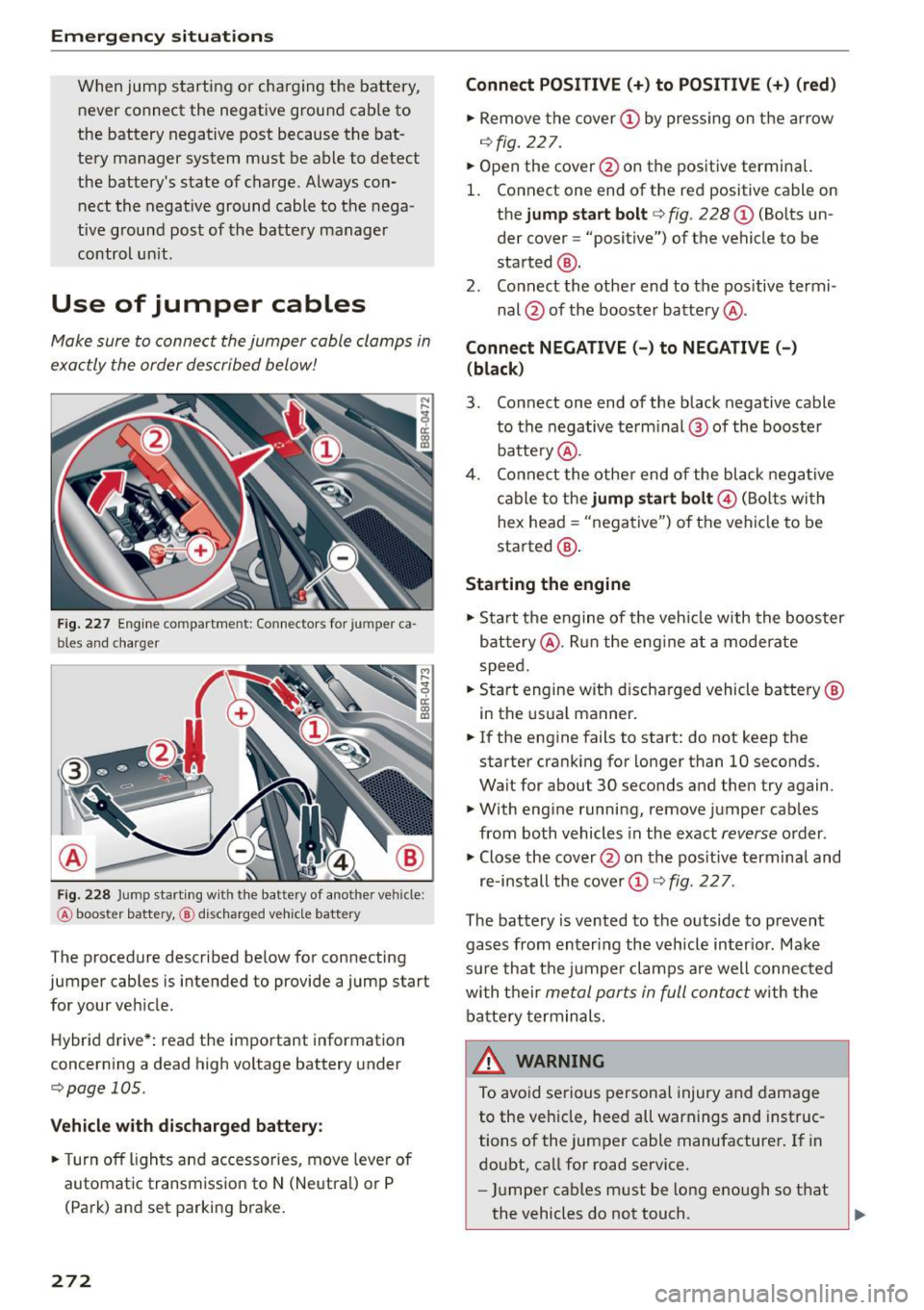
Make sure to connect the jumper cable clamps in
exactly the order described below!
Fig. 227 Engine co mpar tment : Connectors for ju mp er ca
bl es and charger
Fig. 228 Jum p starting wi th the battery of anot her ve hicl e:
@ booste r batte ry ,@ discharged vehicle battery
The procedure described be low for connecting
jumper cables is intended to provide a jump start for your vehicle.
Hybrid drive*: read the important information
concerning a dead high voltage battery under
c;,page 105.
Vehicle with discharged battery:
• Turn off lights and accessories, move lever of
automatic transmission to N (Neutral) or P
(Park) and set parking brake.
272
Connect POSITIVE(+) to POSITIVE (+) (red)
• Remove the cover (!) by pressing on the arrow
¢fig. 227.
• Open the cover @on the positive terminal.
1. Connect one end of the red positive cable on
the
jump start bolt c::> fig. 228 @ (Bolts un
der cover = "positive") of the vehicle to be
started @.
2 . Connect the other end to the positive termi-
nal @ of the booster battery @.
Connect NEGATIVE (-) to NEGATIVE (-)
(black)
3 . Connect one end of the black negative cable
to the negative terminal @ of the booster
battery @.
4. Connect the other end of the black negative
cable to the
jump start bolt © (Bolts with
hex head= "negative") of the vehicle to be
started @.
Starting the engine
• Start the engine of the vehicle with the booster
battery @. Run the eng ine at a moderate
speed.
• Start engine with discharged vehicle battery @
in the usual manner.
• lfthe engine fails to start: do not keep the
starter cranking for longer than 10 seconds.
Wait for about 30 seconds and then try again.
• With engine running, remove jumper cables
from both vehicles in the exact
reverse order .
• Close the cover @on the positive terminal and
re-install the cover@¢
fig. 22 7.
The battery is vented to the outside to prevent
gases from entering the vehicle interior . Make
sure that the jumper clamps are well connected
with their
metal parts in full contact with the
batte ry terminals.
& WARNING
To avoid serious personal injury and damage
to the veh icle, heed all warnings and instruc
tions of the jumper cable manufacturer. If in
doubt, call for road service.
- Jumper cables must be long enough so that
the vehicles do not touch. ..,.
Page 284 of 302
Consumer information
today's automobiles, have steadily reduced the
scope of maintenance and repairs which can be
carried out by vehicle owners.
Also, safety and
environmental
concerns place very strict limits
on the nature of repairs and adjustments to en
gine and transmission parts which an owner can perform .
Maintenance, adjustments and repairs usually re
quire special tools , testing devices and other
equipment available to specially trained work
shop personnel in order to assure proper per
formance, reliability and safety of the vehicle and its many systems.
Improper maintenance, adjustments and repairs
can impair the operation and reliability of your
vehicle and even
void your vehicle warranty .
Therefore, proof of servicing in accordance with
the maintenance schedule may be a condition for
upholding a possible warranty claim made within
the warranty period .
Above all, operational safety can be adversely af
fected, creating unnecessary risks for you and
your passengers.
If in doubt about any servicing, have it done by
your authorized Audi dealer or any other properly equipped and qualified workshop. We strongly
urge you to give your authorized Audi dealer the
opportunity to perform all scheduled mainte nance and necessary repairs. Your dealer has the
facilities, original parts and trained specialists to keep your vehicle running properly.
Performing limited maintenance yourself
The following pages describe a limited number of
procedures which can be performed on your vehi
cle with ordinary tools, should the need arise and
trained personnel be unavailable. Before per
forming any of these procedures, always thor
oughly read all of the applicable text and carefully follow the instructions given . Always rigorously
observe the
WARNINGS provided.
Before you check anything in the engine com
partment, always read and heed all WARNINGS
c::> & and c::> & in Working in the engine compart
ment on page 221 .
282
A WARNING
-
-Serious personal injury may occur as a result
of improperly performed maintenance, ad
justments or repairs.
- Always be extremely careful when working
on the vehicle . Always follow commonly ac
cepted safety pract ices and general com
mon sense. Never risk personal injury.
- Do not attempt any of the maintenance,
checks or repairs described on the following
pages if you are not fully familiar with these
or other procedures with respect to the vehi
cle, or are uncertain how to proceed.
- Do not do any work without the proper tools
and equipment. Have the necessary work
done by your authorized Audi dealer or an
other properly equipped and qualified work
shop.
- The engine compartment of any motor vehi cle is a potentially hazardous area. Never
reach into the area around or touch the radi
ator fan. It is temperature controlled and
can switch on suddenly - even when the en
gine is off and the ignition key has been re
moved. The radiator fan switches on auto
mat ically when the coolant reaches a certain
temperature and will continue to run until
the coolant temperature drops.
- Always remove the ignition key before any
one gets under the vehicle.
-Always support your vehicle with safety
stands if it is necessary to work underneath
the vehicle. The jack* supplied with the vehi
cle is not adequate for this purpose and
could collapse causing serious personal in
jury.
- If you must work underneath the vehicle
with the wheels on the ground, always make
sure the vehicle is on level ground, that the
wheels are always securely blocked and that
the engine cannot be started.
- Always make sure the transmission selector
lever (automatic transmission) is in P (Park
position) and the park brake is applied.
Page 288 of 302
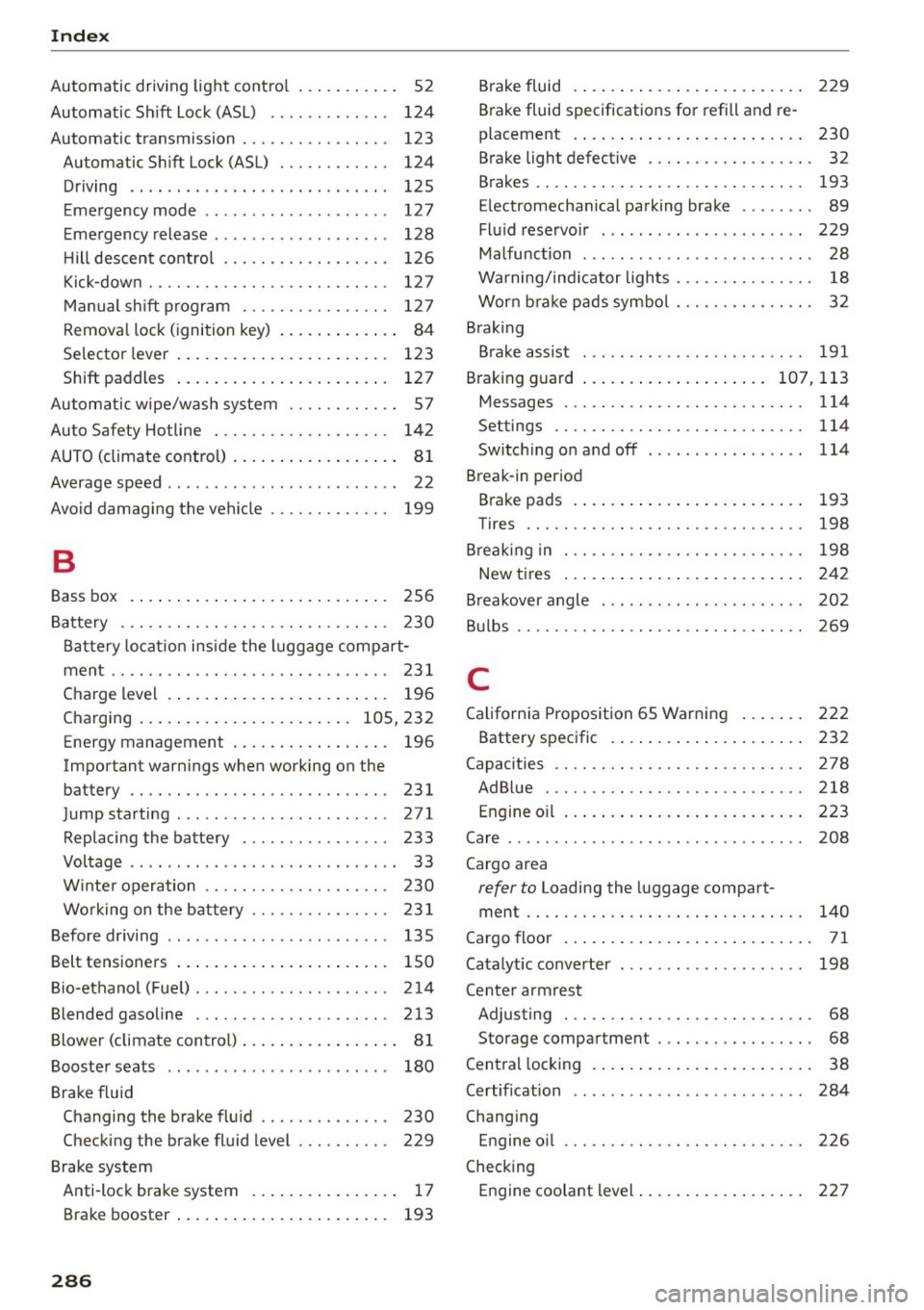
Index
Automatic driv ing light contro l . . . . . . . . . . . 52
Automatic Sh ift Lock (ASL) . . . . . . . . . . . . . 124
Automatic transmission . . . . . . . . . . . . . . . . 123
Automatic Shift Lock (ASL) . . . . . . . . . . . . 124
Driving ...... .................. ... . 125
Emergency mode . . . . . . . . . . . . . . . . . . . . 127
Emergency release . . . . . . . . . . . . . . . . . . . 128
H ill descent control . . . . . . . . . . . . . . . . . . 126
Kick -down . . . . . . . . . . . . . . . . . . . . . . . . . . 127
Manual sh ift program . . . . . . . . . . . . . . . . 127
Remova l lock (ignition key) . . . . . . . . . . . . . 84
Selector lever . . . . . . . . . . . . . . . . . . . . . . . 123
Shift paddles . . . . . . . . . . . . . . . . . . . . . . . 127
Automatic wipe/wash system . . . . . . . . . . . . 57
Auto Safety Hotline . . . . . . . . . . . . . . . . . . . 142
AUTO (climate control) . . . . . . . . . . . . . . . . . . 81
Average speed . . . . . . . . . . . . . . . . . . . . . . . . . 22
Avoid damaging the vehicle . . . . . . . . . . . . . 199
B
Bass box . . . . . . . . . . . . . . . . . . . . . . . . . . . . 256
Battery . . . . . . . . . . . . . . . . . . . . . . . . . . . . . 230
Battery locat ion inside the luggage compa rt-
ment .............................. 231
Charge level . . . . . . . . . . . . . . . . . . . . . . . . 196
Charging . . . . . . . . . . . . . . . . . . . . . . . 105, 232
Energy management . . . . . . . . . . . . . . . . . 196
Important warnings when working on the
battery . . . . . . . . . . . . . . . . . . . . . . . . . . . . 231
Jump starting . . . . . . . . . . . . . . . . . . . . . . . 271
Replacing the battery . . . . . . . . . . . . . . . . 233
Voltage . . . . . . . . . . . . . . . . . . . . . . . . . . . . . 33
W inte r operation . . . . . . . . . . . . . . . . . . . . 230
Working on the battery . . . . . . . . . . . . . . . 231
Before driving . . . . . . . . . . . . . . . . . . . . . . . . 135
Belt tensioners . . . . . . . . . . . . . . . . . . . . . . . 150
B io-ethanol (Fue l) . . . . . . . . . . . . . . . . . . . . . 214
Blended gasoline . . . . . . . . . . . . . . . . . . . . . 213
Blower (climate control) . . . . . . . . . . . . . . . . . 81
Booster seats . . . . . . . . . . . . . . . . . . . . . . . . 180
Brake fl uid
Changing the brake flu id . . . . . . . . . . . . . . 230
Checking the brake fluid level . . . . . . . . . . 229
Brake system Anti-lock brake system . . . . . . . . . . . . . . . . 17
Brake booster . . . . . . . . . . . . . . . . . . . . . . . 193
286
Brake fluid . . . . . . . . . . . . . . . . . . . . . . . . . 229
Brake fluid specifications for refill and re
placement . . . . . . . . . . . . . . . . . . . . . . . . . 230
Brake light defective . . . . . . . . . . . . . . . . . . 32
Brakes . . . . . . . . . . . . . . . . . . . . . . . . . . . . . 193
E lectromechanical parking brake . . . . . . . . 89
Fluid reservo ir . . . . . . . . . . . . . . . . . . . . . . 229
Malfunction . . . . . . . . . . . . . . . . . . . . . . . . . 28
Wa rning/indicator lights . . . . . . . . . . . . . . . 18
Worn b ra ke pads symbo l . . . . . . . . . . . . . . . 32
Brak ing
Brake assist . . . . . . . . . . . . . . . . . . . . . . . . 191
Braking guard ..... .. .. ... . .... ... 107, 113
Messages . . . . . . . . . . . . . . . . . . . . . . . . . . 114
Settings . . . . . . . . . . . . . . . . . . . . . . . . . . . 114
Switching on and
off . . . . . . . . . . . . . . . . . 114
Break-in period Brake pads . . . . . . . . . . . . . . . . . . . . . . . . . 193
Tires . . . . . . . . . . . . . . . . . . . . . . . . . . . . . . 198
B reak ing in . . . . . . . . . . . . . . . . . . . . . . . . . . 198
New tires . . . . . . . . . . . . . . . . . . . . . . . . . . 242
B reakover angle . . . . . . . . . . . . . . . . . . . . . . 202
Bul bs . . . . . . . . . . . . . . . . . . . . . . . . . . . . . . . 269
C
Californ ia Proposition 65 Warning . . . . . . . 222
Battery specific . . . . . . . . . . . . . . . . . . . . . 232
Capacities . . . . . . . . . . . . . . . . . . . . . . . . . . . 278
AdBlue ... .. .... .. .. .. ........... .. 218
Engine oi l . . . . . . . . . . . . . . . . . . . . . . . . . . 223
Care . . . . . . . . . . . . . . . . . . . . . . . . . . . . . . . . 208
Cargo area
refer to Loading the l uggage compart-
ment..... .. .... .. .. .. ........... .. 140
Cargo floor . . . . . . . . . . . . . . . . . . . . . . . . . . . 71
Catalytic converter . . . . . . . . . . . . . . . . . . . . 198
Center armrest
Adjusting . . . . . . . . . . . . . . . . . . . . . . . . . . . 68
Storage compar tment . . . . . . . . . . . . . . . . . 68
Central locking . . . . . . . . . . . . . . . . . . . . . . . . 38
Certification . . . . . . . . . . . . . . . . . . . . . . . . . 284
Chang ing
Engine oil . . . . . . . . . . . . . . . . . . . . . . . . . . 226
Checking Engine coolant level . . . . . . . . . . . . . . . . . . 227
Page 295 of 302
M N
co
a:
co
,...., \!) 1.1'1
N 1.1'1 ,....,
Panoramic sliding sunroof
Convenience opening/closing . . . . . . . . . . . 47
Emergency closing . . . . . . . . . . . . . . . . . . . . 48
Opening and closing . . . . . . . . . . . . . . . . . . 47
Parking . . . . . . . . . . . . . . . . . . . . . . . . . . . . . . 90
Automatic transmission . . . . . . . . . . . . . . 125
Parking aid
C leaning sensors/camera . . . . . . . . . . . . . 209
Parking brake . . . . . . . . . . . . . . . . . . . . . . . . . 89
also refer to Elec tromechanical
parking brake . . . . . . . . . . . . . . . . . . . . . . . . 89
Parking system
refer to Audi parking system plus with rear
view camera . . . . . . . . . . . . . . . . . . . . . . . . 129
Particle filter
refer to Diesel particulate filter . . . . . . . . . 34
Parts replacement . . . . . . . . . . . . . . . . . . . . 283
PASSENGER AIR BAG OFF light . . . . . . . . . . 162
Pedals . . . . . . . . . . . . . . . . . . . . . . . . . . . . . . 139
Physical princ iples of a frontal collision . . . 145
Polishing .... .. .............. ... .... . 210
Pollen filter
refer to Pollutant filter (cl imate control) . . 80
Pollutant filter (climate control) . . . . . . . . . . 80
Power Windows .. .. .............. ... .... .. 46
Power locking system Emergency locking . . . . . . . . . . . . . . . . . . . . 42
L ocking and unlocking the vehicle from in-
side . . . . . . . . . . . . . . . . . . . . . . . . . . . . . . . . 42
Rear lid/trunk lid . . . . . . . . . . . . . . . . . . . . . 43
Selective unlock feature . . . . . . . . . . . . . . . 39
Settings . . . . . . . . . . . . . . . . . . . . . . . . . . . . 39
Switch. .. .. .... ... .. ... ... .. .. .. .... 42
Unlocking and locking vehicle . . . . . . . . . . . 40
Power locks
Windows open and closed . . . . . . . . . . . . . . 4 7
Power meter (hybrid dr ive) . . . . . . . . . . . . . . 99
Power seat adjustment . . . . . . . . . . . . . . . . . 64
Power steering
refer to Electromechanical power assist . . 195
Power window regulators
Conven ience opening/closing . . . . . . . . . . . 47
Malfunctions . . . . . . . . . . . . . . . . . . . . . . . . 47
Pregnant women
Special considerations when wearing a safe-
ty belt . . . . . . . . . . . . . . . . . . . . . . . . . . . . . 149
Index
Pressure (tires) . . . . . . . . . . . . . . . . . . . . . . . 253
Proper safety belt position . . . . . . . . . . . . . . 148
Proper seating position Front passenger . . . . . . . . . . . . . . . . . . . . . 137
Occupants. . . . . . . . . . . . . . . . . . . . . . . . . . 136
Rear passengers . . . . . . . . . . . . . . . . . . . . . 138
Protecting . . . . . . . . . . . . . . . . . . . . . . . . . . . 210
Protective tray . . . . . . . . . . . . . . . . . . . . . . . . . 71
Q
quattro
refer to All-wheel drive
Question Wha t happens to unbelted occupants?
R
195
145
Radiator fan . . . . . . . . . . . . . . . . . . . . . . . . . 229
Rain sensor . . . . . . . . . . . . . . . . . . . . . . . . . . . 57
Defective . . . . . . . . . . . . . . . . . . . . . . . . . . . 32
Raising the vehicle . . . . . . . . . . . . . . . . . . . . 275
Reading lights . . . . . . . . . . . . . . . . . . . . . . . . . 55
Rear fog lights . . . . . . . . . . . . . . . . . . . . . . . . 53
Rear lid
Automatic operation . . . . . . . . . . . . . . . . . . 44
Open ing and closing . . . . . . . . . . . . . . . . . . 43
Rear light
Defective . . . . . . . . . . . . . . . . . . . . . . . . . . . 32
Rear seats
Adjusting seat . . . . . . . . . . . . . . . . . . . . . . . 66
Rearview camera Parking mode 1 . . . . . . . . . . . . . . . . . . . . . 132
Parking mode 2 . . . . . . . . . . . . . . . . . . . . . 133
Rear view mirror . . . . . . . . . . . . . . . . . . . . . . . 60
Rear window heating . . . . . . . . . . . . . . . . . . . 82
Recirculation mode (climate control) . . . . . . 81
Red symbols . . . . . . . . . . . . . . . . . . . . . . . . . . 28
Refill engine oi l . . . . . . . . . . . . . . . . . . . . . . . . 30
Refill ing AdBlue
With bottle .. .. .. ..... ........... ... 219
With canister . . . . . . . . . . . . . . . . . . . . . . . 220
Refuelling .. .... .. ............. .... .. 216
Gasoline inhibitor flap . . . . . . . . . . . . . . . . 216
Release lever for hood . . . . . . . . . . . . . . . . . 221
Remote control Garage door opener ( Home Link) . . . . . . . . . 48
293