height AUDI Q5 2015 User Guide
[x] Cancel search | Manufacturer: AUDI, Model Year: 2015, Model line: Q5, Model: AUDI Q5 2015Pages: 302, PDF Size: 75.01 MB
Page 238 of 302
Wheels
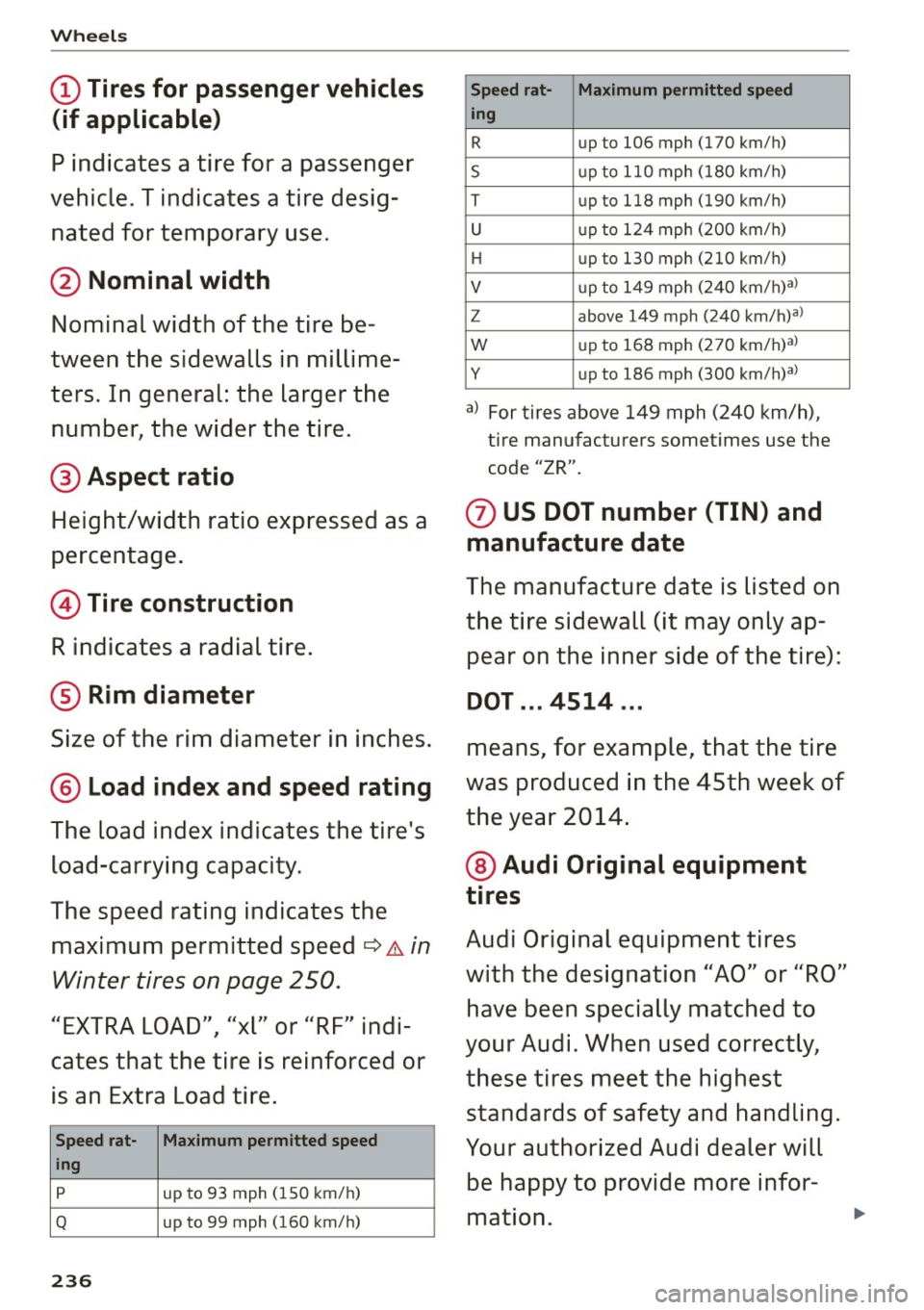
(D Tires for passenger vehicles
(if applicable)
P indicates a tire for a passenger
vehicle. T indicates a tire desig
nated for temporary use .
@ Nominal width
Nominal width of the tire be
tween the sidewalls in millime
ters . In general: the larger the
number, the wider the tire.
@ Aspect ratio
Height/width ratio expressed as a
percentage.
@ Tire construction
R indicates a radial tire.
® Rim diameter
Size of the rim diameter in inches .
@ Load index and speed rating
The load index indicates the tire's
load-carrying capacity.
The speed rating indicates the
maximum permitted speed
¢ & in
W inter tires on page 250 .
"EXTRA LOAD", "xl" or "RF" indi
cates that the tire is reinforced or
is an Extra Load tire.
Speed rat- Maximum permitted speed
ing
p
up to 93 mph (150 km/h)
Q up to 99 mph (160 km/h)
236
Speed rat- Maximum permitted speed
Ing
R up t o 106 mph (170 km/h)
s up to 110 mph (180 km/h)
T up to 118 mph (190 km/h)
u up to 124 mph (200 km/h)
H up to 130 mph (210 km/h)
V up to 149 mph (240 km/h)a>
z above 149 mph (240 km/h)a)
w up to 168 mph (270 km/h)a)
y up to 186 mph (300 km/h)a)
a) For tires above 149 mph (240 km/h),
tire manufacturers sometimes use the
code "ZR".
(J) US DOT number (TIN) and
manufacture date
The manufacture date is listed on
the tire sidewall (it may only ap
pear on the inner side of the tire) :
DOT ... 4514 ...
means , for example, that the tire
was produced in the 45th week of
the year 2014.
@ Audi Original equipment
tires
Audi Original equipment tires
with the designation "AO" or "RO"
have been specially matched to
your Audi. When used correctly,
these tires meet the highest standards of safety and handling.
Your authorized Audi dealer will
be happy to provide more infor
mation.
Page 239 of 302
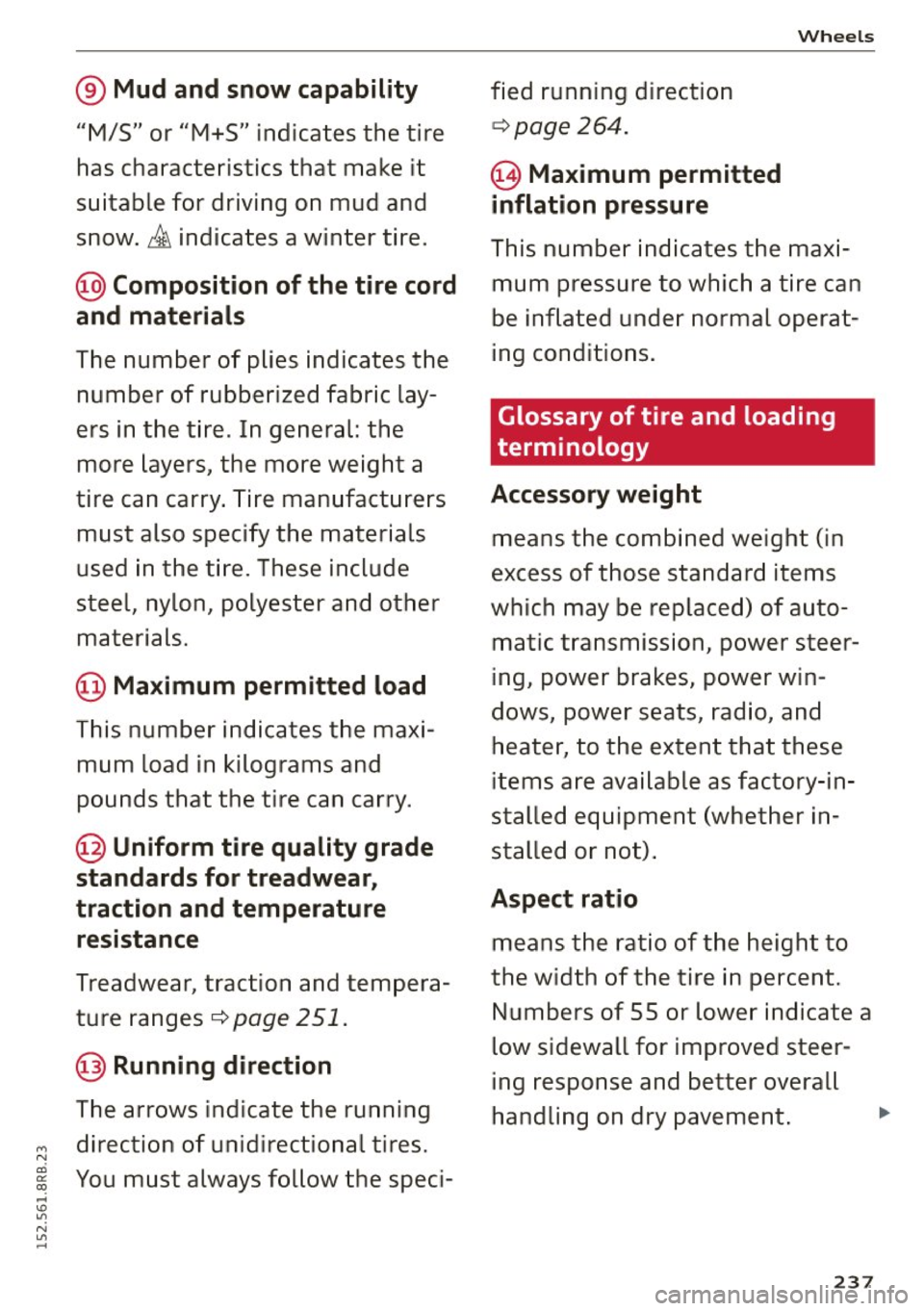
® Mud and snow capability
"M/S" or "M+S" indicates the tire
has characte ris tics that make it
suitable for driving on mud and snow .
& indica tes a winter tire.
@ Composition of the tire cord
and materials
T he number of plies indicates the
number of rubber ized fabric lay
ers in the tire . In general: the
more layers, the more weight a
tire can carry. Tire manufacturers
must also specify the mater ials
used in the ti re. These include
stee l, nylon, polyester and other
materials.
@ Maximum permitted load
This number indicates the maxi
mum load in kilograms and
pounds that the tire can carry .
@ Uniform tire quality grade
standards for treadwear,
traction and temperature resistance
Treadwear , traction and tempera
ture ranges
c::::> page 251 .
@Running direction
The arrows ind icate the running
direction of unidirect ional tires.
You must always follow the speci- fied running direction
c::::> page 264.
€3) Ma
ximum permitted
inflation pressure
Whe els
This number indicates the maxi
mum pressure to which a tire can
be inflated unde r normal operat
ing conditions .
Glossary of tire and loading
terminology
Accessory weight
means the combined weight (in
excess of those standard items
which may be replaced) of auto matic transmission, power steer
ing, power brakes, power win
dows, power seats, radio, and
heater, to the extent that these
items are available as factory-in
stalled equipment (whether in
stalled or not).
Aspect ratio
means the ratio of the height to
the width of the tire in percent. Numbers of 55 or lower indicate a
low s idewall for improved steer
ing response and better overall
handling on dry pavement . .,.
237
Page 253 of 302
M N
co
a:
co
,...., \!) 1.1'1
N 1.1'1 ,....,
& WARNING
Using incorrect snow chains or installing snow
chains incorrectly can result i n loss of vehicle
contro l, wh ich inc reases the r is k of an acci
dent.
(D Note
Snow chains can dama ge the r ims/wheel cov
ers * if t he chains come into d irect contact
w it h them . Remove the whee l covers * fir st .
Use coated snow chains.
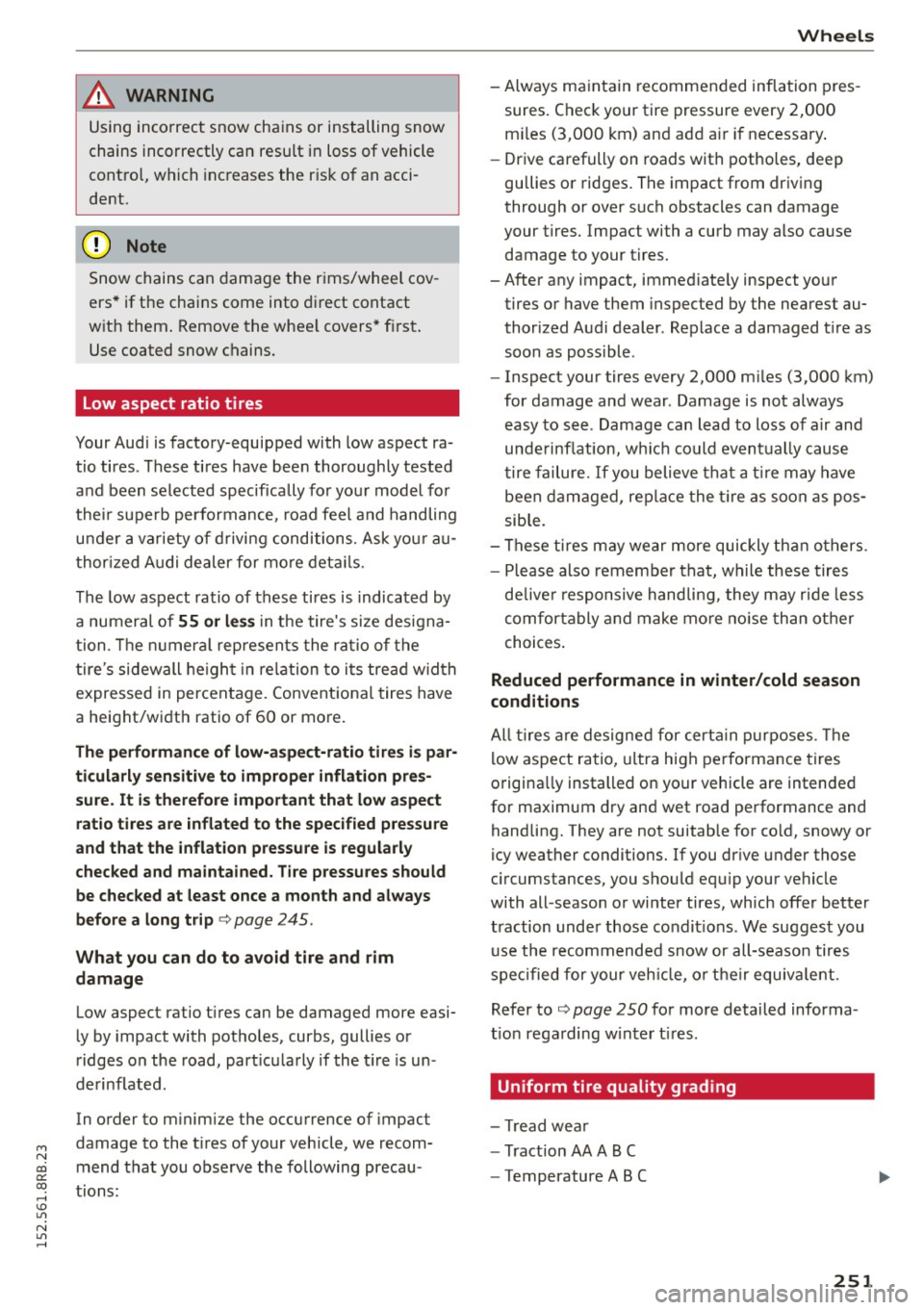
Low aspect ratio tires
Your Audi is factory-equipped with low aspect ra
tio tires . These tires have bee n thoroughly tested
and been selected specifically fo r yo ur model fo r
the ir supe rb pe rformance, road feel and handling
u nder a va riety o f drivi ng conditions. Ask yo ur au
thor ized Audi de aler for mo re det ail s.
The low aspect ratio of these tires is indica ted by
a numeral of
55 or less i n t he tire's si ze des igna
tion . Th e nu mera l represents the rat io of the
tire's sidewall he igh t in relation to i ts tre ad wid th
expressed in percentage. Convent iona l tires have
a height/wi dth ratio of 6 0 or mo re .
The performan ce of low-a spe ct-rati o tires i s par
ticularly sensitive to improper inflation pre s
sure . It is therefore important that low a spect
ratio tires are inflated to the specified p ressure
and that the inflation pressure is regularly
checked and maintained. Ti re pressures should
be checked at least once a month and always
before a long trip
c:> page 245.
What you can do to avoid tire and rim damage
Low aspect ratio t ires can be damaged more easi
ly by impact with potholes, curbs , gullies or
ridges on the road , par ticu la rly if the t ire is un
de rinflate d.
In order to m inim ize the occurrence of impact
damage to the t ires of your vehicle, we recom
mend that you observe the following precau
tions:
Wheels
- Always ma inta in recommended inflation pres
sures. Chec k your tire pressure every 2,000
m iles (3,000 km) and add a ir if necessa ry .
- Drive carefully on roads with potholes, deep
gu llies o r ridges. T he impact from dr iving
through or over such obstacles can damage
your tires. Impact with a curb may also cause damage to your tires.
-After any impact, immed iate ly inspect your
tires or have them inspected by the nearest au
thorized Audi dealer . Replace a damaged t ire as
soon as poss ible .
- Inspect your tires every 2,000 m iles (3,000 km)
for damage and wear. Damage is no t always
easy to see . Damage can lead to loss o f air and
un derinflation, wh ic h could even tually caus e
t ire failure. If you believe tha t a tir e may have
been dam age d, rep lace the t ire as soon as pos
sible.
- These ti res may wear more quickly tha n oth ers.
- Please also remember that, wh ile these tir es
delive r respo nsive handling, they may ride less
c omfortably and m ake mo re no ise th an ot her
choices .
Reduced performance in winter/cold season
conditions
All tires a re designe d for cer ta in p urpo ses. The
l ow as pect ra tio, ultra high pe rformance tires
o rigi na lly installed on your vehicle are intende d
for maximum d ry and wet road performance and
handling. They are not suitab le f or co ld, snowy or
icy weather conditions. If you dr ive under those
c ircumstances, you shou ld equ ip your vehicle
with all-season or winter tires, wh ich offe r better
t raction unde r those co ndit ions . We suggest you
u se the recommende d snow or all-season tires
spe cified for your veh icle, o r th eir equiva le nt.
Refer to
c:> page 250 for more detailed informa
t io n regarding w in te r tir es.
Uniform tire quality grading
- Tread wea r
- Traction AA A B C
- Temperature ABC
251
Page 280 of 302

Technical data
Gross Axle Weight Rating
The Gross Axle Weight Rating is the maximum
load that can be applied at each axle of the vehi
cle ¢& .
Vehicle capacity weight
The vehicle capacity we ight (max. load) is listed
on the driver's side 8 -p ill ar.
_& WARNING
- T he actual Gross Axle Weight Rating at the
front and rear axles should not exceed the
permissible weights, and their combination
must not exceed the Gross Vehicle Weight
Rating.
Dimensions
Length in (mm)
Width in (mm)
Width (across mirrors) in (mm)
Height (unloaded)al in (mm) -
Exceeding permissible weight ratings can
result in veh icle damage, acc idents and per
sonal injury.
(D Note
- The vehicle capacity weight figures apply
when the load is distributed evenly in the
vehicle (passengers and luggage). When
transporting a heavy load in the luggage
compartment, carry the load as near to the
rear axle as possible so that the vehicle's
hand ling is not impaired.
- Do not exceed the maximum permissible
axle loads or the maximum gross veh icle
we ight. Always remember that the vehicle's
hand ling will be affected by the extra load.
T herefore, adjust your speed accordingly.
- Always observe local regulations .
QS/QS hybrid SQS
182.6 (4639) 183 .0 (4647)
74.7 (1898) 75 .2 (1911)
82.2 (2089) 82 .2 (2089)
65 .2 (1655) 65.3 (1658)
al T h e he ight of t he ve hicl e depends on the tires and the su spens ion.
When driving up steep ramps, on rough roads,
over curbs, etc. it is important to remember that
some parts of your vehicle, such as spo ilers or ex- haust system components, may be close
to the
ground . Be careful not to damage them.
Capacities
QS/SQS QS hybrid
Fuel tank: total capacity gal (liters) approx. 19.8 (75) approx. 19.0 (72)
Windshield and headlight* quarts (liters) approx.
4.9 (4.6) approx. 4.9 (4.6)
washer fluid container
278