parking brake AUDI Q5 2015 User Guide
[x] Cancel search | Manufacturer: AUDI, Model Year: 2015, Model line: Q5, Model: AUDI Q5 2015Pages: 302, PDF Size: 75.01 MB
Page 128 of 302
Automatic transmission
-Never leave your vehicle with the engine
running while in gear. If you must leave your
vehicle when the engine is running, activate
the parking brake and move the selector lev er to P.
- Power is still transmitted to the wheels
when the engine is running at idle. To pre
vent the vehicle from "creeping", you must keep your foot on the brake when the engine
is running and the selector lever is in D/S or
R or "tiptronic" mode is selected.
- Do not press the accelerator pedal when
changing the selector lever position while
the vehicle is stationary and the engine is
running.
- Never shift into R or P while driving.
- Before driving down a steep slope, reduce
your speed and shift into a lower gear with
"tiptronic".
- Do not ride the brakes or press the brake
pedal too often or too long when driving
down a hill. Constant braking causes the
brakes to overheat and substantially re
duces braking performance, increases brak
ing distance or causes complete failure of
the brake system.
- To prevent the vehicle from rolling back
when stopping on inclines, always hold it in
place with the brake pedal or parking brake.
- Never hold the vehicle on an incline with a
slipping clutch. The clutch opens automati
cally when it becomes too hot from the
overload. An indicator lamp[!] illuminates
and a driver message appears
<=> page 127
when the clutch is overloaded .
-If the engine must remain running, never
have any driving position engaged when
checking under the hood. Make sure these
lector lever has securely engaged and is
locked in P with the parking brake set
<=>page 221. Otherwise, any increase in en
gine speed may set the vehicle in motion,
even with the parking brake applied.
0 Note
- When stopping on an incline, do not try to
hold the vehicle in place by pressing the ac
celerator pedal while a driving gear is se-
126
lected. This can cause the transmission to
overheat and can damage it. Activate the
parking brake or press the brake pedal to
prevent the vehicle from rolling.
- Allowing the vehicle to roll when the engine
is stopped and the selector lever is in N will
damage the transmission because it is not
lubricated under those circumstances.
{!) Tips
For safety reasons, the parking brake is re
leased automatically only when the driver's
safety belt is engaged in the buckle.
Hill descent control
The hill descent control system assists the driver
when driving down declines.
Hill descent control is activated when the selec
tor lever is in D/S and you press the brake pedal.
The transmission automatically selects a gear
that is suitable for the incline. Hill descent con
trol tries to maintain the speed achieved at the
time of braking, within physical and technical limitations.
It may still be necessary to adjust the
speed with the brakes.
Hill descent control switches off once the decline
levels out or you press the accelerator pedal.
When the speed is set in the cruise control sys
tem <=>
page 95, hill descent control is also acti
vated .
A WARNING
Hill descent control cannot overcome physical
limitations, so it may not be able to maintain
a constant speed under all conditions. Always
be ready to apply the brakes.
Page 209 of 302
M N
co
a:
co
,...., \!) 1.1'1
N 1.1'1 ,....,
Parking on a slope
Do not pork on a slope with a trailer. If it cannot
be avoided, do so only ofter doing the following:
When parking:
.. Apply the foot brake .
.. Have someone place chocks under both the ve
hicle and the trailer wheels .
.. With chocks in p lace, slowly re lease the brakes
unt il the w heel chocks absorb the load .
.. Turn the wheels towa rds the curb .
.. Apply the pa rking bra ke .
.. Move the selec tor lever to P .
When restarting after parking:
.. Apply the foot brake .
.. Start the eng ine .
.. Move the se lecto r lever to 0/5 .
.,. Re lease the par king b rake a nd slow ly pull ou t
and away from the whee l cho cks .
.. Stop and have someone re trieve the w heel
chocks .
(D Tips
If you move the selector lever of the a utomat
ic transmission to P before applying the par k
ing brake and before blocking the wheels, you
may have to use more force later to move the
lever out of the P position .
Trailer mode
207
Page 223 of 302
M N
Checking and Filling Hood
Releasing the engine hood
The engine hood is released from inside the vehi
cle .
Fig . 195 Drive r's side footwe ll: e ng ine hood re lease lever
"' Wi th the driver's door open, pu ll the leve r un
der the instrument panel in the direction of the
arrow
c::> fig . 195.
The hood pops up s light ly under spri ng press ure.
Opening the engine hood
Fig. 196 Relea se leve r un der the eng ine hood
Before opening the engine hood, make su re that
the w indshield wipers are flat aga inst the wind
shield. Otherwise, they could damage the paint
on the hood .
"' Pull up on the release under the hood
c:> fig . 196. This releases the catch.
"' Open the hood all the way
c::> A.
~ _&. WARNING
rl
:5: Hot engine coo lant can burn you.
N l/1 rl
Ch eck in g and Fillin g
-To reduce the risk of being burned, never
open the hood if you see or hear steam or
coolant escaping from the eng ine compart
ment. Wait until no steam or coolant can be
seen or heard before carefully opening the hood.
Closing the engine hood
"' Pull the hood down until the pressu re from the
struts is reduced.
"' Le t the hood
drop down and latch in p lace. Do
not try to push it shut;
it may fa il to engage
c::> A .
A WARNING
-
A hood that is not completely latched cou ld
fly up and block your view while driv ing.
-
- When you close the engine hood, check it to
make sure the safety catch has properly en
gaged . The hood should be flush with the
surrounding vehicle body parts .
- If you notice while driv ing that the hood is
not secured properly, stop at once and close
it .
Working in the engine compartment
Be especially careful whenever you work in the
engine compartment.
Wheneve r you must pe rfo rm an y wo rk in the
eng ine comp artment , for e xample chec king and
fi lling differen t fluids , ther e is a ri sk of i nju ry,
bu rn s and acci den ts. To p re ve nt pe rsonal injur y
al way s ob serve the follo wing WARN INGS . The
e ngi ne compartm ent of an y ve hicle is a haza rd
ou s area
~ ,&..
A WARNING
To help avoid injury, before you check any
thing under the hood:
- Turn off the eng ine.
- Remove the ignition key.
- Apply the parking brake.
-
- Move selector lever of automatic transmis-
sion to P (Park).
221
Page 224 of 302
Checking and Filling
-Always let the engine cool down. Hot com
ponents will burn skin on contact .
- To reduce the risk of being burned, never
open the hood if you see or hear steam or
coolant escaping from the engine compart
ment . Wait until no steam or coolant can be
seen or heard before carefully opening the
hood.
- Keep children away from the engine com
partment .
- Never spill fluids on hot engine compo
nents . They can cause a fire .
- Never touch the radiator fan. The auxiliary
electric fan is temperature controlled and
can switch on suddenly.
- Never open the coolant reservoir cap when
the engine is still warm. The coolant system
is pressurized and hot coolant could spray
out .
- Protect your face, hands and arm from steam or hot engine coolant by placing a
thick rag over the cap when you open the coolant reservoir .
- Do not remove the engine cover under any
circumstances. This increases the risk of
burns.
- If work on the fuel system or the electrical
system is necessary :
- Always disconnect the battery.
- Never smoke or work near heaters or open
flames . Fluids in the engine compartment
could start a fire.
- Keep an approved fire extinguisher imme
diately available.
- To avoid electrical shock and personal injury
while the engine is running or being started, never touch:
- Ignition cables
- Other components of the high voltage
electronic ignition system.
- If you must perform a check or repair with
the engine running:
- First, fully apply the parking brake , move
selector lever of automatic transmission
to P (Park).
222
- Always use extreme caution to prevent
clothing, jewelry, or long hair from getting
caught in the radiator fan, V-belts or other
moving parts, or from contacting hot
parts . Tie back hair before starting, and do
not wear clothing that will hang or droop
into the engine.
- Minimize exposure to emission and chemi
cal hazards
~ ,&. .
&, WARNING
California Proposition 65 Warning:
- Engine exhaust , some of its constituents,
and certain vehicle components contain or
emit chemicals known to the State of Cali
fornia to cause cancer and birth defects and
reproductive harm. In addition, certain flu
ids contained in vehicles and certain prod
ucts of component wear contain or emit
chemicals known to the State of California
to cause cancer and birth defects or other
reproductive harm.
- Battery posts, terminals and related acces sories contain lead and lead compounds,
chemicals known to the State of California
to cause cancer and reproductive harms .
Wash hands after handling .
('.!) Note
When adding fluids, always make sure that
they are poured into the proper container or
filler opening, otherwise serious damage to
vehicle systems will occur.
@ For the sake of the environment
To detect leaks in time, inspect the vehicle
floor pan from underneath regularly. If you
see spots from oil or other vehicle fluids, have
your vehicle inspected by an authorized Audi dealer.
Page 262 of 302
Emerg enc y ass is tance
CJ) Note
Special care is required if you are repairing the
tire on a steep incline.
@ Tips
- Do not operate the compressor for more
than 12 minutes continuously, otherwise it
can overheat . Once the compressor has
cooled, you can continue to use it.
- If sealant has spi lled out, let it dry and then
you can remove it by peeling it away like a
foil.
- Remember to obtain a new bottle of sea lant
from yo ur authorized Aud i dea ler after re
pairing a tire. After this, the functionality of
the tire repa ir set is restored.
- Obey all laws.
Replacing wheels
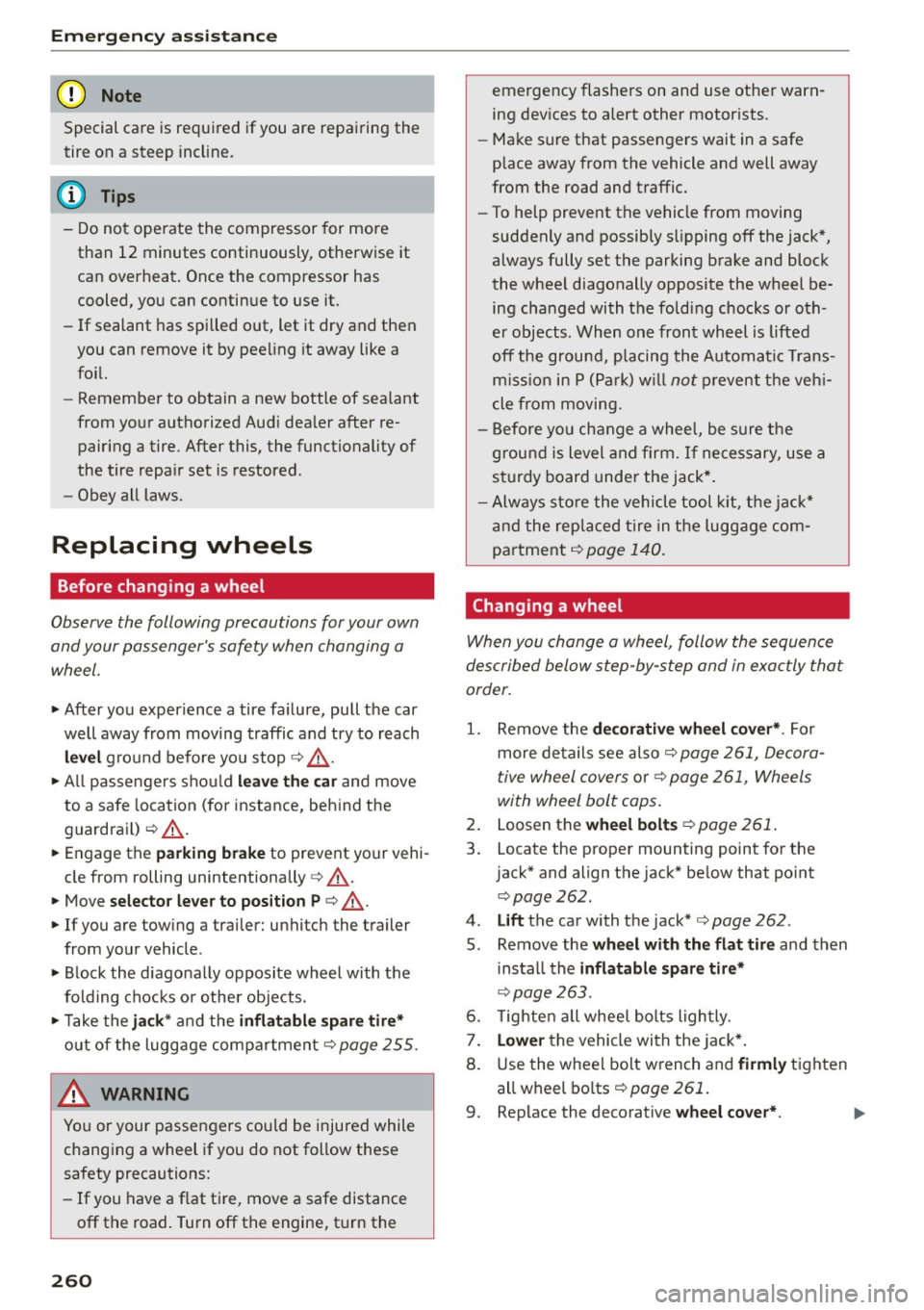
Before changing a wheel
Observe the following precautions for your own
and your passenger's safety when changing a
wheel.
.. After you experience a tire fa ilure, pull the car
well away from moving traffic and try to reach
l eve l ground before you stop¢_& .
.. All passengers sho uld
le ave t he car and move
to a safe location (for instance, behind the
guardrail)¢ _&.
.. Engage the
parking br ake to prevent your vehi
cle from rolling unintentionally¢_& .
.. Move
select or lever to pos itio n P ¢ &_ .
.. If you are tow ing a trailer: unhitch the trailer
from your vehicle .
.. Block the diagonally opposite wheel with the
folding chocks or other objects.
.. Take the
jack * and the in flat abl e s par e tir e*
out of the luggage compartment¢ page 255.
A WARNING
You or your passengers could be injured while
changing a wheel if you do not follow these
safety precautions:
- If you have a flat tire, move a safe distance
off the road. Turn off the engine, t urn the
260
emergency flashers on and use other warn
ing dev ices to alert other motor ists.
- Make sure that passengers wait in a safe
place away from the vehicle and well away
from the road and traffic.
- To help prevent the vehicle from moving
suddenly and possibly slipping off the jack*,
always fully set the parking brake and block
the wheel diagonally opposite the wheel be
ing changed with the folding chocks or oth
er objects. When one front wheel is lifted
off the ground, placing the Automatic Tra ns
m iss ion in P (Pa rk) w ill
not prevent the veh i
cle from moving.
- Before you change a whee l, be sure the
ground is level and firm.
If necessary, use a
sturdy board under the jack *.
- Always store the vehicle tool kit, the jack*
and the replaced tire in the luggage com
pa rtment
¢ page 140.
Changing a wheel
When you change a wheel, follow the sequence
described below step-by-step and in exactly that
order .
1. Remove the d eco rativ e wheel cover*. For
more details see also¢
page 261, Decora
tive wheel covers
or ¢ page 261, Wheels
with wheel bolt caps .
2. Loosen the wheel bolts¢ page 261 .
3. Locate the proper mounting point for the
jack* and align the jack* be low that point
¢ page 262.
4. Lift the car with the jack*¢ page 262 .
5 . Remove the
wheel with th e flat tire and then
install the
inflatable spa re ti re*
¢ page 263.
6. Tig hte n a ll whee l bolts ligh tly .
7 .
Lo we r the vehicle with the jack* .
8 . Use the wheel bolt wrench and
firml y tighten
all wheel bolts ¢
page 261.
9. Replace the decorative wheel co ve r* . ...
Page 264 of 302
Emergency assistance
... Take tight hold of the end of the wrench handle
and turn the wheel bolts
counter-clockwise
about one single turn in the direction of arrow
c::> fig . 218.
Tightening
" Install the wheel bolt wrench over the wheel
bolt and push it down as far as it will go .
... Take tight hold of the
end of the wrench handle
and turn each wheel bolt
clockwise until it is
seated.
A WARNING
- Do not use force or hurry when changing a
wheel -you can cause the vehicle to slip off
the jack* and cause serious personal inju
ries.
- Do not loosen the wheel bolts more than
one turn
before you raise the vehicle with
the jack*. - You risk an injury.
{D) Tips
If a wheel bolt is very tight, you may find it
easier to loosen by carefully pushing down on
the end of the wheel bolt wrench with
one
foot only.
As you do so, hold on to the car to
keep your balance and take care not to slip.
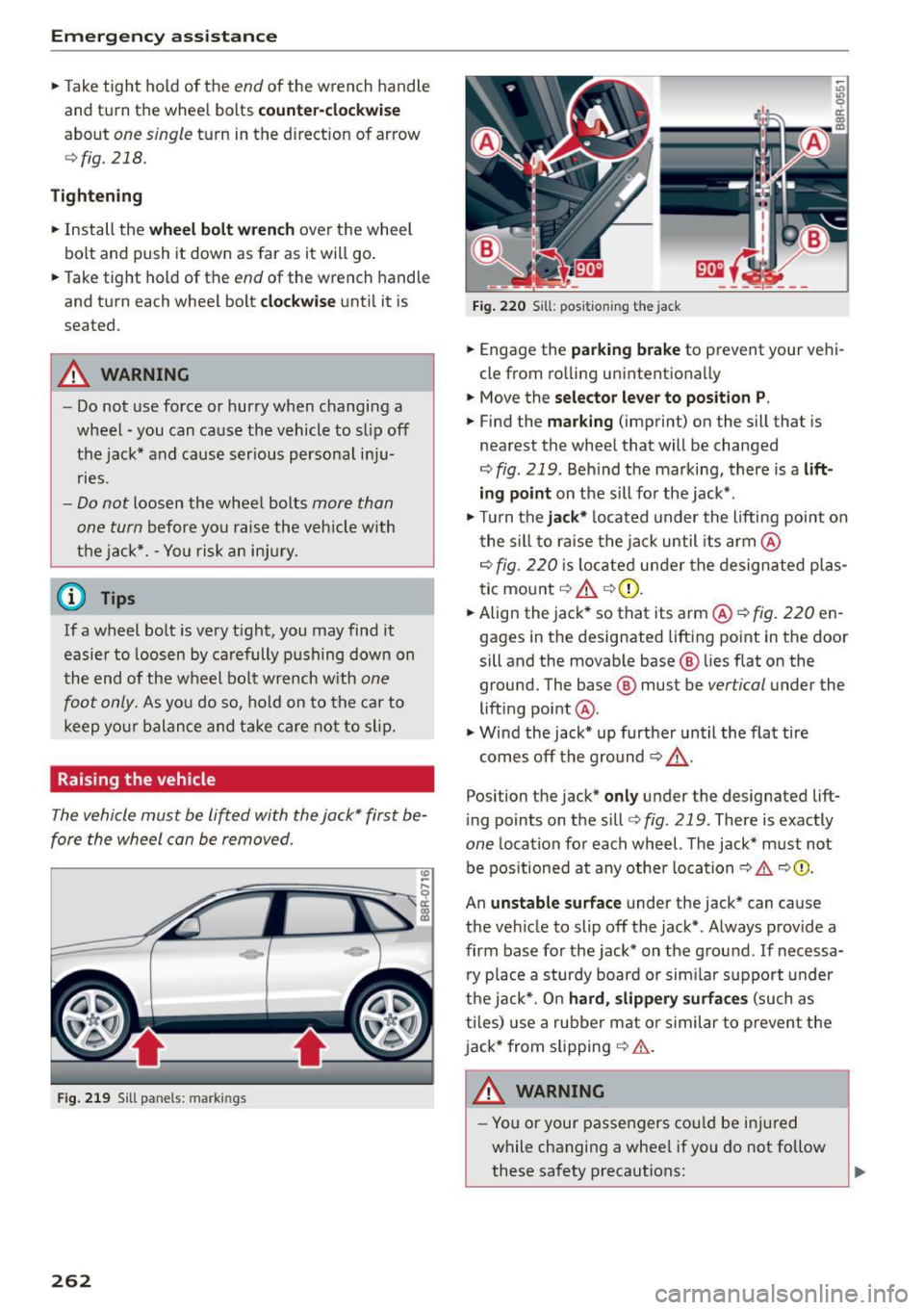
Raising the vehicle
The vehicle must be li~ed with the jack* first be
fore the wheel can be removed.
Fig. 219 Sill panels: mark in gs
262
Fig. 220 Sill: posi tioning the jack
... Engage the parking brake to prevent your vehi
cle from rolling unintentionally
... Move the
selector lever to position P.
... Find the marking (imprint) on the sill that is
nearest the wheel that will be changed
c::> fig. 219 . Behind the marking, there is a lift
ing point
on the sill for the jack*.
"Turn the
jack* located under the lifting point on
the sill to raise the jack until its arm @
c::> fig. 220 is located under the designated plas
tic mount
c::> &. c::>(j).
... Align the jack* so that its arm @ c::> fig. 220 en
gages in the designated lifting point in the door
sill and the movable base ® lies flat on the
ground. The base ® must be
vertical under the
lifting point @.
"Wind the jack* up further until the flat tire
comes off the ground
c::> ,&. .
Position the jack* only under the designated lift
ing points on the sill
c::> fig. 219. There is exactly
one location for each wheel. The jack* must not
be positioned at any other location
c::> .&. c::>(D.
An unstable surface under the jack* can cause
the vehicle to slip off the jack* . Always provide a
firm base for the jack* on the ground . If necessa
ry place a sturdy board or similar support under
the jack*. On
hard, slippery surfaces (such as
tiles) use a rubber mat or similar to prevent the
jack* from slipping
c::> ,&..
A WARNING -
-You or your passengers could be injured
while changing a wheel if you do not follow
these safety precautions:
Page 269 of 302

M N
co ~ co
rl I.O
"' N
"' rl
Left cockpit fuse assignment
Fig. 224 Left side of the cockpit: fuse panel with plastic
clip
Fuse panel @ (black )
No. Equipment
1 Dynamic steering
2 ESC control module
A/C system pressure sensor, electrome-
3 chanical park
ing brake, Homelink, auto-
matic dimming interior rearview mirror, air
quality/outside air sensor, ESC button
5 Sound
actuator/exhaust sound tuning
6 Headlight range contro l/cornering light
7 Headlight (cornering light)
Control modu les (e lectromechanical park-
8 ing brake, shock absorber, quattro Sport,
trailer hitch), DCDC converter
9
Adaptive cruise control or high voltage
battery (hybrid drive)
11 Side assist
12 Headlight range control, parking system
13 Airbag
14 Rear w iper
15 Auxi
liary fuse (instrument panel)
1 6 Auxiliary fuse terminal 15 (engine area) Fuses
and bulbs
Fuse panel @ (brown)
No . Equipment
1 Electric exhaust door
2 Brake light sensor or brake pedal
move-
ment sensor (hybr id drive)
3 Fuel pump
4 AdBlue pumps
or brake booster power
supply (hybrid dr ive)
5 Left seat heating with/without seat venti-
lation
6 ESC
7 Horn
8 Left
front door (window regulator, central
locking, mirror, switch, lighting)
9 Wiper motor
10 ESC
11 Left
rear door (window regu lator, switch,
lighting)
12 Rain and light sensor
Fu
se panel © (re d)
No . Equipment
3 Lumbar support
4 Dynamic steering
5 Climatized cupholder
6 Windshie
ld washer system, headlamp
washer system
7 Vehicle electr ical system control module 1
8 Vehicle e
lectrica l system control module 1
9 Panorama sunroof
10 Vehicle e lectrica l system control module 1
11 Sun shade (pano rama sunroof)
12 Anti-theft a
larm system
267
Page 270 of 302
Fuses and bulbs
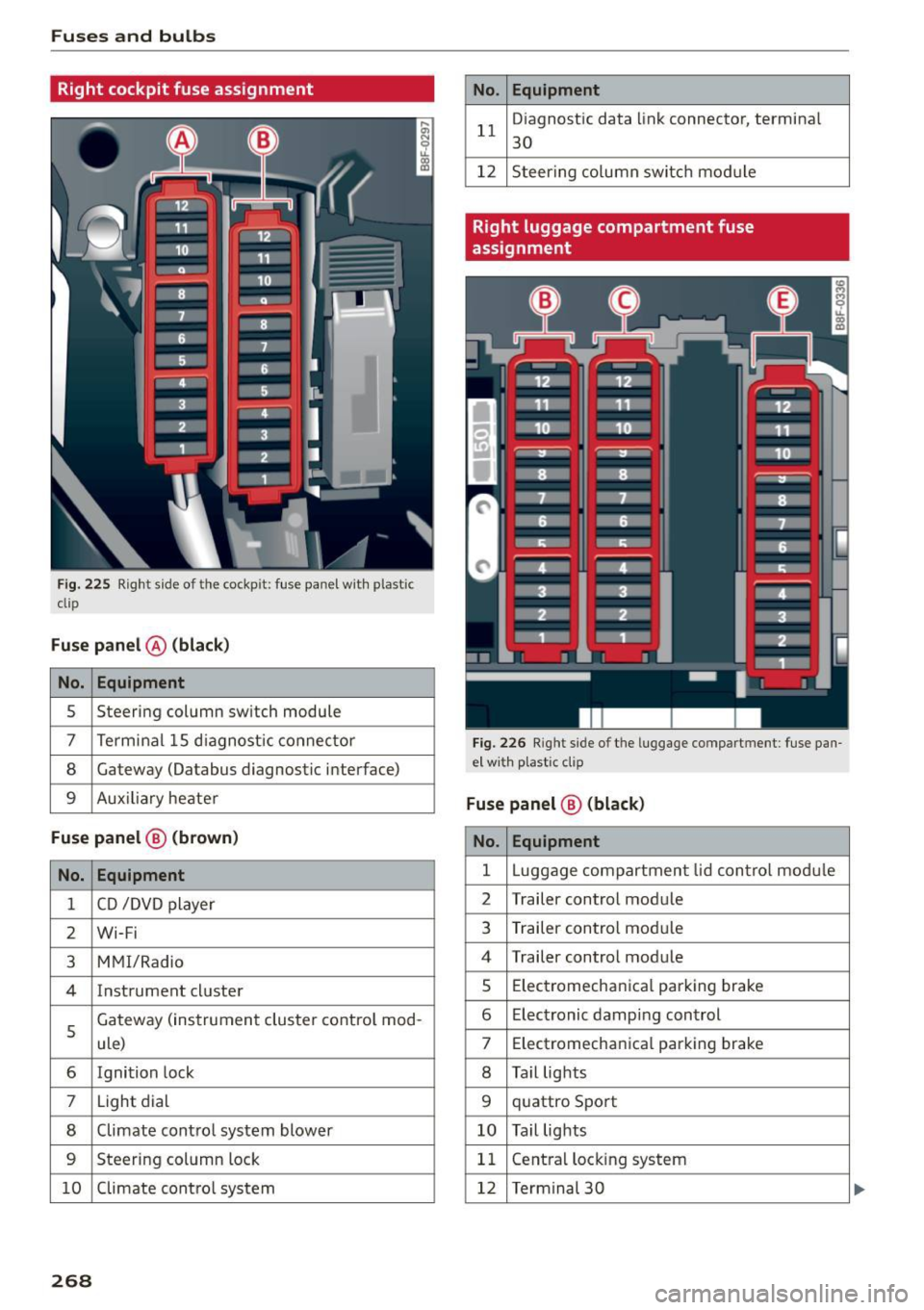
Right cockpit fuse assignment
Fig . 225 Right s ide of the cockpit: fuse panel wit h plastic
clip
Fuse panel @ (black)
No. Equipment
5 Steering column sw
itch module
7 Terminal 15 diagnostic connector
8 Gateway (Oatabus diagnostic interface)
9 Auxiliary heater
Fuse panel@ (brown)
No. Equipment
1 CD /DVD player
2 Wi-Fi
3 MM I/Radio
4 Instrument cluster
5
Gateway (instrument cluster control mod-
ule)
6 Ignition lock
7 Light dial
8 Climate control system blower
9 Steering column lock
10 Climate control system
268
No. Equipment
11 D
iagnost ic data link connecto r, terminal
30
12 Steering column switch module
Right luggage compartment fuse
assignment
Fig. 226 Righ t side of the lu ggage compartment: fuse pan
e l w ith plastic clip
Fuse panel @ (black)
No. Equipment
1 Luggag e compartm ent lid control module
2 Trailer contro
l module
3 Trailer con trol module
4 Trailer control module
s Elec trom echanica l parking brake
6 E lectronic damping control
7 Electromechanical parking brake
8 Tail lights
9 quattro Sport
10 Tail lights
11 Central locking
system
12 Termina l 30
Page 271 of 302
M N
co
a:
co
,...., \!) 1.1'1
N 1.1'1 ,....,
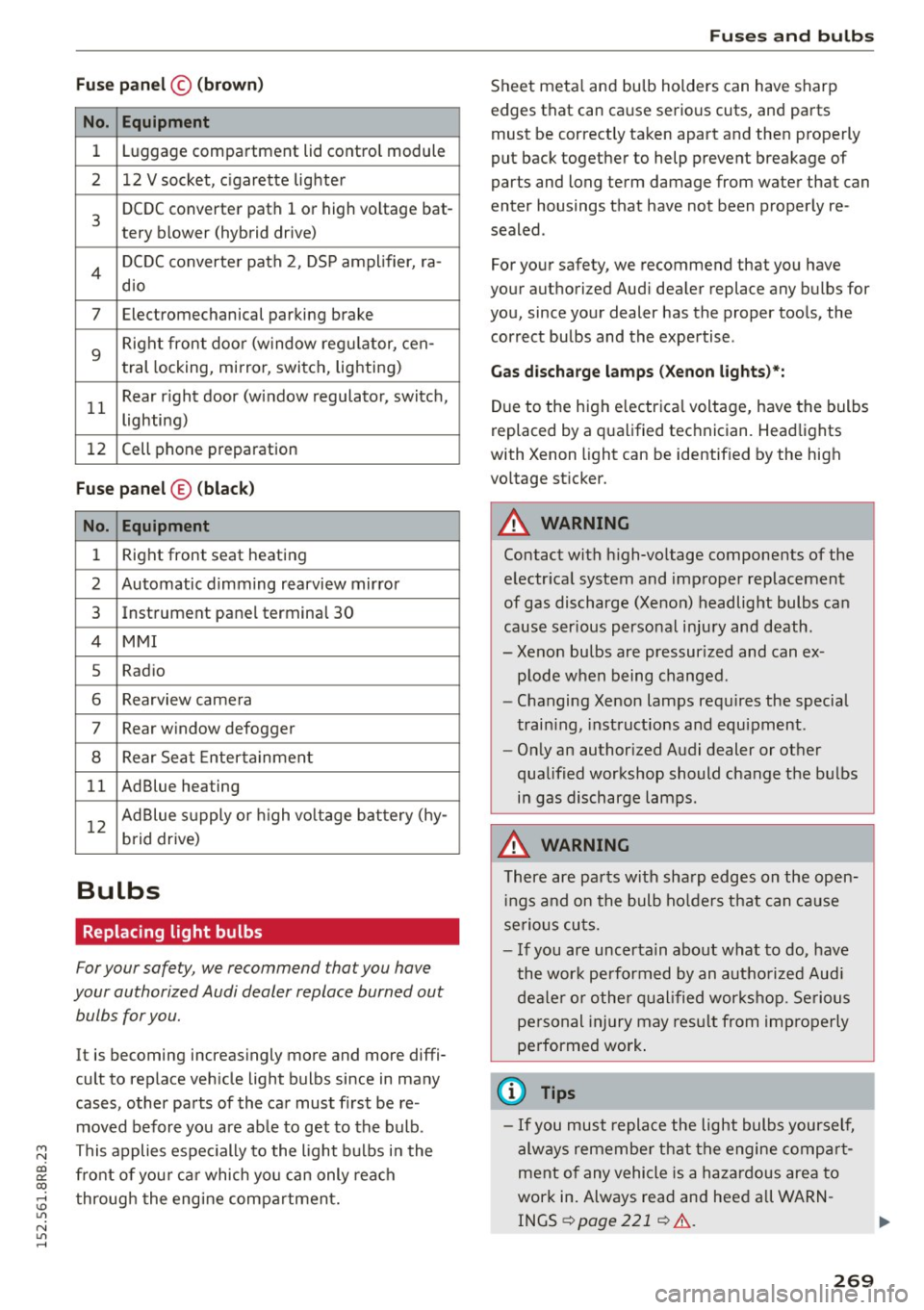
Fuse panel© (brown)
No. Equipment
1 Luggage compartment lid control module
2 12 V socket, c igarette lighter
3
DCDC converter path 1 or high vo ltage bat-
tery blower (hybrid drive)
4 DCDC converter path 2, DSP amplifier, ra-
dio
7 Electromechanical parking brake
9
Right front doo r (window reg ulator, cen-
tral locking, mirror, switch, lighting)
11 Rear r
ight door (window regulator, switch,
lighting)
12 Cell phone
preparation
Fuse panel ® (black)
No. Equipment
1 Right front seat heating
2 Automatic dimming rearview mirror
3 Instrument panel terminal 30
4 MMI
5 Radio
6 Rearview came
ra
7 Rear window defogger
8 Rear Seat Entertainment
11 AdBlue heating
12 Ad
Blue supply or high voltage battery (hy-
brid drive)
Bulbs
Replacing light bulbs
For your safety, we recommend that you have
your authorized Audi dealer replace burned out bulbs for you.
It is becoming increasingly more and more diffi
cult to replace vehicle light bulbs since in many
cases, other parts of the car must first be re
moved before you are ab le to get to the bulb.
This applies espec ially to the light bulbs in the
front of you r car which you can only reach
through the engine compartment.
Fuses and bulbs
Sheet metal and bulb holders can have sharp
edges that can cause serious cuts, and parts
must be correctly taken apart and then properly
put back together to help prevent breakage of
parts and long term damage from water that can
enter housings that have not been proper ly re
sealed .
For your safety, we recommend that you have
your authorized Aud i dealer replace any bulbs for
you, since your dealer has the proper too ls, the
correct bulbs and the expertise .
Gas discharge lamps (Xenon lights )*:
Due to the high e lectrica l voltage, have the bulbs
replaced by a qualified technician. Headlights
with Xenon light can be identif ied by the high
vo ltage sticker.
A WARNING
Contact with high-voltage components of the
electr ical system and improper replacement
of gas discharge (Xenon) headlight bulbs can
cause ser ious personal injury and death.
- Xenon bulbs are pressur ized and can ex-
plode when being changed.
- Changing Xenon lamps requ ires the special
train ing, instructions and equipment.
- Only an authorized Audi dealer or other
qualified workshop should change the bulbs
in gas discharge lamps.
A WARNING "'--
There are parts with sharp edges on the open-
in gs and on the bulb holders that can cause
serious cuts.
- If you are uncertain about what to do, have
the wor k performed by an authorized Aud i
dealer or other qualified workshop. Serious
personal injury may resu lt from improperly
performed work .
(D Tips
-If you must replace the light bulbs yourself,
always remember that the engine compart
ment of any vehicle is a hazardous area to
work in . Always read and heed all WARN
INGS¢ page 221 ¢ .&,.
269
Page 274 of 302
Emergency situation s
When jump starting or charging the battery,
never connect the negative ground cable to
the battery negative post because the bat
tery manager system must be able to detect
the battery's state of charge. Always con nect the negative ground cable to the nega
tive ground post of the battery manager
control un it.
Use of jumper cables
Make sure to connect the jumper cable clamps in
exactly the order described below!
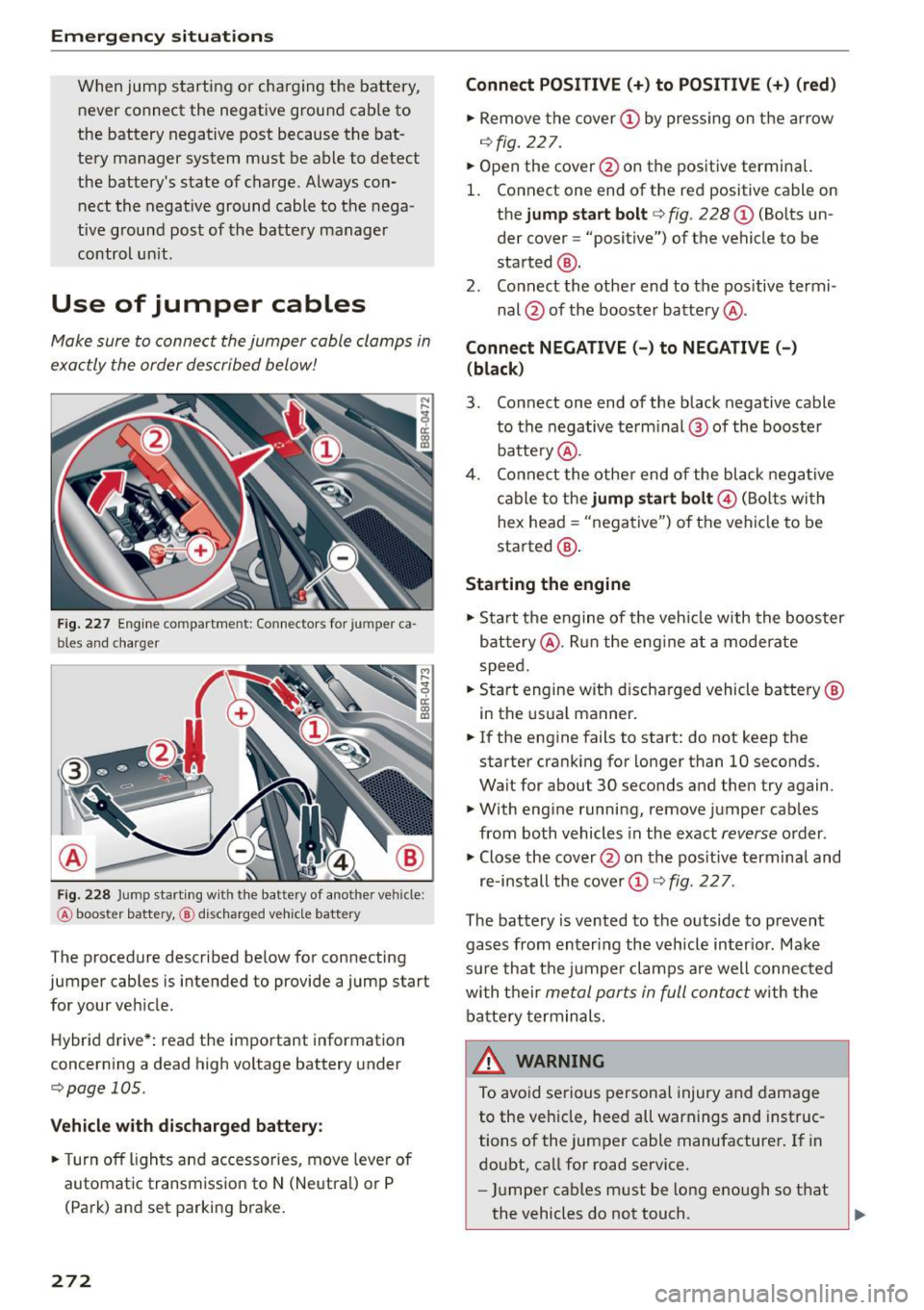
Fig. 227 Engine co mpar tment : Connectors for ju mp er ca
bl es and charger
Fig. 228 Jum p starting wi th the battery of anot her ve hicl e:
@ booste r batte ry ,@ discharged vehicle battery
The procedure described be low for connecting
jumper cables is intended to provide a jump start for your vehicle.
Hybrid drive*: read the important information
concerning a dead high voltage battery under
c;,page 105.
Vehicle with discharged battery:
• Turn off lights and accessories, move lever of
automatic transmission to N (Neutral) or P
(Park) and set parking brake.
272
Connect POSITIVE(+) to POSITIVE (+) (red)
• Remove the cover (!) by pressing on the arrow
¢fig. 227.
• Open the cover @on the positive terminal.
1. Connect one end of the red positive cable on
the
jump start bolt c::> fig. 228 @ (Bolts un
der cover = "positive") of the vehicle to be
started @.
2 . Connect the other end to the positive termi-
nal @ of the booster battery @.
Connect NEGATIVE (-) to NEGATIVE (-)
(black)
3 . Connect one end of the black negative cable
to the negative terminal @ of the booster
battery @.
4. Connect the other end of the black negative
cable to the
jump start bolt © (Bolts with
hex head= "negative") of the vehicle to be
started @.
Starting the engine
• Start the engine of the vehicle with the booster
battery @. Run the eng ine at a moderate
speed.
• Start engine with discharged vehicle battery @
in the usual manner.
• lfthe engine fails to start: do not keep the
starter cranking for longer than 10 seconds.
Wait for about 30 seconds and then try again.
• With engine running, remove jumper cables
from both vehicles in the exact
reverse order .
• Close the cover @on the positive terminal and
re-install the cover@¢
fig. 22 7.
The battery is vented to the outside to prevent
gases from entering the vehicle interior . Make
sure that the jumper clamps are well connected
with their
metal parts in full contact with the
batte ry terminals.
& WARNING
To avoid serious personal injury and damage
to the veh icle, heed all warnings and instruc
tions of the jumper cable manufacturer. If in
doubt, call for road service.
- Jumper cables must be long enough so that
the vehicles do not touch. ..,.